deepSA2018 at SemEval-2018 Task 1: Multi-task Learning of Different
Label for Affect in Tweets
1Zi-Yuan Gao and2Chia-Ping Chen Department of Computer Science and Engineering
National Sun Yat-sen University Kaohsiung, Taiwan
Abstract
This paper describes our system implementa-tion for subtask V-oc of SemEval-2018 Task 1: affect in tweets. We use multi-task learn-ing method to learn shared representation, then learn the features for each task. There are five classification models in the proposed multi-task learning approach. These classification models are trained sequentially to learn differ-ent features for differdiffer-ent classification tasks. In addition to the data released for SemEval-2018, we use datasets from previous SemEvals during system construction. Our Pearson cor-relation score is 0.638 on the official SemEval-2018 Task 1 test set.
1 Introduction
In recent years, people began to study how to cre-ate computational systems that process and under-stand the human languages. Today, people share their thoughts on social networks of the Internet, e.g. Facebook, Line, Twitter and so on. Thus, if the messages in the textual contents of social net-works can be extracted and summarized automat-ically via algorithms, it is possible to learn what people are interested in or are concerned with, and use such information to predict future market trends.
Here we continue our previous works on the task 4 of SemEval-2017: Sentiment Analysis in Twitter (Rosenthal et al., 2017). SemEval-2017 subtask 4A is similar to task 1 of SemEval-2018: Affect in Tweets (Mohammad et al.,2018). They are challenging tasks as the messages on Twitter, called tweets, are short and informal. Further-more, in addition to noisy or incomplete texts, the emotional content of a tweet can be ambiguous and subjective.
Affect in Tweets is an expanded version of WASSA-2017 shared task (Mohammad and Bravo-Marquez, 2017). The best system in
WASSA-2017 is an ensemble of three sets of ap-proaches, including feed-forward neural network, multi-task deep learning and sequence modeling using CNNs and LSTMs (Goel et al.,2017). They attempt to use the idea of multi-task learning to ex-plore the notion of generalized or shared learning across different emotions. In this paper, we extend the idea with different label methods.
The rest of this paper is organized as follows. In Section2, we introduce our system. In Section3, we describe the details of training and experimen-tal settings. In Section4, we present the evaluation results along with our comments.
2 System Description
2.1 Baseline System
Using RNN has become a very common tech-nique for various NLP tasks. There are many units for RNN-based model like simple RNN, gated recurrent units (GRU) (Chung et al., 2014), and long short-term memory (LSTM) (Hochreiter and Schmidhuber, 1997). For the baseline, we use LSTM as unit for its long-range dependency.
Figure1shows the architecture of our baseline system. Our baseline system contains an input layer, an embedding layer, Bi-LSTM layers and an output layer. At the input layer, the words of tweet are pre-processed, and they are treated as a sequence of wordsw1, w2, ...wn. Each word is represented by a one-hot vector, and the size of in-put layer is equal to the size of word list.
At the embedding layer, each word is converted to a word vector. We use pre-trained word vector which are stored in a matrix. Words are mapped to word vectors by the word embedding matrix. A word not in the word embedding matrix is repre-sented by a zero vector.
A Bi-LSTM layer containshunits. We use
bidi-rectional (Schuster and Paliwal, 1997) structure
to gather two-way contextual information at each point. The hidden states from the first word to the penultimate word in a tweet are connected to the hidden states of the next word. The state values in both directions are combined with sum. Only the last Bi-LSTM states of the last word are connected to the output layer. Finally, the network output is converted to probability by a soft-max function.
Figure 1: LSTM-RNN architecture.
2.2 Multi-task Learning
Multi-task learning has been used with success in applications of machine learning, from natu-ral language processing (Collobert and Weston, 2008) and speech recognition (Deng et al.,2013). By sharing representations with related tasks, a model tends to generalize better on the original task (Ruder,2017). In this work, different labels for the same data are exploited in multi-task learn-ing.
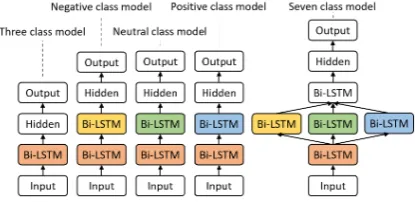
Figure 2 shows our multi-task learning frame-work. The overall system is divided into five mod-els. The Three-class model is trained first, and its trained parameters are used to initialize the param-eters in other models. Then we train the Negative, Neutral, Positive class models, and their trained parameters are used to initialize the parameters of the Seven class model. The final output is obtained from the Seven class model.
Figure 2: Multi-task learning of sentiment classifica-tion.
Three class model In Three class model, the tweets are converted to the word vector and used as the input to Bi-LSTM layer. The output layer has three units for three classes {−1,0,1}.
Negative class model The Negative class model has one more Bi-LSTM layer than Three class model. The output layer has four units for four classes{−3,−2,−1, other}.
Neutral class model The Neutral class model has the same architecture as the Negative class model. The output layer has two units for two classes{0, other}.
Positive class model The Positive class model has the same architecture as the Negative class model. The output layer has four units for four classes{other,1,2,3}.
Seven class model The Seven class model com-bines the Bi-LSTM layers of the Negative class, Neutral class, and Positive class mod-els. Further, it has one additional Bi-LSTM layer. The output layer has seven units for seven classes{−3,−2,−1,0,1,2,3}. Note that attention mechanism (Luong et al.,2015; Wang et al., 2016) is incorporated in this model.
3 Training
3.1 Data
We use the dataset provided for the SemEval-2018 shared task (Mohammad et al., 2018), which in-cludes a new dataset and the datasets provided for SemEval-2017 (Rosenthal et al., 2017). Table1 summarizes the statistics of these datasets.
3.2 Different Labeling
[image:2.595.79.287.613.714.2]dataset labels -3 Negative-2 -1 Neutral0 1 Positive2 3 total
train-18 - 129 249 78 341 167 92 125 1,181
train-17 - 8,581 18,186 15,219 41,986
train-all to±1 129 249 8,659 18,527 15,386 92 125 43,167 train-all to±2 129 8,830 78 18,527 167 15,311 125 43,167 train-all to±3 8,710 249 78 18,527 167 92 15,344 43,167 train-all bal-method 1 3,013 3,012 3,012 18,527 5,201 5,201 5,201 43,167 train-all bal-method 2 3,000 3,000 3,000 3,000 3,000 3,000 3,000 21,000
dev-18 - 69 95 34 105 58 35 53 449
Table 1: Statistics of our different labeling methods and datasets. train-18 and dev-18 are from SemEval-2018 Task 1. train-17 is from SemEval-2017 task 4. train-all means the merger of the train-18 and train-17 datasets.
3.3 Pre-processing
We begin with basic pre-processing methods (Yang et al., 2017), e.g. splitting a tweet into word, replacing URLs and USERs with normal-ization patterns<URL>and<USER>, and
con-verting uppercase letters to lowercase letters. As tweets are informal and complex, the basic pre-processing is too simple to convey enough impor-tant information.
Tweets often have emoticons and hashtags, which could be instrumental to sentiment analy-sis. Thus, we use text processing tool1 (
Bazio-tis et al.,2017) to improve text normalization, in-cluding sentiment-aware tokenization, spell cor-rection, word normalization, word segmentation (for splitting hashtags). and word annotation.
3.4 Early Stopping
The early stopping method is used to prevent over-fitting when the loss of a development set ceases to decrease for a few epochs. We randomly take 20% of SemEval-2018 train data as the development set for early stopping and the remaining 80% data as the train set.
3.5 Settings
The maximum length for any tweet in the used datasets is n = 99. The embedding is based on a publicly available set of word vectors learned from400million tweets for the ACL WNUT 2015 shared task (Baldwin et al.,2015).
The baseline system uses 4 hidden Bi-LSTM layers, with300 neurons in each layer. Dropout method with probability0.3is used to prevent the model from overfitting (Srivastava et al.,2014).
1github.com/cbaziotis/ekphrasis
In the multi-task learning approach, the num-bers of neurons in the Bi-LSTM and hidden layers are [200,200], [200,150,200], [200,150,100], [200,150,200], [200,[150,150,150],200,200] for the 5 different class models, respectively.
4 Results
4.1 Baseline System
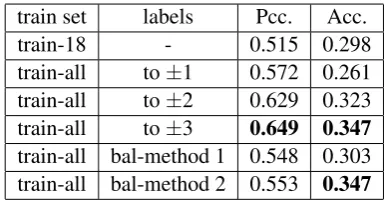
First, we compare the experiments of different la-beling in baseline system to decide how to use the train-17 dataset. In baseline system, we use the basic pre-processing for text normalization. The results are shown in Table2. The calculation of Pearson correlation coefficient (Pcc.) requires cal-culating the mean value of the data, which is often close to zero. From the results, labeling to more distant from zero get the higher Pcc. Therefore, we use labeling to ±3 method in the multi-task learning system.
train set labels Pcc. Acc.
train-18 - 0.515 0.298
train-all to±1 0.572 0.261 train-all to±2 0.629 0.323 train-all to±3 0.649 0.347 train-all bal-method 1 0.548 0.303 train-all bal-method 2 0.553 0.347
Table 2: Results of different labeling. Pcc. means the pearson correlation coefficient (all classes). Acc. means the accuracy.
4.2 Multi-task Learning System
[image:3.595.79.520.61.207.2] [image:3.595.319.514.538.639.2]model training set Pcc. Pcc.(s-m) Kappa Kappa(s-m) Acc. baseline train-18 0.515 0.567 0.499 0.534 0.298 baseline train-all 0.649 0.712 0.628 0.700 0.347 multi-task train-18 0.603 0.660 0.579 0.623 0.312 multi-task train-all 0.689 0.760 0.671 0.753 0.350 multi-task* train-18 0.622 0.667 0.616 0.653 0.361
multi-task* train-all 0.691 0.770 0.665 0.757 0.323 multi-task* train-all 0.638 0.698 0.606 0.643
-Table 3: Results of multi-task learning. Final row is the official SemEval-2018 test set result and others are development set results. Here * means using the ekphrasis tool for pre-processing and s-m means some-emotion.
baseline system. When the basic pre-processing method is replaced by using ekphrasis tool, the performance is further improved. Finally, we sub-mit the results from our best system for the unseen test set to SemEval-2018, getting 0.638 for Pcc. eventually. We note this is significantly lower than 0.691 on the development data.
5 Conclusion
The proposed method improves performance on SemEval-2018 over baseline systems without multi-task learning. External dataset can signifi-cantly improve the Pcc. performance, but not the Acc. performance. The possible reason is that all the labels of external dataset are marked as±3, re-sulting in data imbalance problem. In the future, we will use skewness-robust weights to solve this problem and use more resources to improve the system as sentiment lexicons.
References
Timothy Baldwin, Marie-Catherine de Marneffe, Bo Han, Young-Bum Kim, Alan Ritter, and Wei Xu. 2015. Shared tasks of the 2015 workshop on noisy user-generated text: Twitter lexical normal-ization and named entity recognition. In Proceed-ings of the Workshop on Noisy User-generated Text, pages 126–135.
Christos Baziotis, Nikos Pelekis, and Christos Doulk-eridis. 2017. Datastories at semeval-2017 task 4: Deep lstm with attention for message-level and
topic-based sentiment analysis. InProceedings of
the 11th International Workshop on Semantic Evalu-ation (SemEval-2017), pages 747–754. Association for Computational Linguistics.
Junyoung Chung, Caglar Gulcehre, KyungHyun Cho, and Yoshua Bengio. 2014. Empirical evaluation of gated recurrent neural networks on sequence model-ing. arXiv preprint arXiv:1412.3555.
Ronan Collobert and Jason Weston. 2008. A unified architecture for natural language processing: Deep neural networks with multitask learning. In Pro-ceedings of the 25th international conference on Machine learning, pages 160–167. ACM.
Li Deng, Geoffrey Hinton, and Brian Kingsbury. 2013. New types of deep neural network learning for speech recognition and related applications: An overview. InAcoustics, Speech and Signal Process-ing (ICASSP), 2013 IEEE International Conference on, pages 8599–8603. IEEE.
Pranav Goel, Devang Kulshreshtha, Prayas Jain, and Kaushal Kumar Shukla. 2017. Prayas at emoint 2017: An ensemble of deep neural architectures for emotion intensity prediction in tweets. In Pro-ceedings of the 8th Workshop on Computational Ap-proaches to Subjectivity, Sentiment and Social Me-dia Analysis, pages 58–65.
Sepp Hochreiter and J¨urgen Schmidhuber. 1997. Long short-term memory. Neural computation, 9(8):1735–1780.
Minh-Thang Luong, Hieu Pham, and Christopher D Manning. 2015. Effective approaches to attention-based neural machine translation. arXiv preprint arXiv:1508.04025.
Saif M. Mohammad and Felipe Bravo-Marquez. 2017. WASSA-2017 shared task on emotion intensity. In
Proceedings of the Workshop on Computational Ap-proaches to Subjectivity, Sentiment and Social Me-dia Analysis (WASSA), Copenhagen, Denmark. Saif M. Mohammad, Felipe Bravo-Marquez,
Mo-hammad Salameh, and Svetlana Kiritchenko. 2018. Semeval-2018 Task 1: Affect in tweets. In Proceed-ings of International Workshop on Semantic Evalu-ation (SemEval-2018), New Orleans, LA, USA. Sara Rosenthal, Noura Farra, and Preslav Nakov. 2017.
Mike Schuster and Kuldip K Paliwal. 1997. Bidirec-tional recurrent neural networks. IEEE Transactions on Signal Processing, 45(11):2673–2681.
Po-Yuan Shih. 2016. Skewness-Robust Neural Net-works with Application to Speech Emotion Recog-nition. Ph.D. thesis, Masters thesis, National Sun Yat-sen University.
Nitish Srivastava, Geoffrey Hinton, Alex Krizhevsky, Ilya Sutskever, and Ruslan Salakhutdinov. 2014. Dropout: A simple way to prevent neural networks from overfitting. The Journal of Machine Learning Research, 15(1):1929–1958.
Yequan Wang, Minlie Huang, Li Zhao, et al. 2016. Attention-based lstm for aspect-level sentiment clas-sification. InProceedings of the 2016 Conference on Empirical Methods in Natural Language Process-ing, pages 606–615.
Tzu-Hsuan Yang, Tzu-Hsuan Tseng, and Chia-Ping Chen. 2017. deepsa at semeval-2017 task 4: Inter-polated deep neural networks for sentiment analysis in twitter. InProceedings of the 11th International Workshop on Semantic Evaluation (SemEval-2017), pages 616–620. Association for Computational Lin-guistics.