A Bayesian Model for Joint Learning of Categories and their Features
Lea FrermannandMirella Lapata
Institute for Language, Cognition and Computation School of Informatics, University of Edinburgh
10 Crichton Street, Edinburgh EH8 9AB
[email protected], [email protected]
Abstract
Categories such as ANIMAL or FURNITURE are acquired at an early age and play an impor-tant role in processing, organizing, and con-veying world knowledge. Theories of cat-egorization largely agree that categories are characterized by features such as function orappearanceand that feature and category acquisition go hand-in-hand, however previ-ous work has considered these problems in isolation. We present the first model that jointly learns categories and their features. The set of features is shared across categories, and strength of association is inferred in a Bayesian framework. We approximate the learning environment with natural language text which allows us to evaluate performance on a large scale. Compared to highly engi-neered pattern-based approaches, our model is cognitively motivated, knowledge-lean, and learns categories and features which are per-ceived by humans as more meaningful.
1 Introduction
Categorization is one of the most basic cognitive functions. It allows individuals to organize their subjective experience of their environment by struc-turing its contents. This ability to group different objects into the same category based on their com-mon characteristics underlies major cognitive activ-ities such as perception, learning, and the use of lan-guage. Global categories (such as FURNITURE or ANIMAL) are shared among members of societies, and influence how we perceive, interact with, and argue about the world.
Given its fundamental importance, categoriza-tion is one of the most studied problems in
cog-nitive science. The literature is rife with theoret-ical and experimental accounts, as well as model-ing simulations focusmodel-ing on the emergence, repre-sentation, and learning of categories. Most theo-ries assume that basic level concepts such asdogor chair are characterized by features such as barks
orused-for-sitting, and are grouped into cate-gories based on those features. Although the pre-cise grouping mechanism has been subject to con-siderable debate (including arguments in favor of ex-emplars(Nosofsky, 1988),prototypes(Reed, 1972), and categoryutility(Corter and Gluck, 1992)), it is fairly uncontroversial that categories are associated with featural representations.
Experimental studies show that the development of categories and feature learning mutually influ-ence each other (Goldstone et al., 2001; Schyns and Rodet, 1997): concepts are categorized based on their features, but the perception of features is influenced by already established categories, and, like categories, features evolve over time. There is also evidence that features such asbarks or runs
are grouped into types like behavior(Ahn, 1998; McRae et al., 2005; Spalding and Ross, 2000), and the distribution of feature types varies across cat-egories. For instance, living-things such as ANI -MALS have characteristicbehavior, whereas arti-facts such asTOOLShave characteristicfunctions, and both categories have characteristicappearance. In this paper, we investigate the problem ofjointly learning categories and their feature types. Previous modeling work has largely considered these prob-lems in isolation, focusing either on category learn-ing with a fixed set of simplistic features (Ander-son, 1991; Sanborn et al., 2006) or feature learning (Austerweil and Griffiths, 2013; Baroni et al., 2010;
Kelly et al., 2014), but not both.
We present a Bayesian model which induces (se-mantic) categories and feature types from natural language text. Although language is one of many factors influencing category formation (others in-clude the physical world, how we perceive it, and interact with it), large text corpora encode a surpris-ing amount of extralsurpris-inguistic information (Riordan and Jones, 2011), and can thus be viewed as an ap-proximation of the learning environment. Moreover, focusing on textual data, allows us to build catego-rization models with theoretically unlimited scope, and evaluate categories and their features on a much larger scale than previous work in the cognitive sci-ence literature.
Our model induces categories (e.g., ANIMALS) and their feature types (e.g., behavior) from ob-servations of target concepts (e.g., lion, cow) and their co-occurring contexts (e.g.,eats, sleeps, large). While we can directly evaluate learnt categories through comparison against behavioral data, eval-uating feature types is less straightforward. Previ-ous work has shown that the kinds of features learn-able from text are qualitatively different from those produced by humans, which makes direct com-parison difficult (Baroni et al., 2010; Kelly et al., 2014). We circumvent this problem by assessing in a crowd-sourcing experiment whether the induced feature types are relevant for a given category and whether they form acoherentclass. Evaluation re-sults show that our joint model learns accurate cat-egories and feature types achieving results competi-tive with highly engineered approaches focusing ex-clusively on feature learning.
2 Related Work
The problems of category formation and feature learning have been considered largely independently in the literature. Bayesian categorization models were pioneered by Anderson (1991) and recently re-formalized by Sanborn et al. (2006). These mod-els are aimed at replicating human behavior in small scale category acquisition studies, where a fixed set of simple (e.g., binary) features is assumed. Fr-ermann and Lapata (2014) propose a model simi-lar in spirit, which they apply to simi-large scale corpora, while investigating incremental learning in the
con-text of child category acquisition (see also Fountain and Lapata (2011) for a non-Bayesian approach). Their model associates sets of features with cate-gories as a by-product of the learning process, how-ever these feature sets are independent across cate-gories and are not optimized during learning.
Previous approaches on feature learning have primarily focused on emulating or complementing norming studies by automatically extracting norm-like properties from textual corpora (e.g., elephant has-trunk,scissorsused-for-cutting). A com-mon theme in this line of research is the use of pre-defined syntactic patterns (Baroni et al., 2010), or manually created rules specifying possible con-nection paths of concepts to features in dependency trees (Devereux et al., 2009; Kelly et al., 2014). Once extracted, the features are typically weighted in order to filter out noisy instances. Features are learnt for individual concepts rather than categories. Austerweil and Griffiths (2013) also focus exclu-sively on feature learning, however from sensory data. They develop a nonparametric Bayesian model which is able to infer unlimited features, based on distributional patterns as well as category informa-tion.
To our knowledge, we propose the first Bayesian model that jointly learns categories and their fea-tures, arguing that the two tasks are mutually de-pendent. Our model is knowledge-lean, it learns from raw text in a single process, without rely-ing on parsrely-ing resources, manually crafted rule pat-terns, or post-processing steps. Our work also dif-fers from approaches which combine topic mod-els with human-produced feature norms (Steyvers, 2010). Our aim is not to boost the generalization performance of a topic model, rather we investi-gate how both categories and features can be jointly learnt from data.
3 The BCF Model
Generate category distribution,θ∼Dir(α)
forconcept type`do
Generate category,k`∼Mult(θ)
forcategorykdo
Generate feature type distribution,µk∼Dir(β)
forfeature typegdo
Generate feature distribution,φg∼Dir(γ)
forstimulusddo
Observe conceptcdand retrieve categorykcd Generate a feature type,gd∼Mult(µ
kcd)
forfeature position ido
[image:3.612.313.543.55.153.2]Generate a featurefd,i∼Mult(φgd)
Figure 1: The generative story of the BCF model. Observations f and latent labelsk andgare drawn from Multinomial distributions (Mult). Parameters for the multinomial distributions are drawn from Dirichlet distributions (Dir).
differ in their strength of association with feature types (e.g., the feature typefunctionwill be highly associated with TOOLSbut less so with ANIMALS). BCF jointly optimizes categories and their featural representation: the learning objective is to obtain a set of meaningful categories, each characterized by relevant and coherent feature types.
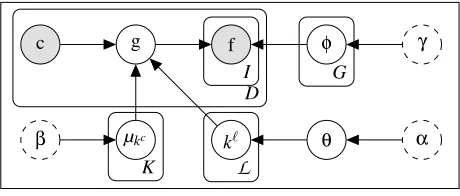
The generative story and plate diagram for the BCF model are shown in Figures 1 and 2, respec-tively. The input to the model is a collection of stimuli d∈ {1..D} extracted from a large text cor-pus. Each stimulus consists of a target concept c∈ {1..
L
} and its contextf∈ {1..F}. We adopt a simple representation of context as the set of words making up the sentencecoccurs in (exceptc). The model assigns concepts to categoriesk∈ {1..K}and features to feature types g ∈ {1..G}. It learns a set of concept clusters (i.e., categories), as well as a clustering over features (i.e., feature types), and a distribution over those feature clusters for each category (i.e., category-feature type associations). Specifically, the occurrences of a concept will be assigned a category, based on how similar the con-cept’s feature types are compared to the feature types of all other potential categories. Simultane-ously, upon observing a stimulus (i.e., a concept in context), the model assigns the context to a particu-lar feature type based on its probability under allpo-g
c f
k` θ α
µkc
β
φ γ
I D
L
K
G
Figure 2: The plate diagram of the BCF model. Shaded nodes indicate observed variables, and dot-ted nodes indicate hyperparameters.
tential feature types, and the prior probability of ob-serving that feature type with the concept’s assigned category.
More formally, we can describe the model through the generative story given in Figure 1. We assume a global multinomial distribution over cate-gories Mult(θ), drawn from a symmetric Dirichlet distribution with hyperparameterα. For each cate-gory k, we assume an independent set of multino-mial parameters over feature typesµk, drawn from a
symmetric Dirichlet distribution with hyperparam-eter β. For each concept type `, we draw a cat-egory k` from Mult(θ). Finally, for each feature typeg, we draw a multinomial distribution over fea-turesMult(φg)from a symmetric Dirichlet distribu-tion with hyperparameter γ. With these global as-signments in place, we can generate stimuli d as follows: we first retrieve the category kcd
of the observed concept cd; we then generate a feature
type gd from the category’s feature type
distribu-tion Mult(µkcd); and finally, for each feature
posi-tioniwe generate feature fd,ifrom the feature type’s
distributionMult(φgd). The joint probability of the
model over latent categories, latent feature types, model parameters, and data can be factorized as:
P(g,f,µ,φ,θ,k|c,α,β,γ) = (1) P(θ|α)
∏
` P(k `|θ)
∏
k P(µk|β)
∏
g P(φg|γ)∏
d P(g d|µ
kcd)
∏
i P(fd,i|φ gd).
[image:3.612.75.298.55.212.2]associ-Categories (k1)bouquet scarf slipper coat hat veil hair cape glove cap fur...
(k2)buzzard penguin toad emu duck bird pheasant chickadee crocodile...
(k3)broccoli cantaloupe cauliflower yam potato blueberry spinach...
(k4)dresser apartment shack gate basement garage curtain cabinet...
Feature types
(g1)wear cover veil woman coat glove hair cap face head
(g2)white black color brown dark spot red
hair colour yellow
(g3)bird eat animal food rodent rabbit rat
mouse mammal dog
(g4)ant insect butterfly wasp larva nest beetle
[image:4.612.68.543.56.135.2]egg caterpillar moth
Figure 3: Example of categories (top) and feature types (bottom) inferred by the BCF model. Connecting lines indicate a strong association between the category and the respective feature type.
ated with the stimuli.
Exact inference in the BCF model is intractable, so we turn to approximate posterior inference to dis-cover the assignments of latent variables that best explain our data. We construct a Gibbs sampler (Ge-man and Ge(Ge-man, 1984) which iteratively re-assigns single variables based on the current assignments of all other variables. One Gibbs iteration for our model consists of one sweep through the input stim-uli, resampling feature type assignments from:
P(gdkcd =i|gk−cdd,f−,kc d
,β,γ) (2)
∝P(gdkcd =i|g−kcdd,kcd,β)×P(fd|f−,gdkcd =i,γ),
followed by one sweep through the concept types, resampling category assignments from:
P(k`= j|gk`,k−,α,β) (3)
∝P(k`=j|k−,α)×P(g
k`|g−k`,k`= j,β),
where gd
kcd denotes the feature type assignment to
stimulusdgiven the categorykcd
ofd’s observed tar-get conceptcd. k` refers to the category assignment of concept type`,gk` refers to the feature type
asso-ciations of categoryk`, and fdrefers to the observed
features in stimulusd. The superscript − indicates
the absence of the variable assignment(s) which are currently resampled from the current representation of the model state.
Figure 3 illustrates example output produced by our model, in terms of learnt categories, learnt fea-ture types and their associations. Connecting lines indicate category-feature type associations. Feature types are shared across categories, e.g., categories CLOTHING(k1), BIRDS(k2), andFOOD(k3) are all associated with feature typecolor(g2).
4 Experimental Design
In this section we outline our experimental set-up for assessing the performance of the BCF model de-scribed above. We present our data set, briefly intro-duce the models used for comparison with our ap-proach, and explain how system output was evalu-ated. We then report results on a series of experi-ments which evaluate the quality of the categories and feature types learnt by BCF.
Data Our experiments used basic-level target con-cepts (e.g.,cat orchair) from two norming studies (McRae et al., 2005; Vinson and Vigliocco, 2008). In these studies, humans were presented with con-cepts and asked for each concept to produce a set of characteristic features. In a subsequent study (Foun-tain and Lapata, 2010), the concepts were classi-fied into 41 categories (with possible multi-category membership), 34 of which we use as a goldstandard in our categorization experiments (comprising 492 concepts in total). We excluded very general cate-gories such asTHINGorSTRUCTURE, based on the intuition that it is difficult to identify characteristic features for them. As a heuristic concepts were ex-cluded if they were close to the root of WordNet (e.g., with depth 2 or 4).
We removed stopwords as well as words with a part of speech other than noun, verb, and adjective. Fur-thermore, we discarded words with an age of acqui-sition above 10 years (Kuperman et al., 2012) to re-strict the vocabulary to frequent and generally famil-iar words.
Models and Parameters We compared the
per-formance of BCF against BayesCat, a Bayesian model of category acquisition (Frermann and Lap-ata, 2014) and Strudel, a pattern-based model which extracts concept features from text (Baroni et al., 2010).
BayesCat induces categories, which are repre-sented through a distribution over target concepts, and a distribution over features (i.e., individual con-text words). In contrast to BCF, it does not learn types of features. In addition, while BCF induces a hard assignment of concepts to categories, BayesCat learns soft distributions over target concepts for each category. Soft assignments can be converted into hard assignments by assigning each concept to its most probable category. We ran BayesCat on the same input stimuli as BCF, with the following pa-rameters: the number of categories was set toK=
40, and the hyperparameters toα=0.7,β=0.1,γ=
0.1. For the BCF model, we used the same number of categories, namelyK=40. The number of fea-ture types was set toG=75, and the hyperparam-eters to α=0.5,β=0.5, and γ=0.1. Parameters were tuned on the development set. For both mod-els, we report results averaged over 10 Gibbs runs, each time we ran the sampler for 1,000 iterations. We used annealing during learning which proved ef-fective for avoiding local optima.
Strudel automatically extracts features for con-cepts from text collections following a pattern-based approach. It takes as input a set of target concepts and a set of patterns, and extracts a list of features for each concept, where each concept-feature pair is weighted with a log-likelihood ratio expressing the pair’s strength of association. Baroni et al. (2010) show that the learnt representations can be used as a basis for various tasks such as typicality rating, cat-egorization, or clustering of features into types. In our experiments we obtained Strudel representations from the same Wackypedia corpus used for extract-ing the input stimuli for BCF (and BayesCat). Note
that Strudel, unlike the two Bayesian models, is not a cognitively motivatedacquisitionmodel, but an op-timized system developed with the aim of obtaining the best possible features from data.
4.1 Experiment 1: Evaluation of Categories
In our first experiment we evaluate the quality of the categories induced by the three models presented above. The models produce hard categorizations, however, the cognitive gold standard we use for evaluation (Fountain and Lapata, 2010) represents soft categories. We obtained a hard categorization by assigning members of multiple categories to their most typical category (typicality scores are provided with the data).1
Method BCF and BayesCat learn a set of
cate-gories which we can directly compare to the gold standard. For Strudel, we produce a categorization as follows: we represent each concept as a vector over features (obtained from Wackypedia), where each component corresponds to the concept-feature log-likelihood ratios provided by Strudel; following Baroni et al. (2010), we then cluster the vectors us-ing K-means and the Cluto toolkit.2 As for the other models, we set the number of categories toK=40.
Metrics To assess the quality of the clusters
pro-duced by the models, we measure purity (pur; the extent to which each learnt cluster corresponds to a single gold class) as well as its inverse, colloca-tion (col; the extent to which all items of a particu-lar gold class are represented in a single learnt clus-ter). Both measures are based on set-overlap, and we also report their harmonic mean (f1; Lang and Lapata 2011). In addition, we report the V-measure (v1; Rosenberg and Hirschberg 2007) and its fac-tors measuring the homogeneity of clusters (hom) and their completeness (com). The two factors intu-itively correspond to purity and collocation, but are based on information-theoretic measures.
Results Our results are summarized in Table 1.
They show that BCF and Strudel perform almost identically, and both outperform BayesCat. BCF learnsthe categories from data, whereas for Strudel
hom com v1 pur col f1 BCF 0.68 0.64 0.66 0.59 0.52 0.55
[image:6.612.313.539.53.152.2]BayesCat 0.65 0.59 0.62 0.57 0.45 0.50 Strudel 0.70 0.62 0.66 0.61 0.48 0.54
Table 1: Model performance on the category induc-tion task.
we construct the categories post-hoc after a highly informed feature extraction process (relying on grammatical patterns). It is therefore not surpris-ing that Strudel performs well, and it is encourag-ing to see that BCF does too. Also, note that Strudel tends to learn very clean clusters at the cost of re-call, whereas the tradeoff is less extreme for BCF. Again, this is expected given Strudel’s pattern-based approach. While BCF and Strudel are constrained to assign each concept to only one category, BayesCat induces a soft categorization which is turned into a hard categorization in a post-learning step. While this setting allows for more flexibility, it also in-duces more uncertainty and results in categoriza-tions which resemble the gold standard less closely compared to the two other models.
4.2 Experiment 2: Evaluation of Features
We next investigate the quality of the features our model learns. We do this by letting the model pre-dict the right concept solely from a set of features. If the model has acquired informative features, they will be predictive of the unknown concept. Specifi-cally, the model is presented with a set of previously unseen test stimuli with the target concept removed. For each stimulus, the model ranks all possible tar-get concepts based on the features f (i.e., context words).
Method In our experiments we compared the
ranking performance of BCF, BayesCat, and Strudel. For the Bayesian models, we directly ex-ploit the learnt distributions. For BCF, we compute the score of a target conceptcgiven a set of features as:
Score(c|f) =
∑
g P(g|c)P(f|g). (4)
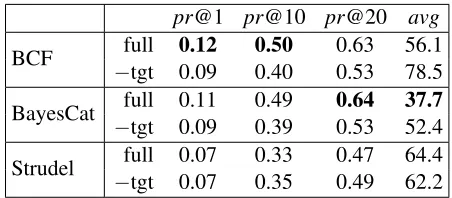
pr@1 pr@10 pr@20 avg BCF −tgt 0.09full 0.12 0.500.40 0.630.53 56.178.5
BayesCat −tgt 0.09full 0.11 0.490.39 0.640.53 37.752.4
[image:6.612.76.297.54.110.2]Strudel −tgt 0.07full 0.07 0.330.35 0.470.49 64.462.2
Table 2: Model performance on the concept predic-tion task. Precision at rank 1, 10, 20, and average rank assigned (avg). −tgt refers to the condition where we remove context words which are identi-cal to the target concept as opposed to using the full context.
Similarly, for BayesCat we compute the score of a conceptcgiven a set of features as follows:
Score(c|f) =
∑
k
P(c|k)P(f|k). (5)
For Strudel, we rank concepts according to the cumulative log-likelihood ratio-based association score over all observed features for a particular con-ceptc:
Score(c|f) =
∑
f∈f
association(c,f). (6)
Metrics Since we can directly compare model
predictions against the actual target concept of the stimulus, we report precision at rank 1, 10, and 20. We also report the average rank assigned to the cor-rect concept. All results are based on a random test set of 2,000 previously unseen stimuli. To con-trol for the possibility that the models are learning a strong (yet trivial) correlation between target con-cepts and identical words occurring as features, we also report results on a modification of our test set where we remove any mention of the target concept from the context, if present (the−tgt condition).
Results Our results on the concept prediction task
0 0.1 0.2 0.3 0.4 0.5 0.6 0.7
0 2 4 6 8 10 12 14 16 18 20
Cumulative Relative Frequency
Rank
[image:7.612.82.289.58.201.2]BCF BayesCat Strudel
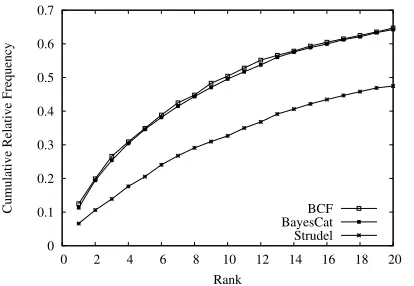
Figure 4: Number of times the correct target con-cept was placed within the top 20 ranks by BCF, BayesCat, and Strudel.
perform comparably given that they learn from ex-actly the same data and exploit local co-occurrence relations in similar ways. BayesCat produces bet-ter average rank scores than BCF, while achieving lower precision scores. This can be explained by the fact that BCF assigns low ranks to correct concepts more reliably than BayesCat. Figure 4 shows the rel-ative cumulrel-ative frequencies of the ranks assigned by the three models. We display the top ranks 1 through 20 (out of 492). As can be seen, BCF per-forms slightly better than BayesCat. Pairwise differ-ences between the systems are all statistically sig-nificant (p0.01); using a one-way ANOVA with post-hoc Tukey HSD test).
Note that performance decreases for the Bayesian models in the−tgt condition, i.e., when occurrences of the target concept are removed from the context. Strudel is less affected by this given its pattern-based learning mechanism which is not prone to associ-ating target word types with themselves. However, repetitions are a natural phenomenon from a cogni-tive standpoint and it seems reasonable to consider multiple occurrences of a concept as a canonical fea-ture of the learning environment.
Overall, the precision scores may seem low. How-ever, the models rank a set of 492 target con-cepts; a random baseline would achieve a pr@1 of only 0.002%. In addition, the target concepts we are considering are by design highly confusable: they were selected so that they form categories and are thus bound to share some features which makes the
salmon journey move hundred mile strong
current reproduce
BCF salmon tuna goldfish lobster fish
BayesCat fish radio goldfish salmon clock Strudel train house apartment ship car
finger avoid cut quick claw tip painful BCF tent ski peg curtain hut BayesCat eye ear spider leg hair Strudel finger toe hair tail hand
Table 3: Model output on the concept prediction task for salmon (top) and finger (bottom): the top part of each table shows the true concept (left) and the context provided to the model as input (right). The bottom part of the table shows the five most highly ranked concepts (left to right) for each model.
prediction task harder. Example output for all three models is shown in Table 3. The models take context features “journey move hundred mile strong” and “avoid cut quick claw tip” as input and are expected to predict salmon andfinger, respectively. Unlike Strudel, BCF and BayesCat ranksalmonalmost cor-rectly and the other high ranked concepts are reason-able in the given context as well. For the second ex-ample, only Strudel predicts the correct concept cor-rectly, but again the top-ranked concepts of the other two models are reasonable in the given context.
4.3 Experiment 3: Evaluation of Feature Types
In this suite of experiments we evaluate two as-pects of the feature types induced by our model: (1) Are they relevantto their associated category? and (2) Do they form acoherentclass? Our evalu-ation followed the intrusion paradigm originally in-troduced to assess the output of topic models (Chang et al., 2009). We performed two intrusion studies using Amazon’s Mechanical Turk crowd-sourcing platform.
[image:7.612.311.543.58.178.2]Strudel white change pant
trouser replace
paint fasten thick layer apply
hole shirt lie neck finish
pattern hood cover crimson woolen
man occasion see steal striped
BCF wear cover veil woman coat
white black color brown dark
eye tooth ear skin lip
wear suit trouser woman garment
animal feather skin wool material
Figure 5: Example feature types learnt for the categoryCLOTHINGby Strudel (top) and BCF (bottom).
‘Select intruder feature type (right) wrt category (left).’ ant hornet
moth flea beetle wasp cockroach
◦egg female food young bird ◦ant insect butterfly wasp larva •wear cover veil woman coat ◦body air fish blood muscle
‘Select the intruder word.’
◦ ◦ • ◦ ◦
[image:8.612.78.541.55.128.2]egg female box young bird
Figure 6: Illustration of the feature type intrusion task (top); and the word intrusion task (bottom).
study, where participants were shown a single fea-ture type (again represented as a word cluster) and asked to detect the intruder feature/word (see Fig-ure 6 bottom). If the featFig-ures are overall coherent and meaningful, it should be relatively straightfor-ward to identify the intruder.
Method We compared the feature types learnt by
BCF and Strudel. We omitted BayesCat from this evaluation as it does not naturally produce feature types, rather it associates unstructured lists of fea-tures with categories. As mentioned earlier, Strudel does not induce feature types either, however, it as-sociates concepts with features which can be post-processed to obtain feature types as follows. Given a category induced by Strudel (as explained in Experi-ment 1), we collected the features associated with at least half of the concepts in the category with a log likelihood score no less than 19.51.3 We then clus-tered these features with K-means (using the Cluto toolkit) intoK=5 feature types.
For BCF, for each category k, we select the five
3Following Baroni et al. (2010), this number corresponds to
a probability of co-occurrence below 0.00001, assuming inde-pendence.
feature typesg with highest associationP(g|k), to-gether with one intruder feature type g0 which is
highly associated with some other category k0 but
not withk. For Strudel we took the five feature types elicited through the procedure described above, and one random feature type from the global set of fea-ture types. Each feafea-ture type was represented by a cluster of five words.
With respect to the word intrusion task, partici-pants were only shown feature types (i.e., word clus-ters) irrespectively of the associated category. BCF feature types g were represented as the set of the five wordswwith highest probabilityP(f|g). In ad-dition, we added one intruder word which had low probability undergbut high probability under some other feature type. For Strudel, we represented fea-ture types as a random subset of five words, and added an additional intruder word from the global set of features.
For the feature type intrusion task, We evaluated a total of 40 categories for each model. Each par-ticipant assessed 10 categories per session (5 per model). Categories and feature types were presented in random order. For the word intrusion task, we evaluated a total of 66 feature types for each model. Participants saw 11 feature types per session, in ran-domized order. In both cases, we collected 10 re-sponses per item.
Metrics We evaluated feature type relevance and
coherence by measuring precision (the proportion of intruders identified correctly). We also use the Kappa coefficient to measure inter-subject agree-ment (Fleiss, 1981) on our two tasks.
Results Our results are presented in Table 4.
dif-Feat Type Intrusion Word Intrusion Prec Kappa Prec Kappa
BCF 0.52 0.23 0.78 0.60
[image:9.612.76.296.54.110.2]Strudel 0.56 0.26 0.36 0.21
Table 4: Performance of Strudel and BCF on the feature type and word intrusion tasks. We report precision (Prec) and inter-subject agreement (Fleiss’ Kappa; all Kappa values are statistically significant at p0.05).
ferences are not statistically significant, using a t-test). Again this is not surprising considering that Strudel’s feature types were elicited through a highly informed, pipelined process. The results show that the simpler and cognitively plausible BCF model learns feature types of a quality comparable to a highly engineered, competitive system. Examples of feature types discovered by BCF and Strudel are shown in Figure 5, for the category CLOTHING. As can be seen, Strudel obtains a large number of action-related features (e.g.,replace, change, steal). BCF creates more varied feature types. For exam-ple, the second cluster refers to external properties (e.g., color), and the last cluster containsCLOTHING materials.
Concerning the word intrusion task, we observe that participants are able to detect the intruder more accurately when presented with BCF feature types as compared to Strudel feature types (differences be-tween Strudel and BCF are statistically significant at p0.05, again using at-test). The results sug-gest that the feature types learnt by BCF are more coherent, and indeed express meaningful properties shared by concepts belonging to the same category. While being relevant to the category, Strudel’s fea-ture types do not seem to exhibit internal coherence to a similar extent. The mutual dependence of cat-egory formation and feature learning allows BCF to learn feature types which are both relevant and indi-vidually interpretable.
5 Discussion
In this paper we presented a cognitively motivated Bayesian model which jointly learns categories and their features, arguing that the two tasks are co-dependent. Our model learns from raw text
with-out relying on elaborate post-processing and high-precision patterns. Evaluation of the inferred cat-egories and their features shows that BCF per-forms competitively compared to a system specif-ically engineered to extract high quality features, despite the more complex learning objective, and the knowledge-lean approach. We approximate the cognitive learning environment with large text cor-pora. However, we do not claim to learn fea-tures qualitatively similar to feafea-tures produced in hu-man elicitation studies. Instead, we show, through a crowdsourcing-based human evaluation, that the learnt features are meaningful in that they are rele-vant to their associated category and form a coherent class.
An interesting direction for future work would be to learn feature types from multiple modalities (not only text) and to investigate how different informa-tion sources (e.g., visual or pragmatic input) influ-ence feature learning. The BCF model learns de-scriptive feature types represented as a collection of feature values. In addition to such descriptive fea-tures (e.g.,behavior) categories also possess defin-ingfeatures (e.g.,animate) which are bound to one particular value. Extending the model in a way that allows to learn qualitatively different types of fea-tures is desirable from a cognitive perspective. We will also develop an incremental learning algorithm for joint category and feature learning (e.g., using sequential Monte Carlo methods such as Particle Fil-tering). In addition, it would be interesting to inves-tigate the emergence of feature types with nonpara-metric Bayesian methods.
Finally, the BCF model can be applied to tasks beyond those discussed here. For example, one could learn definitions (aka features) of terms (aka concepts) in specialist fields (e.g., finance, law, medicine) or monitor how the meaning of words or concepts as represented by their features changes over time.
Acknowledgments We thank Micha Elsner and
References
Ahn, Woo-Kyoung. 1998. Why are different fea-tures central for natural kinds and artifacts?: the role of causal status in determining feature cen-trality. Cognition69:135.
Anderson, John R. 1991. The adaptive nature of human categorization. Psychological Review 98:409–429.
Austerweil, Joseph L. and Thomas L. Griffiths. 2013. A nonparametric Bayesian framework for constructing flexible feature representations. Psy-chological Review120(4):817–851.
Baroni, Marco, Silvia Bernardini, Adriano Ferraresi, and Eros Zanchetta. 2009. The WaCky wide web: a collection of very large linguistically processed web-crawled corpora. Language Resources and Evaluation43(3):209–226.
Baroni, Marco, Brian Murphy, Eduard Barbu, and Massimo Poesio. 2010. Strudel: A corpus-based semantic model based on properties and types. Cognitive Science34(2):222–254.
Chang, Jonathan, Jordan Boyd-Graber, Chong Wang, Sean Gerrish, and David M. Blei. 2009. Reading tea leaves: How humans interpret topic models. In Neural Information Processing Sys-tems. pages 288–296.
Corter, James E. and Mark A. Gluck. 1992. Explain-ing basic categories - feature predictability and information. Psychological Bulletin111(2):291– 303.
Devereux, Barry, Nicholas Pilkington, Therry Poibeau, and Anna Korhonen. 2009. Towards un-restricted, large-scale acquisition of feature-based conceptual representations from corpus data. Re-search on Language & Computation7(2-4):137– 170.
Fleiss, Joseph L. 1981.Statistical Methods for Rates and Proportions. Wiley, New York.
Fountain, Trevor and Mirella Lapata. 2010. Meaning representation in natural language categorization. InProceedings of the 32nd Annual Conference of the Cognitive Science Society. Portland, Oregon, pages 1916–1921.
Fountain, Trevor and Mirella Lapata. 2011. In-cremental models of natural language category
acquisition. In Proceedings of the 33nd An-nual Conference of the Cognitive Science Society. Boston, Massachusetts, pages 255–260.
Frermann, Lea and Mirella Lapata. 2014. Incremen-tal Bayesian learning of semantic categories. In Proceedings of the 14th Conference of the Eu-ropean Chapter of the Association for Computa-tional Linguistics, EACL 2014, April 26-30, 2014, Gothenburg, Sweden. pages 249–258.
Geman, Stuart and Donald Geman. 1984. Stochastic relaxation, Gibbs distributions and the Bayesian restoration of images. IEEE Transactions on Pat-tern Analysis and Machine Intelligence6(6):721– 741.
Goldstone, Robert L., Yvonne Lippa, and Richard M. Shiffrin. 2001. Altering object representations through category learning. Cognition78:27–43.
Kelly, Colin, Barry Devereux, and Anna Korhonen. 2014. Automatic extraction of property norm-like data from large text corpora. Cognitive Science 38(4):638–682.
Kuperman, Victor, Hans Stadthagen-Gonzalez, and Marc Brysbaert. 2012. Age-of-acquisition rat-ings for 30,000 english words.Behavior Research Methods44(4):978–990.
Lang, Joel and Mirella Lapata. 2011. Unsupervised semantic role induction with graph partitioning. In Proceedings of the 2011 Conference on Em-pirical Methods in Natural Language Processing. Edinburgh, Scotland, UK., pages 1320–1331. McRae, Ken, George S. Cree, Mark S. Seidenberg,
and Chris McNorgan. 2005. Semantic feature production norms for a large set of living and nonliving things. Behavioral Research Methods 37(4):547–59.
Nosofsky, Robert M. 1988. Exemplar-based ac-counts of relations between classification, recog-nition, and typicality. Journal of Experimental Psychology: Learning, Memory, and Cognition 14:700–708.
Reed, Stephen K. 1972. Pattern recognition and cat-egorization. Cognitive psychology3(3):382–407. Riordan, Brian and Michael N. Jones. 2011.
Comparing feature-based and distributional mod-els of semantic representation. Topics in Cogni-tive Science3(2):303–345.
Rosenberg, Andrew and Julia Hirschberg. 2007. V-measure: A conditional entropy-based external cluster evaluation measure. InProceedings of the 2007 Joint Conference on Empirical Methods in Natural Language Processing and Computational Natural Language Learning. Prague, Czech Re-public, pages 410–420.
Sanborn, Adam N., Thomas L. Griffiths, and Daniel J. Navarro. 2006. A more rational model of categorization. InProceedings of the 28th An-nual Conference of the Cognitive Science Society. Vancouver, Canada, pages 726–731.
Schyns, Philippe G and Luc Rodet. 1997. Catego-rization creates functional features.Journal of Ex-perimental Psychology: Learning, Memory, and Cognition23:681–696.
Spalding, T. L. and B. H. Ross. 2000. Concept learn-ing and feature interpretation. Memory & Cogni-tion28:439–451.
Steyvers, Mark. 2010. Combining feature norms and text data with topic models. Acta Psychologica 133(3):234–243.