with CCG and Log-Linear Models
Stephen Clark
∗ University of OxfordJames R. Curran
∗∗ University of SydneyThis article describes a number of log-linear parsing models for an automatically extracted lexicalized grammar. The models are “full” parsing models in the sense that probabilities are defined for complete parses, rather than for independent events derived by decomposing the parse tree. Discriminative training is used to estimate the models, which requires incorrect parses for each sentence in the training data as well as the correct parse. The lexicalized grammar formalism used is Combinatory Categorial Grammar (CCG), and the grammar is automatically extracted from CCGbank, a CCG version of the Penn Treebank. The combination of discriminative training and an automatically extracted grammar leads to a significant memory requirement (up to 25 GB), which is satisfied using a parallel implementation of the BFGS optimization algorithm running on a Beowulf cluster. Dynamic programming over a packed chart, in combination with the parallel implementation, allows us to solve one of the largest-scale estimation problems in the statistical parsing literature in under three hours.
A key component of the parsing system, for both training and testing, is a Maximum En-tropy supertagger which assigns CCG lexical categories to words in a sentence. The super-tagger makes the discriminative training feasible, and also leads to a highly efficient parser. Surprisingly, given CCG’s “spurious ambiguity,” the parsing speeds are significantly higher than those reported for comparable parsers in the literature. We also extend the existing parsing techniques for CCG by developing a new model and efficient parsing algorithm which exploits all derivations, including CCG’s nonstandard derivations. This model and parsing algorithm, when combined with normal-form constraints, give state-of-the-art accuracy for the recovery of predicate–argument dependencies from CCGbank. The parser is also evaluated on DepBank and compared against the RASP parser, outperforming RASP overall and on the majority of relation types. The evaluation on DepBank raises a number of issues regarding parser evaluation.
This article provides a comprehensive blueprint for building a wide-coverage CCG parser. We demonstrate that both accurate and highly efficient parsing is possible with CCG.
∗University of Oxford Computing Laboratory, Wolfson Building, Parks Road, Oxford, OX1 3QD, UK. E-mail: [email protected].
∗∗School of Information Technologies, University of Sydney, NSW 2006, Australia. E-mail: [email protected].
1. Introduction
Log-linear models have been applied to a number of problems in NLP, for example, POS tagging (Ratnaparkhi 1996; Lafferty, McCallum, and Pereira 2001), named entity recognition (Borthwick 1999), chunking (Koeling 2000), and parsing (Johnson et al. 1999). Log-linear models are also referred to asmaximum entropy modelsandrandom fieldsin theNLPliterature. They are popular because of the ease with which complex discriminating features can be included in the model, and have been shown to give good performance across a range ofNLPtasks.
Log-linear models have previously been applied to statistical parsing (Johnson et al. 1999; Toutanova et al. 2002; Riezler et al. 2002; Malouf and van Noord 2004), but typically under the assumption that all possible parses for a sentence can be enumerated. For manually constructed grammars, this assumption is usually sufficient for efficient estimation and decoding. However, for wide-coverage grammars extracted from a treebank, enumerating all parses is infeasible. In this article we apply the dy-namic programming method of Miyao and Tsujii (2002) to a packed chart; however, because the grammar is automatically extracted, the packed charts require a consid-erable amount of memory: up to 25 GB. We solve this massive estimation problem by developing a parallelized version of the estimation algorithm which runs on a Beowulf cluster.
The lexicalized grammar formalism we use is Combinatory Categorial Grammar (CCG; Steedman 2000). A number of statistical parsing models have recently been devel-oped forCCGand used in parsers applied to newspaper text (Clark, Hockenmaier, and Steedman 2002; Hockenmaier and Steedman 2002b; Hockenmaier 2003b). In this article we extend existing parsing techniques by developing log-linear models forCCG, as well as a new model and efficient parsing algorithm which exploits all CCG’s derivations, including the nonstandard ones.
Estimating a log-linear model involves computing expectations of feature values. For the conditional log-linear models used in this article, computing expectations re-quires a sum over all derivations for each sentence in the training data. Because there can be a massive number of derivations for some sentences, enumerating all derivations is infeasible. To solve this problem, we have adapted the dynamic programming method of Miyao and Tsujii (2002) to packedCCGcharts. A packed chart efficiently represents all derivations for a sentence. The dynamic programming method uses inside and outside scores to calculate expectations, similar to the inside–outside algorithm for estimating the parameters of aPCFGfrom unlabeled data (Lari and Young 1990).
Generalized Iterative Scaling (Darroch and Ratcliff 1972) is a common choice in the NLP literature for estimating a log-linear model (e.g., Ratnaparkhi 1998; Curran and Clark 2003). Initially we used generalized iterative scaling (GIS) for the parsing models described here, but found that convergence was extremely slow; Sha and Pereira (2003) present a similar finding for globally optimized log-linear models for sequences. As an alternative to GIS, we use the limited-memory BFGS algorithm (Nocedal and Wright 1999). As Malouf (2002) demonstrates, general purpose numerical optimization algorithms such as BFGS can converge much faster than iterative scaling algorithms (including Improved Iterative Scaling; Della Pietra, Della Pietra, and Lafferty 1997).
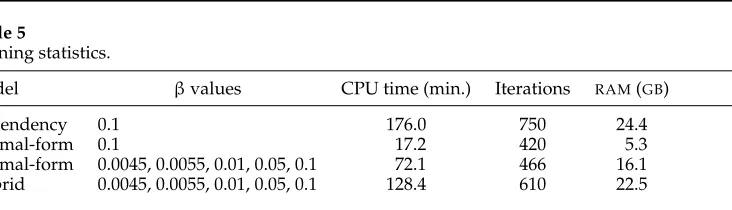
These methods are either too slow or sacrifice parsing performance, and so we use a parallelized version of BFGSrunning on an 18-node Beowulf cluster to perform the estimation. Even given the large number of derivations and the large feature sets in our models, the estimation time for the best-performing model is less than three hours. This gives us a practical framework for developing a statistical parser.
A corollary ofCCG’s base-generative treatment of long-range dependencies in rel-ative clauses and coordinate constructions is that the standard predicate–argument re-lations can be derived via nonstandard surface derivations. The addition of “spurious” derivations inCCGcomplicates the modeling and parsing problems. In this article we consider two solutions. The first, following Hockenmaier (2003a), is to define a model in terms ofnormal-formderivations (Eisner 1996). In this approach we recover only one derivation leading to a given set of predicate–argument dependencies and ignore the rest.
The second approach is to define a model over the predicate–argument dependen-cies themselves, by summing the probabilities of all derivations leading to a given set of dependencies. We also define a new efficient parsing algorithm for such a model, based on Goodman (1996), which maximizes the expected recall of dependencies. The development of this model allows us to test, for the purpose of selecting the correct predicate–argument dependencies, whether there is useful information in the additional derivations. We also compare the performance of our best log-linear model against existingCCGparsers, obtaining the highest results to date for the recovery of predicate– argument dependencies from CCGbank.
A key component of the parsing system is a Maximum EntropyCCGsupertagger (Ratnaparkhi 1996; Curran and Clark 2003) which assigns lexical categories to words in a sentence. The role of the supertagger is twofold. First, it makes discriminative estimation feasible by limiting the number of incorrect derivations for each training sentence; the supertagger can be thought of as supplying a number of incorrect but plausible lexical categories for each word in the sentence. Second, it greatly increases the efficiency of the parser, which was the original motivation for supertagging (Bangalore and Joshi 1999). One possible criticism of CCGhas been that highly efficient parsing is not possible because of the additional “spurious” derivations. In fact, we show that a novel method which tightly integrates the supertagger and parser leads to parse times significantly faster than those reported for comparable parsers in the literature.
The parser is evaluated on CCGbank (available through the Linguistic Data Con-sortium). In order to facilitate comparisons with parsers using different formalisms, we also evaluate on the publicly available DepBank (King et al. 2003), using the Briscoe and Carroll annotation consistent with the RASP parser (Briscoe, Carroll, and Watson 2006). The dependency annotation is designed to be as theory-neutral as possible to allow easy comparison. However, there are still considerable difficulties associated with a cross-formalism comparison, which we describe. Even though theCCGdependencies are being mapped into another representation, the accuracy of the CCGparser is over 81% F-score on labeled dependencies, against an upper bound of 84.8%. TheCCGparser also outperformsRASPoverall and on the majority of dependency types.
CCG, and give a convincing demonstration that, through use of a supertagger, highly efficient parsing is possible withCCG.
2. Related Work
The first application of log-linear models to parsing is the work of Ratnaparkhi and colleagues (Ratnaparkhi, Roukos, and Ward 1994; Ratnaparkhi 1996, 1999). Similar to Della Pietra, Della Pietra, and Lafferty (1997), Ratnaparkhi motivates log-linear models from the perspective of maximizing entropy, subject to certain constraints. Ratnaparkhi models the various decisions made by a shift-reduce parser, using log-linear distri-butions defined over features of the local context in which a decision is made. The probabilities of each decision are multiplied together to give a score for the complete sequence of decisions, and beam search is used to find the most probable sequence, which corresponds to the most probable derivation.
A different approach is proposed by Abney (1997), who develops log-linear models for attribute-value grammars, such as Head-driven Phrase Structure Grammar (HPSG). Rather than define a model in terms of parser moves, Abney defines a model directly over the syntactic structures licensed by the grammar. Another difference is that Abney uses a global model, in which a single log-linear model is defined over the complete space of attribute–value structures. Abney’s motivation for using log-linear models is to overcome various problems in applying models based onPCFGs directly to attribute-value grammars. A further motivation for using global models is that these do not suffer from the label bias problem (Lafferty, McCallum, and Pereira 2001), which is a potential problem for Ratnaparkhi’s approach.
Abney defines the following model for a syntactic analysisω:
P(ω)=
iβ fi(ω)
i
Z (1)
wherefi(ω) is a feature, or feature function, andβiis its corresponding weight;Zis a normalizing constant, also known as thepartition function. In much work using log-linear models in NLP, including Ratnaparkhi’s, the features of a model are indicator functions which take the value 0 or 1. However, in Abney’s models, and in the models used in this article, the feature functions are integer valued and count the number of times some feature appears in a syntactic analysis.1 Abney calls the feature functions
frequency functionsand, like Abney, we will not always distinguish between a feature and its corresponding frequency function.
There are practical difficulties with Abney’s proposal, in that finding the maximum-likelihood solution during estimation involves calculating expectations of feature val-ues, which are sums over the complete space of possible analyses. Abney suggests a Metropolis-Hastings sampling procedure for calculating the expectations, but does not experiment with an implementation.
Johnson et al. (1999) propose an alternative solution, which is to maximize the conditional likelihood function. In this case the likelihood function is the product of theconditionalprobabilities of the syntactic analyses in the data, each probability condi-tioned on the respective sentence. The advantage of this method is that calculating the conditional feature expectations only requires a sum over the syntactic analyses for the
sentences in the training data. The conditional-likelihood estimator is also consistent for the conditional distributions (Johnson et al. 1999). The same solution is arrived at by Della Pietra, Della Pietra, and Lafferty (1997) via a maximum entropy argument. Another feature of Johnson et al.’s approach is the use of a Gaussian prior term to avoid overfitting, which involves adding a regularization term to the likelihood function; the regularization term penalizes models whose weights get too large in absolute value. This smoothing method for log-linear models is also proposed by Chen and Rosenfeld (1999).
Calculating the conditional feature expectations can still be problematic if the gram-mar licenses a large number of analyses for some sentences. This is not a problem for Johnson et al. (1999) because their grammars are hand-written and constraining enough to allow the analyses for each sentence to be enumerated. However, for grammars with wider coverage it is often not possible to enumerate the analyses for each sentence in the training data. Osborne (2000) investigates training on a sample of the analyses for each sentence, for example the top-nmost probable according to some other probability model, or simply a random sample.
The CCGgrammar used in this article is automatically extracted, has wide cover-age, and can produce an extremely large number of derivations for some sentences, far too many to enumerate. We adapt the feature-forestmethod of Miyao and Tsujii (2002), which involves using dynamic programming to efficiently calculate the feature expectations. Geman and Johnson (2002) propose a similar method in the context ofLFG parsing; an implementation is described in Kaplan et al. (2004).
Miyao and Tsujii have carried out a number of investigations similar to the work in this article. In Miyao and Tsujii (2003b, 2003a) log-linear models are developed for automatically extracted grammars for Lexicalized Tree Adjoining Grammar (LTAG) and Head Driven Phrase Structure Grammar (HPSG). One of Miyao and Tsujii’s motivations is to model predicate–argument dependencies, including long-range dependencies, which was one of the original motivations of the wide-coverage CCGparsing project. Miyao and Tsujii (2003a) present another log-linear model for an automatically extracted LTAGwhich uses a simple unigram model of the elementary trees together with a log-linear model of the attachments. Miyao and Tsujii (2005) address the issue of practical estimation using an automatically extractedHPSGgrammar. A simple unigram model of lexical categories is used to limit the size of the charts for training, in a similar way to how we use aCCGsupertagger to restrict the size of the charts.
be encoded; for example, we have found that using Penn TreebankPOStags as features significantly improves supertagging accuracy. Another difference is that Malouf and van Noord use the random sampling method of Osborne (2000) to allow practical estimation, whereas we construct the complete parse forest but use the supertagger to limit the size of the charts. Their work is also on a somewhat smaller scale, with the Dutch Alpino treebank containing 7,100 sentences, compared with the 36,000 sentences we use for training.
Kaplan et al. (2004) present similar work to ours in the context of anLFGgrammar for English. The main difference is that theLFGgrammar is hand-built, resulting in less ambiguity than an automatically extracted grammar and thus requiring fewer resources for model estimation. One downside of hand-built grammars is that they are typically less robust, which Kaplan et al. address by developing a “fragment” grammar, together with a “skimming mode,” which increases coverage on Section 23 of the Penn Treebank from 80% to 100%. Kaplan et al. also present speed figures for their parser, comparing with the Collins parser. Comparing parser speeds is difficult because of implementation and accuracy differences, but their highest reported speed is around 2 sentences per second on sentences from Section 23. The parse speeds that we present in Section 10.3 are an order of magnitude higher.
More generally, the literature on statistical parsing using linguistically motivated grammar formalisms is large and growing. Statistical parsers have been developed for TAG (Chiang 2000; Sarkar and Joshi 2003), LFG (Riezler et al. 2002; Kaplan et al. 2004; Cahill et al. 2004), and HPSG (Toutanova et al. 2002; Toutanova, Markova, and Manning 2004; Miyao and Tsujii 2004; Malouf and van Noord 2004), among others. The motivation for using these formalisms is that many NLP tasks, such as Machine Translation, Information Extraction, and Question Answering, could benefit from the more sophisticated linguistic analyses they provide.
The formalism most closely related toCCGfrom this list isTAG.TAGgrammars have been automatically extracted from the Penn Treebank, using techniques similar to those used by Hockenmaier (Chen and Vijay-Shanker 2000; Xia, Palmer, and Joshi 2000). Also, the supertagging idea which is central to the efficiency of theCCGparser originated with TAG(Bangalore and Joshi 1999). Chen et al. (2002) describe the results of reranking the output of an HMM supertagger using an automatically extractedLTAG. The accuracy for a single supertag per word is slightly over 80%. This figure is increased to over 91% when the tagger is run in n-best mode, but at a considerable cost in ambiguity, with 8 supertags per word. Nasr and Rambow (2004) investigate the potential impact of LTAG supertagging on parsing speed and accuracy by performing a number of oracle experiments. They find that,with the perfect supertagger, extremely high parsing accuracies and speeds can be obtained. Interestingly, the accuracy ofLTAGsupertaggers using automatically extracted grammars is significantly below the accuracy of theCCG supertagger. One possible way to increase the accuracy ofLTAGsupertagging is to use a Maximum Entropy, rather thanHMM, tagger (as discussed previously), but this is likely to result in an improvement of only a few percentage points. Thus whether the differ-ence in supertagging accuracy is due to the nature of the formalisms, the supertagging methods used, or properties of the extracted grammars, is an open question.
Related work on statistical parsing withCCGwill be described in Section 3.
3. Combinatory Categorial Grammar
entries consist of a syntactic category, which defines valency and directionality, and a semantic interpretation. In this article we are concerned with the syntactic compo-nent; see Steedman (2000) for how a semantic interpretation can be composed dur-ing a syntactic derivation, and also Bos et al. (2004) for how semantic interpretations can be built for newspaper text using the wide-coverage parser described in this article.
Categories can be either basic or complex. Examples of basic categories areS (sen-tence),N(noun),NP(noun phrase), andPP(prepositional phrase). Complex categories are built recursively from basic categories, and indicate the type and directionality of arguments (using slashes), and the type of the result. For example, the following category for the transitive verbboughtspecifies its first argument as a noun phrase to its right, its second argument as a noun phrase to its left, and its result as a sentence:
bought := (S\NP)/NP (2)
In the theory ofCCG, basic categories are regarded as complex objects that include syntactic features such as number, gender, and case. For the grammars in this article, categories are augmented with some additional information, such as head information, and also features onScategories which distinguish different types of sentence, such as declarative, infinitival, andwh-question. This additional information will be described in later sections.
Categories are combined in a derivation usingcombinatory rules. In the original Categorial Grammar (Bar-Hillel 1953), which is context-free, there are two rules of
functional application:
X/Y Y⇒X (>) (3)
Y X\Y⇒X (<) (4)
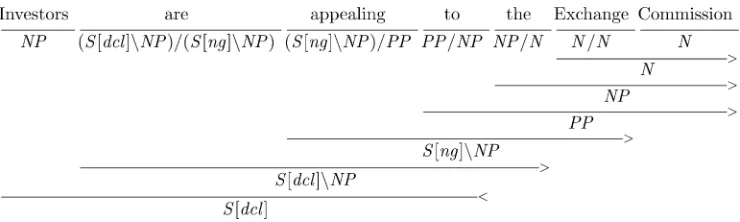
where X andY denote categories (either basic or complex). The first rule is forward application (>) and the second rule is backward application (<). Figure 1 gives an example derivation using these rules.
[image:7.486.54.424.523.634.2]CCGextends the original Categorial Grammar by introducing a number of addi-tional combinatory rules. The first is forward composition, which Steedman denotes
Figure 1
Figure 2
Example derivation using type-raising and forward composition.
by >B (because B is the symbol used by Curry to denote function composition in combinatory logic; Curry and Feys 1958):
X/Y Y/Z ⇒B X/Z (>B) (5)
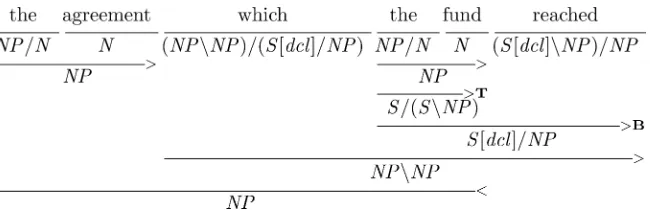
Forward composition is often used in conjunction withtype-raising(T), as in Figure 2. In this case type-raising takes a subject noun phrase and turns it into a functor looking to the right for a verb phrase;the fundis then able to combine withreachedusing forward composition, giving the fund reached the category S[dcl]/NP (a declarative sentence missing an object). It is exactly this type of constituent which the object relative pronoun category is looking for to its right: (NP\NP)/(S[dcl]/NP).
Note that the fund reachedis a perfectly reasonable constituent inCCG, having the typeS[dcl]/NP. This allows analyses for sentences such asthe fund reached but investors disagreed with the agreement, even though this construction is often described as “non-constituent coordination.” In this example,the fund reachedandinvestors disagreed with
have the same type, allowing them to be coordinated, resulting inthe fund reached but investors disagreed withhaving the typeS[dcl]/NP. Note also that it is this flexible notion of constituency which leads to so-called spurious ambiguity, because even the simple sentencethe fund reached an agreement will have more than one derivation, with each derivation leading to the same set of predicate–argument dependencies.
Forward composition is generalized to allow additional arguments to the right of the Z category in (5). For example, the following combination allows analysis of sentences such asI offered, and may give, a flower to a policeman(Steedman 2000):
may give
(S\NP)/(S\NP) ((S\NP)/PP)/NP >B ((S\NP)/PP)/NP
This example shows how the categories formayandgivecombine, resulting in a cate-gory of the same type asoffered, which can then be coordinated. Steedman (2000) gives a more precise definition of generalized forward composition.
Further combinatory rules in the theory of CCG include backward composition (<B) and backward crossed composition (<BX):
Y\Z X\Y⇒BX\Z (<B) (6)
Backward composition provides an analysis for sentences involving “argument cluster coordination,” such asI gave a teacher an apple and a policeman a flower(Steedman 2000). Backward crossed composition is required for heavy NP shift and coordinations such asI shall buy today and cook tomorrow the mushrooms. In this coordination example from Steedman (2000), backward crossed composition is used to combine the categories for buy, (S\NP)/NP, andtoday, (S\NP)\(S\NP), and similarly forcook and tomorrow, producing categories of the same type which can be coordinated. This rule is also generalized in an analogous way to forward composition.
Finally, there is a coordination rule which conjoins categories of the same type, producing a further category of that type. This rule can be implemented by assuming the following category schema for a coordination term: (X\X)/X, whereXcan be any category.
All of the combinatory rules described above are implemented in our parser. Other combinatory rules, such as substitution, have been suggested in the literature to deal with certain linguistic phenomena, but we chose not to implement them. The reason is that adding new combinatory rules reduces the efficiency of the parser, and we felt that, in the case of substitution, for example, the small gain in grammatical coverage was not worth the reduction in speed. Section 9.3 discusses some of the choices we made when implementing the grammar.
One way of dealing with the additional ambiguity in CCG is to only consider normal-formderivations. Informally, a normal-form derivation is one which uses type-raising and composition only when necessary. Eisner (1996) describes a technique for eliminating spurious ambiguity entirely, by defining exactly one normal-form deriva-tion for each semantic equivalence class of derivaderiva-tions. The idea is to restrict the combination of categories produced by composition; more specifically, any constituent which is the result of a forward composition cannot serve as the primary (left) functor in another forward composition or forward application. Similarly, any constituent which is the result of a backward composition cannot serve as the primary (right) functor in another backward composition or backward application. Eisner only deals with a grammar without type-raising, and so the constraints cannot guarantee a normal-form derivation when applied to the grammars used in this article. However, the constraints can still be used to significantly reduce the parsing space. Section 9.3 describes the various normal-form constraints used in our experiments.
A recent development in the theory ofCCGis themulti-modaltreatment given by Baldridge (2002) and Baldridge and Kruijff (2003), following the type-logical approaches to Categorial Grammar (Moortgat 1997). One possible extension to the parser and grammar described in this article is to incorporate the multi-modal approach; Baldridge suggests that, as well as having theoretical motivation, a multi-modal approach can improve the efficiency ofCCGparsing.
3.1 Why UseCCGfor Statistical Parsing?
the recovery of long-range dependencies can be integrated into the parsing process in a straightforward manner, rather than be relegated to such a post-processing phase (Clark, Hockenmaier, and Steedman 2002; Hockenmaier 2003a; Clark, Steedman, and Curran 2004).
Another advantage of CCG is that providing a compositional semantics for the grammar is relatively straightforward. It has a completely transparent interface between syntax and semantics and, becauseCCGis a lexicalized grammar formalism, providing a compositional semantics simply involves adding semantic representations to the lexical entries and interpreting the small number of combinatory rules. Bos et al. (2004) show how this can be done for the grammar and parser described in this article.
Of course some of these advantages could be obtained with other grammar for-malisms, such as TAG, LFG, and HPSG, although CCG is especially well-suited to analysing coordination and long-range dependencies. For example, the analysis of “non-constituent coordination” described in the previous section is, as far as we know, unique toCCG.
Finally, the lexicalized nature ofCCGhas implications for the engineering of a wide-coverage parser. Later we show that use of asupertagger(Bangalore and Joshi 1999) prior to parsing can produce an extremely efficient parser. The supertagger uses statistical sequence tagging techniques to assign a small number of lexical categories to each word in the sentence. Because there is so much syntactic information in lexical categories, the parser is required to do less work once the lexical categories have been assigned; hence Srinivas and Joshi, in the context ofTAG, refer to supertagging asalmost parsing. The parser is able to parse 20Wall Street Journal(WSJ) sentences per second on standard hardware, using our best-performing model, which compares very favorably with other parsers using linguistically motivated grammars.
A further advantage of the supertagger is that it can be used to reduce the parse space for estimation of the log-linear parsing models. By focusing on those parses which result from the most probable lexical category sequences, we are able to perform effective discriminative training without considering the complete parse space, which for most sentences is prohibitively large.
The idea of supertagging originated with LTAG; however, in contrast to the CCG grammars used in this article, the automatically extractedLTAGgrammars have, as yet, been too large to enable effective supertagging (as discussed in the previous section). We are not aware of any other work which has demonstrated the parsing efficiency benefits of supertagging using an automatically extracted grammar.
3.2 Previous Work onCCGStatistical Parsing
The work in this article began as part of the Edinburgh wide-coverage CCG parsing project (2000–2004). There has been some other work on defining stochastic categorial grammars, but mainly in the context of grammar learning (Osborne and Briscoe 1997; Watkinson and Manandhar 2001; Zettlemoyer and Collins 2005).
gen-erated first, conditioned on the sentence, and then attachment decisions are made to form the dependency links. The probability of the category sequence is estimated using a maximum entropy model, following the supertagger described in Clark (2002). The probabilities of the dependencies are estimated using relative frequencies, following Collins (1996).
The model was designed to include some long-range predicate–argument depen-dencies, as well as local dependencies. However, there are a number of problems with the model, as the authors acknowledge. First, the model is deficient, losing probability mass to dependency structures not generated by the grammar. Second, the relative frequency estimation of the dependency probabilities is ad hoc, and cannot be seen as maximum likelihood estimation, or some other principled method. Despite these flaws, the parser based on this model was able to recover CCG predicate–argument dependencies at around 82% overall F-score on unseenWSJtext.
Hockenmaier (2003a) and Hockenmaier and Steedman (2002b) present a generative model of normal-form derivations, based on various techniques from the statistical parsing literature (Charniak 1997; Goodman 1997; Collins 2003). ACCGbinary deriva-tion tree is generated top-down, with the probability of generating particular child nodes being conditioned on some limited context from the previously generated struc-ture. Hockenmaier’s parser uses rule instantiations read off CCGbank (see Section 3.3) and some of these will be instances of type-raising and composition; hence the parser can produce non-normal-form derivations. However, because the parsing model is estimated over normal-form derivations, any non-normal-form derivations will receive low probabilities and are unlikely to be returned as the most probable parse.
Hockenmaier (2003a) compares a number of generative models, starting with a baseline model based on a PCFG. Various extensions to the baseline are considered: increasing the amount of lexicalization; generating a lexical category at its maximal projection; conditioning the probability of a rule instantiation on the grandparent node (Johnson 1998); adding features designed to deal with coordination; and adding dis-tance to the dependency features. Some of these extensions, such as increased lexicaliza-tion and generating a lexical category at its maximal projeclexicaliza-tion, improved performance, whereas others, such as the coordination and distance features, reduced performance. Hockenmaier (2003a) conjectures that the reduced performance is due to the problem of data sparseness, which becomes particularly severe for the generative model when the number of features is increased. The best performing model outperforms that of Clark, Hockenmaier, and Steedman (2002), recoveringCCGpredicate–argument dependencies with an overall F-score of around 84% using a similar evaluation.
Hockenmaier (2003b) presents another generative model of normal-form deriva-tions, which is based on the dependencies in the predicate–argument structure, in-cluding long-range dependencies, rather than the dependencies defined by the local trees in the derivation. Hockenmaier also argues that, compared to Hockenmaier and Steedman (2002b), the predicate–argument model is better suited to languages with freer word order than English. The model was also designed to test whether the inclu-sion of predicate–argument dependencies improves parsing accuracy. In fact, the results given in Hockenmaier (2003b) are lower than previous results. However, Hockenmaier (2003b) reports that the increased complexity of the model reduces the effectiveness of the dynamic programming used in the parser, and hence a more aggressive beam search is required to produce reasonable parse times. Thus the reduced accuracy could be due to implementation difficulties rather than the model itself.
(2002), and to offer a more flexible framework for including features than the generative models of Hockenmaier (2003a). For example, adding long-range dependency features to the log-linear model is straightforward. We also showed in Clark and Curran (2004b) that, in contrast with Hockenmaier (2003a), adding distance to the dependency features in the log-linear model does improve parsing accuracy. Another feature of conditional log-linear models is that they are trained discriminatively, by maximizing the condi-tional probability of each gold-standard parse relative to the incorrect parses for the sentence. Generative models, in contrast, are typically trained by maximizing thejoint
probability of thetraining sentence, parsepairs, even though the sentence does not need to be inferred.
3.3 CCGbank
The treebank used in this article performs two roles: It provides the lexical category set used by the supertagger, plus some unary type-changing rules and punctuation rules used by the parser, and it is used as training data for the statistical models. The treebank is CCGbank (Hockenmaier and Steedman 2002a; Hockenmaier 2003a), a CCGversion of the Penn Treebank (Marcus, Santorini, and Marcinkiewicz 1993). Penn Treebank conversions have also been carried out for other linguistic formalisms, includingTAG (Chen and Vijay-Shanker 2000; Xia, Palmer, and Joshi 2000),LFG(Burke et al. 2004), and HPSG(Miyao, Ninomiya, and Tsujii 2004).
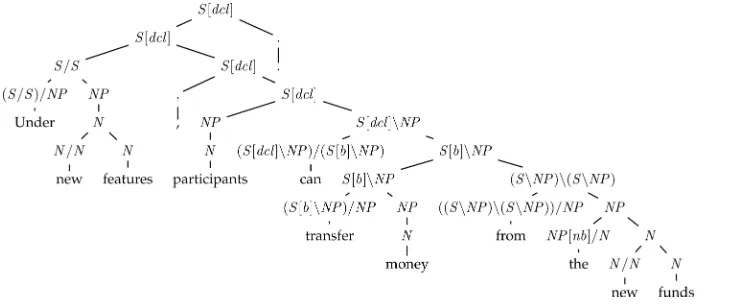
CCGbank was created by converting the phrase-structure trees in the Penn Tree-bank into CCG normal-form derivations. Some preprocessing of the phrase-structure trees was required, in order to allow the correctCCGanalyses for some constructions, such as coordination. Hockenmaier (2003a) gives a detailed description of the procedure used to create CCGbank. Figure 3 shows an example normal-form derivation for an (ab-breviated) CCGbank sentence. The derivation has been inverted, so that it is represented as a binary tree.
[image:12.486.48.415.474.627.2]Sentence categories (S) in CCGbank carry features, such as [dcl] for declarative, [wq] forwh-questions, and [for] for small clauses headed byfor; see Hockenmaier (2003a) for the complete list.Scategories also carry features in verb phrases; for example,S[b]\NP
Figure 3
is a bare-infinitive; S[to]\NPis ato-infinitive;S[pss]\NPis a past participle in passive mode. Note that, whenever anSorS\NPcategory is modified, any feature on theSis carried through to the result category; this is true in our parser also. Finally, determiners specify that the resulting noun phrase is non-bare: NP[nb]/N, although this feature is largely ignored by the parser described in this article.
As well as instances of the standard CCGcombinatory rules—forward and back-ward application, forback-ward and backback-ward composition, backback-ward-crossed composi-tion, type-raising, coordination of like types—CCGbank contains a number of unary
type-changingrules and rules for dealing with punctuation. The type-changing rules typically change a verb phrase into a modifier. The following examples, taken from Hockenmaier (2003a), demonstrate the most common rules. The bracketed expression has the type-changing rule applied to it:
r
S[pss]\NP⇒NP\NP workers [exposed to it]r
S[adj]\NP⇒NP\NPa forum [likely to bring attention to the problem]
r
S[ng]\NP⇒NP\NPsignboards [advertising imported cigarettes]
r
S[ng]\NP⇒(S\NP)\(S\NP)became chairman [succeeding Ian Butler]
r
S[dcl]/NP⇒NP\NPthe millions of dollars [it generates]
Another common type-changing rule in CCGbank, which appears in Figure 3, changes a noun categoryNinto a noun phraseNP. Appendix A lists the unary type-changing rules used by our parser.
There are also a number of rules in CCGbank for absorbing punctuation. For exam-ple, Figure 3 contains a rule which takes a comma followed by a declarative sentence and returns a declarative sentence:
, S[dcl]⇒S[dcl]
There are a number of similar comma rules for other categories. There are also similar punctuation rules for semicolons, colons, and brackets. There is also a rule schema which treats a comma as a coordination:
, X⇒X\X
Appendix A contains the complete list of punctuation rules used in the parser.
Penn Treebank are difficult to convert toCCGcombinatory rules, and because of noise introduced by the Treebank conversion process.
3.4CCGDependency Structures
Dependency structures perform two roles in this article. First, they are used for parser evaluation: The accuracy of a parsing model is measured using precision and recall overCCGpredicate–argument dependencies. Second, dependency structures form the core of thedependency model: Probabilities are defined over dependency structures, and the parsing algorithm for this model returns the highest scoring dependency structure.
We define aCCGdependency structure as a set ofCCGpredicate–argument depen-dencies. They are defined as sets, rather than multisets, because the lexical items in a dependency are considered to be indexed by sentence position; this is important for evaluation purposes and, for the dependency model, determining which derivations lead to a given set of dependencies. However, there are situations where the lexical items need to be considered independently of sentence position, for example when defining feature functions in terms of dependencies. Such cases should be clear from the context.
We defineCCGpredicate–argument relations in terms of the argument slots inCCG lexical categories. Thus the transitive verb category, (S\NP)/NP, has two predicate– argument relations associated with it, one corresponding to the object NP argument and one corresponding to the subjectNP argument. In order to distinguish different argument slots, the arguments are numbered from left to right. Thus, the subject relation for a transitive verb is represented as(S\NP1)/NP2, 1.
The predicate–argument dependencies are represented as 5-tuples: hf,f,s,ha,l, wherehf is the lexical item of the lexical category expressing the dependency relation,
f is the lexical category,sis the argument slot,hais the head word of the argument, and
lencodes whether the dependency is non-local. For example, the dependency encoding
companyas the object ofbought(as inIBM bought the company) is represented as follows:
bought2, (S\NP1)/NP2, 2,company4,− (8)
The subscripts on the lexical items indicate sentence position, and the final field (−) indicates that the dependency is a local dependency.
Head and dependency information is represented on the lexical categories, and dependencies are created during a derivation as argument slots are filled. Long-range dependencies are created by passing head information from one category to another using unification. For example, the expanded category for the control verbpersuadeis:
persuade := ((S[dcl]persuade\NP1)/(S[to]2\NPX))/NPX,3 (9)
example, the control verbs persuadeandpromisehave the same lexical category, which means thatpromise Brooks to gois assigned a structure meaningpromise Brooks that Brooks will go.
The kinds of lexical items that use the head passing mechanism are raising, aux-iliary and control verbs, modifiers, and relative pronouns. Among the constructions that project unbounded dependencies are relativization and right node raising. The following relative pronoun category (for words such aswho, which,andthat) shows how heads are co-indexed for object-extraction:
who := (NPX\NPX,1)/(S[dcl]2/NPX) (10)
In a sentence such as The company which IBM bought, the co-indexing will allow com-pany to be returned as the object ofbought, which is represented using the following dependency:
bought2, (S\NP1)/NP2, 2,company4, (NP\NP)/(S[dcl]/NP) (11)
The final field indicates the category which mediated the long-range dependency, in this case the object relative pronoun category.
The dependency annotation also permits complex categories as arguments. For example, the marked up category forabout(as inabout 5,000 pounds) is:
(NX/NX)Y/(N/N)Y,1 (12)
If5,000has the category (NX/NX)5,000, the dependency relation marked on the (N/N)Y,1
argument in (12) allows the dependency betweenaboutand5,000to be captured. In the current implementation every argument slot in a lexical category corresponds to a dependency relation. This means, for example, that the parser produces subjects of to-infinitival clauses and auxiliary verbs. In the sentenceIBM may like to buy Lotus,IBM
will be returned as the subject of may,like,to, and buy. The only exception is during evaluation, when some of these dependencies are ignored in order to be consistent with the predicate–argument dependencies in CCGbank, and also DepBank. In future work we may investigate removing some of these dependencies from the parsing model and the parser output.
4. Log-Linear Parsing Models forCCG
than emphasising a single derivation. Thus, the probability of a dependency structure,
π, given a sentence,S, is defined as follows:
P(π|S)= d∈∆(π)
P(d,π|S) (13)
where∆(π) is the set of derivations which lead toπ.
This approach is different from that of Clark, Hockenmaier, and Steedman (2002), who define the probability of a dependency structure simply in terms of the depen-dencies. One reason for modeling derivations (either one distinguished derivation or a set of derivations), in addition to predicate–argument dependencies, is that derivations may contain useful information for inferring the correct dependency structure.
For both the dependency model and the normal-form model, the probability of a parse is defined using a log-linear form. However, the meaning ofparsediffers in the two cases. For the dependency model, a parse is taken to be ad,πpair, as in Equa-tion (13). For the normal-form model, a parse is simply a (head-lexicalized) derivaEqua-tion.2 We define a conditional log-linear model of a parse ω∈Ω, given a sentence S, as follows:
P(ω|S)= 1
ZSe
λλλ·fff(ω) (14)
whereλλλ·fff(ω)=iλifi(ω). The functionfiis the integer-valued frequency function of theith feature;λiis the weight of theith feature; andZSis a normalizing constant which ensures thatP(ω|S) is a probability distribution:
ZS=
ω∈ρ(S)
eλλλ·fff(ω) (15)
where ρ(S) is the set of possible parses for S. For the normal-form model, features are defined over single derivations, including local word–word dependencies arising from lexicalized rule instantiations. The feature set is derived from the gold-standard normal-form derivations in CCGbank. For the dependency model, features are defined over dependency structures as well as derivations, and the feature set is derived from all derivations leading to gold-standard dependency structures, including nonstandard derivations. Section 7 describes the feature types in more detail.
4.1 Estimating the Dependency Model
For the dependency model, the training data consists of gold-standard dependency structures, namely, sets ofCCGpredicate–argument dependencies, as described earlier. We follow Riezler et al. (2002) in using a discriminative estimation method by maximiz-ing theconditionallog-likelihood of the model given the data, minus a Gaussian prior
term to prevent overfitting (Chen and Rosenfeld 1999; Johnson et al. 1999). Thus, given training sentencesS1,. . .,Sm, gold-standard dependency structures,π1,. . .,πm, and the definition of the probability of a dependency structure from Equation (13), the objective function is:
L(Λ)=L(Λ)−G(Λ) (16)
=log m
j=1
PΛ(πj|Sj)− n
i=1 λ2i
2σ2
i
= m
j=1
log
d∈∆(πj)eλλλ·fff(d,πj)
ω∈ρ(Sj)eλλλ·fff(ω)
−
n
i=1 λ2i
2σ2i
= m
j=1
log
d∈∆(πj)
eλλλ·fff(d,πj)−
m
j=1
log
ω∈ρ(Sj)
eλλλ·fff(ω)−
n
i=1 λ2i
2σ2
i
whereL(Λ) is the log-likelihood of modelΛ,G(Λ) is the Gaussian prior term, andnis the number of features. We use a single smoothing parameterσ, so thatσi=σfor all
i; however, grouping the features into classes and using a differentσfor each class is worth investigating and may improve the results.
Optimization of the objective function, whether using iterative scaling or more general numerical optimization methods, requires calculation of the gradient of the ob-jective function at each iteration. The components of the gradient vector are as follows:
∂L(Λ)
∂λi =
m
j=1
d∈∆(πj)
eλλλ·fff(d,πj)f
i(d,πj)
d∈∆(πj)e λ λ λ·fff(d,πj)
(17)
−
m
j=1
ω∈ρ(Sj)
eλλλ·fff(ω)fi(ω)
ω∈ρ(Sj)e λ
λλ·fff(ω) − λi σ2i
The first two terms are expectations of feature fi: the second expectation is over all derivations for each sentence in the training data, and the first is over only the deriva-tions leading to the gold-standard dependency structure for each sentence.
The estimation process attempts to make the expectations in Equation (17) equal (ignoring the Gaussian prior term). Another way to think of the estimation process is that it attempts to put as much mass as possible on the derivations leading to the gold-standard structures (Riezler et al. 2002). The Gaussian prior term prevents overfitting by penalizing any model whose weights get too large in absolute value.
4.2 Estimating the Normal-Form Model
For the normal-form model, the training data consists of gold-standard normal-form derivations. The objective function and gradient vector for the normal-form model are:
L(Λ)=L(Λ)−G(Λ) (18)
=log m
j=1
PΛ(dj|Sj)− n
i=1 λ2i
2σ2i
∂L(Λ)
∂λi = m
j=1
fi(dj) (19)
−
m
j=1
d∈θ(Sj)
eλλλ·fff(d)fi(d)
d∈θ(Sj)e λ λ
λ·fff(d) − λi
σ2
i
wheredjis the the gold-standard normal-form derivation for sentenceSjandθ(Sj) is the set of possible derivations forSj. Note thatθ(Sj) could contain some non-normal-form derivations; however, because any non-normal-form derivations will be considered incorrect, the resulting model will typically assign low probabilities to non-normal-form derivations.
The empirical value in Equation (19) is simply a count of the number of times the feature appears in the gold-standard normal-form derivations. The second term in Equation (19) is an expectation over all derivations for each sentence.
4.3 The Limited-MemoryBFGSAlgorithm
The limited memoryBFGS(L-BFGS) algorithm is a general purpose numerical optimiza-tion algorithm (Nocedal and Wright 1999). In contrast to iterative scaling algorithms such as GIS, which update the parameters one at a time on each iteration, L-BFGS updates the parameters all at once on each iteration. It does this by considering the topology of the feature space and moving in a direction which is guaranteed to increase the value of the objective function.
The simplest way in which to consider the shape of the feature space is to move in the direction in which the value of the objective function increases most rapidly; this leads to the method ofsteepest-ascent. Hence steepest-ascent uses the first partial derivative (the gradient) of the objective function to determine parameter updates. L-BFGSimproves on steepest-ascent by also considering the second partial derivative (the Hessian). In fact, calculation of the Hessian can be prohibitively expensive, and so L-BFGSestimates this derivative by observing the change in a fixed number of previous gradients (hence thelimited memory).
Malouf (2002) gives a more thorough description of numerical optimization meth-ods applied to log-linear models. He also presents a convincing demonstration that gen-eral purpose numerical optimization methods can greatly outperform iterative scaling methods for many NLPtasks.3 Malouf uses standard numerical computation libraries
as the basis of his implementation. One of our aims was to provide a self contained estimation code base, and so we implemented our own version of theL-BFGSalgorithm as described in Nocedal and Wright (1999).
5. Efficient Estimation
The L-BFGS algorithm requires the following values at each iteration: the expected value and the empirical expected value of each feature, for calculating the gradient; and the value of the likelihood function. For the normal-form model, the empirical expected values and the likelihood can be easily obtained, because these only involve the single gold-standard derivation for each sentence. For the dependency model, the computations of the empirical expected values and the likelihood function are more complex, because these involve sums over just those derivations leading to the gold-standard dependency structures. We explain how these derivations can be found in Section 5.4. The next section explains howCCGcharts can be represented in a way which allows efficient estimation.
5.1 PackedCCGCharts as Feature Forests
The packed charts perform a number of roles. First, they compactly represent every
derivation, dependency-structurepair, by grouping together equivalent chart entries. Entries are equivalentwhen they interact in the same manner with both the genera-tion of subsequent parse structure and the statistical parse selecgenera-tion. In practice, this means that equivalent entries have the same span; form the same structures, that is, the remaining derivation plus dependencies, in any subsequent parsing; and generate the same features in any subsequent parsing. Back pointers to the daughters indicate how an individual entry was created, so that any derivation plus dependency structure can be recovered from the chart.
The second role of the packed charts is to allow recovery of the highest scoring derivation or dependency structure without enumerating all derivations. And finally, packed charts are an instance of afeature forest, which Miyao and Tsujii (2002) show can be used to efficiently estimate expected values of features, even though the expec-tation may involve a sum over an exponential number of trees in the forest. One of the contributions of this section is showing how Miyao and Tsujii’s feature forest approach can be applied to a particular grammar formalism, namelyCCG. As Chiang (2003) points out, Miyao and Tsujii do not provide a way of constructing a feature forest given a sentence, but provide the mathematical tools for estimation once the feature forest has been constructed.
In our packed charts, entries are equivalent when they have the same category type, identical head, and identical unfilled dependencies. The equivalence test must account for heads andunfilleddependencies because equivalent entries form the same dependencies in any subsequent parsing. Individual entries in the chart are obtained by combining canonical representatives of equivalence classes, using the rules of the grammar.Equivalence classesin the chart are sets of equivalent individual entries.
A feature forestΦis defined as a tupleC,D,R,γ,δwhere:
r
R⊆Dis a set of root disjunctive nodes;r
γ:D→2Cis a conjunctive daughter function;r
δ:C→2Dis a disjunctive daughter function.The interpretation of a packed chart as a feature forest is straightforward. First, only entries which are part of a derivation spanning the whole sentence are relevant. These entries can be found by traversing the chart top-down, starting with the entries which span the sentence. Individual entries in a cell are the conjunctive nodes, which are either
lexical category, wordpairs at the leaves, or have been obtained by combining two equivalence classes (or applying a unary rule to an equivalence class). The equivalence classes of individual entries are the disjunctive nodes. And finally, the equivalence classes at the roots of theCCGderivations are the root disjunctive nodes.
For each feature function defined over parses (see Section 4) there is a corresponding feature function defined over conjunctive nodes, that is, for each fi:Ω→N there is a correspondingfi:C→N which counts the number of times featurefiappears on a particular conjunctive node. The value offifor a parse is then the sum of the values offi for each conjunctive node in the parse.
The features used in the parsing model determine the definition of the equivalence relation used for grouping individual entries. In our models, features are defined in terms of individual dependencies and local rule instantiations, where a rule instan-tiation is the local tree arising from the application of a rule in the grammar. Note that features can be defined in terms of long-range dependencies, even though such dependencies may involve words which are a long way apart in the sentence. Our earlier definition of equivalence is consistent with these feature types.
As an example, consider the following composition of will with buy using the forward composition rule:
(S[dcl]will\NP)/NP
(S[dcl]will\NP)/(S[b]\NP) (S[b]buy\NP)/NP
The equivalence class of the resulting individual entry is determined by theCCG cate-gory plus heads, in this case (S[dcl]will\NP)/NP, plus the dependencies yet to be filled. The dependencies are not shown, but there are two subject dependencies on the first
NP, one encoding the subject ofwilland one encoding the subject ofbuy, and there is an object dependency on the secondNPencoding the object ofbuy. Entries in the same equivalence class are identical for the purposes of creating new dependencies for the remainder of the parsing.
5.2 Feature Locality
features in a generative model. One of the early motivations of the Edinburgh CCG parsing project was to see if the long-range dependencies recovered by a CCGparser could improve the accuracy of a parsing model. In fact, we have found that adding long-range dependencies to any of the models described in this article has no impact on accuracy. One possible explanation is that the long-range dependencies are so rare that a much larger amount of training data would be required for these dependencies to have an impact. Of course the fact thatCCGenables recovery of long-range dependencies is still a useful property, even if these dependencies are not currently useful as features, because it improves the utility of the parser output.
There is considerable flexibility in defining the features for a parsing model in our log-linear framework, as the long-range dependency example demonstrates, but the need for dynamic programming for both estimation and decoding reduces the range of features which can be used. Any extension to the “locality” of the features would reduce the effectiveness of the chart packing and any dynamic programming performed over the chart. Two possible extensions, which we have not investigated, include defining de-pendency features which account for all three elements of the triple in a PP-attachment (Collins and Brooks 1995), and defining a rule feature which includes the grandparent node (Johnson 1998). Another alternative for future work is to compare the dynamic programming approach taken here with the beam-search approach of Collins and Roark (2004), which allows more “global” features.
5.3 Calculating Feature Expectations
For estimating both the normal-form model and the dependency model, the following expectation of each featurefi, with respect to some modelΛ, is required:
EΛfi=
S 1
ZS
ω∈ρ(S)
eλλλ·fff(ω)f
i(ω) (20)
whereρ(S) is the set of all parses for sentenceS, andλλλis the vector of weights forΛ. This is essentially the same calculation for both models, even though for the de-pendency model, features can be defined in terms of dependencies as well as the derivations. Dependencies can be stored as part of the individual entries (conjunctive nodes) at which they are created; hence all features can be defined in terms of the individual entries which make up the derivations.
CalculatingEΛfirequires summing over all derivationsωwhich includefifor each sentenceS in the training data. The key to performing this sum efficiently is to write the sum in terms of inside and outside scores for each conjunctive node. The inside and outside scores can be defined recursively. If the inside score for a conjunctive node c
is denoted φc, and the outside score denotedψc, then the expected value offi can be written as follows:
EΛfi=
S 1
ZS
c∈CS
fi(c)φcψc (21)
Figure 4
Example feature forest.
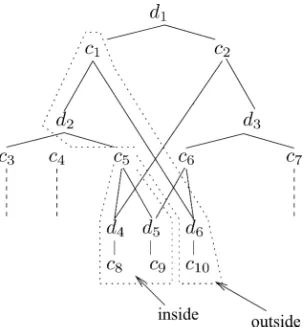
Figure 4 gives an example feature forest, and shows the nodes used to calculate the inside and outside scores for conjunctive nodec5. The inside score for a disjunctive
node,φd, is the sum of the inside scores for its conjunctive node daughters:
φd=
c∈γ(d)
φc (22)
The inside score for a conjunctive node,φc, is defined in terms of the inside scores ofc’s disjunctive node daughters:
φc=
d∈δ(c)
φdeλλλ·fff(c) (23)
whereλλλ·fff(c)=iλifi(c). If the conjunctive node is a leaf node, the inside score is just the exponentiation of the sum of the feature weights on that node.
The outside score for a conjunctive node,ψc, is the outside score for its disjunctive node mother:
ψc=ψdwherec∈γ(d) (24)
The calculation of the outside score for a disjunctive node, ψd, is a little more involved; it is defined as a sum over the conjunctive mother nodes, of the product of the outside score of the mother, the inside score of the disjunctive node sister, and the feature weights on the mother. For example, the outside score ofd4in Figure 4 is the
sum of two product terms. The first term is the product of the outside score ofc5, the
inside score ofd5, and the feature weights atc5; and the second term is the product of
the outside score ofc2, the inside score ofd3, and the feature weights atc2. The definition
is as follows; the outside score for a root disjunctive node is 1, otherwise:
ψd=
{c|d∈δ(c)}
ψc
{d|d∈δ(c),d=d}
φdeλλλ·fff(c)
The normalization constantZSis the sum of the inside scores for the root disjunctive nodes:
ZS=
dr∈R
φdr (26)
In order to calculate inside scores, the scores for daughter nodes need to be calcu-lated before the scores for mother nodes (and vice versa for the outside scores). This can easily be achieved by ordering the nodes in the bottom-upCKYparsing order.
5.4 Estimation for the Dependency Model
For the dependency model, the computations of the empirical expected values (17) and the log-likelihood function (16) require sums over just those derivations leading to the gold-standard dependency structure. We will refer to such derivations ascorrect
derivations. As far as we know, this problem of identifying derivations in a packed chart which lead to a particular dependency structure has not been addressed before in the NLPliterature.
Figure 5 gives an algorithm for finding nodes in a packed chart which appear in correct derivations.cdeps(c) returns the number of correct dependencies on conjunctive node c, and returns the incorrect marker∗if there are any incorrect dependencies on
c; dmax(c) returns the maximum number of correct dependencies produced by any sub-derivation headed by c, and returns ∗if there are no sub-derivations producing
Figure 5
only correct dependencies;dmax(d) returns the same value but for disjunctive noded. Recursive definitions of these functions are given in Figure 5; the base case occurs when conjunctive nodes have no disjunctive daughters.
The algorithm identifies all those root nodes heading derivations which produce just the correct dependencies, and traverses the chart top-down marking the nodes in those derivations. The insight behind the algorithm is that, for two conjunctive nodes in the same equivalence class, if one node heads a sub-derivation producing more correct dependencies than the other node (and each sub-derivation only produces correct dependencies), then the node with less correct dependencies cannot be part of a correct derivation.
The conjunctive and disjunctive nodes appearing in correct derivations form a new feature forest, which we call a correct forest. The correct forest forms a subset of the complete forest (containing all derivations for the sentence). The correct and complete forests can be used to estimate the required log-likelihood value and feature expectations. LetEΦΛfibe the expected value offiover the forestΦfor modelΛ; then the values in Equation (17) can be obtained by calculatingEΦΛjfifor the complete forestΦj for each sentenceSjin the training data, and alsoE
Ψj
Λfifor each correct forestΨj:
∂L(Λ)
∂λi = m
j=1
(EΨj
Λfi−E Φj
Λfi) (27)
The log-likelihood in Equation (16) can be calculated as follows:
L(Λ)= m
j=1
(logZΨj−logZΦj) (28)
where logZΦand logZΨare the normalization constants forΦandΨ.
5.5 Estimation in Practice
Estimating the parsing models consists of generating packed charts for each sentence in the training data, and then repeatedly calculating the values needed by theL-BFGS estimation algorithm until convergence. Even though the packed charts are an efficient representation of the derivation space, the charts for the complete training data (Sec-tions 02–21 of CCGbank) take up a considerable amount of memory. One solution is to only keep a small number of charts in memory at any one time, and to keep reading in the charts on each iteration. However, given that theL-BFGSalgorithm takes hundreds of iterations to converge, this approach would be infeasibly slow.
Our solution is to keep all charts in memory by developing a parallel version of theL-BFGStraining algorithm and running it on an 18-node Beowulf cluster. As well as solving the memory problem, another significant advantge of parallelization is the reduction in estimation time: using 18 nodes allows our best-performing model to be estimated in less than three hours.
holding the packed charts for that subset in memory. The key stages of the algorithm are the calculations of the model expectations and the likelihood function. For a single-process version these are calculated by summing over all the training instances in one place. For a multi-process version, these are summed in parallel, and at the end of each iteration the parallel sums are combined to give a master sum. Producing a master operation across a cluster usingMPIis areduceoperation. In our case, every node needs to be holding a copy of the master sum, so we use anall reduceoperation.
The MPI library handles all aspects of the parallelization, including finding the optimal way of summing across the nodes of the Beowulf cluster (typically it is done using a tree algorithm). In fact, the parallelization only adds around twenty lines of code to the single-process implementation. Because of the simplicity of the parellel communication between the nodes, parallelizing the estimation code is an example of anembarrassingly parallelproblem. One difficult aspect of the parallel implementation is that debugging can be much harder, in which case it is often easier to test a non-MPI version of the program first.
6. The Decoder
For the normal-form model, the Viterbi algorithm is used to find the most probable derivation from a packed chart. For each equivalence class, we record the individual entry at the root of the subderivation which has the highest score for the class. The equivalence classes were defined so that any other individual entry cannot be part of the highest scoring derivation for the sentence. The score for a subderivationdisiλifi(d) where fi(d) is the number of times the ith feature occurs in the subderivation. The highest-scoring subderivations can be calculated recursively using the highest-scoring equivalence classes that were combined to create the individual entry.
For the dependency model, the highest scoring dependency structure is required. Clark and Curran (2003) outline an algorithm for finding the most probable dependency structure, which keeps track of the highest scoring set of dependencies for each node in the chart. For a set of equivalent entries in the chart (a disjunctive node), this involves summing over all conjunctive node daughters which head sub-derivations leading to the same set of high scoring dependencies. In practice large numbers of such conjunctive nodes lead to very long parse times.
As an alternative to finding the most probable dependency structure, we have developed an algorithm which maximizes the expected labeled recall over dependen-cies. Our algorithm is based on Goodman’s (1996) labeled recall algorithm for the phrase-structure PARSEVAL measures. As far as we know, this is the first application of Goodman’s approach to finding highest scoring dependency structures. Watson, Carroll, and Briscoe (2005) have also applied our algorithm to the grammatical relations output by theRASPparser.
The dependency structure,πmax, which maximizes the expected recall is:
πmax=argmax π
πi
P(πi|S)|π∩πi| (29)
standard, then we calculate the expectedrecall by summing the recall ofπ relative to eachπi, weighted by the probability ofπi.
The expression can be expanded further:
πmax=argmax π
πi
P(πi|S)
τ∈π
1 ifτ∈πi
=argmax π
τ∈π
π|τ∈π P(π|S)
=argmax π
τ∈π
d∈∆(π)|τ∈π
P(d|S) (30)
The reason for this manipulation is that the expected recall score for π is now written in terms of a sum over the individual dependencies inπ, rather than a sum over each dependency structure forS. The inner sum is over all derivations which contain a particular individual dependencyτ. Thus the final score for a dependency structure
πis a sum of the scores for each dependencyτinπ; and the score for a dependencyτ
is the sum of the probabilities of those derivations producingτ. This latter sum can be calculated efficiently using inside and outside scores:
πmax=argmax π
τ∈π 1
ZS
c∈C
φcψc ifτ∈deps(c) (31)
whereφcis the inside score andψcis the outside score for nodec;Cis the set of conjunc-tive nodes in the packed chart for sentenceSanddeps(c) is the set of dependencies on conjunctive nodec. The intuition behind the expected recall score is that a dependency structure scores highly if it has dependencies produced by high probability derivations.4
The reason for rewriting the score in terms of individual dependencies is to make use of the packed chart: The score for an individual dependency can be calculated using dynamic programming (as explained previously), and the highest scoring dependency structure can be found using dynamic programming also. The algorithm which finds
πmaxis essentially the same as the Viterbi algorithm described earlier, efficiently finding a derivation which produces the highest scoring set of dependencies.
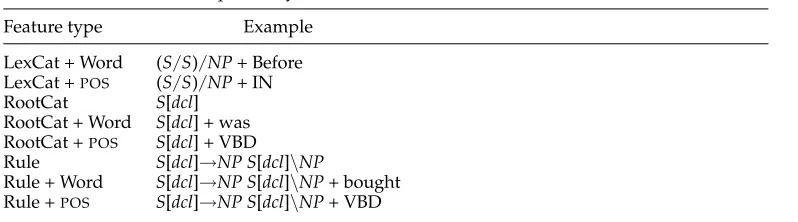
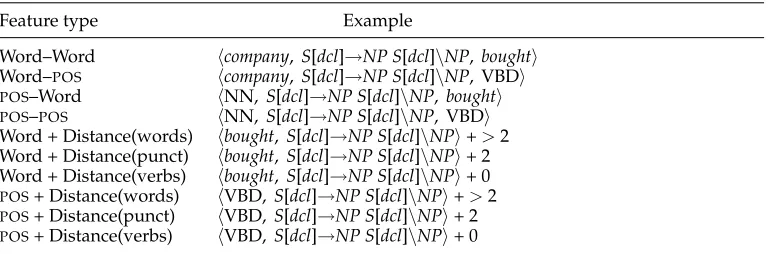
7. Model Features
The log-linear modeling framework allows considerable flexibility for representing the parse space in terms of features. In this article we limit the features to those defined over local rule instantiations and single predicate–argument dependencies. The fea-ture sets described below differ for the dependency and normal-form models. The