Master Thesis
Resource Operations Model in a
Dynamic World
Software Engineering
Faculty of Electrical Engineering,
Mathematics and Computer Science
University of Twente
J.W. Koelewijn
Computer Science
Software Engineering
0007838
Witbreuksweg 379-007
7522 ZA
Enschede
RESOURCE OPERATIONS MODELS HAVE OFTEN BEEN USED AS AN ABSTRACTION OF SYSTEMS TO PERFORM BEHAVIOURAL PATTERN DETECTION. TRADITIONALLY, FOR THE ACTUAL PATTERN DETECTION AND CONSTRAINT SPECIFICATION, THESE SYSTEMS USE REGULAR EXPRESSIONS.
HOWEVER, REGULAR EXPRESSIONS SUFFER FROM POOR EVOLVABILITY, BECAUSE THE ALPHABET MUST BE KNOWN. THEREFORE IN THIS THESIS, TWO ALTERNATIVES ARE CONSIDERED: GRAPH TRANSFORMATION SYSTEMS AND THE VIBES SPECIFICATION LANGUAGE. BECAUSE CONSTRAINT VERIFICATION METHODS ARE ALMOST EXCLUSIVELY USED
IN COMBINATION WITH STATICALLY TYPED LANGUAGES, WE INVESTIGATED THE ISSUES IN PERFORMING CONSTRAINT VERIFICATION ON DYNAMICALLY TYPED LANGUAGES. TRADITIONAL
VERIFICATION SYSTEMS USE THE TYPE INFORMATION AVAILABLE IN THE ABSTRACT SYNTAX TREE (AST), BUT THIS TYPE INFORMATION IS MOSTLY NOT AVAILABLE IN THE AST OF DYNAMICALLY TYPED LANGUAGES, UNLESS COMPLEX TYPE INFERENCE ALGORITHMS ARE USED.
ALTHOUGH TYPE INFERENCE HELPS IN SOME CASES, MOST OF THE TIME ONLY A SET OF TYPES CAN BE INFERRED FOR VARIABLES, RATHER THAN AN EXACT TYPE. IT HAS APPEARED THAT THIS MAKES IT NECESSARY TO PERFORM CONSTRAINT VERIFICATION AT RUNTIME. THE SOLUTIONS THAT ARE PROPOSED IN THIS THESIS HAVE BEEN IMPLEMENTED AND TESTED IN
Acknowledgements
This thesis marks the end of an era for me. An era that begun when I first set foot on campus and in which I have learned very much, both professional and personal. I call it an era, because it seemed to last forever. But as with all good things, it comes to an end. Before I begin with this thesis, I want to take the possibility to show my grat-itude to all people that have stood me by and helped in my professional and personal development.
First and foremost I would like to thank my family, who never failed to believe in me, even in times this thesis seemed to have no end. During my whole life as a student they have believed in me, and the only times they asked how long it would take until it was finished, was because they were genuinely interested in me.
I would also like to thank my girlfriend, who always believed in me, even in times I felt helpless and lost. She helped me find motivation and helped me relax and for this I am very thankful. Without you the last year would not have been so pleasant.
My friends and colleagues have also helped me find my way, personally and pro-fessionally, something for which I am very grateful.
Last but not least I would like to show my gratitude to my supervisors. Without the countless discussions and help with my text I would not been able to write this thesis.
Table of Contents
1 Introduction 1
1.1 Resource Operations Model . . . 2
1.2 Aspectual conflict detection . . . 5
1.3 Regular expressions . . . 7
2 Problem Statement 10 3 Specification of behavioural patterns 14 3.1 Difference between specification and underlying model . . . 14
3.2 Graph based . . . 14
3.2.1 Introduction . . . 14
3.2.2 Experiments . . . 19
3.2.3 Evaluation . . . 21
3.3 Vibes based . . . 22
3.3.1 Introduction . . . 22
3.3.2 Evaluation . . . 26
3.4 Summary . . . 28
4 Associating actions with behavioural patterns 29 4.1 Specifying actions in constraints . . . 30
4.2 Actions and AOP . . . 32
4.3 Multiple simultaneous actions . . . 32
4.4 Evaluation . . . 34
5 Detecting behavioural patterns in dynamically typed languages 36 5.1 Verification of static and dynamically typed languages . . . 36
5.2 Keeping track of patterns . . . 37
5.3 Resource designation . . . 40
5.4 Tying it together . . . 41
5.5 Multiple constraints . . . 44
5.6 Summary . . . 46
6 Implementation in Smalltalk 49 6.1 Why Smalltalk? . . . 49
6.2 Deterministic Abstract Recognisers . . . 49
6.3 Meta information . . . 51
6.4 Constraints . . . 52
6.5 Ordering constraints . . . 53
6.6 SuperVisor . . . 54
6.7 Message interception . . . 55
6.8 Working out the example . . . 57
6.8.1 Creating the constraints . . . 57
6.8.3 Using the SuperVisor to tie it all together . . . 62
6.8.4 Ordering the actions . . . 66
6.9 Conclusions . . . 67
7 Conclusions 69 7.1 Overcoming poor evolvability . . . 69
7.2 Behavioural joinpoints . . . 70
7.3 Verifying dynamically typed systems . . . 71
7.3.1 Keeping track of patterns . . . 71
7.3.2 Designating resources . . . 71
7.3.3 Coupling patterns to constraints . . . 71
7.4 Implementation . . . 72
7.5 Lessons learned . . . 72
7.6 Future work . . . 72
7.7 Personal evaluation . . . 73
7.8 Summary . . . 75
A CheckDesign 78 B API 85 B.1 DAR . . . 85
B.2 Annotations . . . 88
B.3 Constraints . . . 89
Chapter 1
Introduction
A Resource Operations Model is a model in which the world is abstracted into re-sources and the operations that can be performed on them. On such a model constraints can be defined, which constrain the behaviour of the resource in terms of its operations. Using a Resource Operations Model to model a system can thus be seen as creating a behavioural model of the system.
This chapter gives background information about Resource Operations Models and how they have been used in the past and explains regular expressions and how they are used.
Chapter 2 gives the problem statement, which is broken down into three problems, that will be addressed in this thesis.
In Chapter 3 we give a short recapitulation of the shortcomings of regular expres-sions with respect to constraint specifications, especially on how susceptible regular expressions are to changing alphabets, and we give an evaluation of two alternative approaches, Graph Transformation Systems and Vibes. The two alternatives are eval-uated on how they compare to each other and to regular expressions with respect to behavioural constraint specifications for resource operations models, and how they could be used for constraint verification for dynamically typed languages.
In Chapter 4 a novel way to further use information contained in behavioural constraint specifications is given. This chapter proposes to use the state information contained in constraints to add functionality to the system under verification. The chapter does not only propose a way to use this information, but will also discuss several implications that may be introduced, such as the addition of functionality from multiple constraints at the same time.
In Chapter 5 a method to perform behavioural constraint verification with respect to resource operations models on dynamically typed languages is introduced. Dynam-ically typed language cannot be verified using traditional (compile-time) verification techniques, because these techniques rely heavily on information in the Abstract Syn-tax Tree (AST) that is not available at compile-time in dynamically typed languages. This chapter proposes a solution to this problem and proposes methods to keep track of behavioural patterns and to designate pieces as code as resources. After this it combines the previous findings in a solution with which it is possible to perform be-havioural constraint verification on resource operations models of dynamically typed languages.
Chapter 6 gives an overview of a reference implementation of this verification sys-tem, and will discuss problems found during implementation and how they have been solved.
In Chapter 7.7 we reflect on the process of writing this research and will discuss the lessons that were learned during it.
solved in this thesis and how they have been solved.
1.1
Resource Operations Model
A Resource Operations Model is a model in which the world is abstracted in resources and the operations that can be performed on these resources. This abstraction can be compared with the concept of Object Orientation. The concept of Object Orientation was introduced to bring a higher level of abstraction to programming paradigms. This abstraction was introduced during a time that programming languages were still pro-cedural, and it was hard to model the world using such an paradigm. Therefore the Object Orientation model was introduced, in which real world things were represented as objects. An object is the data that makes up this real world concept, and the op-erations that can be performed on this data. This way, a real world concept was encapsulated with its functionalities in one unit.
A Resource Operations Model can be compared to Object Orientation in that real world concepts are modelled as Resources, and the Operations that can be performed on these resources. However, Resource Operation Models are not used for programming behaviour in the first place, but rather to provide a tool toreason about the behaviour of a program. The Resource Operations Model is used to detect certain behavioural patterns in programs, rather than being used to specify the behaviour of programs.
Because Resource Operations Models are used to describe the behaviour of pro-grams, their elements can be seen as abstractions of programming concepts. This means that the resources in the Resource Operations Model are abstract representations of concepts and that the operations in the Resource Operations Model can be seen as abstract representation of the methods of these concepts. There is one caveat though: A Resource could represent multiple concepts at once and an Operation could rep-resent multiple methods at once. This is where the difference in abstraction becomes visible.
Consider a program in which multiple abstract data types are being used which have been created over time. Because multiple teams have worked on the project, naming of the abstract data types has not followed a clear and distinct standard, and some abstract types have been created multiple times. For instance, both teams have implemented a logical queue using for instance arrays as the underlying concrete data type (Buffer and Queue), and the operations of this logical queue can be abstracted withadd andremoveoperations. Both implementations represent the same concept of a logical queue, but because the teams did not cooperate well, they allowed the two separate artefacts to be created independently of each other. Although both imple-mentations share the same abstract operations, it is not possible to test whether their behaviour is the same.
To test their behaviour we introduce the Resource Operations Model and we define both Buffer and Queue to be a Queue-Resource and we specify that thestoremethod of the Queue object and the put method of the Buffer object are abstracted in the
put operation of the Queue-Resource. Now we have abstracted both objects into one Resource and we have defined the operations of this Resource, and we can test whether the behaviour is as expected. This example shows that a resource can be used to abstractpart of the behaviour of a more complex concept.
Once a Resource Operations Model has been defined, constraints can be specified on the model. A constraint is defined in the New Oxford American Dictionary as a limitation or a restriction. In this context it means that a constraint is used to limit or restrict the behaviour of a program. In the Resource Operations Model, a constraint is used to test if the program behaves within the limitations of the constraints.
its capacity. Another constraint can be specified stating that it is not possible to get something from an empty Queue-Resource. Of course, to fully specify these resources we have to define operations for getting something from a Queue-Resource, but this is not of importance now. What is important is that the Resource Operations Model is an abstraction of (part of) the behaviour of a program and that constraints can be specified on this behaviour. The behaviour of a program can be tested using the Resource Operations Model and the constraints.
Because the Resource Operations Model is an abstraction of the behaviour of a program, it is very useful for creating a common ground for behavioural conflicts. For instance, a constraint could be specified that it is not possible to retrieve an item from an empty collection. This constraint is an abstraction of the previous example, but it can be expressed using the Resource Operations Model as well. Instead of abstracting the Queue and the Buffer Objects as Queue-Resource, they could have been abstracted in a Collection-Resource. Other objects of the collection data type could then be abstracted as Collection-Resources as well, and only one constraint has to be used to test the behaviour of all these objects. However, this does not necessarily mean that the Buffer and Queue objects are now only abstracted into Collection-Resources, the model also allows for multiple abstractions of the same object. This means that a Queue can be abstracted into a Queue-Resource and into a Collection-Resource at the same time. This makes the Resource Operations Model a very powerful and expressive model, that can be used as an abstraction of (part of) the behaviour of Object Oriented systems. Note however, that the Resource Operations Model is not limited to Object Oriented systems, because it can be used in procedural systems as well, for instance to constrain the usage of variables. In this example the variables are abstracted in to resources, and reading and writing a variable can be abstracted into
read andwriteoperations.
The Resource Operations Model is an abstraction of the behaviour of a program and as such can be used to model the behaviour and to test if a system is compliant to a given set of behavioural constraints.
Another example in which the usage of the Resource Operations Model is illus-trated is the analysis of a bank account. A bank account can be accessed by multiple systems at once. One of them can be an ATM where you are withdrawing money and another system is a bank back-end system transferring money to the account. If these two actions would take place at different moments in time and there would be no overlap, there is no problem. You withdraw money and some time later money is transferred to your account.
To see what problems can arise in this scenario, we first identify the bank account as a shared resource. An account can be seen as a shared resource, because the account is shared by both the ATM and the bank back-end system. Now we identify the operations that can be performed on the resource. The most obvious operations are withdrawing money and transferring money to it, but actually these operations consist of sub-operations. The basic operations are reading the amount of money, performing an arithmetic operation on this amount (addition or subtraction) and writing a new amount. This means that the operations that are performed consist of reading and writing the amount of money in the bank account.
The case in which withdrawal and transfer of funds to the account occur in different, non-overlapping moments in time can be considered as correct behaviour. The bank ac-count holds the correct balance, and everything is in order. A schematic representation in the form of a sequence diagram is given in Figure 1.1.
Figure 1.1:Representation of correct behaviour of processes A and B
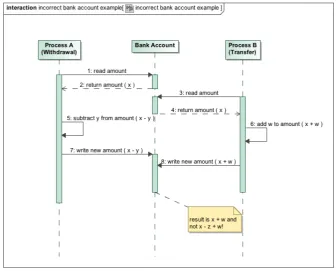
balance and the other process reads the balance as well before the new balance is written? In this case, both processes have the same balance on which they perform their arithmetics, and from now on it does not matter in what order the rest of the operations are performed, because the balance will be stored wrong anyway. This wrong sequence is illustrated in the sequence diagram in Figure 1.2.
In this diagram we see that Process A (withdrawal) reads the amount of money in the bank account. Directly after this, Process B (transferring) reads the amount as well. Now both processes hold the same amount. Now Process A subtracts an amount and writes the result back to the amount. After this, Process B adds an amount and writes this amount to the account. This means that in the end only the transfer of money is recorded in the balance and that the result of the withdrawal is not recorded in the balance. In this case this would not be a big problem for the account holder, but imagine an ordering in which only the withdrawal is recorded...
This situation can be easily detected if a constraint would be used that specifies that a write operation should always immediately be preceded by a read operation. This simple constraint would be enough to detect that the second situation (Figure 1.2) would display unwanted behaviour.
Figure 1.2:Representation of incorrect behaviour of processes A and B
1.2
Aspectual conflict detection
The Resource Operations Model has been used in the context of Aspectual Conflict Detections as well. Before we can explain how the Resource Operations Model is used, Aspect Oriented Programming is explained and we explain what Aspectual Conflicts are.
Although the adoption of the Object Oriented programming paradigm did not take off to a great start when its first concepts were introduced with first Simula 67 [17] and later the first Object Oriented programming language Smalltalk [20], since the intro-duction of graphical user interfaces in the mid 1990s, object orientation has become one of the most widely used programming paradigms. This started with the introduction of C++ and accelerated with the introduction of Sun’s Java [13] and Microsoft’s .NET Platform [33]. With the introduction of the object oriented programming paradigm, focus shifted from modules with separated data and behaviour, to self-contained units which encapsulated both the data and the behaviour. These units are known as classes and and instances of these classes are called objects.
This new notion brought a new layer of abstraction to programming languages, and it enabled programmers to model in a more data-centric manner rather than a procedure-centric manner. A table is an object on which things can be placed and is made up of a surface object and leg objects, which all have their own functionalities.
document it is often enough to mention that the Observer pattern is used, and other developers know what is meant with this. The design is clear, because the Observer pattern is in there in a self contained area in the diagram. In a perfect world, the same could be said for the code. One would expect that the code for the Observer pattern would be in a self contained set of classes as well, but this is not the case. Because of the nature of the pattern, the concept is used by many classes, and method calls are made from all these classes as well. This means that in order to implement the Observer pattern, lines of code have to be added to all classes that want to exhibit this observable behaviour.
The Observer pattern is not the only example in which object oriented programming does not seem to be able to deliver a good solution in which the functionality is contained in a limited set of classes. Other examples are for instance logging, tracing, auditing and security related concerns. Because these concerns have the tendency to cut through the interfaces of many other classes, they are calledcrosscutting concerns. These problems could be solved by the concept ofmeta objectsthat was introduced by Pattie Maes in her paper Concepts and Experiments in Computational Reflection [24] and which was later extended in the book The Art of the Metaobject Protocol of Kiczales et al. [23]. Metaobjects are the objects that make up classes, and by modifying the objects that make up classes, one can change the behaviour of these classes. Although the concept is very expressive and useful, its concepts are hard to understand and it did not bring the abstractions needed to solve the problems of crosscutting concerns in a modular fashion.
Later these ideas were used to create a new paradigm specifically created to address crosscutting concerns. This new paradigm is called Aspect Oriented Program-ming [22]. In this paradigm, a piece of code can be executed on pre-specified moments during the execution of the code. These pre-specified moments are called joinpoints. A joinpoint is a point in the execution of a program at which new code can be inserted. Different implementations of Aspect Oriented Programming allow the usage of differ-ent joinpoints, but the commonly used joinpoints are method calls, method executions and field access.
The code that should be executed and the specification of the joinpoints where this should happen is called an aspect. An aspect is made up of the following parts:
◦ A name that is given to the aspect
◦ A pointcut expression selecting joinpoints on which the aspect should be applied
◦ Advice, the code that should run when the joinpoints that are selected by the pointcuts are encountered during the execution
◦ Methods that can be used in the advice
◦ Variables that can be used in the advice and (possibly)
◦ A Super aspect from which functionality and pointcuts can be inherited.
The process in which the advice is applied to the base code (i.e. non aspectual code) is called weaving. This can happen in different ways: the advice can be inserted into the original source code by a preprocessor or it can be inserted into the compiled code. When a virtual machine is used, there are other possibilities. One of them is weaving the advice when the original classes are loaded into the virtual machine, or to insert the advice into the bytecode. Another method of applying advice is by using so called Proxy classes. Because the term weaving can mean different things, we will use the term superimposition in this thesis.
which holds pointcut expressions to select those joinpoints at which the state of objects is changed; for instance, all setter methods of a specific collection of objects. This way the functionality provided by the pattern is contained in one unit, called the aspect, and the source is a clear representation of the design in which this functionality was already in a self contained area.
A good overview of Aspect Oriented Programming and an overview of multiple im-plementations can be found in [10]. Well known AOP imim-plementations are AspectJ [1] and Compose?[2].
We have seen that Aspect Oriented Programming provides a method to modularise otherwise crosscutting code. This brings great power to developers, but with it new problems can be introduced as well.
Imagine for instance two aspects, one that is used to encrypt data that is written to a database and another aspect that is used to log all database access. Now consider that these two aspects are defined on the same joinpoints as well. Whenever two aspects are superimposed at the same joinpoint, there is the possibility that unwanted behaviour emerges. The problem is that this is not always obvious. Both aspects can work perfectly well when superimposed separately on the base code, but could introduce errors when superimposed together. This, for instance, can be the case when both aspects change the same fields in the base code.
Whenever such unwanted behaviour occurs, it is called anaspectual conflict. As-pectual conflicts happen when two aspects, when superimposed together, introduce unwanted and unanticipated behaviour.
Aspectual conflicts can be of two kinds: the first is structural and the second is behavioural. Structural conflicts arise when for instance two aspects introduce methods or fields with the same name, or structural conflicts can be introduced by changing the inheritance tree or introduce conflicting annotations. Behavioural conflicts arise when two aspects together change the behaviour of the program. For both kinds of problems research has been done, in [15] for instance, graph transformation systems are used to detect structural conflicts and in [29] a classification system for aspects is introduced to detect whether aspects interfere with the behaviour of the base program. In [29], Rinard et al. introduce the concept of scopes, with which they try to capture the behaviour of an aspect or method with respect to fields in the base code. The behaviour is being captured as being either read behaviour or write behaviour, and although it is not mentioned in the work itself, the Resource Operations Model is used in a very basic form.
In Durr [9] the Resource Operations Model is used to reason about behavioural conflicts between aspects. In this work the use of the Resource Operations Model is and is used in a wider sense than the basic, implicit use in Rinard. Where the work of Rinard et al. only focuses on classifying aspects, the work of Durr focusses on the detection of aspectual conflicts. A conflict is defined in either a constraint or in assertions, which both are given in the form of regular expressions. Before the aspects are superimposed on the base code, all possible orderings in which the aspects can be superimposed are generated, and traces of possible sequences of operations on resources are created. Then these sequences are tested to see if they match the regular expression that was used to specify the constraint (or do not match in the case of assertions).
1.3
Regular expressions
used to specify certain patterns which can then be identified in a string of text. Before a regular expression can be used, however, the alphabet has to be known. The alphabet of a regular expression is defined as the collection of the characters, or tokens, that cannot be broken down into smaller constituents. A regular expression is then specified using the symbols from the alphabet. In other words, the alphabet defines the tokens that can be recognised by the regular expression. Because the alphabet of the expression is specified by the user, this means that regular expressions can be used for other purposes than identifying text patterns. For instance, regular expressions can be used to detect patterns in certain abstractions.
In [31] a regular expression over an alphabet Σ is defined recursively as follows:
i) Basis:λanda, for every a ∈Σ, are regular expressions over Σ
ii) Recursive step: Letuandvbe regular expressions over Σ. The expressions
(u∪v) (u v) (u∗)
are regular expressions over Σ
iii) Closure: u is a regular expression over Σ only if it can be obtained from the basis elements by a finite number of applications of the recursive step.
In this recursive definition,λ denotes the null element and Σ the alphabet of the regular expression. The regular expression (u∪v) is the union of u and v, (uv) is the concatenation and (u∗) denotes the Kleene star operation, meaning zero or more occurrences ofu. Sometimes u+ is used as a shorthand foruu∗.
An example, that can be used with the bank account example of section 1.1, is the following regular expression:
(read write)
Although it is very simple, this can be read as: write is preceded byread. However, this expression only accepts the sequenceread write, and what we want to achieve is a regular expression that accepts more than only that sequence. To do this, we add the Kleene star operation, so that the sequence read write can occur zero or more times:
(read write)∗ This regular expression accepts the sequences:
∅
read write
read write read write
read write read write read write
read write read write read write read write
Regular expressions can be a very powerful tool to detect sequences and to see if a certain sequence adheres to a given pattern. That is why they are often used to specify constraints. The given example for instance can be interpreted as that a write operation can only occur if a read operation was performed immediately before that and that areadoperation can only be followed by awriteoperation and cannot occur on its own. If this is not the case, it is an indication that the actual behaviour is not aligned with the required behaviour.
Another example where regular expressions are being used for constraints is the work of Durr [9], in which regular expressions are used to specify constraints and assertions. If the behaviour (represented in a Resource Operations Model) cannot be captured by the regular expression of a constraints, a warning is generated and displayed to the developer.
To test if a given sequence adheres to a regular expression, a deterministic finite automaton is created that accepts the regular expression.
Definition 1.3.1 Adeterministic finite automaton (DFA)is a tuple M= (Q,Σ, δ, q0, F),
where Q is a finite set of states, Σa finite set called the alphabet, q0 ∈Σ a
distin-guished state known as the start state, F ⊂ Q called the final or accepting states, and δ a total function from Q ×Σto Q known as the transition function [31].
A DFA can be represented graphically by using a special graph, consisting of nodes and edges. A state is represented by a circle with a label, the start state is indicated by a circle with an arrow head attached to it, and a final state is represented by two circles drawn inside each other. The edges have labels over them and the labels come from the alphabet. For everyδ(qi, a) =qj from the transition function (qi, qj∈ Qand
a ∈Σ) there is an edge from the node with labelqi to the node qj with labela. For instance, the regular expression (read write)∗ can be represented by the DFA in figure 1.3.
q0 q1
read
write
Figure 1.3:DFA of the (read write)∗regular expression
The DFA starts inq0, indicated by the arrowhead attached to it, andq0is an final (or accepting) state as well, which is indicated by the double circles. If areadsymbol is encountered, a transition is made to q1, which is not a final state. This means that the sequence read itself is not accepted by the regular expression. Only if a write symbol is encountered another transition is made to q0, which is an accepting state and thus the sequenceread writeis accepted.
Chapter 2
Problem Statement
In the previous chapter regular expressions were introduced, but although they are often used, they do have certain shortcomings. We have seen that a regular expression is expressed using a certain alphabet Σ. This alphabet contains all symbols that are accepted by the corresponding regular automaton. In some cases, the fact that this alphabet Σ is predetermined, causes a problem. The problem is not apparent when a certain regular expression is used once, but it emerges over time. This becomes apparent when a regular expression is used to detect patterns with evolving alphabets. When the alphabet does not evolve, there is no problem. However, when the alphabet changes, it means that symbols are added or removed from the alphabet. When such a change in the alphabet occurs, it could mean that the regular expressions should be changed as well. This is especially the case when they are used in a context such as in [9]. In this work regular expressions are used to specify constraints and assertions on operations that are performed on certain resources. But what if the set of operations changes, for instance, if a certain operation is added? In this case the alphabet of the regular expression changes and because of this the constraints should change as well. The need to change specifications if the alphabet changes places an extra burden on the developers of the code. The developers always have to keep the specifications in the back of their head and should always think about the constraints when they update the code. Because when they update the code, it could be that they add or remove symbols from the alphabet. When the alphabet changes, the regular expressions used to create the specification could change as well, otherwise constraints that are not violated, could be violated using the same specifications.
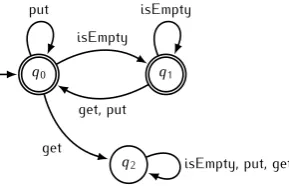
To illustrate this, consider the following example. In Figure 2.1 a regular automaton of a constraint is given. This constraint is specified on a buffer which only has the following methods:
{put, get, isEmpty}
This constraint states that something can only be retrieved from a buffer if it is not empty. To enforce this, a call to the method isEmpty should be made before the
get method is invoked. Only if this is done the automaton accepts the input. If the
get method is invoked without invoking theisEmpty method, the automaton makes a transition to stateq2, which is not an final state and from which it is not possible to reach a final state. Such a non-final state from which it is not possible to reach a final state is called a trap state. Trap states are used to indicate failures of the modelled system.
q0 q1
q2
isEmpty
get put
get, put isEmpty
[image:16.595.207.373.319.428.2]isEmpty, put, get
Figure 2.1:Buffer constraint expressed with an regular automaton.
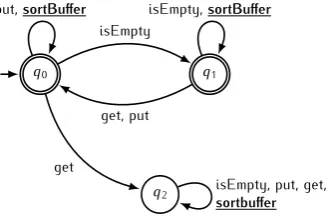
case, however. Because the interface changed, the alphabet Σ changed as well, and this in turn means that the constraint should be changed as well to be able to handle calls to the introducedsortBuffer as well. In the case of the constraint of the example this means that new transitions should be added that point to the same state as where they originate. An adapted version of the same constraint is shown in Figure 2.2.
q0 q1
q2
isEmpty
get put,sortBuffer
get, put
isEmpty,sortBuffer
isEmpty, put, get,
sortbuffer
Figure 2.2:Buffer constraint adapted for the addedsortBufferoperation.
The example shows that regular expressions can suffer from poor evolvability. This poor evolvability can become a serious problem when regular expressions are used to perform verification of constraints, such as in the area of conflict detection or when regular expressions are used to detect behavioural conflicts in code. This thesis will look for a way to overcome this problem of poor evolvability with respect to the Re-source Operations Model and will investigate alternatives to regular expressions to specify constraints on resource operations.
The Resource Operations Model has been used in the context of Aspect Oriented Programming (AOP) to identify possible aspectual conflicts. However, the Resource Operations Model can be used for other purposes within the field of AOP, i.e. to specify points in the execution to insert code, so-called joinpoints.
In a keynote, Kiczales (one of the main contributors to AspectJ) made a strong case to improve joinpoint models as they exist today [21]. This because he feels that the current joinpoint models are not completely capable of capturing all events that can occur in the execution of a program. In [6] Cazzola et al. investigate the limitation of current mainstream AOP implementations, and they opt for a more semantic approach for joinpoint selection. They identify that the semantics of the joinpoint selection model can bepropertyorbehaviouralbased. With property based semantics they mean that joinpoints are based on properties of those joinpoints, for instance, whether the code at the joinpoint does not interfere with a specific property. Behavioural based semantics then deals with what the executed code displays as behaviour.
join-points. This thesis therefore investigates how constraints on a Resource Operations Model can be used to define and select behavioural joinpoints at which functionality can be added to existing systems.
The detection of behavioural patterns has until now only been carried out on statically typed languages such as C, C# and Java. In a statically typed language, the type of a variable has to be specified explicitly, or can be inferred by a type inference system automatically. This way, information about variables in the code can be used by the compiler to detect certain type errors. Because information about variable types is available at compile-time, behavioural patterns can be detected before the program is run.
In dynamically typed languages, such as Smalltalk, Ruby or Python, values are typed, rather than variables. Because of this, a variable only has a type when a value is stored in it. Although there exist flow analysis algorithms to narrow the set of types a variable can have at any moment [19], no exact type information is available at compile-time and the exact type information of a variable is only available at runcompile-time. Because the behaviour of a program is often expressed using operations that are performed on variables, and because the set of operations that can be performed on a variable is dependent on the type of the variable, behavioural patterns can only be detected at runtime.
This is the reason that the detection of behavioural patterns has mostly focused on statically typed programming languages (such as for instance the detection of as-pectual conflicts in [9]) and dynamically typed languages have been left behind in such investigations. In this thesis we will investigate whether it is possible to detect behavioural patterns in dynamically typed languages, and if so, how to keep track of patterns that have occurred during the execution. We want the solution to be scalable in the sense that whenever the constraint specification grows in complexity, the veri-fication system should not incur performance penalties.
To give an overview of what this thesis addresses, Figure 2.3 is given. This figure gives an overview of an hypothetical system, which is capable of verifying systems based on a Resource Operations Model and constraints on this model.
At the heart of this picture we see the Verification System, which will give a Verdict as output based on the Constraints and the Resources and Operations. We also see that the Constraints can be used to attach Actions. Actions are used to specify functionality that is to be added to the system under verification. The diagram also shows that the Resources and Operations are an abstraction of the system under verification, and that the Constraints are used to constrain the Resources and Operations.
To summarise, this thesis addresses the following problems in terms of Figure 2.3:
1. How can we overcome the poor evolvability of regular expressions, which are used to specify the Constraints?
2. How can the Resource Operations Model be used to specify behavioural join-points? In other words, how can Actions be added?
3. How can the verification system for Resource Operations Models be used for dynamically typed languages?
Chapter 3
Specification of behavioural
patterns
This chapter evaluates two alternatives to regular expressions that can be used to specify behavioural constraints. The focus of the investigation will be the usability and evolvability of the alternatives with respect to Resource Operations Models. The chapter begins with an overview of the differences between a specification and its underlying model and continues with describing graph transformation systems and the Vibes specification language as alternatives to regular expressions to specify con-straints and verifying whether these concon-straints are not violated. The chapter concludes with an evaluation of the two alternatives.
3.1
Difference between specification and underlying model
Before we start the discussion of limitations that a specific specification method may have, it is important to distinguish between the specification and the underlying model that is used to verify whether a certain specification holds. It is often possible to get from a specification to its model through a form of translation, but to give a thorough overview of the problems a specification technique may have, it is important not to overlook its underlying model. The specification in itself is a certain language in which properties that should hold or should not hold can be expressed. This language can be a very formal looking language (such as for instance Z [18]), or a language that completely exists of graphical symbols, such as for instance the language of flow diagrams. The underlying model is an abstraction of the system against which the specification is checked and often there are multiple ways in which the underlying model can be described (e.g. the formal model of UML). The underlying model is therefore of great importance in discussing specification techniques, because often problems of a specification technique have their origins in the model.
3.2
Graph based
3.2.1
Introduction
The abstraction used there is that the cities are represented by vertices and the roads between the cities as edges. One of the reasons why graphs are so commonly used, is because of the mathematical properties of graphs. Many algorithms exist for graphs, such as for the calculation of the shortest path between two points, or for the calculation of a cycle that visits each vertex.
Class C
Variable A 6
read write write
7 9
belongsTo
value target
nextOp target
nextOp
newValue target
newValue
Figure 3.1:Graph representing operations performed on a variable.
An example of a graph is given in Figure 3.1. In this figure the rectangles with
Class C, Variable A, read, write, 6, 7 and9 are vertices and the arrows between them represent relationships between them. The name of the relationship is given as a label next to the arrows. The example displays one of the ways graphs can be used to model the usage of a variable by a program. The variable is depicted as a node in the graph and as can be seen, Variable A belongs to Class A and has an initial value of 6. The first operation that is performed on the variable is a readoperation. This can be seen because the read node has a target edge with Variable A as the target node. After the read operation, the next operations are twowrite operations, havingnewValue’s of respectively 7 and 9.
The graph given in Figure 3.1 is one way to model the behaviour of a program as a Resource Operations Model. Although this graph does not give a complete model, it already can be used to detect some behavioural patterns. However, before we explain how patterns can be specified using graphs and how they can be detected, we have to explain the concept of meta models.
To formally create a model, a so calledmeta model is needed. Generally, a meta model defines the language and processes from which to form a model. The meta model states what elements can occur in a model and what relations may exist between those elements. For instance, the meta model of the graph in Figure 3.1 is given in Figure 3.2.
This meta model expresses what relations can exist between different type of nodes in a graph. For instance, it makes clear that a Variable has a value and belongs to a class. It is also shown thatread andwriteare both specialisations ofOperation.
Class
Variable Value
Operation
Write Read
belongsTo
value target
newValue nextOperation
Figure 3.2:Meta model of the operational model of the graph in Figure 3.1.
needed. Of course, such a pattern can be modelled using a graph as well, but for this to be usable, there should be a method to find the pattern in the original graph.
Before explaining how two graphs can be compared, it is necessary to give a formal definition of a graph.
Definition 3.2.1 AgraphG is a tuple hV , E, Li, where
◦ V is a finite set of vertices (nodes) ◦ E is a finite set of edges and ◦ L is a finite set of labels
An edgee ∈ E is a tuple (src, lbl, tgt), wheresrc, tgt ∈ V andlbl ∈ L. This defines an edge between verticessrcandtgtwith labellbl. Labels on vertices are represented by an edge ewheresrc=tgt.
To compare two graphs, the concept ofmorphismsis introduced. A morphism defines that there exist similarities in the form and structure of two graphs:
Definition 3.2.2 Given two graphs G = hVG, EGi and H = hVH, EHi, a morphism
f :G → H has two functions:
◦ fV :VG→ VH
◦ fE :EG→ EH
and preserves structure: fE(v, a, w) = (fV(v), a, fV(w))for all(v, a, w)∈ E.
This definition states that there exist mappings from nodes of graph G to nodes of graph H and that there exist mappings from edges of graph G to edges of graphH. It also defines that the structure of the graph remains in the second graph, by stating that when an edge is mapped, the mapping of the source and target nodes of that edge are mapped as well and consistently.
When these mappings are bijective, the graphs are said to beisomorphic. Isomor-phism states that the form and structure of two graphs are exactly the same, and a one-to-one mapping between the graphs can be made.
Class C
Variable A 6
read write write
7 9
ClassC
Variable A
belongsTo
value
target
nextOp target
nextOp
newValue target
[image:22.595.142.442.99.347.2]newValue belongsTo
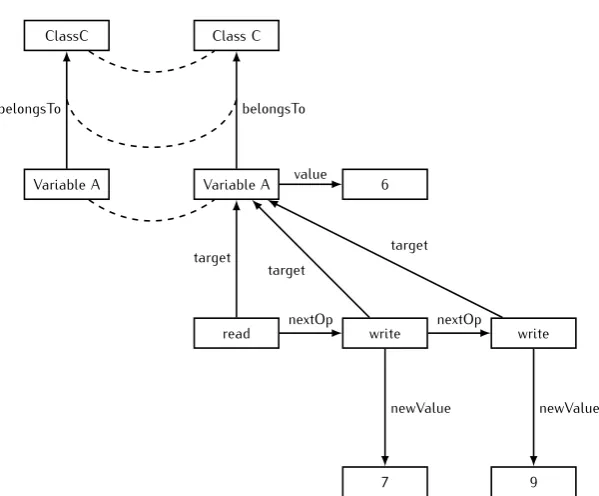
Figure 3.3:Two graphs and a morphism between them (represented by the dashed arcs)
two graphs. This process of finding such a morphism is often called graph matching, because we want to find a match of a certain graph in another one.
To make this more clear, consider the left hand side of Figure 3.3. Here we see a graph that represents the relationship between Class C and a Variable A, represented by the edge labeledbelongsTo. This graph can be matched in the graph of Figure 3.1, because there exists a morphism between the two graphs. This morphism is represented by the dashed arcs between the graph in the left hand side and the graph in the right hand side. Note that the morphism does not only define a mapping between nodes of the two graphs, but of the edges involved as well, and that the morphism preserves the structure.
When graphs are used to detect a graph in another graph, the latter graph is called thehost graph. The host graph is the graph for which a morphism has to be found.
Although morphisms make it possible to detect subgraphs in other graphs, being able to change the structure of the host graph once we found a match would be useful as well, especially in the context of behavioural conflict detection. This would make it possible to indicate in the host graph where a conflict was found and which operations are involved in this conflict. This is in contrast to using a special data structure to store this information. This would completely decouple the conflict detection from the underlying programming language, because all detection calculations are performed in the graph, rather than in a specific programming language and thus would make the pattern detection more portable.
Thankfully there already exists a concept to change the structure of a graph, so-called Graph Transformation Systems. With such a system, a graph is specified that should be matched in the host graph and another graph is given that specifies how the found subgraph is to be altered once a match is found. Not only additions to the host graph can be specified, but deletion of nodes and edges is possible as well.
Application Conditions (NACs) are combined in one specification, opposed to the more commonly used format in which the pattern, items to be added or deleted and the NACs are specified using morphisms. Not only does this allow a more compact notation, it is more easy to see what a rule does as well.
Opposed to a graph that specifies which subgraph should be matched, a Negative Application Condition in a transformation rule specifies a pattern that should not be matched in the host graph. If the graph specified by a NAC can be matched in the host graph, the rule itself will not match and the transformations specified by the rule will not be performed. This makes it possible to match very specific subgraphs in a host graph and completes the expressiveness of graph transformation systems.
Node
AddedNode
DeletedNode
NACNode
add
delete
[image:23.595.229.354.239.345.2] [image:23.595.217.367.517.639.2]nac
Figure 3.4:Notation of transformation rules in Groove
In Figure 3.4 a transformation rule is given with all features of a graph transfor-mation system. First of all, there is the black, solid node with the Node label. This specifies the graph that should be matched in the host graph. Next to this the green edge and node with theAddedNodelabel are displayed, with a bigger line width. This represents a node and an edge that are added after the application of the transforma-tion rule. There is also a dashed node DeletedNodeand a dashed edge. These two represent a node and an edge that should be matched in the host graph as well, but these will be removed after the application of the rule. Finally, there is a dashed node
NACNode and an edge connected to it with increased line width, which specify the Negative Application Condition. As stated before, these specify a pattern that should not be matched in the host graph.
write write
conflict
target
nextOp
target
involves involves
Figure 3.5:Graph transformation rule to indicate a conflict.
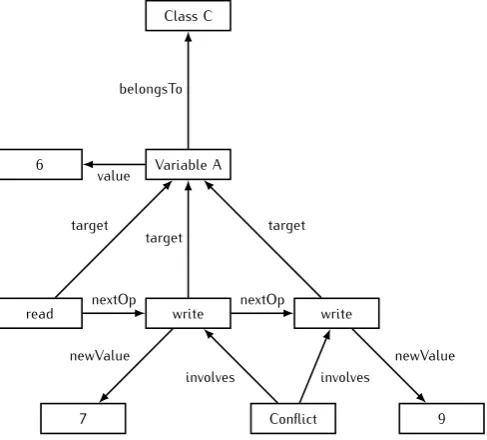
In other words, the rule states that it does not matter what the target of the write operation is, but it is considered a conflict whenever two consecutivewriteoperations are performed on this target. Application of this rule on the graph of Figure 3.1 results in the graph of Figure 3.6.
Class C
Variable A 6
read write write
7 Conflict 9
belongsTo
value target
nextOp target
nextOp newValue
target
[image:24.595.171.415.169.389.2]newValue involves involves
Figure 3.6:Graph representing operations performed on a variable after the application of the rule of Figure 3.5
The previous example shows that transformation rules can be used to specify con-straints on a model. These transformation rules are always specified using the meta model, and are applied on an instance of this meta model. Because the rules are specified using elements from the meta model, that what can be expressed using a transformation system depends on what elements are available in the meta model. In other words, the expressiveness of the transformation system depends on the expres-siveness of the meta model.
3.2.2
Experiments
In order to evaluate graph transformation systems for behavioural pattern detection, we have developed a meta model for Resource Operations. This meta model was used to model the operations that are performed on resources. To create instances of this meta model, we developed a system that creates a resource operations model of a program while it is executing. This resource operations model is expressed as a graph, and constraints are specified using transformation rules. When the program is finished, subgraph matching is performed to see whether one of the constraint graphs can be found in the model of the program. When such a match is found, it indicates that a constraint violation has been found.
With respect to constraint specifications, the applicability of graph transformation systems all depends on the meta model that is being used. When the meta model is not general enough it can be hard to create constraint specifications that apply to different variations of the same constraint and great care should be taken when developing such a meta model. One of the meta models that has been used in our experiments is given in Figure 3.7.
Trace Operation
Resource
Variable Class Method
Write
Read Message
nextOp
resource
belongsTo belongsTo
belongsToMethod flow nextOp
Figure 3.7:One of the meta models used during experiments with using Graph Transformation Systems for defining constraints for Resource Operation Models
is all about. A Resource is connected to a Trace. A Trace is the entity in the model from which all possible operations on a resource can be traced back. A Trace belongs to exactly one Resource. A specialisation of the Resource is given by the Variable. This specialisation is represented in the figure by the open arrowhead. A Variable belongs to a class (the belongsToedge), and a Class can have multiple Variables. A Class can also have multiple Methods, but a Method can only belong to one Class. A Trace is the entity that binds a Resource to the Operations performed on it. The Trace has at most one edge to an Operation, denotednextOp. The Operation that is pointed to by this edge is the first Operation performed on the Resource in the given Trace. Each following Operation in the Trace can be found by following consecutive
nextOp edges. Each Operation belongs to a certain Method, which is demonstrated by the belongsToMethod edge. This edge is in the model for traceability purposes; using this, one can specify where in the code a certain conflict was detected.
The Operation entity is further specialised in Read, Write and Message entities, which denote what kind of Operation was actually performed on the Resource.
In the meta-model there is also aflow edge from operations. These edges are used to specify the flow between Operations. If only one Resource is being tracked, this
flow edge will be the same as the nextOp edge, but in case multiple Resources are being tracked, they will diverge. Theflow edges are merely there to keep track of the flow of control, and can, together with thebelongsToMethod edges, be used to create a stack trace to a detected conflict.
Using this meta model, several experiments have been carried out to evaluate graph transformation systems for use in resource operations models and constraints on this model.
be used to detect this constraint violation.
Variable Trace Operation
Operation write variable
{nextOp?}
operation
read
conflict conflict
Figure 3.8:Transformation rule defining a constraint violation.
In this example transformation rule, a conflict edge is introduced whenever a node with the write label is preceded by a node that does not have a read label. This example shows that constraints are specified by giving the exceptions to the expected behaviour. This could also mean that in order to fully test whether an implementation conforms to a constraint, multiple exceptions to the expected behaviour have to be specified, and that one constraint could exists of several rules.
If this is compared to regular expressions, this is a disadvantage, because with regular expressions the constraint itself is specified, rather than the exceptions to that constraint, and a constraint can be specified using one regular expression. The regular expression either matches, or does not match and when it does not a constraint violation is detected. However, as will become clear in the next section, there are methods with which it is possible to specify constraints using Graph Transformation Systems instead of specifying the exceptions to the expected behaviour.
3.2.3
Evaluation
We have seen that graph transformation systems are based on the relatively simple concepts of graphs. The simplicity of graphs is one of the advantages of graph trans-formation systems, because they are easy to understand by domain experts. This is of importance, because often constraints on the behaviour of a system are developed by domain experts, or the constraints are at least verified by these experts. We have also seen that graphs, although simple in nature, form a powerful modelling tool, because the expressiveness only depends on the meta model that is used. Because of their relative simplicity and expressiveness, they have been used in several areas such as internet routing and for protocol verification.
During the experiments we encountered that the constraints had to be expressed in terms of conflicts rather than the wanted behaviour. Compared to regular expressions, this could be a disadvantage. However, these problems can be solved by changing how a conflict is detected.
With respect to the evolvability of constraints, graph transformation systems suffer from the same problems as regular expressions. The creation of constraints and a one-to-one mapping of message names to operation names introduced the same evolvability problems as with regular expressions; when a method name changes, the constraint specifications has to be changed as well. However, when new methods are added, it is not necessary to change the constraint specifications, because when a call to this introduced method occurs, in the worst case the constraint specification graph will not be found.
One way to overcome the problem of changing method names is by introducing an intermediate layer in which method names are mapped to operation names. These mappings could be many-to-one mappings and using this it is possible to update the implementation without the need to update the constraint specifications. This solution however, is not uniquely usable for graph transformation systems, but could be used with regular expressions as well. Such a mapping could be implemented using an annotation system, with which method names can be annotated as operation names and thus creating a mapping from methods to operations. There is one pitfall however: the mapping between method names and operation names has to be updated as well, meaning that the introduction of the mapping only shifted the evolvability question to another level.
There is another property of graph transformation systems that poses a problem with respect to this thesis. To test whether a rule can be applied, a match between the ruleR1and the graphG1must be found. The algorithm for matching is known to be NP complete in the size ofR1[12]. This means that although it is relatively simple to check whether a solution is correct, finding such a solution cannot be done in polynomial time. For small graphs this is not a problem, but whenever the pattern grows, the time to find a match grows exponential in the size of the pattern. Note however, that this is a worse case complexity, it does not mean that this will always be the case. There exists for instance a method that performs incremental pattern matching, with which it is not necessary to perform a complete graph matching whenever the host graphs changes. In most cases this means that a complete match does not need to be found, because a partial match was already found. However, even these methods still have the same worst case complexity, which means that in some cases the pattern matching will take a very long time.
Although this does not pose a problem with respect to the expressiveness nor to the evolvability of specifications, this does pose a problem for runtime checking of resource operations constraints. Because in the worst case, every time a resource operation has been performed, a new subgraph match has to be found. Because the algorithm for subgraph matching is NP complete, this means that it will considerably slow down the analysis process. In Chapter 2 we stated that we wanted that the solution would be scalable and that complex constraint should not incur performance penalties. Therefore graph transformation systems are not considered to be an alternative for regular expressions in the context of this thesis.
3.3
Vibes based
3.3.1
Introduction
the most important contribution of his work consists of a so-called context sensitive
[image:28.595.120.189.471.707.2]wildcard. The meaning of the wildcard is dependent on the context in which it appears, and before we explain this more clearly, we will give an introduction to the syntactical elements of Vibes.
Figure 3.9:Container node
We begin by giving the semantics of the container node, of which an example is given in Figure 3.9. The container node defines the boundaries of a specification, i.e. all elements belonging to the specification are drawn inside the container node. The container node has a name, in the example this is anIdentifier, and a regular expression, called thescope expressionof the specification. This scope expression is used to identify the set of procedures on which the specification should apply. In the example this scope expression is<<f>>, meaning that this specification is meant for all procedures that are calledf.
In a specification a normalnodeis given by a rectangle with rounded corners. A node has an identifier which is used to spec-ify its name. In this example the name is given byanIdentifier. In a specification an initial node is also given by a rect-angle with rounded corners, but this node is stereotyped with
<<initial>>. This node represents the unique initial state of the constraint specification.
Afinal nodeis given by a normal node with the<<final>> stereotype. This is a node that when reached, is accepted by the specification, meaning that the program can always be in that state without violating the constraint given by the specification.
Aninitial-final nodeis a node that is both an initial and a final node at the same time. This means that the specification starts at this node and that it will never be a constraint violation when it is in this state.
A special kind of transition is given by the wildcard tran-sition. A wildcard transition is given by an arrow between a source node and a target node with a $ label. The wildcard transition represents all transitions that are not defined explic-itly to leave the source node. As a result, the wildcard tran-sition is dependent on all other outgoing trantran-sitions from the same state, because it is used to designate all possible, non-specified operations that can be performed on the resource in a specific state. In other words, the transition is context sensitive.
Figure 3.10:Constraint on methoddoProcessingstating that a method should always start with a call tosetUpand should end with a call totearDown.
As an example look at Figure 3.10, in which a Visual constraint is given. This con-straint has as scope expression<<doProcessing>>, meaning that it is applicable for all methods with that name. The identifier of the constraint is
AlwaysSetupAndTear-downConstraint. This constraint consists of four states,beginMethod, setup-complete,
tornDown and trap. The constraint can be interpreted as follows: The only possible way in which an implementation is accepted is when it first executes thesetUpmethod, then makes zero or more other method calls and finally makes a call to thetearDown method. When it tries to call any other method before the setUp method, or when a call to any method is made after the tearDownmethod was called, the trap state is reached. This state is a non-final state and it is not possible to reach a final state either. This implies that the system is in a conflicting state.
However, when the final call is a call to tearDown, and no other calls are made afterwards, the system is in a state that complies to the specification and therefore it can be said that the system is behaving according to its specification.
1 v o i d d o P r o c e s s i n g ( )
2 {
3 setUp ( ) ;
4 e x e c u t e A l g o r i t h m ( ) ; 5 tearDown ( ) ;
6 }
Listing 3.1:Source code example for design compliance verification
Consider the source code in Listing 3.1. This is an implementation of a
us check whether this is really the case.
When we start, we are in state beginMethod, because this is the initial state of the Vibes specification. Then, in line 3, we make a call to setUp() and by doing this, we make a transition to statesetup-completeof the constraint. In line 4, we call the executeAlgorithm() method. This method call does not appear as a transition in the specification, but because we are in state setup-complete and the only outgoing transitions are the tearDownand the$ transition, we automatically map the call to
executeAlgorithm() to thecontext sensitive wildcardtransition$. We can do this, be-cause we have encountered a method call whose name does not appear as an outgoing transition from the state we are in (i.e.setup-complete). Now, in line 5, we make a call to thetearDown()method, and because we are still insetup-completeand there is an outgoing transition with the same name, we go to statetornDown. BecausetornDown is a final state, and there are no more method calls in the source code, we know that this implementation complies with the constraint.
1 v o i d d o P r o c e s s i n g ( )
2 {
3 i n i t i a l i z e ( ) ; 4 setUp ( ) ;
5 e x e c u t e A l g o r i t h m ( ) ; 6 tearDown ( ) ;
7 }
Listing 3.2:Another (wrong) source code example for design compliance verification
Now consider the code of Listing 3.2. When we start, we are in state beginMethod of theAlwaysSetupAndTeardownConstraintas well, because this always is the initial state of the constraint. In line 3, we begin by making a method call to the initialize() method. Because we have a $ transition from state beginMethod to the trap state, and we are not calling the setUp()method, we enter thetrapstate. From here it does not matter what we do, we will never reach a final state. This means that the imple-mentation did not comply to the constraint and that a constraint violation was detected.
The thing that jumps out from the examples is the power of the context sensitive wildcard. Due to this wildcard, the constraints are more robust, because in comparison with regular expressions, we do not need the whole alphabet to be defined. In other words, a regular expression with alphabet Σ only accepts or rejects finite sequences from Σ∗whereas Vibes accepts any finite sequence, even sequences that are not in Σ∗. Although relative simple in nature, the context sensitive wildcard brings great power to Vibes specifications, because there is no need to change constraint specifi-cations whenever implementations change. All newly introduced methods or symbols are caught with the $-transition.
In this thesis we try to find an alternative to regular expressions to create constraint specifications for resource operation models. Vibes, in contrast, was introduced to check whether an implementation in a procedural language conforms to its design. Therefore we have to map Vibes specification to the Resource Operations Model.
In order to be able to use Vibes specifications as constraints on Resource Op-erations Models, we have to make some changes to how certain pieces of a Vibes specification are interpreted:
◦ The scope expression is now used to specify what resource is constrained by the constraint.
◦ Transitions in the Vibes specifications are now used to represent the operations that are performed on the constrained resource.
These three small changes in how Vibes specifications are interpreted, enable us to use Vibes to create constraints on resource operations. We only made minor changes to the semantics, and we did not change the semantic of the context sensitive wildcard, nor did we change the semantics of states. Because of this, all properties of Vibes specifications still stand, i.e. there is still no need to specify all possible symbols in the constraint specification. Because the context sensitive wildcard is still used as it was originally intended, it still stands for all transitions from the current state which are not explicitly stated in the specification.
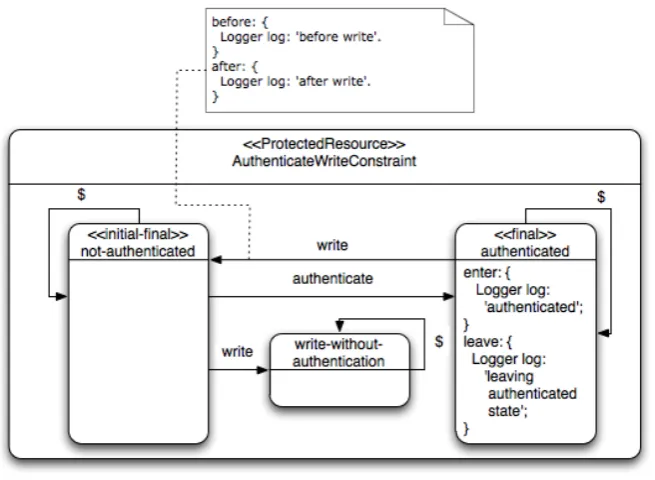
Figure 3.11:Constraint onProtectedResourcesstating that awriteoperation should always be preceded by areadoperation.
As an example of a constraint specification for resource operations, take a look at Figure 3.11. This specification constrains ProtectedResources and it is meant to enforce that each time a write operation is performed, it is preceded by a read operation. When awriteoperation is performed without a precedingreadoperation, we immediate make a transition to state write-without-read, which is a trap state, because it is not possible to reach a final state from it.
3.3.2
Evaluation
Because Vibes specifications have the added context sensitive wildcard transition, they are less susceptible to changes in the implementation than regular expressions and they can very well be used instead of regular expressions.
Figure 3.12:Vibes constraint for a Buffer resource.
If we look back at the example of Chapter 2, in which we gave a regular expression to constrain a Buffer resource, we will address the problem that existed with regular expression using Vibes specifications to specify the constraint.
Remember that in Chapter 2 we consider a resource Buffer for which the following operations are defined:
{put, get, isEmpty}
and consider the constraint specification given in Figure 3.12. This constraint specifies that the get operation can only be performed if the isEmpty operation is performed immediately before it. If theget operation is performed without a precedingisEmpty operation the constraint will be violated, because the non-final state
get-without-check is reached from which it is not possible to reach a final state. Note that in the example of Figure 3.12 theget transition betweenempty-checkedandnot-checked has been made explicit for clarity; this transition could have been omitted because of the $ transition between empty-checkedandnot-checked.
Now consider that a new operation clearBuffer is added. This has no impact on the constraint specification of Figure 3.12, because every time the new clearBuffer operation is performed this is handled by the $transition in the specification.
q0 q1
q2
isEmpty
get put
get, put isEmpty
[image:32.595.220.365.572.665.2]isEmpty, put, get
Figure 3.13:Buffer constraint expressed with an DFA.
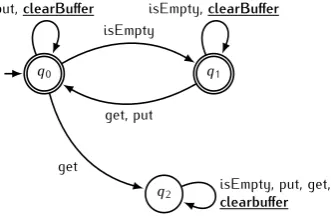
able to accept those symbols. If we now add theclearBufferoperation, this would mean that in the DFA of Figure 3.13 new transitions have to be added. For the semantics of the constraint to stay the same, we have to add this new symbol to all looping transitions. For the DFA given in Figure 3.13 this would result in the DFA given in Figure 3.14.
q0 q1
q2
isEmpty
get put,clearBuffer
get, put
isEmpty,clearBuffer
isEmpty, put, get,
clearbuffer
Figure 3.14:Buffer constraint adapted for the addedclearBufferoperation.
This demonstrates that Vibes specifications are less susceptible to changes than regular expressions and thus have higher evolvability than regular expressions.
3.4
Summary
In this chapter we have investigated two alternatives to regular expressions in the context of resource operation constraint specifications. We have seen that although very expressive and easy to understand, graph transformation systems are rather ex-pensive to implement. Because of the NP completeness of subgraph matching, graph transformation systems are not a good alternative for runtime verification of these constraints.
Chapter 4
Associating actions with
behavioural patterns
In the previous chapter we have discovered that Vibes can be used as a constraint specification language for Resource Operation Models. We also discovered that Vibes in a somewhat adapted form can be used to detect behavioural conflicts in other areas than in which the model is mostly used, i.e. concurrent computing and aspect oriented programming. With the Resource Operations model it is possible to capture multiple implementations of the same abstract concept into one Resource, which allows users to reason about the more abstract implications of this abstract concepts. An example of this is that both a buffer and an array can be captured by a Collection resource.