Performance Evaluation of GPBiCGSafe Method without
Reverse-Ordered Recurrence for Realistic Problems
Seiji Fujino
∗,
Takashi Sekimoto
†Abstract— GPBiCG method is an attractive it-erative method for the solution of a linear system of equations with nonsymmetric coefficient matrix. However, we meet often with instability of conver-gence when GPBiCG method is adopted in the so-lution of realistic problems. In this paper, we con-sider a new algorithm with minimization of the as-sociate residual and without reverse-ordered recur-rence in the algorithm. We refer to a new iterative method as GPBiCG with safety convergence (abbre-viated as GPBiCGSafe) method. Moreover we will support that GPBiCGSafe method yields safety con-vergence through numerical experiments.
Keywords: GPBiCG method, GPBiCG AR method, nonsymmetric coefficient matrix, Associate residual, Reverse-ordered recurrence, GPBiCGSafe method
1
Introduction
Generalized Product Bi-Conjugate Gradient (abbrevi-ated as GPBiCG) method [7] is an attractive iterative method for the solution of linear systems with a non-symmetric coefficient matrix. However, the popularity of GPBiCG method has diminished over time except for the context of limited field of analysis because of instabil-ity of convergence. Therefore, some variants of GPBiCG method which have stability of convergence and robust-ness compared with the original GPBiCG method have been proposed.
We proposed a safety variant (abbreviated as BiCGSafe) of Generalized Product type Bi-CG method from the viewpoint of reconstruction of the residual polynomial and determination of two acceleration parametersζnand ηn [3]. It embodied that a particular strategy for
reme-dying instability of convergence, acceleration parameters are decided from minimization of the associate residual of 2-norm [5]. However, we could not reveal the reason of instability of GPBiCG method because of reconstruction of the algorithm in a different way. Though both conver-gence rate and stability of BiCGSafe method were fairly improved, instability itself of GPBiCG method could not corresponds directly to its algorithm.
∗Research Institute for Information Technology, Kyushu
Univer-sity, Email:[email protected]
†Graduate School of Information Science and Electrical
Engi-neering, Kyushu University
In this paper, we consider a new algorithm based on minimization of the associate residual and without reverse-ordered recurrence. We refer to as GPBiCG with safety convergence (hereafter abbreviated as GP-BiCGSafe) method. Moreover we will make verification of stability of GPBiCGSafe method, and make it clear that the reason of instability of GPBiCG method corre-sponds to reverse-ordered recurrence adopted in the al-gorithm of GPBiCG method. We will verify that GP-BiCGSafe method yields safety and robustness of conver-gence through many numerical experiments.
2
Brief
description
of
product-type
methods
We consider iterative methods for solving a linear system of equations
Ax=b (1)
whereA∈RN×N is a given unsymmetric matrix, andx,
bis a solution vector and right-hand side vector, respec-tively. WhenAis a large, sparse matrix which arises from realistic problems, efficient solution of (1) is substantially very difficult. This difficulty has led to the development of a rich variety of generalized CG type methods having varying degrees of success (see, e.g., [6]).
The biconjugate gradient (so-called BiCG) method based of the Lanczos algorithm is a crucial example of a gen-eralized CG method. In many cases, the Lanczos algo-rithm give some of the fastest solution times and sta-bility of convergence among all generalized CG methods. The Lanczos algorithm, however, is known to break down during iteration process. In practice, the occurrence of breakdown can cause failure to irregularly converge to the solution of (1). The fact that the Lanczos algorithms perform well in some cases but fail in others heightens the need for further insight and development of the Lanczos type iterative methods.
We note that the basic recurrence relations between Lanc-zos polynomialsRn(λ) andPn(λ) hold as follows:
R0(λ) = 1, P0(λ) = 1, (2)
Rn+1(λ) = Rn(λ)−αnλPn(λ), (3)
Pn+1(λ) = Rn+1(λ) +βnPn(λ), (4)
Then we can introduce the three-term recurrence rela-tions for Lanczos polynomialsRn(λ) only by eliminating Pn(λ) from (2) and (4) as follows:
R0(λ) = 1, R1(λ) = (1−α0λ)R0(λ) (5)
Rn+1(λ) = (1 + βn−1 αn−1
αn−αnλ)Rn(λ)
−βn−1 αn−1
αnRn−1(λ), n= 1,2, . . . (6)
Zhang [7] discovered that moderate convergence property can be gained by choosing for acceleration polynomials Hn(λ) that are built up in the three-term recurrence form
as polynomial Rn(λ) in (5) and (6) by adding suitable
undetermined parametersζn andηn as follows:
H0(λ) = 1, (7)
H1(λ) = (1−ζ0λ)H0(λ), (8)
Hn+1(λ) = (1 +ηn−ζnλ)Hn(λ)−ηnHn−1(λ),(9)
n= 1,2, . . . .
The polynomials Hn(λ) satisfiesHn(0) = 1 and relation
as Hn+1(0)−Hn(0) = 0 for alln. Here we introduce an
auxiliary polynomials Gn(λ) as
Gn(λ) := (Hn(λ)−Hn+1(λ))/(ζnλ). (10)
By reconstruction of (6) using the acceleration polyno-mials Hn(λ) and Gn(λ), we have the following coupled
two-term recursion of the form as
H0(λ) = 1, G0(λ) =ζ0, (11)
Hn(λ) = Hn−1(λ)−λGn−1(λ), (12)
Gn(λ) = ζnHn(λ) +ηnGn−1(λ), (13)
n= 1,2, . . . .
Using these acceleration polynomials Hn(λ) andGn(λ),
his discover led to the generalized product-type methods based on Bi-CG method for solving the linear system with unsymmetric coefficient matrix. He refered as GPBiCG method [7]. However, the original Lanczos algorithm is also known to break down or nearly break down in some cases. In practice, the occurrence of a break down cause failure to converge to the solution of linear equations, and the increase of the iterations introduce numerical error into the approximate solution. Therefore, convergence of the generalized product-type methods is affected. Com-paratively little is known about the theoretical properties of the generalized product-type methods. The fact that the generalized product-type methods perform very well sometimes but fail in others motivates the need for fur-ther insight into the construction of polynomials for the product-type residualHn+1(λ)Rn+1(λ).
In a usual approach, acceleration parameters are decided from local minimization of the residual vector of 2-norm
||rn+1(:= Hn+1(λ)Rn+1(λ))||2, where Rn+1(λ) denotes the residual polynomial of the Lanczos algorithm and Hn+1(λ) denotes the acceleration polynomial for conver-gence. Instead, it embodies that a particular strategy for remedying instability of convergence. That is, algorithm of GPBiCG AR[4] method based on local minimization of associate residual a rn(:= Hn+1(λ)Rn(λ)) can be
writ-ten as follows:
a rn=rn−ηnAzn−1−ζnArn. (14)
Here rn is the residual vector of the algorithm.
Matrix-vector multiplication ofAunandArn+1are directly com-puted according to definition of multiplication of matrix A and vector. On the other hand, Apn and Azn are
computed using its recurrence. In the algorithm of GP-BiCG AR method, modification parts which differ from the original GPBiCG method are indicated with under-lines.
2.1
Reverse-ordered recurrence
In the algorithm of GPBiCG AR method, an auxil-iary vector of un is developed using underlined
reverse-ordered recurrence as below.
The reverse-ordered recurrence can be disappeared owing to the underlined modification.
un := λGnPn
= λPn(ζnHn+ηnGn−1)
= ζnλHnPn+ηnλGn−1(Rn+βn−1Pn−1)
= ζnλHnPn+ηn(λGn−1Rn+βn−1λGn−1Pn−1)
= ζnApn+ηn(Azn−1+βn−1Aun−1) (15)
We replace computation ofλGn−1Rn withAzn−1. Com-putation of Azn−1 is already used in determination of parameters. Then computational cost doesn’t increase.
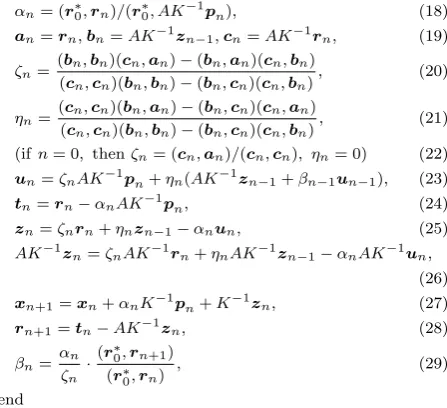
As a result, we could devise GPBiCGSafe method with-out reverse-ordered recurrence. Next we exhibit an algo-rithm of preconditioned GPBiCGSafe method. In GP-BiCGSafe method, parameters ζn, ηn are decided from
minimization of 2-norm of associate residual.
Algorithm of preconditioned GPBiCGSafe method
x0 is an initial guess, r0=b−Ax0, Chooser∗0such that (r∗0,r0)̸= 0, β−1= 0, setp−1=u−1=z−1= 0,
forn= 0,1,· · · until||rn+1|| ≤ε||r0||do : begin
pn=rn+βn−1(pn−1−un−1), (16)
αn= (r∗0,rn)/(r∗0, AK−1pn), (18)
an=rn,bn=AK−1zn−1,cn=AK−1rn, (19)
ζn=
(bn,bn)(cn,an)−(bn,an)(cn,bn) (cn,cn)(bn,bn)−(bn,cn)(cn,bn)
, (20)
ηn=
(cn,cn)(bn,an)−(bn,cn)(cn,an) (cn,cn)(bn,bn)−(bn,cn)(cn,bn)
, (21)
(ifn= 0, thenζn= (cn,an)/(cn,cn), ηn= 0) (22)
un=ζnAK−1pn+ηn(AK−1zn−1+βn−1un−1), (23)
tn=rn−αnAK−1pn, (24)
zn=ζnrn+ηnzn−1−αnun, (25)
AK−1z
n=ζnAK−1rn+ηnAK−1zn−1−αnAK−1un, (26)
xn+1=xn+αnK−1pn+K−1zn, (27)
rn+1=tn−AK−1zn, (28)
βn=
αn
ζn ·
(r∗0,rn+1) (r∗0,rn)
, (29)
end
We show computational cost of six kinds of iterative methods with ILU(0) preconditioning per one iteration in Table 1. In Table 1, “N” means dimension of ma-trix, and “nnz” means the number of total nonzero en-tries of matrix. “K−1”, “u,v” and “α” means precondi-tioner, vectors and scalar value, respectively. From Table 1, we see that computational cost per one iteration of GPBiCG AR, GPBiCGSafe and BiCGSafe methods are small amount compared with that of other three iterative methods.
3
Numerical experiments
3.1
Computational environment and
condi-tions
All computations were done in double precision floating point arithmetics, and performed on Nehalem (CPU: In-tel Xenon X5570, Clock: 2.93GHz, memory: 24Gbytes, OS: RedHat Enterprise Linux 5.2).
All codes were compiled with the “-O3” optimization op-tion. The right-hand sidebwas imposed from the physi-cal load conditions. The stopping criterion for successful convergence of the iterative methods is less than 10−10 of the relative residual 2-norm ||rn+1||2/||r0||2. In all cases the iteration was started with the initial guess so-lutions x0 = 0. The maximum number of iterations is fixed as 104. Matrices are normalized with diago-nal scaling. The initial shadow residual r∗0 = b−Ax0 of GPBiCG and GPBiCG AR methods is equal to the initial residual r0. As test matrices as shown in Table 2, 17 matrices in total are taken from Florida sparse matrix collection[2]. We examined performance of GP-BiCG, AS GPBiCG v1 (Abe-Sleijpen GPBiCG variant-1), AS GPBiCG v2 (Abe-Sleijpen GPBiCG variant-2), GPBiCG AR, GPBiCGSafe and BiCGSafe methods pre-conditioned using ILU(0) without extra fill-ins. In Table
[image:3.595.68.292.74.278.2]2 we show specifications of test matrices.
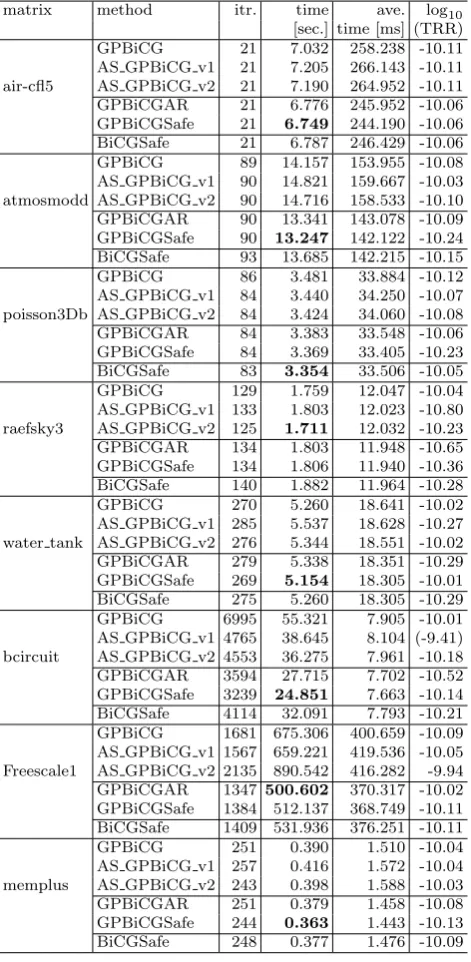
Table 3-4 show the numerical results of GPBiCGSafe method and other iterative methods. “itr.” means num-ber of iterations, “time” means computation time in sec-onds and “ratio” means the ratio of computation time of GPBiCG AR method to that of GPBiCG method. “max” denotes non-convergence until iterations reach at the maximum iteration counts.
Table 1: Computational costs of six kinds of iterative methods with ILU(0) preconditioning per one iteration.
method K−1v Av (u,v) u±v αv (×2nnz) (×2nnz) (×2N) (×N) (×N)
GPBiCG 2 2 7 17 14
AS GPBiCG v1 2 2 8 15 16
AS GPBiCG v2 2 2 8 15 15
GPBiCG AR 2 2 7 15 13
GPBiCGSafe 2 2 7 14 13
BiCGSafe 2 2 7 14 13
Table 2: Specifications of test matrices. matrix N nnz ave. analytical
nnz field air-cfl5 1,536,000 19,435,428 12.65 hydro atmosmodd 1,270,432 8,814,880 6.94 dynamic poisson3Db 85,623 2,374,949 27.74
raefsky3 21,200 1,488,768 70.22 water tank 60,740 2,035,281 33.51
bcircuit 68,902 375,558 5.45 electrical Freescale1 3,428,755 17,052,626 4.97 circuit memplus 17,758 126,150 7.1
sme3Da 12,504 874,887 69.97 structural sme3Db 29,067 2,081,063 71.6
sme3Dc 42,930 3,148,656 73.34
appu 14,000 1,853,104 132.36 directed big 13,209 91,465 6.92 weighted graph ecl32 51,993 380,415 7.32 semiconductor epb3 84,617 463,625 5.48 thermal k3plates 11,107 378,927 34.12 acoustics waseda 19,060 24,377,548 1279. electromagnetics
In Table 3-4, “TRR” means true relative residual of the approximate solutionxn+1. For matrices air-cfl5 and at-mosmodd, when iteration count for convergence is small, GPBiCGSafe method works well because of small amount of computational cost per one iteration. For matrices raefsky3 and water tank, when iteration count is mod-erate, performance of GPBiCGSafe method is competi-tive. Sometimes GPBiCGSafe method is the most effi-cient. However, the difference of performance is small.
[image:3.595.312.543.348.535.2]important fact, when property of matrix becomes ill-conditioned as matrix k3plates, robustness of GPBiCG, AS GPBiCG v1, v2 are not sufficient. On the contrary, GPBiCG AR, GPBiCGSafe and BiCGSafe methods are significantly robust.
Table 3: Performance of six kinds of iterative methods.
matrix method itr. time ave. log10 [sec.] time [ms] (TRR) GPBiCG 21 7.032 258.238 -10.11 AS GPBiCG v1 21 7.205 266.143 -10.11 air-cfl5 AS GPBiCG v2 21 7.190 264.952 -10.11 GPBiCGAR 21 6.776 245.952 -10.06 GPBiCGSafe 21 6.749 244.190 -10.06 BiCGSafe 21 6.787 246.429 -10.06 GPBiCG 89 14.157 153.955 -10.08 AS GPBiCG v1 90 14.821 159.667 -10.03 atmosmodd AS GPBiCG v2 90 14.716 158.533 -10.10 GPBiCGAR 90 13.341 143.078 -10.09 GPBiCGSafe 90 13.247 142.122 -10.24 BiCGSafe 93 13.685 142.215 -10.15 GPBiCG 86 3.481 33.884 -10.12 AS GPBiCG v1 84 3.440 34.250 -10.07 poisson3Db AS GPBiCG v2 84 3.424 34.060 -10.08 GPBiCGAR 84 3.383 33.548 -10.06 GPBiCGSafe 84 3.369 33.405 -10.23 BiCGSafe 83 3.354 33.506 -10.05 GPBiCG 129 1.759 12.047 -10.04 AS GPBiCG v1 133 1.803 12.023 -10.80 raefsky3 AS GPBiCG v2 125 1.711 12.032 -10.23 GPBiCGAR 134 1.803 11.948 -10.65 GPBiCGSafe 134 1.806 11.940 -10.36 BiCGSafe 140 1.882 11.964 -10.28 GPBiCG 270 5.260 18.641 -10.02 AS GPBiCG v1 285 5.537 18.628 -10.27 water tank AS GPBiCG v2 276 5.344 18.551 -10.02 GPBiCGAR 279 5.338 18.351 -10.29 GPBiCGSafe 269 5.154 18.305 -10.01 BiCGSafe 275 5.260 18.305 -10.29 GPBiCG 6995 55.321 7.905 -10.01 AS GPBiCG v1 4765 38.645 8.104 (-9.41) bcircuit AS GPBiCG v2 4553 36.275 7.961 -10.18 GPBiCGAR 3594 27.715 7.702 -10.52 GPBiCGSafe 3239 24.851 7.663 -10.14 BiCGSafe 4114 32.091 7.793 -10.21 GPBiCG 1681 675.306 400.659 -10.09 AS GPBiCG v1 1567 659.221 419.536 -10.05 Freescale1 AS GPBiCG v2 2135 890.542 416.282 -9.94 GPBiCGAR 1347 500.602 370.317 -10.02 GPBiCGSafe 1384 512.137 368.749 -10.11 BiCGSafe 1409 531.936 376.251 -10.11 GPBiCG 251 0.390 1.510 -10.04 AS GPBiCG v1 257 0.416 1.572 -10.04 memplus AS GPBiCG v2 243 0.398 1.588 -10.03 GPBiCGAR 251 0.379 1.458 -10.08 GPBiCGSafe 244 0.363 1.443 -10.13 BiCGSafe 248 0.377 1.476 -10.09
We exhibit summary of performance of six kinds of precondi-tioned iterative methods in Table 5. From Table 5, it can be seen that GPBiCG AR, GPBiCGSafe and BiCGSafe methods converged for all test matrices. In particular, GPBiCGSafe method outperforms among the product-typed iterative meth-ods.
[image:4.595.317.538.111.589.2]We demonstrate the ranking of convergence time and overall
Table 4: Performance of six kinds of iterative methods. (cont’d)
matrix method itr. time ave. log10 [sec.] time [ms] (TRR) GPBiCG 1498 12.038 7.836 -10.22 AS GPBiCG v1 1090 8.860 7.850 -10.23 sme3Da AS GPBiCG v2 1295 10.446 7.836 -9.68 GPBiCGAR 1039 8.387 7.782 -10.04 GPBiCGSafe 1072 8.604 7.745 -10.07 BiCGSafe 949 7.664 7.759 -10.16 GPBiCG 1192 27.262 22.193 (-9.59) AS GPBiCG v1 1096 25.162 22.220 -10.06 sme3Db AS GPBiCG v2 1389 31.587 22.162 (-9.12) GPBiCGAR 831 19.137 22.060 -10.07 GPBiCGSafe 1005 22.955 22.040 -10.01 BiCGSafe 924 21.149 22.018 -10.04 GPBiCG 2599 94.239 35.755 -10.80 AS GPBiCG v1 2207 80.437 35.854 (-8.64) sme3Dc AS GPBiCG v2 1756 64.182 35.812 -9.96 GPBiCGAR 1628 59.232 35.582 -10.17 GPBiCGSafe 1603 58.482 35.669 -10.04 BiCGSafe 1614 58.713 35.575 -10.01 GPBiCG 27 1.765 18.296 -10.32 AS GPBiCG v1 26 1.744 18.346 -10.05 appu AS GPBiCG v2 26 1.739 18.346 -10.05 GPBiCGAR 29 1.787 18.207 -10.22 GPBiCGSafe 29 1.789 18.172 -10.20 BiCGSafe 29 1.796 18.379 -10.31 GPBiCG 936 1.267 1.346 -10.00 AS GPBiCG v1 831 1.161 1.390 -10.30 big AS GPBiCG v2 948 1.304 1.368 -10.49 GPBiCGAR 769 1.012 1.308 -10.14 GPBiCGSafe 803 1.056 1.305 -10.34 BiCGSafe 812 1.082 1.324 -10.36 GPBiCG 125 0.775 5.952 -10.11 AS GPBiCG v1 126 0.805 6.167 -10.21 ecl32 AS GPBiCG v2 121 0.752 5.992 -10.15 GPBiCGAR 124 0.755 5.831 -10.13 GPBiCGSafe 123 0.741 5.797 -10.20 BiCGSafe 124 0.754 5.847 -10.06 GPBiCG 89 0.784 8.528 -10.12 AS GPBiCG v1 89 0.790 8.629 -10.73 epb3 AS GPBiCG v2 89 0.900 9.820 -10.20 GPBiCGAR 94 0.807 8.362 -10.02 GPBiCGSafe 90 0.767 8.267 -10.06 BiCGSafe 89 0.722 7.899 -10.15
GPBiCG max - - -9.69
AS GPBiCG v1 7675 24.443 3.180 -10.30 k3plates AS GPBiCG v2 max - - -9.54 GPBiCGAR 5580 17.357 3.104 -10.33 GPBiCGSafe 6391 19.845 3.100 -10.08 BiCGSafe 5680 17.672 3.105 -10.94
Table 5: Summary of performance of six kinds of precon-ditioned iterative methods.
method converged non- spurious fastest conv. conv. cases GPBiCG 15/17 2/17 1/17 0/17
AS GPBiCG v1 15 2 2 0
AS GPBiCG v2 14 3 1 2
GPBiCG AR 17 0 0 4
GPBiCGSafe 17 0 0 8
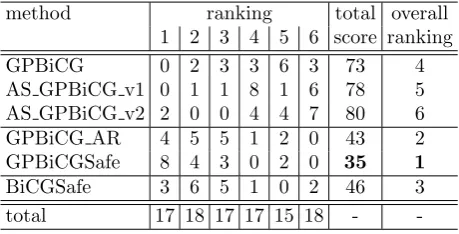
[image:4.595.53.289.170.652.2]ranking for six kinds of preconditioned iterative methods in Table 6. From total score and ranking, it is concluded that convergence rate of GPBiCGSafe method is excellent from the viewpoint of robustness and efficiency. Convergence rate of GPBiCG AR and BiCGSafe methods are competitive. On the other hand, performance of GPBiCG, AS GPBiCG v1,
[image:5.595.55.285.198.315.2]v2 are poor.
Table 6: The ranking of convergence time and overall ranking for six kinds of preconditioned iterative methods.
method ranking total overall 1 2 3 4 5 6 score ranking
GPBiCG 0 2 3 3 6 3 73 4
AS GPBiCG v1 0 1 1 8 1 6 78 5 AS GPBiCG v2 2 0 0 4 4 7 80 6 GPBiCG AR 4 5 5 1 2 0 43 2 GPBiCGSafe 8 4 3 0 2 0 35 1
BiCGSafe 3 6 5 1 0 2 46 3
total 17 18 17 17 15 18 -
-4
Conclusions
In this paper we proposed GPBiCGSafe method without reverse-ordered recurrence. We made clear that reverse-ordered recurrence affected convergence rate of the original GPBiCG method. GPBiCGSafe method outperforms among tested product-type iterative methods. GPBiCG AR and BiCGSafe methods work well compared with the conventional GPBiCG method.
References
[1] K. Abe, G. Sleijpen: Solving linear equations with a stabilized GPBiCG method, Applied Numerical Math., 2012. (in press)
[2] Tim Davis’ sparse matrix collection of Florida University: http://www.cise.ufl.edu/research/sparse/matrices/
[3] S. Fujino, M. Fujiwara and M. Yoshida: BiCGSafe method based on minimization of associate residual, JSCES, No.20050028, 2005.
[4] MoeThuthu, Y. Onoue, S. Fujino, Experimental com-parison of preconditioned GPBi-CG and GPBiCG AR methods in view of stability of convergence, JSCES, No.20090008, 2009.
[5] H.A. van der Vorst: Bi-CGSTAB: A fast and smoothly converging variant of Bi-CG for the solution of non-symmetric linear systems, SIAM J. Sci. Stat. Comput., 13(1992), 631-644.
[6] H.A. van der Vorst: Iterative Krylov preconditionings for large linear systems, Cambridge University Press, Cam-bridge, 2003.