A Review- Image Segmentation using Soft
Computing Techniques
Nicky Upadhyay1, Prof. Jaimala Jha2
1, 2
Computer Science Department, MITS, Gwalior
Abstract: Digital image processing (DIP) receiving organized reinforce strong examine program districts of image upgrade, image division & picture base precedent statement. These all methods are reasonable for some medicinal picture applications. These procedures can be utilized for item acknowledgment and recognition. In beneficial pictures these can be utilized to differentiate disease and in satellite pictures these can be utilized to identify streets and extensions. This review gave a thorough investigation of the grouping calculations proposed in the writing. So as to uncover future bearings for growing new calculations and to manage the determination of calculations for enormous information, a sorting system to arrange various bunching calculations. Because of the need of picture division in numerous applications, it has a difficult future. To portion the pictures, from division procedures edge location, thresholding, district developing and bunching are taken for this examination. This research work centers on various strategies that are generally used to portion photo utilizing bunching systems.
Keywords: Segmentation, Edge detection, Thresholding, Clustering, Region Growing.
I. INTRODUCTION
DIP is having numerous ongoing applications in the fields of remote detecting, prescription, photography, film and video creation, security observing. New inventive innovations are developing in the fields of picture handling, particularly in picture division area [1]. Computerized picture preparing includes handling and control of picture for better understanding and upgraded visual observation. There are two essential inspirations driving the rise of picture handling: upgrade of pictorial data for better human translation &preparing scene information for self-ruling machine recognition [2]. We think about pictures as a standout amongst the most significant medium to pass on data in the field of PC vision. Picture division is a procedure in which we separate the picture into disjoint locales that are important. The objective of picture division is to bunch pixels into remarkable picture districts, i.e., areas relating to singular surfaces, articles, or characteristic pieces of items [3]. We partition the picture into various sections for example set of pixels, pixels in an area are like each other in certain criteria, for example, shading force or surface, in order to find and distinguish items and limits in a picture. Picture division is the establishment of article acknowledgment. Picture division is the initial phase in picture examination. In division esteem is allocated to each pixel in a picture to such an extent that pixel with a similar esteem share certain qualities, for example, shading, power or surface in a specific district [4-6]. Picture division is commonly characterized as the fundamental picture preparing that subdivides an advanced picture f (x, y) into its consistent, separate & nonempty subset f1,f2, f3,… fn , which gives comfort to extraction of quality.
II. RELATED WORK
Parametric entropy offers adaptability to test the pixel scene in a superior way. The creator, endeavored to utilize entropy-based strategies for improving the division procedure by recognizing edge required for division to overcome the problem of the limit esteems prompting the higher closures of the histogram were not chosen [7]. So as to take care of this issue and improve the picture differentiates a picture division technique dependent on projection remove minimization (PDM). The strategy can decide the ideal edge from the underlying EIT picture by limiting the separation between the figured projection of the fragmented picture and the deliberate projection information, which can take full utilization of the first projection information as a division standard feasible.[8] In this paper, they use the convolutional neural network (CNN) to train a SICE enhancer. To overcome the low-contrast images and their high-quality reference images and to make allows working in the start to finish learning of elite SICE techniques. They created
SICE enhancer significantly beats best in class SICE strategies, and even outflanks MEF and stack-based HDR techniques for
presented issue. a powerful numerical calculation to tackle the regularized streamlining issue dependent on ADMM. They have exhibited the benefits of technique over the best in class strategies that require demosaicing as preprocessing within the sight of a mosaic RGB image [11]. The proposes a shading picture division calculation dependent on SLIC super-pixel algorithm and classical N-cut algorithm. The pre-segmentation of the SLIC super-pixel algorithm greatly reduces the complexity and makes the N-cut algorithm perform the image processing of the next stage more quickly and effectively [12].
III. IMAGE SEGMENTATION (IS)
[image:2.612.103.509.279.354.2]IS initial or front stage processing of image compression. The efficiency of segmentation process is its speed, good shape matching and better shape connectivity with its segmenting Dr.S.Kannan Madurai Kamaraj University G.Naliniresult.Segmentation refers to the process of identifying and isolating the surface and regions of the digital image which corresponds to the structural units. Segmentation may also depend on various features that are contained in the image. It may be either color or texture. Segmentation means partitioning of image into various regions or parts. In IS, an image is divided into subparts according to the requirement of the user or the problem being solved [17]. It divides the image in to pixels. Image segmentation divides the image in such a way so that it becomes very accurate. Basically this approach is used for analysis of substances, borders and additional records which are relevant for processing [18].
Fig 2: Image Segmentation Processes
The outcome of is a set of sections that together cover total picture or group of contours removed from picture. The objective of segmentation is to simplify or to modify the demonstration of picture in such a manner that is more significant and easy to evaluate. It produces the better appearance of image. Segmentation of images is done for compression of image, recognition of objects and for editing purpose. For image segmentation image thresholding methods are applied. Segmentation allocates label to each pixel in the picture, such that pixel having similar label can share definite features [19].
IV. VARIOUS METHOD FOR IMAGE SEGMENTATION
Figure 3: Image SegmentationTechniques
A. Segmentation Based On Region Based (RB)
This technique groups together certain objects used for segmentation. Region based segmentation technique used with this method. That region must be together with each other on which segmentation have to performed. It is also known as similarity based segmentation. The borders are recognized to perform segmentation. Every step takes at least one pixel for processing purpose. After applying the process color and texture of the image is altered and then a vector is created from the edge flow. Then further processing is applied on these edges [4]. RB segmentation can be defined that in which we segment similar picture into various regions. They used to determine the region directly. Portioningdone by using grey value of picture pixels.2 basic techniques of RB
Segmentation
Model Based Thresholding
Feature Based Clustering Edge Based
Region Based
Pre- Processing
Image Segmentation
Classification
Result Image
Acquisition
Input Image
[image:2.612.138.479.468.580.2]1) Region Growing (RG) Methods: RG is a method that bunches pixels or sub districts into bigger areas dependent on predefined criteria. The pixels collection begins with a lot of seed focuses such that the relating districts develop by affixing to each seed focuses those neighboring pixels that have comparative properties like dim scale, shading, surface, shape and so forth [20].
2) Region Splitting and Merging: In the event of locale part, the entire picture is taken as a solitary district and afterward this area is being break into a lot of disjoint areas which are sound with themselves. District consolidating restricts Region Splitting. A combining method is utilized after each split and looks at contiguous locales and consolidations them. It begins with little locales and consolidation the districts which have comparative attributes like gray scale, change etc.[21]
B. Segmentation Based on Edge Detection
Another technique for segmentation is edge detection(ED) method. To identify dissimilarities from the image edges are identifies. To recognize pixel values edges are drawn and then these edges are compared with other pixel. In the edge detector method it is not mandatory that detected edge should be close with each other. In this method, firstly the information about edges are extracted and then labeling is done for pixels. Edge can be defined as the boundary between 2 districts with positive properties of dark dimension. ED can be characterized as that each item is encompassed by a shut outskirt, which is unmistakable and can be identified in the force estimation of the picture. It assumes significant job in picture investigation and example acknowledgment as it depicts the physical degree of items. Edge identification strategies are following:
1) Roberts Edge Detection (RED): RED is used in IP for ED. It was proposed by Lawerence Roberts in 1963. It was the first ED. The Roberts administrator plays out a uncomplicated, fast to register, 2D spatial inclination evaluation on a image. It hence features locales of high spatial angle which regularly relate to boundaries. In its most regular use, the contribution to the administrator is a grayscale picture, similar to the yield. Pixel esteems at each point in the yield speak to the evaluated total extent of the spatial slope of the info picture by then [22].
2) Sobel Edge Detection (SED): SED named after Irwin Sobel and it sometimes called as Sobel filter. SED is having 2 covers, 1 is vertical & other is level. These veils are by and large utilized 3*3 measurements. Standard Sobel administrators, for a 3×3 neighborhood, every basic focal inclination gauge is vector whole of a couple of symmetrical vectors. Each symmetrical vector is a directional subordinate gauge increased by a unit vector determining the subsidiary's course. The vector total of these straightforward slope gauges adds up to a vector total of the 8 directional subsidiary vectors. In this way for a point on Cartesian matrix and its eight neighbors having thickness values [23].
3) Prewitt Edge Detection (PED): PED is used ED algorithms in IP. It is also called as Discrete Differentiation operator. It is utilized to ascertain the angle of the picture force work. The PED is use to identify edges based applying a level and vertical channel in succession. The two channels are connected to the picture and summed to shape the last outcome. The two channels are essential convolution channels of the form [24].
C. Segmentation Based On Threshold
The easiest method for segmentation is thresholding. This approach changes a gray scale image wherever the two points are allocated to pixels. These points are below and on upper side of the definite threshold value. In this method, a threshold value is used, that thresholds are obtained from histogram of the original image. The value of the histogram is calculated by detection of edges. So threshold value is accurate only if the detection of edges is accurate. Segmentation perform via thresholding has lesser calculations related to other methods. This technique not provides appropriate results in complex environment [25].
1) Global Thresholding: Global thresholding processes an ideal limit for the whole picture; these procedures need couple of calculations and can function admirably in straightforward cases. These strategies are typically not reasonable for corrupted archive pictures, since they don't have an unmistakable example that isolates closer view content and foundation. In the worldwide thresholding, the power estimation of the information picture ought to have two pinnacle esteems which compare to the signs from foundation and articles. It tells the level of power detachment between two crests in a picture. Worldwide thresholding, utilizing a proper edge T [26].
2) Variable Thresholding (VT): VT separate out the foreground image objects from background based on the difference in pixel intensities of each region. VT, if T can change over the image.
a) Local or regional thresholding, if T depends on a neighborhood of (x, y).
3) Multiple Thresholding (MT): MT can be defined as that segments a grey level image into several distinct regions. It defines more than one threshold for the given image and divides the image into certain brightness regions & is corresponds to background & numerous items.
D. Clustering Based Image Segmentation
Another way to perform segmentation is clustering. In this scheme, an image is transformed into histogram. After clustering is performed on it. Pixels of shading picture are grouped for division utilizing an unsupervised method fluffy C. This is connected for conventional pictures. In the event that it is a loud picture, it results to discontinuity. Grouping based IS utilized to segment pictures of grey level (GL). GL method directly apply & easily extendable to higher dimensional data. Clustering is correspondingly applicable in color & multispectral pictures. There are 2 main methods in clustering:
1) K-Means: The k-means methods of clustering are obtained basic principle to minimize squared distances sum from every points which have each domain of cluster to center of cluster. This sum is also known as the with in cluster as opposed to the between cluster distance that’s the distance sum b/w different center group & global mean of entire dataset. The Fuzzy K-means process in 2 stage process linking a “coarse” segmentation followed by a “fine” segmentation.
2) C-means Clustering Method: It is fuzzy clustering strategy where each point has a level of having a place of bunching as in fluffy rationale, as opposed to has a place with only one group. In this, centroid of a bunch is the mean everything being equal, weighted by then level of having a place with the group. It is additionally called delicate k-implies bunching technique.
3) FELICM: It is condensing of Fuzzy C-Means with Edge and Local Information, which presents the pixel's loads in side nearby neighbor windows to diminish the edge corruption. Mostly this strategy has by one way or another used to defeat the confined appropriation of pixels inside fragments of picture.
E. Model Based Image Segmentation
This technique is based on Markov random field. For color segmentation inbuilt region constraint are used. To define accuracy of edges MRF is joined with edge detection [27]. This method contains the relations amongst color components.
Table1: Describe the formal detail of different research.
S.No. Author’s Techniques Dataset
1 Marie Bieth et.al.(2016) Cascaded random forest Multipal myeloma, prostate cancer,healthy
subject
2 AmalFaraget.al.(2016) CNN Multiatlas
label fusion(MALF)
3 BinditaChaudhuriet.al.(2017) (MLIRM) UCMERCED
4 Vishal Lonarkaret.al.(2017) GLCM, K-means. INRIA
5 Charlie J. Daniels et.al.(2017) Fuzzy markov random field (MRF) algorithm Silico
6 Hongtao Wei et.al (2017) Self-adaptive cuckoo search (SCS) Two images.
7 Muhammad Burhan Khanet.al.(2017) Sludge volume index (SVI) 10 images
8 JianruiCaiet.al.(2018) Convolutional neural
network (CNN)
10,000 image exposure levels
9 Mohamed Ouhtaet.al.(2018) K-means Coil-100,Wang
10 Ronald Kemkeret.al. (2018) Self-taught feature learning Multispectral image (MSI) and hyper
spectral image (HSI)
11 JianruiCai et.al.(2018) Convolutional neural
network (CNN)
10,000 image exposure levels
12 Ying Fu et.al.(2018) Non-local low-rank approximation CAVE and Harvard
13 Wei Yang et.al. (2018) Feature matching
with learned nonlinear descriptors (FMLND)
MR images, T1w and T2w.
14 Lin Cong et.al.(2018) Simple linear iterative clustering (SLIC) and
N-cut(Normalized cut)
Optimal dataset scale
(ODS), optimal image scale (OIS) and average precision (AP)
15 Zhensong Wang et.al. (2018) Segment OARs H&N CT images
16 Anuj Kumar et.al.(2018) Fuzzy clustering image segmentation Multispectral image (MSI) and hyper
spectral image (HSI)
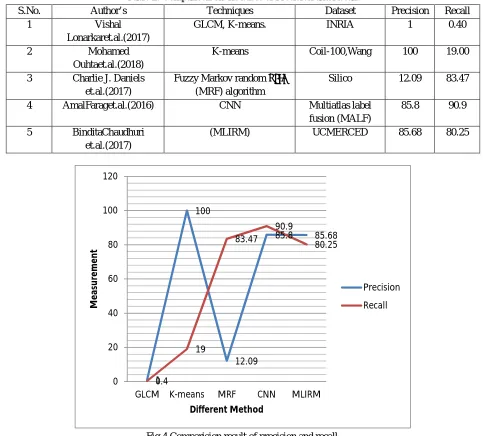
Table 2: Comparison on the bases of Precision and Recall.
S.No. Author’s Techniques Dataset Precision Recall
1 Vishal
Lonarkaret.al.(2017)
GLCM, K-means. INRIA 1 0.40
2 Mohamed
Ouhtaet.al.(2018)
K-means Coil-100,Wang 100 19.00
3 Charlie J. Daniels
et.al.(2017)
Fuzzy Markov random field
(MRF) algorithm
Silico 12.09 83.47
4 AmalFaraget.al.(2016) CNN Multiatlas label
fusion (MALF)
85.8 90.9
5 BinditaChaudhuri
et.al.(2017)
(MLIRM) UCMERCED 85.68 80.25
[image:5.612.70.548.551.702.2]Fig 4.Comparision result of precision and recall.
Table 3: Comparison on the bases of PSNR and MSE.
S.No. Author’s Techniques Dataset PSNR MSE
1 JianruiCai et.al.(2018) Convolutional neural
network (CNN)
10,000 image exposure levels
19.77 19.43
2 Ying Fu et.al.(2018) Non-local low-rank
approximation
CAVE and Harvard 38.11 0.9566
3 Wei Yang et.al. (2018) Feature matching
with learned
nonlinear descriptors (FMLND)
MR images, T1w and T2w.
30.12 2.46
4 Hongtao Wei et.al
(2017)
Self-Adaptive Cuckoo Search (SCS)
Two images. 22.01 5.45
1
100
12.09
85.8 85.68
0.4
19
83.47
90.9
80.25
0 20 40 60 80 100 120
GLCM K-means MRF CNN MLIRM
M
e
as
u
re
m
e
n
t
Different Method
Precision
Fig 5.Comparision result of PSNR and MSE.
V. CONCLUSION
In this audit of picture division procedures, different picture division methods are nitty gritty portrayed and analyzed. These all methods are reasonable for some medicinal picture applications. These procedures can be utilized for item acknowledgment and recognition. In therapeutic pictures these can be utilized to distinguish disease and in satellite pictures these can be utilized to identify streets and extensions. Subsequently obviously different strategies are appropriate for different kinds of picture applications. However, from the examination unmistakably no single strategy is adequate for each picture type and no all strategies are appropriate for a specific picture type. This review gave a thorough investigation of the grouping calculations proposed in the writing. So as to uncover future bearings for growing new calculations and to manage the determination of calculations for enormous information, a sorting system to arrange various bunching calculations. Because of the need of picture division in numerous applications, it has a difficult future.
REFERENCES
[1] Rajesh Dass, Priyanka, Swapna Devi, “Image Segmentation Techniques”, IJECT Vol.3, Issue 1, Jan-March 2012.
[2] GurjeetkaurSeerha, Rajneetkaur, “Review on Recent Image Segmentation Techniques”, International Journal on Computer Science and Engineering (IJCSE), Vol. 5 No. 02 Feb 2013.
[3] Rao, K. M.,Overview of Image Processing. Reading Images,(2006).
[4] Kaur, A. “A review paper on image segmentation and its various techniques in image processing” International Journal of Science And Research, 3(12), (2014). [5] A.Aly, S.b.Deris, N.Zaki, “Research review for digital image segmentation techniques” International Journal of Computer Science & Information Technology
3(5), (2011).
[6] V. Kumar, T. Lal, P. Dhuliya, and Diwaker Pant. "A study and comparison of different image segmentation algorithms." In Advances in Computing, Communication, & Automation (ICACCA)(Fall), International Conference on, IEEE 2016, pp. 1-6.
[7] JianruiCai, ShuhangGu, and Lei Zhang , “Learning a Deep Single Image Contrast Enhancer from Multi-Exposure Images”, IEEE, Transactions On Image Processing, VOL. 27, NO. 4, APRIL 2018.
[8] BinditaChaudhuri, BegümDemir, SubhasisChaudhuri, and Lorenzo Bruzzone , “Multilabel Remote Sensing Image Retrieval Using a Semi supervised Graph-Theoretic Method”, IEEE, TRANSACTIONS ON GEOSCIENCE AND REMOTE SENSING, VOL. 56, NO. 2, FEBRUARY 2018.
[9] Lin Cong, Shifei Ding, Lijuan Wang, Aijuan Zhang, and WeikuanJia, “Image segmentation algorithm based on superpixel clustering”, ISSN 1751-9659, Accepted on 25th June 2018.
[10] Ying Fu, YinqiangZheng, Hua Huang, Imari Sato, and Yoichi Sato, ” Hyperspectral Image Super-Resolution with a Mosaic RGB Image”, IEEE (DOI 10.1109/TIP.2018.2855412, IEEE)
[11] Ronald Kemker , Ryan Luu, and Christopher Kanan, “Low-Shot Learning for the Semantic Segmentation of Remote Sensing Imagery”, IEEE(0196-2892 © 2018 IEEE.
[12] Muhammad Burhan Khan, HumairaNisar, and ChoonAun Ng, “Image Processing and Analysis of Phase-Contrast Microscopic Images of Activated Sludge to Monitor the Wastewater Treatment Plants”, February 14, 2018.
[13] SiyamalanManivannam, WenqiLi,Member, Jianguo Zhang, EmanueleTrucco, and Stephen J. McKenna,” Structure Prediction for Gland Segmentation With Hand-Crafted and Deep Convolutional Features”, IEEE, Transactions On Medical Imaging, VOL. 37, NO. 1, JANUARY 2018.
[14] Roopa.E, Shubha. P, Dr. RamachandraHebbar,” Buildings Detection from Very High Resolution Satellite images Using Segmentation and Morphological Operations”, 2018 International Conference.
[15] MohitKhandelwal , ShraddhaShirsagar , PareshRawat, “MRI Image Segmentation using Thresholding with 3-class C-means Clustering”, IEEE Xplore 19.77
38.11
30.12
22.01 19.43
0.9566 2.46
5.45
-5 0 5 10 15 20 25 30 35 40 45
0 1 2 3 4 5
M
e
as
u
re
m
en
t
Different method
PSNR
[16] Anuj Kumar, H. S. Bhadauria, Nitin Kumar,” Fuzzy Clustering with Level Set Segmentation for Detection of Dental Restoration area”, 2018 International Conference on Advances in Computing and Communication Engineering (ICACCE-2018).
[17] Yogamangalam,R., Segmentation Techniques Comparison in Image Processing. International Journal of Engineering and Technology (IJET), 5(1), (2013). [18] Kaganami,H.Beiji,Z. “Region based segmentation versus edge detection. Intelligent”, Information Hiding and Multimedia Signal Processing, 1217-1221 ,
(2009).
[19] Ma,M.T., and Manjunath,B.,S., “Edge flow: A framework of boundary detection and image segmentation”. IEEE Trans. Image Process., .9(8), 1375– 1388(2000). http://dx.doi.org/10.1109/CVPR.1997.609409.
[20] Li,D.,Zhang,G.,Wu,Z.,Yi.L.,An Edge Embedded Marker-Based Watershed Algorithm for High Spatial Resolution Remote Sensing Image Segmentation, IEEE Transactions 19,2781-2787(2010).
[21] Shih,F.Y., Cheng.S.Adaptive mathematical morphology foredge linking. Information Sciences, 167(4), 9-21(2004).
[22] Baradez, M.O., McGuckin, C.P., Forraz, N., Pettengell, R., Hoppe, “A Robust and automated unimodal histogram thresholdin and potential applications Pattern Recognition, 37(6),1131–1148(2004).
[23] J. Luo, R. T. Cray, and H.C. Lee, Incorporation of derivative priors in adaptive Bayesian color image segmentation.Proc. ICIP’97, Vol. 3, pp. 58-61, Oct 26-29, 2011 Santa Barbara,CA.
[24] Marie Bieth, Loic Peter, Stephan G. Nekolla, Matthias Eiber, Georg Langs, Markus Schwaiger and BjoernMenze, “Segmentation of Skeleton and Organs in Whole-Body CT Images via Iterative Trilateration”, IEEE, 0278-0062, 2017.
[25] AlaaKhadidos, and Victor Sanchez, “Weighted Level Set Evolution Based on Local Edge Features for Medical Image Segmentation”, IEEE, and Chang-Tsun Li, Senior Member, IEEE(DOI 10.1109/TIP.2017.2666042, IEEE).