University of Twente | Master thesis Business Administration Tom Oude Luttikhuis
‘Spread the word’
University of Twente | Master thesis Business Administration Tom Oude Luttikhuis
Master thesis Business Administration
‘Spread the word’
A design oriented study on how expat-experience can be transferred within
multinational firms
University 1st supervisor Huub Ruel, Dr. University of Twente University 2nd supervisor Tanya Bondarouk, Dr. University of Twente
Correspondence concerning this Master thesis should be addressed to the author of this thesis: Tom Oude Luttikhuis
E-mail [email protected] Student Number S1119265
Master program Business Administration Specialization International Management
University of Twente | Master thesis Business Administration Tom Oude Luttikhuis
Preface and acknowledgements
“The world is flat” is a well known metaphor for the current global playing field that is caused by globalization (Friedman, 2005). Globalization is a phenomenon that increases the interconnectedness of countries around the world. A recently termed and simplified definition of globalization is: ”a process of social, political, economic, cultural and technological integration among countries of the world”(Som, 2009, p. 4). Due to this increasing interconnectedness, the quantity of companies that do business globally is rising tremendously. The quantity e.g. of multinational corporations (MNC) worldwide rose from 7.000 in 1990 to 65.000 today (Michel, 2013). Accompanied by this explosive grow in MNC’s that do business internationally is the need for employees whom are capable to do business internationally. It can be stated that globalization thrives the need for employees with international experience. According to Canestrino & Magliocca, (2010, p. 187)”International experience is widely recognized as a source of new knowledge”. Despite the importance of “international experience” for employees of MNC’s, it seems that these organizations don’t have a thorough understanding how they can manage this new knowledge source effectively. This appears e.g. from the fact that expatriate assignments/expats who constitute the richest pool of international experience are not used for transferring their experience upon other organization members
(Vinogradova, Zaman, & Svensson, 2012; Canestrino & Magliocca, 2010; Antal, 2001).
Purpose of this thesis is to explore and validate the causes why this transfer is limited. Subsequently solutions will be designed for these causes that will optimize the transfer of experiences of expats with international assignment experience to other organization members. Currently these experiences are predominantly shared in a process of informal socialization. The disadvantage of this knowledge transfer process is that knowledge remains tacit and stays within the minds of knower’s. When these knower’s leave the organization, the knowledge contained by them leaves also the organization. Important for this knowledge to becomes part of the organizational knowledge base is that this knowledge will be externalized. In this process tacit knowledge is converted into explicit knowledge which can be stored into the organizational knowledge base. This conversion will prevent
organizations from loosing knowledge from experienced employees. Subsequently organizations can use this knowledge again for cultivating the mindset of inexperienced organization members.
This thesis is performed in the context of graduating the master study ‘Business Administration’ at the University of Twente. By finishing this thesis, a period of 3 years of academic education has almost ended. In the past three years, and more specifically during this graduation project, several people have helped and supported me throughout the process. In this line, I would like to thank all of those people. However some of them deserve a special mention. Completing a Master study not only relies on yourself, but also on having people close around you that no matter what, always support you. First and foremost I would like to mention my mother Miranda for her psychological support during the whole project. Second I would like to mention my father Jos for his financial support and support with arranging interviews in MNC’s. Without his network of connections I was never able to held this many interviews. Furthermore, I would also want to mention Lianne (my girlfriend) for her continuous support and love throughout the process since the first moment we met in May 2013.
I would also like to thank Huub Ruel for being my first supervisor and for providing support and assistance during the whole process. Furthermore, I would like to thank Tanya Bondarouk for being my second supervisor. Finally, I would like to thank all companies/interviewees that participated in this project.
University of Twente | Master thesis Business Administration Tom Oude Luttikhuis
Management summary
Globalization increases the interconnectedness of countries around the world. This phenomenon thrives companies more towards being active in a global playing field rather than a national playing field. Important for these companies to be successful in this global playing field, is having employees whom are capable of doing business internationally. It can be stated that globalization thrives the need for employees with international experience. By far the most intensive mechanism for employees to gain international experience is through multi-year expatriate assignments. Unfortunately only a very small minority of the employees have this opportunity because expatriate assignments are very
expensive. If organizations want to become more successful in their globalizing business environment, they should use expatriate assignments/expats for actively harvesting international experiences of this global playing field and transfer this upon other organization members. Transferring this valuable resource will also improve the in general poor expat ROI. Despite this great opportunity, organizations only use expatriate assignments to transfer knowledge to the host country. To support organizations in becoming more successful in their globalizing business environment, I outlined the following research questions:
“What are the design guidelines to optimize the transfer of experiences of expats with international assignment experience to other organization members?”
Important for me is to support these organizations with practical solutions that directly can be used to increase the performance of their knowledge transfer. A well-known approach that bridges this gap between research and practice is a design oriented approach. More specifically I used a regulative cycle to support organizations in optimizing their knowledge transfer. The performed cycle within this thesis consists out of three stages: 1). Problem definition, 2). Analysis and diagnosis, and 3). Plan of action.
1). Problem definition
The first stage of the regulative cycle conceives an intake process, orientation process and cause and effect diagram. During this first (exploratory) stage, several interviews with internal and external stakeholders made clear that:
’international experiences is of major importance if companies want to business successfully in their globalizing business environment’, and ‘international experiences are a valuable resource for the
organization but the transfer of these experiences are predominantly informal’.
Together with these stakeholders I was able to identify a list of causes/problems (page: 24) that relate to a limited transfer of international experiences from expats with international assignment experience upon other organization members. These causes are used to constitute a preliminary cause and effect diagram (page: 25).
2). Analysis and diagnosis
University of Twente | Master thesis Business Administration Tom Oude Luttikhuis
HR managers (department) who are in general responsible for initiating knowledge management projects in the organization lack profound international experience themselves. Not having profound international experience makes it very difficult to: 1). identify what ‘international experience’ is needed for employees to be successful in a globalizing environment, 2). to manage this resource optimally. On the other side, Expats who contain these ‘international experiences’ could not transfer this upon HR managers (other organization members) because overtime explicit knowledge turns into tacit knowledge.
I propose that if HR managers have a better understanding of the concept international experience, they can manage this organizational resource better because than they know ‘what’ should be managed. When these HR managers are provided with a solution design that conceives an effective knowledge management approach, these managers will be able (because they know ‘how’) to optimize the knowledge transfer of international experiences from expats upon other organization members. 3). Plan of action
The third stage of the regulative cycle conceives a literature review and the constitution of a solution design. The focus in the literature review is upon the knowledge questions: 1). What is ‘international experience’? and 2). How to implement an effective knowledge management approach? Purpose of this review is to retrieve guidelines from the literature for the constitution of a solution design that will provide HR managers with an effective knowledge management approach. This design, when
implemented should optimize the transfer the knowledge transfer of international experiences from expats upon other organization members. Reviewing the literature for a single/best conceptualization of international experience revealed that there is no convergence among researchers about one
universal concept that represents “international experience”. The focus was therefore on providing HR managers with existing concepts that relate somehow to “international experience” and which can compensate for their lack in prolonged international experience. A broad list of concepts is presented in this study. I would recommend HR managers to use the Global Mindset Inventory (GMI) because this concept is the world’s first and only psychometric assessment tool that measures and predicts performance. Reviewing the literature for an effective knowledge management approach revealed that the critical success variables for an effective knowledge management approach are leadership, culture, process, intellectual capital and strategy. The most viable solution retrieved to support the knowledge management of international experiences from expats upon other organization members is a
Community of Practice. A Community of Practice can be defined as a group of people, along with their shared resources and dynamic relationships, who assemble to make use of shared knowledge, in order to enhance learning and create a shared value for the group. While community refers to the group part, practice implies knowledge in action. To provide HR managers with an effective approach, I constituted a solution design for a Community of Practice on basis of effective knowledge
management theory. For each critical success variable I was able to identify the determinants and tools and techniques in this design. The overarching guidelines presented in this solution design for an effective Community of Practice approach are:
1. Having an appropriate leader who is responsible for the knowledge management 2. Having a conceptualization for ‘international experience’
3. Having an internet/intranet website 4. Having events
University of Twente | Master thesis Business Administration Tom Oude Luttikhuis
Table of contents
1. Introduction ... 8
1.1 Problem statement ... 8
1.2 Research goal ... 10
1.3 Pragmatic relevance... 10
1.4 Theoretical relevance... 11
1.5 Research question ... 11
1.6 Thesis outline ... 11
2. Research methodology ... 12
2.1 Design Science ... 13
2.2 Conceptualization of performance... 16
2.3 Research methods, research instruments, data collection and analysis ... 16
2.3.1 Interview research beyond subjective relativism ... 17
2.3.1.1 Reliability & validity ... 17
2.3.1.2 Generalizability ... 18
3 Problem definition ... 19
3.1 Intake ... 19
3.2 Internal orientation ... 20
3.2.1 Interviews ... 20
3.2.2 Stakeholders ... 21
3.2.3 Interview sampling and analysis ... 22
3.2.4 Interview outcomes ... 22
3.3 Cause and effect diagram ... 23
4 Analysis and diagnosis ... 25
4.1 Validation interviews... 25
4.2 Results from exploration interviews, validation interviews and theoretical analysis ... 26
4.3 Cause and effect diagram refined ... 34
4.3.1 Recap on causal relationships (CR) ... 34
4.4 theoretical directions to solve the problems ... 37
5 Plan of action ... 39
5.1 Theory-based investigation ... 39
5.1.1. What is ‘international experience’? ... 40
5.1.1.1 Intercultural effectiveness/performance ... 41
University of Twente | Master thesis Business Administration Tom Oude Luttikhuis
5.1.2 Knowledge management ... 47
5.1.3 Effective knowledge Management implementation ... 55
5.2 Solution design ... 61
5.2.1 Design guidelines ... 61
5.3 Practical implication of solution design ... 64
6 Conclusions ... 70
7 References ... 77
University of Twente | Master thesis Business Administration Tom Oude Luttikhuis
1.
Introduction
1.1 Problem statement
PANAMA PANAMACITY 24 OKTOBER 2011
Today I’ve planned to visit the Miraflores locks nearby Panama City. These
locks are located in the Panama canal and enable together with the Pedro Miguel locks and the Gatun Locks that ships can cross through the Panama canal from the Atlantic Ocean to
the Pacific Ocean. Daily enormous cruise ships and container ships are lifted in the locks. Visiting the locks is an amazing experience for most of the travelers in Panama. On my way
from Panama City to the locks a certain unrealistic scenery kept my attention. I was just outside Panama city in a somewhat deserted area. Beyond the normal scenery of this area there was an enormous concrete wall with the dimensions to hide a complete suburb. For a minute I was complete astonished by this immense fortress. This moment was interrupted by a
brand new black BMW with black windows that arrived at the entrance of the fortress. A soldier in front of the fortress opened the gate and the BMW drove inside. For a moment I could look inside the fortress. Behind the enormous walls there was a paradise with villas, palm trees and swimming pools. I was curious and decided to walk towards the soldier and asked him: “what is this for place and who is living here?”. He answered my question with: “This is an expat compound were international managers live who are on an international
assignment”. The first thing that immediately came up in my mind was: “I spend a lot of money to travel around the world to gain international experience while these expats are probably paid a lot of money to work abroad and gain in this way their international experience”. It seemed to me as the perfect job. Get paid to achieve a lot of international experience. But at that same moment the following questions came up in my mind: How can
these expats gain international experience when they foster rather cultural isolation than cultural learning? Are the companies whom the expats are working for aware how their international managers can gain as much international experience as possible? But more important do these companies get a return on investment(ROI) from their expat assignments? How do they get ROI and do they use expats for harvesting knowledge of diverse cultures and
markets? It seems not.
NETHERLANDS ENSCHEDE 5 MARCH 2012
My trip in Central and South America ended in the end of January 2012. It was time to start my Master in Business Administration with the specialization track international management. Today I have the course International management. Sitting in the class room and reading a bit
in the second chapter of the book, my eyes discovered the following sentences:
“Multi-year expatriate assignments are by far the most intensive mechanism through which employees can learn about another culture and market. However this mechanism can be the
most expensive for cultivating a global mindset”(Som, 2009, p. 47).
University of Twente | Master thesis Business Administration Tom Oude Luttikhuis
open mind, learn the local language, and make friends with colleagues and neighbors, they gain access to a wealth of new culture. … Unfortunately, my experience in Mexico indicates that many expatriate managers live in ‘golden ghettos’ of ease with little genuine contact with
locals other than servants”(Som, 2009, p. 47).
By reading this I was surprised because I experienced the same in Panama. Again I was immediately curious about the questions: How can these expats gain international experience when they foster rather cultural isolation than cultural learning? Are the companies whom the
expats are working for aware how their international managers can gain as much international experience as possible? But more important do these companies get return on investment(ROI) from their expat assignments? How do they get ROI and do they use expats
for harvesting knowledge of diverse cultures and markets?
From this moment I knew what I wanted to research for my Master thesis and decided to start a brief literature review towards this topic
“The world is flat” is a well known metaphor for the current global playing field that is caused by globalization (Friedman, 2005). Globalization is a phenomenon that increases the interconnectedness of countries around the world. A recently termed and simplified definition of globalization is: ”a process of social, political, economic, cultural and technological integration among countries of the world”(Som, 2009, p. 4). Due to this interconnectedness companies not only compete in a national playing field but more over in a global playing field. Over the past decades in which countries became more interconnected, researchers and practitioners increasingly acknowledged the importance of international experience for employees and organizations whom are working in this global playing field (Javidan & Teagarden, 2011; Canestrino & Magliocca, 2010; Levy, Beechler, Taylor, & Boyacigiller, 2007; Gupta & Govindarajan, 2002). By far the most intensive mechanism for
employees to gain international experience is through multi-year expatriate assignments (Lovvorn & Chen, 2011; Nummela, Saarenketo, & Puumalainen, 2004; Gupta & Govindarajan, 2002). When reviewing the literature on this topic it’s remarkable that this cultivation process is predominantly focused on cultivating the mind of the individual instead of the organization. Companies make large investments into employees to enrich their mindset(Shen & Hall, 2009). Important to let this mindset permeate also into the organization (increase Expat ROI) is the transfer of international experiences from the employees with international assignment experience to other organization members. Unfortunately researchers acknowledge that with expatriate assignments this expensive and valuable knowledge is barely transferred back into the organization.
Research by Antal (2001) revealed information about companies lacking to convert individual learning from these expatriates into organizational learning. Results indicate that: “expatriate managers return from foreign assignments with a wealth of different kinds of knowledge that could be used as a
University of Twente | Master thesis Business Administration Tom Oude Luttikhuis
organization that the expatriates could offer is actively and passively resisted rather than capitalized upon. Unless organizations put in place processes and structures that facilitate the conversion of the individual knowledge to organizational knowledge, the resource will remain untapped”.
Recently research by Vinogradova, Zaman, & Svensson (2012) explored again the topic of knowledge transfer from expatriates. Research eleven years after the conducted study by Antal (2001) revealed still similar problems towards knowledge transfer and the content of knowledge that should be achieved during expatriate assignments.
“Concerning the knowledge transfer within the companies, the purpose of international assignments is mainly to transfer knowledge to the host country. Therefore, there are no goals
for the expatriate to acquire knowledge during the assignment. Furthermore, we found that there are no routines or practices in place for capturing the knowledge upon returning either.
In spite of this, many of the repatriate’s state that they have learnt a lot during their assignments and that they believe that this knowledge is also valuable for the
company”(Vinogradova et al., 2012, p. 33)
When companies don’t transfer these international experiences from employees with international assignment experience to other organization members, valuable knowledge for the company will be lost when this individual leaves the company (Oddou, Osland, & Blakeney, 2009). Worse is that the international experience of cultures and markets isn’t utilized within the company to cultivate also the mindset from those who didn’t had the opportunity for any exposure. This limited transfer of
knowledge restrains the company in being more successful in their globalizing business environment.
1.2 Research goal
The purpose of this research is fourfold. First verification of the problem statement will be done to assure this problem isn’t only my own perception or only exist within the literature. With several distinct companies whom are active in the global playing field and whom are working with expats with international assignment experience, the importance of international experiences if companies want to business successfully in their globalizing business environment will be verified. Also the limited transfer of international experiences from employees with international assignment upon other organization members will be verified. Secondly, when these companies verify the importance of international experiences and acknowledge same shortcomings towards the knowledge transfer of international experiences, than together with them an attempt will be made to indicate the possible causes that relate to a limited knowledge transfer. Thirdly, the causes found that cause a limited transfer of knowledge will be validated and further explored by means of literature within this field of study and among other companies but whom are also active in the global playing field and whom are also working with employees with international assignment experience. Fourthly after validating the causes a solution design will be constituted by means of state of the art literature. To constitute a relevant solution with this thesis for the participating companies that will improve the knowledge transfer, the emphasis will be on a design oriented approach.
1.3 Pragmatic relevance
From a pragmatic perspective this research is relevant because applied knowledge will be used to constitute a design that suits the real needs of those companies. Instead of producing general
University of Twente | Master thesis Business Administration Tom Oude Luttikhuis that immediately can be undertaken by those companies to solve their problems towards knowledge transfer issues. In general a design oriented approach is applied to solve performance problems in a single company (van Aken et al., 2007). This will result in tailor made solutions for this specific company, but decreases the generalizability. This research will apply also a design oriented approach, but will include multiple companies. By including multiple companies selected at random from a diverse sample, a solution design will be constituted that has a larger generalizability. The ambition with this research is to verify the problem statement in practice and to investigate the problems that cause a limited transfer of knowledge. By solving these issues an attempt will be made to contribute not only in improving the knowledge transfer of international experiences but to support companies also in a first step to support/formalize the whole knowledge management of international experiences.
1.4 Theoretical relevance
The theoretical contribution of this thesis consists out of several parts. First a contribution will be made to the existing literature by verifying the importance of international experiences as an organizational resource for companies whom are active in the global playing field. Also the limited transfer of international experiences from employees with international assignment experience upon the organization will be discussed. Secondly, clarification will be provided towards the causes that effect a limited transfer of international experiences between employees with international assignment experience upon other organization members. Thirdly, by means of state of the art literature and the solutions provided by the participants, an attempt will be made to create a solution design that solves these causes. The constituted solution design can be seen as a deliverable of this thesis and will contribute towards the existing literature in how companies can improve the knowledge transfer of international experiences from expats with international assignment experience upon the organization.
1.5 Research question
The central research question for this thesis is cited below.
“What are the design guidelines to optimize the transfer of experiences of expats with international assignment experience to other organization members?”
1.6 Thesis outline
University of Twente | Master thesis Business Administration Tom Oude Luttikhuis
2.
Research methodology
The ambition with this thesis is to optimize the transfer of international experience from expats with international assignment experience to other organization members. The goal is to provide the participating companies with practical solutions that directly can be used to increase the performance of their knowledge transfer. Notable is that this research is related towards solving a rather practical problem within the existing reality. Within social sciences the aim of most research methodology is towards producing knowledge just for knowledge (Verschuren & Hartog, 2005). This theory-oriented research and methodology is providing in general contributions towards science but lacks often the direct contribution towards solving problems within existing reality. This well-known gap has to do with an already long-standing debate concerning the rigor, or methodological soundness, of our research versus its relevance to managers (Gulati, 2007). Lately the importance of relevance within scientific research is emphasized again due to the current economic and organizational crisis (Polzer, Gulati, Khurana, & Tushman, 2009). Most researchers refer to this gap as the rigor-relevance dilemma (Andriessen, 2004; Bridgman, 2007; Gulati, 2007) or as the research-practice gap (Bennis & O’Toole, 2005). Important for this thesis to deliver a practical solution within the existing reality is to use methodology that bridges this gap. Otherwise the deliverables of this thesis could become rather rigorous and not relevant enough for the companies to realize the performance improvement towards their knowledge transfer problem. According to (Polzer et al., 2009) the two boundaries rigor and relevance can be spanned when researchers adopt a full cycle approach to research.
“A full-cycle approach to research occurs when an individual researcher cycles between multiple methodologies to observe naturally occurring phenomena and proceeds by traveling back and forth
between observation and manipulation-based research settings, establishing the power, generality, and conceptual underpinnings of the phenomenon along the way(Chatman & Flynn, 2005, pp. 434–
435; Polzer et al., 2009, p. 283)”.
Important for selecting an appropriate methodology is to bear in mind that this methodology contains a full-cycle approach to increase the chances on relevant solutions. According to Avenier & Bartunek (2010, p. 1)”a number of research methods are specifically aimed to developing academic knowledge relevant for practice”. These methods include: action-research, insider/outsider collaborative research, engaged research, interactive research, relational scholarship of integration between researchers and practitioners, design science methods and evidence based management(Avenier & Bartunek, 2010). Besides the fact that above stated methods are specifically aimed to develop academic knowledge for relevant practice, a brief analyses indicates which also incorporate a full-cycle approach. Analyzing the above stated methods for their incorporation of a full-cycle approach sheds especially light on action-research with the cyclical process (Susman & Evered, 1978) and design science with the regulative cycle (Van Strien, 1997). Comparing both methods should result in selecting the most appropriate method for this thesis.
According to Järvinen (2007) who compared similarities of the fundamental characteristics of action research with design science state: “we have compared some important characteristics of both action research and design science, and the fit between dimensions seem to be very high. To this end, we claim that action research and design science should be considered as similar research
approaches”(Järvinen, 2007, p. 50). Analyzing these similarities of the fundamental characteristics of both methods thoroughly in the quest for the most appropriate method for this thesis, results in
University of Twente | Master thesis Business Administration Tom Oude Luttikhuis
primarily oriented at solving the local problem in close collaboration with the local people”(Järvinen, 2007, p. 51). The difference between the both approaches is that with design science the initiation and interest comes from the researcher while with action research this comes from a more jointly
collaboration. Probably both methods could provide relevant solutions in solving the research question of this thesis. Because I solely initiated this research due to my interest in this topic, I feel more for applying design science (regulative cycle) in solving the central question of this thesis.
2.1
Design Science
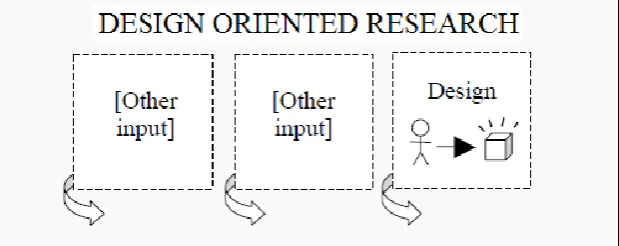
The constitution of the design science paradigm is predominantly initiated and inspired by Simon (1996; original in 1969). In ‘Sciences of the artificial’ he explores the fundamental differences between natural science and sciences of the artificial. Science of the artificial concerns knowledge with the building of artifacts whereas natural science is knowledge about natural objects and phenomena. Van Aken (2004) refers to this distinction in science as explanatory science (natural science) and design science (science of the artificial). Explanatory science is a quest for truth by developing knowledge aimed at description, prediction and explanation. Design science however quests for improving the human conditions by developing knowledge to solve field problems (Denyer, Tranfield, & Van Aken, 2008). When applying a design oriented approach for improving the human conditions, design can be defined as a process in which something is created (Fallman, 2003). Within this research process design activities are involved to produce new knowledge. Within this process ‘research’ can be seen as the area and ‘design’ as the means to finally constitute a solution design (Fallman, 2009).
[image:13.595.135.445.377.500.2]
Figure 1: The process of design oriented research
University of Twente | Master thesis Business Administration Tom Oude Luttikhuis 2.1.1 Regulative cycle
Using the regulative cycle as ‘the’ method for solving the research question of this thesis, leaves me to explain the following aspects before starting with the actual research:
Design part regulative cycle
Conceptualization of performance
Research methods, research instruments, data collection and analysis
Design part regulative cycle
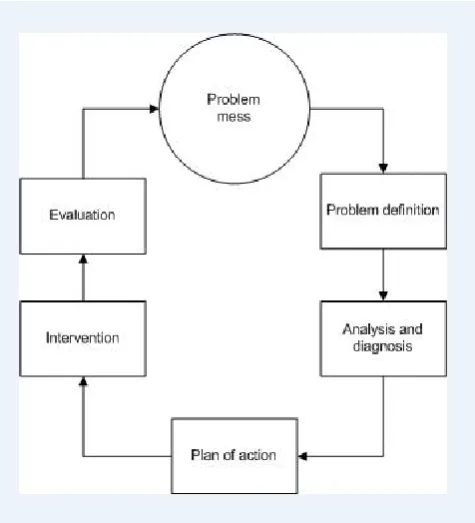
[image:14.595.184.422.357.619.2]According to van Aken et al., (2007) the theory on how to setup a BPS project should be used in a comprehensive, critical and creative way. With comprehensive they mean that the full-cycle approach should be followed as a whole and not as a menu where readers pick and choose certain elements. With critical they mean that the theory should be used critically and most important “The creative use means that the approach given in this book is not simply copied, but that it is to be contextualized. The approach given in this handbook should be regarded as a ‘design model’; a general model to be used as the basis for the design of the specific setup of a BPS project for a specific setting”(van Aken et al., 2007, p. 5). Therefore an elaboration will be made on the steps that are comprised into the design part. Besides the elaboration of these steps an explanation will be given in which steps this thesis will deviate from the norm process to provide a good connecting with the context of this thesis.
Figure 2: The regulative cycle (source: Van Strien, 1997)
Step 0: Problem mess
Not mentioned before but the problem mess is the actual starting point of a BPS project and contains the initial problem which is constructed by the problem-owner of the organization (Joan Ernst van Aken et al., 2007). Normally a meeting will be held with the problem owner of a certain organization to outline the problem mess and define a preliminary problem statement. In this case I constituted by means of my personal experiences and state of the art literature the central problem to study.
University of Twente | Master thesis Business Administration Tom Oude Luttikhuis major importance that the problem also exists among the participating companies. Verification of the central problem will be done during the interviews. These results will be elaborated in chapter 3. Step 1: Problem definition
Normally this problem definition step is where the problem is constructed by the problem owner, however problem analysis may show that the initial problem is a perception problem or a target problem, or may show that the problem is only a symptom of an underlying one. Hence this step is a thorough scoping process (van Aken et al., 2007). Within this thesis I constituted by means of my personal experiences and state of the art literature the central problem to study. To prevent this
problem is a perception problem or a target problem, or may show that the problem is only a symptom of an underlying, verification of the central problem will be done during the interviews among the participating companies. This step contains an intake process, orientation process and the constitution of a cause and effect diagram. The purpose of this chapter is to verify the initial problem statement and to include additional perspectives regarding current problems, causes and possible solutions to the central problem statement.
Step 2 Analysis and diagnosis
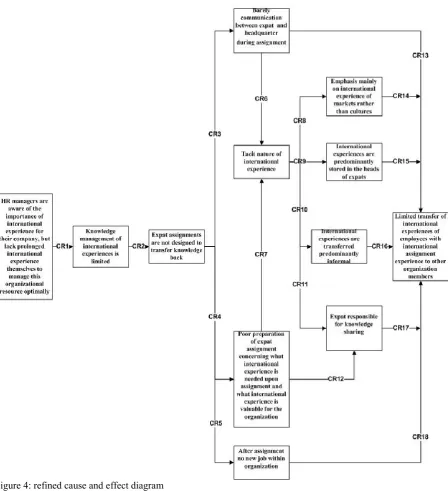
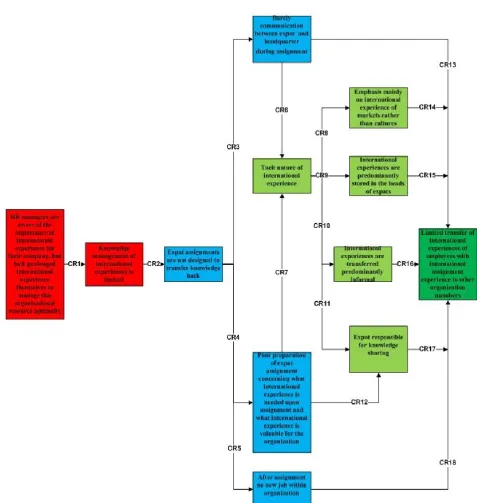
The second step of the regulative cycle starts when the problem has been defined, some of its potential causes and consequences identified, the assignment and the problem-solving approach determined (van Aken et al., 2007). The predominant purpose of the analysis and diagnosis step is to validate the founded business problems and to explore and validate their causes and consequences. This will be done by means of an empirical-based investigation and a theoretical analysis. The empirical-based investigation consists of validation interviews which will be held with different internal and external stakeholders. The purpose of these interviews are to create explanatory power for the possible causes and solutions found with the exploratory interviews in the problem definition phase. The purpose of the theoretical analysis is to accompany the results of the validation interviews with state of the art literature. According to van Aken et al., (2007, p. 71)“the theoretical analysis provides an extra source of evidence on causal relationships. This is especially valuable when it can be established that two particular factors are present but when at the same time it cannot be claimed on empirical grounds that these factors causally relate”. With the outcomes of the empirical-based investigation and theoretical analysis I will refine the cause and effect diagram if necessary and create in this way a validated cause and effect diagram. By means of this validated cause and effect diagram it’s possible to establish a definitive problem specification. From here theoretical directions will be formed to research the validated problems.
Step 3: Plan of action
University of Twente | Master thesis Business Administration Tom Oude Luttikhuis
2.2
Conceptualization of performance
In general BPS projects are initiated to design solutions that increase the performance of a business system, department or a company on one or more criteria.”Ultimately it should impact the profit of a company, but usually the actual objectives of a BPS project are of a more operational nature, related to the effectiveness and/or efficiency of operational business processes”(van Aken et al., 2007, p. 7). While the scope of this research conceives more than just a department or a company, it’s important that the concept of performance within this thesis will be defined. Only in this way it is possible to conclude if the proposed solution design contributes in improving the performance. Based on the findings of both Antal (2001) and Vinogradova, Zaman, & Svensson (2012) the central concept to measure any improvement will be ‘formalization’. Within their research they acknowledge that if organizations want to improve the knowledge transfer of expatriates upon the organization, they need to formalize the knowledge transfer of international experiences. Currently expats have indistinctness about what is important and only share this informal. Antal (2001) and Vinogradova, Zaman, & Svensson (2012) conclude that increasing formalization by putting in place for instance processes and structures improves the knowledge transfer. Within this thesis I will follow the definition of
formalization proposed by Bodewes (2002). According to Bodewes (2002, p. 214)”formalization represents the extent to which codified work processes coordinate and control work processes”.
During the interviews, the current extent of formalization within the knowledge transfer process will be analysed. On this basis, solutions will be designed that increase this level of formalization towards a more formalized level. When the proposed solutions increase the current level of formalization, this can be seen as a performance improvement.
2.3
Research methods, research instruments, data collection and analysis
The research design and method that suits this Master thesis and should deliver the appropriate results is related to the type of research question that needs to be answered (Berg, 2004)
.
According to van Aken et al., (2007) the research method accompanied by a design oriented approach are interviews. Therefore I will briefly elaborate on how interviews should be performed, and how this method will be performed within this thesis.“If you want to know how people understand their world and their lives, why not talk with them? Conversation is a basic mode of human interaction. Human beings talk with each other; they interact, pose questions, and answer questions. Through conversations we get to know people, learn about their
experiences, feelings, attitudes, and the world they live in”(Kvale & Brinkmann, 2008, p. xvii). The philosophy behind interviews has its roots in the basic mode of human interaction “a
University of Twente | Master thesis Business Administration Tom Oude Luttikhuis information: Kvale & Brinkmann, 2008). In this way an attempt will be made to produce by means of interviews as a research method the best possible outcomes.
2.3.1 Interview research beyond subjective relativism
Important when performing scientific research is that the results/knowledge produced with the selected research method are reliable in a scientific way. “The trustworthiness, the strength, and the
transferability of knowledge are in the social sciences commonly discussed in relation to the concepts of reliability, validity, and generalization”(Kvale & Brinkmann, 2008, p. 241). Therefore a brief elaboration will be made of these concepts and which activities have been undertaken to support the trustworthiness, strength, and transferability of the knowledge produced with the interviews for this study.
2.3.1.1 Reliability & validity
“Reliability pertains to the consistency and trustworthiness of research findings; it is often treated in relation to the issue of whether a finding is reproducible at other times and by other
researchers”(Kvale & Brinkmann, 2008, p. 245).“Validity refers in ordinary language to the truth, the correctness, and the strength of a statement. A valid argument is sound, well-grounded, justifiable, strong and convincing”(Kvale & Brinkmann, 2008, p. 246). According to Campion, Palmer, & Campion (1998) one of the most strongly supported conclusions from the last 80 years of published research on interviews is that:”structuring the interview enhances its reliability and validity and, hence, its usefulness for prediction and decision making”(Campion et al., 1998, p. 47). When
performing qualitative research there are three types of interviews: unstructured, semi-structured, and structured (Baumbusch, 2010). Unstructured interviews have a low reliability because this type of interviewing is comparable with a normal conversation in which questions are not pre-set. The chance other researchers will produce similar findings is therefore small. Semi-structured and structured interviews are characterized by pre-set questions. Due to these pre-set questions, the chance other researchers will produce similar findings is higher. Within this thesis semi-structured interviews are used because this structure with pre-set questions in the open ended format allows for the comparison between respondents as well as possibilities to clarify and extend the statements of the respondent (Kvale & Brinkmann, 2008). While the pre-set questions in this case improve the reliability of the results, the open ended format decreases the reliability. To improve the reliability of the open ended format questions, researcher can use a structured process for analyzing the social data. According to Babbie (2009)”The key process in the analysis of qualitative social research data is coding,
University of Twente | Master thesis Business Administration Tom Oude Luttikhuis assumed that the causes/results are valid when these are identified by distinct groups and identified within ‘state of the art’ literature.
2.3.1.2 Generalizability
After judging the findings of interview research to be reasonably reliable and valid, the question remains whether the results can be generalized upon other subjects and or situations. In general solving business problems with a design oriented approach happens from an individual organizational perspective (van Aken et al., 2007). This increases the chance in providing the specific company with a relevant solution, but decreases the generalizability of this solution. To improve the generalizability one can involve more organizations who are faced with the similar problem. In cooperation with the World Trade Center (WTC) I was able to constituted a representative, random, and stratified sample of 142 companies (see appendix F.1). The big advantage of this sample is that the only similarity
between the companies is that they are located in Twente and do business internationally. They differ in all the other aspects like: size, industry, product or service company etc. After investing a
University of Twente | Master thesis Business Administration Tom Oude Luttikhuis
3
Problem definition
The purpose of this chapter is to verify the initial problem statement and to add other perspectives in regard to the current problems, causes and possible solutions related to the initial problem. This step contains an intake process, orientation process and a cause and effect diagram.
__________________________________________________________________________________
3.1
Intake
The intake within this thesis deviates from the norm process of van Aken et al., (2007) While the intake approach within this thesis differs, the final result of constructing a initial problem is the same. In general this initial problem is constructed by a problem-owner of a certain company. In this thesis I constructed by means of my own experiences and state of the art literature the following initial problem:
‘A limited transfer of international experiences from expats with international assignment experience to other organization members restrains companies in becoming more successful in their globalizing
business environment’
To verify that this initial problem isn’t my own perception or only exists within the literature, all the respondents of the participating companies were asked about the importance of international
experience for them and their organization within their globalizing business environment and how formally this source of knowledge is shared.
Respondent no. 1 stated: “Very important, our market is the international market. If we don’t know exactly what is going on in the local market, how their culture is and how they want to be treated, we can never offer a bid”. Respondent no. 1 also acknowledged: “The international experiences gained by our expats during the assignment are solely shared informal”.
Respondent no. 2 stated: “Acculturating with a certain culture is of major importance when companies wants to be active within that culture. It’s important to transfer this experiences upon your
colleagues”. Respondent no.2 also stated: “The transfer of cultural experiences are shared informal. Due to the fact this happens informal, it’s difficult to capture these experiences and convert these into processes!”.
Respondent no. 3 said: “If we want to do business successfully in different cultures, we need to respect the cultural differences. These are learned by expats when they are assigned into these cultures” Respondent no. 3 also acknowledged: The responsibility of sharing these experiences comes from me and not from the organization. I can decide if I transfer these experiences or not. If I transfer these experiences this happens pure informal because there is no system. The reason for this, is because they don’t think about capturing these international experiences”.
Respondent no. 4 explained: “International experiences are important for knowing what our customers want. Knowing what they want will result in selling more. Respondent no. 4 stated also: “We worked with expats but didn’t transfer the experiences because after the assignment they immediately started working somewhere else. With the international experiences of our previous expats, the current and future expats could have a lot of advantages”.
University of Twente | Master thesis Business Administration Tom Oude Luttikhuis yourself, you will notice them only when it goes wrong”. Respondent no. 5 stated also:”Sharing my international experiences comes from me and not from the organization. This sharing of international experiences happens informal”.
All these respondents have different backgrounds and are from different multinational companies, whom differ organizational size, industry, etc. Mutually these respondents acknowledge that international experiences is of major importance if companies want to business successfully in their globalizing business environment. Despite this mutual consent they state that “international
experiences” are a valuable resource for the organization but the transfer of these experiences are predominantly informal (See appendix B for the explorative transcripts).
3.2
Internal orientation
After verifying the initial problem statement, it’s time to explore the scope and depth of the problem. This exploration will be done by discussing the problem with important stakeholders into this problem. According to van Aken et al., (2007, p. 45)”interviews are conducted with people who are responsible for the (solution of the) problem and people who are confronted with the problem”. The purpose of these interviews are to add other perspectives to problem. To produce the best possible outcomes with these interviews I will incorporate the stages of Kvale & Brinkmann (2008), elaborate upon the stakeholders which will be selected for the interviews as respondents, reflect upon the interview sampling and analysis and conclude with the interview outcomes which will be the input of the cause and effect diagram.
3.2.1 Interviews
Kvale & Brinkmann (2008)
Thematizing: According to van Aken et al., (2007), the most important function of exploratory interviews is to include additional perspectives to a certain problem. For that reason the questions in the exploratory interview guide were thematized to gain specific knowledge towards the causes and solutions regarding the central problem
Designing: The qualitative exploration interviews are semi-structured because this structure allows for the comparison between respondents as well as possibilities to clarify and extend the statements of the respondent(Kvale & Brinkmann, 2008). The questions which were thematized were all in the open-ended format in order to stimulate as much response as possible.
Interviewing: The interviews will be conducted through face to face interviews. This because the companies in the sample are all closely situated to my home. I choose for this maybe time consuming technique to achieve the best possible results for this thesis.
Transcribing: With help of a pragmatic transcription method all the oral recorded data has been transcribed into written text. This method transcribes the data from the interviews sufficient for the extent in which the data needs to be analyzed .
Analyzing: The transcripts will be analyzed through the process of open coding, axial coding, and selective coding. By codifying the written text underlying patterns will be revealed which will contribute in the constitution of the cause and effect diagram.
Verifying: The ambition with these interviews is to produce reliable data that is reproducible by others and correct and therefore valid.
Reporting: The thematized interview questions are reported in Appendix A. The transcriptions of the exploratory interviews are reported in Appendix B. The codes produced by means of the transcripts are reported in Appendix C.
University of Twente | Master thesis Business Administration Tom Oude Luttikhuis 3.2.2 Stakeholders
Among the participating companies, interviews will be held with important stakeholders into the problem. Within this research, the focus will be on employees which have in lesser of greater degree international experiences and on employees who are responsible for the transfer of this knowledge resource. As already mentioned in chapter 1, by far the most intensive mechanism for employees to learn about another culture and market is through multi-year expatriate assignments (Gupta & Govindarajan, 2002; Lovvorn & Chen, 2011; Nummela et al., 2004). Therefore the focus will be predominantly on employees who have experienced a multi-year expatriate assignment. Besides these Expatriates whom are categorized as PCN’s in the international human resource (IHRM) terminology there are also Inpatriates whom can be defined as HCN’s and TCN’s (Harvey, Novicevic, & Speier, 1999) These inpatriates also contain valuable knowledge about other cultures and markets. “Parent-country national (PCN) refers to a person of the same nationality as the MNC headquarters. Host-country national (HCN), sometimes called local national, refers to a person of the same nationality as an MNC subsidiary. Third-country national (TCN) refers to a person of a third nationality, employed either in the MNC parent country or in an MNC subsidiary” (De Cieri, Cox, & Fenwick, 2007, p. 287). All above mentioned type of employees contain international experiences and are therefore interesting for discussing the causes why there international experiences are limited transferred upon other organization members.
Whom are responsible, that employees with international assignment experience transfer this upon other organization members needs a little bit clarification. The transfer of knowledge can be seen as an stage/phase of knowledge management (Alavi & Leidner, 2001; Bhatt, 2001; de Jong & Roelofs, 2000; Gold, Malhotra, & Segars, 2001).“Defining the concept of knowledge management is difficult, as different perspective or schools of knowledge management can yield different dimensions and meanings. Although the definitions vary in their description of knowledge management, there seems to be a consensus of treating knowledge management as a process”(Yahya & Goh, 2002, p. 458).
University of Twente | Master thesis Business Administration Tom Oude Luttikhuis 3.2.3 Interview sampling and analysis
The ambition with this thesis is to provide a solution design that is not only applicable for the
participating companies but also applicable for other companies. To increase the generalizability of the results from the interviews upon an as big as possible population, it’s important that the sample needs to be: representative, random and stratified (Downs & Adrian, 2012). For this design oriented
approach that contains exploratory interviews and validation interviews, I’m looking for companies that are active in the global playing field. Due to the incredible amount of companies whom are active in the global playing field, I decided due to the fact that I will held face-to-face interviews, to scope this down to the area where I live called ‘Twente’(part of eastern Holland). With the help of World Trade Center(WTC) Twente which supports companies in Twente to do business internally, I managed to establish a list of companies in Twente that are active in the Global playing field. The sample contains 142 companies (see appendix F.1). The big advantage of this sample is that the only similarity between the companies is that they are located in Twente and do business internationally. They differ in all the other aspects like: size, industry, product or service company etc. This great diversity among the companies in the sample strengths the representativeness. The companies which I will approach for my thesis will be randomly assigned by rolling with a fair die. From the randomly assigned companies I will select stakeholders from different layers within the organization. In this way I try to establish results that have a high generalizability.
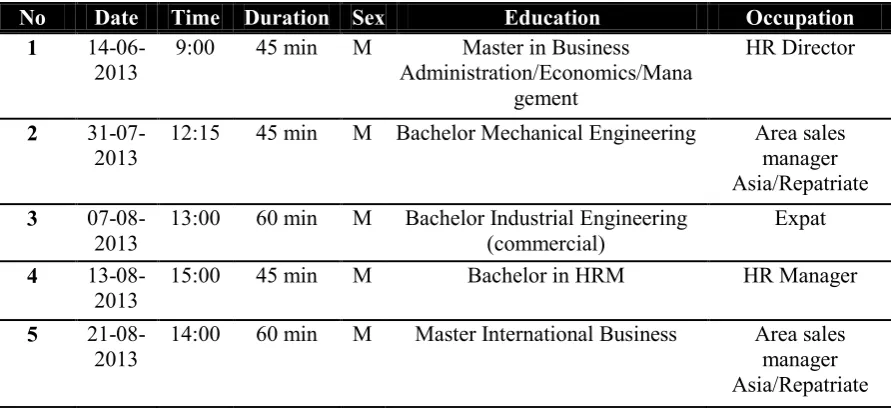
[image:22.595.75.521.399.603.2]The final sample for the exploratory interviews consisted of five stakeholders. Understated an overview is given with background information regarding these exploratory interviews.
Table 3: Background information regarding the exploratory interviews. 3.2.4 Interview outcomes
After conducting the exploratory interviews with the selected stakeholders, it became clear that all participants mutually acknowledge the importance of knowledge and experiences of the international market for them and their organization if they want to business successfully in their globalizing business environment. Despite this mutual consent they state that “international experiences” are a valuable resource for the organization but the transfer of these experiences from employees with international assignment experience upon the organization is limited. By listening to the recordings and analyzing the interview transcripts carefully through a process of open coding, axial coding, selective coding and by means of literature related to the problem, I was able to establish a list of brief
No Date Time Duration Sex Education Occupation 1
14-06-2013 9:00 45 min M Administration/Economics/ManaMaster in Business gement
HR Director
2 31-07-2013
12:15 45 min M Bachelor Mechanical Engineering Area sales manager Asia/Repatriate 3
07-08-2013
13:00 60 min M Bachelor Industrial Engineering (commercial)
Expat
4
13-08-2013 15:00 45 min M Bachelor in HRM HR Manager
5 21-08-2013
University of Twente | Master thesis Business Administration Tom Oude Luttikhuis code descriptions of the most important interview outcomes that relate somehow to the central
problem. These interview outcomes will be elaborated more extensively in the analysis and diagnosis chapter.
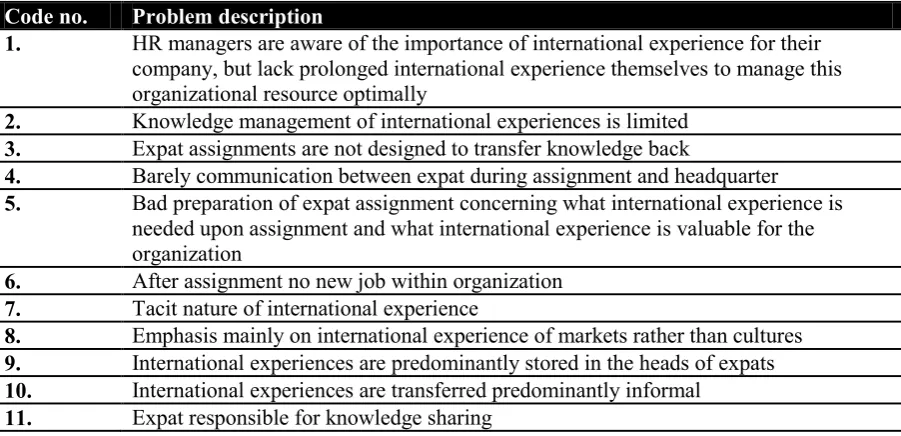
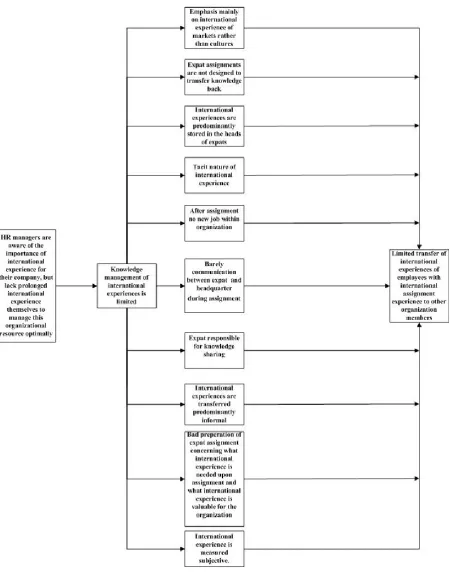
Code no. Problem description
1. HR managers are aware of the importance of international experience for their company, but lack prolonged international experience themselves to manage this organizational resource optimally
2. Knowledge management of international experiences is limited 3. Expat assignments are not designed to transfer knowledge back
4. Barely communication between expat during assignment and headquarter 5. Bad preparation of expat assignment concerning what international experience is
needed upon assignment and what international experience is valuable for the organization
6. After assignment no new job within organization 7. Tacit nature of international experience
8. Emphasis mainly on international experience of markets rather than cultures 9. International experiences are predominantly stored in the heads of expats 10. International experiences are transferred predominantly informal
[image:23.595.74.525.124.342.2]11. Expat responsible for knowledge sharing
Table 4: Summary of the problems related to the central problem.
3.3
Cause and effect diagram
A cause and effect diagram generally shows a mess of symptoms that is created by a mess of causes. The more symptomatic phenomena are posited on the right side of the diagram and the causes on the left side (van Aken et al., 2007). Based on the intake meeting, stakeholder analysis and the exploratory interviews a list of symptoms and causes has been established. As already mentioned, the stakeholders whom are responsible for the (solution of the) problem are the HRM employees. Stakeholders who are confronted with the problem state that “HR managers are aware of the importance of international experience for their company, but lack prolonged international experience themselves to manage this organizational resource optimally”(code 1). According to Skelin (1999), Soliman & Spooner (2000) and Yahya & Goh (2002) HRM employees are responsible for the knowledge management system within organizations. This lack of international experience could result in why the “knowledge management of international experiences is limited”(code 2). According to Alavi & Leidner (2001) the objective of these systems is to support the creation, transfer and application of knowledge in organizations. Analyzing the above stated problem definitions (with the exception of code 1 and 2) makes clear that code 3 – 12 effects somehow the creation, transfer and application of these
University of Twente | Master thesis Business Administration Tom Oude Luttikhuis Preliminary Cause and Effect diagram
[image:24.595.76.527.89.662.2]
University of Twente | Master thesis Business Administration Tom Oude Luttikhuis
4
Analysis and diagnosis
The predominant purpose of the analysis and diagnosis step is to increase explanatory power for the causes retrieved in the previous chapter. This will be done by means of an empirical-based
investigation and theoretical analysis. During this empirical-based investigation validation interviews will be held with different internal and external stakeholders which will create explanatory power for the causes retrieved during the exploratory interviews in the problem definition step. The theoretical analysis will strength the results of the empirical-based investigation further and will contribute also as an extra source of evidence when causal relationships cannot be claimed on empirical grounds. Within this chapter first an elaboration will be made on the stages of Kvale & Brinkmann (2008) regarding the validation interviews. By incorporating these stage an attempt will be made to produce the best possible outcomes for the empirical based investigation. Second, the results of the exploration interviews, validation interviews and theoretical analysis will be elaborated per cause. Third, after elaborating on these results a refined cause and effect diagram will be constituted. To provide clarification for this cause and effect diagram, a recap will be performed on the causal relationships. Fourth, by means of these results the central problems will be selected and theoretical directions will be created. These theoretical directions provide the research directions during the plan of action step of the regulative cycle.
4.1
Validation interviews
Kvale & Brinkmann (2008)
Thematizing: According to van Aken et al., (2007), the most important function of validation interviews is to increase explanatory power. For that reason the questions in the validation interview guide were thematized to gain more explanatory power for the causes retrieved during the exploratory interviews.
Designing: The qualitative validation interviews are semi-structured because this structure allows for the comparison between respondents as well as possibilities to clarify and extend the
statements of the respondent(Kvale & Brinkmann, 2008). The questions which were thematized were all in the open-ended format in order to stimulate as much response as possible.
Interviewing: The interviews will be conducted through face to face interviews. This because the companies in the sample are all closely situated to my home. I choose for this maybe time consuming technique to achieve the best possible results for this thesis.
Transcribing: With help of a pragmatic transcription method all the oral recorded data has been transcribed into written text. This method transcribes the data from the interviews sufficient for the extent in which the data needs to be analyzed .
Analyzing: The transcripts will be analyzed by means of the results retrieved in the problem definition step.
Verifying: The ambition with these interviews is to produce reliable data that is reproducible by others and correct and therefore valid.
Reporting: The thematized interview questions are reported in Appendix D. The transcriptions of the validation interviews are reported in Appendix E.
University of Twente | Master thesis Business Administration Tom Oude Luttikhuis The final sample for the validation interviews consisted of three stakeholders. Understated an
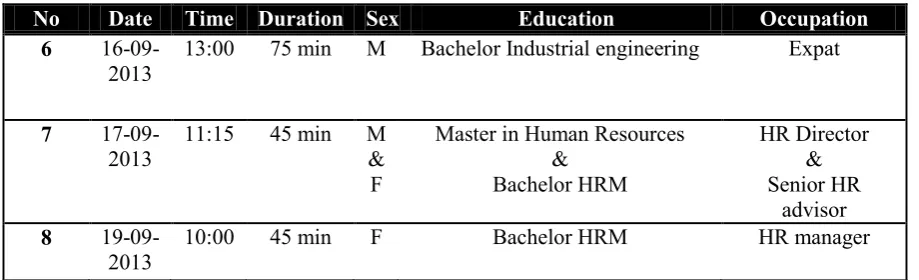
[image:26.595.68.528.112.252.2]overview is given with background information regarding these validation interviews.
Table 5: Background information regarding the validation interviews.
4.2
Results from exploration interviews, validation interviews and theoretical analysis
Cause 1 HR managers are aware of the importance of international experience for their company, but lack prolonged international experience themselves to manage this organizational resource optimally
Exploration interviews
Respondent no. 1 explained:”Very important, because the international market is our market. Our customers are spread all over the globe. If we don’t know exactly what our customers want, we can never offer a bid. Equal to the Omani, if we don’t know what happens in the local market, how their culture is and how they want to be treated, than offering a bid is a no-go issue”. Respondent no. 4 stated: “The world is our market! International experiences are therefore a very important
organizational resource for our organization”. Respondent no. 4 explained:”Currently we don’t do much with these international experiences. It is important for doing business successfully but I’m not aware of which knowledge and experiences exactly contribute in doing business successfully. We worked with expats but never transferred these international experiences upon the organization. I think that we could have a lot of advantages when we had transferred these international experiences upon the organization”. Respondent no. 4 explained also: “Expats need a lot of international experience depending on the culture they have to deal with. I only don’t know what international experience they need”. Respondent no. 5 stated:” HR manager are not aware which international experiences are important because in general they lack international experience themselves”.
Validation interviews
Respondent no. 7 stated:”international experience for our organization and employees is very important”. Respondent no. 8 explained:”We make our money as a service organization with the knowledge and experience of our employees. Without the knowledge and experience of our employees we have no existence as a company. Managing this organizational resource is therefore the utmost for our company”.
Literature review
Reviewing literature on this topic agrees upon the findings from the exploration interviews and validation interviews. Black, Jensen, & Gregersen (2003, pp. 263–264) point out that in a previous study, only 11% of American HR executives had themselves lived or worked in a foreign country. According to Shen & Hall, (2009) and Vinogradova et al., (2012) this lack of international experience
No Date Time Duration Sex Education Occupation 6
16-09-2013
13:00 75 min M Bachelor Industrial engineering Expat
7 17-09-2013
11:15 45 min M & F
Master in Human Resources &
Bachelor HRM
HR Director & Senior HR
advisor 8
19-09-2013
University of Twente | Master thesis Business Administration Tom Oude Luttikhuis results in a poor management of international experiences. According to Vinogradova et al., (2012, p. 23)“All of the HR managers refuse that international experience is required in their roles, but at the same time they admit that it would have been a benefit”.“When it comes to transferring the
knowledge, all of the HR respondents agree that there is need for improvement”(Vinogradova et al., 2012, p. 25).“When it comes to coming up with concrete suggestions for improving knowledge transfer the HR respondents fail to do so. It is rather the repatriates that have many suggestions for such improvements. This indicates that it may be a clear disadvantage for the HR managers not to have international work experience”(Vinogradova et al., 2012, p. 29). Vinogradova et al., (2012) finally state that:“since those in charge of handling the international assignments do not have any international experience, it is quite obvious that there is a lack of knowledge and understanding regarding this issue”(Vinogradova et al., 2012, p. 31).
Cause 2 Knowledge management of international experiences is limited
Exploration interviews
Respondent no. 1 explained:”for a while we notice that we as an organization are struggling with knowledge management. We even invited professors and supportive personnel whom are specialized into this phenomenon of knowledge management and what to do with knowledge and how do I transfer this upon the organization. It’s a difficult phenomenon”. Respondent no. 1 also stated: This is no process. I would say this is a challenging topic with a lot of derived aspects. Respondent no. 3 stated: “In our organization we are thinking of implementing a knowledge management system but relatively not much has been undertaken”. Respondent no.3 also explained: “The international experiences are currently shared informal and not in a system. The reason for this is because they don’t think of sharing this in a system”. Respondent no. 5 stated also:”as far as I know we don’t manage our international experiences in a system”.
Validation interviews
Respondent no. 7 acknowledged:”There is no central concept within our company worldwide. Also there is no concept within the Netherlands”. Respondent no. 8 explained:”At the moment we are busy worldwide to look, were is our knowledge located, what knowledge do we need and how do we take care that this knowledge will be applied and shared. This is real knowledge management. We started with this in the beginning of this year.
Literature
Reviewing the subsequent causes agrees upon the findings from the exploration interviews and validation interviews. In the previous chapter I already discussed that within this thesis ’knowledge management’ will be considered as a cyclical process that contains five steps termed: knowledge acquisition, knowledge documentation, knowledge transfer, knowledge creation and application (De Jong & Roelofs , 2000). When discussing knowledge management systems, these are integrated in organizations to support them with the creation, transfer and application of knowledge (Alavi & Leidner, 2001). The subsequent causes discussed within this chapter will clarify that organization lack/are limited in the creation, transfer and application of international experiences.
Cause 3 Expat assignments are not designed to transfer knowledge back
Exploration interviews