warwick.ac.uk/lib-publications
A Thesis Submitted for the Degree of PhD at the University of Warwick
Permanent WRAP URL:
http://wrap.warwick.ac.uk/97572
Copyright and reuse:
This thesis is made available online and is protected by original copyright.
Please scroll down to view the document itself.
Please refer to the repository record for this item for information to help you to cite it.
Our policy information is available from the repository home page.
STATEMENT
The work presented in this Thesis has not been submitted
for another degree of this or any other University. It is original
with the exceptions stated below:
(i) The work in Chapter 1 is a review and commentary on the existing
design methods for model reference adaptive systems.
(ii) In Chapter 2, the performance comparison of M.I.T. and Liapunov
designs with step and sinusoidal inputs was reported in the candidate's
M.Sc. dissertation. This work is reproduced here for the sake of
completeness. The performance study for stochastic inputs and the
inclusion of three other designs are new.
(iii) Elsewhere in the thesis ideas, results and examples which are
due to other authors are clearly acknowledged in the references.
ABSTRACT
This thesis sets out to compare five well known design rules
for the design of model reference adaptive systems. These are the
M.I.T. rule, the Liapunov synthesis, the gradient rules of Dressier
and Price, and the Monopoli design rule. A systematic performance
comparison is made using two low order gain adjustment systems
simulated on a digital computer. Step, sinusoidal and stochastic
input signals are used and the system state variables and performance
criteria are all expressed as dimensionless quantities. The results
clearly demonstrate the superior performance of the Liapunov and
Monopoli designs. The main disadvantage of other designs is that the
dimensionless performance criteria is not a monotonic decreasing
function of the dimensionless gain parameter. An analysis of the
noisy case is then performed and this further points out the flexibility
of the Liapunov synthesis.
The next objective of the research is to extend the scope of
application of the Liapunov designs. First a modification of the usual
design algorithm for multivariable systems is made sc that a wider
class of plants, in which the adjustable parameters may appear simul
taneously in two or more elements of the plant and control matrices,
can be readily treated. Examples are given to illustrate the design
procedures and the typical performance of such designs. Secondly, the
simultaneous parameter and state estimation system using model
reference methods is investigated. Landau's hyperstability design,
which can be shown to be equivalent to the Liapunov design, is preferred
for this problem. To distinguish this design from the well known
Generalized Equation Error (G.E.E.) design, we have called it the
Stable Response Error (S.R.E.) design. The practical difficulty of
using this globally stable design rule is found to be the implementation
of the series (derivative) compensator. It is then shown how the
problem is solved by using the state variable filters. Various
simulation results substantiate the characteristics (namely unbiased
estimates and very fast convergence) of the resulting design. The
recovery of the simultaneous state estimates when the state variable
filters are used with the S.R.E. design is then considered. With
a moderate rate of convergence, the quality of the state estimates is
found to be good. The main disadvantage of the S.R.E. method is that
the range of parameter variations must be known a priori in order to
design the series compensator which ensures the global stability.
Finally, the extensions of the S.R.E. method to treat nonlinear and
multivariable systems are presented. The main effort here is to
find the appropriate structures of the estimation model.
To conclude the thesis, a real case study is presented.
This is the modelling of a nonlinear, third order internal combustion
engine by a linear, first order model. The parameters of the model
are adjusted according to the S.R.E. design rule. The practical
results obtained demonstrate the feasibility of using the model
reference method in a real physical system. Then some of the
experiments are repeated with the estimation system based on the
G.E.E. design rule. The results are found much inferior to those
ACKNOWLEDGEMENTS
The author wishes to express his deepest gratitude to
Professor P.C. Parks who supervised this research work, for his
guidance and encouragement throughout its progress. He is also
indebted to The Royal Commission For The Exhibition of 1851, for
the financial assistance in the form of an Overseas Scholarship,
and to the British Cov.cil, for the granting of a Fees Award. Thanks
are also due to Professor R.V. Monopoli (University of Massachusetts),
Professor I.D. Landau (ALSTHOM Research Laboratory and University
of Grenoble) and Professor J.L. Douce (University of Warwick) for
their encouragement and many useful discussions. Finally, his
thanks go to his colleague, Mr. J.N. Devlukia, for his assistance
in the experiments on the internal combustion engine and to Mrs.
V. Carroll for her patience in typing this thesis.
Y
LIST OF CONTENTS
Page N o .
CHAPTER 1 - INTRODUCTION
1.1 BACKGROUND INFORMATION 1
1.2 LITERATURE SURVEY 2
1.2.1 Adaptive Control 2
1.2.2 Identification 5
1.3 PURPOSE AND LAYOUT OF THE THESIS 8
1.4 DEFINITIONS AND THEOREMS 10
CHAPTER 2 - COMPARATIVE STUDIES OF MODEL REFERENCE
ADAPTIVE CONTROL (M.R.A.C.) SYSTEMS
2.1 INTRODUCTION 15
2.2 A CRITICAL COMPARISON OF THE DESIGN RULES 17
2.2.1 M.I.T. Rule and Liapunov Synthesis 17
2.2.2 Other Design Rules 21
2.2.3 A Simulation Study of the Adaptive 23
Response
2.3 A SYSTEMATIC PERFORMANCE COMPARISON 25
2.3.1 First Order Systems 26
2.3.2 Second Order Systems 33
2.3.3 Summary 38
2.4 GENERAL DISCUSSIONS 39
2.4.1 General Parameter Adjustments 39
2.4.2 Eftects of Noise 41
2.4.3 Noise and Disturbance Rejection 43
2.5 CONCLUSIONS - 44
(v)
CHAPTER 3 - DESIGN OF MULTIVARIABLE M.R.A.C. SYSTEMS
USING LIAPUNO.’ SYNTHESIS
3.1 INTRODUCTION
3.2 GENERAL DESIGN ALGORITHM PREVIOUSLY
SUGGESTED
3.3 A MORE GENERAL DESIGN ALGORITHM
3.4 AN ILLUSTRATIVE EXAMPLE
3.5 FURTHER EXAMPLES
•3.6 CONCLUSIONS
CHAPTER 4 - DESIGN OF MODEL REFERENCE PARAMETER AND
STATE ESTIMATION SYSTEMS
4.1 INTRODUCTION
4.2 THE STABLE RESPONSE ERROR (S.R.E.) METHOD
FOR PARAMETER ESTIMATION
4.2.1 Statement of the Basic Problem
4.2.2 The Basic Design Rule
4.2.3 The Role of the Proportional (Feed
forward) Loops
4.2.4 The State Variable Filters
4.2.5 Noise Contamination
4.2.6 Simulation Results
4.3 THE ADAPTIVE STATE OBSERVER
4.3.1 Development
4.3.2 Simulation Results
4.4 EXTENSIONS
4.4.1 A Class of Nonlinear Plants
4.4.2 A Class of Multivariable Systems
CHAPTER 5 - AN APPLICATION CASE STUDY
5.1 INTRODUCTION 98
5.2 A BRIEF DESCRIPTION OF THE SYSTEM AND 99
THE EXPERIMENTS
5.2.1 The Engine 99
5.2.2 The Experimental Setup 100
5.2.3 The Adaptive Models 102
5.3 EXPERIMENTAL RESULTS 104
5.3.1 The S.R.E. Design 104
5.3.2 The G.E.E. Design 111
5.4 CONCLUDING REMARKS 114
CHAPTER 6 - FINDINGS AND FURTHER WORK 115
6.1 FINDINGS 115
6.2 SUGGESTIONS FOR FURTHER WORK 117
REFERENCES 119
APPENDICES
A.l. Liapunov Design 125
A. 2. Differential Equations of the Various 127
Designs
A. 3. Dimensional Analysis 129
A.4. The Stochastic Signal 131
A. 5. The Adaptive Laws for General Parameter 136
Adjustments
A.6. Hyperstability and Identification 138
A.8. Parameter Sensitivity of Positive
Real Functions
A.9. The Generalized Equation Error Method
A.10. Transformation to a Canonical Form
CHAPTER 1 INTRODUCTION
1.1. BACKGROUND
The model reference adaptive control (M.R.A.C.) technique
has been a popular approach to the control of systems operating in the
presence of parameter and environmental variations. In such a scheme,
the desirable dynamic characteristics of the plant are specified in
the reference model and the input signal or the controllable parameters
of the plant are adjusted, continuously or discretely, so.that its
response will duplicate that of the model as closely as possible. The
identification of the plant dynamic performance is not necessary and
hence a fast adaptation can be achieved.
In the last decade or so, the design methods for M.R.A.C.
systems have been dominated by the so called M.I.T. rule and many
attempts have been reported to implement the resulting design in real
physical systems. However, more often than not, the designer finds
himself confronted with a complex stability problem or inadequate
performance of the adaptive loop and all these limit the widespread
application of M.R.A.C. techniques although it is thought to be an
attractive alternative to many conventional methods. In the same
period, other new design methods have been developed to overcome the
snortcomings of the M.I.T. rule and the literature is flooded with new
proposals. In fact the situation has reached a stage where the
designer is fairly confused about the status of the various methods
now available.
Recently tho concept of model reference has been regarded
more generally than it was first being used for in adaptive control.
For instance, it can be readily shown that the well known Kalman
of parallel model reference systems. Two important methods of system
identification namely the equation error method and the response error
method can be formulated as a series-parallel and parallel model
reference systems respectively. Also the recently popularized method
of compensating multivariable systems, namely the model following method,
can be treated as a parallel model reference system. Hence, further
research on M.R.A.C. systems will benefit all these important areas of
automatic control.
It is with such a background that this research has been
initiated. It does not attempt to invent entirely new design rules.
Rather the main effort has been expanded on the clarification of the
status of the art of designing model reference adaptive systems and on
further development of some prospective design rules to simplify the
implementation and to widen the scope of their application.
1.2. LITERATURE SURVEY
1.2.1. Adaptive Control
The M.R.A.C. system was first designed by the performance
index minimization method proposed by Whitaker ^ of the M.I.T.
Instrumentation Laboratory and has since then been referred as the
M.I.T. design rule. The performance index is the integral squared of
the response error. This rule has been very popular due to the simplicity
in the practical implementation of the plant gain adjustment loop. For
the adjustment of other parameters, however, sensitivity filters are
required and the hardware involved may be prohibitive for simultaneous
multi-parameter adjustments. An improved design rule with respect to
3
the speed of response has then been proposed by Donalson who used a
more general performance index than that of Whitaker, but additional
need of the sensitivity filters can be avoided by a gradient method
developed later on by Dressier , or by an 'accelerated gradient method'
suggested by Price ^ . The latter is easier to implement and is
capable of achieving faster adaptations compared with other gradient
techniques. Another contribution to the simplification of the design
comes from the application of sensitivity analysis by Kokotovic et
7 8
al ’ resulting in a design similar to the M.I.T. rule. Here, with
further approximation, only one sensitivity filter is required for
simultaneous multi-parameter adjustments. For some other particular
. 27
applications, W m s o r has also modified the M.I.T. rule to reduce
the sensitivity of the response to the loop gain, at the expense of
additional instrumentation. All the design rules mentioned are not
however, globally stable and hence the adaptive gain which governs the
speed of response is limited. A good compromise between the stability
and the speed of adaptation will have to be decided by laborious
simulation studies. A recent contribution by Green ** has extended the
work of Dressier to form a 'stable maximum descent' method. However
this adaptive rule is not attractive from a practical viewpoint because
the first derivatives of the state vectors are often required to assure
global stability of the resulting system.
Owing to the serious problem of instability encountered in
the M.I.T. rule and other gradient techniques, two branches of research
have become very active. These are the theoretical stability analysis
using such tools as the second method of Liapunov, and the new synthesis
approach which avoids the instability problem. The effort in the
analysis of the parameter adjustment loops,^which differential equations
24
arc nonlinear and nonautonomous, are summarized by James who shows
that the current status of control theory can only cope with simple
systems with deterministic signals and can hardly treat those with
and time consuming. On the other hand, in the Liapunov synthesis
approach, the adaptive rule is obtained by selecting the design equations
to satisfy conditions derived from the second method of Liapunov, so that
the system stability is guaranteed for all inputs. Butchart and
9
Shackcloth have first suggested the use of a quadratic Liapunov
• . 2
function which was employed later on by Parks to redesign systems
formerly designed by the M.I.T. rule. The use of a different Liapunov
.
.
11 12function by Phillipson and Gilbart et al has resulted in the
introduction of proportional (feedforward) loops which would improve
the damping of the adaptive response.
The main disadvantage of the Liapunov method is that the entire
state vector must be available for measurement, which is not often
possible. Recent efforts in the application of the idea of positive real
13 14
transfer function, notably that by Monopoli * , have allowed one to
eliminate or reduce the number of differentiators required to implement
the design rule for adjusting both the plant gain and other parameters.
Among other possible solutions to avoid the use of derivative networks,
Currie and Stear have envisaged the use of a Kalman filter, which
would also handle the measurement noise problem, while the use of state
observers ^ to estimate the states of an unknown time-varying plant is
still an open question. Some recent contributions on adaptive state
17 18
observers ’ represent the serious interest and the early stage of
development in the use of observers in adaptive control. Another
limitation of the Liapunov design rule is that it may not be applicable to
cases where the plant parameters cannot be directly adjusted. Such a
case was mentioned by Winsor and Roy ^ but a solution has been found
14
.
.
.
recently by Monopoli . A further possibility of indirectly controlling
the plant by adjusting the feedforward and feedback gains has been
investigated by Landau et al and Narendra et al
The Liapunov design can also be derived using the hyperstability
stability approach, the analysis of nonideal systems is very simple.
For instance the conditions for bounded-input bounded-output stability
can be readily written down when noise or time-varying parameters are
present. Although the hyperstability approach could give many other
designs, so far the best found is still the same as the Liapunov design.
Hence besides the convenience in analysis the hyperstable design rule
is equivalent to the Liapunov design rule.
Other less well known but important designs deserve mentioning
25
here. Nikiforuk anc Rao have suggested combining the advantages of
the sensitivity and stability considerations and they produced an
adaptive rule which could be made stable if the bound on the parameter
26
variations is known. Choe and Hikiforuk have suggested a feedback
law which guarantees bounded-input bounded-output stability and uses
only partial state measurements. Both of these approaches use the
second method of Liapunov and represent alternative ways of designing
on the basis of stability theory. Finally, the readers are referred
27-29
to three recent survey papers for other proposed designs.
1.2.2. Identification
Process parameter estimation using an adjustable model has
39 A O
been a popular on-line system identification technique ’ . This
method seeks to adjust the parameters of the model contii.uously so as
to null some error measure between the plant and the model. Two types
of models have been widely used, one being the series-parallel model
28
while the other is the parallel model . The former yields an error
measure called the equation error which is linear in the unknown
parameters; the latter uses the response error as an error measure
which is non-linear in the unknown parameters. Hence they are also
seeks to minimize the square of error measure according to a steepest
41
descent law. It uses a so called state variable filter technique
to avoid pure signal differentiations and is proved to be globally
asymptotically stable. Recently the extension of this approach to
treat multivariable systems has been done by Pazdera and Pöttinger 49
50
Narendra and Kudva who use the Liapunov synthesis design rules,
61
and by Landau who uses the hyperstability design rule. The only
limitation of the G.E.E. method is that it gives biased estimates
when the plant output is corrupted by noise.
The parallel model approach is in fact the usual parallel
model reference adaptive system but with the adjustable model attempting
to track the stationary (or slow-varying) plant. Hence all that has
been said about the design methods in Section 1.2.1 may be applicable
here. The status of the design rules is as follows. The sensitivity
37 47
method ’ is most popular but uneconomical due to the large amount
of time-varying sensitivity filters required; the stability may be
52 4
assured in some designs . The gradient method of Dressier ,
Hsia and Vimolvanich does not require sensitivity filters but is
limited to local convergence only. The gradient method employing
52 .
stochastic approximation is stable but the amount of hardware
required for generating sensitivity functions is usually prohibitive
and the rate of convergence is very slow. The synthesis approach of
Parks ^ and Landau globally stable but its implementation
requires the use of the plant state vector. All these methods,
|
parallel model approach is that the former only gives parameter estimates
28 whereas the latter gives simultaneous parameter and state estimates
This aspect has not bean emphasized in the past primarily because the
latter was dominated by the sensitivity design rule which was difficult
to implement and because it was usually thought that the simultaneous
parameter and state estimation could be adequately handled by more
. 54 55
complex methods like the extended Kalman filter ’ . However it is
now well known that the extended Kalman filter possesses a serious
convergence problem and is also difficult to implement. The potential
of the parallel model reference techniques is its simplicity in structure
and. fewer apriori information about noise statistics. The assured
stability of the Liapunov and hyperstability designs will certainly
add to the attractiveness of using model reference systems for simultaneous
parame :er and state estimations.
With explicit parameter and state estimations, many well known
. . . 44,
control techniques can then be applied to achieve adaptive control
£ r £0
. Now there arises an important question as to when should M.R.A.C.
(without explicit identification) be used and when should the adaptive
control with on-line identification be used. Besides the usual
consideration about the accessibility of adjustable parameters, the
possibility of injecting test perturbations and the availability of
state vectors, the most important factor influencing the choice of
adaptive control technique is the question of whether or not the
plant has dominant right-half-plane zeros (nonminimum phase) which
vary with the operating condition. As the M.R.A.C. uses high gains
in the adaptive loops, it may not be suitable for systems with
nonminimum phase transfer function whereas the adaptive control employing
68
explicit identification can cope with this type of system . If the
8
as it avoids the usually difficult identification problems.
1.3. PURPOSE AND LAYOUT OF THF. THESIS
The initial part of this research is a continuation of work
done as an M.Sc. project in which a simulation study verified in some
examples the superior performance of the Liapunov design over the M.I.T.
rule. In this thesis, other gradient methods are included in the
comparison and more general stochastic inputs are also used. Only
continuous time linear models and plants are considered. The results
confirm the earlier observation that the Liapunov design possesses
excellent performance characteristics not attainable by other designs.
Hence further developments of the Liapunov design rule will be worth
while in order to extend the usefulness of model reference techniques.
The latter part of the research thus includes the generalization of
the usual Liapunov design algorithm for multivariable systems to treat
a wider class of plants, the use of state variable filters for
implementing the parallel model reference identification system, and
a practical case study to assess the model reference systems designed
by using stability theories. The layout of the thesis is as follows.
Chapter 2 describes the comparative studies of several
design rules which include the M.I.T. rule, the Liapunov syntr.esis,
the gradient rules of Dressier and Price, and the. Monopoli design
rule. Step, sinusoidal and stochastic inputs are used in the systematic
performance comparison on the simulated examples. Dimensionless
variables and performance criteria are used so that the results are
most general. A qualitative analysis is then presented to discuss the
Chapter 3 reviews the commonly used Liapunov design algorithm
for the design of multivariable M.R.A.C, systems and points out its
limitation when used in some actual applications, A new general
algorithm is then derived and examined using the example of an
adaptive speed control loop for a Ward-I.eonard system. Qualitative
discussions of two more examples are also given.
Chapter 4 begins with the discussion of using the Landau
hyperstability design rule for on-line system identification problems.
The possibility of using the state variable filte: s to avoid pure
differentiation of signals when only the output of the plant but not
the'state vector is measurable is then investigated in detail. The
feasibility of simultaneous parameter and state estimations is then
explored. Finally, possible extensions to nonlinear systems and
multidimensional systems are examined. Throughout this Chapter,
various simulation results are presented to substantiate the theoretical
developments and to demonstrate the typical performance of such designs.
Chapter 5 presents a case study in which the Landau design
rule is assessed on a real physical system. The case is the on-line
modelling of a third-order internal combustion engine by using an
adjustable first-order linear model. The effects of neglecting the
higher order modes and the inherent nonlinearity of the engine on the
performance of this model reference identification system are examined.
not been widely recognised are brought together in the next section.
Hopefully this will ease the reading of this thesis.
10
1.4. DEFINITIONS AND THEOREMS
The reader is assumed to have fundamental knowledge on the
second method of Liapunov, A good account of this method is the paper
32 . . . .
by Kalman and Bertram while an example of its use m synthesis is
demonstrated in appendix A.l, The various configurations of model
reference systems have been discussed in reference 28 and hence only
the series-parallel and parallel models are to be distinguished here.
The concepts of absolute stability and hyperstability which have only
been recently utilized for the synthesis of model reference adaptive
2 21
systems ' will be discussed.
28 29
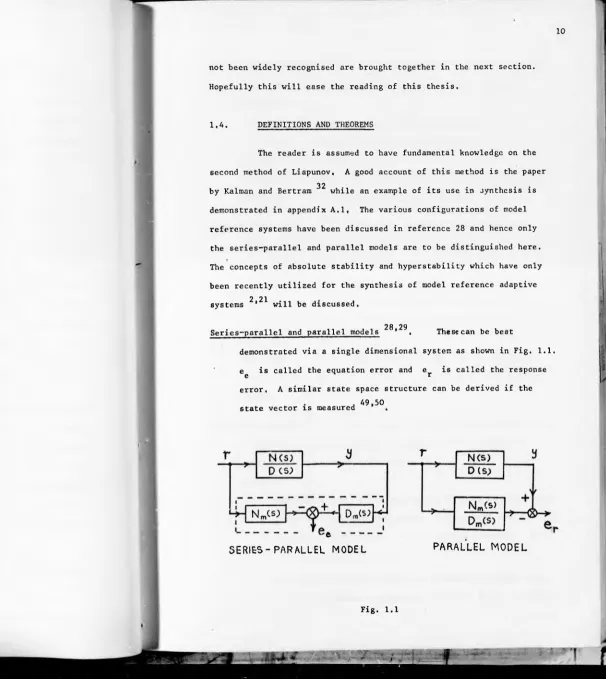
Series-parallel and parallel models * . These can be best
demonstrated via a single dimensional system as shown in Fig. 1.1.
e is called the equation error and e is called the response
e t
error, A similar state space structure can be derived if the
. 49,50 state vector is measured
SERIES-PARALLEL MODEL
PARALLEL MODEL
[image:20.636.15.621.13.692.2]Positive real function 56,58 A rational transfer function G(s)
is termed "positive real" if the following conditions are
satisfied:
(1) G(s) has no poles in Re [s] > 0 and poles on the jw
axis are simple with positive real residues;
(2) Re G(ju) Z 0 for all u>.
It is termed "strictly positive real" if in the above conditions,
the sign > is replaced by z and vice versa.
Positive real matrix ^ . A rational transfer function matrix
Z(s) is termed positive real if:
(1) Z(s) has real elements for real s;
(2) the elements of Z(s) have no poles in Re [s] > 0 and
poles on the jui axis are simple, and such that the
associated residue matrix is non-negative definite Hermitian
(3) Z(joj) + ZT *(ju) 5 0.
The signs T and * denote transpose and complex conjugate
respectively. Similarly a strictly positive real matrix can be
defined.
13 . .
Kalman-Meyer Lemma . This lemma was first stated by Kalman in his
treatment of the Lure problem on absolute stability and was
later modified by Meyer. The result is:
Lemma:
Let A be a real n x n matrix all of whose characteristic
roots have negative real parts, x be a real non
negative number and b , k be two real n-vectors. If
'V %
x + 2 kT (si - A)“ 1 b
is a positive real function of s then there exist two
12
/ H
d such that
a) A P + P A -d d - Q ;
<\, »V,
rl
b) P b = k + t2 d ;
% r\j 'X*
c) Q is positive semidefinite and P is positive
definite.
For the purpose of using this lemma in the Liapunov
design, one needs to put
t = 0 ;
d
■v 0 so that P b•v
[l, 0 ... 0]
so that k^TjuX - A] 1 b
<\, L J n.
k •V.
k ;
N(joj) D(ju)
where
57
N(s)
D(s) is the transfer function of the plant.
Hypers tability . This term was introduced by V.M. Popov to denote
the stability property of a system consisting of a linear section
and a nonlinear feedback section as shown in Fig. 1.2.
a
Consider the following state space description of the linear
13
x
•\>
y
F x + G u
r\, <\,
H x
(
1
.1
)where it is assumed that the pair [F, g] is completely
controllable and the pair [f, h] is completely observable.
The vectors u and y are also assumed to have the same <v >v<
dimension.
Kyperstability is a property of the system which requires the
inputs u to satisfy the following inequality: 'Vi
uT ( t ) y ( t ) d t i <$ [ ||x(°) II ] SUP l l x ( t ) II ( 1 . 2 )
Here 6 is a positive constant depending on the initial state
of the system but independent of the time t. The inequality
(1.2) hence defines the allowable class oi nonlinearity.
The system (1.1) is termed "hyperstable" if for any u in the 'Vi
subset defined by (1.2) the folloviing inequality holds for
some positive constant k and for all t:
X ( t ) || i k ( 11x ( ° ) II + 6) (1.3)
The system is termed "asymptotically hyperstable" if for any
u in the subset defined by (1.2) the inequality (1.3) holds
Now lets state the conditions required to^satisfieJby the linear
section of equation (1.1), the transfer function matrix of which
Theorem (Popov) 57: A necessary and sufficient condition for the
transfer function matrix Z(s) of the system (1.1) to define
14
a (asymptotically) hyperstable system is that Z(f) be (strictly)
positive real.
20 • •
Eventual stability . The origin of a system, which solution starts
at time
co and state is said to be eventually stable if,
given e > 0 there exist numbers 6 and T such that
II «0 11 < Ó implies that 11 x ( t , t 0 ,
'V X0> II < e for
all
c * co ? T,
If in addition, there is an r > 0 and a T fl such that
|| x 0 I|<r and tQ i T Q imply.that x (t, tQ , xQ) ^ 0 as
t -*• <» , then the origin is said to be eventually asymptotically
stable.
Theorem (Lasalle and Rath): Consider the following systems (1.4)
and (1.5):
X = F (x, t) 0.4)
X - F (x, t) + P (x,t) 0-5)
<\j r\j %
If the system (1.4) has a uniformly asymptotically stable
origin, then the system (1.5) will be eventually asymptotically
stable if | P. (x. t) | S h (t) when || X II S 13<V0 > °)
J v J 'v
where either:
h. (t) -* o as t -*• “ J
15
CHAPTER 2 - COMPARATIVE STUDIES OF
MODEL REFERENCE ADAPTIVE CONTROL SYSTEMS
2.1. INTRODUCTION
The design of continuous model reference parameter adaptive
control systems has received much attention by the control engineers
in the past fifteen years. Consequently many ingenious design rules
have been reported in the literature. As pointed out in the brief
survey of Section 1.2. there are two main approaches in the synthesis
of this class of M.R.A.C. systems. One is based on the minimization
of a performance index and the other on a Liapunov function
Each of these approaches has its own merits and limitations, although
many modifications have been suggested to improve them further. A
direct contrast of the merits of these designs has been briefly
mentioned in the literature * but a rigorous comparison especially
that from a performance viewpoint has not been reported. Hence a
comparative study of the various design rules will be of great interest
to the designers who have long been faced with the difficulty of
selecting a suitable one for certain applications.
In this chapter attention will initially be focussed on
single-inpui. single-output plant gain adjustment systems. Some of the
more popular rules are critically analysed to point out their relative
merits with regards to the stability, realization and adaptive response,
which will also be supported by some simulation results. Subsequently
a systematic performance comparison based on some well-known criteria
is attempted through simulation studies. Deterministic as well as
stochastic inputs are employed. Sensitivities of the performance to
the input frequency bands are also examined. The interesting and
16
similitudes .
The latter part of this chapter is concerned with the study
of more general parameter adjustments. A qualitative analysis of the
various designs is given and the general concern about noise and
disturbance rejection is also examined.
The design rules to be compared are the M.T.T. rule \ the
2 12 4 . 5
Liapunov synthesis * and the rules suggested by Dressier , Price
13 •
and Monopoli . The first two rules are by now well known while the
latter three are les.' popular. The main reason for choosing the
Dressler's and Price's rules is not merely because of their own merits
but also because they can be viewed as a crude approximation to the
Liapunov design rule with e, replacing the e vector. Hence the effect
of using ej instead of e on the stability and response of the Liapunov
design can be investigated. The inclusion of the Monopoli's rule here
is natural as it is an improved version of the original Liapunov design
with regards to the physical implementation. There are of course other
g . . 25
important design rules such as those due to Kokotovic , Nikiforuk
and Choe . However they are thought to be less general in applications
and possess one or more of the following weaknesses:
(1) time-varying filters are required to generate the
exact sensitivity functions;
(2) at most bounded-input, bounded-output stability can
be ensured;
(3) adaptive gains required to assure convergence are
proportional to the bound on parameter variations -
hence in practice only useful for systems with small
parameter variations;
(4) no integral action in the adaptive loop - hence greater
17
parameter deviations; one such effect is to cause
saturation during the transients;
(5) not truly parameter adaptive - hence not applicable
to system identification problems.
Therefore these latter designs are not included to maintain a feasible
size of the undertaking.
2.2. A CRITICAL COMPARISON OF THE DESIGN RULES
The following analysis is based on the aggregate of knowledge
scattered in the literature. This information is reviewed here and
studied by means of simulations. We shall first compare the M.I.T.
1 2 9-12
rule and the Liapunov synthesis ’ through the design of a g a m
adjustment loop of a linear system as shown in Fig. 2.1. Following
4 . 5
this we shall examine design rules due to Dressier , Price and
13 . . .
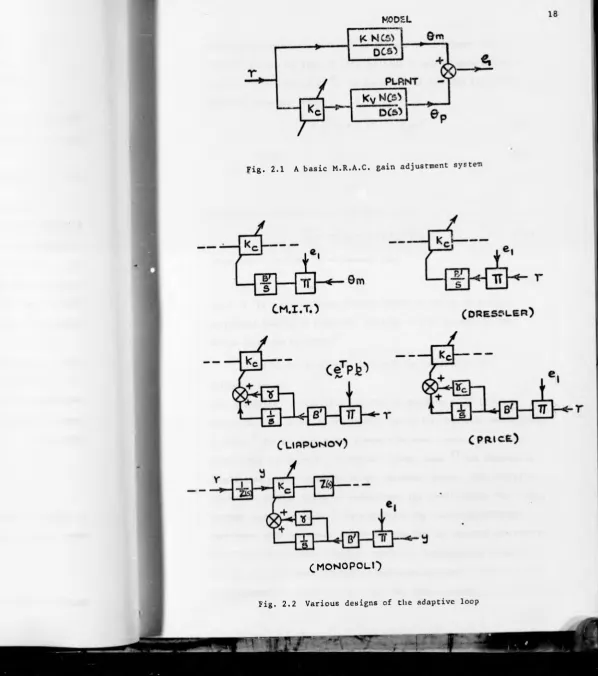
Monopoli . The block diagrams of these designs are shown m Fig. 2.2.
2.2.1. M.I.T. Rule and Liapunov Synthesis
The notation used below is that shown in Fig. 2.1 and Fig. 2.2.
The performance index used in the M.I.T. rule ^ is
j
ej^ dt and theparameter adjustment law using a steepest descent minimization
technique is
K
c Be, !_!3 Ke (2.1)
In this case the sensitivity function
hence the above equation becomes
is proportional to aud
B'e,0
1 m (2.2)
KCD£L
Fig. 2.1 A basic M.R.A.C. gain adjustment system
tM O M O P O Lf)
[image:28.627.16.615.21.698.2]19
The Liapunov synthesis is based on the use of a Liapunov function
The most successful form of this function V used to date is that
proposed by Gilbart et al . As described in appendix A.I., the
function takes the forms
V = eTPe + X (X + y K m)2
where m = B'e^Pbr
X = K - K K c v
(2.3)
(2.4)
(2.5)
(
2
.
6
)
(2.7) and the time derivative of V is given by
= -e^Qe - 2 Xy K 2 m 2
dt \ v
These result in a stable adjustment law:
K «* m + y m
c
where y is a proportional constant which is chosen to provide
additional damping if required. Putting y = 0 results in the
2
design rule used by Parks .
Equations (2.2) and (2.7) will be compared in the
following manner:
(a) Stability - A stability analysis of equation (2.2) is very
difficult. The doubt about possible instability has been demonstrated
o ,
by Parks for a second order system with step inputs. Even for a
23
first order system with a sinusoidal input, James has obtained a
complicated stability domain in the parameter space. This domain is
shown here in Fig. 2.3(a) to demonstrate the complications «-hat arise.
Further studies by James ^ have revealed the stability problems
associated with stochastic inputs and the lack of adequate theoretical
methods to predict the stability boundary. An example is shown here
in Fig. 2.3(b). Hence extensive simulations during the design stage
Fig. 2.3 Stability regions of M.I.T. DESIGNS
/ , t 23,24.
[image:30.629.26.614.10.702.2]21
hand equation (2.7) is assured to be stable Tor all inputs such that
e 0 asymptotically, with the assumption that K is slowly time-
% v
varying. When this assumption is severely violated, a stability
problem similar to that of equation (2.2) may arise. 'Eventual
stability', however, can be assured by using a theorem due to Lasalle
and Rath (see Section 1.4) if the time-varying function belongs
20
to the following class :
|Kv (t)| s n(t) (2.8)
where n(t) 0 as t -*• "
or n(t) dt is finite.
^0
(b) Physical Realization - Equation (2.2) can be easily implemented
and it is this distinct advantage that has made M.R.A.C. a popular
adaptive control strategy. Equation (2.7) however, requires the
estimation of the complete state vector which is not often available
and hence necessitates the use of differentiating networks which cause
a noise amplification problem, or the use of adaptive state observers
17 18
' which further complicate the implementation.
(c) Response - The speed of adaptation of both equations depends
on the magnitudes of the adaptive gain B' and the input signal R. A
large B' is always necessary to maintain a high speed of adaptation.
However as B' and R vary, the damping of the response will also vary.
11
12
Root locus plots of these equations for a second order system '
2
would show that when B'R is large, the M.I.T. design will be under
damped while the Liapunov design will be adequately damped with suitable
values of the proportional gain y .
2.2.2. Other Design Rules
We shall next examine the following rules.
4
hand equation (2.7) is assured to be stable for all inputs such that
e -»■ 0 asymptotically, with the assumption that K is slowly time-
% v
varying. When this assumption is severely violated, a stability
problem similar to that of equation (2.2) may arise. 'Eventual
stability', however, can be assured by using a theorem due to Lasalle
and Rath (see Section 1.4) if the time-varying function belongs
20
to the following class :
21
where
|Kv (t)| $ n(t)
n(t) + 0 as t -*■ "
l(t) dt is finite.
(
2
.8
)r-<
• n(b) Physical Realization - Equation (2.2) can be easily implemented
and it is this distinct advantage that has made M.R.A.C. a popular
adaptive control strategy. Equation (2.7) however, requires the
estimation of the complete state vector which is not often available
and hence necessitates the use of differentiating networks which cause
a noise amplification problem, or the use of adaptive state observers
17 18
’ which further complicate the implementation.
(c) Response - The speed of adaptation of both equations depends
on the magnitudes of the adaptive gain B' and the input signal R. A
large B' is always necessary to maintain a high speed of adaptation.
However as B' and R vary, the damping of the response will also vary.
11 12
Root locus plots of these equations for a second order system ’
2
would show that when B'R is large, the M.I.T. design will be under
damped while the Liapunov design will be adequately damped with suitable
values of the proportional gain y.
va
fc
22
K = B'e,r (2.9)
c l
The resulting controller is very simple and no sensitivity filter is
required. The disadvantages are that the damping of the response suffers
at larger loop gains and that the global stability is not guaranteed.
Its stability problem is similar to that of the M.I.T. rule.
Price ^ ---- The parameter adjustment law which is called the accel
erated gradient method is
K = B 'e ir + y c It (B'e ir) (2-10)
where v is a constant. ' c
The controller is similar to that of Dressier except for the
addition of the proportional (feedforward) term. This term has the
effect of improving the damping and the stability of the response.
This stabilising effect would however be impaired as the order of the
system increases, and generally the global stability cannot be guaranteed.
13
Monopolr --- This is based on a modification of the Liapunov
scheme. A differentiating block (Z(s)) is used to modify the plant
transfer function such that Z(s)N(s)/D(s) is positive real, and the
Kalman-Meyer Lemma (see Section 1.4) is used to eliminate the error
derivatives required in equation (2.7). Hence
K c = B'eiy + y (B'eiy) (2.11)
where y is the modified input signal to the plant and obtained by
passing the original signal through a filter (1/Z(s)). For an n-th
order plant with m zeros, the order of Z(s) is (n-m-1). Global
asymptotic stability of the adaptive loop will be guaranteed while the
number of derivatives required is reduced to (n-m-1), or
(n-m-2) if the extra damping loop is not in use. The latter is achieved
by decomposing Z(s) into Z'(s)(s + a). Now since K is available,
23
This technique can be easily extended to the case of a general time-
varying gain.
2.2.3. A Simulation Study of the Adaptive Response
At this point one would wonder whether or not the stability
issue should have an important weight at all on assessing a design
rule. For instance if the M.I.T. design, subject to a stability
analysis or simulation which defines the domain of stable operations,
would in this stable domain exhibit a faster speed of adaptation than
the Liapunov design, then the former would be regarded as practically
adequate and the emphasis on achieving global stability should be
lessened. If the reverse is true then the requirement for the design
to guarantee global stability will be more acceptable and useful to
the system designers. Such an issue, which has so far been neglected
in the literature, will be investigated here.
various designs has been conducted. The adaptive response is defined
in this context as the time response of the parameter adjustment when
there is a step change in the parameter. The study has indeed shown
that very often the Liapunov designs could achieve excellent performance
not attainable by other rules. As an example consider a second order
plant whose gain is to be adjusted. Referring to Fig. 2.1 and 2.2, the
following values are assumed:
A simple simulation study of the adaptive response of the
N(s) 1
a i *> 2 , a 2 ■= 1 , K “ 1 ,
D(s)
l+a1s+a2s2
25
Z(s) = 2s + 2 (as in Ref. 13) and shall limit the values of y and
to, say, 50% because in actual use they may have to be quite small
to reduce the effect of any noise at the plant output and the excessive
transient overshoots due to large initial errors. Some of the typical
adaptive responses of the various designs are depicted : • Fig. 2.4
for step as well as sinusoidal inputs. The responses shown for the
M.I.T., Dressier and Price designs have been optimized with respect
to the convergence time. The responses shown for the Liapunov and
Monopoli's schemes are, however, not optimized - i.e. they can still
be further improved if required by increasing the adaptive gain. From
this simulation study, the M.I.T. design is found to be unstable for
B' > 1. Even when it is stable at lower values of B ' , the response is
slow, the convergence time being well over five system time constants.
The response of the Dressier scheme to a step input is similar to that
of the M.I.T. scheme. However, for a sinusoidal input, the Dressier
scheme shows a steady state parameter error which is dependent on the
loop gain as well as the input signal frequency. The design due to
Price shows a better damping and stability which improve as y c is
increased. On the other hand, the Liapunov design is always stable
and the damping and convergence can be improved systematically by
varying B' and y. A convergence time of even less than one system
time constant can be easily achieved. The design due to Mor.opoli,
which does not require any differentiator in this case, exhibits quite
a fast response. Although its damping would suffer at higher B', the
system stability would always be maintained. These results also
substantiate the foregoing theoretical analysis.
2.3. A SYSTEMATIC PERFORMANCE COMPARISON
The importance of a performance comparison has been discussed
V
26
in Section 2.2.3. The example given also indicates the complexity and
scale involved in any attempt to make a complete comparative study.
A systematic approach is therefore taken in this section.
30
Some commonly used performance criteria which include the
settling time (Tg) , the integral of squared error (ISE) , the integral
of time absolute error (ITAE), and the integral of time squared error
(ITSE) will be employed to compare the responses of the various designs
against their system parameters. This will be studied experimentally
through computer simulations of two gain adjustment schemes. The
results will be presented in the form of similitudes by applying a
31
dimensional analysis to the system differential equations such that
the quantities to be investigated are expressed in dimensionless
groups. The dimensionless performance criterion is denoted by m,
a n d a;m er\V tonl«ss s y s te m pam m eH n is ¿«.»voted b y *6». .
The performance characteristics are defined in this connection as the
plots of TTj against m2>
, N(s) 1 \
2.3.1. First Order Systems ( --^ -y = "J+sT '
In this case, the designs due to Dressier and Price are
identical to the Liapunov schemes. Also, the latter does not require
any differentiators. Hence we only need to compare the M.I.T. and
the Liapunov designs. Their system equations are listed in appendix
A .2.
Deterministic inputs --- Step and sinusoidal inputs are employed.
From the dimensional analysis shown in appendix A.3. the following
are defined:
m„ = KK B'R2T (M.I.T. design)
2 V
27
= T /T
s (5% Tg criterion)
KRT2 K 2R2T 1 1
; iei2dt
Jt|e j(dt (ISE criterion)(ITAE criterion)
K2R2T 2 1
(ITSE criterion)
The parameters which cannot be grouped into the above are fixed at:
frequency of sinusoidal input = 2.5 c/s, Kc (tQ) - 0, y = 0 and
0
.
1
.
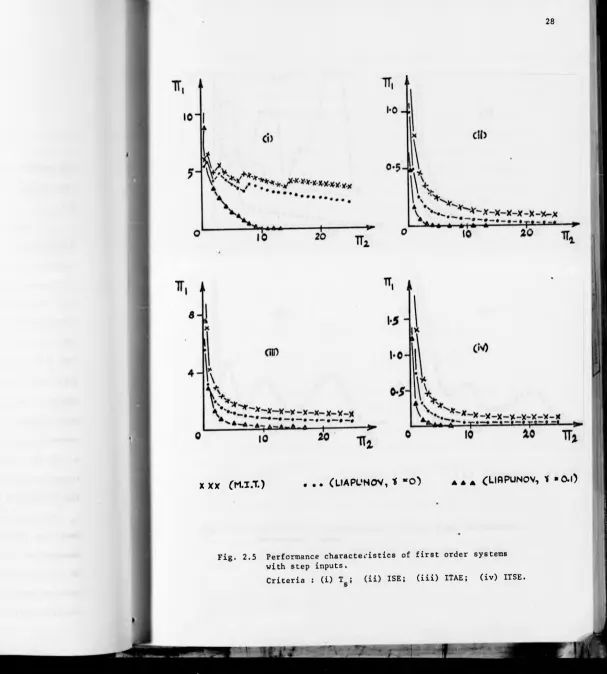
2.5 and 2.6. For step inputs, in which case the M.I.T. design is
always stable, the Tg criterion shows a region where this design is
unfavourable since Xj may increase or decrease with an increment in
tt2 , whereas the same type of uncertainty does not appear in the
Liapunov design with y = 0.1. For sinusoidal inputs, all the four
characteristics for the M.I.T. design possess regions of uncertainty
over a wide range of ir2< Furthermore it has already been ensured
that within the parameter ranges tested, that is it s 25, this
design is operated below the boundary of conditional stability as
pointed out by James (Fig. 2.3 (a)). These findings suggest that an
extensive simulation study would be necessary in order to determine
a safe and economic value of tt2 t0 achieve any specific tTj even
though the system is operated in the stable region. On the other hand,
the similitudes for the Liapunov designs show a monotonic decrease of
tt1 with increasing ir2 . This is a desirable feature. In addition this
design can achieve values of ttj not attainable by the M.I.T. design.
Examinations of the effect of changing the input signal frequency have
also been conducted. The results which are too long to show here,
indicate that in the M.I.T. scheme the system performance is very
28
X X X (M .I.T.)
. . . (UAPC?NOV, < “ O )
a a a( L
ia p u n o v, t » 0 .0
Fig. 2.5 Performance characteristics of first order systems
with step inputs.
[image:39.636.24.631.18.692.2]it is almost insensitive to the frequency especially at higher gains.
Stochastic inputs --- The above experiment is repeated with a
band-limited Gaussian white noise input. This stochastic signal is obtained
by spacing a digitally generated, zero mean, Gaussianly distributed
sequence of pseudo random numbers, by an interval of h seconds and
with linear interpolations. The variance of the signal is denoted by
and its power spectrum which is approximately flat possesses a
cutoff frequency of l/2h Hz . The properties and generation of
this stochastic signal are further discussed in appendix A.4. To
reduce the complexity of this investigation, only the ISE criterion
will be studied in detail.
where e[ ] denotes the expectation (i.e. ensemble average) operator.
The fixed parameters are: h = 0.002, K ^ t g ) = 0.0, y = 0 or 0.1.
similitudes show that both the M.I.T. and Liapunov designs exhibit the
desirable characteristics that iij decreases monotonicaiiy with
increasing The latter also achieves a much lower tr^ which
cannot be reached by the former. Another important property that has
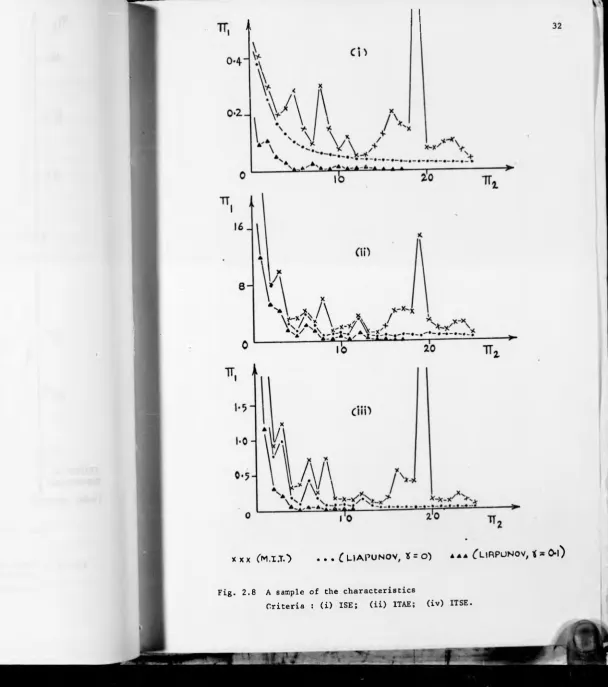
been noted is that the variances about the expected values are different
in each case. From the plot shown in Fig. 2.7(b), one observes that the
variances in the M.I.T. design are very much larger than those in the
Liapunov scheme. This indicates that in the former scheme there may
exist a considerable degree of uncertainty about its performance. This The dimensionless quantities are:
IT
2 = KK B'6.2 v N t (M.I.T. design)
= K B'6.2 T
v N (Liapunov design)
31
X X X ( M . X . T . ) . . . ( U R P U N O V , % — O ) A A A ¿URPUNOV, * = 0 -l)
Fig. 2.7 Performance characteristics of first order systems
with stochastic inputs.
[image:42.665.41.648.10.699.2]¿1
XXX ('M.I.T.') . . .
c
U A P U N O V , * = 0 ) *** fU R P U N O V , < - 0 -l )Fig. 2.8 A sample of the characteristics
[image:43.643.21.630.10.698.2]33
is confirmed by studying the ensemble members of the random process.
One of these is shown here in Fig. 2.8. Also shown are ensembles of
the corresponding results using the other two integral criteria. These
similitudes reveal that the M.I.T. scheme possesses the undesirable
that in the Liapunov scheme shows an almost monotonic decrease.
In addition to the case just reported, other experiments
have been carried out. The finding is that when the power spectrum
of the input signal (proportional to l/h) is reduced, the performance
of the M.I.T. design would deteriorate whereas that of the Liapunov
design would improve.
here. The system differential equations are as listed in appendix A.2.
It is noted that while the Liapunov design requires one differentiator,
that due to Monopoli does not need any.
Deterministic inputs ---- From the dimensional analysis shown in
appendix A.3. the following are defined:
property that ir may increase or decrease with increaiing ir2 while
2.3.2. Second Order Systems ( d(s)" ”
1+a s+a s2
1 2
1
)
The five designs described in Section 2.2. will be examined
TT 2
■= KK B'R2a,
v 1 (M.I.T. design)
- K B'R2a,
v 1 (others)
(2% T criterion) s
1
Cj 2dt (ISE criterion)
K 2R 2a 1
— — tlejdt
KR a 2
= --- -— te 2dt (XTSE criterion)
K 2R2a2 J 1
Other fixed parameters are: a2/a2 = Kc (tQ) = Yc =
Y = 0 and 0.1, frequency of sinusoidal input = 0.16 c/s.
The performance characteristics obtained are shown in Fig.
2.9 and 2.10. With step inputs, the M.I.T. and Dressier designs
possess a minimum in it as tt2 varies; for tt2 smaller or larger
than this minimum value, it increases sharply. Other designs show
a monotonic reduction, especially at higher values of tt2> With sine
inputs, both the M.I.T. and Dressier designs are again found to possess
a minimum in iTj, and the latter is more critical than the former.
The design by Price shows an unfavourable performance in that the
uncertainty as discussed in the first order systems occurs. The
Liapunov and the Monopoli designs, however, still maintain the
desirable performance characteristics similar to that with step inputs.
The performance of these designs with different frequencies
of the sinusoidal input signal has also been examined. The same range
of tt2 is used. The general observation is that the Liapunov and
Monopoli designs are less sensitive to the signal frequency with
regards to both the stability and the convergence rate. The M.I.T.
system always possesses a minimum iTj at some value of tt2 which
increases with the frequency; at lower frequencies, more than one
minimum point may be observed. The convergence rate decreases with
increasing frequencies. The Dressier system is unstable at higher
frequencies; at lower frequencies the system is stable for a small
range of it but this range may increase or decrease with decreasing
frequencies. The design by Price improves at lower frequencies, in
that the fluctuation in ir reduces, but deteriorates rapidly at
frequencies higher than the resonant frequency of the plant and
35
*xx ( M J . - O . . . (LIBPUNOV,
%
= 0 ) ‘ a* * CLIRPUNOV,%
= 0.0coo CMONOPOU') d o b ¿ P R IC E , O .5 } T , f ('D R E S S L E R ')
< _ > OR |
C
C-HflNGE i n S C A L IN G '')Fig. 2.9 Performance characteristics of second order systems
with step inputs.
[image:46.667.23.654.10.703.2]X X X (M.I.T.)
m i(LIR P o N O V , Ti = 0 )
a a a( HRPuMOV, X = o -O
OOO (MONOPOLl) B O B
(
P R IC E ,
= 0 -5 )
r T T
C
D R E S S L E R )
t > oR ^ ( C H A N G E IN S C A L I N G )
Big. 2.10 Performance characteristics of second order systems with sinusoidal inputs.
o o o CMONOP&Ui) O D D ( P R I C E , 1<c = 0 * 5 ) T t f ( D F E S S L E R )
^ C C H A N G E IN S C A L I N G )
Fig. 2.11 Performance characteristics of second order systems with stochastic inputs.
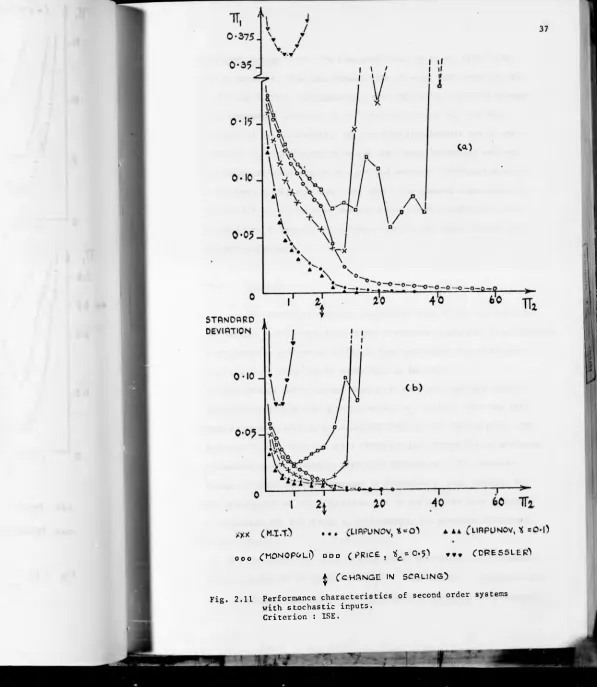
[image:48.637.30.627.10.697.2]Stochastic inputs --- The same experiment as in the first order
case is repeated. The main results with h = 0.1 are shown in Fig.
2.11(a) and 2.11(b). To summarise, the Liapunov and Monopoli designs
exhibit monotonic decrease of it with increasing ir2 and the
variances of Hj are small; the other designs exhibit one or more
minima in it and the variauces are also large indicating serious
uncertainty as mentioned in the previous section. Different spectra
of the input signal have also been used. The general observation is
that the M.I.T. <-nd Dressier designs exhibit worse performance when
the bandwidth of the signal is reduced, while the other designs show
improved performance.
2.3.3. Summary
The extensive computer simulation study of the various M.R.
A„C. designs reveals many interesting properties regarding the performance
of the adaptive systems at different loop gains and under different
input signals. These may be summarised as follows:
(1) The designs which are not assured to be stable globally behave
very differently when the gain parameter it varies. They are also
found to be sensitive to the frequency band of the input signal; one
reason of this is that the total effective gain varies due to different
attenuation by the system at different frequencies. The possible
outcome of these two disadvantages is instability, poor damping, or
poor convergence of the adaptation. It is unfortunate that in trying
to compensate for the change in environment, the adaptive system may
become sensitive to its own parameters.
(?) The performance of those designs which are assured to be globally
stable improves as the gain parameter it increases. In addition they
39
content by operating at larger values of n2>
(3) Among the three schemes based on gradient methods, the Dressier
design exhibits the worst performance characteristics especially when
the input is sinusoidal or stochastic. The M.l.T. design is quite
acceptable if the performance specification is not very strict. The
design by Price performs better than the M.l.T. system with step or
stochastic inputs but is inferior with sinusoidal inputs.
(4) The two designs based on stability consideration may achieve low
values of tTj not attainable by other designs. Between the two,
the Liapunov scheme is better as it requires s lower value of ir
to meet the same performance criterion. On interchanging the roles of
the model and the plant, the case studied would become an identification
system. Hence this investigation also reveals the shortcomings of those
37 38
model reference identification schemes ’ based on gradient methods.
2.4. GENERAL DISCUSSIONS
In the previous sections, no attempt has been taken to
include the study of more general parameter adjustments and the effects
of noise and disturbance inputs. Hence an examination of these
general concerns is in order and presented herewith.
b ^ and a ^ respectively. The parameter adjustment laws using the
M.I.T. rule, the Dressier rule and the Liapunov synthesis are shown
in Table 2.1. For simplicity the proportional term in the Liapunov
design is put to zero; the laws due to Price and Monopoli are also
not included as they are extensions of the Dressier and Liapunov designs
and hence trivial for the purpose of comparing structures.
40
Rules M.I.T. Dressier Liapunov
b . =
Pi gi * e i * rif
(i) Bi ' e l • r
T (i)
Bi * < * % > ■ r
a . =
Pi "“i • el • °if
-a. • e . ( P
i 1 m
X (i)
-°i ' ■ ep
Table 2.1.
The ^ denotes the ith differentiation with respect to time and r.f
and 0., are defined as if
41
economical compared to the M.I.T. rule since both require r and
(i)
0 to be accessible. While the e can be readily generated using
C t ^ ( i ) ^
O and 0 , each r., and 0.„ would require one additional
p m if if M
filter having the same order as that of the model.
The Liapunov design has been synthesized to assure global
asymptotic stability while the M.I.T. and Dressier designs could only
be proved to be locally stable. It is observed that the stabilizing
factor in the Liapunov design is due to the presence of a . In this
s.
aspect, the other designs which use e^ only would seem to be less
stable as the system crder increases.
In short the M.I.T. rule is found most undesirable; the
Dressier rule offers the advantage of simplicity while the Liapunov
synthesis guarantees global asymptotic stability. It is sufficient
here to mention that the reduction of the order of differentiation,
the introduction of proportional damping and the treatment of time-
varying parameters can easily be incorporated in the Liapunov design.
(i)
2.4.2. Effects of Noise
We shall analyse the effect of including the process and
sensor noise in the plant output. 0^ is assumed to be the only
measurable output while r, r ^ and 0^ are assumed noise free. Thus
0 . 0., and e will have noise components. As is well known
P P if
in the case of parameter estimation system, the presence of noise
components may introduce d.c. bias in the steady state values of the
a . parameter and hence contribute to additional e.rror to the plant
output. To investigate this possibility, we shall make use of the following
equation.
a = a • e • 0 (2.15)
Let e„, 0„ and a be the respective noise free values, e and
o * o o n