December 2014
Exploring and utilizing the concept of setting conditions in the
Exploring and utilizing the concept of setting conditions in the
functional assessment process
functional assessment process
Linda Aldridge
Keystone Learning Services, Perry LeCompton, KS, [email protected]
Richard Harrison
Southeast Kansas Education Service Center, Topeka, KS, [email protected]
Kimberly Harrison
Washburn University, Topeka, Kansas., [email protected]
Cherie Blanchat
TASN Autism and Tertiary Behavior Supports, Kansas City, Kansas, [email protected]
Follow this and additional works at: https://scholar.utc.edu/jafh
Part of the Education Commons, and the Social Work Commons
Recommended Citation Recommended Citation
Aldridge, Linda; Harrison, Richard; Harrison, Kimberly; and Blanchat, Cherie (2014) "Exploring and utilizing the concept of setting conditions in the functional assessment process," Journal of Adolescent and Family Health: Vol. 6 : Iss. 2 , Article 5.
Available at: https://scholar.utc.edu/jafh/vol6/iss2/5
Introduction
The practices of functional behavioral assessment and Positive Behavioral Supports (PBS) are part of the Individuals with Disabilities Education Act Amendments of 1997 (IDEA) (P.L. 105-17). Procedures and strategies associated with functional assessment and PBS have been validated in the literature(Koegel, Keogel, & Dunlap, 1996: Quinn, 2000; Tilly et al., 1998) and are essential in structuring and implementing effective behavioral interventions. When determining function of behavior, much of the literature has focused on the core four functions of avoidance, escape, attention and control. Often these functions are determined through the use of an antecedent behavior consequence (ABC) analysis where the assessor analyzes the immediate temporal environmental events surrounding the behavior (Asmus, Vollmer, & Borrero, 2002; Carr & Durand, 1985; Crone & Horner, 2003). While analysis of the “core four” is important and often productive, it is critical to consider those conditions that prompted initial emergence of the target behavior(s).
Early in the discovery of behavioral principles literature focused upon “setting events” as a key piece in understanding behavior (Bijoi & Baer, 1961). It was understood that the Antecedent Behavior Consequence paradigm was set up by circumstances (setting events) that could have occurred long before the actual behavior of interest and measurement. Bijou and Baer defined setting events as follows:
“In contrast to stimulus events, setting events are more complicated than a simple presence, absence or change of stimulus such as turning on a light, a sudden drop in temperature, or a smile from mother. Instead, a setting event is a stimulus-response interaction, which simply because it has occurred will affect other stimulus-response relationships which follow it. (Bijou & Baer, 1961, p.21).”
inappropriate behaviors and failure to learn can be directly attributed to conditions found within the school, community, and/or home. In fact, when “inappropriate behaviors” are analyzed from the child’s perspective, those behaviors can sometimes be seen as quite reasonable responses to unreasonable conditions.
This diminished emphasis on setting conditions can lead to the design of ineffective behavioral interventions, frustrated teachers, and of most concern, students with on-going behavioral problems. This article reviews some of the most common setting conditions divided into the three interrelated domains: school, community, and home. For each domain, there is a general explanation and a table listing setting conditions often experienced by children, followed by possible solutions. Finally a hypothetical case is presented, drawn from a composite of practitioner experiences. As setting conditions are explored, it becomes increasingly apparent that school social work expertise is an inherent part of suggested solutions; setting conditions to be explored are complex interactions across multiple settings requiring knowledge of the bio-psycho-social framework of behavior across micro, mezzo, and macro level interventions (Ashford & Lecroy, & Lortie, 2006).
School Setting Conditions
report school personnel sometimes rely upon outdated and harmful practices and fail to implement those instructional strategies, curricula, and behavioral supports that most likely lead to student success (Marzano, et al, 2001).
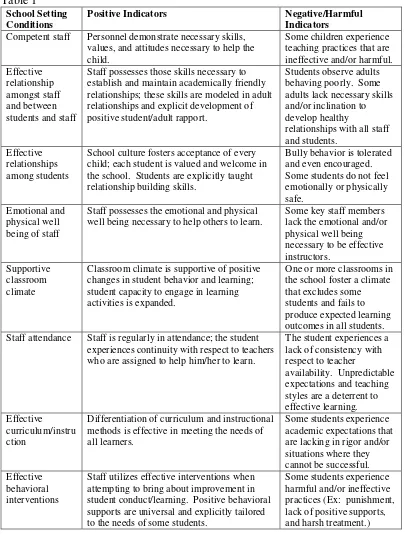
Table 1 outlines common school setting conditions, listing attributes indicative of positive school environment and indicators of non- supportive or harmful conditions. The list is not exhaustive; it is understood that there are many school based setting conditions that could possibly be a factor in understanding a student’s failure to learn or to select inappropriate behavioral responses while in school.
School Setting Solutions
To address school based setting conditions, it makes sense to revise the FBA process to include analysis of those conditions most common in schools that are directly associated with positive behaviors and academic growth. Concurrently, the assessment team must be cognizant of conditions that promote negative behaviors and interfere with learning. In conjunction with the revised FBA, teachers need an opportunity to learn about conditions that will be analyzed as part of the FBA. Finally, a review team composed of members from outside the school setting can periodically review completed FBAs to ensure that the process is followed, and to watch for patterns of special education placement where ineffective and harmful practices contribute to student failure. Furthermore, school social workers and other school personnel might assist in promoting a well configured and functional school team as a natural part of their duties within the school setting.
Case Example
Table 1 School Setting Conditions
Positive Indicators Negative/Harmful
Indicators Competent staff Personnel demonstrate necessary skills,
values, and attitudes necessary to help the child.
Some children experience teaching practices that are ineffective and/or harmful. Effective
relationship amongst staff and between students and staff
Staff possesses those skills necessary to establish and maintain academically friendly relationships; these skills are modeled in adult relationships and explicit development of positive student/adult rapport.
Students observe adults behaving poorly. Some adults lack necessary skills and/or inclination to develop healthy
relationships with all staff and students.
Effective relationships among students
School culture fosters acceptance of every child; each student is valued and welcome in the school. Students are explicitly taught relationship building skills.
Bully behavior is tolerated and even encouraged. Some students do not feel emotionally or physically safe.
Emotional and physical well being of staff
Staff possesses the emotional and physical well being necessary to help others to learn.
Some key staff members lack the emotional and/or physical well being necessary to be effective instructors.
Supportive classroom climate
Classroom climate is supportive of positive changes in student behavior and learning; student capacity to engage in learning activities is expanded.
One or more classrooms in the school foster a climate that excludes some students and fails to produce expected learning outcomes in all students. Staff attendance Staff is regularly in attendance; the student
experiences continuity with respect to teachers who are assigned to help him/her to learn.
The student experiences a lack of consistency with respect to teacher
availability. Unpredictable expectations and teaching styles are a deterrent to effective learning. Effective
curriculum/instru ction
Differentiation of curriculum and instructional methods is effective in meeting the needs of all learners.
Some students experience academic expectations that are lacking in rigor and/or situations where they cannot be successful. Effective
behavioral interventions
Staff utilizes effective interventions when attempting to bring about improvement in student conduct/learning. Positive behavioral supports are universal and explicitly tailored to the needs of some students.
The referral team, to understand what has happened to Student A during his short tenure as an elementary student, must consider the following setting conditions: attendance pattern of key staff members; harmful effects of retention and ability grouping; and consideration that previous behavioral interventions may have been ineffective due to poor design and/or implementation. Once setting conditions are analyzed, the team may decide that special education placement is premature; it may be beneficial to the student to implement effective school practices along with general education supports for the child.
Community Setting Conditions
There are a variety of community conditions that impact both the academic and behavioral success of a student. In considering community setting conditions, one must also consider whether students live in a rural or urban setting as both have potential for unique complications. Proximity and availability of employment opportunity and medical resources will influence the ability of families to quickly respond to children’s needs (Barrett, Eber & Weist, 2013). Both the safety and availability of transportation affect student emotional status if the child feels unsafe navigating the community (Buliung, Faulkner, Beesley, & Kennedy, 2011; Wiebe, Guo, Allison, Anderson, Richmond & Branas, 2013). When a community does not value education, students are less engaged in school studies and activities (Fabian, 2007; Morrison, 2003). Availability of health and nutritional resources is another critical factor (Kerns, Walker, Lyon, Cosgrove, & Bruns, 2011; Symons, Cinelli, James, & Groff, 1997). Furthermore, access to appropriate after-school programs, adult supervision, and other supplementary school programs must be considered (Bassok, Fitzpatrick, & Loeb, 2012; Brindis, Klein, Schlitt, Santelli, Juszczak, & Nystrom, 2003; Schorr, 1997).
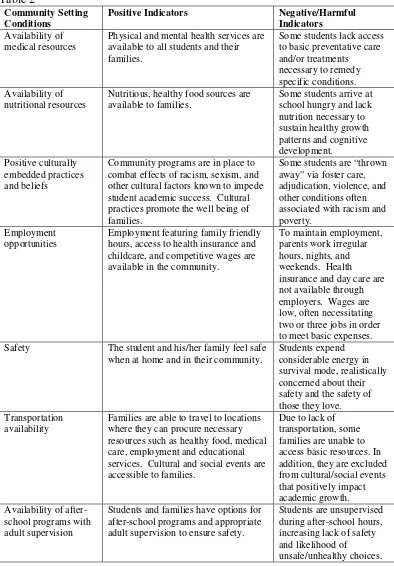
Table 2 below lists some of the most common community based setting conditions that influence school conduct and learning. Interactions between community agencies and school require school social workers, teachers, and administrators to work in conjunction with community agency personnel to improve conditions experienced by everyone. Needed improvements will likely involve policy change, legislative action, and re-defining of the roles of professionals across many agencies.
Community Setting Solutions
Table 2
Community Setting Conditions
Positive Indicators Negative/Harmful
Indicators Availability of
medical resources
Physical and mental health services are available to all students and their families.
Some students lack access to basic preventative care and/or treatments necessary to remedy specific conditions. Availability of
nutritional resources
Nutritious, healthy food sources are available to families.
Some students arrive at school hungry and lack nutrition necessary to sustain healthy growth patterns and cognitive development.
Positive culturally embedded practices and beliefs
Community programs are in place to combat effects of racism, sexism, and other cultural factors known to impede student academic success. Cultural practices promote the well being of families.
Some students are “thrown away” via foster care, adjudication, violence, and other conditions often associated with racism and poverty.
Employment opportunities
Employment featuring family friendly hours, access to health insurance and childcare, and competitive wages are available in the community.
To maintain employment, parents work irregular hours, nights, and weekends. Health insurance and day care are not available through employers. Wages are low, often necessitating two or three jobs in order to meet basic expenses. Safety The student and his/her family feel safe
when at home and in their community.
Students expend considerable energy in survival mode, realistically concerned about their safety and the safety of those they love. Transportation
availability
Families are able to travel to locations where they can procure necessary resources such as healthy food, medical care, employment and educational services. Cultural and social events are accessible to families.
Due to lack of transportation, some familiesare unable to access basic resources.In addition, they are excluded from cultural/social events that positively impact academic growth. Availability of
after-school programs with adult supervision
Students and families have options for after-school programs and appropriate adult supervision to ensure safety.
Students are unsupervised during after-school hours, increasing lack of safety and likelihood of
near schools. Issues involving quality of employment opportunities require long-term planning and communication between public and private entities. Options regarding after-school programming and school-linked or full services school configurations, in tandem with other community agencies, should be explored. Obviously, it is not possible for school districts to solve broader societal and community problems in isolation. However, committed educators are an integral part of the community team as solutions to complex problems are designed and implemented. Within the school domain, school social workers and other appropriate personnel can ensure consideration of community setting conditions through interviews, ecological assessments, and social histories. At very least, special education placement can be avoided when student behaviors are clearly linked to adverse community conditions.
Case Example
Consider sixth grade student B, who lives in a violent area of town where crime rates are high. B misses school frequently to care for younger siblings while the parent is working. Student B is bright but at school appears tired and irritable. When bus services were reduced, it required her mother to leave for work earlier, with B’s precarious attendance rate dropping to record lows. Daily schoolwork and test scores indicate B is four years behind academically, thus two teachers refer B to the student support team for poor academic performance.
Pertinent setting conditions include: community safety; availability of nutritional resources; transportation availability; employment opportunities; childcare quality and availability of medical resources. If the FBA focuses only on B’s behaviors and academic struggles and not the larger setting conditions in her community, interventions will likely promote the wrong “solutions” (truancy programs, specialized instruction) and ignore those relevant conditions in her life. The key to B’s school success depends upon the capacity for adults across agencies to coordinate their efforts for her and her family while finding alternative ways to access the general education curriculum. It can be especially empowering for B when adults recognize and value her caregiver role within the family.
Home Setting Conditions
consequences of parental substance abuse (Barnard & McKeganey, 2004), domestic violence (Roskos, Handal, & Ubinger, 2010) lack of nutrition, and/or extreme health and hygiene issues (Taras, 2005). Other conditions often impacting student learning include inadequate sleep (Meijer, Wittenboer, 2004), unstable housing situations (Astone & McLanahan, 1991; Henderson & Mapp, 2002) inconsistent availability of critical equipment (glasses, hearing aids, mobility devices, etc.) (Dusing, Skinner, & Mayer, 2004) untreated mental health conditions (Forrest, Bevans, Riley, & Louis, 2011; Sznitman , Reisel, & Romer, 2011), and poor school attendance patterns (Roby, 2004).
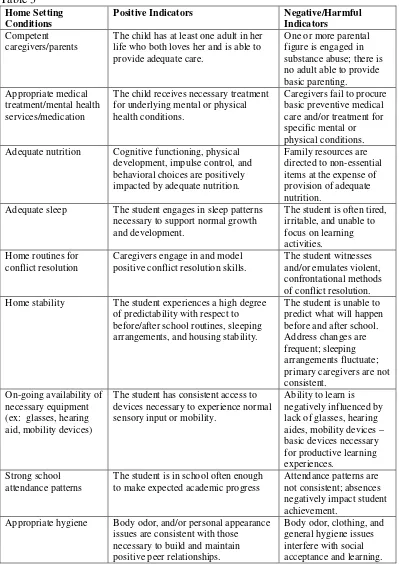
Table 3 below, while not exhaustive, addresses some common home based setting conditions. Direct analysis of home-based conditions can be a path fraught with peril and therefore is avoided by school personnel. And yet, failure to address such conditions with both compassion and expectation for meaningful change can leave a student labeled as needing special services when, in fact, there is no disability.
Home Setting Solutions
Because the boundaries between respect for family values and required action in cases of neglect and abuse can be blurry, it is not surprising that some educators avoid exploration of these issues, focusing instead upon school conditions directly under their control. Impactful home interventions require non-confrontational, reliable delivery of services, sensitivity to family values, and promotion of the dignity of each family member. Furthermore, identification of additional family supports and availability of legal, health, and emotional services in the school can help stabilize complex family problems. If school personnel want to affect home setting conditions, they must have positive and consistent contact with the families of their students. The unique ecological training and therapeutic expertise of school social workers positions them to be instrumental in addressing home setting conditions alongside other school staff.
Case Example
Table 3 Home Setting Conditions
Positive Indicators Negative/Harmful
Indicators Competent
caregivers/parents
The child has at least one adult in her life who both loves her and is able to provide adequate care.
One or more parental figure is engaged in substance abuse; there is no adult able to provide basic parenting. Appropriate medical
treatment/mental health services/medication
The child receives necessary treatment for underlying mental or physical health conditions.
Caregivers fail to procure basic preventive medical care and/or treatment for specific mental or physical conditions. Adequate nutrition Cognitive functioning, physical
development, impulse control, and behavioral choices are positively impacted by adequate nutrition.
Family resources are directed to non-essential items at the expense of provision of adequate nutrition.
Adequate sleep The student engages in sleep patterns necessary to support normal growth and development.
The student is often tired, irritable,and unable to focus on learning activities. Home routines for
conflict resolution
Caregivers engage in and model positive conflict resolution skills.
The student witnesses and/or emulates violent, confrontational methods of conflict resolution. Home stability The student experiences a high degree
of predictability with respect to before/after school routines, sleeping arrangements, and housing stability.
The student is unable to predict what will happen before and after school. Address changes are frequent; sleeping arrangements fluctuate; primary caregivers are not consistent.
On-going availability of necessary equipment (ex: glasses, hearing aid, mobility devices)
The student has consistent access to devices necessary to experience normal sensory input or mobility.
Ability to learn is negatively influenced by lack of glasses, hearing aides, mobility devices – basic devices necessary for productive learning experiences.
Strong school attendance patterns
The student is in school often enough to make expected academic progress
Attendance patterns are not consistent; absences negatively impact student achievement.
Appropriate hygiene Body odor, and/or personal appearance issues are consistent with those necessary to build and maintain positive peer relationships.
verbal abuse documented by teachers in previous interactions with C’s mother. Staff members suspect emotional abuse, neglect, and substance abuse within the family system. A report was made to appropriate authorities and C was referred to the school intervention team where it was determined that a Functional Behavioral Analysis was appropriate. While the Functional Behavioral Analysis team is aware that C’s home life contributes to her learning and behavioral difficulties, the school lacks general education social work services; previous attempts to work directly with C’s mother have resulted in her avoidance of school staff. Because problems in C’s life seem to be unalterable, teachers proceed with a focus upon conditions more easily controlled at school.
C’s FBA needs to include assessment of the following home based setting conditions: Competency of care givers, appropriate medical and mental health treatment, home routines for conflict resolution, and appropriate hygiene.
Remedies to C’s situation involve development of a direct, compassionate relationship between home and school. Because C is already significantly behind academically and evidences emotional issues, she would likely benefit from specialized instruction. However, it is important to recognize that a disability might not be the root cause of her problems; failure to address her home situation could lessen the impact of special education interventions. Social work services targeting relevant setting conditions might provide a professional, compassionate line of communication between family members and those teachers responsible for helping C to learn.
Conclusions
School setting conditions were purposefully addressed first in this article because educators have worked for decades to create educational climates where teachers and school administrators examine their own behaviors, procedures, and allocation of resources when finding ways to help children. Similarly, educators believe they have the greatest control and the greatest responsibility within school settings. However, when setting conditions are based in the community and home, the realities experienced by the child must be systematically acknowledged, as well. When this acknowledgement is followed by sustained effort to build inter-agency partnerships, bridge unhealthy relationships between family and school personnel, lobby politicians, and make proposals to local school boards, then resources will expand to remedy identified school, community, and home setting conditions circumscribing many tertiary academic and behavioral needs.
behavioral choices necessary to engage in school curriculum and to learn. Thus, school personnel will be more effective through:
• Revising the FBA processes to include a systematic analysis of school, community and home setting conditions whenever a student is considered for special education placement.
• Expanding school social work services to better address collaboration between families, schools, and community agencies;
• Providing professional development for teachers to develop a better understanding of setting conditions and implications for student learning.
• Collaborating with policy and lawmakers to bring about sustained improvement in community resources.
This article is about the necessity to embrace these setting conditions often inherent in extreme, on-going behavioral and learning challenges presented by some children. Failure to identify and deal with setting conditions perpetuates negative patterns of blame, student failure, over-reliance upon special education, and development of inadequate intervention plans. As evidenced in the case examples of students A, B, and C, concerted assessment and analysis of setting conditions, which often create or exacerbate behavioral and learning problems, will result in a deeper understanding of function when developing action plans to address the all too common needs of children. Through identification of relevant setting conditions and action plans expanded beyond the scope of the usual behavioral and academic interventions, it becomes possible to identify “real problems” and to allocate resources accordingly.
References
Allison, M. A., Crane, L. A., Beaty, B. L., Davidson, A. J., Melinkovich, P., & Kempe, A. (2007). School-based health centers: improving access and quality of care for low-income adolescents. Pediatrics, 120(4), e887-e894.
Ashford, J.B., LeCroy,C.W., & Lortie, K.L., (2006). Human behavior in the social environment: A multidimensional perspective (3rd ed.). Belmont, CA: Brooks/Cole.
Asmus, J. M., Vollmer, T. R., & Borrero, J. C. (2002). Functional Behavioral Assessment: A School Based Model. Education and Treatment of Children, 25(1), 67-90.
Barnard, M., & McKeganey, N. (2004). The impact of parental problem drug use on children: what is the problem and what can be done to help? Addiction, 99(5), 552-559.
Barrett, S., Eber, L., & Weist, M. (Eds.). (2013). Advancing education effectiveness:Interconnecting school mental health and school wide Positive Behavior Support. OSEP Center for Positive Behavioral Interventions and Supports.
Bassok, D., Fitzpatrick, M., & Loeb, S. (2012). Disparities in child care availability across communities: Differential reflection of targeted interentions and local demand. Unpublished paper, University of Virginia.
Bijou, S. W., & Baer, D. M. (1961). Child development: A systematic and empirical theory. Century Psychology Series,1. East Norwalk, CT: Appleton-Century-Crofts.
Boyer, C. E. (1994). The relationship between buy-back provisions and teacher attendance rates. Georgia Southern University. (ERIC Document Reproduction Service No. ED 38497)
Brindis, C.D., Klein, J., Schlitt, J., Santelli, J., Juszczak, L., & Nystrom, R.J. (2003). School-based health centers: Accessibility and accountability.
Journal of Adolescent Health, 32(6), 98-107.
Buliung, R., Faulkner, G., Beesley, T., & Kennedy, J. (2011). School travel planning: Mobilizing school and community resources to encourage active school transportation. Journal of School Health, 81(11), 704-712.
Carr, E. G., & Durand, V. M. (1985). Reducing behavior problems through functional communication training. Journal of Applied Behavior Analysis,
18(2), 111-126.
Crone, D.A., & Horner, R.H. (2003). Building positive behavior support systems in schools: Functional behavioral assessment. New York, NY: Guilford Press.
Dusing, S. C., Skinner, A. C., & Mayer, M. L. (2004). Unmet need for therapy services, assistive devices, and related services: Data from the national survey of children with special health care needs. Ambulatory Pediatrics, 4(5), 448-454.
Erickson, H. L. (2001). Stirring the head, heart, and soul: Redefining curriculum and instruction. (2nd ed.). Thousand Oaks, California: Corwin Press, Inc.
Fabian, E. S. (2007). Urban youth with disabilities factors affecting transition employment. Rehabilitation Counseling Bulletin, 50(3), 130-138.
Forrest, C. B., Bevans, K. B., Riley, A. W., Crespo, R., & Louis, T. A. (2011). School outcomes of children with special health care needs. Pediatrics, 128(2), 303-312.
Henderson, A. T., & Mapp, K. L. (2002). A New wave of evidence: The impact of school, family, and community connections on student achievement. Austin Texas: Southwest Educational Development Laboratory. (ERIC Document Reproduction Service No. 474521)
Horner, R. H., & Carr, E. G. (1997). Behavioral support for students with severe disabilities functional assessment and comprehensive intervention. The Journal of Special Education, 31(1), 84-104.
Hill, D. A., & Flores, M. M. (2014). Modeling positive behavior interventions and supports for pre-service teachers. Journal of Positive Behavior Interventions, 16(2), 93-101.
Kerns, S. E., Pullmann, M. D., Walker, S. C., Lyon, A. R., Cosgrove, T. J., & Bruns, E. J. (2011). Adolescent use of school-based health centers and high school dropout. Archives of Pediatrics & Adolescent Medicine, 165(7), 617-623.
Koegel, L.K., Keogel, R.L., & Dunlap, G (Eds.). (1996). Positive behavioral support: Including people with difficult behavior in the community. Baltimore: Paul H Brookes.
Lezotte, Lawrence W. (1991). Correlates of effective schools: The first and second generation. Okemos, MI: Effective Schools Products, Ltd.
Lindstrom, L., Doren, B., & Miesch, J. (2011). Waging a living: Career development and long-term employment outcomes for young adults with disabilities. Exceptional Children, 77(4), 423-434.
Martin, A. J. (2011). Holding back and holding behind: grade retention and students’ non-academic and academic outcomes. British Educational Research Journal, 37(5), 739-763.
Marzano, R. J., Pickering, D. J., & Pollock, J. E. (2001). Classroom instruction that works: Research-based strategies for increasing student achievement. Alexandria, VA: Association for Supervision and Curriculum Development.
Meehan, B. T., Hughes, J. N., & Cavell, T. A. (2003). Teacher–student relationships as compensatory resources for aggressive children. Child development, 74(4), 1145-1157.
Meijer, A. M., & van den Wittenboer, G. L. (2004). The joint contribution of sleep, intelligence and motivation to school performance. Personality and Individual Differences, 37(1), 95-106.
Menzies, H. M., Lane, K. L., & Lee, J. M. (2009). Self-monitoring strategies for use in the classroom: A promising practice to support productive behavior for students with emotional or behavioral disorders. Beyond Behavior, 18(2), 27-35.
Morrison, B. E. (2003). Regulating safe school communities: Being responsive and restorative. Journal of Educational Administration,41(6), 690-704.
Newman, L., Wagner, M., Cameto, R., Knokey, A. M., & Shaver, D. (2010).
Politzer, R. M., Yoon, J., Shi, L., Hughes, R. G., Regan, J., & Gaston, M. H. (2001). Inequality in America: the contribution of health centers in reducing and eliminating disparities in access to care. Medical Care Research and Review, 58(2), 234-248.
Quinn, M.M. (2000): Functional behavioral assessment: The letters and the spirit of the law. Preventing School Failure, 44(4), 156-162.
Reyes, M. R., Brackett, M. A., Rivers, S. E., White, M., & Salovey, P. (2012). Classroom emotional climate, student engagement, and academic achievement. Journal of Educational Psychology, 104(3), 700.
Roby, D. E. (2004). Research on school attendance and student achievement: A study of Ohio schools. Educational Research Quarterly, 28(1), 3-16.
Roskos, P. T., Handal, P. J., & Ubinger, M. E. (2010). Family conflict resolution: Its measurement and relationship with family conflict and psychological adjustment. Psychology, 1(05), 370.
Schorr, L. (1997). Common purpose: Strengthening families and neighborhoods to rebuild America. (1st ed.). New York, New York: Anchor Press.
Sugai, G., & Horner, R. H. (2008). What we know and need to know about preventing problem behavior in schools. Exceptionality, 16(2), 67-77.
Symons, C. W., Cinelli, B., James, T. C., & Groff, P. (1997). Bridging student health risks and academic achievement through comprehensive school health programs. Journal of school Health, 67(6), 220-227.
Sznitman, S. R., Reisel, L., & Romer, D. (2011). The neglected role of adolescent emotional well-being in national educational achievement: Bridging the gap between education and mental health policies. Journal of Adolescent Health, 48(2), 135-142.
Taras, H. (2005). Nutrition and student performance at school. Journal of school health, 75(6), 199-213.
Tomlinson, C. A. (1999). The differentiated classroom: Responding to the
needs of all learners. Alexandria, VA: Association for Supervision and Curriculum Development.
Umbreit, J., Ferro,J., Liaupsin, C.J. & Lane, K.L. (2007). Functional behavioral assessment and function-based intervention: An effective, practical approach. Upper Saddle River, NJ: Prentice-Hall.
Walker, S. C., Kerns, S. E., Lyon, A. R., Bruns, E. J., & Cosgrove, T. J. (2010). Impact of school-based health center use on academic outcomes. Journal of Adolescent Health, 46(3), 251-257.
Weissbourd, R., Bouffard, S. M., & Jones, S. M. (2013). School Climate and Moral and Social Development. In Dary, T. & Pickeral, T. (ed) (2013)
School Climate: Practices for Implementation and Sustainability. A School Climate Brief, Number 1, New York, NY: National School Climate Center.
Wiebe, D. J., Guo, W., Allison, P. D., Anderson, E., Richmond, T. S., & Branas, C. C. (2013). Fears of violence during morning travel to school. Journal of Adolescent Health, 53(1), 54-61.