SOME ASPECTS OF THE VI SUAL SEARCH AND SCANNING BEHAVIOUR OF
SCHIZOPHRENICS
A thesis presented to the
Department ot' Psychology and Soci'ology, University of Canterbury
In t'ulfilment ot the requirements for the Degree of Doctor of Philosophy
by
Robert Gerald Knight Sept embe I"
1974
321
ACKNOWLEDGEMENTS
The author would like to record his thanks to all those, too numerous :to detail, who gave advice and assistance at the various stages
ot
the completion of .this work. I would especially like to thank Mr Paul Russell tor his unspared encouragement, enthusiasm and help in thesupervision
ot
this theSiS. I am also particularly grateful to Mr D.O. Watson and the technicalstaff of the Psychology Department of the University of Canterbury for their construction of the apparatus, and to Mr Je Hanna for his careful presentation
of the graphs .. I would like also thank Dr T.E. Hall and Mr H.R. Unger for their kind permission to
carry out research at Sunnyside Hospital, Christchurch; and Messrso H. Stroud and H. Cohen for the use of
,
facilities at the Ohristchurch Prison. Without
the assistance of the staff and patients at Sunnyside Hospital, and Christchurch Prison, this study would have been impossible. Finally I would like to
thank my family for their encouragement and especially my wife Alexis tor typing this thesis and her support
ABSTRAOT
Same measures of scanning and search behaviour are explored, and their relation to the postulated attention deficit of schizophrenics is investigated. The tasks used required Ss to scan multielement
displays and to either respond to a predefined target, or to make a same-different decision. The primary experimental manipulations involved varying stimulus
complexity, defined both in terms of nwnbers of elements, and stimulus structure. The results suggested th~t
scanning rates do not differ between controls and schizophrenics, over a range of stimulus complexity,
although there is a significant tendency for the patients (especially the older, long term Ss) to have a constant, slower RTf> This implies that slow schizophrenic RT may be more largely determined by response organization and execution, rather than stimulus input processing.
These results are discussed in the context of methodological problems, research on the attention processes of non
TABLE OF CONTENTS
~
INTRODUCTION 1
CHAPTER ONE. Models of Human Selective
Attention and Scanning Behavior.
7
Selective Lis~ening.
8
Selective Visual Perception 13
Models of Selective Visual Perception
14
The Study of Briefly Presented
stimuli
17
Memory Search Exper~ents 20
Same-Different RT Tasks 28
Visual Search 35
Conclusions 46
CHAPT&g TWO. Theories ofCogn1tive Deficit in Schizophrenia and Problems of Research and Interpretation of Research in this Area
Partie Cognitive Deficit Research
49
with schizophrenics 50
Part 2. Methodological Problems and
Schizophrenic Cognitive Deficit Research
84
CHAPTER THRE~. Same-Different RT to Randomly
Constituted Multielement Displays. 111
Experiment 3-1" 113
Experiment 3-2. 124
CHAFfER fOUR. Simlll taneo us Mul tlelement Visual Comparison.
Ex.periment
4 ....
1.Exper1.ment
4 ....
2 .. Experiment4 .... 3.
135 139
147
CHAPTER FIVE. The Scanning and Search Behaviour of Schizophrenic Subjects-Expe rimen t 1"
Task
5-1.
Task 5-2". Task5-3 ..
CHAPTER SIX. The Scanning Behaviour of
Schizophrenic Subjects-The Second Expe rimen t.
CHAPTER SEVEN. Conclusions and Directions for Future Research.
RE:b'Ef<.ENC~ •
168
179 199
216
234
262
'"" 1
-INT RODue TI ON
Attention is a concept with a diverse history.
After the early pOPQlarity of the stQdy of attention
with the introspectionists, the positivistic
behavioQrists, and the Gestalt psychologists sQccessfQlly
dismissed this whole notion from their theoretical
considerations. By the late 1950s however, with
the expansion of interest' in, cognitive psychology and
info[mation processing models, attention, in many
gQises, had become the concern of' many experimental
and psychological theor'ists. This has led gradQally
to the conceptQalization of attention in the context
of information handling structQres and mathematical
models, which have offered more rigoQr and methodological
precision in the measurement of selective attention.
Similarly, fOI' the last twenty years, a
developing literature has been concerned wi th the
understanding of the cognitive dysfunctions coinciding
wi th the onset or exacerbation of psychiatric
distQrbances. In particular, the study of schizophrenic
deficit has been prolonged and detailed .. MQch of
the prod ucti ve \'lork in this area has resulted from the
grafting of cognitive theories of attention on to the
cornpr-ehension 01' the llypothesi zed processing defici t
concomitant with schizophrenic disturbances. This
foremost workers in the field, McGhie (1969), Neale (1971), Shakow (1S72a) and Yates (1973) in relating
cognitive deficit to the work done by attention theorists
such as Kahneman (-1973), Neisser (1967) and Treisman For this reason relevant areas of attention
research are reviewed briefly in the first chapter
and the concepts illtrodLlced at this point are related,
where possihle, to the literature on schizophI'enic
cognitive functioning presented in Chapter 2.
1'he particlllal' line of' experimentation which is
to be followed in the two maj orst udie s reported in this
thesis (Chapters 5 and 6) concerns scanning or' search behaviour in chronic or process schizophrenics. It will
be apparent that such a research project involves only
the limited aspect of possible attention deficit where
attention is operationally defined as the ability to scan
visual material, in this case letter elements, for
,
a target element and to then make a response appropriate
to the task requirements. The primary expe rimen tal
manipula tioH involved varying the levels of stimulus
compl exi ty or stimulus uncertainty (8mi tll, 1968). Process schizophrenics (the definition of the
sllbcategories of schizophrenia is discussed in the
second part of Chapter 2) werle used primarily because
they COilStitu-ce a sizeable majority of' hospitalized
patients, and they also con~only report attentional
.. .3
-are not easily atisimilated into the community and
consequently any delineation of their cognitive
defects is potentially of considerable importance
in aiding their transi ti on from hospital to normal
1tving.
In sele cting COlit rol grou.p s, two approaches
aI'e evident in the li terat ure. One is to argue
that experimenters should be concerned with schizophrenic
deficit as a specific cognitive disturbance not shared
by other psychtatri c gr'oups. The other approach
. ,
is to reg.:c,rd such 'a study as an attempt ;to examine
chrontc schizophrenics and the way they achieve or
approximate normality, with the limited goal of'
concern being only these patients thei r prognosis
and treatment. 11
he latter approach has been used
in thi s the sis. l'his llas been just i1'ied by claiming
that; (a) it is necessary to show that attentiona1
deriei t can be measured by the task used wt th a
particular patient group before movin~ to attack the
specificityof this dysfunction, and (b) all that can
usually be deduced from data is the extent to whicp
a deficit varieb over a number of groups and not
necetisarily the 81)8Ci1'1ci ty
ot
the deficit per lIeeIt is also .pertinent that a normal baseline. is of
considerable theoretical importance if the attention
defect is concept ualized in ter'ms of effort or limi ted
eapaci ty (Kahneman, 1973; see a1 so conclusions,
Rabbitt, 1968) acknowledges that there is no compelling reason for the locus of cognitive deficit to be specific, even if a syndrome is clearly differentiated from every other psychiatric disorder&
Although schizophrenia has been described since the time of Hippocrates~ and has attracted the interest
of many emminent workers in the psychiatric field (e.g., Bleule:p, 1911: Haslam, 1809; Kahlbaum, 187l+; Kraeplin,
1899;
Pinel,1801),
the validity of the concept has often been called to question. How meaningf11.1 then is the diagnosis of schizophrenia upon which the plethora of schizophrenic deficit literature is baded? Many workers in the' field, parti cularly' those involved in psychotherapy or be.haviollr modiflc.ation have decried the traditional nosology ponderously constrl1.cted byKraeplin
(1899),
subsequently modified by Bleuler(1911),
and enshrined seemingly forever in the International Classification of Diseases
(rCD,
8th edition, officially adopted by the N .. Z. Health Department in1968).
Some practitioners have found the concept of schizophreniaunnecessary .. Altschule (1970) for example notes that the Vlord "schizophrenia" wi 11 it 0 .·';pI'obably last forever
for 'two reasons. One is that it is meaningl-ess, and the other is that it is eupohonious (p., 86),,11 Nevertheless continued use of the diagnosis has been vigourously defended as an heuristic hypothesis.
Clinicians from allover the world tend to l'egard OV61't
5
-rigidly defined stereotypes, agreement between psychiatrists can reach eighty, percent, (Beck, 1962; Hordern, Sandifer, Green and Tinbul"Y, 1968) •. There is however more difficulty in establishing
the finer subcategories of diagnosis (Nordern et ale 1968; LorI" and Klett, 1968; Morgan, Brozio, and
Hedllmd ,"1968) ., The usefulness of schizophrenia "as a word to describe a certain set of symptoms has
been veI"y generally accepted, and Kety (1970 ) probably speaks for a majol~i ty view when he states that:
USomeone once said in reply to the controversy about whether Homer had really written the Illiad, that it wasn't Homel~t but someone else with the same name. I really tM.nk" one can finesse the qUestion,of whether schizophrenia exists. I find ~t
very compelling that independent observers'looking at a variety of individuals can come up with " agreement that cex·tain people differ from the J"est and that they differ according to certain characteristics (p .. 278),,11
Finally" what is meant by the IIcognitive approach to schizophrenia,ti and what role may the cognitive
psychologist play in the study of schizophrenia .. Clearly, at this stage, in contrast to biochemical, psychodynamic and motivational theories, cognitive psychological
disoI'der, and to do this, he conceives of' man as an inforn1ation processor, an entity who classifies, encodes, memorizes or attenuat'es stimulus input ..
Buss and Buss (1969) explain that a cognitive theorist may invoke a nwnber of aspects of cognition to explain
schizophrenia:
"He may focus on associations, for it has been cleal'ly demonstrated that
f;lchizophrenic shave assoc1a ti va dlsturbances: or he may focus on concepts, for it has
been clearly demonstrated that schizophrenics have conceptual disturbances.. But
underlying these two kinds of cognitive dysfunc'U on is a more fLJ.ndamental defect of attention - the ability to maintain a set and keep out distracting stimuli. In recent years investigators who view
schizophI'enia in terms of cogni ti ve dysfunction have increasingly endorsed the notion that
attention is the l{ey to .understanding schizophrenia (p. 12).11
Attention then is a dominant theme in any evaluation of schizophrenic disturbance, and is in itself a concept of considerable complex.ity, di~ficl1lt to meaningfully define. Therefore, before turning to a survey of
the studies which have .focused on information processh'lg in schizophrenia, it is important to take a critical view of the meaning experimental psychologists have attached to Uattentionll
1
-CHAPTER ONE
MODELS OF HUMAN SELECTIVE ATTENTION
&
SCM~NIN~BEHAVIOURu ... attention is a topic which has lately been neglected, but which was of great weight in textbooks of an earlier time .. It is one of the most obvious features of human behaviour, and the principles which govern it should certainly form a part of our basic theoretical knowledge. It fell into bad' od9ur bec~u.se of the inabili ty of introspective psychologists to agree with one another, or to provide objective evidence to back their assertions_ but this is a condemnation of the technique used by the introspectionists rather than of the problem.. (Broadbent 1958, p.1 08). It
The most fundamental, innate human ability is that of attending, or of selectively focusing our analyzing mechanisms on a limited area of relevant stimulati on. Hern~dez - pton, Scherrer, and Jouvet (1956b) described attention as involving "the
selective awareness of certain sensory messages with the simultaneous suppression of others (p.331) .. " Similarly Reinhold (1955) suggested that "attention" describes tla state of heightened or increased awareness of' particlllar sensations (p.417). II Certainly, the
8
-erganismts alertness and vigilance. Secondly, attention is described as being selective - it determines which elements of the total stimulus field will exert a predominant influence over behaviour.
Studies of attentionsl functioning in normal 8s, and experiments in the selectivity of attention will be reviewed briefly. While this digression may seem unwarranted, it should be noted that there is a paucity of heuristric theoretical development in the attention studies of schizophrenia, as will be noted later. Consequently, the literature
will be surveyed partly to place the study of attention with schizophrenics into some perspective in terms
of research outside this particular field, and
partly to establish and explore processes which will be used to describe schizophrenic cognitive deficit.
SELEC'l'IVl LISTENING
Selective attention per se, was first largely investigated in the auditory mode, principally
because hearing requires no peripheral localization,
while comparable visual stUdies are confounded by fixation effects and the ease with which a visual signal can
be shut out. The work of the 1950's culminated in Broadbentts (1958) attention model, based on his split-span experimental paradigm (Broadbent, 1954), and
in three fundamental empirical findings (Broadbent, 1971)= (a) The central processing mechanism appears to have
by Broadbent (1952b, 1956a), Poulton (1953), Webster and Solomon (1955) and Webster and Thompson (1953, 1954) •
(b) A physical cue, which permits differentiation between two messages, aids the selective process, e.g." 'Broadbent (1954b), Cherry (1953) and Poulton
(1953~ 1956).
(c) It is more efficient to indicate to Ss which channel is to be responded to before the messages ,arrive, rather than afterwards, e.g., Broadbent
(1952a) and Cherry (1953).
Broadbent's model (1958) is of importance, because it was the first sophistocated attempt to deal with selectivity of auditory perception, and because it had considerable impact on thinking of clinical investigators (Yates, 1966a; McGhie, 1969) .. His model was based on a set of 12 postulates which
organized the Central Nervous System into a communication channel of limited capacity, preceded by a selective device. This selector, using physical features of the stimuli monitors all inputs and selects information from sensory events with common features .. There is also a bias in the choice of input, and certain, events with novelty or high physical intensity may take precedence. The model contains a bU£fer storage uni t which briefly retains information, but since this is of a limited capacity, a rehearsal circuit is
10
-Modification of this model was forced by the results of a long series of studies by Anne Treiaman . and others (Lawson, 1966; Treisman, 1960, 196!~a , 1964b_,
1964c, 1964d, 1969, 1970, 1971; Treisman and :Geffen, 1967; Treisman and Fearnley, 1971; Treiaman and Riley, 1969) who showed that important information in
the irrelevant message is at least partly analyzed at a verbal levele These experimental results were derived using the -shadowing- technique first developed by Cherry (1953), which requires the Ss to repeat
verbatim, the primary message as it is being received. Treisman (1960), modified the original Broadbent model, by claiming that the filter did not totally prevent
the verbal analysis of the secondary message, but merely attenuated irI'elevant inputs. To the extent that ohly important stimuli receive full verbal
analysis, these elaborations form the basis of the revised model advanced by Broadbent (1971, p148) ..
An
alternative to the Attenuation model was pI'ovided by Deutsch and Deutsch (1963, 1967) andelaborated by Norman (1968) .. This conceptualization asswnes that all input, irrelevant or relevant 9 is
processed to the verbal recognition level. Processes posterior to the perceptual level, such as a short term memory buffer storeg or a response selector
mechanism, a.llow suppression of the input" The conflict between the perceptual attenuation theory, and the
11
-Attempts to discriminate between the two models using the traditional shadowing task have not been successful (Norman, 1969; Greenwald, 1970b).
a recent study by Greenwald (1972) indicates
However,
that both processes may take place in certain circumstances. He used an experimental task (Greenwald, 1970a, 1970b)
in which confl ict Vias produced by presenting auditory digit stimuli at the same time as visual digit stimuli, which ser'ved as the primar'Y input. Efficiency of
processing was measured by Reaction Time (RT) to the primary stimulus. The basis of Greenwald's (1972) ex.)eriment was to negate the conflict by means of habituation i.e., the conflicting auditory stimuli were repeated for several trials. Disruption of the habi·tuatioYl sequence was' then ini tiated in an attempt to see whether secondary input suppression took .. llace at a perceptual, or response level. Greenwald notes that this f.'1ethod r'equires a strong conflict situation and the necessity for some asswnptions c8ncerning the constituents of the response latency, and comes to the conclusion that:
liThe re8ul ts for tests of perceptual filtering and respons e supr;.)ressi on indi cated that both
processes participated in the attention selectivity induced by
the
habituation procedure ••• Thiscombination
or
processes is not necessarily paradoxical if' it is Bf;sumedthat the content of the distx'Bctor channel is fully verbally analyzed for the first few trials of each habi tuation series.. Once this analysis has occurred, the nervous system (a) initiates asup~ression of the response to be anticipated (continued) cont ent of the distractor channel, and (b) reduced (or as Treisman (1964) hE~s put it, attenuates) the level of perceptual
.... 12 ..
The assumption that there is a single central processing channel is implicit in much of the work reported above, and in the studies of Moray, (1967, 1969), Welford (1968), Lindsay (1970), and others. Allport, Anton1s and Reynolds (1971.) have demonstrated
that this is not necessarily true, and that Ss can shadow continuous speech while at the same time viewing pictorial scenes, or while sight reading
piano musice Their multichannel hypothesis suggests that a number of independent and parallel processors operate on the input and that to the extent that any of the arune processors are being used on differing input, will simultanequs performa.nce of these tasks be possible. Hence, while the brain may exhibit single channel operation, there is no reason to accept
that this is a generalizable phenomenon.
One final line of investigation (Underwood, 1972, 1973; Underwood and Moray, 1971) has postulated that
the low detection rates of the secondary messages may be due in part to the allocation of Itcapaci ty" to the response required to demonstrate the degree of control of attention of the primary message.. Response
organization of the primary message requires so much energy that little is left over to handle competing inputs.. The l'esults of Underwood's (1972, 1973)
studies indicated that response requirements do influence recall and detection of targets in the secondary
13
-Thus perceptual factors and the physical similarity of two inputs may well interact with performance measures when sequential presentations are involved&
Research on selective listening is an ongoing area of endeavour, and the Norman and Treisman models of selective attention are undergoing the experimental scrutiny which they formerly accorded to the original Broadbent model.. Many of the conc epts developed in these studies have been applied to research of
schizophrenic attention dysfunction, and many of the issues introduced in this context will be consider~d
in more detail in subsequent chapters.
SELECTIVE VISUAL PERCEPTION
Selective visual attention has been studied using a multiplicity of tasks and the research has spawned a large variety of models, conclusions and experimental paradigms. Hence any review in this area must itself be selective, and the focus in this survey will be on the basic issues which have elicited the most interest, rather than on a definitive tabulation of all the
empirical work ~onceived in this particular field. Implicit in Townsend's (1971) work is a division of selective attention tasks into four major
categories which will be examined in turn:
(a) Brief visual tachistoscopic presentations of complex stimuli, e.g. Estes' (1965) detection paradigm, (Rumelhart, 1970) ..
(b) Memory search experiments, using the paradigm established by Sternberg (1966, 1969)&
14
-time tasks which have been used in a large variety of situations (Nickerson, 1969).
(d) The viaual search experiments, which developed from the work of Neisser (196.3, 1967).
This classification is not exhaustive, nor are the categories exclusive or independent~ Because this thesis is derived largely from the latter two categories, the emphasis will be on those types of scanning task: however the other paradigms have
produced data which is often of particular relevance to understanding scanning as a whole. It should also be noted that other researchers of schizophvenic
cognitive deficit have adopted the first two experimental paradigms listed above. Several detection experLments based on Eates' work have been reported (e.g@, Neale, 1971) and currently work is being carried out by
Qheckosky (Cavanaugh, 197.3, personal communication) using memory search tasks.
Before proceeding to discuss the empirical evidence available, it is necessary to define the various Variables, and the processes which are hypothesized to be important in the understanding of selective attention.
Models of Selectiv~ VisJt~l Perception.
... 15 ....
where appropriate, into aerial or parallel processing modes, (Fig. 1-1).
The concept of parallel, or serial processing haa been defined rigourously by Townsend (1971, 1972)0 The assumptions of a parallel model are:
(a) All elements are worked on at once, with processing commencing on all elements at the same time.
(b) Processing may finish at different times, if different elements have different processing rates.
(c) Processing may depend on the past, but not the future .. Tha't; is, the processing of any element Xj of the set X
1, X2, G 0 8 X
j , ••• Xn may depend on
whether X. 1 J- or X. 2 J- is finished firsta but may not , be dependent on whether element Xj +1 01" Xj+2 is finished last.
The basic asswnptions of the serial model are: (a) Only one element is processed at a timeo (b) No one element is processed until the one preceding it has been completely processed.
(c) Different processing rates for different elements may hold.
(d) It is often asswned, for the sake of ease of mathematical manipulation, that the same order of processing is llsed on each trial for anyone set of complex elements.
The theorizing of Egeth (1966), Hawkins (1970), Murdock (1971) and Ueno (1968) culminated in
\0 "II""
SERIAL
FEATURE TESTING
. , PAR.4..LLEL
-TEMPLAT.i: I;IATCliING SERIAL ,
-r
MHAUSTIVE·,I
S;;.'LFTERMINATINGJi;XHAUSTIVE
-S,;.:;LF
l'ERMINATING-(',-) :\ T\TD01'.,· QnD >c T)
J ... \ ... i:,...L1 1-:1 ~1.. ",1.':.,d.1.
l ·
':'1_A~ 'T'~"~D "'''''''D''R \..i.e".t!a ....SL~ANDO~:i ORDiR
t.2
IXED ORDER{
001';STA:::~T DECISION TIME DISTRIBUTED DECISION 'rIME[
""i'I"TST '. '!ITT D,'i'C1 "Io-n T1"'14'
\..1 __ 1., 41._. ..c" i.;) J.~ .1. •• .£.41
DIJ'fEIBUT8D D:J1.CISION Tn~E
::;;XHA,OSTIVE {lwmo;.
ORD~R
.'IT-r;''f'''
J:' _A.i.!.llJ ORD~~'s .w.'
i
RA.t:D0;; Ol"{D.2:RSELF T::::Rt:IN
ATING-7IX~D ORDER
Potential Eodels...,2..1 Visual Scanning.. Ba.§';tli on Egeth (1966:! 1,267) g aIld Ea'ilikins (-j
:21°) ..
... 17 ....
processes. Identifiability, a concept developed by Greeno and Steiner
(1964),
was adopted by Townsendto examine the possibility that the intangible
processes lying.between input and output may ever be determined to be either serial or parallel, as defined above. He has demonstrated, using expotential grunma distributions (McGill,
1963)
to describe the processing times of elements, that the identification of parallel or serial systems is extremely difficult, especially when it is considered that a number of hybrid (mixed serial and parallel) systems may well hold, and m1'mic the strictly parallel or serial models. He showed, as have Murdock(1971 )
9 and Atkinson, Holmgren and Juola(1969),
that when means of the distributions are examined, a strictly parallel system may predict the resultswhich were commonly associated with a serial system; that is, a positive linear relationship between mean RTand the number of elements to be processed. So,
while othe r controversies in this field - self terminating versus exhaustive search, limi.ted or unlimited capacity -have proved tractdble to some extent, the question of serial, parallel, or hybrid must remain unresolved in most of the contexts in which it has been studied.
'rhe _S~~_;Briefl;y: Presented Stimuli:
The type of selective attention task involving reca.ll of relevant information following brief
tachistoscopic presentation has a long history (e.get Boring, 1924; Brown
'1960;
Egeth,1967;
Harris and Haber,18
-Sperling
(1960, 1963, 1967)
proposed a model of infonnation processing which implied the existence of a parallel operating receptor mechanism oriconic memory, out of which information was scanned in serief.'lc
Estes and others (Bjork and Estes,
1971;
Estes,1965;
Estes and Taylor,1964, 1966;
Estes and Wessel,1966;
Grindley and Townsend1970;
Holding,1971;
Holmgren,
1968;
McIntyre, Fox and Neale,1970;
Wolford, Wessel and Estes,1968)
have developed an experimentaltask in which they measure the probabili ty of a cox'rect detection of two letters amongst a number of random letter's following very brief exposure.. From this, Estes and Taylor
(1964)
derived a measure of perceptual span, corrected for guessinge The major reason for developing the technique was to provide estimates of the number of elements perceived from a brief visual display, wi th a minimal di sruption due to memory loss It It wassuggested that this technique was superior to the partial report technique of Sperling
(1960)
and Averbach andCoriello s
(1961)
"indicatorU method.,The model which was developed using these tasks~
was originally based on Broadbent' s
(1958)
schema. All elements in the display are first registered inparallel and then the Ittraces" slowly decay expotentiallyo Before complete fading of the icon (Neis~jer,
1967),
registered items are scanned serially, and then classified aseither signal or noise. When the target element is encountered it is reported as detected, unless the trace has faded below threshold before detection
... 19
-and Taylor,
1966) ..
This gene ral model, which is similar to those of Sperling
(1967),
sternberg (1966), and Broadbent(1958)
adequately explained early research results, but was unable to sustain the data of' Wolford et al .. (1968), and Bjork and Eates(1971).
They used theRT procedure of Estes and Wessell(1966)9
and also varied them:unber of target or critical items in the display" If a serial model holds, then RT should decrease as the number of target items increases in a display with a constant number of elements. Wolford et ale (1968) ·f'ound that when the raw data was corrected for.changing
proportions of gue sses a s a function of the number of redundant signals (using either an algebraic procedure or confidence level judgements), the curve relating RT to number of redundant critical items became horizontal& This supported the results of Atkinson et ale
(1969)
and WaS later confirmed by Bjork and ~stea
(1971).
Thisled· to a tentative revision of the model. Bjork
and Estes concluded that the extraction of information from the elements, may be carried out in parallel (as in Wolfox'd et a1,., 1968; Rumelhart p
1970)..
However,a seria.l self terminating model for processes involving comparison of elements of a display, with items in memory, seemed to be indicated. Since in these experiments
the redundant target element WaS always the same character, only one comparison would be needed with the memory element for a correct detection. This
- 20 "'"
and Bolt, 1970) and such same-different RT tasks as that of Bamber (1969).
Memol';Y: SeJ!,rch Experiments
The principal exponent of this particular paradigm is Sternberg, and since his first papers (Sternberg, 1966; 1967), a not inconsiderable body of liter~ture
has grown up using memory scanning experiments. The research methodology most commonly reported involves tachistoscopic presentation of a randomly chosen list of digits. Some seconds after exposure, the S is presented with one or more (e.g., Metlay, Handley and Kaplan, 1971) "probel! digits which mayor may not have been presented in the stimulus sequence. The
S is required to respond as rapidly as possible, indicating whether or not the "probe If was a membe r of' the original
stimulus sequence. Sternberg found a posi ti ve linear relationship, indicating a search time of
40
maae/item, between the RT and the number of items presented.Sternberg rejected the possibility of a parallel scan on -two grounds - (a) if a parallel scan were self terminating there would be no relationship between
RT and number of items in the stimulus sequence, and (b) if a parallel exhaustive search had been used, the
relationship would have been nonlinear (sternberg, 1966;
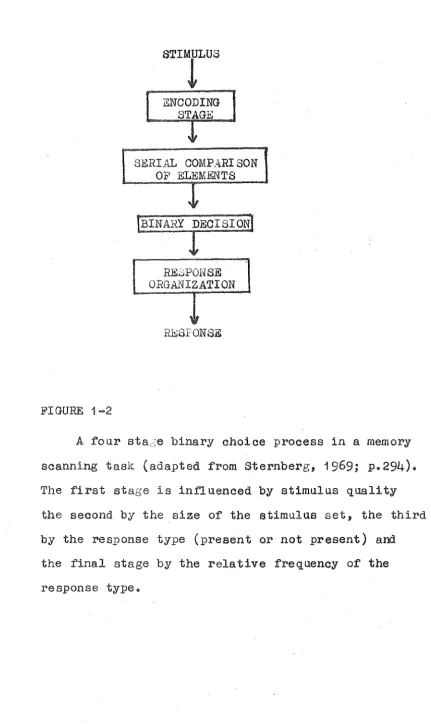
Corcoran~ 1970). This work led to a model of binary
classification~ with a series of additive stages (Fig.
1~2). This serial and exhaustive search model, which
"'" 21 ....
S.8RLAL COMPARI SON OF ELEMENTS
RE3POHSE
o
RG AllfIZATI ON [image:26.564.65.497.56.781.2]R:8S:FONSE
FIGURE 1-2
A four sta".;e binary choice process in a memory scanning tasle (adapted from Sternberg, 1969; p.294). The first stage is influenced by stimulus quality
.... 22
-Nickerson
(1966)
extended the memory search paradigm when he compared and contrasted two tasks,(a) where a single item was in memory and several on, display, and (b) several i terns in memory and one on displaYe The task wos to decide whether any of the first set of letters (checklist) were included in the second set (search set), and to register the decision as quickly as possiblee. The results confirmed the
importance of, (a) the number of items in the checklist, (b) the number of items in the se,arch set, and (c)
the number common to both. With relatively unpracticed Sa, RT was affected as much by differences in the
checklist as by differences in memory set. Error rates tended to be high when a multielement checklist and a multielement search list had only a single element in conunon .. Also, in contradiction to Sternberg, the number of pairwise checklist-searchlist comparisons did not appear ,to be exhaustive. The fact that for a specific numbe r of items in each list g RT vari ed inversely with
the number in common to the lists, suggested that as soon as a matching pair of items is fo und, search is terminated.
Various experiments since Sternberg's original publication have urged some caution in assuming this model to be entirely generalizable, especially with
regards to the exhaustive search requirement. Corcoran
(1970)
reported an unpublished study in which serial position of the digit in the stimulus sequence affected... 23
-"probert was presente d less than a second aft er the end of the list. Burrows and Okada (1971) found not only strong serial position effects but also parallel slopes for posi tive. and negative responses .. They swggested that modifications to the original Sternberg serial exhaustive model may be necessary. It is possible ,to adopt the exhaustive search approach to strong serial position effects by assuming that such effects results from the entire scan being
completed in less time if the target is in a favourable serial position. However, such results can also
be explained in terms of, a parallel model (Murdock, 1 971; Atkins on et· al ~ j 1969).. strong sel'ial position
effects were also found by Morin, DeRosa and Stultz (1967) a.nd DeRosa and Baumgate (1971).. They presented their positive set digits successively (in contrast to
Sternb(H"g's simultaneous presentation), and su,;gested that whether or not stimuli are temporally organized, through the interpolation of a pause within the digit series, strongly influences the serial position effects ..
Wingfield and Branca (1970) reported two stUdies in which Ss searched memorized lists of up to 12 digits or letters fo I' a probe digit. Reaction ·times were
used to examine both strategies of recoding, and of search thro ugh memory. They found that Ss reduced memory load by searching for the t.est i tern among the complement!3ry set when the size of the ::Jresented list waS in excess of' the size of its complement. While
.." 24
-search may be limited to the case where it has been demonstrated most consistently : high speed scanning for a single target .. Exhaustive search was not found when the Ss searched for more than one target, and where 8s are required to report the element following
the target item in the positive set (De Hosa and Baumgate, 1971~ Sternberg, 1967 ).
Several other results which requiz'e some incorporation into the Sternberg conceptualization have been published" Dumas,GT'osS and Checkosky
(1972)
hav.e shown that the Sternberg model is disrupted by Variations in theprobability of stimUlus elements or attributese Connor
(1972)
inferred the existence of a serial memory set encoding stage, which would also explain Morin et a1. fa (1967) results wi th tempo rally organizedstimuli. Swanson, Johnson and Briggs
(1972)
usedPosner and K.eele~s
(1967)
task which involved measuring same-different RTs to physically similar or dissimilar Ii teral stimuli 9 and where it was found that Sscan respond "same" faster when two upper case Ats
are presented, than when A and lower case a are shown. Swanson et al@ found a significant difference between a group who saw stimuli of the same physical format, and a group who were presented with stimuli which
differed in physical dimensions, but had associational identity. They suggested that a recoding operation mus t take place beful"'e stimuli of differing physical
format C8n be compared.
.,. 25
-alphanlllfleric stimuli.. Dumas
(1972)
investigated memory search, with practice, using multidimensional geometric stimuli. The tact that RT was dependent on the nwnber of shared attributes had been established by Nickerson(1967)
and later replicated by Checkosky(1971)$ Consequently, Dumas used geometric shapes with a varied number of dimensions in common. His results were consistent with a model postulating
self terminating compari sons wi thlnitems, but exhaustive search between items in memory. He found also, in
contrast to Neisser~ Novick and Lazar
(1963),
that while the effects on RT due to size of the memory set disappea!'ed, the effects of the dimensionality remained after eight days' practice - a resultDuroas held to be inconsistent with parallel feature testing ..
Klatzky and At.kinson (1970) looked at the case in which the test probe was not directly comparable to the stimulus sequence elements.. Either letters,
words~ or pictures were used as probe elements while the memory set comprised letters only. Hence, the Ss mi@lt make a positive response if the probe stimulus was a word the first letter of which was a member of the memory sete Similarly, if the target stimulus was a picture, then Ss made a positive response only
i f the first letter of the name of that picture was
a membel' of the memory set.. Since this experiment showed that exhaustive search need not occur under some oi rcumstances $I Klatzky, Juola and Atkinson (1971)
set out to define the conditions for such a search
- 26 ...
or not a given target matched one of the previously matched memory set, where the target stimuli for a given session were either exclusively letters,
exclusively pi·ctures, or a random sequence of bothe The RT functions of the letter or picture exclusive sessions were found to be consistent with an exhaustive model of memory scanning. The resul ts for the random
sessions deviated markedly from the predictions of such a model.
While Sternberg found a direct linear relationship, Nickerson
(1966)
found a logarathmic function, in asimilar manner to Hick's (1952) relation. Briggs and Blaha
(1969)
suggested this may be artifactual, but more recently Simpson (1972) has found that mean RT was a function of' log2 (positive set size).. This in turn suggests some sort of binary choice comparison process consis tent \Ni th the model s of Hick, and WeI ford(1960) ..
Finally~ Lively (1972) performed a study in which
he used a memory set of ei.ther digits or consonants and a test set which could comprise either digits or consonants .. Hence a negative response could be to ei the I' the same category probet or the di fferent
category probe" He found that the slope of the RT func tion for the concept ually different negative items was less than for the negative itams of the same class as the memory set.
27
-at hand" For example, there has been a tren~,
explored by Briggs and his students, towards the fitting of logarithmio relations to the RT versus positive set size function, and the introduotion of the concept of uncertainty from the work of Attneave
(1959) and others, on Information Theory (Briggs, Peters and Fisher 1972; Briggs and SWanson, 1970; Johnsen and Briggs, 1973; Lyons and Briggs,
1971; Swanson, Johnsen and Briggs, 1972). The ser'ial nature of memory se,aroh has been generally accepted, althouGh it has been demonstrated that the evidence presented, does not warrant the dismissal of the possibility of parallel search, (e.g~,
Murdock, 1971; Townsend~ 1972; Townsend and Roos,
The eXhaustive nature of the search has ,not been so clearly supported. While Sternberg (1969) fo'md no serial position effects, these have been fr'equently reported in other studies (Clifton and Birenbaum$! 1970,; Corballis, 1967; Corcoran, 1970; Forrin and Morin'lI' 1969; Kennedy and Hamil ton, 1969; Kirsner and Oraik, 1971; Morin at al., 1971 ). Forrin and Cunningham (1973) found that the existence of
serial position effects may be a function of the time for which elements are retained before scanning
and thi s accords with conclusions of Clifton and
BirenbaLIDl, 19700 Anders ("1973), using retrospective report, as well as conventional RT measures has
.. 28 ...
into subgro ups which are searchedexhausti vely
within subgroups, but in a aelr ter.minating manner, between gro ups. Theios, Smith, Haviland, Traupman and May
(1973)
have also pointed out that Sternberg confounded the probability of occurrence of a stimulus probe, and memory set size, and notes that probability has long been known to influence RT, (Hyman,1953;
Falmagne,1965;
ILaming,1968) ..
They demonstrat~d
"-that when this confounding was considered, self terminating mOdels are at least equally as viable as exhaustive models, and somewhat more parsimonious.
At present then, there is a considerable
di senchantment with the position Sternberg propounded in
1969,
and this is reflected in the productive, but not yet conclusive search tor alternative understandingof the dimensions or memory, and the r2s01ution of conflicting experimental conclusions.
Same-Diffel"lent Rs.action Time Tasks.
Judgements of identity or nonidentity of geometric or literal stimuli have also contributed to the
Such understanding of' visllal information processing ..
tasks can be structured so that Ss either see the stimuli to be comp8red sequentially (a basically memory task9 similar to memory search), or else
simultaneously, a perceptual discrimination task. vThile Sternberg's model is orten invokeds data rrom
"" 29
-In g enersl, in this type of st udy ther'e has been a greater emphasis on a search for variables which influence RT in specific situations, rather than vigourous adherence to general models.. Marcel
(1970),
for example, demonstra"ed that perceptual processing may well vary under di fferent condi tions .. In an expex'1ment using geometric data, he showed that while two conjLIDctions of values of four seperatedimensions maY,be analyzed in parallel, two conjunctions which are complementary, or from a saine functional
dimension~ al~e analyzed sequentially. Checking whether a pattern is red and has a vertical bar,
cannot be done at the same time as checking whether it is green and has a horizontal bar, (if these are the only alternatives on the relevant dimensi~n8) even with fairly extensive practice. After some practice however, checking whether a pattern is red and has
a verttcal bal" can proceed at the same time as checking whether it is a circle, and the bar is solid.. One may attend, he suggests, to events simultaneously only when they are on functionally separate channels ..
Keeley and Doherty
(1968, 1969)
obtained results of a similar nature .. Subjects were required t~repoI't where a break in a Landolt ring occ urred .. fo Wld that when the four C t s with br caks in the
They
same orientation werd exposed successively, each at the same duration as when only one was exposed, there was a significant increase in the Ss~ ability to
identify the orientation (or hitrate) over the
~ .30
-four of the rings were exposed simultaneously for an equal duration, there waB no increase in hitrate over the single exposure condition.
Marcel suggests, that this could be evidenCe for
parallel receptors, and that testing whether the break is at IIInorth" against all ~xposed Cs rna.}' be pos sible~
but that it is not possible to test "south" in one ring at the same time as "north" in another ..
Tasks more explicitly using a binary same ... different choloe have been reported (e .. g .. , Bindra, Williams
and Wise!! 1965; Bindra, Donderi, and Nishisato, 1968; Nicker)sonll 1965).. This led to the interesting
demonstration of' parallel processing and to the
development of a new experimental task, some aspects of which will be reported in this thesis, (Donderi and Zelnicker, 1969; Donderi and Case, 1970).
Donderi and Zelnicker found that when up to 13 geometric shapes were exposed simultaneously toa S who decided whether all the shapes were the same or whether one of the shapes was different, response
la tency was ind ependent 01' the number of shape s presented. 'rhey hypothesizedtha t input from all the shapes were
simultaneously pI'ocessed into one, or two shape categories and that a decision theory choice was made between
!lsarne" (where there was only one category) and
"different!! (where there was more than one shape category), independently of the number of shapes.
were, (a) all shapes identical, (b) 'one shape dirferent from the rest, and (c) with the
5-14
shapes stimuli, three shapes different. Decision la tency was again found to be j.ndependent of the number of shapes presented, and correct "same" and
., 3-di:t'ferentll decisions were taster than "i-different"
decisions. Connor
(1972)
has shJwn that parallel processing in a similar situation holds even undercondi tions o1~ increased irrelevant informational input,. However, where tl!_e stimuli were made more confusing,
that 1s when the distinctiveness of the different stimuli was reduced by using less clear type, or by using
visually similar letters, processing became clearly serial .. This suggests that the ability to attend to more than one stimulus input is limited by the necessity of using the same set of feature analyzers
on the stimuli (e.g .. Treisman,
1969;
Marcel,1970;
Keeley and Doherty,
1968) ..
An experiment similar to that of Donderi and Zelnicker, was designed by Egeth, Jonides and Wall
(1972)
who also round, using up to six stimuli, nonrandomly placed, that RT was independent of the nwnber of stimuli .. These results can be related to experiments by Brand(1971)
who discovered that looking for, any digit in a backgrOUnd of letters, may proceed as quickly as looking fora specificdigit in such a background. Hence categorization of overlearned stimuli, int.o functionally independent classes, may proceed in parallel.
I . . . 32 ..
which pairs of stimuli were variea along one or more dimensions - colour, size or shapef and each
dimension had only two possible values. His findings supported none of the basic Egeth (1966) models.
The results were however consistent with a- model which postulated the following assumptions:
(a) Parallel processing of the different stimulus. (b) Random distribution of decision time over trialse (c) Termination of search when dissimilar
dimension is found ..
(d) Time required to interrogate one dimension covaries with time required to determine the state of the other dimensions.
The support for (a) was derived solely from the same response data which revealed that the RT for judging both of two dimensions the same was not slower than the RT for judging the single slowest
dirrlension the same. Hence it is possible th~t a serial search mode may be employed when Ss are required
to respond to differences in any dimension. Downing and Gossman (1970) performed a similar experiment which concentrated on the different responses. The results of their three studies strongly supported a parallel processing model. None of the data was clearly consistent with a serial process, but the results were also in agreement with Hawkins' four postulates, indicating that Ss can process
... 33
-Bamber
(1969)
reported a study in which a criterion set of letters was exposed to the S outside a tachistoscope and a test set which was briefly exposed tachistoscopically. Subjects were required to report whether or not all the letters in the second exposure were the same as the first" His data was not in accordance with the serialself tenninating model he had previously suggested" and he developed a two process model to explain his I'e suI ts!
'U1'he two processes are a relatively slow
diffel'ence anaJ.yzer, which works in series and a faster identity analyzer" The difference analyzer emits either a • samet or tdifferentt signal, whe:l.'eas the identity analyzer emits only a 'same t signal.. A match be'!;ween the
'samet of the identity analyzer and the 'same' of 'the dLt'ferent analyzer results in a fast
t sarne ' response, whereas only the 'different'
signal ['X'Offl a di fference analyze!' produces
a 'different e response.. \'Vhen the test stimulus
is 'same' both analyzers emit 'same' signals but since the iderdiity analyzer is faster it haa already lnitiated a 'same' response by the time the difference analyzer emits a 'same'. Therefore the 'same t response is faster' than.
the 'different', and faster than would be expected by the serial self terminating model (p
213)"0
Downing
(1971)
notes however that responseprobability bi&s may be important in determining these resllitse Egeth (1966), Nickerson (1965, 1967, 1969), and Bamber (1969) all found same judgements faster than difference judgements, whereas Downing and Gossman (1970) did not. Downing
(1971)
showed that thi s m8J'- be a result oi' the different proba bili ty of same and different responses. Williams(1972)
felt that the Nickerson
(1965)
result might well... 34
-comparisonse He used Nickerson's sequential letter
presentation task, and by controlling the number of times that particular stimulus pairs were. presented
in the same-different paradigm, controlled the effects
of practi ce., He found that a same RT was faster, or
slowel~ than a different RT depending on the number of
times a S responded to specif'ic stimuli.
Grill (1971) has suggested a need for clarification of the conditions under which processes occur, that is,
she has noted that results and models may well be
hlgllly task specificlII She notes, for example that
a wid.e variety of' stimuli have been used; alphanumeric
stimuli (Nickel'son, 1966; Sternberg, 1966), randomly generated stimuli (Sekuler and Abrruns, 1968; Snodgrass,
1971, 1972) regular geometric figures (e. g", 9 Egeth~
1966; Hawkin8~ 1969; Lindsay and Lindsay 1966), 01'
stimuli which v&.ry al ong one integral dimension, (eo g .. , pitch or loudness; Nickerson, 1969). The comparison stimuli may be presented simultaneo usly (elll g .. , Donderi
and Zelnickel", 1969; Egeth, 1966; Sekuler and Abrams,
1968) OT' sequentially (Atkinson et al., 1969; Bamber, 1969;
Burrows ano. Murdoc.lc, 1969).. Some Ss receive large
pepiods of practice (Briggs and Blaha 1969; Ne1sser, Novick and Lazar,
1963;
Sekuler and Abrams,1968),
other's receive les8 (Danderi and Case 1971; Egeth, 1966)a Grill manipulated three variables - (a)
type of task (either simultaneous or sequential
presentation of geometric stimuli), (b) relative
Bet for speed as opposed to accuracy (e.ge,Fitts,
- 35
--rather than simultaneous presentations, and that
while processing tended towards the parallel mode
with practice in the simultaneolls condition, this
was not true in the successive conditionQ Relative
speed and accuracy set, had little relation to
response latency.
Same-different experiments have been carried
out under a varj.ety of conditions, and using a
number of dlffel"ing tasks. l1'he evidence available
suggest s ·tha t extreme care is necessary in producing
generalizable models$ In contradistinction to
memory search, ther'e is little evidence of exhallstive
search (eeg., Jnodgl"ass, 1971, 1972).. It is also cl ear that ill1.der some c ondi tions, parallel search,
ill lIst rated unegyivocally by a horizontal function
r'elating numbel' of element s to RP, may well occur.
'This appears to be trlle especially in tasks where
simul taneolls present ation, extensive practice and
the pos sibili ty of interl'ogat ion of functionally
independent dimensions is possible (Grill, 1971; Marcel, 1970; NeiDSel' et ale 1963).
~§..ejl..1'...Qh
Thi 8 con~oi derable ar'ea of research endeavollr
was la rgely stimllla ted by the wo de of Neis ser and hi s
colleagues in the early 1960'
IS,
and much of thesllbseqLlen t I'eseal"ch in memory search and same-different R'f experiments owes its initial motivation to these
early papers.. Visllal search is defined here as
- 36 ..
before or simultaneously with the sequence to be searched .. Memory search is the situation, as reviewed previously, where the target presentation is subsequent to the exposure of the stimulus or searched set of elements ..
Neisser
(1963)
was directly concerned with the question of parallel and serial search strategies" He required Ss to search through letter lists for thepresence or absence of one or more target letters, and perhaps t.he principle result of this work
was the finding that searching for two target elements could proceed as swiftly' as search for one target .. While serial strategies could be devi sed to handle
this data (Corcoran,
1970),
no such equivocation is possible with the results of Neisser, Novick and 1,azi3.r,(1 963)
iii 'rhey fOWld that wi th extensi vapractice, t::ls could search for ten it ems as quiclcly as for one - clear evidence of unlimited capacity ..
Kaplan and Carvellas (1965), and Kaplan, Carvellas and ; .. etlay (1966) also demonstrated the
dependence of scanning time on practice. When targets are searched for immediately after they are designated, search time is related to the number of target elements, ruld they postulated the initial
conditlon of sel'1al search is transformed, with practice~
- 37 ...
Shurtleff and Maraetta (1968) replicated part of the Kaplan et ale study, and failed to show a linear increase in scanning time as a function of the number of targets held in immediate memory.
Shurtleff and Marsetta felt this disagreement may have been caused by the fact that the Kaplan et ale
experiment actually increased the number of targets to be responded tJ in each stimulus presentation as the number of targets increased, whereas in the later experiment the number of targets to be found did not increase with the number of targets in
immediate memory., This would not however reconci;!.e Shurtleff and lviarsetta t s resul ts wi th those of Kaplan
and Oarvellas (1965). However one further di ff'erence, which may explain the discrepancy, is that the Kaplan expel'iments used targets drawn at random from all 26 letters of' the alphabet, whereas Shurtleff and Marsetta selected their targets from a specific set
of six elements~
An
experiment by Metlay, Sokoloff and Kaplan (1970) tends to support this conclusion. They found that when a S sea:r'ched a list of letters for one to five different targets which were randomly chosen from all 26 letters of the alphabet, the time required to scan the lists increased as a linear function ofthe number of targets searched fore When the targets were chosen from a specific set of fi ve letters
however, while scanning time increased with the
- 38 ""'
tests tl required increases with the nwnber of potential targets, although with sufficient practice, when
searching for a specific letter set of targets the Ss ultimately became able to test tor them
s1mul taneo usly .. It is also possible that the
I
curvilinear increase when the S memorized a small subset of the potential targets, may represent an intermediate stage in the gradual transition from serial to parallel.
The serial processing approach was strengthened by Nickerson and Feehrer (1964), who found a monotonic increase in RT with the increase in the number of
target elements, in an experiment where stimulus
letters were presented sequentially in a tachistoscope and where 8s were required to re spond only ,to the
critical items. This result was confirmed by Ohase and Posner (1965).. Rabbitt (1964, 1967) showed that not only the number of targets, but also the number
of non critical el~ents, increased response latencieso Subjects appeared to search not only for features which distinguished a target element, but also those
identifying a noncri tical element .. Whether target or nontarget elements are tested fOI',. may well be a function of the probability of target occurrence .. In the Neisser paradigm" probability that any
letter is a target is approximately 0.02, whereas in Rabbitt's experiment, this probability tended towards 0.5.
One of the few experiments on novelty and scanning
... 39
-that Ss can search for any wlfamil1ar element in a list of letters as rapidly as for "any digit",
but less rapidly than for a fixed and familiar
element .. This suggests novelty is not an
immediately given property of stimulus elements,
but the product of one particular pattern of prooessing
Neisser and Beller (1965) reported two experiments in which 88 searched through word lists for targets
defined in terms of their meaning (e .. g .. , "any animal")~
Scanning time Vias found to be gl'eater in this
situation, than when the target is a specif'ic word, or
a member of a defined gI'OUp of words.. Similarly,
Neisser and StopeI' (1965) required Ss to SC~1 word lists and to report proper names.. Some of the lists
contatned It cue 1/ words which made it pos sible to skip
a number of lines. Several seconds were necessary to
make such a skip, thus cues for short skips were not
used@ The rt:searcher surmised that the skip response
might not be under direct stimulus control, implying
that eye movements might have a pattern controlled by
higher order mechanisms.
The original Neiseer re suI ts h.,"":tve been confirmed
and extended in a number of ways (e.g., Peterson and
Pe·terson, 1970). Brown, and his colleagues at the Uni versi ~y of Exeter have al so ta.ckled some of the
problems raised by Neis ser (1963).. strongman and Brown (1966) instructed Ss to search for a meaningful word in a nonsense word oontext, or a nonsense word
in a meaningful context. Wi thin each 0 f the se
... 40 ....
levels of nonsense syllable association value were presented. Hypothesizing from Neisser's results, it was expected that search for an item not possessing an attribute (negative instructions) would lead to longer RTs than would search for an element possessing a specific characteristic (positive instructions). The results showed that visual search times were
significantly influenced by both the frequency of the target words, and the association value of the context items. There was also a significant .interaction
ob'served,betwe(:.:n type 'Of' instructions and target
fl"eQuency. Brown "md Chick
(1970)
clearly confirmed Neisserfs(1963)
finding that searching for the rowthat does not contain the target element, takes
longer than searching f'or the one row which does contain "the target .. One experimental difference which may account for this is that the definition of a target
in the two cases is completely different .. In searching for a 'target's presence, the notion of' a I'OW is not
necessary, however in order to report the absence
of a target, the letter structure of the row is imp8rtant .. The influence· of the context in which the target is buried has been further stUdied by Portnoy, Portnoy and Sal zinger
(1964).
They instructed Ss to locate nonsense target syllables in fields of other nonsensesyllables. They varied the relative association value of the target and the field. The results indicated that search time is lower when the target association v';,lue is high, and when there is a
41
-Sohultz and Lovelaoe (1964) fowmd that Ss located high meaningfulness
eve
tr1grama more rapidly than those with low meaningtulnesa.Smith and Egeth (1966) criticized Portnoy €It al~
(1964) on the grollllds that their measure of search time did not permit a computation of decision time per i tern, from the total number of items searched. Hence no conclusion as to whether familiarity effects decision time per item examined, or the total number of items actually examined. They therefore used a Nei sseI' format to reduce the potential strategi €IS ..
They did not find that familiarity influenced dis cI'imnabili ty using the deci si on time per item criterion. Hence the e.ffects of familiarity may be confined to unstructured search situatio.r&.
Krueger
(1970a)
employed an interesting design which I'equired the 8 to search for a target letter amongst visual displays of varying redundancy. He showed that 3s can find a target more quickly in structured stllnull (words or pseudowords) than in non structured groups of letters .. Also, Ss se.srch more ralJidly thro ugh coherent sentences than through scrambled lists of words. He showed, by increasing the numbel' of memory c)mparisons (Ss searched for more targets), tha t redundancy ai ds search by speeding the initial encoding stage.Even when familiarity is induced within one experimental session