Master
thesis
Romy Breukers
Master: Public Administration
Faculty: Management and Governance University of Twente
21 June 2013
Supervision
First supervisor UT: Prof. Dr. S.A.H. Denters Second supervisor UT: Prof. Dr. R.A. Wessel External supervisor: Dr. P.H. Omtzigt
CDA Tweede Kamer, Den Haag
1
Foreword
This research is conducted as a master thesis for the master Public Administration at the CDA Tweede Kamer fractie.
In that case, especially I would like to thank Pieter Omtzigt, for offering me the opportunity to do my research at the CDA Tweede Kamer fractie and for his assistance, help and patience during my research. It was an unforgettable experience to be at the CDA Tweede Kamer fractie, to experience this work culture and to visit Brussels. I would like to thank Edward de Lanoy and Feliz Garcia for offering the opportunity to do my research at Fractiebureau CDA. And I would like to thank Ans Seriese, EU-advisor at the Tweede Kamer der Staten-Generaal, for her time, assistance and conversations during my research.
I would like to thank my first supervisor prof. dr. Bas Denters and my second supervisor prof. dr. Ramses Wessel, related to the Faculty Management & Governance of the University of Twente, for their supervision during the whole process. The start was difficult and the process took a long time, including ups and downs. But both, Bas Denters and Ramses Wessel, believed in a good result. They gave me the confidence and the energy to go on and to finish my thesis.
2
Management summary
The Early Warning System is introduced by the Lisbon Treaty in 2009 and focuses on the control of subsidiarity. The aim of the Early Warning System is to generate more influence for national parliaments of EU member states in EU decision-making processes. When parliaments think a legislative proposal of the European Commission breaches the principle of subsidiarity, they can accomplish a subsidiarity check and can submit a reasoned opinion within eight weeks after publication. In these eight weeks, it is important to convince other parliaments to submit a reasoned opinion as well. Every member state has 2 votes. If a proposal receives more than 18 votes, a yellow card will be drawn to the Commission and it has to review its legislative proposal. If a proposal receives more than 27 votes, an orange card will be drawn to the Commission and it has to send its proposal and the submitted reasoned opinions to the European Parliament and the European Council. When these institutions agree with the parliaments, the proposal of the Commission will be rejected.
This study is commissioned by Pieter Omtzigt, member of the Dutch Parliament and pension rapporteur in the EU on behalf of the Dutch Parliament. 16 February 2012 the Commission
published the 'White Paper on pensions', which contains several policy initiatives for 'adequate and sustainable pension systems' in Europe. The Dutch parliament is concerned about the subsidiarity principle of some initiatives in this white paper. On behalf of the Dutch parliament, first Omtzigt will try to convince the Commission to change the draft proposal. If the Commission does not change these initiatives for the final proposal, the Dutch parliament will start a yellow card or orange card procedure after the Commission published the proposal.
3
identified factors and the frequency of submitting reasoned opinions. These hypotheses are tested by accomplishing a nonparametric correlation test and crosstabs, between the number of
submitted reasoned opinions in 2010 and 2011, and the seven factors.
The study shows that polarization, population size and net position have a moderated influence. Parliaments with a high rate of polarization, a high population size and a weak net position will submit reasoned opinions more frequently than parliaments with a low rate of polarization, a low population size and a high net position. The parliamentary system and the number of seats in the parliament have a weak influence on the frequency of submitting reasoned opinions. Parliaments with a bicameral parliamentary system and with a high number of seats submit reasoned opinions more frequently than parliaments with an unicameral system and with a small number of seats. The factors effective parties and trust have no influence on the frequency of submitting reasoned opinions.
4
Table of Contents
1. Introduction 6
1.1 Issue 6
1.2 Aim of study 8
1.3 Research questions 9
1.4 Layout report 10
2. The Early Warning System 11
2.1 Role of national parliaments in the EU 11
2.2 The Early Warning System: the occasion 13
2.3 Early Warning System: how is it supposed to work? 15
2.4 The principle of subsidiarity and proportionality 17
2.5 Difficulties and limitations of the yellow and orange card procedure 18
2.6 Conclusion 19
3. Issuing a yellow card: hypotheses 20
3.1 Decision-making costs 21
3.1.1 Bicameral and unicameral parliamentary system 21
3.1.2 Size of the parliament 22
3.1.3 Effective parties 23
3.1.4 Polarization 24
3.2 Benefits 24
3.2.1 Population size 24
3.2.2 Net position 26
3.2.3 Trust 27
3.3 Conclusion 27
4. Methods 28
4.1 Reasoned opinions 28
4.2 Bicameral and unicameral parliamentary system 29
4.3 Size of parliament and capacity 29
4.4 Effective parties 30
4.5 Polarization 30
5
4.7 Net position 31
4.8 Trust 32
4.9 Relationship dependent variable and independent variables 33
4.9.1 Nonparametric correlation test 33
4.9.2 Cross tabs 34
4.10 Conclusion 35
5. Results: the Early Warning System in practice 36
5.1 Reasoned opinions: frequency of use 36
5.1.1 A successful yellow card: Monti II 37
5.2 Reasoned opinions and national parliaments 38
5.3 Reasoned opinions and parliamentary system 40
5.4 Reasoned opinions and the size of the parliament 41
5.5 Reasoned opinions and the number of effective parties 43
5.6 Reasoned opinions and polarization 44
5.7 Reasoned opinions and population size 46
5.8 Reasoned opinions and net position 47
5.9 Reasoned opinions and trust 48
5.10 Conclusion 49
6. Conclusion 51
6.1 The conclusion of this study 51
6.2 What does this study mean for practitioners? 52
6.3 What does this study mean for scientists? 53
6.4 Limitations and more… 53
6.4.1 Literature and documentation study 54
6.4.2 Testing hypotheses 54
6.5 Recommendations for future research 55
References 56
6
1. Introduction
The Lisbon Treaty was signed in 2007 and entered into force in 2009, after ratification by the 27 EU Member States. This Lisbon Treaty includes the ‘Early Warning System’, which focuses on the control of subsidiarity. According to the principle of subsidiarity the EU does not take action, unless when it will be more effective than at local, regional or national level. When parliaments think a proposal breaches the principal of subsidiarity, they have the opportunity to object to legislative proposals of the European Commission within eight weeks after publication. When parliaments object to a legislative proposal, they can draw a yellow or orange card to the Commission. The aim of the Early Warning System is to generate more influence for national parliaments of EU member states in EU decision-making processes (TEU, 2009).
The aim of this study is to acquire knowledge about the role of national parliaments in EU decision-making by focusing on the Early Warning System, including the yellow and orange card procedure, in order to be able to provide new perspectives on these procedures, coalition-making processes and decision-making processes.
In this chapter the issue and the aim of this study will be further introduced. Then the research questions will be described. This chapter will end with the practical and scientific relevance of this study.
1.1 Issue
A former general opinion is that parliaments are the 'losers' or 'victims' of the EU integration. Because of the integration process their influence in decision-making processes in the EU
diminishes (Raunio and Hix, 2000). According to the deparliamentarization theory, the decrease of power of parliaments is a result of the advancing integration in the EU (O’Brennan and Raunio, 2007). However, in contrast to this theory, the intergovernmentalism theory implies that
parliaments do have benefits of European integration. The Member States are the link between the nation and the EU and make, coordinate and control EU policy. The multi-level governance theory agrees. The EU is a system with several levels without strict separation between these
7
The image of parliaments is changing. Parliaments are seen as a collective actor within the EU. In recent EU treaties, parliaments have received new powers to enhance their role within the EU (Cooper, 2011). The Lisbon Treaty introduced an important new instrument. The Early Warning System authorizes parliaments to discuss new legislative proposals of the Commission for
compliance with the principle of subsidiarity (Cooper, 2011; TEU). According to protocol 2 art. 6 of the Lisbon Treaty (TEU), parliaments have eight weeks to perform a subsidiarity-test and submit a reasoned opinion:
Every parliament has 2 votes, with a difference between unicameral parliaments and bicameral parliaments:
If a parliament sends a reasoned opinion, this counts as 2 votes, depending on the national
parliamentary system. With at least one third of the total votes, the Commission receives a yellow card and should reconsider its proposal. With at least half of the total votes, the Commission receives an orange card and the proposal will be blocked, but can be reintroduced by the
Commission. In case of this orange card procedure, it will be very difficult for the Commission to maintain the proposal:
“any national parliament or any chamber of a national parliament may, within eight weeks from the date of transmission of a draft legislative act, in the official
languages of the Union, send to the Presidents of the European Parliament, the Council and the Commission a reasoned opinion stating why it considers that the draft in question does not comply with the principle of subsidiarity. It will be for each national parliament or each chamber of a national parliament to consult, where appropriate, regional parliaments with legislative powers,” (art. 6, TEU).
8
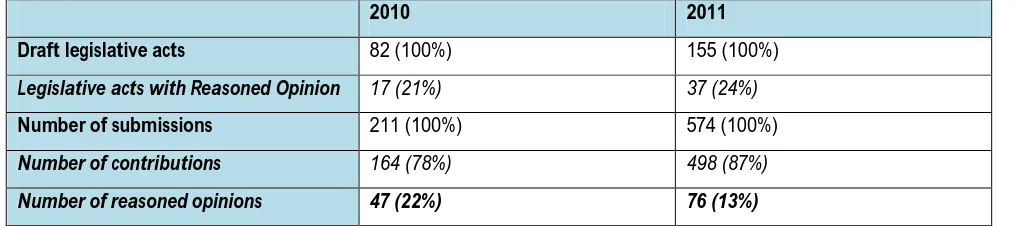
Parliaments have the possibility to influence legislative proposals of the Commission and influence decision-making processes of the EU (Senden & Vandamme, 2009). However, the yellow and orange card procedure are rarely used successfully. Only once, in case of Monti-II in May 2012, 19 parliaments submitted a reasoned opinion, enough for drawing a yellow card (Ministerie van Buitenlandse Zaken, 2012).
1.2 Aim of study
By signing the Lisbon Treaty in 2007, the Early Warning System was introduced and in 2009 this instrument entered into force (TEU, 2009). From 2010 till today, several parliaments submitted a reasoned opinion in case of several draft legislative acts.
A possible yellow card procedure could be initiated concerning the case of the ‘White Paper on pensions’. 16 February 2012 the Commission published this white paper, which contains several policy initiatives for 'adequate and sustainable pension systems' in Europe (European Commission, 2012). The Dutch parliament is concerned about the subsidiarity and proportionality principles of some initiatives in this white paper (Commissie Sociale Zaken en Werkgelegenheid, 2012; Tweede Kamer der Staten-Generaal, 2012). Because of this, the Dutch Parliament appointed Pieter Omtzigt (member of the Dutch Parliament, party CDA) as pension rapporteur (Tweede Kamer der Staten-Generaal, 2012). First, on behalf of the Dutch parliament, he will try to convince the Commission to change the concerning initiatives. If the Commission does not change these initiatives for the final proposal and this final proposal will be published, the Dutch parliament will perform a subsidiarity-test and, if necessary, start a yellow or orange card procedure (Omtzigt, 2012).
This case and evaluation study about the Early Warning System has been chosen because of its practical and scientific relevance. Practical relevance, because this study will generate new
“Where reasoned opinions on a draft legislative act’s non-compliance with the principle of subsidiarity represent at least one third of all the votes allocated to the national Parliaments in accordance with the second subparagraph of paragraph 1, the draft must be reviewed;”(art. 7, 2009)
9
information about the Early Warning System and will generate new knowledge about issuing a yellow or orange card procedure. This will help the Dutch parliament deciding whether to start a yellow or orange card procedure in case of the white paper on pensions. At this moment, there is still no evaluation report available about the Early Warning System (Seriese, 2013). So there is no information about the effectiveness of this instrument.
This study analyses and evaluates the yellow and orange card procedures for 2010 and 2011. It makes clear how frequently a parliament supplied a reasoned opinion and voted for a yellow card. Thereby, with this study will be tried to identify factors which influence the decision to start a yellow or orange card procedure. If the Dutch parliament decides to start a yellow card procedure in case of the proposal of pensions, this new information will help to make coalitions with other parliaments for drawing a yellow card to the Commission.
Besides the practical relevance, this study has scientific relevance, because there are limited studies and there is no evaluation report about the Early Warning System available (Seriese, 2012). The Early Warning System is a new instrument. As a result, there is limited knowledge about it and there are limited scientific studies available.This evaluation study is relevant for the scientific field, because it will give new knowledge and perspectives about the Early Warning System, the yellow and orange card procedure, coalition-making processes and decision-making processes. Therefore, this study can be a start of more scientific research.
1.3 Research questions
This study can be divided into three stages. The first stage is a description of the Early Warning System, including the yellow and orange card procedure. It describes the formal framework and how this instrument should work in practice. The second stage is about identifying factors. Based on scientific literature, possible factors for the support of submitting a reasoned opinion will be identified. The third stage is about which factors influence the support for submitting a reasoned opinion.
For this study, one research question and four sub questions are developed:
Which factors influence the support of national parliaments of EU Member States, for issuing
10
I. What is the Early Warning System, including the yellow card and orange card procedure and
what is the formal framework of this instrument?
II. How frequently did parliaments of EU Member States start a yellow card or orange card
procedure, how much support received these procedures from the parliaments and how
many procedures resulted in a yellow card or orange card to the European Commission?
III. Which factors influence the consideration process of starting a yellow or orange card
procedure?
When the current white paper of pension will be transformed into a legislative proposal and will be published by the Commission, the Dutch parliament considers to initiate a yellow card
procedure. Because of this, the Dutch parliament would get more information about the yellow and orange card procedure. Therefore, the last sub question is about lesson learning:
IV. When the European Commission publishes a legislative proposal, in which way can a
parliament create a broad enough coalition with other parliaments to generate enough
votes for drawing a yellow card?
1.4 Layout report
11
2. The Early Warning System
In this chapter sub question I, ‘what is the Early Warning System, including the yellow card and orange card procedure and what is the formal framework of this instrument’, will be answered. A
short explanation of the role of parliaments in EU decision-making processes will be described, based on policy documents. This broad subject will be specified into the Early Warning System, including the yellow and orange card procedure. In the description of the yellow and orange card procedure, the focus will be on the content of this instrument, the formal framework, the terms subsidiarity and proportionality and finally the limitations.
2.1 Role of national parliaments in the EU
For many years, there have been several discussions about the involvement of parliaments in EU decision-making processes. Usually, the opinion is that parliaments are the 'losers' or 'victims' of the EU integration (Kiiver, 2005). Because of the integration process the influence of parliaments in EU decision-making reduces (Raunio & Hix, 2000). Parliaments lose regulatory powers to the Council of Minister particularly, which is the decisive legislative body of the EU, in co-decision with the European Parliament (Kiiver, 2005). According to Raunio and Hix (2000) ”there is almost universal agreement among political scientists, including both integration and legislative scholars,
that power has shifted further to the executive at the expense of parliaments and that traditional
mechanisms of parliamentary accountability have been weakened”. However, parliaments do
retain certain functions within the EU. The most fundamental functions of parliaments are about ratification of EU Treaties, implementation of EU legislation into national law and the continued enforcement of accountability of the governments when they act at EU level (Kiiver, 2005).
Because of the discussion about the involvement of parliaments in EU decision-making, several theories are formulated. A theory about the reducing power of parliaments is the
deparliamentarization theory. According to this theory, the decrease of power of parliaments is a
result of the advancing integration of parliaments in the EU and of five factors:
The first factor is the constitutional factor. This is about the transfer of power from national level to EU level. A part of the power of parliaments is transferred to the EU. For example: initiatives of monetary policy; agriculture policy and external trade.
12
with the treaty as a whole. Therefore it is possible that a treaty will not be ratified, because a parliament does not agree with only a section of the treaty (O'Brennan & Raunio, 2007).
The third factor is the increase of the Qualified Majority Voting: This voting system is the most common form of voting in the EU Council of Ministers. Votes of the Member States are weighted. There is a qualified majority when 255 votes of 345 votes are positive. Because of this procedure, parliaments have limited control, because “qualified majority as opposed to unanimity voting reduces parliaments’ ability to indirectly influence Council
decision” (European Centre for Parliamentary Research and Documentation, 2011).
The fourth factor is the 'Murky world of committees and expertise’ (Raunio & Hix, 2000): decision-making is more technical and specialized. Because of this, there are many workgroups and specialized committees. The EU has more opportunities to use these specialized groups than parliaments have (Raunio & Hix, 2000).
The fifth and final factor is that “the powers and legitimacy of the European Parliament fall far short of full compensation of the loss of power of parliaments” (O'Brennan & Raunio,
2007). For example, the European Parliament does not have the right of initiative (initiatiefrecht) or full authority about budget.
In contrast to the deparliamentarization theory, the intergovernmentalism theory suggests that parliaments have benefits of the European integration. According to Moravcsik (1993) 'the European Community does not diffuse the domestic influence of the executive: it centralizes it'.
Parliaments are the link between Member States and the EU. Parliaments make, coordinate and control EU policy. But there is a strict separation between national and EU policy-making. However, decision-making in EU by parliaments is influenced by national interests (Moravcsik, 1993).
The Multi-level governance theory is in line with the Intergovernmentalism theory. According to this theory, the EU is a system with several levels without strict separation between these levels, whereby parliaments play a role within EU decision-making processes (Moravcsik, 1993). So parliaments play a role in the decision-making processes in case of legislative proposals of the Commission, but also in the decision-making processes in case of transforming legislative proposals into a policy.
13
explained on the basis of intergovernmentalism theory. Before the 1990's there was a lack of input legitimacy within the European Union. This became clear after the Danish citizens voted in a referendum against the Treaty of Maastricht in 1992 and the French citizens almost rejected this treaty. Parliaments came to be seen as important actors for reducing the democratic deficit within the EU (Norton, 1998). Because of this, parliaments got more formal instruments with which they can exert influence at EU-level (van den Berg, 2011). An example of a formal instrument is the Early Warning System, where parliaments have the opportunity to issue a yellow or orange card when they have the opinion that a legislative proposal of the Commission breaches with the subsidiarity principle (European Commission, 2009).
Today, there are still discussions about the influence of parliaments in EU decision-making processes. In ‘the speech on Europe’, the Prime Minister of the United Kingdom, David Cameron, suggests that in 2017, by a referendum, the British citizens would get the opportunity to vote about the British membership in the EU. The British citizens have the opportunity to stop this membership. Thereby, Cameron suggests that the conditions of the British membership should be revised (BBC, 2013). William Hague, the UK Foreign Secretary, claims that the EU needs a "red card" system for parliaments to block proposals if parliaments think EU officials are going too far (BBC, 2013). There is more discussion and criticism about the role of parliaments in the EU.
2.2 The Early Warning System: the occasion
In the 1990's parliaments shifted from the side line to the playing field of the EU. Because of the European integration, the EU got more influence at the domestic level and therefore more involvement of parliaments was necessary (Kaczynski, 2011).
14
and EU institutions possible. A first step for more collaboration between the EU and parliaments. However this first step seems not very big, it is the first formal recognition of the rights of
parliaments in EU decision-making processes (Kaczynski, 2011).
In 2002 and 2003, parliaments were allowed to participate in the European Convention for the creation of a Constitution for Europe. At this Convention, the suggestion was to give parliaments the possibility to have more involvement into European decision-making processes. More specific, parliaments should have the possibility to block European proposals if this was in contrary to the principle of subsidiarity. Therefore the European Constitution developed a first version of the yellow card procedure, but many parliaments disagreed with this procedure (Kaczynski, 2011). In 2005 referenda in The Netherlands and France failed. This rejection of the Convention delayed the direct parliamentary involvement in the EU. As a results, the involvement of parliaments in EU decision-making got more and more attention and became a hot issue in the negotiations to the Lisbon Treaty. Some parliaments would like to realize a greater involvement of parliaments.
Especially The Netherlands, one of the initiators, opted for more involvement for parliaments in EU decision-making processes. This resulted not only into a yellow card procedure, but it also
contained an orange card procedure. Both procedures were accepted by the Lisbon Treaty in 2007 (de Bruijn, 2011).
In 2006 the Commission improved the political dialogue with parliaments by the so called ‘Barrosso initiative’. The Commission directly sends all new proposals to the parliaments, so the parliaments can give a reaction as to improve the policy formulation. Some parliaments were actively reacting, and discussed the principle of subsidiarity in their reaction (Kiiver, 2006). Between 2005 and 2009 COSAC, the inter parliamentary conference for European Affairs
committees, coordinated eight pilots in order to gain experience with subsidiarity control. None of these pilots reached the threshold of one-third of the parliaments. With these pilots, COSAC identified some issues with the Early Warning System. These issues were resolved in the Lisbon Treaty. One of the issues was that parliaments had trouble performing a subsidiarity check. Because parliaments had only six weeks, instead of eight weeks in the Lisbon Treaty, to submit a reasoned opinion and there were no translations available for all the official languages of the EU of the legislative proposals (Kiiver, 2006; Kaczynski, 2011).
15
as an example of the intergovernmentalism theory. In accordance with this theory, there is a separation between national and EU policy-making, but parliaments ‘make, coordinate and control the EU policy’ (Moravcsik, 1993). Because of the demand for more involvement of parliaments in EU decision-making, the parliaments received instruments like the Early Warning System to influence EU decision-making processes (de Bruijn, 2011).
2.3 Early Warning System: How is it supposed to work?
To influence European decision-making processes, parliaments have several instruments to use, which are generated by European Treaties (European Commission, 2007). In line with the
Constitutional Treaty, the Lisbon Treaty tries to increase the position of the European Parliament (EP) and parliaments (of 27 EU Member States) in European decision-making processes. The Lisbon Treaty introduced new instruments for more involvement of parliaments (Senden & Vandamme, 2009).
The Lisbon Treaty introduced the Early Warning System, whereby parliaments can test the legislative proposals of the Commission on subsidiarity, a so called 'subsidiarity check', after publishing the proposal by the Commission (Kiiver, 2011). After finishing this subsidiarity check, parliaments can submit a 'reasoned opinion'. A reasoned opinion can be seen as a vote against the legislative proposal. Each parliament can submit two votes. In case of a bicameral parliamentary system each chamber can submit one vote. In case of an unicameral parliamentary system, the concerning chamber can submit two votes (art. 7 TEU). This means that parliaments and senates are treated equally. In a bicameral parliamentary system it would be more difficult in mobilizing two votes, compared to an unicameral parliamentary system where only one chamber has to be convinced to submit a reasoned opinion (Kiiver, 2011).
16
its opinion and the reasoned opinions of the parliaments to the European Parliament and the European Council. These institutions have to take a decision about the subsidiarity infringement of the legislative proposal (art. 7 TEU). If the European Parliament or the European Council agrees with the parliaments, the legislative proposal will be rejected (Kiiver, 2011). However, if the
Commission reviews its proposal not well, it is likely that the European Parliament or the European Council reject the proposal. It is likely that members of these institutions, especially in case of the Council, follow the opinion of their national parliament (Kiiver, 2011; Kaczynski, 2011).
When the Commission drafts a legislative proposal, the proposal will be translated in all official languages of the EU. When the last translation is finished, the Commission sends the translated proposal to the parliaments. Parliaments have eight weeks to perform a subsidiarity check and to submit a reasoned opinion (art. 6 TEU). Formally parliaments have a period of eight weeks, but in practice the parliaments can take note of the legislative proposal earlier, because the English and French version are available earlier than the translated versions. It can make a difference of a few weeks (Kiiver, 2011).
When the parliaments receive the legislative proposal, it has to decide if it performs a subsidiarity check. Balancing this decision is different for every parliament. Parliaments have different
conceptions about subsidiarity (Kaczynski, 2011). If a parliament decides to perform a subsidiarity check, it will make its decision known at the website of the Inter Parliamentary EU information eXchange (IPEX). IPEX is a platform for the European Parliament and parliaments to exchange information. It works more as an archive for these institutions (IPEX, 2013).
When a parliament accomplished a subsidiarity check, it has to formulate a reasoned opinion. There are no specific guidelines for a reasoned opinion. The only requirement for a parliament is to focus on the principle of subsidiarity in its reasoned opinion, otherwise the reasoned opinion does not count as a vote against the legislative proposal of the Commission. A good formulation of the reasoned opinion is important. In most cases it is negatively formulated, because a parliament thinks there is an infringement of the principle of subsidiarity (Kiiver, 2011).
When a parliament decides to submit a reasoned opinion, it will try to convince other parliaments to submit a reasoned opinion as well. The parliament has to coordinate this with other
17
mobilizing a broad coalition with other parliaments. Parliaments will have to coordinate its actions with other parliaments by contacting representatives in Brussels or representatives in the
concerning parliaments (Omtzigt, 2012).
2.4 The principle of subsidiarity and proportionality
A subsidiarity check has to be performed before a parliament can initiate a yellow or orange card procedure. But what is the principle of subsidiarity? In article 5 of the Treaty on European Union, the principle of subsidiarity is defined:
So, according to the principle of subsidiarity the EU does not take action, unless the action at EU level will be more effective than at local, regional or national level. This means that the
Commission has to justify the relevance of every proposal against the principle of subsidiarity. However, according to the Lisbon Treaty (2009), the EU has six exclusive competences with regards to the management of Customs Union; the economic and monetary policy of the EU; the
maintenance of competition laws; the common positions of EU member-states in international trade negotiations; the common fisheries policy; some international agreements (European Union, 2010). Even though there is a definition given by the EU, on the principle of subsidiarity (with exclusive competences for the EU), it remains difficult to decide if something belongs at the EU level, or local, regional or national level. There is no specific definition with clear 'boundaries' about the principle of subsidiarity. Often, it is a matter of opinion when a parliament decides if there is an infringement of subsidiarity or not (Kaczynski, 2011).
The proportionality principle is related with the subsidiarity principle. The proportionality principle is entered into force with the Treaty of Amsterdam in 1992. The proportionality principle regulates the exercise of powers by the European Union. According to this principle the EU should not go further than necessary in case of performing new policy and legislation. When there are different
“Under the principle of subsidiarity, in areas which do not fall within its exclusive competence, the Union shall act only if and in so far as the objectives of the proposed action cannot be sufficiently achieved by the Member States, either at central level or at regional and local level, but can rather, by reason of the scale or effects of the proposed action, be better achieved at Union level. The institutions of the Union shall apply the principle of subsidiarity as laid down in the Protocol on the application of the principles of subsidiarity and proportionality. National Parliaments ensure compliance with the
18
manners to introduce new legislation, the EU should choose that manner whereby the Member-States have freedom as much as possible (Europa, 2013).
2.5 Difficulties and limitations of the yellow and orange card procedure
According to Senden & Vandamme (2009) and Jans & Piedrafita (2009) there are some difficulties and limitations of the Early Warning System. The first and most important difficulty of this
instrument is the time limit of eight weeks. Parliaments have eight weeks to perform a subsidiarity check, submit a reasoned opinion and create a coalition with other parliaments to generate
enough votes for a yellow card or orange card (Senden & van Damme, 2009). These eight weeks includes breaks, national holidays etc., except the month August. During these eight weeks the development of the conceptual proposal stops. Therefore it is important that parliaments submit a reasoned opinion as soon as possible. However, according to Senden & van Damme (2009), a time limit of eight weeks is too short. This statement of Senden & van Damme (2009) is confirmed by an example. After publishing the proposal by the Commission, the parliament of Estonia wanted to perform a subsidiarity check. For accomplishing this subsidiarity check and submitting a reasoned opinion, the Estonian parliament had a normal time limit of eight weeks. Because of the Christmas break of 3 weeks, the Estonian parliament was left only five weeks. According to the Estonian parliament, five weeks is way too short to deliver a reasoned opinion (Seriese, 2013).
Furthermore, when the Commission publishes a proposal before the Summer break of six weeks, there are a few weeks left for parliaments to perform a subsidiarity check, submit a reasoned opinion and contact other parliaments. Accomplishing all the tasks in a few weeks is difficult. The statement of Senden & van Damme (2009) and the protest of the Estonian parliament show that the period of eight weeks is a limitation in case of the Early Warning System.
However, this statement is partially contradicted. Parliaments have the opportunity to take note of the proposal earlier, because the English and French versions are earlier available. This can make a difference of weeks (Kiiver, 2011). This fact invalidates partially the statement of Senden & van Damme (2009) and the protest of the Estonian parliament. However, formally parliaments have eight weeks to finally submit a reasoned opinion. So in that case, the statement of Senden & van Damme (2009) and the protest of the Estonian parliament are still relevant.
19
consideration than only a subsidiarity check (Senden & van Damme, 2009). A third difficulty is that in case of an orange card, the Commission could try to circumvent the negative advices by
changing the proposal. Then it is still possible that the proposal (partially) will be seen as positive and will result into new legislation. The final limitation is that it is not possible for the Court to reject the proposal for other reasons than subsidiarity (Senden & Vandamme, 2009 and Jans & Piedrafita, 2009).
2.6 Conclusion
In this chapter, sub-question I, ‘what is the Early Warning System, including the yellow card and orange card procedure and what is the formal framework of this instrument’, is discussed.
Concluding, the Early Warning System is introduced by the Lisbon Treaty in 2009 and focuses on the control of subsidiarity. The aim of the Early Warning System is to generate more influence for national parliaments of EU Member States in EU decision-making processes. When parliaments have the opinion that a legislative proposal of the Commission infringes the principle of
20
3. Issuing a yellow card: hypotheses
In this chapter, the focus is on initiating a yellow or orange card procedure. Therefore , factors which influence this process are very important. First, it will be important to identify the possible factors before answering sub-question III ‘which factors influence the consideration process of starting a yellow or orange card procedure’. As a result, several hypotheses will be developed
based on scientific literature.
Before issuing a yellow or orange card, there is a procedure with different steps. Within eight weeks, a parliament has to accomplish a subsidiarity check, has to submit a reasoned opinion and has to try to convince other parliaments to submit a reasoned opinion as well. For issuing a yellow or orange card, parliaments have to convince other parliaments for creating a coalition to get more than 18 votes (art. 7 TEU). This coalition-making process should lead to a result or collective good that parliaments cannot attain individually. So building a coalition will lead to collective benefits (Olson, 1965; Lupia & Sin, 2003). But, besides benefits, the procedure can lead to costs, decision-making costs. Every parliament has to weigh the costs and benefits.
According to Buchanan & Tullock (1962) there are two types of costs: external costs and decision-making costs (Parisi, 2012). Decision-decision-making costs are the opportunities, resources, time and effort before making a decision or to reach an agreement (Ostrom & Ostrom, 1971). The height of the decision-making costs depends on the number of participants in the decision-making process (Dougherty & Edward, 2011). The higher the number of participants, the higher the decision-making costs.
In this case there are several decision-making costs. For submitting a reason opinion, parliaments have to discuss internally and make the decision to submit a reasoned opinion or not. A parliament which submits a reasoned opinion has to discuss external with other parliaments and has to
persuade other parliaments to join as well. During these steps parliaments make costs for decision making.
21
domestic, national benefits. These benefits will be derived from making an attempt to change the outcome of an EU-decision, or be active in the interest of the national citizens.
3.1. Decision-making costs
After the Commission published the legislative proposal, within eight weeks parliaments have to perform a subsidiarity check and have to submit a reasoned opinion (art. 6 TEU). Parliaments have to discuss with and convince other parliaments to submit a reasoned opinion as well. Only when there are more than 18 votes, it is possible to draw a yellow card. Parliaments with an unicameral system have 2 votes automatically. Parliaments with a bicameral system have 2 votes too, but split up in 1 vote per parliament (art. 7 TEU).
3.1.1. Bicameral and unicameral parliamentary system
An unicameral parliamentary system means that there is one national parliament in a state. With a bicameral parliamentary system the parliament exists of two chambers, a national council and a senate (Lijphart, 1999). In case of a bicameral parliamentary system, both parliaments have to discuss issuing a yellow card. Both parliaments have to adapt their opinions and both have to submit a reasoned opinion, when it will result into 2 votes. These internal consultations result into decision-making costs like time and effort. It is to be expected that it will be a threshold for these parliaments to submit a reasoned opinion and initiate a yellow or orange card procedure.
Besides these internal decision-making costs, there are international decision-making costs as well. In case of these international costs, there are two different considerations. The first consideration is about self-initiated action. If a parliament decides to submit a reasoned opinion, it is necessary to convince other parliaments to submit a reasoned opinion as well, for drawing a yellow card. When a parliament with an unicameral system submits a reasoned opinion, it automatically results into 2 votes. But in case of a parliament with a bicameral system, both chambers have 1 vote. Only when both chambers submit a reasoned opinion, it results into 2 votes. Because of this, it will be easier and therefore more attractive to form a coalition with parliaments with an unicameral system. Consequently, it is likely that parliaments with an unicameral system are involved in issuing a yellow card more frequently.
22
parliament which initiates the procedure. However in this case a parliament has not to persuade others, it has to think about the proposal from another parliament to join as well. In case of parliaments with a bicameral system, both parliaments have to be requested to join to get 2 votes. In case of parliaments with an unicameral system, only once the parliament has to be persuade to get 2 votes. Because of this, it will be more likely that parliaments with an unicameral system will be invited more frequently than parliaments with a bicameral system.
Based on the discussion above, a hypothesis is formulated:
Hypothesis 1: the percentage of parliaments submitting a reasoned opinion is higher amongst
parliaments with a unicameral parliamentary system than amongst parliaments with a bicameral
parliamentary system.
3.1.2 Size of the parliament
There are lots of scientific studies and theories about the size of groups and the degree of action of these groups. Mancur Olson (1965) is one of the most famous scientists about collective action (Lupia & Sin, 2003). According to Olson (1965) the size of a group influences the degree of action. In his book ‘The logic of collective action’ Olson (1965) claims that in contrast with larger groups, smaller groups will be more effective and would act more willing. In case of large groups the benefits for every individual member are smaller, members would be less motivated and the organizational costs are higher. Olson (1965) claims that the benefits in smaller groups will be higher than the costs. When the group is larger, the costs of coordinating behaviour and the costs of the formal organization will be higher too: this will lead to a higher barrier in larger groups to act collective (Lupia & Sin, 2003). This is in line with the statement of Buchagan & Tullock (1962).
In this perspective, parliaments with a high number of parliamentarians will have higher decision-making costs than parliaments with a small number of parliamentarians. For large parliaments it will be more difficult to create one statement and act collectively. Based on the foregoing
23
There is another plausible argument: a small parliament may have less capacity to engage in matters than larger parliaments. In a small parliament there are relatively few members who can deal with the parliaments’ workload. In parliaments with more members this workload can be divided amongst more members. As a results, parliaments with a high number of parliamentarians can more easily submit a reasoned opinion than a parliament with fewer parliamentarians.
To test the differences in costs of submitting a reasoned opinion by small parliaments or large parliaments, two hypotheses are formulated:
Hypothesis 2a: Parliaments with a small number of members have low decision-making costs and
submit reasoned opinions more frequently than parliaments with a large number of members.
Hypothesis 2b: Parliaments with a large number of members have more capacity, and will
therefore submit more often a reasoned opinion than parliaments with a small number of
members.
3.1.3 Effective parties
There is a difference in the number of parties in parliaments among Member States. The United Kingdom has a two party system and The Netherlands have a multiple party system. In this case it is important to define the effective number of parties in a parliament. The effective number of parties is the number of important or viable political parties in a parliament that includes parties of unequal size (Golosov, 2010). A parliament will be concentrated when there is a small number of effective parties. When there is a large number of effective parties, the parliament will be
fragmented. According to the theory of Olson (1965) discussed above, it is likely that fragmented parliaments will have more decision-making costs than concentrated parliaments, because in a fragmented parliament there are more groups of parties. The costs of coordinating behaviour and formal organization are higher in parliaments with more individuals/groups than in parliaments with less individuals/groups. So, it is likely that concentrated parliaments submit a reasoned opinion easier and more frequently than fragmented parliaments.
To test this statement, the following hypothesis is formulated:
Hypothesis 3: national parliaments with a small number of effective parties submit reasoned
24 3.1.4 Polarization
Another interesting factor is polarization. There are two different kinds of polarization: social polarization and political polarization. In case of social polarization there are different groups of citizens with contradicting opinions. In case of political polarization there are different groups of political parties with contradicting opinions and ideologies (Esteban & Ray, 1994). Every party has opinions about different subjects. Based on its opinion, a party has a ‘left, right or central position’. The polarization value reflects the contradictions and the range of positions of political parties in a parliament (Esteban & Ray, 1994; in Indridason, 2011). When the polarization value of a parliament is high, the political parties of this parliament have broad contradictions. When the polarization value of a parliament is low, the political parties of this parliament have small contradictions. It seems logical to assume that parliaments with a large number of parties tend to be more polarized. But the study of Dalton (2008) shows that the rate of polarization depends not on the number of parties (Dalton, 2008).
Based on the discussion above, it is likely that parliaments with a high rate of polarization will submit reasoned opinions less frequently than parliaments with a low rate of polarization. To test this, the next hypothesis is formulated:
Hypothesis 4: Parliaments with a high rate of polarization submit reasoned opinions less frequently
than parliaments with a low rate of polarization.
3.2 Benefits
3.2.1 Population size
Parliaments have several opportunities to influence the decision-making processes in the EU. First by the European Parliament. A distinction can be made between Member States with a high population size and Member States with a low population size. The number of seats in the European Parliament depends on the number of citizens. Member States with a large number of citizens have more seats in the European Parliament. When a Member State has more seats in the European Parliament, this member state has more votes in the European Parliament and
eventually more influence in the European decision-making processes. For example, Germany has more than 80 million citizens and therefore 99 seats in the European Parliament, while
25
Besides the European Parliament, parliaments can influence the decision-making process in the EU by the Early Warning System. In case of the Early Warning System, every Member State has 2 votes to influence the EU decision-making process. So, formally there is no difference between the Member States and the population size does not matter.
The Early Warning System could be interesting for small Member States. For small Member States it is difficult to influence the decision-making process in the European Parliament because of their small number of seats. In case of the Early Warning System there is no difference in the degree of influence, because every Member State has 2 votes. So a small Member State has as much influence as a large Member State. Therefore it is likely that small Member States would submit a reasoned opinion more frequently.
The Early Warning System is an instrument for parliaments to influence the decision-making process in the EU. When drawing a yellow or orange card fails, it is still possible that this ‘unsuccessful yellow or orange card procedure’ influences the EU decision-making process. For example: Member States with a large population size, like Germany, France, United Kingdom think proposal A infringes the subsidiarity principle, so the parliaments of these Member States submit a reasoned opinion. Drawing a yellow card fails, so the legislative proposal of the Commission goes to the European Parliament for decision. Because Member States with a large population size have problems with proposal A, it will be likely that these will vote against proposal A in the European Parliament. It will be likely that proposal A will be voted down, because the large Member States have a high number of votes in the European Parliament.
Formally all member states are equal, but in practice there is a difference. The population size still influences the decision-making process. Large Member States have more opportunities to
influence the EU decision-making process.
26
States to reach the collective good. Olson (1965) calls them ‘free riders’. The small Member State which does not contribute, will benefit of the contributions and costs of the large Member State.
From a purely formal perspective, there are no reasons why small Member States would be more or less likely to submit reasoned opinions more frequently than large Member States. Because with the Early Warning System both have equal influence in the decision-making process in the EU. But in fact, the impact of large Member States is likely larger than the influence of small Member States. Based on the theories of Olson (1965) and Olson and Zeckhauser (1966), it will be likely that large Member States will submit reasoned opinions more frequently than small Member States. To test these opportunities, the next hypothesis is formulated:
Hypothesis 5: Parliaments of large member states would submit a reasoned opinion more
frequently than parliaments of small member states.
3.2.2 Net position
A parliament consists of a group of members, which represent all citizens (individuals) of a state (Verheugt, 2009). When parliaments think a legislative proposal infringes the subsidiarity principle, they have the possibility to submit a reasoned opinion. Formally, the goal is to make a coalition with other parliaments to get more than 18 votes for drawing a yellow card. However, another reason to submit a reasoned opinion is to make a statement about the EU to their own citizens. Several scholars argued that the EU has undermined the authority of parliaments and that the control of parliaments in EU legislative processes are overstated (Duina & Oliver, 2005). The example of the UK, mentioned before, shows that some parliaments agree with this statement. When a parliament submits reasoned opinions frequently, it shows its own citizens that it is active against the EU, for the national benefit. However this will not result into a yellow card, this activity can result into national benefits, for example more votes during the national elections.
27
position and is a so called winner (European Commission, 2011). The expectation is that Member States with a weak net position (loser), will be more active in submitting reasoned opinions:
Hypothesis 6: Member States with a weak net position will be more active in submitting reasoned
opinions, than Member States with a strong net position.
3.2.3 Trust
The second national benefit is the trust of citizens in the European Union. Trust is an important factor for governments at all levels. The trust of citizens contributes to the effective functioning and performance of governments (Easton, 1965). Trust facilitates the acceptance of democratic values and ideas by citizens (Norris, 1999). According to Norris (1999), citizens with a high rate of trust accept decisions of the EU easier than citizens with a low rate of trust. Thereby, when there is a high rate of trust, the EU will be more popular. Parliaments with a low rate of trust are less capable to accept legislative proposals of the Commission, than parliaments with a high rate of trust. Thereby, the EU is less popular by parliaments with a low rate of trust. Applying these theories to the Early Warning System, the expectance will be that parliaments with a low rate of trust will submit reasoned opinions more frequently.
Hypothesis 7: parliaments with a low rate of trust in the European Union, submit reasoned opinions
more frequently than parliaments with a high rate of trust in the European Union.
3.3 Conclusion
In case of submitting a reasoned opinion parliaments have to weigh decision-making costs and benefits. Decision-making costs are opportunities, resources, time and effort before making a decision (Ostrom & Ostrom, 1971). The benefits can be split up into two parts: a) the
28
4. Methods
For the preparation of this study a literature research and a documentation research are
performed to attain general information about decision-making processes within the EU and the Early Warning System. Scientific literature and formal documents of the EU and the Dutch government have been consulted. Because the availability of scientific literature and formal documents about the Early Warning System is limited, it is difficult to acquire information and to obtain a clear and complete perspective about it. Based on the information generated from this research, the previous chapters are accomplished.
In this chapter the methods for testing the hypotheses will be explained. The first section explains what the dependent variable of this study will be and how this variable will be studied and
analysed. The subsequent sections explain and analyse the relationship between the dependent variable and seven factors (independent variables).
4.1 Reasoned opinions
This section focuses on the dependent variable of this study: the number of submitted reasoned opinions by parliaments of EU Member States for the years 2010 and 2011. Unfortunately, there is not yet a complete list of the submitted reasoned opinions in 2012 available. For collecting the number of reasoned opinions per parliament, the IPEX website will be used. IPEX, abbreviation for the InterParliamentary EU information Exchange, is an online platform for the mutual exchange of information between parliaments and the European Parliament concerning issues related to the EU, and is especially created in light of the provisions of the Lisbon Treaty. The main part of IPEX is the documents database which contains parliamentary documents and information concerning the EU, draft legislative proposals, consultations and information documents coming from the
Commission. At the same time, IPEX offers the means for following the subsidiarity check
deadlines. Beside this part, IPEX contains a calendar of interparliamentary meetings and events in the EU and provides links to relevant websites (IPEX, 2013).
29
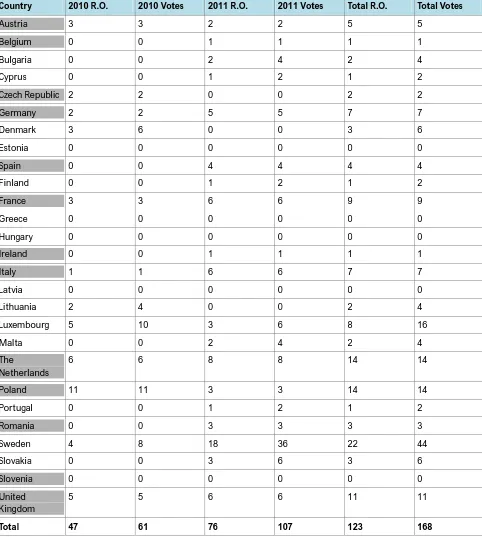
frequently a parliament submitted a reasoned opinion in 2010 and 2011 and how many reasoned opinions were submitted in 2010 and 2011.
For this study the statistical software programme ‘SPSS’ will be used to enter the data and to make statistical analyses to test the hypotheses. For years, SPSS is one of the most used statistical
software programmes to make statistical analyses (Huizingh, 2006). Before starting these analyses it is necessary to make a data file. First the names of the 27 Member States will be entered and then the concerning parliaments are entered. Because the parliaments are the units in this study, every individual parliament has a line (horizontal) in this data file. Finally, for every parliament the number of submitted reasoned opinions will be entered in the data file and it is clear how
frequently a parliament submitted a reasoned opinion in 2010 and 2011.
4.2 Bicameral and unicameral parliamentary system
With hypothesis 1 the relationship between the frequency of submitting a reasoned opinion and the parliamentary system will be tested. The parliamentary system is the independent variable. To test this hypothesis it is necessary to identify the parliamentary systems of all 27 Member States. Because of the literature and documentation study, the 27 Member States are already identified. Then, the World Factbook of the Central Intelligence Agency (CIA) will consulted. The CIA is an independent Government agency of the United States, which is responsible for providing national security intelligence to senior US policymakers. The World Factbook is an annual summary which provides the essential elements of basic intelligence on all areas of the world and related to many countries in the world, including the 27 EU member states (CIA, 2013). For every Member state the parliamentary system will be entered in the data file. The type of the parliamentary system will be indicated by name (unicameral or bicameral) as well as by number. Number 1 represents an unicameral parliamentary system and number 2 represents a bicameral parliamentary system.
4.3 Size of parliament and capacity
For analysing the relationship between the frequency of submitted reasoned opinions and the size of a parliament, it is necessary to identify the size of the parliaments for the years 2010 and 2011. For identifying this data, the online database Parliament and Government Composition Database (ParlGov) (2013) will be used. This database is a project supported by different institutions, but
now a days mainly supported by the University of Bremen in Germany (ParlGov, 2013). By
30
the size of the parliaments in 2010 and 2011 can be found. This database gives only information about parliaments like the national councils and, unfortunately, gives no information about the senates. To identify the size of the ‘senates’, another source has to be found. For identifying the sizes of the senates the online World Factbook of the CIA (2013) and the websites of the senates of the Member States will be consulted. This data of 2010 and 2011 will be entered in the data file of SPSS.
4.4 Effective parties
To analyse the relationship between the frequency of submitted reasoned opinions and the number of effective parties in a parliament, the database of ParlGov (2013) will be consulted. For each national council the effective number of party votes of all elections are given. The effective number of party votes is not available for senates. The effective number of party votes of 2010 and 2011 will be entered in the SPSS data file. For some parliaments the effective number of party votes in 2010 and 2011 will be the same, because in both years there is the same cabinet. For other parliaments the effective number of party votes of 2010 differs from 2011, because in between there was an election, which resulted into another cabinet and another setting of parties in the parliament. If this is the case, the mean of the effective number of party votes of 2010 and 2011 will be calculated, and a new variable in the SPSS database is created.
The effective number of party votes for the senates are not available, also not by another sources. The assumption is that the fragmentation of parties (effective number of party votes) in the national council and the senate will be similar. Therefore, in case of parliaments with a bicameral system the effective number of party votes for the national councils will be used for the senates as well. Otherwise, with blank columns it is not possible to do statistical analyses. The data of 2010 and 2011 will be entered in the SPSS data file.
4.5 Polarization
To study the relationship between the frequency of submitting reasoned opinions and polarization in a parliament, it will be necessary to identify the polarization rate of each parliament. The
31
that the polarization of the national council and the senate will be similar. Therefore, the polarization rate of the national councils will be used for the senates. The polarization rates of 2010 and 2011 will be entered in the SPSS data file.
4.6 Population size
To study the relationship between the frequency of submitted reasoned opinions and population size, it will be necessary to identify the population size for every Member State. Thereby, the population size gives an indication of the rate of influence of a Member State in the European Parliament. To get the data about the population size of the Member States, the online World Factbook (CIA, 2013) and the website of the European Union (EU, 2013) will be consulted. These
data will be entered in the SPSS data file.
4.7 Net position
To study the relationship between the frequency of submitted reasoned opinions and the net position, the contributions of the Member States to the EU and vice versa should be identified and analysed. Therefore, the EU budget 2010 financial report (2011) and the EU budget 2011 financial report (2012) will be consulted. Both financial reports give an overview of the ‘operating budgeting
balances’ of the EU for each Member State. The constructing estimates of ‘operating budgeting balances’ is an accounting exercise of financial costs and benefits that each Member State derives from the EU. This balance is derived by calculating the difference between a) the operating expenditure (excluding administration) allocated to each Member State, and b) the adjusted national contribution (excluding TOR) of each Member State. But it is necessary to make a note here. According to both financial reports (2011, 2012) “these payments are adjusted to sum up to total allocated operating expenditure (as for calculating the UK correction), so that operating
budgetary balances add up to zero”. The EU budget 2010 financial report (2011) added a
32 Figure 4.1: EU budget 2010 financial report (EC, 2011)
The example above shows that the balance of Belgium is EUR -1 466,4 million. This is a negative balance, which means Belgium contributes more to the EU compared with the benefits it receives from the EU. That means that Belgium is a ‘net loser’. Thereby, the ‘operating budgetary balance’ gives the percentage of Gross National Income (GNI) for each member state. Both the balance and the percentage of each Member State of 2010 and 2011 will be entered in the SPSS data file.
4.8 Trust
To study the relationship between the frequency of submitting reasoned opinions and the trust of citizens in the EU, the report Standard Eurobarometer will be consulted. A few times a year, the public opinion about the EU will be studied, commissioned by the Commission. One of the factors which will be studied by this survey is the factor trust. To identify the rate of trust by citizens for 2010 and 2011, the Standard Eurobarometer 74 of 2010 and the Standard Eurobarometer 76 of 2011 will be consulted. A part of the citizens of each Member State was asked to make clear if the citizen tends to trust or tends to not trust the EU. Then, for every Member State the percentage of tend to trust, tend to not trust or don’t know were calculated. These percentage of 2010 and 2011 will be entered in the SPSS data file.
For Belgium, the method detailed above can be illustrated as follows using the data for the year 2010:
Operating expenditure (i.e. excluding administration) amounts to EUR 1 850.6 million
( = 6 145.1 – 4 294.5) for Belgium and to EUR 104 151.5 million ( = 111 337.5 – 7 185.9) for the EU as a whole.
‘National contribution’ (i.e. excluding TOR) amounts to EUR 3 293.6 million
( = 4 783.2 – 1 489.6) for Belgium and EUR 103 415.6 million ( = 119 074.9 – 15 659.3) for the EU as a whole.
Belgium’s share in EU ‘national contribution’ is thus 3.18 % ( = 3 293.6 / 103 415.6).
Belgium’s adjusted ‘national contribution’ is thus: 3.18 % x EUR 104 151.5 million = EUR 3 317.0 million.
The ‘Operating budgetary balance’ is established as follows:
33
4.9 Relationship dependent variable and independent variables
To test the relationship between the frequency of submitting reasoned opinions and the factors mentioned above, two statistical analyses will be performed. First, a nonparametric correlation test will be performed and then with using cross tabs, the relation will be tested again.
Before the nonparametric correlation test and the cross tabs can be performed, it is important that the variables are ready to use. In case of the dependent variable number of reasoned opinions, the number of reasoned opinions for 2010 and 2011 will be ad together. This new variable will be used for analysing.
To measure the relationship between the dependent variable frequency of submitting reasoned opinions and the independent variables for 2010 and 2011, for several independent variables it will be necessary to calculate the means. It will be not necessary to compute the independent
variables unicameralism/bicameralism and the number of seats of the parliament because these variables apply to both 2010 and 2011. However, for the independent variables effective parties, polarization, net position and trust the mean of the data of 2010 and 2011 will be calculated. This will be done with the statistical programme SPSS, by using the option Compute for creating a new variable (Huizinga, 2006).
As well as for the independent variables above, for the independent variable population size a new variable will be calculated. Not the mean of the variable will be calculated, but this variable will be transformed with Logarithm. Because there is a skewed distribution of population size between the Member States, it is necessary to use the Logarithm option. This option corrects the skewed distribution of this variable and a new, more equal, variable will be created (Pallant, 2007).
4.9.1 Nonparametric correlation test
After transform the variables into new useful variables, the first statistical analysis can be done. To measure the correlation between the dependent variable and the independent variables, a
nonparametric correlation test will be performed. The new variable ‘total number of submitted reasoned opinions’ is the dependent variable. The variables ‘unicameralism/bicameralism’, ‘number of seats in parliaments’ and the new variables with the mean of ‘effective parties’,
34
tables with extremes of -1, what means a 100% negative association, and +1, what means a 100% positive association. A value of 0 indicates the absence of association between variables (Huizinga, 2006). The results of the nonparametric correlation test are presented in appendix 3. This table with results will be analysed in the next chapter.
For this analysis it will be necessary to know the values given by this test mean. In case of a correlation test with a random sample, the significance value of the correlation is important. Because this study does not use an ad random sample but uses the whole population, the significance of the correlation is not important for this study. Important is the value of the
correlation coefficient. Cohen (1988) uses criteria of < 0.10 for no effect, 0.10 for small effect, 0.30 for medium effect and 0.50 for large effect (Pallant, 2007).
4.9.2 Crosstabs
Besides the statistic Kendall’s tau-b of the nonparametric correlation test, normal cross-tabs are used as well to measure the correlation. Before a crosstab can be performed, it is necessary to categorize the dependent variable and the independent variables.
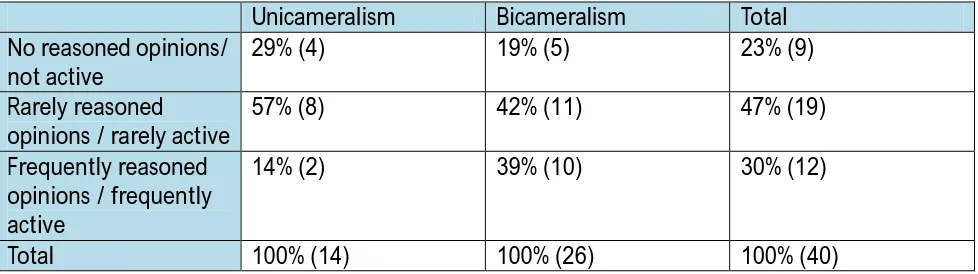
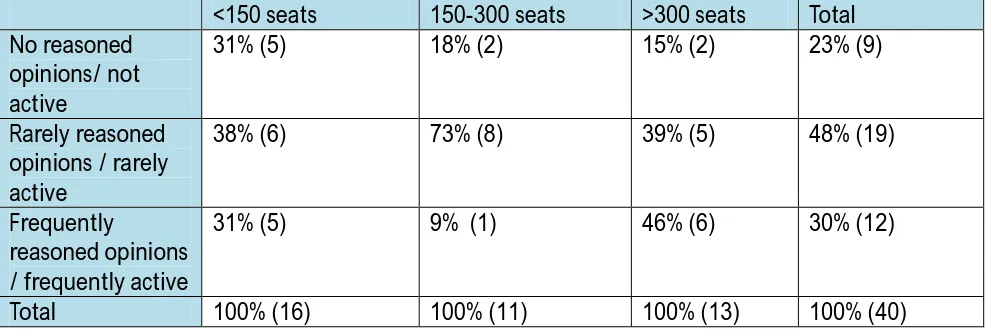
The dependent variable total number of reasoned opinions in 2010 and 2011 will be categorized into 3 categories. In category 0 a parliament never submitted a reasoned opinion and is therefore not active. In category 1 a parliament submitted reasoned opinions rarely and is rarely active, and submitted reasoned opinions with a frequency of 1 till 4. In category 2 a parliament submitted a reasoned opinion frequently (4 times or more) and is therefore frequently active.
Some of the independent variables will be categorized into 3 categories too. The independent variable of unicameralism and bicameralism is already categorized into two categories: category 1 are parliaments with an unicameral parliamentary system and category 2 are parliaments with a bicameral parliamentary system. It is not possible to categorize this variable into 3 categories. The independent variable of effective parties will be categorized into 3 categories: in category 1 are parliaments with a value of 0 or more; in category 2 are parliaments with a value of 4 or more; in category 3 are parliaments with a value of 5 or more.
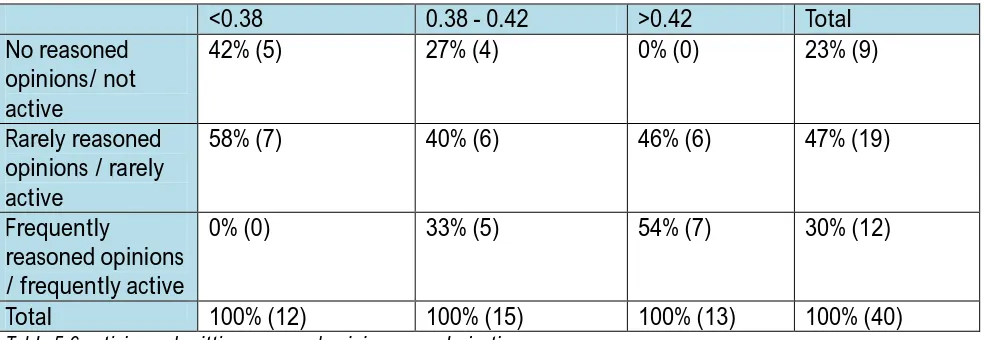
The independent variable of polarization is categorized into 3 categories: category 1 are
35
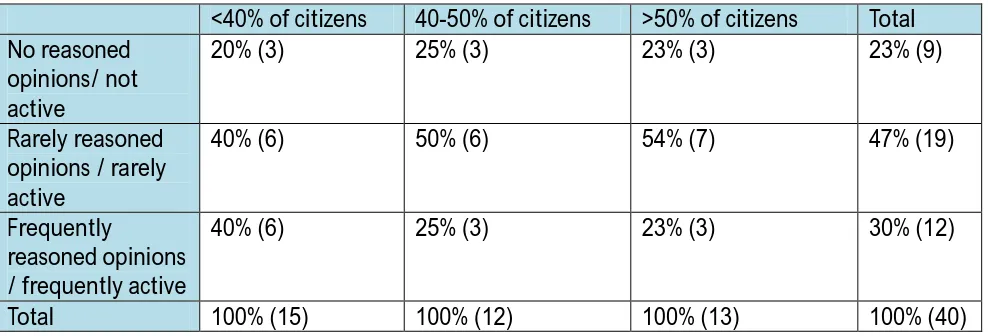
The independent variable of trust is categorized into 3 categories: in category 1 are parliaments when less than 40% of their citizens tend to trust the EU; in category 2 are parliaments when more than 40% of their citizens tend to trust the EU; in category 3 are parliaments when more than 50% of the citizens tend to trust the EU.
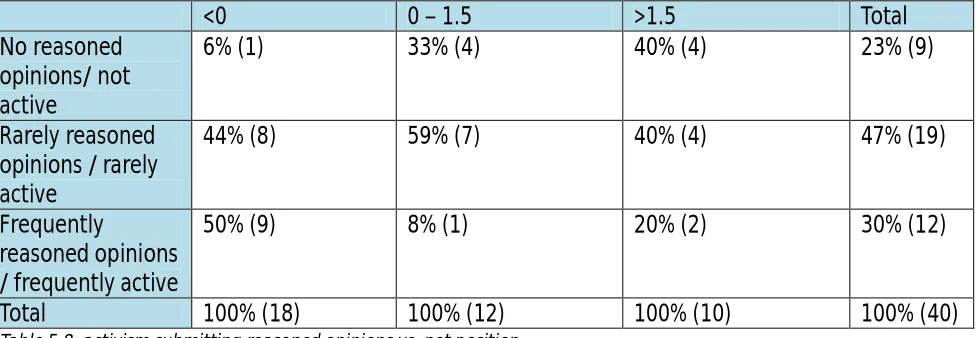
The independent variable net position of member states is categorized into 3 categories: in
category 1 are parliaments with a net value of less than 0, so a negative position; in category 2 are parliaments with a net value of more than 0, so with a small positive net position; in category 3 are parliaments with a net value of more than 1.5.
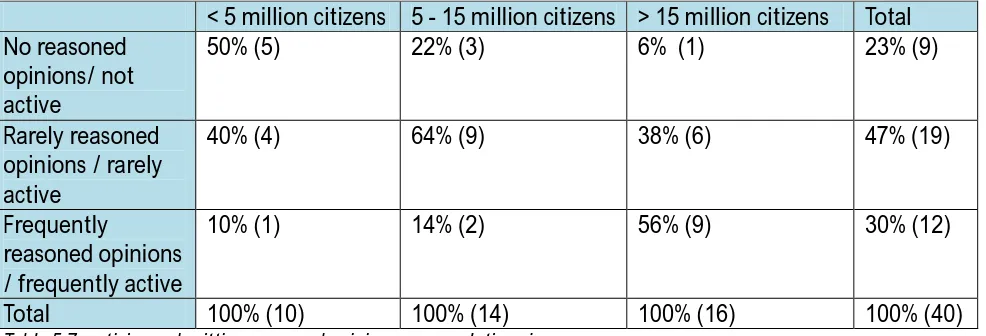
Finally, the independent variable Log size (population size but logarithm) is categorized into 3 categories: in category 1 are parliaments with less than 5 million citizens; in category 2 are parliaments with more than 5 million citizens; in category 3 are parliaments with more than 15 million citizens.
With these new variables, a cross table will be performed. In case of the independent variables the option ‘percentage’ will be used. With this function it is possible to analyse if the percentage of active parliaments will be higher when this parliament has an unicameral parliamentary system. The results of this analysis will be discussed in the next chapter.
4.10 Conclusion
For the preparation of this study, first a literature study and a documentation study are
accomplished, to get information about decision-making and coalition-making processes within the EU and about the Early Warning System. Scientific literature and formal documents of the EU, the Dutch government and international databases have been consulted.
Second, for testing the relation between the dependent variable and the independent variables, the statistical software program ‘SPSS’ will be used and two different calculations will be