feedback technology
B. S
C. T
HESISJ. G
ROENEVELD, S1717626
July 4, 2018
Version: FINAL
Number of words: 27.049
Supervisor: Job Zwiers
Critical observer: Gijs Huisman
University of Twente Faculty EWI
Judgment of fabrics using haptics
Abstract
Acknowledgements
I would like to thank my supervisor Job Zwiers for his help, guidance, feedback and useful input during this project. I would also like to thank Gijs Huisman for being my critical observer and provide me with useful suggestions and feedback.
Furthermore, I would like to thank Hecla Professional for providing the topic of this graduation project, and for being an enthusiastic support during the project. In special, I would like to thank Leo Kuipers, the contact person of Hecla Professional. I also want to thank the contact person of PVH, Dominic Sluiter, for his support and time during this project. It was useful to gain insight in the current system and the upcoming innovations regarding the digital showroom.
Judgment of fabrics using haptics CONTENTS
Contents
1 Introduction 1
1.1 Situation . . . 1
1.2 Challenges . . . 1
1.3 Research Questions . . . 1
1.4 Report Outline . . . 2
2 Context Analysis 3 2.1 Literature Review . . . 3
2.1.1 Definition of haptic feedback . . . 3
2.1.2 Types of haptics . . . 4
2.1.3 Implementation of haptics . . . 6
2.1.4 Conclusion Literature Review . . . 8
2.2 State Of The Art Review . . . 9
2.2.1 Teslasuit . . . 9
2.2.2 Ultrahaptics . . . 10
2.2.3 HaptX Gloves . . . 10
2.2.4 Tanvas . . . 11
2.2.5 Haptic Revolver . . . 11
2.2.6 SensAble Phantom Omni . . . 12
2.2.7 Conclusion State Of The Art Review . . . 13
2.3 Conclusion . . . 13
3 Ideation 14 3.1 Brainstorming . . . 14
3.2 Stakeholder analysis . . . 15
3.2.1 Users . . . 15
3.2.2 Developers . . . 16
3.2.3 Legislators . . . 16
3.2.4 Decision-makers . . . 16
3.3 PACT analysis . . . 17
3.4 Scenario from the user’s perspective . . . 19
3.5 Meeting PVH . . . 20
3.6 Preliminary requirements . . . 20
3.7 Concepts . . . 21
3.7.1 Dropouts . . . 21
3.7.2 Promising idea . . . 22
3.8 Conclusion and final concept . . . 23
4 Specification 24 5 Realisation 26 5.1 Software and hardware components . . . 26
5.1.1 Hardware . . . 26
5.1.2 Software . . . 33
5.2 Motion tracking . . . 33
5.3 Render of fabrics . . . 33
5.4 Prototype . . . 34
5.4.1 Set-up . . . 34
6 Evaluation 37
6.1 Functional test . . . 37
6.1.1 Evaluation of the ’Must-haves’ . . . 37
6.2 User test . . . 39
6.2.1 Haptic wheel test . . . 40
6.2.2 Sheet of fabric test . . . 41
6.2.3 Results . . . 42
6.2.4 Conclusions . . . 48
6.3 Feedback client . . . 50
6.4 Conclusion . . . 50
7 Conclusions and recommendations 52 7.1 Conclusions . . . 52
7.2 Recommendations . . . 53
Judgment of fabrics using haptics 1 INTRODUCTION
1
Introduction
1.1
Situation
Designing clothes and presenting new collections of clothes to retailers, are two events which return on structural base for companies in the clothing industry.
During the designing of clothes, designers want to present their ideas about fabrics, and so they must present a piece of the fabric they want to use. Currently this piece of fabric is either hand-made and so rather expensive, or represented with pictures, which does not allow for a proper judgment of the fabric. In order to allow the designers to save time, be more flexible, clarify themselves, and in order to save money, new ways of presenting the fabric must be found. The way of presenting new collections used to be by making a batch of the complete col-lection and send them to the retailers. For every product the production machines need to be set-up, new sheets of fabric are needed, and the products also have to be transported. All of these actions cost the clothing companies a lot of money and time. In addition, by throwing away materials and transporting the products, the companies leave a big ecological footprint. In order to overcome these problems, a clothing company (PVH) came up with a digital showroom. These rooms are located in offices of the companies. Retailers can visit an office were they can see the new collection via digital displays. Using a big touchscreen the retailer can compose a collection out of the collection of the brand. Since retailers also want to judge the fabric of the clothes, still a batch of clothes needs to be made. Presenting clothes on screen allow the companies to make just 15% of the collection instead of the full 100% they used to make. This is a big improvement but leaves room for more developments.
The former stated company which came up with the digital showroom is PVH. This is a clothing company with brands like Tommy Hilfiger and Calvin Klein. PVH is a client of Hecla Professional, an audio and video systems company located in Hengelo. Hecla is the client for this graduation project, PVH is an indirect client.
1.2
Challenges
The goal of this graduation project is to develop a system which is able to haptically render fabrics in order to allow judgment of fabrics both by the designers and the retailers. As an inspiration for this system the Haptic Revolver of Microsoft [1] is used to build on. The system overcomes the problems of wasting materials and making big costs. The system is also able to provide the user a realistic fabric hand in order to allow judgment of the fabric. The system is developed within current technological limits. The system also allows for presenting different fabrics, since a lot of clothes are made with different fabrics. The system allows for quick switching between fabrics. The system also holds the possibility to accompany the haptic feedback with visual feedback.
1.3
Research Questions
Continuing the previous presented situation and challenges, two research questions are identified that will be covered by the following thesis:
• How to develop a haptic wheel interface which allows both designers and retailers of a clothing company to judge fabrics?
To support the main research question and give a more elaborate answer, the following subques-tions were formulated.
• Does the use of a small piece of fabric allow for rendering a big sheet of fabric?
• How to construct a haptic wheel interface?
• Which features of fabric hand can, and which cannot be rendered using the haptic wheel?
1.4
Report Outline
The report is organized as follows. In chapter 2 a context analysis, based on a literature review and a state-of-the-art review, is performed. In this chapter literature on the topic of haptic feed-back is examined and a state of the art of haptic feedfeed-back devices is stated. Haptic feedfeed-back is explored and the conclusion is, that haptic feedback technology is currently not able to render fabrics in order to judge them. The precision of rendering is too low. However, developments regarding rendering small textures are nearby.
In order to find fitting solutions, chapter 3 examines other kinds of solutions. Using modern technologies, potential possibilities on the topic of rendering fabrics are examined. Preliminary re-quirements are formulated based on: a brainstorm session, stakeholder analysis, PACT analysis, scenarios and a meeting with the client. Using these preliminary requirements, a final concept is chosen: a haptic wheel interface based on the haptic revolver of Microsoft.
Chapter 4 tends to describe the envisioned system into more details by stating requirements prioritized using the MoSCoW method, the specification of the prototype. After formulating these requirements, chapter 5 describes the realisation of the system. All the steps taken in order to realise the prototype are stated, and a hi-fi prototype is made.
In order to evaluate the prototype’s functionality and usability, both a functional test and an user test are conducted. These tests showed positive results, all of the functional requirements are met, and the user test shows the potential of the system. The hi-fi prototype is also presented to the client, PVH, they gave positive feedback and were enthusiastic about the final system.
Judgment of fabrics using haptics 2 CONTEXT ANALYSIS
2
Context Analysis
This chapter covers a literature research which describes what haptic feedback is, what important features of fabrics are and it examines the possibilities of using haptic feedback technologies in order to judge fabrics. Leading in this chapter is the question: To what extend do modern technologies/devices allow for rendering fabrics and their features.
Technologies like force feedback, vibrotactile feedback, electrotactile feedback, ultrasound feedback, and thermal feedback are explored. Comparing the found features with these tech-nologies allows to reason whether or not haptics are useful when rendering fabrics. Furthermore, this chapter will also cover a state of the art review describing which haptic devices already exist, and how relevant they are. The final part of this chapter is an overall conclusion on the con-text analysis. This conclusion tends to combine the findings in literature on the topic of haptic feedback technology with the found haptic devices, in order to state the potential of different technologies and devices.
2.1
Literature Review
This literature review covers a study on haptic feedback technology, and tries to answer the question:To what extend does haptic feedback allow for accurate rendering of fabrics?
This review contains four parts. The first part states a definition of haptic feedback. The second part regards a state-of-the-art of haptic feedback. In this part the current state and devel-opments in haptic feedback technology are explored. The third part focuses on the use of haptic feedback in the judgment of fabrics. This part reviews some basic requirements of judging fabrics, and this requirements are compared with the possibilities of haptic feedback. Lastly, conclusions are drawn in an attempt to give a clear and concise answer to the question if haptic feedback is useful in the judgment of fabrics, so if it allows for accurate rendering of fabrics.
2.1.1 Definition of haptic feedback
In order to improve todays human computer interaction, haptic feedback technology can be used. Nowadays, a lot of this interaction is based on touch, which is often by sliding and tapping on a screen of glass that gives visual feedback. A big setback of the touchscreen is the lack of tangible feedback. Smart-phones are able to vibrate when receiving a message, but this functions as an alert rather than providing the user with tangible feedback. Paterson [2] states that people like to interact in a new way with their computer and their screens, this new way is based on haptic feedback and it’s found on the idea of allowing people to interact with technology in a more active and exploratory way. The word ’haptic feedback’ arises from the word haptic, which means the sense of touch [3–7]. Using haptic feedback technology, also called haptics, interaction with the virtual environment is no longer only visual and aural but it’s also tangible [3, 8]. The words haptic feedback and haptics are used interchangeable in this review. In order to overcome todays lim-ited manner of human computer interaction, haptic feedback can be used to make this interaction more active and exploratory by providing tangible feedback.
used to determine what the object is. Kinesthetic feedback and tactile feedback are two high level kinds of haptic feedback, and can be used both separately and combined based on what kind of feedback is needed.
In order to reproduce the physical features of a virtual object, a haptic interface can be used. This interface is a device which exchanges energy with users, either via mechanical movement or an electrical stimulus [4]. Via sensors the interface can determine the input of the user. Based on this input, the interface is able to calculate a fitting output and delivers it via actuators [4, 8]. Saddik [8] states that two major features can be determined which characterize haptic devices, namely, the degrees of freedom (DOF) and the refresh rate. The degrees of freedom indicate on how many axis the device can deliver force. 1-DOF for instance implies one degree of freedom. In the current existing haptic feedback devices 1-DOF, 2-DOF and 3-DOF are most common is agreed by Xia [3] and Salisbury et al. [7]. The relatively new and emerging 4-DOF and higher orders allow for more realistic feedback but are harder to produce [7]. The refresh rate refers to the maximum amount of individual forces the device can generate per time unit. According to Saddik [8] this is typical 1kHz to create a smooth feedback. Both of these properties, DOF and refresh rate, contribute to the realism of the haptic feedback.
Using the above stated characteristics of haptic feedback a definition of haptic feedback tech-nology is formulated. This definition combines the different kinds of haptics at a high level, with the abilities of haptics, and the way of presenting the haptics. The formulated definition is as follows:
Haptic feedback technology is either one, or a combination of kinesthetic and tactile feedback, which allows a person to interact with the virtual environment by touching virtual objects which real-world features are recreated with the use of haptic feedback devices called haptic interfaces. This definition is used throughout this literature review.
2.1.2 Types of haptics
Haptic feedback has a general definition, but haptics occur in different types. In order to get an overview of the current types of haptic feedback, the framework provided by Tesla is used [9]. This framework is used since it allows for a systematic exploration of the different types of hap-tics. In addition, this framework gives an elaborate view on the topic of haphap-tics. According to this framework [9], haptics consist out of five basic types of feedback, namely, force feedback, vibro-tactile feedback, electrovibro-tactile feedback, ultrasound feedback, and thermal feedback. Only force feedback depends on kinesthetic feedback, the four other types of feedback are based on tactile feedback. Each of the five feedback types is based on a certain physics phenomenon. Since the characteristics of these phenomena are different, the different types of feedback currently only fit for specific applications.
2.1.2.1 Force feedback
Judgment of fabrics using haptics 2 CONTEXT ANALYSIS
reproduce touch using pressure and movement, it is based on kinesthetic feedback, and requires freedom of movement for the user to be realistic.
2.1.2.2 Vibrotactile feedback
Different from the above stated force feedback, vibrotactile feedback affects the skin and its re-ceptors. Kaczmarek et al. [11] state that vibrotactile stimulation is based on mechanical vibrations which arouse tactile sensations. An example of vibrotactile feedback is the buzzing of a mobile phone when receiving a call [12,13]. Hayward et al. [12] state that this kind of feedback is the most used type of all haptic feedback technologies. This is most likely the case since this technology is cheap, simple and easy to use. In addition, this technology does not require a lot of param-eters and it has a relatively small power consumption. The technology lends itself particularly for hand-held devices with applications like invisible alerts, warnings, messages, and feedback in games [12]. Vibrotactile feedback is concerned with stimulating the receptors in the skin of the user with the use of vibrations.
Besides the stated advantages of this technology, also some disadvantages can be distin-guished. To explain these disadvantages, a closer look must be taken to the principal vibrotactile feedback technology uses. The two most used manners of evoking vibration is by either using an eccentric mass motor or using an electromagnetic moving coil [13]. One disadvantage is that it’s hard to make these actuators small enough to deliver specific and detailed tactile feedback on the skin. Therefore this kind of feedback is less useful for applications where small-scale feedback is needed. In addition, these actuators have a relative confined area. So in order to give feedback on larger parts of the skin, multiple actuators are needed [12]. Besides this prac-tical disadvantages, also some physical properties of this technology are challenging to control and may cause problems. This troubling physical properties are the time it costs to adapt the frequency, the bandwidth of the actuator and the difference in reaction time between stimulus and response compared to the real-world [13]. Vibrotactile feedback interfaces are cheap and relative easy to use, however, they also offer some challenges regarding small-scale feedback and parameter management..
2.1.2.3 Electrotactile feedback
By stimulating both the receptors and the nerve fibers using electric current, one can provide feedback. This feedback using electric current is called electrotactile feedback [11]. By either applying electric charge directly on a finger or via a conductive surface, an electrostatic field is created. Kaczmarek et al. [11], Bau et al. [14] and Meyer et al. [15] agree that this electrostatic field can be experienced as friction due to the attraction force developed between the finger and the (conductive) surface. Kaczmarek et al. [11] call this kind of friction between a finger and an adapted touch surface the ’electrostatic friction’. Based on the amount of voltages applied to the surface, the electrostatic friction changes. This change in friction results in a broad variety of dif-ferent shapes and textures which can be experienced by the user [14, 15]. This kind of feedback can be applied to very small surfaces, but can also be used for bigger surfaces. The technology can be shaped as a new device, added to objects or be added to existing devices like phones and tablets. Combining the visuals of an object with a tactile sensation allows users to experience an object virtually and over a distance. One big advantage of this kind of feedback is the lack of moving mechanical parts, which allows the device to be small and solid [14]. Using electric current one can provide feedback based on electrostatic friction, which can be used to render objects, shapes, and textures.
2.1.2.4 Ultrasound feedback
ultrasound based technology allows the user to use the feedback on bare skin, so without the use of a reflective film to feel the pressure caused by the ultrasound.
2.1.2.5 Thermal feedback
Using temperature and thermal conductivity, thermal feedback provides a user with the thermal characteristics of the object the interface is rendering. Thermal feedback is based on the use of temperature in order to give feedback to the user [17, 18]. When the fingertip of a user touches the surface of an object, a simulation of the heat transfer gives the user the idea of feeling the temperature which fits the object. In order to give a realistic simulation of the heat, Kyung et al. [17] state that controllability of the heat and a fast response is essential. Thermal feedback can be used to give feedback over a bigger surface, but this requires a lot of energy since heat needs to be generated or be taken away. Kyung et al. [17], and Jones and Berris [18] agree that regardless of thermal feedback not being the primary concern in tactile feedback research, it’s a crucial part of realistic feedback. When two objects have the same shape and texture, one can distinct between the two objects based on their different thermal characteristics. Two important concepts in thermal feedback are, according to the research of Kyung et al. [17], heat capacity and thermal conductivity. These concepts as a product, but also the differences between them, describe the heat transfer of materials. These differences and products allow thermal feedback to simulate the thermal behavior of objects, in order to make them feel more realistic [17]. The concepts heat capacity and thermal conductivity are important in thermal feedback, since they provide the user with thermal characteristics of the rendered object.
2.1.3 Implementation of haptics
In order to tell whether or not haptic feedback technology can be used in the judgment in fabrics, the physical properties and characteristics of fabrics are needed. After formulating these fea-tures, the formerly stated different haptic feedback technologies can be examined to be suitable for judging fabrics.
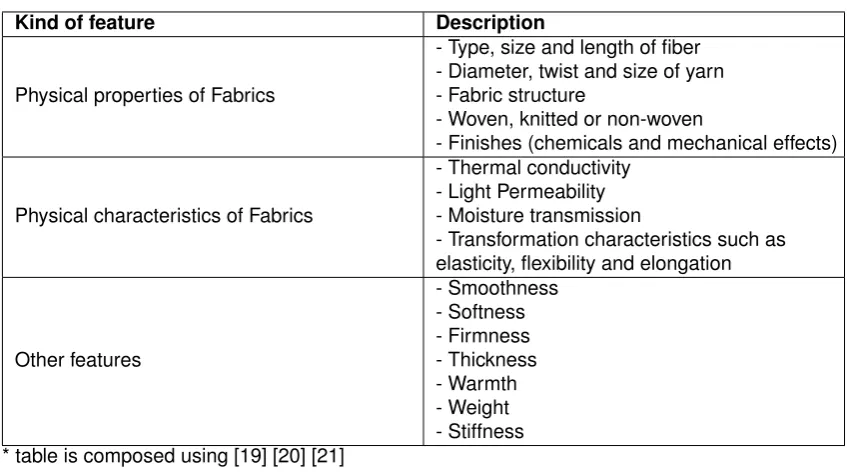
2.1.3.1 Features of fabric hand
Judgment of fabrics using haptics 2 CONTEXT ANALYSIS
Table 1– Features of fabric hand *
Kind of feature Description
Physical properties of Fabrics
- Type, size and length of fiber - Diameter, twist and size of yarn - Fabric structure
- Woven, knitted or non-woven
- Finishes (chemicals and mechanical effects)
Physical characteristics of Fabrics
- Thermal conductivity - Light Permeability - Moisture transmission
- Transformation characteristics such as elasticity, flexibility and elongation
Other features - Smoothness - Softness - Firmness - Thickness - Warmth - Weight - Stiffness * table is composed using [19] [20] [21]
2.1.3.2 Haptic feedback technology applied to the features of fabrics
Currently there is a lot of research on the topic of rendering the textures of surfaces, using haptic feedback interfaces. In this section the five different types of haptic feedback technology stated in chapter 2.1.2 will be examined.
2.1.3.2.1 Force feedback
Because of its characteristics, force feedback is not very useful when rendering fabrics. Textures are basically differences in height on a detailed level. One could argue that using force feed-back, this differences can be generated in order to render the texture. However, force feedback is based on perceiving feedback via the nerves inside muscles and joints, as stated in chapter 2.1.1. The texture of fabrics is experienced by tactile sensations [19], which means it’s too small and detailed to experience with the nerves inside muscles and joints. This means that texture is too small to render using force feedback. However, the transformation characteristics from the physical characteristics of table 1 could be rendered, since they do rely to some extent on ones kinesthetic sensations. For example, the elasticity and flexibility of a big sheet of fabric. In order to render fabrics force feedback cannot be used to render fine textures, but it might be useful to render other features of fabric hand.
2.1.3.2.2 Vibrotactile feedback
2.1.3.2.3 Electrotactile feedback
Using electrotactile feedback, textures can be recreated using electrostatic friction. To a certain extent, this will cover the physical properties of fabrics given in table 1, also referred to as the texture [13–15]. This electrotactile feedback provides feedback when the user moves his fingers over the interface. This feedback exists due to electrostatic fields which induce friction. Currently no electrotactile device exist which can render such small details as needed for accurate render-ing of the texture differences between two similar fabrics. Todays most advanced devices render up to 1mm. This is detailed, but not sufficient for rendering fabrics, which usually have highly de-tailed textures and finishes [26]. To some extent electrotactile feedback is able to render textures, using electrostatic fields.
2.1.3.2.4 Ultrasound feedback
Ultrasound on its own is not sufficient to render fabrics, however, in combination with other types of haptic feedback this type might be useful. According to Meyer et al. [15], ultrasound feedback is able to support an electrostatic interface to render textures. Electrotactile feedback interfaces can produce forces on a wide-bandwidth, which allows to render textures to some extent, but the range of friction it can produce is not very wide. Adding an ultrasonic device to the interface may solve this problem, since the ultrasound feedback is able to generate this wider range of friction. Currently no proper solution is found but the idea seems promising [15]. Ultrasound feedback might be useful in combination with other types of feedback when rendering fabrics.
2.1.3.2.5 Thermal feedback
Next to rendering the actual and expected temperature of the fabric, thermal feedback also allows to render some of the physical characteristics stated in table 1. Kyung et al. [17] state the rele-vance of thermal cues to people, since they use them in order to discriminate among materials. Both the characteristics thermal conductivity and moisture transmission heavily depend on tem-perature and its behavior. These characteristics can be rendered using thermal feedback [27]. The haptic interface must have a fast heating and cooling rate in order to simulate a realistic heat transfer between the fingertip and the rendered fabric. Kyung et al. [17] state that a cooling rate of 2◦C/s and a heating rate of 4◦C/s are sufficient, this is possible to realize with todays technology. Since thermal feedback is able to render some of the physical characteristics of fabric hand, this type of feedback might be useful when rendering fabrics.
2.1.4 Conclusion Literature Review
This review states a brief overview on the topic of haptic feedback and the different types of tech-nology used to create interfaces. Subsequently, important features of fabric hand are described and the stated types of technology are compared to these features.
Judgment of fabrics using haptics 2 CONTEXT ANALYSIS
Force feedback and vibrotactile feedback do not seem to apply for rendering fabrics for judg-ment. Both of the types allow for rendering one feature to some extent, but either the way of interacting is not good, or the desired feature is not rendered sufficient. These technologies are, with todays technology, not useful when rendering fabrics for judgment.
Current techniques does not allow to render at such precision as needed, but the potential is big. Especially electrotactile feedback, which is a fairly new type of feedback in the field of rendering textures, allows for rendering small details. Further investigation is needed to be able to use haptic feedback technology to judge fabrics.
The focus of this review is on haptic feedback in general and gives an overview of current types of haptic feedback technology. At this moment the main principal of a type of feedback may not seem to be applicable to judge fabrics, a further elaboration of this technology may give new solutions which do apply. Combining different haptic feedback technologies in one device in combination with AR/VR to provide high quality visual feedback could be useful to some extent in order to judge fabrics. More investigation is needed on the topic of combining haptics with AR/VR in order to render fabrics for judgment.
2.2
State Of The Art Review
This review describes which products already are available and developed in the field of hap-tic feedback with relation to rendering textures, it tends to answer the question: Which haptic interfaces are already developed on the topic of rendering fabrics and/or textures?
This state of the art review contains six sections which cover developed haptic feedback in-terfaces. In the last section conclusions are drawn with respect to the stated question.
2.2.1 Teslasuit
The Teslasuit by Tesla is a full body suit which holds a haptic feedback system, motion capture system and it is temperature controlled [28]. The Teslasuit system is based on a combination of Electrical Nerve Stimulation and Electrical Muscle Stimulations. This combination ensures a high density of sensations to the user. Next to this nerve and muscle stimulation, the suit also holds a thermocontrol which allows for thermal feedback. Using this feature the suit can both heat up and cool down according to the virtual environment or object. This suit is stretchable, breathable, durable and washable.
Figure 1– Teslasuit, picture from Teslasuit.io [28]
2.2.2 Ultrahaptics
Ultrahaptics uses ultrasound feedback to create three-dimensional shapes and textures to some extend [29]. This device (figure 2) allows to add haptics to virtual objects, to develop holographic interfaces and enlarges gesture control with the use of tactile feedback. This device creates a tactile sensation in mid-air, this means without the need for controllers and wearables.
If rendering with Ultrahaptics at a very high density was possible this device might be inter-esting to render the texture of fabrics. However, the density and accuracy of rendering is low and only allows for rendering basic shapes in mid-air rather than very detailed textures.
Figure 2– Ultrahaptics, picture from Electronicdesign.com [30]
2.2.3 HaptX Gloves
[image:15.595.202.401.491.593.2]Judgment of fabrics using haptics 2 CONTEXT ANALYSIS
into this gloves as well. Combining the microfluidic actuators with an exoskeleton which provides force feedback to each individual finger, allow for a realistic rendering of objects.
[image:16.595.203.402.205.317.2]The HaptX Gloves can render with a high accuracy due to its high actuator density. According to their website [31] only the flat of the hand already holds up to 120 actuators. Although this is a very high density, this is by far not enough to render the detailed texture of fabrics. The thermal properties, which will be added in the near future this device, can be used to render thermal conductivity of a fabric.
Figure 3– HaptX Gloves, picture from HaptX.com [31]
2.2.4 Tanvas
Tanvas is a device which enables the user to add a sense of touch to a touch display using hap-tic feedback technology [32]. Using ultrasonic vibrations and electrostahap-tic fields this technology allows the user to feel different materials on a touchscreen (figure 4), which enables one to feel what he sees on screen. This technology aims to provide tactile feedback to the fingertips in order to enable interaction with the virtual environment.
According to reviews of people who used this technology at the CES 2016, the experience is not very good. The device is able to render rough shapes, but it does not allow for rendering detailed textures since it is not accurate enough. This technology might be interesting in the future but currently does not seem to be useful in order to allow judgment of fabrics.
Figure 4– Tanvas, picture from Cnet.com [33]
2.2.5 Haptic Revolver
[image:16.595.203.402.497.630.2]wheel’s axis. When the user touches the virtual surface, the wheel moves up and touches the fingertip. By rotating the wheel when the user moves his finger, a friction is rendered based on the speed of the movement along the surface. The wheel can be changed, so different materials can be used in order to provide different tactile sensations to the user. By adding edges and other elements to the wheel, objects on top of the virtual surface can be rendered as well.
[image:17.595.203.401.218.366.2]This technology does not allow to completely render the fabrics without using any existing fabrics. Yet this means that is does allow to provide an accurate fabric hand since it uses the actual fabric. This technology seems suitable for the rendering of fabrics.
Figure 5– Haptic Revolver, picture from MSpoweruser.com [34]
2.2.6 SensAble Phantom Omni
The Phantom Omni (figure 6) is a 6-DoF haptic device and has a pen-based interface, its handle is connected to the base using one chain with different joints [35]. The device uses force feedback in order to render objects and textures. The Phantom Omni currently can be used in combination with the Penn Haptic Texture Toolkit (HaTT) developed by Penn Engineering, which offers 100 haptic texture and friction models [36].
The Phantom Omni can render very accurate due to its 6-DoF and the accurate actuators used. One very big down-side to this technology is the use of a pen-based interface, which, as stated before, does not provide an intuitive interaction. Since the user is not able to experience the tactile sensations with his fingers, this may feel odd.
[image:17.595.215.394.560.672.2]Judgment of fabrics using haptics 2 CONTEXT ANALYSIS
2.2.7 Conclusion State Of The Art Review
Currently no device exist which is able to render fabrics accurate enough to be used to judge the fabric. Some of the devices are able to render for instance the thermal conductivity of a material, but other features of fabric hand seem to be not possible. Even devices like the HaptX Glove and the Phantom Omni, which both can render with a very high accuracy, don’t seem to apply for this application. The Haptic Revolver of Microsoft seems to be a good option since it renders the fabric at the highest accuracy as possible, because it uses the actual fabric.
2.3
Conclusion
This chapter states a context analysis on the topic of haptic feedback. Both a literature review and a state of the art review are included in order to provide a complete overview on the topic of haptic feedback with respect to the judgment of fabrics.
The stated literature review tries to answer if and to what extend haptic feedback allows for accurate rendering of fabrics. This section concludes that currently the technology is not devel-oped enough to allow for sufficient rendering of fabrics for judgment. Some techniques allow for rendering certain features of the fabric to some extend, but none allows for rendering multiple features. Maybe a combination of multiple types of haptic feedback do allow for rendering multi-ple features of the the fabric. Even if this is possible, the quality of the render is not sufficient yet due to the technology which still not allow for high quality rendering. The potential of using haptic feedback is big, but it is not ready yet.
The state of the art review examines which haptic interfaces are already developed regarding rendering fabrics and/or textures. Currently no device exist which is able to render fabrics detailed enough to be used for judging the fabric. No device exist which actually aims to render fabrics. Some devices have the ability to render textures to a certain extend, and some are able to render thermal conductivity. As stated, only a combination of multiple features will allow for a sufficient fabric hand, this is not achieved by any of the devices. However, the Haptic Revolver of Microsoft seems to be interesting since it uses the actual fabric, but tends to reduce the amount of needed material. By building this device and adapt it to the use case of judging fabrics, this device might be useful.
3
Ideation
This chapter describes the ideation phase of this project. The ideation phase is the first phase of the design method for Creative Technology, it is used to generate ideas, and based on certain aspects choose one final concept to build. This chapter contains multiple aspects, which lead to the final concept. First a brainstorm is stated which includes eight ideas. Some of these ideas are based on ideas and devices found during the context analysis. After brainstorming, a stakeholder analysis is conducted. This analysis tends to give more insight in the involved parties, and how to treat them during the whole project. After conducting a stakeholder analysis, a PACT analysis is performed. This PACT analysis allows to formulate different aspects of the current situation, which enables the developer to gain more insight in this situation. Using the PACT analysis, a scenario is made from the user’s perspective. Combining all of the finding during the context analysis and the ideation, a list of preliminary requirements is made. The ideas of the brainstorming session are treated using the preliminary requirements, this leads to a fitting solution, the final concept: a haptic wheel interface.
3.1
Brainstorming
Idea 1
Create a fabric which can be modified in order to reproduce different properties of a fabric. By using special fibers, which change when applying electricity to them, a fabric can be changed real-time. With this special fibers, properties like the elasticity, roughness, and the way the clothes fall can be changed. This fibers can be woven to create a small sheet of fabric, parts of clothes like a sleeve, or complete pieces of clothes.
Idea 2
Create advanced weaving machines which can locally weave small sheets of fabric which allow for judgment. Computer models for the weave pattern of a fabric are generated and send to the weaving machine. By defining a set of basic fibers with all specific characteristics, different properties of fabrics can be generated. These machines are small and portable so they can be placed at the locations of the different end-users.
Idea 3
Create a surface with very tiny needles which can move up and down in order to generate prop-erties of a fabric. These needles are small enough to not be experienced as sharp, painful and disturbing. By moving these needles with different speed, resistance and in different patterns, these needles allow for generating specific properties in compliance to the fabrics.
Idea 4
Use a pen-based interface which uses vibrotactile feedback to render the properties of a fabric. By holding a pen which vibrates in specific patterns, the feeling of scraping a pen over a fabric can be generated. First one piece of the fabric has to be created and using measuring devices a model of the fabric can be made. This model can be send to the end-users and be transported on to a pen, which then provides vibrotactile feedback.
Idea 5
Judgment of fabrics using haptics 3 IDEATION
Idea 6
Use a 3D-model to create an exploded view of the fabric. For instance the weave pattern can be displayed, which allows the viewer to see how the fabric is made (using an exploded view for instance). This tells experienced people in the field of fabrics how the fabric feels and behaves. In combination with sophisticated shaders, this model allows for a visual judgment of the fabric. Adding physics allows for accurate modeling of clothes around a virtual person. This concepts tends to show both the way the material is made, and how it behaves.
Idea 7
Create an interface which uses a small piece of the fabric in order to render a bigger piece of the fabric. This can be done using a wheel which rotates in the opposite direction of the user’s movement. The device can be hold in one hand and can be used as an extension to a visual representation of the fabric. Using the existing piece of fabric allows for an accurate feeling of the fabric since the actual fabric is used. Wheels can be changed to render different sheets of fabric.
Idea 8
Create mood-boards which represent a fabric. Using colors, objects, textures and shapes, a certain impression of the fabric can be given. By defining different characteristics using specific images, a fabric can be presented. This requires people who are trained to read this mood-boards.
3.2
Stakeholder analysis
Using a stakeholder analysis, the parties involved in the development of the prototype can be found. According to Freeman and Reed [37], a stakeholders is either an individual, a group or an organisation that has an interest in a project. Stakeholders affect or are affected by certain decisions and outcomes of the project. Neither of the stakeholders are the same nor equal. Sharp et al. [38] state that stakeholders can be categorised based on their role in the project. The four concepts of main stakeholders are: users, developers legislators and decision-makers.
By mapping the stakeholders into a stakeholder matrix, the importance of the different stake-holders can be determined. Based on this matrix the way of managing the stakestake-holders can be determined. The stakeholder matrix of Mendelow [39] adapted by Thompson [40] is used, which provides a matrix with two axis: a power-axis and an interest-axis. Figure 7 holds the adapted matrix, mapping all the stakeholders. This matrix follows from the analysis stated below. Both the power and the interest of the stakeholders are examined.
3.2.1 Users
The users are the people who will interact with the system, the ones who will use the system. This project recognizes two main users, the designers of clothes and the retailers who are rep-resentatives of retail companies. For this project both of this groups are involved with the brand Tommy Hilfiger, part of the clothing company PVH [41]. Also a third user can be distinguished, the buyers of the fabrics.
The first group of users are the retailers of companies who tend to sell clothes of a collection by a clothing company. They will visit a clothing company and choose a collection of clothes, based on the looks and fabric hand of the clothes. This process currently works, so for the retailers there is no need for commissioning the system. However, when a clothing company chooses to commission this system, this may have influence on the experience of judging the product. This group of users have a high interest but their power is low.
and there is no direct need for commissioning the system. However, when this system is com-missioned by a clothing company this may have influence of the experience. The judgment of fabrics could either improve or become worse, both having a major influence on the work of the designers. This results in a high interest, but since they do not have the last word, their power is medium.
A potential third group of users can be distinguished, these users are the buyers of the fabrics in name of a clothing company. Next to the designers, also a group of people is present which buy fabrics. This group could also use the envisioned system when the producer of the fabrics uses this system to present a lot of fabrics without the need of bringing big sheets of fabric. However, in order to narrow the scope of potential users, this group is not taken into account.
3.2.2 Developers
Developers are all the people that are involved in the developing of the project. In this project the researcher performs this role. The interest of the researcher is high since he executes this project himself. The influence of the developer is medium. He is able to make decisions, but these are for a big part based on the interests of the users and decision makers who have a lot more power. A co-developer for the judgment of fabric project is Juliette Hoedemakers. Her focus is on the visual aspect of judging fabrics, so she is not involved in developing this particular concecpt. She is involved in the bigger concept of he idea, she has a high interest but low power.
3.2.3 Legislators
There are no legislators involved in this project.
3.2.4 Decision-makers
Decision-makers are the ones who have high power in the development of the system. This group of people is responsible for the project and/or the system. This group of people set requirements and state goals. They must be involved in major steps in the development since they have a final say in the decisions that are made.
The client for this graduation project is Hecla Professional. They do not have the intention to commission the system themselves, but are highly interested in the development since it is for one of their clients. The system is a potential product for Hecla which they can sell to clients like PVH. Besides, the techniques involved are relative new technologies which may be interesting for their company, so gaining information is interesting for this group. The interest of Hecla Professional is high as well as their power.
Another decision-maker is the supervisor from the University of Twente, from the bachelor program Creative Technology. He has medium interest and a high power. Next to the supervisor also a critical observer is present. He has medium interest and medium power.
Judgment of fabrics using haptics 3 IDEATION
Figure 7– Matrix with stakeholders. Showing their interest on the x-axis and their power on the y-axis
3.3
PACT analysis
The aim of designing a system is to create it in such a way, it meets the needs of specific users, who execute certain activities in a certain context using specific technologies. PACT is a frame-work which can be used to specify these users, activities, context, and technologies [42]. PACT is an acronym, which stands for the words: People, Activities, Context and Technologies, according to Trulock [43]. Based on this PACT analysis, iPACT adds an ’i’ which allows to state the ’intention’ of the system [44].
Intention
The intention of this envisioned system is to allow for tangible judgment of fabric without the need of making clothes or big sheets of fabric. Yet, it must allow the user to experience a big sheet of fabric in order to be able to judge the fabric.
People
Retailers
The retailers are, as stated before, representatives of companies who retail the clothes of clothing companies. Out of all of the clothes of a brand, they compose a collection which they will sell to their costumers. In order to make funded choices in the selection of clothes they must judge the clothes on different aspects. The look, the colors, the way the clothing folds, the reflection in light, the texture and fabric hand. All of these aspects contribute to how well the clothes will be sold by the retailer, and how well the clothes fit into the collection of the retailer.
The motivation of the retailer to use system is to judge the quality and hand of the fabric. If a clothing company he visits chooses to use visuals and an interface to transfer the fabric in order to present their clothes, the retailer simply has no other choice than to use it.
The retailer sees a lot of different clothes and fabrics, so he is experienced in the field of judg-ing fabrics. Since he tends to both judge and buy clothes, he has skills in both judgjudg-ing clothes and in sales..
Designers
The designers of a clothing company are, as stated before, responsible for the design of the clothes and for the material choice. The fabric they tend to use must fit both the design and the theme of the collection. The designers are often experienced in the field of fabrics but still need to see and feel a lot of specific details to judge if the fabric is good enough to be used. All the properties must be felt and experienced to get a good impression of the fabric.
The designers are motivated to use an interface which renders the fabric because this allows for a more precise judgment of fabric, compared to currently used systems. Nowadays this is often done using images, which are spread to other designers all over the world. By creating an interface which allows for a more tangible but yet quick way of communicating the fabrics will improve the design-phase.
Since designers are responsible for the theme of a collection, designing clothes, and choose fabrics they are good in judging fabrics. They work with fabrics on daily base, and small details are important since they either strengthen of weaken their designs.
Activities
The users of the system want to judge the fabric of a garment. The reason they want to judge is either because they determine if they will use the fabric in their design (designers), or to determine if they want a garment in their collection (retailers).
The frequency of judging by the retailers depends on how often the clothing company tends to present a new collection, usually this is 4 times a year. For each of these collections the retailer visits the clothing company only once, so the retailer will use the system only 4 days per year. Yet these interactions are very important since based on these interactions the retailer decides whether or not he will buy clothes of the collection.
The designers will use the system more frequent since they have multiple fabrics to judge per garment. This means they will interact more frequent with the system compared to the retailers.
Context
The judging of the fabrics will be in an office, so inside a building. There is a lot of space to move and electricity is at hand. The setting is in case of the retailer formal and in case of the designer somewhat informal yet professional.
Technologies
Recently, clothing companies have integrated technology in presenting their clothes to retailers. A big touch interface is used in combination with a wall filled with screens. The presentation rooms also include audio, which allows for a presentation of the theme of the collection. The touch interface and screens are also used to present the clothes themselves. To get a tangible feeling of the fabrics the clothing companies offer a swatches book, with real sheets of fabric.
Judgment of fabrics using haptics 3 IDEATION
[image:24.595.159.446.142.333.2]process tends to be traditional and analog.
Figure 8– Digital showroom of Tommy Hilfiger, by PVH. Image from knight-interactive.com [45]
3.4
Scenario from the user’s perspective
By defining a concrete description of a use-case, a scenario, design implications can be formu-lated and substantiated. A scenario describes how the user uses the envisioned system, what he wants and what he needs. This gives insight in the requirements based on concrete situations. The base of this scenario is the performed PACT analysis. Since the scenarios describe the sit-uation from the user’s perspective, the intention was to use both the retailer’s and the designer’s perspective in order to create a scenario (or multiple scenarios). However, after contacting the clothing company PVH, it is concluded that a scenario from the designer’s perspective is not feasible. The designers of clothing companies are very busy, and an appointment was impos-sible. Besides , the contact persons did not have enough knowledge about the design process to give enough information for a scenario. For that reason there is no scenario present from the designer’s perspective, the retailer’s perspective however is explored.
Retailer
Jim is a 30 year old men who is a representative for a big clothing retail-company. He got an invitation to come to the clothing-company PVH in Amsterdam to see the new collection of Tommy Hilfiger. So this morning he woke up and drove to Amsterdam, and now is ready to enter the office of PVH.
The office is a high building, located in the port of Amsterdam. The building is modern, nice looking and quite impressive. Jim enters the building via a revolving door and the receptionist greets him. After telling who he is and why he is here, the receptionist calls Peter, the represen-tative of Tommy Hilfiger who is going to present the collection to him. While waiting for Peter to arrive, Jim gets a cup of coffee and a nice seat.
When Peter arrives, he and Jim take the elevator to the 14th floor where they have an as-tonishing view over the port. The 14th floor is separated in rooms by walls made of glass, this allows you to see everything going on and allows you to see a part of the collection presented. The clothes are displayed on mannequins, and Peter tells they are just a selection of this winters’ collection.
even bigger walnut desk is present. Again with a big touchscreen mounted on the desk, but now also a big wall with screens is present at the end of the desk. Peter presses a button and the showroom goes into theater-mode, a movie with information about the collection is presented.
After the elaborate introduction to the collection, Jim has a good impression of the theme and inspiration of the collection. Peter briefly explains how the interface works, and now Jim is free to explore the collection himself using the touchscreen. Another cup of coffee is brought into the room. By dragging and sliding on the screen, Jim can compose a collection, and review clothes on the big wall with screens.
Peter then also points at a small controller which lays on the table. Next to the controller a nice box is located which holds a stack of wheels. It seems like there is fabric on top of the wheels. Peter explains to Jim that whenever he wants to feel the fabric of a garment, he can tell him and he will change the wheel accordingly. After Jim tells Peter he wants to feel the fabric of a specific shirt, Peter easily clicks a wheel of the controller and hand it over to Jim. The controller has two grooves in which Jim puts his fingers, so that his fingertips touch the wheel. When Jim moves the controller around, the wheel starts to spin which give him the impression he is moving his hand on a big sheet of fabric. On the screen he sees the fabric in detail, and next to it a model on screen wearing the shirt.
When finished with experiencing the shirt, Jim wants to feel the fabric of a pair of jeans. Peter switches the wheel with a new wheel, and within seconds Jim is able to experience the fabric of the jeans. The controller allows him to feel a big sheet of fabric with just a small device in his hand.
After Jim is done composing a collection which his company can sell, Peter clicks on the finish button on screen. Jim enters his e-mail address and the invoice is sent to him via an e-mail. Jim and Peter shake hands and Jim is guided towards the exit. Jim heads home after composing a collection via a pleasant experience.
Designer
Further investigations needed, not enough information present to state a proper scenario in which the envisioned system is used.
3.5
Meeting PVH
During the ideation phase, also the client PVH is visited. They gave information about the pro-cess, and the current developments. The client did not have a lot of requirements, since they want to explore possibilities rather than obstruct creative ideas. They would like to be able to render fabrics without the need of physical fabrics, and the rendered fabrics must allow for judgment. In order to fit into the style of PVH, the system should look neat and luxurious.
3.6
Preliminary requirements
Judgment of fabrics using haptics 3 IDEATION
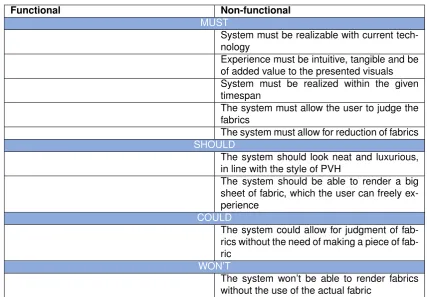
Table 2– Preliminary requirements of the system *
Functional Non-functional
MUST
System must be realizable with current tech-nology
Experience must be intuitive, tangible and be of added value to the presented visuals System must be realized within the given timespan
The system must allow the user to judge the fabrics
The system must allow for reduction of fabrics
SHOULD
The system should look neat and luxurious, in line with the style of PVH
The system should be able to render a big sheet of fabric, which the user can freely ex-perience
COULD
The system could allow for judgment of rics without the need of making a piece of fab-ric
WON’T
The system won’t be able to render fabrics without the use of the actual fabric
* table is composed using the PACT analysis, the scenarios and a meeting with the client (PVH).
3.7
Concepts
When comparing the ideas of the brainstorming section with the preliminary requirements, choices can be made. Both the dropouts and promising ideas are stated. A short recap of the ideas:
• Idea 1: Fabric with fibers which can be modified in order to generate specific properties
• Idea 2: Weaving machines which can locally weave custom sheets of fabric
• Idea 3: Surface with tiny needles which move up and down to generate tactile sensations
• Idea 4: Pen-based interface which uses vibrotactile feedback to render fabric
• Idea 5: Use of electrostatic fields in order to generate texture
• Idea 6: Use visuals like a 3D-model of the weaving pattern
• Idea 7: Controller with a rotating haptic wheel, which holds a tiny piece of fabric
• Idea 8: Mood-boards which represent fabrics
3.7.1 Dropouts
placed when applicable. This matrix emphasizes that idea 7 is the only idea which meets all the requirements.
Figure 9– Matrix with the ideas and the non-functional ’must-haves’. Idea 7 is the only idea which meets all of the requirements.
Technology is not developed enough
Both the ideas 3 and 5 seem interesting and promising. However, current technology is not de-veloped enough to allow for such a way of rendering fabrics. Idea 3 requires a surface of needles with a diameter of 1mm or smaller, which must be controlled separately. This requires mechanics on a very small scale, yet the needles must be quite strong to compensate the applied pressure of the user. This does not seem to be possible with current technology. Idea 5 requires electro-static fields which are made with a precision of 1mm or even smaller. Based on literature it can be concluded that current technology is not developed enough to allow for such precision and yet be tangible.
Poor experience
The ideas 4, 6, and 8 dropout since they do not allow for an intuitive and tangible interaction. One of the requirements of the client is to allow for judgment based on tangible interaction, which is not the case for the ideas 6 and 8. Idea 4 is in concept good-working, and should allow the user to feel the texture of a fabric whilst the fabric is not present. However, the experience is similar to judge a fabric when rubbing across the surface using a pointed pen-like tool. This is not a logic and intuitive way to experience a fabric.
Not realizable due to the given timespan
Idea 1 and idea 2 use another approach to render fabrics and some of its properties. However, the ideas are too complex and elaborate to realize in the given timespan. For this reason the ideas dropout. Creating a new kind of advanced fibers requires elaborate and time consuming investigation. The same holds for creating weaving machines which are portable, and can lo-cally create a custom fiber. These machines must be able to set-up themselves, and advanced weaving patterns must be integrated. This requires a lot of knowledge on the topic of weaving, fibers, and weaving machines. Both of this ideas are time consuming and not realizable given the timespan.
3.7.2 Promising idea
Judgment of fabrics using haptics 3 IDEATION
3.8
Conclusion and final concept
This part states the final concept based on the findings in this ideation phase. As stated previ-ously, idea 7 seems to be most promising, for this reason this idea will be used as base for the concept. The idea is funded on the idea of Microsoft which is stated in the context analysis, the Haptic Revolver. This haptic device, however, is not available to use and test, so a prototype has to be made.
4
Specification
The specification phase is the second phase of the design method for Creative Technology. The found requirements of the ideation phase are specified in to more detail. Also, based on the final concept (which is stated in chapter 3.7), requirements are formulated. Taken the context analysis and the ideation into account, requirements can be formulated. A sketch is made in order to specify into more detail what the envisioned system should look like.
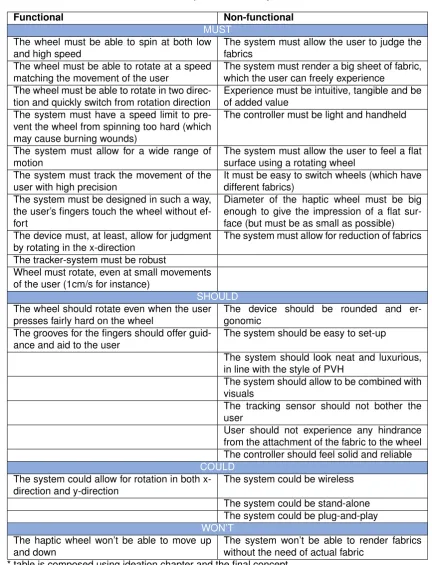
Similar to table 2, table 3 distributes the requirements with respect to functional and non-funtional requirements. Also, the requirements are prioritised based on the MoSCoW method. The MoSCoW method developed by Dai Clegg of Oracle UK in 1994 is a method used to create a prioritised list or requirements [46]. Based on this prioritised list one can determine the sequence of completing requirements. According to Haughey [46], the acronym MoSCoW stands for Must have, Should have, Could have and Won’t have. Where the ’must-haves’ are non-negotiable, the ’should-haves’ should be delivered as many as possible and the ’could-haves’ are nice but do not have direct impact on the success of the project. The ’won’t-haves’ state possibilities, but which are not included in the design because the were not feasible. Table 3 can be found on the next page.
[image:29.595.134.471.424.628.2]Combining all of the requirements, the envisioned system looks like the sketch in figure 10. The haptic wheel is present, and can rotate in two directions. Also grooves for the fingers are present. The device is handheld and allows for quick switching of fabrics. In this design the ability to move up and down is included, this ability however, is not realizable due to a short of both time and money. Also a wire is present at the back of the controller. This wire is preferable not present, but given the time and complexity of the design it is not a major point of interest.
Judgment of fabrics using haptics 4 SPECIFICATION
Table 3– Requirements of the system *
Functional Non-functional
MUST
The wheel must be able to spin at both low and high speed
The system must allow the user to judge the fabrics
The wheel must be able to rotate at a speed matching the movement of the user
The system must render a big sheet of fabric, which the user can freely experience
The wheel must be able to rotate in two direc-tion and quickly switch from rotadirec-tion direcdirec-tion
Experience must be intuitive, tangible and be of added value
The system must have a speed limit to pre-vent the wheel from spinning too hard (which may cause burning wounds)
The controller must be light and handheld
The system must allow for a wide range of motion
The system must allow the user to feel a flat surface using a rotating wheel
The system must track the movement of the user with high precision
It must be easy to switch wheels (which have different fabrics)
The system must be designed in such a way, the user’s fingers touch the wheel without ef-fort
Diameter of the haptic wheel must be big enough to give the impression of a flat sur-face (but must be as small as possible) The device must, at least, allow for judgment
by rotating in the x-direction
The system must allow for reduction of fabrics
The tracker-system must be robust
Wheel must rotate, even at small movements of the user (1cm/s for instance)
SHOULD
The wheel should rotate even when the user presses fairly hard on the wheel
The device should be rounded and er-gonomic
The grooves for the fingers should offer guid-ance and aid to the user
The system should be easy to set-up
The system should look neat and luxurious, in line with the style of PVH
The system should allow to be combined with visuals
The tracking sensor should not bother the user
User should not experience any hindrance from the attachment of the fabric to the wheel The controller should feel solid and reliable
COULD
The system could allow for rotation in both x-direction and y-x-direction
The system could be wireless
The system could be stand-alone The system could be plug-and-play
WON’T
The haptic wheel won’t be able to move up and down
The system won’t be able to render fabrics without the need of actual fabric
5
Realisation
The realisation phase is the third phase of the design method for Creative Technology. The specification phase leads towards design choices which are used to state the required and used components for the hi-fi prototype. These components consist of hardware, software and the casing. All components are analysed to be consistent with the requirements before realised and added to the prototype. This chapter describes which technologies are used to build the prototype, why certain design choices are made and states the final prototype. First the hardware is treated, components like the motor, tracking device, and the casing. Different motors are tested in order to find the right one, a motor with 80 rpm an a big torque. Also different trackers are tested, the HTC VIVE came out most stable and yet easy to implement. For the casing also a few iterations are stated. The final design consists of deep grooves for the fingers to rest in, nice round shapes and a beam to attach the tracker to. For every component the iterations are stated when applied. Since problems occurred during different phases of the realisation, the iteration is a process which is done constantly. This results in iterations for individual components rather than iterations of the complete prototype.
Next to the hardware, also the software is explained in some detail. Major tasks of the system are treated: motion tracking and the rendering of fabrics. The complete and final prototype is presented in its final setup, including different haptic wheels with seven different fabrics.
5.1
Software and hardware components
The requirements, as stated in chapter 4, are interpreted in order to make them meaningful for the component at hand. However, due to limited time, not all requirements are treated extensively for all different components. In order to illustrate how his interpreting of requirements can be performed, this is done for one hardware component: the motor. The functional requirements are translated to technological requirements. This kind of requirements is measurable, and so the components can be compared to measurable specifications. Abilities and functions of the motor are calculated, and compared to the technological requirements. This will lead to a motor which meets all the defined needs.
5.1.1 Hardware
Different hardware components are used for this system. Each of the components are explained in more detail belows. The components used are a motor, H-bridge module, Arduino UNO, track-ing device, servo, power-supply, haptic wheel, and a castrack-ing.
Motor
In order to find a fitting motor, some requirements need to be taken into account.
• The motor must be able to rotate in two directions. Using a brushed motor is preferable since this kind of motors is able to rotate in two directions.
• The motor must be strong enough to rotate even while the user applies some pressure to the wheel.
• The motor must rotate with a certain speed. This is based on a number of variables: The speed is calculated by stating some variables. The maximal distance to cover in one move-ment, this is assumed to be 100cm. The diameter of the wheel, which is 6cm. This diameter gives a circumference of 18.84cm (found using6∗π). Dividing the maximal distance (100cm) by the circumference of the wheel (18.84cm), gives the number of rotations needed to cover the maximal distance. Namely, 5.31 rotations (100/18.84). As a guideline for the desired time the motor takes to make this 5.31 rotations, is 2-5 seconds.
Judgment of fabrics using haptics 5 REALISATION
• The motor must rotate smooth in order to allow for a stable and fluent interaction.
In order to find the correct motor, different models are examined. Since stepper-motors rotate fairly stuttering at lower speeds, these motors are not taken into account. The first two motors where not strong enough and/or able to rotate at the right speed. Motor 3 seems to be the most promising motor since it is both strong and rotates at the desired speed, for that reason motor 3 is chosen to be used for this system.
Motor 1, Adafruit 5V DC Toy / Hobby Motor [47]
• The torque at the shaft of the motor is 0.20Ncm, which means that it can lift approximately 0.02kg (0.2N cm/10(gravitational acceleration approx.)) when a shaft with a radius of 1cm is used. With the wheel, which has a diameter of 6cm, the torque is 0.003 Kgcm (0.02/6. This is not strong enough since the user is able to stop the motor when pushing his finger against the wheel.
• This motor has a max. speed of 9100 rPM when 5V is applied. This means that the motor can cover the distance of 100cm in 0.035 seconds when a wheel with a diameter of 6cm is used (5.31/(9100/60) = 1.01). This is too fast, covering a distance of 100 cm in just 0.035 seconds does not seem to be use-able for the proposed task.
• This motor costse1,69 on the website adafruit.com, this is cheap, so affordable.
Motor 2, Conrad 12V MFATransmissiemotor 540 50:1 [48]
• The torque at the shaft of the motor is 30Ncm, which means that it can lift approximately 3kg (30N cm/10(gravitational acceleration approx.)) when a shaft with a radius of 1cm is used. With the wheel, which has a diameter of 6cm, the torque is 0.5 Kgcm (3/6. This seems to be strong enough. Yet, after trying this motor, the torque does not appear to be sufficient. The motor can easily be stopped when it rotates at lower speeds.
• This motor has a max. speed of 316 rPM when 12V is applied. This means that the motor can cover the distance of 100cm in 1.01 seconds when a wheel with a diameter of 6cm is used (5.31/(316/60) = 1.01).
• This motor costse26,49 on the website Conrad.nl, this seems to be a reasonable price.
Motor 3, Pololu 12V 131:1 Metal Gearmotor [49]
• The torque at the shaft of the motor is 180Ncm, which means that it can lift approximately 18kg (180N cm/10(gravitational acceleration approx.)) when a shaft with a radius of 1cm is used. With the wheel, which has a diameter of 6cm, the torque is 3 Kgcm (18/6. This torque is big enough to ensure the user is not able to stop the motor when pushing it. The motor is able to rotate at lower speeds with sufficient torque.
• This motor has a max. speed of 80 rPM when 12V is applied. This means that the motor can cover the distance of 100cm in 3.98 seconds when a wheel with a diameter of 6cm is used (5.31/(80/60) = 3.98). This top-speed is sufficient to render the fabric with a distance of 100cm within the desired time.
• This motor costse42.70 on the website Pololu.com, this seems to be a reasonable price.
H-Bridge module
Arduino UNO
In order to control the motor using the H-bridge module an Arduino UNO is used. This Arduino UNO is able to send digital signals and PWM signals. It can also receive data from the tracker via the serial port which allows the Arduino to control the motor compliant with the movement of the tracker.
Tracking device
The tracking device must be able to track the movement of the user with the device. It should be easy to attach to the controller. It does not need to provide the exact location in free space, it must track the direction (over one axis) and velocity of the movement.
Accelerometer
First, an accelerometer was used since it is fairly small, easy, cheap and it measures the acceler-ation which can be transformed to velocity. After testing the sensor it appeared the sensor does not return a constant value. The measured acceleration has to be integrated over time in order to return the velocity (which can be used to calculate movement). When starting to measure, the values it returns instantly starts to drift. This occurs since also the errors are integrated over time, and so the errors enlarge every integration. This sensor is not accurate enough to be useful for this system.
HTC VIVE tracker
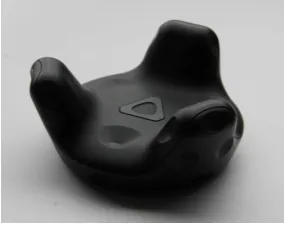
[image:33.595.230.373.442.555.2]In order to find a more stable way to track the movement, the HTC VIVE tracker is used (figure 11). This tracker enables to track very accurate the movement of the user. It is easy to attach using a default camera screw, a M6 screw in the Netherlands (which are used on tri-pods for example). The HTC VIVE tracker can only be used in combination with a base-station of HTC. This base-station must be located at a distance of at least 2.5m from the tracker, and must be aimed towards the tracker.
Figure 11– The HTC VIVE tracker.
Servo
In order to move the 12V DC motor up and down, which allows to choose whether or not to let the wheel touch the user’s finger, a servo motor can be used. However, after testing, the servo motor is found not to be strong enough to lift the 12V DC motor. Next to that, the protocol used to control the servo violates the protocol used to control the 12V DC motor. Since it is both practically as programming-wise a challenge, and it does not directly influence the success-rate of the concept, it is decided to leave the servo out of the concept and leave the idea for further investigations.
Power-supply
![Figure 1 – Teslasuit, picture from Teslasuit.io [28]](https://thumb-us.123doks.com/thumbv2/123dok_us/9680714.469694/15.595.202.401.491.593/figure-teslasuit-picture-from-teslasuit-io.webp)
![Figure 3 – HaptX Gloves, picture from HaptX.com [31]](https://thumb-us.123doks.com/thumbv2/123dok_us/9680714.469694/16.595.203.402.497.630/figure-haptx-gloves-picture-from-haptx-com.webp)
![Figure 6 – SensAble Phantom Omni, picture from delfthapticslab.nl [35]](https://thumb-us.123doks.com/thumbv2/123dok_us/9680714.469694/17.595.203.401.218.366/figure-sensable-phantom-omni-picture-from-delfthapticslab-nl.webp)

![Figure 8 – Digital showroom of Tommy Hilfiger, by PVH. Image from knight-interactive.com [45]](https://thumb-us.123doks.com/thumbv2/123dok_us/9680714.469694/24.595.159.446.142.333/figure-digital-showroom-tommy-hilger-image-knight-interactive.webp)