RC Chakraborty, www.myreaders.info
Genetic Algorithms & Modeling : Soft Computing Course Lecture 37 – 40, notes, slides www.myreaders.info/ , RC Chakraborty, e-mail [email protected] , Aug. 10, 2010 http://www.myreaders.info/html/soft_computing.html
Genetic Algorithms & Modeling
Soft Computing
www.myreaders.info
Return to Website
Genetic algorithms & Modeling, topics : Introduction, why genetic algorithm? search optimization methods, evolutionary algorithms (EAs), genetic algorithms (GAs) - biological background, working principles; basic genetic algorithm, flow chart for Genetic Programming. Encoding : binary encoding, value encoding, permutation encoding, tree encoding. Operators of genetic algorithm : random population, reproduction or selection - roulette wheel selection, Boltzmann selection; Fitness function;
Crossover - one-point crossover, two-point crossover, uniform crossover, arithmetic, heuristic; Mutation - flip bit, boundary, Gaussian, non-uniform, and uniform; Basic genetic algorithm : examples - maximize function f(x) = x2 and two bar pendulum.
RC Chakraborty, www.myreaders.info
Genetic Algorithms & Modeling
Soft Computing
Topics
(Lectures 37, 38, 39, 40 4 hours) Slides
1. Introduction
What are Genetic Algorithms and why Genetic Algorithm? Search optimization methods; Evolutionary Algorithms (EAs), Genetic Algorithms (GAs) : Biological background, Working principles, Basic Genetic Algorithm, Flow chart for Genetic Programming.
03-23
2. Encoding
Binary Encoding, Value Encoding, Permutation Encoding, Tree Encoding.
24-29
3. Operators of Genetic Algorithm
Random population, Reproduction or Selection : Roulette wheel selection, Boltzmann selection; Fitness function; Crossover: One-point crossover, Two-point crossover, Uniform crossover, Arithmetic, Heuristic; Mutation: Flip bit, Boundary, Gaussian, Non-uniform, and Uniform;
30-43
4. Basic Genetic Algorithm
Examples : Maximize function f(x) = x
2and Two bar pendulum.
44-49
5. References 50
02
RC Chakraborty, www.myreaders.info
Genetic Algorithms & Modeling
What are GAs ?
• Genetic Algorithms (GAs) are adaptive heuristic search algorithm based on the evolutionary ideas of natural selection and genetics.
• Genetic algorithms (GAs) are a part of Evolutionary computing, a rapidly growing area of artificial intelligence. GAs are inspired by Darwin's theory about evolution - "survival of the fittest".
• GAs represent an intelligent exploitation of a random search used to
solve optimization problems.• GAs, although randomized, exploit historical information to direct the search into the region of better performance within the search space.
• In nature, competition among individuals for scanty resources results in the fittest individuals dominating over the weaker ones.
03
RC Chakraborty, www.myreaders.info
1. Introduction
Solving problems mean looking for solutions, which is best among others.
Finding the solution to a problem is often thought :
−
In computer science and AI, as a process
of searchthrough the space of possible solutions. The set of possible solutions defines the search space (also called state space) for a given problem. Solutions or partial solutions are viewed as points in the search space.
−
In engineering and mathematics, as a process of
optimization. Theproblems are first formulated as mathematical models expressed in terms of functions and then to find a solution, discover the parameters that optimize the model or the function components that provide optimal system performance.
04
RC Chakraborty, www.myreaders.info
• Why Genetic Algorithms ?
It is better than conventional AI ; It is more robust.
- unlike older AI systems, the GA's do not break easily even if the inputs changed slightly, or in the presence of reasonable noise.
- while performing search in large state-space, multi-modal state-space, or n-dimensional surface, a genetic algorithms offer significant benefits over many other typical search optimization techniques like - linear programming, heuristic, depth-first, breath-first.
"Genetic Algorithms are good at taking large, potentially huge search spaces and navigating them, looking for optimal combinations of things, the solutions one might not otherwise find in a lifetime.” Salvatore Mangano Computer Design, May 1995.
05
RC Chakraborty, www.myreaders.info
1.1 Optimization
Optimization is a process that finds a best, or optimal, solution for a problem. The Optimization problems are centered around three factors :
■ An objective function :
which is to be minimized or maximized;
Examples:
1. In manufacturing, we want to maximize the profit or minimize the cost .
2. In designing an automobile panel, we want to maximize the strength.
■ A set of unknowns or variables :
that affect the objective function, Examples:
1. In manufacturing, the variables are amount of resources used or the time spent.
2. In panel design problem, the variables are shape and dimensions of the panel.
■ A set of constraints :
that allow the unknowns to take on certain values but exclude others;
Examples:
1. In manufacturing, one constrain is, that all "time" variables to be non-negative.
2 In the panel design, we want to limit the weight and put constrain on its shape.
An optimization problem is defined as : Finding values of the variables that minimize or maximize the objective function while satisfying the constraints.
06
RC Chakraborty, www.myreaders.info
• Optimization Methods
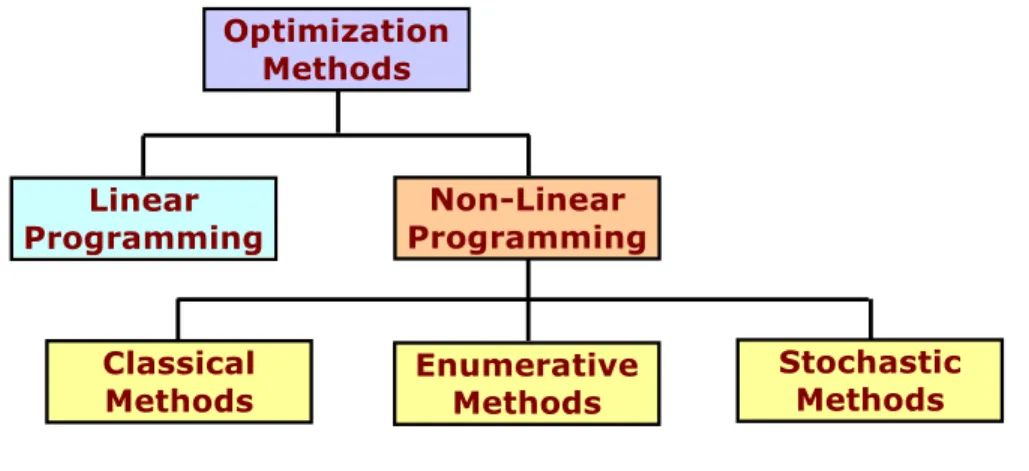
Many optimization methods exist and categorized as shown below.
The suitability of a method depends on one or more problem characteristics to be optimized to meet one or more objectives like :
−
low cost,
−
high performance,
−
low loss
These characteristics are not necessarily obtainable, and requires knowledge about the problem.
Fig. Optimization Methods
Each of these methods are briefly discussed indicating the nature of the problem they are more applicable.
07
Optimization Methods
Non-Linear Programming Linear
Programming
Stochastic Methods Classical
Methods Enumerative Methods
RC Chakraborty, www.myreaders.info
■
Linear Programming
Intends to obtain the optimal solution to problems that are perfectly represented by a set of linear equations; thus require a priori knowledge of the problem. Here the
−
the functions to be minimized or maximized, is called objective
functions,−
the set of linear equations are called restrictions.
−
the
optimal solution, is the one that minimizes (or maximizes)the objective function.
Example :
“Traveling salesman”, seeking a minimal traveling distance.
08
RC Chakraborty, www.myreaders.info
■
Non- Linear Programming
Intended for problems described by non-linear equations.
The methods are divided in three large groups:
Classical, Enumerative and Stochastic.
Classical search
uses deterministic approach to find best solution.
These methods requires knowledge of gradients or higher order derivatives. In many practical problems, some desired information are not available, means deterministic algorithms are inappropriate.
The techniques are subdivide into:
−
Direct methods, e.g. Newton or Fibonacci
−
Indirect methods.
Enumerative search
goes through every point (one point at a time ) related to the function's domain space. At each point, all possible solutions are generated and tested to find optimum solution. It is easy to implement but usually require significant computation. In the field of artificial intelligence, the enumerative methods are subdivided into two categories:
−
Uninformed methods, e.g. Mini-Max algorithm
−
Informed methods, e.g. Alpha-Beta and A* ,
Stochastic search
deliberately introduces randomness into the search process. The injected randomness may provide the necessary impetus to move away from a local solution when searching for a global optimum. e.g., a gradient vector criterion for “smoothing” problems.
Stochastic methods offer robustness quality to optimization process.
Among the stochastic techniques, the most widely used are :
− Evolutionary Strategies (ES),
− Genetic Algorithms (GA), and
− Simulated Annealing (SA)
.
The ES and GA emulate nature’s evolutionary behavior, while SA is based on the physical process of annealing a material.
09
RC Chakraborty, www.myreaders.info
1.2 Search Optimization
Among the three Non-Linear search methodologies, just mentioned in the previous slide, our immediate concern is
Stochastic searchwhich means
−
Evolutionary Strategies (ES),
−
Genetic Algorithms (GA), and
−
Simulated Annealing (SA).
The two other search methodologies, shown below, the Classical and the Enumerative methods, are first briefly explained. Later the Stochastic
methods are discussed in detail. All these methods belong to Non-Linear search.
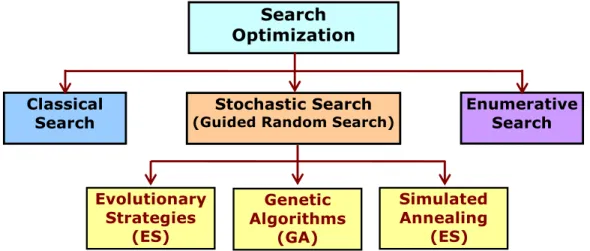
Fig Non- Linear search methods 10
Search Optimization
Stochastic Search
(Guided Random Search) Enumerative Search Classical
Search
Evolutionary Strategies
(ES)
Genetic Algorithms
(GA)
Simulated Annealing
(ES)
RC Chakraborty, www.myreaders.info
• Classical or Calculus based search
Uses deterministic approach to find best solutions of an optimization problem.
−
the solutions satisfy a set of necessary and sufficient conditions of the optimization problem.
−
the techniques are subdivide into
directand
indirectmethods.
◊
Direct or Numerical methods :−
example : Newton or Fibonacci,
−
tries to find extremes by "hopping" around the search space and assessing the gradient of the new point, which guides the search.
−
applies the concept of "hill climbing", and finds the best local point by climbing the steepest permissible gradient.
−
used only on a restricted set of "well behaved" functions.
◊ Indirect methods :
−
does search for local extremes by solving usually non-linear set of equations resulting from setting the gradient of the objective function to zero.
−
does search for possible solutions (function peaks), starts by restricting itself to points with zero slope in all directions.
11
RC Chakraborty, www.myreaders.info
• Enumerative Search
Here the search goes through every point (one point at a time) related to the function's domain space.
−
At each point, all possible solutions are generated and tested to find optimum solution.
−
It is easy to implement but usually require significant computation.
Thus these techniques are not suitable for applications with large domain spaces.
In the field of artificial intelligence, the enumerative methods are subdivided into two categories : Uninformed and Informed methods.
◊
Uninformed or blind methods :−
example: Mini-Max algorithm,
−
search all points in the space in a predefined order,
−
used in game playing.
◊ Informed methods :
−
example: Alpha-Beta and A* ,
−
does more sophisticated search
−
uses domain specific knowledge in the form of a cost function or heuristic to reduce cost for search.
Next slide shows, the taxonomy of enumerative search in AI domain.
12
RC Chakraborty, www.myreaders.info
[Ref : previous slide Enumerative search]
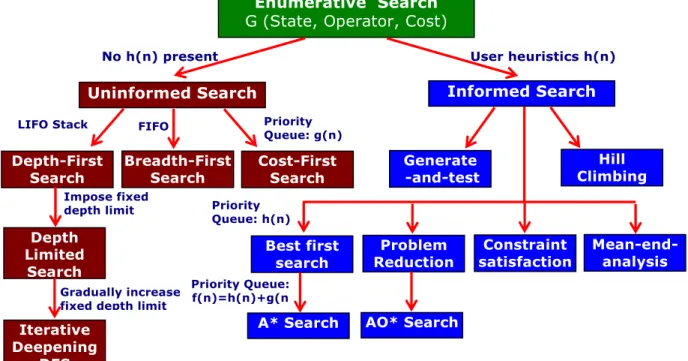
The Enumerative search techniques follows, the traditional search and control strategies, in the domain of Artificial Intelligence.
−
the search methods explore the search space "intelligently"; means evaluating possibilities without investigating every single possibility.
−
there are many control structures for search; the depth-first search and breadth-first search are two common search strategies.
−
the taxonomy of search algorithms in AI domain is given below.
Fig. Enumerative Search Algorithms in AI Domain
13
User heuristics h(n) No h(n) present
Priority Queue:
f(n)=h(n)+g(n LIFO Stack
Gradually increase fixed depth limit
Impose fixed depth limit
Priority Queue: g(n)
Priority Queue: h(n) FIFO
Enumerative Search G (State, Operator, Cost)
Informed Search Uninformed Search
Depth-First Search
Breadth-First
Search Cost-First Search
Generate -and-test
Hill Climbing
Depth Limited
Search
Iterative Deepening
DFS
Problem Reduction
Constraint
satisfaction Mean-end- analysis Best first
search
A* Search AO* Search
RC Chakraborty, www.myreaders.info
• Stochastic Search
Here the search methods, include heuristics and an element of
randomness (non-determinism) in traversing the search space. Unlikethe previous two search methodologies
−
the stochastic search algorithm moves from one point to another in the search space in a non-deterministic manner, guided by heuristics.
−
the stochastic search techniques are usually called
Guided random search techniques.The stochastic search techniques are grouped into two major subclasses :
−
Simulated annealing and
− Evolutionary algorithms.
Both these classes follow the principles of evolutionary processes.
◊
Simulated annealing (SAs)−
uses a thermodynamic evolution process to search minimum energy states.
◊ Evolutionary algorithms (EAs)
−
use natural selection principles.
−
the search evolves throughout generations, improving the features of potential solutions by means of biological inspired operations.
− Genetic Algorithms (GAs)
are a good example of this technique.
The next slide shows, the taxonomy of evolutionary search algorithms.
It includes the other two search, the Enumerative search and Calculus based techniques, for better understanding of Non-Linear search methodologies in its entirety.
14
RC Chakraborty, www.myreaders.info
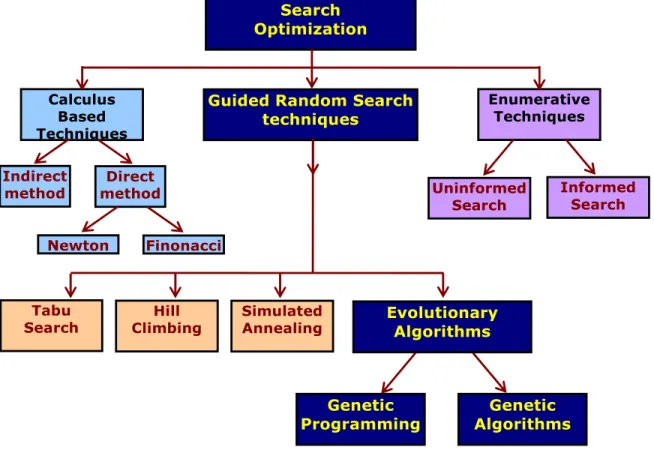
• Taxonomy of Search Optimization
Fig. below shows different types of Search Optimization algorithms.
Fig. Taxonomy of Search Optimization techniques
We are interested in Evolutionary search algorithms.
Our main concern is to understand the evolutionary algorithms : - how to describe the process of search,
- how to implement and carry out search,
- what are the elements required to carry out search, and - the different search strategies
The Evolutionary Algorithms include : - Genetic Algorithms and
- Genetic Programming
15
Search Optimization
Guided Random Search techniques
Enumerative Techniques Calculus
Based Techniques
Indirect
method Direct method
Simulated Annealing
Informed Search
Hill Climbing Tabu
Search
Genetic Algorithms Genetic
Programming Newton Finonacci
Uninformed Search
Evolutionary Algorithms
RC Chakraborty, www.myreaders.info
1.3 Evolutionary Algorithm (EAs)
Evolutionary Algorithm (EA) is a subset of Evolutionary Computation (EC) which is a subfield of Artificial Intelligence (AI).
Evolutionary Computation (EC)
is a general term for several computational techniques. Evolutionary Computation represents powerful
search and optimization paradigm influenced by biological mechanisms ofevolution : that of natural selection and genetic.
Evolutionary Algorithms (EAs)
refers to Evolutionary Computational models using randomness and genetic inspired operations. EAs involve
selection, recombination, random variation and competition of theindividuals in a population of adequately represented potential solutions.
The candidate solutions are referred as chromosomes or individuals.
Genetic Algorithms (GAs)
represent the main paradigm of Evolutionary Computation.
-
GAs simulate natural evolution, mimicking processes the nature uses : Selection, Crosses over, Mutation and Accepting.
-
GAs simulate the survival of the fittest among individuals over consecutive generation for solving a problem.
Development History
EC = GP + ES + EP + GA
Evolutionary
Computing Genetic
Programming Evolution
Strategies Evolutionary
Programming Genetic Algorithms Rechenberg
1960 Koza
1992 Rechenberg
1965 Fogel
1962 Holland
1970
16
RC Chakraborty, www.myreaders.info
1.4 Genetic Algorithms (GAs) - Basic Concepts
Genetic algorithms (GAs) are the main paradigm of evolutionary computing. GAs are inspired by Darwin's theory about evolution – the
"survival of the fittest". In nature, competition among individuals for
scanty resources results in the fittest individuals dominating over the weaker ones.
−
GAs are the ways of solving problems by mimicking processes nature uses; ie., Selection, Crosses over, Mutation and Accepting, to evolve a solution to a problem.
−
GAs are adaptive heuristic search based on the evolutionary ideas of natural selection and genetics.
−
GAs are intelligent exploitation of random search used in optimization problems.
−
GAs, although randomized, exploit historical information to direct the search into the region of better performance within the search space.
The biological background (basic genetics), the scheme of evolutionary processes, the working principles and the steps involved in GAs are illustrated in next few slides.
17
RC Chakraborty, www.myreaders.info
• Biological Background – Basic Genetics
‡
Every
organismhas a set of rules, describing how that organism is built. All living organisms consist of
cells.
‡
In each cell there is same set of
chromosomes.Chromosomes are strings of DNA and serve as a model for the whole organism.
‡
A chromosome consists of
genes, blocks of DNA.
‡
Each gene encodes a particular protein that represents a
trait(feature), e.g., color of eyes.
‡
Possible settings for a trait (e.g. blue, brown) are called
alleles.
‡
Each gene has its own position in the chromosome called its
locus.
‡
Complete set of genetic material (all chromosomes) is called a
genome.
‡
Particular set of genes in a genome is called
genotype.
‡
The physical expression of the genotype (the organism itself after birth) is called the
phenotype, its physical and mental characteristics, such as eye color, intelligence etc.
‡
When two organisms mate they share their genes; the resultant offspring may end up having half the genes from one parent and half from the other. This process is called
recombination(cross over) .
‡
The new created offspring can then be mutated.
Mutationmeans, that the elements of DNA are a bit changed. This changes are mainly caused by errors in copying genes from parents.
‡
The
fitnessof an organism is measured by success of the organism in its life (survival).
18
RC Chakraborty, www.myreaders.info
[ continued from previous slide - Biological background ]
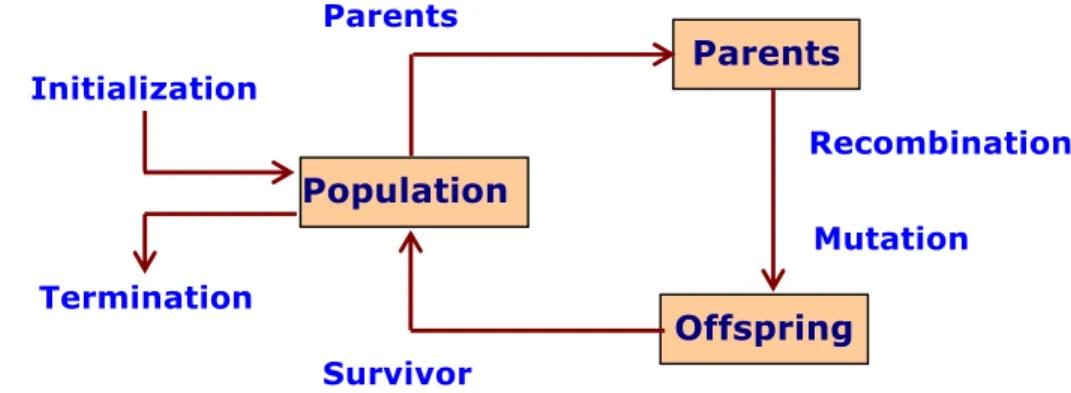
Below shown, the general scheme of evolutionary process in genetic along with pseudo-code.
Fig. General Scheme of Evolutionary process
Pseudo-Code BEGIN
INITIALISE
population with random candidate solution.
EVALUATE
each candidate;
REPEAT UNTIL
(termination condition ) is satisfied DO 1.
SELECTparents;
2.
RECOMBINEpairs of parents;
3.
MUTATEthe resulting offspring;
4.
SELECTindividuals or the next generation;
END
.
19
Parents
Offspring Population
Recombination Mutation
Parents
Termination Initialization
Survivor
RC Chakraborty, www.myreaders.info
• Search Space
In solving problems, some solution will be the best among others.
The space of all feasible solutions (among which the desired solution resides) is called
search space(also called state space).
−
Each point in the search space represents one
possible solution.−
Each possible solution can be "marked" by its value (or
fitness) for the problem.
−
The GA looks for the
best solutionamong a number of possible solutions represented by one point in the search space.
−
Looking for a solution is then equal to looking for some extreme value (minimum or maximum) in the search space.
−
At times the search space may be well defined, but usually only a few points in the search space are known.
In using GA, the process of finding solutions generates other points (possible solutions) as evolution proceeds.
20
RC Chakraborty, www.myreaders.info
• Working Principles
Before getting into GAs, it is necessary to explain few terms.
−
Chromosome : a set of genes; a chromosome contains the solution in form of genes.
−
Gene : a part of chromosome; a gene contains a part of solution. It determines the solution. e.g. 16743 is a chromosome and 1, 6, 7, 4 and 3 are its genes.
−
Individual : same as chromosome.
−
Population: number of individuals present with same length of chromosome.
−
Fitness : the value assigned to an individual based on how far or close a individual is from the solution; greater the fitness value better the solution it contains.
−
Fitness function : a function that assigns fitness value to the individual.
It is problem specific.
−
Breeding : taking two fit individuals and then intermingling there chromosome to create new two individuals.
−
Mutation : changing a random gene in an individual.
−
Selection : selecting individuals for creating the next generation.
Working principles :
Genetic algorithm begins with a set of solutions (represented by chromosomes) called the population.
−
Solutions from one population are taken and used to form a new population. This is motivated by the possibility that the new population will be better than the old one.
−
Solutions are selected according to their fitness to form new solutions (offspring); more suitable they are, more chances they have to reproduce.
−
This is repeated until some condition (e.g. number of populations or improvement of the best solution) is satisfied.
21
RC Chakraborty, www.myreaders.info
• Outline of the Basic Genetic Algorithm
1.
[Start] Generate random population of n chromosomes (i.e. suitable solutions for the problem).
2.
[Fitness] Evaluate the fitness f(x) of each chromosome x in the population.
3.
[New population] Create a new population by repeating following steps until the new population is complete.
(a) [Selection] Select two parent chromosomes from a population according to their fitness (better the fitness, bigger the chance to be selected)
(b) [Crossover] With a crossover probability, cross over the parents to form new offspring (children). If no crossover was performed, offspring is the exact copy of parents.
(c) [Mutation] With a mutation probability, mutate new offspring at each locus (position in chromosome).
(d) [Accepting] Place new offspring in the new population
4.
[Replace] Use new generated population for a further run of the algorithm
5.
[Test] If the end condition is satisfied, stop, and return the best solution in current population
6.
[Loop] Go to step 2
Note : The genetic algorithm's performance is largely influenced by two operators called crossover and mutation. These two operators are the most important parts of GA.
22
RC Chakraborty, www.myreaders.info
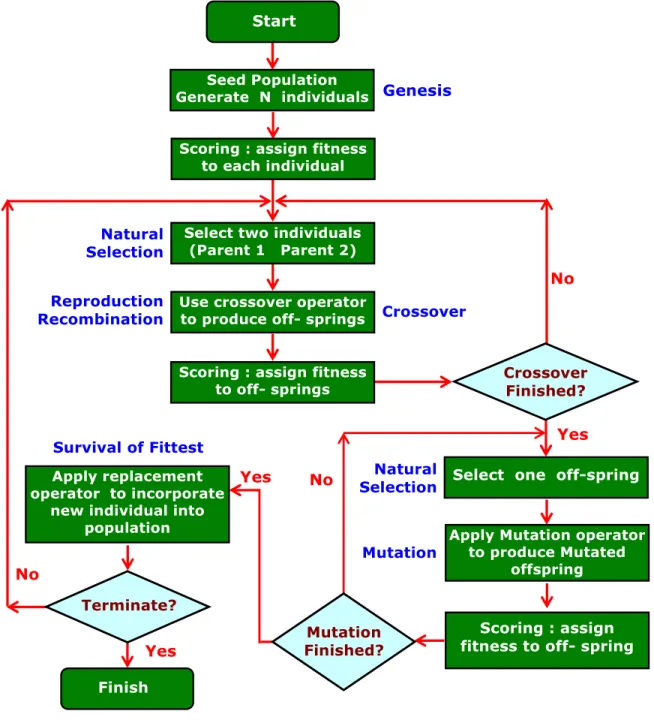
• Flow chart for Genetic Programming
Fig. Genetic Algorithm – program flow chart
23
Yes No
No
No SelectionNatural Natural
Selection
Mutation Crossover
Survival of Fittest Reproduction Recombination
Genesis
Yes
Yes Seed Population
Generate N individuals
Scoring : assign fitness to each individual
Select two individuals (Parent 1 Parent 2)
Select one off-spring Use crossover operator
to produce off- springs
Scoring : assign fitness to off- springs
Apply replacement operator to incorporate
new individual into population
Mutation Finished?
Terminate?
Finish
Crossover Finished?
Start
Apply Mutation operator to produce Mutated
offspring
Scoring : assign fitness to off- spring
RC Chakraborty, www.myreaders.info 2. Encoding
Before a genetic algorithm can be put to work on any problem, a method is needed to encode potential solutions to that problem in a form so that a computer can process.
−
One common approach is to encode solutions as binary strings: sequences of
1'sand
0's,where the digit at each position represents the value of some aspect of the solution.
Example :
A Gene represents some data (eye color, hair color, sight, etc.).
A chromosome is an array of genes. In binary form a
Genelooks like :
(11100010)a
Chromosomelooks like:
Gene1 Gene2 Gene3 Gene4 (11000010, 00001110, 001111010, 10100011)A chromosome should in some way contain information about solution which it represents; it thus requires encoding. The most popular way of encoding is a
binary stringlike :
Chromosome 1 : 1101100100110110 Chromosome 2 : 1101111000011110
Each bit in the string represent some characteristics of the solution.
−
There are many other ways of encoding, e.g., encoding values as integer or real numbers or some permutations and so on.
−
The virtue of these encoding method depends on the problem to work on .
24
RC Chakraborty, www.myreaders.info
• Binary Encoding
Binary encoding is the most common to represent information contained.
In genetic algorithms, it was first used because of its relative simplicity.
−
In binary encoding, every chromosome is a string of bits :
0or
1, like
Chromosome 1: 1 0 1 1 0 0 1 0 1 1 0 0 1 0 1 0 1 1 1 0 0 1 0 1Chromosome 2: 1 1 1 1 1 1 1 0 0 0 0 0 1 1 0 0 0 0 0 1 1 1 1 1
−
Binary encoding gives many possible chromosomes even with a small number of alleles ie possible settings for a trait (features).
−
This encoding is often not natural for many problems and sometimes corrections must be made after crossover and/or mutation.
Example 1:
One variable function
,say
0 to 15numbers, numeric values, represented by 4 bit binary string.
Numeric
value 4–bit
string Numeric
value 4–bit
string Numeric
value 4–bit string
0 0 0 0 0 6 0 1 1 0 12 1 1 0 0
1 0 0 0 1 7 0 1 1 1 13 1 1 0 1
2 0 0 1 0 8 1 0 0 0 14 1 1 1 0
3 0 0 1 1 9 1 0 0 1 15 1 1 1 1
4 0 1 0 0 10 1 0 1 0
5 0 1 0 1 11 1 0 1 1
25
RC Chakraborty, www.myreaders.info
[ continued binary encoding ] Example 2 :
Two variable function represented by 4 bit string for each variable.
Let two variables
X1 , X2as
(1011 0110) .Every variable will have both upper and lower limits as
≤ ≤
Because 4-bit string can represent integers from
0to
15,
so
(0000 0000) and (1111 1111)represent the points for
X1 , X2 as ( , )and
( , )respectively.
Thus, an
n-bitstring can represent integers from
0to
2n -1, i.e.
2nintegers.
Binary Coding Equivalent integer Decoded binary substring
1 0 1 0
0 x 20 = 0 1 x 21 = 2 0 x 22 = 0 1 x 23 = 8 10
Let Xi is coded as a substring Si of length ni. Then decoded binary substring Si is as
where Si can be 0 or 1 and the string S is represented as Sn-1 . . . . S3 S2 S1 S0
Example :
Decoding value
Consider a 4-bit string
(0111),−
the decoded value is equal to
23 x 0 + 22 x 1 + 21 x 1 + 20 x 1 = 7
−
Knowing
and
corresponding to
(0000)and
(1111) ,the equivalent value for any 4-bit string can be obtained as
( − )Xi = + --- x (decoded value of string) ( 2ni − 1 )
−
For e.g. a variable
Xi ;let
= 2 ,and
= 17,find what value the 4-bit string
Xi = (1010)would represent. First get decoded value for
Si = 1010 = 23 x 1 + 22 x 0 + 21 x 1 + 20 x 0 = 10then
(17 -2)
Xi = 2 + --- x 10 = 12 (24 - 1)
The accuracy obtained with a 4-bit code is
1/16of search space.
By increasing the string length by 1-bit , accuracy increases to
1/32.
26X i L Xi XiU
X 1 L X 2 L X1U X2U
2 10 Remainder 2 5 0
2 2 1 1 0
k=0
Σ
K=ni - 1
2 k S k
X i L XiU
X i L
XiU XiL
XiL XiU
RC Chakraborty, www.myreaders.info
• Value Encoding
The Value encoding can be used in problems where values such as real numbers are used. Use of binary encoding for this type of problems would be difficult.
1.
In value encoding, every chromosome is a sequence of some values.
2.
The Values can be anything connected to the problem, such as : real numbers, characters or objects.
Examples :
Chromosome A 1.2324 5.3243 0.4556 2.3293 2.4545 Chromosome B ABDJEIFJDHDIERJFDLDFLFEGT
Chromosome C (back), (back), (right), (forward), (left)
3.
Value encoding is often necessary to develop some new types of crossovers and mutations specific for the problem.
27
RC Chakraborty, www.myreaders.info
• Permutation Encoding
Permutation encoding can be used in ordering problems, such as traveling salesman problem or task ordering problem.
1. In permutation encoding, every chromosome is a string of numbers that represent a position in a sequence.
Chromosome A 1 5 3 2 6 4 7 9 8 Chromosome B 8 5 6 7 2 3 1 4 9
2. Permutation encoding is useful for ordering problems. For some problems, crossover and mutation corrections must be made to leave the chromosome consistent.
Examples :
1. The Traveling Salesman problem:
There are cities and given distances between them. Traveling salesman has to visit all of them, but he does not want to travel more than necessary. Find a sequence of cities with a minimal traveled distance. Here, encoded chromosomes describe the order of cities the salesman visits.
2. The Eight Queens problem :
There are eight queens. Find a way to place them on a chess board so that no two queens attack each other. Here, encoding describes the position of a queen on each row.
28
RC Chakraborty, www.myreaders.info
• Tree Encoding
Tree encoding is used mainly for evolving programs or expressions.
For genetic programming :
−
In tree encoding, every chromosome is a tree of some objects, such as functions or commands in programming language.
−
Tree encoding is useful for evolving programs or any other structures that can be encoded in trees.
−
The crossover and mutation can be done relatively easy way .
Example :
Chromosome A Chromosome B
( + x ( / 5 y ) ) ( do until step wall )
Fig. Example of Chromosomes with tree encoding
Note : Tree encoding is good for evolving programs. The programming language LISP is often used. Programs in LISP can be easily parsed as a tree, so the crossover and mutation is relatively easy.
29
+ x /
5 y
do untill
step wall
RC Chakraborty, www.myreaders.info
3. Operators of Genetic Algorithm
Genetic operators used in genetic algorithms maintain genetic diversity.
Genetic diversity or variation is a necessity for the process of evolution.
Genetic operators are analogous to those which occur in the natural world:
− Reproduction
(or Selection
) ;− Crossover
(or Recombination);
and− Mutation.
In addition to these operators, there are some parameters of GA.
One important parameter is
Population size.
−
Population size says how many chromosomes are in population (in one generation).
−
If there are only few chromosomes, then GA would have a few possibilities to perform crossover and only a small part of search space is explored.
−
If there are many chromosomes, then GA slows down.
−
Research shows that after some limit, it is not useful to increase population size, because it does not help in solving the problem faster. The population size depends on the type of encoding and the problem.
30
RC Chakraborty, www.myreaders.info
3.1 Reproduction, or Selection
Reproduction is usually the first operator applied on population. From the population, the chromosomes are selected to be parents to crossover and produce offspring.
The problem is how to select these chromosomes ?
According to Darwin's evolution theory "survival of the fittest" – the best ones should survive and create new offspring.
−
The Reproduction operators are also called Selection operators.
−
Selection means extract a subset of genes from an existing population, according to any definition of quality. Every gene has a meaning, so one can derive from the gene a kind of quality measurement called
fitness function. Following this quality (fitness value), selection can be performed.
−
Fitness function quantifies the optimality of a solution (chromosome) so that a particular solution may be ranked against all the other solutions.
The function depicts the closeness of a given ‘solution’ to the desired result.
Many reproduction operators exists and they all essentially do same thing.
They pick from current population the strings of above average and insert their multiple copies in the mating pool in a probabilistic manner.
The most commonly used methods of selecting chromosomes for parents to crossover are :
−
Roulette wheel selection,
−Rank selection
−
Boltzmann selection,
−Steady state selection.
−
Tournament selection,
The Roulette wheel and Boltzmann selections methods are illustrated next.
31
RC Chakraborty, www.myreaders.info
• Example of Selection
Evolutionary Algorithms is to maximize the function
f(x) = x2with x in the integer interval
[0 , 31],i.e., x
= 0, 1, . . . 30, 31.1.
The first step is encoding of chromosomes; use binary representation for integers; 5-bits are used to represent integers up to
31.2. Assume that the population size is
4.3.
Generate initial population at random. They are chromosomes or genotypes; e.g.,
01101, 11000, 01000, 10011.4. Calculate fitness value for each individual.
(a)
Decode the individual into an integer (called phenotypes),
01101 → 13; 11000 → 24; 01000 → 8; 10011 → 19;(b)
Evaluate the fitness according to
f(x) = x2 ,13 → 169; 24 → 576; 8 → 64; 19 → 361.
5. Select parents (two individuals) for crossover based on their fitness in
pi.Out of many methods for selecting the best chromosomes, if
roulette-wheelselection is used, then the probability of the
i thstring in the population is
pi = F i / ( F j ) ,where
F i
is fitness for the string
iin the population, expressed as
f(x) piis probability of the string
ibeing selected,
n
is no of individuals in the population, is population size,
n=4 n * piis expected count
String No Initial Population
X value Fitness Fi f(x) = x2
p i Expected count N * Prob i 1 0 1 1 0 1 13 169 0.14 0.58
2 1 1 0 0 0 24 576 0.49 1.97
3 0 1 0 0 0 8 64 0.06 0.22 4 1 0 0 1 1 19 361 0.31 1.23
Sum 1170 1.00 4.00
Average 293 0.25 1.00
Max 576 0.49 1.97
The string no
2has maximum chance of selection.
32
j=1
Σ
n
RC Chakraborty, www.myreaders.info
• Roulette wheel selection
(Fitness-Proportionate Selection)
Roulette-wheel selection, also known as Fitness Proportionate Selection, is a genetic operator, used for selecting potentially useful solutions for recombination.
In fitness-proportionate selection :
−
the chance of an individual's being selected is proportional to its fitness, greater or less than its competitors' fitness.
−
conceptually, this can be thought as a game of Roulette.
Fig. Roulette-wheel Shows 8 individual with fitness
The Roulette-wheel simulates 8 individuals with fitness values Fi, marked at its circumference; e.g.,
− the 5th individual has a higher fitness than others, so the wheel would choose the 5th individual more than other individuals .
− the fitness of the individuals is calculated as the wheel is spun n = 8 times, each time selecting an instance, of the string, chosen by the wheel pointer.
Probability of
i thstring is
pi = F i / ( F j ), where
n = no of individuals
, called population size; pi
= probabilityof i
thstring being selected;
Fi = fitnessfor
ithstring in the population.
Because the circumference of the wheel is marked according to a string's fitness, the Roulette-wheel mechanism is expected to make copies of the
ithstring.
Average fitness = F j / n ; Expected count = (n =8 ) x pi
Cumulative Probability5 = pi
33
5%
1
9%
2
13%
3
17%
4
8%
6
8%
7
20%
8
20%
5
Σ
j=1 nF F
F
Σ
i=1 N=5RC Chakraborty, www.myreaders.info
• Boltzmann Selection
Simulated annealing is a method used to minimize or maximize a function.
−
This method simulates the process of slow cooling of molten metal to achieve the minimum function value in a minimization problem.
−
The cooling phenomena is simulated by controlling a temperature like parameter introduced with the concept of Boltzmann probability distribution.
−
The system in thermal equilibrium at a temperature
Thas its energy distribution based on the probability defined by
P(E) = exp ( - E / kT )
were k is Boltzmann constant.
−
This expression suggests that a system at a higher temperature has almost uniform probability at any energy state, but at lower temperature it has a small probability of being at a higher energy state.
−
Thus, by controlling the temperature
Tand assuming that the search process follows Boltzmann probability distribution, the convergence of the algorithm is controlled.
34
RC Chakraborty, www.myreaders.info
3.2 Crossover
Crossover is a genetic operator that combines (mates) two chromosomes (parents) to produce a new chromosome (offspring). The idea behind crossover is that the new chromosome may be better than both of the parents if it takes the best characteristics from each of the parents.
Crossover occurs during evolution according to a user-definable crossover probability. Crossover selects genes from parent chromosomes and creates a new offspring.
The Crossover operators are of many types.
−
one simple way is,
One-Point crossover.−
the others are
Two Point, Uniform, Arithmetic, and Heuristic crossovers. The operators are selected based on the way chromosomes are encoded.
35
RC Chakraborty, www.myreaders.info
• One-Point Crossover
One-Point crossover operator randomly selects one crossover point and then copy everything before this point from the first parent and then everything after the crossover point copy from the second parent. The Crossover would then look as shown below.
Consider the two parents selected for crossover.
Parent 1 1 1 0 1 1 | 0 0 1 0 0 1 1 0 1 1 0 Parent 2 1 1 0 1 1 | 1 1 0 0 0 0 1 1 1 1 0
Interchanging the parents chromosomes after the crossover points - The Offspring produced are :
Offspring 1 1 1 0 1 1 | 1 1 0 0 0 0 1 1 1 1 0 Offspring 2 1 1 0 1 1 | 0 0 1 0 0 1 1 0 1 1 0
Note : The symbol, a vertical line, | is the chosen crossover point.
36
RC Chakraborty, www.myreaders.info
• Two-Point Crossover
Two-Point crossover operator randomly selects two crossover points within a chromosome then interchanges the two parent chromosomes between these points to produce two new offspring.
Consider the two parents selected for crossover :
Parent 1 1 1 0 1 1 | 0 0 1 0 0 1 1 | 0 1 1 0 Parent 2 1 1 0 1 1 | 1 1 0 0 0 0 1 | 1 1 1 0
Interchanging the parents chromosomes between the crossover points - The Offspring produced are :
Offspring 1 1 1 0 1 1 | 0 0 1 0 0 1 1 | 0 1 1 0 Offspring 2 1 1 0 1 1 | 0 0 1 0 0 1 1 | 0 1 1 0
37
RC Chakraborty, www.myreaders.info
• Uniform Crossover
Uniform crossover operator decides (with some probability – know as the mixing ratio) which parent will contribute how the gene values in the offspring chromosomes. The crossover operator allows the parent chromosomes to be mixed at the gene level rather than the segment level (as with one and two point crossover).
Consider the two parents selected for crossover.
Parent 1 1 1 0 1 1 0 0 1 0 0 1 1 0 1 1 0 Parent 2 1 1 0 1 1 1 1 0 0 0 0 1 1 1 1 0
If the mixing ratio is
0.5approximately, then half of the genes in the offspring will come from parent 1 and other half will come from parent 2.
The possible set of offspring after uniform crossover would be:
Offspring 1 11 12 02 11 11 12 12 02 01 01 02 11 12 11 11 02
Offspring 2 12 11 01 12 12 01 01 11 02 02 11 12 01 12 12 01
Note: The subscripts indicate which parent the gene came from.
38
RC Chakraborty, www.myreaders.info
• Arithmetic
Arithmetic crossover operator linearly combines two parent chromosome vectors to produce two new offspring according to the equations:
Offspring1 = a * Parent1 + (1- a) * Parent2 Offspring2 = (1 – a) * Parent1 + a * Parent2
where
a is a random weighting factor chosen before each crossoveroperation.
Consider two parents (each of 4 float genes) selected for crossover:
Parent 1 (0.3) (1.4) (0.2) (7.4) Parent 2 (0.5) (4.5) (0.1) (5.6)
Applying the above two equations and assuming the weighting factor
a = 0.7, applying above equations, we get two resulting offspring.
The possible set of offspring after arithmetic crossover would be:
Offspring 1 (0.36) (2.33) (0.17) (6.87) Offspring 2 (0.402) (2.981) (0.149) (5.842)
39
RC Chakraborty, www.myreaders.info
• Heuristic
Heuristic crossover operator uses the fitness values of the two parent chromosomes to determine the direction of the search.
The offspring are created according to the equations:
Offspring1 = BestParent + r * (BestParent − WorstParent) Offspring2 = BestParent
where r is a random number between 0 and 1.
It is possible that
offspring1will not be feasible. It can happen if r is chosen such that one or more of its genes fall outside of the allowable upper or lower bounds. For this reason, heuristic crossover has a user defined parameter n for the number of times to try and find an
rthat results in a feasible chromosome. If a feasible chromosome is not produced after n tries, the worst parent is returned as offspring1.
40
RC Chakraborty, www.myreaders.info 3.3 Mutation
After a crossover is performed, mutation takes place.
Mutation is a genetic operator used to maintain genetic diversity from one generation of a population of chromosomes to the next.
Mutation occurs during evolution according to a user-definable mutation probability, usually set to fairly low value, say
0.01a good first choice.
Mutation alters one or more gene values in a chromosome from its initial state. This can result in entirely new gene values being added to the gene pool. With the new gene values, the genetic algorithm may be able to arrive at better solution than was previously possible.
Mutation is an important part of the genetic search, helps to prevent the population from stagnating at any local optima. Mutation is intended to prevent the search falling into a local optimum of the state space.
The Mutation operators are of many type.
−
one simple way is,
Flip Bit.
−
the others are
Boundary, Non-Uniform, Uniform, and Gaussian.The operators are selected based on the way chromosomes are encoded .
41
RC Chakraborty, www.myreaders.info
• Flip Bit
The mutation operator simply inverts the value of the chosen gene.
i.e.
0goes to
1and
1goes to
0.
This mutation operator can only be used for binary genes.
Consider the two original off-springs selected for mutation.
Original offspring 1 1 1 0 1 1 1 1 0 0 0 0 1 1 1 1 0 Original offspring 2 1 1 0 1 1 0 0 1 0 0 1 1 0 1 1 0
Invert the value of the chosen gene as
0to
1and
1to
0The Mutated Off-spring produced are :
Mutated offspring 1 1 1 0 0 1 1 1 0 0 0 0 1 1 1 1 0 Mutated offspring 2 1 1 0 1 1 0 1 1 0 0 1 1 0 1 0 0
42
RC Chakraborty, www.myreaders.info
• Boundary
The mutation operator replaces the value of the chosen gene with either the upper or lower bound for that gene (chosen randomly).
This mutation operator can only be used for integer and float genes.
• Non-Uniform
The mutation operator increases the probability such that the amount of the mutation will be close to
0as the generation number increases. This mutation operator prevents the population from stagnating in the early stages of the evolution then allows the genetic algorithm to fine tune the solution in the later stages of evolution.
This mutation operator can only be used for integer and float genes.
• Uniform
The mutation operator replaces the value of the chosen gene with a uniform random value selected between the user-specified upper and lower bounds for that gene.
This mutation operator can only be used for integer and float genes.
• Gaussian
The mutation operator adds a unit Gaussian distributed random value to the chosen gene. The new gene value is clipped if it falls outside of the user-specified lower or upper bounds for that gene.
This mutation operator can only be used for integer and float genes.
43
RC Chakraborty, www.myreaders.info
4. Basic Genetic Algorithm :
Examples to demonstrate and explain : Random population, Fitness, Selection, Crossover, Mutation, and Accepting.
•
Example 1 :Maximize the function
f(x) = x2over the range of integers from
0 . . . 31.Note : This function could be solved by a variety of traditional methods such as a hill-climbing algorithm which uses the derivative.
One way is to :
−
Start from any integer x in the domain of f
−
Evaluate at this point x the derivative f’
−
Observing that the derivative is +ve, pick a new x which is at a small distance in the +ve direction from current x
−
Repeat until x =
31See, how a genetic algorithm would approach this problem ?
44
RC Chakraborty, www.myreaders.info
[ continued from previous slide ]
Genetic Algorithm approach to problem
- Maximize the function
f(x) = x2 1.Devise a means to represent a solution to the problem :
Assume, we represent x with five-digit unsigned binary integers.
2.
Devise a heuristic for evaluating the fitness of any particular solution :
The function f(x) is simple, so it is easy to use the f(x) value itself to rate the fitness of a solution; else we might have considered a more simpler heuristic that would more or less serve the same purpose.3.
Coding - Binary and the String length :
GAs often process binary representations of solutions. This works well, because crossover and mutation can be clearly defined for binary solutions.
A Binary string of length 5 can represents 32 numbers (0 to 31).
4.
Randomly generate a set of solutions :
Here, considered a population of four solutions. However, larger populations are used in real applications to explore a larger part of the search. Assume, four randomly generated solutions as : 01101, 11000, 01000, 10011.
These are chromosomes or genotypes.
5.
Evaluate the fitness of each member of the population :
The calculated fitness values for each individual are -(a) Decode the individual into an integer (called phenotypes), 01101 → 13; 11000 → 24; 01000 → 8; 10011 → 19;
(b) Evaluate the fitness according to f(x) = x 2 ,
13 → 169; 24 → 576; 8 → 64; 19 → 361.
(c) Expected count = N * Prob i , where N is the number of individuals in the population called population size, here N = 4.
Thus the evaluation of the initial population summarized in table below . String No
i Initial
Population (chromosome)
X value (Pheno types)
Fitness
f(x) = x2 Prob i (fraction of total)
Expected count N * Probi
1 0 1 1 0 1 13 169 0.14 0.58 2 1 1 0 0 0 24 576 0.49 1.97
3 0 1 0 0 0 8 64 0.06 0.22
4 1 0 0 1 1 19 361 0.31 1.23
Total (sum) 1170 1.00 4.00
Average 293 0.25 1.00
Max 576 0.49 1.97
Thus, the string no 2 has maximum chance of selection.
45
RC Chakraborty, www.myreaders.info
6.
Produce a new generation of solutions by picking from the existing pool of solutions with a preference for solutions which are better suited than others:
We divide the range into four bins, sized according to the relative fitness of the solutions which they represent.
Strings Prob i Associated Bin 0 1 1 0 1 0.14 0.0 . . . 0.14 1 1 0 0 0 0.49 0.14 . . . 0.63 0 1 0 0 0 0.06 0.63 . . . 0.69 1 0 0 1 1 0.31 0.69 . . . 1.00
By generating 4 uniform (0, 1) random values and seeing which bin they fall into we pick the four strings that will form the basis for the next generation.
Random No Falls into bin Chosen string 0.08 0.0 . . . 0.14 0 1 1 0 1 0.24 0.14 . . . 0.63 1 1 0 0 0 0.52 0.14 . . . 0.63 1 1 0 0 0 0.87 0.69 . . . 1.00 1 0 0 1 1
7.
Randomly pair the members of the new generation
Random number generator decides for us to mate the first two strings together and the second two strings together.
8.
Within each pair swap parts of the members solutions to create offspring which are a mixture of the parents :
For the first pair of strings: 0 1 1 0 1 , 1 1 0 0 0
− We randomly select the crossover point to be after the fourth digit.
Crossing these two strings at that point yields:
0 1 1 0 1 ⇒ 0 1 1 0 |1 ⇒ 0 1 1 0 0
1 1 0 0 0 ⇒ 1 1 0 0 |0 ⇒ 1 1 0 0 1
For the second pair of strings: 1 1 0 0 0 , 1 0 0 1 1
− We randomly select the crossover point to be after the second digit.
Crossing these two strings at that point yields:
1 1 0 0 0 ⇒ 1 1 |0 0 0 ⇒ 1 1 0 1 1
1 0 0 1 1 ⇒ 1 0 |0 1 1 ⇒ 1 0 0 0 0
46