http://wrap.warwick.ac.uk/
Original citation:
Rajpoot, Nasir M. (Nasir Mahmood), Wilson, Roland, 1949- and Yao, Z. (2004) Planelets
: a new analysis tool for planar feature extraction. In: 5th International Workshop on
Image Analysis for Multimedia Interactive Services (WIAMIS 2004), Lisboa, Portugal,
21-23 Apr 2004
Permanent WRAP url:
http://wrap.warwick.ac.uk/61380
Copyright and reuse:
The Warwick Research Archive Portal (WRAP) makes this work by researchers of the
University of Warwick available open access under the following conditions. Copyright ©
and all moral rights to the version of the paper presented here belong to the individual
author(s) and/or other copyright owners. To the extent reasonable and practicable the
material made available in WRAP has been checked for eligibility before being made
available.
Copies of full items can be used for personal research or study, educational, or
not-for-profit purposes without prior permission or charge. Provided that the authors, title and
full bibliographic details are credited, a hyperlink and/or URL is given for the original
metadata page and the content is not changed in any way.
A note on versions:
PLANELETS: A NEW ANALYSIS TOOL FOR PLANAR FEATURE EXTRACTION
Nasir Rajpoot
Roland Wilson
Zhen Yao
Department of Computer Science
University of Warwick
Coventry CV4 7AL, United Kingdom
e-mail:
nasir,rgw,[email protected]
ABSTRACT
Locally planar structures, formed by sweeping edges of ob-jects, are commonly found in video sequences and convey most of the useful information. In this paper, the issue of effi-cient representation of such structures is addressed. We pro-pose a novel representation tool which uses basis functions, termed as planelets, resembling planar structures and having compact support in space-time and spatiotemporal frequency. The representation is translation invariant, offers good direc-tional selectivity, and can be computed efficiently. We show that the new representation, while being fast, produces video denoising results which compare favourably to one of the best known methods.
1. INTRODUCTION
Wavelets have gained significant popularity as a signal anal-ysis and processing tool over the last decade or so. This is largely due to their ability to provide a localised, sparse rep-resentation of a signal (or image) which is inherently mul-tiresolution in nature and can deal with point singularities. It should come as no surprise that wavelet-based solutions to many problems in the analysis and processing of video se-quences have been proposed. These include denoising, cod-ing, and motion compensation [1]. However, the performance of such algorithms is severely restricted due to the following observation. While the wavelet transform in higher dimen-sions can be conveniently computed separably, separability also seriously limits the ability of wavelets to efficiently rep-resent higher dimensional features (such as lines in images or planes in3D image volumes). For2D images, non-separable representations such as ridgelets [2] and curvelets [3] have recently been developed, motivated by the same observation. Ridgelets have also been shown to be optimal for represent-ing functions with linear srepresent-ingularities. Furthermore, the lack of frequency selectivity remains an elusive problem with most techniques operating in the wavelet domain.
In this paper, we present a novel representation designed specifically for efficiently representing3D functions with pla-nar singularities. Locally plapla-nar structures, such as moving luminance edges, are commonly found in video sequences and often convey most of the information. The new rep-resentation, termed as the planelet basis, has a combination of scale, translation, and directional characteristics which are
well matched to the locally planar surfaces of interest in many applications. Extraction of such planar features may be useful in various applications, such as video denoising, video cod-ing, geometry estimation [4] and tracking of objects in video sequences. The planelet representation offers translation in-variance, good directional selectivity, and yet can be com-puted efficiently. The computational complexity of a planelet transform isO(n), wherenis the number of points in analy-sis window. In its current form, the representation provides a non-orthogonal basis and is redundant by less than14%.
In the next section, the new basis is briefly described. The ability of planelets to extract planar surfaces is demonstrated in Section 3. Experimental results for restoring video se-quences in very noisy environments show the superiority of our representation over the state-of-the-art method of denois-ing. The paper concludes with some remarks about the cur-rent work and directions for future work.
2. REPRESENTATION WITH PLANELETS
A prototypical planelet function in 1D is of the following form
fξ,ω,a(x) =g(x−ξ
a ) exp[−j
ω(x−ξ)
a ] (1)
whereξ, ωandaare respectively the location, frequency and scale parameters of the function. The functiong(.)is a win-dow function, chosen alongwith the sampling interval to en-sure invertibility of the discrete form of the transform. In2D, the planelet basis can be regarded as a modification of the complex wavelet bases proposed in [5, 6], which show both translation invariance and directional selectivity, and may be used as an alternative to the ridgelet representation. In 3D, the basis comprises of the set of Cartesian products overξ, ω at each scalea. That the continuous transform defined by (1) is invertible follows directly from the observation that it is simply the multiresolution Fourier transform (MFT) [5].
by
ˆ
Xm=Fn(I−Gm,m+1Gm+1,m)xm (2)
whereXˆmdenotes the DPT at scalem,Fnis the WFT
oper-ator with window sizen×n×n,Iis the identity operator,
xmis the Gaussian pyramid representation ofxat levelm
xm= mY−1
0
Gl+1,lx (3)
andGm,m+1, Gm+1,m are the raising and lowering
opera-tors associated with transitions between levels in the Gaussian pyramid. Invertibility follows directly from equations (2) and (3):
Theorem 1 The representation defined by equation (2) is in-vertible.
Proof
First we note that the WFT operatorFnhas an inverse, which
can be denoted byF−1
n . Secondly, we know from Burt and
Adelson that the Laplacian pyramid is invertible, since, triv-ially,
xm=xm−Gm,m+1xm+1+Gm,m+1xm+1 (4)
and the proof is completed by induction onm.
Importantly, although both the pyramid and WFT operators are Cartesian separable, the closeness of the Burt and Adel-son filter to a Gaussian function gives the pyramid virtually isotropic behaviour, which can be exploited well by the high frequency resolution of a Fourier basis. The planelet basis functions resemble planar structures and have compact sup-port in both space-time and spatiotemporal frequency.
3. PLANAR FEATURE EXTRACTION
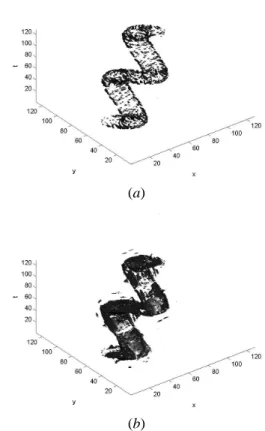
Planelets provide an ideal tool for representing local planes in a video sequence (or an image volume, in general) due to their ability to localise planar surfaces which correspond to lines in the Fourier domain. The presence of planar surface in a local analysis window can be inferred by computing the eigenval-ues of the local inertia tensor in the window and analysing them. The parameters for orientation of the local planar sur-face and translation from centre of the window can also be estimated by analysing the most significant coefficients in the locality. Consider a video sequence synthesised by moving the centre of a circle on a sinusoidal wave in the time direc-tion. Nonlinear approximations of this sequence using only
0.07%of the wavelet and planelet coefficients are shown in Fig. 1(a) and 1(b), respectively. It is clear from this example that the planelet approximation of a video sequence contain-ing locally planar surfaces can result in a smaller approxi-mation error as compared to that using wavelets. Planelets, therefore, can also be used for a piecewise planar approxima-tion of a video sequence. Moreover, the approximaapproxima-tion can be made to be adaptive to the local scale of the planar surfaces.
(a)
(b)
Fig. 1. Nonlinear approximation of a video sequence
contain-ing a movcontain-ing circle uscontain-ing (a) wavelets (b) planelets
4. EXPERIMENTAL RESULTS
The ability of planelets to capture locally planar structures can be demonstrated in various applications, one of which is video denoising. In video sequences acquired in extremely noisy situations, it can be assumed that the coefficients which are relatively small in magnitude most likely correspond to the noise. This leads to a simple thresholding strategy in the planelet domain, which is akin to wavelet shrinkage method commonly used for denoising 2D images. Since the pres-ence of additive Gaussian white noise means that almost all the planelet coefficients are affected by it, soft thresholding would provide an estimation of the original uncorrupted video sequence. The choice of threshold is crucial to the perfor-mance of a transform domain denoising algorithm [9]. We use either or both of the following thresholds: (1) a modifica-tion of the universal threshold proposed by Donoho and John-stone [10];θi =L(σ)
√
2 logni, wherenidenotes the
num-ber of coefficients at leveliof the planelet decomposition,σ is the noise variance, andL(σ)is a suitably chosen function ofσ, and (2) the SUREshrink (or simply SURE) threshold [1]. A translation invariant (TI) version of the planelet denoising was also implemented for a fair comparison with the transla-tion invariant wavelet (TIW) denoising [11] in its3D form.
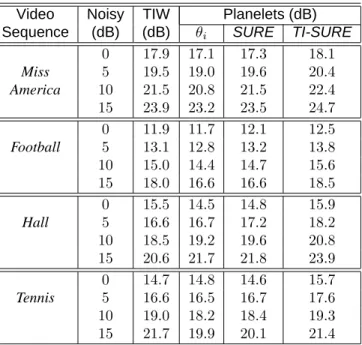
coef-ficients of the noisy sequence represented in a3-level planelet domain using a163 window. Experimental results for the planelet denoising and the 3D TIW denoising [11] of the noisy sequences with signal-to-noise-ratio (SNR) values of
0dB, 5dB, 10dB, and 15dB are presented in Table 1. The functionL(σ)was chosen to beL(σ) =alog10σ+bwhere
a, b∈<andb= 2a. A value ofa= 0.46was chosen empiri-cally using least squares fitting. It can be observed from these results that the TI planelet denoising gives better performance than the3D TIW denoising in terms of both visual quality and SNR gain. Denoising using TI planelet representation with
SURE threshold generally outperforms the other two
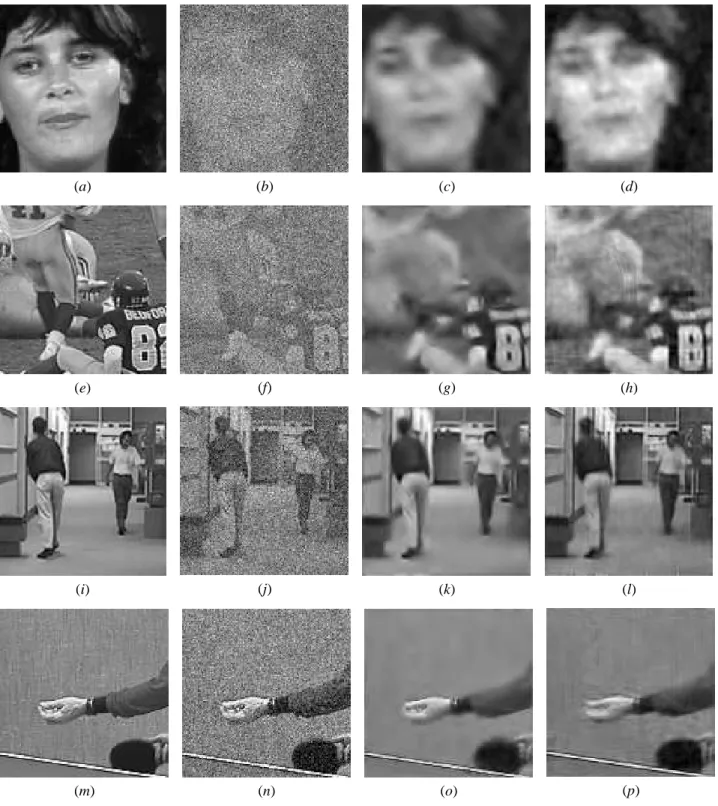
meth-ods. Selected frames, for each of these sequences, restored by planelet denoising are shown in Fig. 2. Two types of ar-tifacts were observed from non-TI results: blocking arar-tifacts due to the use of a163window, and fake textures which some-times persist within these windows, due to suppression of a significant amount of high frequency energy. The TI planelet denoising proves to be effective in removing both these kind of artifacts, and is particularly good in reconstructing some of the details that were smoothed out with the TIW method.
The computational complexity of our algorithm isO(n)as compared toO(Nlog2(N))for TIW denoising, wherenand
N respectively denote the size of analysis window and the size of video sequence (resolution of each frame times the number of frames). While being faster by orders of magni-tude, our algorithm still compares favourably to the3D TIW for all our experiments.
Video Noisy TIW Planelets (dB)
Sequence (dB) (dB) θi SURE TI-SURE
0 17.9 17.1 17.3 18.1
Miss 5 19.5 19.0 19.6 20.4
America 10 21.5 20.8 21.5 22.4
15 23.9 23.2 23.5 24.7 0 11.9 11.7 12.1 12.5
Football 5 13.1 12.8 13.2 13.8
10 15.0 14.4 14.7 15.6 15 18.0 16.6 16.6 18.5 0 15.5 14.5 14.8 15.9
Hall 5 16.6 16.7 17.2 18.2
10 18.5 19.2 19.6 20.8 15 20.6 21.7 21.8 23.9 0 14.7 14.8 14.6 15.7
Tennis 5 16.6 16.5 16.7 17.6
10 19.0 18.2 18.4 19.3 15 21.7 19.9 20.1 21.4
Table 1.SNR (in dB) values for four standard video sequence
5. CONCLUSIONS
In this paper, planelets were proposed as an efficient represen-tation tool for3D functions with planar singularities. Such singularities are commonly found in video sequences in the form of moving luminance edges. It was shown that a piece-wise planar approximation of a video sequence can be
ob-tained by using a very small fraction of transform coefficients in the planelet domain. The ability of planelets to extract pla-nar features from a video sequence makes them an attractive tool for analysis in various applications. For instance, decent restoration of video sequences captured in extreme noise is possible by thresholding of the planelet coefficients. The ef-fects of oversampling and use of tapered windows remain to be investigated. Although the discrete planelet transform can be computed efficiently, its redundancy and high storage re-quirements may be of concern in some applications. Future work will address these issues and a further investigation into the usefulness of planelets in a wide range of video analysis applications.
6. REFERENCES
[1] S. Mallat. A Wavelet Tour of Signal Processing. Aca-demic Press, 1998.
[2] E. Candes. Ridgelets: Theory and Applications. PhD thesis, Stanford University, Department of Statistics, 1998.
[3] E. Candes. Curvelets and curvilinear integrals. Journal
of Approximation Theory, 113:59–90, 2000.
[4] A. Bhalerao and R. Wilson. A Fourier approach to3D local feature estimation from volume data. In
Proceed-ings British Machine Vision Conference, 2001.
[5] R.G. Wilson, A.D. Calway, and E.R.S. Pearson. A gen-eralized wavelet transform for Fourier analysis: The multiresolution Fourier transform and its applications to image and audio signal analysis. IEEE Transancation
on Information Theory, 38(2):674–690, March 1992.
[6] N.G. Kingsbury. Image processing with complex wavelets. Phil. Trans. Royal Soc. A, 1999.
[7] P.J. Burt and E.H. Adelson. The Laplacian pyramid as a compact image code. IEEE Transactions on
Communi-cations, 31:532–540, 1983.
[8] M. Porat and Y.Y. Zeevi. The generalized Gabor scheme of image representation in biological and machine vi-sion. IEEE Trans. PAMI, 10:452–468, 1988.
[9] M. Jansen. Noise Reduction by Wavelet Thresholding. Springer-Verlag, 2001.
[10] D.L. Donoho and I.M. Johnstone. Ideal spatial adap-tation via wavelet shrinkage. Biometrika, 31:425–455, 1994.
[11] R.R. Coifman and D.L. Donoho. Translation-invariant denoising. In A. Antoniadis and G. Oppenheim, edi-tors, Wavelets and Statistics, pages 125–150. Springer-Verlag, 1995.
(a) (b) (c) (d)
(e) (f) (g) (h)
(i) (j) (k) (l)
(m) (n) (o) (p)
Fig. 2. Denoising results for four standard video sequences
(a) Frame# 90 of Miss America (b) Noisy (SNR=0dB) (c) TIW (SNR=17.9dB) (d) TI-Planelets (SNR=18.1dB)
(e) Frame# 60 of Football (f) Noisy (SNR=5dB) (g) TIW (SNR=13.1dB) (h) TI-Planelets (SNR=13.8dB)
(i) Frame# 106 of Hall (j) Noisy (SNR=10dB) (k) TIW (SNR=18.5dB) (l) TI-Planelets (SNR=20.8dB)