University of Warwick institutional repository:
http://go.warwick.ac.uk/wrap
A Thesis Submitted for the Degree of PhD at the University of Warwick
http://go.warwick.ac.uk/wrap/58594
This thesis is made available online and is protected by original copyright.
Please scroll down to view the document itself.
Technological Change, Diffusion and Output Growth
Maurizio Baussola
A thesis submitted in fulfilment of the requirements
for the degree of Doctor of Philosophy,
Warwick Business School Research Bureau,
University of Warwick,
Technological Change, Diffusion and Output Growth
I.
Introduction1
2.
Technological Change and Endogenous Growth5
2.1
Introduction 52.2
An
Overview of Traditional Growth Models6
2.2.1
Harrod-Domar6
2.2.2
The Neo-Classical Model9
2.2.3
Optimal Growth13
2.3
Endogenous Growth Models: The role of Knowledge15
2.3.1
Learning by Doing15
2.3.2
Knowledge and Human Capital23
2.3.3
Endogenous Growth and Research and Development29
2.3.4
Product Variety39
2.3.5
Empirical Evidence47
2.4
The Convergence Hypothesis60
2.5
Economic Integration and Growth69
2.S.1
The Determination of the Growth Rate73
2.6
Critical Evaluation of Endogenous Growth Theory 782.7
Conclusions89
3.
The Economics of Technological DitTusion91
3.1
Introduction92
3.2
Demand-Based Models93
3.2.1
Probit Models93
3.2.2
Uncertainty, Information and Learning96
3.2.3
Models With Strategic Interactions98
3.3
The Integrated Approach99
3.4
Empirical Tests106
3.S
Technological Diffusion At Economy-Wide Level108
3.5.1
Vintage Models109
3.S.2
Stock Adjustment Models112
3.6
Conclusions115
4.
Output Growth and Endogenous Technological DitTusion116
4.1
Introduction116
4.2
Exogenous Diffusion of New Technologies and OutputFluctuations
117
4.3
Knowledge Diffusion and Growth123
4.4
Endogenous Diffusion of New Technologies and Growth127
4.S
Model implications140
4.6
Conclusions145
5.
Empirical Investigation: An Introduction
147
6.
The Dynamics of R&D and Investment
154
6.1
Introduction
154
6.2
Innovative Activity and Investment
156
6.3
The Causality Between R&D and Investment:
Traditional Granger Causality Tests
161
6.3.1
Unit Root Tests
162
6.3.2
Choosing the Appropriate Lag Length
165
6.3.3
Cointegration and Granger Causality
170
6.4
Causality Between R&D and Investment in an Intersectoral
Framework
176
6.4.1
Time Series Properties of the Variables
182
6.4.2
Long-Run Relationship
188
6.5
Conclusions
191
Appendix 1-
Data Description
193
Appendix II - Data Sources and Summary Statistics
202
Appendix III - Investment and R&D Growth Rate
205
7.
The Interaction Between Investment and Output Growth
208
7.1
Introduction
208
7.2
Traditional Granger Causality Tests
210
7.3
Long-Run Relationship
213
7.4
The Dynamic Response of Output Growth
216
7.5
Conditional Granger Causality
(R&D, Investment, Output Growth)
219
7.6
Conclusions
224
Appendix -
Data Sources and Summary Statistics
226
8.
R&D, Investment and Growth: the UK Evidence
227
8.1
Introduction
227
8.2
Causality Between R&D and Investment
228
8.2.1
Unit Root Tests and Traditional Granger Causality Tests
228
8.3
Long-Run Relationship
231
8.4
The Interaction Between Output and Investment
233
8.5
Long-Run Relationship
236
8.6
Conditional Granger Causality
(R&D, Investment, Output Growth)
238
8.7
Conclusions
240
Appendix -
Data Sources and Summary Statistics
242
9.
Conclusions
243
Summary
The thesis presents a critical review of both traditional and new growth models
emphasising their main implications and
points of controversy. Three main research
directions have been followed, refining hypothesis advanced in the sixties. We first find
models which follow the learning by doing hypothesis and therefore consider knowledge
embodied in physical capital. The second class of models incorporate knowledge within
human capital while the third approach considers knowledge as generated by the research
sector which sells designs to the manufacturing sector producing capital goods. A typical
outcome of such models
is the existence of externalities which causes divergence
between market and socially optimal equilibria. Policy intervention aimed at subsidising
either human capital or physical capital is thus justified.
Empirical analysis has received new impetus from the theoretical
debate.
However, past empirical tests
are mainly based on heterogeneous
cross section data
which take into account mean growth rates over given periods of time, and ignore pure
time series analysis. On empirical grounds, the role of investment in the growth process
has been emphasised. This variable has also been decomposed to consider the impact of
machinery and equipment investment alone.
In this thesis we have underlined six
aspects of endogenous growth models,
which in our opinion reflect the main points of controversy:
i) scale effects;
ii) the treatment of knowledge as a production input;
iii) the role of institutions;
iv) the empirical controversy dealing with the robustness of growth regression
estimates and the measurement of the impact of some crucial variables (e. g.,
investment) on growth;
v) the simplified representation of R&D;
vi)
the absence of any discussion of diffusion phenomena.
We then propose a new version of an R&D endogenous growth model, which
explicitly incorporates the diffusion of innovations and permits comparison with results
derived from other models which do not consider the diffusion process. In this new
model the interaction between the sector producing final output and the sector producing
capital goods generates the time path of diffusion and hence the growth rate of the
economy.
In addition, there is another clear growth effect which derives from changes in the parameter which defines the diffusion path of new capital goods.
An
increase in the value of this parameter again causes an increase in human capital devoted to research and an upward shift of the diffusion path, thus increasing the long-run growth rate. This result underlines the difference with previous R&D endogenous growth models in that we now have a clear distinction between the sectors producing and using new capital goods.The empirical implications of the theoretical models are then investigated by testing the causal link between R&D and investment, on the one hand, and output growth and investment on the other hand. Indeed, a crucial task of any empirical investigation dealing with endogenous growth theories is to explain the nature of the links between industrial research, investment and economic growth. There is much room for study in this framework, as there are still only a few studies analysing these relationships. Our analysis deals with both aggregate data for the US and UK economies and an intersectoral analysis for the US manufacturing sector. We have used a test procedure which allows us to analyse both the short-run and the long-run properties of the variables using cointegration techniques. We are able to test for any feedback between these variables, thus giving more detailed and robust evidence on the forces underlying the growth process.
The results suggests that R&D Granger causes investment in machinery and equipment only in the US economy. However, there is evidence of long-run feed-back implying that investment may also affect R&D. In the UK economy there is no evidence for R&D causing investment nor is there strong evidence of long-run feed-back between the two variables. This suggests that the causal link between R&D and investment may not be thought of as a stylised fact in industrialised economies.
CHAPTER
I
1.
Introduction
Growth theory has been a central issue in Economics since classical economists.
In the 1950s and 1960s it became the most important issue in economics following seminal studies by Schumpeter (1934) and Solow (1956). Solow's neo-classical
approach contributed to resolving controversial results from previous models (Harrod, (1939, 1949) and Domar (1946». Studies by Koopmans (1968) and Cass (1965) refined the standard neo-classical approach with a more detailed theoretical framework, while
the studies by Kuznets (1955) contributed to the empirical debate on economic growth. After this period of controversial debate, interest in growth related issues
decreased, due to both theoretical and empirical problems. The main drawback of the neo-classical model lies in the assumption that technological change is exogenous and as a result the model cannot discriminate between the different variables which cause long-run growth. This analytical drawback contributed to a decrease in interest, both
theoretical and empirical, in economic growth until the first half of the 1980s, when new
models were proposed building on the seminal work by Arrow (1962), which endogenised technical progress through a learning-by-doing approach.
2
Knowledge becomes the crucial element in the innovative process with the new growth theory considering its role incorporated in either physical or human capital. This new analytical approach refines the neo-classical model and the studies by Arrow (1962) and Uzawa (1965). Some of the new models also consider knowledge as the result of the specific activity of an R&D sector in the economy. In such models technological
progress is endogenised through the production function of the R&D sector., the parameters of which determine, therefore, the long-run growth rate of the economy. A
typical outcome of such models is an externality associated with knowledge, as it is not a
fully excludable good. Thus, the market equilibrium may diverge from the welfare optimum, depending on the nature of the knowledge generating process. Such
externalities may affect either human or physical capital but in all cases the outcome is a
remuneration of human capital or physical capital which is less than is socially optimal. Despite recent analytical improvements there is still a gap between theoretical predictions and empirical findings. The empirical results (which are typically based on new data sets for the world economies (Penn World Table» often contrast with the conclusions of the theoretical models and, in general, there has been no improvement in the explanatory capacity of these models compared with the traditional neo-classical model. This fact is crucial, as it may reduce future interest in growth theory and hence in
the explanation of the determinants of long-run growth.
Together with the new interest in growth issues, there has also been a growing
interest in the economics of innovation. Building upon the work by Schumpeter (1939),
3
However, there is still a wide gap between the analysis of new growth theory, which endogenises the innovation process, and the economics of technological change. In particular we think that the analysis of the diffusion process in the innovation field may be used to help understand the possible impact of innovation on output fluctuations within the analytical structure of endogenous growth models. Hence, in this thesis, we
have incorporated an explicit treatment of the diffusion of innovation into an aggregate
endogenous growth model. Both theoretically and empirically, we have then analysed in depth the implications for the aggregate model, focusing on the causal links between the
key variables within the model, i.e., R&D, investment and output growth.
The thesis is organised as follows. In the second chapter we critically review both
traditional and new growth models. We focus particularly on the R&D endogenous growth models (Romer 1990a, I990b, Grossman and Helpman 1991a, 1991b) which represent the theoretical framework used later to incorporate the diffusion process into an aggregate growth model. We also analyse the empirical evidence relating to such models.
The third chapter analyses the theory of technological diffusion, focusing on both
4
In the fourth chapter, we present a new version of an R&D endogenous growth model, which explicitly incorporates the diffusion of innovations and permits comparison with results derived from original models which do not consider the diffusion process.
The last three chapters present empirical results. This are mainly concerned with tests of the main predictions of endogenous growth models, i.e., the causal link between
R&D and investment, on the one hand, and output growth and investment on the other hand.
This analysis sheds light on relationships which are still controversial within the
empirical debate and may help in our understanding of the empirical implications of the growth models analysed in the previous chapters. The analysis deals with both aggregate
5
CHAPTER II
2.
Technological Change and Endogenous Growth
2.1
Introduction
The determinants of economic growth have always been a point of controversy in
economic debate. In this chapter we shall analyse the main theoretical and empirical studies which have significantly contributed to the debate on economic growth and focus on the research lines representing the benchmark for the analyses described in the follow-ing chapters.
In the initial stages the theoretical debate concentrated mainly on the use of an aggregate production function to represent the economy and the growth rate was taken
as exogenous, given an exogenous growth rate of the population and technical progress. Debate on these issues, which ceased for roughly twenty years, received further impetus from a new theoretical perspective which tends to focus on the variables endogenously
determining the growth rate, and may therefore explain the long-run differences between different economies. A starting point for this debate is provided by Romer's analysis
(1986), in which the growth rate is endogenously determined following a learning-by-doing approach (Arrow 1962). Since then new models have been developed,
concen--
.6
in the original Arrow model, or in human capital (Uzawa 1965, Lucas 1988). In addition,
technical progress may be endogenised considering a third approach providing a specific sector of the economy (Research and Development) which produces knowledge which may then be used to produce new capital goods.
These new elements of the debate will be analysed, with particular emphasis on
their implications.
It
will be useful, however, to start this analysis with a brief review ofthe traditional models, and then move on to analyse the new approaches in greater detail.
2.2
An Overview of Traditional Growth Models
2.2.1
Harrod-Demar
We shall start the analysis of the traditional approaches with the Harrod-Domar model'. We can summarise the model briefly as follows:
(2.1)
L
J =Loe
nt (2.2)I=S
(2.3)
S=sY
(2.4)
I
=
V(~)
7
Equation [2. I] represents the labour supply. It is assumed that the labour force
grows at an exogenous and constant rate equal to
n,
while [2.2] represents theequilib-rium conditions on the goods market. Savings [2.3] are a constant proportion of the
na-tional income (Y). Equation [2.4] implies that, along a growth path where the goods
market is in equilibrium, expectations are always fulfilled: in other words, at any time
t,
firms will invest as long as the equilibrium between the desired and effective capital stock is reached. Recall that v represents the desired capital/output ratio and dy
at
theex-pected change in income. Along a balanced growth path, the expected and effective growth rates coincide.
In this context, without technical progress, the output growth rate coincides with
the growth rate of the labour force (n):
(2.5)
(2.6)
• y
=n
y
where
Y
=
dY
and." is the labour-output ratio. Technical progress may be introduceddt
assuming that
it
is neutral, labour augmenting and growing at a constant rate 2.We therefore have
2 Recall that the neutrality of technical progress referes to three different concepts:
8
where s,is the growth rate of technical progress. Equation [2.7] establishes that the
la-bour-output ratio decreases (due to technical progress) following an exponential path
determined by the parameter
ga'
Output dynamics is therefore determined by the parame-ters 11andga:
(2.8)
We therefore have
(2.9)
.
y
- =g +11
Y a
Equation [2.9] shows the natural growth rate when technical progress is included
in the model. From [2.3] and [2.4] we get the definition of the warranted growth rate
which maintains the goods market equilibrium. Thus we have
(2.10)
v-=sY
dYdt
9
(2.11) ldy
=
sy dt v
Equation [2.11] implies
The warranted growth rate is sv. Therefore, a balanced growth path is only reached when s/v = n -+-
ga ,
i.e., when both per-capita income and per capita-capitalstock grow at the exogenous rate
ga,
which is determined by technical progress, and full employment is guaranteed. However, s and v are not endogenous variables and, there-fore, there is no guarantee that the equality between the natural and warranted growthrates is reached in the economy.
The solution of this dilemma in the Harrod-Domar model has been twofold. On the one hand, the post-Keynesian school has emphasised the endogenity of the saving propensity considering its diversification among the social classes (Pasinetti 1962, 1974). On the other hand, the neo-classical approach (Solow 1956) has used the definition of aggregate production function to enodogenise the capital-output ratio.
2.2.2 The Neo-Classical Model
10
therefore, the capital-output ratio may vary as well thus modifying the assumption of the Harrod-Domar model in which the capital-output ratio is fixed.
The economy may be represented by means of an aggregate production function of the type
(2.13) Y
=
f(K(t), A(t)L (t»where
K
represents the aggregate capital stock,L
the labour force andA
a variable whichincorporates the change in labour productivity. It is assumed that
A
is an increasing andmonotonic function of time. Equation [2.13] may be written in terms of output per
effi-cient labour units
(2.14) y
=
f
tk )
==l(k,l)
f'
(k) >0;
I"
(k)s
0
where
It is also assumed that labour productivity grows at a constant rate
go
and thegrowth rate of the labour force isn. This means that 1
(2.15) A(t)
=
egG/(2.15') L(t)=e'"
11
If the previous hypothesis that each individual saves a constant ratio
s
of hislher income is maintained, aggregate savings are given by(2.16) S=sY
Savings are used to finance investments, and assuming no capital depreciation,
we get
•
(2.17) K =sALj(k)
Combining [2.15], [2.15'] and [2.17], we may write
•
(2.18) k =sj(k)-(g" +ll)k
This equation is a version of the well-known fundamental equation of the Solow model, which determines the evolution of the capital-labour ratio.
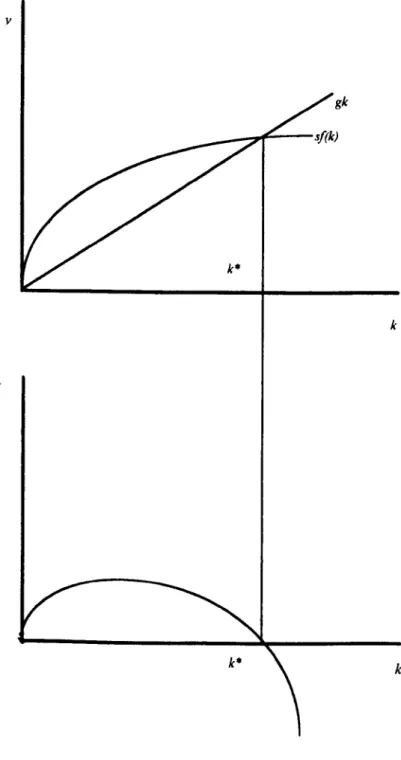
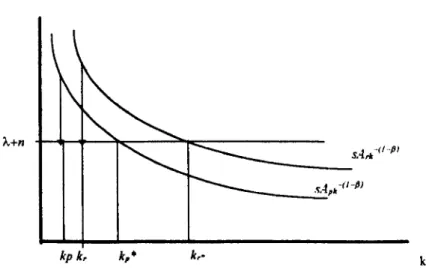
When s/(k) is greater than (ga + ll)k, the capital-labour ratio grows, while on the
other hand k decreases when s/(k) < (ga + n)k. Figure 1 shows the equilibrium path of
12
y
gk
k
•
k
k
13
2.2.3
Optimal Growth
The traditional neo-classical model may be modified to endogenise savings and to de-termine the optimal growth rate, which, without external effects and assuming rational
expectations, coincides with the competitive market equilibrium. The theoretical framework is a synthesis of the analysis of Ramsey (1928), Cass (1965) and Koopmans (1965).
The representative individual has a utility function of the type
(2.19)
Cl-Cl -1
U(C)
=
---,-t_I-a
where
C
is consumption at timet
and a defines the intertemporal elasticity ofsubstitu-tion. The representative consumer chooses the consumption path which maximises the
utility function [2.19], under the constraint of the available resources. Itis assumed that
the aggregate production function is of the type Y =/(K(t),A(t)L(t)). This equation may
be written in terms of output per efficient labour unit, as in the case of [2. 14]. The
in-tertemporal maximisation problem may be formulated as follows:
00 ((
=r:
1)
(2.20)
Max
f
«<r:"
ce; _
a -
dt
o
s.t .
•
14
where c is consumption per efficient labour unit, p is the rate of time preference,
n
thepopulation growth rate, ga the productivity growth rate and A.the capital depreciation rate 4.
The corresponding Hamilton conditions of this problem are
(( ceg.1
r:
-1)
(2.21)
H=e-(p-n)1 +m(f(k)-c-(ga +n+A)k)I-a
(2.21')
He
=
0<::> e-(p-n)te
gat(ce
gatFa -
m
=
0•
(2.21" ) H, =+m<::> -m(
f'
(k)-(s,
+n+ A)) (2.21"') lim m(t) =Ojlim H=
0t~1X') t--+(1)
where m is the co-state variable. Taking logarithms of [2.21 '], differentiating with
re-spect to time tand combining with [2.21 '], we get the growth rate of
c:
•
c
(2.22)
-=a-1(f'(k)-(ag +A+p))c a
The inclusion of exogenous labour productivity growth enables us to solve the problem of the constancy of per-capita income and consumption in the original neo-classical model.
15
In this case, in steady state, the ratio ~
=
C , i.e., per capita consumption in efficientAL
labour units, is constant. However, per capita consumption in physical units grows at
the rate
ga
since [2.23] holds:c
-(2.23)
-=cA
L
If this result solves the problem of the cap on per capita income and consumption
typical of the neo-classical model without technological change, it does not, however, explain the source of technical progress and therefore the source of economic growth. This contradiction in the original neo-classical model, which, in fact, represents the real objective of a theoretical investigation on growth, has been faced by the later endoge-nous growth models. This line of research aims at investigating the source of techno-logical change and its impact on growth and on the ability of the market economy to
reach efficient growth paths.
2.3
Endogenous Growth Models: the role of knowledge
2.3.1 Learning by Doing
16
Endogenous growth models have tried to fill this gap by defining the variables which may affect technical change. However, the theoretical framework of this line of research lies in models refined in the 60s (Arrow 1962, Uzawa 1965, Shell 1966), in
which the role of knowledge as production input is considered. There has been three main lines of research which have tried to identify the mechanisms of knowledge
accu-mulation.
Firstly, knowledge has been incorporated in physical capital (Arrow 1962),
de-pending on its accumulated stock. The rationale of this analytical tool is that firms im-prove and add knowledge (learning-by-doing) to the capital goods they produce. This knowledge incorporated in capital goods may be freely used by other firms, thus
con-tributing to the productivity of production inputs in the whole economy.
Secondly, knowledge has been incorporated in human capital (Uzawa 1965, Lu-cas 1988). Again there may be an external effect (however, not essential to determine an endogenous growth rate of the economy), deriving from the use of human capital in the production process, which, as in the case of learning-by-doing, creates the typical
prob-lem of market equilibrium with externalities.
Finally, there are models (R&D models) which consider knowledge accumulation
as the result of an activity specifically dedicated to this purpose (Shell 1966, Romer 1990a, 1990b, Grossman and Helpman 1991). We initially consider the first type of model then discuss the other theoretical approaches.
We shall start by analysing the non-vintage version of the Arrow model, which simplifies the exposition while leaving unchanged the conclusions (Sheshinski 1967). Consider a
17
(2.24) Y
=
Kb
A(t)LI-bwhere A(t) represents the state of knowledge at time t. Following the learning by doing
hypothesis, we may write
where I( represents the state of knowledge, which is a function of accumulated
invest-ment. As in the traditional neo-classic model, it is assumed that consumers intertempo-raly maximise their utility function. Thus we have
(2.26)
MaxI'"
e-
P1(c
t•a -I)dt
1-0 o
s. v.
From the Hamilton conditions we get
t-a
(2.27) H =e-P1(_c-)+m(kfiKI:J. -c)
1-0
(2.28') He
=
0<=>
e-
P1c-
a=
m
• •
(2.28") Hi; = - m
<=>
m=-m(f3k -(1- filKI:J. )18
where leis the aggregate measure of capital stock,
k
is per capita-capital stock andL
isthe labour force.
The equilibrium condition in the capital market requires that
K=Lk.
Taking logarithms of[2.28'], differentiating with respect to time
t
and finally substituting [2.28"], we get•
(2.29) ~
=
Y
=
(J -I(J3k
-(I-I1-~)La -
p)C
This condition states that the consumption growth rate is proportional to the dif-ference between the marginal product of capital and the rate of time predif-ference. In this
version of the model it is assumed that the labour force is constant.
Itis worth noting that this model shows an endogenous growth rate
r
> 0pro-vided that
f3
+ a=
1. If we consider a logarithmic transformation of [2.29] anddifferen-tiate with respect to time
t,
we get(2.30) 0
= f3(a
+
f3
-l)yIf a+
f3
< 1, the only steady state growth rate isr
=
0, as in the traditionalneo-classic model without technical progress.
This result suggests that even with increasing returns to scale a positive steady
state growth rate is not always attainable. In fact, the value of
a
must be sufficiently19
In this case the growth rate would be'
This growth rate implies a scale effect which derives from the size of the labour
force. This effect depends on the assumption that knowledge is incorporated in the
ag-gregate stock of capital. On the other hand, if one assumes that knowledge is proxied by the average capital stock, a growth rate independent from the size of the labour force
may be derived'
The market and optimal equilibria differ since the social planner would maximise
the utility function [2.27], no longer assuming the stock of knowledge (incorporated in
the capital stock) as given. The first order conditions are therefore obtained including all
capital stock, even that part which is external to the individual firm. The Hamilton
conditions become
1-0
(2.32)
H =e-P'(_c_)+
m(ka+~La - c)1-(J
.
.
(2.32")
n,
=-m<;:::>m=-m((a+~)k-(1-a-~)c')(2.32"')
limmit )
=
0;limH
=
0I~OO 1400
This implies the following growth rate
5Romer (1986) has shown that a technology with increasing return to scale such that ~+<x>l may cause
a positive and growing growth rate.
20
This growth rate is higher than the market equilibrium growth rate. In other
words, the competitive equilibrium implies an underinvestment by the single firm, since it
does not internalise the externality represented by the stock of knowledge incorporated in physical capital. This underinvestment therefore causes lower production.
We may link this analytical approach, which incorporates the stock of knowledge
m physical capital, to a wider field of investigation, where the so-called learning by watching is taken into account (King and Robson 1989, 1992).
The basic idea in this framework is that there is a demonstration or contagion
ef-fect which comes from observations of new ideas embodied in new investment The em-pirical evidence discussed in Cohen and Levinthal (1989) shows that many innovations in one firm or industry determine development and innovations in other firms and
indus-tries. Scott (1989) views investment as the engine of growth, because it brings about new investment opportunities, which may be called learning externalities. In the model proposed in King and Robson, the level of technological knowledge evolves over time
21
Denote
G;
as the natural growth rate given by the technical progress function, which is afunction of the investment rate (i):
(2.34) G,
=
f(i)From the intertemporal maximisation problem one can derive the growth rate of
consumption'
c (r -p)
(2. 3 5)
= ;_______::_:_
C 0'
where
p
is the rate of time preference, r is the interest rate and adefines theintertempo-ral elasticity of substitution.
The investment criterion adopted by firms requires that the marginal product of
capital be equal to its user cost. Assuming a Cobb Douglas technology, the production function in per capita terms is:y=Al-ak, where A represents the stock of knowledge and k
per capita capital. It is assumed that the labour force is constant and this allows the normalisation
L
=
1. Knowledge is a function of investment and evolves according toThe investment criterion condition implies
'Given a utility function of the type
.
U(c)=C1-erlI-o .from the intertemporal maximisation of this.
c
(r-p)function one gets: -
= --_
...
22
a
r
(2.37) -= -+A
v
1-1
where
v
is the capital-output ratio,r
is the interest rate,A.
is capital depreciation and Iisthe tax rate'.
Equilibrium requires that [2.34] and [2.35] be equal, i.e., the natural growth rate
and the warranted (rational expectation) growth rate must be equal. Furthermore, in equilibrium the investment rate is given by
(2.38) I.=-vC
c
Solving the system represented by equations [2.35], [2.37] and [2.38], gives the equilibrium growth rate
•
c
i(p+'A(I-I))(2.39)
-=y=----c a(l-I)-oi
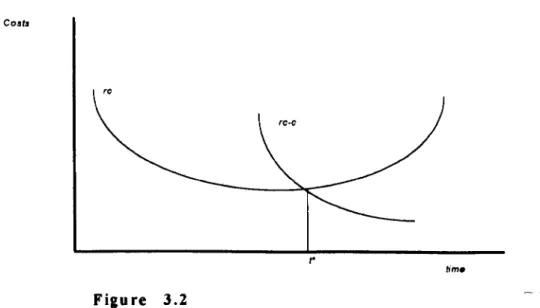
Itis worth noting that this solution is not unique given the non-linearity of the
technical progress function. Equation [2.39] states that the growth rate compatible with
23
capital market equilibrium is an increasing and convex function of i. The equilibrium solutions are given by the intersections with the technical change function (Figure 2.2).
r
CJlE
TPF
Figure 2.2
CME=Capital market equilibrium
TPF=Technical progress function
2.3.2 Knowledge and Human Capital
24
scale. The labour input is allocated between the education and production sectors. The
aggregate production function is of the type: Y =I{K.AL). The model may be
summa-rised as follows:
00
(2.40) Max
J
e( t )e -pidto
•
(2.40' ) k
=
.ry - Ale
(240")
A
=
A'It:J
where e is per capita consumption. A the state of technological knowledge. A.the capital
depreciation rate,
s
the proportion of savings to national income andy
per capita income. In other words, the problem is the usual intertemporal maximisation of con-sumption subject to the constraint determined by the accumulation of physical capitaland technology. The latter is a function of the ratio between the labour force employed in the education sector (LE) and in production (Lp). Itis worth stressing that the division of the labour force into two components has been widely considered in many later en-dogenous growth. models.
It
is possible to derive the optimal allocation of the labourforce between the production and education sectors and the optimal capital-labour and capital-output ratios from the conditions for intertemporal maximisation. In the model it is shown that the optimal growth rate is reached when the growth rate of labour
pro-•
25
Following the line of research outlined by Uzawa is the Lucas model (1988), which represents a generalisation of the previous models of human capital accumulation. Consider again a closed economy with competitive markets, identical individuals and a technology with constant returns to scale in absence of externalities. We also define
h
asa measure of the qualification of each worker. It is assumed that a worker with this qualification level assigns a fraction q(h) of his/her time to productive activity and a
frac-tion 1 -q(h) to hislher qualification.
In addition to this direct effect of human capital on productivity, an external ef-feet is considered. This latter refers to the mean level of qualification of human capital, which may also influence the productivity of other inputs and therefore may affect the growth rate of the economy. As in the previous model it is assumed that consumers
maximise their utility
in
an infinite time horizon. We then have(1) I-a
(2.41) Max
f
~pI L(t)dto I-a
• f\S
(2.411) K =AKf3[qhLtf3 h - Le
•
(2.41") h
=
Eh(l-q)It is also assumed that the labour force grows at an exogenous rate n.
as-26
s
sumed that the technological level is constant and equal to
A.
The term h captures the external effect of human capital and is proxied by the mean qualification level of the la-bour force. The second constraint concerns the accumulation of human capital. Thisequation implies that the accumulation of human capital is a linear function of the effort
dedicated to this accumulation process (1 -q).
If there is no effort in the accumulation of human capital (q
=
1), the economy does not accumulate human capital. On the other hand, ifq
=
0, i.e. the entire effort isdedicated to the accumulation of human capital, the economy grows at the rate E. The
~ iJ
equilibrium condition in the labour market means that h =h.
The conditions which show the growth rate of per capita consumption and human capital can be derived from the Hamilton conditions.
(2.42) H
=
e-
p,(cl-a)
L(t)+m(AKP
(qL)H
hl-P,S -Le)
+
l(hE(1- q))
1-0
(2.42') He =0
<=>
e-p'c-
a =m
(2.42" )H
q=
0<=>
m(
AKP
(1-f3)(
qLhr
PLhI+
S)=
lthe )
(2.42'" )H
le = -;"<=>;"
=-m(f3AKP-1
(qL/-
Ph
l-P
+[})
(2.42'" )H
h=
-i
<=>
i
=
-m((1-f3)AKP
(qLY-
P hH+S )-1£(1-q)
From conditions [2.42'] and [2.42"] it is possible to derive the equation which
27
(2.43) ~
=y =0'-I(I3AK[3-1 (ql.)I-Ph1-[3+3- p)e
The accumulation rate of physical capital may be obtained from the constraint
[2.41]
and from[2.43r
•
K
(2.44)
-
=
y+n
K
One should consider now the accumulation of human capital From
[2.43]
we get(2.45)
(y~:
p)=
KP-1(qL/-P
hl-P~3Taking logarithms of
(2.45)
and then differentiating with respect to time yields:.
h
y(l-I3)(2.46) h =
(1-13+3)
.
9 . K AK-(1-P)( L 1-Ph1-P.3 Le
Equation (2.44) is derived considering that: - = q )
-K
K
e
The first term on the RHS may be substituted considering the expression for - Therefore we have:
e
.
K
ay
+p= ----'-____:~
K
13
Le
K.
KTaking logarithms and differentiating with respect to time we get: - =
r
+n
28
ters which determine the growth rate in [2.46] may be obtained from the Hamilton
con-ditions. In fact, from [2.42"] we have
(2.47)
m
=
E/
AK[3(qLr
PLh
9-PAgain using logarithms and differentiating with respect to time we get
.
. .
m
h /(2.48) -
+J3y
+Il
+(3 - J3) -
=
-m
h
I
From equation [2.42'''] we note that
m
=
-(p + YeT), while from [2.42"] andm
.
[2.42""] we may obtain!
= -
6 .Therefore we can substitute these values in [2.48] tode-I
scribe the parameters which define the growth rate of human capital
h _
_
(1-J3)(t-(p-n))(2.49) - - Yh -
.-h 0(1-
J3
+
3) - 3
29
(2.50) e-(p-n)
Y
=
Y
h= _
__;_--(JThis growth rate coincides with the optimal growth rate. If
s
>0,equation [2.49]holds and hence we have
r
>rh.
This will induce higher growth of physical capitalcompared with human capital. In a market economy, therefore, with a positive external effect individuals will invest in human capital at a lower rate than would be socially
op-timal. Itis however worth noting that the external effect on human capital is not neces-sary to determine the endogenous growth rate of the economy. This latter is positively influenced by the parameter which defines the productivity of human capital, the growth
rate of the labour force and the intertemporal elasticity of substitution. The growth rate is negatively influenced by the discount rate.
2.3.3 Endogenous Growth and Research and Development
In this type of models knowledge accumulation explicitly depends on the amount of resources allocated to inventive activity. A common framework for the recent models described by Romer (1990a, 1990b, 1991) and Grossman-Helpman (1991, 1992) is the
original work by Shell (1967). The economy is again represented through the aggregate production function
30
where
K
andL
are respectively the capital stock and the labour input.A
is the aggregate stock of knowledge. The evolution ofA is given by the following equation.
(2.52)
A
=oy,(t)Y -AeA
O<o~l
O~yr ~
1
x,
~O
where 8is a coefficient which reflects the success of the research activity,
v.
indicates theproportion of output allocated to inventive activity and A..: is the rate at which techno-logical knowledge is depreciated.
The aggregate stock of capital evolves according to
(2.53)
K
=s(tJ[l- y,(t)]Y-')J(where srepresents the propensity to save and A is the capital depreciation rate. We focus
on the accumulation of
K
andA ~
it is therefore assumed that the labour force is constant and normalised to one. In a decentralised economy the accumulation process may beobtained from the system [2.52] [2.53].
31
00
(2.54) Max
j
U[(l- s)(l-Yr
)Y, -pidto
(2.54' ) (2.54")
•
A
=
0YrY -AeA
.
K
= s(l-Y
r )Y -
').J(The usual Hamilton conditions may be derived. However, it must be stressed
that when there are two state variables (A and K), the solution of the problem is not simple. Shell does not give an explicit solution; however, he shows how
A
andK
tend to-
-a specific const-ant, respectively A and K .
This result is not consistent, since bounded technological progress can only guarantee a constant income level which therefore remains steady. This criticism, dis-cussed in Kzuo Sato (1965), is based, in particular, on the specification of
A.
In fact, if[2.52] is rewritten as
.
(2.55)
A
=0YrA - ArA
or
•
(2.56) A
=
OV -A
A :.Tr r
then there is no longer an upper bound to knowledge as long as oYrAr> O.
32
In the Romer model, the output of the sector which produces knowledge is a partially excludable good. It should be borne in mind that a good is rival if its use by an individual or firm precludes its use by another. The opposite definition applies for non-rivalry. A good is excludable if the owner can prevent others from using it. Public
goods are, by definition, both non-rival and non-excludable. The Romer model separates
the rival and non rival component of knowledge. The former is proxied by human capital used in the production of consumer goods, while the latter is proxied by the stock of
knowledge incorporated in the designs of the existing capital goods.
The economy is represented by three sectors:
a) the final goods sector;
b) the research sector;
c) the sector which produces capital goods.
In the first sector the production function considers a multiplicity of capital goods
using a representation taken from Dixit and Stiglitz (1977):
~
(2.57) Y= g(L.
HyJL
x(il
1=133
X
=={X
I }: l' The production function is homogeneous of degree one. The functiong(Hy.L ) is therefore homogeneous of degree I - f/J.
The production function describes the technology of a representative firm, within a competitive market.
The research sector produces knowledge, which is incorporated in designs then sold to the sector which produces intermediate goods. The production function in this sector considers the production of designs at time t as a linear function of human capital
(Ha) and the existing stock of knowledge (A)
•
(2.58)
A=oHuA
where 8 (8 > 0) is a parameter reflecting the productivity of human capital in the
re-search activity. The sector which produces intermediate goods cannot be described in terms of a representative
firm.
For each capital good (t) there is a distinct firm which therefore acts as a monopolist.A firm in the manufacturing sector may convert J.Junits of final output into a unit
of intermediate good . The aggregate measure of capital (K)may be defined as follows:
A
(2.59) K
=
I!LX,
34
where p represents the cost (in terms of final output) of producing one unit of capital
good (i). The total amount of human capital H is the sum of human capital in manufac-turing (Hy) and human capital employed in the research sector (Ha.). Itis also assumed that the labour force is constant, implying that H and its components are constant as well.
It is then assumed that the different types of capital goods are all used at the same level
x·
and that the index i may be represented through a continuous variable. Equations[2.57] and [2.59] may be rewritten as follows:
where
x·=-
K/J
A
and
(2.61)
K=/J Ax·
35
O.
Due to the stationarity of the model the values ofHa
andH,
are constant; however,the value of
Ha
is endogenously determined, thus also determining the growth rate of the economy.The labour market must clear for
Ha
andH,
to remain constant. and, therefore,returns on human capital employed in the manufacturing sector and in the research sec-tor must be equal. In the manufacturing sector returns on human capital are given by
the marginal productivity rule. We therefore have
(2.62) W.fly
=
gflyA( x*lwhere Whyis the remuneration of human capital and ghyA(x*)¢Jis its marginal
pro-ductivity. In the research sector, returns to human capital depend on the rent which can be extracted from a patent on an invented capital good. Thus we have
(2.63) Wfl
=
P»A•
where P; is the present value of the monopoly rent which can be extracted by researchers
and
oA
is the number of designs produced per unit time per unit human capital. The36
A
(2.64) Max
J
(g( Hy,usar :
p(x(i))x(i))dio
and therefore
(2.65) p(x(i)) = q,g(Hy, L)x(i)CP-1
On the supply side, given the demand function, the problem for the single monopolist
which produces capital good (i)is
r
A
f
rt sIds(2.66) Maxf[p(x(t))X(t}-r(I)J.IX(I/r 0 dt
o
where rp.(t) is the rental cost of capital used for the production ofx(i). This problem is,
however, easily solved due to the stationarity of the model. Indeed, r, x(i) and pare
constant in equilibrium. The cost of a patent Pa will be defined in equilibrium by
(2.67) P,
=
X*
rm1
~f37
1
(g( H .
L)cp2J
1-<1>(2.68)
x·
=
yrJ..l
The conditions for the equilibrium in the labour market are
If for the sake of simplicity and without loss of generality we explicit the function
the value of
Ha
may be endogenously determined.. If we take preferences as being
ex-ogenous, this value will be given by
H =H-
ra
(2.71) a df
If we endogenise preferences, the value of
Ha
is determined
by"10Preferences are easily endogenised through the usual intertemporal maximisation: Max (Cl-U/l-a)e-rt
.
C
38
(2.71' )
In both cases the result is crucial for it shows that the balanced growth rate depends on
the allocation of
Ha.
which is in turn obtained from the equilibrium conditions in thela-bour market and from the parameter 8, which represents the productivity of the human
capital employed in the research sector. Equation [2.71] suggests that a decrease in the
interest rate causes an increase in
Ha
and therefore has a positive effect on the long-rungrowth rate. From equation [2.72] the impact of the interest rate is obtained through
the parameters p and
a.
It is worth noting that the parameter p" which defines thepro-duction cost of capital goods, does not affect the equilibrium value of
Ha
and therefore the growth rate. This means that any investment subsidies, which bring about a reduc-tion of the producreduc-tion cost of capital goods, have no effect on economic growth. This is due to the equilibrium conditions in the labour market. Human capital in the research sector must compete with human capital in manufacturing and returns on both inputsmust, therefore, be equal in equilibrium. A subsidy which reduces the value of p,
deter-mines a higher value of x* (from equation 2.67).
An
increase inx* has a positive effect on the marginal productivity ofH,
and therefore on its remuneration. On the other hand, the demand for capital goods increases and returns to human capital in research increases39
The growth rate determined through this mechanism is lower than the socially optimal growth rate, as returns on human capital in the research sector do not corre-spond to their optimal level, causing, therefore, an underallocation of resources in this sector. This depends, on the one hand, on externality in the research sector, as the
ag-gregate stock of knowledge grows as new inventions are discovered without any remu-neration (due to the non-excludability hypothesis). On the other hand, the purchase of
designs is made by a single monopolist producing intermediate goods. This causes a difference between the remuneration of the input used (the price of the patent) and the marginal productivity of human capital in the research sector.
A socially optimal solution may be achieved through a subsidy to the research sector to balance the difference between the marginal productivity of human capital and the corresponding remuneration.
2.3.4
Product Variety
differ-40
entiated good. The firm may also invest in Research and Development to produce new differentiated goods.
The model is characterised by an aggregate demand side defined by
I
(272) C
=
[I
x(j)"d;
r
O<a<l
where xU) is the quantity of good x of the variety
j.
On the supply side, each firm holds the technology for the production of a single variety, for which it has a monopolisticpower. Itis assumed for simplicity that each variety needs a labour unit for each unit of
output produced. The demand function [2.72] implies that:
MRO)
=aptj),
whereMRO)
is the marginal revenue and
pO)
the price of variety0).
If the marginal costMC
is equal to the wage ratew
for all varieties and ifMRO)
=MCU)
the price of the single varietieswill be the same
w
(2.73) p
=-a.
Given the price rule, operating profits per variety of good are defined by
(2.74) 1t=(l-a)pX
41
where X represents aggregate output and n the number of varieties. In a dynamic framework, monopolistic competition implies an entry condition determined by a
no-arbitrage rule
(2.75)
.
1t S
-+-=r
S
S
a
represents the value of a firm, which is equivalent to the present value of the profitsgained at
any
time t. In other words,a
is given by, 00 -
J
r( sids(2.76) S
=
Jet
1t(t)dtwhere nrepresents the profits flow and r the discount rate. The no-arbitrage condition
establishes that the rate of profit and the rate of capital gain are equal to the nominal
in-terest rate.
A
potential entrepreneur who wants to invest inR&D
to develop a new42
(2.77) 3
=
wbAn
where
b
is a parameter which reflects labour productivity,
w
is the wage rate and
An
is
the stock of knowledge.
Assuming that
An
is proxied by the cumulated experience
in
R&D measured by the number of varieties which have been invented
(n),we may write
II(2.78)
S
=
wbn
The equilibrium condition in the labour market requires that employment in R&D
and in the manufacturing sector be equal to the aggregate supply of labour
(2.79)
!!_~+
X
=L
n
where
billrepresents the amount of work needed for an innovation; ~ is the number of
innovations at time
tand
X
the amount of labour allocated to the manufacturing sector.
If it is assumed that consumer preferences are described by the usual utility
func-tion
U = --,c" "
the growth rate of C may be derived from
1 - o
43
(2.80)
C
=
_![r -
p-Pc
1
e
a
r.
where
pc
is the price of final output (in equilibrium the price is identical for all varieties).
Given the equilibrium condition in the labour market and the non-arbitrage condition, it
is possible to show that the economy is characterised by the following growth rate"
[ (1- a) ~ - up]
(2.81) Yn
=~--~---u+(1-u)a
where
pis the rate of time preference,
bis the parameter which reflects labour
produc-tivity and
a
is the inverse of the elasticity of intertemporal substitution.
Itis worth
not-ing that
rn
increases if
12Consider the following equations: aYn+X=L; -
"
+ -a
= r .The first equation represents there-a
a
wb
source constarint in the labour market, while the second describes the no-arbitrage. Since
a
=-n
w
1 band
Pc
= -.
and taking the wage rate as the numeraire, we have:Pc
= -
and therefore:a
= -.
a a
n
a
"XThis implies that: - = -
r
n .In addition we have: - = (1 - a ) - .From the equation which definesa
a
bae
(I-a) P -(I-a)the demand for goods we get: -
=
r
n and _c=
r
n' The interest rate isthe-e
a
Pc
a
1 - a
refore defined by:
r
= P +r
n -- (er - 1). Substituting into the equation which defines the no-aa) the size of the labour force (L) is greater (scale effect);
b)the rate of time preference is lower;
c)the degree of monopolistic power (11a)is greater;
d) the elasticity of intertemporal substitution (1/0-) is greater .
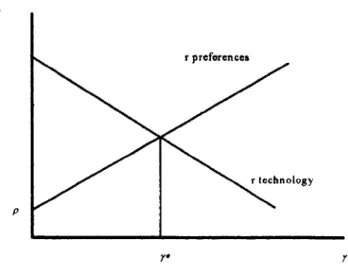
. These results are clearly shown in Figure 2.3., where the steady state conditions are represented. The RR curve represents the resource constraint, while the AA curve represents the no-arbitrage condition. The RR curve has a negative slope as an increase
in the innovation rate (Yn) implies greater employment in the R&D sector and therefore a
decrease in employment in manufacturing. The AA curve has a positive slope as an in-crease in the innovation rate brings about an inin-crease in the effective capital cost,
deter-mined by a higher interest rate and a faster depreciation of the value of the firm. A higher profit rate is therefore needed to undertake the R&D activity. The intersection between the two curves represents the steady state equilibrium.
Figure 2.3 a. shows how growth is constrained, on the one hand, by the availability of re-sources and, on the other, by market incentives. An expansion of the available resources moves the RR curve upwards; a lower rate of time preference moves the AA curve
x
A
r
Figure 2.38
It is worth noting that the model defines a positive rate of innovation if
Lrb
>apl(J - a) (from equation [2.81
D.
If this condition does not hold, there is noendoge-nous growth (Yn)
=
O. The cost of innovation is so high that it discourages anyinnova-tion. The solution implies that all the resources are allocated to the production of the existing varieties of goods, without further innovation (new varieties). Figure 2.3a must
46
x
A
L
r
Figure 2.3b
This analysis, which deals with the production of differentiated final goods, may
be extended to the case of differentiated productions of intermediate goods. The model may also be extended to the case where the increase in quality of new products is taken into account. In this case, the high quality products substitute for the low quality ones. This means that the producers of the low quality goods will not gain any more positive profits and that therefore monopolistic power is not maintained for an infinite time, as
in the case of horizontally differentiated products.
The arbitrage condition is modified to take into account the risk of the investment
47
As in the Romer model the difference between the balanced and optimal growth rate lies inthe external effect produced in the R&D sector. Indeed, the stock of knowl-edge grows as new varieties of products are created by single researchers without any corresponding remuneration. A Pareto efficient solution may be attained by introducing a
subsidy to the R&D sector to take into account this spill-over effect and to restore equi-librium between the private and social remuneration of labour in the research sector.
A further development of these R&D models is given in the analysis by Aghion and Howitt (1992), of which we mention the main hypotheses and conclusions.
The output of research activity is made stochastic through inventions which
ar-rive following a Poisson stochastic process. In addition, a sort of Shumpeterian hypothe-sis (creative destruction) is introduced, in that the successful R&D activity makes the previous inventions unprofitable. This innovative mechanism finally determines endoge-nous economic cycles. The model, while improving on previous R&D models, does not
consider capital accumulation, as physical capital is not considered in the production functions of the three sectors which define the economy.
2.3.5 Empirical Evidence
48
Despite this theoretical improvement, empirical tests in this line of research are still controversial. However, there have been some recent improvements in techniques and in the quality of the data sets. Nevertheless, general dissatisfaction persists, particu-larly regarding the robustness of the results and the explanatory capacity of the adopted
empirical models.
Two different approaches have been used for the empirical tests. The first makes use of a historic approach, identifying all those cases where external economies deriving
from the use of certain capital goods have involved significant increases in productivity growth (Rosenberg 1986, Caballero-Lyons 1991).
The second approach uses econometric analysis based on cross-country data,
which aims to establish the significance of appropriate explanatory variables as determi-nants of the growth rate.
We will focus on this second approach, which is the empirical counterpart of the theoretical models analysed in the previous sections. The core empirical literature in-cludes the studies by Romer (1990b), De Long-Summers (1991, 1992), Barro and Sala-i-Martin (1992), Fischer (1992), Mankiw, Romer and Weil (1992), Jones (1995).
In the model proposed by Romer (1990a, 1990b), the crucial variable affecting
49
This result crucially depends on the assumption that the function g(Hy,L), which
appears in the aggregate production function, is of the type
1-cp (2.83) g(Hy,L)=[aH: +(l-a)LP]p
If the parameter
fJ
tends to zero, we have the usual Cobb-Douglas productionfunction
(2.84) g( Hy, L) =
n,
o:(1-CPI L(1-O:I(I-CPIIn this case, even assuming some exogenous variations in the labour force (L),
there are no effects on the equilibrium value of
Ha
and, therefore, on the growth rate. Inoff-50
set each other, thus leaving the market equilibrium unchanged.
In this case the increase
in
L
has no effects on the long-run growth rate.
On the other hand, assuming that the value of the parameter
P
is different from
zero, a variation of
Linfluences
HQ'In this case we have
It
may be argued that if
Hand L
are complements
(ifP
is below zero) an increase
of
L
causes a reduction of
Ha
and therefore a reduction in the long-run growth rate.
The empirical model takes into consideration the basic aggregate production
function [2.60], which may be rewritten as a function of
A
and
K
U sing logarithms and differentiating with respect to time gives
y
d
1~
«. )]
L
A
K
(2.87J-=-l
-,151
Denoting the capital depreciation rate as A, the investment-output ratio will be
linked to Kby the relation
(2.88)
~=[(~)(;)]-A
Substituting [2.88] in [2.86] yields:
'\
From the hypotheses of the theoretical model it may be argued that the invest-ment-output ratio does not affect the growth rate of
A;
on the other hand,L
has a nega-tive effect on this variable.From equation [2.89] the impact of the investment-output ratio and the size of
the labour force (L) may be derived, However, one needs to assume, on the one hand, that the ratio HyL remains substantially constant over the sample period and, on the
52
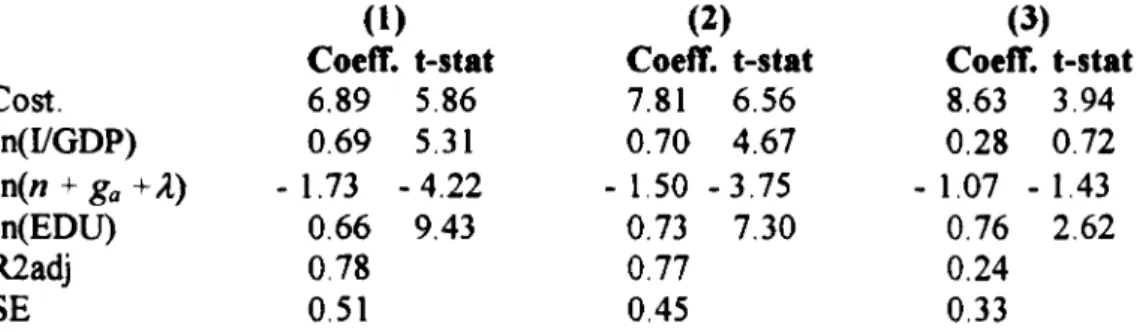
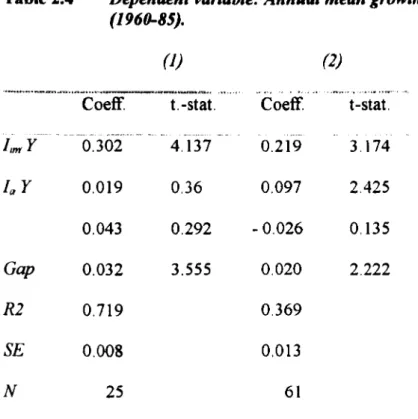
Table 2.1
Dependent variable: annual mean growth rate of GDP per capita,
1960-85. OLS estimates.
Const.
POPGR.
YINV
GOV
DUM I
DUM2
R2adj.
SE
VM
SD
CoetT.
2.20 0.968 - 0.0002 0.182 - 0.099 - 1.27 - 1.24 0.147 1.436 4.07 1.88t-stat
2.78 4.71 - 2.55 6.67 - 3.57 - 3.13 - 2.96Table 2.2
Dependent variable: annual mean growth rate of GDP per capita,
1960-85. OLS estimates
Const.
POPGR
YINV
INV2GOV
DUM
IDUM2
R2adj.
SE VMSD
CoetT.
0.949 0.885 - 0.0003 0.422 - 0.0076 - 0.110 - 1.04 - 1.25 0.440 1.41 4.07 1.88t-stat
1.00 4.33 - 2.83 3.93 - 2.31 - 3.99 - 2.53 - 3.04Legend: POPGR =average annual rate of growth of the population:
Y=mean income;INV= ratio of investment (public and private) toGOP; GOV = ratio of public expmditure to theGOP (excluding
public investment); IN'll =squarerootofINV; Dl.Ml =Dummy for African countries; OL'Ml =Dummy for South American
COWl-tries.
SE=standard error of regression; VM=mean value of dependent variable; SO=standard deviation of dependent variable. The
num-berof countriesconsidered isIll.
Source: ROtvlER (1990b) pages358-59.