University of Warwick institutional repository
This paper is made available online in accordance with publisher policies. Please scroll down to view the document itself. Please refer to the repository record for this item and our policy information available from the repository home page for further information.
To see the final version of this paper please visit the publisher’s website. Access to the published version may require a subscription.
Authors:
Article Title: Ion structure in warm dense matter: Benchmarking solutions of hypernetted-chain equations by first-principle simulations Year of publication: 2009
Link to published version:
K. W¨unsch, J. Vorberger, and D.O. Gericke, Physical Review E79, 010201(R) (2009)
Ion structure in warm dense matter: benchmarking HNC by first
principle simulations
K. W¨unsch, J. Vorberger, and D.O. Gericke
Centre for Fusion, Space and Astrophysics,
Department of Physics, University of Warwick,
Coventry CV4 7AL, United Kingdom
(Dated: August 27, 2009)
Abstract
We investigate the microscopic structure of strongly coupled ions in warm dense matter using ab initio simulations (DFT-MD) and hypernetted chain equations (HNC). We demonstrate that an approximate treatment of quantum effects by weak pseudo-potentials fails to describe the highly degenerate electrons in warm dense matter correctly. However, one component HNC calculations for the ions agree well with first principle simulations if a linearly screened Coulomb potential is used. These HNC results can be further improved by adding a short range repulsion that accounts for bound electrons. Examples are given for recently studied light elements, Lithium and Beryllium, and for Aluminum where the extra short-range repulsion is essential.
I. INTRODUCTION
The structural properties of warm dense matter (WDM) provide the basis for a general understanding of such diverse systems as giant gas planets [1, 2], laser-heated solids and imploding capsules of hydrogen during inertial confinement fusion [3]. The availability of intense lasers makes it nowadays possible to investigate WDM in the laboratory by x-ray scattering [4–7]. The interpretation of the x-ray scattering signal and its application as diagnostics need, however, theoretical input for the structural properties of WDM. Such a model should be fast and simple enough to allow for a similar treatment as developed for weakly coupled plasmas [8]. A fitting routine based on HNC seems applicable; however, a validation of such approximate results by means of first principle simulations is required.
The theoretical investigation of WDM is challenging since it requires a consistent de-scription of interacting systems with degenerate electrons and strongly coupled ions. Here, we will discuss two approaches: the classical hypernetted chain (HNC) method based on integral equations developed in fluid theory and first principle simulations using density functional molecular dynamics (DFT-MD). For purely classical systems, the first approach is known to yield reasonably accurate results, but the quantum nature of the electrons can only be treated approximately. Nevertheless, this method provides high numerical efficiency. In contrast, ab initio simulations like DFT-MD aim to describe fully interacting quantum systems. That is, they include strong ionic correlations as well as the quantum behavior for the electrons. This treatment exactly meets the requirements of WDM, but such simulations demand much computing power.
II. METHODS
The spatial arrangement of the particles in WDM can be described by the pair distribution function gab(r) or the static structure factor Sab(k). These functions are connected via a
Fourier transformation. For multi-component isotropic systems, we have [9]
Sab(k) =δab+
4π√nanb
k
∞
Z
0
dr r2[gab(r)−1] sin (kr). (1)
First, we briefly discuss the classical hypernetted chain approach. This method combines the Ornstein-Zernike and the HNC closure relations [10–12]
hab(r) = cab(r) +
X
c
nc
Z
d¯rcac(¯r)hcb(|r−¯r|), (2)
gab(r) = exp(−βVab(r) +hab(r)−cab(r)). (3)
This system of coupled integral equations can be solved numerically for an arbitrary number of components [13]. The bridge diagrams neglected in the HNC approximation (3) are well-known to be of minor importance for the intermediate coupling strengths considered here.
Here, we use two versions of the HNC approach. The first one considers only the ions explicitly and the electrons are treated either as a uniform, neutralizing background (one component plasma - OCP model) or as a polarizable background (Yukawa model). In the latter case, linear screening leads the Yukawa or Debye potential
VY ii(r) =
Z2 e2
r exp(−κr) (4)
as an effective ion-ion interaction. Of course, the OCP limit is recaptured for κ= 0. The Yukawa model (Y) treats the electrons within linear response which is applicable as long as the electron-ion interaction is weak. To describe the partially degenerate electrons in WDM, the inverse screening lengthκ should be calculated by κ2
= (4e2
me/π~3)
R
dp fe(p) with the
Fermi distributionfe(p). The classical Debye-H¨uckel law as well as Thomas-Fermi screening
are included as limiting cases.
be treated approximately within classical methods. In this paper, we consider a simple form of the Klimontovich-Kraeft potential (KK) [14] and, for one example, the Deutsch potential [15]. For WDM conditions, both potentials are much weaker than the Coulomb potential. A more detailed comparisons with other quantum pseudo-potentials can be found in Ref. [13]. The approximate descriptions of electron-ion systems presented above should be com-pared to first principle quantum simulations. Here, we use density functional molecular dy-namics (DFT-MD) as available in the VASP code [16–18]. It relies on the Born-Oppenheimer approximation to decouple the ionic and electronic degrees of freedom. For every MD step, Kohn-Sham equations [19] are self-consistently solved for the electronic ground state in the external field of the ions. This ground state is defined on the basis of the Mermin func-tional to incorporate temperature effects on the electron distribution [20]. The electronic exchange-correlation contribution is estimated via the generalized gradient approximation (GGA) [21]. The electron-ion interaction is modelled using the projector augmented wave (PAW) method [22, 23] which makes it possible to include all electrons (core and valence) into the calculations in an efficient manner. Finally, Hellmann-Feynman forces can be de-rived from the electronic wave functions to move the ions with classical Newton dynamics.
The electron wave functions are represented by plane waves with an energy cut-off of 300 eV (Al) and 800 eV (Be, Li), respectively. In the calculations for Beryllium and Lithium, all electrons are treated as valence electrons. For Aluminum, the full inner shells were treated as core states. The Brillouin zone was sampled at the Gamma point only. The high temperatures (compared to solids) of the WDM state require a substantial number of electronic bands to properly represent the tail of the Fermi distribution.
The molecular dynamics (MD) part of the simulations uses a time step of 0.192 fs and up to 2000 MD steps after equilibration. Simulations were performed with 108 to 250 ions whose temperature was controlled by a Nose-Hoover thermostat [24].
III. RESULTS AND DISCUSSION
0.2 0.4 0.6 0.8 1.0 1.2
gii
(r)
0.0 0.5 1.0 1.5 2.0 2.5
r [A˚ ]
DFT-MD HNC-Y+SRR HNC-Y HNC-KK
(c) = 3 0
0.2 0.4 0.6 0.8 1.0 1.2
gii
(r)
(b) = 2 0
0.2 0.4 0.6 0.8 1.0 1.2
gii
(r)
(a) = 0
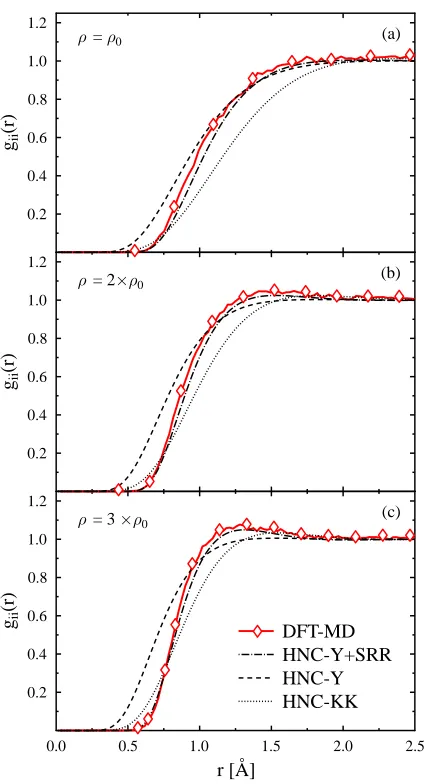
FIG. 1: (color online) Ion-ion pair distribution functionsgii(r) in warm dense Beryllium at multiples
of the normal density ρ0= 1.848 g/cm3: (a) normal density; (b) ρ= 2ρ0 (two times compressed); (c)ρ= 3ρ0. The temperature and the ion charge state are T= 13 eV and Z= 2, respectively.
[4, 5, 7, 25].
[image:6.595.204.416.71.463.2]0.2 0.4 0.6 0.8 1.0 1.2
Sii
(k)
0 2 4 6 8 10
k [A˚-1]
DFT-MD HNC-Y+SRR HNC-Y HNC-KK
= 3 0
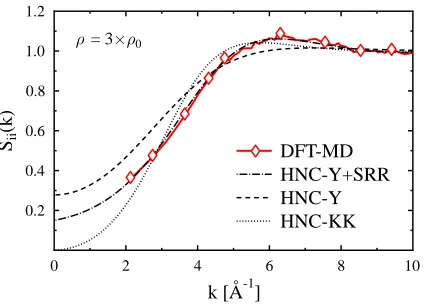
FIG. 2: (color online) Static ion-ion structure factorSii(k) for compressed Beryllium under
condi-tions as in Fig 1(c).
interactions leads to strongly reduced screening clouds around the ions. The ions, in turn, interact more strongly. Indeed, the resulting pair distributions are very close to OCP results (not shown) for all cases.
Surprisingly, the model, that considers only ions that interact via screened Coulomb forces (labeled HNC-Y), works rather well when compared to the DFT-MD data. In particular, larger distances and the shoulder of the pair distribution in the upper two panels of Fig. 1 are nicely described. This fact indicates that screening can be considered to be linear for larger distances.
Large discrepancies arise for small distances where the ion-ion repulsion appears to be underestimated by the HNC approaches discussed so far. They can be understood on the basis of the electronic configuration of the Beryllium ions with Z∼2. Regardless of tem-perature and compression, the ions still have an intact 1s2
shell. When these shells start to overlap, an additional repulsive force arises due to the Pauli exclusion principle. The forbid-den overlap of the electron orbitals can be modelled by an additional short range repulsion (SRR)
ViiY+SRR(r) =
a r4 +
Z2 e2
r exp(−κr). (5)
[image:7.595.205.417.77.229.2]0.2 0.4 0.6 0.8 1.0
gii
(r)
0.0 0.5 1.0 1.5 2.0 2.5 3.0 3.5
r [A˚ ]
DFT-MD HNC-Y HNC-Deutsch HNC-KK
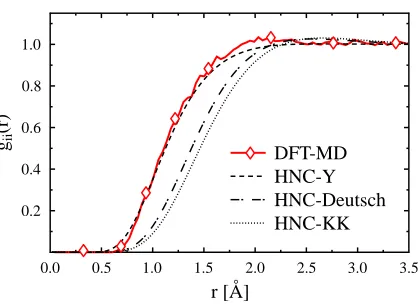
FIG. 3: (color online) Ion-ion pair distribution of Lithium with T = 5 eV, ρ= 0.85 g/cm3, and
Z= 1.6.
further ionization.
The new potential (5), labelled “Y+SRR”, gives the desired larger correlation hole in the pair distributions when used in the HNC approach. In particular for the highly compressed Beryllium in Fig. 1(c), the additional repulsion is significant to reproduce the correct inter-particle spacing and the maximum in the distribution.
Fig. 2 shows the static ion-ion structure factor related to the case in Fig. 1(c). Again, the KK potential leads to a OCP-like behavior, i.e. Sii(0)≈0. The application of other
pseudo-potentials (not shown) yields results between HNC-KK and HNC-Y. They show, however, not the same shape as the DFT-MD results. As for the pair distributions, the best agreement with the DFT-MD data can be obtained by the use of a Yukawa potential with an additional short range repulsion (Y+SRR). The structure factor from DFT-MD is restricted to k-values larger than 2π/L where L is the length of the simulation box. Therefore, HNC is a valuable tool to calculate the structure factor for smaller values. The results should be considered with caution though since algebraic screening known to occur for large distances [27, 28] is not incorporated.
[image:8.595.207.417.76.228.2]0.2 0.4 0.6 0.8 1.0 1.2 1.4 1.6 1.8
gii
(r)
0.5 1.0 1.5 2.0 2.5 3.0 3.5 4.0 4.5 5.0 5.5
r [A˚ ]
DFT-MD HNC-Y+SRR HNC-OCP HNC-Y
FIG. 4: (color online) Ion-ion pair distribution for Aluminum with T= 1.1 eV, ρ= 3.4 g/cm3, and
Z= 3.
since the higher ionization destroys the full 1s shell.
Warm Aluminum is discussed in the last example of Fig. 4. Under these conditions, the ions are strongly coupled (Γ≈170) and the pair distribution shows its typical characteristics: well-pronounced maxima and a large correlation hole. Results similar to the DFT-MD data, but slightly shifted to largerr, are achieved by the HNC approach for a OCP. The overesti-mated second maximum indicates, however, that screening is important here although HNC calculations using linear screening (4) show by far not enough spatial correlations.
One should however keep in mind that aluminium ions possess full inner shells under these conditions. As for Beryllium, these bound electrons lead to an additional repulsion between the ions at short distances. After taking this SRR into account, the ion-ion pair distribution obtained by HNC also shows the typical characteristics for a strongly coupled system and agrees well with the simulation data. Interestingly, these correlations are here not due to strong Coulomb forces as in highly ionized dense plasmas, but due to the interaction of full inner shells. In other words, these ionic correlations mainly result from the Pauli principle applied to shells of bound electrons.
IV. CONCLUSIONS
[image:9.595.205.417.78.230.2]do not yield agreement with the quantum simulations. Although the Klimontovich-Kraeft potential is an extreme case, this fact holds for other quantum potentials as well.
A simple linearly screened Coulomb potential used in HNC calculations for the ions only is, however, often in good agreement with the DFT-MD results. The results can be considerably improved by including additional short range repulsion due to the forbidden overlap of bound electrons in full shells. It has been shown that an appropriate algebraic potential can mimic this effect.
In conclusion, the Yukawa potential with an additional short range repulsion can describe the ionic structure of WDM in agreement with the results from the DFT-MD simulations even for ions with many bound electrons.
Acknowledgments
We gratefully acknowledge financial support from the UK Engineering and Physical Sci-ences Research Council.
[1] T. Guillot et al. inJupiter, edited by W.M.F. Bagenal et al. (Cambridge, 2004).
[2] B. Militzer, W.D. Hubbard, J. Vorberger, I. Tamblyn, and S.A. Bonev, ApJ Letters688, L000 (2008).
[3] J.D. Lindl et al., Phys. Plasmas 11, 339 (2004).
[4] S.H. Glenzer, G. Gregori, R.W. Lee, F.J. Rogers, S.W. Pollaine, and O.L. Landen, Phys. Rev. Lett. 90, 175002 (2003).
[5] S.H. Glenzeret al., Phys. Rev. Lett.98, 065002 (2007). [6] A.L. Kritcher at al., Science322, 69 (2008).
[7] E. Garc´ıa Saiz et al., Nature Phys. 4, 940 (2008).
[8] G. Gregori, S.H. Glenzer, W. Rozmus, R.W. Lee, and O.L. Landen, Phys. Rev. E67, 026412 (2003).
[9] J.P. Hansen and I.R. McDonald, Theory of Simple Liquids, (Academic Press, London, 1990). [10] J.M.J. Van Leuwen, J. Groenveld, and J. DeBoer, Physica25, 792 (1959).
[12] L. Ornstein and F. Zernike, Proc. Akad. Sci. (Amsterdam) 17, 793 (1914).
[13] K. W¨unsch, P. Hilse, M. Schlanges, and D.O. Gericke, Phys. Rev. E77, 056404 (2008). [14] Y. Klimontovich and W.-D. Kraeft, High. Temp. Phys. (USSR) 12, 212 (1974).
[15] C. Deutsch, Phys. Lett. 60A, 317 (1977).
[16] G. Kresse and J. Hafner, Phys. Rev. B 47, RC558 (1993). [17] G. Kresse and J. Hafner, Phys. Rev. B,49, 14251, (1994). [18] G. Kresse and J. Furthm¨uller, Phys. Rev. B 54, 11169 (1996). [19] W. Kohn and L.J. Sham, Phys. Rev. 140, A1133 (1965). [20] N.D. Mermin, Phys. Rev. 137, A1441 (1965).
[21] J.P. Perdew, K. Burke, M. Ernzerhof, Phys. Rev. Lett.77, 3865 (1996). [22] P.E. Bl¨ochl, Phys. Rev. B 50, 17953, (1994).
[23] G. Kresse and D. Joubert, Phys. Rev. B 59, 1758 (1999). [24] W.G. Hoover, Phys. Rev. A 31, 1695 (1985).
[25] E. Garc´ıa Saizet al., Phys. Rev. Lett.101, 075003 (2008).
[26] S. Izvekov, M. Parinello, C.J. Burnham, G.A. Voth, J. Chem. Phys.120, 10896 (2004). [27] A. Alastuey and Ph.A. Martin, Phys. Rev. A40, 6485 (1989).