Technical support in collaborative decision
making: an explorative study
Master thesis Mira Oberhagemann (s1087681)
University of Twente, August 2017
Supervisors:
3
Abstract
Background: Collaborative decision making is a complex group process. Supporting the structure of a collaborative decision making discussion and the communication during the discussion can lead to a more efficient discussion and better decision making. This support could be realized by technological support systems. However, the use of technology during a discussion could also have disadvantages, such as overburdening the cognitive capacities of the group members. Therefore the effects of implementing such a tool in a discussion should be investigated.
Goal: The goal of this work is to investigate the effects of a technical support tool for collaborative decision making. This research focuses mainly on possible benefits and disadvantages such a tool could have during a collaborative design discussion. Especially regarding the possible influence on the focus on the topic, the awareness of the
communicational aspects used, the structure and flow of the discussion and the cognitive load.
Method: Four groups of four participants tested an app that was used as a prototype for a technical support tool during a collaborative design discussion. The experiment was set up in a two-by-two design, with each group having one discussion with and one discussion without the app. Both audio and video recordings were made of all discussions. After the sessions the participants were asked to answer questions about the aforementioned aspects of the
discussions.
Results: The participants reported the discussion with the app to be more structured and that they were more conscious about the communicational aspects during those discussions. Those two effects seem to lead to a more efficient discussion and especially to better decisions. However, the flow of the discussions was disrupted by the app and participants reported a high cognitive load during the sessions with the app, describing the app as distracting and confusing. Finally, the setting of the experiment, the group dynamic and the topic of the discussion were found to have influence on the discussion and therefore possibly also on the use of the app.
4 Index
1. Introduction ... 6
1.1. Collaborative decision making ... 7
1.2. Communication in collaborative decision making ... 8
1.3. Cognitive load ... 10
2. Research questions ... 13
3. Considerations for the design of the experiment ... 14
4. Method ... 15
4.1. Design ... 15
4.2. Materials ... 16
4.3. Participants ... 18
4.4. Pilot test ... 18
4.5. Procedure ... 19
5. Results ... 21
5.1. Analysis ... 21
5.2. Results of the qualitative analysis ... 23
5.2.1. Group 2 ... 23
5.2.2. Group 3 ... 27
5.2.3. Group 4 ... 30
5.2.4. Group 5 ... 35
5.2.5. Results of the quantitative analysis ... 37
6. Additional results for the data from this study ... 44
7. Answering the research questions ... 47
8. Discussion ... 51
9. Limitations and recommendations for further research ... 54
10. Conclusion ... 56
5
12. Appendix ... 59
12.1. Appendix 1: Structure of the groups ... 59
12.2. Appendix 2: Design topics ... 60
12.3. Appendix 3: Structure of the app ... 61
12.4. Appendix 4: Instructions for the session-instructor ... 62
12.5. Appendix 5: Form 1 ... 63
12.6. Appendix 6: Information sheet for the participants ... 64
12.7. Appendix 7: Instructions for the participants given by the instructor ... 68
12.8. Appendix 8: Informed consent ... 69
12.9. Appendix 9: Questionnaire ... 70
12.10. Appendix 10: Interviews ... 72
12.11. Appendix 11: Cohen’s kappa ... 74
12.12. Appendix 12: Results ... 79
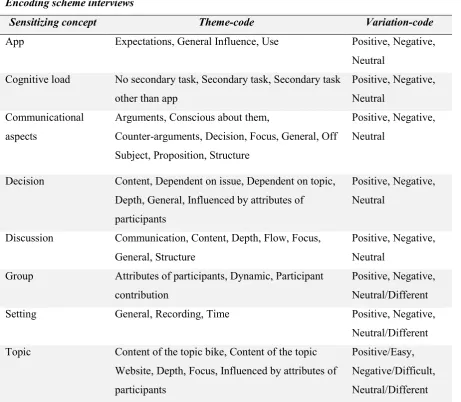
12.13. Appendix 13: Encoding scheme interviews ... 99
12.14. Appendix 14: Summary codes ... 100
12.15. Appendix 15: Descriptive statistics ... 105
6
1.
Introduction
In today’s society, an increased use of intelligent systems (also called ambient intelligence) gets more common every day. Intelligent systems are systems that combine software with technology, such as sensors, to be integrated in fields as for example health care, daily life or business, where they enhance the environment (for examples see: Corchado et al, 2009; Cook et al., 2009). To be able to react in an intelligent way, a systems needs to have the ability to use reasoning, learn from its environment and to make decisions and choices about the actions it takes. (Negnevitsky, 2002).
Intelligent systems differ in the amount of intelligence they possess and therefore range from simple rule-based programs (such as sensors that enhance living environments with for example smart thermostats that control the temperature in your house, or apps that adjust the lights in an environment according to the user’s presence) to more intelligent systems that can provide some sort of advanced reasoning (for example Amazon Alexa or IBM’s Watson). Additionally, intelligent technological systems that assists the user’s activities can be combined to make an enhanced and more intelligent system (Viterbo et al., 2010). Even though intelligent systems are already applied frequently, and research continually makes progress in developing those systems, it remains challenging to make a technology or system truly intelligent. Reasoning and decision making requires the ability of learning from situations and even though technology becomes increasingly advanced, additional research is still needed to be able to enhance artificial intelligence further (Bonstrom, 2016).
One of the research projects that aim to further develop intelligent systems is the “Living Smart Campus” program of the University of Twente, Enschede, the Netherlands. This program aims to enhance the university campus with technology, using the campus as a “living lab” to test possible solutions for complex social issues as well as enhancing cooperation and coordination on campus. It combines different research projects, such as autonomously detecting human activities in a space with Wi-Fi sensors or indoor navigation for visually impaired people. This project aims at giving researchers the possibility to develop and test smart technology in a realistic setting. (Startdocument Living Smart Campus, 2016)
7
different sources of information, providing relevant knowledge and structure decision making (for example to decide in which restaurant a group should go eat). If applied correctly and efficiently, decision support systems are able to increase the productivity, efficiency and effectiveness of decision making processes (Druzdzel & Flynn, 2002). However, current examples such as “LetsDoIt” do not include supporting decision making in a real time discussion but merely provide a voting system, including preferences of the people involved (Marques et al., 2016; Lesser et al., 2017) or support for decisions made by only one person (for example a manager of a company) (Druzdzel & Flynn, 2002). Previous research has shown that group decision support systems (GDSS) such as the “Software Aided Meeting Management” can be effective in e.g. facilitating group creativity and enhancing decision making (Nunamaker et al., 1987) by organizing the decision process and giving the member better insight in the procedure of the process (Poole et al., 1993). However, computerized GDSS usually are not applied in face-to-face, group discussions, but in interactive virtual groups, who work with messenger systems (Fulk & Steinfeld, 1990; Shim et al, 2002). The challenge of this report is, to explore the possibility of applying group decision support systems in a face-to-face decision making process with verbal communication only, which usually are the foundation for complex design problems (Conklin & Begeman, 1988).
1.1. Collaborative decision making
Collaborative decision making is a complex multi-agent socio-cognitive process. This means that a group of people tries to reach a consensus on a common decision by combining individual beliefs, desires, goals, intentions, and preferences with those of the other individuals involved in an interactive process (Panzarasa et al, 2002; Owen, 2015). Collaborative decision making implies either democratic decision making, where all group members are equally empowered to make contributions, or consensus decision making, where a leader shares a problem with a group and they reach a decision together (Lunenburg, 2011). In those processes, the group discusses about the reasons that lead to a design decision, the justifications, other alternatives that have been considered by the group and the evaluation of possible tradeoffs. Basically, it includes the whole argumentation process of the group that led to their decision (Lee, 1997).
8
decision is (partly) his or her own (Owen, 2015; Lunenburg, 2011). Benefits of such a collaborative decision are, that the participants share their individual expertise about the different aspects that have to be discussed, which can enrich the final decision compared to a decision of a single person (Owen, 2015; Lunenburg, 2011)
Furthermore, it supports collaboration and therefore can strengthen teamwork by collaborative project management (Lee, 1997). This is the result of each individual participating in making the decision, resulting in an explicit agreement to implement the collaborative choices as a total of all individuals’ participation (Owen, 2015).
A collaborative decision making process for a design decision requires the participants to discuss and to justify their arguments, to consider alternatives and tradeoffs and to ultimately include the whole argumentation that led to the decision (Lee, 1997). Therefore, it requires that each individual respects the other participants as member of the group. This means that they have to be accepted intentional agents and their internal states such as intentions, thoughts and emotions have to be acknowledged (Balzarotti et al., 2014). To accomplish that, communication is essential for collaborative decision making (Panzarasa et al., 2002).
1.2. Communication in collaborative decision making
In a decision making process, every aspect that is mentioned by a group member can be used as a part of the final design decision, as long as it is properly and reasonably presented. It is therefore required, that the communication, and therefore the presentation of different arguments by different group members, has a good structure (Lee, 1997). Good communication in collaborative decision making can avoid conflicts and establishes effective relations between group members, motivating individuals to get even more involved in the collaboration process. (Panzarasa et al., 2002).
9
agreements between the participants is crucial to achieve a common goal (Balzarotti et al., 2014). First of all, the first of the five layers; defining the issue to assure that the main topic is clear to every participant. Identifying the issue first is the most important step in the decision making process. Without a defined frame of the issue, that is accepted by all participants, there could be the risk of discussions about different issues. This could lead to confusion and a decision that is not accepted by all of the individuals because they feel that the wrong problem is being addressed (Owen, 2015). To support the focus of the discussion on the defined issue, the participants should also be aware of the meta level of the discussion, so, aware of the fact that they are not talking about the defined issue anymore but that they have gone off subject. This awareness allows the group to keep the focus and stay within the defined frame. (Conklin & Begeman, 1988). In the frame of this research, this raises the question if technical support in a decision making discussion could influence and improve this focus on the topic at hand and prevent the discussion from going off subject.
The second step in a decision making process is to hear propositions, arguments and corresponding counter-arguments from all participants (Lee, 1997; Conklin & Begeman, 1988). Propositions are responses to the defined issue and need argumentation for or against them to resolve the issue (Conklin & Begeman, 1988).
10
have in a single person decision (Owen, 2015; Lunenburg, 2011). The evaluation of the alternatives and possible arguments has to be understood by every participant, such that the costs and benefits are clear and agreed on by every participant, to make sure it results in a decision supported by the whole group (Owen, 2015).
In the last step of the decision making process, a decision is made. Crucial to reaching consensus about a design problem, is that it should be clear to every participant that a final decision is made, so that it can be guaranteed that all arguments and counter-arguments are taken into account (Owen, 2015).
To achieve that all those steps previously mentioned are implemented well in the discussion, it is required that all participants agree on the communicational structure that is used. This means for example that if the speaker thinks he gives an argument, the rest of the group has to perceive the given statement as an argument to communicate effectively (Johnson & Johnson, 2014). If the communication is well structured, the final decision will be a product of the collaboration of all arguments and alternatives of each participant combined, making the decision accepted by everyone and therefore more easily implemented. However, structuring communication is a process that people normally are unaware of and that happens without giving a thought to it (Langer et al., 1978), which leads to the question if a support tool could raise awareness about those communicational aspects and support the communicational structure by doing so.
1.3. Cognitive load
11
the areas that will be discussed in the decision making process. The topic of the discussion must therefore be identified and defined by the support tool, in order to serve as a well understood common base for the discussion. Additionally, the app as a support tool should include possibilities to define possible arguments and alternatives made during the discussion and define the boundaries of the decision that must be made (Owen, 2015).
The app used in this research is implemented as a technical support tool to let the user clearly identify a topic-frame about the pending issue, and gives the user the possibility to identify a frame of the communicational structure defined by Lee (1997) during the discussion. To assure the structured communication that is necessary to get to an aggregated decision, the app presents several communicational aspects for the user to choose, to make the user recognize the underlying structure that is active at that time and the issue that is talked about. Thereby it aims to enhance the focus on the issue that is discussed at that moment and on the communicational aspects used.
12
in the flow of the activity and a possible cognitive overload that should be minimized as much as possible to make the use of the tool as efficiently as possible (Oviatt et al., 2004).
This research aims to minimize possible cognitive effort required by the support system by using a prototype that aims to improve the structure of the discussion and allows verbal communication only, thereby trying to minimize possible distractions. According to the informational load hypothesis, this minimization of distraction should be possible, because the use of an app that makes the user more aware of the communicational structure should require a minimal cognitive effort. According to that theory, the semantic information about the communicational structure should already be activated in the discussion, and only needs to be referred to by using the app (Oviatt et al., 2004). Therefore, the focus should lie on the discussion itself and the supporting functions of the app should stay in the background of the discussion. This is important, because a low cognitive load required by the support system would make the process of using the app and learning how to structure the communication easier and more efficient (Oviatt et al., 2004). The question that arises in this context is, whether using the app has an influence on the cognitive load during the discussion and if it disturbs or improves the flow of the discussion.
13
2.
Research questions
Based on the discussed literature, six research questions were formulated regarding the use of technical support in collaborative decision making:
1. How does the usage of technical support in a collaborative decision making discussion influence the participants’ focus on the topic at hand?
2. What influence has the use of technical support on the awareness about communicational aspects of a collaborative decision making discussion?
3. What influence has the use of technical support on the communicational structure of a collaborative decision making discussion?
4. What influence has the use of technical support on the cognitive load during a collaborative decision making discussion?
5. What influence has the use of technical support on the flow of the collaborative decision making discussion?
Regarding that this research is of an explorative nature, to find out what basic benefits and constraints of technical support are, the sixth research question is:
14
3.
Considerations for the design of the experiment
To be able to answer the research questions, an experiment is designed with a number of groups testing an app as a prototype of a support tool in a collaborative decision making discussion. Several requirements have to be taken into account for the design of this experiment.
First each group has to do two sessions, one with the app, the other one without the app, to make sure that possible effects that are found are not just because of the diversity of the groups.
Second, there has to be at least one group that starts with the app in the first session and works without the app in the second session. And at least one group that start without the app in the first session and then works with the app in the second session. These conditions are necessary to be able to rule out effects of familiarity that can occur in the second session. Familiarity means here that the group members do not know each other and are not familiar with the setting of the experiment in the first session, but are more familiar with each other and with the setting in the second session.
Third, there have to be two different design topics to discuss due to practical reasons. It is not motivating to discuss a design question two times. Unfortunately, this leads to the effect that possible differences in outcome of the two sessions could also be due to the different topics. To take that into account, there have to be at least two groups for each condition (starting with the app or starting without the app), one that starts with the first topic and one that starts with the second topic.
15
4.
Method
4.1. Design
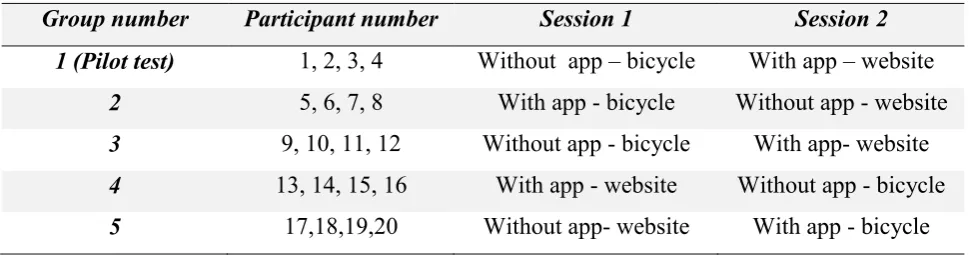
As mentioned before, this study has a two-by-two design which means, that there are four different possible combinations of the condition “with app”, the condition “without app”, the topic “website” and the topic “bicycle parking” as shown in table 1.
Table 1
Overview of the classification of groups in design conditions
Group number Participant number Session 1 Session 2
1 (Pilot test) 1, 2, 3, 4 Without app – bicycle With app – website
2 5, 6, 7, 8 With app - bicycle Without app - website
3 9, 10, 11, 12 Without app - bicycle With app- website 4 13, 14, 15, 16 With app - website Without app - bicycle
5 17,18,19,20 Without app- website With app - bicycle
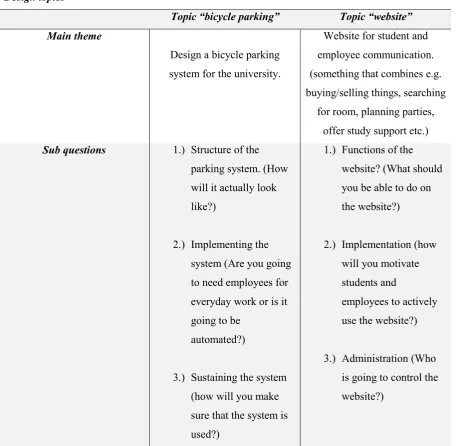
The two discussed topics, design questions about a bicycle parking system at the university and design questions about a website for the students and employees of the university (for more information see appendix 2) were created for this experiment based on four different factors. First, they had to be about something out of the daily life of the students, such that the students could develop the feeling to design something meaningful to them. Second, the issues were designed as problems that actually exists on the university (not necessarily problems that actually have to be addressed, but nevertheless realistic). Third, the issues were chosen as if they could actually be part of the living smart campus project. Fourth, all three questions for both issues were created regarding a practical part, a question about possible implementation in the daily life of the students on the campus and a maintenance part, to represent different important questions in a design project.
[image:15.595.70.555.258.387.2]16
4.2. Materials
For the setting of this research, different materials were used. The data is collected in a record-and-replay approach where the decision making process is recorded synchronously via an audio and video recording system that captures the unfolding discussion. Additionally, in one half of the discussions, an asynchronous recording of the decision making process takes place by using the app. For the video recordings of the session, two video-cameras were used. Those cameras were set-up to both sides of the group and from a high angle. This enables the recording of all gestures and facial expressions and to have an accurate picture of the turn taking during the discussion. Two cameras were enough to get a sufficient view of all the participants faces. Furthermore, for the audio recording, a digital voice recorder was used to get an audio data of the session. The voice recorder was also used to record the interviews at the end of each session. Further voice recording was done by Apple iPads.
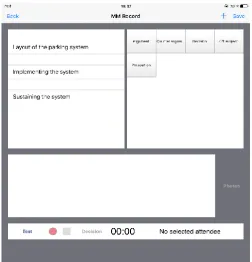
[image:16.595.173.426.465.728.2]There were four iPads (one for each participant) which were equipped with the apps MM Record and MM Report. The iPads were also equipped with a (microphone-only) headset. On all iPads, the app MM Record was used in combination with the headset to make an individual voice recording of the participant that was using that iPad. Also, in the sessions with app, the app MM Record was used to register the use of the programmed buttons. The app MM Report was used only for storing all the information that is recorded by MM Record.
17
Two audio recording methods were chosen, because the individual recordings are easier to collect and analyze in combination with the use of the app (especially in the sessions with the app) and the voice recorder is then used to have a clear recording of the whole discussion. Also, the two recordings served as a fail-safe option. The apps MM Record and MM report are freely available for IOS devices in the Apple app store. They were originally designed and programmed by Tech-cico at the Université de Technologie de Troyes in France and were originally used as a meeting annotation and report tool (Xinghang, Nada, & Guillaume, 2015).
Additionally, combined with all the objective data that was acquired by the recordings of each session, this study also provides qualitative data acquired by a semi-structured interview, which is split in three different parts. The three parts are based on the condition of the sessions that the participant had before the interview and consist of interview 1, which is about decision making with the app, interview 2 which is about decision making without the app, and finally the last part, interview 3, which is about a comparison between those two processes. The questions in the interviews are based on the research questions and hypotheses. The interview starts with questions that are open and broad, to capture as many thoughts of the participants as possible and is then complemented with more precise, but still open follow-up questions. The follow-up questions are constructed in a way that they lead in the direction of the research questions, to make sure the information needed to answer them is collected. This process gives the advantage of having the data needed for the research. Simultaneously, it gives the participants the ability to say everything they want to say, possibly leading to potential important data containing aspects that are new to the research and not considered in the research questions. Additionally, the participants had to fill in a questionnaire at the end of each session (see appendix 9 and 10 for the interview schema and the questionnaire). The qualitative data gives the possibility to explore the participants’ perception of the app and its use. It helps to get rich and explorative data about the app, which might give more insight in the usability of the app. As mentioned before, the interviews also were recorded by a voice recorder to give the interviewer the opportunity to concentrate on conducting the interview, without the need to make notes and to have a complete recording of all answers for the analysis. This research will mainly focus on the analysis of the semi-structured interviews. However, the results of the quantitative analysis of the recorded sessions and the analysis of the questionnaire, that are both conducted by other researchers will be taken into account in the discussion of this thesis.
18
session and each condition for the participants and an informed-consent form. The instructions for the instructor are about the necessary information that the participants need to have to start the experiment. (for the complete instructor instructions see appendix 7). The instruction manual for the participants included information about the condition in which they were participating (with or without the app) and the topic they had to discuss.
4.3. Participants
To answer the research question, twenty participants in groups of four took part in a collaborative decision making process, answered a questionnaire and were interviewed individually. They were separated in five groups of four, the first group was used for a pilot test and the other four groups for the actual experiment. The participants were recruited via the participant-system of the University of Twente, SONA. The participants had to sign up for the research, with the condition that they had to be available on both scheduled timeslots. The participants could earn three SONA -credits for their participation (which they need in order to complete their study program) and had the chance of winning a coupon worth 20 euros (five coupons to give away), both to evoke motivation for participation. In order to win the coupons, the participants had to write down an email address at the end of the first session, which was used for a random lottery drawing at the end of the experiment.
All recruited participants were psychology students of the University of Twente, between 18 and 22 years old, with an average age of 20 years (m = 20, sd = 1,01) and they took part in the experiment as part of their course program. Also, it was convenient to have students as participants, because they are used to discussions in groups (with group members they don't know) due to multiple group-projects that they have to do during their study program. Additionally, the students have no further design background. No other sample criteria were used, because design decisions are commonly made in different situations by different groups.
4.4. Pilot test
19
all participants well. Also, some minor technical issues could be solved. For the instruction materials, the pilot test showed that especially the instruction for the with-app condition was not specific enough. Moreover, there was a tendency that the participants did not read the instruction very carefully. This lead to improved instruction materials for the participants, and additional instruction material for the session-instructor (see appendix 7).
4.5. Procedure
As mentioned above, the experiment was divided in two parts for each group. The two different sessions of each group were at two consecutive days and took about 90 minutes each, including the interview and the questionnaire. Before every session, the session-instructor had to fill in form 1 (appendix 5). In the first session, the instructor welcomed the participants and set up all the equipment, which gave the participants time to read their instructions (appendix 6). After the participants finished reading, the instructor asked if there are any questions and answered them if necessary. Also, the instructor proceeded to ask questions to test the understanding of the participants of the setting and gave further instructions (especially in the with-app condition) (appendix 7). Then, the participants proceeded to read and sign the informed consent (appendix 8). After every participant signed the informed consent, the instructor again asked if there are any questions and answered them if necessary. Next, the instructor asked every participant to put on the headset and started all the recordings, starting with the recordings of the cameras, then the voice recorder and then the recordings of the app. After all the recordings were started, the instructor clapped his hands, to set a common starting point on all recordings and as a sign for the participants to start their discussion.
20
participants gave a proposition, argument or any of the other communicational aspects that were indicated by the buttons of the app, the participants were ask to press the buttons accordingly.
21
5.
Results
5.1. Analysis
The data analysis of the interviews is done according to Baarda (2013). The analysis is based on the concept of “grounded theory”, which means that the data is analyzed in an iterative process, to extract information on which a new theory could be founded.
22
To verify and validate the labels that were found, an inter-rater reliability was calculated based on the labeling of a second rater. To do so, the second rater independently labeled 25% of the interviews. That is, the interviews of one randomly chosen participant of every group. Based on those labels Cohen’s kappa was calculated:
Table 2
Cohen’s Kappa
Interview Code Calculation kappa
P7 Sensitizing concepts
𝜅 =0,97 − 0,23 1 − 0,23 =
0,74 0,77= 0,96
Theme codes
𝜅 =0,95 − 0,12 1 − 0,12 =
0,74 0,79= 0,94
Variation codes
𝜅 =0,95 − 0,37 1 − 0,37 =
0,58 0,63= 0,92
P12 Sensitizing concepts
𝜅 =0,96 − 0,17 1 − 0,17 =
0,79 0,83= 0,95
Theme codes 𝜅 =0,96 − 0,08
1 − 0,08 = 0,88 0,92= 0,96
Variation codes
𝜅 =0,92 − 0,38 1 − 0,38 =
0,54 0,62= 0,87
P14 Sensitizing concepts
𝜅 =0,9 − 0,21 1 − 0,21 =
0,69 0,79= 0,87
Theme codes
𝜅 =0,9 − 0,09 1 − 0,09 =
0,81 0,91= 0,89
Variation codes
𝜅 =0,9 − 0,37 1 − 0,37 =
0,53 0,63= 0,84
P19 Sensitizing concepts
𝜅 =0,9 − 0,23 1 − 0,23 =
0,67 0,77= 0,87
Theme codes 𝜅 =0,9 − 0,08
1 − 0,08 = 0,82 0,92= 0,89
Variation codes
𝜅 =0,9 − 0,38 1 − 0,38 =
0,52 0,62= 0,84
The Cohen’s kappa that is calculated for the four interviews is between 0.84 and 0.96 which represents an almost perfect agreement of the raters (Landis & Koch, 1977) For the extended version of the calculation see appendix 11.
23
between the conditions. For the comparison of the positive and negative statements the Mann-Whitney-U test was conducted. Furthermore, to test the differences between the ratings for the two different topics the Wilcoxon signed rank sum test was used.
5.2. Results of the qualitative analysis
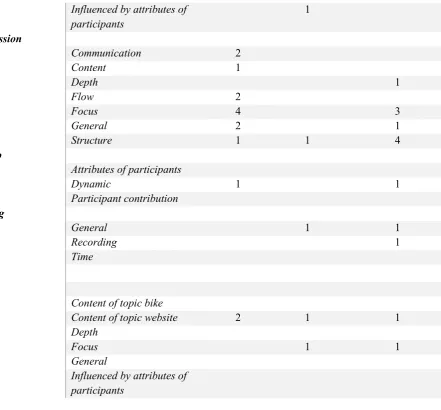
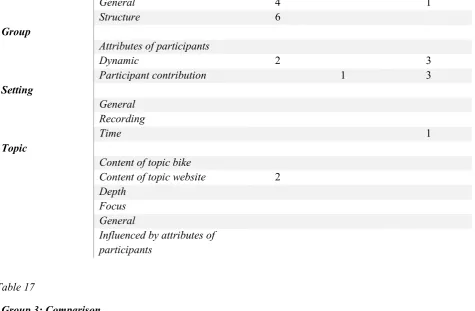
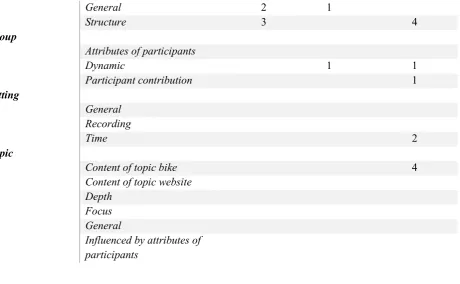
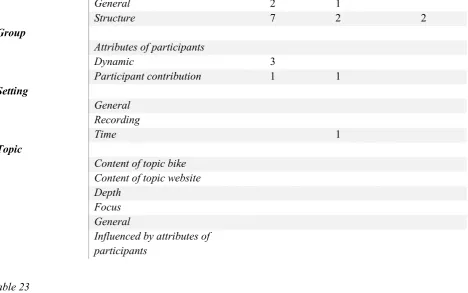
In this section an overview of the results of the interviews is shown. The results are presented for each interview part. They are divided in results for each session of each group, and the interview part were the participants compared the two sessions. For and overview over those results see the tables in appendix 12. Group one is the group for the pilot test, for more information about that group see section 2.4. In the following paragraphs the results of the sessions will be subdivided in the results about the discussion, the communicational aspects and the decision, the cognitive load and finally a part with the result of additional aspects that were found.
5.2.1. Group 2
5.2.1.1.First session Discussion
In this session, the group discussed the topic “bicycle parking” whilst using the app. In the general discussion almost all aspects were perceived negatively by all participants. Participant 5 (P5) and P8 said about the discussion that they perceived it as superficial. All four participants also had a negative opinion on the flow of the discussion, the focus of the discussion and especially the structure of the discussion. For example, P8 said that she “got lost in the discussion” and that the discussion was “not really well organized”. Additionally, P6 said that the group lost focus on the discussed issues and that the use of the app disrupted the flow of the discussion. However, three of the four participants also reported the general focus on the issues as good. P6 and P7 said that their discussion was first structured by those three issues, but that they started to jump between the issues during the discussion.
24
Communicational aspects and decisions
The interview showed that the opinions about the communicational aspects in this session were mostly negative. P6 did not like their arguments and three of the four participants thought that the use of the communicational aspect was unstructured. Furthermore, the participants did not agree on whether the focus on the communicational aspects was positive or negative. P6 and P8 found it helpful to be focused on the communicational aspects that are used, P5 was not focused on the communicational aspects and P7 found it to be confusing to have to think about them, and to focus on which communicational aspect are used during the discussion.
Despite the negative perception of the discussion and the communicational aspects of this session, the decisions in general were perceived as positive by the whole group, even though P8 was not sure about what the content of the decision really was, and P5 thought that the decisions could have been discussed more.
Cognitive load
The general negative opinion about the discussion also mirrored in the negative judgment of the cognitive load. All group members perceived the secondary task of using the app as distracting from the discussion and P8 also thought the app “would inhibit the discussion a bit”. P6 even directly called the general influence of the app negative and mentioned that she forgot to switch between the issues during the discussion. On the other hand P6 also said that she could imagine the benefits of the app for the analysis of a discussion, because of the ability to see what issue is being discussed. Furthermore, P8 thought that the app could be really useful if the discussion would generally be a bit more structured.
Other aspects
Further apparent effects are that P6 and P7 perceived the dynamic of the group as negative as well as the setting because it was “awkward” to talk in a group that you do not know,
resulting in an unnatural discussion.
Three of the four participants found the topic they had to discuss to be difficult because they did not know much about it. Furthermore, P7 found it especially difficult, because as
25 5.2.1.2.Second session
Discussion
For the second session, the second group had to discuss the topic “website” without using the app. The discussion in this session was perceived as more positive than in the first session. P5 and P6 described the general communication in the discussion as positive and P5 and P7 liked the flow of the discussion. The discussion was perceived as focused on the topic by three of the four participants, even though P6 was unsure about how good that focus was. Moreover, P8 thought that it wasn’t helpful to the focus of discussion that they “didn’t really pay attention to what [they] were doing” regarding the communicational structure. The structure of the discussion is, just as in the first session, perceived negative by all participants and described as overlapping and unstructured.
Communicational aspects and decisions
Without the use of the app, only P6 and P8 commented on the communicational aspects during the interview. P6 did not like that there were almost no counter-arguments, but thought that the arguments and propositions were okay, whereas P8 stressed not being aware of the communicational structure without using the app. She felt that this could make coming to a decision more difficult, “because then you don’t really know what the counter-arguments and what the arguments are, so you don’t really know what the best option is.”
However, the decisions made in this discussion are perceived as fitting by P6 and as “okay” by P7. Moreover, P8 said that she had thought that they “thought about a lot of things even in depth now” compared to the first session. P6 and P7 said that especially the decisions about the functions of the website made sense.
Cognitive load
Only P8 stated in the interview that the overall focus on the discussion was better “because you didn’t had another task to do, so you weren’t distracted”. The other participants did not comment on that.
Other aspects
26
influence with P6 and P8 thinking that they “agreed on almost everything”, which P8 found to be positive and P6 found to be a negative influence on the discussion.
There were only a few comments from P5 and P6 on the topic in this session. P5 liked the topic better than talking about bicycles. P6 mentioned that it led to a discussion which was partly off subject.
5.2.1.3.Comparison Discussion
P5 and P6 found the general discussions to be similar. Additionally, P5 thought that the communication in the discussion without app was better because they could talk to each other more without being disrupted. Furthermore, the discussions with app had more depth according to P6 and a better structure because of the app according to P7 and P8. However, P8 thought that the discussion without app is more thought through because they could discuss more. Also, three of four group members thought that the app disrupted the flow of the discussion and half of the group mentioned that it was easier to focus on the discussion when they did not have to use the app.
Communicational aspects and decisions
In the comparison of the communicational aspects, a difference between the sessions was reported, but almost all comments made about that difference are made only by P6. P6 said that she thought that the app was distracting. In hindsight however, she found that being conscious about being off subject and the other communicational aspects, helped to structure the discussion and gave a better argumentation with good arguments and counter-arguments. P8 agreed that the app helped structure the communication by making the group members aware of the communicational aspects.
27
Cognitive load
Despite positive comments about the influence of the app on the communicational aspects, P8 thought that one loses time in the discussion while thinking about what those aspects are. P7 thought that one loses the focus on the discussion when using the app. Moreover, she did not really know when to push which button, which made the use of the app distracting. P5 had a similar opinion, stating that discussing without the app was more fluent than with the app.
Other aspects
It was again reported by one participant that the communication in the discussion felt forced (P7) as well as that the limited time frame had a negative influence on the discussion (P8). Additionally, the topic “website” was perceived as easier by P5 and P6. No further statements were made about influences of group, setting or topic of the discussion.
5.2.2. Group 3 5.2.2.1.First session Discussion
The first session of this group was without the app and about the topic “bicycle parking”. Half of the group reported the general discussion as “quite okay” and “quite elaborate”. Despite that, the opinions about the focus during the discussion were split between positive and negative, ranging from “being pretty focused” to “not [drifting] off too often” to “somehow [getting…] lost sometimes”. Also, the general structure of the discussion was perceived negative by three of the four participants and was described as “lacking” and “unstructured”.
Communicational aspects and decision
Regarding the communicational aspects, participant P10 was under the impression that they tried to come up with good arguments and that she thought that the group always tried to have the aspects in mind during the discussion. Furthermore P9 and P12 described the use of the aspects as sometimes unstructured and P11 criticized the lack of counter-arguments.
28
Cognitive load
P12 decided to write things down during the discussion and reported this secondary task as beneficial for the structure of the discussion.
Other aspects
P12 reported the setting of the experiment to be “intimidating” because of the recoding, and P10 and P12 found the topic both uninteresting and difficult because they did not know a lot about it. The dynamic of the group was perceived equally negative and positive. P12 and P9 found everybody to be a bit shy, and P11 believed that the participants needed to get used to each other first. On the other hand P10 mentioned that “it was nice that always someone felt the need to break the pauses and [to come] up with new ideas”.
5.2.2.2.Second session Discussion
In the second session this group had to discuss about the topic “website” whilst using the app. Almost all aspects of the discussion were rated as positive. Especially the communication during the discussion, the focus and the structure of the discussion. The communication was described as “quite good” and better than in the first discussion. Furthermore, the participants said that they had a good focus and payed more attention to the discussion because of the app. Moreover, the group thought that the discussion was well structured and half of the group said that this also was a result of using the app.
Communicational aspects
29
The resulting decisions were generally rated as positive, even though all participants mentioned some negative aspects of the decisions. P11 found the decision to be dependent on limited knowledge about the topic, P9 and P10 found them to be dependent on the issue, with good decisions for the first two issues they discussed and no agreement about the third issue, and lastly P10 and P12 were not totally satisfied with the content of the decisions because of different personal opinions.
Cognitive load
Three of the four group members thought that the app was a bit distracting because you could miss information while you were using it (P9), which made the discussion more difficult (P12) and that it was “annoying to get both things done at once” (P10), but P12 also said that the app was less distracting than she expected it to be.
Other aspects
The topic “website” is perceived as interesting by P10 and P12, whereas the group dynamic in this session is described as negative by three of the four participants, because two of the participants disagreed and it was “hard [for the other two] to say something in between”. P12 especially stressed the bad contribution of one of the other participants, saying that this participant kept quiet for too long, while disagreeing with the decisions in the end.
5.2.2.3.Comparison Discussion
In the comparing part of the interviews, the flow, the depth, the focus and especially the structure of the discussion was perceived as better in the discussion with the app. P10 thought for example, that the app “shifted the focus more on the actual topic” and P11 reckoned that it gave them more time to think about the topic in depth. P9 too believed that the flow was better in the second discussion, because the participants knew each other by then, but that the app disrupted that flow partly.
30
Communicational aspects and decisions
Regarding the communicational aspects, the participants almost solely talked about the those aspects in the interviews about the discussion with app. P9 and P11 for example, thought that they were more aware of the communicational aspects they used, which improved the structure of the discussion
Comparing the decisions of both discussions, both P11 and P10 reported to be more aware of and more satisfied with the decisions that were made in the session with app, because the app made her more aware of the decisions. However, P10 said this could partly be because of the topic as well.
Cognitive load
P11 reported that, because they had to focus on two things at once, the “creative freedom” during the discussion was inhibited. In contrast to that, P12 thought before the discussion that “[she’d] be slightly distracted” by the app, but say that “it was fine” and that “there was no big distraction”
Other aspects
P12 said that the group dynamic was different in both sessions, because they “got to know each other better and [they] were more used to the whole setting” in the second session. She also believed that there was more agreement in the first session. Moreover, P9 felt that the participants were “less shy” in the second session.
Regarding the differences in the topics, P9 and P10 reported the topic “website” to be easier, because they felt more involved with it.
5.2.3. Group 4
5.2.3.1.First session Discussion
31
disrupted that focus a bit, whereas P16 stated that her focus was improved by the app. The flow of the discussion on the other hand was rated negative by half of the group. P16 thought that this was because of three different factors, namely the structure of their communication, the difference in English skills in the group and because the app inhibited him in contributing to the discussion. P15, on the other hand thought it to be mainly because of the negative group dynamic and the different English skills. For the structure of the discussion, both negative and positive statements were made. On the one hand the overall discussion was described as very well structured by the whole group, on the other hand it was mentioned by three of the four group members, that their structure was dependent on the issue they were talking about. For example P15 and P16 thought that the structure of the discussion about the implementation of the website was not good.
Communicational aspects and decisions
Regarding the communicational aspects, all participants reported it as positive to be conscious about them during the discussion. P13 found the app making her more aware of the intentions of the other members of the group. P14 agreed with that, stating that using the app made her more aware of what the others were trying to express. P15 added that “clicking the button […] implied that you had had to follow up on what they were saying and make that you had to listen and make an active decision about what the content of what they were saying was”. Also the participants liked the propositions that were made, how they structured the communicational aspects and how focused they were on the aspects because of the app. However, two of the four participants felt that they did not bring in enough counter-arguments.
Three of four participants stated that they were satisfied with the decisions that were made. P14 stressed that the app was really helpful in making it clear when a decision was made, because you had to consciously click on a button.
Cognitive load
Regarding the cognitive load, the opinion of the group was divided. Participants 13 and 16 perceived the cognitive load due to the secondary task as negative. Especially participant 16 seemed to be bothered by the use of the app. He said that he forgot to use the app when others were talking and found the app to be inhibiting for the discussion.
32
the speaking portion of everyone quite well” and that the app “did keep [her] involved” in the discussion. P15 also added that there should be more or other buttons to give more options in choosing communicational elements such as “building up on that”.
Other aspects
P14 thought that they were “very polite about agreeing and disagreeing with each other” and thought that everyone in the group was “comfortable sharing what they thought, because everyone was respected” and P13 agreed with that, in contrast to the other two participants who found the dynamic in the group to be “too friendly” and the English skills too different to have a good discussion.
Regarding the topic, P14 liked to discuss about it, whereas P15 and 16 found it to be difficult to talk about the website, because they never thought about it before and did not have many ideas. P15 additionally thought that 30 minutes was not enough time to discuss about the topic, and P16 would have liked a time restriction on the three issues.
5.2.3.2.Second session Discussion
The second session of this group was without the use of the app and about the topic “bicycle parking”. The general discussion was described as positive by two of the participants, and P16 stressed that he thinks the discussion had a better flow than their first discussion. However, the content, depth and focus were perceived negative. P16 especially disliked the content, because he thought they jumped between the ideas without talking about them in depth and P14 stressed that they focused randomly on those ideas without giving the discussion a clear focus or a “red line”.
33
Communicational aspects and decisions
There were not many comments made on the communicational aspects. P14 said that she consciously tried to think about the aspects in contrast to P13, who did not thought about them at all. Furthermore P14 also thought that there weren’t that focused on the aspects and went off topic sometimes. She thought structuring the communicational aspects more could have made the decisions more efficient. In contrast to that, P16 thought that it “was a good flow of exchanging propositions, arguments and counter-arguments”.
The decisions generally were found to be good according to P14 and P15, but they “need more discussion” according to P14 and P16. P16 stated that he was not satisfied with the decisions because he personally did not like them and P13 even thought that they did not make clear decisions.
Cognitive load
P16 said that he liked that the discussion was not inhibited by having to use the app, whereas P15 said that the app still had a positive structuring influence on the discussion even though it was not used this time.
Other aspects
P16 felt that he had to go with the ideas of the rest of the group because he did not want to “trigger a discussion” and P15 found that “some people didn’t want to contribute as much”. Also P14 and P15 found the time limit of the sessions a negative factor; P15 thought this because she did not like the topic and she was looking at the time checking when it would be over and, in contrast to that, P14 felt that they needed more time to come to better decisions. All four participants agreed on the topic “bicycle parking” being difficult to discuss, because it was too broad and not interesting nor relevant to them.
5.2.3.3.Comparison Discussion
34
discussion more structured and better discussed in depth. Moreover, P14 mentioned that the app made everyone consciously let the others finish talking, which made the discussion more smooth compared to the discussion without the app. P13 and P16 had similar opinions as P14, namely that the discussion was more structure with the app. However, P16 found the discussion without the app to be less inhibited and P16 and P13 also thought that they could focus better on the discussion itself without the app.
Communicational aspects and decisions
Regarding the communicational aspects, P14 said that the app made them more aware about the communicational aspects. She thought this led to a better structure, and ultimately to better and “a lot more focus on getting to a decision”. In contrast to that, she described the structure of the communicational aspects in the session without app as “a little chaotic at times”. Also, P13 liked being aware of giving an argument or making a decision with the app. P16 found the structure to be better in the session without the app, which he thought was because the app in combination with focusing on the communicational aspects, inhibited the discussion, but also due to the topic.
P13 said that she “wasn’t really aware of when [they] made a decision and when [they] didn’t” in the session without app, therefore she found the decisions in the first session more clear. P14 augmented in a similar way, that the decisions in the session with app where a logic conclusion. However, the decisions in general were found to be (largely) dependent on the topic by three of the four participants.
Cognitive load
P16 and P13 mentioned that they were distracted by the app, and P16 specifically mentioned that he found it easier to discuss without it. P14 and P15 on the other hand, made no comments on the cognitive load, but described the general influence of the app as making the discussion smooth, by having to be more focused on what everyone is saying. P15 even said that the app positively influenced the second session because it trained them in thinking more structured.
Other aspects
35
restriction of 30 minutes was restricting in the second session. She said that this was because the discussion was less structured and therefore more time was needed to come to a decision.
5.2.4. Group 5 5.2.4.1.First session Discussion
The fifth group started with the topic “website” and without using the app. P19 said that she liked the discussion in general and P20 described it as good. Three of the four participants described the focus on the discussion in the group generally as good.
The opinions on the structure of the discussion on the other hand, were divided; P17 found it to be unstructured and P18 described it as mixed up in the end but okay in general. However, P19 and P20 described it as okay and better towards the end.
Communicational aspects and decisions
P19 and P20 thought that they had good arguments and P19 also liked how they structured the communicational aspects. Additionally, P17 and P19 criticized the small number of counter-arguments.
Cognitive load
Due to the discussion being without the app, nothing was said about the use or influence of the app and the cognitive load.
Other aspects
Three of the four participants perceived it as positive that everybody contributed and agreed with each other. Also, P19 mentioned that he found the focus of the group on especially two of the three issues to be good and that they had a lot of information and inspiration about the topic.
5.2.4.2.Second session Discussion
36
positive regarding the structure and described the discussion as generally well structured. Moreover, P19 liked that everyone participated, and P20 was under the impression that everyone was agreeing with one another. P20 mentioned that she was so focused on the discussion, that she forgot to use the app. In contrast to that, P18 stated that she was focused on the discussion, but that the app broke that focus because she “was a bit confused by the Ipad sometimes”.
Communicational aspects and decisions
All participants stated that they were more conscious about the communicational aspects because of the app, which they found to be supporting for their decisions. P20 for example found it more clear what they were saying, and P17 brought forward that the buttons are a reminder to structure the communicational aspects and to come to a decision. However, P19 still criticized that they had not many counter-arguments.
Three of the four participants stated that they made good decisions in this session. P18 did not comment on that.
Cognitive load
The cognitive load of the secondary task of using the app is perceived as negative by three of the four participants. They described it as confusing to use or distracting, and P20 sometimes just forgot to use the app which did not influence her focus on the discussion. Additionally, P17 and P20 thought that the app generally had a positive influence on the discussion and P17 said that you get used to it during the discussion and that it gets easier to divide the attention.
Other aspects
Three of the four participants described the overall group dynamic and contribution as positive. P19 said that they “all said something and nobody was just sitting there saying: yeah it’s okay” and P20 felt that the group was thinking “more in the same direction”. The setting and the topic did not seem to have any further influences on the discussion.
5.2.4.3.Comparison Discussion
37
they thought the flow of the discussion was better in the second session, because they knew each other better. Additionally, P20 thought they found more ways to look at the topic because of the app. P18 mentions that the discussion about the bicycle parking was more focused because the topic was less broad. She also mentioned that the depth of the discussion without app was positive. There were no negative remarks for both discussions.
Communicational aspects and decisions
Regarding the communicational aspects, P17 and P19 found the structure of the aspects more obvious with the app, which, according to them, made it easier to communicate. Furthermore P17 and P20 liked the structure of the aspects in the discussion to be guided and more structured by the app.
Three of the four participants found the decisions to be dependent on the topic. P18 and P20 found the decisions for the topic “bicycle parking” more superficial and the decisions for the topic “website” better thought through. However, they also mentioned that the app made them more conscious about the decisions.
Cognitive load
P17 found it difficult to use the app at first but she got used to it during the session. She also says that the app helps guiding the communication. Also, P20 mentioned that the discussion was improved by the use of the app.
Other aspects
Three of the four participants described the group dynamic as generally good and were more comfortable with each other in the second session. There were no further comments on the topics and the setting.
5.2.5. Results of the quantitative analysis
38
Discussion:
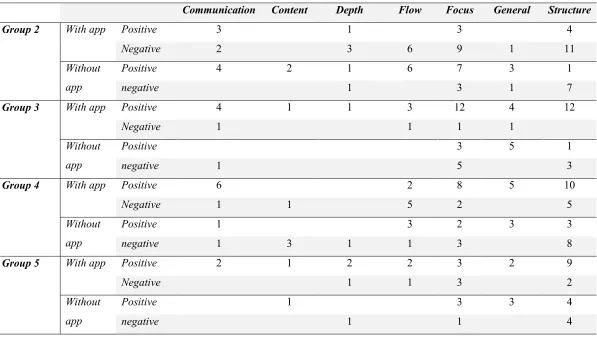
Descriptive statistics (appendix 15) showed that the participants rated both discussions as positive in general. However the discussion without app in general was rated slightly more positive than the discussion with app with an average of 3.50 positive ratings (Mdn = 3.0; Range = 2; SD = 1.000) and only one negative rating (M = 0.25; Mdn = 0; Range = 1; SD = .500) per group for the general discussion without app. In contrast to that, the discussion with app was rated with an average of 2.75 positive ratings (Mdn = 3.0; Range = 5; SD = 2.217) and 0.50 negative ratings (Mdn = 0.5; Range = 1; SD = .577 ) per group. However, the only significant effect about the rating of the general discussion was that the number of positive ratings for the discussion without app was significantly higher than the number of negative ratings. All other difference for the rating of the general discussion were not significant.
Table 3
Significant effects: Discussion
Condition* Z Asymp. Sig. (2-tailed)
Communication 3 -2.191 .028
Flow 2 -2.124 .034
General 4 -2.428 .015
Structure 1 -2.191 .028
4 -1.764 .078
*1 = comparison with app positive – without app positive; 2 = with app negative – without app negative; 3 = comparison with app positive – with app negative; 4 = comparison without app positive – without app negative
39
discussion with app was rated with an average of 6.50 positive ratings (Mdn = 5.5; Range = 9; SD = 4.359) and an average of 3.75 negative ratings (Mdn = 2.5; Range = 8; SD = 3.594) per group, whereas the focus on the discussion without app was rated with an average of 3.75 positive ratings (Mdn = 3.0; Range = 5; SD = 2.217) and an average of 3.00 negative ratings (Mdn = 3.0; Range = 4; SD = 1.633) per group. None of the differences found for the focus on the discussion were significant.
The communication was rated significantly positive for the discussion with app (p = .028 ) with an average of 3.75 positive ratings (Mdn = 3.5; Range = 4; SD = 1.708) and an average of one negative rating (Mdn = 1.0; Range = 2; SD = .816) per group. Compared to that the communication in the discussion without app was rated less positive with an average of only 1.25 positive ratings (Mdn = 0.5; Range = 4; SD = 1.893) and an average of 0.5 negative ratings (Mdn = 0.5; Range = 1; SD = .577) per group.
In contrast to that, the flow of the discussion was rated significantly positive for the discussion without app (p = .034) with an average of 2.25 positive ratings (Mdn = 1.5; Range = 6; SD = 2.872) per group and only one negative statement (M = 0.25; Mdn = 0; Range = 1; SD = .500). The flow of the discussion with app on the other hand was rated negative with an average of 3.25 negative ratings (Mdn = 3.0; Range = 5; SD = 2.630) and only 1.75 positive ratings (Mdn = 2.0; Range = 3; SD = 1.258) per group.
Communicational aspects and decision:
40
statements were made (positive statements: n = 8; M = 2.00; Mdn = 2.5; Range = 3; SD = 1.414; negative statements: n = 22; M = 5.50; Mdn = 5.5; Range = 7; SD = 3.109). Another effect that support those results is that the focus on the communicational aspects during the discussion also was perceived as slightly more positive in the discussion with app (positive statements: n = 13; M = 3.25; Mdn = 2.5; Range = 6; SD = 2.630; negative statements: n = 5; M = 1.25; Mdn = 1.0; Range = 3; SD = 1.500) compared to the discussion without app (positive statements: n = 0; negative statements: n = 2; M = 0.50; Mdn = 0.5; Range = 1; SD = .577).
Table 4
Significant effects: Communicational aspects
Condition* Z Asymp. Sig. (2-tailed)
Conscious about them 1 -2.352 .019
3 -2.381 .017
Counter-arguments 1 -2.000 .046
4 -2.000 .046
Decisions 1 -1.984 .047
Focus 1 -2.460 .014
Off subject 1 -2.049 .040
Propositions 1 -1.984 .047
*1 = comparison with app positive – without app positive; 2 = with app negative – without app negative; 3 = comparison with app positive – with app negative; 4 = comparison without app positive – without app negative
Furthermore, the structure of the communicational aspects and the decisions were rated higher in the discussions with app. The structure of the discussion was perceived positive in the discussion with app with an average of 3.50 positive statements (Mdn = 4.5; Range = 5; SD = 2.380) and an average of 1.25 negative statements (Mdn = 0.5; Range = 4; SD = 1.893) per group. Compared to that, the structure of the communicational aspects in the discussion without app was perceived negative with an average of 1.25 negative statements (Mdn = 1.5; Range = 2; SD = .957) and an average of only 0.75 positive statements (Mdn = 0.5; Range = 2; SD = .957) per group. However, in further analysis, none of those difference was found to be significant.
41
2.944) and an average of only 0.50 negative statements (Mdn = 0.5; Range = 1; SD = .577). The decisions in the discussion without app were perceived to be negative, but only with an average of 0.50 negative statements per group (Mdn = 0; Range = 2; SD = 1.000). No positive statements were made about the decisions in the discussion without the app regarding the communicational aspects. The differences between the positive ratings of the decisions in the discussions with app and the rating of the decisions in the discussions without app were found to be significant (p = .047, see table 4).
The indication that is given about the decisions regarding the communicational aspects is supported by the results for the sensitizing concept “decisions”. The participants reported the decisions in general to be significantly positive for the discussion with app (p = .019) and also positive, but not significantly, for the discussion without app. Table 5 shows that the decisions in general in the discussion with the app are rated (almost significantly) more positive than those in the discussion without app (positive with app: M = 5.00; Mdn = 5.0; Range = 2; SD = 1.155; positive without app: M = 3.25; Mdn = 3.0; Range = 3; SD = 1.258). Additionally there were less negative reports on average on the general decisions with the app (negative with app: M = 0.75; Mdn = 0.5; Range = 2; SD = .957; negative without app: M = 1.50; Mdn = 1.0; Range = 4; SD = 1.915).
Table 5
Significant effects: Decisions
Condition* Z Asymp. Sig. (2-tailed)
General 1 -1.764 .078
3 -2.352 .019
*1 = comparison with app positive – without app positive; 2 = with app negative – without app negative; 3 = comparison with app positive – with app negative; 4 = comparison without app positive – without app negative
42
However, the content of the decisions is rated positive for the discussion without app with an average of 1.75 positive statements (Mdn = 1.5; Range = 4; SD = 1.708) and an average of only 0.50 negative statements (Mdn = 0; Range = 2; SD = 1.000) per group. The content of the decisions in the discussions with app on the other hand are perceived slightly negative with an average of one negative statement (Mdn = 1.0; Range = 2; SD = 1.155) and only 0.75 positive statements (Mdn = 0.5; Range = 2; SD = .957) per group.
Cognitive load:
Table 6 shows that the app as a secondary task was perceived as significantly negative by all groups (M = 7.75; Mdn = 6.0; Range = 7; SD = 3.500) with on average only one positive statement made per group (Mdn = 1.0; Range = 2 ; SD = .816). Also the participants reported it to perceive it as positive if they did not have to do a secondary task with an average of 2.50 positive statements per group (Mdn = 1.5; Range = 7; SD = 3.317), even though this reported difference was not significant.
Table 6
Comparison (Mann-Whitney U): positive ratings – negative ratings
Sensitizing concept Theme-code Z Asymp. Sig. (2-tailed)
Cognitive load Secondary task -2.381 .017
App General influence -2.124 .034 Topic Content “bicycle
parking”
-1.703 .089
The general influence of the app on the other hand was mainly perceived as positive with an average of four positive statements (Mdn = 3.0; Range = 9; SD = 3.830 ) per group and an only one negative statement.
The participants reported positive as well as negative aspects about the use of the app with on average two positive statements (Mdn = 2.0; Range = 2; SD = .816) and 1.75 negative statements (Mdn = 2.0; Range = 1; SD = .500) made per group.
Other aspects:
43
one negative statement on average per group (Mdn = 0.5; Range = 3; SD = 1.414). The topic “bike” on the other hand is perceived as mainly negative by the participants, with an average of 3.75 negative statements (Mdn = 4.0; Range = 7; SD = 2.872) per group and only one positive statement. However, the only significant difference for the topics that was found was that the topic “bicycle parking” is rated significantly more positive than negative as can be seen in table 6, all other effect were not significant.