november | 2017
Rosa Krause
S1188518
Master Communication Studies
Specialisation: Marketing Communication
1st supervisor: Anna Fenko
Package Tactile Experience on Taste Evaluation
The interaction of package material and environmental
Acknowledgements
I would like to thank my kind supervisor Anna Fenko who supported me during the whole process. Although it took some time to get finished with my thesis, Anna never gave up on me and always encouraged me to continue. So thanks a lot! It was very helpful. Furthermore, I would like to thank my second supervisor, Joyce Karreman, for providing me with pretty helpful feedback in order to improve my work.
-Abstract–
- Keywords –
Table of Contents
1. Introduction...
2. Theoretical Framework... 2.1. Consumer Decision Making... 2.2. Multisensory Design... 2.3. Material of the Package... 2.4. Environmental Scent... 2.5. Taste Evaluation and Perceived Taste Perception... 2.6. General Health Interest and Perceived Product Healthiness... 2.7. Congruence... 2.8. Research Model...
3. Research Method... 3.1. Pre-Test... 3.1.1. Results pre-test...
3.1.1.1. Naturalness/pleasantness...
3.1.1.2. Affiliation muesli/breakfast...
3.1.1.3. Implication main study...
3.2. Participants... 3.3. Stimuli...
3.3.1. Package material ...
3.3.2. Environmental scent... 3.4. Measures... 3.5. Procedure...
4. Results... 4.1. Effects of the Package Material... 4.2. Effects of Environmental Scent... 4.3. Interaction Effects... 4.4. Perceived Taste Perception... 4.5. General Health Interest and Perceived Healthiness... 4.6. Effects of Congruency... 4.7. Interaction Effects of Gender and Scent... 4.8. Reflection of Results on Hypotheses...
5. Discussion...
5.1. Limitations and Future Research...
6. Conclusion...
References...
APPENDICES...
A.1. APPENDIX A...
A.2. APPENDIX B... A.3. APPENDIX C... A.4. APPENDIX D...
1. Introduction
Nowadays, food purchase decisions are complex and difficult processes for consumers because of the huge amount of products in particular market categories. In the category “healthy food products” consumers face the challenge to select the “right” products. Grunert et. al (2010) found that only 27% of consumers looked at nutrition information on the package before making a selection and that this information was difficult to understand for them. Therefore, the usage of the nutrition information on a package is associated with the interest in healthy eating and the understanding of this information is associated with nutrition knowledge (Grunert et al., 2010).
According to Lähteenmäki (2013), “in promoting healthy eating, food manufacturers have the role as providers of better options for consumers to choose from when purchasing food”. Consumers use certain cues such as naturalness, vitality and activity to select food products that are good for them (Lähteenmäki, 2013). The distinction between nutrition claims, “the nutrient content without explaining the relation to health function/outcome”, and heath claims, the “front-of-package information with specific health-related functions/outcomes”, is important for research in this area. Both claims have to be understood by consumers in order to guide them to the purchase of products, which are good for them and to eliminate difficulties in doing so. According to Lähteenmäki (2013), the
appeal of the product and the degree of which health-claims add value to consumers also have to be considered.
Not only visual cues but also haptic cues are important in evaluating a product. In particular, touching a product and experiencing it’s material can affect the product’s evaluation for example (Spence & Gallace, 2011).
Another study emphasizes that consumption norms and environmental interventions are important factors in order to influence consumer’s decision making and to improve the monitoring of the amount of consumed food (Wansink & Chandon, 2014). Most consumers are not aware of or have difficulties in estimating the amount of food they consume. Several factors influence high food intake, such as categorization, health halo, negative affect and stress. Moreover, sensory cues like ambient sound, scent, lighting and temperature can influence the food consumption. Concerning to Wansink & Chandon (2014), it is easier to change the food environment than to change the consumer’s mind.
To conclude, a new research opportunity would be to measure the effectiveness of the combination of environmental adaptations such as material of the package and environmental scent. This combination of stimuli is not
2. Theoretical Framework
This chapter is about related work concerning this research idea. First, the consumer decision making in general is explained to illustrate the different aspects of processing information. This is followed by an explanation of multisensory design. In addition, the variables material of package and environmental scent are examined. Furthermore, perceived taste perception is also taken into account as dependent variable. Additionally, general aspects like general health interest and congruence are reviewed. Finally, the research model is explained and presented. new insight of marketing and purchasing healthy food products. The research question is: ”To what extent do a natural scent and natural material affect the healthiness perception of consumers purchase decisions of healthy food products?” The research is a 2 (package material: natural vs unnatural) x 3 (scent: natural vs unnatural vs no scent) research design. The variables package material and scent are the independent variables, which influence the dependent variables taste evaluation, purchase intention and product evaluation. Perceived healthiness and general health interest are covariate variables of this study.
The study is as a ‘laboratory’ experiment in a controlled environment and is a quantitative research with a between-subject design.
2.1. Consumer Decision Making
Consumer decision making can be determined in different ways. According to Cohen and Babey (2012), people “respond to contextual cues
without conscious thought or decision-making”. It means that people unconsciously react to certain heuristics like for example the appearance of the product, sizes, brands etc. The decision-making in such cases can also include systematic errors and inferior choices (Cohen and Babey, 2012). Many food companies use salient heuristic food cues to pretend to sell healthy food products, which in fact are not as healthy as perceived.
processing, the decision making is more intuitive or impulsive whereas in type 2 processing the decision making is more reflective (Samson & Voyer, 2012).
To illustrate, according to Cohen and Babey (2012), healthy food labels are associated with food that is less palatable. While combining lower prices with healthy messages effects in an increase of purchase, the healthy message alone did not trigger the purchase.
What is more, the intention of consumers coming to a supermarket also influences certain product purchases. A study found that people who are on a frequent ‘fill-in’ trip to the supermarket, are more accessible to contextual cues than people who have to buy a large quantity of products (Cohen and Babey, 2012). Furthermore, 2/3 of the purchase decisions are made in the store. The decisions are based on two factors, the “attention that a product display attracts”, and the “inferences a consumer makes about the quality of the product itself”.
Moreover, there is one dual processing theory from Cacioppo and Petty’s (1984), which is called the elaboration likelihood model. In this model, there are two ‘routes’ to persuasion, the central route and the peripheral route. The central route is used when the motivation, involvement and ability to process information is high of the consumer, whereas the peripheral route is used when the motivation, involvement and the ability to process information is low. While using the
central route, the consumer elaborates on the message and therefore the effects are long-lasting. In contrast, while using the peripheral route, the consumer is influenced by peripheral or heuristic cues like for example the brand name or the price.
The elaboration likelihood model emphasizes one example of dual processing theory. The central route from the elaboration likelihood model is alike the conscious information processing from dual processing theory, whereas the peripheral route is alike the non-conscious processing. This means, that consumers, who cognitively process information, use the central route. Whereas non-cognitive information processing uses the peripheral route.
Considering the theories above, the material of the package and the environmental scent can act as peripheral or heuristic cues used through the peripheral route. Therefore, the consumer has to be unaware of the package material and environmental scent manipulation. In fact, consumers have to experience the product in order to evaluate it. Every consumer has his/ her own product taste, which is determined by different attributes the consumer considers. Therefore, these attributes act as the basis for potentially rich product experience (Hoch, 2002).
2.2. Multisensory Design
multiple product properties like for instance visual, tactual, auditory and olfactory properties (Schifferstein, 2011). This kind of approach enhances the product experience amongst others. The main challenge of multisensory design is to combine the product properties in a way in which the product meaning is expressed correctly (Schifferstein, 2011).
However, multisensory design involves sensory product experience. According to Hultén (2011), the sensory experience is defined as “an individual’s perception of goods or services or other elements in a service process as an image that challenges the human mind and senses”.
In this study visual, touch and smell properties are used to create sensory product experience. In detail it means that the consumer can actively see and touch the product. The scent is absorbed by the consumer in an unconscious way.
According to Hultén (2011), product properties such as material, surface, temperature, weight, form and stability form the touch
experience of a product. Whereas the smell experience is automatically connected to the product and contributes to the product’s identity. What is more, scents can be also used to influence the emotional state and mood of the consumer. Congruency of the scent and the product is also important in order to create a ‘natural connection’ which can lead to a positive experience (Hultén, 2011).
2.3. Material of the Package
The material of the package is one attribute of packaging, which can influence consumer decision making (Becker et al., 2011). The experience of the package design (color, shape, material) is an implicit, heuristic process, which can also mislead consumers in purchasing
perceived healthy food products. This means, that the product’s package plays an important role in perceiving a product as healthy.
Additionally, research has shown that “people intuitively make connections between different domains, a phenomenon referred to as ‘cross-modal correspondence’” (Becker et al., 2011; Schifferstein, 2011). For example, the material of a package can influence the taste perception of a food product. Becker et al. (2011) conclude that the package appearance (shape, color, material) influences taste evaluations of food products. It is also important to take in mind, that the effects of package appearance depend on consumers´ sensitivity to design.
elicited by this sensory modality might be the more effective in modulating people overall (multisensory) product experience” (Spence et al. (2011).
In addition to that, Krishna et al. (2007) also found that haptic qualities in terms of ‘touching the product’ influences the product evaluation. It means that touching a product effects the overall evaluation of the product. Therefore, it is assumed that a haptic condition like touching the material of the product can influence the product evaluation and more importantly the taste evaluation of the product rather than only looking at the product.
Furthermore, another study investigated the relationship between consumers’ perceptions of food quality and physiological product
characteristics (Bredahl et al., 1998). According to them, it is important to consider consumers’ quality perceptions when designing a new product, which has to be marketed. In this study, the authors focused on physical product characteristics or ‘intrinsic quality cues’. It seems that the expected quality strongly relates to the experienced quality (Bredahl et al., 1998).
However, there is already literature which examined the effects of different package materials. Zhang (2013) tested among other factors the influence of package material on product experience. He found out that different materials elicit different product evaluations. Rough cardboard for example was evaluated
by the participants as most fitting to the words ‘warm’, ‘healthy’ and ‘organic’ (Zhang, 2013). Additionally, smooth cardboard was evaluated as fitting to the words ‘sweet’, ‘comfortable’ whereas plastic packaging was combined with the word ‘cold’. The smooth cardboard package was rated highest in purchase intention (Zhang, 2013).
Additionally, Lith (2015) determined the influence of different package materials on perceived healthiness. She found out that low shine plastic is more likely evaluated as unhealthy, whereas cardboard paper is more likely evaluated as healthy. Moreover, Lith (2015) states, that the package material can have a
significant influence on the perceived healthiness. However, results show that the healthy material has no significant influence on perceived healthiness in combination with the healthy product (in this case knäckebröd), whereas a healthy package material of an unhealthy product (in this case chocolate) leads to a greater perceived healthiness of the product.
With respect to the present literature the first hypothesis is formulated as follows:
H1: A natural package material will increase the perceived healthiness and consumer purchase intention compared to an unnatural package material.
2.4. Environmental Scent
According to Cohen and Babey (2012), ambient scent can influence human purchase decisions. People are not able to ignore scent, because they are not able to turn off their senses.
In addition, Bosmans (2006) claims that scent can influence a consumer’s buying behavior. There are two different kind of scents that can be distinguished, product-specific scents and ambient scents. Product-specific scents are scents of the product itself, whereas ambient scents are so called ‘extraneous environmental cues’, which are not necessarily related to certain products. Ambient scents are also evaluated either as pleasant or unpleasant or either liked or disliked. Therefore, they are related to the experience of emotions.
Furthermore, the experience of an ambient scent can trigger semantic information and therefore the evaluation of a product can vary concerning the degree of congruence. While the perception of scent is an implicit process, consumers should not be aware of being influenced by scents. This is because a
high awareness can lead to the opposite effect (Bosmans, 2006). The results of this study show, that ambient scents have a strong influence on product evaluation, if the ambient scents are congruent with the product category. But also if the scent is not congruent with the product category, it can still affect the consumer’s evaluation. This would be the case when the scent is salient and when the motivation of the consumer is low (Bosmans, 2006).
Based on the previous studies, it is supposed that an ambient or environmental scent, which is congruent with the product, affects consumers’ perceived healthiness and purchase intention. This means, that a natural environmental scent which is associated with healthiness increases the perceived healthiness and the purchase intention. So the second hypothesis can be put into words as follows:
H2: A natural environmental scent will increase the perceived healthiness and the consumers’ purchase intention compared to an unnatural environmental scent.
2.5. Taste Evaluation and Perceived Taste Perception
although there are conflicting results, there also seems to be an effect of package color on taste perception (Becker et al., 2011).
On the other hand, taste perception can also act as a contradictory factor. The ‘unhealthy = tasty intuition’ claims, that food products which are perceived as unhealthy are evaluated as more attractive in taste (Raghunathan et al., 2006). Therefore, if the intention of the consumer is a hedonic one, it is likely that he/she chooses to purchase unhealthy food products. This means, that consumers are likely to choose unhealthy food products, because they think that these products taste better.
Concerning this ‘unhealthy-tasty’ intuition, perceived healthiness mediates the purchase intention of a consumer in this study.
What is more, Rozin et al. (1999) states, that there is also a gender difference in evaluating food in general. It seems that males combine food with pleasure instead of health, whereas females combine food with health instead of pleasure.
Verbeke (2005) also states, that females are more likely to compromise taste when it comes to healthy food products. Furthermore, the results show that functional or healthy food is defined as worse-tasting by consumers.
What is more, consumers can also be distinguished in so called ‘taste-lovers’ and ‘nutrition-fact-seekers’ (Mai et al., 2012). Attributes which influence the product choice for ‘taste-lovers’ are more likely taste and price,
whereas attributes like nutrition information and health drive the consumer choice of the ‘nutrition-fact-seekers’. Therefore, ‘taste-lovers’ care less about their health than ‘nutrition-fact-seekers’.
According to Mai et al. (2012), there are two sub-divisions of ‘taste-lovers’ and ‘nutrition-fact-seekers’, named ‘heavy’ and ‘soft’. The results of this study accentuate that ‘heavy taste lovers’ (“less health-conscious consumers with lower nutrition self-efficacy”, Mai et al., 2012) reduce food product choice to one simple attribute like taste. In comparison, ‘soft taste lovers’ for example score higher in nutrition self-efficacy but also deliberate their choices by health-unrelated attributes like taste and price more than ‘heavy taste lovers’. In contrast, food choices of ‘heavy nutrition fact seekers’ are influenced most by health-related attributes, followed by ‘soft nutrition fact seekers’ (Mai et al., 2012).
Considering the literature above, hypotheses can be formulated as follows:
H3: The products which will be perceived as healthier will be perceived as less tasteful than the products which will be perceived as less healthy.
H4a: Males will act more as ‘taste-lovers’ and will evaluate an unnatural material as more tasteful which will increase the purchase intention.
nutrition-fact-seekers and will evaluate a natural material as more healthy and less tasteful which will increase the purchase intention.
2.6. General Health Interest and Perceived Product Healthiness
Based on previous studies, general health interest and perceived healthiness of a product are also factors to be considered when talking about healthy food choices.
Previous studies show that there is a strong link between the general health interest and low fat products (Lähteenmäki, 2013;
Zandstra et al., 2001). Grunert et al. (2007) state, that in general people are interested in food and health but there are several factors which can influence the health interest. Stress is one factor for example, which influences health interest. Consumers are mostly stressed in the typical food purchase situation in the supermarket which leads to lower interest in purchasing healthy food products (Grunert et al., 2007). So if consumers are motivated and able to notice the food package, they can also process the nutrition information on it (Lähteenmäki, 2013).
Another example is gender-specific, means that women are more interested in health than men (Grunert et al., 2007). This is confirmed by another study of Roininen et al. (1999). The results show that women are more interested in attributes like health and taste than men. In addition, younger people score lower in health
interest and higher in taste concern than older people (Roininen et al., 1999).
Besides the interest, perception has also to be investigated. As described with the health interest, concerning the healthiness perception women are more likely to perceive the nutrition information of a food package than men (Grunert et al., 2007). The same applies for the factor ‘stress’, which means that consumers are less likely to perceive the nutrition information of the food package when being stressed.
Moreover, Zandstra et al. (2001) claim that consumers who score high in general health interest are more likely to consume more fruits and vegetables and have a lower fat-intake. In addition to that, there is a strong relation between general health interest and natural product
interest (Zandstra et al., 2001, Roininen et al., 1999). ‘Natural product interest’ “considers the importance of eating organic foods and foods that are not processed or do not contain additives” (Roininen et al., 1999).
2.6. Congruence
Congruence is also an important aspect to consider in this study. According to Schifferstein (2011), sensory congruence is important to simplify or clarify the product’s message. Besides, the congruence of sensory information also increases the consumers’ preference for a product and liking of a product.
Therefore, it is assumed that the congruence of a healthy/natural material and a healthy/natural environmental scent classifies the product as healthy and for that reason, increases the perceived healthiness. It is also assumed that this leads to an increase of the consumer’s purchase intention.
H7a: The congruence of a natural package material and a natural environmental scent will increase the perceived healthiness and will lead to an increased purchase intention by consumers with high general health interest.
H7b: The congruence of an unnatural package material and an unnatural environmental scent will decrease the perceived healthiness and will lead to an increased purchase intention by consumers with low general health interest.
2.8. Research Model
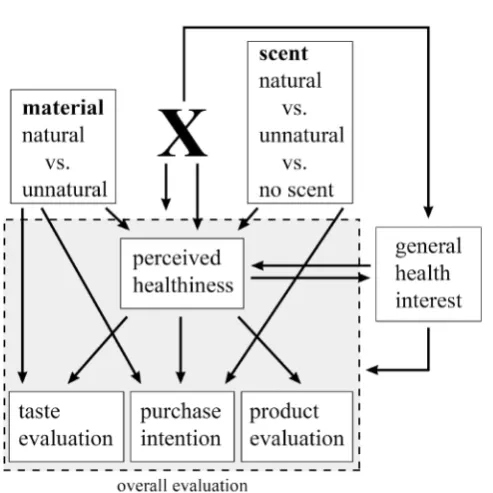
The research model is presented in figure 1. The material and the environmental scent are the independent variables. It is important to mention, Tijssen (2017) found out that product
packages with so-called ‘vibrant’ colors scored less in perceived healthiness
(e.g. red with low brightness and high saturation) than less vibrant ‘watered-down’ colors (e.g. blue with high brightness and low saturation). In general, lower brightness and higher saturation let participants evaluate products as more sweet (Tijssen, 2017). This is because ‘light’ products usually are light colored with high brightness and low saturation whereas ‘regular’ products mostly have high saturation and low brightness.
According to the literature, perceived healthiness of the product is examined to be a moderator variable in this research. In addition to that, another hypothesis is formulated as follows:
H5: A natural package material combined with a natural environmental scent will be perceived as healthier than an unnatural package material combined with an unnatural environmental scent.
H6a: The product which will be perceived as healthier will be evaluated more positively by consumers with high general health interest than the product which will be perceived as less healthy.
Figure 1. Research model.
3. Research Method
This chapter is about the research method of the main experiment. It starts with a description of the pre-test followed by a description of the participants, the stimuli material, the measures and the procedure of the main experiment.
3.1. Pre-Test
The pre-test was conducted in order to determine healthy/unhealthy environmental scent. The design which was used is a within-subject design.
Twenty participants were randomly selected in order to execute the pre-test. The sample consisted of students from the University of Twente. Both sexes were considered. The nationality of the respondents was Dutch. The background of these participants was not observed.
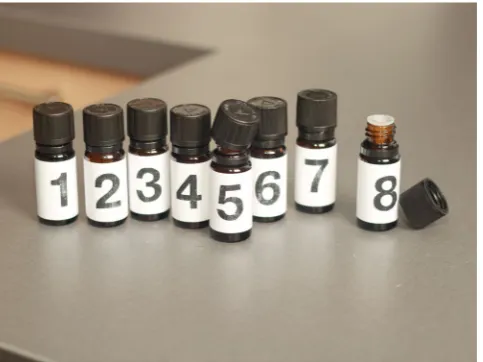
The stimuli materials were eight different scents. The scents were filled in bottles. The labels of the bottles were covered with numbers of the range of one until eight (see figure 2; appendix B).
The naturalness and the pleasantness of the scents were measured through a questionnaire taken from other studies (see figure 3; appendix B). This questionnaire contains questions to be answered with a 5 point Likert scale. Besides the two variables above, participants also had to rate if the scents fit to breakfast in the morning and fit with muesli. Furthermore, participants that the material of the package is processed via
the central route(visual cues) and peripheral route (tactile cues). Because of that, the environmental scent has to be used in such a way the participants are not aware of this manipulation. This mean, that consumers will process this information in a conscious and unconscious way. Whereas the environmental scent will be processed via the peripheral route and therefore unconscious. For this reason, the environmental scent is less peripheral than the material of the package. Therefore, it can be stated that the material of the package is processed via the peripheral route at stage 1 and the environmental scent via the peripheral route at stage 2.
However, perceived healthiness and general health interest are the covariate variables in this study. Taste evaluation, purchase intention and product evaluation are the dependent
had to fill in general information at the end of the questionnaire such as gender, age and nationality (see appendix B).
The test is executed in a laboratory setting with no distraction. The participants sit at a table, which is provided with the different scent items. The questionnaire is in form of paper and lies on the table. The pre-test started with an introduction which was written at the first page of the questionnaire. The researcher was sitting next to the participant and answered questions about the test if necessary.
The scent significantly rated as ‘healthy’ is used as the healthy environmental scent in the main study and the one significantly rated as ‘unhealthy’ is used as unhealthy environmental scent.
3.1.1 Results pre-test
3.1.1.1. Naturalness/pleasantness
In order to evaluate the results of the first and second question, the median and the interquartile range (IQR) has been calculated.
The results show that vanilla and orange are the two scents being evaluated as natural. In comparison to the other scents, the IQR of these two scents is relatively high, especially for orange (=2.5). Because of that, the distribution amongst the different answers is also relatively high.
Moreover, almost all scents (except coffee, honey) are being evaluated as pleasant for the respondents. The interquartile range (IQR)
of the scents no 2, 4, 5, 6, 7, 8 is relatively small (0.5-1). Therefore, the distribution amongst the different answers is also relatively small.
3.1.1.2. Affiliation muesli/breakfast
Considering the evaluation of the third and fourth question, the percentage of the different answers has been calculated.
There seem to be only three scents (vanilla, coconut, orange), which fit to breakfast in the morning concerning the majority of respondents. So coconut and orange are the only scents concerning the respondents, which fit to breakfast in the morning.
Considering the affiliation with muesli, coffee, honey, strawberry and green apple, are clearly evaluated as not fitting to muesli (85-90%). The percentage of coconut and vanilla shows that the opinion of these scents to fit to muesli is more likely to be ‘yes’ rather than ‘no’ (45:40%, 50:35%). Therefore, these scents are most likely to fit to muesli.
3.1.1.3. Implication main study
Figure 2. Different scents in bottles. Each number means a different scent: (1) coffee; (2) cinnamon; (3) honey; (4) coconut; (5) vanilla; (6) orange;
(7) strawberry; (8) green apple.
Number 1.
Please open the bottle with the number ‘1’ on it and take a smell. After smelling, please check the circle you most agree with for every question.
very unnatural unnatural neutral natural very natural
1. How natural / unnatural was the smell?
0 0 0 0 0
very unpleasant unpleasant neutral pleasant very pleasant
2. How pleasant / unpleasant was the smell?
0 0 0 0 0
no yes I don’t know
3. Does the smell fit with breakfast in the morning?
0 0 0
no yes I don’t know
4. Does the smell
fit with muesli? 0 0 0
Figure 3. Main questions of the pre-study questionnaire. These four questions had to be answered for all scents numbered from number1 until number8.
3.2. Participants
The participants are randomly selected with a sample size of 120 participants (2x2 between-subject design). The age of the participants lies in between the range of 18-30 (young adults). Both sexes (male/female) are considered. The sample is from the Dutch population in the region of Twente. Therefore, the participants are Dutch and non-Dutch (integrated foreigners, who live in the Netherlands).
Furthermore, the participants are no frequent visitors of a specific supermarket, because the experiment is hold in a controlled environment (laboratory room) and not in a specific supermarket. Moreover, the level of education is taken into account, as well as the background/experience on healthy food purchase.
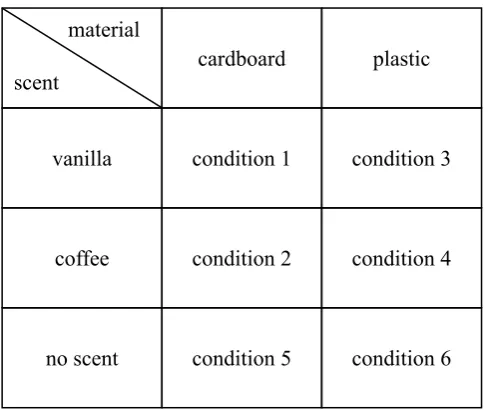
In order to approximate the samples of the pre- and main study, only Dutch or Dutch-speaking participants are asked to participate in the experiment. The sample is divided into six groups, each group with another condition (see
figure 4).
An independent samples t-test was executed to measure if they are differences in gender between the conditions. Results show that there are no significant gender differences between the different conditions with t (118) = .106 and p = .504. In addition, an analysis of variance is used to determine differences of age between the conditions. Results show that there are no statistically significant differences between muesli. Therefore, vanilla is used as the second
[image:24.595.45.279.490.692.2]the age of the participants and the conditions with
F (12, 119) = 1.180 and p = .307.
material
scent cardboard plastic
vanilla
coffee
condition 1 condition 3
condition 2 condition 4
[image:25.595.68.549.52.152.2]no scent condition 5 condition 6
Figure 4. Different conditions of the main study. The amount of 120 participants is randomly divided by six con-ditions which makes 20 participants per condition.
3.3. Stimuli
There are two variables used as stimuli, package material and environmental scent. As described in the research model, the package material and the environmental scent are mostly processed via the peripheral route.
3.3.1. Package material
[image:25.595.56.303.275.480.2]For the main study, two different materials are used for the package. Cardboard is used as the package material for the healthy package and
Table 1. Demographics per condition
condition1 condition2 condition3 condition4 condition5 condition6
gender male
female 40%60% 60%40% 65%35% 45%55% 45%55% 55%45%
age 18-21 years
22-24 years 25-27 years 28-30 years 65% 25% 5% 5% 35% 55% 5% 5% 40% 45% 10% 5% 35% 40% 20% 5% 35% 40% 5% 20% 25% 55% 15% 5%
Percentages of gender and age per condition.
plastic is used as the material for the unhealthy package (see figure 5; appendix C).
3.3.2. Environmental scent
Likewise the two different materials which are used in the main study, also two different environmental scents are used to create a healthy/ unhealthy cue.
The scent which is evaluated as most healthy and positively during the pre-test is used as the healthy environmental scent in the main experiment. Whereas the scent which is evaluated as most unhealthy and negatively during the pre-test is used as the unhealthy environmental scent in the main experiment.
Figure 5. Different packages as stimuli of the main study which only differ in the material: (1) cardboard package; (2) plastic package.
[image:25.595.313.560.580.761.2]3.4. Measures
There are five variables, which are measured: purchase intention, perceived healthiness, product evaluation, taste evaluation and general health interest. All variables are measured with a questionnaire taken from another study (Fenko et al., 2016).The language which was used for the questionnaire (and the whole experiment) is Dutch (see appendix C). Because the
questionnaire is already been used and tested of its reliability, it can be assumed that it is reliable.
Nevertheless, the Cronbach’s alpha is calculated for this study and presented in table 1. The reverse coded items (amount = 5) are considered and recoded for the reliability calculation. According to the Cronbach’s alpha, all five scales are reliable.
Purchase intention is measured with three questionnaire items on a 5-point Likert scale with 1 = fully disagree and 5 = fully agree. Perceived healthiness is measured with seven items on a 5-point Likert scale (1 = fully disagree, 5 = fully agree) and product evaluation is measured with six items on a 5-point Likert scale (1 = fully disagree, 5 = fully agree). Further, perceived taste perception or taste evaluation is measured with five questions on a 5-point Likert scale (1 = fully disagree, 5 = fully agree) and general health interest is measured with eight questions on a 5-point Likert scale (1 = fully disagree, 5 = fully agree).
Finally, at the completion of the
questionnaire are several demographical questions about age, nationality and education.
The results are calculated with SPSS in form of an ANOVA and ANCOVA analysis. The variable ‘general health interest’ is the moderator variable in this study.
1. Purchase intention
1.1 I would like to try this product.
1.2 I would seriously consider buying this product. 1.3 I would buy this product.
2. Perceived healthiness
2.1. I expect this product to be healthy.
2.2. I would consider this product as good for me. 2.3. The product feels healthy.
2.4. The product looks healthy.
2.5. This product looks low on calories.
2.6. I have an impression that this product is healthy. 2.7. This muesli looks healthier than similar muesli prod-ucts.
3. Product evaluation
3.1. This product looks good.
3.2. This product will probably be of good quality. 3.3. This product looks attractive.
3.4. I would probably notice this product among other similar products.
3.5. The name of the product sounds attractive to me. 3.6. This product has an attractive shape.
4. Taste evaluation
4.1. This product’s texture is pleasant. 4.2. This product smells nice.
4.3. This product tastes good. 4.4. This product tastes nutritious. 4.5. I like the taste of this product.
5. General health interest
5.1. The healthiness of food has little impact on my food choices.
5.2. I am very particular about the healthiness of food I eat. 5.3. I eat what I like and I do not worry much about the healthiness of food.
5.4. It is important for me that my diet is low in fat. 5.5. I always follow a healthy and balanced diet.
5.6. It is important for me that my daily diet contains a lot of vitamins and minerals.
5.7. The healthiness of snacks makes no difference to me. 5.8. I do not avoid foods, even if they may raise my choles-terol.
Figure 6. The five factors (also scales) which are measured in the main study and it’s different questionnaire items.
Scale Cronbach’s
Purchase intention .87
Perceived healthiness .72
Product evaluation .77
Taste evaluation .73
General health interest .81
3.5. Procedure
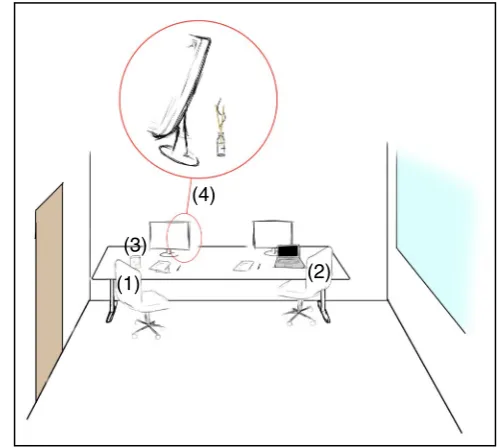
The data collection was in form of an experiment in a laboratory setting. After randomly selecting participants, they were asked to come into a room and sit at a table. Besides the stimuli material and the questionnaire, there will be no further potential to be distracted. The structure of the room is shown in figure 7. The experiment started by describing the actions the participants had to take.
First, they had to read through the informed consent in order to clarify possible ethical threats. After the informed consent was signed by the participant and researcher, the participants started reading and answering the questionnaire. If questions emerged during the experiment, participants could ask the researcher what was also clarified in the beginning.
For the scales ‘purchase intention’ and ‘product evaluation’, the participants were asked to look at the product and evaluate it in general. For the scale ‘perceived healthiness’, participants also had to touch the product. Further, for the items of the scale ‘taste evaluation’, participants were asked to actively take a sample of the muesli and taste it. Finally, the scale ‘general health interest’ and demographical information had just to be answered by the participant and formed the conclusion of the study.
The duration of the experiment was about five until ten minutes per participant. The informed consent and the questionnaire was
[image:27.595.311.560.139.363.2]in form of paper. The scent was spread in the room with wooden sticks in a jar as acting like a diffuser. The jar was hidden in the room so that participants could not see it.
Figure 7. The structure of the laboratory room of the main study: (1) participant; (2) researcher; (3) product; (4) scent diffuser.
(1) (2)
(4)
(3)
4. Results
A 2x2 univariate analysis of variance (ANOVA) was performed to analyse if there are any statistically significant differences between the means of the different groups. The variable ‘perceived healthiness’ is used as the covariate (moderator) in this analysis. Reverse coding was necessary for negative items on the scale for general health interest.
4.1. Effects of the Package Material
healthiness’ as covariate with F (5,114) = 6.032,
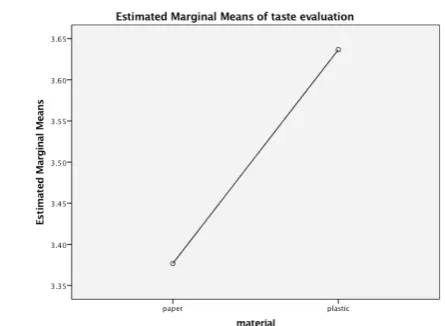
p = .016. Therefore, the plastic package is rated higher (M = 3.64, SD = .662) in the taste evaluation than the cardboard package ( M = 3.38, SD = .563).
There was no statistically significant difference in the scores for the cardboard material (M = 3.75, SD = .490 ) and plastic material (M
=3.76 , SD = .518 ) condition considering the perceived healthiness with F (5,114) = .024 and
p = .878. Furthermore, there is no statistically significant difference between the cardboard material (M = 3.08, SD = .840) and the plastic material (M = 2.96, SD = .821) condition considering the purchase intention F (5,114) = .581, p = .448.
In order to test the significance level of ‘perceived healthiness’ as the covariate, an analysis of covariance (ANCOVA) has been performed. The results show that ‘perceived healthiness’ has no significant effect on the outcome of the dependent variable ‘purchase intention’ with F (5,114) = 1.552 , p = .215. A statistically difference of the independent variable ‘material’ (with cardboard material (M = 3.08,
SD = .840) and plastic material (M = 2.96, SD
[image:28.595.299.545.51.116.2]= .821)) concerning ‘perceived healthiness’ as covariate and ‘purchase intention’ as dependent variable is not found (F (5, 114)= .385, p = .536).
Table 3. 2x2 ANOVA
Dependent variable df F p
taste evaluation 1 5.315 .023*
perceived healthiness 1 .024 .878
purchase intention 1 .581 .448
Independent variable: package material. Note * p<.05
Figure 8. Significant effect of package material on taste evaluation.
4.2. Effects of Environmental Scent The results show no significant difference between the natural environmental scent (M = 3.14, SD = .984) and the unnatural environmental scent (M = 2.92, SD = .653) condition concerning the effect on ‘purchase intention’ with F (5,114) = .736 and p = .481.
Considering the effect on ‘perceived healthiness’, results show no significant difference for the natural environmental scent (M = 3.81, SD = .443) and the unnatural environmental scent (M = 3.77, SD = .491) condition with F (5,114)= .621, p = .539.
[image:28.595.294.517.166.329.2].215). There is also no statistically significance concerning the variable ‘scent’ (natural scent (M
= 3.14, SD = .984); unnatural scent (M = 2.92,
[image:29.595.58.301.247.295.2]SD = .653); no scent (M = 3.00, SD = .823)) as independent variable, ‘perceived healthiness’ as covariate and ‘purchase intention’ as dependent variable with F (5,114) =.604 and p = .548.
Table 4. 2x2 ANOVA
Dependent variable df F p
taste evaluation 2 .113 .893
perceived healthiness 2 .479 .621
Independent variable: environmental scent. Note * p<.05
4.3. Interaction Effects
An analysis of variance (2x3 ANOVA) is used to test the effects of the interaction between the different materials and environmental scents. In this analysis, the independent factors are the material and the environmental scent and the dependent variable is the so called ‘overall evaluation’ (mean of ‘purchase intention’, ‘perceived product healthiness’, ‘product evaluation’ and ‘taste evaluation’).
According to the analysis of variance, there is no statistically significant difference between the means of the interaction of material and environmental scent F (5,114) = .461, p = .632.
4.4. Perceived Taste Perception
Results of a one-way-ANOVA analysis show that there is no significant difference of ‘perceived
healthiness’ influencing the ‘taste evaluation’ with
F (17,102) = .873 and p = .607.
Additionally, an independent-samples t-test show was conducted to find out whether there are differences in the taste evaluation among males versus females. Results show that there is no significant difference in the scores for males (M = 3.54, SD = .597) and females (M = 3.47, SD = .659) with t (118) = .636 and p = .514.
Moreover, the outcome of another ANOVA analysis shows that there is no significant difference of the interaction effect between gender and material on taste evaluation with F (3,116) = .009 and p = .925.
4.5. General Health Interest and Perceived Healthiness
The results show that mean of general health interest is M = 2.77 with a standard deviation of .299. The lowest score on health interest is 2.13 and the highest is 3.38.
However, the general health interest does not have a statistically significant effect on the overall product evaluation, F (21, 98)= 1.237 and
p = .239.
Furthermore, according to the results of an ANOVA analysis, there is no significant difference of the interaction between the material and the environmental scent on the perceived healthiness with F (5, 114) = .124 and p = .884.
health interest’ as the covariate and ‘product evaluation’ as the dependent variable shows no significant effects. There is no significant effect of ‘perceived healthiness’ on the product evaluation with F (1, 12) = .223 and p = .646 as well as the general health interest with F (1, 12) = 1.383 and
p = .264 on ‘product evaluation’.
4.6. Effects of Congruency
In order to look at the effects of the congruence of the stimuli material, a multivariate analysis of covariance was performed with congruence of scent and material as independent variables, ‘general health interest’ as covariate and
[image:30.595.300.538.435.500.2]‘perceived ‘healthiness’ and purchase intention’ as dependent variables . There is no statistical evidence that the congruence of the stimuli has any effect on the perceived healthiness (F (2, 11) = .011), p = .989) and purchase intention (F (2, 11) = 1.823, p = .211).
Table 5. 2x2 ANOVA purchase intention
Factor df F p
package material 5 .581 .448
environmental scent 5 .736 .481
Dependent variable: purchase intention. Note * p<.05
Table 6. 2x2 ANCOVA purchase intention
Factor df F p
package material 5 1.552 .215
environmental scent 5 .604 .548
Dependent variable: purchase intention. Note * p<.05 Covariate: perceived healthiness
Table 7. 2-way MANOVA gender X scent
dependent variables df F p
perceived healthiness 5 3.126 .048
purchase intention 5 3.746 .027
taste evaluation 5 3.929 .022
interaction variable: gender X scent. Note * p<.05
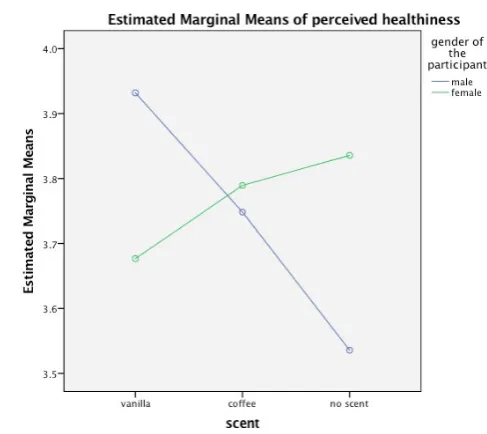
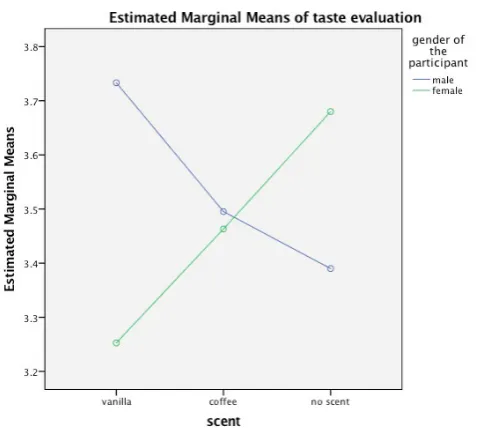
Figure 9. Significant interaction effect of scent and gender 4.7. Interaction Effects of Gender and Scent Additionally, there are significant effects of the interaction of gender and scent on several dependent variables which were not predicted. There are statistically significant effects on ‘perceived healthiness’ (F (5,114) = 3.126 , p = .048), ‘purchase intention’ (F (5, 114) = 3.746, p
= .027) and ‘taste evaluation’ (F (5, 114) = 3.929,
p = .022).
In particular, males have higher means in the rating of ‘perceived healthiness’, ‘purchase intention’ and ‘taste evaluation’ in the natural scent condition (vanilla), whereas females have higher means in the condition with no scent (see
[image:30.595.291.535.555.772.2]Figure 11. Significant interaction effect of scent and gender on taste evaluation.
Figure 10. Significant interaction effect of scent and gender on purchase intention.
4.8. Reflection of Results on Hypotheses In conclusion, the results show one statistically significant effect. The material of the package significantly influences the taste evaluation. For that reason, hypothesis number three can be partially confirmed because package material does show a significant effect, whereas environmental scent does not. In comparison,
the results show no confirmation of the other hypotheses (see table 6).
5. Discussion
One of the main findings of the current study is that the material of the package had a significant effect on the taste evaluation of the participants. Therefore, there seems to be an impact of material on taste evaluation which is consistent with previous results (Becker et al., 2011). There were no other hypotheses confirmed or assumptions met through the study. In general, the sample is almost equally distributed amongst males and females. What is more, the range of age is quite small because the participants were mostly students. This leads to another assumption that the characteristics of students or the attitude of life and choices in life do not differ highly amongst students. In addition, some participants (mostly male) expressed not to be frequent muesli consumers, which could also have been influenced the overall evaluation of the product itself in the sense that for them the evaluation was merely neutral.
Table 8. Overview of (dis-)confirmation of hypotheses.
Hypotheses (dis-)confirmation
H1 A natural package material will increase the perceived healthiness and
consumer purchase intention compared to an unnatural package material. not confirmed
H2 A natural environmental scent will increase the perceived healthiness and the
consumers’ purchase intention compared to an unnatural environmental scent. not confirmed
H3 The products which will be perceived as healthier will be perceived as less
tasteful than the products which will be perceived as less healthy. partially confirmed*
H4a Males will act more as ‘taste-lovers’ and will evaluate an unnatural material as
more tasteful which will increase the purchase intention. not confirmed
H4b Females will act more like nutrition-fact-seekers and will evaluate a natural
material as more healthy and less tasteful which will increase the purchase intention.
not confirmed
H5 A natural package material combined with a natural environmental scent will
be perceived as healthier than an unnatural package material combined with an unnatural environmental scent.
not confirmed
H6a The product which will be perceived as healthier will be evaluated more
positively by consumers with high general health interest than the product which will be perceived as less healthy.
not confirmed
H6b The product which will be perceived as healthier will be evaluated less
positively by consumers with low general health interest than the product which will be perceived as less healthy.
not confirmed
H7a The congruence of a natural package material and a natural environmental
scent will increase the perceived healthiness and will lead to an increased purchase intention by consumers with high general health interest.
not confirmed
H7b The congruence of an unnatural package material and an unnatural
environmental scent will decrease the perceived healthiness and will lead to an increased purchase intention by consumers with low general health interest.
not confirmed
*confirmed: cardboard package is rated as less tasteful than plastic package.
evaluation which is consistent with the study of Spence & and Gallace (2011). A reason for having taste evaluation as significant effect on its own could be caused be the so called “affective ventriloquism”. It means that “people’s feelings about the packaging tend to carry over and influence what they say about the contents when the come to taste/evaluate them” (Spence, 2016). Therefore, the tactile property, the material, could have been such a strong impact on taste evaluation in a way that it suppressed the other variables.
What is also interesting is, that the
cardboard package was rated lower in tastefulness than the plastic package. Although perceived healthiness had no significant effect, this result would be consistent with the ‘unhealthy-tasty’ intuition (Rozin et al., 1999). It was assumed that the plastic package would be evaluated as less healthy and therefore would be evaluated more positively by men. Since there were no significant effects, this can not be assumed, but for future research this could be an opportunity.
the potential disadvantage of a natural package material of high perceived price segment. Interestingly, this remark applies for the cardboard package as well as for the plastic package. Therefore, the shape or the colour ,for example, could also have had an influence on product evaluation. Including more characteristics which stimulate different sense perceptions could help to distinguish different products from one another, which also fits to the multisensory approach (Schifferstein, 2011).
Furthermore, regarding taste perception, it was assumed that unnatural material would increase the purchase intention of males because of higher taste perception, whereas natural material would increase the purchase intention of females because of higher perceived healthiness. There could be several reasons why there is no significant effect found especially in the difference of males and females.
First of all, the sample was almost equally distributed amongst the two groups of gender. This means, that the distribution of the two samples was relatively low. What could be more interesting is the setting in which the participants had to make their choices. In daily life situations, the setting of purchasing food is different from the laboratory one. There are other factors involved like for example stress or the mood of the consumer itself. Further, Rozin et al. (1999) stated, that males are more likely combine food choices with pleasure and females are more
likely to combine food choices with health. Because there was no effect found on perceived healthiness, which means that females did not perceive one of the two products as healthy, there cannot be found an effect of gender either. Regarding male participants and the distinction whether they perceive food as pleasant or
unpleasant, should be considered to be measured in future research. In the current study, there was no measurement about the particular perceived pleasantness of the product and therefore it can be assumed that there could be an effect when including this factor.
However, the general health interest was not important for this sample because the distribution was low. What seems more to be interesting in this sample are the tactile characteristics such as the material and the hedonic characteristics such as the taste. Consequently health does not seem to have an impact on this sample but pleasure seems to be more important. Therefore, there is a possibility that the sample mainly consists of the so called ‘soft taste lovers’ (Mai et al., 2012). Therefore, taste or the perception of taste seemed to be more important as for example the nutrition information.
critical about the questions of the questionnaire. This fact could also have had an influence on the taste perception of the product.
Concerning the general health interest and perceived healthiness, it was assumed that a natural material and scent would be perceived as healthier than an unnatural material and scent. Additionally, the hypotheses with a higher perceived healthiness perception would get a more positive evaluation by consumers with high scores on general health interest than the less healthy product. On the other hand, the product with higher perceived healthiness would get lower scores on positive evaluation by consumers with low general health interest than the less healthy one.
Clearly, there are no effects of perceived healthiness. (Grunert et al., 2007) states, that the factor ‘stress’ can have an influence on the general health interest. Most consumers are in a stressful situation while being at the supermarket, which was not the case for the participants of the current study because of the laboratory setting.
In addition, the participants are mostly students who are relatively young. According to Roininen et al., 1999, younger people score lower in general health interest. This can be also suggested by the results of this study because the score on general health interest was relatively low.
Moreover, concerning congruency, it was assumed that a natural package and natural
scent would lead to higher purchase intention by participants which score high on general health interest. Opposing, an unnatural scent and material would increase purchase intention for participants low in general health interest.
According to Schifferstein (2011), one of the aims of congruency is to simplify the message of the product. A possible explanation for the fact that in the current congruency effects have not been found or confirmed could be, that the message could have been to simple.
food product, they could also be used for other research fields.
5.1. Limitations and Future Research
There are some limitations concerning this study. One limitation is at one side the location of the main experiment. In this study, the
location was a laboratory room without any other distractions. In real life, consumers would stand in front of the cereal’s shelf in the supermarket where a lot of distraction takes place. Moreover, the scenario in the supermarket would be different then during the experiment. While searching for the right product in the supermarket, there could be other factors like stress or ignorance for example which also influence decision making. Further, in the supermarket setting, participants have to choose between different products. In the current study, participants had to evaluate one product and were not aware of other alternatives. For that reason, future research could be conducted as field studies in more realistic environments like daily life settings in the supermarket in which a choice has to be made between different products which enhance active comparison amongst perceived (un)natural products. It remains still unclear if environmental scent would have an effect on purchase intention in real environments.
However, since taste seems to be the most important variable in this study, the laboratory setting was more suitable for the taste evaluation.
For this reason, the laboratory setting might be a limitation for other variables or concepts like the congruency effect but it was beneficial for the taste evaluation aspect.
Another limitation of the main study could be that the data of the two non-scent conditions is not collected in the same laboratory room of the scent-conditions rather in different locations. With respect to a non-scent or neutral environment, in which the data is collected, there could be other distracting or influencing factors although other potential scents were avoided.
In addition to that, because of the fact that the two packages are tried to build and look the same, only the body of the package is different concerning the material. This means, that the top of the cardboard package is the same as the plastic one. While opening the cardboard package, participants noticed that the top was out of plastic and remarked it. It could have been influenced the evaluation of the cardboard package. Therefore, in future research, the
package should consist out of paper on the whole. Another explanation of the low
distribution of the results could be the factor ‘age’. The age-range of the participants lies between 18-30 years, which means that the sample only consists of young adults.
at the University of Twente. Further, there was also measured a low variance in general health interest which makes it even more challenging to distinguish between those who have high general health interest and those who have low general health interest.
Moreover, according to Verbeke (2005), older people which are highly knowledged are more likely to accept healthy food products. For future research, the age range and the educational level should be extended in order to increase the possibility of diversity.
What is more, researchers could be inspired by the effects of gender combined with scent in order to improve perceived healthiness, purchase intention and taste evaluation for food products.
6. Conclusion
The aim of the study was to investigate to what extent a natural material and natural environmental scent affect the healthiness perception of consumers purchase decisions of healthy food products. There were no significant results in order to accomplish this aim. What shows an effect is the package material on taste evaluation, which is in consensus with already existing research. Scientifically, it can be stated that this study confirms the already existing knowledge about package material and its effects. For that reason, this knowledge can be further
used on consumer decision making processes. However, the purpose of the study was also to gain knowledge especially about the effects of scents on consumer decision making. The fact there are effects found in this study concerning environmental scent and gender, establishes future research possibilities. Moreover, the effect of scent is already been studied in laboratory settings and should therefore be studied in more natural environments like real life visits to the supermarket.
Hence, food manufacturers and consumers benefit from this study in the sense that there is indeed possibility of gaining more insight of marketing and purchasing healthy food products. The knowledge that package material influences taste evaluation can be helpful in designing healthy food product packages in the sense that the material triggers tastefulness and increases the chance of being chosen from the customer. Furthermore, food manufacturers are also able to use the new gained knowledge of the effect of scent and gender to even improve product evaluation on a gender specific level. This distinction decreases generality and could increase success of a certain product.
References
Becker, L., van Rompay, T. J., Schifferstein, H. N., & Galetzka, M. (2011). Tough package, strong taste: The influence of packaging design on taste impressions and product evaluations. Food Quality and Preference, 22(1), 17-23. Bosmans, A. (2006). Scents and sensibility: when do (in) congruent ambient scents influence product evaluations?. Journal
of Marketing, 70(3), 32-43.
Bredahl, L., Grunert, K. G., & Fertin, C. (1998). Relating consumer perceptions of pork quality to physical product characteristics. Food Quality and Preference, 9(4), 273-281.
Burton, S., Tangari, A. H., Howlett, E., & Turri, A.M. (2014). How the perceived healthfulness of restaurant menu items influences sodium and calorie misperceptions: Implications for nutrition disclosures in chain restaurants. Journal of Consumer Affairs, 48(1), 62-95.
Cacioppo, J. T., & Petty, R. E. (1984). The elaboration likelihood model of persuasion. Advances in Consumer Research,
11(1), 673-675.
Cohen, D. A., & Babey, S. H. (2012). Contextual influences on eating behaviours: heuristic processing and dietary choices.
Obesity Reviews, 13(9), 766-779.
Fenko, A., Kersten, L., & Bialkova, S. (2016). Overcoming consumer scepticism toward food labels: The role of multisensory experience. Food quality and preference, 48, 81-92.
Fenko, A., Lotterman, H., & Galetzka, M. (2016). What’s in a name? The effects of sound symbolism and package shape on consumer responses to food products. Food quality and preference, 51, 100-108.
Grunert, K. G., & Wills, J.M. (2007). A review of European research on consumer response to nutrition information on food labels. Journal of public health, 15(5), 385-399.
Harris, J. L., Thompson, J. M., Schwartz, M. B., & Brownell, K. D. (2011). Nutrition-related claims on children’s cereals: what do they mean to parents and do they influence willingness to buy?. Public health nutrition, 14(12), 2207-2212. Hoch, S.J. (2002). Product experience is seductive. Journal of Consumer Research, 29(3), 448-454.
Hultén, B. (2011). Sensory marketing: the multi-sensory brand-experience concept. European Business Review, 23(3), 256- 273.
Irmak, C., Vallen, B., & robinson, S.R. (2011). The impact of product name on dieters’ and nondieters’ food evaluations and consumption. Journal of Consumer Research, 38(2), 390-405.
Kelly, B., Hughes, C., Chapman, K., Louie, J. C. Y., Dixon, H., Crawford, J., ... & Slevin, T. (2009). Consumer testing of the acceptability and effectiveness of front-of-pack food labelling systems for the Australian grocery market. Health promotion international, 24(2), 120-129.
Kozup, J. C., Creyer, E. H., & Burton, S. (2003). Making healthful food choices: the influence of health claims and nutrition information on consumers’ evaluations of packaged food products and restaurant menu items. Journal of Marketing, 67(2), 19-34.
Krishna, A., & Morrin, M. (2007). Does touch affect taste? The perceptual transfer of product container haptic cues. Journal of Consumer Research, 34(6), 807-818.
Lähteenmäki, L. (2013). Cliaming health in food products. Food Quality and Preference, 27(2), 196-201.
Lee, W.C.J., Shimizu, M., Kniffin, K.M., & Wansink, B. (2013). You taste what you see: Do organic labels bias taste perceptions?. Food Quality and Preference, 29(1), 33-39.
Magnier, L., Schoormans, J., & Mugge, R. (2016). Judging a product by its cover: Packaging sustainability and perceptions of quality in food products. Food Quality and Preference, 53, 132-142.
Mai, R., & Hoffmann, S. (2012). Taste lovers versus nutrition fact seekers: How health consciousness and self-efficacy determine the way consumers choose food products. Journal of Consumer Behaviour, 11(4), 316-328.
Raghunathan, R., Naylor, R. W., & Hoyer, W. D. (2006). The unhealthy= tasty intuition and its effects on taste inferences, enjoyment, and choice of food products. Journal of Marketing, 70(4), 170-184.
Roininen, K., Lähteenmäki, L., & Zuorila, H. (1999). Quantifications of consumer attitudes to health and hedonic characteristics of foods. Appetite, 33(1), 71-88.
Rozin, P., Fischler, C., Imada, S., Sarubin, A., & Wrzesniewski, A. (1999). Attitudes to food and the role of food in life in the USA, Japan, Flemish Belgium and France: Possible implications for the diet-health debate. Appetite, 33(2),
163-180.
Samson, A., & Voyer, B. G. (2012). Two minds, three ways: dual system and dual process models in consumer psychology
AMS review, 2(2-4), 48-71.
Schifferstein, H. N. (2011, October). Multi sensory design. Procedings of the Second Conference on Creativity and Innovation in Design (pp. 361-362). ACM.
Schifferstein, H. N., & Hekkert, P. (Eds.). (2011). Product experience. Elsevier
Spence, C. (2016). Multisensory packaging design: Colour, shape, texture, sound, and smell. Integrating the packaging and product experience: A route to consumer satisfaction, 1-22.
Spence, C., & Gallace, A. (2011). Multisensory design: Reaching out to touch the consumer. Psychology & Marketing, 28(3), 267-308.
Tijssen, I., Zandstra, E. H., de Graaf, C., & Jager, G. (2017). Why a ‘light’ product package should not be light blue: Effects of package colour on perceived healthiness and attractiveness of sugar-and fat-reduced products. Food Quality and Preference, 59, 46-58.
Verbeke, W. (2005). Consumer acceptance of functional foods: socio-demographic, cognitive and attitudinal determants. Food quality and preference, 16(1), 45-57.
Zandstra, E.H., De Graaf, C., & Van Staveren, W.A. (2001). Influence of health and taste attitudes on consumption of low- and high-fat foods. Food Quality and Preference, 12(1), 75-82.
Appendices
Appendix A:
Preparation experiment and first prototypes
[image:39.595.58.564.156.789.2]figure A.1. prototype no1
Appendices
Welcome and thank you for agreeing to take part in this experiment. The experiment is about testing different smells for developing environmental smell for breakfast in the restaurant of hotel X. You will get different scents to smell, for which we are interested in your opinion. For each scent there are four questions to be answered. The numbers on the top of the questions indicate the bottle you have to use for the upcoming questions. Before continuing to the next scent, you are asked to smell your own arm in order to neutralize your sense of smell. If you have questions or remarks, you can ask me any time. The experiment should approximately take 10-15 minutes. The results of this experiment are anonymously.
Number
1
.Please open the bottle with the number ‘1’ on it and take a smell. After smelling, please check the circle you most agree with for every question.
very unnatural unnatural neutral natural very natural
1. How natural /
unnatural was
the smell?
0
0
0
0
0
very unpleasant unpleasant neutral pleasant very pleasant
2. How pleasant /
unpleasant
was the smell?
0
0
0
0
0
no yes I don’t know
3. Does the smell fit with
breakfast in the morning?
0
0
0
no yes I don’t know
4. Does the smell
fit with muesli?
0
0
0
That’s it! Thank you very much. There are only some general questions left I would like to ask you.
male female
1. What is your
gender?
0
0
Please write down your age below.
2. How old are you?
Please write down your nationality below.
3. What is your nationality?