by
Rebecca Rae Jolley
A thesis
submitted in partial fulfillment of the requirements for the degree of
Master of Arts in English, Rhetoric and Composition Boise State University
DEFENSE COMMITTEE AND FINAL READING APPROVALS
of the thesis submitted by
Rebecca Rae Jolley
Thesis Title: The Neglected Canon: The Use of Speech in Composition Courses Date of Final Oral Examination: 09 May 2013
The following individuals read and discussed the thesis submitted by student Rebecca Rae Jolley, and they evaluated her presentation and response to questions during the final oral examination. They found that the student passed the final oral examination.
Clyde Moneyhun, Ph.D. Chair, Supervisory Committee
Bruce Ballenger, Ph.D. Member, Supervisory Committee
Dawn Shepherd, Ph.D. Member, Supervisory Committee
iv
v
vi
All college students are required to take basic courses in certain core subjects; this includes the universal requirement of composition. In composition instruction, the
rhetorical canons of invention, arrangement, and style are the only skills taught in most writing programs. However, there are two other canons, both related to public speech: memory and delivery. This thesis will focus only on the canon of delivery and defines it as speaking in person before an audience of any size.
The ability to communicate through speech is no less important than the ability to communicate through writing. However, the education system, both collegiate and secondary, has placed very little emphasis on speech instruction beyond voluntary courses and clubs and the occasional presentation in class. Only a small number of students have the ability to speak intelligently and engagingly about their ideas without a script, even though it is a skill that will likely be needed across just as many if not more job fields and life paths than writing.
vii
any effects this had, I conducted a question and answer survey and a short answer survey where they described their current feelings about public speaking as well as some
viii
DEDICATION ... iv
ACKNOWLEDGEMENTS ...v
ABSTRACT ... vi
LIST OF FIGURES ...x
LIST OF ABBREVIATIONS ... xi
INTRODUCTION ...1
CHAPTER ONE: PUBLIC SPEAKING AS AN AREA OF WEAKNESS IN OUR CURRICULUM AND CULTURE ...6
Introduction ...6
Public Speaking as an Area of Weakness in Our Curriculum and Culture ...9
The Role of Technology ...11
Immediacy...15
Why Public Speaking Is an Important Skill ...19
CHAPTER TWO: HOW SPEAKING CAN INFORM COMPOSITION ...27
Introduction ...27
Voice ...32
Engagement...37
Audience Awareness ...39
Talking Through Ideas ...44
ix
Confidence ...55
Interpersonal Relations ...58
Increasing Exposure ...62
CHAPTER THREE: STUDY OF ONE ENGLISH 101 COURSE ...66
Results: Student Perspectives from Public Speaking Study ...71
Evidence of Neglect ...73
Increased Confidence ...76
Personal Connection Increases Engagement ...84
Exposure Increases Confidence ...85
Complicates Thinking and Deepens Understanding ...88
Aids the Writing Process ...92
CONCLUSION ...94
REFERENCES ...98
APPENDIX A ...102
Entrance Multiple Choice and Short-Answer Survey ...102
APPENDIX b ...106
x
Figure 1: Peer Review Preference ... 69
Figure 2: Interest in Public Speaking Instruction ... 74
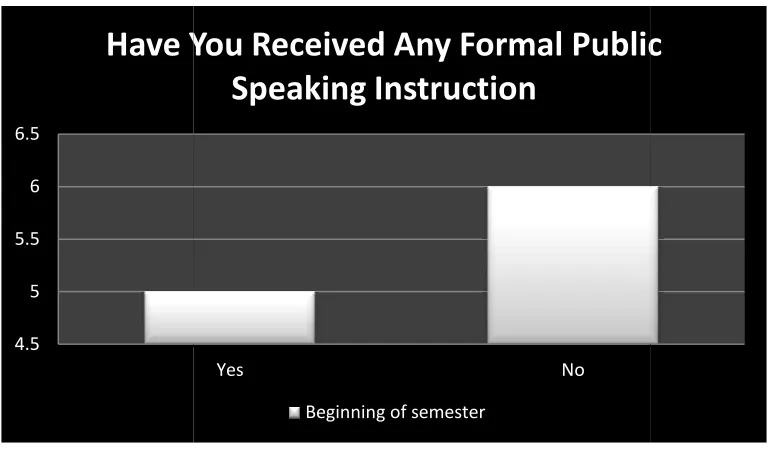
Figure 3: Have You Received Any Formal Public Speaking Instruction ... 75
Figure 4: How Often Do You Speak Publicly ... 76
Figure 5: I Am Afraid of Public Speaking ... 77
Figure 6: I Am Comfortable Speaking About My Ideas ... 79
Figure 7: I Am Comfortable Writing About My Ideas... 79
Figure 8: I Explain Myself Better When: Speaking or Writing ... 80
Figure 9: I Am Comfortable Speaking About My Ideas ... 86
xi BSU Boise State University
GC Graduate College
INTRODUCTION
While reading a chapter titled “Performance” in the text Lingua Fracta by Collin Brooke, I was introduced to the idea of the neglected canons of delivery and memory. Traditionally, there are five canons identified by the Romans: Invention, arrangement, style, memory, and delivery. Brooke cites John Trimbur and Kathleen Welch as commentators on the consolidation of the five canons into three within the classroom.
Lingua Fracta is a text that explores how digital media offers new ways of viewing and using the classical rhetorical canons, “acknowledges the changes that the canons must undergo in the context of new media” (xii)and then gives them new names to match their new functions. Brooke does devote a chapter to the neglected canon of memory;
includes the traditional notion of delivery and expands it to include the new media of our age.
Brooke’s objective is to update and recontextualize the classic rhetorical canons for an age when writing is rapidly moving to an online platform. I will concede that appearance and format are a new part of this canon thanks to the digital age in which, when compared to the days of ancient Greece and Rome, very little information is given orally; however, I feel that the need to provide instruction and practice with public speaking should not not be edged out even when the choice of media and circulation becomes a part of delivery’s definition. It is easier to control the appearance of the digital information that we present to the internet world than it is to control our body language, immediate word choice, actual tone of voice, organization of ideas as they spill forth from us, appearance of confidence and therefore credibility, clarity of mind, and awareness of the audience that is literally in front of us. If delivery or instruction on public speaking was going to be eradicated with the onset of the digital age, then theater would have died out with the invention of films and television.
right to how to improve one’s public speaking abilities or how to better teach it, or even more popular, the topic of anxiety of public speaking. It was even given an acronym – PSA – signifying its frequent use. Public speaking has evidently been shelved into a specialty subject that is often only accessible to students through an extracurricular club after school or required by select majors rather than given a blanket requirement for all students the way that composition is. However, students are still required the perennial in-class presentation that largely produces mediocre results and is not nearly frequent enough to provide the practice needed for the long-lasting improvement that will aid students in their future careers and lives.
I hope to fill the gap that exists in the conversation of public speaking’s
relationship to writing and critical thinking. It is my belief that if students were given the opportunity to frequently speak their ideas aloud before an audience rather than allowing their insubstantial thoughts to be gathered in an ethereal jumble in their minds before putting them out on paper that the quality of students’ analysis, organization, clarity, and originality would be affected.
This is the hypothesis; however, I am mostly just curious about whether or not there would be an effect if students were able to speak before an audience more often. I want to investigate whether or not it is a wrongful neglect or if it simply has become outdated and unnecessary. I sincerely doubt the latter will prove true because of experiences from my own life as a result of an education that neglected the canon of delivery.
indication that I and others like me are in especial need of instruction and practice. My research so far has indicated that those who seek out speech instruction in the form of speech courses or clubs already possess a propensity for the skill and wish to further enhance it, while those who are sorely in need of instruction avoid these optional
offerings. I always felt frustrated by the experience of speaking publicly because I knew that I could organize my thoughts and choose my words much better if I had the privacy of my mind and page to work it out. With digital technologies, we have that privacy. However, that hasn’t prevented me from having to (unimpressively) present a project to a room of interns and publishing executives where only my spoken words, nervous
mannerisms, and scattered thoughts were apparent, instead of my hours of work at the privacy of my desk. I have attended countless job interviews where my entire potential must be demonstrated in a few brief spoken responses. I still must contribute orally in my classes where on more than one occasion my train of thought has broken because I become overwhelmed with the knowledge of all the attention being focused on what I am saying. Then, there are the minor instances of explaining my concerns quickly in phone calls to unseen strangers and professionals, speaking with professors or colleagues, and negotiating with store clerks and bank tellers.
perfectly. I learned the hard way that just because I have comprehended a lesson, I am not necessarily prepared to talk about it. I have learned that it helps to write out my words before speaking them; however, it is not a perfect solution because I don’t have the option of reading my masterfully articulated lesson to students; writing and speaking are two different genres that require different language. While writing crystallizes the knowledge slightly more than winging it, I still feel as if the ability to speak clearly and convincingly without notes is a muscle that has the potential to be strengthened yet has never had the motivation for me until now.
CHAPTER ONE: PUBLIC SPEAKING AS AN AREA OF WEAKNESS IN OUR CURRICULUM AND CULTURE
Introduction
necessary for a full understanding of a communication act, whether is it written, spoken, electronic, or some combination of any of all of these” (vii).
Reynolds further asserts that while these canons of speaking “change form” with the “interiorization of writing,” “the split between the oral and the written is not as convenient as many commentators would have it” (19). Reynolds makes a bold statement here that writing and speaking may be distinct skills, but they are still intertwined in a manner that should not be dismissed by composition instructors. The skills still need each other to realize their full rhetorical potential and learning one can certainly aid the other; however, learning one skill does not automatically equip students to practice the other.
The idea of the skills’ distinctness is backed up by John T. Morello in "Comparing Speaking Across The Curriculum and Writing Across The Curriculum Programs" when he says:
speech products differ in time, medium, and relationship from written texts. As the saying goes, “a speech is not an essay on its hind legs.” Processes by which people create writing and prepare for speaking are different; differences can form the basis of a new set of teaching approaches geared to the oral domain. (110) This reasserts the argument that learning one skill (writing) does not prepare one to practice the other (speech) because the thought processes involved and the factors considered are different. Just because a person has been taught to communicate with words through writing does not mean that they now know how to communicate with those same words through speech.
needs the close educational attention that writing receives. This is one fact that school boards need to understand before they will institute speech in their curriculums, as pointed out by Mina G. Halliday in Communication Is Getting It Together: “’speech is learned, and because it is learned, can be taught.’” Too often people feel that once you learn to talk, you have mastered communication skills (16). In the textbook Public Speaking as a Liberal Art, John F. Wilson and Carroll C. Arnold also explain that we learn to speak “unself-conscious[ly]. So naturally enough, we take our speech habits for granted until something happens that makes us see our talk is not producing the effects we want it to. Then comes the sense that ‘communication has broken down,’ and that sense is not rare” (10). When communication breaks down, that is when we become aware of oral abilities, or lack thereof, and that is when it is too late to learn the skills necessary to try a different avenue for this audience.
It’s generally acknowledged that students need to learn how to arrange their ideas thoughtfully and transfer their thoughts from inner speech to physical print. Why is this need to write deemed more important in mass university required courses than the need to speak? Both skills require transferring thoughts from inner speech to outer
communication; however, speech is not given the delay that writing receives where the communicator can pause, think over their words carefully, engage in trial and error, and revise. With speech, they have one shot to communicate an idea immediately and well. This should make speech more in need of instruction and practice, not less. As
Just because a person can write well, doesn’t mean that the battle is done with communication. Speaking and writing are connected despite their differences in process; Kathleen E. Welch in The Contemporary Reception of Classical Rhetoric:
Appropriations of Ancient Discourse supports the assertion that “Orality and literacy need to be considered together because they worked together….Their deletion by us ignores the orally based rhetoric that was the foundation for writing” (97). The
foundation of composition pedagogy is the direct descendent of an ancient pedagogy for speech instruction. Composition has lost touch with its roots.
Public Speaking as an Area of Weakness in Our Curriculum and Culture
As recently as 2006, Kathleen Yancey has asserted that the ignoring of oral instruction actually does a disservice to writing as well: “by and large people’s rhetorical effectiveness is hamstrung because of their weakness in the area of delivery” (25). Then, in 1992, it was noted that:
scholars in the discipline of Speech Communication have discovered an alarming lack of advanced (and in some cases basic) competence in oral communication among the citizenry of the United States. Vangelisti and Daly (1989) reported the results of a national assessment which tentatively concluded that between 15% and 20% of the population of 21 - to 25-year olds have significant problems with routine communication. The authors suggested that this level of incompetence may well forecast an even greater lack of communication competence in more complex speaking tasks. (Strohmaier 32)
pedagogical tools to facilitate the development of relevant skills…to create feasible techniques for translating scholarly knowledge into a usable form for those who need it in everyday life…Communicators must be exposed to diverse, real-life communication situations, and they must be given direct experience in coping with those contexts. (32)
University, they take pride in their “open curriculum” where students are free to design their own university experience because there are no core requirements – except for a strict two-class writing requirement (Fennessey). This habit in the university curriculum structure of requiring writing and next to no speech instruction and practice may be one of the reasons that Harry Overstreet in The Mature Mind said:
In no area of our maturing… is arrested development more common than in the area of communication…. The person who is mature in his communicative
powers is noted as an exception to the rule. The person who is immature – halting, clumsy, obscure, rambling, dull, platitudinous, insensitive – is the rule. (as cited in Halliday 18)
There just might be a correlation between scholars’ and employers’ observations of the average person’s lack of speaking competency and the lack of attention paid to speaking instruction in the university.
The Role of Technology
more importance in the era of secondary orality than it as for many centuries” (Welch 153). In fact, the reassertion of orality in the twentieth century in the form of the
electronic media – a phenomenon that Eric A. Havelock describes as “the reawakening of the oral spell after a long silence” (as cited in Welch 3) – makes the study of the inclusive theories of classical rhetoric even more pressing than it was before the large changes in consciousness and culture brought about first by the telegraph, then by film, video, computers, and other electronic forms of discourse.
Not only are speaking abilities just as important as they were before the dawn of the internet, it is arguably even more important. Oration was rightly deemed very
important when presidential candidates would travel around the country speaking to large crowds of voters. Then, in 1978, Dwight L. Garner wrote, “When the president addresses the nation through radio and television, he talks to more than a hundred million
of the judges, audience, and fellow contestants; she performed poorly for the whole world and posterity to see. The need to teach people how to speak fluently and with composure has not passed because of technology. Welch supports this by reminding her readers that: Walter Benjamin, in “The Work of Art in the Age of Mechanical Reproduction,” explores the idea that electronic media enable oral discourse to gain power that it had not had in pre-electronic eras: permanence… In secondary orality, the dynamic of the spoken word is not only powerful, it is lasting. We have returned to a state of interdependence of oral and written discourse. With the technology of secondary orality, the spoken word and the written word are empowering each other in ways that previously were not possible. (161)
The nature of our technology now makes oral delivery an even higher priority, not a lower one.
For many theorists, the solution is to revise the classical canons to fit into modern day media. For instance, in Lingua Fracta, Collin Brooke says:
that individual canons have changed over time is not a controversial claim…. Chapters 3 through 7 of this book suggest fresh ways of thinking about the canons, going so far as to rename them for the context of new media but these revisions of transformations are not intended to replace the canons’ classical formation. Rather, they are offered as new layers of dimensions, speculative amendments to terminology that has a long, albeit checkered, history. (43)
standard format in terms of font, text size, margins, and spacing. I concede that these are arguably part of the canon of delivery. However, Brooke’s argument leans on the notion that because these concepts are taught and given frequent attention, the canon of delivery is not neglected. He is okay with the fact that the speaking aspect of delivery is still neglected. And this is where we differ. Because I am not okay with it. It was actually while reading Brooke’s chapter titled “Performance” that I was introduced to the idea of the neglected canons. “Delivery” in particular. In this chapter he explains how the format in which information is delivered to an audience is a new use of delivery and that
discussions of delivery can now take place without first prefacing it with a bemoaning of its neglect. His chapter went on to say that delivery now could also mean file formats and the visual rhetoric of a website. And he is not alone in this belief. Reynolds also writes:
Rethinking delivery simply requires that one see equivalences between oral, written, and electronic pronunciato and actio – analogies between voice/gesture and layout/typography, for example – something that composition specialists focused on technical and computer-assisted writing have been doing with considerable ease for some time now. (4)
Brooke also cites Welch’s stance that the “canon ‘is weakened if it refers only to the gesture, physical movement, and expression that so many commentators have dismissed it as limited to.’ Welch insists that delivery does not vanish with the shift from orality to literacy, but rather changes” (174).
because electronic discourse in the majority of its manifestations appears to be “live” but in fact is stored on film or tape. The immediacy of this appearance, the attractiveness of the liveness, is part of the performative power of the symbol systems of secondary orality. (161)
The need to speak articulately will most likely follow our students wherever they go, and unless they have sought out the instruction, they are going off into the
professional world unequipped with the one skill that presents more than their ideas, but their entire selves to the flesh and blood public.
Immediacy
There is still nothing more powerful and persuasive than a physical being before you. The first step away from a predominately oral culture in which most communication was delivered by person to person contact was the use of printed words. Now in this technological age we have dozens of different ways to contact our fellow men other than face to face contact. However, it is still seen as poor form to break up with someone, deliver bad news, or have a serious conversation over instant messaging, text, email, Facebook, or over the phone instead of facing up and doing your own dirty work. Anything other than physical presence during these difficult conversations is considered to be cowardly and disrespectful.
My argument is that there is no replacement for the immediacy of human presence during performance regardless of the technological advances that our society reaches. The closest we’ve come to is most likely video chatting; however, I’m sure there isn’t a soldier overseas who wouldn’t say that as wonderful as it is to have that
them, even if they couldn’t physically touch. They still aren’t in the same environment, breathing the same air, experiencing the same environment. Speech communication’s power doesn’t lie simply in the words that are said:
Part of the power of the spoken is its immediacy, the directness and intimacy of the connections between speaker and hearer, the physical continuity between the emitted and the received sound waves, the anatomical inflexions of voice that carry subtle emotions simply inexpressible in mere words communicated literally. (Reynolds 151)
Speech is still an important skill – and writing doesn’t replace it. H. Smith, author of An Outline of Man’s Knowledge of the Modern World explains, "The unhappy
confusion between language and writing continues to be universal among all literate people. This universal confusion between speech and writing is today the principle obstacle to a clear understanding of the nature and function of language" (as cited in Morello 110). If we restrict language to print or give students the impression that the written word is the most important use of language communication and give them a lopsided education language-wise, we are handicapping students and overlooking all the possibilities for expression. As Morello says above, pretending that speaking and writing are the same thing and believing that teaching one skill is essentially teaching the other skill than we are showing a poor understanding of the purpose and power of language. As Rob McCormack says, “Language must be language in action” (3). Students need the opportunity to taste the words in their mouth, hear them in their own physical voice, feel them in their hand gestures and facial expressions, and see them reflected in the
Even anciently:
theorists devoted little energy to the topic of delivery, and this lack of attention has often been replicated in modern scholarship, which has tended to focus more on the literary aspects of the surviving texts than the performances derived from them….however, elements of performance and showmanship were crucial to the persuasive effect of much of Cicero’s oratory…. Indeed it was a live performance – not a written text – that most Romans would have experienced oratory, an important fact to bear in mind if we want to understand the full impact of Cicero’s speeches. (Dominik and Hall 6)
Cicero is regarded as one of the greatest orators of all time; however, we can only
experience his work through reading it. But it is not through the words on the page that he became a great. Why do we shell out hundreds of dollars for concert tickets when we could listen to the same music for free? For the performance. For the experience.
spontaneity is a good thing” (as cited in Reynolds 148). In Plato’s “indictment of writing” he expresses a concern with delivery saying that writing has a “strange quality” like a painting:
…for the creatures of painting stand like living beings, but if one asks them a question, they preserve a solemn silence. And so it is with written words; you might think they spoke as if they had intelligence, but if you question them, wishing to know about their sayings, they always say one and the same thing. And every word, when once it is written, is bandied about, alike among those who understand and those who have no interest in it…. (Brooke 33)
and Erasmus, and of the Old and New Testaments – is sealed off into a cul-de-sac… Thought becomes a private, or even an antisocial enterprise” (as cited in Lanham 20). We have retreated into our separate corners where we can safely and without presenting our physical selves to an audience, formulate an argument without seeing our opponent and with the comfortable cushion of time to allow us to carefully choose our words. This is a different skill than what Isocrates and Cicero practiced and taught. What they engaged in was a different skill than written composition.
Speech instruction’s revival is needed because no matter how much we write or create ways to avoid speaking face-to-face, society still seems to have a demand for the immediacy of performance. Even though there are movies, we still go to the theater. Even though there are records, CDs, and mp3s, we still go to concerts. Even though we can write a rebuttal to an argument, we still want to respond verbally. Who hasn’t shouted at a prerecorded program on TV? We still hunger for immediacy in our interactions and need to be able to participate in them.
Why Public Speaking Is an Important Skill
listener” (Wilson and Arnold 8). Once again, public speech could be anything from lecturing a room of hundreds or instructing a single person. The main difference between public speech and conversation is that “in conversational settings no one in particular bears responsibility for creating and maintaining interpersonal relations through speech” (8). The crux of the definition seems to lie wherever the responsibility does. If one has a responsibility to speak, the pressure is on in a way that it is not in a light conversation between friends. For instance, in situations where “a tacit understanding has somehow evolved that Mr. X or Ms. Y will talk. Such a situation could even occur during an interview. It is in that moment of obligation that Mr. X or Ms. Y feels differently. He or she is ‘on’ now” (8).
Another instance that would be considered public speech is in “communicative argument and explanation – processes no social person can avoid using constantly” (6). Josh Compton points out that speech can happen “in small group discussions, question and answer sessions, brainstorming, debates, formal presentations, impromptu remarks, demonstrations, one-on-one inquiries, oral defenses, panel discussions, interviews …and public speeches” (253). It may be that speech is often overlooked in the disciplines because of the misconception that speech is only a “stand and deliver” operation. Seen through that view, then yes, it is less likely to be a necessary skill for every university student. Compton continues that if “we don’t reach this shared understanding, this wider view of what it means to do speech, we are limiting speech in the disciplines. By
has a far greater importance than writing, gestures, and other symbolic expression. …We know the student is a composer; all we need do is listen to his conversations” (201).
On the first page of Idea to Delivery, Dwight Garner writes that “as important as writing [is], speech is the most commonly used method of communication. It is essential to us in all areas of our lives. Even the written word is presented, explained, discussed, and evaluated through the spoken word” (1). Not only is it more frequently used, it is used by nearly every profession, regardless of rank or field. Wilson and Arnold explain to speech students in their textbook how frequently and often unconsciously we use public speech:
It goes on all about us. We all participate in it, sometimes well and sometimes not so well. One study of clerks, secretaries, technicians, and engineers in a large research and development laboratory found the staff spending 35 percent of all working time in face-to-face talk… A secretary tells a supervisor what supplies are in the office inventory and what must be bought. A lab assistant reports data to the supervising chemist or the chemist gives directions to his assistants.
Thousands of small public speeches take place in every business organization – and not only there. An athletic scout returns from scouting a future opponent and tells its game strategies to the head coach, or to two or three coaches, or to the coaches and the entire team. A committee member tells the committee the facts he was asked to collect. (9)
leadership and employability” (Shafer 279). In 1999, an article in the LA Times called “Colleges, Like, Focus on Speech,” Elizabeth Mehren related the experience of the use of speech focused curriculums in a number of prestigious East Coast schools. The reason for the focus was that “writing skills and a degree from a prestigious institution are no longer enough. In order to face the world beyond college, students must speak effectively, be able to organize cogent arguments and be ready to function in an increasingly team-oriented workplace” (as noted in Mehren 1). Or as Edith Poor from Smith College argues in the same article “Being able to write well is no longer the only communications skill that people need to get measured on” (as noted in Mehren 3). Another Smith graduate, Wendy Markus Webb, said “her own speaking skills were minimal” when she graduated in 1980. She is now a senior vice president at Disney in Burbank, but it wasn’t during her undergrad that she was taught the skills she needed to get to where she is today; “it was at the Harvard Business School where she learned to speak up and articulate her thoughts.” What about our students who won’t go on to Harvard Business School? They shouldn’t have to go to the pinnacle of educational institutions in order to get the skills necessary to succeed. Webb says that now “when interviewing college students for prospective
corporate jobs, ‘…they clearly have a hard time articulating themselves. They don’t know how to sell themselves, and often they resort to monosyllabic answers” (3). Writing a well-crafted cover letter and/or resume can get you into an interview. I will never argue that writing is a useless skill. However, it is your speaking ability during the interview that is going to get you into a job. And the once you’ve got the job:
so strong that these skills are considered crucial to a student’s education. Business leaders would agree. A study conducted among employers ranked communication skills as the most important skill needed for applicants seeking employment. More recently, a New York Times article reported on the results of a survey of 3,000 employers who were asked to rank the factors they considered in hiring decisions. When asked to rank on a sale of 1 to 5 the factors they used in making hiring decisions, these employers ranked communication skills second. Only attitude ranked higher. So, it appears that requiring oral presentations across disciplines would…prepare them for success in their careers. (Nicosia 74)
At her institution Kathleen Yancey says that she and her colleagues have been working very hard to assist undergraduates as they apply for high ranking scholarships, fellowships etc. such as the Truman and Rhodes competitions. Through these endeavors they know that “the judges for these awards look for and expect rhetorical skills –
including skill in delivery at interviews” (26). Well, not every one of our students will be applying for these prestigious awards. In fact, most of them won’t be; however, all university students would benefit from greater speech instruction when it comes time to interview for graduate school or in the business and government workforce, “when they are called upon to make speeches or presentations or reports, and when they want to be listened to at town hall meetings or political conventions or other public gatherings” (26).
this section: Sense of Satisfaction, Social Tool, Disciplined Thinking, Understanding of Self, and Understanding of Others. Each facet is accompanied by a paragraph, which includes other benefits, all of which cannot be discussed here. For now, I will focus in on the Social Tool benefit.
The section reiterates the point already made that practicing speech will aid in a number of college activities such as “giving an oral report in a history class or engaging in animated conversation in the student center” (3). But then it informs the students that “the advantages of speech training will be even more noticeable in your community, occupational, and social life after you have left college.” Garner then makes an
interesting point about how improving the speaking abilities of our students can improve our society and the communities in which they take part. It is an especially important idea for university instructors to keep in mind because “colleges educate many of those who help mold our social patterns, and speech training is an important factor in the
William Dominik and Jon Hall in A Companion to Roman Rhetoric explained that “The aspiring orator was to make sure that he talked, walked, and generally carried himself like a man,” and he also “had to make sure there was nothing in his gestures or movement that smacked of the humble laborer” (229). Marxist and feminist issues aside, the kernel of truth here is that they wanted to improve themselves and become something better than common. One of the main reasons that we seek education is to improve ourselves. The most sought after universities are the ones where the motive of the aforementioned curriculum designers is to create intelligent and well-rounded members of society: the elite of society. We need more people in our society who “can say the right thing at the right time” – the person who can “change a situation, unblock a situation, by the timeliness and aptness of their contribution or intervention” (McCormack 12). These are the kind of people who are “attuned to the tensions, ambiguities, and possibilities of social situations and know how to speak to these situations in ways that clarify them for those concerned. They have a way with words. They can speak up. They can organize their thoughts and speak cogently.” This is how Rob McCormack describes “the ethical attributes of the person ideally produced by a rhetorical education.”
CHAPTER TWO: HOW SPEAKING CAN INFORM COMPOSITION
Introduction
Chapter One discussed in depth about how public speaking is still important and relevant in society and why speaking is a dismally weak area in our culture. This is an idea that could easily elicit more discussion and analysis. However, the objective that will hopefully make this argument more relevant to the field of composition and rhetoric is the hypothesis that including more public speaking activities in the standard composition course can not only benefit students’ public speaking abilities, but also improve
composition skills.
Sherri Shafer shares a student’s personal experience in "Building Public Speaking Skills Across the Curriculum" that highlights well the effect of minimal educational exposure to students’ public speaking skills:
sort. You are graded on your material as well as how you present it, but if you have not been properly educated on speaking, your grade suffers. (279-280) Shafer explains what this student’s experience – and no doubt many others’ in the educational system – means: “The academic community has provided a disservice in the field of communications studies” (280). She believes that the answer to mending this discrepancy is a cross-curriculum approach beginning in middle and high schools, in order to “better prepare our students in a more effective manner for the future” (280). I agree that this cross-curriculum approach should be implemented earlier than college and high school; however, I believe there is potential for it to begin as early as elementary school.
Kathleen Welch believes that “we can exploit the power of the spoken word more precisely to achieve more effective writing….We can take advantage of the interaction and the mutual dependence of speaking and writing” (140). By including speech in composition instruction, we could improve student writing. Welch comes to speech’s defense against composition’s domination in education when she says, “a vital element for the creation of philosophy and science was not the dominance of written abstraction or oral culture but the relationship between the two…. The evidence does not support a conception of “victory” by one medium over the other” (97). There was never a declared winner between writing and speaking, and yet writing receives all the benefits of
from which composition courses are developed, than it seems only logical that speech instruction should be included. Welch points out that “Plato’s work developed
significantly because of the interaction of orality and literacy.” She then refers to Walter Ong’s theory that “the mutuality in their coexistence exert[s] powerful language and consciousness changes” (97). In other words, using speech and writing together can have an effect on students’ awareness of their thought processes. Mary Saunders in "Oral Presentations in the Composition Classroom” cites “improved attitudes (indicated by student evaluations) and better grades” as signs that her combination of speaking and writing in the classroom is effective and she hopes that “we will begin to see a number of rhetoric programs that are truly rhetoric programs: marriages between public speaking and composition courses” (360).
There is a great deal of scholarship surrounding the idea that integrating speech elements into the classroom can improve the students’ understanding of the subject being taught. This has been found to be true of any subject not just composition or humanities, which leads to the theory that speech should be used as a learning tool. Mina G. Halliday in Communication Is Getting it Together explains:
Communication study is such that to be made practical, it must be used as an integrated study – one involved with and helping with every other subject or course of study. As Dorothy Higginbotham stated, “Whenever speech has become a separate area of study, it has tended to emphasize differences rather than
similarities in reading, writing, speaking and listening skills.” (16)
enhances the learning of the subject it is paired with. However, the focus of this piece will remain on speech’s effect on composition. John T. Morello in "Comparing Speaking Across the Curriculum and Writing Across The Curriculum Programs," claims that “anyone who has been involved in Writing Across the Curriculum knows that it works only if reading, talking, and listening work with it” (100). This is interesting coming from the composition side rather than the speech or communication camp because Morello is essentially saying that teaching writing works best when paired with talking and
listening.
Mahla Strohmaier, in "Implementing Speaking Across the Curriculum: A Case Study," points out why speech should be used in conjunction with composition rather than as a separate subject:
The earlier work by Vangelisti and Daly (1989) indicated a connection between oral and written communication processes through the discovery of a significant correlation between oral communication competence and students' proficiency in reading, understanding documents, and comprehending prose. (33)
can result in essays that are better grammatically and stylistically and better in the sense of having theses on practicable topics. The strongest point, however, in favor of oral work in the composition classroom is that it enables students to feel that they are taken seriously as people with minds, and this confidence can increase motivation to write well and even to tackle research papers with some sense of pleasure and accomplishment. (357)
From this one passage, she has cited benefits in grammar, style, invention, authority, confidence, and enjoyment. And I do believe that two of those listed are in the favored three of the rhetorical canons (style and invention). Perhaps oral delivery is needed after all.
Wilson C. Snipes, author of “Oral Composing as an Approach to Writing,” uses a recorder in his oral approach to the composing process and has created a “talk-retalk-write-rewrite method.” He says that this “offer[s] the student a chance to hear and to see what he expresses,” meaning that it can help students discover and fine tune their voice by “study[ing] his use of the language, to hear repeatedly his characteristic voice, idiom, [and] patterns” (200). It is also “student-centered” and “simultaneously persona and audience oriented.” Because it is student-centered it can improve student engagement. Persona can help develop students’ voices in relation to their audience, or audience awareness and analysis. It can improve their critical thinking by “offer[ing] the student a critical relationship to his conscious and unconscious command of the language.”
Because it is “rhetoric-centered,” students don’t concern themselves with the distractions of grammar and mechanics. Lastly, it can improve interpersonal relations by
In addition to Snipes’s observations, he compiled the students’ own list of advantages to using this method of talking during composition:
(1) the habit of composing; (2) a better understanding of structures; (3) more conscious awareness of language usage; (4) awareness of options as to how to develop a subject; (5) by listening "you become aware of what you are saying"; (6) speaking and writing were related for the first time; (7) the oral approach "livens up your writing" through its ear appeal; (8) the oral approach enables me to say "more what I feel"; (9) you listen to others more closely; (10) you
recognize that a speaker must use a language the audience can understand; (11) you find yourself involved in critical rethinking for the "tape does not say what I want to say," so "I add new things"; (12) peers are critical; and finally (13) it is fun. (205)
Keeping in mind that Snipes is a composition instructor, not a communications instructor, he states that this method of talking during writing “is the only composing process I know about that offers each student a chance to study himself, to hear himself, to see himself, as a user of language” (205).
From my research, I have grouped the most frequently cited skills affected positively by the use of speech during the composition process. These will be discussed as follows: voice, student engagement, audience awareness, talking through ideas, critical thinking, grammar and mechanics, confidence, and interpersonal relations.
Voice
be defined as the student’s identity as a self and how that manifests in their
communication. A common problem in first year writing, and one that I have noticed within the four classes of first year writing that I have taught, is that students are trying so hard to write “the right way” that they strive to imitate the academic writing that they are assigned in readings and that they encounter during their research and the result always reminds me of a child playing dress up with their parents’ shoes. It’s not that academic voices are the wrong way to write; it’s that it is not the student speaking. And when it’s not the student’s voice, it tends to also not be their ideas. I’m not suggesting plagiarism; I’m referring to original thought.
Duncker also says in relation to voice, “the writing I is of course a separate, dramatized voice, a quite different entity from the I who negotiates dailiness” (319). The personal voice in one’s head doesn’t translate perfectly to any form of communication. It is an entity that needs coaxing and taming in order to develop. It is rare for it to appear naturally. Frequent experience with speaking through their ideas can help students to begin to recognize and grow comfortable with their communicating voice. As Kathleen Yancey says, in Delivering College Composition: The Fifth Canon, “different methods will often suit different speakers” (20). This gives them the opportunity to try on different ways of presenting orally in order to find the way that suits their personality best and enables them to literally find their voice.
Because of the inexperience of most first year writing students, who they are as people and what their educated, well-thought out opinions are can be vague, weak, or lacking in confidence. Having something that you believe in is a vital component of the development of voice. Gerry Brookes quotes a visiting Chinese instructor in “Town Meetings: A Strategy for Including Speaking in a Writing Classroom”: “One of the needs of colleges students, especially first-year ones is to know what they think” (88). This is because for many students:
level of expertise. Now imagine that that fear is very alive in a student who holds a controversial position but doesn’t know how to articulate it well and is aware that they don’t fully understand all the complexities of the issue. The least we can do is try to make them more comfortable and acquainted with their communication style so that when they present their possibly unpopular point of view they can feel that they expressed it well.
Discussion is one of the best ways to substantiate where you stand in relation to other opinions. As Snipes says, “you attempt in the talking stage to discover who you are, what you think, where you stand on certain issues, subjects, experiences, events” (203). However, it can be a scary place to enter into. Brookes believes that he has found a way to encourage discussion without debilitating confrontation. His class will engage in a “Town Meeting.” This is an activity where each student throughout the semester is given the opportunity to speak uninterrupted for five minutes about a topic that concerns them. After responding to a few questions from the instructor, the discussion is opened up to the rest of the class. Brookes is careful to distinguish between this activity and a debate that is inherently confrontational: “They need to learn a critical habit of mind without having their own confidence destroyed in the process” (89). His experience with walking this fine line seems to have been positive. During the most dangerous discussion, he relates that “a real showdown threatened, but we were able to get out the views on each side without direct confrontation. Having seen us avoid it with a potentially divisive topic like this, others are readier to stand up and say what they think on different subjects” (90).
supports writing in the course. Not letting the debate develop in class drives the discussion underground and lets it emerge in journals and papers. Topics that get aired for three minutes, with a few minutes added to consider alternative points of view, become themes in student writing for the whole semester. (91)
We see here how discussing opinions briefly can lead to better knowledge of one’s perspectives and drive to express those perspectives. This ties into the advantages of invention, confidence, and engagement, all ideas that will be discussed later; however, the interconnectedness of these skills makes tidy division difficult.
Welch explains how speaking about ideas can lead to better writing of those ideas:
In addition to increasing writerly authority…the presentation of self in writing depends partly on the issues that the writer has repeatedly spoken to herself or himself or has heard spoken. The connection between presenting a self in speaking and presenting a self in writing is much closer than many researchers have recognized. Connecting speaking and writing can illuminate the
interconnected nature. Welch explains how this nature can work to the composition instructor and student writer’s advantage:
When the large – sometimes overwhelming – problem of authority is
deemphasized, concentration on other writing issues leads to the development of writing strengths such as experimenting with presentations and increasing
readability. This shift in the writer’s preoccupation from establishing authority to other, equally compelling writing issues enables students to work on aspects of writing that often they have never been reached in their previous writing instruction. The authority derives from the oral power….(138)
Engagement
these sessions also seem to help reticent students speak up. They certainly find themselves commenting on and expressing disagreement with these talks on paper, often with surprising energy, which has been disguised by their passive response to the talk itself. They may also speak out in other contexts. (91) John T. Morello, in "Comparing Speaking Across the Curriculum and Writing Across the Curriculum Programs," supports these assertions: “WAC [Writing Across the Curriculum] and SAC [Speaking Across the Curriculum] each underscore how each approach works to make students more involved in their education” (103). This is because, as Brookes says, “the strategy lets students own more of the course” (92). M. Cronin and P. Glenn in “Oral Communication Across the Curriculum in Higher Education: The State of the Art" explain that “students feel that the active learning required by oral communication activities is preferable to the more passive learning in lecture-oriented courses” because “oral communication activities place greater emphasis on sharing their ideas in their classes” (361).
An added benefit to greater sense of ownership over one’s course, voice, and perspectives is that, as Kate Kessler observes in "Composing for Delivery," “Plagiarism disappears because composing for delivery is personal and demands author ownership” (90). When an assignment doesn’t just feel like something that belongs to the instructor, students may want to put more of themselves into their projects.
Another asset is that “the students themselves are a good audience, attentive, sympathetic, and eager to hear each other; they become better listeners” (Brookes 92). What instructor hasn’t looked out over their students and seen half with glazed
“notes” on their laptop? When it’s their fellow students doing the talking and they know that they themselves will be doing the talking soon enough, their interest in what is going on is naturally roused. And when a student is engaged in class, it is more likely that they will be more engaged in the writing that stems from that class. It is less of an assignment to be endured and more an extension of the interesting discussion that happened in class that they got to play an active role in.
Audience Awareness
Since writing is a private activity, which means student writers usually don’t get to witness the effects of their own writing, audience awareness lessons and activities can be depressingly hypothetical. Questions like “Who is the audience that this essay is directed toward?” produce answers like “my teacher” or “my classmates” or “the world.” But when their words will be presented in class, they have a real audience to think about. They are considering the intelligence of the discussions that have taken place so far in class, their friends in the back row cheering them on, the classmate on the other side of the room that they’ve been eyeing and want to impress, not to mention the teacher with the legal pad who hands out the grades and whose grading style they have gained a familiarity with and want to stay on the good side of. That’s a lot of different audiences to consider. Real audiences. And there’s no hiding behind a page from them.
Brookes remarks that “the special pleasure of the exercise [public speech in class] is in seeing the wonder, surprise and shock – both at the strange and at the familiar – that they provoke in each other” (92). While it is fun to watch students discover true
know that they have the power to effect change” (90). This begins with knowing your audience. To refer back to Dwight L. Garner’s outline titled “What Will I Get out of Speech Training,” the last benefit is Understanding of Others. Thesection tells the new speech student that “Your appeal should be based on your understanding of what motivates people” (3).
Kessler uses a technique she calls composing for delivery in which her students compose letters to community members and organizations addressing issues that have been concerning them. These included such letters as a girl writing to the kind proprietors of a restaurant where she worked back home who had given a $100 bill to each employee when they graduated from high school, but she hadn’t received one, and another from a student to the transportation department about the difficulties art students had using the buses because no bus routes would take them to the art offices, requiring them to lug their oversized portfolios from their homes to the inconveniently located office. In both these examples, the students received replies as well as their concerns alleviated. The
restaurateurs apologized for their oversight, assuring her that it was not meant as a slight towards her job performance in any way, and enclosed a $100 bill. The art student’s issue was addressed by the implementing of a new bus route that dropped students off directly in front of the art office.
explains that she developed this technique based on her own experiences as a student: “Writing for a teacher for a grade was not enough to make me want to write well.
Because I wanted my writing to mean more, I looked for audiences beyond my teachers” (90). The strategy uses “delivery as a motivation for writing well” by composing for real audiences in such a way that the motivation involved in the writing process to properly address specific audiences and create a desired effect is very similar to the motivation involved with speaking directly to a specific audience: “Composing for delivery can elicit response and have real results. But to get the results they want, their writing must be carefully crafted and rhetorically sensitive.” The author points out that students are very timid about voicing their opinions to audiences outside their classroom and that writing is a good way to introduce them to the practice because it provides them with the privacy and delay to work through their rhetorical choices: “Composing for delivery can motivate students to link the writing process with the writing product” (89). After having a positive experience with writing to their audience, students begin to become more confident and therefore more likely to address their concerns with community members vocally.
James Moffett, in his book Active Voice: A Writing Program Across the Curriculum, presents the same argument about audience as Kessler that:
When I worked as a teaching assistant for an English 101 instructor during my undergraduate work, the instructor used a technique that I’ve always deemed too risky for my classroom, but during this research I have begun to see the merits outweighing the risk, and also seeing that the risk itself is an important experience. He would put a student’s draft up on the overhead and begin reading it aloud. The students were given a paddle with a green circle on one side and red on the other. They would begin with the green side facing him as he read. They were instructed to flip it to red as soon as they lost interest in the writing. In the modern classroom. there is much attention given to the creation of a humiliation free zone for learning. I feared that this practice would violate that zone. However, the papers would be presented anonymously, and while it may make a student squirm to hear their words that were written in quiet privacy falling on the ears of all their classmates, it allows them to see honest reactions to their writing. I was never present in the class period when this took place and the teacher never informed me of it. I learned about it during my one-on-one sessions with the students. They weren’t
complaining or giving any kind of feedback on the practice itself. They were using the experience as a tool as we revised their papers together. I was introduced to the activity because a number of students said to me, “okay, this is where all the paddles flipped to red so I need help making this more interesting.” They were able to see an immediate audience response and use that to improve their writing. As Brookes says about receiving immediate reactions, it “give[s] them glimpses into minds other than their own” (91).
audience analysis skills necessary for delivering the speech in the classroom” (23). One of the reasons that Speaking across the Curriculum programs advocate using speech in all areas of education is because “conventions of writing doubtlessly change when
community members talk; new initiates must learn to write and speak in the forms and styles of others in the community they wish to join” (Morello 106). Each academic community will need to be addressed differently and all the modes can’t be taught in the single composition classroom. Plus, it is not enough for students to learn to speak to only their academic community; they need to be able “to communicate across groups, thereby building intercommunity relationships” (106).
Using speech to teach audience awareness to composition students may be the most effective way for students to learn the skill. As John F. Wilson and Carroll C. Arnold say in Public Speaking as a Liberal Art:
We never talk to one another without having to adjust, without having to build some sort of relationship between speaker and listener. This necessity for adaptation may be the single most important fact about speech as a way of communicating. To speak is to make an adjustment to our own and someone else’s presence together in time, under specific circumstances. (14)
Their argument ties in well with Kessler’s ideas of students effecting change with their words and rhetorically analyzing how to create that change:
Kathleen Yancey in Delivering College Composition: The Fifth Canon explains how rhetorically analyzing one’s audience for oral communication can aid in the composition process by quoting Quintillian:
Questions of both voice and gesture are determined by what is appropriate: After all, “the same characteristics of voice, gesture and gait are not equally becoming in the presence of the emperor, the senate, the people, and magistrates, or in private and public trials, or in making a request to the praetor for the appointment of a judge to hear our case, and in the actual pleading.” This advice echoes that given for the decisions concerning invention, arrangement, and especially style, the kind of advice every first-year composition textbook includes regarding audience analysis. (20)
Rob McCormack says this about rhetoric: “The art of rhetoric is an art of practical reason, the art of reading situations creatively, setting out positions clearly, appraising alternatives with prudence and practical judgment” (12). The stakes are higher when addressing an audience in person, which makes thinking about that audience a more present and urgent need than it often is for students when composing. Using speech and real audiences in the composition classroom would be like practicing running in the sand; you’ll be even better at it under normal circumstances if you can do it when it’s hard.
Talking Through Ideas
James Moffett advocates speech’s use during these points in the writing process: “Not all stages are pre-writing; talking over one’s ideas in mid-composition or after a draft is often extremely useful” (17). But he also believes it is a vital part of the prewriting process calling it “nearly obligatory” to go over ideas orally before putting them in writing “because that is almost certain to make written results more successful” (51) and that “talking is, after all, the main form of pre-writing (especially if one includes talking to oneself, inner speech)” (19).
The usefulness of “face-to-face” conversation while composing is also seen by Joanna Krych-Appelbaum and Meredyth Musial in “Students' Perception of Value of Interactive Oral Communication as Part of Writing Course Papers." They say:
speakers are affected by their conversational partners – not only in what they plan to say, but how and when they plan to say it. Writing, by contrast, typically has a future reader but the writer cannot interact with the reader. Based on previous research on face-to-face communication, we suggest that students will find it useful to talk interactively with another person about what they are in the process of writing. (131)
This is the same activity that Moffett suggests in Active Voice: A Writing
imitate academic voices that are not their own in their papers and this often results in wordy, vague, or confusing sentences. When I come across these situations in which the students appears to be struggling to convert their inner speech into the “proper” outer speech, I push the paper away and ask the student to tell me what it is they are trying to explain. Time after time they are able to explain much clearer and specifically and often in voices that are perfectly acceptable for their paper with the added bonus of being authentic. As soon as they finish, I reply excitedly “That! Write that!” They then quickly and enthusiastically return to the page.
Moffett explains the nature of inner and outer speech:
Both talking and writing may be usefully regarded as a revision of inner speech, talking being more spontaneous and writing more pondered. …the whole shift from inner speech to outer speech that occurs continually as people verbalize their experience for others. It is designed to show students how to tap off and verbalize what is going on at any moment in their sensations, memories, thoughts, and feelings. (29)
Krych-Appelbaum and Musial then explain why, as Menzel and Carrell put it, “verbalization clarifies thought” (Menzel and Carrell 23): “in face-to-face conversation, people typically introduce ideas step-by-step, to make sure that they are mutually
understood. … Discussion may increase or re-invigorate the students’ own interest in the topic and the assignment, especially if the listener finds the topic particularly interesting” (Krych-Appelbaum and Musial 136).
they interact with their audience, students may learn to more efficiently and effectively communicate their ideas in written form as well as verbally” (136). This practice is also well-received by students since in Krych-Appelbaum and Musial’s experience they:
rated talking before and after writing combined higher than the other three techniques combined. … By initially focusing less on the evaluative aspect and focusing more on the writer’s ideas and how to best break them down to be understandable to a real listener, students can benefit by then applying such knowledge from face-to-face conversation to their paper writing. (136)
In the study by Krych-Appelbaum and Musial, the group that only gave written feedback rated the usefulness of their feedback lower than the students in the
conversation group. Half of the students in the conversation group reported that they “planned to talk before writing in the future” (133). Krych-Appelbaum and Musial believe this method is more useful because:
people need to do much more than simply utter words for others to decode. Conversation is interactive, requiring people to coordinate with one another in order for communication to proceed properly. People not only establish the content of their conversation (the who, what, when, where) but they also provide evidence of their understanding by nodding, asking questions, gesturing, among other techniques. This social coordination is important, because it impacts the ways speakers and listeners plan what they say and do next. (131)
order to record himself talking through his thoughts. He calls it “Thinking-Aloud as Tool.” In one of the final recordings, the student expresses his gratitude for having this opportunity because he thought it was “kind of neat to get my thoughts out” and “to have someone to talk to like this” and that he meant to keep recording himself even after the study (92). Smagorinsky discovered that the tape recorder enabled the student “to think through his purposes for writing in ways he hadn’t previously found available” (93). The troubled student failed or did poorly in all his classes except English that year and he attested that “this stuff helped me in the fact that when I got in there and it was time to write a paper, it was very easy for me…I had a very easy time thinking it through in my head” (93). The student was able to identify verbalization as the difference in his thought process now: “actually getting my thoughts out, not necessarily on paper, but getting my thoughts out to where I was hearing instead of just having it pass through my head, that was a different experience for me.”
had put myself through the process of articulating my inner understanding of the
concepts. However, I would once again find myself in the front of the classroom realizing too late that I couldn’t stand there and read my notes to them. Most of the time, I have to be dancing around just to hold the freshmen’s attention. If I broke eye contact, it would all be over. So I would glance at my notes and catch a few key words and phrases, but see mostly a blur because as I may have mentioned already, I’m not a confident public
speaker. From this experience, I have learned that while it does help to write out my thoughts in preparation for the teaching of a new concept, the best results come when I then practice explaining my ideas without looking at my notes. I have frequently been grateful during these practice sessions because what comes out the first few times is often utter nonsense that I am relieved does not have an audience beyond myself. The moral of this story is that until you can verbally explain a concept to an audience, you have not fully grasped it. Which is why I feel it is important to get students explaining what they have learned aloud if we have any hope of it being retained.
Because of this theory, John Gow would have oral tests during one-on-one conference time with his students. “At conference time, an informal discussion is conducted, based on selected questions. What ensues from this exchange clearly reveals the student’s strengths and weaknesses” (11-12). Students were given a list of ten
compositions. In addition, I have had numerous students mention in evaluations how helpful it was for them to have the opportunity during conferences to talk about what they were thinking about writing while they were still in the pre-writing and drafting phases because it helped them make connections to other ideas and to flesh out what they had been thinking about in a more substantial way than if they had simply started writing.
Patricia R. Palmerton in "Speaking Across the Curriculum: Threat, Opportunity Or Both?" provides an insight into why the practice of talking before and during the composing process is so beneficial: “Speaking across the Curriculum courses are structured to provide more than one chance, being developed around the idea that thinking and talking are integrally related” (4-5). Wilson Snipes’ description of talking makes it more clear how it is related to thinking: “talking includes what you normally call ‘talking to yourself,’ conversing, discussing, during which you ‘talk off the top of your head,’ associate ideas and attitudes freely, make tentative choices among possible points of views, ideas, attitudes, value” (203). Another reason that talking while composing helps is because “Like the delivery of a speech, the writing of the first draft should be fluent and rapid enough to capture the logic of the original outline. Attention to style and "correctness" can be saved for later” (Wood 191). The fluency and rapidness cited here is much like how conversational speech could be described. If a student writer can talk about it first, their paper may likely retain that fluency.
Kathleen Welch explains that whenever you change from one medium of communication to another, orality and literacy “will inform one another” because “they are changes in consciousness, that is, in the ways one conceptualizes” (154).