© 2019, IRJET | Impact Factor value: 7.34 | ISO 9001:2008 Certified Journal
| Page 1430
Conversion and Comparison of a Conventional Building to a Green
Building
Chandrika Pathak
1, Sahil Kumar
21
M.E. Scholar, Department of Civil Engineering, Thapar University, Patiala, Punjab
2B.Tech, Department of Civil Engineering, Lovely Professional University, Jalandhar, Punjab
---***---
Abstract –A Green Building is a building which is designed in such a way to protect health and environment, improves employee productivity and use natural resources for construction. It mainly focused on the construction, operation and maintenance phases. The material used for Green building are selected in such a way that they have minimum environmental burdens. In this paper it describe the materials that are needed for converting a conventional building to a Green Building and also cost analysis were done to give a detailed idea of the energy consumption and its benefits.Key Words: Green Building, Conventional building to a green building, Green Rating System, Sustainable building, Material
required in Green Building.
1. INTRODUCTION
Sustainable building or Green Building is the practice of creating healthier and more resource effective models of construction, renovation, maintenance and operation. It is also known as High Performance Building. The term “Green Building” not just applies to product but also to the building design, construction practice and strategies. Many research have been carried out worldwide to find sustainable materials for building and low technology method result in environmental friendly and sustainable construction. Green Buildings are design to reduce the overall impact on human health and natural environment by
Efficiently using water, air, energy and other resources Reducing waste, pollution and environmental degradation
It often emphasizes taking advantage of renewable resources e.g. using sunlight through passive solar, active solar, and photovoltaic techniques and using plants and trees through green roofs, rain gardens, and for reduction of rainwater run- off. The Fundamental Principles of Green Building is Structure Design Efficiency, Energy Efficiency, Water Efficiency, Materials Efficiency, Resource Efficiency, Indoor Environment Quality Enhancement, Operations and Maintenance Optimization, Waste reduction
2. LITERATURE REVIEW:
Chandra Shekhar Singh (2018) did a research on the green construction concept for eco-friendly design and environmental concern. In the paper the author conclude that reuse of the material which have less effect on environment can reduce the carbon emission and also the material cost.
Mr Aporva V Kothar et al. (2017) did a study on Green Building technology and their impact on environment and health. They reported all the technical and economical aspects a related to Green Building.
Pooja Choudhary et al. (2018) in their paper they studied about the different materials such as vertical gardening, LED lighting etc which are widely used in Green Building construction purpose. They also did a research on the market price of the materials.
Lynn M. Froeschle (1999) dis a research on the environmental assessment of the materials of green Building such as low toxic materials, low VOC, recycled products, local product etc.
IGBC “Indian Green Building Council” has given different rating criteria based on the environment and energy principles.
LEED “Leadership in Energy and Environmental Design”, since building have a sustainable impact on health and environment therefore LEED has given different rating system.
3. OBJECTIVE
The main objective of this research was
To study about the material that are required in Green Building. Converting a Conventional Building to a Green Building.
Cost Analysis of the material used.
4. MATERIAL REQUIRED IN GREEN BUILDING
The material that are required for converting into a green buildings are:
Green Roof and Plantation of trees: A green roof system is an extension of the existing roof with drainage layers, filter cloth, growing media, and plants already prepared in movable, often interlocking grids, whereby each component of the system may be installed separately. The greater insulation offered by green roofs can reduce the amount of energy needed to moderate the temperature of a building, as roofs are the site of the greatest heat loss in the winter and the hottest temperatures in the summer. Green roofs have much lower burning heat load.
LED t8 tube lights: LED t8 tube lights: It uses 50% less energy compared to standard fluorescent lamps. The greenhouse gas emission is decreases by consuming less energy.
Low VOC paints: VOC’s stands for organic volatile compounds, which are chemical compounds emitted from most paints and can affect human health. Low VOC paints are usually odorless and have no chemical solvents so they will greatly improve your indoor air quality.
Double Glaze Glass: These glass an ideal energy efficientwhich reduces the noise and reflects the heat and other UV and IR waves therefore maintaining a comfortable temperature at home.
Waterless urinals: This system uses a chemical led called blue seal which is used to store and recycle urine without any odor. This completely eliminates the usage of water. This proves to be efficient when used in office spaces. The conventional water-filled urinal trap is replaced by a disposable gel inserted in the urinal drain outlet of urinals. It holds a layer of the gel, floating on top of a urine layer
The combination of the Eco trap and the covering blue seal blocks out sewer gases and urine odors from the restroom A 3 ounce dose of the gel lasts up to 1500 uses, replacing from 1000 and up to 4500 gallons of quality potable flush water at each fill
Depending upon the usage, the blue seal liquid and the eco trap has to be replaced periodically
Dual Flush: It is a variation of the flush toilet that uses two buttons to flush different levels of water. A dual-flush toilet permits its user to choose between two amounts of water.
It has been proven to save up to 67% of water usage at homes
The flush tank should be fitted with dual flush faucet which has an option for half flush and full flush
© 2019, IRJET | Impact Factor value: 7.34 | ISO 9001:2008 Certified Journal
| Page 1432
5. CONVERTING CONVENTIONAL BUILDING TO A GREEN BUILDINGA university block have been selected to convert it to a Green Building. The material used in this conventional building was studied and analysed first. Observation were carried out based on the materials and cost.
[image:3.612.165.447.441.645.2]The table 1 shows the material that are used to convert the block into a Green Building.
Table 1: Material Used
Materials in Conventional
Buildings Materials used for Green Buildings
Normal Roofs Green Roofs
Conventional Paints Low VOC Paints
Normal Glass Double Glaze Glass
Standard Fluorescent Lamps 16 watt LED t8 tube light
Normal Urinals Waterless Urinals
Single flush Dual Flus
The above materials are replaced for converting the block to a Green Building. The cost analysis were done based on the materials.
5.1. Calculation of Cost:
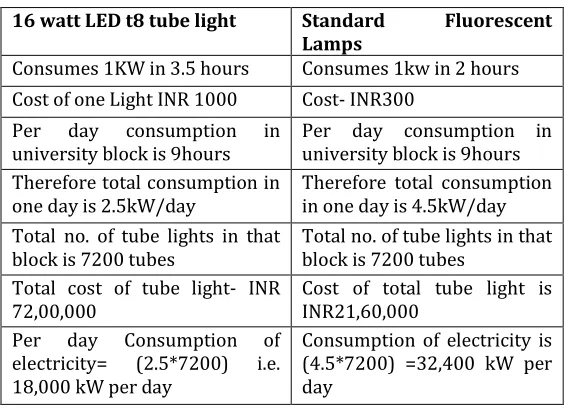
The cost computation were done for the different materials which are required to convert the university block. Based on the cost and the consumption of electricity and energy, analysis were done. Table 2 shows the comparison of the 16 watt LED tube light and the Standard Fluorescent Lamps.
Table 2: Comparison of Tube Light
16 watt LED t8 tube light Standard Fluorescent Lamps
Consumes 1KW in 3.5 hours Consumes 1kw in 2 hours Cost of one Light INR 1000 Cost- INR300
Per day consumption in
university block is 9hours Per day consumption in university block is 9hours Therefore total consumption in
one day is 2.5kW/day Therefore total consumption in one day is 4.5kW/day Total no. of tube lights in that
block is 7200 tubes Total no. of tube lights in that block is 7200 tubes Total cost of tube light- INR
72,00,000 Cost of total tube light is INR21,60,000 Per day Consumption of
electricity= (2.5*7200) i.e. 18,000 kW per day
Consumption of electricity is (4.5*7200) =32,400 kW per day
Assume Rate of per kW as INR9
So for LED = INR 1,44,000/per day
Fluorescent Lamp = INR2,59,200/per day
Waterless Urinals:
Cost of waterless urinals is INR 5,000
Cost of ordinary urinals is INR 800
Ordinary urinals uses 3-5 liters of water per day
Waterless urinals tends to use less.
Dual Flush:
Dual Flush result in an average flush volume of approximately 3.8L/flush.
Where else the single flush models that can use up to 13L/flush
Thus it result in up to a 67% savings in water
Cost of one dual flush is INR20,400
Cost of a single flush is INR 10,200
Double Glaze Glass:
Cost of Double glaze glass is INR 700/sq. ft.
Cost of Single glaze glass is INR 204/sq. ft.
Double glaze glass reduces solar transmission, operating energy and water cost, heat loss due to radiation.
It also reduce the heat gain inside the building, and thus reduces electricity and cooling cost by 25-40%.
Green Roofs:
It will reduce the uses of fans thus reduces the consumption of energy. The combination of soil, plants and trapped layers of air within green roof systems can act as a sound insulation barrier. Green roofs tend to last longer than standard roofing; the components can last up to twice as long as conventional roofing. Thus reduces the maintenance cost.
Low VOC Paints:
The table 3 shows the comparison of conventional Paints and the Low VOC Paints
Table 3: Comparison of Paints
Parameters Conventional Paint Low/Zero VOC Paints
Cost per gallon INR 520-1,500 INR 1,000-3,200
Performance over 10 years 4-5 coats needed 1 coat is enough
6. CONCLUSION:
© 2019, IRJET | Impact Factor value: 7.34 | ISO 9001:2008 Certified Journal
| Page 1434
REFERENCE:I. Singh C. S. (2018) “Green Construction: Analysis on Green and Sustainable Techniques”. II. Kothar A. K. et al. (2017) “ A Review on Green Building Research”
III. Choudhary P. et al. (2018) “Conversion of existing building into green building”.
IV. Froeschle L.M. (1999) “Environmental assessment and specification of Green Building Materials”.
V. Thormark C (2016) “The effect of material choice on the total energy need and recycling potential of Building”. VI. Baker G (2006) “Certification impacts private sector Environmental Design and Construction”.
VII. Sherwin D (2006) “Reducing the cost of Green”.
VIII. Moeck M et al. (2004) “Green Buildings and potential electric light energy saving”. IX. Bilec R. et al. (2006) “The economic benefits of a Green building”.
X. Bonde M. (2016) “Green Building Exploring Performance and Thresholds” XI. Kibert C.J. (2008) “Sustainable Construction: Green Building Design and Delivery”. XII. IGBC “Indian Green Building Council”
XIII. LEED “Leadership in Energy and Environmental Design”