http://www.scirp.org/journal/psych ISSN Online: 2152-7199
ISSN Print: 2152-7180
DOI: 10.4236/psych.2018.93022 Mar. 27, 2018 348 Psychology
Using Bifactor EFA, Bifactor CFA and
Exploratory Structural Equation Modeling to
Validate Factor Structure of the Meaning in
Life Questionnaire, Greek Version
Anastasios Stalikas, Theodoros A. Kyriazos, Vasiliki Yotsidi, Konstantina Prassa
Department of Psychology, Panteion University, Athens, Greece
Abstract
The purpose of this study was to evaluate the structure, invariance, reliability, convergent and discriminant validity of the MLQ with exploratory and con-firmatory factor analysis in 1561 Greek adults. After sample-splitting, a two-factor EFA and a two-factor bifactor EFA model were tested in the first sample. Then, seven CFA models were tested (three ICM-CFA models, two bifactor CFA models and two ESEM models) in the second sample. Two-factor ESEM representation was notably better than the ICM-CFA models and mar-ginally better than the bifactor model. Optimal ESEM model was successfully cross-validated in a third sample. MLQ was also proved to be invariant across gender. Internal consistency reliability was adequate. Convergent and discri-minant validity were also examined. Considering all findings, MLQ is gender invariant, reliable and valid to use in Greek cultural context.
Keywords
MLQ Factor Structure, ESEM, ICM-CFA, Bifactor EFA, Bifactor CFA, Measurement Invariance, Greece
1. Introduction
In recent years, the construct of meaning in life has been extensively studied by a plethora of social scientists, concertedly with the emphasis that has been put on
several other variables of positive psychology (Ryan & Deci, 2001; Seligman &
Csikszentmihalyi, 2000). The meaning in life concerns the degree to which
people think their life matters or has a purpose (Steger & Kashdan, 2006) and is
How to cite this paper: Stalikas, A., Ky-riazos, T. A., Yotsidi, V., & Prassa, K. (2018). Using Bifactor EFA, Bifactor CFA and Exploratory Structural Equation Mod-eling to Validate Factor Structure of the Meaning in Life Questionnaire, Greek Version. Psychology, 9, 348-371.
https://doi.org/10.4236/psych.2018.93022
Received: February 13, 2018 Accepted: March 24, 2018 Published: March 27, 2018
Copyright © 2018 by authors and Scientific Research Publishing Inc. This work is licensed under the Creative Commons Attribution International License (CC BY 4.0).
DOI: 10.4236/psych.2018.93022 349 Psychology
a prominent indicator of well-being (Ryff, 1989; Steger & Frazier, 2005). The
pervasive relation between meaning in life and well-being has been consistently documented across several studies (e.g., Reker, Peacock, & Wong, 1987; Steger & Frazier, 2005). Those who perceive their life as meaningful display higher
op-timism and self-actualization levels (Compton, Smith, Cornish, & Qualls, 1996),
self-esteem (Steger et al., 2006) and positive affect (King, Hicks, Krull, & Del Gaiso, 2006). On the other hand, the failure to achieve meaning in life may lead
to depression and anxiety (Steger et al., 2006;Debats, van der Lubbe, &
Weze-man, 1993), substance abuse (Steger et al., 2008a;Steger & Kashdan, 2006),
in-creased suicidal ideation (Harlow, Newcomb, & Bentler, 1986) and other mental
health problems, mainly due to the experience of boredom, emptiness and apa-thy (Frankl, 1963).
Following several decades of empirical and theoretical work on the signific-ance of meaning in life (e.g., Frankl, 1963; Ryff & Singer, 1998;Steger, 2012), two
important dimensions of the concept have been emerged (e.g., Crumbaugh,
1977; Steger et al., 2006): 1) presence of meaning and 2) search for meaning. Presence of meaning in life refers to the extent to which people perceive their life
as comprehensible, important and meaningful (Steger & Kashdan, 2006) and is
recognized as a construct that leverages positive functioning (Steger & Shin,
2010). Individuals who feel that their life is meaningful experience greater
well-being and lower levels of psychological distress (Steger et al., 2006).
More-over, they have smoother adjustment after experiencing post-traumatic events
(Steger et al., 2008b) and lower levels of neuroticism (Zika & Chamberlain, 1992). They report better health (Steger, Mann, Michels, & Cooper, 2009) and
have reduced likelihood of cognitive decline (Boyle, Buchman, Barnes, &
Ben-nett, 2010).
The second dimension, search for meaning in life, concerns the need for in-tently seeking a valued life purpose or mission and a greater meaning in life and
originates from human intrinsic motivation (Frankl, 1963). Although search for
meaning has been found to result to resilient responses in cases of people facing negative events (e.g.,Skaggs & Barron, 2006; Lee, 2008; Chan & Chan, 2011), in non-stressful situations it is linked to higher levels of depression and anxiety
(Steger et al., 2009), negative affect (Steger et al., 2008b) and reduced levels of happiness and life satisfaction (Park, Park & Peterson, 2010). In most of the
stu-dies conducted (e.g., Steger et al., 2006; Damasio & Koller, 2015; Boyraz,
Lightsey Jr., & Can, 2013; Temane, Khumalo, & Wissing, 2014), negative corre-lations have been documented between the two dimensions. This can be attri-buted to the fact that perceived meaning is associated with less of a need to
pur-sue further meaning in life (Schulenberg, Strack, & Buchanan, 2011).
Neverthe-less, it is noticeable that in some studies this result is overturned and the rela-tionship between them has been reported to be positive, especially in
collectivis-tic cultures such as China and Japan (Steger et al., 2008c; Wang & Dai, 2008).
DOI: 10.4236/psych.2018.93022 350 Psychology
(Steger et al., 2008c). As the interest towards the understanding of human
well-being continuously grows (Seligman, Steen, Park, & Peterson, 2005;
Selig-man & Csikszentmihalyi, 2000), the necessity of using psychometrically sound research tools and rigorously validated measures for assessing such constructs
has become imperative(Diener & Seligman, 2004). Meaning in life is one of the
most critical components to provide the conditions from which happiness arises
(Lent, 2004;Ryff & Singer, 1998) and thus the creation of psychometric scales for its measurement has been deemed indispensable. Several measures of mean-ing in life have been developed in previous work, such as the Purpose in Life Test (PIL; Crumbaugh & Maholick, 1964), the Life Regard Index (LRI; Battista & Almond, 1973) and the Sense of Coherence Scale (Antonovsky, 1987). However, these scales have been criticized for being confounded with several of the va-riables they correlate with (Frazier, Oishi, & Steger, 2003) as well as for having
poor content validity (Dyck, 1987) and structural properties (Steger, 2007). In an
effort to overcome these pitfalls and provide a psychometrically robust measure
of the presence of and search for meaning in life, Steger et al. (2006) developed
the Meaning in Life Questionnaire (MLQ). MLQ scores have greater stability and better discriminant validity than scores of other scales. In a review of
fif-ty-nine instruments assessing meaning in life, Brandstätter et al. (2012)
con-cluded that MLQ is one of the best scales in terms of concept definition, sam-pling, item development and forms of analysis.
The Meaning in Life Questionnaire is a self-report inventory that assesses two dimensions of meaning in life. The Presence of Meaning subscale comprises 5 items (items 1, 4, 5, 6, and 9) and measures respondents’ perceived meaning in their life while the Search for Meaning subscale also consists of 5 items (items 2, 3, 7, 8, and 10) and measures their motivation to discover meaning in their life. The questionnaire takes about 3 - 5 minutes to complete. The MLQ does not have cut scores but it is intended to measure meaning in life across the full range of human functioning.
Steger et al. (2006) reported internal consistency reliability coefficients (Cronbach’s alpha) ranging between .81 and .86 for Presence and between .84 and .92 for Search subscale. One-month test-retest reliability coefficients were .70 for Presence and .73 for Search. Other studies also provide support for the reliability and test-retest reliability of MLQ scores. Currently, the instrument has been translated into more than 20 languages for international use and has
been validated in several cultures including Greece (Pezirkianidis et al., 2016),
Brazil (Damasio & Koller, 2015), Chile (Steger & Samman, 2012), Hong Kong
(Chan, 2014), Turkey and USA (Boyraz et al., 2013), China (Jiang, Bai, & Xue, 2016), Japan (Steger et al., 2008c), and South Africa (Temane et al., 2014). Dur-ing the last few years, the MLQ has also been used in diverse and special
popula-tions within the United States, such as individuals experiencing grief (Boyraz &
Efstathiou, 2011;Boyraz, Horne, & Sayger, 2010), patients suffering from serious
DOI: 10.4236/psych.2018.93022 351 Psychology
al., 2009), and individuals from different ethnic backgrounds (Kiang & Fuligni, 2010). As far as differentiation in demographics variables are concerned, no sig-nificant gender differences have been found, while older participants report
higher scores in Presence subscale and lower scores in Search subscale (Steger et
al., 2006).
The purpose of this study is to validate the MLQ in the Greek context and ex-plore its psychometric properties among non-clinical Greek population. More specifically, the objectives of this study are the following: 1) To validate the
con-struct validity of the Meaning in Life Questionnaire(Steger et al., 2006), Greek
Version using both exploratory and confirmatory factorial analysis techniques like Bifactor EFA, Bifactor CFA and ESEM; 2) to examine measurement inva-riance of MLQ across gender; 3) to study the internal consistency reliability of the MLQ; and 4) to evaluate the convergent and discriminant validity of the MLQ with the constructs of well-being, hope, anxiety, depression, stress, hope and resilience.
2. Method
2.1. Participants
The sample is a subset of a larger dataset. The data used in this study were col-lected from 2016 onwards. The sample comprised 1561 Greek adults of the
non-clinical population. The participants were on average 39.7 years of age (SD =
12.81) and mostly female (62%). Most of them were married (51%), followed by single (41%), divorced (5%), widowed (2%), and 1% endorsing “other”.
2.2. Materials
2.2.1. Meaning in Life Questionnaire (MLQ)
The MLQ (Steger et al., 2006) is a ten-item measure of perceived meaning and
purpose in life. More specifically, it is a two-dimensional scale with five items in each factor. The first factor (Presence of Meaning) includes items about the per-ceived existence of meaning (e.g., “I have a good sense of what makes my life meaningful”). The second factor (Search for Meaning) examines one’s perceived quest for purpose (e.g., “I am always looking to find my life’s purpose”). Items
are rated on a 7-point Likert scale (from “Absolutely True” to “Absolutely
Un-true”). Possible factor scores range from 5 to 35. Scores higher than 24 in each
factor show high Presence/Search for meaning. From the scores of the two
fac-tors combined, four groups of respondents (Steger, 2010) are possible. The two
factors are considered related but distinct. Higher scores suggest greater Pres-ence/Search of meaning. Item nine (“My life has no clear purpose”) is re-verse-scored.
2.2.2. Satisfaction with Life Scale (SWLS)
The Satisfaction with Life Scale (Diener, Emmons, Larsen, & Griffin, 1985) is a
DOI: 10.4236/psych.2018.93022 352 Psychology
rated on a 7-point Likert scale, from 1 = strongly disagree to 7 = strongly agree.
The higher the score the greater the perceived satisfaction. The range of possible scores is from least satisfaction with life (5) to highest life satisfaction (35). Most
of the people fall between 23 - 28 (Pavot & Diener, 1993). The SWLS has been
used both in community samples (c.f. Pavot & Diener, 2008) and clinical
sam-ples (Arrindell, Meeuwesen, & Huyse, 1991) . Internal consistency reliability
(Cronbach’s alpha) was satisfactory ranging from .79 to .89 (Pavot & Diener,
1993;Adler & Fagley, 2005;Steger, et al., 2006;Alfonso & Allison, 1992a). The
SWLS is negatively correlated with depression (Blais, Vallerand, Pelletier, &
Briere, 1989) and with NA (Larsen, Diener, & Emmons, 1985).
2.2.3. Subjective Happiness Scale (SHS)
The SHS (Lyubomirsky & Lepper, 1999) is a brief and widely used self-report
measure of the degree to which the respondent feels happy. Four items are rated
on a 7-point Likert scale (from 1 = not a very happy person to 7 = very happy
person). Higher scores suggest higher mean happiness. Lyubomirsky and Lepper
reported internal consistency reliability ranging from .79 to .94 (M = .86). In the
same study, test-retest reliability ranged from .55 to .90. Finally, convergent va-lidity with well-being measures varied from .52 to .72.
2.2.4. Trait Hope Scale (HS)
Trait Hope Scale (Snyder et al., 1991) is a 12-item, self-report measure of
dispo-sitional hope (e.g., “I can think of many ways to get out of a jam”). Items are tapping on two factors: Agency and Pathways (or confidence and ability to pur-suit goals, respectively). Agency and Pathways represent aspects of hope,
dis-tinctly related(Bronk et al., 2009). Responses are rated using an 8-point Likert
scale, from 1 (Definitely False) to 8 (Definitely True), such that scores can range from a low of 8 to a high of 64, since four items are fillers. Generally, higher
scores suggest a greater sense of hope. In the older version of the HS (Snyder et
al., 1991), responses were rated on a four-point Likert scale (1 = Definitely False,
4 = Definitely True). Snyder et al. (1991) reported that for the total scale,
Cron-bach’s alphas varied from .74 to .84.
2.2.5. Depression Anxiety Stress Scale (DASS)
DASS (Lovibond & Lovibond, 1995)measures emotional distress in three 7-item
factors: namely depression (e.g., “I couldn’t seem to experience any positive feeling at all”), anxiety (e.g., “I was aware of dryness of my mouth”) and stress (e.g., “I found it hard to wind down”). The 21 items are rated on a four-point
Likert scale assessing intensity/frequency of distress (from 0 = did not apply to
me at all to 3 = applied to me very much, or most of the time) over the past
week. The higher the score the more intense or frequent the emotional distress. Each factor has a distinct score ranging from 0 - 21. Scores greater than 14, 10 and 17 suggest extremely severe Depression, Anxiety and Stress respectively
DOI: 10.4236/psych.2018.93022 353 Psychology
= .97 for adults of the general population (Henry & Crawford, 2005), and for
each factor alphas ranged between.81 and .97 (McDowell, 2006 cited in Yusoff,
2013).
2.2.6. The Connor-Davidson Resilience Scale (CD-RISC)
The Connor-Davidson Resilience Scale (CD-RISC, Connor & Davidson, 2003)
includes 25 items measuring psychological resilience (e.g., Can handle unplea-sant feelings). Items are rated on a 5-point Likert scale, from “not true at all” (0),
to “true nearly all of the time” (4). The perceived emotional states are rated over
the past month. The possible score varies from 0 to 100. Higher scores suggest greater resilience. Scores higher than 92 suggest high-resilience individuals.
Connor & Davidson (2003) reported a Cronbach’s alpha of .89 for the entire scale. The CD-RISC was primarily developed to measure stress-coping ability. Therefore, it is negatively correlated with perceived stress and positively corre-lated with social support (Connor & Davidson, 2003).
2.3. Procedure
Data were collected with the help of psychology students who voluntarily admi-nistered the test battery to 15 adult persons of their social environment. About 100 students participated in the study receiving extra credit. All participants were voluntarily recruited by the students on the condition they were older than 18 years. A letter was included in the test battery to inform participants about the purpose of this study. More specifically, the following process took place. First, students received a training course on the administration of psychology questionnaires by the research-team members. Then, a period of pilot-testing the battery followed to track any ambiguities. During pilot testing, the time needed to complete the test battery was estimated (approximately 20 minutes). Finally, each student was supplied with 15 copies of the test battery in paper and pencil form to administer them to adults in their social environment individual-ly.
2.4. Design of the Research
DOI: 10.4236/psych.2018.93022 354 Psychology
(MGCFA) was carried out in the entire sample (N = 1561) to test for the
mea-surement invariance of the MLQ across gender. Reliability analysis followed in the entire sample to examine internal consistency. Finally, the relation of MLQ to well-being (namely to life satisfaction and subjective happiness), trait hope, depression, anxiety, stress, and resilience were examined in the total sample.
Data collected were coded and analyzed with SPSS Version 25.0 (IBM, 2017),
Stata Version 14.2 (StataCorp, 2015) and MPlus Version 7.0(Muthen & Muthen,
2012).
3. Results
3.1. Data Screening
The total sample comprised N = 1561 cases. Missing values in all variables did
not exceed 2%. Missing data analysis followed to examine whether values were
missing completely at random (MCAR). Little’s MCAR test (Little, 1988) was
not significant, Chi-Square (14,972, N = 1561) = 15,128.87, p = .182, suggesting
that values were missing entirely at chance. Thus, missing values in the dataset were estimated with the Expectation-Maximization algorithm (EM). This me-thod assumes a distribution for the missing values and makes likelihood-based
inferences under that distribution (ΙΒΜ, 2016). Then EM is calculating a
matrix of means and covariances to estimate the missing values (Soley-Bori,
2013).
To validate the MLQ factor structure, the total sample (N = 1561) was
ran-domly split into three parts (NEFA = 313, NCFA1 = 624, NCFA2 = 624) with the
ran-dom number generator algorithm of SPSS version 25 (IBM, 2017). Caution was
taken to keep enough sample power in all three subsamples (EFA, CFA1, CFA2).
A sample-to-variable ratio of 10:1 (Osborne & Costello, 2005;Singh et al., 2016)
or alternately more than 300 cases are generally considered adequate for factor analysis (Tabachnick & Fidell 1996;Comrey & Lee, 1992). Our sample-to-variable
ratio for the EFA sample (N = 313), CFA1 sample (N = 624) and CFA2 sample
(N = 624) was 31.3 and 62.4 respectively. Sample-splitting (Guadagnoli &
Velic-er, 1988;MacCallum, Browne & Sugawara, 1996) is generally a cross-validation
method (Byrne, 2010;Brown, 2015).
3.2. Univariate and Multivariate Normality
The data in all four samples (Total, EFA, CFA1 and CFA2) violated the
assump-tions of univariate normality. Specially, Kolomogorov-Smirnov tests (Massey,
1951) on each item of the MLQ were statistically significant for all 10 items
(p < .001). Four tests were used to examine multivariate normality: 1) Mardia’s
multivariate kurtosis test (Mardia, 1970); 2) Mardia’s multivariate skewness test
(Mardia, 1970); 3) Henze-Zirkler’s consistent test (Henze & Zirkler, 1990), and
4) Doornik-Hansen omnibus test (Doornik & Hansen, 2008). All four tests
DOI: 10.4236/psych.2018.93022 355 Psychology
3.3. Establishing Construct Validity with Exploratory
Factor Analysis (EFA)
For both EFA and CFA, MPlus (Muthen & Muthen, 2012) uses robust
rescal-ing-based estimators (like robust MLR). MLR is appropriate for non-normal distributions, estimating standard errors and chi-square test statistics. Finally,
MLR can handle small to medium-sized samples (Bentler & Yuan, 1999;
Mu-then & Asparouhov, 2002 as quoted in Wang & Wang, 2012). Considering all the above properties, the robust MLR was used as an estimator for EFA and CFA.
Two exploratory factor analyses were executed in the EFA sample (N = 313):
1) a standard EFA, and 2) a Bifactor EFA (Schmid & Leiman, 1957). The MLR
was used for parameter estimates with Geomin factor rotation. Bi-Geomin factor rotation was used for the Bifactor EFA. A standard EFA was carried out to estab-lish a factor structure and have a baseline model for comparison with the EFA Bifactor model tested subsequently. Generally, relying on an EFA measurement model is usually a prerequisite to examine construct-relevant multidimensional-ity (Morin et al., 2016a, cited in Howard, et al., 2016). Regarding Bi-factor
analy-sis, Reise et al. (2007) recommended a bifactor always to be tested when
check-ing dimensionality of a construct (cited in Hammer & Toland, 2016). The
Schmid-Leiman method (Schmid & Leiman, 1957) has been used to test
bi-factor CFA models. Nevertheless, Jennrich & Bentler (2011) recently intro-duced the Exploratory Bi-factor Analysis method used in this study. EFA model
fit was evaluated by the following criteria (Hu & Bentler, 1999; Brown, 2015):
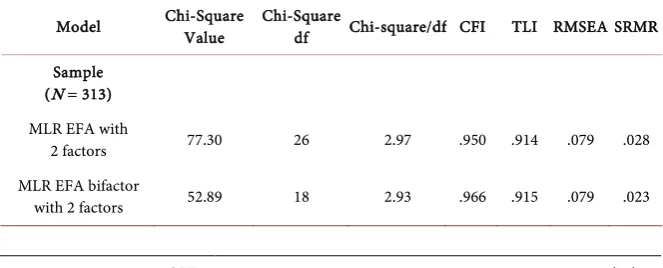
RMSEA (≤.06, 90% CI ≤ .06), SRMR (≤.08), CFI (≥.95), TLI (≥.95), and the chi-square/df ratio less than 3 (Kline, 2016). Fit statistics (see Table 1) suggested that both models achieved acceptable fit to the data with CFI and TLI > .95 and SRMR slightly better for the Bifactor solution. Both Chi-square/df ratios were < 3, indicating adequate fit to the data (Kline, 2016).
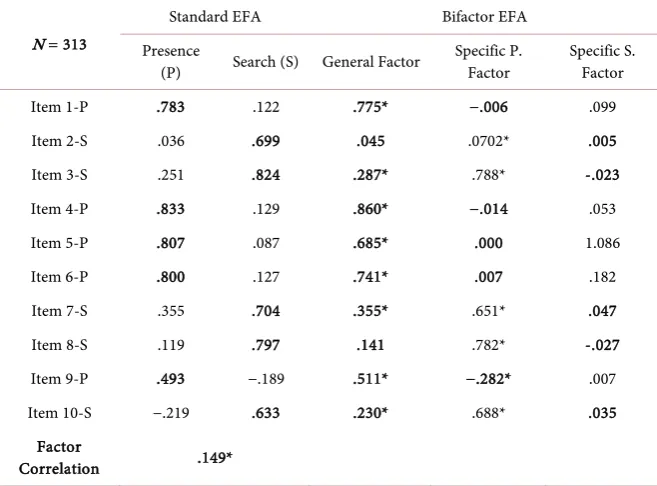
[image:8.595.206.538.610.744.2]Table 2 contains Geominand bi-Geominfactor loading for both EFA solutions tested. Factor Loadings for simple EFA ranged for the Presence factor from .493 (item 9) to .833 (item 4) and for the Search factor from .633 (Item 10) to .824 (Item 3). All items had significant primary factor loadings to the intended factor with no cross-loading items. Geominfactor correlation between Presence Factor
Table 1. Model fit statistics for EFA and EFA bifactor.
Model Chi-Square Value Chi-Square df Chi-square/df CFI TLI RMSEA SRMR
Sample (N = 313) MLR EFA with
2 factors 77.30 26 2.97 .950 .914 .079 .028 MLR EFA bifactor
DOI: 10.4236/psych.2018.93022 356 Psychology
Table 2. Factor loadings & factor correlations for the EFA models tested.
N = 313
Standard EFA Bifactor EFA Presence
(P) Search (S) General Factor Specific P. Factor Specific S. Factor Item 1-P .783 .122 .775* −.006 .099 Item 2-S .036 .699 .045 .0702* .005 Item 3-S .251 .824 .287* .788* -.023 Item 4-P .833 .129 .860* −.014 .053 Item 5-P .807 .087 .685* .000 1.086 Item 6-P .800 .127 .741* .007 .182 Item 7-S .355 .704 .355* .651* .047 Item 8-S .119 .797 .141 .782* -.027 Item 9-P .493 −.189 .511* −.282* .007 Item 10-S −.219 .633 .230* .688* .035
Factor
Correlation .149*
Bold indicates significant primary loading in EFA and weaker factor loadings for Specific factors in Bifactor EFA. *Significant at 5% level.
and Search Factor was .149 (p < .05). Steger et al. (2006) reported a weak nega-tive correlation between the two MLQ Factors. In the bifactor solution, all factor loadings were much higher on the general factor than the intended specific group factor, generating the assumption that the MLQ items may measure a higher order construct of meaning. The marginally better fit statistics of the bifactor solution further support this suggestion. However, Bifactor models always tend
to support unidimensionality (Joshanloo, Jose, & Kielpikowski, 2017). Thus, we
decided to examine the MLQ factor structure further with Confirmatory Factor Analysis.
3.4. Confirming Construct Validity with Confirmatory Factor
Analysis (CFA)
MLR was also used to estimate the models in all Confirmatory Factor Analyses. Goodness of fit was evaluated by the Standardized Root Mean Square Residual (SRMR), the Root Mean Square Error of Approximation (RMSEA, 90% CI), the Comparative Fit Index (CFI), and finally by the Tucker-Lewis index (TLI). Mod-el fit was evaluated by the following criteria (Hu & Bentler, 1999;Brown, 2015): RMSEA (≤.06, 90% CI ≤ .06), SRMR (≤.08), CFI (≥.95), TLI (≥.95), and the
chi-square/df ratio less than 3 (Kline, 2016). Models evaluated were the
follow-ing: 1) a single-factor Independent Cluster Model of CFA(ICM-CFA) which is
generally recommended(Brown, 2015;Crawford & Henry, 2004) to examine the
DOI: 10.4236/psych.2018.93022 357 Psychology
CFA bifactor model (Schmid & Leiman, 1957, c.f. Reise, 2012), with presence and search in two factors and simultaneously tapping a general factor of life
meaning, according to Reise et al. (2007), as quoted in Hammer & Toland,
2016). A variation of this model was also tested by adding a covariance between items 2 and 3 and a covariance between items 7 and 8; 4) a two-factor
Explora-tory Structural Equation Model (ESEM; Asparouhov & Muthen 2009) with all 10
MLQ items loading on the two MLQ factors simultaneously. A variation of this model was also tested by adding a covariance between items 2 and 3 and a cova-riance between items 7 and 8. ESEM produces more unbiased and accurate models in comparison to ICM-CFA because all secondary loadings are not
con-strained to zero like in ICM-CFA (Asparouhov & Muthen, 2009). Therefore, in
ESEM models factor correlations are more accurate even with trivial secondary
loadings (Howard, Gagne, Morin, Wang & Forest, 2016).
We did not test a higher order model. For a two first-order factorial structure, like MLQ, evaluating if the second-order factor improves the model fit when compared to the first-order solution is not possible because of under-identification
of the higher order model (Wang and Wang, 2012). The fit of all seven
alterna-tive CFA models for each sample is presented in Table 3.
[image:10.595.57.539.558.730.2]Regarding model fit, the single factor ICM-CFA (simple CFA) model per-formed poorly. The two-factor ICM-CFA model presented almost acceptable fit, both with and without covariances. The bifactor models showed notably better fit than the two-factor models with all fit statistics within acceptable limits (see
Table 3). Among them, Bifactor model with covariances showed the best fit to the data. However, the ESEM two-factor models also presented equally adequate fit, with all fit measures notable above fit criteria. Unsurprisingly, ESEM two-factor model with covariances showed better fit than the equivalent non-covariant ESEM model. Consequently, two competing optimal models emerged: 1) the two-factor bifactor with covariances model, and 2) the two-factor ESEM with
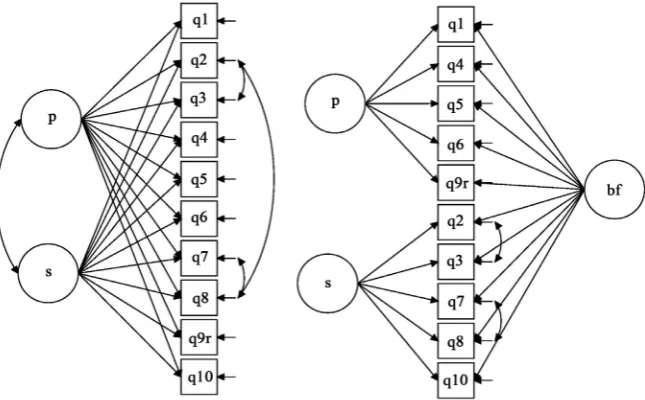
covariances model (see all fit statistics in Table 3 and Figure 1 for path
dia-gram).
Table 3. Model Fit statistics for the CFA and ESEM models tested with the MLR estimator in the confirmation sample.
Model Chi-Square Value Chi-Square df Chi-Square/df CFI TLI RMSEA RMSEA Lower CI Higher CI SRMR RMSEA
CFA 1 Sample (N = 624)
DOI: 10.4236/psych.2018.93022 358 Psychology
Figure 1. A path diagram of the two optimal models found: ESEM model (Left) and CFA
bifactor model (right). Conventionally, latent factors are represented by circles, errors as small arrows pointing on rectangles that represent manifest variables. Single-headed ar-rows connecting the variables represent a causal path while double-headed arar-rows on la-tent variables denote correlation. Double headed arrows between manifest variables de-note error covariance.
However, like ICM-CFA methods, Bifactor analysis ignores cross-loadings
therefore resulting in a general factor with an overestimated variance (Morin et
al., 2016a). Even trivial, unaccounted secondary loadings can inflate factor
cor-relations leading to misspecification (Marsh et al., 2014;Asparouhov & Muthen
2009;Howard et al., 2016). Therefore, unidimensionality based only on bifactor
analysis is often questionable (Joshanloo et al., 2017; Joshanloo & Jovanovic,
2016). Thus, we suggest that the two-factor ESEM model with covariances be
preferable to the bifactor model with covariances (see Figure 1 for more details).
Finally, it should be noted that in the ICM-CFA Model tested, the correlation of the Presence with the Search factor was weak but negative (−0.10), in line with
Steger et al. (2006).
3.5. Cross-Validation CFA in a Different Sample
After determining the optimal model, cross-validation of this model followed
(Byrne, 2010;Brown, 2015) to test whether model fit in a different sub-sample of
the dataset (N = 624). Cross validation of the optimal two-factor ESEM model
with covariances was implemented using the MLR estimator (Muthen &
Mu-then, 2012). As shown in Table 4, fit statistics showed an adequate fit to the cross-validation sample with all measures within acceptable limits. Additionally, all fit measures in CFA 2 sample had comparable values with their corresponding
fit measures in the model emerged in CFA1 sample (see Table 4 for comparison).
3.6. Measurement Invariance
DOI: 10.4236/psych.2018.93022 359 Psychology
Table 4. Model Fit comparison for the optimal two-factor ESEM model with covariances in a validation and a cross-validation
sample.
Model Chi-Square Value Chi-Square df Chi-square/df CFI TLI RMSEA Lower CI RMSEA Higher CI SRMR RMSEA
CFA 1 Sample (N = 624)
MLR 2 Factor ESEM with Cov 51.46 23 2.2 .985 .972 .045 .028 .061 .019 CFA 2 Sample (N = 624)
MLR 2 Factor ESEM with Cov 73.47 23 3.2 .985 .972 .059 .044 .075 .024
two-factor ESEM model with covariances was tested separately in each gender
group (males, N = 599 vs. females, N = 962). To compare nested models for
in-variance across gender, we used the ΔCFI and ΔRMSEA criteria proposed by
Cheung & Rensvold (2002). The model fitted the data very well in females
(Chi-square = 80.82, p = .0000, RMSEA = .051, CFI = .981) and equally well in
males (Chi-square = 65.09, p = .0000, RMSEA= .055, CFI = .975). To evaluate
measurement invariance, the model was then tested in both gender groups
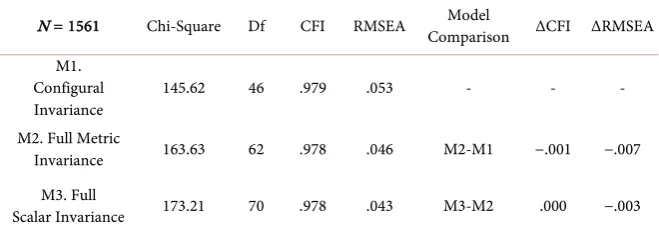
si-multaneously. This model (M1) showed acceptable fit (see Table 5), suggesting
that configural invariance was supported. Equality constraints were then
im-posed on all factor loadings across the two gender groups. As shown in Table 5
both ΔCFI and ΔRMSEA in this constrained model (M2) suggested full metric invariance. Finally, all intercepts were constrained to be equal (M3), and both ΔCFI and ΔRMSEA showed full scalar invariance. Thus, we assume that the MLQ is invariant across gender.
3.7. Internal Consistency Reliability
Internal consistency reliability of MLQ was evaluated with Cronbach’s alpha
coefficient (Cronbach, 1951). Values ≥ .70 are generally considered acceptable
and ≥ .80 adequate (Kline, 2016; Nunnally & Berstein, 1995; Nunnally, 1978).
Alpha coefficient for the total MLQ, the Presence factor and the Search factor were .76, .85, and .86 respectively. All results considered together (values from .76 to .86) suggest that the scale shows adequate internal reliability.
3.8. Convergent and Discriminant Validity
Convergent and discriminant validity was assessed using the total sample (N =
1561). The Presence of meaning was correlated with search for meaning with a
positive, weak and non-significant correlation (r = .23). The correlations of
Presence of meaning with measures of well-being were positive and significant
ranging from weak (r = .35, p < .01, with Hope pathways) to moderate (r = .53
with life satisfaction, p < .01), M = .45. Similarly, the presence of meaning had
positive and significant correlations (all ps < .01) with the dimensions of
CD-RISC, varying from weak (r = .23, Spiritual influences) to moderate (r = .55,
control), M = .39. As expected, the correlations of presence of meaning with
DOI: 10.4236/psych.2018.93022 360 Psychology
Table 5. MLQ Measurement invariance of optimal 2-factor ESEM model across gender.
N = 1561 Chi-Square Df CFI RMSEA Comparison ΔCFI ΔRMSEA Model
M1. Configural
Invariance 145.62 46 .979 .053 - - - M2. Full Metric
Invariance 163.63 62 .978 .046 M2-M1 −.001 −.007 M3. Full
Scalar Invariance 173.21 70 .978 .043 M3-M2 .000 −.003
from r = −.28 with Stress to r = −.40 with Depression, M = −.33. Search for
meaning had a negative correlation with happiness that was, weak and non-significant. Search for meaning had no correlation with life satisfaction and
weak but significant positive correlations with both Agency and Pathways (r = .12,
ps < .01). The correlations of search for meaning and CD-RISC dimensions were
also positive and significant (p < .01) but equally faint, from .07 to .15, M = .11. The same was true for Search for meaning and Stress, Anxiety and Depression,
with very weak, positive correlations (M = .06) of mixed significance (see Table
6 for details).
3.9. Descriptive Statistics of MLQ Scores
In comparison with the scores of the Search factor (M = 23.08, SD = 6.99), the
Presence factor scores were higher and more invariable (M = 25.69, SD = 5.73).
Most participants scored high both on Meaning factor and Search factor (>24), followed by those that scored high in the Presence factor (>24) but not equally high in the Search factor (see Table 7 for details).
4. Discussion
The purpose of this study was to evaluate the following: 1) the construct validity
of the Meaning in Life Questionnaire (Steger et al., 2006), Greek Version using
different explorative and confirmative factorial analysis approaches like Bifactor EFA, ICM-CFA, Bifactor CFA and ESEM; 2) the measurement invariance of MLQ across gender; 3) the internal consistency reliability of the MLQ; and 4) the convergent and discriminant validity of the MLQ with measures of well-being and mental distress. The results suggested that the data fit the ESEM representa-tion better than both the ICM-CFA model and the bifactor model.
More specifically, the sample was split into three different sub-samples
(Gua-dagnoli & Velicer, 1988; MacCallum et al., 1996), maintaining enough sample power in each sample to ensure robustness of the models found. Generally,
sam-ple-splitting is used as a cross-validation method (Brown, 2015; Byrne, 2010).
Regarding sample power, all three samples were far beyond the suggested 10
cases for each observed variable threshold (Osborne & Costello, 2005;Singh et
DOI: 10.4236/psych.2018.93022 361 Psychology
Table 6. Bivariate correlation of MLQ on the total sample.
Spearman’s rho Correlation Coefficient MLQ Presence of Meaning MLQ Search for Meaning Total Sample (N = 1561)
MLQ Presence of Meaning - .02
MLQ Search for Meaning .02 -
Well-Being Dimensions
Subjective Happiness Scale .44** −.03 Satisfaction with Life Scale .53** 0
Trait Hope Scale Agency .46** .12** Trait Hope Scale Pathways .35** .12**
Resilience Dimensions
CD-RISC Pers. Competence .43** .15** CD-RISC Tolerance/Trust .36** .12** CD-RISC Secure relat. .39** .09**
CD-RISC Control .52** .10**
CD-RISC Spir. Influences .23** .07** Mental Distress Dimensions
DASS Stress −.28** .08**
DASS Anxiety −.30** .06*
DASS Depression −.40** .05
**p < .01; *p < .05.
Table 7. Summary statistics for MLQ score for the total sample.
M SD Range
Sample (N = 1561)
Total MLQ 48.77 8.97 55
Presence of meaning factor 25.69 5.73 29 Search for meaning factor 23.08 6.99 30
First two alternative models were tested using Exploratory factor analysis (EFA): 1) a standard EFA to examine the factor structure and to have a baseline model for EFA comparisons, and 2) a bifactor EFA. Generally, both solutions showed adequate fit to the data, with all fit indices within acceptability criteria and significant factor loadings, all in their intended factor with no exceptions. Generally, the fit of the two models tested was very comparable with the Bifactor model having an overall better fit than the standard EFA model. This may not necessarily suggest a predominant general Meaning-in-life factor be present,
since unidimensionality based only on bifactor analysis is unstable (Joshanloo et
[image:14.595.207.541.475.556.2]DOI: 10.4236/psych.2018.93022 362 Psychology
To examine this assumption further, a Confirmatory factor analysis (CFA) followed in a second sample to verify the models emerged from EFA and bifac-tor EFA. All CFA models with error covariance were better than their counter-parts with no covariance. Note that two covariances added to items of the search
factor (see Figure 1)—namely, to item two (“I am looking for something that
makes my life feel meaningful”) with item three (“I am always looking to find my life’s purpose”) and to item seven (“I am always searching for something that makes my life feel significant”) with eight (“I am seeking a purpose or mission for my life.”). Finally, two CFA models showed optimal fit among the seven al-ternative models tested: 1) The two-factor ESEM model with covariances, and 2) the two-factor bifactor model with covariances. Comparing ESEM to Bi-factor factorial analysis, the latter is a CFA subcategory, allocating the variance of items both into a general factor and sub-factors. Each item is specified to load on the
general factor and also its target group factor (Reise, 2012), here “Presence of
meaning” and “Search for meaning”. Bifactor analysis allows for an examination of the common variance shared by the two MLQ factors and the unique variance specific to each of them.
However, bifactor analysis has received some criticism (Reise et al., 2013;
Reise, 2012;Joshanloo et al., 2017). More specifically, it seems that relying solely on the results of bifactor analysis to decide whether a psychological scale is
un-idimensional or multun-idimensional may be questionable (Joshanloo et al., 2017).
Additionally, constraining non-zero cross-loadings to zero can inflate the
va-riance attributed to the general factor in bifactor analysis (Morin et al., 2016;
Jo-shanloo et al., 2017). Given all above considerations, and the commonness of non-trivial secondary loadings in construct validation, bifactor analysis more
often than not is expected to support unidimensionality (Joshanloo & Jovanovic,
2016). All these limitations considered, we suggested that the two-factor ESEM model with covariances is preferable to the bifactor model.
Additionally, in the CFA, a noteworthy difference was found between this study and previous research. In contrast to this study, RMSE was generally
re-ported to be relatively high in previous research (Damasio & Koller, 2015;Steger
et al., 2006). This improvement in RMSE values in this study in comparison to reported empirical research, could possibly be attributed to ESEM and Bifactor techniques used here.
The MLQ Factors in EFA were positively, weakly correlated at 5% level of sig-nificance. However, the correlation of the Presence with the Search factor in the ICM-CFA model tested was weak and marginally negative. This difference in the relationship of the two factors in EFA and CFA may reflect the mixed influences
of both collectivistic and individualistic cultures (Hofstede, 2001;Triandis, 1995)
on the Greek sociocultural context, since Greece (along with Cyprus) is situated in the south-eastern border of Europe. This finding is compatible with previous research, suggesting that in collectivistic cultures (e.g., Japan: Steger et al., 2008c
DOI: 10.4236/psych.2018.93022 363 Psychology
positively correlated. The opposite is true in individualistic cultures (e.g., US:
Steger et al., 2006). Equally, ways of finding personal meaning and the relation-ship between Search and Presence, could be affected by cognitive orientation at
individual level (Steger et al., 2008c), and by differences in social orientation
across cultures at a group level respectively (Boyraz et al., 2013).
The results of measurement invariance (c.f. Brown, 2015; Byrne, 2010; Kline,
2016; Schumacker & Lomax, 2015) of the cross-validated model emerged across gender suggested that all 10 items of the MLQ were invariant (full invariance) when used both by males and females. In other words, results from this mul-ti-group CFA suggest that 1) across the two genders, the pattern of fixed and free parameters of the MLQ was equivalent (configural invariance); 2) across gender corresponding factor loadings of the 10 MLQ items were comparable (metric invariance or weak factorial invariance), and 2) across gender corresponding in-dicator means (intercepts) were equivalent (full scalar invariance or Strong fac-torial invariance). Furthermore, the results supporting the measurement inva-riance of the MLQ across gender are adding to previous research findings in several diverse cultures (e.g., Damasio & Koller, 2015; Boyraz, et al., 2013).
Ac-cording to Damasio & Koller (2015) invariance suggests a significant quality
in-dicator for the MLQ, enabling valid group comparisons between genders, free from response bias.
Additionally, internal consistency reliability of the Greek MLQ is adequate. Specifically, Cronbach’s alpha values were comparable to the results reported by
Steger et al. (2006) and by other studies (e.g., Steger & Samman, 2012; Chan, 2014; Jiang, Bai, & Xue, 2016; Steger et al., 2008c). Lastly, convergent and dis-criminant validity of the Greek MLQ was also examined. Expected correlations were found between MLQ and dimensions of well-being, hope, resilience, stress, anxiety and depression. Presence of meaning had significant correlations with all the above measures. The magnitude of the relationships ranged from low to strong. The opposite was true for the Search for meaning, since the significance of the relations was of mixed level and the relationships with the above con-structs were weak. The results of the correlation analysis were expected since the MLQ was reported to have overlapping content with other related variables
(Steger et al., 2006). Concerning the importance of the relationships, the Pres-ence of meaning factor had different relationships with other constructs tested from MLQ Search for meaning both in magnitude and in direction. This is not surprising, since the two factors of MLQ are reported to have a weak, negative correlation according to Steger et al. (2006).
5. Conclusion
Finally, the general conclusion of this work is that the two-factor structure of
MLQ established by Steger et al. (2006) is confirmed on the Greek cultural
DOI: 10.4236/psych.2018.93022 364 Psychology
fit to the data. Nevertheless, the optimal model among all different two-factor models tested was the ESEM model with error covariances. Considering all above findings, we reach the conclusion that the Meaning in Life Questionnaire, Greek version is a valid and reliable measure to use in the Greek context. A second important finding of this research is that MLQ Greek is gender equiva-lent thus, it can be unbiasedly used by both men and women.
This study has certain limitations that should be taken into consideration. First, during the data collection process, trained psychology students were in-volved. The impact of this method, if any, is unknown. Consequently, any gene-ralization to other populations should be made with caution. Second, missing values in the dataset were estimated with the Expectation-Maximization algo-rithm (EM). Despite that EM is particularly appropriate for Factor Analysis, the information whether this method assumes a distribution that does not violate
the assumption of normality (IBM, 2016)or not (Soley-Bori, 2013) is unclear.
Moreover, error covariances used in optimal model possibly suggest an
over-lapping content of the items (Brown, 2015). A similar issue was reported by
Damasio & Koller (2005) for the Brazil version of the MLQ. So, further research is necessary to examine this issue in yet another sample evaluating if it is a cul-ture-specific effect. Future research could also evaluate new confirmatory factor analysis techniques like Bifactor ESEM. Finally, invariance of the MLQ across age is another possible direction of the research in the future. Besides, construct validity is built over time. So, multiple studies should be carried out over differ-ent samples to shape more robust evidence of construct validity progressively
(Crocker & Algina, 1986;Messick, 1995).
Despite the above limitations, the contribution of the present study is that we have provided strong evidence for the construct validity, measurement inva-riance across gender, reliability and convergent/discriminant validity of the MLQ, Greek version. With the use of EFA bifactor, ICM-CFA, CFA Bifactor and ESEM factorial analysis techniques the MLQ Greek is confirmed to be a valid, reliable and gender equivalent measure of well-being.
References
Adler, M. G., & Fagley, N. S. (2005). Appreciation: Individual Differences in Finding Value and Meaning as a Unique Predictor of Subjective Well-Being. Journal of Perso-nality, 73, 79-114.
Alfonso, Y. C., & Allison, D. B. (1992a). Further Development of the Extended Satisfac-tion with Life Scale.The Behavior Therapist, 5, 15-16.
Antonovsky, A. (1987). Unraveling the Mystery of Health: How People Manage Stress and Stay Well. San Francisco, CA: Jossey-Bass.
Arrindell, W. A., Meeuwesen, L., & Huyse, F. J. (1991). The Satisfaction with Life Scale (SWLS): Psychometric Properties in a Non-Psychiatric Medical Outpatients Sample. Personality and Individual Differences, 12, 117-123.
https://doi.org/10.1016/0191-8869(91)90094-R
Struc-DOI: 10.4236/psych.2018.93022 365 Psychology
tural Equation Modeling, 16, 397-438.https://doi.org/10.1080/10705510903008204
Battista, J., & Almond, R. (1973). The Development of Meaning in Life. Psychiatry, 36, 409-427.https://doi.org/10.1080/00332747.1973.11023774
Bentler, P. M., & Yuan, K. H. (1999). Structural Equation Modeling with Small Samples: Test of Global Self-Esteem. Journal of Personality and Social Psychology, 89, 623-642. Blais, M. R., Vallerand, R. J., Palletier, L. G., & Briere, N. M. (1989). L’ Echelle de
satisfac-tion de vie: Validasatisfac-tion Canadienne-Francaise du ‘Satisfacsatisfac-tion with Life Scale’. [French-Canadian Validation of the Satisfaction with Life Scale]. Canadian Journal of Behavioral Science, 21, 210-223.
Boyle, P. A., Buchman, A. S., Barnes, L. L., & Bennett, D. A. (2010). Effect of a Purpose in Life on Risk of Incident Alzheimer Disease and Mild Cognitive Impairment in Com-munity-Dwelling Older Persons. Archives of General Psychiatry, 67, 304-310. https://doi.org/10.1001/archgenpsychiatry.2009.208
Boyraz, G., & Efstathiou, N. (2011). Self-Focused Attention, Meaning, and Posttraumatic Growth: The Mediating Role of Positive and Negative Affect for Bereaved Women. Journal of Loss and Trauma, 16, 13-32. https://doi.org/10.1080/15325024.2010.507658
Boyraz, G., Horne, S. G., & Sayger, T. V. (2010). Finding Positive Meaning after Loss: The Mediating Role of Reflection for Bereaved Individuals. Journal of Loss and Trauma, 15, 242-258. https://doi.org/10.1080/15325020903381683
Boyraz, G., Lightsey Jr., O. R., & Can, A. (2013). The Turkish Version of the Meaning in Life Questionnaire: Assessing the Measurement Invariance across Turkish and Ameri-can Adult Samples. Journal of Personality Assessment, 95, 423-431.
https://doi.org/10.1080/00223891.2013.765882
Brandstätter, M., Baumann, U., Borasio, G. D., & Fegg, M. J. (2012). Systematic Review of Meaning in Life Instruments. Psychooncology, 21, 1034-1052.
https://doi.org/10.1002/pon.2113
Bronk, C., Hill, K., Lapsley, P. L., Talib, D. K., Tasneem, L., & Holmes, F. (2009). Purpose, Hope, and Life Satisfaction in Three Age Groups. The Journal of Positive Psychology, 4, 500-510.
Brown, T. A. (2015). Confirmatory Factor Analysis for Applied Research (2nd ed.). New York, NY: Guilford Publications.
Byrne, B. M. (2010). Structural Equation Modeling with AMOS: Basic Concepts,
Applica-tions, and Programming (2nd ed.). New York, NY: Routledge.
Chan, W. C. H. (2014). Factor Structure of the Chinese Version of the Meaning in Life Questionnaire in Hong Kong Chinese Caregivers. Health and Social Work, 393, 135-143.https://doi.org/10.1093/hsw/hlu025
Chan, W. C. H., & Chan, C. L. W. (2011). Acceptance of Spousal Death: The Factor of Time in Bereaved Older Adults’ Search for Meaning. Death Studies, 35, 147-162. https://doi.org/10.1080/07481187.2010.535387
Cheung, G. W., & Rensvold, R. B. (2002). Evaluating Goodness-of-Fit Indexes for Testing Measurement Invariance. Structural Equation Modeling, 9, 233-255.
Compton, W. C., Smith, M. L., Cornish, K. A., & Qualls, D. L. (1996). Factor Structure of Mental Health Measures. Journal of Personality and Social Psychology, 71, 406-413. https://doi.org/10.1037/0022-3514.71.2.406
Comrey, A. L., & Lee, H. B. (1992). A First Course in Factor Analysis (2nd ed.). Hillsdale, NJ: Erlbaum.
DOI: 10.4236/psych.2018.93022 366 Psychology https://doi.org/10.1002/da.10113
Crawford, J. R., & Henry, J. D. (2004). The Positive and Negative Affect Schedule (PANAS): Construct Validity, Measurement Properties and Normative Data in a Large Non-Clinical Sample. British Journal of Clinical Psychology, 43, 245-265.
https://doi.org/10.1348/0144665031752934
Crocker, L., & Algina, J. (1986). Introduction to Classical and Modern Test Theory. Or-lando, FL: Harcourt Brace Jovanovich.
Cronbach, L. J. (1951). Coefficient Alpha and the Internal Structure of Tests. Psychome-trika, 16, 297-334.https://doi.org/10.1007/BF02310555
Crumbaugh, J. C. (1977). The Seeking of Noetic Goals Test (SONG): A Complementary Scale to the Purpose in Life Test (PIL). Journal of Clinical Psychology, 33, 900-907.
https://doi.org/10.1002/1097-4679(197707)33:3<900::AID-JCLP2270330362>3.0.CO;2-8
Crumbaugh, J. C., & Maholick, L. T. (1964). An Experimental Study in Existentialism: The Psychometric Approach to Frankl’s Concept of Noogenic Neurosis. Journal of Clinical Psychology, 20, 200-207.
https://doi.org/10.1002/1097-4679(196404)20:2<200::AID-JCLP2270200203>3.0.CO;2-U
Damasio, B., & Koller, S. H. (2015). Meaning in Life Questionnaire: Adaptation Process and Psychometric Properties of the Brazilian Version. RevistaLatinoamericana de Psi-cología, 47, 185-195.https://doi.org/10.1016/j.rlp.2015.06.004
Debats, D. L., van der Lubbe, P. M., & Wezeman, F. R. A. (1993). On the Psychometric Properties of the Life Regard Index (LRI): A Measure of Meaningful Life. Personality and Individual Differences, 14, 337-345.
https://doi.org/10.1016/0191-8869(93)90132-M
Diener, E., & Seligman, M. E. P. (2004). Beyond Money: Toward an Economy of Well-Being. Psychological Science in the Public Interest, 5, 1-31.
https://doi.org/10.1111/j.0963-7214.2004.00501001.x
Diener, E., Emmons, R. A., Larsen, R. J., & Griffin, S. (1985). The Satisfaction with Life Scale. Journal of Personality Assessment, 49, 71-75.
https://doi.org/10.1207/s15327752jpa4901_13
Doornik, J. A., & Hansen, H. (2008). An Omnibus Test for Univariate and Multivariate Normality. Oxford Bulletin of Economics and Statistics, 70, 927-939.
https://doi.org/10.1111/j.1468-0084.2008.00537.x
Dyck, M. J. (1987). Assessing Logotherapeutic Constructs: Conceptual and Psychometric Status of the Purpose in Life and Seeking of Noetic Goals Tests. Clinical Psychology Review, 7, 439-447.https://doi.org/10.1016/0272-7358(87)90021-3
Frankl, V. E. (1963). Man’s Search for Meaning: An Introduction to Logotherapy. New York, NY: Washington Square Press.
Frazier, P., Oishi, S., & Steger, M. (2003). Assessing Optimal Human Functioning. In W. B. Walsh (Ed.), Contemporary Topics in Vocational Psychology, Counseling
Psychol-ogy and Optimal Human Functioning (pp. 251-278). Mahwah, NJ: Erlbaum.
Guadagnoli, E., & Velicer, W. F. (1988). Relation to Sample Size to the Stability of Com-ponent Patterns. Psychological Bulletin, 103, 265.
https://doi.org/10.1037/0033-2909.103.2.265
Hammer, J. H., & Toland, M. D. (2016). Bifactor Analysis in Mplus.
http://sites.education.uky.edu/apslab/upcoming-events/
DOI: 10.4236/psych.2018.93022 367 Psychology https://doi.org/10.1002/1097-4679(198601)42:1<5::AID-JCLP2270420102>3.0.CO;2-9
Henry, J., & Crawford, J. (2005). The Short-Form Version of the Depression Anxiety Stress Scales (DASS-21): Construct Validity and Normative Data in a Large Non-Clinical Sample. The British Journal of Clinical Psychology, 44, 227-239.
https://doi.org/10.1348/014466505X29657
Henze, N., & Zirkler, B. (1990). A Class of Invariant Consistent Tests for Multivariate Normality. Communications in Statistics, Theory and Methods, 19, 3595-3617. https://doi.org/10.1080/03610929008830400
Hofstede, G. (2001). Culture’s Consequences: Comparing Values, Behaviors, Institutions, and Organizations across Nations (2nd ed.). Thousand Oaks, CA: Sage.
Howard, J., Gagné, M., Morin, A. J. S., Wang, Z. N., & Forest, J. (2016). Using Bifactor Exploratory Structural Equation Modeling to Test for a Continuum Structure of Moti-vation. Journal of Management, 1-59.
Hu, L., & Bentler, P. M. (1999). Cutoff Criteria for Fit Indexes in Covariance Structure Analysis: Conventional Criteria versus New Alternatives. Structural Equation Model-ing, 6, 1-55.https://doi.org/10.1080/10705519909540118
IBM Corporation (2016). IBM SPSS Missing Values 24.In IBM SPSS Statistics Version 24, Release 0 Manual. Spring House, PA: IBM Corporation.
IBM Corporation (2017). IBM SPSS Statistical Software, Release 25. Spring House, PA: IBM Corporation.
Jennrich, R. I., & Bentler, P. M. (2011). Exploratory Bi-Factor Analysis. Psychometrika, 76, 537-549.https://doi.org/10.1007/s11336-011-9218-4
Jiang, Y., Bai, L., & Xue, S. (2016). Validation of the Meaning in Life Questionnaire (MLQ) in Chinese University Students and Invariance across Gender. International Journal of Humanities Social Sciences and Education, 3, 41-48.
Joshanloo, M., & Jovanovic, V. (2016). The Factor Structure of the Mental Health Conti-nuum-Short Form (MHC-SF) in Serbia: An Evaluation using Exploratory Structural Equation Modeling. Journal of Mental Health, 26, 510-515.
https://doi.org/10.1080/09638237.2016.1222058
Joshanloo, M., Jose, P. E., & Kielpikowski, M. (2017). The Value of Exploratory Structural Equation Modeling in Identifying Factor Overlap in the Mental Health Conti-nuum-Short Form (MHC-SF): A Study with a New Zealand Sample. Journal of Happi-ness Studies, 8, 1061-1074.https://doi.org/10.1007/s10902-016-9767-4
Kiang, L., & Fuligni, A. J. (2010). Meaning in Life as a Mediator of Ethnic Identity and Adjustment among Adolescents from Latin, Asian, and European American Back-grounds. Journal of Youth and Adolescence, 3, 1253-1264.
https://doi.org/10.1007/s10964-009-9475-z
King, L. A., Hicks J. A., Krull J. L., & Del Gaiso, A. K. (2006). Positive Affect and the Ex-perience of Meaning in Life. Journal of Personality and Social Psychology, 90, 179-196. https://doi.org/10.1037/0022-3514.90.1.179
Kline, R. B. (2016). Principles and Practice of Structural Equation Modeling (4th ed.). New York, NY: The Guilford Press.
Larsen, R. J., Diener, E., & Emmons, R. A. (1985). An Evaluation of Subjective Well-Being Measures. Social Indicators Research, 17, 1-18.https://doi.org/10.1007/BF00354108
Lee, V. (2008). The Existential Plight of Cancer: Meaning Making as a Concrete Ap-proach to the Intangible Search for Meaning. Supportive Care in Cancer, 16, 779-785. https://doi.org/10.1007/s00520-007-0396-7
DOI: 10.4236/psych.2018.93022 368 Psychology Well-Being and Psychosocial Adjustment. Journal of Counseling Psychology, 51, 482-509.https://doi.org/10.1037/0022-0167.51.4.482
Little, R. J. A. (1988). A Test of Missing Completely at Random for Multivariate Data with Missing Values. Journal of the American Statistical Association, 83, 1198-1202. Lovibond, S. H., & Lovibond, P. F. (1995). Manual for the Depression Anxiety Stress
Scales (DASS). New South Wales: Psychology Foundation Monograph.
Lyubomirsky, S., & Lepper, H. (1999) A Measure of Subjective Happiness: Preliminary Reliability and Construct Validation. Social Indicators Research, 46, 137-155.
https://doi.org/10.1023/A:1006824100041
MacCallum, R. C., Browne, M. W., & Sugawara, H. M. (1996). Power Analysis and De-termination of Sample Size for Covariance Structure Modeling. Psychological Methods, 1, 130.https://doi.org/10.1037/1082-989X.1.2.130
Mardia, K. V. (1970). Measures of Multivariate Skewness and Kurtosis with Applications. Biometrika, 57, 519-530.https://doi.org/10.1093/biomet/57.3.519
Marsh, H. W., Morin, A. J. S., Parker, P. D., & Kaur, G. (2014). Exploratory Structural Equation Modeling: An Integration of the Best Features of Exploratory and Confirma-tory Factor Analysis. Annual Review of Clinical Psychology, 10, 85-110.
https://doi.org/10.1146/annurev-clinpsy-032813-153700
Massey, F. J. (1951). The Kolmogorov-Smirnov Tests for Goodness of Fit. Journal of American Statistical Association, 46, 68-78.
https://doi.org/10.1080/01621459.1951.10500769
McDowell, I. (2006). Measuring Health: A Guide to Rating Scales and Questionnaires (3rd ed.). New York, NY: Oxford University Press.
https://doi.org/10.1093/acprof:oso/9780195165678.001.0001
Messick, S. (1995). Validity of Psychological Assessment: Validation of Inferences from Person’s Responses and Performances as Scientific Inquiry into Score Meaning. Amer-ican Psychologist, 50, 741-749.https://doi.org/10.1037/0003-066X.50.9.741
Morin, A. J. S., Arens, A., & Marsh, H. (2016a). A Bifactor Exploratory Structural Equa-tion Modeling Framework for the IdentificaEqua-tion of Distinct Sources of Con-struct-Relevant Psychometric Multidimensionality. Structural Equation Modeling, 23, 116-139.https://doi.org/10.1080/10705511.2014.961800
Muthen, B., & Asparouhov, T. (2002). Using Mplus Monte Carlo Simulations in Practice:
A Note on Non-Normal Missing Data in Latent Variable Models. Mplus Web Notes:
No. 2.
Muthen, L. K., & Muthen, B. O. (2012). Mplus Statistical Software, 1998-2012. Los An-geles, CA: Author.
Nunnally, J. C. (1978). Psychometric Theory (2nd ed.). New York, NY: McGraw-Hill. Nunnally, J., & Berstein, I. (1995). Psychometric Theory. New York, NY: McGraw-Hill. Osborne, J. W., & Costello, A. B. (2005). Sample Size and Subject to Item Ratio in
Prin-cipal Components Analysis. Practical Assessment, Research & Evaluation, 9, 8. Park, N., Park, M., & Peterson, C. (2010). When Is Search for Meaning Related to Life
Sa-tisfaction? Applied Psychology: Health and Wellbeing, 2, 1-13.
https://doi.org/10.1111/j.1758-0854.2009.01024.x
Pavot, W., & Diener, E. (1993). The Affective and Cognitive Context of Self-Reported Measures of Subjective Well-Being. Social Indicators Research, 28, 1-20.
https://doi.org/10.1007/BF01086714
DOI: 10.4236/psych.2018.93022 369 Psychology https://doi.org/10.1080/17439760701756946
Pezirkianidis, C., Galanakis, M., Karakasidou, I., & Stalikas, A. (2016). Validation of the Meaning in Life Questionnaire (MLQ) in a Greek Sample. Psychology, 7, 1518-1530. https://doi.org/10.4236/psych.2016.713148
Reise, S. (2012). The Rediscovery of Bifactor Measurement Models. Multivariate Beha-vioral Research, 47, 667-696.https://doi.org/10.1080/00273171.2012.715555
Reise, S. P., Morizot, J., & Hays, R. D. (2007). The Role of the Bifactor Model in Resolving Dimensionality Issues in Health Outcomes Measures. Quality of Life Research, 16, 19-31. Reise, S. P., Scheines, R., Widaman, K. F., & Haviland, M. G. (2013). Multidimensionality
and Structural Coefficient Bias in Structural Equation Modeling: A Bifactor Perspec-tive. Educational and Psychological Measurement, 73, 5-26.
https://doi.org/10.1177/0013164412449831
Reker, G. T., Peacock, E. J., & Wong, P. T. P. (1987). Meaning and Purpose in Life and Well-Being: A Life-Span Perspective. Journal of Gerontology, 42, 44-49.
https://doi.org/10.1093/geronj/42.1.44
Ryan, R. M., & Deci, E. L. (2001). On Happiness and Human Potentials: A Review of Re-search on Hedonic and Eudaimonic Well-Being. Annual Review of Psychology, 52, 141-166.https://doi.org/10.1146/annurev.psych.52.1.141
Ryff, C. D. (1989). Happiness Is Everything, or Is It? Explorations on the Meaning of Psychological Well-Being. Journal of Personality and Social Psychology, 57, 1069-1081.
https://doi.org/10.1037/0022-3514.57.6.1069
Ryff, C. D., & Singer, B. H. (1998). The Contours of Positive Human Health. Psychologi-cal Inquiry, 9, 1-28.https://doi.org/10.1207/s15327965pli0901_1
Schmid, J., & Leiman, J. N. (1957). The Development of Hierarchical Factor Solutions. Psychometrika, 22, 53-61.https://doi.org/10.1007/BF02289209
Schulenberg, S. E., Strack, K. M., & Buchanan, E. M. (2011). The Meaning in Life Ques-tionnaire: Psychometric Properties with Individuals with Serious Mental Illness in an Inpatient Setting. Journal of Clinical Psychology, 67, 1210-1219.
https://doi.org/10.1002/jclp.20841
Schumacker, R. E., & Lomax, R. G. (2015). A Beginner’s Guide to Structural Equation Modeling (4th ed.). New York, NY: Routledge.
Seligman, M. E. P., & Csikszentmihalyi, M. (2000). Positive Psychology: An Introduction. American Psychologist, 55, 5-14.https://doi.org/10.1037/0003-066X.55.1.5
Seligman, M. E. P., Steen, T. A., Park, N., & Peterson, C. (2005). Positive Psychology Practice: Empirical Validation of Interventions. American Psychologist, 60, 410-421. https://doi.org/10.1037/0003-066X.60.5.410
Singh, K., Junnarkar, M., & Kaur, J. (2016). Measures of Positive Psychology, Develop-ment and Validation. Berlin: Springer.https://doi.org/10.1007/978-81-322-3631-3
Skaggs, B. G., & Barron, C. (2006). Searching for Meaning in Negative Events: A Concept Analysis. Journal of Advanced Nursing, 53, 559-570.
https://doi.org/10.1111/j.1365-2648.2006.03761.x
Snyder, C. R., Harris, C., Anderson, J. R., Holleran, S. A., Irving, L. M., Sigmon, S. T., Yoshinobu, L., Gibb, J., Langelle, C., & Harney, P. (1991). The Will and the Ways: De-velopment and Validation of an Individual-Differences Measure of Hope. Journal of Personality and Social Psychology, 60, 570-585.
https://doi.org/10.1037/0022-3514.60.4.570
Soley-Bori, M. (2013). Dealing with Missing Data: Key Assumptions and Methods for
Bos-DOI: 10.4236/psych.2018.93022 370 Psychology ton University.
StataCorp. (2015). Stata: Release 14. Statistical Software. College Station, TX: StataCorp. Steger, F. M., & Samman, E. (2012). Assessing Meaning in Life on an International Scale:
Psychometric Evidence for the Meaning in Life Questionnaire-Short Form among Chilean Households. International Journal of Wellbeing, 2, 182-195.
https://doi.org/10.5502/ijw.v2i.i3.2
Steger, M. F. (2007). Structural Validity of the Life Regards Index. Measurement and Evaluation in Counseling and Development, 40, 97-109.
https://doi.org/10.1080/07481756.2007.11909808
Steger, M. F. (2010). The Meaning in Life Questionnaire (MLQ).
http://michaelfsteger.com/
Steger, M. F. (2012). Experiencing Meaning in Life: Optimal Functioning at the Nexus of Spirituality, Psychopathology, and Well-Being. In P. T. P. Wong, & P. S. Fry (Eds.),
The Human Quest for Meaning (2nd ed., pp. 165-184). New York, NY: Routledge.
Steger, M. F., & Frazier, P. (2005). Meaning in Life: One Link in the Chain from Reli-giousness to Well-Being. Journal of Counseling Psychology, 52, 574-582.
https://doi.org/10.1037/0022-0167.52.4.574
Steger, M. F., & Kashdan, T. B. (2006). Stability and Specificity of Meaning in Life and Life Satisfaction over One Year: Implications for Outcome Assessment. Journal of Happiness Studies, 8, 161-179.https://doi.org/10.1007/s10902-006-9011-8
Steger, M. F., & Shin, J. Y. (2010). The Relevance of the Meaning in Life Questionnaire to Therapeutic Practice: A Look at the Initial Evidence. The International Forum for Lo-gotherapy, 33, 95-104.
Steger, M. F., Frazier, P., & Zacchanini, J. L. (2008a). Terrorism in Two Cultures: Trau-matization and Existential Protective Factors Following the September 11th Attacks and the Madrid train Bombings. Journal of Trauma and Loss, 13, 511-527.
https://doi.org/10.1080/15325020802173660
Steger, M. F., Frazier, P., Oishi, S., & Kaler, M. (2006). The Meaning in Life Question-naire. Assessing the Presence of and Search for Meaning in Life. Journal of Counseling Psychology, 53, 80-93.https://doi.org/10.1037/0022-0167.53.1.80
Steger, M. F., Kashdan, T. B., Sullivan, B. A., & Lorentz, D. (2008b). Understanding the Search for Meaning in Life: Personality, Cognitive Style, and the Dynamic between Seeking and Experiencing Meaning. Journal of Personality, 76, 199-228.
https://doi.org/10.1111/j.1467-6494.2007.00484.x
Steger, M. F., Kawabata, Y., Shimai, S., & Otake, K. (2008c). The Meaningful Life in Japan and the United States: Levels and Correlates of Meaning in Life. Journal of Research in Personality, 42, 660-678.https://doi.org/10.1016/j.jrp.2007.09.003
Steger, M. F., Mann, J. R., Michels, P., & Cooper, T. C. (2009). Meaning in Life, Anxiety, Depression, and General Health among Smoking Cessation Patients. Journal of Psy-chosomatic Research, 67, 353-358.https://doi.org/10.1016/j.jpsychores.2009.02.006
Tabachnick, B. G., & Fidell, L. S. (1996). Using Multivariate Statistics (3rd ed.). New York, NY: HarperCollins.
Temane, L., Khumalo, I. P., & Wissing, M. P. (2014). Validation of the Meaning in Life Questionnaire in a South African Context. Journal of Psychology in Africa, 24, 81-95. Triandis, H. C. (1995). Individualism and Collectivism. Boulder, CO: Westview.
DOI: 10.4236/psych.2018.93022 371 Psychology Wang, M. C., & Dai, X. Y. (2008). Chinese Meaning in Life Questionnaire Revised in
College Students and Its Reliability and Validity Test. Chinese Journal of Clinical Psy-chology, 16, 459-461.
Yusoff, M. S. B. (2013). Psychometric Properties of the Depression Anxiety Stress Scale in a Sample of Medical Degree Applicants. International Medical Journal, 20, 295-300. Zika, S., & Chamberlain, K. (1992). On the Relation between Meaning in Life and