Characterization of the Burning Behaviour of Plastics
by a New Method
Claus Vogel, Anett Mueller, Dieter Lehmann, Frank Taeger*
Leibniz Institute of Polymer Research Dresden, Dresden, Germany Email: *[email protected]
Received April 12, 2012; revised May 11, 2012; accepted May 20, 2012
ABSTRACT
A method is described, that allows a quick and simple testing of the burning behaviour of plastics. It takes into account ignition time as well as afterflame time; properties that are characteristic for the burning behaviour of a particular plas- tic material. The procedure is easy to perform, it does neither require injection-moulded samples nor expensive equip- ment. The method provides a classification of the burning behaviour. It is especially suitable for a screening of plastic materials complementing established methods like UL-94, GWFI and LOI, and may find application in the development of flame retardants.
Keywords: Plastics; Burning Behaviour; Fire Protection; Flammability
1. Introduction
The characterization of the behaviour of plastics while being on fire is of great importance for the practical use of plastic materials. A phenomenological nomenclature is often used, e.g. a material is called “flammable”, if it continues to burn after the energy source causing the ignition is removed. If however the flame goes out after the energy source has been removed, the material is clas- sified as “not easily ignited”. Sometimes the term “self- extinguishing” is used for the latter case. Materials that resist ignition are called “non-flammable”. Such a phe- nomenological differentiation is applicable in many cases. A more elaborate treatment of the burning behaviour however requires more than these three terms. Most plas- tics are described as being flammable. This is a cones- quence of an overall similar chemical composition. On the other hand the burning behaviour may depend on the particular fire conditions, e.g. the actual temperature the material is exposed to. A certain material may prove to be not easily ignited at lower temperatures, while it burns easily when exposed to higher temperatures. This may lead to misinterpretation and errors by implying a re- duced risk.
In the past, several methods for the characterization of the burning behaviour of plastics have been developed, which allow a more accurate treatment, namely the Lim- iting-Oxygen-Index test (LOI) [1], the test after the Un- derwriter Laboratories’ procedure UL-94 [2] and the filament test [3]. With these methods it is possible to test
the influence of particular material compositions, e.g. the content of flame retardants in injection-moulded samples. This contribution presents a new method for the charac- terization of the burning behaviour of plastics. Measure- ments are discussed and compared to the methods men- tioned above.
2. Experimental
With the new method samples are tested for their flam- mability and maintaining a full blown fire—i.e. after a flash over. Samples must not be injection-moulded. With this method powdered, granular or compact as well as liquid material can be tested. The method is fast, it does not require expensive equipment, and variations in ex- perimental set-up and procedure are possible [4].
With the procedure described here plastics were treat- ed with a flame in order to obtain data for the characteri- zation of the burning behaviour.
2.1. Sample Preparation
For treating a sample with a flame, 200 mg of the poly- mer were weighed into a sample holder and melted care- fully to a compact mass by using a hot-air dryer or a heat gun. The samples thus obtained were placed in a sample holder in a defined position in the upper flame zone of a still not lighted Bunsen burner with preset and fixed set- tings (gas and air flow). The settings were kept constant during the measurements. The flame was adjusted to al- low a gradual heating of the sample and an instant igni- tion of flammable pyrolysis gas.
2.2. Procedure
Treatment of the first sample with the flame and time recording:
The burner is lighted, and the time is measured until the sample visibly burns on its own (ignition time tign).
Further treatment with the flame: After ignition, the flame treatment was continued for 6 sec with constant intensity, then the burner’s flame was immediately stopped.
Recording of the afterflame time: After removal of the ignition source by stopping the burner flame, the period of time is measured, for which the sample keeps on burning on its own (afterflame time taf).
For every material 10 runs were performed. From every material samples were prepared by injecttion- moulding, and subjected to tests according to the UL- 94 as well as the filament test procedure.
[image:2.595.64.540.513.738.2]3. Results and Discussion
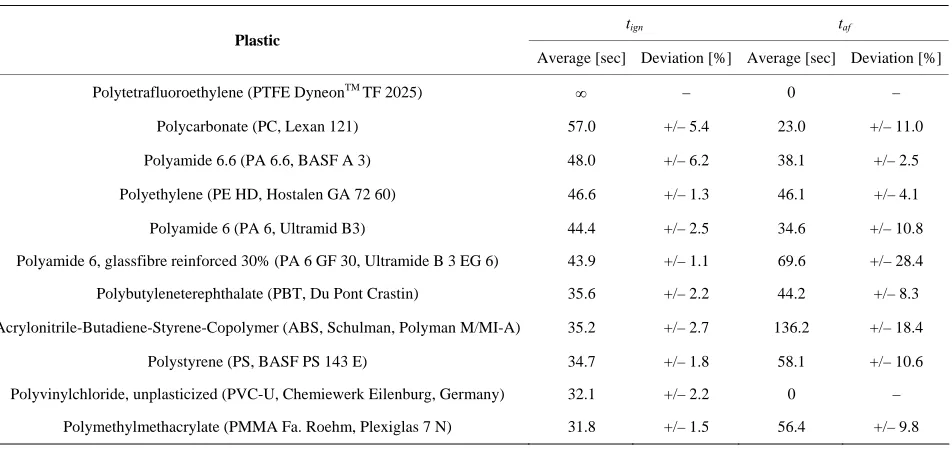
Table 1 lists the ignition time (tign) as well as the after- flame time (taf) for the plastics tested after the procedure described above. The materials tested here strongly differ with respect to these values.
Generally a material should be less flammable, the longer its ignition time and the shorter the afterflame time.However it becomes apparent, that a high or low tign does not mean a low resp. high taf in every case. A more careful interpretation of the values is thus necessary.
3.1. Ignition Time
PTFE and PC are commonly considered as being flame
resistant, and as expected show no ignition (PTFE) or require the longest period of time for ignition (PC). Polyamides 6.6 and PA 6 as well as a glass fibre rein- forced PA 6 show a medium range tign of 44 to 48 sec. A significantly shorter ignition time is found for ABS, PS and PMMA. Contrary to this expected order, high den- sity PE (PE HD, 46.6 sec) and PVC-U (32.1 sec) showed ignition times outside the expected range; compare with results after the Underwriter Laboratories’ test UL-94, the Glow-Wire Flammability Index (GWFI) and the Lim-iting-Oxygen-Index (LOI).
The ignition time is mainly determined by the point, were a sufficient amount of flammable gas has been set free through pyrolysis. For this process a certain extent of thermal decomposition is necessary as well as the dif- fusion of volatile products into the adjacent oxygen-rich atmospheric layer, reflecting the chemical bond strength and the viscosity of the molten phase.
As can be seen from Table 2, the decomposition tem- perature Tdec of the tested materials correlates well with
the order of ignition time from Table 1. Bearing in mind, that minor divergences also result from decomposition temperature ranges of various widths, it can be concluded, that the tign of a certain material is longer, the higher its decomposition temperature.
Differences in constitution of the plastics matrix are less important for the tign since the strong burner flame will ignite the different products from pyrolysis thus overriding inflammation limits.
The close relationship between tign and Tdec is also
evident for PA 6 and PA 6 GF 30. While the glass fibre filled material has a lower rating (or even no rating) then the non-filled counterpart, the tign of the two types of poly- Table 1. Ignition time tign and afterflame time taf of selected plastics, in the order of decreasing tign.
tign taf
Plastic
Average [sec] Deviation [%] Average [sec] Deviation [%]
Polytetrafluoroethylene (PTFE DyneonTM TF 2025) – 0 –
Polycarbonate (PC, Lexan 121) 57.0 +/– 5.4 23.0 +/– 11.0
Polyamide 6.6 (PA 6.6, BASF A 3) 48.0 +/– 6.2 38.1 +/– 2.5
Polyethylene (PE HD, Hostalen GA 72 60) 46.6 +/– 1.3 46.1 +/– 4.1
Polyamide 6 (PA 6, Ultramid B3) 44.4 +/– 2.5 34.6 +/– 10.8
Polyamide 6, glassfibre reinforced 30% (PA 6 GF 30, Ultramide B 3 EG 6) 43.9 +/– 1.1 69.6 +/– 28.4
Polybutyleneterephthalate (PBT, Du Pont Crastin) 35.6 +/– 2.2 44.2 +/– 8.3
Acrylonitrile-Butadiene-Styrene-Copolymer (ABS, Schulman, Polyman M/MI-A) 35.2 +/– 2.7 136.2 +/– 18.4
Polystyrene (PS, BASF PS 143 E) 34.7 +/– 1.8 58.1 +/– 10.6
Polyvinylchloride, unplasticized (PVC-U, Chemiewerk Eilenburg, Germany) 32.1 +/– 2.2 0 –
Table 2. tign and range of Tdec [5-7] of selected plastics.
Plastic tignsec Tdec˚C
PTFE 508 - 538
PC 57.0 420 - 620
PA 6.6 48.0 310 - 380
PE-HD 46.6 335 - 450
PA 6 44.4 310 - 380
PA 6 GF 30 43.9 no data
PBT 35.6 285 - 305
ABS 35.2 250 - 430
PS 34.7 285 - 440
PVC, U 32.1 200 - 300
PMMA 31.8 170 - 300
amides show no significant difference. The glass fibre filling obviously does not change the thermal decompo-sition process of the organic phase. In case of a UL-94 test however the wick feeding effect causes a less fa-vourable burning behaviour which leads to a negative rating.
3.2. Afterflame Time
As mentioned above the ignition time tign does not reflect the actual burning behaviour sufficiently enough, since the measured afterflame time values (taf) show an oppo-site trend in several cases. The afterflame time describes first of all to what extent a material can continue on its own the pyrolysis of the polymer matrix after a defined energy input exceeding the point of ignition (“thermal feedback”). The obvious assumption, that the taf is mainly determined by the heat of combustion (HC) of the plastic, which can be set free during burning, is not correct. This becomes already evident by the fact that no test sample burnt down completely. Yet there is a rela-tion between these two variables for plastics of low calo-rific value (see Table 3). PTFE and PVC-U having the lowest HC of the tested materials showed the shortest taf.
[image:3.595.304.538.102.308.2]However the conclusion that a high HC will result in a long taf is not supported by the experimental findings; compare for example the values for PE and PBT. While the calorific values are strongly different (PE 46.7 kJ/g, PBT 24.8 kJ/g), the taf are very similar (46.1 and 44.2 sec) and in a medium range when compared to the other tested plastics. It is thus more likely that the taf reflects the burning intensity, which in turn is determined by factors like melt viscosity, swelling and the formation of isolating layers on the surface. The influence of such
Table 3. taf and HC [6,7] of selected plastics.
Plastic tafsec HCkJ/g
PTFE 0 + 0.3
PVC, U 0 –18.7
PC 23.0 –29.2
PA 6 34.6 –31.4
PA 6.6 38.1 –31.4
PBT 44.2 –24.8
PE HD 46.1 –46.7
PMMA 56.4 –26.7
PS 58.1 –42.4
PA 6 GF 30 69.6 –22.0
ABS 136.2 –39.8
Table 4. Results from tests according to UL-94, the GWFI procedure and LOI 6,8,9.
Plastic Burning timeUL-94 rating * [sec] GWFI-rating
LOI**
[Vol.% O2]
PTFE V0** – 95
PVC, U V0** – 47
PC V2
13,75 960˚C 27.5
PA 6.6 V2
7,3 960˚C 23
PA 6 V2
2,0 960˚C 23.5
PBT burns down 960˚C 22
PA 6 GF 30 burns down 850˚C 22
ABS burns down not
passed 19
PE HD burns down not
passed 17.5
PS burns down not
passed 17.5
PMMA burns down not
passed 17.5
UL-94 performed on samples of 127 mm × 12.7 mm × 3.2 mm size;
*
average of 2 × 5 treatments with a flame; **average values taken from the literature.
kinetic factors on the taf becomes evident with PA 6 and PA 6 GF 30. The effect of the glass fiber leads to a twice as long taf although this plastic contains 30% less of combustible material.
[image:3.595.310.538.349.599.2]haviour by measured values from real burning samples, we fell back on the above mentioned test methods.
Table 4 lists the results from tests performed on injec-tion-moulded samples of the respective plastics using the the UL-94 and GWFI procedures. The LOI values were taken from the literature.
By assuming that PTFE and PVC get the best ratings also with the UL-94 and GWFI-test, the results for the tested materials are in agreement with the other results and methods. At least there are no clearly opposite trends. Upon trying to give a qualitative order of plastics with respect to their burning behaviour from Table 4, three classes of materials are obtained:
Class 1 showing high flame resistance: PTFE, PVC
Class 2 showing medium flame resistance: PC, PA 6, PA 6.6, (PBT)
Class 3 showing low flame resistance: (PBT), PA 6 GF 30, ABS, PE, PS, PMMA
A more elaborate classification seems not to be possi-ble with the UL-94 or GWFI method alone or by a com-bination of both.
[image:4.595.303.540.291.708.2]A rating of the burning behaviour by a separate evaluation of the tign as well as the taf leads partially to the above classification. Both values indicate the highest flame resistance for PTFE. PC and both the unfilled PAs are in the medium range, and PS, PMMA and ABS show a low flame resistance according to both values. PVC and PA 6 GF 30 can not be clearly assigned to one class, since the ratings after those two values differ too much. In order to solve this problem, tign and taf were combined mathematically. The contained information on the burn-ing behaviour is then expressed by the combined value Wbb. A clear assignment is then possible, at least for the materials investigated in this study. The combination was not performed for materials which could not be ignited (tign = , PTFE), or had a afterflame time taf of 0 (PVC-U). These values already prove the low flammabil-ity of these materials, which are therefore listed on top of
Table 5.
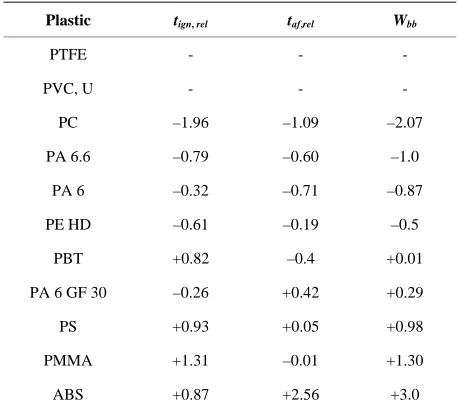
The mathematical procedure applied here is based on establishing average (AV) and standard deviation (root- mean square error, ) of both series of measurements. Then the difference between the individual values and the average was correlated with leading to tign,rel and taf,rel, resulting in values of comparable order of magni-tude. The tign values had to be assigned negative in order to ensure a similar treatment for the relative values re-flecting the burning behaviour. Furthermore the tign,rel was weighed only half for Wbb since by subjective esti-mation tign describes the burning behaviour less accurate then taf.
By simple addition we obtain
, ,
1 2
bb ign rel af rel
W t t (1)
Table 5. Ignition time tign,rel, afterflame time taf,rel and Wbb
value in the order of increasing Wbb.
Plastic tign, rel taf,rel Wbb
PTFE - - -
PVC, U - - -
PC –1.96 –1.09 –2.07
PA 6.6 –0.79 –0.60 –1.0
PA 6 –0.32 –0.71 –0.87
PE HD –0.61 –0.19 –0.5
PBT +0.82 –0.4 +0.01
PA 6 GF 30 –0.26 +0.42 +0.29
PS +0.93 +0.05 +0.98
PMMA +1.31 –0.01 +1.30
ABS +0.87 +2.56 +3.0
In the following the procedure is demonstrated for PA 6:
The average (AV) of the tign is calculated
1
1 N
i i AV
N
x (2)N: number of measured values (9); xi: actual measured value (for PA 6: 44.4sec)
377.241.9 sec 9
ign
s
AV t (3)
with
21
1 N
i i
x AV
N
(4)a (tign) of 7.72 sec is obtained. For tign,rel (PA 6) with
,
PA6 PA6
44.4 sec 41.9 sec 0.32 7.72 sec
ign ign
ign rel
ign
t AV t
t
t
(5)
a value of 0.32 is obtained.
By an analogous procedure for taf with AV (taf) = 56.7 sec and σ (taf) = 31.0 sec and taf,rel (PA 6) = – 0.71 via
, ,
1
0.16 0.71 0.87 2
bb ign rel af rel
W t t (6)
we obtain for PA6 a Wbb of –0.87.
These standardized tests however remain indispensable and find their application, as becomes evident e.g. from recent studies on plastics containing flame retardants [10-12].
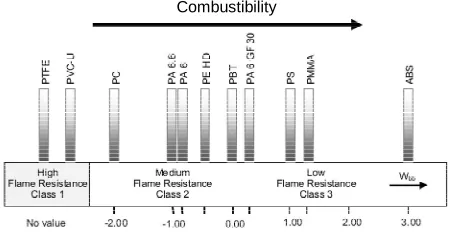
value allows to compare the combustibility of the mate-rials. Figure 1 illustrates this relationship.
The plastics have clearly different Wbb values. The classes of materials from Table 4 can still be recognized. Class 1 is represented by PTFE and PVC with a tign and taf of 0 respectively. The negative range –2 to 0 includes those materials which have been assigned already to class 2 earlier. PBT with a Wbb of 0.01 is at the borderline of class 3. The flammable materials are also clearly di-vided from each other by their Wbb values. The order of increasing flammability is PA 6 GF 30, PS, PMMA, ABS. The clear position of ABS as being the material with the highest combustibility should be noted. The po-sition of PE is worth mentioning, with a Wbb of –0.5 in the medium range of flame resistance, reflecting a high tign together with a relatively high thermal stability.
REFERENCES
[1] DIN EN ISO 4589, “Plastics—Determination of Burning Behaviour by Oxygen Index: Part 1,” Beuth Verlag, Berlin, 1999.
[2] Underwriter Laboratories, “UL-94: Tests for Flammabil-ity of Plastic Materials for Parts in Devices and Appli-ances,” 3rd Edition, Underwriter Laboratories Inc., North- brook, 1989.
[3] DIN EN 60695-2-12, “Fire Hazard Testing: Part 2-12: Glowing/Hot-Wire Based Test Methods—Glow-Wire Flammability Index (GWFI) Test Method for Materials,” Beuth Verlag, Berlin, 2001.
While with the other test methods mentioned above (where PE is assigned to class 3) in most cases the acti-vation energy is expended for ignition, and thus cannot be taken into account for the classification, the new method allows to include this material property. This fact is certainly of advantage in order to estimate more accu-rately the fire risk of a particular material.
[4] F. Taeger, A. Mueller and D. Lehmann, “Verfahren zur Bestimmung des Brandverhaltens von Materialien,” DE Patent No. 10315228.8-52, 2003.
[5] H. Batzer, “Polymere werkstoffe,” Georg Thieme Verlag Stuttgart, New York, 1985, p. 517.
[6] C. J. Hilado, “Flammability Handbook for Plastics,” 5th Edition, Technomic Publishing Company, Basel, 1998, p. 48.
4. Conclusions
[7] J. Troitzsch, “International Plastics Flammability Hand-book,” Carl Hanser Verlag, Munich, Vienna, New York, 1990, p. 22.
The new method allows a quick and simple testing of the burning behaviour of plastics. The procedure is easy to perform, since it does neither require injection-moulded
samples nor expensive equipment. [8] H. G. Elias, “Macromolecules: Applications of Polymers, Volume 4,” Wiley-VCH, Weinheim, 2009, pp. 65-68. doi:10.1002/9783527627240
The method is especially suitable for clearly defined classifications. It may be applied for a screening of plastic materials, or research and development, e.g. finding an optimal flame retardant. Remarkable are the low devia-tion and the good reproducibility of measured values.
[9] A. R. Horrocks and D. Price, “Fire Retardant Materials,” Woodhead Publishing Ltd., Cambridge, 2001, p. 227. [10] U. Braun, A. I. Balabanovich, B. Schartel, U. Knoll, J.
Artner, M. Cisielski, M. Döring, R. Perez, J. K. W. Sandler, V. Altstädt, T. Hoffmann and D. Pospiech, “In-fluence of the Oxidation State of Phosphprorus on the Decomposition and Fire Behaviour of Flame-Retarded Epoxy Resin Composites,” Polymer, Vol. 47, No. 26, 2006, pp. 8495-8508. doi:10.1016/j.polymer.2006.10.022 By the mathematical combination of tign and taf we
have tried to express various material properties that are responsible for the burning behaviour by one value.
The method provides classifications that are supported by the older methods. It thus would make sense to apply
the new method in order to complement the other methods. [11] R. M. Perez, J. K. W. Sandler, V. Altstädt, T. Hoffmann, D. Pospiech, M. Cisielski, M. Döring, H. Braun, A. I. Balabanovich and B. Schartel, “Novel Phosphorus-Modi- fied Polysulfone as a Combined Flame Retardantand Toughness Modifier for Epoxy Resins,” Polymer, Vol. 48, No. 3, 2007, pp. 778-790.
doi:10.1016/j.polymer.2006.12.011 Combustibility
[12] O. Fischer, D. Pospiech, A. Korwitz, K. Sahre, L. Häußler, P. Friedel, D. Fischer, C. Harnisch, Y. Bykov and M. Döring, “Synthesis and Properties of Phosphorus Polyesters with Systamatically Altered Phosphorus Envi-ronment,” Polymer Degradation and Stability, Vol. 96, No. 12, 2011, pp. 2198-2208.
![Table 3. taf and HC [6,7] of selected plastics.](https://thumb-us.123doks.com/thumbv2/123dok_us/9281408.421492/3.595.310.538.349.599/table-taf-hc-selected-plastics.webp)