Using Non-Additive Measure for Optimization-Based
Nonlinear Classification
Nian Yan1,2, Zhengxin Chen1, Yong Shi1,3*, Zhenyuan Wang4, Guimin Huang5
1College of Information Science and Technology, University of Nebraska at Omaha, Omaha, USA 2Nebraska Furniture Mart, Berkshire Hathaway Company, Omaha, USA
3Research Center on Fictitious Economy and Data Sciences, Chinese Academy of Sciences, Beijing, China 4Department of Mathematics, University of Nebraska at Omaha, Omaha, USA
5Guilin University of Electronic Technology, Guilin, China
Email: *[email protected]
Received May 22, 2012; revised June 20, 2012; accepted July 5,2012
ABSTRACT
Over the past few decades, numerous optimization-based methods have been proposed for solving the classification problem in data mining. Classic optimization-based methods do not consider attribute interactions toward classification. Thus, a novel learning machine is needed to provide a better understanding on the nature of classification when the in-teraction among contributions from various attributes cannot be ignored. The inin-teractions can be described by a non-additive measure while the Choquet integral can serve as the mathematical tool to aggregate the values of attributes and the corresponding values of a non-additive measure. As a main part of this research, a new nonlinear classification method with non-additive measures is proposed. Experimental results show that applying non-additive measures on the classic optimization-based models improves the classification robustness and accuracy compared with some popular classification methods. In addition, motivated by well-known Support Vector Machine approach, we transform the pri-mal optimization-based nonlinear classification model with the signed non-additive measure into its dual form by ap-plying Lagrangian optimization theory and Wolfes dual programming theory. As a result, 2n – 1 parameters of the signed non-additive measure can now be approximated with m (number of records) Lagrangian multipliers by applying necessary conditions of the primal classification problem to be optimal. This method of parameter approximation is a breakthrough for solving a non-additive measure practically when there are a relatively small number of training cases available ( ). Furthermore, the kernel-based learning method engages the nonlinear classifiers to achieve bet-ter classification accuracy. The research produces practically deliverable nonlinear models with the non-additive meas-ure for classification problem in data mining when interactions among attributes are considered.
2n 1
m
Keywords: Nonlinear Programming; Nonlinear Classification; Non-Additive Measure; Choquet Integral; Support Vector Machines
1. Introduction
Classic optimization-based methods formulate classifica- tion problems by modeling data with standard optimiza- tion techniques using objectives and constraints. Mathe- matical programming provides general solution to the zoptimization problem. For example, references [1,2] proposed two classification models based on reducing the misclassification through minimizing overlaps or maxi- mizing the distance of two data points in a linear system. A method named Multiple Criteria Linear Programming (MCLP) [3,4] has been initialized to compromise the objectives of models in [1] and [2] simultaneously and achieved a better data separation in a linear system. Al- ternatively, a quadratic model can be used to deal with
linearly inseparable situation [5]. The key idea of those approaches is to separate data when they are in different classes as well as pull data together when they are in the same class. Initiated by [6], another well-known optimi-zation-based classification method is Support Vector
Machine (SVM), which mathematically constructs
hy-perplanes by support vectors. Further more, SVM sepa-rates data nonlinearly by introducing so-called nonlinear
kernel functions.
Although these optimization-based methods separate data linearly or nonlinearly, they do not consider contri-butions from the interaction among attributes. In this paper, we use a nonadditive measure to model data with interactions and propose new nonlinear classification models. Nonlinear integrals can be used as tools to ag-gregate unknown parameters in the non-additive measure
and values of attributes. As one of nonlinear integrals,
the Choquet integral [7] is chosen as the aggregation tool
for data modeling for classification problem. In addition, we investigate the direction of constructing nonlinear objectives by developing kernel functions in nonlinear classification models, a technique taken by SVM.
The rest of this paper is organized as follows: In Sec-tion 2, an overview of classic optimizaSec-tion-based classi-fication methods is provided. Section 3 reviews defini-tions of non-additive measures and the Choquet integral. In Section 4, a new optimization-based classification model with a non-additive measure is proposed. Section 5 describes the Lagrangian optimization approach to solve the issue of dealing limited training samples with the proposed nonlinear classification model. Section 6 shows performance of the proposed models in experi-mental results. Finally, Section 7 provides conclusions from this research.
2. Preliminary
In this section, we provide an overview of classic opti-mization-based classification methods.
Consider that a dataset consists of n attributes and m
records. Let X = {x1, x2, ···, xn} denote the set of feature
attributes and y be the class label, where yj
1,1
for a two classes dataset. The dataset has a form as fol-lows:x1 x2 ··· xn y
f11 f12 ··· f1n y1
f21 f22 ··· f2n y2
···
fm1 fm2 ··· fmm ym where following elements
fj1 fj2 ··· fjn
are the values of attributes x1, x2, ···, xn for the j-th record
in the dataset, denoted by fj, j = 1, ···, 2, m. Note that fj
can be regarded as a vector. In addition, yj is the
corre-sponding class label in the j-th record.
The mathematical programming or optimization-based approach have been widely used for many applications. Particularly, numerous mathematical programming me- thods based on optimization techniques have been pro-posed for solving classification problem [1-3,6]. In clas-sification, the concept of classes is generally expressed as
j
f b
w , where w, fj, and b represent attribute weights,
values, and classification critical value respectively. Therefore, wfj is the weighted sum of all the attributes.
For a dataset with two classes, the decision function for
the classes are defined as:
0j j
y wf b
=1 Maximize Subject to
0, is unrestricted
m j j
j j j
j
y f b
w w
=1 Minimize Subject to
0, is unrestricted
m j j
j j j
j
y f b
w w
where yj = 1 if the j-th record belongs to class 1 and yj =
–1 if the j-th record belongs to class 2.
The two linear classification methods [1,2] based on the idea of reducing misclassification by minimizing the overlaps or maximizing the sum of distances in a linear system. One approach is to maximize the sum of
mini-mum distances (MMD) of data from the critical value.
Another approach separates the data by minimizing the
sum of deviations (the overlapped distances between
classes) (MSD) of data from the critical value. These two
classic linear classification models can easily be de-scribed with a standard form of optimization, i.e.
(MMD)
(MSD)
where αj denotes the degree of the overlapping of the two
classes and βj denotes the distances from the observation
to the critical classification value b. The weights w are optimized by linear programming, a typical optimization technique. The critical value b is given as a constant non-zero real number.
The above two linear classification models provide the basic idea of data separation, which pulls the data apart from the boundary (maximize the sum of βj in MMD) or
to make the smallest data overlapping area (minimize the sum of αj in MSD). However there are some optimization
difficulties in those approaches. For example, the MMD model cannot be optimized because the value of βj can
reach as large as possible since the goal is to maximize the sum of βj. Thus, in the implementation of MMD
model, βj is bounded as βj≤β*, where β* is a given
posi-tive constant. The MMD classification model is only able to classify linearly separable dataset. Similarly, the αj in
MSD model has to be bounded to a very small positive value α* as α
j≥α*.
=1
* * Minimize
Subject to =
, 0; ; 0; i
m
j j j
j j j j j j j
y f b
w
w s unrestricted
) 0
X ( ) = 0
(MCLP) where β* is a positive constant to restrict the upper bound of βi.
Another direction of improving optimization-based classification is to develop nonlinear models by con-structing nonlinear objectives, such as the Multiple Cri-teria Quadratic Programming (MCQP), a nonlinear opti-mization classification [5].
3. Non-Additive Measures
A common characteristic of the methods described above is that the modeling is based on the assumption that con-tributions from all attributes toward classification are the sum of contributions of each attribute. None of those methods considers the interactions among attributes to-ward classification, which may provide a better under-standing of the nature of classification and achieve more satisfactory results. In addition, the model should be able to represent the underlying phenomenon of applications such as classification in a more adequate manner because attributes are not completely isolated from each other. Such a model should have the potential of increased ro-bustness, defined as the ability of maintaining effective performance on both training and testing results on a diversity of datasets. Particularly, a classification model is said to be robust when the performance of its testing results is not significantly distant from training.
The theory of non-additive measure can achieve in-creased robustness and better performance in classifica-tion. The bases of non-additive measures and the nonlin-ear integrals are briefly reviewed in the rest of this sec-tion.
3.1. Definition of Non-Additive Measures
The attribute interactions can be represented by a non-additive measure. The concept of non-additive meas-ure (also referred to as fuzzy measmeas-ure theory) was initi-ated in the 1950s and has been well developed since 1970s [7-9].
Let finite set X = {x1, ···, xn} denote the attributes in a
multidimensional dataset. Several important types of non-additive measure are defined as the followings [8]:
Definition 1. A non-additive measure μ defined on X is
a set function : ( ,
satisfying ,where ( )X
( )
denotes the power set of X, μis monotone
if it satisfies = 0 and if , where
E, F are any sets in E F
EF
( )X
.
Definition 2. A signed non-additive measure μ is
de-fined on X is a set function : ( ) X
,
.
The values of non-additive measure μ are unknown parameters. The signed non-additive measure is adopted to develop optimization-based nonlinear classification models.
3.2. Choquet Integral
Nonlinear integrals are used as data aggregation tools to integrate the values of attributes with respect to a non- additive measure. As one of nonlinear integrals, the Choquet integral is more appropriate for applications such as classification because it provides very important information in interactions among attributes [10].
1 2
f
Now let the values of = f x ,f x , , f xn
denote the values of each attribute in the dataset; let
be the non-additive measure. The general definition of the Choquet integral, with function f X:
,
0
0
d = d d
c f F X F
, based on signed non-additive measure μ, is defined in formula 1 as
(1)
where F = x f x
is called α-cut set of f, for
,
2 1 =1 d =n
, n is the number of attributes in the dataset.
Choquet integral may be calculated as [11]:
j j j
c f
z (2) where
: ( ) [0,0.5) : 0.5,1
2 2
min max if > 0 or = 2 1 =
0 otherwise
n
i i
j j i frc i frc i j i
f x f x j
z
(3)
2i
j frc
is the fractional part of
2i j
and the maximum operation on the empty set is zero. Let
jn, jn – 1, ···, j1 represent the binary form of j, the i in for-mula 3 is determined as following:
0.5,1 =
= 1
2i i
j
i frc i j
and
0,0.5
=
= 0
2i i
j
i frc i j
sum to aggregate the corresponding attribute with respect to the weights in a linear model such as MSD.
4. Optimization-Based Nonlinear Classifiers
with Non-Additive Measures
The idea of using non-additive measure in classification problem is not new. In the fuzzy measure community, non-additive measures have been utilized for modeling attribute interactions for data separation purpose. For example, reference [12] used the Choquet integral with respect to the non-additive measure on statistical pattern classification based on possibility theory, an optimiza-tion-based classification model was later proposed with a non-additive measure [13]. Reference [14] proposed the
k-Interactive (k = 2) classification with feature selections based on a pattern matching algorithm similar to [12]. Classification can also be achieved by directly separating the date using the weighted Choquet integral projection [15] or using a penalized signed fuzzy measure [16]. A detailed discussion of geometric meaning of the contri-butions from feature attributes in nonlinear classification can be found in [17].
There are limitations on above methods, notably: (a) Impractical: Due to the complexity of the non-additive measure, the methods were only applicable for datasets with small number of attributes, generally less than 5. (b) Limited performance: the classification accuracy was not promising compared to other popular methods [13] due to lack of better learning algorithms for determining un-known parameters of a non-additive measure. For in-stance, classification model in [15] with the Choquet integral has infinite number of solutions and the pro-posed method can only determine one of them. To ad-dress these limitations, this current research intends to provide a more practical and powerful solution toward nonlinear classification with a non-additive measure.
In addition, early studies of non-additive measure for classification also show limitations on classification ac-curacy and scalability. For example, although classifica-tion model in [12] is well developed in theory (similar to Bayesian classifier), the classification did not show any benefits of using non-additive measure and it is even more difficult to obtain good results on small Iris dataset, a benchmark dataset from UCI Machine Learning Re-pository (http://archive.ics.uci.edu/ml/). An optimization- based nonlinear classification model [13] with a non- additive measure was later proposed and studied. The results show it even performs worse than linear classifier on iris dataset and only competitive to fuzzy k-NN clas-sifier on other datasets. The research [13] suggests a bet-ter non-additive identification algorithm is needed.
An improvement for nonlinear optimization-based classifiers with non-additive measure might be the opti-mization process of the critical value for classification.
Inn MCLP model, the classification critical value b is not optimized but arbitrarily chosen. A better method to de-termine b could be updating b with the average of the lowest and largest predicted scores [15] during learning iterations. Alternatively, the critical value b in MCLP also can be replaced with soft-margin b ± 1 similar to SVM which constructs a separation belt instead of a sin-gle cutting line. With this technique, it is guaranteed to produce a unique solution to the model because the goal of the optimization is to find the cutting line which is most close to the misclassified data points on both sides. The MCLP model can be extended to a linear program-ming solvable problem with optimized b and the signed non-additive measure, as shown below:
=1 Minimize
Subject to d 1
0; , are unrestricted
m j j
j j
j
y c f b
b
(M1)
where y 1,1
2n 1
m
i , μ, b and α are critical values to be
determined. Model M1 can be solved by standard linear programming techniques such as the simplex method. However, the number of μ, which is 2n – 1, is
exponen-tially related to the number of attributes (n) because of power set operation in the Choquet integral. When the number of records (m) in the training set is relatively small (e.g.
2n 1
m
), the model is difficult to be solved. In the next section, we propose a compromised solution to deal with this situation.
5. Nonlinear Classification with the Signed
Non-Additive Measure by Lagrangian
Optimization
As mentioned, it is hard to optimize the non-additive optimization-based classification models when there are not enough observations ( ). The existing ap-proaches such as hierarchical Choquet integral [18] and the k-Interactive measure [14] ignored some values of non-additive measure μ to some extent. As a solution, the Lagrangian optimization theory can be incorporated to transform the model into practically solvable form with the best approximation of parameters of non-additive measure μ. The Karush-Kuhn-Tucker (KKT) conditions [19] applied in the Lagrangian optimization process are the necessary conditions to guarantee an optimization- based classification model to reach optimum. To develop a nonlinear classifier which can deal with this situation, a quadratic non-additive optimization-based model is con-structed and transformed.
5.1. Lagrangian Theory for Optimization
neces-sary conditions for a given nonlinear optimization prob-lem to reach an optimal solution. The KKT conditions in the Lagrangian optimization provide the necessary con-ditions for the proposed classification model to have an optimal solution. Generally, an optimization problem can be presented as [20]:
Definition 3. Given functions f, gi, i = 1, ···, k, and hi, i = 1, ···, m, defined on vector , the primal
optimization problem is defined as:
n w
mize f w0, = 1, , Mini
Subject to g wi i k
= 0, = 1, ,i m
=1
k m
i i
i i
g w h w
i h wThe generalized Lagrangian function corresponding to
the definition 3 is
=1
, , = i i
L w λ δ f w
where λ= 1, , ,2 i , = 1, , ,2 i
, n
ize ,δ are the
Lagrangian multipliers and i i .
Instead of solving the primal optimization problem, an alternative is to optimize the Lagrangian dual problem, which is defined as
Maxim to 0,
, Subject
w,
L
*, *
where , the greatest lower bound on Lagrangian function L over Ω. The optimal solution for the objective function is called the value of
the problem.
,
= infw
The following Karush-Kuhn-Tucker theorem Tucker 1951 gives the necessary conditions for an optimal solu-tion to general optimizasolu-tion problem.
Theorem 1. Given an optimization problem as defined
in definition 3, the necessary and sufficient conditions for
a point w* to be an optimum are,
, such that
*, ,* * = 0 w
L w *, *, * = 0 L w
* * = 0, = 1, , .
ig wi i k
0, = 1, , .
*i
g w i k
= 1, , .
i k
* 0
=1
, = k i i
i
L w λ f w
g w * 0,
i
The first two conditions are also the necessary condi-tions for the optimization problem to reach optimal. The third condition is called KKT complementary condition. The first two conditions are also the necessary conditions
for the optimization problem to reach optimal. The suffi-cient condition is true only if function (L) of w is convex. In this research, since the convexity of the primal prob-lem is yet to be proved, only the necessary conditions can be considered. Since the constraints of the primal opti-mization problem does not have the condition of equality, only the first two conditions and i are to be
ap-plied. Thus, the lagrangian function for this particular optimization problem is described as:
A necessary condition for a normal point w* to be a minimum of f(w) subject to gi(w) = 0, i = 1, ···, k, is
Cris-tianini2000:
*, *, *
= 0 L w w for some values of λ*.5.2. Quadratic Non-Additive Optimization-Based Classification
We extend model M1 to a quadratic programming form and rewrite to model M2, as follows:
2 =1 1 Minimize 2Subject to d 1
0; , are unrestricted
m i i j j j C
y c f b
b
μ (M2)
1,1
i
y where
It is important to note that 1 2 2 μ
is a constructed ob- jective for modeling purpose. The constant C is normally set to be very large to minimize the impact from the con-structed objective.
5.3. Nonlinear Classifier with the Non-Additive Measure
The optimization problem M2 can be transformed into its corresponding dual problem. Similar to the optimization process of Support Vector Machine Cristianini2000, firstly, the primal Lagrangian is:
2 =1 =1 1 , , = 2 d 1 m i i m i i i iL b C
y c f b
α μ μ
where λiare the Lagrangian multipliers and C is a given
c f 2 1 =1 d = n k k k z
Define vectors zi, α,λ,μas 1 2, , 2 1
i i zi n
= z z,
i
z
1 2 = , , ,m α
1 2 = , , , m
λ
1 2, , 2n 1
= , μ Thus, d =c f
zkμkNow the necessary KKT conditions are applied on the primal Lagrangian function L by taking the partial de-rivative of L with respect to μ,α and b to be zero as fol-lows:
=1 , ,
= m i i = 0
i L b y
α μ
b , , = = L b α μC λ 0
α
whereC is a constant vector and is defined as:
m = C C, , , C
=1 = 0 m i i i y
= λ C =1 = m i ii
C
Therefore, the following conditions hold:
y
iμ z
Thus, after applying the necessary conditions on L, the primal becomes
2 1 2=1 =1 =1
, =1 =1
, =1 =1
=1 , =1 1 2 1 = 2 1 = 2 n m m
i i i ik
i i k
m m
i j i j i
i j i
m m
i j i j i i
i j i
m m
i i j i j
i i j
C y
y y C
y y y b
y y
=1 =1 , ,
= ik 1 i
m m i i i i L b z b
i j i j i j μ z z z z z z
α μ λ
z z
where i j denotes the inner product of zi and zj. The primal problem can be transformed into its dual
problem according to Wolfe’s dual programming theory, as the following shows:
=1 , =1
=1 1 Maximize
2 Subject to = 0
0
m m
i i j i j i i j
m i i i i y y y
i j z z
1,1
y where iSince λ = C and elements in C are constants, and the model can be further simplified as:
.
, =1 =1 1 Maximize 2 Subject to = 00
m
i j i j i j m i i i i y y y
i j z z
1,1
y where iModel M3 can be regarded as a general optimization- based nonlinear classifier with the signed non-additive measure. In addition, the inner product can be further replaced with kernel functions to deliver more accurate classification.
.
It is observed that for constructing optimal separation in a feature space, one does not need to consider the fea-ture space in explicit form, but only has to calculate the inner products between support vectors and the vectors of the future space [21]. Thus, the inner product opera-tion can be replaced with kernel funcopera-tions K, the function that corresponds to an inner product in the expanded feature space. Nonlinear kernel functions are able to map the data into hyper space to achieve better classification.
The three well-known kernel functions have been adopted by Model M3. They are linear, Polynomial and RBF kernel functions.
,
= ,
linear i j i j
K z z z z
(innerproduct/linear Kernel)
, = 1 , k
Polynomial i j i j
K z z z z
(Polynomial Kernel) 2 2
2 , = zi zj RBF i j
K z z e (RBF Kernel) By solving M3 with standard optimization technique, the number of parameters to be optimized is reduced from level of 2n to m.
Model M3 with kernel functions can be solved by
Se-quential Minimal Optimization (SMO) [22]. SMO
Lan-2n1
guage multipliers at each step, the objective function will be decreased and the convergence is guaranteed accord-ing to Osuna’s theorem Osuna [23].
attribute interactions because the datasets were created based on features of the Choquet integral.
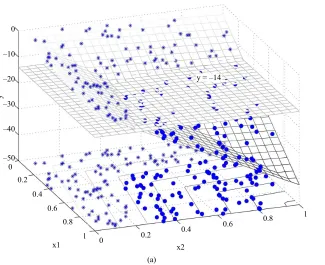
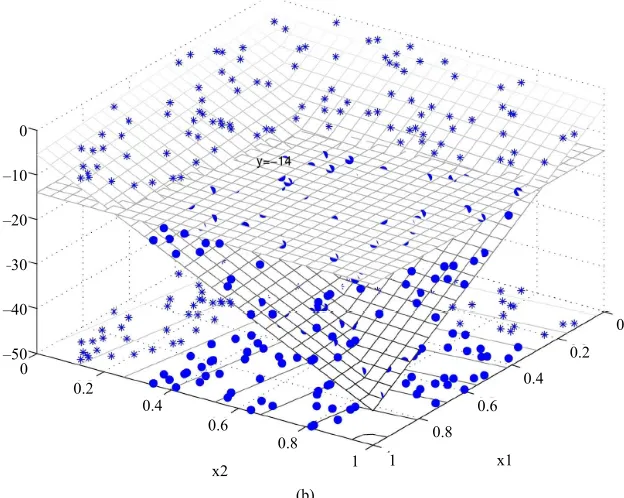
To better understand this nonlinear classification, we visually represent how Model M2 (the primal problem) to perfectly classify the two dimensional artificial dataset in Figure 1. The example was taken from fold-1 training set of the two dimensional artificial dataset. This training set contains 160 data points, including 85 in class 1 and 75 in class 2. Model M2 creates a three dimensional de-cision space (x1, x2, y), where x1, x2 are the attributes of the two dimensional dataset and y is the decision score of M2. The model classifies data as class 1 when y > b, oth-erwise class 2. Figure 1 presents one solution from the cross validation. In Figure 1(a) data points belonging to In conclusion, we point out that the applied KKT
con-ditions are the necessary concon-ditions for the classification model to reach optimum. Model M2 is transformed into its dual form M3 during the Lagrangian optimization to deal with the case of learning with small training dataset (m ). Through this compromised solution, the 2n
– 1 parameters of the signed non-additive measure can now be approximated by m Lagrangian multipliers.
6. Applications
[image:7.595.146.471.472.737.2]The proposed Model M3 has been applied on both artifi-cial and UCI machine learning datasets for classification purpose and compared with performance of other meth-ods.
Table 1. Classification accuracy on two artificial datasets.
Methods 3D 2D
M2 97.2 100
M3 (Linear) 98.8 96.0
M3 (Poly) 99.5 98.0
M3 (RBF) 99.7 99.0
M3 (Sigmod) 62.9 95.0
LibSVM (Linear) 97.7 82.0
LibSVM (Poly) 62.9 95.0 LibSVM (RBF) 98.8 98.0 LibSVM (Sigmod) 97.4 67.0
Decision Tree (J48) 96.3 98.5 Logistic Regression 97.7 84.0
Naïve Bayes 94.1 92
There are two artificial datasets with two classes ran-domly generated according to the definition of the Chouqet integral. One dataset has two dimensions (2D) and the other has three (3D). The 5-fold cross-validation is used for classification evaluation. Model M3 is also compared to other popular classification methods, such as SVMs, Decision Tree (J48), Logistic Regression and Naive Bayes. The average classification accuracy in per-centage is summarized in Table 1 for evaluating testing sets in all 5 folders. As a result, M3 performs best on both artificial datasets when nonlinear kernel methods are used although performance of different kernel meth-ods varies. The results confirm the theoretical assump-tion that models with non-additive measure can deal with
0
–10
–20
–30
–40
y = –14
y
–50 0
0.2 0.4
0.6
1 0.8
0.8 0.6
0.4
x1 0 x2
0.2 1
0
–10
–20
–30
–40
–50
y
0 0.2
0.4 0.6
0.8 1
0 0.2 0.4 0.6 0.8
1 x1
x2
[image:8.595.145.457.88.337.2](b)
Figure 1. Nonlinear classification by Model M2. (a) View 1; (b) View 2.
two classes are represented by asterisks (.) and dots (.), respectively. The data points shown on the bottom of the figure depict the original 2D data, which are apparently not linearly separable. After applying Choquet integral to create a third dimension y, the corresponding 3D data points are now located in two different 2D planes, and are now linearly separable. Figure 1(b) represents the same data set but provides a different perspective to view the data. The linearly inseparable two dimensional data-set x1, x2 is lifted into a hyper space (x1, x2, y) by M2 and then can be easily classified by the decision boundary y = –14 (value of the critical value b).
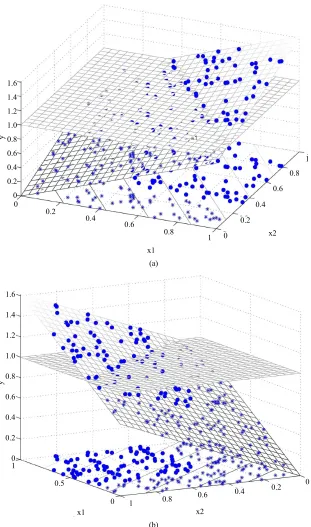
In addition, the data cannot be perfectly classified by the linear model MSD as Figure 2 shows. After applying MSD model, the corresponding 3D data points are still located in one flat surface in the three dimensional space and the two classes cannot be linearly separated. In MSD model, the critical value b is set to 1 and the MSD classi-fication model separates data by decision function y =
w1f1 + w2f2 (y > 1 indicates class 1 and y < 1 for class 2), with the solution w1 = 0.92, w2 = 0.70.
Classification of UCI Datasets
The UCI’s Pima Indian Diabetes and the Australian Credit Approval datasets were classified with model M3. The Australian dataset contains two classes (approval or not) and it has 14 attributes and 690 instances. Both data-sets were transformed into [–1, 1] with z-score normali-zation and the 5-folder cross-evaluation was conducted for the application. The constant variable c was set to
100000 for all the experiments. Table 2 is the summari-zation of the results compared with the SVM classifier with RBF kernel.
The above results show that M3 outperformed SVM with RBF kernel on the Australian credit dataset which indicates the model is more robust when the dataset has more feature attributes, in the sense of that the perform-ance of the testing is not significantly worse then the training. Our experiences also show that the use of La-grangian optimization makes it feasible to solve non- additive measure when the number of attributes is up to 14. The use of kernel functions also ensured the classifi-cation accuracy of the nonlinear model with the signed non-additive measure.
7. Conclusion
[image:8.595.308.538.640.736.2]We have proposed a new classification approach based on optimization-based models while the attributes inter-actions are considered. The theory of non-additive meas-ures were utilized to model the data with interactions.
Table 2. Classification results on two UCI datasets.
Methods Diabetes Australian Credit
SVM (RBF) 76.17 78.70
M3 (RBF) 75.00 84.06
M3 (Linear) 73.18 84.35
M3 (Poly) 75.00 84.20
1.6 1.4 1.2 1.0 0.8
0.6 0.4 0.2 0
y
0
0.2
0.4
0.6
0.8
1
1 0.8
0.6
0 0.2
0.4
x2
x1 (a)
1.6
1.4
1.2
1.0
0.8
0.6
0.4
0.2
0
0
0 0.2 0.4
0.6 0.8
1 x1
0.5 1
x2
y
[image:9.595.144.455.83.610.2](b)
Figure 2. Linear classification by Model MSD. (a) View 1; (b) View 2.
Traditionally, nonlinear integrals are the aggregation tools for non-additive measures. The Choquet integral is good for data modeling purpose. We have demonstrated the value of using non-additive measure on optimization- based classification and proposed a more efficient non- linear model M3, which can classify data by solving less number of parameters. The 2n – 1 parameters of the
signed non-additive measure can now be approximated
on the artificial dataset demonstrated the geometric meaning and profound theory of the nonlinear classifica-tion models. Applicaclassifica-tions on UCI datasets have shown that this nonlinear approach increases model robustness as the classification accuracy is stable and the accuracy of testing results is close to that of the training results. We are now in the process of applying our approach to various data mining applications.
8. Acknowledgements
This work has been partially supported by grants from Nebraska EPSCoR Program, USA, Nebraska Furniture Market Co., USA, BHP Billiton Co, Australia, Innova-tive Group from National Natural Science Foundation of China (#70921061, #70621001, #70901011), China and the CAS/SAFEA International Partnership Program for Creative Research Teams, China.
REFERENCES
[1] N. Freed and F. Glover, “Simple but Powerful Goal Pro-gramming Models for Discriminate Problems,” European Journal of Operational Research, Vol. 7, No. 1, 1981, pp. 44-60. doi:10.1016/0377-2217(81)90048-5
[2] N. Freed and F. Glover, “Evaluating Alternative Linear, Programming Models to Solve the Two-Group Discrimi-nate Problem,” Decision Science, Vol. 17, No. 2, 1986, pp. 151-162. doi:10.1111/j.1540-5915.1986.tb00218.x [3] Y. Shi, “Multiple Criteria and Multiple Constraint Levels
Linear Programming: Concepts, Techniques and Applica-tions,” World Scientific Pub Co Inc., New Jersey, 2001. [4] G. Kou, Y. Peng, Z. Chen and Y. Shi, “Multiple Criteria
Mathematical Programming for Multi-Class Classifica-tion and ApplicaClassifica-tion in Network Intrusion DetecClassifica-tion,”
Information Sciences, Vol. 179, No. 4, 2009, pp. 371-381. doi:10.1016/j.ins.2008.10.025
[5] Y. Peng, G. Kou, Y. Shi and Z. Chen, “A Multi-Criteria Convex Quadratic Programming Model for Credit Data Analysis,” Decision Support Systems, Vol. 44, No. 4, 2008, pp. 1016-1030. doi:10.1016/j.dss.2007.12.001 [6] V. Vapnik, “The Nature of Statistical Learning Theory,”
Springer-Verlag, New York, 1995.
[7] G. Choquet, “Theory of Capacities,” Annales de l’Institut Fourier, Vol. 5, 1954, pp. 131-295. doi:10.5802/aif.53 [8] Z. Wang and G. J. Klir, “Fuzzy Measure Theory,”
Ple-num, New York, 1992.
[9] Z. Wang and G. J. Klir, “Generalized Measure Theory,” Springer, New York, 2008.
[10] Z. Wang, K.-S. Leung and G. J. Klir, “Applying Fuzzy Measures and Nonlinear Integrals in Data Mining,” Fuzzy Sets and Systems, Vol. 156, No. 3, 2005, pp. 371-380. doi:10.1016/j.fss.2005.05.034
[11] Z. Wang and H. Guo, “A New Genetic Algorithm for Nonlinear Multiregressions Based on Generalized Cho-quet Integrals,” The 12th IEEE International Conference on Fuzzy Systems (FUZZ’03), Vol. 2, 25-28 May 2003, pp. 819-821.
[12] M. Grabisch and M. Sugeno, “Multi-Attribute Classifica-tion Using Fuzzy Integral,” IEEE International Confer-ence on Fuzzy System, San Diego, 8-12 March 1992, pp. 47-54.
[13] M. Grabisch and J.-M. Nicolas, “Classification by Fuzzy Integral: Performance and Tests,” Fuzzy Sets System, Vol. 65, No. 2-3, 1994, pp. 255-271.
doi:10.1016/0165-0114(94)90023-X
[14] L. Mikenina and H. J. Zimmermann, “Improved Feature Selection and Classification by the 2-Additive Fuzzy Measure,” Fuzzy Sets and Systems, Vol. 107, No. 2, 1999, pp. 197-218. doi:10.1016/S0165-0114(98)00429-1 [15] K. Xu, W. Z., P. Heng and K. Leung, “Classification by
Nonlinear Integral Projections,” IEEE Transactions on Fuzzy Systems, Vol. 11, No. 2, 2003, pp. 187-201. doi:10.1109/TFUZZ.2003.809891
[16] H. Fang, M. Rizzo, H. Wang, K. Espy and Z. Wang, “A New Nonlinear Classifier with a Penalized Signed Fuzzy Measure Using Effective Genetic Algorithm,” Pattern Recognition, Vol. 43, No. 4, 2010, pp. 1393-1401. doi:10.1016/j.patcog.2009.10.006
[17] J. Chu, Z. Wang and Y. Shi, “Analysis to the Contribu-tions from Feature Attributes in Nonlinear Classification Based on the Choquet Integral,” 2010 IEEE International Conference on Granular Computing (GrC), San Jose, 14-16 August 2010, pp. 677-682.
[18] T. Murofushi, M. Sugeno and K. Fujimoto, “Separated Hierarchical Decomposition of the Choquet Integral,” In-ternational Journal of Uncertainty, Fuzziness and Know- ledge-Based Systems, Vol. 5, No. 5, 1997, pp. 563-585. doi:10.1142/S0218488597000439
[19] H. Kuhn and A. Tucker, “Nonlinear Programming,” Pro-ceedings of 2nd Berkeley Symposium on Mathematical Statistics and Probabilistics, 1951, pp. 481-491.
[20] N. Cristianini and J. Shawe-Taylor, “An Introduction to Support Vector Machines,” Cambridge University Press, Cambridge, 2000.
[21] B. Boser, I. Guyon and V. N. Vapnik, “A Training Algo-rithm for Optimal Margin Classifiers,” 5th Annual Work-shop on Computational Learning Theory, 1992, pp. 144- 152. doi:10.1145/130385.130401
[22] J. Platt, “Fast Training of Support Vector Machines Using Sequential Minimal Optimization,” Technical Report, Microsoft Research, 1998.