Electronic Customer Relationship Management (E-CRM)
Application as Efforts to Increase Customer Retention of
Micro Small and Medium Enterprises (MSMEs) in Banten
Indonesia
Vidila Rosalina
Faculty of Information Technology - Universitas Serang Raya Jl. Raya Serang-Cilegon Km.5 Taman Kopassus Serang Banten
Indonesia
Hamdan
Faculty of Economy - Universitas Serang Raya
Jl. Raya Serang-Cilegon Km.5 Taman Kopassus Serang Banten
Indonesia
Agung Triayudi
Departement of Informatic– Universitas Nasional
Jakarta Indonesia
ABSTRACT
Currently, the Micro, Small and Medium Enterprises (MSMEs) in Banten Indonesia mostly still manage their customers in conventional ways, the touch of information technology has not been done much. One approach to modern business is to pay attention to the factors of good relationships with customers, not only before the transaction, but also after the transaction. The Information Technology System used to manage customer relationships with the aim of increasing customer retention is called Customer Relationship Management (CRM). The existing CRM software is more oriented to large companies that are already established, so that it will cause some discrepancies when applied in MSMEs. This study tries to develop E-CRM software that is tailored to the business needs of MSMEs in Banten by using a local approach to facilitate users in their use. This feature in the E-CRM will help MSMEs in implementing customer relationship management so that they can increase their competitiveness with other companies in maintaining the business they are running and as a means to obtain a wider new market. The approach used by local policy is through observations made on MSMEs in the Banten region. The application developed in this paper is based on 9 characteristics of the Banten MSMEs produced in previous studies [1] and the E-CRM UMKM blue print model that has been published in international seminars [2]. This application development used the stages that exist in the waterfall model method, namely planning, analysis, design, and implementation. The results of the E-CRM UMKM Application are expected to increase customer retention and build global marketing for MSMEs in the Banten region of Indonesia.
Keywords
Customer relationship management; electronic customer
influence the performance of MSMEs in maintaining their business, including financing, human resources, market share, business climate, supporting facilities and infrastructure, and information access [3].
There are several obstacles that can hinder the performance of MSMEs in maintaining their business. Peni Sawitri, et al. (2012) said that the obstacles that are often faced by MSMEs namely having difficulty in marketing their products and maintaining existing markets, as well as constraints to innovation and financial management that have not been optimal have caused MSME business actors to not last long. To be able to survive in maintaining its business, MSMEs are required to be able to start implementing various strategies in their business development efforts. Every MSME business actor is not only required to be able to create unique products but also can market products. Without a good marketing strategy, it can be ensured that the empowerment of MSMEs cannot grow rapidly [4].
implemented CRM in their companies. AMR Research reports several CRM software providers such as Siebel Systems, Microsoft, Clarify (Nortel Networks), PeopleSoft and Oracle as market leaders. Meanwhile, CRM professional service companies which are market leaders such as Accenture, Art Technology Group, Cambridge Technology Partners, CSC, Deloitte Consulting, EDS, eLoyalty, Cap Gemini Ernst & Young, IBM Global Services, KPMG Consulting and Price Waterhouse Coopers. This shows that CRM software providers are mostly foreign companies that might make MSMEs reluctant to use CRM applications into their business
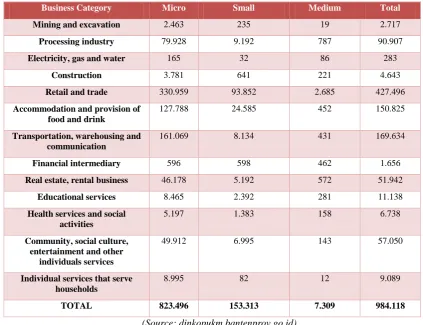
[image:2.595.85.509.212.537.2]ventures, because of the high cost of the application and foreign vendors still lack understanding of unique small and medium business process preparation [6] [11] [12] [13]. This research is motivated by the fact that there are currently no MSMEs in the Banten province of Indonesia that have implemented E-CRM, although many MSMEs have realized the importance of E-CRM and the use of information systems is a necessity that cannot be avoided by any business the foremost position in an industry. The following are MSMEs data in the Banten province (Table 1)
Table 1: MSME Data Based on Business Units in Banten Province
Business Category Micro Small Medium Total
Mining and excavation 2.463 235 19 2.717
Processing industry 79.928 9.192 787 90.907
Electricity, gas and water 165 32 86 283
Construction 3.781 641 221 4.643
Retail and trade 330.959 93.852 2.685 427.496
Accommodation and provision of food and drink
127.788 24.585 452 150.825
Transportation, warehousing and communication
161.069 8.134 431 169.634
Financial intermediary 596 598 462 1.656
Real estate, rental business 46.178 5.192 572 51.942
Educational services 8.465 2.392 281 11.138
Health services and social activities
5.197 1.383 158 6.738
Community, social culture, entertainment and other
individuals services
49.912 6.995 143 57.050
Individual services that serve households
8.995 82 12 9.089
TOTAL 823.496 153.313 7.309 984.118
(Source: dinkopukm.bantenprov.go.id)
Meanwhile, based on a survey conducted in 2017 the level of utilization of CRM / E-CRM in MSMEs in Banten province turned out that from sample data of 30 respondents were known 100% of MSME actors had not utilized and
Figure: 1 Utilization Level of CRM/E-CRM in MSMES
This is what motivates this research to be conducted to help MSMEs in their business by designing E-CRM application that is easy and affordable. Thus the formulation of the problem in this study is "How is the software development or Electronic Customer Relationship Management (E-CRM) application in Micro, Small and Medium Enterprises (MSMEs) in Banten province based on the characteristics of the Banten MSMEs using the waterfall method?". The results of the development of the E-CRM UMKM are expected to contribute to development activities in terms of computational techniques. The purpose of this study was to implement technology, especially in the field of ICT to support economic improvement in the Banten region of Indonesia. The features in this E-CRM will help MSMEs in implementing customer relationship management so that they can increase their competitiveness with other companies in maintaining the business they are running and as a means to obtain a wider new market. The development of the E-CRM UMKM application device is through the stages that exist in the waterfall model software development method discovered by Winston W. Royce in 1970, namely planning, analysis, design, and implementation [8]. The results of the E-CRM UMKM application developed in this study are expected to be
able to increase customer retention and build global scale marketing in MSMEs in the Banten region of Indonesia.
2.
RESEARCH METHOD
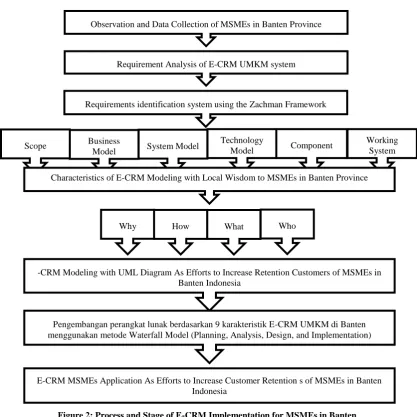
The following are the steps that have been carried out in the overall research on the development of E-CRM UMKM in Banten province of Indonesia, namely: (1) Observation and Data Collection of MSMEs in Banten Province, (2) Requirement Analysis of E-CRM UMKM in Banten , (3) Requirements for identification systems using the 6 Zachman Framework perspective, namely scope, business model, system model, technology model, component, and working system [14], (4) Produced 10 Characteristics of E-CRM Modeling with Local Wisdom to MSMEs in Banten Province [1] [10], (5) E-CRM UMKM Modeling uses 4 Zachman Framework matrices namely why, how, what, who, (6) CRM Modeling with Unified Model Language (UML) Diagram As Efforts to Increase Retention Customers of MSMEs in Banten Province, (7) Software development based on 9 characteristics of the E-CRM UMKM in Banten by using the Waterfall Model method through the stages: Planning, Analysis, Design, and Implementation, (8) So that E-CRM UMKM Application As Efforts to Increase Customer Retention of MSMEs in Banten Indonesia.
0 10 20 30 40
never sometimes ever often
Figure 2: Process and Stage of E-CRM Implementation for MSMEs in Banten
3.
ANALYSIS AND RESULT
Based on the results of observations and needs analysis that has been described in the previous stages, namely, identification of E-CRM needs for MSMEs in the Banten region by using the Zachman Framework which includes six perspectives (scope, business model, system model, technology model, component, and working system ) can produce a fairly complete and comprehensive analysis so that
the E-CRM characteristics of MSMEs in the Banten region do not require features such as those in large companies but simple features tailored to the needs of MSMEs and loaded with local languages to present a userfriendly impression to MSME actors. The following are 9 characteristics [1] that must be applied to the E-CRM UMKM application in Banten province:
Table 2. Characteristic of E-CRM UMKM and Its Implementation in Banten Province
No Characteristic Implementation in Application
1 Local language Using what MSME actors and customers use, namely, Indonesian
2 Economical investment The investation is only smartphone
3 Easy to use and install Can be downloaded quickly through Google Play and can be used immediately and easily
4 Minimalis feature The features used by MSMEs are generally very minimalist, namely: product management and customer management
5 User friendly interface It is very easy to use as evidenced by the results of a limited pretest and post test in using E-CRM UMKM application that has been carried out for MSME actors, which is 98% can immediately understand the use of E-CRM UMKM applications. [9]
6 Android base interface Can be used on all versions of the Android operating system Observation and Data Collection of MSMEs in Banten Province
Requirement Analysis of E-CRM UMKM system
Requirements identification system using the Zachman Framework
Component Working System Technology
Model System Model
Business Model Scope
Why How What Who
E-CRM MSMEs Application As Efforts to Increase Customer Retention s of MSMEs in Banten Indonesia
Characteristics of E-CRM Modeling with Local Wisdom to MSMEs in Banten Province
-CRM Modeling with UML Diagram As Efforts to Increase Retention Customers of MSMEs in Banten Indonesia
[image:4.595.82.513.589.762.2]7 Online or offline run application For some customer relationship management features can be used offline for example: customer data, customer testimonial data, customer complaint data, customer satisfaction data
8 Simple database The database is relatively simple with a simple class diagram consisting of 20 classes
9 Use open source software All of them use open source software to avoid dependency and costs
[image:5.595.109.487.210.424.2]The following are the stages of developing E-CRM UMKM software in Banten province using the waterfall model and the results of each of these stages:
Figure 3. Development Stages of E-CRM UMKM
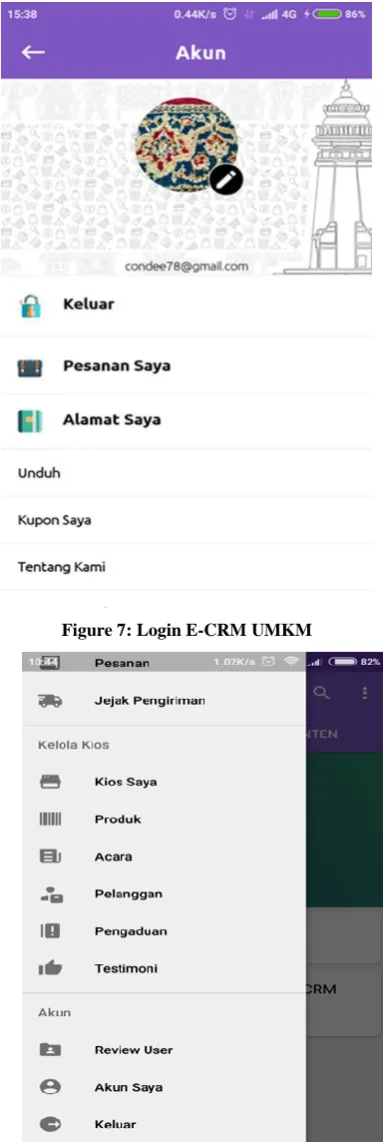
The following is the appearance of the E-CRM UMKM application developed using the waterfall method and built on nine characteristics of MSMEs in
Banten and the UML model resulting from the translation of four Zachman framework matrices:
Planning
• E-CRM UMKM Project PlannerAnalysis
• 10 Characteristics that an E-CRM UMKM must haveDesign
• UML Diagram of E-CRM UMKM • Implementation of 10 Characteristics
of E-CRM UMKM
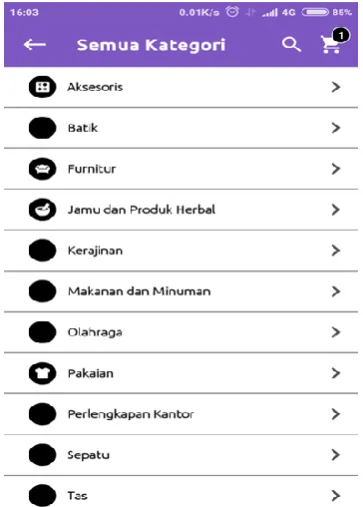
[image:5.595.212.387.473.737.2]Figure 5: Searching Product Feature using Indonesian Language
[image:6.595.207.389.382.636.2]b. The development of E-CRM application in MSMEs in the Banten region through the stages of the waterfall model, namely planning, analysis, design, and implementation is quite effective and efficient so that it produces E-CRM UMKM in Banten province Indonesia.
5.
ACKNOWLEDGEMENT
The authors would like to thank the Ministry of Research Technology and Higher Education of the Republic of Indonesia (KEMENRISTEKDIKTI) for the financial support.
6.
REFERENCES
[1] Rosalina, Vidila., dkk. 2017, Electronic Customer Relationship Management (E-CRM) Modeling on Micro, Small & Medium Enterprises (MSMEs) Banten, International Journal of Computer Applications (0975 – 8887) Volume 176, October 2017, New York, USA.
[2] Rosalina, Vidila, dkk. 2018, , Electronic Customer Relationship Management (E-CRM) Modeling As Effort to Increase Customer retentionon Micro, Small & Medium Enterprises (MSMEs) Banten. ICComSET 26-27 November 2018, Universitas Tasikmalaya, Jawa Barat, Indonesia
[3] Rifa'i, B. 2013. Efektivitas Pemberdayaan Micro Small and Medium Enterprises (UMKM) Krupuk Ikan dalam Program Pengembangan Labsite Pemberdayaan Masyarakat Desa Kedung Rejo Kecamatan Jabon Kabupaten Sidoarjo. Kebijakan dan Manajemen Publik, 130-136
[4] Sawitri,P., Wulandari, L., Simri, L.I.W. 2012. CRM untuk UKM, Konferensi Nasional Sistem Informasi 2012, STMIK - STIKOM Bali 23-25 Pebruari 2012
[5] Rosalina, Vidila. 2013, Pemodelan CRM Pada Perusahaan Petrokimia menggunakan Zachman Framework, Jurnal ELECTRANS ISSN 1412-3762, Volume 12 No 2 September 2013, UPI, Bandung.
[6] Danardatu, Aloysius Heru. 2003, Pengenalan Customer Relationship Management, Ilmu Komputer.Com
[7] Rosalina, Vidila, dkk. 2017. Sosialisasi Pemanfaatan E-CRM untuk Meningkatkan Retensi Pelanggan UMKM . Jurnal Wikrama Parahita Vol 1 No1. November 2017
[8] Pressman, Roger S. 1997. Metode The Classic Life Cycle/Waterfall
[9] Rosalina Vidila. 2018. Pemanfaatan Aplikasi E-CRM Dalam Upaya Meningkatkan retensi Pelanggan UMKM, Seminar Nasional SEMBADHA 2018 pada tanggal 17-18 November 2017-18. Di Sekolah Tinggi Akuntansi Negara (STAN) Bintaro Banten.
[10]Rosalina, Vidila, dkk. 2017. Model Electronic Customer Relationship Management (E-CRM) Menggunakan Adaptasi Bahasa Lokal Pada Usaha Mikro Kecil Menengah (UMKM) Banten, Prosiding SENASSET 2017 (Seminar Nasional Riset Terapan) ISBN 978-602-73672-0-3 : 12, November 2017.
[11]Hashim, R. 2012. Adoption of enterprise information system (EIS) in Malaysian small and medium enterprises (SMEs). Business, Engineering and Industrial Applications (ISBEIA), 2012 IEEE Symposium: 425 - 430.
[12]Garcia, I., Pacheco, C., Martinez, A. 2012. Identifying Critical Success Factors for Adopting CRM in Small: A Framework for Small and Medium Enterprises. Software Engineering Research, Management and Applications 2012, Studies in Computational Intelligence Volume 430, 2012, pp 1-15
[13]Nugraha, A., Dewi, I.N., Novianto, S. 2013. Desain Pengembangan Aplikasi Electronic Customer Relationship Management dalam Mendukung Strategi Pemasaran dan Pengelolaan Pelanggan UMKM, Konferensi Nasional Informatika (KNIF) ITB 2013.