RESEARCH ARTICLE
RADIO FREQUENCY IDENTIFICATION (RFID): STATE OF THE ART AND ITS APPLICATIONS IN
FOOD PROCESSING
* M. Shakila Banu, P. Sasikala, V. Kavitha, G. Yazhini, Lavanya Rajamani and Aruna Dhanapal
Department of Food Processing and Preservation Technology, Faculty of Engineering, Avinashilingam University for Women, Coimbatore
ARTICLE INFO ABSTRACT
Rapid identification technologies have led to a better handling of raw materials and finished products in the food industry. Radio frequency identification (RFID) is an alternative technology with a potential to replace traditional universal product code (UPC) barcodes. RFID enables identification of an object from a distance without requiring a line of sight. Traditionally, universal product code (UPC) barcodes have been used to automate and standardize the identification process. Even though the barcodes are less expensive, they require a clear line of sight between the reader and tag. Radio frequency identification (RFID) has been recently used to speed the handling of manufactured goods and materials. The aim of the present paper is to review the technical and scientific state of the art of RFID technology for wireless communications in the Food processing sector. It also examines how the foodservice industry can take advantage of radio frequency identification (RFID) technologies to improve safety and security, reduce operating expenses, meet compliance requirements and improve efficiency.
Copy Right, IJCR, 2011, Academic Journals. All rights reserved
INTRODUCTION
Radio Frequency Identification, or RFID, is a developing technology that is revolutionizing food distribution and many other industries. Essentially, in its application to the food industry, the technology involves very small microchips (and getting smaller all the time) with radio signal transponders (combination receiver and transmitters) embedded in labels, packaging, cases, or pallets and radio frequency readers and send radio signals positioned at strategic points along the supply chain [1]. A wide range of perceived benefits are expected for RFID based traceability systems in the food industry including tighter control and management of the supply chain and of inventory management with attendant cost savings, reduced labor costs, improvements in customer service, and clearer tracking of customers and the tracing of their purchasing behavior . The systems will also bring benefits of reduced exposure to public safety risks and enhanced customer satisfaction.[2] The purpose of this article is to inform the reader about key concepts and terminology related to RFID technology and to provide examples of how these RFID concepts/capabilities are being applied in the food industry.
*Corresponding author: [email protected]
Barcodes and Radio Frequency Identification
Barcoding and RFID have emerged from the same roots, Auto Identification; this is a broad category of technologies that are used to identify objects, humans and animals. Barcodes are part of every product that we buy and has become the
“ubiquitous standard for identifying and tracking products”
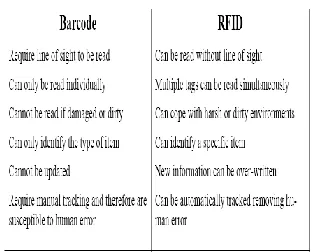
[3]. RFID is a revolutionary information exchange system that can create an environment in which every object can be automatically recognised, tracked, and traced from factory to shelf only using a single tag on each product item or pallet [4]. Table 1 shows that RFID has many benefits over traditional barcoding systems [3].
Table 1. Showing the benefits of RFID over traditional barcoding systems
ISSN: 0975-833X
International Journal of Current Research
Vol. 3, Issue, 11, pp.057-061, October, 2011
INTERNATIONAL JOURNAL OF CURRENT RESEARCH
Article History:
Received 18th
June, 2011 Received in revised form
15th
August, 2011
Accepted 25th
September, 2011
Published online 15th
October, 2011
Key words:
RFID, universal product code, Identification, reader and tag,
Food processing,
[image:1.612.355.512.574.700.2]Elements of RFID system RFID tags
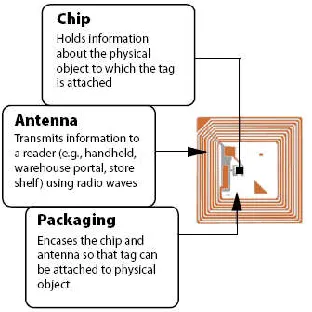
An RFID tag, also known as a transponder, is a small device that can be attached to an object so that the object could be identified and tracked. The tag is composed of a microchip, an antenna, and a substrate or encapsulation material. The microchip stores data whereas the antenna transmits and receives the data. The microchip and antenna attached to the substrate are referred to as the inlay. The inlay is encased in protective material such as paper, plastic, or a film. The size of a tag is usually determined by the size of its antenna because the microchip is usually very small in size [5].
Classification based on power source
Active tag
Active tags require a battery to power up its microchip. Active tags have longer range of operation, greater processing power, and higher operating frequency because they have their own power source. However, higher cost , larger size to accommodate the battery, and shorter life of the batteries make active tags impractical for labeling applications [5]. Active tags operate at frequencies of 433 MHz, 2.45 GHz, or 5.8 GHz. Readers can communicate with active tags from a distance ranging from 20 to 100m [6].
Passive tag
[image:2.612.93.249.501.657.2]Passive tags do not require any power source. They derive power from the signal received from the reader. Therefore, they require a strong signal from the reader and transmit a weak signal to the reader. They transmit only when they are in the field of the reader. These tags are less expensive (approximately 10 cents per tag for large quantities), have a very long operational life, and are small enough to fit onto an adhesive label. Passive tags are used in supply chain for tracking different items. Passive tags typically operate at frequencies of 128 KHz, 13.6 MHz, 915 MHz, or 2.45 GHz. Readers can communicate with passive tags from a distance ranging from a few centimeters to 10m [6].
Fig. 1. Showing the elements of RFID system
Tag reader
The tag reader is a device that powers and communicates with a tag. The reader consists of a high frequency (HF) interface (consisting of a transmitter and a receiver), antenna, and a
control unit. The HF interface generates power to activate and supply power to the tag, sends data to the tag, and receives data from the tag. The reader has one or more antennas that emit radio waves and receive signals transmitted from the tag. The control unit is based upon a microprocessor to control communication with the tag. The control unit also codes and decodes the signal received from the tag [7].
Antenna
The antenna is a conductive element that enables communication between the tag and an RFID reader. Both the reader and tag of an RFID system have antennas for transmitting and receiving data. The antenna of the reader converts the electricity produced by the reader to radio waves and transmits the waves to the tag. The antenna of the tag receives the radio waves and converts them to electricity for powering the microchip. The size of the antenna is important because it determines the operating range of a reader [8].
Working of RFID system
RFID system is composed of a tag and a reader. The reader generates and transmits an interrogation signal to the tag. An active tag powers its microchip from a battery and transmits signal to the reader. A passive tag is powered by the reader either by magnetic induction (near-field coupling) or by electromagnetic wave capture (far-field coupling) [7].
Magnetic induction
[image:2.612.316.516.556.695.2]Faraday’s principle of magnetic induction is the basis of nearfield coupling between a reader and a tag as shown in figure 2. An alternating magnetic field is created by passing large alternating current though the antenna coil of the reader. If the tag, incorporating a smaller antenna coil, is placed in this magnetic field, an alternating voltage appears across the coil of the tag. This voltage, once rectified and coupled to a capacitor, results in accumulation of charge, which is used for powering the chip of a passive tag [7]. Data is transferred from the tag to the reader using load modulation. The tag varies the energy released from the capacitor to the coil of its antenna. This variation is transmitted from the tag to the reader by transformer-type inductive coupling. The reader reads the signal by monitoring the change in the terminal voltage of the coil of its antenna.
Electromagnetic wave capture
[image:3.612.314.531.123.704.2]Far-field RFID system works on a principle similar to that of a radio set. Tags of far-field RFID systems capture electromagnetic waves propagating from the dipole antenna attached to the reader as shown in figure 3. A smaller dipole antenna in the tag receives this electromagnetic energy as an alternating potential difference. This potential difference is rectified and coupled to a capacitor for accumulation of charge and this is then used for powering the chip of a passive tag [7]. The data of far-field RFID tags cannot be transferred to the reader using transformer-type inductive coupling because the tag operates beyond the near-field region. Instead, data is transferred from the tag to the reader using back scattering. Tags using backscatter reflect part of the electromagnetic wave sent from the reader, back to the reader. However, the tag can change the power of the reflected wave by varying the resistance of a load connected to its antenna.
Fig. 3. Showing the schematic of far-field coupling between a reader and a tag [9]
Areas of RFID in food processing
Implementation of RFID in food processing
RFID and Food Traceability
According to Regattieri et al. [11] traceability is defined as “the history of a product in terms of the direct properties of that product and/or properties that are associated with that product once these products have been subject to particular value-adding processes using associated production means and in associated environmental conditions” and “concept relating to all products and all types of supply chain.” RFID tags are essentially tiny computers. The most basic tags simply contain
product identification information while the advanced tags include monitors that can be updated with information such as weight, temperature, and pressure. Food traceability system consists of four components [11] as shown in figure 4.
Benefits of RFID in food industry
[image:3.612.83.236.460.597.2]
In a typical RFID system, RFID tags are attached to objects and send out information when detecting a signal from the tag reader [12]. Tag readers, based on cellular technology, can scan products as needed so that a system can identify what products are located in a particular physical space. During reading, the signal is sent out continually by the active tag whereas in the passive tag, the reader sends a signal to the tag and listens [13] . The data collected by the RFID reader will be sent to backend databases via middleware to be utilized by enterprise systems.
RFID in food safety
Food industries and their consumers have heightened concern about the risk of illness from a contamination incident, whether by accidental tainting of a product during its processing, shipment and storage, or as the result of deliberate tampering. More and more, customers are demanding assurance that the brands they purchase are supplied by companies with enlightened ‘green’ and consumer sensitive policies and practices that address a responsible approach to food safety. Additionally, there is heightened consumer awareness about food quality, including ingredients and their nutrional content, e.g., organic vs. processed foods. This former niche trend has now matured and virtually all consumers are eating healthier foods. They want to be assured of the integrity of the products they are buying, including justification for paying a premium price for them [14]. RFID systems can be used to ensure that food products such as meat, fruit, and dairy products remain within a safe temperature range during transportation and storage [15]. RFID tag can function as a temperature data logger and as a supply-chain tracking tool. The range of operation for the datalogger is from −20 to 50 ◦C. which captures and delivers the temperature history of any product to which it is tagged [15]. Supply chain applications alone, however, offer significant benefits in terms of cost savings, eliminating inefficiencies, ensuring quality and safety, and product source tracing related to product recall and food safety issues. For example, an RFID tag affixed to a pallet of broccoli picked in a field in California would maintain a record of the temperature the product experienced throughout transit from field to retail store receiving dock. If the ideal temperature range were violated, the source of the violation would be indicated, and the issue could be addressed at the source of the violation. This will help ensure that product is handled properly throughout the cold chain and that product quality is enhanced while food safety risk is reduced [1].
RFID and Supply Chain Management
In supply chain management, RFID tags are used to track food products during distribution and storage. RFID technology serves as a replacement for barcode scanners for this particular application. RFID technology also facilitates automated product shipments from a warehouse to a retail store. An RFID system implemented in a store can be used to maintain an accurate database of its inventory that automatically alerts a warehouse management system once the inventories are low [15]. Thus, RFID technology will provide benefits such as greater speed and efficiency in stock operations, better inventory tracking through out the supply chain, and enhanced forecasting [2].
RFID and smart marketing
The transponders in RFID system serve three critical functions: receiving data, storing data, and transmitting data about the product. In a produce industry context, these data could include producer name, field and plot location, pick date, ship date, temperatures experienced en route from field to retailer, and much more. The transponder’s radio signal can be translated into information by readers located at packers, shippers, processors, manufacturers, consolidators, wholesale distribution centers, and retail stores. Readers will be linked to computer databases where the information can be catalogued and analyzed [2].
Other applications
RFID technology has also been used in monitoring the ripening of climacteric fruits during transportation and vending. Vergara and others [16] developed a prototype of an RFID system with metal oxide (MOX) sensors onboard the reader for monitoring the ripening of apples.
Challenges in Implementation of RFID Technology
Outlook
REFERENCES
[1] Rod Hawkes, RFID and Smart Marketing, Senior
Extension Associate Food Industry Management
Program, Cornell University,2005.
[2] Jones, P., Clarke-Hill, C., Comfort, D., Hillier, D., & Shears, P. Radio frequency identification and food
retailing ,British Food Journal, 107(6), 356,2005.
[3] Wyld, D. RFID 101: The next big thing in
management. Management Research News, 29 (4),
154-173, 2006.
[4] Clarke, D., Gosain, S., and Thillairajah, V. Realizing
the promise of RFID, 2005. http://www.ebizq. net/
topics/ rfid/features/6165.html
[5] Roberts CM. 2006. Radio frequency identification
(RFID). Comput Secur 25:18–26.
[6] Weinstein R. RFID: a technical overview and its
application to the enterprise. IEEE IT Prof 7(3):27–
33,2005.
[7] Finkenzeller K. RFID Handbook. West Sussex,
England: John Wiley & Sons. 427 p.,2003.
[8] Brown DE. RFID implementation. New
York:McGraw-Hill. 466 p,2007.
9] Want R. Themagic of RFID. ACMQueue 2(7):41–8. 2004.
[10] Smith, H., & Konsynski, B Developments in Practice X: Radio Frequency Identification (RFID) - An Internet
for Physical Objects. Communications of the
Association for Information Systems, 12, 301-311,2003.
[11] Regattieri, A., Gamberi, M., & Manzini, R. Traceability of food products: General framework and experimental evidence. Journal of Food Engineering, 81, 347-356, 2007.
[12] Lai, F., Hutchinson, J., & Zhang, G. Radio Frequency Identification (RFID) in China: Opportunities and Challenges. International Journal of Retail &
Distribution Management, 33(11/12), 905-916, 2005.
[13] Asif, Z., & Mandviwalla, M. Integrating the Supply Chain with RFID: A Technical and Business Analysis.
Communications of the Association for Information
Systems, 15, 393-427,2005.
[14] Dan Fitzgibbons Principal at Deloitte Consutling LLP
RFID and Food Safety.
[15] Kumar p, Reinitz H.W, Simunovic J, sandeep .K.P , Franzon P.D Overview of RFID Technology and Its
Applications in the Food Industry, Journal of food
science and nutrition,Vol 74,Nr,8,2009.
[16] Vergara A, Llobet E, Ramirej JL, Ivanov P, Fonseca L, Zampolli S, Scorzoni A, Becker T, Marco S, Wollenstein J. An RFID reader with onboard sensing
capability for monitoring fruit quality. Sens Actuators
127:143,2007.