127
IPA
International Journal of Psychology Vol. 6, No. 2, Summer & Fall 2012
PP. 127-144
Iranian Psychological Association
Trust Propensity as a Moderator in the Relationship
between Perceived Manager Trustworthiness and
Job Performance
Saleheh Piryaei, MA Nasrin Arshadi, PhD
Department of Psychology Department of Psychology Shahid Chamran University Shahid Chamran University
The purpose of this study was to investigate the relationship between perceived manager trustworthiness and job performance considering the moderating role of trust propensity. A sample of 300 employees of National Iranian South Oil Company (NISOC) in Ahvaz, Iran was selected by the stratified random sampling method and completed the Perceived Manager Trustworthiness Scale (Mayer & Davis, 1999), the Trust Propensity Scale (Jarvepaa, Knoll, & Leinder, 1998) and the Job Performance Scale (Williams & Anderson, 1991). The data were analyzed using hierarchical regression analysis. The results indicated that perceived manager trustworthiness was positively related to job performance and employee’s trust propensity can moderate this relationship. It can be concluded that perceived manager trustworthiness is an important factor in promoting job performance and this relationship will be stronger when employees have high levels of trust propensity.
Keywords: perceived manager trustworthiness, trust propensity, job performance
128
affected by trust in the organization and also the relationships among the employees (Çelik, 2011).
129
person will trust (Rotter, 1967). Given its role within organizations, it is not surprising that researchers and practitioners alike are interested in identifying the mechanisms through which trust and its components can be developed as well as those factors which moderate their relationships (Burke, Sims, Lazzara & Salas, 2007). In an organization, a prevalent form of relationship is that between a subordinate and a supervisor/manager which plays a critical role in hierarchical, dyadic relationships because of the dependency and vulnerability of employees to their supervisor (Afsar & Saeed, 2010). Several studies showed that trust have influences on processes such as communication, cooperation, information sharing, satisfaction, perceived effectiveness of the manager, increased discretionary behaviors (i.e., organizational citizenship behaviors), increased upward communication, decreased turnover and improved job performance/stability (Burke et al., 2007). Trust researchers argue that employees see managers as trustworthy when they judge their managers as deserving of positive expectations, which is a function of three dimensions: benevolence, integrity, and ability. In addition to trust cues from managers, employees intuitively rely on their internal dispositional cues as important sources for increasing important outcomes such as job performance, OCBS and affective commitment (Colquitt et al., 2007).
130
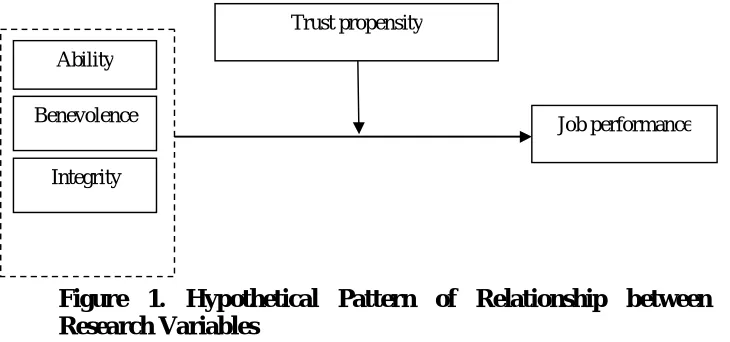
perceived manager trustworthiness and employee’s job performance. Figure 1 depicts these relationships.
Background and Hypotheses
Perceived Manager Trustworthiness
Mayer et al. (1995) defined trust as an individual’s (i.e., the trustor) willingness to be vulnerable to the actions of another party (i.e., trustee), even when the other party cannot be monitored or controlled. Mayer and colleagues cast trustworthiness perception as an antecedent to trust. According to this model, trustworthiness concerns the perceptions about a trustee’s characteristics that influence the extent to which a trustor makes oneself vulnerable to the trustee (Frazer, Johnson, Gavin, Gooty & Bradley, 2010). Among many characteristics in the trust literature, Mayer et al. (1995) focused on three of the most prominent factors of perceived trustworthiness: trustee’s ability, benevolence and integrity. Each of these elements has unique and combined influences on trust, and its relative importance largely depends on the referent and situation. Several studies (e.g., Frazer et al., 2010; Mayer & Davis, 1999; Mayer & Gavin, 2005) indicated that ability, benevolence, and integrity of the trust target are related to trust.
Figure 1. Hypothetical Pattern of Relationship between Research Variables
Ability
Benevolence
Integrity
131
Ability has been defined as, the group of skills, competencies, and characteristics that enable a party to have influence with some specific domains (Mayer et al., 1995).
Benevolence reflects the trustor’s belief that the trustee has the trustor’s best interests in mind and cares about the trustor. Benevolent managers are those that are perceived to genuinely care about their subordinates and convey authentic concern in relationships (Caldwell & Hayes, 2007). In turn, subordinates that perceive their managers as benevolent are also more likely to reciprocate this care and concern by being motivated to work harder, persist longer, and engage in extra-role behaviors (i.e., OCBs), even when there is no extrinsic reward.
132
Perceived Manager Trustworthiness and Job Performance
Trust is needed in the supervisor-subordinate relationship because of interdependence (Lam, Loi & Leong, 2011). Subordinates depend on their managers to accomplish personal goals, career progression, and salary attainment (Rupp & Cropanzano, 2002). Empirical researches showed that perceived manager trustworthiness can affect important work outcomes including job performance, organizational commitment, job satisfaction, and intention to quit (Lau & Lam, 2008). Also, several studies indicated that individuals with high perceived manager trustworthiness are more likely to experience the higher level of job performance (e. g., Colquitt et al, 2007 & Grant & Sumanth, 2009) and there are theoretical explanations and much empirical evidence for this relationship.
Hypothesis 1: Perceived ability relates positively to job performance.
Hypothesis 2: Perceived benevolence relates positively to job
performance.
Hypothesis 3: Perceived integrity relates positively to job
performance.
Moderating Role of Trust Propensity
133
trustworthiness, employees may use their own high trust propensities to make judgments about their manager’s trustworthiness. General support for this proposition appears in Mayer et al. (1995) integrative model of organizational trust.
Hypothesis 4: Trust propensity moderates the relationship between
perceived ability and job performance. That is, the higher the trust propensity, the stronger the positive relationship between perceived ability and job performance.
Hypothesis 5: Trust propensity moderates the relationship between
perceived benevolence and job performance. That is, the higher the trust propensity, the stronger the positive relationship between perceived benevolence and job performance.
Hypothesis 6: Trust propensity moderates the relationship between
perceived integrity and job performance. That is, the higher the trust propensity, the stronger the positive relationship between perceived integrity and job performance.
Method Participants
The participants of this study were 300 employees of National Iranian South Oil Company (NISOC) in Ahvaz, who were selected by the stratified random sampling method. All together, 286 questionnaires were returned and analyzed (a response rate of 95.33%). Of 286 respondents, 82% were men; average age was 41 years, and average tenure of 15.2 years.
Measures
134
performing his/her job.” Perceived trustworthiness-benevolence was assessed by five items, including “My needs and desires are very important to my manager.” Perceived trustworthiness-integrity was assessed by six items, including “My manager tries hard to be fair in dealings with others.” Tan & Lim (2009) reported Cronbach’s alpha of .90 to .94 for the three subscales. In the present study Cronbach’s alpha was .90 for ability, .87 for benevolence and .94 for integrity.
The trust propensity scale. The 7-item scale developed by Jarvepaa,
Knoll, and Leinder (1998) was used to assess the employee’s trust propensity with the sample item of “Most managers tell the truth about the limits of their knowledge”. Participants responded on a 7-point Likert-type scale from 1 (strongly disagree) to 7 (strongly agree). Matiella (2011) estimated its reliability by Cronbach’s alpha to be .86 and in the current study the reliability was .95.
The job performance scale. Job performance was measured with 7
items from a 21-item scale developed by Williams and Anderson (1991). Sample item include “Fulfills responsibilities specified in job description”. This measure used a 1-5 response scale (1, strongly agree, to 5, strongly disagree). Taylor (2010) reported Cronbach’s alpha of .89 for this scale and in the current study the reliability was .93.
Results
Means, standard deviations and correlations between research variables are shown in Table 1.
Table 1
Means, Standard Deviations, and Correlations between Research Variables
Variables M SD 1 2 3 4 5
1. Ability 20.48 5.88 ___
2. Benevolence 17.63 6.32 .80∗ ___
3. Integrity 20.50 7.55 .90∗ .92∗ ___
4. Trust propensity 31.88 14.13 .91∗ .86∗ .93∗ ___ 5. Job performance 25.20 6.60 .87∗ .76∗ .87∗ .94∗ ___
135
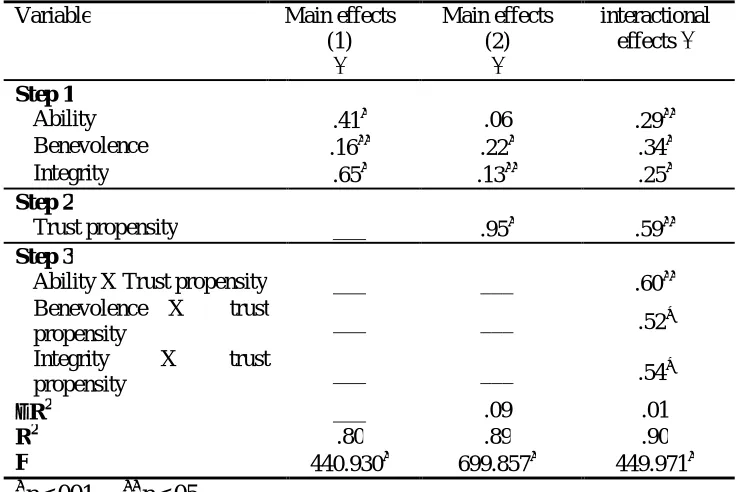
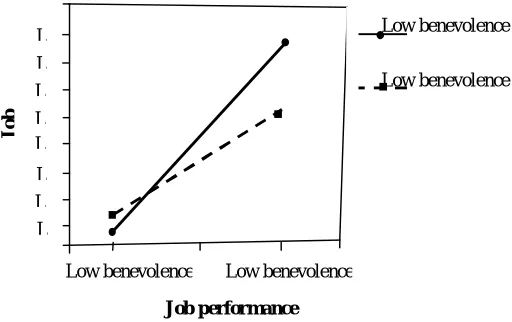
In support of hypotheses 1, 2 and 3, perceived manager trustworthiness facets (ability, benevolence and integrity) were positively related to job performance (R2=.80, ∗p<.001). In step 2, perceived manager trustworthiness facets and trust propensity significantly predict job performance (R2=.89, ∆R2=.09, ∗p<.001). Finally, results of hierarchical regression analyses in step 3, indicate a statistically significant interaction between perceived manager trustworthiness facets and trust propensity as significant predictors of job performance (R2=.90, ∆R2=.01, ∗p<.001). We plotted these interactions in Figures 2, 3 and 4, which suggest that ability, benevolence and integrity as three facets of perceived manager trustworthiness are more positively related to job performance when employees reported high rather than low trust propensity (H4, H5, H6).
The results of hierarchical regression analyses in the prediction of job performance are reported in Table 2.
Table 2
Results of Hierarchical Regression Analyses
Variable Main effects
(1)
β
Main effects (2)
β
interactional effects β Step 1
Ability .41∗ .06 .29∗∗
Benevolence .16∗∗ .22∗ .34∗
Integrity .65∗ .13∗∗ .25∗
Step 2
Trust propensity ___ .95∗ .59∗∗
Step 3
Ability X Trust propensity ___ ___ .60∗∗
Benevolence X trust
propensity ___ ___ .52
∗
Integrity X trust
propensity ___ ___ .54
∗
∆R2 ___ .09 .01
R2 .80 .89 .90
F 440.930∗ 699.857∗ 449.971∗
∗
136
Figure 1. Interaction Effect between Ability and Trust Propensity on Job Performance
Jo
b
Low ability High
Low High 1 2 2 2 2 2 3 3 Job performance
Figure 3. Interaction Effect between integrity and trust propensity on
job performance Jo b Low benevolence Low benevolence Low benevolence L L L L L L L L Low benevolence
Figure 2. Interaction Effect between Benevolence and Trust Propensity on Job Performance
137
Discussion
Overall, the results of this study indicated that a) there is a positive relationship between perceived manager trustworthiness facets (ability, benevolence and integrity) and job performance and b) trust propensity interacted with perceived manager trustworthiness facets (ability, benevolence and integrity) in predicting job performance. So, the higher employees' propensity to trust, will lead to the stronger positive relationship of perceived manager trustworthiness with job performance.
Different studies have investigated these relationships and in most of them significant positive relationships have been reported (Mayer et al., 1995, Frazer et al., 2010., Grant & Sumanth, 2009). Accordingly, job performance can be improved when employees experience positive exchange-based relationships (Taylor, 2010). Existing evidence suggests that trust enables employees to focus their attention on value-producing activities rather than being distracted by concerns about protecting their jobs or monitoring managers' activities (Mayer & Gavin, 2005). So, perceiving managers as trustworthy may enhance the performance in employees by enabling them to feel that they can rely on their manager’s skill, knowledge, and ability (Lam et al. 2011).
138
(1995) proposed that when followers believe their managers have integrity, capability or benevolence, they will be more comfortable engaging in behaviors that put them at risk (e.g., sharing sensitive information) and will tend to increase their inputs and efforts in job. In contrast, Mayer and Gavin (1999) suggested that when employees believe their manager cannot be trusted (e.g., because the manager is perceived not to have integrity) they will divert energy toward "covering their backs," which detracts from their work performance. In contrast, the relationship-based perspective of trust is based on principles of social exchange and deals with employees' willingness to reciprocate care and consideration that a manager may express in a relationship. That is, individuals who feel that their manager has, or will, demonstrate care and consideration will reciprocate this sentiment in the form of desired behaviors. Konovsky and Pugh (1994) drew on this logic, suggesting that a social exchange relationship encourages individuals to spend more time on required tasks and be willing to go above and beyond their job role. Because employees view trustworthy managers as holding strong other-oriented values of benevolence and integrity, employees can count on these managers to share reliable information in their communications and engage in behaviors that advance the organization's mission of helping beneficiaries.
139
insofar as they perceive them as being capable of meeting expectations (ability), holding good intentions (benevolence), and subscribing to and acting upon a set of valued or acceptable principles (integrity). Seeing managers as trustworthy with high abilities will increase employees' confidence in managers' words, intentions, and actions (Mayer et al., 1995) and when employees see their managers as possessing benevolence and integrity, they will increase their job performance. The logic underlying this proposition is that benevolence and integrity are other-oriented values, as benevolence involves concern for the well-being of other people with whom one is in personal contact (Meglino & Ravlin, 1998; Schwartz, 1992) and integrity involves a broad emphasis on social justice and sincerity (Marcus, Lee, & Ashton, 2007). In addition, when individuals do not trust their manager, more time will be spent monitoring the manager's actions as well as documenting personal performance to protect oneself as opposed to performing important tasks and duties (Mayer & Gavin, 2005).
140
processing of information influence on information and the weight each piece of information is given in the decision to trust. Specifically, propensity to trust as the general willingness to place faith in others' reciprocity (Gouldner, 1960) and good intentions can moderate the association between perceived manager’s characteristics and employee’s outcomes.
Limitations and Suggestions for Future Researches
141
References
Afsar, B., & Saeed, B. B. (2010). Subordinate's trust in the supervisor and its impact on organizational effectiveness. The Romanian Economic Journal, 38. 3-25.
Bigley, G. A., & Pearce, J. L. (1998). Straining for shared meaning in organizational science: Problems of trust and distrust. Academy of Management Review, 23, 405-421.
Burke, C. S., Sims, D. E., Lazzara, E. H., & Salas, E. (2007). Trust in leadership: A multi-level review and integration. The Leadership Quarterly 18, 606-632.
Caldwell, C., & Hayes, L. A. (2007). Leadership, trustworthiness, and the mediating lens. Journal of Management Development, 26, 261-281. Campbell, J. P. (1990). Modeling the performance prediction problem
in industrial and organizational psychology. In M. D. Dunnette & L. M. Hough (Eds.), Handbook of industrial and organizational psychology (2nded. Vol. 1, pp. 687--732). Palo Alto,CA: Consulting Psychologists Press.
Çelik, M., Turunc, O. & Begenirbas, M. (2011). The role of organizational trust, burnout and interpersonal deviance for achieving organizational performance. International Journal of Business and Management Studies, 3, 179-189.
Colquitt, J. A., Scott, B. A., & LePine, J. A. (2007). Trust, Trustworthiness, and Trust Propensity: A Meta-Analytic Test of Their Unique Relationships With Risk Taking and Job Performance. Journal of Applied Psychology, 92, 909-927.
Dirks, K. T. (2000). Trust in leadership and team performance: evidence from NCAA basketball. Journal of Applied Psychology, 85, 1004- 1012.
Dirks, K. T., & Ferrin, D. L. (2002). Trust in leadership: Meta-analytic findings and implications for research and practice. Journal of Applied Psychology, 84, 611-628.
142
Examination organizational justice, trustworthiness, and trust: A multi foci examination. Group Organization Management, 35, 39-76. Gabarro, J. J. (1978). The development of trust, influence, and
expectations. In A. G. Athos & J. J. Gabarro (Eds.), Interpersonal
behaviors: Communication a nd understanding in relationships (pp.
290 –303). Englewood Cliffs, NJ: Prentice Hall.
Gouldner, A. W. (1960). The norm of reciprocity: a preliminary statement. American Sociological Review, 25, 161-178.
Grant, A. M., & Sumanth, J. J. (2009). Mission possible? The performance of prosocially motivated employees depends on manager trustworthiness. Journal of Applied Psychology, 94, 927-944.
Hall, A. T., Blass, F. R., Ferris, G. R., & Massengale, R. (2004). Leader reputation and accountability in organizations: implications for dysfunctional leader behavior. Leadership Quaterly, 15, 515-536. Jarvenpaa, S. L., Knoll, K., & Leidner, D. E. (1998). Is anybody out there?
Antecedents of trust in global virtual teams. Journal of Management Information Systems, 14, 29 -64.
Konovsky, M., & Pugh, D. (1994). Citizenship behavior and social exchange. Academy of Management Journal, 37, 656-669.
Lam, L. W., Loi, R., & Leong, C. (2011). Reliance and disclosure: How supervisory justice affects trust in supervisor and extra-role performance. Asia Pac J Manag, DOI10.1007/s10490-011-9249-5. Lau, D., & Lam, L. W. (2008). Effects of trust and being trusted on team
citizenship behavior in chain stores. Asian Journal of Social Psychology, 11, 141-149.
Marcus, B., Lee, K., & Ashton, M. C. (2007). Personality dimensions explaining relationships between integrity tests and counterproductive behavior: Big Five, or one in addition? Personnel Psychology, 60, 1-34.
143
University.
Mayer, R. C., Davis, J. H., & Schoorman, F. D. (1995). An integrative model of organizational trust. Academy of Management Review, 20,709 -734.
Mayer, R. c., & Davis, J. H. (1999). The effect of the performance appraisal system on trust for management: A field quasi-experiment. Journal of Applied Psychology, 84, 123-136.
Mayer, R. c., & Gavin, M. B. (2005). Trust in management and perfor-mance: Who minds the shop while the employees watch the boss? Academy of Management Journal, 48, 874-888.
Mayer, R., & Gavin, M. (1999). Trust for management and performance: Who minds the shop while the employees watch the
boss? Paper presented at the Annual Meeting of the Academy of
Management, Chicago.
Meglino, B. M., & Ravlin, E. C. (1998). Individual values in organizations: Concepts, controversies, and research. Journal of Management, 24, 351-389.
Rotter, J. B. (1967). A new scale for the measurement of interpersonal trust. Journal of Personality, 35, 651- 665.
Rotter, J. B. (1971). Generalized expectancies for interpersonal trust. American Psychologist, 26, 443-452.
Rousseau, D. M., Sitkin, S. B., Burt, R. S., & Camerer, C. (1998). Not so different after all: A cross-discipline view of trust. Academy of
Management Review, 23, 393- 404.
Rupp, D. E., & Cropanzano, R. (2002).The mediating effects of social exchange relationships in predicting workplace outcomes from multi foci organizational justice. Organizational Behavior and Human Decision Processes, 89, 925-946.
Schmidt, F. L., & Hunter, J. E. (2000). Select on intelligence. In E. A. Locke (Ed.), Blackwell handbook of principles of organizational behavior (pp. 3– 8). Malden, MA: Blackwell.
144
Strategy, 15, 14-16.
Tan, H. H., & Lim, A. K. H. (2009). Trust in coworkers and trust in organizations. Journal of Psychology, 143, 45-66.
Taylor, S. G. (2010). Cold looks and hot tempers: Individual-level effects
of incivility in the workplace. Doctoral Dissertation, B.S., Bradley
University.
Wageman, R. (2001). The meaning of interdependence. In M. E. Turner (Ed.), Groups at work: Theory and research (pp. 197–217). Mahwah, NJ: Erlbaum.
Williams, L. J., & Anderson, S. E. (1991). Job satisfaction and organizational commitment as predictors of organizational citizenship and in-role behaviors. Journal of Management, 17, 601-617.