Time-Spectral Solution of Initial-Value Problems
—Subdomain Approach
Jan Scheffel, Ahmed A. Mirza
Division of Fusion Plasma Physics, Association EURATOM-VR, Alfvén Laboratory, School of Electrical Engineering, KTH Royal Institute of Technology, Stockholm, Sweden
Email: [email protected]
Received March 7,2012; revised April 6, 2012; accepted April 12,2012
ABSTRACT
Temporal and spatial subdomain techniques are proposed for a time-spectral method for solution of initial-value prob- lems. The spectral method, called the generalised weighted residual method (GWRM), is a generalisation of weighted residual methods to the time and parameter domains [1]. A semi-analytical Chebyshev polynomial ansatz is employed, and the problem reduces to determine the coefficients of the ansatz from linear or nonlinear algebraic systems of equa- tions. In order to avoid large memory storage and computational cost, it is preferable to subdivide the temporal and spa- tial domains into subdomains. Methods and examples of this article demonstrate how this can be achieved.
Keywords: Initial-Value Problem; Multiple Time Scales; Time-Spectral; Spectral Method; Weighted Residual Method; Subdomains; Domain Decomposition
1. Introduction
The generalised weighted residual method (GWRM) is a fully spectral method, designed to solve partial differen- tial equations in the form of initial-value problems. Al- though various applications of time-spectral methods have appeared in the past, we have tried in [1] to demon- strate a comprehensive view of the wide applicability of spectral methods for the time domain. The method ap-plies to both parabolic and hyperbolic pde’s. Examples, briefly discussed in this article, are the Burger equation, a forced wave equation and a system of 14 coupled mag- netohydrodynamic equations. These are all shown to be successfully solved by the GWRM. The basic intention of the method is to allow for efficient numerical simula- tion of problems with several time scales, where one is primarily interested in the long time scale behaviour. This is, for example, often the case for problems of sta- bility, fluctuations and confinement in fusion plasma physics. However, application of the method shows that it can also be used for very accurate computation on short time scales.
The trial basis functions used for all temporal, spatial and physical domains in the GWRM are Chebyshev polynomials, owing to their minimax property which provides fast convergence [2] and due to the fact that non-periodical boundary conditions are allowed. The so- lution obtained by GWRM is thus semi-analytical rather than purely numerical in the sense that it is a finite sum
of Chebyshev polynomials in time, space and, if one so chooses, parameter space. This is often practical for ap- plications. Moreover, being an acausal method it is not constrained by CFL or other time step restrictions, as is the case for explicit time differencing methods. In com- parison with implicit time differencing schemes, such as the Crank-Nicolson method, the GWRM has been shown to be efficient [1]. On the theoretical side, there remains to determine exact conditions for convergence and accu- racy, being important matters for future study.
where spectral methods in space and finite difference methods in time have been used. Here, we concentrate on the use of spatial and temporal subdomains for the GWRM, which employs a time-spectral method.
The paper is organized as follows. In Section 2, a brief overview of the GWRM is given and some results on comparisons with explicit and implicit finite difference methods are presented. In Section 3, spatial subdomains are introduced. After a discussion of possible computa- tional gain, different GWRM implementations of spatial subdomains are discussed. A weighting method for im- proved convergence is introduced. In Section 4, temporal subdomains are introduced. As shown, this is compara- tively straightforward. An example application of tem- poral subdomains is also studied. In Section 5, the three different implementations of spatial subdomains are ap- plied to the Burger’s equation and to a large system of resistive magnetohydrodynamic (MHD) equations. This is followed by a discussion in Section 6 and conclusions in Section 7.
2. The Generalized Weighted Residual
Method (GWRM)
2.1. Method in Brief
Consider a system of parabolic or hyperbolic partial dif-ferential equations
D t
u u f
t(1)
where is the solution vector, D is a linear or nonlinear matrix operator and is an explicitly given source (or forcing) term. Note that D
may depend on both physical variables (t, xand u) and physical parameters (denoted p) and that f is assumed arbitrary but non-dependent on u. Initial u(t0,x;p) as well
as (Dirichlet, Neumann or Robin) boundary u(t,xB;p)
conditions are assumed known.
t, ; u u x p
, ;f f t x p
To avoid inverting a matrix solution vector, associated with the time derivative, Equation (1) is integrated in time;
0 0
, ; , ; , ; , ; d
t t
t t
D t f tu x p u x p u x p x p
(2) The solution vector u u
t, ;x p
is approximated using first kind, multivariate Chebyshev polynomials series as both trial and weight functions. These polyno- mials, defined by Tn(x) = cos(ncos–1x), are orthogonalwithin the interval [–1,1] over a weight function (1 – x2)–1/2.
Chebyshev polynomials may be defined appropriately to any given finite range [a,b] of x (shifted Chebyshev polynomials) by a linear transformation [2]. Confining us here to one spatial variable x and one parameter p, we thus have
0 0 0
, ; K L M klm k l m
k l m
u t x p a T T T P
(3)using the transformations
, , p
t x
t x
p A
t A x A
P
B B B
p
(4)
with Az
z1z0
2, Bz
z1z0
2 and where in- dices “0” and “1” denote lower and upper computational domain boundaries, respectively. Primes on summation signs in Equation (3) indicate that each occurrence of a zero coefficient index renders a multiplicative factor of 1/2. Just as for standard weighted residual methods (WRM), the unknown coefficients aklmare determined byrequiring that the integral of the weighted residual over the computational domain should be zero. Performing the integration by parts, the result is [1]
0
2
qrs q rs qrs qrs
a b A F (5)
Here Aqrs and Fqrs correspond to Chebyshev expan-
sions of the time integrals on the right hand side of Equa- tion (2). Since Aqrs usually includes u itself, it usually is a
polynomial function of the unknown coefficients aklm.
For nonlinear equations, each element of relation (5) may thus be a complex function of the unknowns. The coeffi- cients brscorrespond to the Chebyshev expansion of the
initial conditions. Equation (5), together with appropriate boundary conditions, is used to determine the GWRM coefficients aqrs that constitute the solution of the prob-
lem. Equation (5) can be linear or nonlinear depending upon the type of the problem. If linear, the coefficients can be found using traditional methods like Gauss elimi- nation. For nonlinear problems, a semi implicit root solver (SIR) has been developed [5]. SIR has proven to be very robust for GWRM applications.
2.2. The GWRM and Finite Time Step Methods
In order to investigate the applicability of the GWRM, some test problems have been solved using the method [1]. The problems were also solved using the finite dif- ference time step Lax-Wendroff and Crank-Nicolson methods. The former method is explicit and is subject to CFL (or similar) time step limiting conditions. The latter method allows for arbitrarily large time steps by using an implicit approach where the functional values are deter- mined both at present and future time steps.
For studying accuracy, the nonlinear Burger equation
2
2
u u u
t x
u x
(6)
has been solved with initial condition u
0,x x
1x
t,1 0and boundary conditions for differ- ent values of
,0
u t u
intended for computing long time behaviour of complex problems with several time scales, it can be used for ac- curate solution of stiff problems. For the case of Burger’s equation, the GWRM was shown to provide efficiency close to that of the Lax-Wendroff and Crank-Nicolson schemes for given accuracy. Improved GWRM effi- ciency is expected for problems with periodic boundary conditions. The GWRM has the additional advantage of providing approximate, analytic solutions.
For studying efficiency, a forced wave equation was solved:
2 2
2 2 ,
u u f t x
t x
(7)
with u t
,0 u t
,1 0, ,
sin
u x A x
0, sin π
u x n x
0,
t . Here A, n, α, β and v are free
parameters, and f(t,x) = A(vβ2 – α2)sin(αt)sin(βx) is the
forcing function. The exact solution is
, cos
π 0.5
sin
π
sin
sinu t x n t n x A t x , (8)
for β = mπ, with m an integer. This problem has the separate system and forcing function time scales
2 n and 2π. Using the parameter values v = 1,
A = 10, α= π/15, β = 3π and n = 3, the ratio of these time scales becomes R
nπ
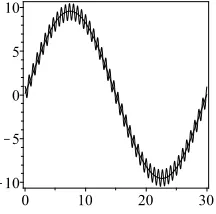
1 45. Thus the forcing term in (7) has here introduced a time scale much longer than that of the “unperturbed” system. [image:3.595.122.230.596.703.2]It was found that the GWRM, as intended, is well suited for long time scale solution of this problem. For suitable mode parameters, it traces the slower dynamics using substantially less computational time than the Lax-Wendroff and Crank-Nicolson schemes. See Figure 1 for the case K = 6, L = 8, where single temporal and spatial subdomains are used. If results are sought for longer times, temporal subdomains are preferably used for the GRWM, in order to guarantee constant computa-tional effort per problem time unit. For problems with wider separation of the time scales, the GWRM will be an increasingly advantageous method as compared to the Lax-Wendroff scheme since the latter must follow the faster time scale. It may also be noted that the GWRM
Figure 1. GWRM solution (smooth curve) of forced wave equation, as compared to exact solution (oscillating curve).
averages more accurately over the fast time scale oscilla-tions than the finite difference methods. This is an inter-esting subject which deserves further attention.
The computations have been carried out using Maple. Although faster computational environments exist, exact comparisons of efficiency are not essential at this stage. The examples we have given show that the efficiency and accuracy of the GWRM is comparable to that of both explicit and implicit finite difference schemes in a given environment. Further optimisation of both GWRM and finite difference codes could increase efficiency, but our examples indicate that time-spectral methods for solution of initial-value pde’s are of interest for general use and for computations of problems in magnetohydrodynamic and fluid mechanics in particular.
3. Spatial Subdomains
The number of operations in GWRM computations can be significantly reduced by using subdomains for the spatial, temporal and physical variables [1]. It is the pri- mary objective of this paper to qualify this claim. Thus we begin this section with some numerical considera- tions.
Iterative solution of the GWRM coefficient Equation (5) will lead to approximately = (K + 1)3(L + 1)3(M + 1)3
operations for each iteration owing to the cubic depend- ence on the number of unknowns for computations in- volving matrix inversion. Using LU decomposition me- thods rather than matrix inversion, the number of opera- tions may be reduced to 3 [6]. This may be an accept- able amount of work. For more complex calculations, however, high efficiency often requires the temporal and spatial domains to be separated into subdomains. This would in principle enable a linear rather than a cubic dependence of efficiency on, for example, the number of spatial modes applied to the entire domain, given that the number of subdomains is proportional to L. Now assume that the temporal and spatial domains are divided into Nt
and Nx subdomains, respectively. The result is that only
3 3 3
2
1 1
3
t x t x
t x
N N K N L N M
N N
1 3
operations are then needed for a particular problem, as- suming that the same total number of modes (degrees of freedom) are sufficient in both cases. As an example, for
K = L = 11, M = 2 and Nt = Nx = 3 there would be a re-
duction from about 2.7 × 10⁷ to 3.3 × 10⁵ operations.
solution is produced.
3.1. Internal Boundaries and Their Modelling
Whereas temporal subdomains are fairly easy to imple- ment, spatial subdomains must be carefully handled. The reason is that, for spatial subdomains, the information that should be passed on between each subdomain is ex- ternally unknown and globally dependent on all other subdomain boundaries. For temporal subdomains the in- formation at one boundary (the initial time) is completely known, thus numerically more stable behaviour may be expected.
A question arises. Given the spatial order s of the combined system of partial differential equations, what is the order of contact required between the internal spatial boundaries in order to avoid underdetermining the sys- tem? Clearly, continuity of the function itself and of its derivative are natural conditions. We may reformulate the problem by instead asking the question: given that the points of contact between the subdomains are given by continuity of the function and its spatial derivative only (second order contact), what requirements need be satis- fied to avoid underdetermination of the system?
In the Appendix we show that the answer may be sim-ply expressed as the criterion
2
s
V (9) where V is the number of dependent variables that are used in the partial differential equation. Note that the number Ns of spatial domains has no influence. As an
example, consider a fourth order equation (s = 4). If second order contact is used at internal boundaries, the equation has to be broken down into at least two second order equations to satisfy the requirement on information (9), that is V≥ 2. This is, of course, easily facilitated.
Implementation of second order contact between the subdomains is not straightforward, however. Derivatives of Chebyshev expansions are spectrally represented as
1
0 0
d d
d d
L L
klm l klm l
l l
u G T g T
x x
(10)1
1 L 2
klm k m l
x lodd
g G
B
Even if the spectral coefficients Gklm associated with
the function u converge, the convergence of the deriva- tive is weaker because of the multiplying factors λ that add extra weight to higher order Gklm coefficients. In or-
der to avoid consequential numerical instability, we have found that an overlapping (“handshaking”) procedure is preferable. The Chebyshev expansions of the dependent variables of each subdomain are allowed to extend a dis- tance ∆x into the neighbouring domains. For simplicity
we restrict us here to discuss a one-dimensional spatial domain. Assuming Ns spatial domains, external and in-
ternal boundary conditions relating to the dependent variable u are then implemented through
1 1 1
0 00, 0 01, 0 02
u x u u x u u x u ,
1
n n
sn sn
u x x u x x
1
n n
sn sn
u x x u x x
1 10,
1 11,
1 12s s s
N N N
u x u u x u u x u , (11)
for 1 ≤n≤ Ns– 1 with xsn denoting the position of the
right-hand boundary of the nth subdomain un. The total
number of external boundary conditions, that should be applied at the boundaries x0 and x1, is s. The set {xsn}
of internal boundaries need not be equidistantly spaced, and the size of ∆x may also be adapted to each subdo- main, depending on, for example, the local stiffness of the problem. We will here constrain us to equidistantly spaced subdomain boundaries having the same values of
∆x, the size of which should be optimized.
We have studied different implementations of spatial subdomains of the form (11). These are now briefly de- scribed.
3.2. Method I—Dependent Subdomains
In this approach, the complete system of all coefficients given by Equation (5) for all domains, including internal and external boundary conditions are solved self- consistently at each iteration. For the internal boundaries it thus holds that, after each iteration p,
n qrs
a
, 1,
, 1,
n p n p
sn sn
n p n p
sn sn
u x x u x x
u x x u x x
(12)
This approach requires only a few iterations (typically 4 - 10 for nonlinear problems) for good accuracy and converges swiftly but on the expense of computational memory, as this involves matrix inversion of a large ma- trix, simultaneously representing all subdomains. A rea- son for employing several dependent subdomains in pre- ference for a single spatial domain is that it may be eco- nomic to localize one or more subdomains in a region of strong gradients for an elsewhere smooth solution.
3.3. Method II—Independent, Consecutively Updated Subdomains
Here Equation (5) is iterated separately for each subdo- main, with internal boundary conditions at point xsn x
obtained from the previous iteration, but with internal boundary conditions at point xsn x obtained from the
, 1,
, 1, 1
n p n p
sn sn
n p n p
sn sn
u x x u x x
u x x u x x
(13)
This procedure decouples the matrices to be inverted at each iteration (one for each subdomain), and substan- tial computational speed is gained. A disadvantage is that a larger number of iterations is needed than for the case of dependent subdomains.
3.4. Method III—Independent, Late Update of Subdomains
This procedure differs from that of independent, con- secutively updated subdomains only by that the internal boundaries are not assigned until all subdomains are computed at each iteration level:
, 1, 1
, 1, 1
n p n p
sn sn
n p n p
sn sn
u x x u x x
u x x u x x
(14)
3.5. Retarding Update of Internal Boundary Conditions
Whereas explicit theoretical criteria for convergence may be formulated for the single domain problem, correspond- ing to solution of a fixed system of nonlinear equations, the situation is different for independent domains. The reason is that those coefficients of Equation (5) that cor- respond to the internal boundary conditions are non-con- stant throughout the iterations. If these were constant, convergence of each subdomain would, of course, be gua- ranteed once the convergence criteria were satisfied. In this case, however, no information is passed between the internal boundaries and a global solution is not attained.
On the other hand, if boundary information changes too rapidly during the iterations of Equation (5), the it- eration scheme may not lead towards a solution and convergence is endangered. Intuitively, a possible rem- edy would be to “retard” the information exchange at the internal boundaries by only allowing for a certain rate of change. The boundary data that comes into iteration p are thus replaced by a weighted combination of boundary value data from both iterations p – 1 and p – 2. This pro-cedure is likely to be successful, since in the limit that all boundary data are obtained from the previous iteration (that is, the boundary conditions are unaltered throughout the iterations) well known convergence criteria exist. The internal boundary Equations (11) are consequently re- placed with the following set of relations:
, 1,
1, 1
, 1, 1
1, 2
1
1
n p n p
sn sn
n p sn
n p n p
sn sn
n p sn
u x x wu x x
w u x x
u x x wu x x
w u x x
(15)
The parameter w is used to control the weight of “new” boundary information in relation to “old” bound- ary information. For w = 1, the scheme degenerates to the case of independent, consecutively updated subdomains, and for w = 0 the conditions at the internal boundaries remain fixed. In the following, we will refer to this pro- cedure as the “w method”.
4. Temporal Subdomains
As described in Section 3, temporal subdomains can en- hance computational efficiency of the GWRM. Similarly as for spatial subdomains, the major role is played by the reduction in operations when inverting the matrix for each domain, required for solution of the coefficient Equation (5). For instance, a temporal domain using K
modes could simply be split up into Nt subdomains with t
K N modes in each. Stiff differential equations, how- ever, may of course require somewhat more than K Nt
modes per subdomain for adequate accuracy, reducing the gain in efficiency. As was also shown in Section 3, optimal efficiency is likely obtained when spatial and temporal subdomains are employed jointly.
There are essentially two different paths to implement temporal subdomains, using single or multiple order contact at the temporal boundary. For single order con- tact, the result from the previous temporal subdomain at time t = t1 is simply used as initial value at time t = t0 for
the subsequent time domain. This is not always allowed: similarly as for spatial subdomains, the number of exter- nal conditions to be imposed on each variable depends on the order of the system. Single order contact requires that there are at least as many variables as the temporal order of the combined differential equations. Since the GWRM system of equations are always cast in the form of Equa- tion (1), this is always guaranteed for GWRM problems. Application to a large system of differential equations will be presented in the next section.
For second order contact in the temporal domain, the condition
2
t
V (16) must be satisfied. This result is found in a similar manner as the condition (9) for spatial subdomains. Here t is the order of the time derivative for the system. Second, or higher, order contact is not necessary for GWRM ap- plications, but may improve convergence, in particular in presence of shocks. This is a matter for future study.
2
d d
u u u
t
3 (17)
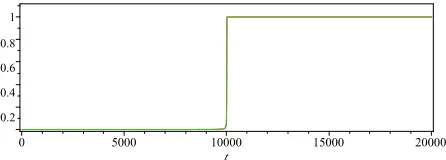
It is assumed that u(0) = δ and that 0 t 2 . This is a stiff differential equation for small values of the pa- rameter δbecause of the presence of a ramp at t1 .
We have solved this problem by using routines for transforming nonlinearities to Chebyshev spectral space and by formulating an equation of the form (5); see Ref. [1]. A strongly ramped solution with δ = 0.0001 is com- puted. We have imposed an accuracy of ε = 1.0 × 10⁻⁴ by
comparing the GWRM solution with the exact solution
1
exp
u t W a a t 1 , where a11 and
W is the Lambert W function. Both the computed and exact solutions are shown in Figure 2. At this accuracy, they are indistinguishable from each other.
Also, the smallness of δ makes the ramp very distinct and numerically difficult to resolve. Consequently, ex- plicit finite difference methods need extremely small time steps to solve the problem. An optimised Matlab solution uses implicit methods that reduces the computa- tional effort to about 100 time steps, taking a few sec- onds on a tabletop computer.
The GWRM solution uses 69 time domains and takes just about the same amount of computational time. The temporal domain length has been automatically adapted as follows. Since it holds that T tn
1, a useful accu- racy criterion is
aK aK
aK aK
, where anis the nth coefficient in the Chebyshev spectral expansion of u.
In performing the adaptive computation, a default of 10 time subdomains is assumed and K = 6 is used. If the accuracy criterion is satisfied, the subdomain length is doubled at the next domain, and if not it is halved. In the latter case, the calculation is repeated for the same sub- domain until the accuracy criterion is satisfied. This goes on as the calculation proceeds in time until near the end- point, where the subdomain length is adjusted to land exactly on the predefined upper time limit. Due to the stiffness of the problem, the subdomains are concentrated near t = 1.0 × 10⁴ where the subdomain length may be as
small as about 2 time units. The automatic extension of the subdomain length in smoother regions saves consid- erable computational time; at the end of the calculation the subdomain length is more than thousand time units.
1
0.8
0.6
0.4
[image:6.595.60.283.629.709.2]0.2
Figure 2. GWRM and exact solutions of Equation (17) for δ
= 0.0001.
5. Results
Accuracy and computational efficiency of two example problems will now be studied, employing the above dis- cussed three GWRM spatial subdomain methods. Also, the effect on convergence by use of the w method (Sec- tion 3.5) will be studied.
5.1. Burger Equation—Spatial Subdomains
The Burger Equation (6) is a fundamental hyperbolic- parabolic partial differential equation from fluid me- chanics, containing both convection and diffusion terms. Thus two separate time scales govern the time evolution of an initial state.
We showed in Section 2 that GWRM accuracy is com- parable to that of explicit and implicit schemes, for a similar number of floating operations. For high accuracy, that is at high mode numbers, it is of interest to deter- mine whether spatial subdomains may reduce the mem- ory requirements and the number of operations. Employ- ing the methods described earlier we compare the results with the analytical solution given in Ref. [1], using 50 terms of the expansion.
The results for Method I are displayed in Table 1 for a suitable selection of parameters. Initial and boundary conditions are those stated below Equation (6) and we have chosen = 0.01. By “Iter” is meant the number of iterations required, “Time” denotes the normalized time required to solve the GWRM system of coefficient Equations (5) including boundary conditions, “Memory” denotes normalized memory requirements and “Max error” is the maximum absolute error as compared to the exact solution. The maximum mode number L for sub- domains is obtained from the relation L10 Ns1. The root solver SIR is set so that it solves system (5) using Newton’s method, with start data given by the ini- tial condition. It is seen that convergence is rapid for all cases, even when 5 subdomains are employed. The pri- mary information from Table 1 is that although compu- tational time and memory requirements decrease when employing the relation L10 Ns1 for the spatial subdomain modes, accuracy is partially lost. Due to the shock-like structure of the solution near r = 1, many modes are needed for high resolution. We will return to this issue.
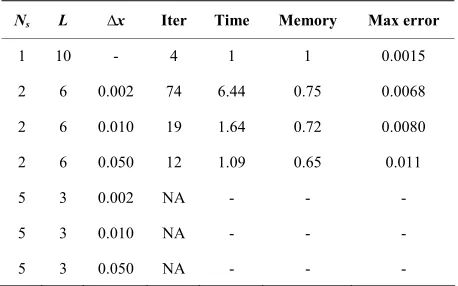
Next, the same problem is solved using Method II. The results are displayed in Table 2. Clearly, less memory is used than in Method I but more iterations are required, thus enhancing computational time. The convergence of all Ns = 5 cases was too slow to reach a SIR solver accu-
racy of 1.0 × 10⁻⁵ within 100 iterations. For the
conver-gent cases, the absolute error is essentially the same as for Method I.
Table 1. Method I solution of Burger’s equation.
Ns L ∆x Iter Time Memory Max error
1 10 - 4 1 1 0.0015
2 6 0.002 4 0.81 0.96 0.0060
2 6 0.010 4 0.74 0.87 0.0080
2 6 0.050 4 0.82 0.86 0.011
5 3 0.002 4 0.57 0.98 0.025
5 3 0.010 4 0.58 1.03 0.025
5 3 0.050 4 0.58 0.90 0.021
Table 2. Method II solution of Burger’s equation.
Ns L ∆x Iter Time Memory Max error
1 10 - 4 1 1 0.0015
2 6 0.002 74 6.44 0.75 0.0068
2 6 0.010 19 1.64 0.72 0.0080
2 6 0.050 12 1.09 0.65 0.011
5 3 0.002 NA - - -
5 3 0.010 NA - - -
5 3 0.050 NA - - -
method described in Section 3.5, using the weighting parameter w, can improve convergence of Method II. Results are shown in Table 3.
The values of w given indicate the values that result in the least number of iterations of Equation (5). We find that convergence can be improved using the w method, in particular for the case with several spatial subdomains. The w method is most effective for largex.
Finally, we return to the question how many spatial modes are required in each of several subdomains to ob- tain the same accuracy as that of the single domain for the Burger equation. Results are shown in Table 4, using Method II. It is seen that Method II offers a path to com- parable accuracy using less memory, at the expense of computational time.
For all cases considered, Method III converges slower than Method II; thus we do not report on any details of these calculations. The result is not surprising, since Method II can be regarded as a hybrid method in relation to Methods I and III in the sense that one subdomain boundary is instantaneously updated as the coefficients of each subdomain are iterated using Equation (5).
[image:7.595.309.536.102.205.2]Let us summarise the results from application of spa- tial subdomains. Regarding convergence, we conclude that Method I converges fast for all cases considered. Method II needs more iterations and does not converge at
Table 3. Method II solution of Burger’s equation.
Ns L ∆x Iter Time Memory Max error w
1 10 - 4 1 1 0.0015 -
2 6 0.050 11 1.02 0.65 0.011 0.9
5 3 0.002 99 2.71 0.67 0.024 0.9
5 3 0.010 49 1.31 0.61 0.025 0.6
5 3 0.050 66 1.74 0.63 0.021 0.1
Table 4. Method II solution of Burger’s equation, higher accuracy.
Ns L ∆x Iter Time Memory Max error w
1 10 - 4 1 1 0.0015 -
2 7 0.01 19 2.72 0.73 0.0021 1.0
5 5 0.01 26 3.29 0.73 0.0011 1.0
all for cases featuring many subdomains. Employing the
w parameter method, however, Method II convergence is obtained for nearly all cases. Method III generally fea- tures poorer convergence properties than Method II.
Accuracyis high for the single subdomain case, since the Burger equation features a shock near r = 1, where high spectral orders are needed for good resolution. Method II reaches the same accuracy both for the case of 2 and 5 subdomains when the order of the Chebyshev spectral expansion is 7 and 5, respectively. This shows that for shock-like problems, the order of the spectral expansions needed in each domain is higher than L Ns,
that is, the total number of degrees of freedom must be increased. For the same values of Ns and L, all methods
provide the same accuracy.
Computational memory requirements are the highest for Method I, since it involves a global solution where all Chebyshev coefficients are simultaneously interrelated at each iteration. Memory reductions by up to 40% were demonstrated for Method II. The reduced memory re- quirement is coupled to the size of the matrix equations corresponding to Equation (5), and for both Methods II and III a substantial increase in efficiency in the sense that the iteration computational time is reduced to a frac- tion of that of the single domain case. The number of iterations required are higher for Methods II and III, however, and the total computational time becomes com- parable to, or higher than, that of Method I.
[image:7.595.309.536.244.313.2] [image:7.595.58.287.267.410.2]5.2. Magnetohydrodynamic Equations—Spatial and Temporal Subdomains
We next turn to an advanced application of GWRM subdomain methods. The problem at hand is a plasma stability problem formulated as a system of coupled mag- netohydrodynamic (MHD) equations. The following set of equations govern the resistive MHD model:
0t
u
d
dt p
u j B
E u B j (18)
d 0
dt p
t
E B
0
B j
These macroscopic (fluid) plasma equations are the continuity and momentum equations, Ohm’s law (in- cluding resistivity) and the (adiabatic) energy equation followed by Faraday’s and (the displacement current free) Ampere’s law, respectively. Regarding notation, E and B
denote the plasma electric and magnetic fields respec- tively, uis the fluid velocity,jis the current density, p is the kinetic pressure, ρ is the mass density, η is the resis- tivity, Γ = 5/3 is the ratio of specific heats and μ0 is the
vacuum permeability. The MHD stability problem con- sists of a system of 14 nonlinear, coupled partial differ- ential equations. Boundary conditions corresponding to a perfectly conducting wall are provided from the require- ments that the radial components of the magnetic field and fluid velocity should vanish, and from the fact that the parallel components of the electric field at the wall should vanish. For further details, see Ref. [7].
A standard way of investigating plasma stability is by linearization of the above equations followed by Fourier decomposition in the azimuthal and axial directions (cir- cular cylindrical geometry is assumed here). All depen- dent quantities Q are considered as the sum of an equi- librium term Q0 and a small perturbation q, thus Q = Q0 +
q. Perturbations are assumed to be proportional to exp[i(mθ + kz)] where k and m are the axial and azi- muthal mode numbers respectively. For a given perturba- tion, stability is completely determined by the equilib- rium. An equilibrium is unstable if it features a time de- pendence exp(γt), where γis a positive number, and sta- ble (wavelike solution) if γ is imaginary.
The Equations (18), together with initial and boundary conditions, have been solved with the GWRM for a number of different equilibria. We here study the stabil-
ity of the z-pinch equilibrium B0θ= r, B0z = 0, p0 = 1 – r2,
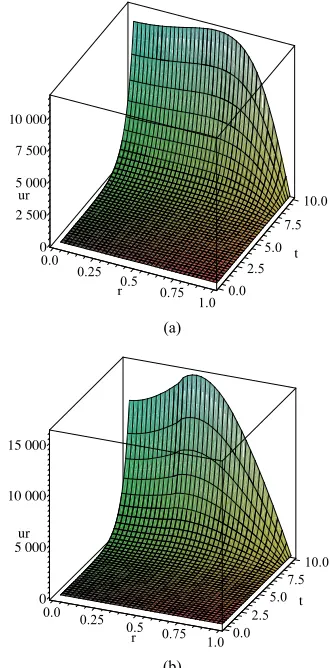
where r denotes the radial coordinate. Also, it is assumed that ρ = constant and that η = 0. The effect of an initial perturbation (m,k) = (1,10) is followed for a sufficiently long time that a dependence of the form exp(γt) has time to develop. The solution to this problem is known from computations using other methods. We have applied both Methods I and II to this problem. In Figure 3(a) is dis- played the evolution in time and space of the radial, per- turbed fluid velocity, using Method I with 5 temporal subdomains (Nt = 5) and a single spatial domain, using
orders K = 5 and L = 10 and a time domain reaching to 10 normalized (Alfvén time) units. The equilibrium was unstable for this perturbation. Obtained growth rate is γ= 1.03, to be compared with the correct result γ= 1.04.
In Figure 3(b) the same method is used for 5 temporal domains, but now for 3 spatial domains using x = 0.05 and with orders K = 4 and L = 3. The obtained growth rate was γ= 1.06. In comparison with the single subdomain case, 81% of the computational time was
0.0
0.0 0.25 2.5
0.5 0.75
7.5 10.0
5.0
1.0 (a)
0.0
0.0 0.25 2.5
0.75
7.5 10.0
5.0
1.0 r
0.5
(b)
Figure 3. (a) GWRM single spatial domain solution of an MHD stability problem formulated using Equations (18), showing radial velocity ur . Method I was used with Ns = 1,
Nt = 5, K = 5, L = 10; (b) GWRM solution as in Figure 3(a),
[image:8.595.337.502.337.671.2]needed, with a memory requirement of 82%.
It should be noted that relatively high values of K
would be required for this case for sufficient accuracy if a single temporal domain were used. This is due to the exponential dependence of the solution, which requires high order spectral resolution. Using orders K = 5 and L
= 10, the value γ = 0.73 was found, and at sufficiently high values of K, the internal Maple memory (on a ta- ble-top computer, order 250 Mb) was insufficient.
Application of Method II was unsuccessful; conver- gence could only be obtained for impractical subdomain time intervals (<0.1 time units). This being in spite of application of the w method, and of various techniques to expedite convergence.
Although this is a linear problem in the unknown vari- ables, iterations are needed to satisfy the internal bound- ary conditions, since the subdomains are partially de- coupled. Thus the SIR solver was fruitlessly tried with various values of its convergence parameters.
Likewise, Method III was unsuccessful in handling this complex problem. The reason is found in that, where- as Method I retains the acausality of the GWRM, Meth-ods II and III introduces independent spatial regions that become coupled to the length of the time interval through a CFL-like criterion. Thus, time domains must be kept small for convergence.
6. Discussion
The GWRM convergence of problems with a single spa- tial domain is often adequate, but memory requirements may be large when many spatial modes are employed for obtaining high accuracy. This is mainly due to that a ma- trix equation for all GWRM coefficients need be solved at each iteration by a root solver, a procedure that scales as L3 operations.
By employing a set of spatial subdomains, memory requirements may be reduced. Spatial subdomains are here implemented in three different ways. In Method I, the internal boundary conditions of all subdomains are simultaneously solved for at each iteration; see Equation (12). This still requires the use of a single, global matrix equation for the GWRM coefficients. In Method II, the subdomains are decoupled so that the connecting internal boundary conditions are updated consecutively at each iteration; see Equation (13). Finally, in Method III the internal boundary conditions are updated jointly at the end of each iteration; see Equation (14). It is in the two latter cases that the main potential for reduction of mem- ory requirements exists, and thus of efficiency in solving the GWRM matrix equation. If L Ns spectral modes are employed at each subdomain, N L Ns
s
3 opera- tions would be performed for coefficient matrix solution at each iteration. This represents a gain in efficiency by a factor 2s
N . We show that, in order to retain accuracy,
more modes are needed in each subdomain, so the gain in efficiency is somewhat reduced for the same accuracy.
Usually Methods II and III require more iterations than Method I. The cause for this is that the information of the internal boundary conditions is changing rapidly. By in- troduction of a weighting parameter w, we have shown that by controlling the rate at which information enters the internal boundary conditions, otherwise numerically unstable cases may be stabilized. For nearly all cases studied in this work, Method II has turned out to be pref- erable to Method III.
All three methods have been employed to solve the example magnetohydrodynamic stability problem. This is an advanced problem, since it involves the simultane- ous solution of 14 coupled partial differential equations, with a rapidly (exponentially) growing solution. Method I was successfully applied, both for single and multiple spatial subdomains and using multiple temporal domains. Whereas Methods II and III were applicable to the Bur- ger example, they were however ineffective for this case in the sense that unrealistically small time domains were essential for convergence. We speculate that this behav- iour is related to the causal behaviour that is imposed by partially decoupling the subdomains (except for bound- ary points) from each other. Spatial decoupling implies a CFL-like condition to be satisfied. For Ns = 3, it would
thus seem that the time interval may not exceed the ratio of characteristic length (1/3 in normalized units) to characteristic speed (1 in normalized units), thus being approximately equal to 1/3 time units. The w method was shown to add increased stability, but convergence re- mained unrealistically slow for all values of w. Turning to the Burger case, the explicit finite difference stability criterion is approximately [1]
t
22
s
t L N
= 2
for Ns= 5. This may explain the need for the w method
here.
We have employed the SIR root solver [5], with pa- rameters set to make it identical to Newton’s method, for inversion of the GWRM matrices of this work. Starting points for the iterations was chosen to be the initial con- ditions of the problems. It should be mentioned that fur- ther optimization of convergence may be aquired by ad- justing the parameters of SIR.
Temporal GWRM subdomains were studied for first order contact applications since the GWRM equations are formulated as a set of first order partial differential equations, and are easy to implement. Nonetheless, sec- ond or higher order contact in time should be considered in future work to improve convergence for advanced problems.
7. Conclusions
REFERENCES
the generalized weighted spectral method (GWRM [1]) have been demonstrated. In this method, also the time domain is given a spectral representation in terms of Chebyshev polynomials.
[1] J. Scheffel, “A Spectral Method in Time for Initial-Value Problems,” American Journal of Computational Mathe- matics, 2012.
Two example applications have been used; the nonlin- ear Burger equation and a system of 14 coupled magne- tohydrodynamic equations. Three different methods em- ploying spatial subdomains were introduced. Whereas the first involved simultaneous solution of all, global Chebyshev coefficients, the other two have the potential of being computationally less demanding because their corresponding Chebyshev coefficient matrix equations are iterated separately at each iteration step.
[2] J. C. Mason and D. C. Handscomb, “Chebyshev Polyno- mials,” Chapman and Hall/CRC,New York, 2003. [3] R. Peyret, “Spectral Methods for Incompressible Viscous
Flow,” Springer-Verlag, Berlin, 2002.
[4] C. Canuto, M. Y. Hussaini, A. Quarteroni and T. A. Zang, “Spectral Methods, Evolution to Complex Geometries and Applications to Fluid Dynamics,” Springer-Verlag, Berlin, 2007.
[5] J. Scheffel and C. Håkansson, “Solution of Systems of Non-Linear Equations—A Semi-Implicit Approach,” Ap- plied Numerical Mathematics, Vol. 59, No. 10, 2009, pp. 2430-2443. doi:10.1016/j.apnum.2009.05.002
It was found that temporal subdomains are essential for efficiency for both high accuracy and extended time computations. Solving a stiff ordinary differential equa- tion it was shown that an adaptive GWRM time domain formulation compared well with commercial software both regarding efficiency and accuracy.
[6] W. H. Press, S. A. Teukolsky, W. T. Vetterling and B. P. Flannery, “Numerical Recipes,” Cambridge University Press, Cambridge, 1992.
[7] J. Wesson, “Tokamaks,” 2nd Edition, Clarendon Press, Oxford, 1997.
8. Acknowledgements
We gratefully acknowledge helpful discussions with Dr. Thomas Johnson.
Appendix
In this Appendix, we derive a criterion for the minimum number H of contact points required at the internal boundaries in order to determine, and not underdeter- mine, an approximate solution that uses the full informa- tion from both the system of differential equations and from the external boundary conditions. H will be a func- tion of the spatial order of the system of differential equations s, the number of spatial subdomains Ns and
the number of variables V. The analysis is restricted to a single spatial dimension but can easily be generalized to higher dimensions. The criterion can also be applied to temporal domains. We assume that the approximate so- lution can be expressed as a truncated expansion in some basis, for example Chebyshev polynomials.
The total number of unknown coefficients of the sys- tem that must be given information is s s, since the
solution for each variable in each subdomain needs in- formation in the form of
VN
s
relations to be completely determined. The differential equations will provide for information to solve for all but s
of these in each subdomain. Thus, in total, the differential equations will provide sVNs sNs s
V 1 s equations. This gives the total number of internal boundary conditionsthat are needed;
N
1
1
sVNs s V Ns s s Ns
where contributions from s externally given boundary
conditions have been accounted for.
The s external boundary conditions may be applied
on any variable, at any external boundary and for any order less than s. The two outermost spatial subdo-
mains related to each variable also have contact with the inner subdomains. These points add upp to HV in total. The desired criterion can now be derived from the re- quirement that the average number of internal contact points
s
s 1
s
should be less or equalthan H. Solving this equation, there results the criterion
N HV VN
s
H V
(A1)
The criterion is independent of , as it should be. For “double handshaking”, that is for H = 2, we see that condition (A1) is easily satisfied for the magnetohydro- dynamics problem of Section 5.2, for which
Ns
s
= 6 and