Learning to make a specific action in response to a stimulus that does not specify the required response is termed arbitrary visuomotor association learning. This learning requires substantial cognitive flexibility, since the meaningful relationship between stimulus and re-sponse must be learned (Wise & Murray, 1999). Such learning is subserved by a brain network that includes the prefrontal cortex, the hippocampal formation, basal ganglia, and premotor regions (Wise & Murray, 2000), in addition to the visual cortices. We have previously found (Roche & O’Mara, 2003) that this learning follows the tra-ditional power curve and that exposure to an explicit train-ing block in which the S–R association was learned led to
faster response times (RTs) in comparison with untrained controls in a subsequent visual discrimination task. These behavioral effects were mirrored by event-related poten-tial (ERP) component changes, particularly larger P300 amplitudes after training; P300 amplitude is thought to re-flect attention, memory, and other cognitive functions (for a review, see Knight, 1990). Considerable work has been carried out on the role of attentional deployment during explicit memory as measured by recall or recognition (see, e.g., Szymanski & MacLeod, 1996), implicit memory as measured by stem or fragment completion, or location priming (e.g., Musen & Viola, 2000), sensorimo-tor learning (e.g., golf putting; Beilock & Carr, 2001), and
513 Copyright 2007 Psychonomic Society, Inc.
Concurrent task performance enhances
low-level visuomotor learning
RichaRd a. P. Roche
University of Dublin, Trinity College, Dublin, Ireland and National University of Ireland, Maynooth, Co. Kildare, Ireland
Seán comminS
National University of Ireland, Maynooth, Co. Kildare, Ireland
FRanciS agnew
University of Dublin, Trinity College, Dublin, Ireland
SaRah caSSidy
National University of Ireland, Maynooth, Co. Kildare, Ireland
KRiStin coRaPi, SandRa LeibbRand, Zoë LiPSon, Jonathan RicKaRd, and Jean SoRohan University of Dublin, Trinity College, Dublin, Ireland
ciaRa wynne
National University of Ireland, Maynooth, Co. Kildare, Ireland and
Shane m. o’maRa
University of Dublin, Trinity College, Dublin, Ireland
Visuomotor association learning involves learning to make a motor response to an arbitrary visual stimulus. This learning is essential for visual search and discrimination performance and is reliant upon a well-defined neural circuit in the brain that includes the prefrontal cortex and the hippocampal formation. In the present study, we investigated the possible role of attentional processes during such learning using dual-task interfer-ence. A motor, verbal, or perceptual concurrent task was performed during the learning/training block of a simple visual discrimination task. Contrary to expectation, the dual-task groups showed improved learning and learning-dependent performance compared with untrained control and non-dual-task trained groups. A second experiment revealed that this effect did not appear to be due to increased arousal level; the inclusion of alerting tones during learning did not result in facilitation. These findings suggest that the engagement of attention, but not arousal, during the acquisition of a visuomotor association can facilitate this learning and its expression.
associative cognitive tasks (e.g., Logan & Klapp, 1991). In many of these studies, dual-task conditions have been employed to manipulate attentional deployment during training. However, relatively little work has been carried out on the interaction of arbitrary visuomotor learning and attentional systems or on the nature of such interactions. In the present study, we investigated the role of attention in learning: We hypothesized that the allocation of attention to the stimulus during visuomotor learning is at least par-tially involved in determining the strength of that learning. This prediction is consistent with the established finding (reviewed in Wulf & Prinz, 2001) that directing attention to the effects of movements during training is beneficial for subsequent performance.
Dual-task paradigms reveal the limitations of human information-processing systems by combining two con-current tasks to produce performance deficits (Hampson, 1989). The degree of impairment is dependent on the combined attentional demands of the two tasks: A con-current task requiring greater attention should produce more severe disruption than one low in attentional de-mands. Some theorists (e.g., Baddeley, 1986; Eysenck, 1982) explain dual-task disruption in terms of a central attention processor that deploys limited resources to sub-ordinate processing mechanisms that execute the tasks. This is termed the resource model (Parasuraman, 1998; Wickens & Kessel, 1980), and this view has been applied to attention and vigilance in the past (Matthews & Davies, 2001; Smit, Eling, & Coenen, 2004; Warm & Dember, 1998). The dual-task methodology has been used exten-sively to investigate the interaction between task diffi-culty and resource allocation in sustained attention and vigilance tasks (see Matthews & Davies, 2001; Matthews, Davies, Westerman, & Stammers, 2000). The locus of this executive processor of resources is likely to be frontal—as Moscovitch (1994) noted—after observing dual-task defi-cits on tasks that are frontally dependent, but not on tasks that draw on the hippocampus/medial temporal lobe. If visuomotor learning recruits the central executive, then withdrawing attention from association learning because of a dual task will impair acquisition and expression of the learning; the greater the attentional demands of the concurrent task, the greater the disruption will be. Corr (2003) showed that procedural learning of spatial loca-tion in a pointing task was disrupted to differing degrees by two types of dual task (mental arithmetic or nonsense syllable counting), whereas Frensch, Wenke, and Rünger (1999) also found dual-task disruption when the concur-rent task (tone counting) was performed during training on a serial reaction task. However, Jiménez and Méndez (1999) found no effect of a concurrent counting task on learning in an SRT task that involved attending and re-sponding to locations; these studies suggest that the na-ture of the secondary task may be of vital significance in determining the effects on performance. For this rea-son, a number of different dual tasks were used in the fol-lowing experiments. Importantly, Schubert et al. (1998) found that either of the two motor dual tasks resulted in impaired performance on an auditory classification task, which was accompanied by reduced P3b amplitude—a
component known to be affected by dual-task conditions. The finding from our previous study (Roche & O’Mara, 2003)—that the present task seems to be indexed by the P3b component—suggests that the inclusion of a concur-rent task is likely to have an effect on this learning. How-ever, unlike standard dual-task experiments in which the concurrent task is performed during an ongoing cognitive task, in the present experiment, we required participants to perform the dual task during the repetition learning of the S–R association.
We attempted to affect visuomotor response acquisi-tion and expression by manipulating attenacquisi-tion during the acquisition of S–R pair learning. In Experiment 1, we ma-nipulated attentional deployment to the association using a concurrent task, with the goal of disrupting the learning and its subsequent expression. The degree of attentional engagement in the concurrent task was also varied. We predicted that within motor, perceptual, and verbal dual-task conditions, high attentional deployment dual-tasks will produce more profound disruption of learning than low attentional tasks, where learning of the S–R association is indexed by performance on the visual discrimination task. Failure of the dual task to disrupt learning may indi-cate that this learning task does not rely heavily on frontal areas and perhaps relies on other portions of the circuit, such as hippocampus or striatum.
ExPERimEnt 1
method Participants
The participants were 64 Trinity College undergraduate students with an age range of 18 to 23 years (M5 20.3). All participants were right-handed, had normal or corrected-to-normal vision, and were randomly assigned to one of eight experimental conditions (n5 8 for each condition).
materials
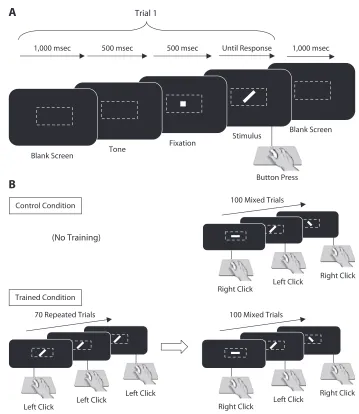
Visual stimuli. The stimuli (see Roche, Commins, & O’Mara, 2004; Roche & O’Mara, 2003) were line segments presented in white on a black screen; each was 0.93º of arc long and 0.13º of arc wide and was presented horizontally, vertically, or diagonally at a 45º angle (forward slash or backslash) at the center of the monitor screen. Each trial was preceded by an auditory orienting tone of 500 msec duration and a central fixation point that remained on screen for 500 msec; the orienting tone and fixation point were always present for both training and discrimination aspects of the task in Experi-ments 1 and 2. The fixation point disappeared and the stimulus was presented (the ISI between fixation offset and stimulus onset was one screen refresh interval of 75 Hz). Visual stimuli remained on the screen until a button-press response was made; the screen remained blank for 1,000 msec before the next trial. Stimuli were generated using a DOS-based TurboPascal program (Version 7) on a Dell PC, which automatically recorded RTs and error rates. A color monitor was used to display the stimuli, and the participants used a standard PC computer mouse to make their responses (Figure 1).
Procedure
and working memory capacity, respectively (Wickens, 1984). Each of these tasks could also be manipulated to require relatively high or low levels of attentional deployment, by varying task demands.
Control group (untrained).A mixture of stimuli (horizontal, vertical, forward slash, and backslash) was presented on the screen; participants monitored the stimuli for a predefined target (forward slash) and responded by pressing the left mouse button with the right index finger. The right mouse button was to be pressed with the middle finger to any of the other stimuli (unpublished pilot data from this laboratory showed that reversing the assignments of button/finger-press responses to target–distractor stimuli resulted in no behavioral effect on accuracy or RTs; therefore, the index finger/left mouse buttonpress was always used for target stimuli in these studies). Participants were instructed to give equal emphasis to speed and accuracy of response. The target was present on 50% of trials, and stimuli remained on the screen until the participant responded. A trial block consisted of 100 trials. Each participant performed one discrimination block.
normally trained group.This group received a training block prior to completion of the same visual discrimination task as the
con-trol group. During the training block, the participant responded to a block of 70 presentations of the forward slash stimulus (later desig-nated the target), using a right index finger press to the left mouse but-ton. This was followed by a short rest period (3 to 5 min), which was followed by one block of the visual discrimination task (100 trials).
motor Dual task 1: Slow tapping. All dual-task participants were presented with the training and visual discrimination blocks, as per the control and normally trained groups, with an additional task added during the training block. Participants were instructed to give equal emphasis to both tasks in all dual-task groups. Motor dual-task participants were required to tap their right foot in time with a met-ronome while they completed the training block. The low attentional demand group was required to tap at a rate of 60 beats per minute (“largetto”). Performance was monitored by the experimenter, who instructed the participant to correct his or her behavior if the tapping was not in time with the metronome. Identical to all dual-task condi-tions, this training block again consisted of 70 trials.
motor Dual task 2: Fast tapping.Participants in the high attentional demand motor group were required to tap their feet at the faster rate of 160 beats per minute (“vivace”) during the training Tone
Blank Screen
Fixation Stimulus
Blank Screen
Trial 1
500 msec
1,000 msec 500 msec Until Response 1,000 msec
Button Press
A
B
Control Condition 100 Mixed Trials
(No Training)
Left Click Right Click
Right Click
Trained Condition
100 Mixed Trials 70 Repeated Trials
Left Click Right Click
Right Click Left Click
Left Click
Left Click
[image:3.576.118.477.77.491.2]block, and then they completed the visual discrimination task (see Liefooghe, Vandierendonck, Muyllaert, Verbruggen, & Vanneste, 2005, for a similar use of foot-tapping conditions).
Verbal Dual task 1: nonsense syllable production.The low attentional demand group repeated the nonsense word blah at a rate of once per second while they engaged in the training block. The ex-perimenter instructed the participant to adjust his or her rate if it devi-ated from 1/sec; the speaking rate was controlled by a metronome.
Verbal Dual task 2: Random number generation.The high attentional demand group for the verbal dual task had to generate random numbers (from 1 to 9) at a rate of 1/sec during the train-ing block. The experimenter monitored and corrected participants’ speech rates. The additional constraint that the numbers generated had to be in a random sequence added a working memory com-ponent to this task, suggesting increased attentional demands over nonsense syllable production (see De Rammelaere, Stuyven, & Vandierendonck, 1999).
Perceptual (and working memory) Dual task 1: Asynchro-nous flashes.The perceptual dual-task conditions required the par-ticipant to respond to the stimulus on the screen during the training block and count the number of times a light flashed distal to the stimulus, giving this condition an additional working memory as-pect. The light was placed near the periphery of vision, 200 cm from the participant in the upper left quadrant of vision (elevated at a 45º angle to the horizontal) such that an eye movement was not neces-sary to identify a flash. In the low attentional engagement group, the
flashes occurred while the training stimulus was not on screen (i.e., during the blank screen, tone, or fixation point), allowing attention to be switched between the screen and the flash. These were termed asynchronous flashes. At the end of the training block, participants were asked to report how many flashes (n 5 50) they had observed. This task resulted in the occurrence of a flash on average every 3.5 sec; this slower rate of presentation was used in the motor or articulatory conditions, since it has been shown that the presentation of infrequent stimuli is found to be most effective in engaging atten-tion (see the sustained attenatten-tion to response task, SART; Robertson, Manly, Andrade, Baddeley, & Yiend, 1997).
Perceptual (and working memory) Dual task 2: Synchro-nous flashes.In the high attention condition, the light flashes oc-curred in synchrony with the appearance of the training stimulus on the screen; thus, participants had to attend to the light flash and the stimulus on screen at the same time, and they also had to report how many flashes (n 5 50) they had observed at the end of the block. Because the flashes were detectable by peripheral vision, no eye movement was necessary, and attention could be divided between the stimulus and the flash simultaneously.
Results
Fixed- Versus Variable-iSi Conditions
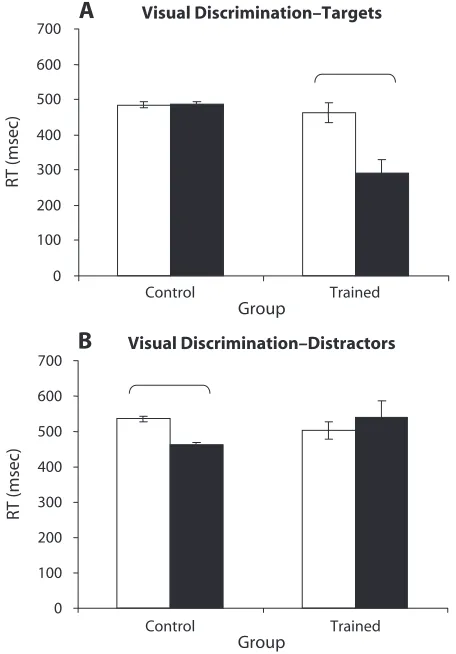
In order to ensure that training effects could not be at-tributed to a rhythmic responding pattern that was induced by the fixed interstimulus interval (ISI), pilot data were collected for the normally trained and untrained control conditions with a variable ISI condition. In these groups, the ISI varied randomly among 500, 750, 1,000, and 1,250 msec. These variable ISI groups were compared with the fixed ISI normally trained and untrained control groups for Experiment 1. Figure 2 shows the comparison of RTs for fixed and variable ISI conditions for normal training and untrained/control groups. For both targets and distractors, minimal differences were observed, and where differences were found (e.g., for trained targets), they indicated an enhanced rather than a diminished train-ing effect in the variable condition. Target RTs were sig-nificantly shorter in the trained conditions for variable over fixed ISI (Tukey, p . .01). Therefore, rather than being the result of a rhythmic responding strategy, the training effects reported in this experiment may actually be a conservative estimate of the possible training effects that are due to the fixed ISI.
Fixed-iSi Dual-task Conditions
Performance during training showed that all tasks were performed with a high level of accuracy (mean absolute errors 5 4.13% 6 0.41 SEM; control, 4%; trained, 3%; Motor 1, 4%; Motor 2, 6%; Verbal 1, 3%; Verbal 2, 6%; Perceptual 1, 3%; Perceptual 2, 4%). RTs for incorrect tri-als were removed from RT analyses. These miss rates did not differ significantly across conditions.
training Blocks
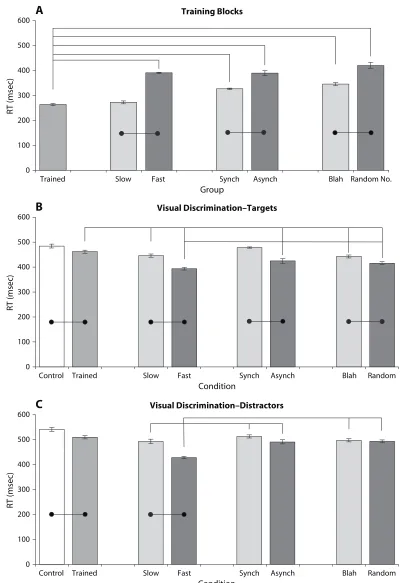
Figure 3A shows mean RTs to the forward slash stimulus during the training block for the normally trained group and each of the experimental groups. In general, significantly longer RTs were obtained for fast versus slow tapping, asynchronous versus synchronous flashes, and random numbers versus nonsense syllables; the shortest RT was recorded for normal training (264 6 4.6 msec). A series
0 100 200 300 400 500 600 700
Control Trained
A
Visual Discrimination–TargetsGroup
RT (msec
)
0 100 200 300 400 500 600 700
Control Trained
B
Visual Discrimination–DistractorsGroup
[image:4.576.43.271.84.411.2]RT (msec)
0 100 200 300 400 500 600
RT (msec)
Training Blocks
Trained Slow Fast Synch Asynch Blah Random No.
Group
A
0 100 200 300 400 500 600
RT (msec)
Visual Discrimination–Targets
Control Trained Slow Fast Synch Asynch Blah Random
Condition
B
0 100 200 300 400 500 600
RT (msec)
Visual Discrimination–Distractors
Control Trained Slow Fast Synch Asynch Blah Random
Condition
C
[image:5.576.98.501.79.662.2]of ANOVAs revealed significant overall RT differences for each of the groups; in the motor dual task, RTs were shorter for slow tapping (273 6 5.6 msec) than for fast tapping [391 6 1.2 msec; F(1,14) 5 81.39, p , .001]; the perceptual dual task produced shorter RTs to synchronous (330 6 2.6 msec) than to asynchronous flashes [350 6 9.5; F(1,14) 5 23.59, p , .001]; for verbal, shorter RTs were found for nonsense/blah (347 6 6.1 msec) than for random number generation [422 6 12.3 msec; F(1,14) 5 89.10, p , .001]. Tukey post hoc tests showed that all groups differed significantly from each other with one exception: The normal training and slow tapping groups in the motor condition did not differ.
Visual Discrimination Blocks
With the exception of synchronous flashes, all dual-task RTs were shorter than those of normal training over-all. This pattern was maintained when the responses were separated into RTs for target present and distractor/target-absent trials (Figures 3B and 3C), again with the excep-tion of the synchronous flashes group. In all cases, RTs to target-present trials were shorter than those of target-absent trials. All dual-task target RTs were significantly shorter than the normally trained target RTs [motor, F(1,14) 5 31.26, p , .0001; perceptual, F(1,14) 5 6.34, p , .0001; verbal, F(1,14) 5 30.74, p , .0001]. Distractor RTs in the dual-task groups tended not to differ from those of normally trained or from each other except for fast motor tapping, which was shorter than the others. All other dif-ferences were significant at the .05 level, as was revealed by Tukey post hoc tests.
In summary, the data from Experiment 1 reveal the fol-lowing general pattern. (1) All training conditions (with the exception of synchronous flashes) resulted in faster RTs on discrimination than the no-training control con-dition. (2) All dual-task conditions (except synchronous flashes) produced faster responding during discrimination than normal (single-task) training.
Discussion
In Experiment 1, we attempted to induce disruption of arbitrary visuomotor learning by means of dual-task interference during training; contrary to expectations, fa-cilitation of performance of a subsequent related task was found rather than disruption. With the exception of the synchronous flashes condition, the dual-task training regi-mens used here produced better transfer to the discrimi-nation task than did the normal (single-task) training or no-training control. It appears, therefore, that rather than reducing the attentional deployment to the target stimulus or the learning, the concurrent task may have increased the amount of attentional resources directed toward the stimulus (indexed by longer RTs during training), re-sulting in faster execution of the S–R association during discrimination, compared with those who were normally trained or not trained at all.
Although this effect may be attributable to increased attentional demands in the dual-task groups, it is also pos-sible that the additional task demands in the dual-task
con-ditions resulted in elevated arousal level and that a more generalized increase in physiologic response is responsi-ble for the observed training gains. Experiment 2 attempts to address this question.
ExPERimEnt 2
Experiment 1 reports a training effect that is enhanced by most of the dual-task conditions used here. One cannot assert with confidence, however, that this effect can be attributed to attentional factors, since arousal level may have also been automatically increased as task difficulty was increased. The role of arousal level was therefore ad-dressed in Experiment 2 by including three conditions in which arousal was increased by an auditory tone that was presented either phasically or tonically during training. Previous research has demonstrated the eliciting effect of auditory tones on physiological arousal as measured by behavioral performance and skin response (O’Connell, Belgrove, Dockree, & Robertson, 2004). We therefore presented phasic tones at two densities—low-density pha-sic, wherein a set of 18 random (phasic) auditory tones was presented during the 70-trial training block, and high-density phasic, in which a more densely spaced set of phasic tones (50 tones per 70-trial training block) was presented during training. The low-density condition was similar in methodology to the O’Connell et al. study in which infrequent/sparsely presented auditory tones were presented in order to elevate physiological arousal levels. The high-density condition was included in order to mir-ror the number of stimulus events occurring during the training block as was present in Experiment 1. In addi-tion, a third condiaddi-tion, tonic, involved an auditory tone being presented continuously throughout the training block. We predicted that increasing arousal during train-ing will facilitate acquisition and expression of learntrain-ing and that greater arousal-mediated effects will be evident in the low-density phasic condition compared with the high-density phasic condition.
method Participants
An additional sample of 40 participants was drawn from the same participant pool as that of Experiment 1. Participants were randomly assigned to one of five conditions (n5 8 in each condition). materials
The tasks were the same as those used in Experiment 1 and were presented in the same way. Alerting stimuli were presented using a tape recorder and consisted of a ringing tone played either randomly (phasic) or continuously (tonic; see the following).
Procedure
Separate control and normally trained groups were collected for the manipulation of arousal in order to attempt to replicate the train-ing effect that was observed in Experiment 1. To investigate the arousal hypothesis, three additional groups in which arousal level was varied were tested.
was a persistent ringing tone of 11 kbps, 88 Hz and was presented from a tape recorder placed 80 cm from the participant at a volume level of 78 dB. The visual discrimination block was then presented in the absence of any alerting tones.
Arousal Group 2: Low-density phasic alerting.The low-density phasic alerting group was identical to the tonic, except that the tone used was discrete, of 300 msec duration, and occurred ran-domly 18 times (approximately 25% of trials—again, an infrequent presentation of a stimulus was used, since it has been shown previ-ously to be effective at eliciting arousal effects; O’Connell et al., 2004) during the 70-trial block. The tone, volume level, and method of presentation were the same as those used in the tonic condition. Again, the discrimination block followed.
Arousal Group 3: High-density phasic alerting.The density phasic alerting group was identical to the low-density group, except that the tone that was used occurred randomly 50 times (in order to be comparable to the number of stimulus events occur-ring duoccur-ring the training blocks in the dual-task conditions of Ex-periment 1) during the 70 trial block. The tone, volume level, and method of presentation were the same as those used in the tonic condition. Once again, the discrimination block followed.
Results
Fixed-iSi Versus Variable-iSi Conditions
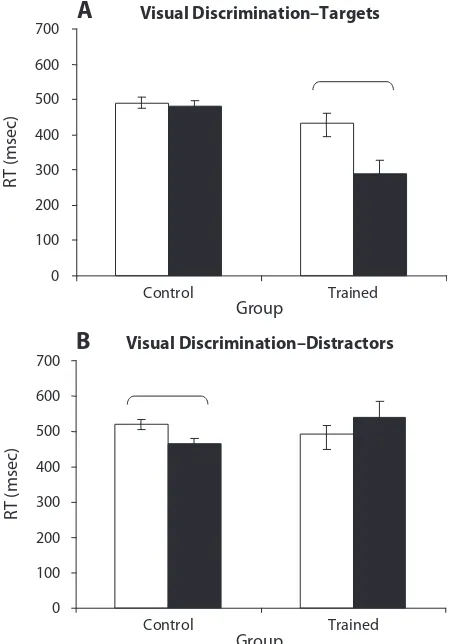
Identical to Experiment 1, pilot data were collected for the normally trained and untrained control conditions with a variable ISI condition in order to ensure that training effects could not be attributed to a rhythmic responding pattern that was induced by the fixed ISI. Again, the ISI varied randomly among 500, 750, 1,000, and 1,250 msec. These variable ISI groups were compared with the fixed ISI normally trained and untrained control groups for Experiment 2. Figure 4 shows the comparison of RTs for fixed- and variable-ISI conditions for normal training and untrained/control groups for Experiment 2. For both tar-gets and distractors, minimal differences were observed, and where differences were found (e.g., for trained tar-gets), they indicated an enhanced rather than diminished training effect in the variable condition. Identical to Ex-periment 1, target RTs were significantly shorter in the trained conditions for variable than for fixed ISI (Tukey,
p . .01). Therefore, it again appears that the training ef-fects reported in this experiment may also be a conserva-tive estimate of the possible training effects elicited by the fixed-ISI conditions.
tonic Versus Phasic noise Conditions
training blocks.Shorter mean RTs were found for the normal training block (250.7 6 7.3 msec) than for training with random noise (295.2 6 13.1 msec) and for training with continuous noise (298.7 6 15.4 msec) [F(3,28) 5 4.723, p 5 .009]. The normal training block RT differed significantly from both noise conditions, but the random and continuous noise conditions did not differ from each other.
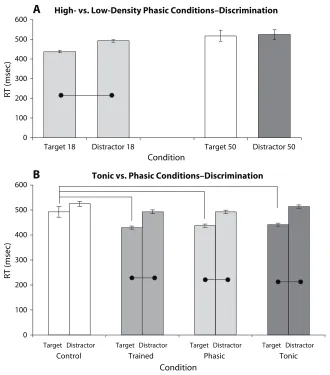
Visual discrimination blocks: High- versus low- density phasic alerting.High- and low-density phasic conditions were first compared in order to ascertain which of the two-tone densities was more effective at eliciting behavioral facilitation of performance that was poten-tially attributable to elevations in physiologic arousal level (Figure 5A). The results showed slower RTs to both
tar-gets (518.26 6 29.15 msec) and distractors (523.29 6 26.66 msec) in the high-density condition (“Target 50” and “Distractor 50”) than in the low-density condi-tion (“Target 18” and “Distractor 18”) (targets, 437.2 6 6.5 msec; distractors, 492.3 6 6.4 msec). Furthermore, there was no significant difference between RTs to targets and distractors in the high-density condition [F(1,7) 5 0.069, p 5 .798]. It would therefore appear that present-ing a larger number of sporadic tones durpresent-ing the learnpresent-ing block leads to decreased rather than increased levels of physiological arousal and alerting, as indexed by behavior. This may possibly be due to faster habituation to the tones if they are presented more frequently, as compared with the 18-tones condition. Furthermore, participants in the 50-tones condition did not show a difference in accuracy of performance, reporting only 4% errors compared with 6% in the 18-tones condition.
The low-density (18-tones) condition may therefore have come closer to achieving the desired elevation of physiologic arousal than the high-density (50-tones) ver-sion. It may be the case that more infrequent stimuli are more effective than a greater density of alerting tones
dur-0 100 200 300 400 500 600 700
Control Trained
A
Visual Discrimination–TargetsGroup
RT (msec
)
0 100 200 300 400 500 600 700
Control Trained
B
Visual Discrimination–DistractorsGroup
[image:7.576.308.534.84.406.2]RT (msec)
ing the learning block. As such, the low-density condition may provide a more valid attempt to investigate the effects of arousal than the high-density condition; therefore, the remaining analyses used only the low-density condition, given that it was found to yield more comparable effects to the dual-task conditions in Experiment 1, despite the lack of parity in event density.
Visual discrimination blocks: tonic versus phasic alerting. Error rates across conditions were low: 6% for the control group, 5% for normally trained, 6% for ran-dom noise, and 5% for continuous noise. RTs for incor-rect trials were again removed from RT analyses. Across all groups, mean RTs for targets were shorter for targets than for distractors [F(3,28) 5 13.22, p 5 .0001]. Tukey post hoc tests showed that this difference was significant (p ,.05) for normally trained (target, 429.3 6 6.0 msec; distractor, 492.4 6 7.7 msec), random noise (target, 437.2 6 6.5 msec; distractor, 492.3 6 6.4 msec), and continuous noise (target, 441.2 6 6.1 msec; distractor, 513.5 6 6.5 msec), but not the control group (target, 492.6 6 21.7 msec; distractor, 524.7 6 9.7 msec). RTs
to distractors did not differ between any groups. RTs to targets in the three trained conditions were significantly shorter than target RTs in the control group (Figure 5B).
GEnERAL DiSCuSSion
The provision of a concurrent task during the training of an S–R pairing resulted in speeded responding to that pairing in the discrimination task that followed. This effect does not appear attributable to generalized increases in physiological arousal that were effected by the presence of the dual task; thus, they may be learning specific. The lack of difference between the arousal groups raises the possi-bility that this task may not have successfully elicited the desired effect of elevated arousal; this is unlikely, however, since the comparison of the high- and low-density condi-tions indicates that this less dense tone rate (18 during the 70-trial block) elicits greater arousal effects than does the condition in which tone density equals the frequency of dual-task stimulus events in Experiment 1 (50 during the 70-trial block). As such, we feel confident in asserting that 0
100 200 300 400 500 600
RT (msec)
Distractor
Target Target Distractor Target Distractor Target Distractor
Control Trained Phasic Tonic
Condition
Tonic vs. Phasic Conditions–Discrimination 0
100 200 300 400 500 600
Target 18 Distractor 18 Target 50 Distractor 50
RT (msec)
Condition
A
B
[image:8.576.113.443.80.455.2]High- vs. Low-Density Phasic Conditions–Discrimination
the attempt to manipulate arousal in Experiment 2 was indeed successful, albeit in the absence of a direct physi-ological index of arousal such as galvanic skin response recording. This finding may indicate that response selec-tion learning in visual discriminaselec-tion does not rely on a limited capacity system organized by a frontally based central executive or that resource deployment under dual-task conditions increased rather than decreased attentional deployment to the S–R learning during training.
In Experiment 1, providing a concurrent task for ex-ecution during a phase of S–R learning led to enhanced rather than impaired learning of the visuomotor associa-tion, as indexed by mean RT to targets on the succeeding discrimination task. This result was contrary to the predic-tion that dual-task complepredic-tion would siphon off resources from learning the association and therefore lead to per-formance deficits on discrimination. Interpretation of this counterintuitive finding may be aided by considering that a simple task that was largely devoid of cognitive evaluation was used; it is therefore plausible that minimal attentional engagement may be all that is required to perform this task adequately. If so, the dual task may have raised the level of attention devoted to both tasks rather than redi-rect resources from one task to another. This suggestion is supported by the fact that in both the motor and verbal conditions, the concurrent task that was intended to gen-erate a greater attentional load (fast tapping and random number generation, respectively) led to shorter RTs than did low-attention dual tasks (slow tapping and nonsense utterance). This pattern was observed in the discrimina-tion task but not in the training task, suggesting a more complex relationship between the variables. The addition of a dual task increased attentional allocation to both on-going tasks, and this increase was uniform for both tasks. It is possible that a function similar to the Yerkes–Dodson curve (Yerkes & Dodson, 1908) determines performance in this case: Tasks that have very low (S–R learning alone) or very high (not tested here) resource demands may result in poor learning, whereas intermediate levels of demand (dual-task conditions used in Experiment 1) may lead to improved performance. Further testing will be required to evaluate this tentative hypothesis.
Alternatively, it is possible that the presence of the con-current task helps to maintain some basal level of atten-tion necessary for such a simple task. Since the learning task used here is low in stimulation levels, it is somewhat comparable to the type of “boring” vigilance/sustained at-tention task that was employed by Davies and colleagues (Matthews & Davies, 2001; Matthews, Davies, & Holley, 1993; Matthews et al., 2000). They reported that such vigilance tasks induce a depletion of resources as they progress, leading to performance decrements. It is pos-sible that the presence of the dual task during the “boring” training block serves to prevent this natural diminution of resources by providing additional stimulation, resulting in enhanced learning.
The exception to the above was the perceptual dual-task condition. Counting asynchronously presented flashes ap-peared to have the same effect as did the other dual tasks.
However, counting synchronous flashes produced no fa-cilitation. Furthermore, the lack of dual-task disruption in any condition strongly suggests that the central execu-tive is not involved in this type of learning: Acquisition of a simple S–R association through repetition may be primarily implicit and independent of the need for a (fron-tal) central processor. The recruiting of this executive by the concurrent task may have had the effect of allocating attention to all ongoing tasks, including a level greater than the normal level applied to the S–R learning, thereby facilitating its acquisition. Another alternative explana-tion is that training under dual-task condiexplana-tions facilitates performance on another variable task (the discrimination task) in comparison with training in isolation. It has been previously shown that variable practice or practice in a variable environment is more beneficial for transfer to another variable task than massed practice. It is therefore possible that massed training leads to impaired perfor-mance in a nonmassed environment.
A concurrent task requiring greater attentional de-mands appears to have a greater facilitatory effect than tasks with lesser attentional demands. This result agrees with the finding of Kramer, Larish, and Strayer (1995), who observed more rapid and superior learning when the training block of a task was variable (or dual) as opposed to fixed priority. How this facilitation takes place is not yet clear, although arousal and executive attention may play important roles. It is possible that heightened arousal (mediated by brain stem structures) or attention (emanat-ing from frontal areas) that is due to the introduction of a second task facilitates the structures that are suspected to be responsible for arbitrary S–R learning. Experiment 2 showed that this effect was not caused by increased physi-ological arousal—favoring an attentional explanation, as-suming that the auditory tones increased arousal. Tones have been used successfully in the past to increase arousal level in a variety of tasks (Manly, Hawkins, Evans, Woldt, & Robertson, 2002; O’Connell et al., 2004; Wilkins, Shallice, & McCarthy, 1987). Note, however, that the presence of the arousing tone in the training block could have resulted in the inhibition of the stimulus, thereby impairing the learning of the S–R association; further, the absence of this tone in the subsequent discrimination block could also have led to performance decrements (see McDowd, 1997; Murphy, McDowd, & Wilcox, 1999). These issues will require further investigation.
discrimination block. One possible mechanism by which this may operate might involve increased deployment of attentional resources from a central processor, which is otherwise surplus to requirements for this learning, though alternatives are also possible. When the task is complex, however, one could predict that the inclusion of the dual task would result in impaired performance, indicating the presence of the limited capacity central executive in chal-lenging visual discrimination tasks.
AutHoR notE
This article is dedicated to the memory of Jonathan Rickard (1977– 2003), whose work is partially presented here. His passing is a huge loss professionally and personally to all who knew him. This work was sup-ported by Enterprise Ireland; S.M.O. was in receipt of a Berkeley fellow-ship from Trinity College (2000–2001). Special thanks to Hugh Garavan and Ian Robertson (Trinity College) and Amanda Ellison (University of Durham) for useful discussions. Thanks also to Paul Dockree and Kevin Murphy (Trinity College) for assistance with E-Prime. We also thank three anonymous reviewers for useful comments and suggestions. Each subject’s participation was obtained only with the understanding and written consent of that subject. The experiment was conducted in accordance with the Code of Ethics of the World Medical Association (Declaration of Helsinki) and the ethical standards of the APA. Address correspondence to R. A. P. Roche, Department of Psychology, National University of Ireland, Maynooth, Co. Kildare, Ireland (e-mail: richard [email protected]).
REFEREnCES
Baddeley, A. D. (1986). Working memory. Oxford: Oxford University Press, Clarendon Press.
Beilock, S. L., & Carr, T. H. (2001). On the fragility of skilled perfor-mance: What governs choking under pressure? Journal of Experimen-tal Psychology: General, 130, 701-725.
Corr, P. J. (2003). Personality and dual-task processing: Disruption of procedural learning by declarative processing. Personality & Indi-vidual Differences, 34, 1245-1269.
De Rammelaere, S., Stuyven, E., & Vandierendonck, A. (1999). The contribution of working memory resources in the verification of simple mental arithmetic sums. Psychological Research, 62, 72-77. Eysenck, M. W. (1982). Attention and arousal: Cognition and
perfor-mance. Berlin: Springer.
Frensch, P. A., Wenke, D., & Rünger, D. (1999). A secondary tone-counting task suppresses expression of knowledge in the serial reac-tion task. Journal of ExperimentalPsychology: Learning, Memory, & Cognition, 25, 260-274.
Hampson, P. J. (1989). Aspects of attention and cognitive science. Irish Journal ofPsychology, 10, 261-275.
Jiménez, L., & Méndez, C. (1999). Which attention is needed for implicit sequence learning? Journal of Experimental Psychology: Learning, Memory, & Cognition, 25, 236-259.
Knight, R. T. (1990). Neural mechanisms of event-related potentials: Evidence from human lesion studies. In J. W. Rohrbaugh, R. Parasura-man, & R. Johnson, Jr. (Eds.), Event-related brain potentials: Basic is-sues and applications (pp. 3-18). New York: Oxford University Press. Kramer, A. F., Larish, J. F., & Strayer, D. L. (1995). Training for
attentional control in dual task settings: A comparison of young and old adults. Journal of Experimental Psychology: Applied, 1, 50-76. Liefooghe, B., Vandierendonck, A., Muyllaert, I., Verbrug
gen, F., & Vanneste, W. (2005). The phonological loop in task alter-nation and task repetition. Memory, 13, 550-560.
Logan, G. D., & Klapp, S. T. (1991). Automatizing alphabet arithmetic: I. Is extended practice necessary to produce automaticity? Journal of Ex-perimental Psychology: Learning, Memory, & Cognition, 17, 179-195. Manly, T., Hawkins, K., Evans, J., Woldt, K., & Robertson, I. H.
(2002). Rehabilitation of executive function: Facilitation of effective goal management on complex tasks using periodic auditory alerts. Neuropsychologia, 40, 271-281.
Matthews, G., & Davies, D. R. (2001). Individual differences in
ener-getic arousal and sustained attention: A dual-task study. Personality & Individual Differences, 31, 575-589.
Matthews, G., Davies, D. R., & Holley, P. J. (1993). Cognitive pre-dictors of vigilance. Human Factors, 35, 3-24.
Matthews, G., Davies, D. R., Westerman, S. J., & Stammers, R. B. (2000). Humanperformance: Cognition, stress and individual differ-ences. Hove, U.K.: Psychology Press.
McDowd, J. M. (1997). Inhibition in attention and aging. Journals of Ger-ontology:Psychological Sciences & Social Sciences, 52B, P265-P273. Moscovitch, M. (1994). Cognitive resources and dual-task interference
effects at retrieval in normal people: The role of the frontal lobes and medial temporal cortex. Neuropsychology, 8, 524-534.
Murphy, D. R., McDowd, J. M., & Wilcox, K. (1999). Inhibition and aging: Similarities between younger and older adults as revealed by the processing of unattended auditory information. Psychology & Aging, 14, 44-59.
Musen, G., & Viola, J. (2000). Attentional requirements for location priming. Psychonomic Bulletin & Review, 7, 646-653. O’Connell, R. G., Belgrove, M. A., Dockree, P. M., & Robert
son, I. H. (2004, April). Do periodic non-contingent cues improve sustained attention to response and goal-related electrodermal activ-ity (EDA) in attention-deficit/hyperactivactiv-ity disorder (ADHD)? Poster presented at the annual meeting of the Cognitive Neuroscience Soci-ety, San Francisco.
Parasuraman, R. (Ed.) (1998). The attentive brain. Cambridge, MA: MIT Press.
Robertson, I. H., Manly, T., Andrade, J., Baddeley, B. T., & Yiend, J. (1997). “Oops!”: Performance correlates of everyday attentional failures in traumatic brain injured and normal subjects. Neuropsychologia, 35, 747-758.
Roche, R. A. P., Commins, S., & O’Mara, S. M. (2004). Low-level visuomotor learning disrupts higher-order behavioural control. Irish Journal of Psychology, 25, 16-25.
Roche, R. A. P., & O’Mara, S. M. (2003). Behavioural and electro-physiological correlates of visuomotor learning during a visual search task. Cognitive Brain Research, 15, 127-136.
Schubert, M., Johannes, S., Koch, M., Wieringa, B. M., Dengler, R., & Münte, T. F. (1998). Differential effects of two motor tasks on ERPs in an auditory classification task: Evidence of shared cognitive resources. Neuroscience Research, 30, 125-134.
Smit, A. S., Eling, P. A. T. M., & Coenen, A. M. L. (2004). Men-tal effort causes vigilance decrease due to resource depletion. Acta Psychologica, 115, 35-42.
Szymanski, K. F., & MacLeod, C. M. (1996). Manipulation of atten-tion at study affects an explicit but not an implicit test of memory. Consciousness & Cognition, 5, 165-175.
Warm, J. S., & Dember, W. N. (1998). Tests of vigilance taxonomy. In R. R. Hoffman, M. F. Sherrick, & J. S. Warm (Eds.), Viewing psychol-ogy as a whole: The integrative science of William N. Dember (pp. 87-112). Washington, DC: American Psychological Association. Wickens, C. D. (1984). Processing resources in attention. In R.
Para-suraman & D. R. Davies (Eds.), Varieties of attention (pp. 63-101). New York: Academic Press.
Wickens, C. D., & Kessel, C. (1980). Processing resource demands of failure detection in dynamic systems. Journal of Experimental Psy-chology: Human Perception &Performance, 6, 564-577.
Wilkins, A. J., Shallice, T., & McCarthy, R. (1987). Frontal lesions and sustained attention. Neuropsychologia, 25, 359-365.
Wise, S. P., & Murray, E. A. (1999). Role of the hippocampal sys-tem in conditional motor learning: Mapping antecedents to action. Hippocampus, 9, 101-117.
Wise, S. P., & Murray, E. A. (2000). Arbitrary associations between antecedents and actions. Trends in Neurosciences, 23, 271-276. Wulf, G., & Prinz, W. (2001). Directing attention to movement
ef-fects enhances learning: A review. Psychonomic Bulletin & Review, 8, 648-660.
Yerkes, R. M., & Dodson, J. D. (1908). The relation of strength of stimulus to rapidity of habit-formation. Journal of Comparative Neu-rology & Psychology, 18, 459-482.