Using Target-side Monolingual Data for Neural Machine Translation
through Multi-task Learning
Tobias Domhan and Felix Hieber
Amazon Berlin, Germany
{domhant,fhieber}@amazon.com
Abstract
The performance of Neural Machine Trans-lation (NMT) models relies heavily on the availability of sufficient amounts of paral-lel data, and an efficient and effective way of leveraging the vastly available amounts of monolingual data has yet to be found. We propose to modify the decoder in a neural sequence-to-sequence model to en-able multi-task learning for two strongly related tasks: target-side language model-ing and translation. The decoder predicts the next target word through two channels, a target-side language model on the lowest layer, and an attentional recurrent model which is conditioned on the source repre-sentation. This architecture allows joint training on both large amounts of mono-lingual and moderate amounts of bimono-lingual data to improve NMT performance. Initial results in the news domain for three lan-guage pairs show moderate but consistent improvements over a baseline trained on bilingual data only.
1 Introduction
In recent years, neural encoder-decoder models (Kalchbrenner and Blunsom,2013;Sutskever et al.,
2014; Bahdanau et al., 2014) have significantly advanced the state of the art in NMT, and now con-sistently outperform Statistical Machine Transla-tion (SMT) (Bojar et al.,2016). However, their suc-cess hinges on the availability of sufficient amounts of parallel data, and contrary to the long line of research in SMT, there has only been a limited amount of work on how to effectively and
effi-ciently make use of monolingual data which is
typically amply available. We propose a modi-fied neural sequence-to-sequence model with
atten-tion (Bahdanau et al.,2014;Luong et al.,2015b) that uses multi-task learning on the decoder side to jointly learn two strongly related tasks: target-side language modeling and translation. Our approach does not require any pre-translation or pre-training to learn from monolingual data and thus provides a principled way to integrate monolingual data re-sources into NMT training.
2 Related Work
G¨ulc¸ehre et al.(2015) investigate two ways of inte-grating a pre-trained neural Language Model (LM) into a pre-trained NMT system: shallow fusion, where the LM is used at test time to rescore beam search hypothesis, requiring no additional fine-tuning and deep fusion, where hidden states of NMT decoder and LM are concatenated before making a prediction for the next word. Both com-ponents are pre-trained separately and fine-tuned together.
More recently,Sennrich et al.(2016) have shown significant improvements by back-translating
target-side monolingual data and using such syn-thetic data as additional parallel training data. One downside of this approach is the significantly in-creased training time, due to training of a model in the reverse direction and translation of monolingual data. In contrast, we propose to train NMT mod-els from scratch on both bilingual and target-side monolingual data in a multi-task setting.
Our approach aims to exploit the signals from target-side monolingual data to learn a strong lan-guage model that supports the decoder in making translation decisions for the next word. Our ap-proach further relates toZhang and Zong(2016), who investigate multi-task learning for sequence-to-sequence models by strengthening the encoder using source-side monolingual data. A shared en-coder architecture is used to predict both,
tions of parallel source sentences and permutations of monolingual source sentences. In this paper we focus on target-side monolingual data and only up-date encoder parameters based on existing parallel data.
In a broader context, multi-task learning has shown to be effective in the context of sequence-to-sequence models (Luong et al.,2015a), where different parts of the network can be shared across multiple tasks.
3 Neural Machine Translation
We briefly recap the baseline NMT model ( Bah-danau et al.,2014;Luong et al.,2015b) and high-light architectural differences of our implementa-tion where necessary.
Given source sentencex=x1, ..., xnand target
sentencey=y1, ..., ym, NMT modelsp(y|x)as a
target language sequence model, conditioning the probability of the target wordyton the target
his-toryy1:t−1and source sentencex. Eachxiandyt
are integer ids given by source and target vocabu-lary mappings,Vsrc,Vtrg, built from the training
data tokens. The target sequence is factorized as:
p(y|x;θ) = m
Y
t=1
p(yt|y1:t−1,x;θ). (1)
The model, parameterized byθ, consists of an
en-coderand adecoderpart (Sutskever et al.,2014).
For training setPconsisting of parallel sentence pairs (x,y), we minimize the cross-entropy loss w.r.tθ:
Lθ =
X
(x,y)∈P
−logp(y|x;θ). (2)
Encoder Given source sentencex=x1, ..., xn,
the encoder produces a sequence of hidden states
h1. . .hn through an Recurrent Neural Network
(RNN), such that:
− →h
i =fenc(ESxi,−→hi−1), (3)
where h0 = 0, xi ∈ {0,1}|Vsrc| is the one-hot
encoding ofxi,ES∈Re×|Vsrc|is a source
embed-ding matrix with embedembed-ding sizee, andfencsome
non-linear function, such as the Gated Rectified Unit (GRU) (Cho et al., 2014) or a Long Short-Term Memory (LSTM) (Hochreiter and Schmidhu-ber,1997) network.
Attentional Decoder The decoder also consists
of an RNN to predict one target word at a time through astate vectors:
st=fdec([ETyt−1; ¯st−1],st−1), (4)
where yt−1 ∈ {0,1}|Vtrg| is the one-hot
encod-ing of the previous target word,ET ∈ Re×|Vtrg|
the target word embedding matrix,fdecan RNN, st−1the previous state vector, and¯st−1the source-dependentattentional vector. The initial decoder hidden state is a non-linear transformation of the last encoder hidden state: s0 = tanh(Winithn+ binit). The attentional vector¯stcombines the
de-coder state with acontext vectorct:
¯st= tanh(Ws¯[st;ct]), (5)
where ct is a weighted sum of encoder hidden
states:ct =Pni=1αtihi and brackets denote
vec-tor concatenation.
The attention vectorαtis computed by an
atten-tion network (Bahdanau et al.,2014;Luong et al.,
2015b):
αti=softmax(score(st,hi))
score(s,h) =v>a tanh(Wus+Wvh). (6)
The next target wordytis predicted through a
soft-max layer over the attentional vector¯st:
p(yt|y1:t−1,x;θ) =softmax(Wo¯st+bo) (7)
whereWomaps¯stto the dimension of the target
vocabulary. Figure1adepicts this decoder archi-tecture. Note that source information fromc indi-rectly influences the statessof the decoder RNN as it takes¯sas one of its inputs.
4 Incorporating Monolingual Data
4.1 Separate Decoder LM layer
RNN yt-1 ET st s̄t s̄t-1 st-1 ct softmax yt RNNTM yt-1 ET st s̄t s̄t-1 st-1 ct softmax yt RNNLM rt rt-1 RNNTM yt-1 ET st s̄t s̄t-1 st-1 ct softmax yt RNNLM rt rt-1 softmax yt (a) baseline RNN yt-1 ET st s̄t s̄t-1 st-1 ct softmax yt RNNTM yt-1 ET st s̄t s̄t-1 st-1 ct softmax yt RNNLM rt rt-1 RNNTM yt-1 ET st s̄t s̄t-1 st-1 ct softmax yt RNNLM rt rt-1 softmax yt (b) +LML RNN yt-1 ET st s̄t s̄t-1 st-1 ct softmax yt RNNTM yt-1 ET st s̄t s̄t-1 st-1 ct softmax yt RNNLM rt rt-1 RNNTM yt-1 ET st s̄t s̄t-1 st-1 ct softmax yt RNNLM rt rt-1 softmax yt
[image:3.595.119.495.62.250.2](c) +LML +MTL
Figure 1: Illustration of the proposed decoder architecture. (a) Baseline model with a single-layer decoder RNN and attention (b) Addition of a source-independent LM layer that feeds into the source-dependent decoder (c) Multi-task setting next-word prediction from both layers; green softmax layers are shared.
In our approach we explicitly define a source-independent network that only learns from target-side sequences (a language model), and a source-dependent network on top, that takes information from the source sequence into account (a transla-tion model) through the attentransla-tional vector¯s. For-mally, we modify the decoder RNN of Equation4
to operate on the outputs an LM layer, which is independent of any source-side information:
st=fdec([rt; ¯st−1],st−1) (8)
rt=flm(ETyt−1,rt−1) (9)
Figure1billustrates this separation graphically.
4.2 Multi-task Learning
The separation from above allows us to train the target embeddingsET and flm parameters from
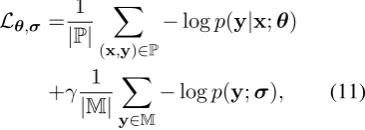
monolingual data, concurrent to training the rest of the network on bilingual data. Let us denote the source-independent parameters byσ. We connect a second loss toflmto predict the next target word
also conditioned only on target history informa-tion (Figure1c). Parameters for softmax layers are shared such that predictions of the LM layer are given by:
p(yt|y1:t−1,σ) =softmax(Wort+bo). (10)
Formally, for a heterogeneous data setZ={P,M}, consisting of parallel and monolingual sentences
(x,y),(y), we optimize the following joint loss:
Lθ,σ=|P|1
X
(x,y)∈P
−logp(y|x;θ)
+γ|M|1 X
y∈M
−logp(y;σ), (11)
where the source-independent parametersσ ⊂θ
are updated by gradients from both mono- and par-allel data examples, and source-dependent param-etersθ are updated only through gradients from parallel data examples. γ ≥0is a scalar to influ-ence the importance of the monolingual loss. In practice, we construct mini-batches of training ex-amples, where 50% of the data is parallel, and 50% of the data is monolingual and setγ = 1.
Since parts of the decoder are shared among both tasks and we optimize both loss terms concurrently, we view this approach as an instance of multi-task learning rather than transfer learning, where opti-mization is typically carried out sequentially.
5 Experiments
We conduct experiments for three different lan-guage pairs in the news domain:FR→EN,EN→DE, andCS→EN.
5.1 Data
For EN→DE and CS→EN we use
news-commentary-v11 as bilingual training data,
NewsCrawl 2015 as monolingual data,
[image:3.595.342.525.348.413.2]System Data EN→DE FR→EN CS→EN
baseline 20.3 39.9 63.0 21.7 27.5 59.1 17.0 24.4 65.2
+ LML 20.4 39.8 63.1 21.3 27.2 59.8 16.9 24.4 65.4
+ LML + MTL + mono 21.4 40.8 61.4 22.3 27.7 58.3 17.2 24.7 64.3
Sennrich et al.(2016) + synthetic 24.4 43.4 56.4 27.4 31.5 52.1 21.2 27.5 59.4 ensemble baseline 22.2 41.6 60.6 23.9 29.1 56.4 18.3 25.5 63.0
+ LML 22.4 41.8 60.9 23.5 28.7 57.2 18.3 25.6 63.4
+ LML + MTL + mono 23.6 42.8 58.9 24.2 29.2 55.9 18.8 25.9 62.2 ensembleSennrich et al.(2016) + synthetic 25.7 44.6 55.0 29.1 32.6 50.3 22.5 28.4 57.8
Table 1: BLEU/METEOR/TER scores on test sets for different language pairs. For BLEU and METEOR higher is better. For TER lower is better.
WMT2016 (Bojar et al., 2016). For FR→EN
we use newscommentary-v9 as bilingual data,
NewsCrawl 2009-13 as monolingual data, and
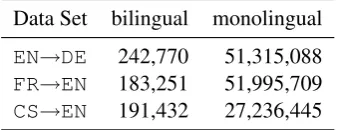
news development and test sets from WMT 2014 (Bojar et al.,2014). The number of sentences for these corpora is shown below:
Data Set bilingual monolingual
EN→DE 242,770 51,315,088
FR→EN 183,251 51,995,709
CS→EN 191,432 27,236,445
5.2 Experimental Setup
We tokenize all data and apply Byte Pair Encod-ing (BPE) (Sennrich et al.,2015) with 30k merge operations learned on the joined bilingual data. Models are evaluated in terms of BLEU (Papineni et al., 2002), METEOR (Lavie and Denkowski,
2009) and TER (Snover et al.,2006) on tokenized, cased test data. Decoding is performed using beam search with a beam of size 5. We implement all models using MXNet (Chen et al.,2015)1.
Baselines Our baseline model consists of a
1-layer bi-directional LSTM encoder with an embed-ding size of 512 and a hidden size of 1024. The 1-layer LSTM decoder with 1024 hidden units uses an attention network with 256 hidden units. The model is optimized using Adam (Kingma and Ba,
2014) with a learning rate of 0.0003, no weight decay and gradient clipping if the norm exceeds 1.0. The batch size is set to 64 and the maximum sequence length to 100. Dropout (Srivastava et al.,
2014) of 0.3 is applied to source word embed-dings and outputs of RNN cells. We initialize all
1Baseline systems are equivalent to an earlier version of
Sockeye:https://github.com/awslabs/sockeye
RNN parameters with orthogonal matrices (Saxe et al.,2013) and the remaining parameters with the Xavier (Glorot and Bengio,2010) method. We use early stopping with respect to perplexity on the de-velopment set. We train each model configuration three times with different seeds and report average metrics across the three runs.
Further, we train models with synthetic parallel data generated throughback-translation(Sennrich et al., 2016). For this, we first train a baseline model in the reverse direction and then translate a random sample of 200k sentences from the mono-lingual target data. On the combined parallel and synthetic training data we train a new model with the same training hyper-parameters as the baseline.
Language Model Layer The architecture with
an additional source-independent LM layer (+LML) is trained with the same hyper-parameters and data as the baseline model. The LM RNN uses a hidden size of 1024. The multi-task sys-tem (+LML + MTL) is trained on both parallel and monolingual data. In practice, all +LML +MTL models converge before seeing the entire mono-lingual corpus and at about the same number of updates as the baseline.
6 Results
[image:4.595.97.266.357.422.2]3 models with different random seeds. However, the use of synthetic parallel data still outperforms our approach both in single and ensemble systems.
While separating out a language model allowed us to carry out multi-task training on mixed data types, it constrains gradients from monolingual data examples to a subset of source-independent network parameters (σ). In contrast, synthetic data always affects all network parameters (θ) and has a positive effect despite source sequences being noisy. We speculate that training from synthetic source data may also act as a model regularizer.
7 Conclusion
We proposed a way to directly integrate target-side monolingual data into NMT through multi-task learning. Our approach avoids costly pre-training processes and jointly trains on bilingual and mono-lingual data from scratch. While initial results show only moderate improvements over the baseline and fall short against using synthetic parallel data, we believe there is value in pursuing this line of re-search further to simplify training procedures.
References
Dzmitry Bahdanau, Kyunghyun Cho, and Yoshua Ben-gio. 2014. Neural machine translation by jointly
learning to align and translate. arXiv preprint
arXiv:1409.0473.
Ondrej Bojar, Christian Buck, Christian Federmann, Barry Haddow, Philipp Koehn, Johannes Leveling, Christof Monz, Pavel Pecina, Matt Post, Herve Saint-Amand, et al. 2014. Findings of the 2014 workshop on statistical machine translation. In Pro-ceedings of the Ninth Workshop on Statistical Ma-chine Translation (WMT’14), pages 12–58. Associ-ation for ComputAssoci-ational Linguistics Baltimore, MD, USA.
Ondrej Bojar, Rajen Chatterjee, Christian Federmann, Yvette Graham, Barry Haddow, Matthias Huck, An-tonio Jimeno Yepes, Philipp Koehn, Varvara Lo-gacheva, Christof Monz, et al. 2016. Findings of the 2016 conference on machine translation (WMT16). InProceedings of the First Conference on Machine Translation (WMT’16), pages 131–198.
Tianqi Chen, Mu Li, Yutian Li, Min Lin, Naiyan Wang, Minjie Wang, Tianjun Xiao, Bing Xu, Chiyuan Zhang, and Zheng Zhang. 2015. MXNet: A flex-ible and efficient machine learning library for
het-erogeneous distributed systems. arXiv preprint
arXiv:1512.01274.
Kyunghyun Cho, Bart van Merrienboer, Caglar Gul-cehre, Dzmitry Bahdanau, Fethi Bougares, Holger
Schwenk, and Yoshua Bengio. 2014. Learning phrase representations using RNN encoder–decoder for statistical machine translation. InProceedings of the 2014 Conference on Empirical Methods in Natu-ral Language Processing (EMNLP’14), pages 1724– 1734, Doha, Qatar.
Xavier Glorot and Yoshua Bengio. 2010. Understand-ing the difficulty of trainUnderstand-ing deep feedforward neural networks. InAIStats, volume 9, pages 249–256. C¸aglar G¨ulc¸ehre, Orhan Firat, Kelvin Xu, Kyunghyun
Cho, Lo¨ıc Barrault, Huei-Chi Lin, Fethi Bougares, Holger Schwenk, and Yoshua Bengio. 2015. On us-ing monolus-ingual corpora in neural machine transla-tion. CoRR, abs/1503.03535.
Sepp Hochreiter and J¨urgen Schmidhuber. 1997. Long
short-term memory. Neural Comput., 9(8):1735–
1780.
Nal Kalchbrenner and Phil Blunsom. 2013. Recurrent
continuous translation models. In Proceedings of
the 2013 Conference on Empirical Methods in Natu-ral Language Processing (EMNLP’13), Seattle. Diederik P. Kingma and Jimmy Ba. 2014. Adam:
A method for stochastic optimization. CoRR,
abs/1412.6980.
Alon Lavie and Michael J. Denkowski. 2009. The ME-TEOR metric for automatic evaluation of machine translation.Machine Translation, 23(2-3):105–115. Minh-Thang Luong, Quoc V. Le, Ilya Sutskever,
Oriol Vinyals, and Lukasz Kaiser. 2015a.
Multi-task sequence to sequence learning. CoRR,
abs/1511.06114.
Minh-Thang Luong, Hieu Pham, and Christopher D. Manning. 2015b. Effective approaches to
attention-based neural machine translation. In Proceedings
of the 2015 Conference on Empirical Methods in Natural Language Processing (EMNLP’15), pages 1412–1421, Lisbon, Portugal. Association for Com-putational Linguistics.
Kishore Papineni, Salim Roukos, Todd Ward, and Wei-Jing Zhu. 2002. BLEU: A method for automatic
evaluation of machine translation. In Proceedings
of the 40th Annual Meeting on Association for Com-putational Linguistics (ACL’02), Philadelphia, Penn-sylvania.
Andrew M. Saxe, James L. McClelland, and Surya Ganguli. 2013. Exact solutions to the nonlinear dy-namics of learning in deep linear neural networks.
CoRR, abs/1312.6120.
Rico Sennrich, Barry Haddow, and Alexandra Birch. 2015. Neural machine translation of rare words with
subword units. CoRR, abs/1508.07909.
Rico Sennrich, Barry Haddow, and Alexandra Birch. 2016. Improving neural machine translation
54th Annual Meeting of the Association for Compu-tational Linguistics, ACL’16, Berlin, Germany. Matthew Snover, Bonnie Dorr, Richard Schwartz,
Lin-nea Micciulla, and John Makhoul. 2006. A Study of Translation Edit Rate with Targeted Human
Anno-tation. In Proceedings of Association for Machine
Translation in the Americas,.
Nitish Srivastava, Geoffrey E Hinton, Alex Krizhevsky, Ilya Sutskever, and Ruslan Salakhutdinov. 2014. Dropout: a simple way to prevent neural networks
from overfitting. Journal of Machine Learning
Re-search, 15(1):1929–1958.
Ilya Sutskever, Oriol Vinyals, and Quoc V Le. 2014. Sequence to sequence learning with neural networks. In Advances in neural information processing
sys-tems, pages 3104–3112.