Washington, DC, 12 November 1986
GENERAL
ENGINEERING
F
ield Manual 5-104 provides a doctrinal basis for the planning and execution of general engineering in the Theater of Operations. General engineering sustains military forces in the theater through the performance of facility construction and repair, and through acquisition, maintenance, and disposal of real property. The Theater of Operations is defined as “That portion of an area of conflict necessary for military operations, either offensive or defensive... , and for the administration incident to such military operations.”This manual will be primarily concerned with support to those noncom-mitted forces within the corps and communications zone areas. It will describe responsibilities, relationships, procedures, capabilities, con-straints, and planning considerations in the conduct of general engineering tasks. The manual was designed to highlight doctrinal procedures and to give an overview of the general engineering functional area.
Field Manual 5-104 was developed for commanders and planning staffs at all levels who require engineer assistance, or are required to give engineer assistance in tasks falling under the general engineering purview.
The proponent agency of this publication is the US Army Engineer School. Users are invited to send comments and suggest improvements on DA Form 2028 (Recommended Changes to Publications and Blank Forms) to— Commandant, US Army Engineer School, ATTN: ATZA-TD-P, Ft. Belvoir, VA, 22060-5291.
DISTRIBUTION RESTRICTION: Approved for public release, distrlbution is unlimlted
*This publication supersedes FM 5-1, 27 July 1971 and FM 5-162, 30 March 1973.
FM 5-104
STANAG IMPLEMENTATION
The provisions of this publication are the subject of International Standardization Agreement (STANAG) 2885, Procedure for the Provision of Potable Water in the Field.
Unless otherwise stated, whenever the masculine gender is used, both men and women are included.
This publication contains copyrighted material.
G
eneral engineering encompasses those engineer tasks which increase the mobility, survivability, and sustainability of tactical and logistical units to the rear of the forward line of troops (FLOT). Such tasks include construction and repair of lines of communication (LOC), main supply routes (MSR), air-fields, and logistica] facilities. While these tasks may be per-formed as far forward as the brigade rear area of the combat zone, most general engineer tasks are performed behind the division rear boundaries. Repair tasks dominate in well-developed theaters. Construction tasks prevail in less-developed theaters. General engineer missions are usually performed by Engineer Combat Heavy Battalions, Port Construction Companies, Con-struction Support Companies, Combat Support Equipment Companies, Dump Truck Companies, and Pipeline Construction Support Companies. Divisional and corps combat battalions may also be required to perform limited general engineer tasks. General engineer tasks in a mid-to high-intensity conflict focus primarily on direct support of military forces. In such circum-stances, little consideration can be given to nation-building missions. In a low-intensity conflict, nation-building tasks may dominate.THE GENERAL ENGINEERING PLANNING PROCESS 2
PLANNING CONSIDERATIONS 2
PRINCIPLES OF THEATER OF OPERATIONS CONSTRUCTION 3
FM 5-104
THE GENERAL ENGINEERING PLANNING PROCESS
General engineer requirements in a Theaterof Operations are based on an analysis of the terrain, the availability of support infra-structure, the logistical and combat force structure to be supported, and the extent of damage to existing facilities: The senior staff engineer makes the detailed analysis and establishes a prioritized list of requirements. Prioritization is coordinated with the senior operations and logistics staff officers (G3 and G4 at division and corps and Deputy Chief of Staff, Operations and Deputy Chief of Staff, Logistics at Echelons Above Corps).
A detailed terrain analysis is conducted to determine the availability of suitable local construction materials and to estimate the engineer effort required to accomplish the general engineer missions. Preliminary Class IV construction material requirements must be forecast for the logisticians as early as possible in the planning process. This ensures that material is available when it is needed. The availability of host nation assets must be determined. Those missions that can be per-formed by host nation units should be
pro-cessed through the staff officer responsible for host nation coordination.
General engineer missions may be allocated to available engineer units on an area basis or a task basis. That is, engineer units maybe given an area of responsibility or may be tasked with a specific mission, such as repair or upgrade of a specific LOC. Tasks are performed in accordance with the priority list that has been developed in conjunction with the supported commands. Priorities may shift as damage occurs due to enemy combat action. Logistical constraints may also govern the sequence in which general engi-neer tasks are performed.
General engineer missions may be performed in support of joint or combined operations. Liaison must be established with supported allied forces or other US services to make sure their requirements are included in the plan-ning process. Construction missions in the rear combat zone and communications zone (COMMZ) will be coordinated by the desig-n a t e d r e g i o desig-n a l w a r t i m e c o desig-n s t r u c t i o desig-n manager.
PLANNING CONSIDERATIONS
HOST NATION SUPPORT planning process, so that engineers can learn Where possible, host nation capabilities local expedient construction methods. should be identified in peacetime. Civil affairs
personnel play a key role in host nation CONTRACT LABOR
interface. They also assist in establishing Contract labor may be available for use in the procedures for obtaining host nation support. COMMZ. If so, contracting officers must be In many parts of the world, host nation appointed, and a contract management capabilities may be limited to providing structure established. Use of contract labor construction materials. It is important to tap frees engineer troop units to move forward host nation regional expertise early in the and reduces engineer force structure
require-ments in the theater.
CONSTRUCTION CRITERIA Wartime construction requirements will be governed by the following criteria:
Ž Make maximum use of existing facilities (US or host nation controlled).
Ž Modify existing facilities rather than undertake new construction.
Ž Use austere design and construction techniques.
Ž Minimize US engineer troop construction effort.
Ž Reduce protective construction. Employ passive protection through dispersion of facilities and equipment (to include in-corporation of nuclear, biological, and chemical (NBC) protective measures and equipment) to reduce the need for protective construction.
Ž Use self-help construction. All non-engineer units must use self-help construc-tion procedures to the limit of their capabilities, short of interfering with primary missions, but without wasting scarce construction materials.
LOGISTICS
An extensive logistical and transportation system is required to support the acquisition and distribution of engineer materials. In developed theaters, engineers depend heavily upon locally procured construction materials and existing distribution networks for sup-plies. In undeveloped or heavily damaged areas, construction materials and distribu-tion networks are not available. Indeed, the engineer effort may be more focused on pro-curing the necessary material and moving it to project sites than on the project itself. Therefore, the logistics effort must be con-sidered in the planning stage so that projects can be successfully accomplished.
PRINCIPLES OF THEATER OF OPERATIONS CONSTRUCTION
Joint Chiefs of Staff (JCS) Publication 3 TEMPORARY STANDARD defines two construction standards for plan- The temporary standard is characterized by ning, designing, and constructing facilities minimal facilities, intended to increase the in support of contingency operations. efficiency of operations. Design life of tem-porary structures is targeted at 24 months. INITIAL STANDARDThe initial standard is characterized by CONSTRUCTION PRINCIPLES austere facilities. These minimize engineer The principles of construction in the Theater construction effort and provide facilities of Operations are speed, economy, flexibility, which offer immediate operation support to decentralization of authority, and estab-units upon arrival in-theater. Initial standard lishment of priorities.
facilities are intended to be used for a limited time, ranging from one to six months.
FM 5-104
Speed
Speed is fundamental to all activities in a Theater of Operations. Practices that support speedy construction include:
Use existing facilities. Engineer units must rapidly provide facilities that enable US forces to deliver maximum combat power forward. The use of existing facilities con-tributes greatly to the essential element of speed by eliminating unnecessary construc-tion effort.
Standardize. Standardized materials and plans save time and construction effort. They permit production-line methods, including prefabrication of structural members. Stand-ardized assembly and erection procedures increase the efficiency of work crews by reducing the number of methods and tech-niques they must learn.
Simplify. Simplicity of design and construc-tion is vital in wartime because manpower, materials, and time are in short supply. Simple methods and materials allow scarce labor to complete installations in a minimum of time.
Use bare-bones construction. Military engineering in the Theater of Operations is characterized by concern for only the mini-mum necessities and by the temporary nature of constructed facilities. Adequate, but minimal, provisions are made for safety. For example, local green timbers are often used to construct wharves or pile-bent bridges even though marine borers will rapidly destroy the timbers. The rationale in this case is that the focus of military effort shifts rapidly, justi-fying a short useful life for the structure. Sanitary facilities may consist of nothing more than pit latrines, because it is not appropriate to provide more permanent or luxurious facilities. In short, quality is sacri-ficed for speed and economy.
Construct in phases. Phased construction provides for the rapid completion of critical parts of buildings or installations and the use of these parts for their intended purpose before the entire project is completed. Although phased construction is somewhat inefficient, it allows maximum use of facilities at the earliest possible time.
Economy
Economy in Theater of Operations construc-tion demands efficient use of personnel, equipment, and materials.
Conserve manpower. The soldier is the vital element. For this reason manpower priorities go to units in contact with the enemy. Despite the mechanization of modern warfare, battles are still won and territory occupied by ground forces. Construction tasks are time consuming, and engineers and construction workers are often in short supply. Conservation of labor is therefore important. Every engineer must function at the peak of efficiency for long hours to accomplish the engineer mission. Careful planning and coordination of personnel assignments are necessary. Projects must be well organized and supervised. Engineer personnel must be carefully allocated and well provided for. The source of support to engineers will depend upon the nature of established command and control relation-ships.
Conserve equipment. In the Theater of Operations, military heavy construction equipment will be in short supply. Some civilian equipment may be available. Because of low densities, operational capability of available equipment may be further jeop-ardized due to shortages of repair parts. Wise use of construction equipment is essential.
Conserve materials. An overseas wartime construction program must be organized to execute the required work in the time allotted and with a minimum of shipped-in tonnage. Local resources must be used and natural resources exploited to the maximum extent possible.
Flexibility
The ever-changing situation in military construction requires that construction in all stages be adaptable to new conditions. To meet this requirement, use standard plans which allow for adjustment and expansion. Standard plans are a part of the Army Facilities Components System (AFCS) and the Navy Advanced Base Functional Com-ponent System. The use of alternate materials is permitted, and design is such that a given construction item may have the maximum number of uses. Theater of Operations standard components are flexible. For example, a standard building plan may be easily adapted to be used as an office, barracks, hospital ward, or mess hall. For-ward airfields are usually designed and located so that they can be expanded into more elaborate installations as time and resources permit.
The AFCS provides the construction units with standard plans, bills of material (BOM), specifications for construction standards, labor and equipment estimates, and material shipping estimates. This information signifi-cantly improves the planning effort at all levels of the chain of command, and provides a common base of information for all units. The AFCS is developed in four technical manuals (TM): TM 5-301, TM 5-302 (a five-volume set of drawings), TM 5-303, and TM 5-304.
Decentralization of authority The wide dispersion of forces in a Theater of Operations requires that engineer authority be decentralized as much as possible. The engineers in charge of operations at partic-ular localities must have authority consistent with their responsibilities.
Establishment of priorities It is essential to establish priorities to deter-mine how much engineer effort must be devoted to a single task. While detailed priority systems are normally the concern of lower echelon commands, all levels of com-mand beginning with the theater comcom-mander must frequently issue directives establishing broad priority systems to serve as a guide for detailed systems. Resources must initially be assigned only to the highest priority tasks. Low priority tasks must be left undone at first. Some unavoidable risks will result. Tasks must be analyzed and the risk of bypassing them evaluated in order to assign priorities.
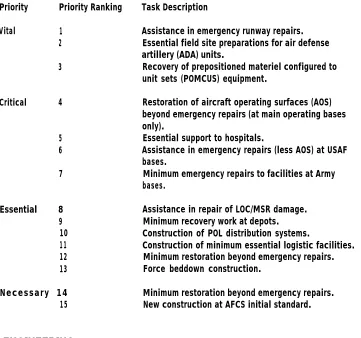
By category of work for war-essential mis-sions, theater engineer efforts will generally give first priority to damage repair of air bases and other critical facilities, second priority to LOC repair, and third priority to restoration or renovation of other necessary facilities. Engineer capability will be applied to the prioritized list of war-essential support missions in accordance with the four priority groups shown in Table 1 (see page 6).
Table 2 (page 6) shows a priority scale applied to each category of general engineer work expected to confront Army engineers in the corps rear and COMMZ. Note that priorities change rapidly and are dependent on the tactical situation.
FM 5-104
Table 1. Engineer Support Priorities in the Theater of Operations
Group Priority Implications of Nonsupport
A Vital High strategic importance.
Early defeat of friendly forces.
B Critical Serious degradation of combat effectiveness. Increased vulnerability on the battlefield. Increased probability of tactical defeats.
C Essential Long-term degradation in sustainability. Significant equipment and materiel losses.
D Necessary Reduced quality of combat service support (CSS). Short term degradation in sustainability.
Moderate equipment or materiel losses.
[image:10.613.129.490.382.720.2]Temporary inconvenience. Minor impact on tactical operations.
Table 2. Sample Integrated Priority List for General Engineering Tasks
Priority Priority Ranking Task Description
Vital 1 Assistance in emergency runway repairs.
2 Essential field site preparations for air defense artillery (ADA) units.
3 Recovery of prepositioned materiel configured to unit sets (POMCUS) equipment.
Critical 4 Restoration of aircraft operating surfaces (AOS) beyond emergency repairs (at main operating bases only).
5 Essential support to hospitals.
6 Assistance in emergency repairs (less AOS) at USAF bases.
7 Minimum emergency repairs to facilities at Army bases.
Essential 8 Assistance in repair of LOC/MSR damage.
9 Minimum recovery work at depots.
10 Construction of POL distribution systems.
11 Construction of minimum essential logistic facilities. 12 Minimum restoration beyond emergency repairs.
13 Force beddown construction.
N e c e s s a r y 1 4 Minimum restoration beyond emergency repairs. 15 New construction at AFCS initial standard.
OF CONSTRUCTION MATERIALS
A
supply of suitable construction material is the basis for establishing, maintaining, and repairing facilities in the Theater of Operations. Nearly all general engineering consumes raw and/or prefabricated construction materials. The most com-monly needed materials are soil, sand, crushed rock, asphalt. concrete, and lumber. The burden of locating and manufacturing many of these materials fails mainly on Combat Heavy Engineer Battalions. However, all engineer units must be prepared to exploit available construction materials. Engineer units tasked to procure construction materials must make full use of their imagination, initiative, and resources. Where standard materials are not available, engineers must improvise.Required construction materials may he supplied through mili-tary logistical systems, obtained from local manufacturers, extracted from local natural resources, or produced by engineer units. Planners must use the source or combination of sources that will fulfill the mission with maximum speed, efficiency, and economy.
SUPPLY THROUGH MILITARY LOGISTICAL SYSTEMS 8 PROCUREMENT FROM LOCAL MANUFACTURERS 8 ENGINEER-PRODUCED NATURAL RESOURCES 8 ENGINEER-PROCESSED MATERIALS 10
FM 5-104
SUPPLY THROUGH MILITARY LOGISTICAL SYSTEMS
The military logistical system is generally The disadvantages of the military supply very responsive to the needs of the construc- system begin to appear further away from tion engineer units. This system has the the source of supply. Long lead times must be advantage of being organized under no- considered by project planners if the normal menclature and units of measure familiar to supply system is used. The risk of damage to supply personnel. This familiarity eases the materials and the cost of materials to the movement of material through the supply government increase because of
chain. When material is in the military supply shipping and handling required. system, its quality can be more easily
moni-tored, and supply status can be easily veri-fied.
increased
PROCUREMENT FROM LOCAL MANUFACTURERS
Procurement of construction material fromlocal manufacturers or producers alleviates many of the problems associated with mili-tary supply channels, but creates other concerns. Local procurement can greatly reduce the lead time before materials arrive at the construction site. In many cases the theater command arranges supply agree-ments with host nations before engineer units arrive. The agreements specify the type and quality of certain materials and specify the locations of material yards. Transportation arrangements, made with the host nation for moving materials closer to the constructing units, reduce the motor transport requirement of these units,
Local procurement of construction materials can cause problems because of variances in quality and dimensions. For example, some plywoods produced in European countries are of such high quality that the circular saw blades normally used in engineer units quick-ly dull, creating a slowdown in construction productivity. Some material may not meet dimensional standards required by the pro-ject. This may cause delays and require design modifications. Some materials, such as cement, may have slightly different chemi-cal properties, which can alter the behavior of the material during construction. It is therefore important that using units become familiar with the locally procured material as soon as practical in order that any needed adaptations can be made.
ENGINEER-PRODUCED NATURAL RESOURCES
Natural resources can be tapped by engineerunits as a source for soil, sand, gravel, and timber. Civilian and military intelligence sources, such as the Terrain Analysts and the Military Geographic Information (MGI) data base of the supporting topographic unit, can locate resources quickly. Since this informa-tion can significantly influence the locainforma-tion of some facilities and installations, it is important to identify resources quickly.
BORROW PITS
Borrow pits are the preferred source of construction aggregate and fill material when resources are scarce and material quality is not critical. Borrow pit material—gravel, sand, and fines—seldom needs to be blasted, crushed, or screened. Though its quality may not be as good as crushed stone, it is often acceptable. The equipment needed to work a borrow pit includes dozers for clearing and
grubbing, dump trucks for hauling, and either scoop loaders, scrapers, or cranes with shovel or dragline attachments for loading.
Borrow pits are best located at the tops of hills close to or on the construction site for ease of material handling. If borrow pits are located away from the construction site, co-ordination with the local landowner must be effected, and additional care must be taken when closing down the pit to prevent undue damage to the surrounding terrain.
QUARRIES
A quarry is an open excavation from which rock may be removed, either by blasting or by ripping with bulldozers. Quarries are typi-cally used when borrow pits cannot support the mission, either because the material is insufficient, the quality is poor, or because borrow pits are too far from the work site. Existing quarries should be used whenever
possible, since developing and operating a quarry requires considerable time, man-power, and equipment. When planners con-sider opening a new quarry site, they must weigh the tactical situation, the security of the quarry unit, and the lead time required to develop the site. Engineer units with quar-rying equipment are scarce resources in the active Army. The use of such units must be carefully planned.
The decision to develop a quarry site must also take into account the quality and quan-tity of material offered, the availability of trained personnel and equipment, the pro-posed quarry’s rock structure and drainage, and the site’s location with respect to civilian populace, access roads, facilities, utilities, and the construction site. The environmental impact of the quarrying operation should be considered because of possible air, ground water, and noise pollution. The equipment
FM 5-104
needed to operate a quarry includes bull-dozers, air compressors, crawler drills or hand drills, and either scooploaders or cranes with shovel attachments.
LOGGING OPERATIONS
When host nation support is not adequate to supply timber products for construction, plan-ners may decide to conduct independent log-ging and/or sawmill operations. Loglog-ging is the process of converting standing timber into sawn logs or timber products and de-livering them to the sawmill for the manu-facture of lumber or heavy timber. Logs can be processed and used for such purposes as timber piles, bridge or wharf stringers, rail-road ties, and framing members for protective structures. Logs can be processed into dimen-sioned lumber for use in Theater of Opera-tions construction if drying time is available. The Army’s capability to conduct logging and sawmill operations is located solely in Engineer Forestry Teams in the Reserve establishment. The Forestry Team General of the Army (GA) is organized under Tables of Organization and Equipment (TOE) 5-520G. The team is divided into a team headquarters, a logging section, and a saw-mill section. Such teams may be attached to a supply and service battalion of the general support group or to an engineer construction group, or it may be used to support indepen-dent operations. The Forestry Team is 75 percent mobile. Forestry Teams are scarce resources, and their use must be carefully planned.
When the decision has been made to use military resources to produce timber products, the first step in planning is to select a timber stand and sawmill site. Again, the support-ing engineer topographic unit can provide useful information. The timber stand may be some distance away from the site of the sawmill. The planner must therefore plan for roads and bridges that can handle heavy loads. Supporting engineer units will need to provide for road maintenance. The sawmill site should be convenient to roads or railroads for transshipment of the lumber products. The sawmill must have a large, clear area around it, be well drained, and be located at a distance from inhabited areas. Provisions must be made for properly disposing of wood waste products and unused wood preserva-tive, which can be hazardous to human beings. An adequate water supply must be available for fire protection at the sawmill. The Forestry Team conducts a reconnais-sance, called a timber cruise, to select a logging site. During the timber cruise, ap-propriate tree species are identified, and the timber stand’s yield is estimated. After the timber cruise is completed, the selected trees are cut, then logs are cut to the correct length. These logs are loaded on trucks and taken to the sawmill, where bark is removed, the logs are sawn into the needed dimensions, and wood preservative is applied. The dimen-sional stability and sturdiness of the wood is enhanced if it is dried in a kiln or in the open air. The drying process consumes valuable space and time.
ENGINEER-PROCESSED MATERIALS
CRUSHED ROCK PRODUCTION screened, and perhaps washed to meet quality Rock of specific size and gradation is needed standards for construction missions. It is for asphalt and concrete production. Crushed almost a certainty that a supply of crushed rock is used as the base course for roads and rock will be needed in any Theater of Opera-airfields. Rock from quarry operations and tions construction.
some borrow pit material must be crushed,
Certain Army engineer units in the active and reserve component have the equipment and trained personnel to establish and op erate large-scale rock crushing plants. Rock processing units, like quarry units, are low-density engineer resources which must be used carefully. Planners must be aware that moving a rock processing unit and establish-ing operations at a new site requires con-siderable lead time.
The plant must be sited within a reasonable distance of the quarry and the construction project. It should be located on level ground with good drainage. Adequate space should be available for equipment, stockpiles, main-tenance areas, related facilities and utilities, and for expansion. An adequate supply of water must be available for the washing process.
The two most common rock processing units have either a 75- or a 225-ton per hour rock processing plant. Each plant consists of several large pieces of towed equipment, The major components are crushers, screening equipment, washing equipment, and portable
conveyers. Planners must be aware that the actual output of any given plant differs from its nominal capacity. Actual production reflects the plant’s capacity to handle the specific product input, the desired size of the final product, the size of the crushing equip-ment, and the proportion of by-product or waste produced.
Other problems that are inherently part of rock processing operations must be consider-ed. Equipment maintenance is inevitably a major task, because the heavy loads and abrasive action of crushing and moving tons of rock rapidly wears and damages equip-ment. Repairs are sometimes difficult, be-cause spare parts are often scarce.
ASPHALT PRODUCTION
Engineer units with organic asphalt plants are low density engineer resources in both the active and reserve components, and should be used carefully. Moving and establishing an asphalt plant requires considerable lead time. An adequate source of raw materials, such as rock, sand, and bitumen, must be available.
ASPHALT PLANT WITH TRAILER-MOUNTED ELEMENTS
Barber-Greene Co., Bituminous Construction Handbook
(Aurora, IL, Barber-Greene, 1963), Figure 67.
FM 5-104
The 100- to 150-ton per hour asphalt plant is the Army’s current plant. This plant can produce all types of bituminous mixes, in-cluding high-type concrete, cold mixes, and stabilized base mixtures. The plant consists of a mixer, hot elevator, gradation control unit, dryer, and feeder, all of which are trailer mounted. The upper half of the gradation control unit, the cold elevator, and numerous ancillary parts must be moved on extra trailers. Equipment needed to support plant operations includes dump trucks, portable conveyors, scoop loaders, bulldozers, and cranes with clamshell attachments. An air compressor with drum cutting tools is needed to open drums of asphalt cement, and fuel
trucks are needed to supply the hot oil heaters and power plants.
When it is determined that a military asphalt plant is needed, planners must select an optimal site. A large, well-drained area with a gravel or hard top surface is to be preferred. The plant must be close to both the source of aggregate and the construction site, because most bituminous mixes either become too cool or begin to cure if they are not placed quickly. A good road net is needed to avoid traffic jams and resultant cooling of mixes. The planner must also consider the potential environmental problems, including dust gen-erated by the plant and potential soil pol-lution from bitumen and fuel spills.
STANDARD ASPHALT TRAVEL PLANT
Barber-Greene, Bituminous Construction Handbook, Figure 75.
PORTLAND CEMENT CONCRETE PRODUCTION
Portland cement concrete can be produced, on a small to medium scale, by any Army engineer battalion and by most of the special engineer support companies in the active component. Certain engineer units in the Army Reserve and National Guard establish-ment have the organic equipestablish-ment and train-ed personnel to install and operate central mix concrete plants if the project calls for large amounts of portland cement concrete. The production of any portland cement requires that the proper raw materials be available. The concrete requires gravel or crushed rock as the coarse aggregate, and sand as the fine aggregate. These materials must be available in sufficient quantities. The coarse aggregate must be of the proper gradation and of a specific size, depending on the structure that is to be built. The fine aggregate should be well graded and free of deleterious material. There must be source of fresh and preferably potable water available at the mixing site. Water is also required at the construction site for use in curing the fresh concrete. Finally, portland cement must
be provided to the using unit either through the military supply chain or through local procurement in the host nation.
Small and medium scale concrete require-ments can be satisfied by any Army engineer unit with either the 16S concrete mixer or the M919 Concrete Mobile. The 16S mixer can be easily moved to remote locations; it supplies small scale concrete requirements. It is man-power-intensive in operation. Several of the 16S mixers can be grouped together to con-struct an efficient concrete central mix plant. The M919 Concrete Mobile is a self con-tained concrete material transporter and mixing machine. This machine is capable of producing high quality, fresh concrete at the construction site. It is a one-person operation, as the driver of the vehicle is also the operator of the mixer. This machine has the capacity to carry materials for 8 cubic yards of concrete when it is fully loaded. The machine’s ma-neuverability is limited to good roads and firm ground at the construction site. Scoop loaders are generally required to support the M919 at the materials yard.
M919 CONCRETE MOBILE
FM 5-104
Large scale concrete requirements can be satisfied by those reserve engineer units which operate central mix plants. Central mix plants have the facilities to handle, store, batch, and mix concrete materials. The individual materials are accurately propor-tioned, then mixed in a large drum mixer. The concrete is deposited in dump trucks and moved to the job site. Central mix plants are capable of producing 80 cubic yards of fresh concrete per hour. This type of production
may be desirable on a large project such as an airfield. Central mix plant operations require the support of scoop loaders, cranes with clamshell attachments, and dump trucks. Central mix plants must be located near the construction site and near a supply of raw materials and water. They must also be situated on firm ground with good drainage, and have plenty of area for vehicular ma-neuver.
A
irfields and heliports support the thrust of combat power and the rapid resupply of friendly forces. Theater airfields and related facilities must be ready to receive early deploying units. They are basic to the Air Force missions of counter air, close air support, and interdiction, and to the integrated doctrine of the AirLand battle. Engineer support to airfields and heliports is therefore a vital mission in the Theater of Operations.Forces in and deploying to developed theaters can use existing airfields. Opening a contingency Theater of Operations may demand that new airfields be built or existing airfields expanded. In a short-warning conflict, emergency war damage repair and priority expedient facility work exceed deployed Air Force capability. Thus, extensive Army support is needed. Planners must identify critical existing airfields and indicate the need for new construction and airfield expansion.
Engineer support to airfields covers a wide array of individual engineer tasks. A majority of these tasks may be classified as horizontal. However, many vertical and utility tasks have been identified by the Air Force as requiring immediate Army restoration work. Major horizontal tasks associated with airfields and heliports closely parallel those required for roads (Chapter 4). Considerations unique to planning and constructing airfields and heliports are discussed in this chapter.
CONSTRUCTION RESPONSIBILITIES 16 TYPES OF AIRFIELDS AND HELIPORTS 18 PLANNING MILITARY AIRFIELDS 19 NEW AIRFIELD AND HELIPORT CONSTRUCTION 21 EXPANSION AND REHABILITATION 24 MAINTENANCE AND REPAIR OF AIRFIELDS AND HELIPORTS 25
FM 5-104
CONSTRUCTION RESPONSIBILITIES
Engineer Combat Heavy Battalions, underthe appropriate Army command, perform designated Air Force and all Army construc-tion. These battalions may be augmented by Combat Engineer Battalions, an Engineer Combat Support Equipment Company, an Engineer Light Equipment Company, an Engineer Construction Support Company, or an Engineer Pipeline Construction Support Company. These units execute large construc-tion projects on a task or area basis, as dictated by the theater plan or other theater project directives.
COMMAND RELATIONSHIPS Units assigned in general support of an Army or Air Force element may also be assigned in direct support of that element for emergency rehabilitation. When units are executing either general or direct support missions, they remain under Army command and operational control. Units executing emergency rehabilitation (direct support) plans, receive and accept detailed opera-tional requirements from the supported com-mander, either Army or Air Force.
SUPPORT TO THE AIR FORCE Current joint-service regulations have es-tablished policies, responsibilities, and pro-cedures for Army construction support to the Air Force. The duties of each service are listed below.
The Army provides troop construction sup port to Air Force-controlled airfields as fol-lows:
Ž Develops engineering design criteria, standard plans, and material to meet Air Force requirements.
Ž Performs reconnaissance, survey, design, construction, or improvement of airfields, roads, utilities, and structures.
Ž Repairs Air Force bases and facilities beyond the immediate emergency recovery requirements of the Air Force (permanent repair).
Ž Supplies construction materials and equipment.
Ž Assists in emergency repair of war-damaged air bases.
Ž Assist in providing expedient facilities (force beddown).
Ž Manages war damage repair and base development; supervises Army personnel. The Air Force base commander sets priorities.
Ž Performs emergency and permanent repair of war damage to forward tactical airlift support facilities.
The Air Force provides troop engineer support as follows:
Ž Performs primary emergency repair of war damage to air bases (rapid runway repair (RRR) and repair of other critical operating facilities), with Primary Base Emergency Engineer Force (Prime Beef) Teams.
Constructs expedient facilities for Air Force units and weapon systems. This excludes responsibility for Army base development.
Ž Operates and maintains Air Force facili-ties. Air Force engineer units (Red Horse Teams) perform maintenance tasks. Ž Provides crash rescue and fire suppression. Ž Manages emergency repair of war damage
and force beddown construction. Ž Supplies material and equipment for its
own engineering mission. •
ENGINEER SUPPORT TO AIR FORCE BASES
FM 5-104
TYPES OF AIRFIELDS AND HELIPORTS
Within the Theater of Operations, airfields and heliports are classified by both area and mission. For each area and mission there are essential, or controlling aircraft, either fixed-wing and/or rotary-fixed-wing. The controlling aircraft, or aircraft combination, is identified for each kind of facility in order to establish limiting airfield and/or heliport geometric and surface strength requirements.
AREA CLASSIFICATION
The area classification identifies the theater sector and the military control under which the airfield is to operate. The four areas are— 1. Battle Area—Sector of the AirLand battle-field normally under military control of a brigade;
2. Forward Area—Sector of the Theater of Operations immediately behind the battle area and normally under military control of a brigade or division;
3. Support Area—Sector of the Theater of Operations behind the forward area, nor-mally within the Corps rear or areas under military control of the fighter air security command;
4. Rear Area—Sector of the Theater of Opera-tions behind the support area, normally the COMMZ, under command of the Theater Army commander.
MISSION CLASSIFICATION The mission classification identifies the aircraft and aircraft combinations that use an airfield according to the kinds of missions assigned to the field. The missions and their associated aircraft combinations are identi-fied separately for fixed-wing and rotary-wing aircraft.
Fixed-wing aircraft
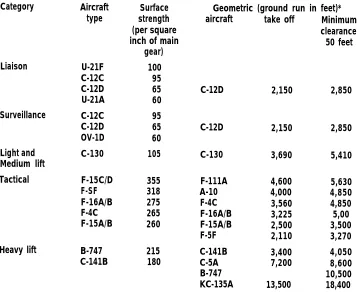
For the purpose of this manual, aircraft are classified in six mission categories which include all fixed-wing aircraft in the current military inventory. A controlling aircraft or combination of controlling aircraft has been designated for each category to establish limiting airfield, geometric, and surface strength requirements. The mission cate-gories include liaison, surveillance, light and medium lift, tactical, and heavy lift. The aircraft or aircraft combinations that perform the missions and their requirements are shown on Table 3.
Rotary-wing aircraft
Four helicopters have been designated as controlling helicopters to establish the limiting geometric and surface strength requirements given in this manual. These helicopters are—
Ž Observation (light) helicopter (OH-58); Ž Utility helicopter (UH-60);
Ž Cargo helicopter (CH-47); Ž Attack helicopter (AH-1G).
The airfield classification system An airfield classification system has been developed in TM 5-330. The system covers all known air missions for fixed-wing aircraft within the theater. Airfield types are derived by combining the controlling aircraft classi-fication with the appropriate military area. Where airfields are to serve as multimission facilities for support of all classes of Army or Air Force aircraft, the first term in the airfield type designation becomes Army or Air Force rather than a controlling aircraft classifica-tion, for example: Army Rear Area. The heliport classification system developed in TM 5-330 derives classifications by combin-ing the selected helicopters with the ap-propriate military area.
Table 3. Mission Classification Data for Fixed-Wing Aircraft Category Liaison Surveillance Light and Medium lift Tactical Heavy lift Aircraft type U-21F C-12C C-12D U-21A C-12C C-12D OV-1D C-130 F-15C/D F-SF F-16A/B F-4C F-15A/B B-747 C-141B Surface strength (per square inch of main
gear) 100 95 65 60 95 65 60 105 355 318 275 265 260 215 180
Geometric (ground run in feet)* aircraft take off Minimum
clearance 50 feet
C-12D 2,150 2,850
C-12D C-130 F-111A A-10 F-4C F-16A/B F-15A/B F-5F C-141B 2,150 3,690 4,600 4,000 3,560 3,225 2,500 2,110 3,400 2,850 5,410 5,630 4,850 4,850 5,00 3,500 3,270 4,050
C-5A 7,200 8,600
B-747 10,500
KC-135A 13,500 18,400
*Other geometric considerations include taxiway, parking apron, overrun; and lateral safety area requirements. Generally, the larger the aircraft, the greater these other geometric dimensions must be. See TM 5-330 for details.
PLANNING MILITARY AIRFIELDS
THEATERWIDE AIRFIELDPLANNING
Most planning factors described Chapter 4 for road design are applicable in airfields. The most important factors are discussed below.
Military mission
To achieve a proper design, it is essential that the engineer planner have a complete under-standing of the purpose, scope, and estimated duration of the particular air missions. Mis-sions that may be conducted include recon-naissance, cargo transport, or attack.
Site selection
The engineer planner’s attention must be directed first toward selecting sites. The operational plan establishes tactical and/or
logistical requirements that influence the type of aircraft and number of aircraft missions required. With this data in hand, the planner can determine the number, type, service life, and construction time limitations for airfields needed in each military area. Within site requirements dictated by the tactical situation, the planner establishes reasonable site requirements for each type of airfield. The planner chooses geographic locations on the basis of topographic features (grading, drainage, and hydrology), soil, vegetation, utilities, climatic conditions, and accessibility of materials. Other site charac-teristics to be studied include weather pat-terns (such as temperature, barometric pres-sure, and wind directions), and flight path obstacles.
FM 5-104
Construction planning
The planner evaluates all existing transport facilities to determine the best methods and routes. These include ports, rail lines, road nets, and other nearby airfields that might be used for assembling and moving construction equipment and materials to the construction site.
The planner evaluates the availability and type of engineer construction forces to deter-mine if construction capability is sufficient to carry out the required airfield construction. The planner must weigh the type and avail-ability of local construction materials against overall needs for proposed con-struction. Both naturally occurring materials and other possible sources for materials for subgrade strengthening should be examined. Requirements for importing special materials for surfacing, drainage, and dust control must be feasible for available construction time and resources.
Security situation
The planner devises an adequate plan to ensure that construction troops can protect themselves, their equipment, and their ma-terials against harassment and sabotage during airfield or heliport construction. Re-quirements for additional security forces should be evaluated.
Airfield damage repair (ADR) The planner must have knowledge of forces dedicated to ADR. Depending upon base locations, local agreements, and the overall military situation, any combination of Army, Air Force, host nation, or contract engineer support may be possible.
Logistical support
The Air Force or Army furnishes the neces-sary data to help plan airfields and heliports. The data should include aircraft character-istics, allowance factors and formulas, broad design, layout, and construction criteria, and
policy guidance. Information should include definitive drawings, specifications, regula-tions, manuals, or other appropriate refer-ences. The services should also submit their specific requirements in broad engineering terms together with general site and ultimate development plans. Army engineer units are usually responsible for site reconnaissance and recommendations, survey, pavement design, layout adaptation, and construction. Logistical support is prescribed by Army Regulation (AR) 415-30/Air Force Regulation (AFR) 93-10. Engineering and logistic data for Air Force base planning can be found in Air Force Manual (AFM) 86-3, Volume I.
INDIVIDUAL
AIRFIELD/HELIPORT DESIGN The engineer commander is responsible for site reconnaissance and recommendations, design of the airfield/heliport, and the actual construction of the individual airfield. The engineer is normally given standard designs for the type and capacity of the airfield. However, the planner must frequently alter these designs to meet time and material limitations or the limitations imposed by local topography, area, or obstruction char-acteristics. The engineer in charge of con-struction may alter designs within the lim-itations prescribed by headquarters but must obtain approval for major changes from headquarters before the work starts.
The engineer commander will need to solve the following engineering problems in car-rying out most airfield assignments:
Ž Design a drainage system structure. Ž Design runways, taxiways, and
hard-stands.
Ž Select/dispose of soils encountered in cuts. Determine their usefulness for improving subgrade.
Ž Choose a method or methods for stabilizing Ž Select the grade for a minimum of
earth-the subgrade. work within specification limits.
Ž Decide upon the type and thickness of the Ž Design related facilities, including access
base course. and service roads, ammunition and POL
s t o r a g e a r e a s , n a v i g a t i o n a i d s Ž Decide upon the type and thickness of the (NAVAIDS), maintenance aprons,
warm-surface course. up aprons, corrosion control facilities,
control towers, airfield lighting, and other facilities.
NEW AIRFIELD AND HELIPORT CONSTRUCTION
CONSTRUCTION GUIDANCEA completed air base is a complex construc-tion project. However, careful planning and a strict focus on essentials can result in a facility that will support air operations soon after construction begins. Subsequent im-provements can be made during use. If construction is guided by an ultimate plan, staged completion of each structure can be designed to serve both expedient operation and the final design of the facility.
Preplanned layouts for each type of field are based on the assumption that previously unoccupied sites will be chosen. However, the layouts have been so coordinated that, within terrain limitations, it is practicable to develop a larger field from a smaller one with minimal construction effort. Existing airfields can be used if they meet minimum requirements or can economically be developed to meet re-quirements.
The construction combination to be followed in any single construction program is gener-ally established by the theater commander. It is best to complete an air base to its ultimate design in a single construction program. Often, however, it is necessary to initially design a lower construction combination to get the base into operation within available time and construction support. In such cases, every effort must be made to proceed to the
ultimate combination designed for the air-field. Repeated modification of a facility plan is to be avoided.
AIRFIELD FACILITIES
A fully completed airfield includes the fol-lowing types of facilities:
Ž Airfield-Runways, taxiways, hardstands, aprons, and other pavements, shoulders, overrun, approach zones, NAVAIDS, air-field marking and lighting.
Ž Sanitary facilities—Kitchens, dining areas, showers, latrines.
Ž Direct Operational Support Facilities— Ammunition, storage and distribution of aviation fuels and lubricants.
Ž Maintenance, Operations, and Supply— Aircraft maintenance, base shops, opera-tions buildings, base communicaopera-tions, photo labs, fire stations, weather facilities, general storage, medical facilities.
Ž Indirect Operational Support Facilities— Roads and exterior utilities, such as water supply and electric power.
Ž Administration—Headquarters, personne] services, recreation, welfare facilities. Ž General housing and troop quarters.
FM 5-104
Construction priorities
The first goal in building a theater airfield is to achieve operational status. Therefore, construction is designed to support air traffic as soon as possible. The order for construction proceeds according to the priorities described below.
First priority. Provide the facilities most essential for air operations as soon as pos-sible. Build airfield operational facilities, such as runways, taxiways, approaches, and aircraft parking areas of minimum dimen-sions. Provide minimum storage for bombs, ammunition, and aviation fuel. Provide es-sential sanitary, electric, and water facilities. Second priority. Increase the capacity, safety, and efficiency of all air base opera-tions. Provide indirect support operational facilities. Construct access and service roads and essential operational, maintenance, and supply buildings.
Third priority. Improve operational facil-ities. Provide facilities for administration and special housing.
Fourth priority. Provide general housing. Staged construction
Construction stages establish a sequence for constructing an airfield. These stages provide for building the airfield in parts, so that minimum operational facilities may be c o n s t r u c t e d i n m i n i m u m t i m e . F o r example, a first-priority task may be reduced to stages as follows:
Ž In stage I, a loop that permits landing, takeoff, circulation, and limited apron parking is built. Runway lengths and widths are the minimum required for critical aircraft.
Ž Stage II provides a new runway. The stage I runway now becomes a taxiway, and
aprons, hardstands, and additional taxi-ways are built.
Ž In stage III, facilities are further expand-ed, and accommodation for more aircraft is added, if necessary. Expedient surfacing is standard for all airfields. When an existing surface in the rear area is not adequate for all-weather-
operations in support of heavy transport aircraft or high performance fighter aircraft, an appropri-ate pavement structure is designed and constructed.
SITE PREPARATION Reconnaissance
Airfield reconnaissance differs from road location reconnaissance (FM 5-36), in that more comprehensive information is needed. An airfield project involves more man-hours, machine-hours, and material than most road projects. Air traffic also imposes stricter requirements on traffic facilities than does vehicular traffic. Consequently, the site selected has to be the best available. Tech-nical Manual 5-330 details reconnaissance planning for airfields and heliports.
Siting
When new construction is undertaken, the planner and the reconnaissance team must choose a site with soil characteristics that meet strength and stability requirements, or a site that requires minimum construction effort to attain those standards.
Airfields present more drainage problems than roads. Their wide, paved areas demand that water be diverted completely around the field, or that long drainage structures be built. Sites at the low point of valleys or other depressed areas should be avoided because they tend to be focal points for water col-lection. As in road construction, subsurface water should be avoided. A desirable airfield site lies across a long, gentle slope, because it
is relatively easy to divert water around the finished installation.
To accommodate missions efficiently, air-fields require large areas of relatively flat land. Advance location and layout avoids cramping facilities. To obtain the required area, the airfield may have to be spread over a large section. This may call for a complex network of taxiways and service roads. Runways should be aligned in the direction of the prevailing wind.
The safe operation of fixed- or rotary-wing aircraft requires that all obstacles above elevations specified by design criteria be removed. These criteria vary according to the operating characteristics of the aircraft that use the airfield. For example, most heliports require an approach zone with a 10:1 glide angle, whereas heavy cargo aircraft in the rear area require a glide angle as flat as 50:1. To achieve the right glide angle, it is often necessary to remove hills and do major earthwork on distant approaches to the airfield proper. The reconnaissance team should avoid locations that need extensive earthwork to achieve the necessary glide angle. Clearances are also required along the sides of runways. An area of specified width must be cleared of all obstacles and graded according to specification.
Surveys
Except for staking requirements, the tech-niques and principles for conducting airfield and heliport construction surveys are iden-tical to those for roads. Technical Manuals 5-232 and 5-233 discuss these principles and techniques of field surveying in detail.
HORIZONTAL STRUCTURES Earthwork
An accurate estimate of earthwork volume is essential to proper control and management
of a horizontal construction project. Several acceptable methods are described in TM 5-330. Following mass diagram construction and analysis, equipment is scheduled and project durations are determined. Analysis of the mass diagram will also determine haul routes, location of equipment work zones, and areas for waste and borrow sites.
Earthwork is conducted as described earlier for road construction, except that project width permits more balancing perpendicular to the airfield’s centerline. Earthwork balancing may also occur between adjacent projects (runway and taxiway, for example).
Drainage
During-construction and permanent drain-age structures are essential to the successful completion of an airfield or heliport. Planning considerations are similar to those used for road construction. Detailed discussion of drainage design, construction, and main-tenance is contained in TM 5-330 and TM 5-820-3.
Surfacing
The decision to pave an airfield or heliport in the Theater of Operations is based upon the urgency that the airfield be completed, the tactical situation, the amount and type of traffic expected, the soil-bearing charac-teristics, the climate, and the availability of new materials and equipment. Surfacing must meet the allowable roughness criteria for each type of aircraft that will use the facility. Specific information on pavement design is contained in TM 5-330 and TM 5-337.
Soil stabilization
S o i l s t a b i l i z a t i o n o p e r a t i o n s i m p r o v e strength, control dust, and render surfaces waterproof. The process is discussed in Chapter 4, and in further detail in TM 5-330.
FM 5-104
SUPPORT FACILITIES Design
Maximum use must be made of existing facilities. However, airfields and heliports may need extensive support facility con-struction. The Army Facilities Components System (AFCS) provides estimates of ma-terial, man-hours of construction effort, and material cost estimates (TM 5-301) for stan-dard types of facilities. Plans for most facil-ities that support airfield operations can be found in TM 5-302.
Standards
Standards for construction in the Theater of Operations are based upon expected duration of use. Facilities are classified as initial (0 to 6 months), and temporary (6 to 24 months). The theater commander normally dictates which standard will be adopted, considering
the expected duration of use and the avail-ability of labor and construction materials. Standards of construction and design appear in the AFCS. Often AFCS-recommended construction materials are not available, and locally procured substitutes must govern construction standards and design.
Survivability enhancement
Several kinds of fortifications are available to enhance aircraft survivability. Technical Manual 5-330 provides information to help in selecting designs, constructing, and main-taining fortifications. Their purpose is to protect parked aircraft from hostile ground fire and the associated damage effects of exploding fuel and ammunition. Field Manual 5-103 discusses revetment construc-tion.
EXPANSION AND REHABILITATION
Whenever possible, existing facilities mustbe used. The wartime missions of theater engineer troops are so extensive and the demand for their services is so great that new construction should be avoided. Facility use must be coordinated with host nation author-ities, because existing airfields, particularly in the rear area, are needed by host nation air forces and for commercial purposes.
Military operations may require that friendly or captured enemy airfields be modified, expanded, or rehabilitated. Expansion and rehabilitation must always be considered over new construction, since there is generally a substantial savings in time, effort, and materials.
Except in highly developed areas, existing airfields are seldom adequate to handle modern, high-performance aircraft. However, some airfields may be made adequate with
only minimal effort. They may also serve as the nucleus for larger fields that meet the specifications of high-performance aircraft. Helicopters and light planes can often operate from existing roads, pastures, and athletic fields.
When the decision to use an existing facility has been made, a reconnaissance is conducted by representatives of the anticipated users and by Army and/or Air Force engineers. They use principles outlined in Chapter 4 for road reconnaissance. Support facilities are converted to standards dictated by the theater construction policy. Imaginative use of existing facilities is preferable to new con-struction. Ground reconnaissance of an air-field previously occupied by enemy forces must be cautious,
booby trapped or nance (UXO).
since facilities may be harbor unexploded
Priorities for expanding and/or rehabilita- material requirements for expanding or re-ting an exisre-ting airfield generally parallel habilitating airfields are usually similar to those for new airfield or heliport construction. requirements for new construction and air-Procedures, personnel, and construction field damage repair.
MAINTENANCE AND REPAIR OF AIRFIELDS AND HELIPORTS
EXPECTED DAMAGE hinder repair efforts. Airfields are likely to be Recent Threat analysis indicates that air- targeted for repeated interdiction attacks. fields will be subjected to damage by an Pavement damage categories established by increasingly capable and complex array of the USAF are shown. The damage category destructive weapons, including cannon fire, for a given munition depends on the delivery rocket fire, small bombs, bomblets, and large method and extent of penetration as well as bombs. Scatterable mines and UXO may charge size.PAVEMENT DAMAGE CATEGORIES
FM 5-104
REPAIRS
The airfield commander prioritizes essential airfield damage repair (ADR) missions, usually in this order:
Ž Reconnaissance/damage assessment; Ž Explosive Ordnance Disposal (EOD); Ž Rapid Runway Repair;
Ž Collateral damage repair to operational facilities, communication systems, am-munition storage facilities, essential main-tenance facilities, fuel storage and dis-tribution, utilities, on and off base access routes.
Runway and taxiway repairs Emergency repairs are conducted as part of RRR to provide a temporary fix. This allows the earliest possible resumption of air mis-sions. The service that is responsible for the airfield determines the Minimum Operating Strip (MOS) and performs crater and surface repairs. All UXO, including remotely de-livered mines, must be cleared from the MOS before surface repair starts. Innovations in hardening common construction equipment now give additional protection to engineers performing rapid removal of small UXO from the MOS. Such hardening also protects operators and equipment during subsequent attacks.
Rapid repair can be achieved with poly-urethane- and polyester-reinforced fiber glass mats. These form a protective cover over crushed stone, and show promise as a sub-stitute for more cumbersome metal airfield matting. Research continues in the use of
polyurethane concrete, which offers a rapid method of providing a semipermanent pave-ment repair.
Permanent pavement repairs are performed by Army engineer teams, primarily from Engineer Combat Heavy Battalions. The airfield commander directs the priority of pavement repair effort, allowing perma-nent repair to begin as soon as the tactical situation, available equipment, and labor permit. Pavements outside the MOS, includ-ing taxiways, usually have a lower repair priority. Deliberately marking and/or clear-ing UXO must be done before permanent repairs. Usually, EOD personnel are avail-able for clearing operations, but engineers may have to perform this task under some circumstances.
Techniques and criteria for maintaining and repairing surface areas is provided in TM 5-624. Office of the Chief of Engineers (OCE) reference documents listed at the end of this manual address repair of bomb crater damage.
Support facilities
Army engineers are responsible for helping Air Force Prime Beef teams to repair critical air-base support facilities, when such repairs exceed the Air Force’s capability. Normally the Air Force performs emergency repairs, while army engineers perform semiper-manent and persemiper-manent repairs. Methods for repairing collateral damage are much the same as ordinary engineer construction tech-niques, and are within the capability of the Engineer Combat Heavy Battalions.
A
n adequate road network is needed to transport troops, equipment, and supplies in support of the combined arms team in the Theater of Operations. Depending upon the mission, situation, and terrain, the road system usually carries most of these assets. Responsibility for road construction and mainte-nance within the theater rests almost wholly with the Army. While no engineer unit is designed solely for road construction and maintenance, many engineer elements in the theater are actively engaged in this task.ROAD NET REQUIREMENTS 28 EXISTING ROUTES 29 MAINTENANCE AND REPAIR 30 NEW ROAD CONSTRUCTION 32
FM 5-104
ROAD NET REQUIREMENTS
TYPES OF ROADSRoads in the Theater of Operations are clas-sified according to their location, traffic-ability, and degree of permanence. Military roads are rarely constructed to meet the exacting requirements of civilian construc-tion. Standards vary—combat trails and roads in the Forward Combat Zone (FCZ) (FM 5-101) may be hastily-cut pathways designed only to enhance mobility for a short time. More permanent networks—Main Supply Routes (MSRs) and Lines of Com-munication (LOCs)—are designed and built to higher standards. This manual addresses more permanent road construction and maintenance.
Sound engineering logic and the urgencies of the military situation dictate that existing roads be used whenever possible. Exceptions include the construction of roads in support of United States Marine Corps (USMC) amphibious operations and road mainte-nance on installations or bases of other services. Where suitable networks do not exist, roads are upgraded or constructed to the following specifications.
Temporary roads
Temporary roads are designed with a life span of up to 2 years. Frost design is omitted. Roads within the Theater of Operations are n e a r l y a l l c o n s t r u c t e d t o t e m p o r a r y standards.
Permanent roads
Permanent roads are designed for greater than 2 but less than 20 years of use. Frost design is incorporated.
Subclassification
Within temporary and permanent specifica-tions, roads are subclassified as type A, B, or C according to the amount of traffic planned per day. Type A roads are designed for the highest capacity, while type C roads are planned for the lowest.
CONSTRUCTION RESPONSIBILITIES Engineer elements, under the appropriate Army command, have the following respon-sibilities:
Ž Road and bridge reconnaissance. Ž Recommendations for traffic circulation
as it pertains to terrain and construction considerations.
Ž Maintenance, repair, improvement, and construction of roads and bridges. Ž Topographic support (FM 5-105).
ROAD PLANNING
The following factors must be considered in all Theater of Operations road planning design:
Location
Route location is dictated by military neces-sity. Where possible, however, use existing roads to avoid unnecessary construction.
Simplicity
Use simple designs that require a minimum of skilled labor and specialized equipment. Use available materials.
Economy of time
Speed is critical to road construction in the Theater of Operations. The nearer the re-quired road is to the forward area, the more vital it becomes. Save valuable time—use manpower, equipment, materials, and facil-ities efficiently.
Economy of materials
Conserve materials, especially those shipped from outside the Theater of Operations. Use local materials wherever possible.
Planning and management
Use effective job management. Good plan-ning, careful scheduling, and thorough super-vision speed job completion and save time,
labor, equipment, and materials. Wherever possible, use staged construction to allow the early use of roadways while further con-struction and improvement continue.
Terrain
Study slopes, drainage, vegetation, character of soil, likelihood of floods, and other con-ditions that may affect construction and layout. Avoid dense brush, timberland, and rolling terrain that require heavy clearing or grading.
EXISTING ROUTES
RECONNAISSANCEConduct route reconnaissance to evaluate the traffic-bearing capabilities of previously-constructed roads. Results support route selection decisions designed to facilitate unit and logistical movement within the theater. Reconnaissance also determines improve-ments needed before a route can carry proposed traffic.
Types
Route reconnaissance is classified as either hasty or deliberate. Hasty route reconnais-sance determines the immediate military trafficability of a specified route. It is limited to critical terrain data necessary for route classification. The results are presented as an overlay supplemented by such additional reports as are required by the situation and the commander’s guidance. A deliberate route reconnaissance is conducted when sufficient time and qualified personnel are available. Deliberate route reconnaissance is usually conducted when the situation demands pro-tracted use of an MSR. An overlay is made with enclosures that describe all pertinent terrain features in detail. These documents form a permanent record which is retained at the engineer unit tasked to perform the reconnaissance. Pertinent information is forwarded to the corps and theater transpor-tation offices to be used in transportranspor-tation planning. The data may also be used to manufacture special overprinted route maps with the assistance of engineer topographic units.
Information sought
The engineer reconnaissance team is briefed as to the anticipated traffic (wheeled, tracked, or a combination) and the anticipated traffic flow. Single flow traffic allows a column of vehicles to proceed while individual on-coming or overtaking vehicles pass at pre-determined points. Double flow traffic allows two columns of vehicles to proceed simul-taneously in the same or in opposite directions (see FM 5-36). The reconnaissance team may also be asked to determine the road name or designation, the location of the road by map grid reference, and the nature and location of obstructions.
Obstructions are defined as anything that reduces the road classification below that required to handle proposed traffic efficiently. Obstructions include— Ž Ž Ž Ž Ž
Restricted lateral clearance, including traveled way width such as bridges, built-up areas, rock falls or slide areas, tunnels, and wooded areas.
Restricted overhead clearance, including overpasses, bridges, tunnels, wooded areas, built-up areas.
Sharp curves. Excessive gradients. Poor drainage.
FM 5-104 Ž Ž Ž Ž Snow blockage. Unstable foundation. Rough surface conditions.
Reinforcing obstacles, including NBC con-tamination, road blocks, craters, and minefield.
Existing bridging may require special atten-tion, as it is often a weak link. It may be necessary to conduct a bridge reconnaissance and classification computations (see Chapter 5 of this manual).
UPGRADING EXISTING ROADS Upgrading an existing road, combined with routine maintenance and repair, usually involves reducing or eliminating obstructions listed above. It is the preferred method of improving the trafficability of a selected route. Techniques, equipment, and materials needed for upgrading are the same as those required for new road construction.
A changing tactical situation and unpre-dictable military operations may also require that engineer troops modify and expand completed construction. The location of a road should allow for potential expansion. Expanding an existing route or facility conserves manpower and material and per-mits speedier completion of a usable roadway.
MAINTENANCE AND REPAIR
Road maintenance is the routine preventionand correction of damage and deterioration caused by normal use and exposure to the elements. Repair restores damage caused by abnormal use, accidents, hostile forces, and severe environmental actions. Rehabilitation restores roads that have not been in the hands of friendly forces and do not meet theater requirements.
ROUTINE MAINTENANCE AND REPAIR
Routine maintenance and repair operations include inspection and supervision, stock-piling materials for maintenance and repair work, maintenance and repair of road sur-faces and drainage systems, dust and mud control, and snow and ice removal. The main purpose of maintenance and repair work is to keep road surfaces in usable and safe condi-tion. It also increases route capacity and reduces vehicle maintenance requirements. E f f e c t i v e m a i n t e n a n c e b e g i n s w i t h a command-wide emphasis stressing good driving practices to reduce unnecessary
damage. Once damage has occurred, prompt repair is vital. After deterioration or destruc-tion of the road surface begins, rapid degener-ation may follow. A minor maintenance job postponed becomes a major repair effort involving reconstruction of the subgrade, base course, and roadway surface. The fol-lowing principles should be observed in conducting sound road maintenance and repair.
Minimize interference with traffic In order to keep surfaces usable, maintenance and repair activities should interfere as little as possible with the normal flow of traffic. A temporary bypass may be required.
Correct basic cause of surface failure Effort spent to make surface repairs on a defective subgrade are wasted. Any mainte-nance or repair job should include an investi-gation to find the cause of the damage or deterioration. That cause must be remedied before the repair is made. To ignore the cause of the damage is to invite prompt reappear-ance of the damage.
Reconst