Abstract— This work investigated the effect of heat input variation on the mechanical properties of ASTM A300. Three welds were made with varying voltages and currents by using Flux Core Arc Welding (FCAW) process and the heat input was computed. Nine test specimens were prepared using API 1104 standard. The specimens were subjected to tensile test, impact test and hardness test. Analysis of variance (ANOVA) was used to determine effect of the various heat input on the mechanical properties of ASTM A300 obtained at the heat affected zone. The result obtained showed that heat input has significant effect on the tensile strength, toughness and hardness of ASTM A300 steel.
Index Terms — Heat Input, Heat Affected Zone, Mechanical Properties, ASTM A300 Steel
I. INTRODUCTION
Steels and its alloys are important materials in the fabrication and construction of structures used in the oil and gas facilities. Welding process is one of the most important techniques and cost effective means of joining steel structures. Weld integrity and strength are important factors in steel structure performance and sustainability when in service. The heat affected zone (HAZ) which is the volume of material at or near the weld metal when exposed to high temperature is an important factor to consider in the
Manuscript received August 7, 2018; revised August 10, 2018.
Stanley Okiy is with the Department of Welding Engineering and Offshore Technology, Petroleum Training Institute, Effurun, Delta State, Nigeria (e-mail: [email protected])
Benjamin Ufuoma Oreko is with Department of Mechanical Engineering, Federal University of Petroleum Resources Effurun, Delta State, Nigeria (corresponding author phone number: 08036785421; e-mail: [email protected]).
.
determination of mechanical properties, weld strength and performance evaluation of steel at the weld region. Attempt has been made by several researchers in the evaluation of heat input on the mechanical properties of various steels [1-9]. Relatedly, the influence of thermic conditions on the mechanical properties of heat affected zone of steels and the relationship between the heat cycle and the absorbed energy has been studied [10-13]. The American Standard for Testing and Materials (ASTM) A300 steel is used in the oil and gas industries for pipeline transportation [14]. Hence, this study seeks to evaluate heat input variation on the mechanical properties of ASTM A300 at the heat affected zone.
II. METHOD A. Material Specifications
The steel material was acquired from Big Finger Oil Services Limited, Warri, Nigeria and the chemical analysis test was conducted (using Angstron spectrometer with model number V-950) at Standard Organization of Nigeria, Enugu, Nigeria, to determine the type of steel. In accordance to ASTM steel designation, this steel falls into low temperature carbon steels grade represented within the A300 series as shown in table 1.
Table 1: Chemical Analysis of ASTM A300 steel
Element Fe C Si P S Cr Co Mn Cu Al W
Composition 98.8 0.16 0.17 0.16 0.01 0.2 0.004 0.64 0.12 0.03 0.05 Constituent (Percentage in Weight)
B. Welding Procedures
In order to investigate the mechanical properties, the specimens were prepared according to API 1104 standard.
Evaluation of Heat Input Variation on the
Mechanical Properties of ASTM A300 Steel at
the Heat Affected Zone
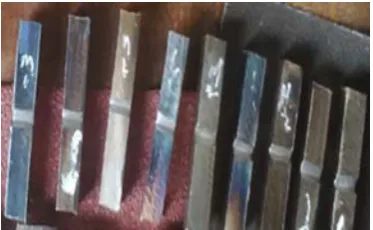
Six (6) plates measuring 304.8mm × 152.4mm × 12mm were cut to shape, bevelled and butt welded using Flux Core Arc Welding (FCAW) process, with 1.2mm diameter mild steel filler wire at varying travel speed and arc voltages using ESAB AB welding machine with serial number 917-008-3060. DCEN welding polarity was employed while the gas flow rate was kept at 20. Figure 1 shows a sample of the butt welded plate using the FCAW process.
[image:2.595.318.539.83.242.2]
Fig.1. Sample of Butt welded plate using FCAW
[image:2.595.59.259.208.363.2]The welding parameters for the three (3) categories of welds, heat inputs and welding speed are shown in tables 2 and 3. Twenty-seven (27) samples of test specimens were obtained from these welds. Nine (9) standard specimens from each weld were machined for tensile, impact and hardness tests, respectively.
Table 2: Welding Parameters for the welds.
Weld (Volts
)
Bead Number
Welding Current
(A)
Weld Time (S)
24.2
Root
Run 137 45
Hot Pass 138 52
Capping 139 55
25.3
Root
Run 140 63
Hot Pass 139 65
Capping 142 61
26.3
Root
Run 143 67
Hot Pass 143 65
[image:2.595.334.544.447.603.2]Capping 143 66
Table 3: Table of the Various Heat Inputs
Arc Voltage
(Volts)
Arc Current
(A)
Welding
Speed (mm/s)
Heat Input
(KJ/mm )
24.2 104 4.89 0.675
25.3 138 4.77 0.744
26.3 143 4.55 0.827
C. Testing Procedure
The welded specimens were subjected to the three (3) mechanical tests namely tensile, hardness and impact. The tensile test was carried out with Enerpac Tensile Testing Machine, model number EEM-421E. Brinell hardness test was done using TQ Universal Testing Machine with model number SM100 and the Impact test (Charpy) was carried out with Brooks impact testing machine with model number MAT21/1T3U. Figures 2, 3 and 4 are the specimens for the tensile, impact, and hardness test, respectively.
Fig. 2. Diagram of Tensile Test Specimen
[image:2.595.80.253.549.781.2] [image:2.595.334.521.652.767.2]Fig. 4. Hardness Test Specimen
III. RESULTS AND DISCUSSIONS
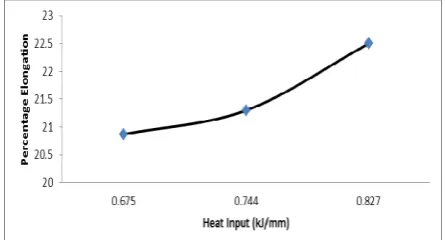
The results for tensile strength, percentage elongation, and percentage reduction of ASTM A300 are plotted in figures 5, 6 and 7, respectively. It was observed in figure 4, that increase in heat input decreases the tensile strength at the heat affected zone of the weldment. Hence, heat input has effect on the tensile strength of ASTM A300. However, the percentage elongation and reduction in area increases and the heat input increases as shown in figures 5 and 6. Also, the impact strength (toughness) and hardness of the ASTM A300 at the HAZ increases as the heat input increases as shown in figures 8 and 9.
Fig.5. Plot of Heat Input vs. Average Tensile Strength
Fig.6. Plots for Energy input vs. percentage Elongation
[image:3.595.74.281.49.153.2]Fig.7. Plots for Energy input vs. percentage Reduction in Area
Fig. 8. Plots for Energy input versus Toughness
Fig.9. Plots for Energy input vs. Hardness
To ascertain if there were variances in the test samples, the results from experiment were analysed using a 2 way ANOVA. Additionally, regression models were obtained for all the variables investigated using Microsoft excel 2010 version. From figure 5, the regression model is obtained in equation 1 as;
[image:3.595.308.545.242.376.2] [image:3.595.304.546.432.588.2] [image:3.595.45.268.638.758.2]x is the heat input (kJ/mm)
Also, the coefficient of determination R2 is 0.95, which
indicate that there is close relationship between heat input and tensile strength and that the model can adequately predict tensile stress for a given heat input. The ANOVA table for the tensile strength of the different test samples is shown in Table 4. The P-values for both the variation in heat input and variation in samples are lesser than 0.05, which means that the effect of energy input on the average tensile strength is significant.
Table 4: ANOVA analysis of the Tensile Strength for the Different test Samples
Source of
Variation SS df MS F P-value F crit
Energy Input 0.0035 2 0.0017 1.3684 0.3525 6.9442 Samples 0.0019 2 0.0009 0.7368 0.434 6.9442
Error 0.0051 4 0.0013 Total 0.0104 8
The regression and experiment plot for input energy versus average values of the impact strength (toughness) is shown in figure 8, and the regression model is given in equation 2.
Y = 87.322x - 12.075 (2) where, Y is the impact strength (toughness) in J
x is the heat input (kJ/mm)
With an R2 of 0.99, the heat input accurately predicts
[image:4.595.306.551.319.392.2]toughness value at the heat affected zone. Table 5 is the ANOVA table for the different samples investigated. It was observed that the values of toughness are affected by the input energy having P-value less than 0.05.
Table 5: ANOVA Table for the Notch Toughness Values for the Different test Samples
Source of
Variation SS df MS F P-value F crit
Energy Input 18289.6 2 9144.8 20.684 0.008 6.94 Samples 258.7 2 129.4 0.292 0.461 6.94
Error 1768.4 4 442.1 Total 20316.7 8
Also, figure 9, is the regression and plot of input energy against the average values of Brinell hardness. The regression model shown in equation 3 accurately predicts values of Brinell test, having R2 of 0.99.
Y = 52.089x + 75.136 (3) where, Y is the Brinell hardness in BHN
x is the heat input (kJ/mm)
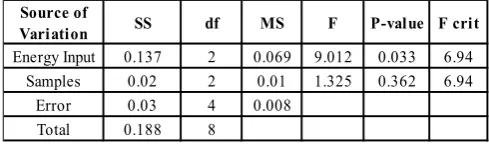
Table 6 is the ANOVA table for the Brinell hardness values. It can be deduced that the hardness of the material is affected by the input energy of the welded joint at the heat affected zone, having P-value less than 0.05.
Table 6: ANOVA Table for the Notch Toughness Values for the Different test Samples
Source of
Variation SS df MS F P-value F crit
Energy Input 0.137 2 0.069 9.012 0.033 6.94
Samples 0.02 2 0.01 1.325 0.362 6.94
Error 0.03 4 0.008
Total 0.188 8
The experimental test and analysis of variance (ANOVA) adopted in this study in assessing the impact of heat input on the mechanical properties of ASTM A300 at heat affected zone indicate that heat input could affect the mechanical properties of ASTM A300 steel.
IV. CONCLUSION
In this study, the heat input variation on the mechanical properties, namely; tensile strength, percentage elongation, percentage reduction, impact strength and hardness of ASTM A300 at the heat affected zone of welded joint has been examined. It is observed that heat input at the heat affected zone of ASTM A300 during welding could significantly affect the tensile strength, percentage elongation, percentage reduction, impact strength and hardness of ASTM A300.
REFERENCES
[image:4.595.46.292.659.733.2][2] M.I. Rafiqul, M. Ishak, M.M.Rahman. Effect of heat input on the mechanical properties of metal inert gas welded 1.6 mm thick galvanized steel sheet. 1st international conference on Mechanical Engineering Research, IOP conf. series: Material Science and Engineering 36, 2012, 012011
[3] P.S. Sheng & V.S. Joshi. Analysis of Heat-affected zone formation for laser cutting of stainless steel. Journal of Materials Processing Technology, science Direct. Volume 53, issue 3-4, 1995, pp 879-892. [4] M. Eroglu, M. Aksoy and N. Orhan. Effect of coarse initial grain size on microstructure and mechanical properties of weld metal and HAZ of a low carbon steel. Materials Science and Engineering A. 269(1): 59-66, 1999.
[5] E. Gharibshahiyan, A.H. Raouf, N. Parvin and M. Rahimian. The effect microstructure on hardness and toughness of low carbon welded steel using inert gas welding. Materials and Design. 32(4): 2042-2048, 2011.
[6] P. Karthik, Karuppuswamy and Amarnath. Comparative evaluation of mechanical properties and microstructural characteristics of 304 stainless steel weldments in TIG and SMAW welding Processes. International Journal of Current Engineering and Technology. Special Issue-2, 2014.
[7] Noor Mazni Ismail,Nurul Aida Amir Khatif, Mohamad Aliff Kamil Awang Kecik, Mohd Ali Hanafiah Shaharudin. The effect of heat treatment on the hardness and impact properties of medium carbon steel, IOP Conf. Ser.: Mater. Sci. Eng. 2016. 114 012108
[8] Q. Wang, D.L. Sun, Y. Na, Y. Zhou, X.L. Han and J. Wang. Effect of TIG Welding parameter on Morphology and mechanical properties of welded joint of Ni-base super alloy. Elsevier Journal of Procedia Engineering, pp. 10, 37-41, 2014
[9] M.F. Hasan. Analysis of Mechanical Behavior and Microstructural Characteristics Change of ASTM A-36 Steel Applying Various Heat Treatment, Journal of Material Science & Engineering, 5:227. 2016. doi:10.4172/2169-0022.1000227
[10]K. Sefcikova1, T. Brtnik, J. Dolejs, K. Keltamaki and R Topilla. Mechanical Properties of Heat Affected Zone of High Strength Steels. 2nd International Conference on Innovative Materials, Structures and TechnologiesIOP Conf. Series: Materials Science and Engineering 96, 2015. 012053 doi:10.1088/1757-899X/96/1/012053 [11]IABSE: Use and Applications of High Performance Steels for Steel
Structures pp 99–110
[12]Gresnigt A M and Steenhuis C M 1997 High Strength Steels – Construction Research Communications Limited pp 31–41
[13]Y. Sakino, Y.C. Kim. Comparison of Charpy Absorbed Energy of Heat Affected Zones in Low and High Toughness Steel. International Journal of Steel Structures. Vol. 13, Issue 1, pp 21-29, 2013 [14]Wan Shaiful Hasrizam, Wan Muda, Nurul Syahida, Mohd Nasir ,
Sarizam Mamat and Saifulnizan Jamian. Effect of Welding Heat Input on Microstructure and Mechanical Properties at Coarse Grain Heat Affected Zone of ABS Grade A Steel. 2015.