SELECTABLE INITIATION SHAPED CHARGES
A.S. Daniels*, E.L. Baker, T.H. Vuong, C.L. Chin, B.F. Fuchs, and S.E. DeFisher U.S. ARMY TACOM-ARDEC
Picatinny Arsenal, New Jersey 07806
ABSTRACT
Several initiation-based selectable detonation techniques have been developed to allow shaped charge warheads to achieve not only deep penetration, but also to exhibit enhanced lethality effects against light armored targets, geologic materials and in a variety of demolition applications. For light armor or softer targets, the lethal area can be increased by spreading penetration material over a wider area. Recently, multi-detonator initiation jet shaping procedures were applied to full-size shaped charge warheads. These warheads successfully demonstrated a significant increase in lethal area against light armor targets. This type of selective initiation was applied to conical, hemispherical and trumpet lined shaped charge warheads. Employment of these selective initiation techniques against masonry targets demonstrates the potential advantages of this technology for use in demolition and urban combat applications. Furthermore, this technology can be exploited to enhance warfighting capabilities to provide increased lethality, agility and survivability to U. S. Soldiers.
1. INTRODUCTION
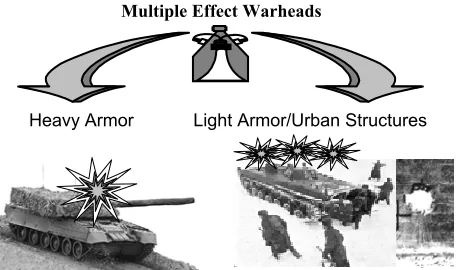
Traditionally, shaped charge technologies have been used against heavily armored targets where deep penetration over a narrow area is required. Advanced munitions such as the Future Combat System’s (FCS) Multi-Role Armament and Ammunition System (MRAAS) and Common Missile are requiring multi-purpose warheads with capabilities to defeat a variety of targets, while reducing the logistics footprint. In an effort to expand the role of conventional warheads, several initiation-based selectable detonation techniques have been developed and demonstrated to allow shaped charge warheads to achieve both deep penetration and enhanced lethal effects for light armor defeat, geologic material attack or demolition applications (Fig. 1) by dispersing penetration material over a wider area.
This multipurpose capability has significant potential advantages over single function munitions and can help increase survivability of the soldier in the field by offering improved protection against a broader range of targets with a single munition. This new increased lethality and versatility can allow the soldier to be more responsive to changing battlefield conditions. The
[image:1.612.324.552.276.411.2]soldier will not have to predetermine what mix of munitions will be required prior to mission deployment and as a result, will need to carry less ammunition to cover all firing scenarios. This makes the fighting force more deployable and more able to rapidly apply combat power in an engagement area. It also makes the fighting force more sustainable by reducing the required logistics footprint and decreasing replenishment demands.
Figure 1. Selectable-initiation warhead against multiple targets.
Previous work on Explosively Formed Penetrators and shaped charge warheads [Baker 1994, Bender 2001, Bouet 1995, Bourne 1999] has shown promising results in the area of initiation-based selectable design techniques. Additionally, multiple initiation firing set development has progressed rapidly and shows considerable promise [Baker 1997]. As a result, multi-detonator initiation jet shaping procedures were applied to large caliber tactical warheads to evaluate performance against standard targets. Although it is possible to preferentially shape jet output with both mechanical and initiation-based methods, the initiation method is advantageous due to the ability to directly control selectability through electronic fuzing options [Daniels 2000]. Mechanically based systems are potentially heavier with slower response times.
2. MULTI-POINT MODELING AND EVALUATION
The effect of multiple detonators on shaped charge jetting characteristics was both computationally and experimentally evaluated. Conical, hemispherical and
Light Armor/Urban Structures Heavy Armor
trumpet lined shaped charge warheads were selected as the test vehicles for this technology demonstration. The conical warhead is a highly characterized 81mm diameter copper lined shape charge used for warhead development work. It was loaded with Octol 70/30 high explosive in a straight cylindrical billet configuration. The hemispherical shaped charge liner was loaded with LX-14 in a standard 100mm cylindrical billet. The trumpet warhead was 125mm in diameter incorporating a highly optimized copper liner and an extremely boattailed LX-14 explosive billet, characteristic of many currently fielded weight efficient designs.
2.1 Conical Selective Initiated Shaped Charge Fan Jets
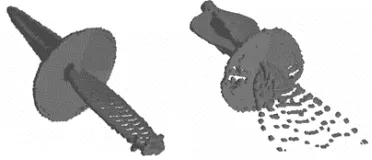
[image:2.612.355.523.160.284.2] [image:2.612.107.240.445.551.2]The conical warhead was computationally modeled using the CTH Eulerian finite difference program to determine the effects of two diametrically opposed and simultaneously fired detonators on jet characteristics. Various detonator locations were modeled along the explosive billet. When placed high on the cylindrical billet, a narrow “fan” jet was resulted. When placed at mid-billet position, a wider fan jet was produced. When the detonators were moved farther forward toward the billet base, increased dispersion of jet material predicted. Figure 2 presents the location and orientation of the detonator patterns that were selected for experimental testing. Graphical results of the three-dimensional CTH modeling are presented in figure 3. The three-dimensional modeling clearly shows the fan like nature of the jet and the resultant increase in cross sectional area over standard initiation.
Figure 2. Conical shaped charge cross section showing two detonator locations.
Figure 3. CTH results for high and low dual detonators (left and right respectively).
Warhead experimentation was done using Octol 70/30 loaded conical warheads with both the high and mid billet positioned dual initiators. Flash radiographs were taken of the resulting jets. Figure 4 presents the resulting experimental flash x-ray results. Spray angle can be seen to increase as the initiation point moves forward on the warhead.
Figure 4. Conical shaped charge jet flash x-rays.
2.2 Hemispherical Lined Warhead
Based on the success of the conical shaped charge selective initiation results, a high performance 100mm hemispherical lined shaped charge design, loaded with LX-14, was chosen for selective initiation investigation. This warhead incorporated a liner based on a hemisphere and a cylindrical explosive billet normally used in conjunction with an initiation device that generates a plane, or flat, detonation wave. The warhead was computationally modeled using the CALE arbitrary Lagrange-Eulerian high-rate finite difference program for basic jetting characteristics. The CTH Eulerian finite difference program was used for the modeling and geometry design of two diametrically opposed and simultaneously fired detonators. Figure 5 presents the baseline CALE modeling.
[image:2.612.325.558.525.574.2]20µs 40µs 60µs
Figure 5. CALE model of a baseline hemispherical shaped charge.
A final multi-point detonator configuration was developed for testing. Figure 6 presents CTH modeling results of the final dual detonator configuration.
High Mid
Spray Angle Detonator Position
Less More
2 Detonators High
[image:2.612.86.272.604.684.2]0
µ
s
4
0
µ
s
6
0
µ
s
Figure 6. Final CTH model of the dual detonator hemispherical liner.
A plastic end plate with combination booster pellet/detonator holders was manufactured to locate the dual detonators on the explosive billet surface. The hemispherical dual point warhead was test fired at a distance of three charge diameters (CD) stand-off from the target plate to characterize penetration performance. The dual detonator test fire configuration and the resulting target plate are shown in figure 7.
Figure 7. Test configuration and target plate.
2.3 Trumpet Selective Initiation Shaped Charge Fan Jets
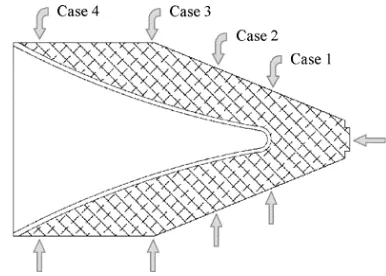
[image:3.612.80.268.79.187.2]A high performance trumpet lined shaped charge warhead was also computationally modeled using the CTH Eulerian finite difference program to determine the effects of two diametrically opposed and simultaneously fired detonators on jet characteristics. Various detonator locations were modeled along the boattail angle of the billet and at the warhead base. When placed high on the boattail portion of the billet, a narrow fan jet was produced. As the detonators were moved forward on the warhead, spray angle (and therefore lethal area) was shown to increase. Continued forward movement of the detonators showed a wider dispersion of penetrator material. Figure 8 presents the location and orientation of the detonator patterns that were down selected for comparison.
Figure 8. Dual point selectable initiation locations.
A comparison of a standard axisymmetric jet initiated along the centerline of the warhead, versus a dual detonator initiated jet is presented in figure 9. The three-dimensional model clearly shows the fan like nature of the jet and the resultant increase in cross sectional area over single centerline initiation.
[image:3.612.91.258.337.491.2]Liner Axisymmetric initiation Dual point initiation
Figure 9. Comparison of CTH predicted standard jet vs. dual point initiated fan jet.
[image:3.612.329.550.580.693.2]Two-dimensional views of the as modeled detonator locations are shown in figure 10. Spray angle can be seen to increase as the initiation point moves forward on the warhead. Case 1 shows a narrow fan jet that remains fairly solid after 35 microseconds. As the detonator location moves forward, as in cases 2 & 3, the jet becomes wider but more dispersed. In case 4, the jet shows little increase in fan width, but instead becomes more widely dispersed in the direction orthogonal to the fan.
Detonation of a warhead for use against a heavily armored target is normally initiated at the rear end of the warhead along the center axis using a single point firing train mechanism that produces an axisymmetric jet. As the selectable fan jet warheads required multiple detonation points along the boat tail explosive billet, plastic collars with combination booster pellet/detonator holders were manufactured to locate the multiple detonators on the warhead billets. Separate collars were fabricated for each of the down selected multiple initiation geometries. Extra long detonator holders were machined and loaded with PBXN-5 booster pellets. The detonator holders were bonded to the collars, and the excess was machined flush with the inside surface of the collars to provide a consistent mating surface between the billet-to-booster pellet interface. The detonators were positioned perpendicular to the surface of the explosive billet to provide a smooth transition of the detonation wave to the explosive billet.
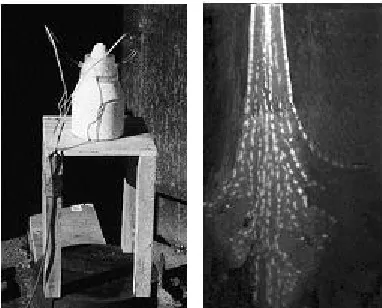
Multi-point warheads were test fired at various stand-offs from the target plate to characterize jet appearance and penetration patterns. A typical test fire configuration is shown in figure 11 along with a flash x-ray of the case 1 shot at 80 microseconds after warhead detonation.
[image:4.612.345.501.77.234.2]Figure 11. Selectable mode warhead test stand (left). X-ray of case 1 fan jet at 80 microseconds (right).
Figure 12 shows a top view of target plates for case 1 that was fired at a 3 CD stand-off. Although warhead modeling predicts a reasonably dense jet after 35 microseconds, modeling beyond this point became prohibitive due to mesh requirement, extremely long run times and the large amount of computer memory required.
Figure 12. Case 1 target plate fired at a 3CD stand-off.
When the detonators were moved forward on the boattail section of the warhead to the case 3 position, the hole width increased such that a cross or x-shaped pattern was produced in the target plate. This is illustrated in Figure 13 which shows the entrance hole for case 3 fired at 3 CD’s.
Figure 13. Case 3 entrance hole and fragment area.
3. FAN JET CONCRETE ATTACK
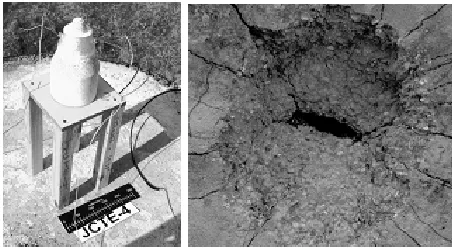
Based on the success of the selective initiation results against armor, the application of dual point selective initiation based warheads for the attack of concrete was investigated as a potential application to urban warfare. Again, the dual point trumpet shaped charge configuration case 1 was chosen for this investigation. Standard SAC-5 concrete targets were chosen for testing in order to assess fan jet concrete damage effects. The dual point selective initiation warhead was test fired at a 3 CD stand-off. Figure 14 presents a photograph of the experimental setup and the resulting concrete target face.
[image:4.612.79.270.372.526.2]Figure 14. Dual initiation shaped charge concrete experimental setup and concrete target face.
The fan jet produces a circular surface crater with a large slot type hole. The results indicate that test firing against masonry wall targets should provide quite a wide fragmentation pattern behind the wall.
CONCLUSION
In an effort to expand the role of conventional warheads, the TACOM-ARDEC Energetics and Warheads Division has developed and demonstrated several initiation-based selectable detonation techniques to allow shaped charge warheads to achieve both deep penetration and enhanced effects against light armor, geologic materials encountered in urban warfare or demolition applications. Modeling and experimentation have shown that jet output is predictable and can be varied significantly for use against a number of different target applications. For light armor or softer targets, the lethal area can be increased by spreading penetration material over a wider area. Multi-detonator initiation based jet shaping procedures were applied to conical, hemispherical and full-size trumpet shaped charge
warheads to evaluate performance against standard targets. These warheads were used to successfully demonstrate a significant increase in lethal area against light armor targets. Test firings against masonry targets demonstrated the potential advantages for demolition and urban combat targets.
REFERENCES
Baker E.L., and T. Vuong, "Massively Parallel Computation of Multimode Warhead Mechanics", Proceedings of the 19th Army Science Conference, Orlando, FL, June 1994.
Baker, E.L., Daniels, A.S., Campbell E., Homentowski, E., “Initiation Based Wave Shaping Studies”, Paper presented at Munitions Technology Symposium IV, Reno, NV, February 1997
Bender, D., R. Fong, W. Ng and B. Rice, “Dual Mode Warhead Technology for Future Smart Munitions”, Proceedings of the 19th International Symposium of Ballistics, Interlaken, Switzerland, May 2001. Bouet, T., P. Tarayre, J.P. Guillon, “Study of a
Multi-point Ignition EF”, Proceeding of the 15th International Symposium on Ballistics, Jerusalem, Israel, 21–24 May 1995.
Bourne, B., J.P. Curtis, K.G. Cowan, D. Finch and R. Barlow-Kay, “Variable Multiple Point Initiated Chemical Energy Warheads”, Proceedings of the 18th International Symposium on Ballistics, San
Antonio, TX, November 1999.