© 2011 Marty Hall
HTML:
HTML:
A Crash Course
Originals of Slides and Source Code for Examples: http://courses.coreservlets.com/Course-Materials/ajax.htmlCustomized Java EE Training: http://courses.coreservlets.com/
Servlets, JSP, JSF 2, PrimeFaces, Java 6 or 7, Ajax, jQuery, GWT, Spring, Hibernate, REST, Android. Developed and taught by well-known author and developer. At public venues or onsite at yourlocation.
© 2011 Marty Hall
For live Ajax & GWT training, see training
t htt //
l t
/
courses at http://courses.coreservlets.com/.
Taught by the author of
Core Servlets and JSP
,
More
Servlets and JSP
and this tutorial Available at public
Servlets and JSP
, and this tutorial. Available at public
venues, or customized versions can be held on-site
at your organization.
Customized Java EE Training: http://courses.coreservlets.com/
Servlets, JSP, JSF 2, PrimeFaces, Java 6 or 7, Ajax, jQuery, GWT, Spring, Hibernate, REST, Android.
y
g
•Courses developed and taught by Marty Hall
–Java 6, Java 7, intermediate/beginning servlets/JSP, advanced servlets/JSP, Struts, JSF, Ajax, GWT, custom mix of topics
•Courses developed and taught by coreservlets.com experts (edited by Marty)
Topics in This Section
•
Differences between xhtml and HTML 4
•
Differences between HTML 5 and HTML 4
•
Basic structure of an xhtml document
•
Hypertext links and URLs
•
Block-level elements
•
Inline elements
•
Tables
•
Forms
•
CSS: thumbnail overview
R f
•
References
4
© 2011 Marty Hall
Differences between
Differences between
xhtml and HTML 4
xhtml: Case
•
In HTML 4, case does not matter for tag
names, attribute names, and predefined
attribute values
BODY B d d b d i l
– <BODY>, <Body>, and <body> are equivalent
– <H1 ALIGN="..."> is equivalent to <H1 aLiGn="..."> <INPUT TYPE="TEXT"> is equivalent to
– <INPUT TYPE= TEXT > is equivalent to <INPUT TYPE="text">
•
In xhtml, use lower case for tag names,
In xhtml, use lower case for tag names,
attribute names, and predefined values
– <body>
– <h1 align="...">
– <input type="text" />
6
xhtml: Quotes
•
In HTML 4, quotes are optional if attribute
l
i
l
l h
i
l
value contains only alphanumeric values
– <H1 ALIGN="LEFT"> or <H1 ALIGN=LEFT>
– <H1 ALIGN=LEFT>
•
In xhtml, you must always use single or
In xhtml, you must always use single or
double quotes
– <h1 align="left"> or
xhtml: End Tags
• HTML 4
S i
– Some tags are containers
• <H1>...</H1>, <A HREF...>...</A>
– Some tags are standalone • <BR>, <HR>
– Some tags have optional end tags • <P>, <LI>, <TR>, <TD>, <TH>
• XHTML
– All tags are containers. End tags always required. • <p>...</p>, <li>...</li>p ... /p , li ... /li
– If there is no body content, start/end tags can be merged • <br></br> <br/>
– An IE bug prevents this for script tags. Use <script ...></script> always.bug p e e s s o sc p ags Use sc p /sc p a ays
– Some people use <br /> (space before slash) for compatibility with very old browsers. But these old browsers won't support XMLHttpRequest anyhow, so this is less important in Ajax apps.
8
xhtml: Boolean Attributes
•
In HTML 4, you can use minimized notation
f
b
l
ib
for boolean attributes
– <option value="1" selected>...</option> <dl compact>
– <dl compact>
•
In xhtml, you must write out the attribute
values
values
– <option value="1" selected="selected">...</option>
Ajax and Dynamic xhtml
•
Dynamically inserted HTML should follow
l
l
HTM
same rules as regular HTML
– Case, quotes, end tags, and boolean attributes
Wrong
•
Wrong
– document.getElementById(resultRegion).innerHTML = '<H1 ALIGN="CENTER">Some<BR>Text</H1>';;
•
Right
– document.getElementById(resultRegion).innerHTML = '<h1align="center">Some<br/>Text</h1>';
10
© 2011 Marty Hall
General Format of
General Format of
xhtml Documents
Customized Java EE Training: http://courses.coreservlets.com/
xhtml Template
• Minimal format
<!DOCTYPE html PUBLIC " //W3C//DTD XHTML 1 0 Transitional//EN" <!DOCTYPE html PUBLIC "-//W3C//DTD XHTML 1.0 Transitional//EN"
"http://www.w3.org/TR/xhtml1/DTD/xhtml1-transitional.dtd">
<html xmlns="http://www.w3.org/1999/xhtml"> <head><title>Some Title</title></head>
b d <body> ...
</body></html>
• Common format
<!DOCTYPE html PUBLIC "-//W3C//DTD XHTML 1.0 Transitional//EN" "http://www.w3.org/TR/xhtml1/DTD/xhtml1-transitional.dtd"> <html xmlns="http://www w3 org/1999/xhtml">
<html xmlns="http://www.w3.org/1999/xhtml"> <head>
<meta http-equiv="content-type" content="text/html; charset=UTF-8" />
<title>Some Title</title></head> <b d >
<body> ...
</body></html>
12
Internet Explorer Bug
•
The xhtml specification recommends an
XM d l
i
h
XML declaration at the top
<?xml version="1.0" encoding="UTF-8"?>
<!DOCTYPE html PUBLIC "-//W3C//DTD XHTML 1.0 Transitional//EN" "http://www.w3.org/TR/xhtml1/DTD/xhtml1-transitional.dtd"> <html xmlns="http://www.w3.org/1999/xhtml">
... </html> </html>
•
IE runs in "quirks" mode if DOCTYPE is not
first line of document
– So always omit XML declaration
<!DOCTYPE html PUBLIC "-//W3C//DTD XHTML 1.0 Transitional//EN" "http://www.w3.org/TR/xhtml1/DTD/xhtml1-transitional.dtd">p g <html xmlns="http://www.w3.org/1999/xhtml">
Legal DTDs
•
Transitional (non-stylesheet formatting like
f
d i
ll
d)
<font> and <i> allowed)
– <!DOCTYPE html PUBLIC "-//W3C//DTD XHTML 1.0 Transitional//EN"
"http://www.w3.org/TR/xhtml1/DTD/xhtml1-transitional.dtd">p // 3 o g/ / / / a s o a d d
•
Strict (no non-stylesheet formatting)
– <!DOCTYPE html PUBLIC "-//W3C//DTD XHTML 1.0 Strict//EN"
"htt // 3 /TR/ ht l1/DTD/ ht l1 t i t dtd"
"http://www.w3.org/TR/xhtml1/DTD/xhtml1-strict.dtd">
•
Frame (for top-level page that uses frames)
– <!DOCTYPE html PUBLIC "-//W3C//DTD XHTML 1 0 Frameset//EN" <!DOCTYPE html PUBLIC //W3C//DTD XHTML 1.0 Frameset//EN "http://www.w3.org/TR/xhtml1/DTD/xhtml1-frameset.dtd">
– Note that the pages that are the frame cells do not use this DTD.
Only the top-level page that sets up the overall layout Only the top-level page that sets up the overall layout.
14
The head and body elements
•
head
– Must contain title
– May contain the following
• meta script style base
• meta, script, style, base
•
body
– Contains main part of the pagep p g
• The part that you directly see in browser window
– Attributes
bgcolor backgro nd te t link link alink
• bgcolor, background, text, link, vlink, alink
– E.g.: <body bgcolor="blue">
– Style sheets often used instead
l d l d f bl
• onload, onunload, onfocus, onblur
© 2011 Marty Hall
HTML 5
Customized Java EE Training: http://courses.coreservlets.com/
Servlets, JSP, JSF 2, PrimeFaces, Java 6 or 7, Ajax, jQuery, GWT, Spring, Hibernate, REST, Android. Developed and taught by well-known author and developer. At public venues or onsite at yourlocation.
Overview
•
DOCTYPE and minimal document format
– Emphasis on simplicity
– Works in old browsers
• Uses conventions that browsers have already been using
• Uses conventions that browsers have already been using
– Does not strictly require the rules of XML
• But XML rules (close tags, lowercase, quotes) normally f ll d
followed
•
New input elements
– <input type="number"/> <input type="range"/>
– <input type= number />, <input type= range />, <input type="date"/> etc.
• Reverts to normal textfield in old browsers
•
Canvas and new JavaScript APIs
HTML 5 Document Format
<!DOCTYPE html>
Note the simple DOCTYPE, simplified meta tag,and omission of "type" in both the style sheet
<html lang="en">
<head>
<
t
h
t " tf 8"/>
and script references. All of those work in old, pre-HTML5 browsers.
<meta charset="utf-8"/>
<link href="css/some-stylesheet.css"
rel="stylesheet"/>
rel= stylesheet />
<script src="scripts/some-script.js"></script>
</head>
</head>
<body>
...
</body>
</html>
18
© 2011 Marty Hall
Hypertext Links and
Hypertext Links and
URLs
Customized Java EE Training: http://courses.coreservlets.com/
Hypertext Links
•
Usage
Li k i i d h i li l (i
– Links can contain images and other inline elements (i.e., <a href…> ... </a>)
•
Link to Absolute URL
– Use a complete URL beginning with http:// Java is discussed in
<a href="http://host/path/chapter2.html"> <a href http://host/path/chapter2.html > Chapter 2</a>.
•
Link to Relative URL
Link to Relative URL
– Use a filename or relative path to filename
• If no slash, interpreted wrt location of current file Java is discussed in
Java is discussed in
<a href="chapter2.html">Chapter 2</a>.
20
Hypertext Links
(Continued)
(Continued)
•
Link to Section
– Use a section name (see below) preceded by # Images are discussed in
<a href="#section2">Section 2</a>. <a href #section2 >Section 2</a>.
•
Link to Section in URL
b l l i h h i
– Use absolute or relative URL, then #, then section name Images are discussed in
<a href="chapter1.html#section2">
S ti 2 f Ch t 1 /
Section 2 of Chapter 1</a>.
•
Naming a Section
Interpreting Relative URLs
• URLs starting with http:// (absolute URLs)
I d i d d l f h URL f
– Interpreted independently of the URL of current page
• URLs starting with .
– Interpreted with respect to the directory of current filep p y
• Really with respect to the rightmost / in the URL, since URLs don't necessarily refer to real folders or files
• URLs starting with ..g
– Interpreted with respect to the parent directory of current file
• Again, based on the URL the browser sees, not necessarily the real location of the resource
• URLs starting with /
– Interpreted with respect to the hostname of the URL
Notes
• Notes
– In addition to <a href...>, these URLs can apply to img, form, script, style, and many other elements
22
Interpreting Relative URLs
(Examples)
(Examples)
• Assume URL of current page is
http //somehost com/a/b/c/d/e/f html http://somehost.com/a/b/c/d/e/f.html
Link Result
Link Result
<a href="http://otherhost.com/a/b.html"> </a>
http://otherhost.com/a/b.html ...</a>
<a href="./g.html">...</a> http://somehost.com/a/b/c/d/e/g.html
<a href="../h.html">...</a> http://somehost.com/a/b/c/d/h.html
© 2011 Marty Hall
Block-Level Elements
Block Level Elements
(Paragraph-Like Elements)
Customized Java EE Training: http://courses.coreservlets.com/
Servlets, JSP, JSF 2, PrimeFaces, Java 6 or 7, Ajax, jQuery, GWT, Spring, Hibernate, REST, Android. Developed and taught by well-known author and developer. At public venues or onsite at yourlocation.
Block-Level Elements
• Headings
h1 h6
• Lists
l
– h1 ... h6
• align attribute
• Basic Text Sections
– ol
• li
– ul
– p
– pre
• Tables
• li
– dl
• dt
Tables
– Covered later in this lecture
• Forms
• dd
• Misc.
– hr
– Covered in later lecture – div
Shared Attributes
• id
A id ifi ll d h J S i f h
– A uniqueidentifier, usually used so that JavaScript can reference the tag later.
• <div id="placeholder-for-ajax"></div>
<i t t "t t" id "fi tN Fi ld" " "/>
• <input type="text" id="firstNameField" name="..."/>
• class
– A stylesheet class name
– <p class="warning">...</p>
• style
– An inline style
– An inline style
– <p style="color: red; font-size: 18px;">Warning!</p>
• JavaScript event handlers
– onclick, onchange, ondblclick, onmousedown, onmouseup, onmouseover, onmousemove, onkeypress, onkeydown, onkeyup
• Discussed in later section on JavaScript
26
Headings
•
Heading Types
– <h1 ...> ... </h1>
– <h2 ...> ... </h2> <h3 > </h3>
– <h3 ...> ... </h3>
– <h4 ...> ... </h4>
– <h5 ...> ... </h5>
– <h6 ...> ... </h6>
•
Attributes: align
– Values: left (default), right, center
•
Nesting tags
Headings: Example
<!DOCTYPE html PUBLIC "-//W3C//DTD XHTML 1.0 Transitional//EN" "http://www.w3.org/TR/xhtml1/DTD/xhtml1-transitional.dtd">http://www.w3.org/TR/xhtml1/DTD/xhtml1 transitional.dtd > <html xmlns="http://www.w3.org/1999/xhtml">
<head><title>Headings</title> </head>
<body bgcolor="#fdf5e6"> <p>
Samples of the six heading types: </p>
</p>
<h1>Level-1 (h1)</h1>
<h2 align="center">Level-2 (h2)</h2> <h3><i>Level-3 (h3) in italics</i></h3> <h4 align="right">Level-4 (h4)</h4> <h5>Level-5 (h5)</h5>
<h6>Level-6 (h6)</h6>
</b d ></ht l> </body></html>
28
p – The Basic Paragraph
•
Attributes: align
– left (default), right, center. Same as headings.
– Whitespace ignored (use <br/> for line break)
• Consecutive <p/>’s do not yield multiple blank lines
• Consecutive <p/> s do not yield multiple blank lines
– But multiple <br/>'s do
– xhtml: End tags required
<body> <p> Paragraph 1 </p> <BODY> Paragraph 1 <P> HTML 4 </p> <p> Paragraph 2 </p> <p> Paragraph 2 <P> Paragraph 3 </BODY>
xhtml: HTML 4:
30 <p> Paragraph 3 </p> </body> /
pre: Preformatted Paragraphs
•
Characteristics
– Line wrapping disabled
– Whitespace no longer ignored Fixed width font used
– Fixed-width font used
•
Problem: Special Characters
<pre> <pre>
if (a<b) { doThis(); } else {
Desired Character Text Required
< < > >
} else { doThat(); }
> & & " " Non-breaking space
div
•
Purpose
A i f l i h bl k l l l
– A container for enclosing other block-level elements
•
Attributes
– align, style, class, idalign, style, class, id
•
Usage
– Apply alignment or styles to multiple elements
– Make a placeholder where Ajax results will be placed
• Differs from span in that span can only enclose inline elements, whereas div can enclose both block and inline
Th
•
The center tag
– <div align="center">...</div> is equivalent to <center>...</center>
• div is allowed in both xhtml transitional and strict
• center is allowed only in xhtml transitional
32
div and span: Example (Code)
<body bgcolor="#fdf5e6">
<p>Some text before the div</p> <p>Some text before the div</p>
<div style="border: inset; background-color: #cccccc;" align="center">
<h2>Using div and span</h2> <h2>Using div and span</h2> <p>A list inside the div:</p> <ol>
<li>List Item One</li> <li>List Item One</li>
<li><span style="background-color: yellow;">
List Item Two (inside span)</span></li> <li>List Item Three</li>st te ee /
</ol>
</div>
div and span: Example (Result)
34
ol: Ordered (Numbered) Lists
•
OL Element
– <ol>
<li>…</li> <li>…</li>li … /li ...
</ol>
Att ib t t t t t
– Attributes: type, start, compact
•
List items: li
Attributes: (When inside ol) value type
– Attributes: (When inside ol) value, type
<p>A sample list:</p> <ol>
Nested Ordered Lists
<h2>Block-Level Elements in xhtml</h2> <ol type="I">
<li>Headings</li>li Headings /li
<li>Basic Text Sections</li> <li>Lists
<ol type="A"> <li>Ordered
<ol type="1"> <li>Th l t <li>The ol tag
<ol type="a"> <li>type</li> <li>start</li> <li>compact</li> </ol></li> </ol></li> <li>The li tag</li> </ol></li>
<li>Unordered <ol type="1">
<li>The ul tag</li> <li>Th li t </li> <li>The li tag</li> </ol></li>
<li>Definition <ol type="1">
<li>The dl tag</li> <li>The dt tag</li> <li>The dt tag</li> <li>The dd tag</li> </ol></li>
</ol></li>
<li>Miscellaneous</li> </ol>
36
UL: Unordered (Bulleted) Lists
•
ul Element
l – <ul> <li>… <li>… ... </ul>
•
Attributes: type, compact
yp
p
– type is disc, circle, or square
•
List items: li (type)
t pe is disc circle or sq are
– type is disc, circle, or square
<p>A sample list:</p> <ul>
ul: Custom Bullets
<h2>Custom Bullets</h2> <ul type="disc">
<li>The ul tag
<ul type="circle"> <li>type
<ul type="square"> <li>disc</li> <li>disc</li> <li>circle</li> <li>square</li> </ul></li>
<li>compact</li> <li>compact</li> </ul></li>
<li>The li tag
<ul type="circle"> <li>typeyp
<ul type="square"> <li>disc</li> <li>circle</li> <li>square</li> </ul></li>
<li>value</li> </ul></li>
</ul>
38
© 2011 Marty Hall
Inline (Text-Level)
Elements
(Font-Like Elements)
(Font-Like Elements)
Customized Java EE Training: http://courses.coreservlets.com/
Inline Elements
•
Physical Character Styles
– b, i, tt, u, sub, sup, small, big, strike, s, blink
– font
• size
• size
• color
• face
b f
– basefont
– size
•
Logical Character Styles
•
Logical Character Styles
– em, strong, code, samp, kbd, dfn, var, cite
40
Inline Elements (Continued)
•
Hypertext Links
– a
• href, name, target, ...
• See earlier section on URLs and links
•
Images
– img
src (required) alt align width height hspace vspace
• src (required), alt, align, width, height, hspace, vspace, border, usemap, ismap
•
Misc. Inline Elements
( bi l d d )
– span (arbitrary style wrapped around text)
– br (explicit line break)
– area (client-side image map) l t (J )
– applet (Java)
Physical Character Styles:
Example
Example
<body bgcolor="#fdf5e6">
<h2>Physical Character Styles</h2> <h2>Physical Character Styles</h2> <b>Bold</b><br/>
<i>Italic</i><br/>
<tt>Teletype (Monospaced)</tt><br/> <u>Underlined</u><br/>
Subscripts: f<sub>0</sub> + f<sub>1</sub><br/> Superscripts: x<sup>2</sup> + y<sup>2</sup><br/> <small>Smaller</small><br/>
<small>Smaller</small><br/> <big>Bigger</big><br/>
<strike>Strike Through</strike><br/> <b><i>Bold Italic</i></b><br/>
<big><tt>Big Monospaced</tt></big><br/> <small><i>Small Italic</i></small><br/> <font color="gray">Gray</font><br/> <d l>D l t </d l><b />
<del>Delete</del><br/> <ins>Insert</ins><br/> </body>
42
Physical Character Styles:
Result
Logical Character Styles:
Example (Code)
Example (Code)
...
<h2>Logical Character Styles</h2> <h2>Logical Character Styles</h2> <em>Emphasized</em><br/>
<strong>Strongly Emphasized</strong><br/> <code>Code</code><br/>
<samp>Sample Output</samp><br/> <kbd>Keyboard Text</kbd><br/> <dfn>Definition</dfn><br/> <var>Variable</var><br/> <cite>Citation</cite><br/>
<em><code>Emphasized Code</code></em><br/>
<f t l " ">< it >G Cit ti </ it ></f t><b /> <font color="gray"><cite>Gray Citation</cite></font><br/> <acronym title="Java Development Kit">JDK Acronym</acronym> ...
44
Logical Character Styles:
Example (Result)
img: Embedding Images
•
Example
<img src="Rover.gif" alt="My Dog" width="400" height="300"/>
•
Attributes:
•
Attributes:
– src (required)
– alt (technically required)( y q )
– align (see <br clear="all"/>)
– width, height
– hspace, vspace
– border
usemap ismap
– usemap, ismap
46
Image Alignment: Example (Code)
<table border="1">
<tr><th>Alignment</th> <th>Result</th></tr>
<tr><th><code>left</code></th>
<td><img src="ajax.jpg" align="left"
alt="Ajax" width="50" height="87"/>
This positions the image at the left side,
with text flowing around it on the right.</td></tr> <tr><th><code>right</code></th>
<td><img src="ajax.jpg" align="right"
alt="Ajax" width="50" height="87"/>
This positions the image at the right side,
with text flowing around it on the left.</td></tr> <tr><th><code>top</code></th>
<td><img src="ajax.jpg" align="top"
alt="Ajax" width="50" height="87"/>
Here, the image runs into the paragraph and the line containing the image is aligned with the image top.</td></tr> ...
Image Alignment: Example (Result)
48
© 2011 Marty Hall
Tables
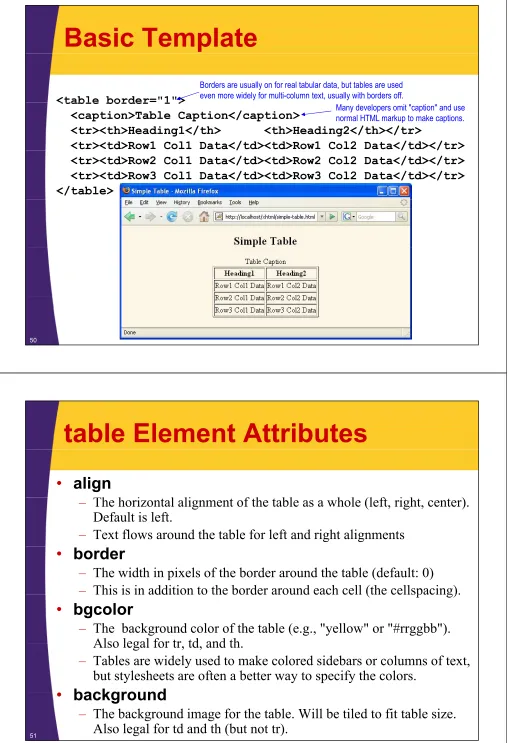
Basic Template
<table border="1">
Borders are usually on for real tabular data, but tables are used even more widely for multi-column text, usually with borders off.
<table border 1 >
<caption>Table Caption</caption>
<tr><th>Heading1</th> <th>Heading2</th></tr>
<tr><td>Row1 Col1 Data</td><td>Row1 Col2 Data</td></tr>
Many developers omit "caption" and use normal HTML markup to make captions.
<tr><td>Row2 Col1 Data</td><td>Row2 Col2 Data</td></tr> <tr><td>Row3 Col1 Data</td><td>Row3 Col2 Data</td></tr> </table>
[image:25.612.54.563.23.766.2]50
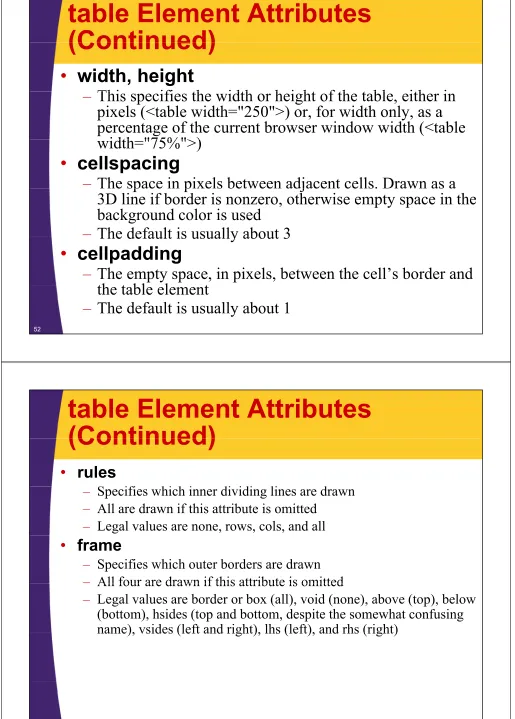
table Element Attributes
• align
Th h i l li f h bl h l (l f i h )
– The horizontal alignment of the table as a whole (left, right, center). Default is left.
– Text flows around the table for left and right alignments
• border
– The width in pixels of the border around the table (default: 0)
– This is in addition to the border around each cell (the cellspacing). ( p g)
• bgcolor
– The background color of the table (e.g., "yellow" or "#rrggbb"). Also legal for tr td and th
Also legal for tr, td, and th.
– Tables are widely used to make colored sidebars or columns of text, but stylesheets are often a better way to specify the colors.
background
• background
table Element Attributes
(Continued)
(Continued)
•
width, height
Thi ifi h id h h i h f h bl i h i
– This specifies the width or height of the table, either in pixels (<table width="250">) or, for width only, as a percentage of the current browser window width (<table
idth "75%">) width="75%">)
•
cellspacing
– The space in pixels between adjacent cells. Drawn as aThe space in pixels between adjacent cells. Drawn as a 3D line if border is nonzero, otherwise empty space in the background color is used
– The default is usually about 3The default is usually about 3
•
cellpadding
– The empty space, in pixels, between the cell’s border and
th t bl l t
the table element
– The default is usually about 1
52
table Element Attributes
(Continued)
(Continued)
• rules
S ifi hi h i di idi li d
– Specifies which inner dividing lines are drawn
– All are drawn if this attribute is omitted
– Legal values are none, rows, cols, and all
• frame
– Specifies which outer borders are drawn
– All four are drawn if this attribute is omittedAll four are drawn if this attribute is omitted
– Legal values are border or box (all), void (none), above (top), below (bottom), hsides (top and bottom, despite the somewhat confusing name), vsides (left and right), lhs (left), and rhs (right)
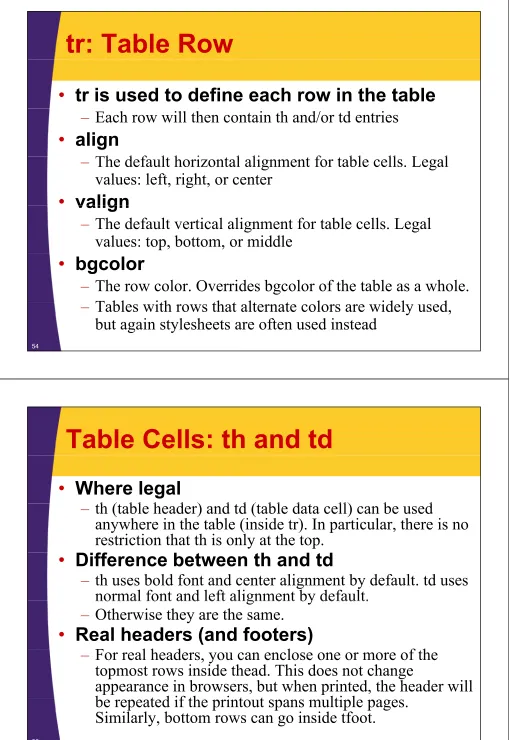
tr: Table Row
•
tr is used to define each row in the table
– Each row will then contain th and/or td entries
•
align
Th d f l h i l li f bl ll L l
– The default horizontal alignment for table cells. Legal values: left, right, or center
•
valign
valign
– The default vertical alignment for table cells. Legal values: top, bottom, or middle
•
bgcolor
– The row color. Overrides bgcolor of the table as a whole.
T bl ith th t lt t l id l d
– Tables with rows that alternate colors are widely used, but again stylesheets are often used instead
[image:27.612.52.562.17.757.2]54
Table Cells: th and td
•
Where legal
h ( bl h d ) d d ( bl d ll) b d
– th (table header) and td (table data cell) can be used
anywhere in the table (inside tr). In particular, there is no restriction that th is only at the top.
•
Difference between th and td
– th uses bold font and center alignment by default. td uses normal font and left alignment by default.
normal font and left alignment by default.
– Otherwise they are the same.
•
Real headers (and footers)
F l h d l f h
– For real headers, you can enclose one or more of the topmost rows inside thead. This does not change
appearance in browsers, but when printed, the header will
b t d if th i t t lti l
Table Cells: th and td -- Attributes
•
align
– left, right, center, justify and char.
– E.g., the following aligns entries on a decimal point
• <td align="char" char=" ">
• <td align= char char= . >
•
valign
– top, bottom, middlep, ,
•
width, height
– Values in pixels only (no percentages officially allowed)
•
bgcolor, background
– Background color and image (tiled)
•
nowrap
– Disables word wrapping. Use with caution
56
Table Cells: th and td – Attributes
(Continued)
(Continued)
•
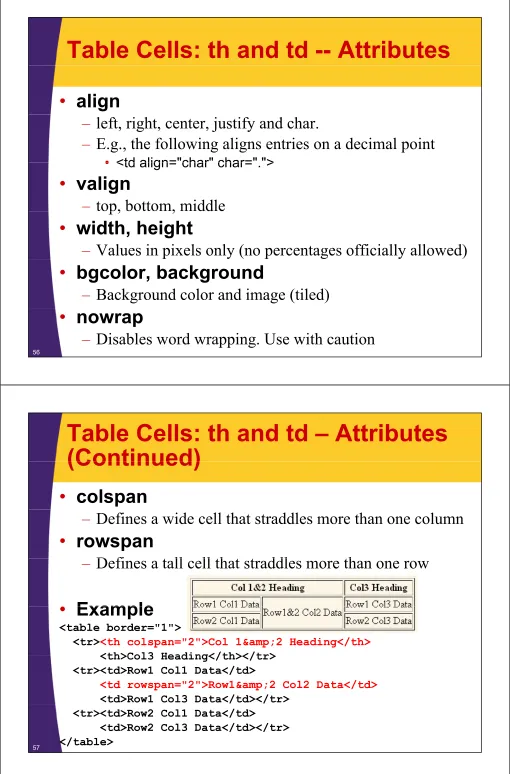
colspan
– Defines a wide cell that straddles more than one column
•
rowspan
D fi ll ll h ddl h
– Defines a tall cell that straddles more than one row
•
Example
•
Example
<table border="1">
<tr><th colspan="2">Col 1&2 Heading</th>
<th>Col3 Heading</th></tr> <th>Col3 Heading</th></tr> <tr><td>Row1 Col1 Data</td>
<td rowspan="2">Row1&2 Col2 Data</td>
<td>Row1 Col3 Data</td></tr> <tr><td>Row2 Col1 Data</td>
© 2011 Marty Hall
Forms
Customized Java EE Training: http://courses.coreservlets.com/
Servlets, JSP, JSF 2, PrimeFaces, Java 6 or 7, Ajax, jQuery, GWT, Spring, Hibernate, REST, Android. Developed and taught by well-known author and developer. At public venues or onsite at yourlocation.
The form Tag
<!DOCTYPE html PUBLIC "-//W3C//DTD XHTML 1.0 Transitional//EN" "http://www.w3.org/TR/xhtml1/DTD/xhtml1-transitional.dtd">http://www.w3.org/TR/xhtml1/DTD/xhtml1 transitional.dtd > <html xmlns="http://www.w3.org/1999/xhtml">
<head>
<title>A Sample Form Using GET</title>
You normally use a relative URL for the ACTION. This URL is just for testing because </head>
<body bgcolor="#fdf5e6"> <div align="center">
/
just for testing because I am running a test server on port 8088 that echoes the data it receives.
<h2>A Sample Form Using GET</h2>
<form action="http://localhost:8088/SomeProgram">
First name:
<input type="text" name="firstName" value="J Random"/><br/> <input type= text name= firstName value= J. Random /><br/> Last name:
<input type="text" name="lastName" value="Hacker"/><p/>
<input type="submit"/> p yp / <!-- Press button to submit form -->
</form>
GET Form: Initial Result
60
GET Form: Submission Result
(Data Sent to EchoServer)
Sending POST Data
<!DOCTYPE html PUBLIC "-//W3C//DTD XHTML 1.0 Transitional//EN" "http://www.w3.org/TR/xhtml1/DTD/xhtml1-transitional.dtd">p // g/ / / / <html xmlns="http://www.w3.org/1999/xhtml">
<head>
<title>A Sample Form Using POST</title> </head>
</head>
<body bgcolor="#fdf5e6"> <div align="center">
<h2>A Sample Form Using POST</h2>
The default method is GET. So, if a form says method="get" or it has no method at all, GET is used.
<form action="http://localhost:8088/SomeProgram"
method="post"> First name:
<input type="text" name="firstName" value="J Random"/><br/> <input type= text name= firstName value= J. Random /><br/> Last name:
<input type="text" name="lastName" value="Hacker"/><p/> <input type="submit"/> <!-- Press button to submit form --> /
</form> </div>
</body></html>
62
POST Form: Submission Result
(Data Sent to EchoServer)
(Data Sent to EchoServer)
64
Text Controls
•
Textfields
– <input type="text" name="…" …/> •value can give original value
•
Password Fields
•
Password Fields
– < input type="password" name="…" …/>
• Always use POST
•
Text Areas
– <textarea name="…"
" " l " " rows="…" cols="…"> …
</textarea>
Push Buttons
•
Submit Buttons
i " b i " /
– <input type="submit" …/>
• Use name if you have multiple buttons
• Use value to change button’s label
•
JavaScript Buttons
– <input type="button"
onclick="someJavaScriptFunction()" …/> onclick someJavaScriptFunction() …/
• Widely used with Ajax
•
Reset Buttons
<i t t " t" />
– <input type="reset" …/>
•
Fancy Buttons
– <button type="submit" ...>yp
html
</button>
66
Multiple Submit Buttons
•
Button names
– Submit buttons don’t normally need a name attribute, but if you have more than one button and want the server to identify which one was pressed, give them names
identify which one was pressed, give them names
• Used more with standard Web apps than with Ajax
Item: Item:
<input type="text" name="Item" value="4 TeraByte iPod"/> <br/>
<input type="submit" name="Add"
value="Add Item to Cart"/> <input type="submit" name="Delete"
Check Boxes
•
Format
– <input type="checkbox" name="…" …>
• Use checked="checked" to make it initially checked
• Name/value pair sent only if checkbox is checked whenName/value pair sent only if checkbox is checked when form is submitted
•
Example code
< /> <p/>
<input type="checkbox" name="noEmail" checked="checked"/> Check here if you do <i>not</i> want to
get our email newsletter get our email newsletter
•
Example result
68
Radio Buttons
•
Format
i " di " " " l " "
– <input type="radio" name="…" value="…"…>
• All radio buttons in a group should have same NAME
• Only one button in a group can be pressed; pressing a different one causes previous one to pop out
different one causes previous one to pop out
•
Example
<dl>
<dt>Credit Card:</dt> <dt>Credit Card:</dt>
<dd><input type="radio" name="creditCard" value="visa"/> Visa</dd>
<dd>…
<dd><input type="radio" name="creditCard" value="java" <dd><input type= radio name= creditCard value= java
checked="checked"/> Java Smart Card</dd>
Combo Boxes
•
Format
– select gives name
– option gives value
•
Example
Favorite language: Favorite language:
<select name="language">
<option value="c">C</option> <option value="c++">C++</option>
<option value="java" selected="selected">Java</option> <option value="javascript">JavaScript</option>
<option value="perl">Perl</option>
i l " b " b / i
<option value="ruby">Ruby</option> </select>
70
List Boxes
•
Format
– Similar to combo boxes, but specify multiple
– GiveGive sizesize if you want to seeif you want to see all entries without scrollbars
•
Example
p
Languages you know:<br/>
<select name="language" multiple="multiple" size="6"> <option value="c">C</option>
/
<option value="c++">C++</option>
<option value="java" selected="selected">Java</option> <option value="javascript">JavaScript</option>
<option value="perl" selected="selected">Perl</option> <option value= perl selected= selected >Perl</option> <option value="ruby">Ruby</option>
Grouping Form Entries:
label fieldset and legend
label, fieldset, and legend
•
label
– If you use the label tag for prompts associated with fields, clicking on the label transfers focus to the input field
– You can either use the "for" attribute or enclose the field
– You can either use the for attribute or enclose the field within the label
• <label for="fname">First name:</label>
<input type="text" name="userFirstName" id="fname"/> <input type= text name= userFirstName id= fname />
• <label>First name:
<input type="text" name="userFirstName" </label>
</label>
•
fieldset and legend
– Grouping all or part of a form inside fieldset drawsGrouping all or part of a form inside fieldset draws attention to it and separates it from the rest of the page
– Using style sheets for the legend is particularly useful
72
Grouping Form Entries:
Example
• HTML
<fieldset>
<legend>ajax:updateField</legend>
<form ...>
<label for="f">Enter temperature in Fahrenheit:</label> <input type="text" id="f"/>
<input type="button" id="convertButton" value="Convert"/> <hr width="500" align="left"/>
<label for="c">Temperature in Celsius:</label> <input type="text" id="c"/>
<l b l f "k">T t i K l i </l b l> <label for="k">Temperature in Kelvin:</label> <input type="text" id="k"/>
Other Controls and Options
•
File upload controls
– <input type="file" …/>
– Lets user select a file and send it to the server
Server side image maps
•
Server-side image maps
– User clicks on an image and form gets submitted.
– Form data gets sent asForm data gets sent as namename.xx=x-posx pos&&namename.yy=y-posy pos
•
Hidden fields
– Preset name and value sent with form submission..
•
Tab order control
– tabindex
74
© 2011 Marty Hall
Thumbnail Review
Thumbnail Review
of CSS
Customized Java EE Training: http://courses.coreservlets.com/
Loading an External Style Sheet
(Most Reusable Approach)
(Most Reusable Approach)
•
styles/my-styles.css
A complete list of the CSS 1 and CSS 2 properties (color, font-weight, etc.) can be found at http://www.w3.org/TR/CSS21/propidx.htmlp { color: blue; }
.note { font-weight: bold; background-color: red; }
my page html
•
my-page.html
<head>
<link href="styles/my-styles.css"
The type attribute is officially optional in HTML 5. In other HTML versions, although it is ignored by browsers, it should be included for HTML validators. link href styles/my styles.css
rel="stylesheet" type="text/css" /> …
</head> </head> <body>
<p>Blue text</p>p ue te t /p
<p class="note">Blue bold text with red background</p> </body>
76
Embedding a style sheet
•
Embedding an internal style sheet
<head>
<style type="text/css"> p { color: blue; }
Again, the type can be omitted in HTML5
p { color: blue; }
.note { font-weight: bold; background-color: red; } </style>y
…
</head>
•
Listing CSS styles inline
CSS Selectors
#some-id {
St l th t l t <h1id " id">
A complete list of the CSS 1 and CSS 2 selectors can be found at http://www.w3.org/TR/CSS2/selector.html
Styles that apply to <h1 id="some-id">
} p {
Styles that apply to <p>
}
.note {
Styles that apply to <div class="note">
}
p span {
p p {
Styles that apply to <p>…<span>…</span>…</p>
}
h1 h2 td li { h1, h2, td li {
Styles that apply to <h1> and also to <h2> and also to <td>…<li>…</li>…</td>
}
78
© 2011 Marty Hall
Wrapup
Customized Java EE Training: http://courses.coreservlets.com/
References
•
Books
– HTML, XHTML, and CSS, Sixth Edition
by Elizabeth Castro
– Head First HTML with CSS & XHTML – Head First HTML with CSS & XHTML
by Eric Freeman and Elisabeth Freeman
•
Online References
– xhtml specification: http://www.w3.org/TR/xhtml1/
– xhtml cheat sheet (pocket reference):
http://floele flyspray org/htmlcheatsheet pdf http://floele.flyspray.org/htmlcheatsheet.pdf
– xhtml reference: http://xhtml.com/en/xhtml/reference/
– xhtml tutorials: http://www.w3schools.com/xhtml/t tuto a s: ttp://www.w3sc oo s.co / t /
– Search on Google for "HTML tutorial[s]" and adapt syntax for xhtml (use validator to be sure)
80
Summary
•
Template
<!DOCTYPE html PUBLIC "-//W3C//DTD XHTML 1.0 Transitional//EN" "http://www.w3.org/TR/xhtml1/DTD/xhtml1-transitional.dtd"> <html xmlns="http://www.w3.org/1999/xhtml">
<head><title>Some Title</title></head> <head><title>Some Title</title></head> <body>
...
</body></html>
•
Differences from HTML 4
– Use lowercase for tag names, attribute names, predefined tt ib t l (<h1 li " t ">)
attribute values (<h1 align="center">)
– Always include end tags (<p></p> or <p/>)
© 2011 Marty Hall
Questions?
Customized Java EE Training: http://courses.coreservlets.com/