A Novel Method for Islanding Detection of
Distribution System With Distributed
Generation
Pedapudi Sushma1
PG Student, Dept. of EEE, RVR&JC College of Engineering, Chowdavaram, Guntur, AP, India1
ABSTRACT: The advancement in new technology like fuel cell, wind turbine, photo voltaic and new innovation in power electronics, customer demands for better power quality and reliability are forcing the power industry to shift for distributed generations. Hence distributed generation (DG) has recently gained a lot of momentum in the power industry due to market deregulations and environmental concerns. Islanding occurs when a portion of the distribution system becomes electrically isolated from the remainder of the power system yet continues to be energized by distributed generators. An important requirement to interconnect a DG to power distributed system is the capability of the DG to detect islanding detection. Failure to trip islanded generators can lead to a number of problems to the generators and the connected loads. The current industry practice is to disconnect all distributed generators immediately after the occurrence of islands. Typically, a distributed generator should be disconnected within 100 to 300 ms after loss of main supply. To achieve such a goal, each distributed generator must be equipped with an islanding detection device, which is also called anti islanding devices like vector surge relay and ROCOF relay.
KEYWORDS: Pv, Distributed generation, Islanding detection, Active methods, and Passive methods.
I. INTRODUCTION
As per IEEE STD 1547-2003 [1], distributed generation is defined as electric generation facilities connected to power systems through a point of common coupling (PCC). In the early days of electricity, there were no inter-connected grids. Electric power was produced close to the point of consumption [8]. So, the electric power industry originally started off using distributed generation. Later on, with the emergence of new technologies, power was produced at one location and was transmitted over long distances at a high voltage to the consumers. This led to a reduction in the per unit cost of power. It also led to a higher reliability of supply since the failure of one unit in a large interconnected system didn’t have a significant effect on the whole system. By the beginning of twentieth century, the backbone of the electric power industry consisted of large power industries dispersed all over the country, with each local company having a monopoly over the geographical region of operation [2].
Figure 1. Classification of distributed generators.
Of all the available DG technologies, due to their higher efficiencies, fuel cells and micro turbines have been receiving the highest research attention.
The availability of a wide variety of DG technologies gives the customers a wide range of combinations of cost and reliability [3]. For instance if a customer such as a ranch owner is located far from the utility supply, then the cost of getting a DG of his own would be lower than paying for a line to be laid out till the ranch. In this circumstance DG would be a viable option if reliability of the supply is not an issue. On the other hand for institutions, like hospitals, where reliability of supply is very critical, DGs can be used as back up supply to increase the reliability of supply at an increased capital cost. Apart from the aforementioned, DGs offer perks such as clean power, ancillary benefits and national security advantages.
In this paper, a novel hybrid islanding detection technique is proposed which integrates both the active and passive techniques to minimize their drawbacks. This method is based on measurement of rate of change of voltage and injection of disturbance current signal into the system. If rate of change of voltage exceeds threshold value, the disturbance current is applied to d-q current controller across direct axis which modulates the voltages and frequency at point of common coupling (PCC).
If islanding is occurred, output voltage and frequency changes from their allowable limits and under/over frequency or voltage relays are used to detect islanding. MATLAB software is used to simulate test system under study to show the effectiveness of proposed methodology for different islanding and non-islanding conditions
II. PROPOSEDMETHODOLOGY
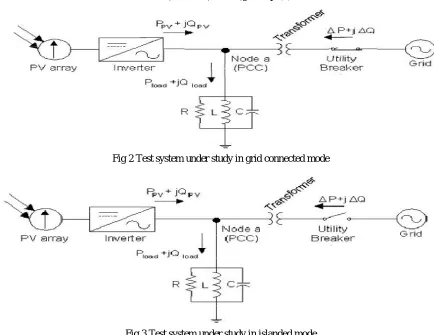
power system model with DG in which proposed methodology is tested. Fig(1a) shows the system in grid connected mode. Active and reactive power consumed by the load in this mode is given by the following equ(1) and (2).,
PLoad = PDG + Pgrid Equ. (1) QLoad = QDG + Qgrid Equ.(2)
Fig 2 Test system under study in grid connected mode
Fig 3 Test system under study in islanded mode
Islanded mode of operation is shown in above fig.
The block diagram of d-q current controller of the DG is shown in the fig.(2). Three important parts are phase-locked loop (PLL), outer power control loop and the inner current control loop. Active and reactive power of DG is independently control by using d-q synchronous reference frame. The Park’s transformation is used for this purpose. Inverter switching signal is determined by the magnitude and angle of the modulating signal. When system is islanded, there may be active power mismatch (ΔP) between active power of DG and load. Hence,
(ΔP = PLoad − PDG = PGrid )
is not zero which results in increase or decrease in the value of PCC voltage. So continuous monitoring and measuring of instantaneous voltage and frequency is necessary. The amount of voltage deviation (ΔV) depends on the value of ΔP. According to IEEE Std.929 and IEEE Std.1547, the voltage thresholds are typically set at 88% and 110%
of the rated voltage value [8]. After measuring the instantaneous voltage calculate rate of change of voltage by using equ. (3)
ROCOV= dV/dt equ. (3)
If this value is within threshold value, then system is grid connected but if it’s value exceeds the threshold value, then third harmonic of output current is injected as a disturbance signal into the system through d-q current controller. If system is grid connected then disturbance signal flows into the low impedance path offered by utility and doesn’t change the system parameter significantly. When system is islanded, disturbance signal affects the system parameter such as voltage and frequency. Their values exceed from their allowable limits and islanding is easily and accurately detected by using over/under voltage or over/under frequency relays. The flow chart of the proposed methodology is shown in fig. (3)
III. SIMULATION RESULTS
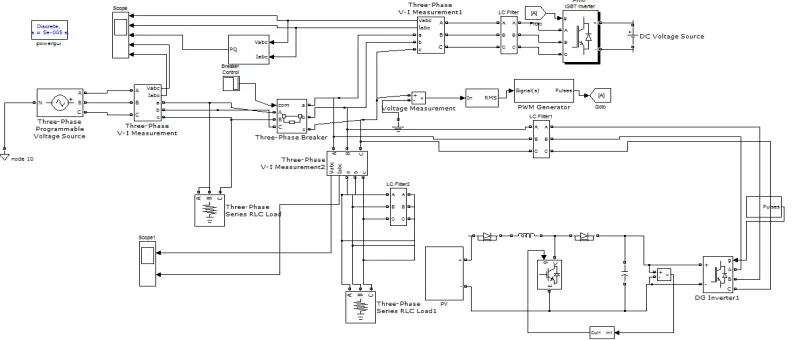
To show effectiveness of the proposed methodology, different islanding non-islanding conditions are simulated in MATLAB software. The below shown fig is the simulation circuit of the proposed system in this for the islanding detection method is founding with the help of circuit breaker in that the circuit breaker is due the parameters values the switch is in on position the system is in grid connected operation , if the circuit breaker is in open the system is in islanding mode.
Fig 6 simulation diagram of the islanding detection method without distributed generation system
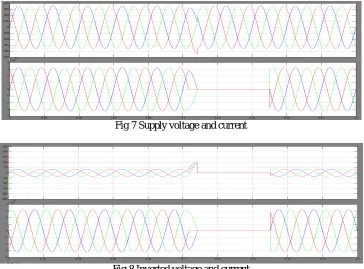
Fig 7 Supply voltage and current
Fig 9 Load voltage and load current
Fig10 Real and reactive power
Above shown figs are the output wave forms of the islanding system without distributed generation fig 7 is the input voltage and input current waveforms, fig inverted voltage and current waveforms ,fig 9 describes the load voltage and load current waveforms of the system without distributed power generation, fig 10 is the active and reactive power waveforms of the conventional system. The islanding detection is based on the circuit breaker the islanding mode is 0.1 to 0.15s.
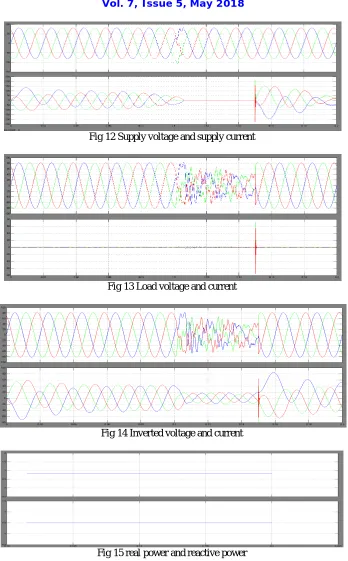
Fig 12 Supply voltage and supply current
Fig 13 Load voltage and current
Fig 14 Inverted voltage and current
Fig 15 real power and reactive power
describes the inverted voltage and current wave forms and the final wave form fig 15 is the real power and reactive power waveforms. The islanding detection is based on the circuit breaker at the time interval of the 0.1 t0 0.15s.
IV. CONCLUSION
In this paper a new methodology is proposed for islanding detection. This is based on rate of change of voltage (passive) and injection of disturbance current signal through current controlled VSC (active).one test system is simulated in MATLAB/SIMULINK software with various loading conditions for islanding and non-islanding such as capacitor switching, I.M starting etc situations. This hybrid methodology integrates both the active and passive techniques and from the results drawn in MATLAB, we can say that this methodology can discriminate islanding and non-islanding situations effectively and accurately.
REFERENCES
[1] S.Shrivastava, S.Jain, R.K.Nema, “A proposed hybrid method for islanding detection”, International journal of Engg. science and technology Vol.2(5),2010,813-817
[2] M.A.Razek, R.A.Swief, M.A.Badr, “Investigation of active and passive detection techniques”, International journal on power Engg. and energy (2314-7318)
[3] Noradin Ghadimi, Rasoul Ghadini and Akabar Danandeh, “A novel islanding detection algorithm based on combined of acive-passive techniques”, world applied science journal 16(3):389-396,2012
[4] Pukar Mahat, Zhe Chen and Birgitte Bak-Jensen, “A hybrid islanding detection technique using average rate of voltage change and real power shift”, PSO program project 2006-1-6316
[5] Hazlie Mokhils, Mahzahr Karimi, Amidaddin Shahriari, “Anew under frequency load shedding scheme for islanded distribution network”, IEEE innovative smart grid technologies,ppl-6,Feb2013
[6] Pukar Mahat, “control and operation of islanded distribution system” in proc.2010 Denmark
[7]Jae-Hyung Kim,Jun-Gu Kim,Young-Hyok Ji,Young-Chae Jung and Chung-Youn Won, “An islanding detection method for a grid connected system based on Goerttzel algorithm” IEEE trans. On power electronics vol.26 No.4,pp.1049-1055,April 2011