Everlasting Multi-Party Computation
∗Dominique Unruh
University of Tartu, Estonia
August 23, 2013
Abstract. A protocol has everlasting security if it is secure against adversaries that are computationally unlimitedafter the protocol execution. This models the fact that we cannot predict which cryptographic schemes will be broken, say, several decades after the protocol execution. In classical cryptography, everlasting security is difficult to achieve: even using trusted setup like common reference strings or signature cards, many tasks such as secure communication and oblivious transfer cannot be achieved with everlasting security. An analogous result in the quantum setting excludes protocols based on common reference strings, but not protocols us-ing a signature card. We define a variant of the Universal Composability framework, everlasting quantum-UC, and show that in this model, we can implement secure com-munication and general multi-party computation using signature cards as trusted setup.
Contents
1 Introduction 2
2 Preliminaries 7
3 Everlasting Quantum UC 9
3.1 The basic model . . . 9 3.2 Ideal functionalities . . . . 12 3.3 Elementary properties of UC 14 3.4 Universal composition . . 16
4 Impossibilities 18
4.1 Classical impossibilities . 18 4.2 Quantum impossibilities . 22
5 Everlasting QKD 27
6 Everlasting 2-party computation 29
6.1 Protocol description and proof 34 6.2 Two-party computation . 45 6.3 Improvements & future work 46
References 47
Symbol index 50
Index 52
∗
1
Introduction
Everlasting security. Computers and algorithms improve over time and so does the ability of an adversary to break cryptographic complexity assumptions and protocols. It may be feasible to make a good estimate as to which computational problems are hard
today, and which encryption schemes unbroken. But it is very difficult to make more than an educated guess as to which cryptographic schemes will be secure, say, ten years from now. Key length recommendations (e.g., [ECR11, NIS11, BB11]) can only be made based on the assumption that progress continues at a similar rate as today; unexpected algorithmic progress and future technologies like quantum computers can render even the most paranoid choices for the key length obsolete.
This situation is very problematic if we wish to run cryptographic protocols on highly sensitive data such as medical or financial data or government secrets. Such data often has to stay confidential for many decades. But an adversary might intercept messages from a protocol that is secure today, store them, and some decades later, when the underlying cryptosystems have been broken, decrypt them. For highly sensitive data, this would not be an acceptable risk.
One way out is to use protocols with unconditional (information-theoretical) security that are not based on any computational hardness assumptions. For many tasks, however, unconditionally secure protocols simply do not exist (in particular if we cannot assume an majority of honest participants). A compromise is the concept ofeverlasting security. In a nutshell, a protocol is everlastingly secure if it cannot be broken by an adversary that becomes computationally unlimited after the protocol execution. This guarantees that all assumptions need only to hold during the protocol execution, sensitive data is not threatened by possible future attacks on today’s schemes. We only need to reliably judge thecurrent state of the art, not future technologies.
Unfortunately, also for everlasting security, we have strong impossibility results. It is straightforward to see that everlastingly secure public key encryption is not possible, symmetric encryption needs keys as long as the transmitted messages, and most secure multi-party computations (MPC) are impossible (e.g., oblivious transfer, see Section 4).
evaluations (Lo [Lo97]). So the goal to get unconditionally secure MPC is not achievable, even with quantum cryptography.
Also, the usefulness of QKD has been challenged (e.g., by Bernstein [Ber09], who also raises other concerns than the following). To run a QKD protocol, an authenticated channel is needed. But how to implement such a channel? If we use a public key infrastructure for signing messages, we lose unconditional security and thus the main advantage of QKD. If we use shared key authentication, a key needs to be exchanged beforehand. (And, if we exchange an authentication key in a personal meeting, why not just exchange enough key material for one-time pad encryption – storage is cheap.)
Everlasting quantum security. A simple change of focus resolves the problems de-scribed in the previous paragraph. Instead of seeing the goal of quantum cryptography in achieving unconditional security, we can see it as achieving everlasting security. For example, if we run a QKD protocol and authenticate all messages using signatures and a public key infrastructure, then we do not get an unconditionally secure protocol, but we do get everlasting security: only the signatures are vulnerable to unlimited adversaries, but breaking the security of the signatures after the protocol execution does not help the adversary to recover the key. (Experience and the discussion on composition below show that one has to be careful: we need to check that signatures and QKD indeed play together well and compose securely. We answer this positively in Section 5: we achieve everlastingly secure universally composable security.)
What about secure MPC? Recall that for constructing unconditionally secure MPC in the quantum setting, the only missing ingredient was a commitment. Once we have a commitment, unconditionally secure MPC protocols exist [Unr10]. Unconditionally se-cure commitments do not exist, but everlastingly sese-cure ones do! Consider a statistically hiding commitment. That is, the binding property may be subject to computational assumptions, but the hiding property holds with respect to unlimited adversaries. Such a scheme is in fact everlastingly secure. Being able to break the binding property of a commitment after the protocol end is of no use – the recipient of the commitment is not listening any more. And the hiding property, i.e., the secrecy of the committed data, holds forever. So a statistically hiding commitment is in fact everlastingly secure. It seems that we have all ingredients for everlastingly secure quantum MPC. The next paragraph, however, shows that the situation is considerably more subtle.
We stress that the neither the concept of everlasting security nor the idea of combining it with quantum cryptography is original to this paper. For example, [ABB+07] already suggested to combine QKD with computational authenticated, albeit without proof or analysis of composition problems.
that this reasoning is wrong! Lo’s impossibility of OT [Lo97] can be easily modified to show that unconditional OT is impossible, even if we consider only passive (semi-honest) adversaries. But everlasting security implies unconditional security against passive ad-versaries: A passive adversary is one that during the protocol follows the protocol (and thus in particular is computationally bounded) but after the protocol may perform un-limited computations. Thus Lo’s impossibility excludes the existence of everlastingly secure OTs.
What happened? The problem is that although statistically hiding commitments are everlastingly secure on their own, they lose their security when composed. Composition problems are common in cryptography, but we find this case particularly instructive: The commitment does not lose its security only when composed with some contrived protocol, but instead in a natural construction. And not only does a particular construction break down, we are faced with a general impossibility. And the resulting protocol is insecure in a strong sense: an unlimited adversary can guess either Alice’s or Bob’s input. (As opposed to a situation where the “break” consists solely of the non-existence of a required simulator.)
One may be tempted to suggest that the failure is not related to the everlasting se-curity, but to the non-composability of the commitments. Damg˚ard and Nielsen [DN02] present commitment schemes that are universally composable (we elaborate on this no-tion below, it is a security nono-tion that essentially guarantees “worry-free” composino-tion), that only need a predistributed common reference strings (CRS), and that are statisti-cally hiding.1 Yet, when using these commitments to get everlastingly secure OT, we run into the same problem again: We would get an everlastingly secure OT using a CRS, but a generalization of Lo’s impossibility shows that no everlastingly secure OT protocols exist even given a CRS (see Section 4).2
Quantum everlasting universal composability. The preceding paragraph shows that, in the setting of everlasting security, it is vital to find definitions that guarantee composability. One salient approach is the Universal Composability (UC) framework by Canetti [Can01]. In the UC framework, we compare a protocol π against a so-called ideal functionality F which describes what π should ideally do. (E.g., F could be a commitment functionality that registers the value Alice commits to, but forwards it to Bob only when Alice requests an open.) We sayπ UC-emulates F if for any adversary Adv (that attacksπ) there is a simulator Sim (that “attacks”F) we have that no machine
Z (the environment) can distinguish π running with Adv (real model) from F running with Sim (ideal model). The intuition behind this is that Adv can perform only attacks that can be mimicked by Sim. Since F is secure by definition, Adv can perform no “harmful” attacks. A salient property of the UC framework is that UC secure protocols
1The schemes given in [DN02] were only shown secure classically. But we think it likely that similar
protocols can be constructed in the quantum setting, too.
2That Damg˚ard and Nielsen’s commitment does not compose well in an everlasting security setting
can be composed in arbitrary ways (universal composition). By tweaking the details of the definition, we get various variants of UC: If Z, Sim, Adv are polynomial-time, we have computational UC. If they are unlimited, statistical UC (modeling unconditional security). Unlimited quantum machines lead to the definition of statistical quantum-UC [Unr10].
M¨uller-Quade and Unruh [MQU10] showed that the UC framework can also be adapted to the setting of everlasting security: We quantify over Z, Sim, Adv that are polynomial-time, but we say thatZdistinguishes the real and ideal model if the distribu-tion ofZ’s output is notstatistically indistinguishable. That is, a protocol is considered insecure if one can distinguish real and ideal model when being polynomial-time during the protocol, but unlimited afterwards (statistical indistinguishability means that no
unlimited machine can distinguish).
The ideas from [MQU10] can be easily adapted to the quantum case. In Section 3, we introduce everlasting quantum UC (eqUC). HereZ, Sim, Adv are quantum-polynomial-time machines (representing the fact that adversaries are limited during the protocol run), but we require that the quantum state output byZ in the real and ideal model is trace-indistinguishable (two quantum states are trace-indistinguishable if no unlimited quantum machine can distinguish them). The eqUC security notion inherits all com-posability properties from the UC notion. Also, protocols that are secure with respect to statistical classical or statistical quantum UC are also eqUC-secure. In particular, known quantum protocols for constructing MPC from commitments [Unr10] are also eqUC secure.3 Thus, if we find an eqUC-secure commitment protocol, we immediately get eqUC-secure MPC protocols by composition.
Everlasting quantum-UC commitments. The problem of everlasting UC commit-ments in the classical setting was already studied in [MQU10]. Their protocol uses a signature card as trusted setup.4 Here a signature card is a trusted device (modeled as a functionality) such that the owner of the card can sign messages, everyone can access the public key, and no-one (not even the owner) can get the secret key.5 Their protocol is, however, only known to be secure in the classical setting. In fact, when we try to prove the protocol secure in a quantum setting, we stumble upon an interesting difficulty in the interplay of zero-knowledge proofs of knowledge and signature schemes.
A core step in the protocol is that Alice performs a proof of knowledge P showing that she knows a certain signatureσ. In the security proof, we then show that Alice must have obtainedσ from the signature card: Assume Alice successfully performsP without requesting σ first. Since P is a proof of knowledge, there is an extractor E (using Alice and indirectly the signing oracle as a black box) that returns a valid witness, i.e., the
3Note that the definition of statistical UC requires the simulator to be polynomial-time if the adversary
is, hence the implication from statistical quantum UC to eqUC is trivial. And statistical classical UC implies statistical quantum UC by [Unr10].
4It is impossible to construct UC commitments without using some trusted setup such as a CRS
[CF01]. [MQU10] shows that for everlasting UC, even a CRS is not sufficient.
signatureσ. SinceE returns the signature without requesting it from the signing oracle, we have a contradiction to the unforgeability of the signature scheme.
It seems that the same reasoning applies against quantum adversaries if we use quantum proofs of knowledge instead. Unfortunately, this is not the case. In a quantum proof of knowledge (as defined by Unruh [Unr12]), an extractor with black box access to the prover executes both the prover (modeled as a unitary operation) as well as its inverse (i.e., the inverse of that unitary). This is the quantum analogue of classical rewinding.
So the extractor E will invoke not only the signing oracle, but also its inverse! But unforgeability will not guarantee that there are no forgeries when the adversary accesses the inverse of the signing oracle. Hence the security proof fails.
To avoid this problem, we need a new protocol which does not require rewinding in the same places of the security proof where we use the unforgeability of the signature scheme. We present such a protocol; it is considerably more involved than the one from [MQU10]. We believe that our approach is of independent interest because it shows one way around the limitations of quantum proofs of knowledge.
Bounded quantum storage model. We quickly compare the concept of everlasting security in this paper with the bounded quantum storage model (BQSM; [DFSS05]). The BQSM achieves very similar goals. Security in the BQSM guarantees that the protocol cannot be broken by an adversary that has limited quantum memory during the protocol execution and unlimited quantum memory after the execution. The BQSM is thus analogous to everlasting security as discussed here, except that it considers quantum memory where we consider computational power. The advantage of the BQSM over our model is that when using a BQSM protocol, we only need to make assumptions about the power of the adversary (its quantum memory). In contrast, in our model we need to assume that the computational power is limitedand that certain mathematical problems are hard. In our view, the main disadvantage of the BQSM is that it might be useful only for a limited time: currently, we may assume a small limit on the adversary’s quantum memory. Should quantum technology advance, though, quantum memory might become cheap, and at that point BQSM protocols must not be used any more. In contrast, with everlasting security as in this paper, if an assumption we use in a protocol is broken, it is likely that there still are other assumptions that can be used – we can then fix the protocol by switching the underlying problem. Also, BQSM protocol tend to have a high communication complexity, and composition is more involved (in particular when we wish for universal composability [Unr11]). Then again, our approach requires trusted setup (signature cards). An interesting goal would be protocols that are simultaneously secure in our model and the BQSM.
bounded storage.
Further related work. [CDMS04] also considers the problem of using an uncondi-tionally hiding computauncondi-tionally binding commitment to construct a quantum OT (as opposed to using directly a functionality). They show that with such a commitment, OT can be realized (no impossibility results are given). However, their OT protocol only computationally hides the sender’s inputs (although one may be tempted to assume otherwise as the commitments that are used are unconditionally hiding). In fact, our impossibility results imply that their OT cannot be everlastingly secure.
Organization & contribution. In Section 3 we present the everlasting quantum UC model and the corresponding composition theorem. In Section 4 we show the impossi-bility of everlastingly secure OT in the classical and the quantum setting using various functionalities. In Section 5 we show that using signature cards or a public key infras-tructure, an everlastingly quantum-UC-secure secure channel can be implemented. In Section 6 we show how to implement arbitrary everlastingly quantum-UC-secure multi-party computation using signature cards.
2
Preliminaries
General. A nonnegative functionµis called negligible if for allc >0 and all sufficiently large k,µ(k) < k−c. A nonnegative functionf is called overwhelming if f ≥1−µ for
some negligible µ. Keywords in typewriter font (e.g., environment) are assumed to be fixed but arbitrary distinct non-empty words in {0,1}∗. ε∈ {0,1}∗ denotes the empty
word. Given a sequencex=x1, . . . , xn, and a setI ⊆ {1, . . . , n},x|I denote the sequence
x restricted to the indicesi∈I.
Quantum systems. We can only give a terse overview over the formalism used in quantum computing. For a thorough introduction, we recommend the textbook by Nielsen and Chuang [NC00, Chap. 1–2]. A (pure) state in a quantum system is described by a vector|ψiin some Hilbert space H. In this work, we only use Hilbert spaces of the form H =CN for some countable set N, usually N ={0,1} for qubits or N ={0,1}∗
for bitstrings. We always assume a designated orthonormal basis {|xi:x∈N} for each Hilbert space, called the computational basis. The basis states |xi represent classical states (i.e., states without superposition). Given several separate subsystems H1 =
CN1, . . . ,H
n=CNn, we describe the joint system by the tensor productH1⊗ · · · ⊗ Hn=
CN1×···×Nn. We writehΨ|for the linear transformation mapping|Φito the scalar product
hΨ|Φi. Consequently,|ΨihΨ|denotes the orthogonal projector on|Ψi. We set|0i+ :=|0i,
|1i+ := |1i, |0i× := √12(|0i+|1i), and |1i× := √12(|0i − |1i). For x ∈ {0,1}n and
Mixed states. If a system is not in a single pure state, but instead is in the pure state
|Ψii ∈ H with probability pi (i.e., it is in a mixed state), we describe the system by a
density operator ρ =P
ipi|ΨiihΨi| over H. This representation contains all physically
observable information about the distribution of states, but some distributions are not distinguishable by any measurement and thus are represented by the same mixed state. The set of all density operators is the set of all positive6 operatorsH with trace 1, and is denoted P(H). Composed systems are descibed by operators in P(H1 ⊗ · · · ⊗ Hn).
In the following, when speaking about (quantum) states, we always mean mixed states in the density operator representation. A mapping E : P(H1) → P(H2) represents a physically possible operation (realizable by a sequence of unitary transformations, mea-surements, and initializations and removals of qubits) iff it is a completely positive trace preserving map.7 We call such mappings superoperators. The superoperator Em
init on P(H) with H := C{0,1}∗
and m ∈ {0,1}∗ is defined by Em
init(ρ) := |mihm| for allρ. By
TD(ρ, ρ′) we denote the trace distance betweenρ and ρ′. Intuitively, the trace distance is the probability with which an unlimited distinguisher can distinguishρ and ρ′ with a
single measurement.
Composed systems. Given a superoperator E on P(H1), the superoperator E ⊗id operates on P(H1 ⊗ H2). Instead of saying “we apply E ⊗id”, we say “we apply E to
H1”. If we say “we initialize H withm”, we mean “we apply Einitm to H”. Given a state
ρ∈ P(H1⊗ H2), letρx:= (|xihx| ⊗id)ρ(|xihx| ⊗id). Then the outcome of measuringH1 in the computational basis isxwith probability trρx, and after measuringx, the quantum
state is ρx
trρx. Since we will only perform measurements in the computational basis in
this work, we will omit the qualification “in the computational basis”. The terminology in this paragraph generalizes to systems composed of more than two subsystems.
Classical states. Classical probability distributionsP :N → [0,1] over a countable set N are represented by density operators ρ ∈ P(CN) with ρ = P
x∈NP(x)|xihx|
where {|xi} is the computational basis. We call a state classical if it is of this form. We thus have a canonical isomorphism between the classical states over CN and the
probability distributions over N. We call a superoperator E : P(CN1) → P(CN2)
classical iff if there is a randomized function F : N1 → N2 such that E(ρ) = P
x∈N1
y∈N2
Pr[F(x) = y]· hx|ρ|xi · |yihy|. Classical superoperators describe what can be
realized with classical computations. An example of a classical superoperator on P(CN)
is Eclass : ρ 7→ P
xhx|ρ|xi · |xihx|. Intuitively, Eclass measures ρ in the computational
basis and then discards the outcome, thus removing all superpositions from ρ.
6We call an operator positive if it is Hermitean and has only nonnegative eigenvalues.
7A mapE is completely positive iff for all Hilbert spacesH′
, and all positive operatorsρonH1⊗ H′,
3
Everlasting Quantum UC
We now present our everlasting quantum-UC-framework. Our definition is based on the modeling of UC in the quantum case from [Unr10]. For a reader familiar with their definition: The new concepts in this section are the definition of QExec (page 10), of trace-indistinguishability (page 10), and of everlasting quantum-UC (Definition 3).
3.1 The basic model
Machine model. A machine M is described by an identity idM in {0,1}∗ and
a sequence of superoperators EM(η) (η ∈ N) on Hstate ⊗ Hclass ⊗ Hquant with
Hstate,Hclass,Hquant := C{0,1}∗
(the state transition operators). The index η in EM(η)
denotes the security parameter. The Hilbert space Hstate represents the state kept by
the machine between invocations, and Hclass and Hquant are used both for incoming
and outgoing messages. Any message consists of a classical part stored in Hclass and a
quantum part stored inHquant. If a machineid
sender wishes to send a message with
clas-sical partm and quantum part |Ψi to a machineidrcpt, the machine idsender initializes Hclass with (id
sender,idrcpt, m) and Hquant with |Ψi. (See the definition of the network
execution below for details.) The separation of messages into a classical and a quantum part is for clarity only, all information could also be encoded directly in a single register. If a machine does not wish to send a message, it initializes Hclass and Hquant withε.
A network N is a set of machines with pairwise distinct identities containing a ma-chine Z with idZ = environment. We write idsN for the set of the identities of the machines in N.
We call a machine M quantum-polynomial-time if there is a uniform8 sequence of quantum circuitsCksuch that for allk, the circuitCkimplements the superoperatorEM(η).
Network execution. The state spaceHN of a networkNis defined asHN:=Hclass⊗ Hquant ⊗N
id∈idsNH
state
id with Hidstate,Hclass,Hquant := C{0,1}
∗
. Here Hstate
id represents
the local state of the machine with identityid and Hclass andHquant represent the state
spaces used for communication. (Hclass and Hquant are shared between all machines.
Since only one machine is active at a time, no conflicts occur.)
A step in the execution of N is defined by a superoperator E := EN(k) operating on HN. This superoperator performs the following steps: First, E measures Hclass in
the computational basis and parses the outcome as (idsender,idrcpt, m). Let M be the
machine in N with identity idrcpt. Then E applies E( η)
M to Hstateidrcpt ⊗ H
class ⊗ Hquant.
Then E measuresHclass and parses the outcome as (id′
sender,id′rcpt, m′). If the outcome
could not be parsed, or ifid′sender 6=idrcpt, initialize Hclass with (ε,environment, ε) and Hquant withε. (This ensures that the environment is activated if a machine sends no or
an ill-formed message.)
8A sequence of circuitsC
k is uniform if a deterministic Turing machine can output the description
The output of the networkNon inputzand security parameterηis described by the following algorithm: Letρ∈ P(HN) be the state that is initialized to (ε,environment, z) in Hclass, and to the empty word ε in all other registers. Then repeat the
follow-ing indefinitely: Apply EN(k) to ρ. Measure Hclass. If the outcome is of the form
(environment, ε,out), return out and terminate. Otherwise, continue the loop. The probability distribution of the return value out is denoted by ExecN(η, z).
Furthermore, by QExecN(η, z), we denote the state of the environment after sending
out. That is, QExecN(η, z) is the density operator resulting from tracing out all systems exceptHstate
environment from ρ.
Corruptions. To model corruptions, we introducecorrupted parties, special machines that follow the instructions given by the adversary. When invoked, the corrupted partyPidC with identityid measuresHclass and parses the outcome as (id
sender,idrcpt, m).
If idsender = adversary, Hclass is initialized with m. (In this case, m specifies
both the message and the sender/recipient. Thus the adversary can instruct a cor-rupted party to send to arbitrary recipients.) Otherwise, Hclass is initialized with
(id,adversary,(idsender,idrcpt, m)). (The message is forwarded to the adversary.) Note
that, sincePC
id does not touch theHquant, the quantum part of the message is forwarded.
Given a networkN, and a set of identities C, we writeNC for the set resulting from replacing each machine M ∈N with identityid ∈C byPC
id.
Security model. A protocol π is a set of machines with environment,adversary∈/
ids(π). We assume a set of identitiespartiesπ ⊆ids(π) to be associated withπ. partiesπ
denotes which of the machines in the protocol are actually protocol parties (as opposed to incorruptible entities such as ideal functionalities).
Anenvironmentis a machine with identityenvironment, anadversary or asimulator
is a machine with identityadversary(there is no formal distinction between adversaries and simulators, the two terms refer to different intended roles of a machine).
In the following we call two networks N,N′ if there is a negligible function µ such that for all z ∈ {0,1}∗ and k ∈N, |Pr[ExecN(η, z) = 1]−Pr[ExecN′(η, z) = 1]| ≤µ(k). We speak ofperfect indistinguishability if µ= 0.
We call two networksN,N′ trace-indistinguishable if there is a negligible functionµ
such that for all z∈ {0,1}∗ and k ∈ N, TD(QExec
N(η, z),QExecN′(η, z)) ≤µ(k). We speak ofperfect trace-indistinguishability if µ= 0.
Definition 1 (Statistical quantum-UC-security) Let protocols π and ρ be given. We say π statistically quantum-UC-emulates ρ iff for every set C ⊆ partiesπ and for
every adversary Adv there is a simulator Sim such that for every environment Z, the networksπC∪{Adv,Z}(called the real model) andρC∪{Sim,Z} (called the ideal model) are indistinguishable. We furthermore require that if Adv is quantum-polynomial-time, so isSim.
and for every quantum-polynomial-time adversary Adv there is a quantum-polynomial-time simulator Sim such that for every quantum-polynomial-time environment Z, the networks πC∪ {Adv,Z} and ρC∪ {Sim,Z} are indistinguishable.
We can now define everlasting quantum-UC-security. The fact that in this definition, we require the networks to be trace-indistinguishable (i.e., even an unlimited machine cannot distinguish the output states ofZ in real and ideal model), models the fact that in everlasting security, we allow unlimited computations after the protocol execution. During the protocol execution, environment, adversary, and simulator are quantum-polynomial-time.
Definition 3 (Everlasting quantum-UC-security) Let protocols π and ρ be given. We say π everlastingly quantum-UC-emulates (short eqUC-emulates) ρ iff for every set
C⊆partiesπ and for every quantum-polynomial-time adversary Advthere is a quantum-polynomial-time simulator Sim such that for every quantum-polynomial-time environ-ment Z, the networks πC∪ {Adv,Z} and ρC∪ {Sim,Z} are trace-indistinguishable.
Note that although ExecπC∪{Adv,Z}(η, z) may return arbitrary bitstrings, we only
com-pare whether the return value ofZ is 1 or not. This effectively restricts Z to returning a single bit. This can be done without loss of generality (see [Can01] for a discussion of this issue; their arguments also apply to the quantum case) and simplifies the definition.
In our framework, any communication between two parties is perfectly secure since the network model guarantees that they are delivered to the right party and not leaked to the adversary. To model a protocol with insecure channels instead, one would explicitly instruct the protocol parties to send all messages through the adversary. Authenticated channels can be realized by introducing an ideal functionality (see the next section) that realizes an authenticated channel. For simplicity, we only consider protocols with secure channels in this work.
Lemma 1 Let π and ρ be protocols. If π statistically quantum-UC-emulates ρ, then
π eqUC-emulates ρ. If π eqUC-emulates ρ, then π computationally quantum-UC-emulates ρ.
If non-uniformly quantum one-way functions and non-uniformly quantum pseudo-random generators exist, these implications are strict.
Proof. The implications are immediate from the definitions.
To show that the implications are strict, let f be a non-uniform quantum one-way function, and let G : {0,1}ℓ → {0,1}ℓ+1 be a non-uniform quantum pseudo-random generator (here ℓmay depends on the security parameter).
Consider the following one-party protocols: In π1, Alice outputsf(m) for uniformly randomm∈ {0,1}η to the environment. When receivingm′ withf(m′) =f(m) from the
environment it answers with 1. Inρ1, Alice outputs a f(m) for uniformly randomm∈
{0,1}η to the environment. π
adversary Adv, we use simulator Sim := Adv, a polynomial-time environment will make Alice send 1 only with negligible probability. Thus the first implication is strict.
Consider the following one-party protocols: In π2, Alice sends r := G(m) for uni-formly randomm ∈ {0,1}ℓ to the environment. In ρ
2, Alice sends a uniformly random
r ∈ {0,1}ℓ+1. π
2 does not eqUC-emulate ρ2: Inρ2, with probability at least 12, r will not be in the range of G, so to distinguish the environment just outputs r in its final output. But π2 computationally quantum-UC-emulates ρ2, since the environment can-not distinguish between pseudo-random and random r. Thus the second implication is
strict.
3.2 Ideal functionalities
In most cases, the behavior of the ideal model is described by a single machineF, the so-called ideal functionality. We can think of this functionality as a trusted third party that perfectly implements the desired protocol behavior. For example, the functionalityFOT for oblivious transfer would take as input from Alice two bitstringsm0, m1, and from Bob a bitc, and send to Bob the bitstring mc. Obviously, such a functionality constitutes a
secure oblivious transfer. We can thus define a protocol π to be a secure OT protocol if π quantum-UC-emulatesFOT whereFOT denotes the protocol consisting only of one machine, the functionality FOT itself. There is, however, one technical difficulty here. In the real protocol π, the bitstringmc is sent to the environment Z by Bob, while in
the ideal model,mc is sent by the functionality. Since every message is tagged with the
sender of that message,Z can distinguish between the real and the ideal model merely by looking at the sender ofmc. To solve this issue, we need to ensure that F sends the
message mc in the name of Bob (and for analogous reasons, that F receives messages
sent by Z to Alice or Bob). To achieve this, we use so-called dummy-parties [Can01] in the ideal model. These are parties with the identities of Alice and Bob that just forward messages between the functionality and the environment.
Definition 4 (Dummy-party) Let a machine P and a functionality F be given. The dummy-party P˜ for P and F is a machine that has the same identity as P and has the following state transition operator: Let idF be the identity of F. When activated, measureHclass. If the outcome of the measurement is of the form(environment,id
P, m), initializeHclass with(id
P,idF, m). If the outcome is of the form(idF,idP, m), initialize Hclass with(id
P,environment, m). In all cases, the quantum communication register is not modified (i.e., the message in that register is forwarded).
Note the strong analogy to the corrupted parties (page 10).
Thus, if we writeπquantum-UC-emulatesF, we mean thatπquantum-UC-emulates
ρF where ρF consists of the functionality F and the dummy-parties corresponding to the parties in π. More precisely:
For more discussion of dummy-parties and functionalities, see [Can01].
Using the concept of an ideal functionality, we can specify a range of protocol tasks by simply defining the corresponding functionality. Below, we give the definitions of various functionalities. All these functionalities are classical, we therefore do not explic-itly describe when the registers Hclass and Hquant are measured/initialized but instead
describe the functionality in terms of the messages sent and received.
Definition 6 (Commitment) Let A and B be two parties. The functionality FCOMA→B,ℓ behaves as follows: Upon (the first) input (commit, x) with x ∈ {0,1}ℓ(k) from
A, send committed to B. Upon input open from A send (open, x) to B. All communi-cation/input/output is classical.
We call A the sender and B the recipient.
Definition 7 (Oblivious transfer (OT)) Let A and B be two parties. The function-ality FOTA→B,ℓ behaves as follows: When receiving input (s0, s1) from A with s0, s1 ∈
{0,1}ℓ(k) andc∈ {0,1} fromB, sends:=s
c to B. All communication/input/output is classical.
We call A the sender and B the recipient.
Definition 8 (Coin toss) Let A and B be two parties. Let D be a distribution on {0,1}∗. The functionality FA,B,D
CT behaves as follows: After having received init from bothA andB, a valuer is chosen according toD, and then r is sent to A,B, andAdv. All communication/input/output is classical.
We write FCTA,B,ℓ for the special case where D is the uniform distribution on {0,1}ℓ.
Definition 9 (CRS) Let A and B be two parties. Let D be a distribution on {0,1}∗. The functionality FD
CRS (common reference string) behaves as follows: In its first
acti-vation, a bitstringr is chosen according to D. Whenever receiving getcrsfrom a party
P, the bitstringr is sent to P. All communication/input/output is classical.
Definition 10 (EPR functionality) Let A and B be two parties. The functionality FEPRA,B behaves as follows: In its first activation, an EPR pair is chosen and stored in quantum registers XA, XB. When receiving getepr from P ∈ {A, B} for the first time,
XP is sent to P.
Definition 11 (Signature card) Let S = (KG,Sign,Verify) be a signature scheme. Let Abe a party. Then the functionality FSCS,A (signature cardfor scheme Swith owner
A) behaves as follows: Upon the first activation, FSCS,A chooses a verification/signing key pair(pk,sk) using the key generation algorithm KG(1λ). Upon a message (getpk) from a party P or the adversary, it sends pk to P or the adversary, respectively. Upon a message(sign, m) from A FSCS,A computes σ←Sign(pk, m) and sends (pk, σ) to A.
Definition 12 (Public key infrastructure) Let KG be a distribution on {0,1}∗ × {0,1}∗. The functionality FA,D
PKI behaves as follows: In its first activation, a pair(pk,sk)
is chosen according to KG. Whenever receivinggetkeyfor a party P 6=A or fromAdv, it sends to P or Adv, respectively. Whenever getting getkey from A, it sends (pk,sk)
to A.
Definition 13 (One-use authenticated channel) The functionality FA→B
auth behaves
as follows: When receiving the first message m from some party A, then m is sent to Adv. Then, when receiving deliver from Adv, m is sent to B. All communica-tion/input/output is classical.
Definition 14 (One-use secure channel) The functionality FsecchanA→B behaves as fol-lows: When receiving the first message m from some party A, then |m| is sent to
Adv. Then, when receiving deliver from Adv, m is sent to B. All communica-tion/input/output is classical.
Definition 15 (Key exchange) LetA andB be two parties. Letℓbe an integer. The functionality FKEA,B,ℓ behaves as follows: When receivinginitfromA(for the first time), a uniformly random K∈ {0,1}ℓ is chosen (except ifAorB is corrupted, in this case the adversary is asked forK). ThenK is sent toAandB. All communication/input/output is classical.
The following definition allows to construct functionalities out of simpler ones. For example, a multi-use authenticated channel from A to B would be (FA→B
auth )∗, and a bidirectional one would be (FauthA→B)∗+ (FauthB→A)∗.
Definition 16 (Combined functionalities) Given functionalities F1 and F2, we
de-fine F1+F2 to be the functionality that internally simulates F1 and F2. Upon message (i, m) with i = 1,2, m is sent to Fi. When Fi sends m, the message is forwarded as
(i, m).
Given a functionality F, we defined F∗ to be the functionality that internally simu-lates an instance Fsid for every bitstring sid (initialized upon first use). Upon message
(sid, m), m is sent to Fsid. When Fsid sends m, the message is forwarded as (sid, m).
3.3 Elementary properties of UC-security
Lemma 2 (Reflexivity, transitivity) Let π, ρ, and σ be protocols. Then π eqUC-emulates π. If π eqUC-emulatesρ and ρ eqUC-emulatesσ, then π eqUC-emulates σ.
Proof. For any quantum-polynomial-time adversary Adv and any set C, with Sim := Adv, we have that πC ∪ {Adv,Z} and πC ∪ {Sim,Z} are equal and hence perfectly
trace-indistinguishable for all Z. If Adv is quantum-polynomial-time, so is Sim = Adv. Thus π eqUC-emulatesρ.
Z Adv
π
(I)
Z Adv
π Advdummy ZAdv
(II)
Z Adv
ρ Sim′
ZAdv
(III)
Z Adv
ρ Sim′
Sim
(IV)
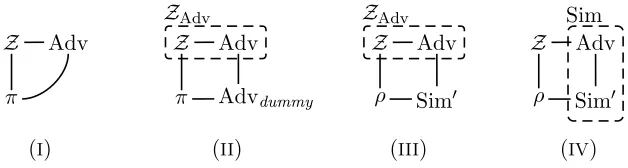
Figure 1: Completeness of the dummy-adversary: proof steps
Sim such that for all quantum-polynomial-time Z, πC ∪ {Adv,Z} and ρC∪ {Sim,Z}
are trace-indistinguishable. Furthermore, for the quantum-polynomial-time adver-sary Adv′ := Sim, there is a quantum-polynomial-time simulator Sim′ such that
ρC ∪ {Sim,Z} =ρC ∪ {Adv′,Z} and σC ∪ {Sim′,Z} are trace-indistinguishable for all
quantum-polynomial-timeZ. From the triangle inequality of the trace-distance, we have that trace-indistinguishability is transitive. Hence πC ∪ {Adv,Z} and σC ∪ {Sim′,Z}
are indistinguishable for all quantum-polynomial-timeZ. Thusπ eqUC-emulatesσ.
Dummy-adversary. In the definition of UC-security, we have three entities interact-ing with the protocol: the adversary, the simulator, and the environment. Both the adversary and the environment are all-quantified, hence we would expect that they do, in some sense, work together. This intuition is backed by the following fact which was first noted by Canetti [Can01]: Without loss of generality, we can assume an adversary that is completely controlled by the environment. This so-called dummy-adversary only forwards messages between the environment and the protocol. The actual attack is then executed by the environment.
Definition 17 (Dummy-adversary Advdummy) When activated, the dummy-adver-saryAdvdummy measures Hclass; call the outcomem. Ifm is of the form (environment,
adversary, m′), initialize Hclass with m′. Otherwise initialize Hclass with (adversary,
environment, m). In all cases, the quantum communication register is not modified (i.e., the message in that register is forwarded).
Note the strong analogy to the dummy-parties (Definition 4) and the corrupted parties (page 10).
Lemma 3 (Completeness of the dummy-adversary) Assume that π eqUC-emulates ρ with respect to the dummy-adversary (i.e., instead of quantifying over all adversaries Adv, we fixAdv := Advdummy). Then π eqUC-emulates ρ.
Proof. Assume that π eqUC-emulates ρ with respect to the dummy-adversary. Fix a polynomial-time adversary Adv. We have to show that there exists a quantum-polynomial-time simulator Sim such that for all quantum-quantum-polynomial-time environments
For a given quantum-polynomial-time environment Z, we construct a quantum-polynomial-time environment ZAdv that is supposed to interact with Advdummy and
internally simulatesZ and Adv, and that routes all messages sent by the simulated Adv toπ through Advdummy and vice versa. Thenπ∪{Adv,Z}andπ∪{Advdummy,ZAdv}are perfectly trace-indistinguishable. (Cf. networks (I) and (II) in Figure 1.) Sinceπ eqUC-emulates ρ with respect to the dummy-adversary, we have that π∪ {Advdummy,ZAdv} andρ∪ {Sim′,ZAdv} are indistinguishable for some quantum-polynomial-time Sim′ and all Z. (Cf. networks (II) and (III).) Since Advdummy is quantum-polynomial-time, so
is Sim′. We construct a quantum-polynomial-time machine Sim that internally sim-ulates Sim′ and Adv (network (IV)). Then ρ ∪ {Sim′,ZAdv} and ρ ∪ {Sim,Z} are perfectly trace-indistinguishable. Summarizing, π ∪ {Adv,Z} and ρ ∪ {Sim,Z} are trace-indistinguishable for all quantum-polynomial-time environmentsZ. Thusπ
eqUC-emulates ρ.
3.4 Universal composition
For some protocol σ, and some protocol π, by σπ we denote the protocol where σ
invokes (up to polynomially many) instances of π. That is, in σπ the machines fromσ
and from π run together in one network, and the machines from σ access the inputs and outputs of π. (That is, σ plays the role of the environment from the point of view of π. In particular, Z then talks only to σ and not to the subprotocol π directly.) A typical situation would be that σF is some protocol that makes use of some ideal functionality F, say a commitment functionality, and then σπ would be the protocol
resulting from implementing that functionality with some protocolπ, say a commitment protocol. (We say thatσF is a protocol in the F-hybrid model.) One would hope that such an implementation results in a secure protocolσπ. That is, we hope that ifπ
eqUC-emulates F and σF eqUC-emulates G, then σπ eqUC-emulates G. Fortunately, this is the case:
Theorem 1 (Universal Composition Theorem) Let π, ρ, and σ be quantum-polynomial-time protocols. Assume thatπ eqUC-emulatesρ. Thenσπ eqUC-emulatesσρ.
If we additionally have thatσeqUC-emulatesG, from the transitivity of eqUC-emulation (Lemma 2), it immediately follows that σπ eqUC-emulatesG.
The composition guarantee given by Theorem 1 is often called universal compos-ability. One should not confuse universal composability with UC-security. Although UC security implies universal composability, it has been shown by Hofheinz and Unruh [HU05, HU06, Unr06] that – in the classical setting at least – universal composability is a strictly weaker notion than UC security.
Proof of Theorem 1. Our goal is to prove that under the assumptions of Theorem 1,
σπ eqUC-emulates σρ. Since σ is quantum-polynomial-time, σ invokes at most a
quantum-polynomial-(I)
Z
Adv
σ π..1
.
πn
(II)
Z
Adv
σ
Sim′1 ρ1 ..
. ... Sim′n ρn
Sim
(III) Z
Adv
σ
π1 .. .
πi−1
Advdummy πi
Sim′i+1 ρi+1 ..
. ... Sim′n ρn Zσ,i
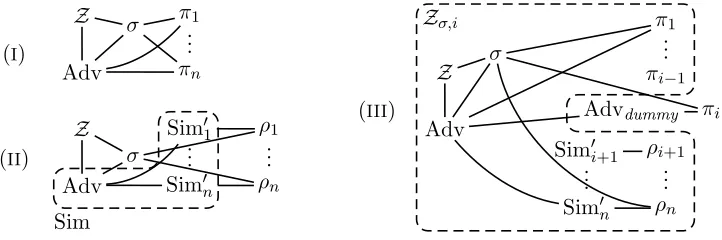
Figure 2: Networks occurring in the proof sketch of Theorem 1. Network (I) represents the real model, (II) the ideal model, and (III) the hybrid case. To avoid cluttering, in (III), the connections to πi−1, Sim′i+1, and ρi+1 have been omitted.
time environments Z we have that π ∪ {Advdummy,Z} and ρ ∪ {Sim′,Z} are
trace-indistinguishable. In the following, we call Sim′ the dummy-simulator.
Let a quantum-polynomial-time adversary Adv be given (that is supposed to at-tackσπ). We construct a simulator Sim that internally simulates the adversary Adv and
ninstances Sim′1, . . . ,Sim′nof the dummy-simulator Sim′. The simulated adversary Adv is connected to the environment and to the protocol σ, but all messages between Adv and the i-th instance πi of π are routed through the dummy-simulator-instance Sim′i
(which is then supposed to transform these messages into a form suitable for instances of ρ). The simulator Sim is depicted by the dashed box in network (II) in Figure 2.
We have to show that for any quantum-polynomial-time environmentZ we have that
σπ ∪ {Adv,Z} and σρ∪ {Sim,Z} are trace-indistinguishable (networks (I) and (II) in
Figure 2).
For this, we construct a hybrid environment Zσ,i. (Zσ,i is depicted as the dashed
box in network (III) in Figure 2.) This environment internally simulates the machines
Z, Adv, the protocol σ, instances π1, . . . , πi−1 of the real protocol π, and instances Sim′i+1, . . . ,Sim′nandρi+1, . . . , ρnof the dummy-simulator Sim′ and the ideal protocolρ,
respectively. The communication between Z, Adv, and σ is directly forwarded byZσ,i.
Communication between Adv and the j-th protocol instance is forwarded as follows: If j < i, the communication is simply forwarded to πj. If j > i, the communication
is routed through the corresponding dummy-simulator Sim′j (which is then supposed to transform these messages into a form suitable for ρj). And finally, if j = i, the
communication is passed to the adversary/simulator outside of Zσ,i. Communication
betweenσ and the instances of π or ρis directly forwarded.
We will now show that there is a negligible function µ such that TD(QExecπ∪{Advdummy,Zσ,i}(η, z),QExecρ∪{Sim′,
Zσ,i}(η, z)) ≤ µ(k) for any security
pa-rameter η and any i = 1, . . . , n. For this, we construct an environment Zσ which
expects as its initial input a pair (i, z), and then runs Zσ,i with input z. Since
π ∪ {Advdummy,Z} and ρ ∪ {Sim′,Z} are trace-indistinguishable for all
trace-distance of QExecπ∪{Advdummy,Zσ,i}(η, z) = QExecπ∪{Advdummy,Zσ}(η,(i, z)) and QExecρ∪{Sim′,
Zσ,i}(η, z) = QExecρ∪{Sim′,
Zσ}(η,(i, z)) is bounded byµ(k) for all i, k, z.
The game QExecπ∪{Adv
dummy,Zσ,i}(η, z) is depicted as network (III) in Figure 2 (except
that we wroteπiinstead ofπ). Observe that QExecρ∪{Sim′
,Zσ,i+1}(η, z) (note the changed
indexi+ 1) contains the same machines as QExecπ∪{Advdummy,Zσ,i}(η, z) (when unfolding the simulation performed byZσ,iinto individual machines) except for the difference that
the communication with thei-th instance of π is routed through the dummy-adversary Advdummy. However, the latter just forwards messages, so π ∪ {Advdummy,Zσ,i} and
ρ∪ {Sim′,Zσ,i+1} are perfectly trace-indistinguishable.
Using the triangle inequality for the trace-distance, it follows that TD(QExecπ∪{Advdummy,Zσ,n}(η, z),QExecρ∪{Sim′
,Zσ,1}(η, z)) is bounded by n · µ(k)
which is negligible. Moreover, QExecπ∪{Adv
dummy,Zσ,n}(η, z) and QExecσπ∪{Adv,Z}(η, z)
describe the same game (up to unfolding of simulated submachines and up to one instance of the dummy-adversary). Similarly, QExecρ∪{Sim′
,Zσ,1}(η, z) and
QExecσρ∪{Sim,Z}(η, z) describe the same game (up to unfolding of simulated
subma-chines). Thus TD(QExecσπ∪{Adv,Z}(η, z),QExecσρ∪{Sim,Z}(η, z)) is negligible and thus
σπ ∪ {Adv,Z} and σρ∪ {Sim,Z} are trace-indistinguishable. Furthermore, since Adv
and Sim′ are quantum-polynomial-time, so is Sim.
Since this holds for all Z, and the construction of Sim does not depend on Z, we
have thatσπ eqUC-emulatesσρ.
4
Impossibilities
In Section 6, we show that by using signature cards and a quantum channel, we can construct general everlastingly secure MPC protocols. The question arises whether both signature cards and quantum channels are needed. We answer this question positively by showing that (a) in the classical setting, most typical trusted setup (including signature cards) is not sufficient to implement everlasting OT and that (b) in the quantum setting, typical trusted setup such as a CRS is not sufficient to implement everlasting OT. The impossibilities even apply if we do not try to achieve UC security but only to implement a stand-alone OT.
4.1 Classical impossibilities
We first give a short overview of our technique. The basic observation underlying our impossibility result is that a protocol that is everlastingly secure is also secure against unlimited passive adversaries. This is due to the fact that a passive adversary follows the protocol during the protocol execution (and is thus polynomial-time) and only after the protocol execution performs an unlimited computation. Thus if an unlimited passive adversary could break the protocol, the protocol would not be everlastingly secure either.
We call a functionality F passively-realizable if there is a protocol that realizes F
key infrastructureFPKI, the commitment FCOM, and the signature cardFSC.
Assume now an everlastingly secure OT protocol π that uses a passively-realizable functionality F. Then π is also secure against passive unlimited adversaries. Let ρ be the protocol that realizes F (passively). Then π′, resulting from replacingF by ρ, will still be an OT secure against passive unlimited adversaries. (Here, of course, we have to be careful with our definition of passively realizing a functionality – the notion needs to compose such that π′ is still secure.) But π′ does not use any functionality, and we know that no OT protocol in the bare model can be secure against unlimited passive adversaries.
Concluding, we get:
Theorem 2 (Simplified, see Corollary 1) There is no everlastingly secure OT pro-tocol which only uses arbitrarily many instances of FCT (coin-toss), FCRS (common
reference string), FCOM (commitment), FPKI (public key infrastructure), and FSC
(sig-nature cards).
We now present the details of the above argumentation:
For a set C of machine identities and a network N of classical machines, let ExecCN(η, z) denote the random variable describing the (classical) states of the machines inC∪ {environment}after the execution of N.
A non-erasing dummy-party is defined like a dummy-party, except that it stores all messages it gets and sends in its state. (This only makes sense in a classical setting, of course.) A non-erasing machine is a machine that stores all messages it sends and receives and all its intermediate states in its state. For a functionality F, we write
ρ′F := {P˜′ : P ∈ partiesπ} ∪ {F} where ˜P′ denotes the non-erasing dummy-party for
P. (Cf. Definition 5.) We call a protocol non-erasing if it consists only of non-erasing machines. We call a protocol π functionality-free if partiesπ = idsπ (i.e., all machines
are parties).
We first define the notion of passively-realizable functionalities. Roughly, a func-tionality is passively-realizable if there is a protocol that implements this funcfunc-tionality with respect to passive adversaries. We will show that any such passively-realizable functionality is essentially useless for implementing everlastingly secure OT in a classical setting.
Definition 18 Fix classical protocols π and ρ with partiesπ = partiesρ. We say π
passively-emulates ρ iff:
• For any (possibly unbounded) environmentZ,Exec∅
π∪{Z}(η, z) andExec ∅
ρ∪{Z}(η, z) are statistically indistinguishable.
• There exists a probabilistic function SA such that for any (possibly unbounded) environmentZ, the random variablesExecA
π∪{Z}(η, z) andS¯A(ExecAρ∪{Z}(η, z))are statistically indistinguishable. Here S¯A:=id×SA denotes the function that is the identity on Z’s state and applies SA to A’s state.
We call a functionality F passively-realizableif there is a (possibly unbounded) non-erasing functionality-free protocol π such thatπ passively-emulates ρ′
F.
Lemma 4 The following functionalities are passively-realizable: FCT (coin-toss), FCRS
(common reference string),FCOM (commitment), FPKI (public key infrastructure),FSC
(signature cards).
Proof. For each of the functionalities listed in the lemma, we need to give a protocol satisfying Definition 18.
ForFCT, the protocolπFCTconsists of Alice choosing the random valuerand sending
it to Bob. The function SA takes the state of the Alice-dummy-party which contains
the coins r, and produces the state that Alice would have after choosing r at random and sending it to Bob. The function SB takes the state of the Bob-dummy-party which
contains the coinsr, and produces the state that Bob would have after receiving r from Alice.
For FCRS, the situation is analogous toFCT.
ForFCOM, the protocolπFCOM is the following: Upon input (commit, x), Alice sends committedto Bob. Upon a later inputopen, Alice sends (open, x) toB. When receiving
committed or (open, x) from Alice, Bob outputs committed or (open, x), respectively, to the environment. The function SA replaces the outgoing messages committed and
(open, x) in Alice’s state by (commit, x) and open, respectively. The functionSB does
not change the messages received/sent by Bob.
For FPKIKG,A, the protocol πFPKI is the following: A selects (pk,sk) according to KG. When a party P requests the public key, A sends the public key to that party. In addition topk,sk which are obtained fromFPKI, the functionSAneeds to compute the
randomness used by KG to compute (pk,sk). This randomness is sampled uniformly from all possible values that lead to (pk,sk).
For FSCS,A, the protocol πFPKI is the follows. A selects (pk,sk) according to the key generation algorithm of S and produces all signatures on its own. When another
party requests the public key, A provides it. As with FPKI, SA needs to produce the
randomness that was used to produce the keys and the signatures, this randomness is sampled randomly from those randomnesses that lead to the keys and signatures that
were produced byFSC.
Definition 19 (Minimally secure OT) We call a two-party protocol π a minimally secure OTif the following properties hold:
• Correctness: If Alice and Bob are honest, and Alice has input m0, m1∈ {0,1}, and
Bob has input c∈ {0,1}, then Bob gets output mc with overwhelming probability. • Alice-security: For any adversary B∗ we have that B∗ cannot guess both Alice’s
inputs with overwhelming probability. More precisely, let Alice get uniformly dis-tributed inputs m0, m1 ∈ {0,1} and c ∈ {0,1}. Let the output of B∗ be (m∗0, m∗1)
after interacting with Alice. Then Pr[(m∗0, m∗1) = (m0, m1)] is notoverwhelming.
distributed inputs m0, m1∈ {0,1} andc∈ {0,1}. Let Pc be the probability that A∗ outputs 1 when interacting with Bob. Then |P0−P1| is negligible in the security
parameter.
We distinguish between minimally secure everlasting OT in which we only consider adversaries A∗ and B∗ that are computationally bounded during the protocol execution
and unlimited afterwards, and minimally secure passive OT in which the adversaries A∗
and B∗ are unbounded but passive (semi-honest).9
Lemma 5 There is no functionality-free minimally secure passive OT protocol.
The fact is well-known, but we are not aware of a reference. Lemma 5 does follow directly from the quantum case (Lemma 9 below), though.
Lemma 6 IfF andG are passively-realizable thenF+G andF∗ are passively-realizable.
Proof. Let πF and πG be the non-erasing functionality-free protocols that passively-emulate ρ′F and ρ′G, respectively. It is easy to see that then πF +πG (the non-erasing functionality-free protocol constructed by combining each party of πF with the corre-sponding party of πG) passively-emulates ρ′
F+G, and similarly π∗F passively-emulates
ρ′F∗.
Lemma 7 There is no minimally secure passive OT protocol which only uses passively-realizable functionalities (even if we allow it to use several different passively-passively-realizable functionalities and arbitrarily many instances of each).
Proof. By Lemma 6, it is sufficient to show that there is no minimally secure passive OT protocol ρ which only uses a single instance of a passively-realizable functionalityF.
Fix a protocolρ using a single instance of a passively-realizable functionalityF. We will show that ρ is not a minimally secure passive OT protocol.
Let πF be the non-erasing functionality-free protocol that passively-emulates F by Definition 18. Let σ be the protocol resulting from ρ by replacing invocations of F by invocations of the subprotocol πF. Then also σ is non-erasing and functionality-free. Then by Lemma 5, σ is not a minimally secure passive OT protocol.
Thus, one of the three conditions from Definition 19 is not satisfied.
Assume that the Alice-security is not fulfilled. That is, there is a passive adversary
B∗ that guesses Alice’s inputs with overwhelming probability. More formally: Let Z be the environment that chooses uniformly random m0, m1, c ∈ {0,1} and provides these values to Alice and Bob and that keeps just (m0, m1) as its final state. Then there is a probabilistic function f such that
for (stZ,stB)←(ExecBσ∪{Z}(η, z)) we have stZ =f(stB) with overwhelming probability.
(1)
9Here, we interpret the notion of a passive adversary so that it behaves exactly like an honest party
Now, since πF passively-emulates F, and since we can consider the machines in σ
that are not part of the subprotocol πF as part of a new environment Z′ (simulating
the original Z and those machines), we have that there is a function SB such that
ExecBσ∪{Z} and ¯SB(ExecBρ∪{Z}) are statistically indistinguishable. (Here ¯SB is defined as
in Definition 18.)
With (1), we get that for (stZ,stB)← (ExecBρ∪{Z}(η, z)) we havestZ =f(SB(stB))
with overwhelming probability.
This, however, implies thatρ is not a minimally secure passive OT protocol (because it breaks the Alice-security of ρ).
If we assume that the Bob-security of σ is not fulfilled, we analogously get that the Bob-security of ρ is not fulfilled. (By corrupting Alice instead of Bob.) And finally if the correctness of σ is not fulfilled, the correctness ofρ is not fulfilled.
Since σ is not minimally secure, it follows that one of the three properties is not fulfilled, and thusρ is not minimally secure, either.
Theorem 3 There is no polynomial-time minimally secure everlasting OT protocol which only uses passively-realizable functionalities (even if we allow it to use several different passively-realizable functionalities and arbitrarily many instances of each).
Proof. For a polynomial-time protocol, any passive adversary is computationally bounded during the protocol execution (since he only has to execute the protocol). Thus the adversaries considered in minimally secure everlasting OT are a superset of those
considered in minimally secure passive OT.
Corollary 1 There is no polynomial-time minimally secure everlasting OT protocol which only uses arbitrarily many instances of FCT (coin-toss), FCRS (common
refer-ence string), FCOM (commitment),FPKI (public key infrastructure), andFSC (signature
cards).
Proof. Immediate from Theorem 3 and Lemma 4.
4.2 Quantum impossibilities
predistributed EPR pairsFEPR, public key infrastructureFPKI (assuming the secret key is uniquely determined by the public key). However, signature cards and commitments are not! (The reason being that signature cards and commitments do not allow to commit/sign superpositions of messages and thus enforce measurements. This cannot be realized with a unitary protocol.)
Then we can proceed as in the classical case: Assume an everlasting quantum OT protocol π using a quantum-passively-realizable functionality F. This protocol is also secure against unlimited passive adversaries (in the above sense). By replacingF by the protocolρ that realizesF, we get a quantum OT protocolπ′ not using any functionality that is secure against unlimited passive adversaries. But Lo [Lo97] shows that such protocols do not exist. Thus we get:
Theorem 4 (Simplified, see Corollary 2) There is no quantum-polynomial-time ev-erlastingly secure OT protocol which only uses arbitrarily many instances of FCT
(coin-toss), FCRS (common reference string), FEPR (predistributed EPR pair), FPKI (public
key infrastructure; assuming that the secret key is uniquely determined by the public key).
We now present the details of the above argumentation:
For a set C of machine identities and a network N of machines, let QExecCN(η, z) denote the joint state of the machines inC∪ {environment} after the execution ofN.
A unitary machine is a machine whose state transition operator is unitary. We call a protocol unitary if it consists only of unitary machines.
In order to get a result analogous to the classical impossibility result from Theorem 3, we need a definition analogous to the classical notion of passive realizability. The classical notion of passive (semi-honest) behavior does not make sense in the quantum setting, a machine cannot store copies of its state in every step of the interaction. Instead, we opt for the next best thing: we require machines to be unitary. This implies that they will not be able to destroy information (though they can lose some information if the protocol requires them to send it to some other machine).
Definition 20 Fix quantum protocols π and ρ with partiesπ = partiesρ. We say π
quantum-passively-emulates ρ iff:
• For any (possibly unbounded) environment Z, QExec∅π∪{Z}(η, z) and
QExec∅ρ∪{Z}(η, z) are trace-indistinguishable.
• There exists a superoperatorEAsuch that for any (possibly unbounded) environment Z, the random variables QExecAπ∪{Z}(η, z) and E¯A(QExecAρ∪{Z}(η, z)) are trace-indistinguishable. HereE¯A:=id⊗ EAdenotes the superoperator that is the identity on Z’s state and applies EA to A’s state.
• The same withB instead ofA.
We call a machine P˜u a unitary dummy party for F and P if P˜u is unitary and {P˜u,F} is indistinguishable from{P ,˜ F}where P˜ is the dummy party forF and P.
|0ki f output
|0ℓi
H⊗ℓ • •
|0ℓi • to Bob
|0ki f to Bob for output
where •
f
applies
|x, yi 7→ |x, f(x)⊕yi
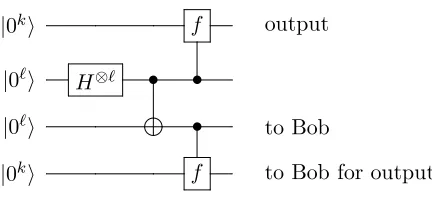
Figure 3: Circuit for computing a CRS
exists a unitary dummy-party P˜u for F and P such that π quantum-passively-emulates {F,P˜u (P ∈parties
π)}.
Lemma 8 The following functionalities are quantum-passively-realizable: FCT
(coin-toss), FCRS (common reference string), FEPR (predistributed EPR pair), FPKI (public
key infrastructure; assuming that the secret key is uniquely determined by the public key).
Notice that FCOM and FSC are not listed here. These are not passively-realizable, even though they are passively-realizable. In fact, as we show below, quantum-passively-realizable functionalities are useless for implementing everlastingly secure OT, but commitment is sufficient for constructing even statistically secure OT protocols [BBCS91] (see [Unr10] for a proof in the quantum-UC-setting). And in Section 6 we show that with signature cards we can construct everlastingly secure OTs.
Proof. For each of the functionalities F listed in the lemma, we need to give a protocol
πF satisfying Definition 20.
For FEPR, the protocol πFEPR consists of Alice producing an EPR pair and sending
the second half of it to Bob (over a secure channel). Since for producing an EPR pair, no ancillae or measurements are needed, the states of Alice and Bob after outputting their halves of the EPR pairs are empty. Thus the superoperators EA and EB (as in
Definition 20) can be chosen to be the identity, and the unitary dummy parties ˜Au and
˜
Bu to be machines that just forward their outputs (without measuring).
For FCRSD , let f be a function and ℓ be an integer such that f(r) is distributed according to D for a uniformly chosen r ∈ {0,1}ℓ. Let k be then length needed for
encoding outputs ofD. Alice evaluates the quantum circuit described in Figure 3. Then she outputs the first register as CRS, keeps the second, and sends the third and fourth register to Bob. Bob outputs the fourth register as CRS and keeps the third. We use dummy parties ˜Au and ˜Bu that use CNOT to “copy” the CRS. More precisely, before forwarding the CRS from FCRS to Z, ˜Au appliesU :|x, yi 7→ |x, x⊕yi to the CRS and a fresh|0ki-initialized quantum register.