•
.~
0 ~ . 0..
.
..
DEPARTMENT OF COMPUTER AND
MATHEMATICAL SCIENCES
Dispersion Control for Multivariate Processes
-Some Comparisons
Pak Fai Tang and Neil Barnett
(66 EQRM 21)
February
,
1996
(AMS
:
62N10)
TECHNICAL REPORT
VICTORIA UNIVERSITY OF TECHNOLOGY
DEPARTMENT OF COMPUTER AND MATHEMATICAL SCIENCES
P 0BOX14428
MCMC
MELBOURNE, VICTORIA 8001
AUSTRALIA
TELEPHONE (03) 9688 4492
FACSIMILE (03) 9688 4050
DISPERSION CONTROL FOR
MULTIVARIATE PROCESSES - SOME
COMPARISONS
PAK FAIT ANG 1 AND NEIL BARNETT 1 Victoria University of Technology
Summary
In Tang and Barnett (1996) some techniques for monitoring and controlling the dispersion of multivariate normal processes based on subgroup data are presented. In
this current paper, comparisons are made between the proposed techniques and
various competing procedures. Simulation results indicate that the proposed
techniques are superior to existing procedures.
Key words : Dispersion control; multivariate normal processes; rational subgroups; statistical performance.
1. Introduction
In Tang and Barnett (1996), some procedures for monitoring and controlling the dispersion of multivariate normal processes based on rational subgroups are
presented for both cases where the in-control value of the process covariance matrix
L
is specified and alternatively unknown in advance of production. Essentially, these1
Dept of Computer and Mathematical Scie!:lces
techniques involve the aggregation of suitably transformed variables, resulting from
the decomposition of the covariance or some positive definite matrices, in order to
produce control statistics having chi-square distributions under in-control and
normality assumptions. In the present paper, the relative effectiveness of these and
various competing techniques are studied. In addition, the effect of incorporating
independent components from the decomposition, on the control performance, is
examined for the known
L
case. To set the discussion in context, the proposedcontrol procedures are briefly reviewed in subsequent paragraphs.
Let sj ( L j ) , s*j (L*j) and sv,u (crv,u) be, respectively, the sample
(population) covariance matrix of the first j variables, that of the last j variables and
the vector of sample (population) covariances between the vth and each of the first u
variables. The conditional sample and population variance of the jth variable given the
first j-1 variables are then given by
s~l · 1=S~-S~ - 1S-:-1
1S··1
l• , ...• 1- l 1.1- 1- 1.1- d
2 2 T ~-1
an cr j•l, ... ,j-1
=
cr j - cr j,j-1 LJ j-1 cr j,j-1 ·-The conditional sample and population covariance matrices of the last p-j+ 1 variables
given the remaining j-l variables are respectively
( )
T (
s
.
.
=s*
.
-
s
. .
. . . s
.
s-:-
1s
..
l •... ,p•l, ... ,1-1 p-1+1 1,.:!,-1 P,.:.;!-1 1-l 1,.:!,-1
... s
p,1-l.
)
-and
L
·
·
=L*
·
-
cr . . · · · cr .I,-:
1cr ..
( )
T (
Page 3
If d and 0 (j = 2, ... , p) denote respectively the vectors of sample and population
- j - j
regression coefficients when each of the last p-j+ 1 variables is regressed on the (j-l)th
variable whilst the remainingj-2 variables are held fixed, these are expressible as
{(s1
·
-1.1
·
s
.
i)-sT 1
.
2s~12(s
..
2 ... s
.
2)}T
J- ,p 1-;..J- J- t:.!.,-
~-d =--0.---"~
- j SJ- ,J-· 1 · 1-S~1J- ,]-· 2S~J-12S·1 J- ,]-
· 2
,...,
,...,
and
Note that d and 0 should be interpreted as the vectors of unconditional sample
-2 -2
and population regression coefficients when each of the last p-1 variables is regressed
on the 1st variable and these are given by
(s12
slpr
d
=---
and-2
respectively. We also use the same notation for distribution functions of Tang and
Barnett (1996).
For a p-variate normal process with presumably known
I.,
the authorsproposed the use of the following control
statistic:-where
2p-l
Tk =
Iz~(k)
j=l
z
.
= <I>-1{x2 ·[(nk -I)SJ.1 .... ,j-1(k) ]} J(k) nk- J 2() 1• ,. . 1 . .,)-. 1
}=2, ... ,p.
Zp+1(k) =<I>-1
{x
2p-1[(nk-I)Sick)(d -0
)TI.~~
.
p•1(d -0J]}
... 2(k) - 2 ' " ... 2(k) ... 2
z .
=<I>-1 2 . -1 s~.
d -0I,-:-
1 . d -0{ [ ( ) T (
)~~
'ptj4(k) xp--1+l (fltc ) 1-l•l, ... 1-2(k) ... j(k) ... j ') .... pel, ... 1-1 ... j(k) ... j }=3, ... ,p.
and the subscript k indicates the subgroup number.
In the absence of prior estimates for I, , the suggested control statistic is
defined as
where
and
2p-1
Tk =
IzJck)
j=l
k=2, ...
z.
=
<1>-1[p
.
[
sJ.1 ...
j-l(k) ] ] J(k) nk-J;Nj,k-1 S2j,k-1 (pooled)
(2)
j=l, ... ,p.
( Sj
1
,k)s ;,!::.'" - v
~-1
r (
(
n, -1)-l Sj'., ., +u
~
-
Tl
(
S;'. '"s ;.!::."
'
-
v
£-1)
(j - l)SJ,k (pooled)
}=2, ... ,p.
The values of S J, ~ k( pooe 1 d) • U J, · k and V j, k can be updated sequentially using the
:-Page 5
2 1 [ 2 2 ]
S j,k(pooled) =
N
N j,k-lS j,k-1 (pooled)+
(nk - l)S j•l, ... ,j-l(k) j,kk
where N j,k
=
L
(ni - j) andsl~O(i)
=
sl~i)'
i=land
Note that for both cases,
{Tk}
is a sequence of independent and identically distributed(i.i.d) chi-square variables with 2p-l degrees of freedom under the in-control and
normality assumption. Thus, unlike other competing procedures, statistically valid
control limits can be easily obtained for the resulting charts. Note also that since any
instability in
I.
is likely to result in unusually large values in theTk
's, it is suggestedusing only the upper control limit.
2. Comparisons
In this section, the relative performance of the proposed techniques are
tested against some existing procedures. For the case where I, is assumed known,
comparison is made between the proposed technique, the modified likelihood ratio
test (MLRT), the
ISl
112 charting technique as well as a possible method based onprincipal components. The first two charting procedures to be used in the comparison
appear to be the most widely discussed techniques for monitoring the dispersion of
included merely because it appears to be a reasonable technique in situations where
principal components possess meaningful physical interpretations. In fact, as stated in
Jackson (1989), this phenomenon is very common in industrial situations. In addition,
Crosier (1988) has identified situations where ' ... if the mean shifts, it does so along
the major axis .... .'. Under these circumstances, it is expected that changes in
L
maywell occur along some of the principal axes, namely the variances of some principal
components may shift. As for the unknown
L
case, the proposed technique iscompared with the modified likelihood ratio test for the equality of covariance
matrices (MLRTECM) as given, for eg., in Anderson (1984, p.405). For clarity of
subsequent discussion, these techniques are briefly reviewed.
MLRT is an unbiased version of the likelihood ratio test of H0
:L
=Lo
against HA:L =F-
Lo
with the sample size,n,
replaced by the number of degrees offreedom, n -1. This test rejects the null hypothesis H0 and suggests a departure of
the process covariance matrix from the standard or the known value
Lo
when thetest or control statistic,
w*
exceedsw;,n,a
wherew*
= -p(n-l)-(n-l)lnlSl+(n-l)lnlLol+Cn-l)tr(Lo1 S ). (3)a and
w;,n,a
denote respectively the false signal rate and the upper lOOa thpercentage point of W * which depends on p and n. The distributional theory involved
with this technique is prohibitively complicated thus limiting its practicality. Although
w*
can be approximated by a chi-square distribution with p(p+ l) degrees of2
freedom when n is large, and the exact upper 1 % and 5% percentage points of
w*
Page 7
values of n, these may be of little value in the context of control charting. In practice,
the control or monitoring procedures are likely to be based on samples not sufficiently
large to justify the use of the chi-square approximation. Besides, it may be preferable
to have a control technique with false signal rates considerably smaller than 1 % or
5%. Although MLRT is admissible (see for eg., Giri (1977), p.186), it will be seen
later that this technique is inferior to the proposed technique for all of the cases
considered.
The other competing procedure is based on the use of the square root of the
generalized sample covariance matrix,
ISl
112. The resulting chart can be regarded as amultivariate analogue of the univariate S chart. When p = 2,
ISl
112 is distributed as ascaled chi-square variable under the stable or in-control multivariate normality
assumption (Anderson (1984), p.264). Thus, control limits may be set at
I
L
1112 2LCL = o X2(n-2),a.12
2(n- l)
I
L
1 112 2and UCL= o X2(n-2),1-a.12
2(n- l) (4)
where x~ 0 denotes the 100 8th percentage point of the chi-square distribution with v '
degrees of freedom. For higher dimensions, Alt et al. (1986) suggested the use of the
3-sigma limits as given by the following formulae :
(5)
The use of this charting technique is ill-advised
because:-(i) it is incapable of detecting changes in
L
such thatIL.I
remains constant.(ii) the formula (5) above yields negative values for the lower control limit for most
practical values of p and n. If LCL is thus set to zero as suggested by Alt et
al.(1990), this means no protection is provided by the resulting
ISl
112 chart againsta decreasing value in
IL.I .
(iii) the associated false alarm rate is considerably larger than the nominal value of
0.0027 especially when n is relatively small. Refer to Table 1 for the false signal
rates for various practical combinations of p and n. These figures are obtained
based on 10,000 simulation runs except when p = 3 or 4 in which case the entries
are found by numerical integration. Note that, in some cases, the false signal rate
is as large as 2%.
<Insert Table 1 about here>
To illustrate the first two points, consider the case of a trivariate process. In this case,
Page9
subject to the constraint
Thus, it is readily seen that, theoretically, it is possible for
ILi
to remain constant oreven decrease in the presence of process troubles. For example, suppose that
cr1 = cr2 =cr3 =1, p12 = 0.1, p13 = 0.7 and p23 = 0.5 are specified as the in-control
values, but in fact cr3 ·is 3 times as large as that specified and p23 is .0.7553, then
ILi
remains at the value 0.32. If cr3 doubles instead, then this results in a smaller value of
ILi.
In either case, the departure is unlikely to be 'picked up' by theISl
112 chartspresented by Alt et al.(1986).
It is perhaps worth noting that, for p = 3 or 4, control limits for the
ISl
112chart can be obtained numerically at any desired a level. In this case, the control
limits are given by
and UCL= ki-a/2
IL
11/2 2p-2 (n-l)p12 owhere k5 is a numerical solution to the integral equation,
00
f
G2(n-p) ( kr, / X(p-2)12 )g(p-2)(n-p+2)(x )dx
= 8.0
(8)
(9)
The notation gv ( •) and Gv ( •) here denote respectively the probability density and
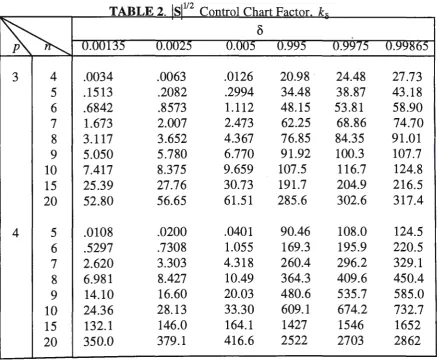
obtained in this manner using Mathematica version 2.2 (Wolfram (1991)) and is given
to 4 significant digits in Table 2 for p = 3 and 4, and various combinations of
b
and n.<Insert Table 2 about here>
The last technique considered for the known I, case is aimed at changes of
I, along the principal axes. It involves charting the sum of the standardized variances
for the principal components, abbreviated hereafter as SSVPC, which is known to be
distributed as a scaled chi-square variable under the multi.variate normal assumption
with the hypothesized I, . The value of SSVPC may be calculated from the familiar
equivalent statistic (n-
l)tr(s
I,~1) (see Appendix (A.3)). Note that, unlike all othercontrol procedures considered in this section, this technique is applicable even in
situations where n::; p. It has also been shown by Kiefer et al.(1965) that it is
admissible. Although separate monitoring of the variances for the different principal
components is possible, this is not considered due to the large number of charts to be
kept when p is large. It is also for meaningful comparison with other techniques
involving a single chart that separate monitoring of the variances is not considered.
However, in practice, it is the recommendation that these individual variances be
retained in order to facilitate the interpretation of out-of-control signals from the
SSVPC charts.
In the absence of prior information about I,, Alt et al.(1990) suggest using
the MLRT and
ISlvz
control charts with the unknown process dispersion parametersPage 11
data. Under these circumstances, the data used for estimating the unknown
parameters are likely to be either small or moderate data sets. Accordingly, the false
signal rates of the resulting techniques are not fixed but instead vary stochastically
with the parameter estimates. This causes some difficulties when a comparison is to be
made between these and the proposed technique. Thus only MLRTECM, which was
originally proposed in the context of hypotheses testing, is considered.
The criterion for MLRTECM is
(10)
where s(i)' ni and spoooled denote respectively the ith sample covariance matrix, its
associated sample size and the pooled covariance matrix based on the q samples. It
was shown by Anderson (1984) that it is an admissible test if ni > 2p-1, i = l, ... ,q.
For equal sample sizes ni = n , this test rejects the null hypothesis that all the q
samples are drawn from populations with the same covariance matrix if W > Wq,p,n,a.
where Wq,p,n,a. denotes the critical value at the I 00 a% significance level. The upper
5% points of W have been tabulated, for example, in Anderson (1984) for various
combinations of p, q and n. There are two problems with the use of MLRTECM in
the context of SPC. The existing tables for the percentiles of W are incomplete in
regard to other values of p, q, n and a which are required for SPC applications.
Besides, successive values of W are correlated and thus the in-control behaviour of
the resulting technique is somewhat unpredictable. However, it is found that ignoring
this issue does not appear to have any remarkable effect on the overall false signal
rate. Therefore, a reasonable comparison can still be made between this and the
It is shown in Appendix (A. I), (A.3) and (A.4) respectively that the
statistical performance of MLRT, SSVPC and MLRTECM (for a step shift in
L
fromI I
Lo
toLi)
depend on the eigenvalues,A
1 , •••,AP
of L~2Li
L~2 , or equivalently, ofL~
1L1
orL1
L~
1,
whereas that of theISl
112 charting technique depends onLo
andLi
only through the product of these eigenvalues, A1A2 •• •AP
(see A.2). Note thatA
1A
2 \ ..AP
represents the ratio of the 'equal-content' volumes of the processellipsoids corresponding to
Li
andLo
respectively. In addition, Nagao (1967) andDas Gupta (1969) independently showed that the power function of the MLRT is
monotonically increasing with respect to
!Ai -
~ Vi. Furthermore, note that MLRT,SSVPC, MLRTECM and
ISl
112 charting procedures are invariant w.r.t. thetransformation
x*
=rx
+
µ wherer
is any nonsingular matrix. This is not true withthe proposed techniques except when
r
.
is diagonal. By lettingr
=diag(~
1
.
,
•••,11; ),
it is readily seen that the values of the proposed statistics are the same whether they
are computed from the covariance or correlation matrix (see A.5 and A.6), and so is
true with the other invariant procedures considered above. However, difficulties arise
when an attempt is made to compare their operating characteristics, since the
statistical properties of the proposed techniques do not appear to be completely
I I
determined by the eigenvalues of
Lo
2L
1
Lo
2 • To provide a 'sensible' comparison, itis therefore necessary to consider several possible combinations of
Lo
andLi
whichPage 13
of the competing procedures. Note, however, that only
Lo
's m the form ofcorrelation matrix need to be considered.
A somewhat systematic way of studying the relative performance of the
various competing techniques is to use several arbitrary orthonormal matrices
r
'sthat diagonalize
L0
112Li L0
112 giving the same diagonal matrix of eigenvalues,A = diag
(A.
1 , ••• ,A.
P ) • For a givenL
0 , A andr ,
L
1 is then determined fromLi
=L~2rTArL~2.Amongst others, the orthonormal matrix that diagonalizes
Lo,
r
=r
0 is used. Thiscorresponds to situations where the shift is along the principal axes, namely, the
variances of some principal components either increase or decrease. Under these
circumstances, the eigenvalues of
L0
112L
1L
0
112 are the ratios ·of variances for theprincipal components, after and before the shift, and hence the control performance of
MLRT, MLRTECM, SSVPC and
ISl
112 depend on them (see A.7). Note that if theeigenvalues of
L
0
112 L
1L
0
112
are identical, thenL
1 is the same irrespective ofr.
Inthis case,
Li=
ALo
where A is the common eigenvalue. This situation may occur inpractice as a consequence of all variances increasing proportionally and the
correlational structure of the variables remaining the same (see Healy (1987)).
The techniques considered for the known
L
case above are compared on thebasis of probability of detecting a persistent shift in the process covariance matrix
from
Lo
toLi.
It is assumed that this change, as well as the shift in the processmean vector if any, occur somewhere during the time interval between the sampling of
two adjacent subgroups. Accordingly, the covariance matrices for samples or
mean shift has no effect on this distribution. Of course, if desired, the average run
lengths (ARLs) of the various techniques can be determined as the reciprocals of their
corresponding probabilities of detection. As for the unknown
l:
case, a morecomplete profile of the run length (RL) properties is required. This is because the
out-of-control RL distributions of both techniques under consideration are not geometric
so that ARL is not a suitable performance criterion (see Quesenberry (1993)).
Furthermore, since these techniques estimate the in-control dispersion parameters
sequentially from the current data stream and the efficiency of these estimates increase
as more data are incorporated into the computations, it can be expected that their RL
performance depend on when the shift takes place. As such, the relative performance
of MLRTECM and the proposed technique are evaluated based on Pr(RL=S; k) for a
step change in
l:
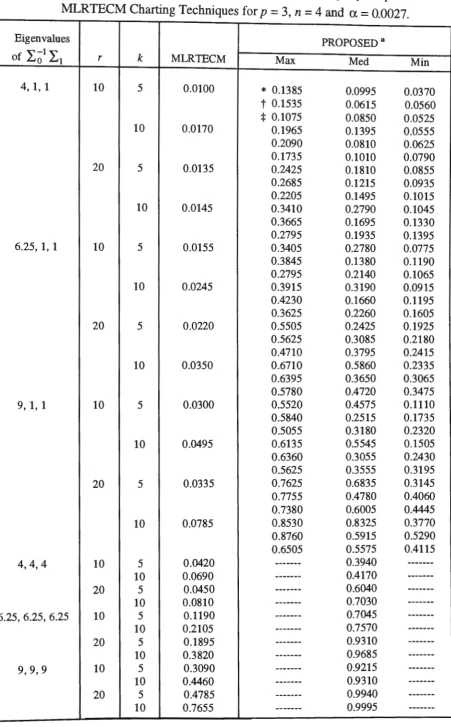
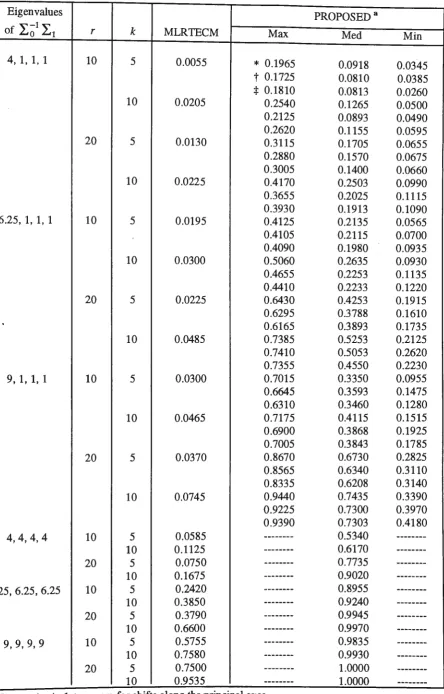
after the rth subgroup, for various combinations of rand k.The results for the known
l:
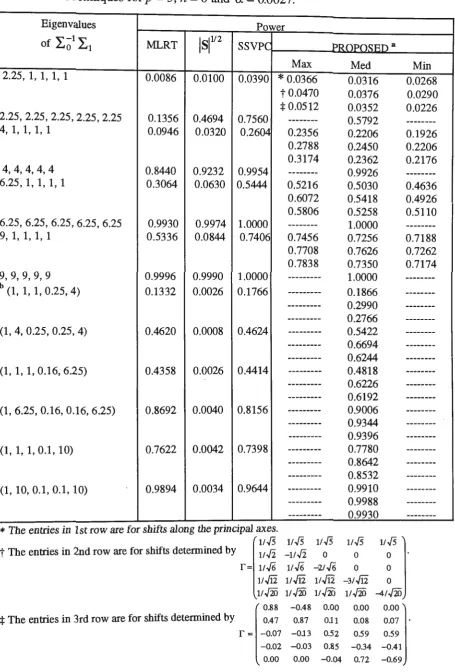
case are tabulated in Tables 3, 4 and 5respectively for the cases where (p
=
3, n=
4), (p=
4, n=
5) and (p=
5, n=
8).These are based on simulations consisting of 5000 iterations each. Thus, the estimated
maximum standard error of the results is
"
" "
_P_r(_l -_Pr_)
=
0.0071 which occurs when the 5000estimated probability, Pr= 0.5. For the unknown
l:
case, the results are based on2000 simulation runs each (with maximum standard error
=
0.0112) and these areshown in Tables 6, 7 and 8 respectively for (p
=
2, n=
3), (p=
3, n=
4) and (p=
4, n= 5). Here, it is assumed that the control procedures are based on subgroups of equal
size, n. The false signal rate associated with each of the control schemes is fixed at
0.0027, in line with the tradional control charting approach. Note that the control
Page 15
of Davis et al.(1971). The control limits for
ISl
112 chart are determined from Table 2for p
=
3, 4 and by means of simulation consisting of 100,000 iterations for p=
5 andn
=
8. Note also that 2-sided control limits with equal significance level on each side are used with SSVPC.<Insert Tables 3 to 8 about here>
For every set of eigenvalues A.1 , •••
,AP
not enclosed within a bracket, theprobabilities for the proposed techniques are simulated for all possible permutations
and the maximum, median and minimum values are tabulated, except for p = 2 in
which case the median is not applicable. The results for the other control procedures
are unaffected by these permutations. Note that for the cases where the eigenvalues
are identical, the results for the proposed techniques are theoretically the same
irrespective of
Lo
(see next section). As shown in Tables 3, 4 and 5, the proposedtechnique is much more powerful than the MLRT and
ISl
112 charting procedures forall the cases considered. Note that even its worst performance in each case is
significantly better than these procedures. For instance, when p = 3, n = 4 and the
standard deviations of two principal components double, the results for MLRT and
ISl
112techniques are respectively 0.0564 and 0.1268 whereas the smallest probability
of detection for the proposed procedure is 0.3524. As compared to SSVPC, the
proposed technique is seen to be marginally worst in most cases where some
eigenvalues are greater than 1 whilst others are 1. However, in cases where some
occurs as a result of some but not all of the variances increasing), the proposed
technique is almost always superior. Particularly notable is the situation when p is
large. For instance, whenp = 5, n = 8 and the eigenvalues are (1, 1, 1, 0.1, 10), the
result for SSVPC is 0.7398 whereas those for the proposed technique are 0.7780,
0.8642 and 0.8532 respectively for the different r considered. Note that the exact
probabilities for SSVPC and
ISl
112 charting technique (for p = 3, 4) are obtainableusing standard statistical software and a published program. The program of Davies
(1980) can be used for finding the cumulative probability of SSVPC since the latter is
distributed as a linear combination of independent chi-square variables with
coefficients A.1 ,. ••
,A.P
(see A.3). If A.1 ,. ..,A.P
are identical, resulting in a scaledchi-square distribution, then many statistical software packages currently available can be
used. If p = 3 or 4, the cumulative probability of
ISl
112 can be determined by means ofnumerical integration. However, as a partial check of the simulation, the simulation
results for these techniques are included. They are found to agree well with the
theoretical values. For instance, the theoretical probabilities for
ISl
112 and SSVPC are(0.1333, 0.3828), (0.4575, 0.8873) and (0.7020, 0.9866) for p = 4, n = 5, a= 0.0027
and A.1 , ..
.,A.P
all equal to 2.25, 4 and 6.25 respectively. These are very close to thecorresponding figures in Table 4.
As for the comparison for the unknown
L
case, Tables 6, 7 and 8 clearlyreveal that the proposed technique is far superior to MLRTECM irrespective of the
dimension p, the change point r, the eigenvalues A.1, •••
,A.P
and the direction of theshift as specified by r . Like the known
L
case, limited comparisons using otherPage 17
It is perhaps worth noting that Calvin (1994) has developed a one-sided test
of covariance matrix with a known null value. However, no attempt has been made to
compare the operating characteristics of this and the proposed technique. A
reasonable comparison cannot be made since the former is specifically designed for
situations where the deviations take the form of
L
=Lo+
B (B is a symmetricpositive definite matrix) whereas the proposed technique is not meant for any specific
shifts. If the shift is anticipated to be of the form
L
=Lo+
B, then therecommendation is to use the former technique.
3. Effect of Aggregation on Control Performance
As presented earlier, the proposed techniques involve the charting of some
aggregate-type statistics formed using independent components resulting from the
partitioning of the covariance matrices. Certainly, if the use of such a statistic incurs
some loss in control performance, then it is preferable to chart the individual
components separately though the improved performance is gained at the expense of
increasing the charting effort. In this section, the effect of such 'aggregation' on the
control performance, is briefly considered for the known
L
case. This effect isexamined by comparing the probabilities of detection by the proposed technique with
that based on the use of the individual components for certain shifts in
L ,
havingequated first their false signal rates. Note that the latter technique, abbreviated
hereafter as the JC technique, involves the plotting of the following statistics
and
(nk - l)SJ.1, ... ,j-1(k) 2
(j1• . 1 , .... 1-. 1
j = 2, ... ,p. (12)
(13)
(nk-l)S
1
~_
1
•
1
... 1·_2<k)(d-0
)TL-
1
·
~
.. p.1._1(d
-0)
j=3,
.
..
,p. (14)' ' ,_ j(k) ,_ j ' ' ,_ j(k) ,... j
It may also be of some value to study the control performance of the
technique based on the use of principal components. In the presence of
:L,
it isreasonable to chart the standardized variances of the principal components (multiplied
by (n-1) each) separately. These are given by the diagonal elements of
I I
(n-l)A02
r
0
sr
0A02 where A
0 and
rl
denote respectively the diagonal matrixcontaining the eigenvalues of
Lo
and the matrix of the corresponding eigenvectors.For ease of subsequent discussion, this technique is referred to as ISVPC.
Following a shift in the process covariance matrix
L ,
the statistics (11) and(12) are readily seen to follow some scaled chi-square distribution whereas the
Hotelling
X
2-type statistics in (13) and (14) can be shown to be generally distributedas linear combinations of independent noncentral chi-square variables (see A.8).
Furthermore, note that the (conditional) independence of these statistics is preserved.
Thus, given the program of Davies (1980), it is possible to determine the overall
probability of 'picking up' any given shift in
L
by the use of these statistics.However, for mathematical convenience, only a special case is considered, namely,
form:-Page 19
a situation which has been noted earlier. Note that under these circumstances, all the
above statistics are chi-square except for the scalar multiple /.., . The same is true for
the ISVPC technique. Thus, the statistical performance of these and the proposed
technique depends on A (besides p and n) irrespective of
L,
0.For reasonable comparison, suppose that the significance levels associated
with the control charts for the IC and ISVPC techniques are set to be equal to a* so
that the overall false signal rate, a, for each control scheme is the same as that of the
proposed technique. Accordingly, the a* for both techniques are respectively given
by
*
-'-a
=1-(l-a)2p-I and .a
* ~=l-(l-a)P.
Furthermore, note that both the lower and upper control limits are used with each
* *
chart and these are set at
~
and 1-~
probability levels respectively. The power of these and the proposed technique are given to 4 decimal places in Table 9 forvarious combinations of p, n, /... and
a.
Note that the results for the proposedtechnique are obtained by means of 5000 simulation runs. In all these cases, it is
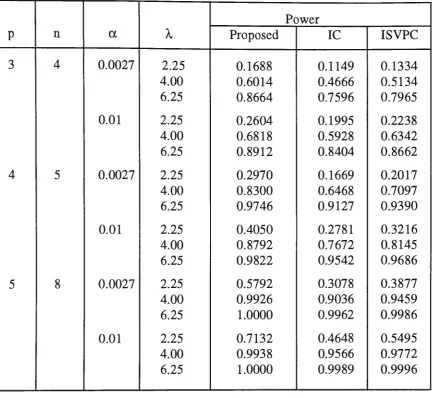
observed that the proposed technique is significantly better than the IC and ISVPC
techniques. It is also seen that ISVPC ranks between the proposed and the IC
technique in performance for all the given shifts. Although no attempt has been made
to study their relative performance thoroughly, the results provide an indication that
incorporating the individual components into a composite statistic in the suggested
<Insert Table 9 about here>
4. Concluding Remarks
Some methods have been presented by Tang and Barnett (1996) for
controlling the dispersion of multivariate normal processes as measured by the
variance-covariance matrix. The one presented for the case with no prior knowledge
of the process parameters is particularly attractive for short production runs and low
volume manufacturing environments. This procedure also enables the monitoring of
new or start-up processes soon after production commences.
A simulation study indicates that the proposed techniques outperform
previously proposed procedures for many sustained shifts in the process covariance
matrix. It has also been demonstrated that the technique presented for the known
.L
case is more powerful in 'picking up' certain shifts than that which involves the
separate charting of the standardized variances of the principal components or the
individual components resulting from the decomposition of the covariance matrices.
In addition, the proposed methods have some practical advantages over the existing
procedures. Besides having a better control over the false alarm rate and the ease of
locating the control limits, the proposed techniques can help identify the nature of
change in the process dispersion parameters. As all multivariate control procedures
are computerised, the complexity of the associated computation should not be an
issue. In fact, almost all standard statistical software packages commercially available
support the implementation of the proposed procedures.
This paper has only considered control procedures based on subgroup data.
Page 21
characteristic at regular time intervals. In this regard, Hawkins (1992), amongst
others, has developed some nonparametric procedures for detecting ramp shifts in
functions of the process dispersion parameters for retrospective and sequential
settings, when the process covariance matrix is either specified or unknown.
However, if the distribution of the observation vectors is known, for example, to be
multivariate normal, a parametric procedure is preferable since better performance is
anticipated. This is an area for future research. Another aspect that warrants
investigation is the robustness of the proposed procedures to departures from the
References
ALT, F. B. and BEDEWI, G. E. (1986). 'SPC of Dispersion for Multivariate Data'.
ASQC Quality Congress Transaction - Anaheim. American Society for Quality
Control, pp. 248-254.
ALT, F. B. and SMITH, N. D. (1990). 'Multivariate Quality Control' in Handbook of
Statistical Methods for Engineers and Scientists, Ed. H.M. Wadsworth,
McGraw-Hill, New York, NY.
ANDERSON, T. W. (1984). An Introduction to Multivariate Statistical Analysis,
2nd ed., John Wiley & Sons, New York, NY.
CALVIN, J. A. (1994). 'One-sided Test of Covariance Matrix with A Known Null
Value'. Communications in Statistics - Theory and Methods 23, pp.3121-3140.
CROSIER, R. B. (1988). 'Multivariate Generalization of Cumulative Sum
Quality-Control Schemes'. Technometrics 30, pp. 291-303.
DAS GUPTA, S. (1969). 'Properties of Power Functions of Some Tests Concerning
Dispersion Matrices of Multivariate Normal Distributions'. Annals of
Mathematical Statistics 40, pp.697-701.
DAVIES, R. B. (1980). "The Distribution of a Linear Combination of
X
2 RandomVariables". Algorithm AS 155, Applied Statistics 29, pp.323-333.
DAVIS, A. W. and FIELD, J. B. F. (1971). 'Tables of Some Multivariate Test
Criteria'. Technical Paper No. 32, C.S.I.R.O, Australia.
GIRI, N. C. (1977). Multivariate Statistical Inference, Academic Press, New York,
NY.
JOHNSON, R. A. and WICHERN, D. W. (1988). Applied Multivariate Statistical
Analysis, 2nd ed., Prentice-Hall, Englewood Cliffs, NJ.
KIEFER, J. and SCHWARTZ, R. (1965). 'Admissible Bayes Character of T2 - and
R2 - and Other Fully Invariant Tests for Classical Normal Problems'. Annals
of Mathematical Statistics 36, pp.747-760.
HAWKINS, D. L. (1992). 'Detecting Shifts in Functions of Multivariate Location and
Covariance Parameters'. Journal of Statistical Planning and Inference 33,
Page 23
HEALY, J. D. (1987). 'A Note on Multivariate CUSUM Procedures'. Technometrics
29, pp.409-412.
JACKSON, J. E. (1991). 'Multivariate Quality Control : 40 Years Later'. in
Statistical Process Control in Manufacturing, Eds. J.B. Keats and D.C.
Montgomery, Marcel Dekker, New York, NY & ASQC Press, Milwaukee,
Wisconsin, pp.123-138.
NAGAO, H. (1967). 'Monotonicity of the Modified Likelihood Ratio Test for a
Covariance Matrix. Journal of Science Hiroshima University Al 31,
pp.147-150.
QUESENBERRY, C. P. (1993). "The Effect of Sample Size on Estimated Limits for
X and X Control Charts". Journal of Quality Technology 25, pp. 237-247.
SRIVASTAVA, M. S. and KHATRI, C. G. (1979). An Introduction to Multivariate
Statistics, Elsevier North Holland, New York, NY.
TANG, P. F. and BARNETT, N. S. (1996). 'Dispersion Control for Multivariate
Processes'. Submitted to Australian Journal of Statistics.
WOLFRAM, S. (1991). Mathematica : A System for Doing Mathematics by
TABLE 1. False Signal Rate of jSj112 Chart with '3-sigma' Limits
~
p3 4 5 6 7 8 9 10
4 0.0203
5 0.0174 0.0206
6 0.0154 0.0188 0.0203
7 0.0139 0.0172 '
0.0187 0.0219
8 0.0128 0.0159 0.0191 0.0197 0.0202
9 0.0118 0.0149 0.0141 0.0191 0.0199 0.0203
10 0.0111 0.0140 0.0178 0.0192 0.0207 0.0220 0.0205
15 0.0087 0.0110 0.0130 0.0143 0.0157 0.0170 0.0204 0.0180
20 0.0085 0.0093 0.0108 0.0121 0.0148 0.0166 0.0164 0.0140 i
25 0.0071 0.0079 0.0108 0.0123 0.0125 0.0121 0.0124 0.0169
30 0.0056 0.0075 0.0106 0.0111 0.0098 0.0119 0.0137 0.0114
112
TABLE 2. S Control Chart Factor
3 4 .0034 .0063 .0126 20.98 24.48 27.73
5 .1513 .2082 .2994 34.48 38.87 43.18
6 .6842 .8573 1.112 48.15 53.81 58.90
7 1.673 2.007 2.473 62.25 68.86 74.70
8 3.117 3.652 4.367 76.85 84.35 91.01
9 5.050 5.780 6.770 91.92 100.3 107.7
10 7.417 8.375 9.659 107.5 116.7 124.8
15 25.39 27.76 30.73 191.7 204.9 216.5
20 52.80 56.65 61.51 285.6 302.6 317.4
4 5 .0108 .0200 .0401 90.46 108.0 124.5
6 .5297 .7308 1.055 169.3 195.9 220.5
7 2.620 3.303 4.318 260.4 296.2 329.1
8 6.981 8.427 10.49 364.3 409.6 450.4
9 14.10 16.60 20.03 480.6 535.7 585.0
10 24.36 28.13 33.30 609.1 674.2 732.7
15 132.1 146.0 164.1 1427 1546 1652
Page 25
TABLE 3. Power Comparison of Proposed, MLRT,
ISl
112 and SSVPC ChartingTechniques for p = 3, n = 4 and a= 0.0027.
Eigenvalues Power
of
I.
0
1I.
1 MLRT1s1112
SSVPC PR1JP(1sl-in aMax Med Min
2.25, 1, 1 0.0030 0.0096 0.0334
*
0.0366 0.0240 0.0230t 0.0350 0.0296 0.0244
:j: 0.0402 0.0264 0.0250 2.25, 2.25, 1 0.0050 0.0348 0.1060 0.0908 0.0888 0.0842 0.0844 0.0840 0.0692 0.0782 0.0750 0.0690 2.25, 2.25, 2.25 0.0102 0.0862 0.2140
---
0.1688 ---4, 1, 1 0.0226 0.0206 0.1668 0.1820 0.1286 0.12540.1622 0.1474 0.1346 0.1390 0.1334 0.1262 4, 4, 1 0.0564 0.1268 0.4278 0.3736 0.3706 0.3524 0.3870 0.3624 0.3536 0.3806 0.3610 0.3310 4, 4, 4 0.1326 0.3182 0.6674
---
0.6014 ---6.25, 1, 1 0.0888 0.0340 0.3374 0.3490 0.3060 0.29260.3174 0.3122 0.2874 0.3010 0.2976 0.2936 6.25, 6.25, 1 0.2374 0.2294 0.6810 0.6810 0.6726 0.6510 0.6488 0.6324 0.6296 0.6534 0.6454 0.6284 6.25, 6.25, 6.25 0.4276 0.5234 0.8944
---
0.8664---b (1, 0.25, 4) 0.0342 0.0030 0.1298
---
0.1704---
0.0886---
0.1306---(1, 0.16, 6.25) 0.1046 0.0028 0.2890
---
0.3324---
0.2786 --- 0.2732---(1, 0.1, 10) 0.3026 0.0040 0.5036
---
0.5622---
0.4610--- 0.4846
---(1, 0.05, 20) 0.6062 0.0042 0.7410 --- 0.8066
--- 0.7528
---
0.7430---~
:: :::::
~~::
:ef::::
:::::::;ip:=ax[~~ -~1' v~
]·
11.[6 11.[6 -21.[6 d b (0.44 0.85 0.27 )
:j: The entries in 3rd row are for shifts determine Y r = o.
78 --0.52 035 ·
0.44 0.06 --0.90
a ( 1 0.75 0.45) is used.
Io= 0.75 1 0.9 0.45 0.9 1
b The entries for the proposed technique are for the particular permutations of eigenvalues enclosed within
TABLE 4. Power Comparison of Proposed, MLRT,
ISl
112 and SSVPC Charting Techniques for p=
4, n=
5 anda
=
0.0027.Eigenvalues Power
ot I.~1
I.
1 MLRT1s1v2
SSVPC PROPO.~Pn3Max Med Min
2.25, 1, 1, 1 0.0046 0.0082 0.0308
*
0.03460.0309 0.0260 t 0.0354 0.0271 0.0206
:j: 0.0350 0.0273 0.0250 2.25, 2.25, 1, 1 0.0072 0.0224 0.1136 0.0972 0.0865 0.0789 0.0920 0.0886 0.0690 0.1036 0.0783 0.0750 2.25, 2.25,.2.25, 1 0.0080 0.0672 0.2292 0.1866 0.1672 0.1556 0.1828 0.1731 0.1586 0.1794 0.1605 0.1416 2.25, 2.25, 2.25, 2.25 0.0110 0.1358 0.3802
---
0.2970---4, 1, 1, 1 0.0154 0.0214 0.1712 0.1782 0.1664 0.1452 0.1850 0.1530 0.1326 0.1656 0.1480 0.1350 4,4, 1, 1 0.0462 0.0656 0.3874 0.4484 0.4209 0.3968 0.4360 0.4115 0.3860 0.4320 0.3985 0.3756 4,4,4, 1 0.1124 0.2504 0.7440 0.6708 0.6562 0.6330 0.6610 0.6535 0.6416 0.6658 0.6599 0.6480 4,4,4,4 0.1914 0.4480 0.8846 --- 0.8300
---6.25, 1, 1, 1 0.0688 0.0346 0.3812 0.3996 0.3790 0.35020.4010 0.3373 0.3320 0.3850 0.3448 0.3280 6.25, 6.25, 1, 1 0.2356 0.1848 0.7824 0.7388 0.7153 0.7086 0.7320 0.7136 0.6770 0.7350 0.6984 0.6836 6.25, 6.25, 6.25, 1 0.4316 0.4392 0.9386 0.9092 0.9070 0.8988 0.9152 0.9123 0.9086 0.9116 0.9054 0.8930 6.25, 6.25, 6.25, 6.25 0.6144 0.6968 0.9842
---
0.9746 ---b0.0234 0.0026 0.1394 0.1548
---(1, 1, 0.25, 4)
--- 0.1688
---
0.1404---(0.25, 0.25, 4, 4) 0.0810 0.0040 0.3218
---
0.4116---
0.4150--- 0.4466 ---(1, 1, 0.16, 6.25) 0.0932 0.0012 0.3114
---
0.3616 --- 0.3742--- 0.3380
---(0.16, 0.16, 6.25, 6.25 0.3412 0.0038 0.6570---
0.7208---
0.7358---
0.7587---(1, 1, 0.1, 10) 0.3040 0.0036 0.5662
---
0.6116---
0.6064---
0.5868Page 27
TABLE 4. continued
Eigenvalues Power
of
I.;
1I.
1 MLRT1s1112
SSVPC PROPO.~Fn8Max Med Min
(0.1, 0.1, 10, 10) 0.7022 0.0032 0.8674 --- 0.9316 --- 0.9210 --- 0.9316 ---(1, 1, 0.05, 20) 0.6276 0.0016 0.7992 --- 0.8700 --- 0.8530 --- 0.8644
---(20, 0.05, 0.05, 20) 0.9522 0.0020 0.9808---
0.9892 --- 0.9914---
0.9834---*The entries in 1st row are for shifts along the principal axes.
( 1/2
1/2 1/2
112 ]
t The entries in 2nd row are for shifts determined by 11.Ji -11.Ji 0 0 .
r-11./6 -21./6 - 11./6
-31°.m
11!12 11112 11!12
[ 099 0.07 0.09
006]
:j: The entries in 3rd row are for shifts determined by -0.11 0.10 0.98 0.15 .
r=
-0.08 0.71 -0.19 0.040.06 0.15 0.68 -0.72
a _ 0.5 1 0.2 0.7 is used.
I.o- o.9 0.2 1 o.4
0.6 0.7 0.4 1
[
1 0.5 0.9 0.6]
b The entries for the proposed technique are for the particular permutations of eigenvalues enclosed within
TABLE 5. Power Comparison of Proposed, MLRT,
ISl
112
and SSVPC Charting Techniques for p = 5, n = 8 and a= 0.0027.Eigenvalues Power
ot L~1
L
1 MLRT1s1112
SSVPf PR ()p()~Pn aMax
2.25, 1, 1, 1, 1 0.0086 0.0100 0.0390
*
0.0366t 0.0470
:j: 0.0512
2.25, 2.25, 2.25, 2.25, 2.25 0.1356 0.4694 0.7560
---4, 1, 1, 1, 1 0.0946 0.0320 0.260.:1 0.2356
0.2788 0.3174
4,4,4,4,4 0.8440 0.9232 0.9954
---6.25, 1, 1, 1, 1 0.3064 0.0630 0.5444 0.5216
0.6072
0.5806
6.25, 6.25, 6.25, 6.25, 6.25 0.9930 0.9974 1.0000
---9, 1, 1, 1, 1 0.5336 0.0844 0.7406 0.7456
0.7708 0.7838
9,9,9,9,9 0.9996 0.9990 1.0000
---b
0.1332 0.0026 0.1766
(1, 1, 1, 0.25, 4) -----
----
---(1, 4, 0.25, 0.25, 4) 0.4620 0.0008 0.4624
---(1, 1, 1, 0.16, 6.25) 0.4358 0.0026 0.4414
---(1, 6.25, 0.16, 0.16, 6.25) 0.8692 0.0040 0.8156
---(1, 1, 1, 0.1, 10) 0.7622 0.0042 0.7398
---(1, 10, 0.1, 0.1, 10) 0.9894 0.0034 0.9644 --
---
---*The entries in 1st row are for shifts along the pnnc1pal axes.
11./5 11./5 11./5
t The entries in 2nd row are for shifts determined by v.Ji _11.Ji 0
:j: The entries in 3rd row are for shifts determined by
r = 11./6 11 .J6 -21./6 11.ffi 11.ffi 11.ffi
1/ .fiiJ 11 .fiiJ 11 .fiiJ
0.88 -0.48 0.00
0.47 0.87 0.11
r=
-0.07 -0.13 0.52-0.02 -0.03 0.85 0.00 0.00 -0.04
Med
0.0316
0.0376 0.0352 0.5792
0.2206
0.2450 0.2362
0.9926
0.5030
0.5418
0.5258 1.0000 0.7256
0.7626
0.7350 1.0000 0.1866
0.2990
0.2766
0.5422
0.6694 0.6244 0.4818 0.6226 0.6192 0.9006 0.9344 0.9396
0.7780
0.8642 0.8532 0.9910 0.9988 0.9930
11./5 11./5
0 0
0 0
-31.ffi 0
11.fiiJ -41.fiiJ
0.00 0.00
0.08 0.07
0.59 0.59
-0.34 -0.41 0.72 -0.69
Min 0.0268 0.0290
0.0226
---0.1926
0.2206
0.2176
---0.4636 0.4926 0.5110
---0.7188
0.7262
0.7174
Page 29
1 0.58 0.51 0.39 0.46
a 0.58
1 0.6 0.39 0.32 is used. I.o = 0.51 0.6 1 0.44 0.43
0.39 0.39 0.44 1 0.52 0.46 0.32 0.43 0.52 1
b The entries for the proposed technique are for the particular permutations of eigenvalues enclosed within
TABLE 6.
Pr(RL
~k)
for a Change inL.
after the rth Subgroup, by Proposed and MLRTECM Charting Techniques for p = 2, n = 3 and a= 0.0027.I
' IEigenvalues I PROPOSED a
ot L.~1
L.
1 r k MLRTECM Max Min4, 1 10 5 0.0110
*
0.1270 0.0675t 0.1645 0.0680
:j: 0.1345 0.0615
10 0.0205 0.1750 0.0970
0.2195 0.0885
0.1860 0.1010
20 5 0.0125 0.2125 0.1255
0.2640 0.1365
0.2365 0.1205
10 0.0165 0.3000 0.2105
0.3165 0.1740
0.3205 0.1925
6.25, 1 10 5 0.0185 0.2785 0.1680
0.3265 0.1295
0.3205 0.1505
10 0.0375 0.3195 0.2180
0.3700 0.1505
0.3840 0.1765
20 5 0.0225 0.4515 0.3040
0.5015 0.2705
0.4725 0.2605
10 0.0495 0.5875 0.4230
0.6115 0.3405
0.6040 0.3680
9, 1 10 5 0~0360 0.4345 0.2840
0.4880 0.2015
0.5030 0.2370
10 0.0525 0.5080 0.3455
0.5660 0.2510
0.5185 0.2910
20 5 0.0485 0.6560 0.4785
i 0.6755 0.4100
0.6780 0.4625
10 0.0970 0.8050 0.6370
0.8045 0.5120
0.7965 0.5695
4, 4 10 5 0.0265
---
0.2285 ---10 0.0425 --- 0.2760 ---20 5 0.0330 ------- 0.4205 ---10 0.0645 --- 0.4890 ---6.25, 6.25 10 5 0.0675 --- 0.4890 _______ ... _10 0.1090 --- 0.5115 ---20 5 0.0940 ----- 0.6935 ---10 0.1905 --- 0.8035
---9, 9 10 5 0.1465 --- 0.6965
---10 0.2270 --- 0.7450 ----- ----20 5 0.2365 --- 0.8770
---1 () () .d.1'J() --- () Q~Q()
---*The entries in 1st row are for shifts along the principal axes.
t The entries in 2nd row are for shifts determined by r=(---0.9% 0.004
J·
---0.004 ---0.996:j: The entries in 3rd row are for shifts determined by
r
= .(
0.189 0.982] 0982 ---0.189
a .L,0 =
( 1 0.5J
is used.0.5 1
TABLE 7. Pr(RL~ k) for a Change in
L
after the rth Subgroup, by Proposed andMLRTECM Charting Techniques for p = 3, n = 4 and a = 0.0027.
Eigenvalues PROPOSED a
ot :L~1
:L1
r k MLRTECM Max Med Min4, 1, 1 10 5 0.0100
*
0.1385 0.0995 0.0370t 0.1535 0.0615 0.0560
:j: 0.1075 0.0850 0.0525 10 0.0170 0.1965 0.1395 0.0555 0.2090 0.0810 0.0625 0.1735 0.1010 0.0790 20 5 0.0135 0.2425 0.1810 0.0855 0.2685 0.1215 0.0935 0.2205 0.1495 0.1015 10 0.0145 0.3410 0.2790 0.1045 0.3665 0.1695 0.1330 0.2795 0.1935 0.1395 6.25, 1, 1 10 5 0.0155 0.3405 0.2780 0.0775 0.3845 0.1380 0.1190 0.2795 0.2140 0.1065 10 0.0245 0.3915 0.3190 0.0915 0.4230 0.1660 0.1195 0.3625 0.2260 0.1605 20 5 0.0220 0.5505 0.2425 0.1925 0.5625 0.3085 0.2180 0.4710 0.3795 0.2415 10 0.0350 0.6710 0.5860 0.2335 0.6395 0.3650 0.3065
0.5780 0.4720 0.3475
9, 1, 1 10 5 0.0300 0.5520 0.4575 0.1110
0.5840 0.2515 0.1735
0.5055 0.3180 0.2320 10 0.0495 0.6135 0.5545 0.1505 0.6360 0.3055 0.2430 0.5625 0.3555 0.3195
20 5 0.0335 0.7625 0.6835 0.3145
0.7755 0.4780 0.4060 0.7380 0.6005 0.4445 10 0.0785 0.8530 0.8325 0.3770 0.8760 0.5915 0.5290 0.6505 0.5575 0.4115
4,4,4 10 5 0.0420
---
-
0.3940---10 0.0690
---
0.4170---20 5 0.0450
---
0.6040---10 0.0810
---
0.7030---6.25, 6.25, 6.25 10 5 0.1190 --- 0.7045
---10 0.2105
---
0.7570---20 5 0.1895
---
0.9310 ---10 0.3820---
0.9685---9,9,9 10 5 0.3090 --- 0.9215
---10 0.4460
---
0.9310 ---20 5 0.4785---
0.9940 ---10 0.7655---
0.9995Page 33
*The entries in 1st row are for shifts along the principal axes.
( 0.87
t The entries in 2nd row are for shifts determined by r
= _
036 0.340.23
044)
-0.31 0.88 .
-0.92 -0.19
( 0.85
:j: The entries in 3rd row are for shifts determined by r = 0.3 l -0.43
0.04
053)
-0.85 -0.43 .-0.53 0.73
a [ 1
I.0 = o.75
0.45
0.45]
.
is used.
1 0.9
0.9 1
TABLE 8. Pr(RL::; k) for a Change in
L
after the rth Subgroup, by Proposed andMLRTECM Charting Techniques for p = 4, n = 5 and a= 0.0027.
Eigenvalues PROPOSED a
or
I.;
1I.
1 r k MLRTECM Max Med Min4, 1, 1, 1 10 5 0.0055
*
0.1965 0.0918 0.0345t 0.1725 0.0810 0.0385 :j: 0.1810 0.0813 0.0260
10 0.0205 0.2540 0.1265 0.0500
0.2125 0.0893 0.0490 0.2620 0.1155 0.0595
20 5 0.0130 0.3115 0.1705 0.0655
0.2880 0.1570 0.0675
0.3005 0.1400 0.0660
10 0.0225 0.4170 0.2503 0.0990
0.3655 0.2025 0.1115
0.3930 0.1913 0.1090
6.25, 1, 1, 1 10 5 0.0195 0.4125 0.2135 0.0565
0.4105 0.2115 0.0700
0.4090 0.1980 0.0935
10 0.0300 0.5060 0.2635 0.0930
0.4655 0.2253 0.1135
0.4410 0.2233 0.1220
20 5 0.0225 0.6430 0.4253 0.1915
0.6295 0.3788 0.1610 0.6165 0.3893 0.1735
10 0.0485 0.7385 0.5253 0.2125
0.7410 0.5053 0.2620
0.7355 0.4550 0.2230
9, 1, 1, 1 10 5 0.0300 0.7015 0.3350 0.0955
0.6645 0.3593 0.1475
0.6310 0.3460 0.1280
10 0.0465 0.7175 0.4115 0.1515
0.6900 0.3868 0.1925 0.7005 0.3843 0.1785
20 5 0.0370 0.8670 0.6730 0.2825
0.8565 0.6340 0.3110 0.8335 0.6208 0.3140
10 0.0745 0.9440 0.7435 0.3390
0.9225 0.7300 0.3970 0.9390 0.7303 0.4180
4,4,4,4 10 5 0.0585
---
0.5340---10 0.1125
---
0.6170---20 5 0.0750
---
0.7735---10 0.1675
---
0.9020---6.25, ---6.25, 6.25 10 5 0.2420
---
0.8955---10 0.3850
---
0.9240---20 5 0.3790
---
0.9945---10 0.6600
---
0.9970---9,9,9,9 10 5 0.5755
---
0.9835---10 0.7580
---
0.9930---20 5 0.7500
---
1.0000---10 0.9535
---
1.0000---*The entries in 1st row are for shifts along the pnnc1pal axes.
t The entries in 2nd row are for shifts determined by [ 0.96 -0.27
r= 0.04
-0.06
:j: The entries in 3rd row are for shifts determined by [0.96
' 0.28
r= O.Ql
0.07
a [ I o.5 0.9 o.6] is used. :t = 0.5 1 0.2 0.7
0
0.9 0.2 0.4
0.6 0.7 0.4 1
0.11 0.11 -0.66
0.74 0.12
-0.23
0.62
-0.74
Page 35
0.26
0031
0.94 0.17 0.22 -0.72 0.02 -0.670.26
004)
-0.87 -0.33
-0.42 0.66
I
TABLE 9. Power Comparison of Proposed, IC and ISVPC Charting Technique for Shifts in the Form of
I.
1 = A I, 0.Power
p n
a
A
Proposed IC ISVPC3 4 0.0027 2.25 0.1688 0.1149 0.1334
4.00 0.6014 0.4666 0.5134
6.25 0.8664 0.7596 0.7965
0.01 2.25 0.2604 0.1995 0.2238
4.00 0.6818 0.5928 0.6342
6.25 0.8912 0.8404 0.8662
4 5 0.0027 2.25 0.2970 0.1669 0.2017
4.00 0.8300 0.6468 0.7097
6.25 0.9746 0.9127 0.9390
0.01 2.25 0.4050 0.2781 0.3216
4.00 0.8792 0.7672 0.8145
6.25 0.9822 0.9542 0.9686
5 8 0.0027 2.25 0.5792 0.3078 0.3877
4.00 0.9926 0.9036 0.9459
6.25 1.0000 0.9962 0.9986
0.01 2.25 0.7132 0.4648 0.5495
4.00 0.9938 0.9566 0.9772
Page 37
Appendices
A.1. The Distributional Properties of
w*
Depend on the Eigenvalues of L~tLi
Lo~.* .
Note that W may be wntten as
w*
= -
p(n -1)-(n -1)lnlLo
i
s
Loi
I+
(n -l)tr(
Loi s
Lo
~
)
s.t.
A1
0 0rArT
=A=
diag(A-1, ... ,Ap)=
0A2
0 0 0 AP
where A-1 ,. .. ,AP are the eigenvalues of A. Due to invariance w.r.t. any orthonormal
I
transformation (upon
Lo
2 X ),where
l'f
's are independently distributed as X~-i variables (see Theorem 3.3.8, p.82,Srivastava et al.(1979)). Similarly,
tr(
L~t SL~!)
is distributed as1 p
-~A..u.
(n-1)
fit
i iwhere U i's are i.i.d X~-i variables. Combining these, the distribution of
w
*
thereforedepends on the combination of A-1, ... , AP . In addition, it is readily shown that the
I I
eigenvalues of
Lo
2Li
Lo
2characteristic equation. Note also that the result is not affected by the rotation of the
coordinate axes.
A.2. The Statistical Performance of
jsj
112 Chart Depends on the Product of the -.! --.!.Eigenvalues of
Lo
2L
1
Lo
2•Note that the use of
jsj
112 charts with control limits of the formkilLol
and k21Lol
isequivalent to charting and comparing the statistic
IL~!
SLo~
I
with the constantski
andki .
By using similar arguments to those in A.1, it is readily shown that the statisticalperformance of this control technique depends on the product of the eigenvalues of
A.3. The Distributional Properties of The Sum of Standardized Variances of The _.! --.!.
Principal Components (SSVPC) Depend on The Eigenvalues of
Lo
2L
1
Lo
2•The sum of the standardized variances (multiplied by n - 1) of the principal components
is given by
t{<n-1>(
A~r
0
)s( A
0lr
0rJ
=tr[
(n -l)A~tr
0
srJ A
0
~ J.
where A0 and
rJ
denote respectively the diagonal matrix of the eigenvalues ofLo
andthe matrix with the corresponding normalized eigenvectors. This statistic is invariant
I
w.r.t. any pxp orthonormal transformation (upon A02
r
0X). In particular, it is
Page 39
t{
(n-I>rl(
A
0
~r
0
srJ
A-}
)r
0J
=
tr[(n
-1)(
r.;
A
0
~r
0
)s( rJ
A~!r
0
rJ
=
t{
(n-1):~)
s(
~)
rJ
(see Johnson et al.(1988), p.51)1
=
tr[<n-l)Loi
sL;t]
=
(n -l)tr[ Loi
SLoi
J.
·: Lo
2 is symmetricNote that this implies that the value of the plot statistic remains the same whether it is
computed from the principal components or any other set of linearly independent
combinations of the individual variables obtained in the above manner.
Now, let
r
be an orthogonal matrix such that1 I
where
b
1,b2, ••• ,bP represent the eigenvalues ofLo
2L
1 L~2. Since(n-l)tr[
Lo~ SL~t
J
=
(n-l)t{
r(
L
0
~ SL~!
)rT
J
where
r(
Loi
SLoi
)rT -
WP (n
-1,A)
whenI.= I.
1,
it is readily seen that the sum ofthe standardized variances of the principal components is distributed as a linear
combination of p independent chi-square variables with n-1 degrees of freedom each and
A.4. Statistical Performance of MLRTECM Depends on the Eigenvalues of
I.~112 L1 I.;112
The MLRTECM criterion is W = -2lnA where
q 1
Ill 1
2 (n;-1) s(i)A= i=1
I
s
pooled 1-t<ni+ ... +nq-q)=C~-i-~"'--~~~~~~~
q 1<n1+ ... +nq-q)
L/ni -
l)S(i)i=l
and C is a constant depending on the
ni 's
.
Due to invariance, A may be characterizedby
IT
qI l.!.(n
·-1)c
v.
2 }J
where
Vi -
WP ( n
i -1, I),- WP(ni
-1, A),j=l, ... ,r
j = r+ 1, ... ,q
r is the change point and A denotes a diagonal matrix containing the eigenvalues
"' "' of "'-112"" "'-112 Thus it is readily seen that the statistical performance of
/\;1, .. • 'l\;P ~o ~1 ~o · ,
Page 41
A.5. Scale Invariance of The Proposed Statistic (Known
I.
Case)Let G =
diag(~
1
, . . .,*)
be the diagonal matrix with ith element being the reciprocal ofthe standard deviation of the ith variable. The sample covariance matrix computed from
the variables scaled to have unit variances (i.e the sample correlation matrix) is then
given by
s*
=GSGTwhere d denotes the zero vector of (p-1) elements, S22 is the sample covariance
matrix of the last (p-1) variables, and
ST = (R
12S1S2 R13S1S3 • •• R1PS1S P ). Similarly, the population correlation matrix is
where
L.22
represents the population covariance matrix of the last (p-1) variables andmatrix of the last (p-1) variables, given the first one, is
:-L.;2.1
= Dl'.22 DT - ( -1 Dl'.12)(1r1( -1L.i2
DT)0'1 ,..., 0'1
-= Dl'.22DT -DL.12(cri)-1 L.i2DT
,...,
-=D(
L22-L~2(cr:f
LJ2
)oT
= Dl'.22•1DT,
where L. 22•1 denotes the corresponding quantity calculated from the covariance matrix.
Note that the proposed charting variable is a function of, amongst others, the variance
ratio of the first variable and the Hotelling chi-square statistic based on the vector of
regression coefficients when each of the last (p-1) variables is regressed on the first
variable (1st off-diagonal vector divided by 1st diagonal element of the sample
covariance matrix). When calculated from s* and
L.
*, these are respectivelyand
s*2 s2;cr2 s2
1 - 1 1 - 1
~*2 - 1 - 0'2