Mersenne Factorization Factory
Thorsten Kleinjung1, Joppe W. Bos2, and Arjen K. Lenstra1
1
EPFL IC LACAL, Station 14, CH-1015 Lausanne, Switzerland
2 NXP Semiconductors, Leuven, Belgium??
Abstract. We present new factors of seventeen Mersenne numbers, obtained using a variant of the special number field sieve where sieving on the algebraic side is shared among the numbers. It reduced the overall factoring effort by more than 50%. As far as we know this is the first practical application of Coppersmith’s “factorization factory” idea. Most factorizations used a new double-product approach that led to additional savings in the matrix step.
Keywords:Mersenne numbers, factorization factory, special number field sieve, block Wiede-mann algorithm
Version:17.1, January 12, 2015
1 Introduction
Despite its allegedly waning cryptanalytic importance, integer factorization is still an inter-esting subject and it remains relevant to test the practical value of promising approaches that have not been tried before. An example of the latter is Coppersmith’s by now classical sug-gestion to amortize the cost of a precomputation over many factorizations [8]. The reason for the lack of practical validation of this method is obvious: achieving even a single “interesting” (i.e., record) factorization usually requires such an enormous effort [20] that an attempt to use Coppersmith’s idea to obtain multiple interesting factorizations simultaneously would be prohibitively expensive, and meeting its storage requirements would be challenging.
But these arguments apply only to general numbers, such as RSA moduli [31], the context of Coppersmith’s method. Given long-term projects such as [10, 11, 6] where many factoring-enthusiasts worldwide constantly busy themselves to factor many special numbers, such as for instance small-radix repunits, it makes sense to investigate whether factoring efforts that are eagerly pursued no matter what can be combined to save on the overall amount of work. This is what we set out to do here: we applied Coppersmith’s factorization factory approach in order to simultaneously factor seventeen radix-2 repunits, so-called Mersenne numbers. Except for their appeal to makers of mathematical tables, such factorizations may be useful as well [18].
Let S = {1007,1009,1081,1093,1109,1111,1117,1123,1129,1147,1151,1153,1159,1171,
1177,1193,1199}. For all n ∈ S we have determined the full factorization of 2n−1, using the method proposed in [8, Section 4] adapted to the special number field sieve (SNFS, [23]). Furthermore, for two of the numbers a (new, but rather obvious) multi-SNFS approach was exploited as well.
Most of our new factorizations soundly beat the previous two SNFS records, the full factorizations of 21039−1 and 21061−1 reported in [1] and [7] respectively. Measuring individual (S)NFS-efforts, factoring 21193−1 would require about 20 times the effort of factoring 21039−1 or more than twice the effort of factoring the 768-bit RSA modulus from [20]. Summing the ?? Part of this work was conducted while this author was at Microsoft Research, One Microsoft Way, Redmond,
individual efforts for the seventeen numbers involved would amount to more than one hundred times the (21039 −1)-effort. Extrapolating our results, sharing the work `a la Coppersmith allowed us to do it in about 50 times that effort. The practical implications of Coppersmith’s method for general composites remain to be seen.
Although the factoring efforts reported here shared parts of the sieving tasks, each factor-ization still required its own separate matrix step. With seventeen numbers to be factored, and thus seventeen matrices to be dealt with, this gave us ample opportunity to experiment with a number of new algorithmic tricks in our block Wiedemann implementation, following up on the work reported in [1] and [20]. While the savings we obtained are relatively modest, given the overall matrix effort involved, they are substantial in absolute terms. Several of the matrices that we have dealt with are considerably larger than the one from [20], the largest published comparable matrix problem before this work.
Section 2 gives background on the (S)NFS and Coppersmith’s method as required for the paper. Section 3 introduces our two sets of target numbers to be factored, while sections 4 and 5 describe how the two main steps of the SNFS here applied to these numbers. The newly found factors are presented in Section 6 and Section 7 concludes the paper with a few remarks.
All core years reported below are normalized to 2.2 GHz cores.
2 Background on (S)NFS and Coppersmith’s method
2.1 Number field sieve
To factor a composite integerN in the current range of interest using the number field sieve (NFS, [23]), a linear polynomial g ∈ Z[X] and a degree d > 1 polynomial f ∈ Z[X] are determined such thatg and f have, moduloN, a root m≈N1/(d+1) in common. For any m
one may selectg(X) =X−mand f(X) =Pd
i=0fiXi whereN =Pid=0fimi and 0≤fi< m (or |fi| ≤ m2) for 0 ≤ i ≤ d. Traditionally, everything related to the linear polynomial g is referred to as “rational” and everything related to the non-linear polynomialf as “algebraic”. Relations are pairs of coprime integers a, b with b ≥ 0 such that bg(a/b) and bdf(a/b) have only small factors, i.e., are smooth. Each relation corresponds to the vector consisting of the exponents of the small factors (omitting details that are not relevant for the present description). Therefore, as soon as more relations have been collected than there are small factors, the vectors are linearly dependent and a matrix step can be used to determine an even sum of the vectors: each of those has probability at least 50% to lead to a non-trivial factor ofN.
Balancing the smoothness probability and the number of relations required (which both grow with the number of small factors) the overall heuristic expected NFS factoring time is
L((64/9)1/3)≈L(1.923) asymptotically forN → ∞, where
L(c) =L[1
3, c] and L[ρ, c] = exp((c+o(1))(log(N))
ρ(log(log(N)))1−ρ)
for 0≤ρ≤1 and the degreedis chosen as an integer close to (log(log(3 log(NN))))1/3. A more careful selection of g and f than that suggested above (following for instance [19]) can lead to a substantial overall speed-up but has no effect on the asymptotic runtime expression.
heuristic expected runtime isL((32/9)1/3)≈L(1.526) asymptotically forN → ∞, where the degreedis chosen as an integer close to (2 log(log(3 log(NN))))1/3. Both asymptotically and in practice the SNFS is much faster than the NFS, with a slowly widening gap: for 1000-bit numbers the SNFS is more than ten thousand times faster, for 1200-bit numbers it is more than 30 thousand times faster.
The function L(c) satisfies various useful but unusual properties, due to the o(1) and
N → ∞:L(c1)L(c2) =L(c1+c2),L(c1) +L(c2) =L(max(c1, c2)), and for c >0 and fixed k
it is the case that (log(N))kL(c) =L(c)/log(L(c)) =L(c).
2.2 Relation collection
We briefly discuss some aspects of the relation collection step that are relevant for the re-mainder of the paper and that apply to both the NFS and the SNFS. LetN be the composite to be factored, c = (64/9)1/3 (but c = (32/9)1/3 if N is special), and assume the proper
corresponding d as above. Heuristically it is asymptotically optimal to choose L(2c) as the upper bound for the small factors in the polynomial values and to search for relations among the integer pairs (a, b) with |a| ≤ L(2c) and 0 ≤ b ≤ L(2c). For the NFS the rational and algebraic polynomial values then have heuristic probabilitiesL(−8c) andL(−83c) to be smooth, respectively; for the SNFS both probabilities areL(−4c). Either way (i.e., NFS or SNFS) and assuming independence of the polynomial values, the polynomial values are both smooth with probability L(−2c). Over the entire search space L(c)L(−2c) = L(c2) relations may thus be expected, which suffices.
Relation collection can be done using sieving because the search space is a rectangle inZ2
and because polynomial values are considered. The latter implies that if p divides g(s) (or
f(s)), thenpdividesg(s+kp) (orf(s+kp)) for any integerk, the former implies that givens
all corresponding valuess+kp in the search space are quickly located. Thus, for one of the polynomials, sieving is used to locate all pairs in the search space for which the corresponding polynomial value has only factors bounded byL(c2). This costs
X
pprime,p≤L(c2)
L(c)
p =L(c)
(for N → ∞, due to the o(1) in L(c)) and leads to pairs for which the polynomial value is smooth. Next, in the same way and at the same cost, the pairs are located for which the other polynomial value is smooth. Intersecting the two sets leads toL(2c) pairs for which both polynomial values are smooth.
As suggested in [29] the sieving task is split up into a large number of somewhat over-lapping but sufficiently disjoint subtasks. Given a root z modulo a large prime q of one of the polynomials, a subtask consists of sieving only those pairs (a, b) for whicha/b≡zmodq
and for which therefore the values of that polynomial are divisible by q. This implies that the original sizeL(c) rectangular search space is intersected with an index-q sublattice of Z2, resulting in a size L(c)/q search space. Sieving can still be used in the new smaller search space, but in a somewhat more complicated manner [29], as first done in [17] and later much better in [13]. Also, more liberal smoothness criteria allow several primes larger than L(2c) in either polynomial value [12]. This complicates the decision of when enough relations have been collected and may increase the matrix size, but leads to a substantial overall speed-up. Another complication that arises is that duplicate relations will be found, i.e., by different subtasks, so the collection of relations must be made duplicate-free before further processing.
2.3 Matrix and filtering
Assume that the numbers of distinct rational and algebraic small primes allowed in the smooth values during relation collection equalr1 andr2, respectively. Withr =r1+r2, each relation
corresponds to an r-dimensional vector of exponents. With many distinct potential factors (i.e., large r1 and r2) of which only a few occur per smooth value, the exponent vectors
are huge-dimensional (withr on the order of billions) and very sparse (on average about 20 non-zero entries).
As soon as r + 1 relations have been collected, an even sum of the corresponding r -dimensional vectors (as required to derive a factorization) can in principle be found using linear algebra: withv one of the vectors and the others constituting the columns of an r×r
matrixMraw, an r-dimensional bit-vectorx for whichMrawx equals vmodulo 2 provides the
solution. Although a solution has at least a 50% chance to produce a non-trivial factorization, it may fail to do so, so in practice somewhat more relations are used and more than a single independent solution is derived.
The effort required to find solutions (cf. Section 5) grows with the product of the dimen-sion r and the number of non-zero entries of Mraw (the weight of Mraw). A preprocessing
filtering step is applied first to Mraw in order to reduce this product as much as is
practi-cally possible. It consists of a “best effort” to transform, using a sequence of transformation matrices, the initial huge-dimensional matrixMraw of very low average column weight into a
matrixM of much lower dimension but still sufficiently low weight. It is not uncommon to continue relation collection until a matrixM can be created in this way that is considered to be “doable” (usage of a second algebraic polynomial for some of our factorizations takes this idea a bit further than usual; cf. sections 3.2 and 4). Solutions for the original matrixMraw
easily follow from solutions for the resulting filtered matrixM.
2.4 Coppersmith’s factorization factory
use) for which the rational polynomial value is smooth. Using this stored table of L(1.639) pairs corresponding to smooth rational polynomial values, any composite in the correct range can be factored at costL(1.639) per composite: the main costs per number are the algebraic smoothness detection, again with smoothness bound L(0.819), and the matrix step. Factor-ing ` = L() such integers costs L(max(2.007,1.639 +)), which is advantageous compared to `-fold application of the regular NFS (at costL(1.923) per application) for`≥L(0.084). Thus, after a precomputation effort of L(2.007), individual numbers can be factored at cost
L(1.639), compared to the individual factorization costL(1.923) using the regular NFS. During the precomputation the L(1.639) pairs for which the rational polynomial value is smooth are found by sieving L(2.007) locations. This implies that, from an asymptotic runtime point of view, a sieve should not be used to test the resultingL(1.639) pairs for alge-braic smoothness (with respect to an applicable algealge-braic polynomial), because sieving would cost L(2.007). As a result each individual factorization would cost more than the regular application of the NFS. Asymptotically, this issue is resolved by using the elliptic curve fac-toring method (ECM, [25]) for the algebraic smoothness test because, for smoothness bound
L(0.819), it processes each pair at cost L(0), resulting in an overall algebraic smoothness detection cost of L(1.639). In practice, if it ever comes that far, the ECM may indeed be the best choice, factorization trees ([4] and [15, Section 4]) may be used, or sieving may simply be the fastest option. Because the smooth rational polynomial values will be used by all factor-izations, in practice the rational precomputation should probably include, after the sieving, the actual determination of all pairs for which the rational polynomial value is smooth: in the regular (S)NFS this closer inspection of the sieving results takes place only after completing both sieves.
These are asymptotic results, but the basic idea can be applied on a much smaller scale too. With a small number ` of sufficiently close composites to be factored and using the original NFS parameter choices (and thus a table ofL(1.683) as opposed toL(1.639) pairs), the gain approaches 50% with growing`(assuming the matrix cost is relatively minor and disregarding table-storage issues). It remains to be seen, however, if for such small `individual processing is not better if each composite uses a carefully selected pair of polynomials as in [19], and if that effect can be countered by increasing the rational search space a bit while decreasing the smoothness bounds (as in the analysis from [8]).
We are not aware of practical experimentation with Coppersmith’s method. To make it realistically doable (in an academic environment) a few suitable moduli could be concocted. The results would, however, hardly be convincing and deriving them would be mostly a waste of computer time – and electric power [21]. We opted for a different approach to gain practical experience with the factorization factory idea, as described below.
2.5 SNFS factorization factory
If we switch the roles of the rational and algebraic sides in Coppersmith’s factorization fac-tory, we get a method that can be used to factor numbers that share the same algebraic polynomial, while having different rational polynomials. Such numbers are readily available in the Cunningham project [10, 11, 6]3. They have the additional advantage that obtaining
3
their factorizations is deemed to be desirable, so an actual practical experiment may be con-sidered a worthwhile effort. Our choice of target numbers is described in Section 3. First we present the theoretical analysis of the factorization factory with a fixed algebraic polynomial withO(1) coefficients, i.e., the SNFS factorization factory.
LetL(2α) be the size of the sieving region for the fixed shared algebraic polynomial (with coefficient size O(1)), let L(β) and L(γ) be the algebraic and rational smoothness bounds, respectively. Assume the degree of the algebraic polynomial can be chosen asδ(log(log(log(NN))))1/3 for all numbers to be factored.
The algebraic polynomial values are of size L[23, αδ] and are thus assumed to be smooth with probability L(−αδ3β) (cf. [22, Section 3.16]). With the coefficients of the rational poly-nomials bounded by L[23,1δ], the rational polynomial values are of size L[23,1δ] and may be assumed to be smooth with probabilityL(−31γδ). To be able to find sufficiently many relations it must therefore be the case that
2α−αδ
3β −
1
3γδ ≥max(β, γ). (1)
The precomputation (algebraic sieving) costsL(2α) and producesL(2α−αδ3β) pairs for which the algebraic value is smooth. Per number to be factored, a total of L(max(β, γ) + 31γδ) of these pairs are tested for smoothness (with respect toL(γ)), resulting in an overall factoring cost
L(max(2β,2γ,max(β, γ) + 1 3γδ))
per number. Ifβ 6=γ, then replacing the smaller of β and γ by the larger increases the left hand side of condition (1), leaves the right hand side unchanged, and does not increase the overall cost. Thus, for optimal parameters, it may be assumed thatβ =γ. This simplifies the cost toL(max(2γ, γ+ 31γδ)) and condition (1) to
(2− δ
3γ)α≥γ+
1 3γδ,
which holds for someα≥0 as long asδ <6γ. Fixingδ, the cost is minimized when 2γ =γ+31γδ or whenγ +31γδ attains its minimum; these two conditions are equivalent and the minimum is attained forγ= (3δ)−1/2. The condition δ <6γ translates into
δ <121/3 respectively γ >18−1/3.
It follows that for δ approaching 121/3 from below, the factoring cost per number approaches
L((4/9)1/3) ≈L(0.763) from above, with precomputation cost L(2α), α → ∞. These SNFS factorization factory costs should be compared to individual factorization costL((32/9)1/3)≈ L(1.526) using the regular SNFS, and approximate individual factoring costL(1.639) after a precomputation at approximate costL(2.007) using Coppersmith’s NFS factorization factory. Assuming γ = (3δ)−1/2, the choices γ = (2/9)1/3 ≈ 0.606 and α = (128/343)1/3 ≈0.808 lead to minimal precomputation costL((4/3)5/3) ≈L(1.615), and individual factoring cost
L((4/3)2/3) ≈L(1.211). This makes the approach advantageous if more than approximately
larger α) may be advantageous, according to a more complete analysis of which we present the conclusion.
Suppose that`=L() special numbers must be factored. If <6−1/3, then computeγ as the unique positive root of (3γ(γ+))2−4γ−2and set δ= 3γ(γ+)
2γ+ . Otherwise, if≥6 −1/3,
then compute γ as the unique positive root of 18γ3−2γ−and setδ = 3γ12. In either case α = 36γγδ2δ−+1δ2 (which simplifies to α = 6γδ2−δ2 in the second case) and β = γ as above. The
optimal overall factoring cost is L(2α).
For example, for = 6−1/3 ≈0.550 we getγ =,δ = 2,α = 3/2, precomputation cost
L(2α) ≈ L(1.651), and individual factoring cost L(2γ) ≈L(1.101). Sets of special numbers can be constructed for which all parameters (including the degree of the shared algebraic polynomial) can be chosen in this way. We leave the construction as an exercise to the reader (for Coppersmith’s factorization factory this is trivial).
3 Targets for the SNFS factorization factory
3.1 Target set
For our SNFS factorization factory experiment we chose to factor the Mersenne numbers 2n−1 with 1000 ≤ n ≤ 1200 that had not yet been fully factored, the seventeen numbers 2n−1 withn∈S as in the Introduction. We writeS =SI∪SII, where SI is our first batch
containing exponents that are±1 mod 8 and SIIis the second batch with exponents that are
±3 mod 8. Thus
SI={1007,1009,1081,1111,1129,1151,1153,1159,1177,1193,1199}
and
SII={1093,1109,1117,1123,1147,1171}.
Now that these numbers have been factored, only one unfactored Mersenne number with
n ≤ 1200 remains, namely 2991−1. It can simply be dealt with using an individual SNFS effort, like the others withn≤1000 that were still present when we started our project. Our approach would have been suboptimal for these relatively smalln.
Around 2009, when we were gearing up for our project, there were several more exponents in the range [1000,1200]. Before actually starting, we first used the ECM in an attempt to remove Mersenne numbers with relatively small factors and managed to fully factor five of them [5]: one with exponent 1 mod 8 and four with exponents ±3 mod 8. Three, all with exponents ±3 mod 8, were later factored by Ryan Propper (using the ECM, [36]) and were thus removed fromSII. Some other exponents which were easier for the SNFS were taken care
of by various contributors as well, after which the above seventeen remained.
3.2 Polynomial selection for the target set
We used two different algebraic polynomials: fI = X8 −2 for n = ±1 mod 8 in SI and
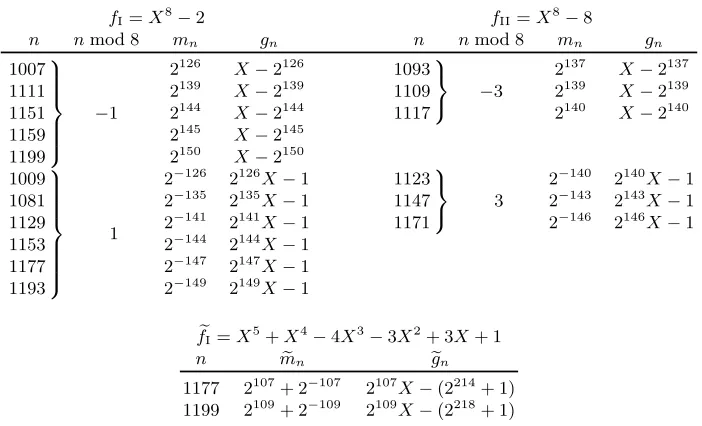
fII = X8 −8 for n = ±3 mod 8 in SII. This leads to the common roots mn and rational polynomials gn corresponding to n as listed in Table 1. Relations were collected using two sieves (one for fI shared by eleven n-values, and one for fII shared by six n-values) and
Table 1.The shared algebraic polynomials, roots, and rational polynomials for the 11 + 6 = 17 Mersenne numbers 2n−1 considered here.
fI=X8−2 fII=X8−8
n nmod 8 mn gn n nmod 8 mn gn
1007 1111 1151 1159 1199
2126 X−2126 1093
1109 1117
2137 X−2137
2139 X−2139 −3 2139 X−2139
−1 2144 X−2144 2140 X−2140
2145 X−2145 2150 X−2150 1009 1081 1129 1153 1177 1193 1
2−126 2126X−1 1123
1147 1171
2−140 2140X−1
2−135 2135X−1 3 2−143 2143X−1
2−141 2141X−1 2−146
2146X−1
2−144 2144X−1 2−147 2147X−1
2−149 2149X−1
e
fI=X5+X4−4X3−3X2+ 3X+ 1
n men egn
1177 2107+ 2−107 2107X−(2214+ 1) 1199 2109+ 2−109 2109X−(2218+ 1)
in an attempt to reduce the effort to process the resulting matrix, for n ∈ {1177,1199}
additional relations were collected using the algebraic polynomial feI, as specified in Table 1 along with the common roots men and rational polynomials egn. Although n = 1177 and
n= 1199 share feI, to obtain the additional relations it turned out to be more convenient to use the vanilla all-sieving approach from [14] twice, cf. Section 4.4.
Another possibility would have been to select the single degree 6 polynomial X6−2. Its relatively low degree and very small coefficients lead to a huge number of smooth algebraic values, all with a relatively large rational counterpart (again due to the low degree). Atypically, rational sieving could have been appropriate, whereas due to large cofactor sizes rational cofactoring would be relatively costly. Overall degree 8 can be expected to work faster, despite the fact that it requires two algebraic polynomials. Degree 7 would require three algebraic polynomials and may be even worse than degree 6 for our sets of numbers, but would have had the advantage that numbers of the form 2n+ 1 could have been included too
4 Relation collection for the target set
4.1 Integrating the precomputation
The first step of Coppersmith’s factorization factory is the preparation and storage of a precomputed table of pairs corresponding to smooth rational polynomial values. With the parameters from [8] this table containsL(1.639) pairs. Assuming composites of relevant sizes, this is huge – possibly to the extent that it is impractical. If we apply Coppersmith’s idea as suggested in the second to last paragraph of Section 2.4 to a relatively small number of composites with the original NFS parameter choices, the table would containL(1.683) pairs, which is even worse.
SNFS with a shared algebraic polynomial. Though better, this is still impractically large. Another effect in our favor is that we are using degree 8 polynomials, which is a relatively large degree compared to what is suggested by the asymptotic runtime analysis: for our
N-values the integer closest to (2 log(log(3 log(NN))))1/3 would be 6. A larger degree leads to larger algebraic values, fewer smooth values, and thus fewer values to be stored.
Most importantly, however, we know our set of target numbers in advance. This allows us to process precomputed pairs right after they have been generated, and to keep only those that lead to a smooth rational polynomial value as well. With` numbers to be factored and
L(1.5232 ) as smoothness bound (cf. Section 2.2), this reduces the storage requirements from
L(1.523)L(−1.4523) =L(1.145) to `L(1.523)L(−1.2523) =`L(0.763). For our target sets this is only on the order of TBs (less than six TBs forSII.).
Despite the integration of the algebraic precomputation stage and the processing of the resulting smooth algebraic values on the rational side, the stages are described separately below.
4.2 Algebraic sieving
For the sieving of the polynomial fI = X8 −2 from Section 3.2 we used a search space
of approximately 266 pairs and varying smoothness bounds. At most two larger primes less than 237 were allowed in the otherwise smooth fI-values.
The sieving task is split up into a large number of subtasks: given a root z of fI
mod-ulo a large prime number q, a subtask consists of finding pairs (a, b) for which a/b ≡ zmodq (implying thatq dividesb8fI(a/b)) and such that the quotient b8fI(a/b)/q is smooth
(except for the large primes) with respect to the largest h ·108 less than q, with h ∈ {3,4,6,8,12,15,20,25,30,35}.
Pairs (a, b) for whicha/b≡zmodq form a two-dimensional lattice of index q inZ2 with basis q0
, z1
. After finding a reduced basis u, v ∈ Z2 for the lattice, the intersection of the original search space and the lattice is approximated as{ ab
=iu+jv: i, j∈Z,|i|<2I,0≤
j <2J}. The bounds I, J ∈Z>0 were (or, rather, “are ideally” as this is what we converged
to in the course of our experiments) chosen such that I +J + log2(q) ≈ 65 and such that max(|a|) ≈ max(b), thus taking the relative lengths of u and v into account. Sieving takes place in a size 2I+J+1 rectangular region of the (i, j)-plane while avoiding storage for the (even,even) locations, as described in [13]. After the sieving, all fI-values corresponding to
the reported locations are divided by q and trial-divided as also described in [13], allowing at most two prime factors between q and 237. Allowing three large primes turned out to be counterproductive with slightly more relations at considerably increased sieving time or many more relations at the expense of a skyrocketing cofactoring effort.
Each (a, b) with smooth algebraic polynomial value resulting from subtask (q, z) induces a pair (−a, b) with smooth algebraic polynomial value for subtask (q,−z). Subtasks thus come in pairs: it suffices to sieve for one subtask and to recover all smooth pairs for the other subtask before further processing. Forn≥1151 we used mostq-values with 4·108 < q <8·109 (almost 233), resulting in about 157 million pairs of subtasks. For the othern-values we used fewer pairs of subtasks: about 126 million forn∈ {1007,1009} and about 143 million for the others.
smoothness bounds require more memory and thus more cores. After completion of a batch, the resulting pairs are inspected for smoothness of their applicable rational polynomial values as further described below. Processing the batches, not counting the rational smoothness tests, required about2367core years. It resulted in 1.57·1013 smooth algebraic values, and thus for eachn∈SI at most twice that many values to be inspected for rational smoothness.
Storage of the 1.57·1013values (in binary format at five bytes per value) would have required 70 TB. As explained in Section 4.1 we avoided these considerable storage requirements by processing the smooth algebraic values almost on-the-fly; this also allowed the use of a more relaxed text format at about 20 bytes per value.
Sieving for n ∈ SII was done in the same way. For the polynomial fII = X8 −8 and
n∈ {1147,1171} about 118 million pairs of subtasks were processed for most q-values with 3·108 < q < 5.45·109. For the other n-values in S
II about 94% to 96% of that range of q
-values sufficed. Overall, sieving forn∈SIIrequired1626core years and resulted in 1.16·1013
smooth algebraic values.
4.3 Rational factorization trees
Each time a batch offI-sieving subtasks is completed (cf. Section 4.2) the pairs (a, b) produced
by it are partitioned over four initially empty queues Q34,Q35,Q36, and Q37: if the largest prime in the factorization of b8fI(a/b) has bitlength i for i ∈ {35,36,37} then the pair is
appended to Qi, all remaining pairs are appended to Q34.
After partitioning the new pairs among the queues, the following is done for eachn∈SI
(cf. Section 3.1). For all pairs (a, b) in∪iα=34(n)Qi, withα(n) as in Table 2, the rational polynomial value bgn(a/b) (with gn as in Table 1) is tested for smoothness: if bgn(a/b) is smooth, then (a, b) is included in the collection of relations for the factorization of 2n−1, else (a, b) is discarded. The smoothness test for the bgn(a/b)-values is conducted simultaneously for all pairs (a, b) ∈ ∪αi=34(n)Qi using a factorization tree as in [15, Section 4] (see also [4]) with
τ(n)·108 and 2β(n) as smoothness and cofactor bounds, respectively (with τ(n) andβ(n) as in Table 2). Here the cofactor bound limits the number and the size of the factors inbgn(a/b) that are larger than the smoothness bound.
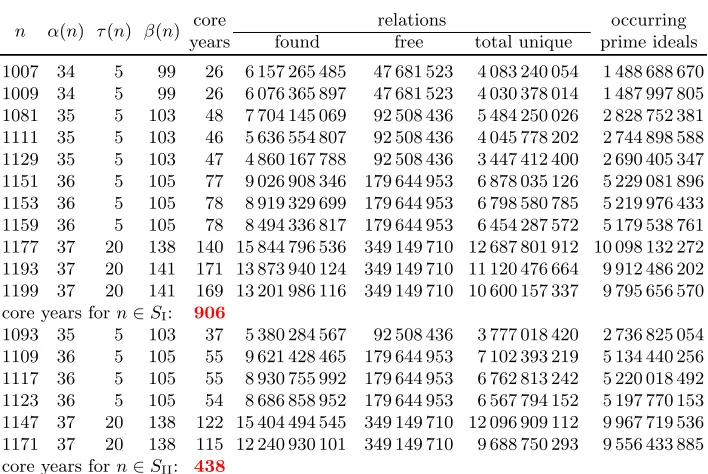
For all n∈SI, besides the runtimes Table 2 also lists the numbers of relations found, of
free relations [24], of relations after duplicate removal (and inclusion of the free relations), and of prime ideals that occur in the relations before the first singleton removal (where the number of prime ideals is the actual dimension of the exponent vectors). All resulting raw matrices are over-square. For n ∈ {1193,1199} the over-squareness is relatively small. For
n= 1193 we just dealt with the resulting rather large filtered matrix. For n= 1199, and for
n= 1177 as well, additional sieving was done, as further discussed in the section below. The unusually high degree of over-squareness for the smallern-values is a consequence of the large amount of data that had to be generated for the larger n-values, and that could be included for the smaller ones at little extra cost.
Completed batches of subtasks forfII-sieving were processed in the same way. The results
are listed in Table 2.
4.4 Additional sieving
poly-Table 2.
n α(n) τ(n) β(n) core relations occurring years found free total unique prime ideals
1007 34 5 99 26 6 157 265 485 47 681 523 4 083 240 054 1 488 688 670 1009 34 5 99 26 6 076 365 897 47 681 523 4 030 378 014 1 487 997 805 1081 35 5 103 48 7 704 145 069 92 508 436 5 484 250 026 2 828 752 381 1111 35 5 103 46 5 636 554 807 92 508 436 4 045 778 202 2 744 898 588 1129 35 5 103 47 4 860 167 788 92 508 436 3 447 412 400 2 690 405 347 1151 36 5 105 77 9 026 908 346 179 644 953 6 878 035 126 5 229 081 896 1153 36 5 105 78 8 919 329 699 179 644 953 6 798 580 785 5 219 976 433 1159 36 5 105 78 8 494 336 817 179 644 953 6 454 287 572 5 179 538 761 1177 37 20 138 140 15 844 796 536 349 149 710 12 687 801 912 10 098 132 272 1193 37 20 141 171 13 873 940 124 349 149 710 11 120 476 664 9 912 486 202 1199 37 20 141 169 13 201 986 116 349 149 710 10 600 157 337 9 795 656 570 core years forn∈SI: 906
1093 35 5 103 37 5 380 284 567 92 508 436 3 777 018 420 2 736 825 054 1109 36 5 105 55 9 621 428 465 179 644 953 7 102 393 219 5 134 440 256 1117 36 5 105 55 8 930 755 992 179 644 953 6 762 813 242 5 220 018 492 1123 36 5 105 54 8 686 858 952 179 644 953 6 567 794 152 5 197 770 153 1147 37 20 138 122 15 404 494 545 349 149 710 12 096 909 112 9 967 719 536 1171 37 20 138 115 12 240 930 101 349 149 710 9 688 750 293 9 556 433 885 core years forn∈SII: 438
nomialsegn from Table 1. These two n-values sharefeI, so we could have used Coppersmith’s approach. For various reasons we treated them separately using the software from [14].
Forn= 1177 we used on the rational side smoothness bound 3·108, cofactor bound 2109, and large factor bound 237. On the algebraic side these numbers were 5·108, 274, and 237. Using large primesq ∈[3·108,3.51·108] on the rational side (as opposed to the algebraic side above) we found 1 640 189 494 relations, of which 1 606 180 461 remained after duplicate removal. With 1 117 302 548 free relations this led to a total of 2 723 483 009 additional relations. With the 12 687 801 912 relations found earlier, this resulted in 15 411 284 921 relations in total, involving 15 926 778 561 prime ideals. Although this is not over-square (whereas the earlier relation set forn= 1177 from Section 4.3 was over-square), the new free relations contained many singleton prime ideals, so that after singleton removal the matrix was easily over-square. The resulting filtered matrix was deemed to be small enough.
For n = 1199 the rational smoothness bound is 4 ·108. All other parameters are the same as for n = 1177. After processing the rational large primes q ∈ [4·108,6.85·108] we had 6 133 381 386 degree 5 relations (of which 5 674 876 905 unique) and 1 117 302 548 free relations. This led to 17 392 336 790 relations with 15 955 331 670 prime ideals and a small enough filtered matrix.
4.5 Equipment used
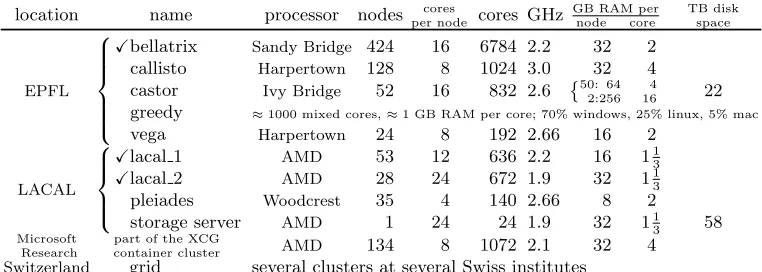
Relation collection forn∈SI was done from May 22, 2010, until February 21, 2013, entirely
on clusters at EPFL as listed in Table 3: 82% on lacal 1 and lacal 2, 12% on pleiades, 3% on greedy, and 1.5% on callisto and vega each, spending 3273 (2367 + 906) core years. Fur-thermore, 65 and 327 core years were spent on lacal 1 and lacal 2 for additional sieving for
n= 1177 andn= 1199, respectively. Thus a total of 3665core years was spent on relation collection forn∈SI.
Relation collection for n ∈ SII was done from February 21, 2013, until September 11,
2014, on part of the XCG container cluster at Microsoft Research in Redmond, USA, and on clusters at EPFL: 46.5% on the XCG cluster, 45.5% on lacal 1 and lacal 2, 5% on castor, 2% on grid, and 1% on greedy, spending a total of2064(1626 + 438) core years. It followed the approach described above forfI, except that data were transported on a regular 500 GB hard
disk drive that was sent back and forth between Redmond and Lausanne via regular mail.
Table 3.Description of available hardware. We have 100% access to the equipment at LACAL and to 134 nodes of the XCG container cluster (which contains many more nodes) and limited access to the other resources. A checkmark (X) indicates InfiniBand network. All nodes have 2 processors.
location name processor nodes per nodecores cores GHz GB RAM per node core
TB disk space
Xbellatrix callisto castor greedy vega
Sandy Bridge 424 16 6784 2.2 32 2
Harpertown 128 8 1024 3.0 32 4
EPFL Ivy Bridge 52 16 832 2.6 50: 64
2:256 4 16 22 ≈1000 mixed cores,≈1 GB RAM per core; 70% windows, 25% linux, 5% mac
Harpertown 24 8 192 2.66 16 2
Xlacal 1 Xlacal 2 pleiades storage server
AMD 53 12 636 2.2 16 113
LACAL AMD 28 24 672 1.9 32 1
1 3
Woodcrest 35 4 140 2.66 8 2
AMD 1 24 24 1.9 32 11
3 58 Microsoft
Research
part of the XCG
container cluster AMD 134 8 1072 2.1 32 4
Switzerland grid several clusters at several Swiss institutes
5 Processing the matrices
Although relation collection could be shared among the numbers, the matrices must all be treated separately. Several of them required an effort that is considerably larger than the matrix effort reported in [20]. There a 192 795 550×192 796 550-matrix with on average 144 non-zeros per column (in this section all sizes and weights refer to matrices after filtering) was processed on a wide variety of closely coupled clusters in France, Japan, and Switzer-land, requiring four months wall time and a tenth of the computational effort of the relation collection. So far it was the largest binary matrix effort that we are aware of, in the public domain. The largest matrix done here is about 4.5 times harder.
5.1 The block Wiedemann algorithm
Wiedemann’s algorithm. Given a sparse r ×r matrix M over the binary field F2 and
most r. Denoting its coefficients by Fi ∈ F2 and assuming that F0 = 1 we have F(M)v =
Pr
i=0FiMiv = 0, so that x follows as Pri=1FiMi−1v. Wiedemann’s method [34] determines
x in three steps. For any j with 1 ≤ j ≤ r the j-th coordinates of the vectors Miv for
i = 0,1,2, . . . satisfy the linear recurrence relation given by the Fi. Thus, once the first 2r+ 1 of thesej-th coordinates have been determined using 2r iterations of matrix×vector multiplications (Step 1), the Fi can be computed using the Berlekamp-Massey method [26] (Step 2), where it may be necessary to compute the least common multiple of the results of a fewj-values. The solutionx then follows using another r matrix×vector multiplications (Step 3).
Steps 1 and 3 run in timeΘ(rw(M)), wherew(M) denotes the number of non-zero entries of M. With Step 2 running in time O(r2) the effort of Wiedemann’s method is dominated by steps 1 and 3.
Block Wiedemann. The efficiency of Wiedemann’s conceptually simple method is
consid-erably enhanced by processing several different vectors v simultaneously, as shown in [9, 33]: on 64-bit machines, for instance, 64 binary vectors can be treated at the same time, at neg-ligible loss compared to processing a single binary vector. Though this slightly complicates Step 2 and requires keeping the 64 first coordinates of each vector calculated per iteration in Step 1, it cuts the number of matrix×vector products in steps 1 and 3 by a factor of 64 and effectively makes Wiedemann’s method 64 times faster. This blocking factor of 64 can, obvi-ously, be replaced by 64t for any positive integer t. This calculation can be carried out by t
independent threads (or on tindependent clusters, [1]), each processing 64 binary vectors at a time while keeping the 64tfirst coordinates per multiplication in Step 1, and as long as the independent results of thet-fold parallelized first step are communicated to a central location for the Berlekamp-Massey step [1].
As explained in [9, 20] a further speed-up in Step 1 may be obtained by keeping, for some integer k > 1, the first 64kt coordinates per iteration (for each of the t independent 64-bit wide threads). This reduces the number of Step 1 iterations from 264rt to (1k + 1)64rt while the number of Step 3 iterations remains unchanged at 64rt. However, it has a negative effect on Step 2 with time and space complexities growing as (k+ 1)µtµ−1r1+o(1) and (k+ 1)2tr, respectively, forr→ ∞ and withµthe matrix multiplication exponent (we used µ= 3).
Double matrix product.In all previous work that we are aware of a single filtered matrix
M is processed by the block Wiedemann method. This matrixM replaces the original matrix
Mraw consisting of the exponent vectors, and is calculated asM =Mraw×M1×M2 for certain
filtering matrices M1 and M2. For most matrices here, we adapted our filtering strategy,
calculatedMf1 =Mraw×M1, and applied the block Wiedemann method to the r×r matrix
M without actually calculating it but by usingM =Mf1×M2. BecauseM vcan be calculated asMf1(M2v) at (asymptotic) costw(M2) +w(Mf1) this is advantageous ifr(w(Mf1) +w(M2)) is lower than the product of the dimension and weight resulting from traditional filtering. Details about the new filtering strategy will be provided once we have more experience with it.
Error detection. During relation collection no special attention has to be paid to detect
depend on the matrix step used and that allow detection and, if required, rollback to a recent correct state at relatively small additional cost. They are part of factoring “folklore” and normally not explicitly described. For instance, in [2, Section 3.3], where Gaussian elimination was used, spurious dependencies (such as ad-th column consisting of the sum of columns 1 through d−1 for regularly spaced d-values) were upfront included in the matrix. For many later factorizations (such as [12]) block Lanczos was used. This generates a sequence of vectors with most of them mutually orthogonal, so an occasional orthogonality check suffices to keep the calculation on track.
For block Wiedemann, we used the following simple method, used since about 2001 by Emmanuel Thom´e [32] and in 2002 independently developed by the first author and Jens Franke to deal with frequently flipping bits which went by unnoticed in the floating-point focussed infrastructure they relied upon; for steps 1 and 3 it later appeared in [16]. For a checkpoint distance c and a random vectorz we (reliably) precomputeu= (MT)cz. Because the inner product hu, xi equals hz, Mcxi, probably almost all errors can be detected that occurred in Step 1 between the two consecutive checkpoints x and Mcx. In Step 3 one can check that the same checkpoints as in Step 1 are computed and one can do a similar, but faster, inner product check as in Step 1 (this was used once, when some files were not copied or written correctly); we do not elaborate. The result of Step 2 can be checked by verifying that certain coefficients are zero in a product of two large matrix-polynomials. The check can be sped up in a simple randomized manner.
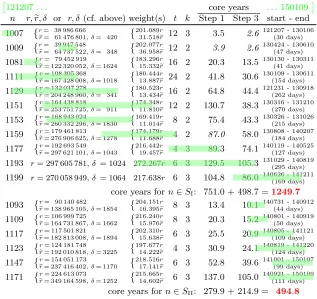
5.2 Matrix results
All matrix calculations were done at EPFL on the clusters with InfiniBand network (bellatrix, lacal 1, and lacal 2) and the storage server (cf. Table 3). Despite our limited access to bellatrix, it was our preferred cluster for steps 1 and 3 because its larger memory bandwidth (compared to lacal 1 and lacal 2) allowed us to optimally run on more cores at the same time while also cutting the number of core years by a factor of about two (compared to lacal 1). The matrix from [20], for instance, which would have required about 154 core years on lacal 1 would require less than 75 core years on bellatrix.
Table 4 lists some data for all matrices we processed. Jobs were usually run on a small number of nodes (running up to five matrices at the same time), as that requires the least amount of communication and storage per matrix and minimizes the overall runtime. Ex-tended wall times were of no concern. The Berlekamp-Massey step, for which there are no data in Table 4, was run on the storage server. Its runtime requirements varied from several days to two weeks, using just 8 of the 24 available cores, writing and reading intermediate results to and from disk to satisfy the considerable storage needs. For each of the numbers Step 2 thus took less than one core year.
The error detection methods proved their worth: at least once in Step 1 during the start-up phase of bellatrix and occasionally for lacal 1 and lacal 2 due to writing problems on the network file system.
6 Factorizations
Table 4.Data about the matrices processed, as explained in Section 5.1, with Mf1,M2, and M matrices of
sizesr×er,re×(r+δ), andr×(r+δ), respectively, for a relatively small positive integerδ. Runtimes in italics
are estimates for data that were not kept. Starting from Step 3 forn = 1151 a different configuration was used, possibly including some changes in our code, and the programs ran more efficiently. Untiln= 1159 a blocking factor of 128 was used (sotmust be even), forn∈ {1177,1193,1199} ∪SII it was 64 in order to fit
on 16 nodes. The green bars indicate the periods that the matrices were processed, on the green scale at the top. Dates are in the formatyymmdd.
121207. . . core years . . .150109
n r,er, δ or r, δ(cf. above) weight(s) t k Step 1 Step 3 start - end
1007 r= 38 986 666
e
r= 61 476 801, δ= 420
201.089r
31.518er
12 3 3.5 2.6 121207 - 130106(30 days)
1009 r= 39 947 548
e
r= 64 737 522, δ= 348
202.077r
36.958er
12 2 3.9 2.6 130424 - 130610(47 days)
1081 r= 79 452 919 e
r= 122 320 052, δ= 1624
183.296r
15.332er
16 2 20.3 13.5 130130 - 130311(41 days)
1111 r= 108 305 368
e
r= 167 428 008, δ= 1018
180.444r
13.887er
24 2 41.8 30.6 130109 - 130611(154 days)
1129 r= 132 037 278
e
r= 204 248 960, δ= 341
180.523r
13.434er
16 2 64.8 44.4 121231 - 130918(262 days)
1151 r= 164 438 818
e
r= 253 751 725, δ= 911
174.348r
11.810er
12 2 130.7 38.3 130316 - 131210 (270 days)
1153 r= 168 943 024
e
r= 260 332 296, δ= 1830
169.419r
11.014er
8 2 75.4 43.3 130326 - 131026(215 days)
1159 r= 179 461 813
e
r= 276 906 625, δ= 1278
174.179r
11.688er
4 2 87.0 58.0 130808 - 140207(184 days)
1177 r= 192 693 549
e
r= 297 621 101, δ= 1043
216.442r
19.457er
4 3 89.3 74.1 140119 - 140525(127 days)
1193 r= 297 605 781, δ = 1024 272.267r 6 3 129.5 105.3 131029 - 140819(295 days)
1199 r= 270 058 949, δ = 1064 217.638r 6 3 104.8 86.0 140626 - 141211(169 days)
core years forn∈SI: 751.0 + 498.7 =1249.7
1093 r= 90 140 482
e
r= 138 965 105, δ= 1854
204.151r
16.395er
8 3 13.4 10.1 140731 - 140912(44 days)
1109 r= 106 999 725
e
r= 164 731 867, δ= 1662
216.240r
15.976er
8 3 20.3 15.2 140801 - 140919(50 days)
1117 r= 117 501 821
e
r= 182 813 008, δ= 1894
202.310r
15.638er
6 3 25.5 20.9 140805 - 141121(109 days)
1123 r= 124 181 748 e
r= 192 010 818, δ= 3225
197.677r
14.222er
4 3 30.9 24.1 140819 - 141220(124 days)
1147 r= 154 051 173
e
r= 237 416 402, δ= 1170
218.516r
17.141er
6 3 52.8 39.6 141001 - 150107(99 days)
1171 r= 224 613 073
e
r= 349 164 598, δ= 1252
215.665r
14.602er
6 3 137.0 105.0 140921 - 150109(111 days)
core years forn∈SII: 279.9 + 214.9 = 494.8
algebraic number field defined by a single algebraic polynomial (in our case fI for n ∈ SI
andfII forn∈SII). Using this software forn∈ {1177,1199}, the values for which additional
sieving was done for the polynomialsfeIand e
gnfrom Table 1, would have required a substantial amount of programming. To save ourselves this non-trivial effort we opted for the naive old-fashioned approach used for the very first SNFS factorizations as described in [24, Section 3] of finding explicit generators for all first degree prime ideals in both number fields Q(√8
2) and Q(ζ11+ζ11−1) and up to the appropriate norms. Because both number fields have class
number equal to one and the search for generators took, relatively speaking, an insignificant amount of time, this approach should have enabled us to quickly and conveniently deal with these two more complicated cases as well.
the speed requirements unavoidably produced by sieving and cofactorization) were used as input to the filtering step. When we started counting the number of bad inputs, extrapolation of early counts suggested quite a few more than 244 bad entries, implying the possibility that the matrix step had to be redone because the 244 incorrect congruences may not suffice to produce correct congruences (combining incorrect congruences to remove the bad entries). We narrowly escaped because, due to circumstances beyond anyone’s control [30], the count unexpectedly slowed down and only 189 bad entries were found. This then led to a total of 195 correct congruences, after which the factorization followed using the approach described above. The bug has been fixed, and forn= 1199 the problem did not recur.
The seventeen factorizations that we obtained are listed below: n, the lengths in binary and decimal of the unfactored part of 2n−1, factorization date, the lengths of the smallest newly found prime factor, and the factor.
1007 : 843-bit c254, Jan 8 2013, 325-bit p98:
456648335230526285864952133714425117400753719511824784488197858947527635536 20148815526546415896369
1009 : 677-bit c204, Jun 12 2013, 295-bit p89:
328016293993162203862559385660775410788362383458683411815672560081556389845 94836583203447
1081 : 833-bit c251, Mar 11 2013, 380-bit p115:
143958109023236030672465272149722147580189359410433570676762910927750259908 3325989958974577353063372266168702537641
1111 : 921-bit c278, Jun 13 2013, 432-bit p130:
940169921742610112608562740053788168866892343030602990266594724011208557285 0557654128039535064932539432952669653208185411260693457
1129 : 1085-bit c327, Sep 20 2013, 460-bitp139:
268286355184946394155501223506130260611391954211714181416821906546974102697 3149811937861249380857772014308434017285472953428756120546822911
1151 : 803-bit c242, Dec 12 2013, 342-bitp103:
831191943103956096429163491797781276599700151644473213627100061117477526433 7926657343369109100663804047
1153 : 1099-bit c331, Oct 28 2013, 293-bitp89:
101223609612478739536241908851788886296068899804351792496835242933132301150 56983720103793
1159 : 1026-bit c309, Feb 9 2014, 315-bit p95:
629992650360823359001119647014620004385929325178156608184518819156211543492 10038027033309344287
1177 : 847-bit c255, May 29 2014, 370-bitp112:
201566078754892345466259020562112388697008576143602159294285984752310846552 3348455927947279783179798610711213193
1193 : 1177-bit c355, Aug 22 2014, 346-bit p104:
852273262013143618238937766054336366702174253883119064577144090160499615075 16230416822145599757462472729
1199 : 1041-bit c314, Dec 17 2014, 252-bitp76:
4218108040611917562429786369962714155026225684343947313001103389074302369031
1093 : 976-bit c294, Sep 13 2014, 405-bitp122:
1109 : 998-bit c301, Sep 20 2014, 483-bitp146:
246160192118893252008690552181810705879686400612203285102080433991774223148 89351269580238737955397055519355385591659502001884424804253804809798519
1117 : 1102-bit c332, Nov 24 2014, 259-bit p78:
520973969756320610191611683062985619298001156192232208204963188406964166233609
1123 : 1064-bit c321, Dec 23 2014, 285-bitp86:
432174937442617825091240517171252021834859519423625288706968889787572287434 21469882287
1147 : 873-bit c263, Jan 10 2015, 378-bit p114:
471661056045900801786914314898846331049686822504477947359335825425991737416 239736817636268059783884146105254485417
1171 : 1134-bit c342, Jan 11 2015, 423-bit p128:
123486709628332584428076753832658383476279975879401175061904202736046204438 43301292612106209291538933323931056186142998412331913
The total cost for the eleven factorizations forn∈SIwas about4915core years, with relation
collection estimated at 3665 core years, and all matrices in about 1250 core years. The total cost for the six factorizations for n∈SII was about2559core years, with relation collection
estimated at 2064 core years, and all matrices in about 495 core years. The total cost for all seventeen factorizations was close to but less than 7500core years.
Individual factorization using the SNFS would have cost ten to fifteen thousand core years for all n ∈ SI and four to six thousand core years for all n ∈ SII, so overall we obtained a
worthwhile saving.
With smallest newly found factors of 76 and 78 decimal digits (of 21199−1 and of 21117−1, respectively) and a largest factor found using the ECM of 83 decimal digits [35], it may be argued that our ECM preprocessing could have been a bit “luckier”; on the bright side, the 254-digit (844-bit) prime factor of 21117 −1 may be a new largest prime factor record for SNFS factorizations.
7 Conclusion
We have shown that given a list of properly chosen special numbers their factorizations may be obtained using Coppersmith’s factoring factory with considerable savings, in comparison to treating the numbers individually. Application of Coppersmith’s idea to general numbers looks less straightforward. Taking the effects into account of rational versus algebraic pre-computation (giving rise to many more smooth values) and of our relatively large algebraic degree (lowering our number of precomputed values), extrapolation of the 70 TB disk space estimate given at the end of Section 4.2 suggests that an EB of disk space may be required if a setS of 1024-bit RSA moduli to be factored is not known in advance. This is not infeasible, but not yet within reach of an academic effort. Of course, these excessive storage problems vanish ifS is known in advance. But the relative efficiency of current implementations of siev-ing compared to factorization trees suggests that |S|individual NFS efforts will outperform Coppersmith’s factorization factory, unless the moduli get larger. This is compounded by the effect of advantageously chosen individual roots, versus a single shared root.
be larger than the ones here, fewer will be factored by the ECM. Thus, we expect that future table-makers, who may wish to factor larger Mersenne numbers, can profit from the approach described in this paper to a larger extent than we have been able to – unless of course better factorization methods or devices have emerged. Obviously, the SNFS factorization factory can be applied to other Cunningham numbers, or Fibonacci numbers, or yet other special numbers. We do not elaborate.
Acknowledgements. We gratefully acknowledge the generous contribution by Microsoft
Research to the relation collection effort reported in this paper. Specifically, we want to thank Kristin Lauter for arranging access to the XCG container lab, Lawrence LaVerne for technical support and Michael Naehrig for his assistance in the coordination of the relation collection. We thank Rob Granger for his comments. This work was supported by EPFL through the use of the facilities of its Scientific IT and Application Support Center: the SCITAS staff members have been tremendously helpful and forthcoming dealing with our attempts to process the seventeen matrix steps in a reasonable amount of time. Finally, this work was supported by the Swiss National Science Foundation under grant numbers 200021-119776, 200020-132160, and 206021-128727 and by the project SMSCG (Swiss Multi Science Compute Grid), with computational infrastructure and support, as part of the “AAA/SWITCH – e-infrastructure for e-science” program.
References
1. K. Aoki, J. Franke, T. Kleinjung, A. K. Lenstra, and D. A. Osvik. A kilobit special number field sieve factorization. In K. Kurosawa, editor, Asiacrypt 2007, volume 4833 of LNCS, pages 1–12. Springer, Heidelberg, 2007.
2. D. Atkins, M. Graff, A. K. Lenstra, and P. C. Leyland. The magic words are squeamish ossifrage. In
Asiacrypt 1994, volume 917 ofLNCS, pages 263–277. Springer, Heidelberg, 1994.
3. F. Bahr. Liniensieben und Quadratwurzelberechnung f¨ur das Zahlk¨orpersieb, 2005. Diplomarbeit, Uni-versity of Bonn.
4. D. J. Bernstein. How to find small factors of integers. http://cr.yp.to/papers.html, june 2002. 5. J. W. Bos, T. Kleinjung, A. K. Lenstra, and P. L. Montgomery. Efficient SIMD arithmetic modulo a
Mersenne number. In IEEE Symposium on Computer Arithmetic – ARITH-20, pages 213–221. IEEE Computer Society, 2011.
6. J. Brillhart, D. H. Lehmer, J. L. Selfridge, B. Tuckerman, and S. S. Wagstaff, Jr. Factorizations of bn±1,b= 2,3,5,6,7,10,11,12Up to High Powers, volume 22 ofContemporary Mathematics. American Mathematical Society, First edition, 1983, Second edition, 1988, Third edition, 2002. Electronic book available at:http://homes.cerias.purdue.edu/~ssw/cun/index.html, 1983.
7. G. Childers. Factorization of a 1061-bit number by the special number field sieve. Cryptology ePrint Archive, Report 2012/444, 2012. http://eprint.iacr.org/.
8. D. Coppersmith. Modifications to the number field sieve. Journal of Cryptology, 6(3):169–180, 1993. 9. D. Coppersmith. Solving homogeneous linear equations over GF(2) via block Wiedemann algorithm.
Mathematics of Computation, 62(205):333–350, 1994.
10. A. J. C. Cunningham and A. E. Western. On Fermat’s numbers. Proceedings of the London Mathematical Society, 2(1):175, 1904.
11. A. J. C. Cunningham and H. J. Woodall. Factorizations of yn±1,y= 2,3,5,6,7,10,11,12 up to high powers. Frances Hodgson, London, 1925.
12. B. Dodson and A. K. Lenstra. NFS with four large primes: an explosive experiment. In D. Coppersmith, editor,Crypto 1995, volume 963 ofLNCS, pages 372–385. Springer, Heidelberg, 1995.
13. J. Franke and T. Kleinjung. Continued fractions and lattice sieving. InSpecial-purpose Hardware for At-tacking Cryptographic Systems – SHARCS 2005, 2005. http://www.hyperelliptic.org/tanja/SHARCS/ talks/FrankeKleinjung.pdf.
14. J. Franke and T. Kleinjung. GNFS for linux. Software, 2012.
16. W. Geiselmann, A. Shamir, R. Steinwandt, and E. Tromer. Scalable hardware for sparse systems of linear equations, with applications to integer factorization. In Cryptographic Hardware and Embedded Systems – CHES 2005, volume 3659 ofLNCS, pages 131–146. Springer, Heidelberg, 2005.
17. R. Golliver, A. K. Lenstra, and K. McCurley. Lattice sieving and trial division. InAlgorithmic Number Theory Symposium – ANTS’94, volume 877 ofLNCS, pages 18–27, 1994.
18. J. Harrison. Isolating critical cases for reciprocals using integer factorization. In IEEE Symposium on Computer Arithmetic – ARITH-16, pages 148–157. IEEE Computer Society, 2003.
19. T. Kleinjung. On polynomial selection for the general number field sieve. Mathematics of Computation, 75:2037–2047, 2006.
20. T. Kleinjung, K. Aoki, J. Franke, A. K. Lenstra, E. Thom´e, J. W. Bos, P. Gaudry, A. Kruppa, P. L. Montgomery, D. A. Osvik, H. te Riele, A. Timofeev, and P. Zimmermann. Factorization of a 768-bit RSA modulus. In T. Rabin, editor,Crypto 2010, volume 6223 of LNCS, pages 333–350. Springer, Heidelberg, 2010.
21. A. K. Lenstra, T. Kleinjung, and E. Thom´e. Universal security; from bits and mips to pools, lakes – and beyond. In M. Fishlin and S. Katzenbeisser, editors, Number theory and cryptography, volume 8260 of
LNCS, pages 121–124. Springer, Heidelberg, 2013. http://eprint.iacr.org/2013/635.
22. A. K. Lenstra and H. W. Lenstra, Jr. Algorithms in number theory. In J. van Leeuwen, editor,Handbook of Theoretical Computer Science (Volume A: Algorithms and Complexity), pages 673–715. Elsevier and MIT Press, 1990.
23. A. K. Lenstra and H. W. Lenstra, Jr. The Development of the Number Field Sieve, volume 1554 ofLNM. Springer-Verlag, 1993.
24. A. K. Lenstra, H. W. Lenstra, Jr., M. S. Manasse, and J. M. Pollard. The number field sieve. pages 11–42 in [23].
25. H. W. Lenstra Jr. Factoring integers with elliptic curves. Annals of Mathematics, 126(3):649–673, 1987. 26. J. Massey. Shift-register synthesis and BCH decoding.IEEE Transactions on Information Theory, 15:122–
127, 1969.
27. P. Montgomery. Square roots of products of algebraic numbers. In W. Gautschi, editor,Mathematics of Computation 1943–1993: a Half-Century of Computational Mathematics, Proceedings of Symposia in Applied Mathematics, pages 567–571. American Mathematical Society, 1994.
28. P. Q. Nguyen. A Montgomery-like square root for the number field sieve. InAlgorithmic Number Theory Symposium – ANTS III, volume 1423 ofLNCS, pages 151–168, 1998.
29. J. M. Pollard. The lattice sieve. pages 43–49 in [23].
30. B. Radford. Why do people see guardian angels?, August 2013. http://news.discovery.com/human/ psychology/why-people-see-guardian-angels-130813.htm.
31. R. L. Rivest, A. Shamir, and L. Adleman. A method for obtaining digital signatures and public-key cryptosystems. Communications of the ACM, 21:120–126, 1978.
32. E. Thom´e, 2002. Private communication.
33. E. Thom´e. Subquadratic computation of vector generating polynomials and improvement of the block Wiedemann algorithm. Journal of Symbolic Computation, 33(5):757–775, 2002.
34. D. Wiedemann. Solving sparse linear equations over finite fields. IEEE Transactions on Information Theory, 32:54–62, 1986.
35. P. Zimmermann. 50 large factors found by ECM.http://www.loria.fr/~zimmerma/records/top50.html. 36. P. Zimmermann. Input file for Cunningham cofactors.