On Extractability (a.k.a. Differing-Inputs) Obfuscation
Elette Boyle∗ Cornell University
Kai-Min Chung Academia Sinica
Rafael Pass† Cornell University
April 16, 2014
Abstract
We initiate the study of extractability obfuscation (a.k.a. differing-inputs obfuscation), a notion first suggested by Baraket al. (JACM 2012): An extractability obfuscatoreOfor a class of algorithmsMguarantees that if an efficient attackerAcan distinguish between obfuscations eO(M1), eO(M2) of two algorithmsM1, M2∈ M, thenAcan efficiently recover (givenM1 and
M2) an input on whichM1andM2provide different outputs.
• We rely on the recent candidate virtual black-box obfuscation constructions to provide can-didate constructions of extractability obfuscators for N C1; next, following the blueprint
of Garg et al. (FOCS 2013), we show how to bootstrap the obfuscator for N C1 to an
obfuscator for all non-uniform polynomial-time Turing machines. In contrast to the con-struction of Garg et al., which relies on indistinguishability obfuscation for N C1, our
construction enables succinctly obfuscating non-uniformTuring machines(as opposed to circuits), without turning running-time into description size.
• We introduce a new notion of functional witness encryption, which enables encrypting a message m with respect to an instancex, language L, and function f, such that anyone (and only those) who holds a witness wfor x∈L can computef(m, w) on the message and particular known witness. We show that functional witness encryption is, in fact, equivalent to extractability obfuscation.
• We demonstrate other applications of extractability extraction, including the first con-struction of fully (adaptive-message) indistinguishability-secure functional encryption for an unbounded number of key queries and unbounded message spaces.
• We finally relate indistinguishability obfuscation and extractability obfuscation and show special cases when indistinguishability obfuscation can be turned into extractability ob-fuscation.
∗
Supported in part by AFOSR YIP Award FA9550-10-1-0093.
†
1
Introduction
Obfuscation. The goal ofprogram obfuscation is to “scramble” a computer program, hiding its implementation details (making it hard to “reverse-engineer”), while preserving the functionality (i.e, input/output behavior) of the program. A first formal definition of such program obfuscation was provided by Hada [Had00]: roughly speaking, Hada’s definition—let us refer to it as strongly virtual black-box—is formalized using the simulation paradigm. It requires that anything an at-tacker can learn from the obfuscated code, could be simulated using just black-box access to the functionality.1 Unfortunately, as noted by Hada, only learnable functionalities can satisfy such a strong notion of obfuscation: if the attacker simply outputs the code it is given, the simulator must be able to recover the code by simply querying the functionality and thus the functionality must be learnable.
An in-depth study of program obfuscation was initiated in the seminar work of Barak, Goldreich, Impagliazzo, Rudich, Sahai, Vadhan, and Yang [BGI+12]. Their central result shows that even if we consider a more relaxed simulation-based definition of program obfuscation—called virtual black-box obfuscation—where the attacker is restricted to simply outputting a single bit, impossibility can still be established (assuming the existence of one-way functions). Their result is even stronger, demonstrating the existence of families of functions such that given black-box access to fs (for a
randomly chosen s), not even a single bit ofs can be guessed with probability significantly better than 1/2, but given the code of any program that computesfs, the entire secretscan be recovered.
Thus, even quite weak simulation-based notions of obfuscation are impossible.
Barak et al. [BGI+12] also suggested an avenue for circumventing these impossibility results:2 introducing the notions of indistinguishability and “differing-inputs” obfuscation. Roughly speak-ing, an indistinguishability obfuscator iO for a class of circuits C guarantees that given any two equivalent circuits C1 andC2 (i.e., whose outputs agree on all inputs) from the class, obfuscations
iO(C1) andiO(C2) of the circuits are indistinguishable. In a very recent breakthrough result, Garg,
Gentry, Halevi, Raykova, Sahai, and Waters [GGH+13] provide the first candidate construction of
indistinguishability obfuscators for all polynomial-size circuits. Additionally, Garg et al [GGH+13] and even more recently, the elegant works of Sahai and Waters [SW13] and Hohenberger, Sahai and Waters [HSW13], demonstrate several beautiful (and surprising) applications of the indistin-guishability obfuscation notion.
In this work, we initiate the study of the latter notion of obfuscation—“differing-inputs”, or as we call it, extractability obfuscation—whose security guarantees are at least as strong as indistin-guishability obfuscation, but weaker than virtual black-box obfuscation. We demonstrate candidate constructions of such extractability obfuscators, and new applications.
Extractability Obfuscation. Roughly speaking, an extractability obfuscator eO for a class of circuitsC guarantees that if an attackerA can distinguish between obfuscationsiO(C1), iO(C2) of
two circuits C1,C2 ∈ C, then A can efficiently recover (given C1 and C2) a point x on which C1
and C2 differ: i.e., C1(x) 6=C2(x).3 Note that if C1 and C2 are equivalent circuits, then no such
input exists, thus requiring obfuscations of the circuits to be indistinguishable (and so extractability obfuscation implies indistinguishability obfuscation).
1Hada actually considered slight distributional weakening of this definition. 2
Hada also suggested an approach for circumventing his impossibility result: he suggested sticking with a simulation-based definition, but instead restricting to particular classes of attacker. It is, however, not clear (to us) what reasonable classes of attackers are.
We may rely on the candidate obfuscator forN C1 of Brakerski and Rothblum [BR13] or Barak et al. [BGK+13] to obtain extractability obfuscation for the same class. We next demonstrate a
bootstrapping theorem for extractability obfuscation, showing how to obtain extractability obfus-cation for all polynomial-size circuits. Our transformation follows that of [GGH+13], but incurs a somewhat different analysis.
Theorem 1.1 (Informally stated). Assume the existence of an extractability obfuscator for N C1
and the existence of a (leveled) fully homomorphic encryption scheme with decryption in N C1
(implied, e.g., by Learning With Errors (LWE)). Then there exists an extractability obfuscation for
P/poly.
Relying on extractability obfuscation, however, has additional advantages: in particular, it allows us to achievesuccinctness of the obfuscated program. Namely, we refer to an extractability (or indistinguishability) obfuscator as succinct if it can be used to obfuscate (non-uniform) Turing machines, while ensuring that the size of the obfuscated code preserves a polynomial relation to the size of the original Turing machine. In contrast, a non-succinct obfuscator may (and, indeed, the constructions of [GGH+13, BR13] do) turn running time into size: even if the original Turing machine has a short description, but a long running time, the obfuscated code will have a long description. To achieve succinctness, we are additionally required to rely on the existence of P -certificates in the CRS model—namely, succinct non-interactive arguments forP.4
Theorem 1.2 (Informally stated). Assume the existence of an extractability obfuscation forN C1, the existence of a fully homomorphic encryption scheme with decryption inN C1 (implied, e.g., by LWE) andP-certificates (in the CRS model). Then there exists a succinct extractability obfuscation for P/poly.
On a high level, our construction follows the one from [GGH+13] but (1) modifies it to deal with executions of Turing machines (by relying on an oblivious Turing machine), and more importantly (2) compresses “proofs” by usingP-certificates. We emphasize that this approach doesnotwork in the setting of indistinguishability obfuscation. Intuitively, the reason for this is thatP-certificates of false statementsexist, but are just hard to find; efficiently extracting such P-certificates from a successful adversary is thus crucial (and enabled by the extractability property).
We next explore applications of extractability obfuscation.
Functional Witness Encryption. Consider the following scenario:
You wish to encrypt the labels in a (huge) graph (e.g., names of people in a social network) so that no one can recover them, unless there is a clique in the graph of size, say, 100. Then, anyone (and only those) who knows such a clique should be able to recover the labels of the nodes in the identified clique (and only these nodes). Can this be done?
The question is very related to the notion of witness encryption, recently introduced by Garg, Gentry, Sahai, and Waters [GGSW13]. Witness encryption makes it possible to encrypt the graph in such a way that anyone who finds any clique in the graph can recover the whole graph; if the graph does not contain any such cliques, the graph remains secret. The stronger notion of extractable witness encryption, introduced by Goldwasser, Kalai, Popa, Vaikuntanathan, and Zel-dovich [GKP+13], further guarantees that the graph can only be decrypted by someone who actually
4Such certificates can be either based on knowledge-of-exponent type assumptions [BCCT13], or even onfalsifiable
knowns a clique. However, in contrast to existing notions, here we wish to reveal only the labels associated with the particular known clique.
More generally, we put forward the notion of functional witness encryption (FWE). An FWE scheme enables one to encrypt a message m with respect to an N P-language L, instance x and a function f, such that anyone who has (and only those who have) a witness w for x ∈ L can recover f(m, w). In the above example, m contains the labels of the whole graph, w is a clique, and f(m, w) are the labels of all the nodes in w. More precisely, our security definition requires that if you can tell apart encryptions of two messagesm0, m1, then you must know a witnesswfor
x∈L such thatf(m0, w)6=f(m1, w).
We observe that general-purpose FWE and extractability obfuscation actually are equivalent (up to a simple transformation).
Theorem 1.3(Informally stated). There exists a FWE forN P and every polynomial-size function
f if and only if there exists an extractability obfuscator for every polynomial-size circuit.
The idea is very simple: Given an extractability obfuscator eO, an FWE encryption of the message m for the language L, instance x and function f is the obfuscation of the program that on input woutputsf(m, w) if w is a valid witness for x∈L. On the other hand, given a general-purpose FWE, to obfuscate a program Π, let f be the universal circuit that on input (Π, y) runs Π on input y, let L be the trivial language where every witness is valid, and output a FWE of the message Π—since every input y is a witness, this makes it possible to evaluate Π(y) on every y.
Other Applications. Functional encryption [BSW12, O’N10] enables the release of “targeted” secret keysskf that enable a user to recover f(m), and onlyf(m), given an encryption of m. It is
known that strong simulation-based notions of security cannot be achieved if users can request an unbounded number of keys. In contrast, Garget al.elegantly showed how to use indistinguishability obfuscation to satisfy an indistinguishability-based notion of functional encryption (roughly, that encryptions of any two messagesm0, m1 such thatf(m0) =f(m1) for all the requested secret keys
skf are indistinguishable). The main construction of Garg et al, however, only achieves
selective-message security, where the attacker must select the two message m0, m1 to distinguish before
the experiment begins (and it can request decryption keys skf). Garg et al. observe that if they
make subexponential-time security assumptions, use complexity leveraging, and consider a small (restricted) message space, then they can also achieve adaptive-message security.
We show how to use extractability obfuscation to directly achieve full adaptive-message security for any unbounded size message space (without relying on complexity leveraging).
The idea behind our scheme is as follows. Let the public key of the encryption scheme be the verification key for a signature scheme, and let the master secret key (needed to release secret keys skf) be the signing key for the signature scheme. To encrypt a message m, obfuscate the
program that on input f and a valid signature on f (with respect to the hardcoded public key) simply computesf(m). The secret keyskf for a functionf is then simply the signature onf. (The
high-level idea behind the construction is somewhat similar to the one used in [GKP+13], which used witness encryption in combination with signature schemes to obtain simulation-based FE for a single function f; in contrast, we here focus on FE for an unbounded number of functions).
in the security reduction and, roughly speaking, makes it possible to simulate key queries without harming security for the messages selected by the attacker.
Theorem 1.4 (Informally stated). Assume the existence of non-interactive zero-knowledge proofs of knowledge for N P and the existence of extractability obfuscators for polynomial-size circuits. Then there exists an (adaptive-message) indistinguishability-secure functional encryption scheme for arbitrary length messages.
Another interesting feature of our approach is that it directly enables constructions of Hier-archical Functional Encryption (HiFE) (in analogy with HierHier-archical Identity-Based encryption [HL02]), where the secret keys for functionsf can be released in a hierarchical way (the top node can generate keys for subsidiary nodes, those nodes can generate keys for its subsidiaries etc.). To do this, simply modify the encryption algorithm to release the f(m) message in case you provide an appropriate chain of signatures that terminates with a signature on f.
From Indistinguishability Obfuscation to Extractability Obfuscation. A natural ques-tion is whether we can obtain extractability obfuscaques-tion from indistinguishability obfuscaques-tion. We address this question in two different settings: first directly in the context of obfuscation, and second in the language of FWE. (Recall that these two notions are equivalent when dealing with arbitrary circuits and arbitrary functions; however, when considering restricted function classes, there are interesting differences).
• We introduce a weaker form of extractability obfuscation, in which extraction is only required when the two circuits differ on only polynomially many inputs. We demonstrate that any indistinguishability obfuscation in fact implies weak extractability obfuscation.
Theorem 1.5 (Informally stated). Any indistinguishability obfuscator for P/poly is also a weak extractability obfuscator for P/poly.
• Mirroring the definition of indistinguishability obfuscation, we may define a weaker notion of
FWE—which we refer to as indistinguishability FWE (or iFWE)—which only requires that
if f(m0, w) = f(m1, w) for all witnesses w for x ∈ L, then encryptions of m0 and m1 are
indistinguishable (in contrast, the stronger notion requires that if you can distinguish between encryptions ofm0andm1you must know a witness on which they differ). It follows that iFWE
for languages in NP and functions in P/poly is equivalent to indistinguishability obfuscation for P/poly, up to a simple transformation. We show that if restricting to languages with polynomially many witnesses, it is possible to turn any iFWE to an FWE.
Theorem 1.6 (Informally stated). Assume there exists indistinguishability FWE for every
NP language with polynomially many witnesses, and the functionf. Then for every language
L in NP with polynomially many witnesses, there exists an FWE for L and f.
Our proof relies on a local list-decoding algorithm for a large-alphabet Hadamard code due to Goldreich, Rubinfeld and Sudan [GRS00].
not “too sensitive” to m: i.e., if for any two messages m0, m1 there are only polynomially many
witnessesw for which M(m0, w)6=M(m1, w). This captures, for example, functions M that only
rarely output nonzero values. Going back to the example of encrypting data m associated with nodes of a social network, we could then allow someone holding cliquewto learn whether the nodes in this clique satisfy some chosen rare property (e.g., contains someone with a rare disease, all have the same birthday, etc). Indeed, while there may be many cliques (corresponding to several, even exponentially many, witnesses w), it will be the case that M(m, w) is almost always 0, for all but polynomially manyw.
On the other hand, Theorem 1.6 also provides implications of iFWE for restricted function classes. In particular, Theorem 1.6 gives a method for transforming indistinguishability FWE for the trivial function f(m, w) = m to FWE for the same function f. It is easy to see that indistinguishability FWE for this particular f is equivalent to the notion of witness encryption [GGSW13], and FWE for the same f is equivalent to the notion of extractable witness encryption of [GKP+13]. Theorem 1.6 thus shows how to turn witness encryption to extractable witness encryption for the case of languages with polynomially many witness.
Finally, we leave open whether there are corresponding transformations from indistinguishability obfuscation in the case of many disagreeing inputs, and iFWE in the case of many witnesses. In the latter setting, this is interesting even for the special case of witness encryption (i.e., the function
f(m, w) =m).
Related Work.
• A concurrent and independent work of [ABG+13], appearing on ePrint shortly after our
orig-inal ePrint posting, gives similar results achieving extractability obfuscation for Turing ma-chines, and fully secure (and delegatable) functional encryption. In addition, they provide a construction of broadcast encryption with short ciphertexts, secret keys, and public parame-ters. In contrast, they do not study functional witness encryption or the relationship between indistinguishability obfuscation and extractability obfuscation.
• Boyle and Pass [BP13] (also concurrent and independent to [ABG+13]) show further applica-tions of extractability obfuscation, achieving perfect zero knowledge succinct non-interactive arguments (SNARGs) and instantiating the random oracle in full-domain hash applications (building upon [SW13, HSW13]). They additionally show limitations in extractability ob-fuscation with respect to distributional auxiliary input, demonstrating a pair of efficiently samplable distributions Z, Z0 for which either (1) general-purpose extractability obfuscation w.r.t. auxiliary input from Z does not exist, or (2) succinct non-interactive arguments of knowledge (SNARKs) for NP w.r.t. auxiliary input fromZ0 do not exist.
• A recent work by Garg et al. [GGHW13] provides further evidence that extractability ob-fuscation with respect to arbitrary (worst-case) auxiliary input may not be achievable, by introducing a new plausible obfuscation assumption and demonstrating that either one or the other cannot exist.
• Finally, while in this work we demonstrate that indistinguishability obfuscation implies ex-tractability obfuscation for programs that differ on polynomially many inputs, we do not pro-vide any applications of this result. A recent work by Bellare, Stepanovs, and Tessaro [BST13] shows a nice application of extractability obfuscation for programs differing on only polyno-mially many inputs (in the context of extracting several simultaneously hardcore bits from one-way functions with polynomially bounded preimage size). As such, by Theorem 6.2, they can base their application on indistinguishabilityobfuscation.
1.1 Overview of the Paper
In Section 2, we present definitions and notation for some of the tools used in the paper. In Section 3, we introduce the notion of extractability obfuscation and present a bootstrapping trans-formation from any extractability obfuscator for N C1 to one for all of P/poly. In Section 4,
we define functional witness encryption (FWE), and show an equivalence between FWE and ex-tractability obfuscation. In Section 5, we describe an application of exex-tractability obfuscation, in achieving indistinguishability functional encryption with unbounded-size message space. In Sec-tion 6, we explore the relaSec-tionship between indistinguishability and extractability obfuscaSec-tion, providing transformations from the former to the latter in special cases.
2
Preliminaries
2.1 Fully Homomorphic Encryption
A fully homomorphic encryption scheme E = (GenFHE,EncFHE,DecFHE,EvalFHE) is a public-key
encryption scheme that associates with an additional polynomial-time algorithm EvalFHE, which
takes as input a public key pk, a ciphertext c = EncFHE(pk, m) and a circuit C, and outputs, a
new ciphertext c0 = EvalFHE(pk, c, C), such that DecFHE(sk, c0) = C(m), where sk is the secret
key corresponding to the public key pk. Formally, we require E to have the following correctness property:
Definition 2.1 (FHE correctness). There exists a negligible function ν(k) such that
Pr
pk,sk←Gen(1k)
∀ciphertexts c1, ..., cn s.t.ci ←Encpk(bi), ∀ poly-size circuits f :{0,1}n→ {0,1}
Decsk(Evalpk(f, c1, ..., cn)) =f(b1, ..., bn),
≥1−ν(k).
It is required that the size of c0 =EvalFHE(pk,EncFHE(pk, m), C) depends polynomially on the
security parameter and the length of C(m), but is otherwise independent of the size of the circuit
C. For security, we simply require that E is semantically secure. We also require that Eval is deterministic, and that the decryption circuit Decsk(·) is in N C1. Most known schemes satisfy
these properties. Since the breakthrough of Gentry [Gen09], several fully homomorphic encryption schemes have been constructed with improved efficiency and based on more standard assumptions such as LWE (Learning With Errors) (e.g., [BV11, BGV11, GSW13, BV13]).
Suppose ˆx = (ˆx1,xˆ2,· · · ,xˆk) is an FHE encryption of plaintext message x (where ˆx` encrypts
the`th position ofx), ˆa= (ˆa1,ˆa2, . . .) an FHE encryption of the tape values, ˆsan FHE ciphertext
of the current state, and M an oblivious Turing machine terminating on all inputs within t steps. More specifically, a description of M consists of an initial state s and description of a transition circuit,CM. In each stepi= 1, . . . , tof evaluation,M accesses some fixed positionposinput(i) of the
input, fixed positionpostape(i) of the tape (extending straightforwardly to the multi-tape setting), and the current value of the state, and evaluatesCM on these values.
Homomorphic evaluation ofM on the encrypted input ˆxthen takes place intsteps: In each step
i, the transition circuitCM ofM is homomorphically evaluated on the ciphertexts ˆxposinput, ˆapostape,
and ˆs, yielding updated values for these ciphertexts. The updated state ciphertext ˆsresulting after
t steps is the desired output ciphertext. Note that obliviousness of the Turing machine is crucial for this efficient method of homomorphic evaluation, as any input-dependent choices for the head location would only be available to an evaluator in encrypted form.
Overall, homomorphic evaluation of M takes time O(t(k)·poly(k)), and can be described in space O(|M| ·poly(k)).
2.2 (Indistinguishability) Functional Encryption
A functional encryption scheme [BSW12, O’N10] enables the release of “targeted” secret keys that enable a user to recover f(m)—and only f(m)—given an encryption of m. In this work, we will consider the indistinguishability notion of security for functional encryption. Roughly, such a scheme is said to be secure if an adversary who requests and learns secret keysskf for a collection of
functions f cannot distinguish encryptions of any two messages m0, m1 for whichf(m0) =f(m1)
for every requested f.
Definition 2.3 (Functional Encryption). [BSW12, O’N10] A functional encryption scheme for a class of functions F = F(k) over message space M = Mk consists of four algorithms F E = (Setup,KeyGen,Enc,Dec) with syntax
• Setup(1k): on input the security parameter 1k, Setup outputs public parameters pp and a
master secret key msk.
• KeyGen(msk, f): on input the master secret keymsk and function description f ∈ F,KeyGen
outputs a secret key skf.
• Enc(pp, m): on input public parameters ppand message m,Enc outputs a ciphertext c.
• Dec(skf, c): on input a secret key skf and ciphertext c output an evaluated plaintext m0
(allegedly corresponding tof(m)).
satisfying the following properties:
• Correctness: For every message m ∈ M and function f ∈ F, there exists a negligible functionµ(k) for which
Pr
h
(pp,msk)←Setup(1k);skf ←KeyGen(msk, f) :Dec(skf,Enc(pp, m))6=f(m)
i
≤µ(k).
• Indistinguishability Security: The advantage of any PPT adversary A in the following challenge is negligible in k:
1. Setup: The challenger samples (pp,msk)←Setup(1k) and gives the public parameterspp
2. Key Queries: A adaptively submits queries fi ∈ F and is given skf1 ← KeyGen(msk, fi) for each query. This step can be repeated any polynomial number of times.
3. Challenge: A submits two messages m0, m1 ∈ M for which fi(m0) = fi(m1) for every
function fi queried in the key query phase, and is given a challenge ciphertext c ←
Enc(pp, mb) for a randomly selected bitb← {0,1}.
4. Additional Key Queries: A adaptively submits queries fi ∈ F, subject to the restriction
thatfi(m0) =fi(m1). For each such query,Ais givenskf1 ←KeyGen(msk, fi). This step can be repeated any polynomial number of times.
5. Guess: Aoutputs a bitb0 ∈ {0,1}.
The advantage of Ain the game above is defined to be |Pr[b0 =b]−1 2|.
2.3 P-Certificates
P-Certificates are a succinct argument system forP. We presentPcertificates in the CRS model. Consider the following canonical languages forP: for every constantc∈N, letLc={(M, x, y) :
M(x) =y within |x|c steps}. Let T
M(x) denote the running time of M on inputx.
Definition 2.4 (P-certificates). [CLP12] A tuple of probabilistic interactive Turing machines (CRSGencert, Pcert, Vcert) is a P-certificate system in the CRS model if there exist polynomials gP, gV, ` such that the following hold:
• Efficient Verification: On inputcrs←CRSGen(1k),c≥1, and a statementq= (M, x, y)∈ Lc, and π ∈ {0,1}∗,Vcert runs in time at most gV(k+|q|).
• Completeness by a Relatively Efficient Prover: For every c, d ∈ N, there exists a negligible function µ such that for every k ∈ N and every q = (M, x, y) ∈ Lc such that |q| ≤kd,
Pr[crs←CRSGen(1k);π←Pcert(crs, c, q) :Vcert(crs, c, q, π) = 1]≥1−µ(k).
Furthermore, Pcert on input (crs, c, q) outputs a certificate of length`(k) in time bounded by gP(k+|M|+TM(x)).
• Soundness: For every c ∈ N, and every (not necessarily uniform) PPT P∗, there exists a negligible function µsuch that for every k∈N,
Pr[crs←CRSGen(1k); (q, π)←P∗(crs, c) :Vcert(crs, c, q, π) = 1∧q /∈Lc]≤µ(k).
P certificates are directly implied by any publicly-verifiable succinct non-interactive argument system (SNARG) for P. In particular, we have the following.
Theorem 2.5. Assuming that Micali’s CS proof [Mic00] is sound, or assuming the existence of publicly-verifiable fully succinct SNARG system for P [BCCT13] (which in turn can be based on any publicly-verifiable SNARG [Gro10, Lip12, GGPR13, BCI+13]), then there exists aP-certificate system in the CRS model.
2.4 Functional Signatures
In a functional signature scheme, in addition to amaster signing key that can be used to sign any message, there are secondary signing keys for functionsf (calledskf), which allow one to sign any
message in the range of f.5 We present the definition as considered in [BGI13]. A similar notion was presented in [BF13] for the special case of functions corresponding to predicates.
Definition 2.6 (Functional Signatures). [BGI13] A functional signature scheme for a message space M, and function family F = {f :Df → M} consists of algorithms (FS.Setup, FS.KeyGen,
FS.Sign,FS.Verify):
• FS.Setup(1k) → (msk,mvk): the setup algorithm takes as input the security parameter and
outputs the master signing key and master verification key.
• FS.KeyGen(msk, f) → skf: the KeyGen algorithm takes as input the master signing key and
a function f ∈ F (represented as a circuit), and outputs a signing key for f.
• FS.Sign(f,skf, m) → (f(m), σ): the signing algorithm takes as input the signing key for a
functionf ∈ F and an inputm∈ Df, and outputs f(m) and a signature of f(m).
• FS.Verify(mvk, m∗, σ) → {0,1}: the verification algorithm takes as input the master verifica-tion keymvk, a messagem and a signature σ, and outputs 1 if the signature is valid.
We say that FS is a functional signature scheme forunbounded-length messagesifM={0,1}∗. We require the following conditions to hold:
Corectness:
∀f ∈ F,∀m∈ Df,(msk,mvk)←FS.Setup(1k),skf ←FS.KeyGen(msk, f),(m∗, σ)←FS.Sign(f,skf, m),
FS.Verify(mvk, m∗, σ) = 1.
Unforgeability:
The scheme is unforgeable if the advantage of any PPT algorithm A in the following game is negligible:
• The challenger generates (msk,mvk)←FS.Setup(1k), and givesmvktoA
• The adversary is allowed to query a key generation oracle Okey, and a signing oracle Osign,
that share a dictionary indexed by tuples (f, i), whose entries are signing keys: skif ←
FS.KeyGen(msk, f). This dictionary keeps track of the keys that have been previously gener-ated during the unforgeability game. The oracles are defined as follows :
– Okey(f, i) :
∗ if there exists an entry for the key (f, i) in the dictionary, then output the correspond-ing value, skif.
∗ otherwise, sample a fresh key skif ←FS.KeyGen(msk, f), add an entry (f, i)→skif to the dictionary, and output skif
– Osign(f, i, m):
∗ if there exists an entry for the key (f, i) in the dictionary, then generate a signature on f(m) using this key: σ ←FS.Sign(f,skif, m).
5
Note that this includes as a special case signing permissions defined by predicates, e.g. by considering the function
∗ otherwise, sample a fresh key skif ←FS.KeyGen(msk, f), add an entry (f, i)→skif to the dictionary, and generate a signature onf(m) using this key: σ←FS.Sign(f,skif, m).
• The adversary wins if it can produce (m∗, σ) such that
– FS.Verify(mvk, m∗, σ) = 1.
– there does not existm such that m∗ =f(m) for anyf which was sent as a query to the
Okey oracle.
– there does not exist a (f, m) pair such that (f, m) was a query to the Osign oracle and m∗ =f(m).
Function privacy:
Intuitively, we require the distribution of signatures on a message m0 generated via different keys
skf to be computationally indistinguishable, even given the secret keys and master signing key.
Namely, the advantage of any PPT adversary in the following game is negligible:
• The challenger honestly generates a key pair (mvk,msk)←FS.Setup(1k) and gives both values to the adversary. (Note wlog this includes the randomness used in generation).
• The adversary chooses a function f0 and receives an (honestly generated) secret key skf0 ←
FS.KeyGen(msk, f0).
• The adversary chooses a second functionf1 for which |f0|=|f1|(where padding can be used
if there is a known upper bound) and receives an (honestly generated) secret key skf1 ←
FS.KeyGen(msk, f1).
• The adversary chooses a pair of valuesm0, m1 for which|m0|=|m1|and f0(m0) =f1(m1). • The challenger selects a random bit b ← {0,1} and generates a signature on the image
message m0 = f0(m0) = f1(m1) using secret key skfb, and gives the resulting signature σ←FS.Sign(skfb, mb) to the adversary.
• The adversary outputs a bitb0, and wins the game ifb0 =b.
Succinctness:
The size of a signatureσ ←FS.Sign(skf, m) is bounded by a polynomial in the security parameter k, and the size of the output |f(m)|. In particular, it is independent of |m|, the size of the input to the function, and |f|, the size of a description of the functionf.
Theorem 2.7 ([BGI13, BF13]). Given any NIZK argument of knowledge for N P, there exists a functional signature scheme for unbounded-length messages and functions, satisfying unforgeability and function privacy. Assuming a succinct non-interactive argument of knowledge (SNARK) for
N P, the corresponding functional signature scheme is alsosuccinct.
We also remark that a straightforward modification of these constructions also yield an analo-gous result forTuring machinesf.
3
Extractability Obfuscation
We now present and study the notion of extractability obfuscation, which is a slight relaxation of “differing-inputs obfuscation” introduced in [BGI+12]. Intuitively, such an obfuscator has the
property that if a PPT adversary can distinguish between obfuscations of two programs M0, M1,
For simplicity, we present and refer primarily to a security definition with respect to worst-case auxiliary input. It has become increasingly evident, however, that the achievability of extraction-type objects may depend greatly on the level of auxiliary-input resilience demanded, and for the case of obfuscation such a worst-case guarantee may be too strong to hope for (e.g., [HT98, BCPR13, BP13, GGHW13]). We thus also present two weaker distributional variants, in which the extraction property is only required to hold for specific distributions of auxiliary input and/or programs in the class Mk. We remark that these weaker notions suffice for our applications, and that no negative results for the application-required auxiliary input distributions are known.6 We also present security with respect to non-uniform adversaries; analogous versions can be considered for the case of uniform adversaries (in which case the corresponding extractor is also required to be uniform).
Definition 3.1 (Extractability Obfuscator – Worst-Case Inputs). (Variant of [BGI+12]7) A uni-form PPT machineeOis anextractability obfuscator(w.r.t. worst-case inputs) for a class of Turing machines {Mk}k∈Nif the following conditions are satisfied:
• Correctness: There exists a negligible functionnegl(k) such that for every security parameter
k∈N, for all M ∈ Mk, for all inputsx, we have
Pr[M0 ←eO(1k, M) :M0(x) =M(x)] = 1−negl(k).
• Security: For every non-uniform PPT adversaryA and polynomialp(k), there exists a non-uniform PPT extractorEand polynomialq(k) such that the following holds. For everyk∈N, every pair of Turing machinesM0, M1 ∈ Mk, and every auxiliary input z,
Prhb← {0,1};M0 ←eO(1k, Mb) :A(1k, M0, M0, M1, z) =b
i
≥ 1
2+
1
p(k) (1)
=⇒ Pr
h
w←E(1k, M0, M1, z) :M0(w)6=M1(w)
i
≥ 1
q(k). (2)
We now present a distributional variant, where instead of requiring extraction to hold with respect to every program pair M0, M1 ∈ Mk and auxiliary input z∈ {0,1}∗, we consider a
distri-bution D that samples (M0, M1, z) ← D and require that for this distribution D, there exists an
extractor such that the above extraction condition holds.
Definition 3.2 (Extractability Obfuscator w.r.t. DistributionD). A uniform PPT machine eO is anextractability obfuscator w.r.t. distributionDoverMk×Mk×{0,1}∗if it satisfies the correctness
property from Definition 3.1, in addition to the following (weaker) extraction property:
• Security: For every non-uniform PPT adversaryA and polynomialp(k), there exists a non-uniform PPT extractor E and polynomial q(k) such that for every k ∈ N, it holds with 6
Indeed, currently existing evidence of impossibility makes use of complex auxiliary input distributions, formed by obfuscating particular programs.
7
Formally, our notion of extractability obfuscation departs from differing-inputs obfuscation of [BGI+12] in three ways: First, we consider a setting in which the adversary (and extractor) may receive auxiliary input. Sec-ond, [BGI+12] require the extractor E to extract a differing input for M0, M1 given anypair of programs M00, M
0
1
evaluating equivalent functions. Finally, [BGI+12] consider also adversaries who distinguish with negligible advantage
overwhelming probability over (M0, M1, z)← Dthat
Prhb← {0,1};M0 ←eO(1k, Mb) :A(1k, M0, M0, M1, z) =b
i
≥ 1
2+
1
p(k)
=⇒ Prhw←E(1k, M0, M1, z) :M0(w)6=M1(w)
i
≥ 1 q(k).
Finally, we consider security against general distributional auxiliary input, in which the above extraction property holds for every efficiently samplable distributionD.
Definition 3.3 (Extractability Obfuscator w.r.t. Distributional Auxiliary Input). A uniform PPT machineeOis anextractability obfuscator w.r.t. (general) distributional auxiliary inputfor the class of Turing machines{Mk}k∈Nif it satisfies the correctness property from Definition 3.1 in addition
to the following extraction property:
• Security: For every non-uniform PPT adversaryA, polynomialp(k), and efficiently samplable distribution D over Mk × Mk × {0,1}∗ there exists a non-uniform PPT extractor E and
polynomial q(k) such that for every k ∈ N, it holds with overwhelming probability over (M0, M1, z)← D that
Prhb← {0,1};M0 ←eO(1k, Mb) :A(1k, M0, M0, M1, z) =b
i
≥ 1
2+
1
p(k)
=⇒ Prhw←E(1k, M0, M1, z) :M0(w)6=M1(w)
i
≥ 1 q(k).
Note that the extractorE in this definition may depend not only on the adversary, but also on the distributionD.
We contrast the notion of extractability obfuscation with that ofindistinguishability obfuscation:
Definition 3.4 (Indistinguishability Obfuscator). [BGI+12] A uniform PPT machine iO is an indistinguishability obfuscatorfor a class of circuits{Ck}ifiOsatisfies the Correctness and Security properties as in Definition 3.1 (for circuit class {Ck} and circuits C0, C1 in the place of Turing
machines), except with Line (2) replaced with the following:
=⇒ ∃w:C0(w)6=C1(w). (20)
Note that any extractability obfuscator is also directly an indistinguishability obfuscator, since existence of an efficient extraction algorithm E finding desired distinguishing input w as in (2) in particular implies that such an input exists, as in (20).
Remark 3.5. Note that in the definition of extractability obfuscation, the extractor is given access to the programsM0, M1. One could consider an even stronger notion of obfuscation, in which the
extractor is given only black-box access to the two programs. As we show in Appendix A, however, achieving general-purpose obfuscation satisfying this stronger extractability notion is impossible.
We now present specific definitions of extractability obfuscators for special classes of Turing machines.
Definition 3.6 (Extractability Obfuscator forN C1). A uniform PPT machineeON C1 is called an extractability obfuscator for N C1 if for constants c∈N, the following holds: Let Mk be the class of Turing machines corresponding to the class of circuits of depth at mostclogkand size at most
Definition 3.7 (Extractability Obfuscator for TM). A uniform PPT machine eOTM is called an extractability obfuscator for the class TM of polynomial-size Turing machines if it satisfies the following. For each k, let Mk be the class of Turing machines Π containing a description of a
Turing machineM of size bounded by k, such that Π takes two inputs, (t, x), with|t|=k, and the output of Π(t, x) is defined to be the the output of running the Turing machineM(x) fort steps. Then eOTM is an extractability obfuscator for {Mk}.
Applying the properties of extractability obfuscation to this class of Turing machines {Mk}
implies that for programs Π0,Π1 ∈ Mk defined above (corresponding to underlying size-k Turing
machines M0, M1), efficiently distinguishing between obfuscations of Π0 and Π1 implies that one
can efficiently extract an input pair (t0, x0) for which Π0(t0, x0) 6= Π1(t0, x0). In particular, either
M0(x0) 6=M1(x0) or Runtime(M0, x0) 6=Runtime(M1, x). Thus, if restricting attention to a
sub-class ofMk for which each pair of programs satisfiesRuntime(M0, x) =Runtime(M1, x) for each
input x, then “standard” extraction is guaranteed (i.e., such that the extracted input contains x0
satisfying M0(x0) 6= M1(x0)), while achieving input-specific runtime of the obfuscated program.
(Indeed, for an input x of unknown runtime, one simply executes the obfuscated program ˜Π se-quentially with increasing time boundst=k, k2, k22, k23,· · · until a non-⊥ output is received). If restricting to a subclassMk that has a polynomial runtime boundt(k), then “standard” extraction can be guaranteed by simply definingRuntime(M, x) =t(k) for everyM ∈ Mkand every inputx.
In the sequel, when referring to an extractability obfuscation of a Turing machine M, we will implicitly mean the related program ΠM as above, but will suppress notation of the additional
input t.
Definition 3.8(Extractability Obfuscator for Bounded-InputTM). A uniform PPT machineeOBI
is called an extractability obfuscator for bounded-input Turing machines if it satisfies the following. For eachkand polynomial`(k), letM`
k be the class of Turing machines Π as in Definition 3.7, but
where the inputs (t, x) of Π are limited by |t|=k and |x| ≤`(k). Then there exists a polynomial
ps(k) for which eOBI is an extractability obfuscator for {Mk`}, and for every k ∈ N, and every
M ∈ M`
k, it holds that the obfuscation M0 ←eOBI(1k, M, `(k)) has size bounded by ps(`(k), k).
3.1 Extractability Obfuscation for N C1
In this work, we build upon the existence of any extractability obfuscator for N C1.
Assumption 3.9(N C1 Extractability Obfuscator). There exists a secure extractability obfuscator
eON C1 for N C1, as in Definition 3.6
In particular, this assumption can be instantiated using the candidate obfuscator forN C1 given by Brakerski and Rothblum [BR13] or Barak et al. [BGK+13]. These works achieve (stronger)virtual black-box security within an idealized model, based on certain assumptions. We refer the reader to [BR13, BGK+13] for more details.
3.2 Amplifying to General Polynomial-Sized Turing Machines
In this section, we demonstrate how to bootstrap from an extractability obfuscator for N C1 to one for all (bounded-input) Turing machines with a polynomial-sized description, by use of fully homomorphic encryption (FHE), in conjunction with a P-certificate system (a succinct argument system for statements inP).8 Our construction provides also two corollaries. Relaxing our
assump-8P-certificates are immediately implied by any succinct non-interactive argument (SNARG) system for NP, but
tions, by usingleveled FHE, and removingP-certificates, we achieve extractability obfuscation for polynomial-size circuits. And strengthening our assumption, replacing P-certificates with suc-cinct non-interactive arguments of knowledge (SNARKs), yields extractability obfuscation for all polynomial-size Turing machines. Our construction follows the analogous amplification transfor-mation of Garg et. al [GGH+13] in the (weaker) setting of indistinguishability obfuscation.
At a high level, the transformation works as follows. An obfuscation of a Turing machine
M consists of two FHE ciphertexts g1, g2, each encrypting a description of M under a distinct
public key, and an obfuscation of a certain (low-depth) verify-and-decrypt circuit. To evaluate an obfuscation ofM on inputx, a user will homomorphically evaluate the oblivious9 universal Turing machine U(·, x) on both ciphertexts g1 and g2, and generate a P-certificate φ that the resulting
ciphertexts e1, e2 were computed correctly. Then, he will provide a low-depth proof π that the
certificate φ properly verifies (e.g., simply providing the entire circuit evaluation). The collection of e1, e2, φ, π is then fed into the N C1-obfuscated program, which checks the proofs, and if valid
outputs the decryption ofe1.
Note that the use of computationally soundP-certificates enables the size of the obfuscation of
M to depend only on thedescription sizeofM, and not its runtime. This approach is not possible in the setting of indistinguishability obfuscation, as certificates of false statements exist, but are simply hard to find.
Theorem 3.10. There exists a succinct extractability obfuscator eO for bounded-input TM, as in Definition 3.8, assuming the existence of the following tools:
• eON C1: an extractability obfuscator for the class of circuits N C1.
• E = (GenFHE,EncFHE,DecFHE,EvalFHE): a fully homomorphic encryption scheme with
decryp-tion Dec in N C1.
• (CRSGencert, Pcert, Vcert): a P-certificate system in the CRS model.
We first present the construction, and then analyze its properties below.
Extractability Obfuscator eO:
• Obfuscate(1k, M, s(k), t(k)): On input the security parameter 1k, description of a Turing
ma-chine M ∈ Mk, and polynomial bounds on the size s=s(k) and runtime t=t(k) of Turing machines in the class{Mk}to be obfuscated, do the following:
1. Let Uk be the oblivious universal Turing machine (TM) that accepts as input a TM
descriptionT and a valuev, and executes T on inputv fort(k) steps.
2. Sample two key pairs for the FHE scheme: (pk1FHE,sk1FHE)←GenFHE(1k) and (pk2FHE,sk2FHE)←
GenFHE(1k).
3. EncryptM under each FHE public key: g1 ←EncFHE(pk1FHE, M) andg2←EncFHE(pk2FHE, M).
Here we assumeMis encoded in a canonical form as an`-bit string for use by the universal Turing machineUk(·,·).
4. Sample a CRS for theP-certificate system: crs←CRSGencert(1k).
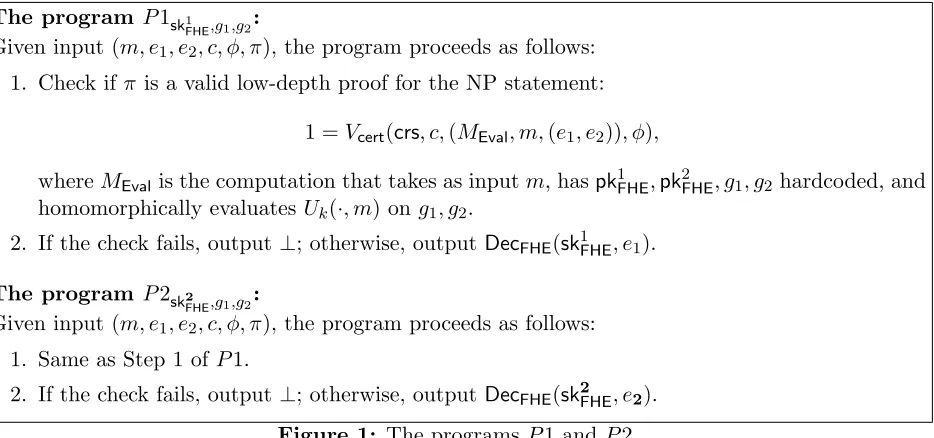
5. Generate anN C1 obfuscation for the program P1sk1
FHE,g1,g2 given in Figure 1, as
P ←eON C1(1k, P1sk1
FHE,g1,g2).
(Note thatP1 also implicitly has hardcodedcrs,pk1FHE,pk2FHE).
9
The program P1sk1
FHE,g1,g2:
Given input (m, e1, e2, c, φ, π), the program proceeds as follows:
1. Check ifπ is a valid low-depth proof for the NP statement:
1 =Vcert(crs, c,(MEval, m,(e1, e2)), φ),
whereMEvalis the computation that takes as inputm, haspk1FHE,pk2FHE, g1, g2 hardcoded, and
homomorphically evaluatesUk(·, m) ong1, g2.
2. If the check fails, output ⊥; otherwise, outputDecFHE(sk1FHE, e1).
The program P2sk2 FHE,g1,g2:
Given input (m, e1, e2, c, φ, π), the program proceeds as follows:
1. Same as Step 1 ofP1.
2. If the check fails, output ⊥; otherwise, outputDecFHE(sk2FHE, e2).
Figure 1: The programs P1 and P2.
6. Output the obfuscationσ= (P,crs,pk1FHE,pk2FHE, g1, g2).
• Evaluate(σ, m, s(k), t(k)): On input an obfuscation σ = (P,crs,pk1FHE,pk2FHE, g1, g2), program
input m, and size and runtime bounds s = s(k), t = t(k) for the relevant class of Turing machines {Mk}, do the following:
1. Homomorphically evaluate the m-evaluation function independently on the two FHE ci-phertextsg1, g2 (allegedly encrypting a Turing machine description): i.e.,
e1=EvalFHE(pk1FHE, Uk(·, m), g1) and e2 =EvalFHE(pk2FHE, Uk(·, m), g2),
whereUkis the oblivious universal Turing machine that accepts as input a TM description
T and value v, and executes T on input v fort(k) steps. (See Remark 2.2 for discussion on homomorphic evaluation of an oblivious Turing machine of known runtime). Denote this computation (taking as inputmand computing e1, e2) byMEval. Note thatMEvalhas
pk1FHE,pk2FHE, g1, g2 hardcoded.
2. Generate aP-certificate that e1 and e2 were computed correctly. That is, taking a bound
c∈Nfor whichMEval(m) outputs within|m|csteps, letφ←Pcert(crs, c,(MEval, m,(e1, e2))).
3. Compute a low-depth proofπthatφis a validP-certificate: i.e.,Vcert(crs, c,(MEval, m,(e1, e2)), φ) =
1. This can be achieved by simply providing the complete evaluation tableau of theVcert
circuit.
4. Run P(m, e1, e2, c, φ, π). (Recall P is an obfuscation of the program P1sk1
FHE,g1,g2, as described in Figure 1) and output the result.
Proof of Theorem 3.10. We now prove the correctness, succinctness, and security of eO.
Correctness. First, note that the circuit evaluating the programP1sk1
FHE,g1,g2 is inN C
1. Indeed,
The correctness of the FHE encryption and evaluation algorithms implies that with overwhelm-ing probability g1 is a valid encryption of the Turing machine description M and that e1 is an
encryption of Uk(M, m) = M(m). The correctness of the underlying N C1 obfuscator eON C1 guarantees the obfuscation of the program P1sk1
FHE,g1,g2 will evaluate the program correctly; the correctness of the P-certificate scheme provides that the honestly generated certificate will prop-erly verify; and the check step program itself will pass on honest execution. Therefore, the final output will be the desired evaluationM(m).
Succinctness. We now analyze the description size and running time of the obfuscationM0. Consider first the size of M0. Recall M0 is composed of the following elements: a common reference stringcrsfor theP-certificate system, two FHE public keyspk1,pk2, two FHE ciphertexts
g1, g2 encrypting a description of M, and an obfuscation P of the program P1 with respect to
eON C1. We have that |crs|,|pk1|,|pk2| =poly(k), and |g1|,|g2| =poly(k)·s(k) (where s=s(k) is the maximum size of TMs in the classMk). The underlyingN C1 obfuscator has the property that
|eON C1(C)|=poly(|C|) for any circuit C ∈ N C1, so it remains to analyze the size of a circuitC representing the programP1.
The program P1 proceeds in two steps. In the second step, it evaluates the decryption circuit of the FHE scheme on the ciphertext e1. This decryption requires size poly(k)·s(k). In the
first step of P1, it accepts and verifies the consistency of a (low-depth) proof π corresponding to the computation of Vcert(crs, c,(Eval(Uk(·,·), g1, g2), m,(e1, e2)), φ), verifying that φ is a valid P
-certificate for the correct homomorphic evaluation yielding e1, e2. The verification of π requires
size equal to the size of Vcert on these inputs. By the efficient verification property of the P
-certificate system, this is bounded bygV(k+|(Eval(Uk(·,·), g1, g2), m,(e1, e2))|), wheregV is a fixed
polynomial. This expression is dominated by the description size of the universal Turing machine
Uk (which was chosen sufficiently large to evaluate any Turing machine M ∈ Mk). We have that |Uk| = poly(s(k)). Thus, putting these pieces together, it holds that the |M0| = poly(k, s(k)), as
desired.
Consider now the runtime of M0. We analyze each step of Evaluate(σ, m):
1. Homomorphic evaluation of Uk(·, m) on g1, g2: By Remark 2.2, this takes place in time
poly(k, t(k)), wheret(k) was a bound on the maximum runtime of Turing machinesM ∈ Mk.
2. Generating a P-certificate of correctness: By the properties of the P-certificate system, this
Pcert evaluation takes place in time bounded by gP(k+|MEval|+TMEval(m)), where gP is a
fixed polynomial (andMEval is the program corresponding to the homomorphic evaluation in
Step 1). From above, we have that this ispoly(k, t(k)).
3. Compute a low-depth proof that theP-certificate correctly verifies: This corresponds precisely to the time of evaluatingVcert. By the efficient verification property of theP-certificate system,
this takes place in time gV(k+|(MEval, m,(e1, e2))|), where gV is a fixed polynomial. Since |e1|,|e2|=poly(k)·s(k) and|MEval|=poly(s(k)), it follows that this step takes timepoly(s(k)).
4. Run the obfuscated program P(m, e1, e2, c, φ, π): By assumed properties of the underlying
N C1 extractability obfuscator eON C1, the runtime of P is polynomial in the runtime of the original program P1. From the analysis above (since the size of a circuit corresponds also to its runtime), the runtime ofP1 is thuspoly(s(k)).
Security. Fix any PPT adversary A and polynomial p(k). In order to construct the desired extractor E, for any pair of Turing machines M0, M1 ∈ Mk we consider a sequence of hybrid
ex-periments, gradually modifying an obfuscation ofM0toM1. From these intermediate experiments,
we will derive a collection of different extraction strategies; the ultimate extractorE will randomly select one of these strategies in order to attempt extraction. We will show that ifAcan distinguish an obfuscation of M0 from one ofM1, then it must successfully distinguish between some adjacent
pair of hybrid experiments, which will imply the corresponding “sub”-extractor strategy will suc-ceed. SinceE chooses among these sub-strategies at random, it will choose the successful strategy with probability at least 1/(# hybrids).
Explicitly, consider the following sequence of hybrids:
• Hyb0: This hybrid corresponds to an honest execution ofeO to obfuscateM0.
• Hyb1: Same as hybrid Hyb0, except that the second FHE ciphertext is now generated as an encryption ofM1: g2←EncFHE(pk2FHE, M1).
• Hyb2: Same as hybrid Hyb1, except that the obfuscated program P is now generated as
an obfuscation of P2 (which decrypts using the second FHE secret key). That is, P ←
eON C1(P2sk2
FHE,g1,g2).
• Hyb3: Same as hybridHyb2, except that the firstFHE ciphertext is now also generated as an encryption ofM1: g1←EncFHE(pk1FHE, M1).
• Hyb4: Same as hybrid Hyb3, except that the obfuscated program P is once again generated as an obfuscation ofP1: i.e.,P ←eON C1(P1sk1
FHE,g1,g2). Note that this hybrid corresponds to
an honest execution ofeO to obfuscateM1.
Step 1: Hyb0 to Hyb1. We argue that no PPT A will be able to distinguish between these hybrids, and thus we need not address extraction in this case.
Claim 3.11(Security of FHE). Assuming the FHE schemeE is IND-CPA secure, then the outputs of Hyb0 and Hyb1 are computationally indistinguishable.
Proof. Suppose there exists a PPT distinguisherAbetween the two hybrids. We then demonstrate a PPT attackerAFHE who breaks the IND-CPA security of the FHE scheme.
AFHE begins by executing A and receiving a pair of Turing machine descriptions M0, M1 ∈ Mk. In the FHE security game, AFHE receives a public key pk from the FHE challenger; AFHE
submits M0, M1 as his challenge message pair, and receives a ciphertext g0 (corresponding to an
encryption of one of the two messages). AFHE sets pk2FHE = pk and g2 = g0. It further samples
a fresh FHE key pair (pk1FHE,sk1FHE) ← GenFHE(1k), generates an encryption of M0 under this
public key, asg1 ←EncFHE(pk1FHE, M0), and generates an obfuscation of the circuitP1sk1
FHE,g1,g2 as
P ←eON C1(P1sk1
FHE,g1,g2). Note that this requires only knowledge of the firstFHE secret key (and not the second, which is unknown to AFHE). AFHE then submits the tuple (P,pkFHE1 ,pk2FHE, g1, g2)
to the adversaryA.
Note that if g0 was an encryption ofM0, then this tuple is distributed exactly as the output of
hybrid Hyb0, whereas if g0 was an encryption of M1 the tuple is distributed exactly as in hybrid
Step 2: Hyb1 to Hyb2. We show that any adversary who distinguishes between these hybrids necessarily implies an extractor who succeeds with noticeable probability in extracting an input x
on which M0 and M1 disagree.
Claim 3.12 (Security of eON C1, soundness of P-certificates). Suppose eON C1 is an extractabil-ity obfuscator for the circuit class N C1, and(Pcert, Vcert) is a sound P-certificate system. Then for
any PPT adversary A and polynomial p1(k) there exists a PPT extractor EHyb1 and polynomial q1(k) such that, for every pair M0, M1 ∈ Mk and every auxiliary input z,
Pr
h
b← {1,2};H ←Hybb(M0, M1) :A(1k, H, M0, M1, z) =b
i
≥ 1
2 +
1
p1(k)
=⇒ Pr[x←EHyb1(1
k, M
0, M1, z) :M0(x)6=M1(x)]≥
1
q1(k)
.
Proof. Fix a PPT adversary A in the Hyb1 versus Hyb2 distinguishing game. For every choice of values zv := (pk1FHE,pk2FHE, g1, g2), consider the following adversary AN C1 (induced by A) on the underlying N C1 extractability obfuscator eON C1 for the pair of N C1 programs P1sk1
FHE,g1,g2 and
P2sk2
FHE,g1,g2:
The eON C1 adversary AN C1(1k, P1sk1
FHE,g1,g2, P2sk2FHE,g1,g2,(zA, zv)):
1. AN C1 receives a challenge obfuscation P, generated as either P ← eON C1(P1sk1
FHE,g1,g2) or
P ←eON C1(P2sk2
FHE,g1,g2).
2. AN C1 runs the adversaryA on input (1k, H, M0, M1, zA), whereH is the tuple of values H=
(P,pk1FHE,pk2FHE, g1, g2), where pk1FHE,pk2FHE, g1, g2 are given in zv (Note that for appropriate
distribution ofzv, this tuple will correspond to the output distribution of eitherHyb1orHyb2).
Denote the output of Aby guess∈ {1,2}.
3. AN C1 outputsguess as his own prediction in theeON C1 distinguishing game.
Note that if the values in zv are generated in the following way, then the tuple of valuesσ given
to A in Step 2 is distributed identically to the output of either Hyb1 or Hyb2, depending exactly on whether the challenge obfuscationP was generated as an obfuscation of P1 or P2.
Sampling procedure SampleZ(1k) forzv:
1. Sample two key pairs for the FHE scheme: (pk1FHE,sk1FHE)←GenFHE(1k) and (pk2FHE,sk2FHE)←
GenFHE(1k).
2. Encrypt a description of M0 under the first FHE public key: g1 ← EncFHE(pk1FHE, M0), and
encrypt a description of M1 under the second FHE key: g2←EncFHE(pk2FHE, M1).
3. Outputzv = (pk1FHE,pk2FHE, g1, g2).
Thus, ifA(1k, H, M0, M1, zA) distinguishes betweenH ←Hyb1(M0, M1) andH←Hyb2(M0, M1)
with advantage 1/p(k) over the entire randomness of the experiment, then with probability at least 1/2p(k) over the choice of zv ← SampleZ(1k), it must hold that A distinguishes between such H
conditioned on the valuezv, with advantage 1/2p(k).
Therefore, by the security of the N C1 obfuscator eON C1, there exists a PPT extractor EN C1 and polynomial q0(k) such that, with probability 1/2p(k) over the choice of zv ← SampleZ(1k),
EN C1 extracts a value x ← EN C1(1k, P1sk1
FHE,g1,g2, P2sk2FHE,g1,g2, zv) for which the circuits disagree (i.e.,P1sk1
FHE,g1,g2(x)6=P2sk2FHE,g1,g2(x)) with success probability 1/q
It remains to show that any such input x must contain a value m for whichM0(m)6=M1(m).
Indeed, if this is the case, then the algorithmEHyb1 which first sampleszv ←SampleZand then ex-ecutesEN C1 on the appropriate set of values will have successfully extracted with overall noticeable success probability p(k)1 q01(k).
Recall that the input ofP1 (orP2) is a tuple (m, e1, e2, c, φ, π) wherem is an input to a circuit
inCk,e1, e2 are allegedly homomorphically evaluated ciphertexts,c∈Nis a runtime bound on this evaluation procedure,φis a P-certificate thate1, e2 were computed correctly, andπ is a low-depth
proof thatφproperly verifies.
First, note that Step 1 of the programs P1sk1
FHE,g1,g2 and P2sk2FHE,g1,g2 are identical, since they each have the same pair of ciphertextsg1, g2 hardcoded. So for any input tuple (m, e1, e2, c, φ, π),
this tuple will either pass the verification in both P1 and P2 or fail in both. Thus, in order for P1sk1
FHE,g1,g2(x) 6=P2sk
2
FHE,g1,g2(x) for some x = (m, e1, e2, c, φ, π), it must be that (1) the
low-depth proofπ verifies correctly (otherwise both programs output ⊥), and (2) DecFHE(sk1FHE, e1)6=
DecFHE(sk2FHE, e2).
Since the proofπ verifies correctly, it must be that indeed 1 =Vcert(crs, c,(MEval, m,(e1, e2)), φ).
That is, φ must be a valid P-certificate that e1, e2 were generated as the result of
homomorphi-cally evaluating Uk(·, m) on the (hardcoded) FHE ciphertexts g1, g2, respectively (recall this is
the definition of MEval). By the soundness of the P-certificate system, since EN C1 is an efficient PPT algorithm, this means that with all but negligible probability this is truly the case: i.e.,
e1=EvalFHE(pk1FHE, Uk(·, m), g1) and e2 =EvalFHE(pk2FHE, Uk(·, m), g2). Recall thatg1 and g2 were
generated as encryptions ofM0 andM1. By the correctness of the FHE decryption and evaluation
algorithms, this means with all but negligible probability that DecFHE(sk1FHE, e1) = M0(m) and
DecFHE(sk2FHE, e2) =M1(m). Thus, the value m satisfiesM0(m)6=M1(m), as desired.
Step 3: Hyb2 toHyb3. As in Step 1, we argue that no PPTAwill be able to distinguish between these hybrids, and thus we need not address extraction in this case.
Claim 3.13(Security of FHE). Assuming the FHE schemeE is IND-CPA secure, then the outputs of Hyb2 and Hyb3 are computationally indistinguishable.
Proof. The claim follows in a nearly identical fashion to that of Claim 3.11.
Step 4: Hyb3 to Hyb4. This step directly mirrors Step 2.
Claim 3.14(Security ofeON C1, soundness ofP-certificates). Suppose thateON C1 is an extractabil-ity obfuscator for the circuit class N C1, and(Pcert, Vcert) is a sound P-certificate system. Then for
any PPT adversary A there exists a PPT extractor EHyb3 for which the following holds: For every polynomial p(k), there exists a polynomial q0(k) such that for every pair M0, M1 ∈ Mk and every
auxiliary input z,
Prhb← {3,4};H←Hybb(M0, M1) :A(1k, H, z) =b
i
≥ 1
2 +
1
p(k)
Pr[x←EHyb3(1
k, M
0, M1, z) :M0(x)6=M1(x)]≥
1
q0(k).
Our final extractor E works by choosing at random a ← {1,3} and then executing the sub-extractor strategy EHyba.
The proof of Theorem 3.10 follows from Claims 3.11-3.14, in the following fashion. For any polynomialpA(k), take pE(k) to be the polynomial 12q0(k) given by theeON C1 extraction security for distinguishing success advantage 14pA(k) (i.e., the extraction probability of theeON C1 extractor isq0(k) if theeON C1 adversary distinguishes with advantage 14pA(k)).
Suppose there exists a pair of Turing machines M0, M1 ∈ Ck and auxiliary inputz such thatA
distinguishes between eO-obfuscations ofM0 and M1 with advantage pA(k):
Prhb← {0,1};C0 ←eO(1k, Cb) :A(1k, C0, z) =b
i
≥ 1
2+
1
pA(k) .
Then for some i∈ {0,1,2,3},A must successfully distinguish between adjacent hybrids Hybi and
Hybi+1 with advantage 14pA(k). By Claims 3.11 and 3.13, if it is the case that i= 0 or 2 then we
have a contradiction. If i= 1, then by Claim 3.12 the extraction strategy EHyb1 will succeed with probability q0(k). Finally, if i= 3, then by Claim 3.14 the extraction strategyEHyb3 will succeed with probability q0(k).
Therefore, with probability 12 the constructed extractorE will correctly guess the correct value of i ∈ {1,3}, in which case it will succeed in extraction with probabilityq0(k), hence yielding an overall extraction probability of 12q0(k), as desired.
We remark that by replacing the P-certificates with succinct non-interactive arguments of knowledge (SNARKs), then the resulting extractability obfuscator is secure for all polynomial-size Turing machines of possibly unbounded input size.
Corollary 3.15. Based on any extractability obfuscator for the class of circuitsN C1, fully homor-morphic encryption, and succinct non-interactive arguments of knowledge (SNARKs), there exists an extractability obfuscator for TM, as in Definition 3.7.
We also observe that by using a leveled FHE, and removing the P-certificates from the con-struction, we can still achieve extractability obfuscation forP/poly.
Remark 3.16 ((Non-succinct) Extractability Obfuscation from Weaker Assumptions). One may remove the assumption of P-certificates, and remove the circular security assumption of the FHE scheme (yielding onlyleveledFHE), in exchange for losing succinctness of the resulting obfuscator. More explicitly, the above extractability obfuscator constructioneO can be modified as follows. Instead of generating aP-certificate that the homomorphic evaluation ofUkwas performed correctly
and then computing a low-depth proof that the resulting P-certificate properly verifies, simply generate a (large) low-depth proof of correctness of the homomorphic evaluation directly. Further, in the place of FHE, simply sample and utilize keys for a leveled FHE scheme with sufficient levels to support homomorphic evaluation of Uk. The resulting transformation eO0 still satisfies the
required correctness and security properties, but no longer achieves succinctness (i.e., the size of the obfuscated Turing machine depends polynomially on its runtime):
• The leveled FHE scheme will now require larger public key sizes, proportional to theruntimeof the Turing machineM to be obfuscated. Recall the obfuscated programeO0(1k, M) contains
within it two such (leveled) FHE public keys.
this computation is low depth (indeed, the circuit still lies in N C1), the size of the circuit, and hence the size ofP, will grow at least linearly in theruntimeofUk instead of just its size.
Theorem 3.17. Based on any extractability obfuscator for the class of circuits N C1, and leveled fully homomorphic encryption, there exists a (non-succinct) extractability obfuscator for P/poly.
4
Functional Witness Encryption
We put forth the notion of functional witness encryption (FWE). An FWE scheme enables one
to encrypt a message m with respect to an N P language L, instance x and a function f, such that anyone that has, andonly those that have, a witnessw forx ∈L can recoverf(m, w). More precisely, our security definition requires that if you can distinguish encryptions of two messages
m0, m1, then you must know a witness wforx∈Lsuch that f(m0, w)6=f(m1, w).
For example, an FWE scheme would allow one to encrypt the nodes of a large graph in such a way that anybody (andonly those) who knows a clique in the graph can decrypt the labelson the corresponding clique.
Definition 4.1 (Functional Witness Encryption). A functional witness encryption scheme for an NP language L (with corresponding witness relation R) and class of Turing machines {Mk}k∈N,
consists of the following two polynomial-time algorithms:
• Enc(1k, x, m, M): The encryption algorithm takes as input the security parameter 1k, an
unbounded-length stringx, a messagem∈M SGfor some message spaceM SG, and a Turing machine description M ∈ Mk, and outputs a ciphertextc.
• Dec(c, w): The decryption algorithm takes as input a ciphertext cand an unbounded-length string w, and outputs an evaluationm0 or the symbol⊥.
satisfying the following conditions:
Correctness: There exists a negligible functionnegl(k) such that for every security parameter k, for any message m ∈M SG, for any Turing machine M ∈ Mk, and for anyx ∈L such that
R(x, w) holds, we have that
Pr
h
Dec(Enc(1k, x, m, M), w) =M(m, w)
i
= 1−negl(k).
Security: For every PPT adversary A and polynomialsp(k), `(k), there exists a PPT extractor
E and polynomial q(k) such that for every security parameter k, every pair of messages
m0, m1 ∈M SGk, every Turing machineM ∈ Mk, stringx, and auxiliary inputz of length at
most`(k),
Pr
h
b← {0,1};c←Enc(1k, x, mb, M) :A(1k, c, z) =b
i
≥ 1
2+
1
p(k)
=⇒ Pr
h
w←E(1k, p(k), x, m0, m1, M, z) :M(m0, w)6=M(m1, w)
i
≥ 1 q(k).
Remark 4.2. When restricting our notion of functional witness encryption to the trivial Turing machine class Mk:={Mk} with Mk(m, w) =m corresponding to “standard” witness encryption,
Definition 4.3 ((Succinct) FWE for N P and P/poly). PPT algorithms (EncP /N Ppoly,DecP /N Ppoly) are said to compose afunctional witness encryption scheme for N P and P/polyif the following holds: For every N P relation R, and every class of Turing machines {Mk} with maximum description sizes(k) and maximum runtimet(k) polynomial ink, the pair of algorithms induced by
EncR,{Mk}(·,·,·,·) :=Enc
P /poly N P
(·,·,·,·), R, s(k), t(k),
DecR,{Mk}(·,·) :=Dec
P /poly N P
(·,·), R, s(k), t(k)
is a secure FWE scheme for language R and class of Turing machines{Mk}.
(EncP /N Ppoly,DecN PP /poly) is further said to besuccinctif there exist polynomialsps andptsuch that
for every N P relation R, every class of Turing machines {Mk} with polynomial size and runtime
s(k), t(k), everyk∈N, every polynomial-size stringx, everym∈M SG, and every Turing machine
M ∈ Mk, the encryption runtime
c←EncP /N Ppoly(1k, x, m, M), R, s(k), t(k)
is bounded bypt(k,|R|, s(k), t(k)), and the corresponding ciphertext size satisfies
|c| ≤ps k,|R|, s(k)
.
In particular, the ciphertext size depends only on the description size of the supported Turing machines, without turning size into runtime.
We demonstrate that FWE is, in fact, equivalent to extractability obfuscation, up to a simple transformation.
Theorem 4.4 (Equivalence of FWE and Extractability Obfuscation). The existence of the follow-ing two primitives is equivalent:
1. Succinct functional witness encryption for N P andP/poly, as in Definition 4.3.
2. Succinct extractability obfuscation for P/poly.
Roughly, given an extractability obfuscator eO, an FWE encryption of the messagem, for the language L, instance x and function f will be the obfuscation of the program that on input w
outputs f(m, w) if w is a valid witness for x ∈ L. On the other hand, given a general-purpose FWE, to obfuscate a program Π, letf be the universal circuit that on input (Π, y) runs Π on input
y, letLbe the trivial language where every witness is valid, and output a FWE of the message Π.
Proof of Theorem 4.4. We prove equivalence via two implications.
1. (FWE⇒ Ext-Obf):
Suppose there exists a succinct FWE scheme (EncP /N Ppoly,DecP /N Ppoly) for N P and P/poly. We construct the desired extractability obfuscator eO= (Obfuscate,Evaluate).
• Obfuscate. Given size and runtime bounds s(k), t(k) for a class of Turing machines
{Mk} with respect we wish to obfuscate, take Uks,t to be the universal Turing machine