Journal of
RANGE MANAGEMENT VozumeEy,
dYmher
jr
Rangeland Management in Australia ____._ Thadis W. Box and Rayden A. Perry 167 Range Education in East Africa J. H. Robertson, Gene F. Payne, and C. V. Jensen 171 Evaluating Multiple Economic Effects of Forage Development
and Management ______________________ E. William Anderson and Maurice L. Jernstedt 174 Shade for Improving Cattle Gains and Rangeland
UseRE ____________________--_-__________________________________________ E. H. McIlvain and M. C. Shoop 181 Long-Term Grazing Effects on Fescue Grassland
Soils _______________________-__--__--__---__________ A. Johnston, J. F. Dormaar, and S. Smoliak 185 Evaluation of Pinyon-Juniper Conversion to Grassland ______________._ Richard S. Aro 188 Moisture Interception as a Factor in the Competitive Ability of Bluebunch
Wheatgrass ____________________ M. S. Ndawula-Senyimba, V. C. Brink, and A. McLean 198 Grass Species Growth on a Volcanic Ash-Derived Soil
Cleared of Forest ___________________________________________-__-___-__-___-_-___-______________ F. V. Pumphrey 200 Acidifying Nitrogen Compounds and Range Fertilization
Clenton E. Owensby and John L. Launchbaugh 203 Influence of Secondary Succession on Honey Mesquite Invasion in
North TexasRE ____________________________________ C. J. Scifres, J. H. Brock, and R. R. Hahn 206 Influence of Site on Mesquite Mortality from 2,4,5-T
B. E. Dahl, R. B. Wadley, M. R. George, and J. L. Talbot 2 10 of Factors on Saltbush Establishment in California
Eamor C. Nord, Patrick F. Hartless, and W. Dennis Nettleton 216 An Evaluation of an Interseeded Sideoats Grama Stand Four Years
After Establishment ________________________________ E. Earl Willard and Joseph L. Schuster 223 Emergence of Grass Seedlings Under Crop Residue Culture
James R. Stroh and Vernon P. Sundberg 226 Effect of Spraying with 2,4-D upon Abundance of Pocket Gophers
in Franklin Basin, Idaho ______________________________-__--___-_--___--__-_______-___--__-_ A. C. Hull, Jr. 230
Technical Notes
Measuring Vegetation Changes on Fixed Quadrats by Vertical
Ground Stereophotography ________________________--______--____________________________ K. F. Wells 233 Weight-Length Relations in Flowering Dogwood
Twigs __________._________--______----_________________________________- L. K. Halls and R. F. Harlow 236
Viewpoints
The Status of Successional and Systems Analysis Ecology
0. B. Collins and P. E. Smeins 237
Book Reviews ___________________________________.______...________.______________________________________________________________________ 239 RE = Con Resumen en Espaiiol
Cover
Photo-springtime
on the Mojave Desert.
Rangeland Management in Australia1
pastures can be improved by ag- ronomic means from those which must be managed strictly on an ecological basis. Using the Ameri- can definition of range, the entire Australian continent, with only small portions removed for inten- sive agriculture and urban develop- ment, would be considered range- lands. For the purpose of this paper, we will discuss only the arid and semi-arid rangelands as out- lined by Perry (1966), Heathcote (1968), and others.THADIS W. BOX AND RAYDEN A. PERRY
Dean of Natural Resources, Utah State University, Logan, Utah; and Leader, Rang-eland Research Unit, Commonwealth Scientific and
Industrial Research Organization, Canberra, A.C.T., Australia.
Highlight
The term “rangeland” in Australia is used to designate the arid and semi-arid areas unsuitable for crop production. The lands of this pastoral zone cover about 2,200,OOO square miles. This vast area accounts for 74% of the continent, yet it is occupied by only 3% of its people. Of the total area, over 99% is unimproved native rangeland, less than one-half of one percent is improved pasture, and less than one-tenth of one percent is cropped. Almost a third of the land is unoccupied. The arid rangelands carry about a third of the country’s sheep and beef cattle. These livestock produce about A$400,000,000 in export income for the country. Ranges are managed on a low capital and labor input system. Many of the larger cattle properties are unfenced; livestock are con- trolled by water development. Areas around water and smaller properties in the arid zone may be severely deteriorated in range condition. Current research projects are designed to provide information to prevent further decline in productivity, aid development , and to improve management.
The term “rangeland” in Aus- tralia is used to designate the arid and semi-arid areas unsuitable for crop production. It encompasses all land in which rainfall on a given area is not adequate for crop production (Perry, 1966, following a definition similar to that of Meigs, 1953). This definition is clear and unequivocal in that land can be classified as arid or non- arid in accordance with a single land use characteristic, that is, whether or not the rain falling on it is adequate fos economic crops or sown pasture production. The definition does not make for a static boundary between the arid and non-arid country. The eco- nomics of crop production change with changes in technology, de- velopment of new crops and varie- ties and with changes in cost of pro- duction or of the value of a prod- uct. In response to such changes, the boundary between arid and non-arid land fluctuates but only land marginal to the boundary is affected. Most of the areas remain definitely arid or non-arid.
In Australia, the south and south- east boundary of the arid range- lands is the low rainfall margin for
wheat production which has been determined by long agricultural ex- perience. In the north and north- east, agricultural experience is lack- ing and the boundary used is a line where the duration of the agricul- tural growing season, determined from daily rainfall records and a water balance model (Slayter, 1960), is 12 weeks in four out of five years (Perry, 1966).
The Australian definition of rangeland differs markedly from that used by Americans. It sepa- rates out the arid and semi-arid regions as rangelands and leaves the unimproved grazing lands of the more humid regions as “native pastures.” The accepted Ameri- can definition, on the other hand, states that any land producing native forage for animal consump- tion is rangeland. American range managers are currently broaden- ing their definition of rangelands to include recreational lands, watershed, waste disposal areas, etc. that are not traditionally grazing lands for livestock. The Australian definition of rangelands as only arid and semi-arid regions may appear unnecessarily limited in scope to Americans, but it serves l Received June 3, 1970; accepted for
publication July 7, 1970.
a useful purpose in Australia by separating out those lands on which
167
Australian rangelands thus de- fined cover about 2,200,OOO square miles. They are commonly referred to as the pastoral zone; however, much of the northern undeveloped areas suitable for potential crop- ping outside the arid zone may be also included in the pastoral zone in some publications.
The boundaries of the arid Aus- tralian rangeland are shown in Figure 1. These lands cover about 74% of Australia but are occupied by only about 3% of its people. The area includes a large part of all mainland states except Victoria. The rangeland portion of the various states are as follows: New South Wales 46%, Queensland 630/o, South Australia 87”/0, Western Aus- tralia 86%, and the Northern Territory 86% (Perry, 1966).
168
BOX AND PERRY
v
TASMANIAFIG. 1. Rangelands of Australia. The cross hatched area represents those lands defined as rangelands in Australia and covers about 74% of the continent.
one-third quoted by Heathcote (1968).
In 1962, the arid lands carried about one-third of the country’s sheep and beef cattle. Since then the proportion has declined partly because of droughts and partly be- cause of the demand for animals to stock the rapidly developing im- proved pastures of noa-arid Aus- tralia. Annual export income from the livestock industries of the arid area exceeds $400,000,000, Austra- lian currency.
Sheep and cattle are not evenly distributed. Seven-eights of the sheep are concentrated in the two eastern states of Queensland and New South Wales. The rangelands of these two states account for slightly over one quarter of the Aus- tralian sheep population. By con- trast, rangelands in South Australia and Western Australia combined support less than 4% of Australia’s sheep. Of the 47,700,OOO sheep in arid Australia in 1962, 22,200,OOO were in Queensland, 19,349,OOO in New South Wales, 3,965,OOO in Western Australia, 2,200,OOO in South Australia, and only 9,000 in the Northern Territory.
The distribution of beef cattle is somewhat different. Over half of
the beef cattle in the rangelands occur in Queensland and one-fifth in the Northern Territo,ry. The arid areas of these two states to- gether suppolrt one-quarter of Aus- tralia’s beef cattle population (Perry, 1966). Of the 4,491,OOO cattle, 2,240,OOO are in Queens- land, 904,000 are in the Northern Territory, 601,000 in Western Aus- tralia, 466,000 in New South Wales, and only 100,000 in South Aus- tralia.
The Vegetation of Australian Rangelands The vegetation of Australian rangelands has been described in various ways. Williams (1955) and Cochrane (1967) listed 17 structural sub-formations. Leigh and Noble (1969) and Moore and Perry (1970) have recognized 10 major sub- formations. Of these 10 sub-forma- tions, 5 are woodlands mostly char- acterized by eucalypts occupying
16.9% of the total Australian arid land area. They are variable in form, ranging from midheight to low trees and dense to very open stands.
Shrublands occupy 43.8% of the Australian arid land area. Of these Acacia shrublands, characterized by
tall shrubs or low trees, are the most widespread and occupy 32.8% of the arid land. Shrub steppes dominated by low chenopodiaceous shrubs (mainly A triplex and Kochiu) account for most of the
remainder of the shrubland area and are widespread, mainly south of the Tropic of Capricorn.
Grasslands occupy 39.3% of the arid rangelands. Of these, the arid hummock grasslands dominated by spinifex (Trio&a and Plectruchne)
account for 30.5% and are the second most widespread sub-forma- tion in the arid areas. Although important from the viewpoint of area they are not used extensively and are mo,stly vacant land. Arid tussock grasslands characterized by Mitchell grass (Astreblu spp.) oc-
cupy 8.8% of the arid lands. They are extensive on cracking clay soils in the northern half of the zone and because of their high stock carry- ing capacity are very important to the grazing industries.
Status of Australian Rangelands Extensive botanical changes have occurred on most of the rangelands following grazing and indiscrimi- nate lopping for drought feed. These changes have resulted in the disappearance of some palatable shrub species and a marked in- crease in some of the less palatable or increaser species. In Australia some of the shrublands, such as the saltbush ranges in the winter-rain- fall areas, degrade into grasslands with overgrazing. In most cases, American experience has been the other way around.
Although they are sparsely popu- lated, it is apparent that the arid lands are far from in virgin con- dition. In just a little over a cen- tury much of Australia’s interior has changed from the world’s largest land mass untouched by the hand of modern man to the de- graded pastureland of modern day graziers.
endemic warm blooded animals were likewise unique, consisting mainly of marsupials and birds that had evolved in the absence of native predators. The coming of the aborigine, and apparently the dingo with him, represented the first alien influence to this isolated continent, and their introduction is recent in geologic time.
It is doubtful that either the dingo or man did much to alter plant evolutionary patterns in their brief residence of 30-40 thousand years. Populations of both men and dogs have always been low in Australia. The men were largely nomadic and possessed no grazing animals. They did not till the land or destroy the natural vegeta- tion. With the exception of burning, they lacked tools necessary for major landscape modification; therefore, neither the plants or the animals evolved the protective fea- tures necessary to survive under the impact of European man’s land use.
The desert shrubs of Australia do not have the protective spines that grow in the deserts of other con- tinents and were soon grazed be- yond their capacity to endure. Many native marsupials were de- fenseless against the onslaught of the fox, the feral cat, the domestic dog, and other predators that were introduced into the environment. The result is that in the last hun- dred years, many Australian range- lands have developed into vast degraded arid ecosystems . Some plant and animal species have been lost forever, others have been re- duced to low populations and the environment altered to such a point that they may never be able to survive. Still others, although weakened, can be brought back with proper management. Some animals (e.g. kangaroos) increased with the development of stock watering points. The European rabbit which spread into the range- lands between 1880 and 1900 ef- fectively occupied the ecological niches of many of the small to medium sized native herbivores.
RANGELANDS
OF AUSTRALIA
The Australian environment today is not what it was a hundred years ago and the so-called natural bal- ance can never be reclaimed.
Not all of Australia’s rangelands are degraded. In general, those areas that have been settled the longest or the areas with smaller properties are the most heavily grazed. In addition, areas near water development on larger prop- erties may be severely flogged. The conditions of Australia’s arid range- lands are better than many arid regions of the world, such as the Middle East and North Africa. The major difference is that the Aus- tralian rangeland has b,een settled for a very sho’rt period of time and the human population pressures have not been great. In addition, many of the perennial plants of the arid regions are relatively un- palatable and water develolpments are still relatively sparsely distrib- uted. For these reasons, Australia is fortunate in that many of its rangelands are still in relatively good condition; however, most of the ranges in the occupied area of Australia have shown a continuous downward trend since they were settled.
The rapidity with which Austra- lian environment changed with European settlement has been well documented. Most of the area was nolt settled until the 1880’s. Within a few years of settlement of each area, articles began to appear in the popular press taking note of the change due to overgrazing. By the 1890’s, papers were being read in the Royal Societies on the effects of grazing intensity. Since that time, papers have appeared period- ically describing disasterous effects of grazing on various local areas in Australia. More recently, the effects of grazing on vegetation through- out Australia has been summarized by Moore (1962), Perry (1966, 1969), and Heathcolte (1968). In 1969 Perry wrote:
The rangeland pastoral industries are valuable but because of lack of knowl- edge, they are exploitative, i.e.; they are mining the land resources on which
169
they depend. Most rangelands show some deterioration, already some have deteriorated badly. Continued and accelerating deterioration can be ex- pected unless scientifically based man- agement practices designed to preserve the rangeland resources are adopted.
Management of Range Lands Part of the problem of range- land deterioration in Australia is associated with the type of man- agement in the arid areas. Here livestock operations have de- veloped on an extensive, low input structure. Large properties are operated with low labor forces and with a minimum amount of physi- cal structures involving capital in- put. The extensive nature of these operations may vary from rather low input operations to stations where cattle and sheep are raised almost as feral animals and mus- tered once or twice a year for branding and shipping. Although this type of operation may seem wasteful to many range managers, the return to investment is usually good. In 1968 Heathcote wrote:
Relative to the other primary pro- ducing areas, the pastoral land use seems to provide a greater return on capital, if at the expense of extensive rather than intensive settlement, de- spite extremely low yields per acre. Efficiency of use has been achieved by minimizing the labor involved and the investment in improvements (often limited to fences for greater control of the use of the forage and water facilities to supply the scarcest com- modity) and making sole use of the native self-regenerating forage.
170
BOX AND PERRY
Cattle production in most of the arid zone is likewise low when mea- sured in turnoff rates. Figures of
13% to 19% annual turnoff from
the herds of western Queensland,
Northern Territory, and northern
western Australia are common. In
some cases as much as 60% of female
stock produced on stations is
needed for herd maintenance alone.
Under those conditions any appre-
ciable sale of female stock tends
to lower the livestock turned off
from a given station.
In the Kimberley’s of Western
Australia it is generally accepted
that herds suffer a normal death
loss of about 11%. Calving per-
centages and branding percentages
are 101~. Under such conditions, a
little over a folurth of the herd or
about 28% are breeders. The rest
are either replacement animals or
bullocks to be held to an ad-
vanced age for sale.
Such low turnolff rates indicate that there is a great 08pportunity for increasing output from the live- stock producing areas of arid Aus- tralia. Unfortunately, little infor- mation is available from the field.
In fact, many figures quoted are
broad estimates because most of
the stations’ never have a complete muster of the cattle and do1 not know how many of the livestock are
actually available for producing
purposes. In most cases, the only
measure of production is the num-
ber of animals sold when muster- ing takes place.
Most of the large cattle proper- ties are unfenced. There is little
opportunity to practice scientific
range management. One of the
most pressing needs for increasing
livestock production in arid Aus-
tralia is to bring the livestock under
control. The principles of animal
husbandry and range management
cannot be applied to animals which are essentially in a feral condition. Such simple and proven manage- ment practices as controlled breed-
ing programs, supplemental feed-
ing, improved grazing systems, and safe stocking rates can do much to
improve the productivity of Aus-
tralian rangelands and improve the
condition o,f the vegetation on
which the animals graze.
Australians are just now begin-
ning to realize the value of their
vast arid interior. Most of the
human population is concentrated
in the humid fringe around the out- side of the continent. The entire political and econo,mic structure of
the country has revolved around
the outer fringe. The recent
drought and the activity of Austra-
lian professional biologists con-
cerned about the arid interior have
resulted in the establishment of a
rangelands research unit in the
Commonwealth Scientific and
Industrial Research Organization
(CSIRO) to study the maintenance
and use of the rangelands resources. The leader of this unit, Ray Perry, has said:
Because of our short history of settle- ment, Australia is still in the fortu- nate position of having large areas of rangeland in relatively good con- dition. The alternatives are clear: that we either learn to maintain its condition or watch it deteriorate to unproductive wasteland from which it cannot be restored (Perry, 1969).
Traditionally, Australian range-
lands have been used primarily for livestock production. Little atten- tion has been given to the multi-
ple use management of rangelands
as we know them in America. The
timber resources of the arid in-
terior are not great. Most of the
watersheds drain internally and do
not contribute to the water supply of large metropolitan o,r agricul-
tural areas. Therefore, little em-
phasis has been given to forestry or watershed management.
The present value elf arid range-
lands for recreational purposes is
far overshadowed by its potential. Australians, for the most part, look to the sea and the beach for out- door recreatioa.
has largely been
Foreign tourism
attracted to the beaches,
As the population
and other
centers, the coastal areas.
human population grows and
beaches become more crowded, the
need for solitude and wide open
spaces will cause more people to turn to the arid zone for recrea- tion. The wide open spaces of the outback will be at a premium.
In fact, the increase in tourist visits to the center of Australia has
already begun. In 1967, 40,000
tourists visited the Northern Terri-
tory. Almost 20,000 found their
way in 1968 to Ayers Rock, an
isolated monolith 350 miles from
the nearest town in the center of a
hostile desert. Alice Springs has
already established itself as a major attraction for world travelers. The
natural beauty of arid landscapes
is beginning to attract visitors from near and far. Lower transcontinen- tal air fares are predicted with the
coming of jumbo jets and super-
sonic aircraft. Domestic travel facil- ities are constantly improving. Arid
Australia can look forward to an
ever increasing tourist industry. Australia quite logically has con-
centrated most of her research
efforts and her development dollars in the humid zone where most of the people live and where political
pressures are greatest. Like most
countries, she has put first em-
phasis on the immediate and most
urgent needs of the majority of her
people; however, the potential of
Australia’s arid lands far out-
weighs actual contribution to the
present day ecoaomy. In the future, it is likely to remain largely pas-
toral, but its contributions in
minerals, irrigated agriculture, and
outdoor recreation are bound to
increase.
Australia is in a fortunate posi- tion of being able to profit by the mistakes made in other countries. It is an advanced country with sci-
entific and technical expertise on
a par with any country in the
world. There is no reason why
the Australian rangelands
be maintained in their
cannot present
rate of production-and perhaps in-
crease in productively-if the Aus-
tralians themselves decide rangelands are important.
RANGE
EDUCATION
171
Literature Cited
BUREAU OF AGRICULTURAL ECONOMICS. 1965. The Australian Sheep Indus- try Survey 1960-61 to 1962-63. Bur. Agr. Econom., Canberra, Australia. 65 p. (mimeogr.)
COCHRANE, G. R. 1967. A vege- tation map of Australia with ex- planatory notes. Cheshires. Mel- bourne.
HEATHCOTE, R. L. 1968. The Aus- tralian Rangelands. The Etruscan. 17:8-12.
of Australia. Ed. R. 0. Slatyer and R. A. Perry. Aust. Nat. Univ. Press, Canberra, Aust. p. 73-92.
MEIGS, P. 1953. World distribution of arid and semi-arid homoclimes. In
Review of Research in Arid Zone Hydrology. UNESCO. Paris. p. 203- 210.
LEIGH, J. H., AND J. C. NOBLE. 1969. Vegetation Resources. In Arid Lands
9
MOORE, R. M. 1962. The effect of sheep grazing in Australian vegeta- tion. In The simple fleece: Studies in the Australian wool industry. (Ed. A. Barnard). Melbourne Univ. Press. Melbourne. p. 170-l 83. MOORE, R. M., AND R. A. PERRY. 1970.
Vegetation. In Australian Grass-
8
Range Education in East Africa
J. H. ROBERTSON, GENE F. PAYNE, AND C. V. JENSEN1
Specialists in Range Managment, Egerton College, Njoro, Kenya.
Highlight
Range management instruction in East Africa is centered in the 3-year diploma course at Egerton College, Kenya. Since 1966, range diplomates have received AID Scholarships to study toward B.S. and M.S. degrees in the U.S.A. The return flow of range graduates began to replace expatriate range specialists in 1969.
The newly independent nations bordering Lake Victoria-Kenya, Tanzania and Uganda-are referred to here as East Africa.
The awareness of range manage- ment as a science and a dire neces- si ty prevails at all levels of govern- ment in East Africa, but especially in Kenya. This awareness can be traced to a few dedicated ex- patriate career officers in the Minis-
IAll members of the West Virginia University-U.S.A. AID Contract Team Egerton College, Njoro, Kenya. Pres- ent addresses and titles are: Professor J. H. Robertson, Professor, Division of Renewable Natural Resources, University of Nevada, Reno, Nevada; Dr. Gene F. Payne, Professor, Animal and Range Sciences Department, Montana State University, Bozeman, Montana; Mr. C. V. Jensen is former Head of Department of Range Man- agement, Egerton College, N joro, Kenya.
tries of Agriculture and the East African Agriculture and Forestry Research Organization. At the risk of omitting others equally deserv- ing we will mention E. J. Russell, J. M. Rattray, Leslie Brown, D. C. Edwards, P. J. Greenway, A. V. Bogdan, John Peberdy, David Pratt, R. H. Brown, Richard Ed- mundson and Hugh York. The Americans Harold Heady, Leland Falloln, James Moomaw, Jay Bent- ley and Victor Bunderson were in Kenya laying ecological ground- work and recommending manage- ment techniques before any formal education was begun in Range Management.
Range Management education, as such, was formally begun at Eger- ton College in Kenya in October, 1965. The following year a United Nations Development Program team was organized at Nairobi under the leadership of Victor Bunderson to do range surveys, ex- tension education and research.
John T. Cassady of this team took the initiative in organizing the East African section of the Ameri- can Society of Range Management.
With assistance fro’m David Bishop and Roy L,ewis of the United Nations Development Pro-
lands. Ed. R. M. Moore, Aust. Nat. Univ. Press, Canberra, Aust.
PERRY, R. A. 1966. The Need for Rangelands Research in Australia. Proc. Ecol. Sot. Aust. 2:1-14. PERRY, R. A. 1969. CSIRO Range-
lands Research Unit. CSIRO, Aus- tralia. 12 p. (mimiogr.)
SLATYER, R. 0. 1960. Agricultural climatology of the Katherine area, N. T. CSIRO Aust. Div. Land Res. Reg. Surv. Tech. Pap. No. 13. 18 p. WILLIAMS, R. J. 1955. Vegetation
regions (map and notes). In Atlas of Australian Reseources. Dep. of Nat. Develop., Canberra, Aust.
9
gram team, the Farmer’s Training Institute was reactivated at Narok. Samson Lekakeny, B.S. 1966 in range management, Colorado State University, was appointed in 1968 to organize a training program in range and stock management for his tribe, the Purko Masai.
These extension officers are writ- ing short course syllabi and produc- ing 16 mm cinefilms on livestock improvement, range and ranch management, disease control and bush control. David Bishop and Roy Lewis are outfitting 4 mobile vans with A-V teaching equipment, using the pastoral tribal language. These vans are operated out at the manyattas (tribal settlements) by Range Certificate holders from the Animal Health and Industry Training Institute (AHITI).
The range curriculum at the AHITI extends through 3 terms and includes biology, physics, chem- istry and forage crops in the first term. Terms 2 and 3 cover ecology, animal husbandry, range manage- ment, economics and ranch orga- nization. There are 2 weeks of field- trip and 12 of practicals. When employed these men will be paid $45 to $80 per month, about half as much as Egerton diplomates. Refugees from several countries are learning at AHITI.2
RANGE
EDUCATION
171
Literature Cited
BUREAU OF AGRICULTURAL ECONOMICS. 1965. The Australian Sheep Indus- try Survey 1960-61 to 1962-63. Bur. Agr. Econom., Canberra, Australia. 65 p. (mimeogr.)
COCHRANE, G. R. 1967. A vege- tation map of Australia with ex- planatory notes. Cheshires. Mel- bourne.
HEATHCOTE, R. L. 1968. The Aus- tralian Rangelands. The Etruscan. 17:8-12.
of Australia. Ed. R. 0. Slatyer and R. A. Perry. Aust. Nat. Univ. Press, Canberra, Aust. p. 73-92.
MEIGS, P. 1953. World distribution of arid and semi-arid homoclimes. In
Review of Research in Arid Zone Hydrology. UNESCO. Paris. p. 203- 210.
LEIGH, J. H., AND J. C. NOBLE. 1969. Vegetation Resources. In Arid Lands
9
MOORE, R. M. 1962. The effect of sheep grazing in Australian vegeta- tion. In The simple fleece: Studies in the Australian wool industry. (Ed. A. Barnard). Melbourne Univ. Press. Melbourne. p. 170-l 83. MOORE, R. M., AND R. A. PERRY. 1970.
Vegetation. In Australian Grass-
8
Range Education in East Africa
J. H. ROBERTSON, GENE F. PAYNE, AND C. V. JENSEN1
Specialists in Range Managment, Egerton College, Njoro, Kenya.
Highlight
Range management instruction in East Africa is centered in the 3-year diploma course at Egerton College, Kenya. Since 1966, range diplomates have received AID Scholarships to study toward B.S. and M.S. degrees in the U.S.A. The return flow of range graduates began to replace expatriate range specialists in 1969.
The newly independent nations bordering Lake Victoria-Kenya, Tanzania and Uganda-are referred to here as East Africa.
The awareness of range manage- ment as a science and a dire neces- si ty prevails at all levels of govern- ment in East Africa, but especially in Kenya. This awareness can be traced to a few dedicated ex- patriate career officers in the Minis-
IAll members of the West Virginia University-U.S.A. AID Contract Team Egerton College, Njoro, Kenya. Pres- ent addresses and titles are: Professor J. H. Robertson, Professor, Division of Renewable Natural Resources, University of Nevada, Reno, Nevada; Dr. Gene F. Payne, Professor, Animal and Range Sciences Department, Montana State University, Bozeman, Montana; Mr. C. V. Jensen is former Head of Department of Range Man- agement, Egerton College, N joro, Kenya.
tries of Agriculture and the East African Agriculture and Forestry Research Organization. At the risk of omitting others equally deserv- ing we will mention E. J. Russell, J. M. Rattray, Leslie Brown, D. C. Edwards, P. J. Greenway, A. V. Bogdan, John Peberdy, David Pratt, R. H. Brown, Richard Ed- mundson and Hugh York. The Americans Harold Heady, Leland Falloln, James Moomaw, Jay Bent- ley and Victor Bunderson were in Kenya laying ecological ground- work and recommending manage- ment techniques before any formal education was begun in Range Management.
Range Management education, as such, was formally begun at Eger- ton College in Kenya in October, 1965. The following year a United Nations Development Program team was organized at Nairobi under the leadership of Victor Bunderson to do range surveys, ex- tension education and research.
John T. Cassady of this team took the initiative in organizing the East African section of the Ameri- can Society of Range Management.
With assistance fro’m David Bishop and Roy L,ewis of the United Nations Development Pro-
lands. Ed. R. M. Moore, Aust. Nat. Univ. Press, Canberra, Aust.
PERRY, R. A. 1966. The Need for Rangelands Research in Australia. Proc. Ecol. Sot. Aust. 2:1-14. PERRY, R. A. 1969. CSIRO Range-
lands Research Unit. CSIRO, Aus- tralia. 12 p. (mimiogr.)
SLATYER, R. 0. 1960. Agricultural climatology of the Katherine area, N. T. CSIRO Aust. Div. Land Res. Reg. Surv. Tech. Pap. No. 13. 18 p. WILLIAMS, R. J. 1955. Vegetation
regions (map and notes). In Atlas of Australian Reseources. Dep. of Nat. Develop., Canberra, Aust.
9
gram team, the Farmer’s Training Institute was reactivated at Narok. Samson Lekakeny, B.S. 1966 in range management, Colorado State University, was appointed in 1968 to organize a training program in range and stock management for his tribe, the Purko Masai.
These extension officers are writ- ing short course syllabi and produc- ing 16 mm cinefilms on livestock improvement, range and ranch management, disease control and bush control. David Bishop and Roy Lewis are outfitting 4 mobile vans with A-V teaching equipment, using the pastoral tribal language. These vans are operated out at the manyattas (tribal settlements) by Range Certificate holders from the Animal Health and Industry Training Institute (AHITI).
The range curriculum at the AHITI extends through 3 terms and includes biology, physics, chem- istry and forage crops in the first term. Terms 2 and 3 cover ecology, animal husbandry, range manage- ment, economics and ranch orga- nization. There are 2 weeks of field- trip and 12 of practicals. When employed these men will be paid $45 to $80 per month, about half as much as Egerton diplomates. Refugees from several countries are learning at AHITI.2
172
ROBERTSON
ET AL.
In Uganda the non-degree agri- cultural colleges at Arapai and Bukulasa and the Veterinary Train- ing Institute, Entebbe, and in Tan- zania, Tengeru Agricultural Train- ing Institute near Arusha have been turning out diplomates with incidental instruction in range management. The same is true of the agricultural college of Univer- sity of East Africa, Makerere, Kam- pala. Actually, senior students in agriculture at Makerere have done some very comprehensive range studies.
The College of African Wildlife Management, Mweka, near Moshi, Tanzania, makes an important con- tribution to range education. We take the liberty of quoting from Leslie Robinette’s reply to an in- quiry. Robinette has taught range ecology there about 5 years.
“We give only one course in range management but it consists of approximately 3 hours of lec- tures weekly for 28 weeks covering such topics as plant physiology and ecology in relation to grazing, vege- tation measurement techniques, enough statistics to appreciate what is involved in sampling, con- dition and trend, etc. Emphasis has been on range management as it relates to big game but competition between game and livestock is touched upon. On safari we applied many of the vegetative techniques, observed and discussed range con- dition and trend but again with much of the emphasis on game ranges. About 12 weeks are spent annually on safari and about one fourth of this time has been spent on range problems.”
May we now return to examine Egerton College. It is a quasi- governmental boarding school es- tablished in 1939 for the sons and daughters of British farmers in the White Highlands. One of the most modern buildings is J. F. Kennedy Dining Hall. The last white stu- dent departed in 1965. The Col- lege is near Nakuru, seat of the Rift Valley Province. Although only 30 miles from the equator, the climate is pleasant, 50-80 F.,
owing to the elevation, 7,400 feet. The mean annual precipitation of 36 inches is separated by two very dry seasons into the long rains and short rains.
During 1965, a 2-year curriculum was devised with all the range courses coming the second year (Robertsoa and Jensen, 1966). Seventeen volunteers were received who had completed their first year in either crops or animal hus- bandry. Egerton students at that time numbered about 200, most of whom had Division II passes in the Cambridge secoadary certifi- cate. Division I passers usually accept employment, enter a uni- versity, or do higher certificate, i.e. specialized fifth and sixth years in secondary school. Examinations, pass levels and university admission standards are as described by Craig (1969). Most Egerton students are on bursaries (scholarships) from their governments, the remainder from institutions such as banks, the Agha Khan Fund and the Kenya Farmer’s Association. Nearly all the African students are from peas- ant families. The Asian students are frolm mercantile pursuits. They comprise 10-15s of the student body. About half of the range students come from outside of Kenya, mostly from Tanzania and Uganda.
Two range courses are taught for non-range diploma streams. Gen- eral agriculture, animal husbandry, farm management and agricultural education majors are required to hear 20 lectures on “Range man- agement in East Africa.” Engi- neers have 10 lectures and 20 hours of practicals in “Range develop- ments.” Enrollment in these classes was 106 in 1969.
The 2-year range diplo’ma pro- gram was in vogue only one year. While executing it, the S-year cur- riculum was framed. All curricu- lum planning was in consultation with the Division of Range Man- agement, Kenya Ministry of Agri- culture.
Before elaborating upon the 3- year curriculum, we would like to
try to communicate some feeling for the 2-year diploma holders who were posted as range officers, re- settlement officers, UNDP assist- ants, etc. Some were sent into situations as pioneers without suf- ficient supervision. The following excerpts are from a letter from a 2-year diplomate, 3 months ex- Egerton, posted to a pastoral dis- trict.
“It is not safe to move about. At the moment there is a curfew 6:30 PM to 6:00 AM. I he 3 miles from town. We are 3 officers only and it is extremely lonely up here. We are open to danger at anytime and all means of communication with the rest is pretty poor. In these N. E. districts the people are being settled in villages. The ground is completely denuded except the evergreen Euphorbia fed on by
camels. All the cattle are emaciat- ing at a very high rate. Security cannot allow these cattle to be grazed outside for they may act as a source of food for the Shifta.
The Turkana, hopeless and hun- gry people are mainly immigrants and nobody accepts them. The number at the moment amounts to over 3,000 people. It is my duty to settle them, where, I do not know.”
The Shifta (Somali raiders) prob- lem was settled by negotiation in 1968 and long-delayed progress in range development is now possible in the wholly pastomral Northeast- ern Province, east of Lake Ru- dolph and north of the Tana River.
This letter of October 1966 con- tained much more about the tribal hostility, conflicting religious beliefs, floundering ranching co- operatives, and malaria.
RANGE
EDUCATION
173
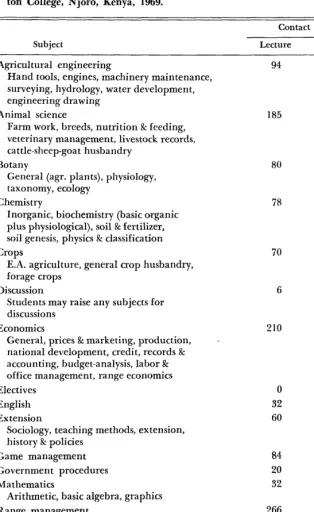
Table 1. Summary of subjects studied by range management students, Eger- ton College, Njoro, Kenya, 1969.
rent United States range curricu- lum, Egerton is more rigid (Table 1).
Contact hours
Agricultural engineering
Hand tools, engines, machinery maintenance, surveying, hydrology, water development, engineering drawing
Animal science
Farm work, breeds, nutrition & feeding, veterinary management, livestock records, cattle-sheep-goat husbandry
Botany
General (agr. plants), physiology, taxonomy, ecology
Chemistry
Inorganic, biochemistry (basic organic plus physiological), soil & fertilizer, soil genesis, physics & classification Crops
E.A. agriculture, general crop husbandry, forage crops
Discussion
Students may raise any subjects for discussions
Economics
General, prices & marketing, production, national development, credit, records & accounting, budget-analysis, labor & office management, range economics Electives
English Extension
Sociology, teaching methods, extension, history & policies
Game management Government procedures Mathematics
Arithmetic, basic algebra, graphics Range management
Principles, forage values, inventories, improvements, management planning, literature, fire management, water supply, safari, seminar
Soils Zoology
94
185
80
78 96
70
6 0
210
0 0
32 0
60 0
84 136
20 0
32 0
266 310
40 112
188
100
40
45
0
60
72
ploma streams were just selected The range curriculum was ex-
on the basis of academic record and panded and further adapted to
personality. The pastoral back- East African needs during 1967- ground u-i terion for range students 1969. In the S-year curriculum there is credited with bringing about the are 9 terms. Each term is 10 weeks lowest grade point average of all of instruction and one of examina- diploma streams, but the best ath- tions, except term IX which is letic records. Range has more than shortened to
5
weeks to allow for its share of sports captains. final exams. Compared with a cur-Range majors meet an hour per week for 6 weeks during the first term to get acquainted and find out what range management is about. Each student takes the floor to explain where he came from, why he is there and to stand ques- tioning. The 1967 intake of 26 students represented 20 tribes. Secondary and college level board- ing schools in East Africa are ex- cellent melting pots. Much of the old tribal hostility is overcome, an important factor in political sta- bility in East Africa.
Range management is not sched- uled in the second and fourth terms. Range instruction resumes in the third term with an intro- ductory course of 20 contact hours, half as lectures. The second and fourth terms are devoted to english, mathematics, engineering, biology, chemistry, forestry and animal hus- bandry. Range is taught in each of the last 5 terms.
A 2-week range safari and 3 weeks game management instruc- tion at the College of African Wild- life Management occupies the in- terval preceding the ninth term. Much of the wildlife experience is obtained on safari in game parks. Ten tage, cots, and utensils were donated to Egerton in 1966 by U.S. Agency for International Develop- ment. Use of this equipment has made it possible for the Govern- ment of Kenya to give vacation em- ployment on range projects-a very important part of range education.
At the end of the ninth term, the students face 5 days of written and oral examinations. The five ex- aminations are:
Range management I, vegeta- tion, physiology, ecology, and grazing systems.
Range management II, im- provemen ts, surveys and sampling, and information sources.
174
4.
5.
Crop husbandry and agricul- tural engineering.
Economics, extension, and farm management.
Outside examiners are invited in to question each student and sub- mit their reports to the Principal. In borderline cases, they re-evalu- ate examination papers. In the event of a final grade just below passing, the student is usually per- mitted by the Academic Council to repeat the examinations after a month or more of study.
At the time the range manage- men t curriculum was established,
the ninth term examinations were the primary criterion for granting the diploma. Presently, the ex-
%
ANDERSON AND JERNSTEDT
aminations count 25% while the grade point average (a recent in- novation) colunts 75% toward the final evaluation.
Standards have been upheld and scholastic competition has been keen. About 80% of the intake have received diplomas. Of. the 14 range diplomates, 3 have earned B.S. degrees and 2 M.S. degrees at the University of Arizona. David Mbuvi received his M.S. and is now a lecturer at Egerton. George Ayiga came over in September, after 3 years in research and teaching in Kenya. Three from the class of 1968 are studying range manage- ment, agricultural economics, and game management in the U.S.A. At least one from the 1969 class is
9
Evaluating Multiple Economic Effects of Forage
Development and Management1
E. WILLIAM ANDERSON AND MAURICE L. JERNSTEDT
State Range Conservationist and State Resource Economist, Soil Conservation Seroice, Portland, Oregon.
Highlight
A multiple-effect approach is illustrated for evaluating the economic impact of a forage development and management project on a ranching enterprise. A nucleus project, such as an irrigated pasture, may result *in a chain reaction of other potential adjustments in land use, animal husbandry, and resource management. The economic benefits illustrated are considerably greater than those usually associated with range and pasture projects because multiple effects that accrue within the total operation are considered. This is an im- portant item for the ranch operator when making decisions on financing potential developments. Some broad guidelines are presented which are useful for evaluating economic aspects of land use, forage management and animal husbandry in conjunction with each other.
A successful range livestock operation involves several major activities. Two of these are: (1) pro- ducing forage, which is primarily a function of managing plants, water, and soils (i.e., resource man- agement), and (2) converting a for- age crop into products useful to humans. The latter is primarily a function of managing animals.
l Received December 19, 1969; ac- cepted for publication January 13, 1971.
How efficiently these activities are conducted conjunctionally influ- ences the profit-making ability of the total ranching enterprise. More attention, however, has been focused on animal management or husbandry than on potential land use adjustments and resource man- agement. Not nearly enough at- tention has been given to coordi- nating the two phases.
We need to sharpen our thinking on how to assess fully the value of
presently studying in the U.S. All of these people were awarded “AID” Scholarships strictly on merit. Neither political nor con- sanguineal criteria were applied in making these selections.
Given the blessing of continued political stability, range education can be expected to flourish. Their need is greater than ours and their problems more formidable.
Literature Cited
CRAIG, W. BRADFORD. 1969. ASPAU
Policies. African scholarship program of American Universities. 866 United Nations Plaza, N. Y.
ROBERTSON, JOSEPH H., AND C. V. JEN-
SEN. 1966. A range management
curriculum begins in East Africa. J. Range Manage. 19: 103-105.
forage from range and pasture, par- ticularly under multiple use man- agement if grazing is only one use of the land. We especially need to know the benefits that accrue throughout the entire year’s opera- tion of a ranching enterprise if a greater volume or better quality of forage is developed and is available when needed.
174
4.
5.
Crop husbandry and agricul- tural engineering.
Economics, extension, and farm management.
Outside examiners are invited in to question each student and sub- mit their reports to the Principal. In borderline cases, they re-evalu- ate examination papers. In the event of a final grade just below passing, the student is usually per- mitted by the Academic Council to repeat the examinations after a month or more of study.
At the time the range manage- men t curriculum was established,
the ninth term examinations were the primary criterion for granting the diploma. Presently, the ex-
%
ANDERSON AND JERNSTEDT
aminations count 25% while the grade point average (a recent in- novation) colunts 75% toward the final evaluation.
Standards have been upheld and scholastic competition has been keen. About 80% of the intake have received diplomas. Of. the 14 range diplomates, 3 have earned B.S. degrees and 2 M.S. degrees at the University of Arizona. David Mbuvi received his M.S. and is now a lecturer at Egerton. George Ayiga came over in September, after 3 years in research and teaching in Kenya. Three from the class of 1968 are studying range manage- ment, agricultural economics, and game management in the U.S.A. At least one from the 1969 class is
9
Evaluating Multiple Economic Effects of Forage
Development and Management1
E. WILLIAM ANDERSON AND MAURICE L. JERNSTEDT
State Range Conservationist and State Resource Economist, Soil Conservation Seroice, Portland, Oregon.
Highlight
A multiple-effect approach is illustrated for evaluating the economic impact of a forage development and management project on a ranching enterprise. A nucleus project, such as an irrigated pasture, may result *in a chain reaction of other potential adjustments in land use, animal husbandry, and resource management. The economic benefits illustrated are considerably greater than those usually associated with range and pasture projects because multiple effects that accrue within the total operation are considered. This is an im- portant item for the ranch operator when making decisions on financing potential developments. Some broad guidelines are presented which are useful for evaluating economic aspects of land use, forage management and animal husbandry in conjunction with each other.
A successful range livestock operation involves several major activities. Two of these are: (1) pro- ducing forage, which is primarily a function of managing plants, water, and soils (i.e., resource man- agement), and (2) converting a for- age crop into products useful to humans. The latter is primarily a function of managing animals.
l Received December 19, 1969; ac- cepted for publication January 13, 1971.
How efficiently these activities are conducted conjunctionally influ- ences the profit-making ability of the total ranching enterprise. More attention, however, has been focused on animal management or husbandry than on potential land use adjustments and resource man- agement. Not nearly enough at- tention has been given to coordi- nating the two phases.
We need to sharpen our thinking on how to assess fully the value of
presently studying in the U.S. All of these people were awarded “AID” Scholarships strictly on merit. Neither political nor con- sanguineal criteria were applied in making these selections.
Given the blessing of continued political stability, range education can be expected to flourish. Their need is greater than ours and their problems more formidable.
Literature Cited
CRAIG, W. BRADFORD. 1969. ASPAU
Policies. African scholarship program of American Universities. 866 United Nations Plaza, N. Y.
ROBERTSON, JOSEPH H., AND C. V. JEN-
SEN. 1966. A range management
curriculum begins in East Africa. J. Range Manage. 19: 103-105.
forage from range and pasture, par- ticularly under multiple use man- agement if grazing is only one use of the land. We especially need to know the benefits that accrue throughout the entire year’s opera- tion of a ranching enterprise if a greater volume or better quality of forage is developed and is available when needed.
MULTIPLE ECONOMIC EFFECTS 175
prise may be incompletely con- sidered.
Table 1. Abbreviated summary of ranch operations and yearlong livestock/ feed balance for the initial situation of 200 cows.
The purpose of this paper is to present guidelines for assessing a forage development and manage- men t program in terms of the several beneficial effects accruing to the total ranch operation. Bene- fits that result from fully develop- ing potential land use adjustments and resource management are em- phasized. These benefits augment those obtained from good animal husbandry and contribute markedly to 0,verall econo’mic gain.
Developing irrigated pasture to meet a critical summer-forage situ- ation was used herein as the initial improvement to illustrate how one kind of forage development can trigger a chain of events. The principles in this analysis apply equally well, for example, to evalu- ating the total impact of a poten- tial crested wheatgrass seeding on the ranching operation. This type of analysis applies to public as well as private land improvements.
cows
T-
BULLS REPIAC. YRLG. HEIFERS Totals Livestock
Animal Unit Equivalent Number
Animal Units Feed 8 Forage Needed
1 .o 200 200
1.3 1’:
0.6 30
18
Pasture
Spring 3/15-5/15 Summer 5/15-lo/30 Fall 1 l/l - 1 l/30
“0~ 12/l -3/15
400 AUM 26 AUM
1,100 70
200 13
1,700 AUMs 109 AUMs
300 tons 15 tons
I
36 AUM 100
18 154 AUMs
40 tons
I
460 AUM 1,270
230 1,960 AUMs
355 tons
320 tons 1 I 30 tons
A simple procedure for develop- ing the data was used. First, we explained the problem and what we hoped to achieve by obtaining factual data and observations first- hand from ranchers. Next, we ob- tained their estimates of the num- ber of beef cows required in their locality to provide a minimum- sized cow-weaner calf operation. Third, we jointly developed the amount of different kinds of feed required yearlong for the major kinds of livestock in this cow-calf operation. Finally, we obtained their estimates of the acres of each kind of forage-spring, summer, and fall range; pasture; hay; crop after- math-required toI produce the feed and forage needed to support this cow-calf operation. Their experi- enced production rates were used.
Seasonal feed and forage require- ments are shown for the major kinds of animals in this operation. Based on the ranchers’ experienced yields, about 11,000 acres of land would be needed to produce the various feeds required yearlong.
Background Information Six Oregon cattle ranchers repre- senting typical ranching operations in three major ranching areas, each of whom operated both irrigated pasture and rangeland, were con- sulted jointly by the authors. The objective was to obtain basic data and to develop a typical ranching operation on which to base a study of forage values. It was considered important to find out what ranchers thought their management prob- lems, solutions, and benefits were and to express these in meaningful terms. These six ranchers provided personal knowledge and quantita- tive data such as seasonal weight gains and calf-crop percentages re- lated to their operations. Data ob- tained from these ranchers were surprisingly uniform from area to area, and their data have been sub- stantiated by later consultations with individuals and groups of ranchers in other ranching areas. Each of these ranchers had realistic opportunities to improve forage production and management.
After developing the initial situ- ation in the model approach, we assumed that 100 acres of lower- elevation spring range of this typical ranch could be irrigated and had soils that would grow im- proved pasture or hay under in- tensive management. We asked, “what opportunities, alternatives, and benefits would this provide to the total ranching operation?”
Collectively, these data represent an analysis of a hypo,thetical or typical cattle ranch for a locality. The info,rmation collected was re- corded on a summary of ranch operations and livestock feed for ready reference and study using a model approach.
Land Use Adjustment Table 1 summarizes the initial situation developed with the ranchers which consisted of a cow- calf operation based on 200 cows.
176
ANDERSON
AND JERNSTEDT
Table 2. Abbreviated summary of range operations and yearlong livestock/ feed balance for the planned*situationof 300 cows.
cows BULLS REPLAC. YRLG. HEIFERS
Totals
Livestock
Animal Unit Equivalent Number
Animal Units Feed 8 Forage Needed
Posture
1.3
:z
I
0.645 27
I
067 AUM 1,2141,040 3,120 AUM
452 tons
sate for the resulting shortage of early spring range forage and to increase it enough for a larger number of livestock it was de- cided that a range seeding (450 acres) of an adapted species was needed within the area of low- elevation range.
Spring 4/l-6/15 p;rner 6/15-9/30
a 10/l-12/31
“0~ l/1-3/31
750 AUM 50 AUM
1,050 70
900 60
2,700 AUM 380 tons
180 AUM
67 AUM 94 80 237 AUM
52 tons
Land Needed Range Seeding Spring range Summer mnge brig. posture
Hay d crop aftermath Legume-grass hay Croplond
Toiuls
Est. Produ Acres Per Acre
450 1 1/2A AUM 4,575 1OA AUM / 5,570 5A/AUM
:5
6AUM/A 12AUM/A (229;) 2AUM/A
5T/A 23 1 1/2T/A 11,000
owes
of optimism. In balancing the sea- sonal forage supply, it was appar- ent that there was a shortage of spring forage. The alternative chosen to alleviate this problem was to make a range seeding in the lower-elevation rangeland that would be suitable for early spring grazing. About 450 acres of typical range seeding would be required to provide the needed spring forage.
In the locality represented by the data used to develop the model ranch, spring range is typified by bluebunch wheatgrass (Agropyron s+xtum Pursh.), Sandberg blue- grass (Poa secunda Presl.), with varying amounts of chea tgrass brome (Bromus tectorum
L.)
and big sagebrush (A rtemisia triden ta ta Nutt.). Areas of soils on slopes suitable for range seeding or irri- gation are common in these lower- elevation areas. Summer range is typified by Idaho fescue (Festuca idahoensis Elmer.), pinegrass (Cal- amagrost is ru bescens Buckl.), blue- bunch wheatgrass, Sandberg blue- grass and abundant forb species. The irrigated pasture that produces about 6 animal unit months per acre consists primarily of Kentucky bluegrass (Poa pratensisL.)
and white clover (Trifolium repensL.).
The improved pasture consists of Latar orchard grass (Dactylis glom- erata L.) and Ladak alfalfa (Medi- cage sat iva L.).ion Seosonol Availability
.I
Resource Management Adjustment
2. The range seeding, which is suitable for early spring grazing would, in turn, allow for de- layed spring grazing on the native range. This helps im- prove range condition. The range seeding, which can be grazed earlier in the spring than native range also might reduce the dry-lot feeding costs.
Based on the nucleus develop- ment of 100 acres additional irri- gated land, the fo’llowing relational factors involving adjustment in re- source management of the total ranch were developed with the ranchers (Fig. 1). Although the po- tential production for the typical ranch was balanced with total live- stock feed requirements, only the management of cows is shown for the sake of simplicity.
1. The amount of spring-range forage was reduced
by
using 100range (due to having a range seeding available) improves the forage volume that is available for the livestock at that time. It also improves the nutritional quality of the native forage be- cause of reduced “washiness.” The result could be an increase in weight gain per head per day while grazing the native range. 4. The irrigated pasture would be
ready for grazing in late spring. This provides the animals with high quality forage which re- sults in a good rate of animal 3. This later-than-usual date for beginning grazing on native
-
acres for irrigation. To compen- production. It is ideal forage for
TYPE OF SPRING 1 SUMMER 1 FALL 1 WINTER FEED 81 FORAGE -MAR. 1 APR. 1 MAY I JUNE I JULY I AUG. I SEPT: I OCT. I NOV. I DEC. I JAN. I FEB.
SPRING RANGE SUMMER RANGE AFTERMATH FEEDLOT
I
INITIAL SITUATION 200 COWS,&X7 Grazing period
PLANNED SITUATION 300 COWS
RANGE SEEDING SPRING RANGE IRRIG. PASTURE SUMMER RANGE AFTERMATH