A SUSTAINABLE FOREST FUTURE?
David Pearce1, Francis Putz2, Jerome K Vanclay3
1999
1 Department of Economics, University College London, Gower St, London, WC1E 6BT, UK. E mail: [email protected]
2 Department of Botany, University of Florida, Gainsville, FL 32611, USA and CIFOR, PO Box 6596 JKPWB, Jakarta 10065, Indonesia. E-mail: [email protected] 3 School of Resource Science and Management, Southern Cross University, PO Box 157,
Lismore, NSW, Australia. E-mail: [email protected]
Contents
1 The issue
2 The theme
3 The terminology of forest management 4 The meaning of optimal forest land use
5 The meaning of sustainable forest management 6 The context for the analysis
7 The private interests of the logging companies 7.1 The empirical evidence
7.2 Factors that could favour the financial profitability of STM 7.2.1 The discount rate
7.2.2 Timber prices
7.2.3 Timber volume growth rates 7.2.4 Property rights
7.2.5 Efficiency and best practice
7.2.6 Valorising non-commercial species 8 The national perspective
8.1 Widening the options to all forest land uses 8.2 Sequencing of land use
8.3 Shadow pricing private costs and benefits 8.4 Allowing for non-timber values
8.4.1 The evidence on environmental impacts of logging regimes 8.4.2 Willingness to pay for certified timber
8.4.3 Willingness to pay for non-timber products and services 8.4.4 Kumari’s study for Malaysia
8.4.5 Bann’s study for Cambodia
8.4.6 Shahwahid et al.’s study for Malaysia 8.4.7 Mattsson’s study for Sweden
9 An economic model of sustainable forestry 10 Summary and conclusions
Annex 1 Discounting
Annex 2 Non-timber economic values
1 The issue
Concern about the rate at which the world’s forests are being depleted is widespread. Recent international calls for radical efforts to reduce deforestation include the United Nations Inter-governmental Forum on Forests of the UN Commission on Sustainable Development (1999), and the World Commission on Forests and Sustainable Development (1999). This concern reflects an appreciation of the ecological and economic functions of forests: as providers of timber and many non-timber predicts, as the habitat for much of the world’s biological diversity, and as regulators of local, regional and global environments. These functions are at risk. Most of the forest clearance is in areas of high forest cover and high human population pressure in tropical areas for agriculture. In temperate and boreal areas the pressures from logging are more important. But in all areas, forestry itself has an important role to play both as a partial cause of deforestation, and, if practised wisely, as a potential source of salvation for at least some of the world’s forests. In terms of its causal role, forestry tends to open up primary forest areas, enabling colonists to move in, using roads forged by the timber companies. In some parts of the world, forests are converted not to agriculture but to biomass plantations of fast growing trees or to other agro-industries based on tree-crop plantations such as palm oil and rubber. Here the primary agent is not the peasant, but the richer elements of local and international society. How, then, can the world’s forests be used more wisely? It is this admittedly grand and complex question that we seek to answer in this paper. Some argue for outright protection, caricatured perhaps in the phrase ‘fence and forget’. Others argue for ‘sustainable forest management’, and still others for systems of forest management that rely on acceptance of an initial period of exploitation of valuable species followed by outright protection. The issue, then, is the optimal use of forested land1, which begs the question of what is meant by ‘optimal’. This is addressed shortly.
Forested land may be retained as forest or it may be converted to non-forest uses such as crop agriculture, livestock, and urban expansion, or to industrial tree crops. The first question, then, is under what circumstances it is better to convert forest land to non-forest uses, and when not. If it can be shown that forest land is best retained as forest – where ‘best’ needs to defined (see below)- the further issue arises of what kind of forestry is to be preferred.. Here the issue is clouded in terminological confusion because the words used in reference to forestry have come to mean different things to different people. But, in order to focus the debate we choose three archetypes familiar in the literature: conventional logging (CL), sustainable timber management (STM) and sustainable forest management (SFM). We adopt this terminology not because we think it is free from misinterpretation, but because the literature on the role of forestry in
deforestation has adopted it, making it extremely difficult to elicit the lessons from that literature without using that language. We devote some time to explaining what we mean by the terms below and why , in an ideal world, we would prefer a different terminology. For the moment, we take CL to be more short-term in focus, less concerned with forest regeneration through
management, and often lacking in government control. We take STM to be a forest
management system that aims for sustained timber yields. We take SFM to be a system of forest management that aims for sustained yields of multi-products from the forest.
1 We use the term forested land rather than forest land to make it clear that we are dealing with land that still has
There have been recent challenges to the idea that conservation is best served through sustainable timber or forest management (Bowles et al, 1998; Vincent, 1992; Kishor and
Constantino, 1993; Howard et al, 1996; Rice et al, 1997). One argument is that conservation can only be served by outright protection (Bowles et al, 1998), i.e. while SFM has the potential for protection, it is inferior to outright protection. Another view is that conservation might be better served by an initial period of well managed logging followed by protection (Rice et al., 1998a?; Rice et al., 1998b; Cannon et al., 1998). Against this, it is argued that outright protection has an extremely limited chance of being successful in face of the high costs of protection, the need to use forests for profit, and human population growth: in many places sustainable forestry management offers the only chance of maintaining forests and biodiversity (Whitmore, 1999).
2 The theme
In terms of the debate about the optimal use of forested lands, the existing literature tends to focus on the financial returns from STM , SFM and CL and on physical descriptions of the comparative ecological impact profiles of these forms of forest use management. The focus on financial returns is justified in so far as actual forest use is determined by relative profits. The focus on ecological impact profiles is relevant for a full economic assessment. An economic assessment makes three potentially major adjustments to a financial analysis: the existing
financial costs and benefits are adjusted to ‘shadow values’ to reflect the true opportunity cost of the resources involved; and environmental and social costs and benefits (‘externalities’) are included both at the national level, and at the global level.
(1) The first modification adjusts financial costs and benefits to reflect shadow prices. A shadow price, say the price of labour or the exchange rate, differs from a financial price in that it reflects the true opportunity cost of the resources in question. As an instance, the ruling wage rate would be used in a financial analysis, but if the labour employed would otherwise be unemployed, the shadow wage rate will tend to be closer to zero (since the wage in alternative employment is, effectively, zero). A shadow exchange rate is the rate that would prevail if trade was free and open, rather than, as is often the case, managed through trade quotas and tariffs. It is important to understand that this shift to shadow pricing alters the stakeholder perspective. Whereas financial costs and benefits are relevant to the logger or concessionaire, shadow priced costs and benefits are relevant from the standpoint of the forest owning nation.
(2) The second modification adds in all environmental and social consequences which affect the wellbeing of anyone within the nation. Thus, if indigenous peoples are adversely affected by the forest development, their wellbeing must be counted in any economic study. Similarly, if logging gives rise to soil erosion, loss of flood control, loss of biodiversity, etc. an economic analysis would attempt to take these into account. It is important to understand that ecological functions of forests have a parallel in economic magnitudes – all ecological functions are economic functions.
whether it emanates from a loss of any use value (e.g. ecotourism, or carbon storage ) or any loss of non-use value, i.e. wellbeing unassociated with any direct use of the forest. It is not always appreciated that economic analysis is potentially quite different to financial analysis. An economic analysis might, for example, sanction an activity that is wholly unprofitable from a financial standpoint.
In this paper we try to build up the overall picture, as best we can, by beginning with financial analysis and extending it to full global economic assessment. It is important to understand that a global economic assessment is useful only in so far as it demonstrates the superiority of one form of forest land use over another, i.e. it shows, in an accounting sense, which land use is ‘best’. Unless there are corresponding cash flows which capture those values, the exercise remains interesting but unlikely to cause changes in the way forests are treated. For example, SFM may turn out to be financially inferior to CL, but this does not mean that SFM is to be dismissed. An economic analysis that includes all social and environmental externalities can guide us to the relevant conclusion. Now suppose the economic analysis demonstrates that SFM is superior to CL, regardless of the contrary finding for the financial analysis. Since the financial costs and benefits ‘drive’ the land use decision, SFM can only be introduced if forest land use is regulated in some way, or if forest land users are compensated for the difference between the profits under CL and the profits under SFM. In this paper we are concerned mainly with the demonstration phase. The broad issue of designing compensatory and ‘capture’ incentives is not addressed in detail here except indirectly by reference to the literature, e.g. Pearce (1996), Panayotou and Ashton (1992). Capture mechanisms include debt-for-nature swaps, carbon trading, forest certification etc.
3 The terminology of forest management
As noted above, the terminology used in the debate over the appropriate use of forested land has become confusing.
‘Logging’ rightly refers to the process of harvesting timber from a forest, but whereas timber harvesting appears ‘value-neutral’, logging has come to be regarded as necessarily destructive and evoking the picture of huge clear-cuts on steep slopes. Logging, however, can be a
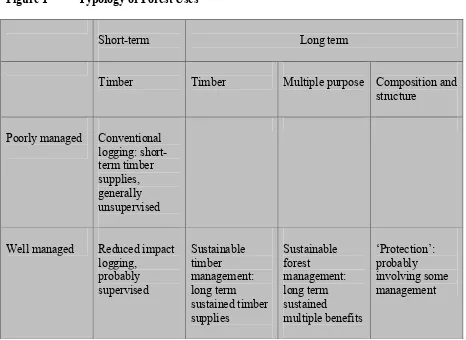
legitimate part of good or ‘wise’ forest management. In the same way, the literature now refers to ‘conventional logging’ as if it too characterises undesirable treatment of forest. To a forester, however, conventional logging might characterise standard forest management practice as opposed to unconventional means of timber extraction, e.g. with the use of helicopters. But some conventional logging is not practised wisely, so that it becomes possible to contrast poor management practice with, say, reduced impact logging (RIL). To a forester, RIL would simply be a feature of any good management system. In what follows we maintain the more popular image of conventional logging as meaning use of the forest for short-term timber supplies, aimed solely at short-term profits and without significant government control. Management plans may or may not exist for this type of timber harvesting, and, while the potential is there for switching to a more long-term sustained timber yield, it is more likely that forest degradation, forest loss and conversion to non-forest use will follow.
management plan is fully implemented for timber is fully implemented and focuses on the long term. Note that the sustained yield does not necessarily mean that one species is sustained over time. As the forest structure and composition change over time because of harvesting or natural succession, harvested species may change.
Sustainable forest management embraces the view of the forest as yielding many different products and providing many different ecological services. Sustainable forest management will therefore produce an array of products and services which may or may not include timber. SFM therefore relates to the multiple use of the forest. To a forester, the term ‘management’ could relate to the management of resources, inventorying and yield calculation, and to silvicultural practice (e.g. climber cutting), so that, on some definitions, SFM is already embodied in good practice timber harvesting. Again, then, the terminology of SFM is not ideal but is retained here to convey the idea of multi-product uses and with a focus on the longer term.
‘Protection’ is also ambiguous. For ardent environmentalists it almost certainly means the maintenance of the structure and composition of the forest without change caused by human intervention. For others it risks being confused with ‘conservation’ which is the proper management of the forest for the sustained yield of some product(s), service(s), or some combination of products and services. Again, a forester would argue that he or she has always been in the business of conservation in this sense (as indicated by the more traditional term of ‘conservator’). ‘Protection’ also conjures up the image of leaving a forest totally alone when, in practice, some management of invasive exotic species, fire etc. is still likely to be required to conserve structure and composition. If so, it would appear that private interests will not result in protection because it yields no return but does involve costs such as monitoring, fencing etc. In practice, private interests may well engage in protection since private benefits can accrue from conservation of the carbon content of the forest – see Section 8.5- and protection may be consistent with some uses of the protected forest, e.g. ecotourism.
Figure 1 Typology of Forest Uses
Short-term Long term
Timber Timber Multiple purpose Composition and structure
Poorly managed Conventional logging: short-term timber supplies, generally unsupervised
Well managed Reduced impact logging,
probably supervised
Sustainable timber management: long term sustained timber supplies
Sustainable forest
management: long term sustained
multiple benefits
‘Protection’: probably involving some management
4 The meaning of ‘optimal’ forest land use
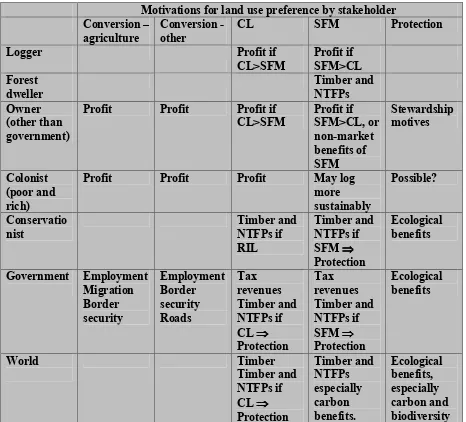
What is ‘optimal’ depends on the viewpoint of the economic agent making the decision to convert forest land or to adopt a particular forestry regime. Hence we need to identify the stakeholders.
From the standpoint of most logging companies a forest exists to be logged. In principle, a forest will not be logged if it is unprofitable to do so, although it is perfectly feasible that loggers may log land at a loss if subsidies prevail. If the forest is profitable, the management regime used will generally be that which maximises profits, subject to any regulations on harvesting that may be in place. In addition to obligations under relevant legislation, logging companies may voluntarily attenuate maximum profits if they feel some obligation towards the environment. In some cases it would appear that the most profitable regime is not employed. RIL might, for example, lower costs but not be used, perhaps because of ignorance or for reasons that remain unclear.
of products, including timber; as an environmental resource; as a stewardship objective, and so on.
From the standpoint of forest dwellers a forest exists to provide an array of ecological and economic functions ranging from timber, fuelwood, and wildmeat to protection against floods. From the standpoint of poor agricultural colonists forests exist for the land they provide for timber, crops and livestock, mainly the latter two. The productivity of this land is temporarily advanced through burning and clearance, and may be more permanently advanced by the use of inputs such as fertiliser. Such colonists may nonetheless have complex mixes of motives. Thus, Mourato and Parikh (1999) show that slash and burn cultivators in Peru exhibit a strong concern for the conservation values of their forests. The image of colonists as being poor is not always correct: they may also be wealthy individuals or companies looking to exploit subsidies, to speculate on land values, or to anticipate conversion to lucrative plantations and agro-industries. From the standpoint of the conservationist the forest exists to provide ecological functions, amenity and the provision of wellbeing to forest peoples. Motivations vary and may range from a desire to make direct use of the forest (e.g. ecotourism) to a concern for the intrinsic rights of biodiversity to exist.
From the standpoint of national governments, forests may serve any of the above functions depending on the extent to which governments have the wellbeing of particular stakeholders at heart. They may prefer :
logging to preservation because it provides employment and tax income; conversion because it may yield higher returns than timber production;
conversion and colonisation because of the need to ‘establish’ political frontiers and accommodate migrants;
conservation because of a concern for vulnerable indigenous groups, because of the potential income from sustainable uses of the forest, because there are financial inducements to conserve, or because they have forest protection as a general social objective.
From the standpoint of the world as a whole there may be a preference to log forests for the valuable timber they contain, or to conserve forests for their local and global ecological
functions. In the latter case, there may be a preference to conserve forests because of their role in providing biodiversity and in storing carbon which would otherwise be released to the
atmosphere, contributing to global warming. The relevant agents reflecting ‘world’ interests include some activities by bilateral and multinational aid agencies, various UN organisations not directly involved with aid, the Global Environment Facility, and international NGOs.
(1) to impose a given use on all stakeholders, regardless of the differences of viewpoint. This ‘solution’ is potentially unstable because one or more stakeholders will lose from the imposed land use. Hence they have a continuing incentive to break the agreement by securing its subsequent rejection, or by ‘illegally’ using the forest for their own purposes; (2) to find an agreement which adopts a given use of the forest land and in which those who
lose are compensated in some way for forgoing their use of the land. On this solution, all stakeholders are (ideally) better off with the agreed land use than they were without it. The second solution suggests the meaning of ‘optimal’: it is a land use which is judged socially the most beneficial overall, but in which those who lose from the land use are compensated for their losses. This definition accords with elementary game theory (for a brief introduction see Perman and McGillvray, 1999).
In practice, actual compensation for losses is often not feasible. At the very least then, forest land should be allocated to those uses which maximise, as far as possible, the aggregate social value of the forest land. If gains and losses are measured in monetary terms, then this
requirement is equivalent to a standard cost-benefit analysis approach and the compensation is potential rather than actual. Put another way, gainers have to be able to compensate losers and still have net gains to show (Pearce, 1986). In practice, while we may not be able to assign economic values to all functions, the cost-benefit approach is a reasonable way of organising the framework for analysis.
A convenient language to describe stakeholders’ interests is that of ‘private’ and ‘social’ gains and losses. ‘Private’ refers to the private interests of the stakeholder, i.e. what benefits him or her. ‘Social’ takes the wider, social perspective and the jurisdiction may be local, national, regional or global. In theory, governments or global agencies should take the social standpoint, but it is well known that this is not always the case. Both perspectives are relevant to
determining ‘optimal’ forest land use because adopting a social perspective without
acknowledging that some stakeholders’ private interests may be compromised will, as noted above, be potentially unstable. For an overview of conflicts in forest land use see Chapter 7 of Panayotou and Ashton (1992).
Table 1 encapsulates the different interests of the forest stakeholders, albeit in simplistic terms. The reality is that motivations will often be complex mixes of those shown.
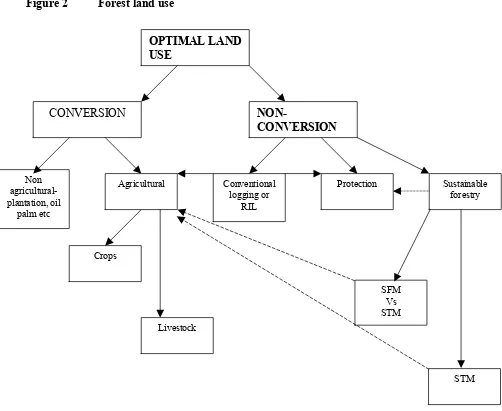
INSERT TABLE 1 INSERT FIGURE 2
Figure 2 shows competing and complementary forest land uses in diagrammatic form. Note that conventional logging (CL) is potentially capable of leading to protection if well managed logging occurs in an initial period after which loggers leave the area and protective policies are introduced. CL is also, however, linked to conversion since the initial period of logging opens up the forest area to colonists and industrial uses through the construction of roads. Which of these views is correct is an empirical matter. CL could, in principle, also lead to STM if initial-phase loggers focus on only large specimens, collateral damage is minimised and regeneration is fast. STM, of course, also opens up the forest and relies for its avoidance of colonisation and
by STM/SFM seems unlikely due to soil and biomass damage in the CL phase. Nonetheless, we retain the possibility of the sequence from CL to STM/SFM.
5 The meaning of sustainable forest management
Optimal land use is not necessarily the same thing as sustainable land use (Toman and Ashton, 1994)2. The current debate about forestry is partly about sustainability, i.e. about making use of forested land in a sustainable fashion. In large part, converting forest land to agriculture – in tropical regions – is not sustainable because soils often do not have the capacity to sustain agricultural activity indefinitely, although the case for perennials is far stronger in this respect. There are, however, many cases in which tropical forests have been converted and successful agriculture follows (see e.g. Schneider, 1995). In other cases, provided suitable fallow periods prevail, forested land can be converted for short term agricultural use and then be cleared again and reused after the fallow period. This ’cycle’ of agriculture and forest regeneration is also potentially sustainable.
As noted above, the debate about appropriate forestry mixes two different aspects of sustainability:
(1) sustainable timber management (STM) in which the focus is on a sustained yield of timber over long time periods; and
(2) sustainable forest management (SFM) in which the focus is on the many products and services of the forest sustained over long periods of time.
While it is generally thought that STM is consistent with SFM, it is at least open to argument that STM will give a less sustainable flow of non-timber products relative to SFM. Thus, it is important to distinguish STM from SFM.
In sustainable timber management, timber is extracted with regard to a continuous future supply of wood through investment in regeneration. STM also tends to be associated with minimisation of damage to residual stands, a point emphasised by Vanclay (1996), possible investment in finding uses for currently non-merchantable species, and accelerated growth of merchantable species in managed stands.
With SFM, non-timber products and ecological services may also be exploited, e.g. through carbon trades, bio-prospecting, debt-for-nature swaps etc. Social uses of forest may also be taken into account (indigenous peoples). Thus SFM is:
‘management of primary or secondary forests for the sustained production of timber or other products or both in which forest cover is maintained indefinitely’ (Dickinson et al, 1996).
Reid and Rice (1997) suggest that the primary management objective of SFM is
2 Optimality tends to be defined in terms of maximising the net present value (NPV) of the flow of services from the
‘obtaining a constant or increased flow of wood from a forest whose natural structure and species composition are maintained to some degree, though not entirely’,
a definition that, nonetheless, interestingly makes no reference to ecosystem function or ecological processes. IFF (1999) state:
‘Non market forest goods and services and, moreover, cultural, spiritual and ethical values of forests are fundamental considerations of sustainable forest management. The importance of these contributions of forests should not be contested in principle, even if they cannot be denominated in monetary terms’.
This quotation emphasises the view that SFM extends way beyond products and ecological services. Perhaps the most complete definition comes from Bruenig (1996):
‘….management should aim at forest structures which keep the rainforest ecosystems as robust, elastic, versatile, adaptable, resistant, resilient and tolerant as possible;..canopy openings should be kept within the limits of natural gap formation; stand and soil damage must be
minimised; felling cycles must be sufficiently long and tree marking so designed that a selection forestry canopy structure and a self regulating stand table are maintained without, or with very little, silvicultural manipulation; production of timber should aim for high quality and
6 The context for the analysis
The context for the remainder of the paper is one where the starting point is an existing forest. Thus, we do not discuss the optimal use of bare or degraded land. Additionally, although land uses that involve conversion of the forest are relevant to the analysis, they are incidental to the main focus which is on the appropriate form of forestry. It may or may not be the case that land conversion is socially or privately ‘better’ than a given forestry use.
Finally, outright protection is also relevant to the analysis but is not the main focus. Like
conversion, protection has to be part of the analysis because forest practices are capable of being a precursor to a protected area classification. Conventional logging, for example, is frequently a precursor to agricultural colonisation, and hence land conversion. One current argument is that protection might follow on from an initial period of logging.
7 The private interests of the logging companies
7.1 The empirical evidence
From the logging firm’s point of view, the use of the forest will be dictated by the option
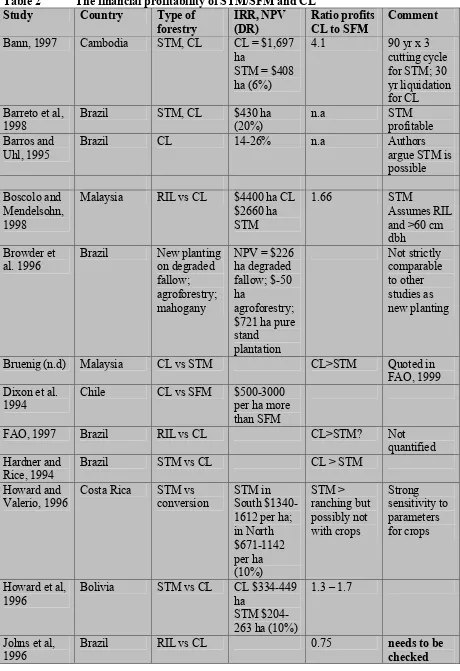
providing the largest private financial rate of return. Empirical evidence relating to these rates of return is limited. The results of a literature search are given in Table 2. A particular problem concerns the fact that STM and SFM systems have rarely been in place long enough for an accurate picture on financial returns to be obtained (Dickinson et al .1996). Furthermore, it is seldom to the logging firm’s advantage to reveal the actual costs of logging operations. Double accounting is therefore commonplace when record books are accessible at all. Those few studies that compare STM/SFM and CL therefore tend to be based on financial model simulations. Additionally, where there is additional evidence on the rate of return to STM/SFM, the relevant studies often do not attempt a comparison with CL, contenting themselves with a demonstration that STM/SFM is profitable per se. Some of the analyses are also not very clear on precisely what the forest ‘management’ regime is.
INSERT TABLE 2
While the quality of the analysis in some of the studies leaves something to be desired, the general conclusions emerging from Table 2 are:
(1) that STM is potentially profitable at ‘reasonable’ discount rates of, say 5-10% (in real terms). It is possible that financial viability would be doubtful at higher rates;
(2) that STM is almost systematically less profitable than ‘liquidation’ forestry and other forms of conventional logging.
Nonetheless, while this inequality of profitability explains the widespread preference of loggers for CL, it does not justify it. The reason for this, as indicated previously, is that the financial cost benefit calculation of the logger is not the same as that for society generally and certainly not for the world as a whole.
7.2 Factors that could favour the financial profitability of STM
Advocates of STM have drawn attention to four main factors that might increase the financial return to STM relative to CL: discount rates, future price increases, incremental growth rates for timber volume, and property rights.
7.2.1 The discount rate
One ‘price’ of potential importance for the SFM vs CL debate is the discount rate. For the financial perspective the relevant discount rate is that of the logger or concessionaire. For the national perspective, the relevant rate is the social discount rate. The two rates can be expected to differ, with the social rate being below the private rate (Pearce, 1986). Surprisingly little is known about discount rates in developing countries. Some evidence exists on discount rates for agriculturists in developing countries. For example, Cuesta et al (1994) found that real personal discount rates of farmers in Costa Rica were in the range of 15-22%, and they use the finding to cast doubt on the economic feasibility of introducing soil conservation measures. Aylward and Porras (1998) suggest that a social discount rate for Costa Rica generally would be 7-10%, i.e. half the private rate. Nonetheless, the range for the social rate is roughly in accord with the rates that have been used in forest studies in Costa Rica. By far the most comprehensive analysis is by Poulos and Whittington (1999) which covers the general public in Ethiopia, Mozambique, Uganda, Indonesia ,Bulgaria and Ukraine. While not all of these are countries with significant forest, they are typical of the range of forested countries. Poulos and Whittington find that short-term personal discount rates are 45-206% and longer short-term rates are11-28%. The long short-term rates are very consistent with the Cuesta et al (1994) study in Costa Rica. Rates this high would make it difficult to justify even the most conventional of development projects. In the context of forestry they are effectively fatal for any investment with a long-term focus.
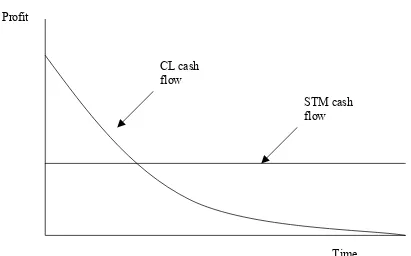
The importance of the discount rate can be illustrated by Figure 3. There a hypothetical flow of profits from CL and SFM is illustrated with the typical ‘hump’ of returns under CL occurring early on. Annex 1 shows how the ‘switching’ discount rate can be found, i.e. the rate which would make the NPV of the two profit streams the same3. While high personal discount rates appear to be the norm on the basis of the empirical evidence, it is important to stress that few studies exist that adopt rigorous methodologies for estimating those discount rates. Additionally, some poor communities do manage timber production on a non-exploitative basis, suggesting that communal discount rates may be markedly less than purely personal rates (see Pinedo-Vazquez and Rabelo, 1999, on varzea logging).
INSERT FIG 3 ABOUT HERE
3 Figure 3 assumes a constant discount rate over time. In practice, discount rates may vary with time due to changes
7.2.2 Timber prices
If timber prices are expected to appreciate then there is some benefit to curtailing cuts now in favour of the future (effectively, price increases can be thought of as a deduction from the discount rate). But future timber prices are unlikely to grow rapidly. Some of the high price increases simulated in the STM studies, e.g. Howard and Valerio (1996), are based on protected forest industries. World prices are a better guide. Moreover, world price (‘border prices’) would be the relevant magnitude in economic, as opposed to financial, studies. Rice et al (1998) use 2% p.a. growth in real prices which may, however, be an exaggeration of future price increases. Work at Resources for the Future (Sohngen et al, 1997) suggests baseline price growth rates well under 1% p.a. for the next 100 years. Even with a high demand scenario, price increases barely exceed 1% per annum over the next 60 years. These results are consistent with other estimates of long term trends – e.g. see Brooks et al. (1996). Overall, it seems unlikely that future price increases will confer significant advantages on STM relative to CL. More generally, as long as timber is ‘abundant’, stumpage prices will be low, making STM financially
vulnerable (Southgate, 1998). 7.2.3 Timber volume growth rates
Timber volume growth rates have an effect similar to real relative price increases. If growth rates are faster under STM then the difference can be regarded as the equivalent of a reduction in the discount rate. Rice et al (1998) suggest 2% p.a. as an average for growth relevant to STM, i.e. 2% per annum in volume of the stand. However, quotations of percentage growth rates are not very meaningful. First, growth depends on stand condition such that growth is an inverse ‘U’ shaped curve relative to stand condition (low at poor states and low again if there is high density and crowding, although the latter is rare in managed natural forests) – see Vanclay (1994). Second, large trees may have small percentage growth rates but substantial incremental yields in terms of cubic metres of wood. Third, account has to be taken of damage in CL to residual trees (10-40 cm dbh) that will form the next crop in polycyclic management operations. Surviving damaged trees grow slowly and will not contribute to the next commercial crop due to stem defects. Most of the growth benefit from RIL and STM derives from higher stocking and fewer weed dominated areas, such as vine blankets.
Overall, STM could easily result in volume increments of commercial species that are 2-4 times higher than after CL.
7.2.4 Property rights
It is widely argued that insecure or short-term property rights encourage CL, so that longer-term rights would encourage a switch to SFM, or at least STM. Rice et al. (1998) accept the argument in principle but argue that longer-term concessions would not alter the underlying financial costs and benefits, favouring CL. But tenure might also encourage better environmental choices of equipment and the training of staff, or at least enable better choices to be made. Boscolo and Vincent (1998) simulate the effects of longer-term concessions on the timing of harvests in Malaysia and show that, on their model, it would make no difference. Generally, it does not pay to leave trees standing4. Probably the best way to accommodate the concession length issue is to
4 The issue of concession length needs to be distinguished from the issue of allocating rents where rent equals the
regard longer concessions as an enabling device for STM which, without additional incentives such as performance bonds, will nonetheless be unlikely to lead to STM.
7.2.5 Efficiency and best practice .
One remaining issue concerns the extent to which the STM systems observed in Table 1 reflect ‘best practice’. That is, what is being observed may not be the most efficient form of STM, making cost comparisons misleading. Various inefficiencies need to be addressed: (a) ratio of usable wood to cut wood; (b) ratio of cut wood to wood at the mill gate, (c) ratio of mill output to mill input. Do (a) and (b) vary by type of management regime? How do loggers respond to efficiency improvements (and why don’t they adopt them automatically?). Part of the problem seems to be that critics are damning STM as it has been practised. Defenders of STM and SFM are saying that past systems were poorly implemented, e.g. by excessive canopy opening, inappropriate log transport, inappropriate machinery, lack of training and planning, etc. In other words, we need to know what would constitute an efficient system.
But what constitutes efficient STM or SFM may be rather like the Holy Grail, since efficiency implies an agreed objective and the reality is that no such consensus exists. Objectives might, for example, embrace recreating the original stand, regenerating harvested species, conserving ‘habitat’ trees, minimising gaps, and so on. The reality seems to be that SFM is itself an ‘elastic’ concept, making the criticism that it has not been practised when it should have been, difficult to evaluate.
7.2.6 Valorising non-commercial timber species
It has been argued that ‘valorising’ non-commercial timber stock will provide less incentive to use regimes that damage residual stands (Buschbacher, 1990). Rice et al (1998) argue, on the other hand, that expanding the commercial range of species simply results in all species being exploited. The reality is complex and depends on prices for such species, supervision and what the management regime is trying to achieve. In Queensland, the valorisation of species took pressure off the best and most accessible areas, and good supervision of the operations meant that the additional species harvested did not result in degradation of the residual stand (Vanclay, 1996). But it is hard to generalise on the valorisation issue.
7.2.7 Concessionaires and confidence
Sustainable forest practices involve having confidence in the long term future. Many of the world’s most valuable forests are in areas where there is a potential for rapid political change and the insecurity that it engenders. The effect of lack of security will be to reduce confidence in the future and hence to favour short-run exploitation. The effect is the same as that of a high discount rate.
8 The national perspective
The national perspective on land use options differs from the financial analysis outlined above in several ways.
First, logging may not be the ‘best’ use of the forest land, so that the options on land use broaden to those set out in Figure 1.
Second, attention now has to be paid to the sequencing of land use. Figure 1 suggests one possibility is that logging is followed be either protection or conversion (and to which we might add abandonment). Which one follows will determine the flow of costs and benefits to the nation.
Third, financial gains and losses should no longer be as relevant as economic gains and losses, i.e. financial flows should be shadow priced.
Fourth, all forest values other than timber values become relevant.
Fifth, if global values exist and can be converted to resource flows of benefit to the nation, then they too become relevant.
We address each modification in turn.
8.1 Widening the options to all forest land uses
Figure 2 shows a set of alternative forest land uses. In practice there will be combinations of uses that should also be considered, e.g. agro-forestry, clearance for plantation forestry, oil palm, etc. But the principle is the same, whereas a private logger might reasonably consider only the financial costs and benefits of logging options, the nation state should consider all options and evaluate their economic value.
8.2 Sequencing of land use
Surprisingly little attention appears to be paid in the CL ‘vs’ SFM debate to the sequencing issue. It is well known that logging opens up frontier land which may then be colonised by agriculturists5. Repetto (1990) is of the view that most deforestation arises from the initial action of logging which creates access to hitherto inaccessible forest land. In their review of
econometric studies of deforestation Kaimowitz and Angelsen (1998) find that deforestation is higher when land is accessible, when timber and agricultural prices are high (encouraging logging and conversion), when rural wages are low and when there are opportunities for long distance trade. Of these factors, several – accessibility, timber prices, and trade potential – all relate to logging. Southgate (1998) documents cases where most road construction in forested areas has come from loggers, encouraging conversion to cropland and pasture. Low stumpage prices might contribute to conversion since even the modest rates of return that might be expected from agriculture compare favourably to forestry at low stumpage prices.
5 Sequencing may happen the other way round. The land may initially be cleared for agriculture and taking timber
This picture contrasts with the one suggested by some analysts who argue that CL could be followed by outright protection (Rice et al, 1998a; Rice et al 1998b; Cannon et al. 1998). The argument here is as follows: loggers are unlikely to return to the same area after the initial logging phase because
(a) they do not practise sustainable forestry, thus making future timber stands unlikely to be of commercial interest, and
(b) because they have high discount rates, also making future yields unattractive.
The land is therefore potentially available for protection without the further threat of logging. The argument has some force, but there are several problems.
First, the picture of loggers entering an area only once is often not accurate. Loggers often return 5-10 years after the first harvest to harvest trees that have become commercially valuable
because of changes in transport infrastructure, in milling methods and market potential. The later phase, re-entry loggers may also be different people to the first-time entrant: smaller operators with lower operating costs acting as agents for small mills working in formerly high graded areas. The ‘protect after logging‘ scenario thus has to relate to a context in which the threat of subsequent logging interventions remains.
Second, even if the threat of further logging is removed, the threat of colonisation for non-timber purposes is not removed and, indeed, is, ex hypothesi, more likely. Colonisation here may be for subsistence agriculture but also for far more attractive agro-industrial use such as oil palm. Additionally , the ‘logging followed by protection’ view is based on what could happen rather than on what actually has happened in the past. However, there is an argument that says protection is easier after CL because land prices fall once loggers withdraw. Land can then be bought cheaply for protection purposes.
Third, CL may result in such significant degradation that what is left is not worth protecting. Substantial opening of canopies results in increased susceptibility to fires and increases in the likelihood of weed infestations. A spiral of degradation soon becomes irreversible.
Conventional logging followed by protection has indeed occurred, for example in Queensland, in the Noel Kemp Mercado carbon offset project in Bolivia, and in parts of Africa. But how far these examples arise simply because there were funds available for subsequent protection and because there was low population pressure on available land is unclear. Indeed, it is hard to envisage many circumstances in which there will be limited pressures to convert the land. The choice is then not often between ‘logging followed by protection’ and SFM/STM, but between some form of continuous forestry and land conversion. The potential for logging to be followed by protection may therefore be smaller than some of the literature acknowledges, although Reid and Rice (1997) accept that STM will be best suited to areas where there are strong pressures to colonise the forest for conversion. And, of course, protection is costly and in no way avoids the need for continued management.
situation for New Zealand. That such a policy works for New Zealand, and has been suggested in the USA where some environmental groups are calling for cessation of all logging on in National Forests, carries the suggestion that this option is best for countries with relatively high levels of per capita income. A country like Malaysia, where there are already extensive lowland plantations, could adopt such a policy, but lower income countries are still likely to face
formidable pressures for conversion of natural forest, so that finding profitable forest management systems is still important6.
Again, it needs to be recalled that protection is not costless. Not only are there continuing management costs, but there are capital costs of fencing and management institutions. To these must be added the value of the protected land in its forgone use(s).
8.3 Shadow pricing private costs and benefits
The analyses of costs and benefits to loggers have typically all been in terms of financial rather than economic flows. Exceptions, noted in Table 2, are the World Bank studies reported by Grut (1990).
8.4 Allowing for non-timber values
Allowing for non-timber values of the forest alters the focus of analysis from STM to SFM. In economic language, the relevance measure is now total economic value (TEV) from the different possible land uses. TEV comprises use and non-use values and both are capable of expression in monetary terms by estimating the relevant willingness to pay (WTP) for those functions (Pearce, 1993, 1996).7 The basic argument is that, even if STM is ‘worse’ than CL in financial terms, if the WTP for the incremental non-timber benefits of SFM exceeds the financial deficit, SFM will be preferred from a national perspective. More formally,
SFM > CL, if WTPntv > Πcl - Πstm ….[1]
Where ‘ntv’ is non-timber values and Π is profit.
Bawa and Seidel (1998) say there is no experience of timber regimes that integrate NTPs into the management system, but this does not square with Putz (1992), or with empirical experience from Costa Rica (Romero, 1999) and Nicaragua (Salick, 1995). Romero (1999) found that RIL had no effect on the available biomass of epiphytic bryophyes that are harvested and sold by local people. Similarly, Salick (1995) found that NTFPs and natural forest management for timber were compatible in Nicaragua. In small scale natural forests integration of NTFPs with timber is more the rule than the exception (see Pinedo-Vazquez and Rabelo, 1998). However, Putz et al. (1999) note that management invariably involves favouring some wildlife species over others.
6 The New Zealand and Malaysia examples raise the interesting issue of whether there might be an ‘environmental
Kuznets curve’ (EKC) for forest protection. EKCs exist when growth in income per capita first results in environmental degradation and then, after some turning point, a reduction in degradation. Such curves have been found for air pollution. In the current case, the hypothesis would be that countries opt for more forest protection and more plantations as incomes pass a certain point.
7 It is important to understand that all ‘prices’ in economics reflect willingness to pay. Some commentators limit
8.4.1 The evidence on environmental impacts of logging regimes
The presumption in inequality [1] above is that environmental benefits under STM/SFM exceed those under CL. This has been challenged by Rice et al (1997, 1998a, 1998b). They argue that the physical effects of CL on the forest were relatively mild for the case they studied in lowland Bolivia. However, that case relates to extremely low intensity mahogany harvesting, and it would be hard to envisage that it would also hold for the much more intensive harvesting characteristic of the eastern Amazon, or the dipterocarp forest of southeast Asia. Rice et al (1998) and Reid and Rice (1997) argue that STM/SFM can be just as destructive of the total forest as CL, a view supported by Bawa and Seidler (1998). Uncontrolled logging, it is argued, may be comparatively benign, especially on flat lands that are logged when soils are dry and where there is a low density of commercially exploitable species. Without the prior
topographical, soil trafficability and density conditions, however, CL may be very destructive. STM can be destructive if it involves major canopy clearance in an effort to encourage
regeneration of light demanding species, but much depends here on the management system in place (see below).
Extrapolation from single site studies, however, is dangerous. Manokaran (1998) describes the effects of selective logging in Pasoh, Malaysia. Contrary to statements that no selective logging system has been successful (Rice et al, 1998), Manakoran finds that the Malayan Uniform System (MUS) of selective cutting in the 1950s successfully regenerated the basal area of primary forest which, by the mid 1990s, was well stocked with commercially valuable
dipterocarp species. He contrasts this with the far less successful selective management systems (SMS) being practised in the hill forests. Moreover, the Queensland experience of over one hundred years of logging and close to SFM also suggests that selective logging can be successful (Vanclay 1994, 1996).
Biodiversity
Part of the problem with the discussion on environmental impacts concerns the characterisation of the environmental objectives of forest management. Whereas Rice et al. (1997) talk primarily in terms of the maintenance of biodiversity, others would argue that what matters is the
maintenance of ecosystem functions and ecological processes. Some of the concern about avoiding management-induced changes in tropical forest composition is based on the concept of ‘climax communities’, and the idea that tropical forests are unchanging and lacking in resilience. Given the long history of substantial human impacts on tropical forests and the large areas of tropical forest currently under some sort of silvicultural management by people, the
But even at the level of biodiversity the issue is far from clear cut. First, all forest management is likely to reduce biodiversity relative to pre-intervention conditions, or at least to change species composition The very term ’management’ means that something is being done to the forest that would not have happened without intervention. Second, the issue then becomes one of
comparing the biodiversity profile –i.e. the nature and extent of diversity - under the different management regimes, say SFM and CL. Thus, Rice et al (1998b) make a biodiversity
conservation argument in favour of introducing protection after logging has taken place. They suggest that even CL followed by protection is superior to STM/SFM because the former halts the process of forest domestication But this is a double edged argument, for CL could just as easily result in the loss of species dependent on large canopy openings or for regeneration pioneer species. Certainly, CL stands are especially prone to weed infestations due to excessive damage and lack of pre- or post-logging treatments to discourage weeds and encourage potential crop trees. Even though it does not constitute STM or SFM, reduced impact logging (RIL) would be a substantial step in the right direction. Thus, pre-felling vine cutting can substantially reduce post-logging incidence of serious vine infestations, and also reduce logging damage where vines tie together tree crowns. RIL thus constitutes a major step forward.
Additionally, there has been a tendency to generalise from single area case studies. The work of Rice et al. relies heavily on observations in the dry forests of Northern Bolivia where, if
sustainable timber exploitation for the species currently harvested is to be practised, substantial canopy manipulation is required in order to provide the conditions for the regeneration of light-demanding species, especially Swietenia macrophylla. The structure and composition of the forest would thus have to change in a substantial way to avoid loss of the currently most valuable species of canopy trees. Even for these forests, it is unclear that species loss due to management need be significant. These forests have survived major disturbances in the past, and proper zoning of the forest should ensure biodiversity is retained.
Not all commercially valuable timber tree species require substantial canopy disturbance for regeneration. In southeast Asia dipterocarp forests, for example, minimising damage to residual stands is important to protect the abundant advanced regeneration of commercial species present before harvesting and to reduce the likelihood of vine infestation once the canopy is opened. The valuable canopy dominants in the forests of much of the Guyana Shield area in northern South America are also negatively affected by the substantial canopy openings required to regenerate mahogany in northern Bolivia.
small habitat patches within harvested areas, suggesting, again, that careful logging is consistent with biodiversity protection.
Carbon
Forest-based carbon sequestration, both by conserving carbon already stored in forests and by sequestering additional carbon by stimulating tree growth, has become an important focus for foresters because of the role that forest carbon release plays in accelerating global warming. This role was given official recognition in the 1997 Kyoto Protocol to the 1992 Framework
Convention on Climate Change. Countries can benefit in terms of achieving their emission reduction targets by engaging in ‘carbon trades’ whereby they offset some of their own emission targets by reducing net emissions in another country. The issue here is how different
management regimes affect carbon storage.
Silvicultural practices affect carbon balances. Thus, if vines are cut and left to decompose, carbon is released in the short term from the decomposition process, but can be offset later by the faster growth of the trees that are now free of the vines. SFM, practised properly, involves minimum site preparation and extended rotations, whereas clear cutting results in loss of necromass and soil organic matter which may well not be offset by subsequent sequestration through faster tree growth. In general, then, silvicultural practice benefits the carbon balance. Exceptions might include savannah woodlands (e.g. the pine forests of Central America) that are invaded by shade tolerant and less fire resistant trees. Restoring the open stands will result in carbon releases that may not be compensated for by increasing sequestration in the remaining trees.
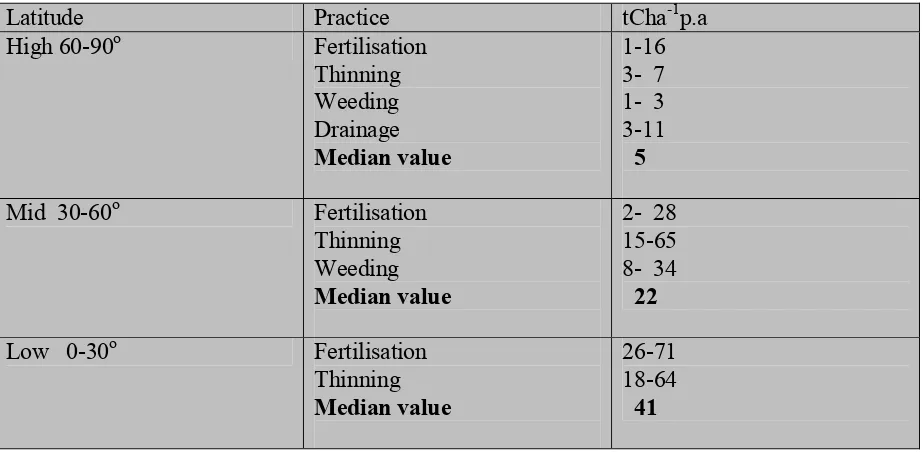
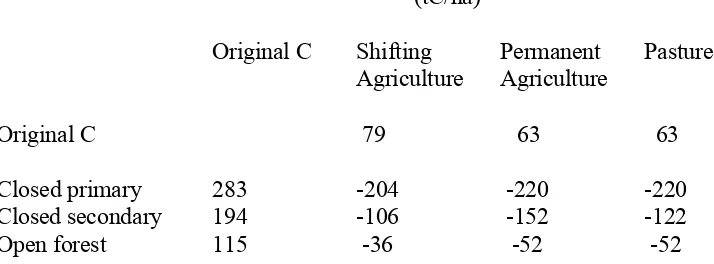
Dixon (1997) conducts a survey of experience with silvicultural practices in forty countries. Dixon’s results are shown in Table 3 below. The analysis suggests that silvicultural practices can result in additional sequestration or conservation of carbon ranging from 5tC to 41tC depending on latitude. Dixon suggests that if these practices were applied to the 600 million ha of land suitable for forest management in the nations surveyed, conservation of carbon would be of the order of 100-300 mtC p.a. over a 50 year period8. The economic efficiency of such measures is unlikely to compare favourably to the costs of reducing greenhouse gas emissions through energy-related schemes, or from plantations, but Dixon suggests that the practices in question could sequester carbon at some $13 tC. This is lower than the $20-30 tonne often quoted. In comparative simulations of carbon sequestration in Malaysian forests logged by trained crews following RIL guidelines and with CNV methods, Pinard and Putz (1996) (see also Boscolo and Vincent,1998, which adopts the Pinard-Putz estimates) showed that the use of RIL techniques conserved carbon in the harvested stands and resulted in substantially greater rates of post-harvesting sequestration due to higher stocking of potential crop trees and fewer problems with vines and other weeds.
An interesting study by Solberg (1997) suggests that if carbon is valued at $50 tC,
approximately the level of the Norwegian carbon tax, the value of Norwegian forests would increase by 2-30 times the value of timber output. If forests are managed according to their
8 For reference, global emissions of CO2 are some 6.2 billion tC, so that the potential from improved silvicultural
mixed timber and carbon value, as opposed to their timber value alone, significant changes would need to occur in management practices. Standing volumes and rotation ages would need to be increased, and there would need to be substantial increases in investment in silviculture. Leakage issues would loom large under such a scenario, given the large and growing
international demand for paper and other wood fibre products. With long rotations, natural forest succession would occur which, in some cases, would reduce the attractiveness of forests for early successional species of plants and animals, as well as for recreation, so some of the ‘carbon gains’ would be offset by other factors. Despite these misgivings, the clear implication is that the attachment of economic values to carbon via trading and/or meeting domestic emission
reduction targets could substantially favour better managed forests9.
Table 3 Dixon’s survey estimates of incremental carbon sequestration from silvicultural practices
Latitude Practice tCha-1p.a
High 60-90o Fertilisation Thinning Weeding Drainage Median value
1-16 3- 7 1- 3 3-11 5
Mid 30-60o Fertilisation Thinning Weeding Median value
2- 28 15-65 8- 34 22 Low 0-30o Fertilisation
Thinning Median value
26-71 18-64 41
Source: Dixon (1997).
Numerous ‘carbon offset’ projects exist either in actual or simulated form (simulations often involve actual projects which are not primarily designed to reduce carbon emissions, but which are being ‘tracked’ to see if the carbon benefits would make a significant difference; other simulations exist that are not associated with particular projects). Details of the various deals and their costs per tonne of carbon reduced can be found in Pearce et al (1998). Few of the deals relate to forest management. The offset projects can be analysed to elicit the average costs per tonne of carbon equivalent reduced. However, since the deals have not generally been developed on a cost efficient basis (selecting the cheapest options first) such an analysis is not particularly helpful. Estimates of the prices at which carbon will trade under the ‘flexibility mechanisms’ in
the Kyoto Protocol do, however, suggest that around $10 tC is likely to be a mean price, provided substantial trading takes place. As the USA is committed to meeting some three-quarters of its Kyoto target by trading (US Administration, 1998), and the European Union has recently announced that it may permit up to 50% of its own target to met from trading, the market could be substantial. A suggested guideline is that carbon may trade at between $5 and $15 tC. The importance of these figures can readily be seen. For forest conservation as a whole, compared to conversion, forests may secure a carbon ‘credit’ of $75o to $2250 per hectare on this basis10. For the comparison between SFM and CL, of course, the gains would be far more modest. If Dixon’s figures (Dixon, 1997) are adopted, incremental gains over CL may range from 5-41tC, or $25 to $615 ha.
However, great care needs to be taken in multiplying carbon storage or sequestration estimates by unit money values for traded carbon. The procedure is correct if the price of traded carbon is an equilibrium price, i.e. one that equates supply and demand for traded carbon. That price will be sensitive to the number of deals done. If there are vast ‘offers’ of carbon from countries seeking to capitalise on the carbon value of sustainable forestry, it may have the effect of forcing the price of carbon down, thus reducing the economic returns from carbon conservation. These ‘system wide’ effects have been stressed in a number of studies, e.g. Sohngen et al (1998). 8.4.2 Willingness to pay for certified timber
There are two approaches to securing an economic measure of the value of non-timber forest values. The first rests on what people are willing to pay for timber certified as coming from ‘sustainable’ forests, the idea being that ‘sustainable’ timber embodies all non-timber values in some premium over the world price for timber. The second attempts directly to estimate the economic value of the various forests functions independently.
If consumers of wood products are willing to pay a premium to guarantee that the forests supplying the products are sustainably managed, then that willingness to pay can be thought of as an approximation of the WTP in equation [1] above. Similarly, if forest companies are willing to adopt sustainable practices in order to secure some marketing gain from certification, then the costs of certification provide a lower bound of the additional value of certification. Certification schemes exist to guarantee the sustainability of various forests, akin to ‘eco-labelling’ of various products. Various certifying bodies are accredited by the Forest
Stewardship Council (FSC) and 3.5 m cubic metres of certified timber entered international trade in 1996, whilst 10 million ha of forests has been certified by 1998 (Crossley and Points, 1998). Certification costs are around $0.2 to 1.7 per ha for developing countries (Crossley and Points, 1998) and 9-12 cents per acre for assessment and 1-3 cents per acre per annum for licensing and auditing in the USA (Mater et al. 1999). Accordingly, any WTP above this level of cost represents the ‘net premium’ for SFM.
The evidence on the premium consumers are WTP for certified timber is mixed. A survey of four studies in Barbier et al (1994) revealed the following:
(a) a survey of UK manufacturers in 1990 suggested 65% were WTP more for certified timber; (b) a survey of UK consumers in 1991 suggested a 13-14% premium WTP
(c) a survey of UK consumers in 1992 indicated that 58% would not buy timber if they knew it came from rainforests, and
(d) a 1992 survey of timber importers suggested that 70% thought their customers were not willing to pay for certified timber.
An additional survey in British Columbia suggests that 67% of respondents to a survey would pay 5% more for certified timber, and 13% said they would pay 10% more (Forsyth et al, 1999). Crossley and Points (1998) suggest that certified products are securing premia of 5-15% in some cases, but that the real benefits of certification for industry lie in securing greater market share and longer term contracts. There is some evidence that companies gaining certification secure higher company value, i.e. the value of certification shows up in share prices on the stock exchanges.
If we take the 5-15% range as a likely measure of premium, the argument in Gullison (1995) and Rice et al (1997) is that this is far from sufficient to compensate for the additional profitability of CL over SFM as shown in Table 2. But their argument is suspect. Table 2 suggests that a typical ratio of financial profits for CL relative to STM would be, say, 1.5. For STM to become
competitive it is not necessary for prices to rise by 50%. A hypothetical numerical example should suffice to show that the price premium need only be a fraction of the difference in profits between CL and STM. If costs of CL are 75 and those for STM are 100, but both face the same market price of 150, then the ratio is 75/50 = 1.5, similar to that found in Table 2. The net price premium that will make profits equal is given by
p* = (CST-CCL)/P
where P is the common log price. In the numerical example, p* = 17% (25/150), which is considerably different to 50%. It is true that this premium is gross of certification costs, so that the true price premium required for parity between profits in the two regimes is higher than 17%.
8.4.3 Willingness to pay for non-timber products and services
A more direct approach is to seek the willingness to pay people express for the particular non-timber products and services from forests. We review what is known about these WTPs. But note that they need to be applied to the differential flow of environmental products and services from SFM as opposed to forests that are just logged. The total values would be relevant if all such services were lost, as they might be from forest conversion. The differential values are relevant for the CL/SFM comparison. The importance of this distinction is that we know a reasonable amount about the economic value of forest services, but, apparently, little about the differential flows of those services according to different forest management regimes.
and tends to exaggerate the problems of applying valuation techniques, whilst some of the others are already dated11.
There are of course substantial difficulties in reaching general conclusions from WTP studies, primarily because appropriate guidelines for carrying out such studies, such as those set out in Godoy et al. (1993) and Godoy and Lubowski (1992) have not been followed. The result has been a mixture of legitimate and illegitimate valuation procedures. The types of mistake made have included generalisation from studies of a small area of forest to wider areas, with little regard for (a) the fact that the area in question will not be typical of the whole forest area simply because of variations in distance to market, and (b) ignoring the fact that, in a hypothetical world where the whole forest was exploited for non-timber products, the prices, and hence the
profitability, of non-timber production would fall. Another methodological issue is the extent to which values are based on maximum sustainable yield or on actual harvests, which are often very much less, i.e. the values that emerge are sensitive to what is assumed about the
management regime in place. Godoy et al. (1993) also point out that some studies value the stock and some the flow, the former being an interesting measure for wealth accounting but of little value when comparing competing land use values. Studies also vary as to whether they report gross revenues or revenues net of labour and other costs. Finally, little account has been taken in many of the studies of the extent to which the relevant non-timber activity is itself sustainable, so that what is being compared may well be two non-sustainable land use options. Annex 2 provides an overview of what is known about non-timber values based on WTP studies.
Extracting some kind of consensus from the estimates in Annex 2 is clearly hazardous. We can speculate on the following annual values but care needs to be taken in generalising any of these numbers (Southgate et al., 1996).:
Non-timber extractive Values: $ 50 ha Non-extractive:
recreation $ 5 - 10 ha ecological $ 30 ha
carbon $ 600-4400 ha
Non-Use $ 2 - 27 ha
Whichever way the analysis is done, the major role of carbon values is revealed. Should, for some reason, global warming not remain a serious issue of concern, then tropical forests might be found to have measured environmental value of around $100 per hectare, far from enough to justify outright protection on economic grounds.
8.4.4 Kumari’s study for Malaysia
One of the few studies that attempts to place an economic value on the differential flows of goods and services from CL and SFM is Kumari (1995,1996) for the peat swamp forests of North Selangor in Malaysia. The analysis relates to the differential benefits of moving from an existing unsustainable timber management system, based on Malaysian Stateland forest practice, to sustained forest management overall. Various degrees of sustainability are addressed to allow
for the trade-off between sustained timber and non-timber products and services. The results are shown below.
NPV 1990 US$/ha at 8% discount rate Unsustainable
CL Sustainable option 1 Sustainable option 2 Sustainable option 3
Timber values 1380 944 700 510
Local/national non-timber values
251 308 447 563
Global values 3356 3645 3658 3668
Total 4987 4897 4805 4741
Notes: assumes 20% damage case. Kumari (1996) also estimates NPV for a 50% damage case. M.ringits converted to $ at 2.5 R per $. Option 3 is more sustainable than 2, 2 is more sustainable than 1.
Assuming constant damage from logging across all management schemes, CL would be preferred to each of the sustainable options, although the uncertainty in the approaches used to value the impacts is such that the statistical significance of the differences shown above is unlikely to be high. However, Kumari (1996) argues that the damage rate will be much higher, at 50%, for the least benign forms of timber extraction, the first two columns above. In that case the total damages would change as follows:
Total 4092 4252 4805 4741
The sustainable systems are now markedly better than the unsustainable systems. The ‘best’ sustainable system shows a 13% improvement on the ‘best’ unsustainable system.
The national non-timber benefits comprise rattan, bamboo, recreational and water benefits, together with ago-hydrological benefits because of the regulation of water supplies. The global benefits comprise endangered species and carbon, with the latter being the most important. The economic values shown reflect (a) the difference in unit ‘prices’ (WTP) applied to the impacts, and (b) the differences in ecological impacts. Taking the ‘best’ sustainable option (2) and comparing it to the base case of unsustainable management which maximises timber benefits alone, the incremental changes are as follows:
Increase in NPV for Option 2 relative to unsustainable base case. NPV 1990 $US/ha
Timber -160
National non-timber +225
Global +648
Total +713
How typical this analysis is for forests generally is of course open to serious question. In this case, for example, the agro-hydrological benefits account for about two-thirds of the national non-timber incremental benefits, rattan accounting for the rest. The fairly dominant role of carbon is borne out by the review in Annex 2, even though Kumari uses different (and lower) carbon values. Additional questions arise with respect to the economic analysis itself since it uses several ‘benefits transfer’ estimates (essentially, borrowing WTP figures from other studies). It is known that benefits transfer is subject to significant margins of error. Most importantly, the global benefits will not accrue to forest owners or concessionaires without institutional change which compensates them for storing carbon in the biomass. Existing carbon trades, and those expected under the Kyoto Protocol, thus become extremely important. In essence, Kumari’s analysis provides the ‘demonstration’ phase, but not the capture phase of the analysis, as she herself notes.
Nonetheless, Kumari’s approach, which is essentially traditional incremental cost-benefit analysis, is the correct one and is likely to be the only one that can capture all the relevant changes in the multiple outputs of different forest management regimes.
8.4.5 Bann’s study for Cambodia
Bann (1997) reports detailed economic values for timber, non-timber products and
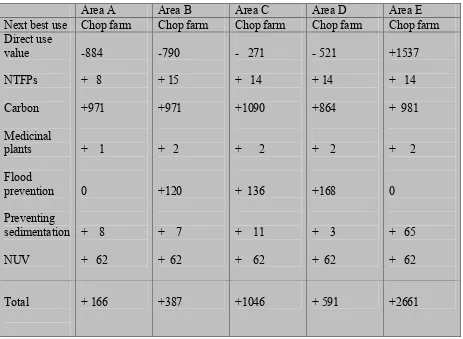
environmental benefits for forest land in Ratanakiri, Cambodia. The analysis is interesting since it suggests that, for this case, NTFPs alone represent the best use of the forest land, although there is a crucial difference between actual, current rates of collection and those that could be obtained, the latter being based on a full forest inventory. The essential results are shown below (with corrections as there are several wrong totals in the original and environmental benefits are wrongly treated in the summary table).
NPV at 6% US$/ha
Existing sustainable NTFP collection Potential sustainable NTPF collection Sustainable timber Unsustainable timber NTFPs: Malva nuts Rattan Bamboo
697 3811
23 88
0 0
Environmental benefits: Biodiversity Watershed Carbon 511 76 7 511 76 7
Assumed to be half NTPF scenarios = 297
0
Timber 0 0 408 1697