Jian Liu1 ?, Sihem Mesnager2, and Lusheng Chen3
1 School of Computer Software, Tianjin University, Tianjin 300072, P. R. China and
CNRS, UMR 7539 LAGA, Paris, France
2 Department of Mathematics, University of Paris VIII, University of Paris XIII,
CNRS, UMR 7539 LAGA and Telecom ParisTech, Paris, France
3
School of Mathematical Sciences, Nankai University, Tianjin 300071, P. R. China
Abstract. For vectorial Boolean functions, the behavior of iteration has consequence in the diffusion property of the system. We present a study on the diffusion property of iterated vectorial Boolean functions. The measure that will be of main interest here is the notion of the de-gree of completeness, which has been suggested by the NESSIE project. We provide the first (to the best of our knowledge) two constructions of (n, n)-functions having perfect diffusion property and optimal alge-braic degree. We also obtain the complete enumeration results for the constructed functions.
Keywords: Boolean functions; degree of completeness; perfect diffusion property; algebraic degree; balancedness.
1
Introduction
Vectorial Boolean functions have been extensively studied for their applications in cryptography, coding theory, combinatorial design etc., see [4] for a survey. Let Fn2 denote the n-dimensional vector space over the finite fieldF2 with two elements. Vectorial Boolean functions are functions from the vector spaceFn2 to the vector space Fm2, for given positive integers n and m. These functions are called (n, m)-functions and include the single-output Boolean functions (which correspond to the casem= 1).
In 1949, Shannon [16] used the term diffusion to denote the quantitative spreading of information. For an (n, m)-function, the diffusion property describes the influence of input bits on the output bits. The exact meaning of diffusion relates strongly to the methods of cryptanalysis. An intuitive measure related to diffusion is of considerable importance for vectorial Boolean functions: the degree of completeness, denoted by Dc, which is given by the comments from the NESSIE project [15]. In [10], Kam and Davida introduced the concept of
?This work is supported by the National Key Basic Research Program of China under
complete functions, which means that every output bit depends on every input bit (also see [7,9]). For a vectorial Boolean function, the degree of completeness quantifies the rate of input bits that the output bits depend on. A complete function possesses optimal degree of completeness, i.e., Dc = 1. In this paper, we use the notion of the degree of completeness to indicate the diffusion prop-erty of a vectorial Boolean function. In this sense, by perfect diffusion propprop-erty we mean iterated vectorial Boolean functions which possess optimal degree of completeness. There are other indicators of diffusion property which shall not be discussed here. For instance, thebranch number of diffusion layers (see [6]) re-lates closely to differential cryptanalysis [2] and linear cryptanalysis [12] on block ciphers. Thediffusion factor (see [6]) quantifies the average number of changed output bits when a single input bit is changed. The degree of completeness can be seen as some kind of weakened version of diffusion factor.
The investigation on the degree of completeness of iterated (n, n)-functions helps in general the understanding of the evolution of diffusion property of cryp-tographic systems. Some methods of cryptanalysis on cryptosystems are based on the idea of identifying the relation between a particular output bit with the input bits. If every output bit depends on only a few of the input bits, there may exist some potential attacks, such as algebraic attacks [1,5], since one may convert the cipher-text into a system of polynomial equations and solve it di-rectly. For example, in a product cryptosystem [16] such as block cipher and hash function, the degrees of completeness of iterated round functions (seen as vectorial Boolean functions) have consequence in the diffusion property of the whole system. A round function is preferable to have perfect diffusion property for providing complete diffusion, see the general model in Section 3.2. In the context of stream ciphers, the model of augmented functions should be consid-ered (see [8]), where an update function L is iterated to generate keystreams by composing an output function. If the degrees of completeness of the iterated update functions L(i), i = 1,2, . . ., are very low, then the algebraic attack is expected to be efficient. Other potential applications of functions with perfect diffusion property could be found.
a class of almost balanced (n, n)-functions with perfect diffusion property is giv-en. Moreover, complete enumeration results for the constructed functions are obtained, which show that there are many (n, n)-functions with perfect diffusion property.
This paper is organized as follows. Formal definitions and necessary prelim-inaries are introduced in Section 2. In Section 3, two constructions of vectorial Boolean functions with perfect diffusion property are proposed for the first time, and the complete enumeration results for these functions are presented. To avoid being too theoretical, we give an explicit example to show that it is possible to construct recursive round functions to provide complete diffusion. We summarize this paper in the last section.
2
Background and Preliminaries
In this paper, additions and multiple sums calculated modulo 2 will be de-noted by ⊕ and L
i respectively, additions and multiple sums calculated in characteristic 0 or in the additions of elements of the finite field F2n will be
denoted by + and P
i respectively. The functions from the vector space F n 2 to F2 are called n-variable Boolean functions, and the set of all the n-variable Boolean functions is denoted by Bn. For f ∈ Bn, the Hamming weight (in brief, weight) of f is wt(f) = {x∈ Fn2
f(x) = 1}
, and the (0,1)-sequence
defined by (f(v0), f(v1), . . . , f(v2n−1)) is called the truth table of f, where
v0 = (0, . . . ,0,0),v1 = (0, . . . ,0,1), . . . ,v2n−1 = (1, . . . ,1,1) are ordered by
lexicographical order. Ann-variable Boolean functionf can be uniquely repre-sented in thealgebraic normal form (in brief,ANF) that
f(x) = M v∈Fn2
cvxv11x v2 2 · · ·x
vn
n ,
where x= (x1, . . . , xn)∈Fn2, v= (v1, . . . , vn)∈Fn2, cv ∈F2. Let wt(v) denote the Hamming weight (or weight) of a vectorv, that is the number of its nonzero coordinates, then deg(f) = maxv∈Fn2{wt(v) | cv 6= 0} is called the algebraic degree off.
Proposition 1. [3] Letf ∈ Bn andf(x) =L
v∈Fn2cvx v1 1 x
v2 2 · · ·x
vn
n . Then,cv=
L
x∈Fn2,xvf(x), where x v means that x = (x1, . . . , xn) is covered by v = (v1, . . . , vn), i.e., for any i = 1, . . . , n, xi = 1 implies vi = 1. In particular, deg(f) =n if and only ifwt(f) is odd.
An affine permutation L on Fn2 is defined as L(x) = xM⊕a, where M is a nonsingular n×nmatrix over F2 and a∈Fn2. Moreover, ifa=0, thenL is called a linear permutation.
Proposition 2. [3] The algebraic degree of an n-variable Boolean function f
Fori= 1, . . . , n, denote byei the vector inFn2 whosei-th component equals 1, and 0 elsewhere. Thedegree of completenessof ann-variable Boolean function
f is defined as
Dc(f) = 1−
|{i|ai= 0,16i6n}|
n , (1)
whereai=|{x∈Fn2 |f(x)⊕f(x⊕ei) = 1}|,i= 1, . . . , n. Equivalently, let V(f) =
i ∃x∈F
n
2 such that f(x)⊕f(x⊕ei) = 1,16i6n , (2) be the set of indices of the variables appearing in the ANF of f, then Dc(f) = |V(f)|/n.
Let n and m be two positive integers. The functions from Fn2 to F m 2 are called (n, m)-functions (or vectorial Boolean functions). Such a function F is given by F = (f1, . . . , fm), where the Boolean functions f1, . . . , fm are called the coordinate functions of F. An (n, m)-function is called balanced if for any
b ∈Fm2, the size of the pre-image set |F−1(b)|= 2n−m. The derivative ofF at directionais defined as
4aF(x) =F(x)⊕F(x⊕a), a∈Fn2\ {0}. Thealgebraic degree ofF, denoted by Deg(F), is defined as
Deg(F) = max
16i6mdeg(fi). Thedegree of completeness ofF is defined as
Dc(F) = 1
m(Dc(f1) +· · ·+ Dc(fm)). (3)
Since the degree of completeness of ann-variable Boolean function can also be described as Dc(f) =|V(f)|/n, whereV(f) is defined as in (2), then for an (n, m )-functionF = (f1, . . . , fm), we have Dc(F) = (|V(f1)|+· · ·+|V(fm)|)/nm. Also, the following equivalent definition is easy to obtain, which is originally given by the NESSIE project [15].
Definition 1. [15] For an(n, m)-functionF = (f1, . . . , fm), thedegree of com-pleteness is defined as
Dc(F) = 1−
|{(i, j)|aij = 0,16i6n,16j6m}|
mn ,
whereaij =|{x∈Fn2 |fj(x)⊕fj(x⊕ei) = 1}|,i= 1, . . . , n,j = 1, . . . , m. For an (n, m)-function F, it is obvious that 06Dc(F)61, andF is called complete if Dc(F) = 1 (see [10]), which provides the highest possible level of diffusion. Note that Dc(F) defined in (3) takes the mean value of all the Dc(fi)’s withi= 1, . . . , m, while the following two meaningful measures are also intuitive,
Dmaxc (F) = max
16i6m{Dc(fi)}, D min
c (F) = min
Clearly, Dmin
c (F)6Dc(F)6Dcmax(F), and Dminc (F) = 1 if and only if Dc(F) = 1. Hence, Dminc is the strongest measure of completeness for vectorial Boolean functions. In this paper, we mainly discuss the measure Dc suggested by the NESSIE project [15].
For ann-variable Boolean functionf, since for anyb∈Fn2,
ai=|{x∈Fn2 |f(x)⊕f(x⊕ei) = 1}|=|{x∈Fn2 |f(x⊕b)⊕f(x⊕b⊕ei) = 1}|, wherei= 1, . . . , n, then from (1), we have Dc(f(x)) = Dc(f(x⊕b)). In general, the degree of completeness is not invariant under composition on the right by linear permutations. For example, let f(x1, . . . , xn) =x1⊕ · · · ⊕xn ∈ Bn, and
L(x1, . . . , xn) = (x1⊕ · · · ⊕xn, x2, . . . , xn) which is a linear permutation onFn2, then f ◦L(x1, . . . , xn) = x1, and thus Dc(f) = 1 > Dc(f ◦L) = 1/n. For a positive integerr, letF(r)=
r
z }| {
F◦ · · · ◦F denote ther-th iterated function of F.
Definition 2. An(n, m)-functionF is called non-degenerateif for every linear permutationLonFn2,Dc(F◦L) = 1. Moreover,F is said to haveperfect diffusion property ifm=nand for any positive integer k,F(k) is non-degenerate.
Theorem 1. For an(n, m)-function F = (f1, . . . , fm), if for all i = 1, . . . , m, deg(fi) =n, thenF is non-degenerate.
Proof. According to Proposition 2, one gets that for every linear permutationL
onFn2 and every 16i6m, deg(fi◦L) = deg(fi) =n, thus Dc(fi◦L) = 1. From (3), we have that Dc(F ◦L) = (Dc(f1◦L) +· · ·+ Dc(fm◦L))/m= 1. Hence,
F is non-degenerate. ut
Remark 1. When we choose a basis{α1, . . . , αn}ofF2n overF2, then the vector spaceFn2 can be endowed with the structure of finite fieldF2nby an isomorphism π:x= (x1, . . . , xn)∈Fn2 →x1α1+· · ·+xnαn∈F2n. For a Boolean functionf
onF2n, we identify Dc(f) with Dc(f◦π). Since for anyi= 1, . . . , n, ai=|{x∈Fn2 |f◦π(x) +f ◦π(x⊕ei) = 1}|
=|{x∈Fn2 |f(π(x)) +f(π(x) +π(ei)) = 1}| =|{x∈F2n|f(x) +f(x+αi) = 1}|,
then from (1), one gets that Dc(f) = Dc(f ◦π) = 1 if and only if for any
i = 1, . . . , n, the derivative ∆αif(x) is not a zero function (i.e., there exists x ∈ F2n such that ∆α
if(x) = 1). Note that L is a linear permutation on F
n 2 if and only if π◦L◦π−1 is an additive automorphism on F2n. Hence, from
Definition 2, a Boolean function f is non-degenerate if for anyi= 1, . . . , n and any additive automorphism LofF2n,∆αif◦L(x) is not a zero function.
Remark 2. The trace function fromF2n to F2is defined as
Trn1(x) =x+x 2
where x ∈ F2n. Given a basis{α1, . . . , αn} of F2n over F2, a function F from
F2n to itself can be written asF(x) = f1(x)α1+· · ·+fn(x)αn, wherefi(x) =
Trn1(βiF(x)),i= 1, . . . , n, are then-variable coordinate Boolean functions ofF, and{β1, . . . , βn}is thedual basis of{α1, . . . , αn}satisfying
Trn1(αiβj) =
0 for i6=j,
1 for i=j.
It is known that for any basis ofF2n overF2, there exists a dual basis (see [11,
Chapter 2]). From Definition 2, we know that an (n, n)-function F has perfect diffusion property if and only if for every k, every coordinate function of F(k) is non-degenerate, which is equivalent to saying that, for any j ∈ {1, . . . , n},
fj(k)(x) = Trn1 βjF(k)(x)
is non-degenerate. From Remark 1, we have that
fj(k)(x) is non-degenerate if and only if for any i∈ {1, . . . , n}and any additive automorphismLofF2n,
∆αif
(k)
j ◦L(x) =f (k)
j ◦L(x) +f (k)
j ◦L(x+αi) = Trn1βjF(k)◦L(x)
+ Trn1βjF(k)◦L(x+αi)
= Trn1βj4αiF(k)◦L(x)
is not a zero function. As a consequence, from Definition 2, an (n, n)-functionF
is said to have perfect diffusion property if for any positive integerk, any i, j∈ {1, . . . , n}, and any additive automorphismLofF2n, Trn1 βj4α
iF
(k)◦L(x)
is not a zero function.
3
Constructions of Vectorial Boolean Functions with
Perfect Diffusion Property
In this section, we construct two classes of (n, n)-functions which have perfect diffusion property. Moreover, the enumeration results for the constructed func-tions are obtained.
3.1 Rotation Symmetric (n, n)-Functions with Perfect Diffusion Property
Let (x1, x2, . . . , xn)∈Fn2. For 16k6n−1, define
ρkn(x1, x2, . . . , xn) = (xk+1, . . . , xn, x1, . . . , xk),
Definition 3. Let f be ann-variable Boolean function. An(n, n)-functionF is called rotation symmetric(in brief, RS) if it has the form
F(x) = f(x), f◦ρ1n(x), f◦ρ2n(x), . . . , f◦ρnn−1(x)
. (4)
Letf ∈ BnandF = (f, f◦ρ1n, . . . , f◦ρnn−1). For anyx∈Fn2 and any integer
l>1,
F◦ρln(x) = f◦ρln(x), f◦ρl+1n (x), . . . , f◦ρln−1(x) =ρln f(x), f◦ρ1n(x), . . . , f◦ρnn−1(x)
=ρln◦F(x). (5) An (n, n)-functionF satisfying Eq.(5) is calledshift-invariant in [6]. Recall that an n-variable rotation symmetric Boolean functionf is defined as f ◦ρ1
n(x) =
f(x) for any x∈Fn
2 (see [14]). By Eq.(5), the following equivalent definition of RS (n, n)-functions is easy to obtain.
Proposition 3. An(n, n)-functionF is RS if and only if for anyx∈Fn2,
F◦ρ1n(x) =ρ1n◦F(x).
Proposition 4. IfF is an RS(n, n)-function, then for any integerk>1,F(k)
is an RS(n, n)-function.
Proof. We prove it by induction on k. The result is already true for k = 1. Suppose thatF(k)is RS for k=s, wheres
>1, thenF(s)has the form
F(s)(x) = f(x), f◦ρn1(x), . . . , f◦ρnn−1(x)
,
which implies that
F(s+1)(x) =F(s)(F(x)) = f(F(x)), f◦ρn1(F(x)), . . . , f◦ρnn−1(F(x))
= f ◦F(x), f◦F◦ρ1n(x), . . . , f◦F◦ρnn−1(x)
, (6)
where Eq.(6) follows from Eq.(5) sinceF is RS. Hence, fork=s+ 1,F(k)is an RS (n, n)-function. By the mathematical induction, we get that fork>1,F(k)
is RS. ut
Remark 3. From Proposition 3 and Proposition 4, one can see that rotation sym-metric (n, n)-functions possess many desirable properties like (i) the algebraic representations are short; (ii) the evaluation of the functions is efficient (since a circular shift of the input bits leads to the corresponding shift of the output bits); (iii) the iterated functions are still rotation symmetric.
Under the action of ρk
n, 0 6k 6 n−1, the orbit generated by the vector
x= (x1, x2, . . . , xn) is defined as On(x) =
ρkn(x1, x2, . . . , xn)
06k6n−1 . (7)
0< r < t. Thenρt
n(x) =x, which implies thatρpn·t(x) =x, thus ρnn−p·t(x) =x, i.e.,ρrn(x) =x, a contradiction to the fact that|On(x)|=t > r. Clearly, all the orbits generate a partition ofFn2. Every orbit can be represented by its lexico-graphically first element, called therepresentative element. It is proved that (see e.g. [6, Appendix A.1]) the number of distinct orbits is Ψn = n1Pk|nφ(k)2
n/k, whereφ(k) is the Euler’sphi-function. LetΛ(n)1 , Λ(n)2 , . . . , Λ(n)Ψ
n denote the set
of all the representative elements in lexicographical order, whereΛ(n)1 =0and
Λ(n)Ψ
n =1, and we use{Λ1, Λ2, . . . , ΛΨn}for short if there is no risk of confusion.
Forf ∈ Bnand 16i6Ψn, letf|On(Λi)denote the restriction off toOn(Λi),
i.e., forx∈ On(Λi),f|On(Λi)(x) =f(x). Then, we have the following theorem.
Theorem 2. For anyn-variable Boolean functionf satisfying the following con-ditions:
(i) Fori= 1,2, . . . , Ψn−1,wt f|On(Λi)
=ti·wt(Λi)/n, whereti =|On(Λi)|; (ii) f(1) = 0,
the RS(n, n)-functionF(x) = f(x), f◦ρ1
n(x), . . . , f◦ρnn−1(x)
has perfect dif-fusion property, and for everyk>1,Deg F(k)
=n.
Proof. Fori= 1,2, . . . , Ψn−1, letF|On(Λi)denote theti×nmatrix overF2that
F|On(Λi)=
F(Λi)
F ρ1 n(Λi)
.. .
F ρti−1
n (Λi)
ti×n
=
F(Λi)
ρ1
n(F(Λi)) .. .
ρti−1
n (F(Λi))
ti×n ,
where ti =|On(Λi)| and the last equality is from Eq.(5). It is obvious that the number of 1’s in every column (as well as every row) of F|On(Λi) is the same.
Since wt f|On(Λi)
= ti·wt(Λi)/n, then every row of F|On(Λi) has the same
weight that
wt f|On(Λi)
·n ti
= ti·wt(Λi)·n
n·ti
= wt(Λi).
Hence, for x=ρl
n(Λi), wherei= 1,2, . . . , Ψn−1 andl= 0, . . . ,|On(Λi)| −1, wt(F(x)) = wt F ρln(Λi)= wt (Λi) = wt ρln(Λi)= wt(x),
i.e., for every x∈Fn2\ {1}, wt(F(x)) = wt(x). Therefore, for every k>1 and every x∈Fn2\ {1}, we have
wtF(k)(x)= wt(x). (8)
Thanks to Proposition 4, we know that F(k)is still an RS (n, n)-function, thus we can write F(k) as f(k), f(k)◦ρ1n, . . . , f(k)◦ρnn−1
Eq.(8), we have that fori= 1,2, . . . , Ψn−1, every column of the matrix
F(k)
On(Λi)=
F(k)(Λ i)
F(k) ρ1n(Λi)
.. .
F(k) ρti−1
n (Λi)
ti×n
=
F(k)(Λ i)
ρ1n F(k)(Λi)
.. .
ρti−1
n F(k)(Λi)
ti×n
has weightti·wt(Λi)/n. SinceS Ψn
i=1On(Λi) =Fn2, then it is easy to prove that Ψn
X
i=1
ti·wt(Λi)
n = 2
n−1.
Condition (ii) implies wt F(k)(1)
= 0, then we have
wtf(k)= Ψn−1
X
i=1
ti·wt(Λi)
n = 2
n−1−1.
Hence, according to Proposition 1, deg f(k)=n, which leads to Deg F(k)=
n. Note that forl = 0, . . . , n−1,ρln is an affine permutation onFn2, then from Proposition 2, we have deg f(k)◦ρl
n
= deg(f(k)) =n. Thus, Theorem 1 implies that F(k) is non-degenerate. Therefore,F(x) has perfect diffusion property. ut
In Theorem 3, we will calculate the number of all the functions constructed in Theorem 2. Before that, we introduce the following lemma which is given by Maximov [13, Lemma 1].
Lemma 1. [13] For Fn
2, the number of orbits withtelements of weight wis
ηn,t,w=
1 t P
k|t,qk|wµ(t/k)·
n/qk
w/qk
,fort, w= 1, . . . , n, whereqk= gcd(n,k)n ,
1, fort= 1, w= 0,
0, otherwise,
(9)
where µ(·) is the M¨obius function, i.e., for integer t > 1, µ(t) = 1, if t = 1;
µ(t) = (−1)m, ift=p
1p2· · ·pm, wherep1, . . . , pm are distinct primes;µ(t) = 0, for all other cases.
Theorem 3. The number of distinct RS(n, n)-functions constructed in Theo-rem 2 is
Nn = n−1
Y w=1 n Y t=1 t
t·w n
ηn,t,w
, (10)
where ηn,t,w= 1tPk|t,qk|wµ(t/k)·
n/qk
w/qk
Proof. In Theorem 2, for anyi= 1,2, . . . , Ψn−1, wt f|On(Λi)
=ti·wt(Λi)/n, which implies that one can construct ti
ti·wt(Λi)/n
distinctf|On(Λi)’s. Moreover,
Lemma 1 claims that the number of orbits with t=ti elements of weight w= wt(Λi) isηn,t,w. Then, one can get that the number of distinct RS (n, n)-functions
constructed in Theorem 2 isNn in Eq.(10). ut
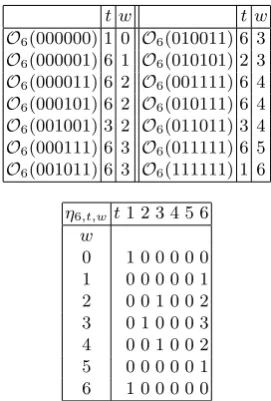
Example 1. ForF62, all the orbits and the values ofη6,t,w in Eq.(9) are listed in Table 1, wheret andware respectively the number and the weight of elements in an orbit.
Table 1. All the orbits ofF62 and the values ofη6,t,w
t w t w
O6(000000) 1 0 O6(010011) 6 3
O6(000001) 6 1 O6(010101) 2 3
O6(000011) 6 2 O6(001111) 6 4
O6(000101) 6 2 O6(010111) 6 4
O6(001001) 3 2 O6(011011) 3 4
O6(000111) 6 3 O6(011111) 6 5
O6(001011) 6 3 O6(111111) 1 6
η6,t,wt1 2 3 4 5 6
w
0 1 0 0 0 0 0 1 0 0 0 0 0 1 2 0 0 1 0 0 2 3 0 1 0 0 0 3 4 0 0 1 0 0 2 5 0 0 0 0 0 1 6 1 0 0 0 0 0
Then, from Theorem 3, we have
N6= 5
Y
w=1 6
Y
t=1
t
t·w 6
η6,t,w
= 2.6244×10¹¹≈237.9,
while the number of all the (6,6)-functions is 226·6= 2384.
Example 2. In Example 1, we have shown all the orbits{O6(Λi), i= 1, . . . ,14} ofF6
2. Letf be a 6-variable Boolean function defined as
f|O6(000000)= (0), f|O6(010011)= (1,0,0,1,0,1),
f|O6(000001)= (0,0,0,1,0,0), f|O6(010101)= (0,1),
f|O6(000011)= (0,0,1,1,0,0), f|O6(001111)= (1,1,0,1,1,0),
f|O6(001001)= (1,0,0), f|O6(011011)= (1,0,1),
f|O6(000111)= (0,1,0,0,1,1), f|O6(011111)= (1,1,1,1,0,1),
f|O6(001011)= (1,0,0,1,0,1), f|O6(111111)= (0),
where the binary vectors on the right-hand side denote the truth tables of the restriction functionsf|O6(Λi),i= 1, . . . ,14, i.e.,
f|O6(Λi)= f(Λi), f◦ρ
1
6(Λi), . . . , f◦ρ6ti−1(Λi)
,
whereti=|O6(Λi)|. Since the functionf satisfies the conditions in Theorem 2, then the RS (6,6)-function
F = f, f◦ρ16, . . . , f◦ρ 5 6
has perfect diffusion property. Due to Proposition 4, the iterated functionF(k)is RS for k>2. Letf(k)=f F(k−1), thenF(k)= f(k), f(k)◦ρ16, . . . , f(k)◦ρ56. By Proposition 1, the ANFs of the following Boolean functions can be obtained from the truth tables of f, f(2),f(3),f(4) respectively.
f(x1, . . . , x6)
=x1x2x3x4x5x6⊕x1x2x3x4x5⊕x2x3x4x5x6⊕x1x2x3x4⊕x1x2x3x5 ⊕x1x2x4x5⊕x1x2x4x6⊕x1x2x5x6⊕x1x3x4x6⊕x2x3x4x5⊕x2x3x4x6 ⊕x2x4x5x6⊕x3x4x5x6⊕x1x2x5⊕x1x2x6⊕x1x3x4⊕x1x3x6⊕x1x5x6 ⊕x3x4x5⊕x3x4x6⊕x4x5x6⊕x4,
f(2)(x1, . . . , x6)
=x1x2x3x4x5x6⊕x1x2x3x5x6⊕x1x2x4x5x6⊕x1x2x3x5⊕x1x2x3x6 ⊕x1x2x4x5⊕x1x3x4x6⊕x2x4x5x6⊕x3x4x5x6⊕x1x2x3
⊕x1x3x4⊕x2x4x5⊕x3x4x5⊕x1,
f(3)(x1, . . . , x6)
=x1x2x3x4x5x6⊕x1x2x3x4x5⊕x1x2x3x4x6⊕x1x3x4x5x6⊕x2x3x4x5x6 ⊕x1x2x3x5⊕x1x2x4x5⊕x1x2x4x6⊕x1x2x5x6⊕x1x3x4x5⊕x1x3x4x6 ⊕x2x3x4x5⊕x2x4x5x6⊕x1x2x5⊕x1x2x6⊕x1x3x4⊕x1x3x6⊕x1x5x6 ⊕x2x3x4⊕x3x4x6⊕x4x5x6⊕x4,
f(4)(x1, . . . , x6) =f(2)(x1, . . . , x6).
The ANFs of the functions directly show that the RS (6,6)-function F has perfect diffusion property, and for everyk>1, Deg F(k)= 6.
3.2 Almost Balanced (n, n)-Functions with Perfect Diffusion Property
representations are short and the evaluations are efficient. In this part, we pro-pose a large set of almost balanced (n, n)-functions with perfect diffusion prop-erty. Here we call an (n, m)-function F almost balanced, if for every b ∈ F2m,
|F−1(b)−2n−m|takes a small value. For a finite setE with cardinality|E|=N, the set of all the permutations on E forms a symmetric groupSN whose group operation is the function composition.
Note that forn>2, there is no balanced (n, n)-function (i.e., permutation on Fn2) with perfect diffusion property. In fact, let F be a permutation on Fn2, then since all the permutations onFn2 form a finite symmetric group, there must exist somei>1 such thatF(i)= id, where id denotes the identity permutation. Hence, we haveF(i)(x) =xfor everyx∈Fn2, which implies Dc F(i)
= 1/n <
1. Thus, F cannot have perfect diffusion property. Therefore, finding almost balanced (n, n)-functions with perfect diffusion property is attractive.
Theorem 4. For any σ that belongs to the symmetric group on the set Fn 2 \ {0,1}, the almost balanced(n, n)-function
F(x) =
0, x=0or1,
σ(x), otherwise, (11)
has perfect diffusion property, and for every k>1,Deg F(k)
=n.
Proof. From Eq.(11), one gets that for anyk>1,
F(k)(x) =
0, x=0or1, σ(k)(x), otherwise.
Since σ(k) is a permutation on
Fn2 \ {0,1}, then it is easy to see that every coordinate function ofF(k)has weight 2n−1−1, which implies from Proposition 1 and Theorem 1 that Deg F(k)=n andF(k) is non-degenerate. Therefore, F
has perfect diffusion property. ut
The following enumeration result is obvious.
Theorem 5. The number of distinct almost balanced(n, n)-functions construct-ed in Theorem 4 is Pn= (2n−2)!.
Example 3. The number of almost balanced (6,6)-functions with perfect diffu-sion property constructed in Theorem 4 isP6= (26−2)!≈2284, compared with the enumeration result in Example 1 that the number of RS (6,6)-functions with perfect diffusion property constructed in Theorem 2 isN6≈237.9.
Remark 4. Denote by Fn,Gn the sets of all the (n, n)-functions constructed in Theorem 2 and Theorem 4 respectively. Then, it is easy to check thatF2=G2, F3⊆G3, and forn>4,FnTGn=6 ∅but neitherFn⊆Gn norGn⊆Fn.
Model.LetGbe an(n, n)-function,Ki,i= 0,1, . . ., be vectors inFn2. Then, in a product cryptosystem, thei-th round function Fi is
Fi(x) =
G(x⊕K0), ifi= 1,
G(Fi−1(x)⊕Ki−1),ifi>2.
(12)
Suppose thatK0 =K1=· · ·=K, and we defineF(x) = G(x⊕K). Then, by (12), we have fori>1,Fi(x) =F(i)(x). The functionF is preferable to have perfect diffusion property, which leads to Dc(Fi) = 1 for eachi>1. If theKi’s are not identical, then the case is more complicated. In the following, we use a simple example to illustrate that by using (n, n)-functions in (11), one can get Dc(Fi) = 1 foriodd. The example given here is suggestive if not very practical. Example 4. In the above model, let
G(x) =
0, x=0or 1, σ(x), otherwise,
be an almost balanced function in (11), where σis a permutation onE=Fn2\ {0,1} satisfying {0,1}S
U(σ) is a F2-subspace ofFn2, where U(σ) ={x∈E |
σ(x) =x}is the set of fixed points ofσ. LetKi−1,Fi,i>1, be defined in (12). We now prove that ifU(σ)6=∅and fori>1,Ki∈U(σ)\Ai, whereA1=∅and
Ai=
( k
M
j=1
Ki−j, k
M
j=1
Ki−j⊕1
k= 1, . . . , i−1
)
, i>2,
then Deg(Fi) = nand Dc(Fi) = 1 for all odd i. One can easily check that for
i>2,Ai is a set, i.e., all the elements inAi are distinct.
Fori > 1, let fl(i) be the l-th coordinate function of Fi, where 16 l 6 n. It is clear that wtfl(1) = 2n−1 −1 which is odd, then from the proof of Theorem 4, we have Deg(F1) =nand Dc(F1) = 1. Moreover, there exist exactly two x∈Fn2 such thatF1(x) =0, and for eachy ∈E\A1, there exists exactly one x∈Fn2 such thatF1(x) =y. By calculating iteratively, one can get that for every i>2 and everyk= 1, . . . , i−1, there exist exactly two x∈Fn2 such that
Fi(x) =L k
j=1Ki−jor0, and for eachy∈E\Ai, there exists exactly onex∈Fn2 such thatFi(x) =y. Since fori>1,Ki6∈Ai, thenKi⊕1∈E\Ai, thus there exists exactly one x∈Fn2, denoted by xi,0, such thatFi(xi,0) =Ki⊕1, which impliesG(Fi(xi,0)⊕Ki) =0. Recall that{0,1}SU(σ) is aF2-subspace ofFn2, then fori>1, sinceKi∈U(σ), we haveAi⊆U(σ). From the above discussion, we obtain that for i>1, the multiset {∗G(Fi(x)⊕Ki)|x∈Fn2 \ {xi,0} ∗} is equal to the multiset{∗Fi(x)⊕Ki |x∈Fn2\ {xi,0} ∗}. Hence, fori>1, denote bygl(i)thel-th coordinate function ofFi(x)⊕Ki, where 16l6n, then we have
It is obvious that wtfl(i)and wtgl(i) have the same parity, which leads to that wtfl(i)and wtfl(i+1)have different parities. Therefore, ifi>1 is odd, then wtfl(i)is odd, thus we have Deg(Fi) =nand Dc(Fi) = 1.
4
Concluding Remarks
In this paper, we construct two classes of (n, n)-functions with perfect diffusion property and optimal algebraic degree. These functions provide complete diffu-sion after iterations. The enumeration results for the constructed functions show that there are many (n, n)-functions which have perfect diffusion property.
The functions constructed in Theorem 2 and Theorem 4 represent a theoret-ical interest, which may have weak resistance to different cryptanalysis. Further improvements in the design of (n, n)-functions with perfect diffusion property are of interest. In addition, the RS (n, n)-functions defined in this paper may be worth discussing in the future for their efficient evaluations and short represen-tations.
Acknowledgments. The authors would like to thank the anonymous referees for their helpful comments.
References
1. Bard, G.V.: Algebraic Cryptanalysis. Springer, New York (2009)
2. Biham, E., Shamir, A.: Differential cryptanalysis of DES-like cryptosystems. J. Cryptol. 4(1), 3–72 (1991)
3. Carlet, C.: Boolean functions for cryptography and error correcting codes. In: Cra-ma, Y., Hammer, P. (eds.) Boolean Models and Methods in Mathematics, Com-puter Science, and Engineering. pp. 257–397. Cambridge University Press, London (2010)
4. Carlet, C.: Vectorial Boolean functions for cryptography. In: Crama, Y., Hammer, P. (eds.) Boolean Models and Methods in Mathematics, Computer Science, and Engineering. pp. 398–469. Cambridge University Press, London (2010)
5. Courtois, N.T., Pieprzyk, J.: Cryptanalysis of block ciphers with overdefined sys-tems of equations. In: Zheng, Y. (eds.) Advances in Cryptology—ASIACRYPT 2002. LNCS, vol. 2501, pp. 267–287. Springer, Heidelberg (2002)
6. Daemen, J.: Cipher and hash function design strategies based on linear and differ-ential cryptanalysis. PhD thesis, Catholic University of Louvain (1995)
7. Feistel, H.: Cryptography and computer privacy. Sci. Am. 228(5), 15–23 (1973) 8. Fischer, S., Meier, W.: Algebraic immunity of S-boxes and augmented functions.
In: Biryukov, A. (eds.) Fast Software Encryption, FSE 2007. LNCS, vol. 4593, pp. 366–381. Springer, Heidelberg (2007)
9. Forr´e, R.: Methods and instruments for designing S-boxes. J. Cryptol. 2(3), 115– 130 (1990)
11. Lidl, R., Niederreiter, H.: Finite Fields. Cambridge University Press, New York (1997)
12. Matsui, M.: Linear cryptanalysis method for DES cipher. In: Helleseth, T. (ed-s.) Advances in Cryptology—EUROCRYPT’93. LNCS, vol. 765, pp. 386–397. Springer, Heidelberg (1994)
13. Maximov, A.: Classes of plateaued rotation symmetric Boolean functions under transformation of Walsh spectra. Cryptology ePrint Archive, Report 2004/354 (2004),https://eprint.iacr.org/2004/354
14. Pieprzyk, J., Qu, C.X.: Fast hashing and rotation-symmetric functions. J. Universal Comput. Sci. 5(1), 20–31 (1999)
15. Preneel, B., Bosselaers, A., Rijmen, V., et al.: Comments by the NESSIE project on the AES finalists (2000)http://www.nist.gov/aes