ISSN: 2319-8753
I
nternational
J
ournal of
I
nnovative
R
esearch in
S
cience,
E
ngineering and
T
echnology
(An ISO 3297: 2007 Certified Organization)
Vol. 2, Issue 9, September 2013
Performance and Emission Characteristics of
MPFI Engine by Using Gasoline - Ethanol
Blends
K B Siddegowda
1, J Venkatesh
2Associate Professor, Department of Automobile Engineering, P. E. S. College of Engineering, Mandya-571401, Karnataka, India1
Professor, Department of Automobile Engineering, P. E. S. College of Engineering, Mandya-571401, Karnataka, India2
.
Abstract: Ethanol is rarely used as an automobile fuel; blends with standard gasoline are much more common. Use of
higher (above 50%) ethanol gasoline blends required modification in both calibration and engine hardware. In this paper experiments are conducted on MPFI engine to study the performance and emission of the ethanol gasoline blended fuel. The ethanol is blended with 10%, 20%, and 30% by volume with gasoline. The various engine performance characteristics
like BTE, BSFC and BSEC are recorded from the acquired data and emission parameters like UBHC, CO, C02, and NOX
are measured using five gas BOSCH analyzer. The results are revealed that on adding the 20% ethanol to gasoline there is increase in the brake thermal efficiency and fuel consumption is slightly less as that of gasoline. It is also found that there is considerable amount of decrease in emission on using ethanol with gasoline blend. Experimental results indicated that when ethanol-gasoline blend is used, the engine CO and HC emission decreases notably as a result of the leaning effect
caused by the ethanol addition and CO2 emission increases because of the improved combustion.
Keywords: MPFI engine, Ethanol gasoline blends, Performance, Emission characteristics
I. INTRODUCTION
ISSN: 2319-8753
I
nternational
J
ournal of
I
nnovative
R
esearch in
S
cience,
E
ngineering and
T
echnology
(An ISO 3297: 2007 Certified Organization)
Vol. 2, Issue 9, September 2013
to more completely combust the fuel, resulting in fewer emissions. Since ethanol is produced from plants that harness the power of the sun, ethanol is also considered a renewable fuel. Therefore, ethanol has many advantages as an automotive fuel. [6] Ethanol is a water-free alcohol and there for can withstand cooler temperatures. Table 1 enlists the various properties of ethanol blends when compared to Gasoline fuel.
TABLE 1
PROPERTIES OF GASOLINE FUEL BLENDED WITH VARIOUS PERCENTAGES OF ETHANOL (AVERAGE VALUES) [8]
Sample code Ethanol (%) Gasoline (%) Flash
Point (0c)
Auto ignition temperature
(0C)
Vapour pressure at (Kpa at
37.80C)
Energy density (MJ/L) Octane number Specific gravity
E00 00 100 -65 246 36 34.2 91 0.7474
E10 10 90 -40 260 38.9 33.182 93 0.7508
E20 20 80 -20 279 39 32 94 0.7605
E30 30 70 -15 281 38 31.5 95 0.7782
E40 40 60 -13.5 294 35.6 30 97 0.7792
E50 50 50 -5.0 320 34 29 99 0.7805
E60 60 40 -1.0 345 31 28 100 0.7812
E70 70 30 0.0 350 28 27 103 0.7823
E80 80 20 5.0 362 24 26.5 104 0.7834
E90 90 10 8.5 360 18 23.6 106 0.7840
E100 100 00 12.5 365 9 23.5 129 0.7890
II. MULTIPORT FUEL INJECTION
Multiport fuel injection injects fuel into the intake ports just upstream of each cylinder's intake valve, rather than at a central point within an intake manifold. MPFI (or just MPI) systems can be sequential, in which injection is timed to coincide with each cylinder's intake stroke; batched, in which fuel is injected to the cylinders in groups, without precise synchronization to any particular cylinder's intake stroke; or simultaneous, in which fuel is injected at the same time to all the cylinders. The intake is only slightly wet, and typical fuel pressure runs between 40-60 psi. Many modern EFI systems utilize sequential MPFI; however, in newer gasoline engines, direct injection systems are beginning to replace sequential ones.
III. EXPERIMENTAL SETUP AND TESTING
ISSN: 2319-8753
I
nternational
J
ournal of
I
nnovative
R
esearch in
S
cience,
E
ngineering and
T
echnology
(An ISO 3297: 2007 Certified Organization)
Vol. 2, Issue 9, September 2013
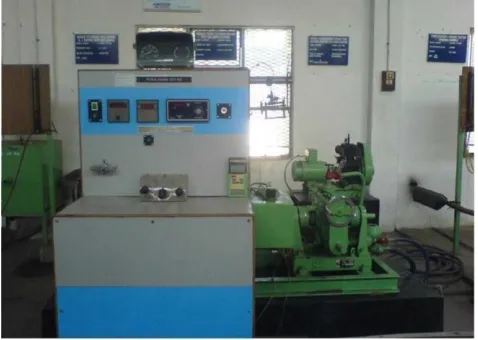
Figure 1: Shows MPFI engine setup Figure 2: Photograph of the Experimental Setup
1. Engine test rig 14. Speedometer
2. Engine bed 15. Fuel Indicator
3. Engine 16. Exhaust pipe
4. Shaft 17. Cylinder cut off switch
5. Dynamometer
6. Loading arrangement
7. Water supply
8. Ignition switch
9. Load indicator
10. Dynamometer speed indicator
11. Temperature indicator
12. Ignition switch
13. Accelerometer
Figure 3: Schematic diagram of experimental setup
ISSN: 2319-8753
I
nternational
J
ournal of
I
nnovative
R
esearch in
S
cience,
E
ngineering and
T
echnology
(An ISO 3297: 2007 Certified Organization)
Vol. 2, Issue 9, September 2013
TABLE 2
TEST ENGINE SPECIFICATIONS
Figure 4: BOSCH five gas analyzer
IV. RESULTS AND DISCUSSION
Engine test are performed at different blends with the volumetric ratios of 0% to 30% with an increment of 10% ethanol. Engine was operated with each blend at constant speed with varying load. The mixture was prepared just before the experiments to prevent the reaction of ethanol with water vapor. The desired speed is maintained by the Electronic Control Unit (ECU). The required engine load was obtained through the hydraulic dynamometer control. The variables that are continuously measured include force on hydraulic dynamometer (kg), fuel consumption (kg/min) and air-fuel ratio. For comparison purposes the tests were also conducted with Gasoline under the same conditions. From the results of these tests it is noticed that the optimum blend for Gasohol (blends of Gasoline and Ethanol) is 20 % by volume.
A. Brake Specific Fuel Consumption
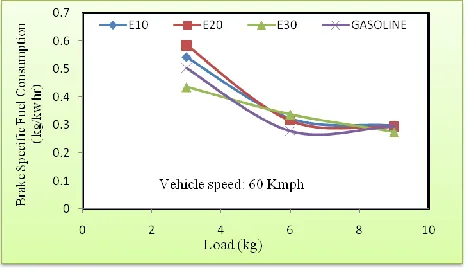
Figure 4: Variation of BSFC with Load for various gasohol blends
Item Specification
Model: Maruti 800cc,MPFI engine
Manufacturer : Maruti Udyog Ltd.
Type Petrol, 3cyl, Inline
Cooling Water cooled.
Displacement : 796cc.
Compression ratio 7.9:1
Maximum Power 39.5bhp@5000rpm
ISSN: 2319-8753
I
nternational
J
ournal of
I
nnovative
R
esearch in
S
cience,
E
ngineering and
T
echnology
(An ISO 3297: 2007 Certified Organization)
Vol. 2, Issue 9, September 2013
B .Brake Thermal Efficiency
The variation of BTE with load for gasoline and its blends is shown in Figure 5. For all fuels, the BTE is improved with increase in load. This is due to reduction in heat loss and increase in power with increase in load. It is observed that the E20 fuel gave the higher efficiency than the Gasoline fuel for all load condition and the efficiency for E10 and E30 fuels are slightly lower than the gasoline. For E20 blend the maximum brake thermal efficiency is obtained as 32 % at 75% of full load.
Figure 5: Variation of BTE with Load for various gasohol blends Figure 6: Variation of HC with Load for various gasohol blends
C.
Exhaust EmissionsFigure 6 shows the variation of UBHC (Unburnt Hydrocarbons) with load. It is observed that the UBHC emissions for the Gasohol are lower than the Gasoline fuel. The UBHC emission for E30 at 75% of full load condition is nearly 20 % lesser than Gasoline. The presence of oxygen in the fuel was thought to promote complete combustion that leads to lowering the HC emissions. These reductions indicate more complete combustion of the fuel.
The variation of CO and CO2 with load is presented in Figure 7and 8. The CO is a toxic by-product of all hydrocarbons
combustion that is also reduced by increasing the oxygen content of the fuel. More complete oxidation of fuel results in
more complete combustion to CO2 rather than leading to the formation of CO. It is observed that the CO emissions for
ISSN: 2319-8753
I
nternational
J
ournal of
I
nnovative
R
esearch in
S
cience,
E
ngineering and
T
echnology
(An ISO 3297: 2007 Certified Organization)
Vol. 2, Issue 9, September 2013
Figure 7: Variation of CO with Load for various gasohol blends Figure 8: Variation of CO2 with Load for various gasohol blends
D. Nitrous Oxides
The effect of gasoline alcohol blends on NOx emissions are shown in Figure 9. Major factor contributing to NOx emissions include high flame temperature and presence of oxygen during combustion. Due to much lower flame temperature the ethanol contributes its NOx emissions are usually lower than that of gasoline [3,5]. It apparent that any HC oxidation process that takes place during combustion of alcohol blends provides leaning of mixtures that lead lower NOx emissions.
Figure 9: Variation of NOx with load for various gasohol blends
V. CONCLUSION
ISSN: 2319-8753
I
nternational
J
ournal of
I
nnovative
R
esearch in
S
cience,
E
ngineering and
T
echnology
(An ISO 3297: 2007 Certified Organization)
Vol. 2, Issue 9, September 2013
REFERENCES
[1] Huseyin Serdar Yucesu, Tolga Topgul, Can Cinar, Melih Okur, “Effect of ethanol-gasoline blends on engine performance and exhaust emissions in different compression ratios”, Applied Thermal Engineering26(2006) 2272-2278
[2]L.M.Baena, M.Gomez, J.A.Calderon, “Aggressiveness of a 20% bioethanol-80% gasoline on autoparts: I behavior of metallic materials and evaluation of their electrochemical properties”, Elsevier fuel journal volume 95, May2012
[3] Luis Miguel Rodriguez-Anton, Miguel Hernandez-Campos, Francisco-Sanz-perez, “Experimental determination of some physical properties of gasoline, ethanol and ETBE blends”, Elsevier Fuel journal vol.112, Oct. 2013 pp 178-184.
[4] Mustafa Kemal Balki, Cenk Sayin, Mustafa Canakci, “The effect of different alcohol fuels on the performance, emission and combustion characteristics of a gasoline engine”, Journal of Fuel
[5] Piotr Bielaczyc, Josepeh Woodburn, Dariusz Klimkiewicz, Piotr Pajdowski, Andrzej Szczotka, “An examination of the effect of ethanol-gasoline blends’ physiochemical properties on emissions from light-duty spark ignition engine”, Journal of Fuel Processing Technology vol.107, March2013, pp 50-63
[6] Hakan Bayraktar, “Experimental and theoretical investigation of using gasoline-ethanol blends in spark ignition engines”, Elsevier Journal, Renewable Energy vol.30, Issue 11, Sept. 2005, pp 1733-1747
[7] M.A.Ceviz, F.Yuksel, “Effects of ethanol-unleaded gasoline blends on cyclic variability and emissions in an SI engine”, Elsevier Journal, Applied Thermal Engineering 25(2005) 917-925
![TABLE 1 PROPERTIES OF GASOLINE FUEL BLENDED WITH VARIOUS PERCENTAGES OF ETHANOL (AVERAGE VALUES) [8]](https://thumb-us.123doks.com/thumbv2/123dok_us/1703705.1216194/2.612.62.553.274.459/properties-gasoline-blended-various-percentages-ethanol-average-values.webp)