Lock-Dependent Messages
Mart´ın Abadi1,3, Dan Boneh2,?, Ilya Mironov1, Ananth Raghunathan2,?,??, and Gil Segev2,?,??
1 Microsoft Research Silicon Valley 2
Stanford University 3 University of California, Santa Cruz
Abstract. Motivated by the problem of avoiding duplication in storage systems, Bellare, Keelveedhi, and Ristenpart have recently put forward the notion of Message-Locked Encryption (MLE) schemes which sub-sumesconvergent encryptionand its variants. Such schemes do not rely on permanent secret keys, but rather encrypt messages using keys de-rived from the messages themselves.
We strengthen the notions of security proposed by Bellare et al. by con-sidering plaintext distributions that may depend on the public parame-ters of the schemes. We refer to such inputs aslock-dependent messages. We construct two schemes that satisfy our new notions of security for message-locked encryption with lock-dependent messages.
Our main construction deviates from the approach of Bellare et al. by avoiding the use of ciphertext components derived deterministically from the messages. We design a fully randomized scheme that supports an equality-testing algorithm defined on the ciphertexts.
Our second construction has a deterministic ciphertext component that enables more efficient equality testing. Security for lock-dependent mes-sages still holds under computational assumptions on the message dis-tributions produced by the attacker.
In both of our schemes the overhead in the length of the ciphertext is only additive and independent of the message length.
Keywords: Deduplication, convergent encryption, message-locked en-cryption
1
Introduction
Deduplication, which eliminates redundant copies in user-provided data, is an important space-saving technique in communications and storage (see, for
ex-?This work was supported by NSF, the DARPA PROCEED program, an AFO SR
MURI award, a grant from ONR, an IARPA project provided via DoI/NBC, and by Samsung. Opinions, findings and conclusions or recommendations expressed in this material are those of the author(s) and do not necessarily reflect the views of DARPA or IARPA. Distrib. Statement “A:” Approved for Public Release, Distribu-tion Unlimited.
??
ample, [28,35,26]). Storage systems that rely on deduplication typically let the server have unfettered access to the clients’ data. This set-up creates an obvious confidentiality problem, since the clients must trust the server with not only storing their documents but keeping them secret too.
The first solution for balancing confidentiality and efficiency in deduplication was described by Douceur et al. [18] and calledconvergent encryption. According to this deterministic scheme, a message is encrypted under a message-derived key (a hash of the message) so that identical plaintexts are mapped to identical ciphertexts. After encrypting the message, the client uploads the ciphertext to the server, retaining the hash to allow later decryption. In the meantime, the server can recognize equal ciphertexts, storing only one copy of each: if two clients happen to upload the same file, the resulting ciphertexts will be identical and can be deduplicated. The clients need not coordinate their actions and might not even be aware of each other’s existence. Implementations and variants of convergent encryption followed [3,14,25,30,33,2,1] but their precise security guarantees were never fully proven or even stated.
Message-locked encryption.Recently, Bellare, Keelveedhi, and Ristenpart [7] brought much needed rigor into the area, by defining a new encryption primitive, Message-Locked Encryption (MLE), and several definitions that capture various aspects of MLE security. They also constructed and analyzed several schemes in their framework.
We briefly recall the definition of MLE and two security notions of pri-vacy and tag integrity for MLE schemes introduced by Bellare et al. An MLE scheme encapsulates a standard (possibly randomized) symmetric-key encryp-tion scheme where the encrypencryp-tion algorithm accepts a message m and a key k, and outputs a ciphertext c. The decryption algorithm reverses the process, recoveringmfromc givenk. The scheme comes with akey derivation algorithm
that, unlike a conventional key generation algorithm, is a deterministic function frommtok. It also includes atag-generation algorithmthat maps the ciphertext to a tag. Identical plaintexts result in equal tags. The corresponding ciphertexts, which may be randomized, are not necessarily equal. Tag integrity means that no computationally bounded adversary can trick the server into replacing a valid encryption with a ciphertext that does not decrypt to the same plaintext.
assump-tion of unpredictability of the plaintexts—is similar to the theory of deterministic public-key encryption initiated by the work of Bellare, Boldyreva, and O’Neill [4] (see also [6,10,5,12,19,24,32,29]).
Lock-dependent messages.In addition to the min-entropy requirement, there is another constraint on the adversarially chosen distribution of plaintexts im-plicit in the definition of MLE. If the adversary is allowed to specify a distribu-tion of plaintexts, it may use the fact that the tags are deterministic for leaking unnecessary information on the messages (e.g., select a distribution that is con-centrated on messages whose tags share a particular property, such as that they all start with a zero bit, or that the first bit of the tag reveals the first bit of the message). Doing so immediately gives the adversary a constant advantage in answering the challenge (of whether the output was a random string of bits or an encryption of a message drawn from the distribution). Similar attacks can be effective against any deterministic encryption scheme, where the adversary tailors the distribution to the scheme’s public key. The common way of sidestep-ping this difficulty is to require that the distribution be chosen independently of the system parameters or, in the case of deterministic encryption, of the sys-tem’s public key. More formally, the adversary must commit to the distribution of plaintexts before accessing the description of the system.
Since the parameters of the scheme are supposed to be publicly available, they must be included into the view of any realistic adversary. As soon as the adversary learns the parameters of the system and may influence, however indi-rectly, the distribution of plaintexts, the assumption of independence becomes false, voiding the security guarantees proven under this assumption.
In this paper we ask whether security guarantees can encompass also attacks that may depend on the scheme’s parameters. Identifying the public parameters of an encryption scheme with alock, we can paraphrase the problem addressed in this paper as follows:
Can message-locked encryption be secure for lock-dependent messages?
1.1 Our Contributions
In this paper we put forward two approaches for resolving this question in the af-firmative, and provide schemes that are secure even for lock-dependent messages in realistic and rigorously defined adversarial models.
Our second approach, on the other hand, continues using deterministic tags. Security for lock-dependent messages is guaranteed by limiting the computa-tional power of the adversarial message distributions. (This approach is inspired by the recent work of Raghunathan, Segev, and Vadhan [29] who proposed a similar adversarial model for deterministic public-key encryption.) Specifically, in the random oracle model, we consider adversaries that are allowed to choose the distribution of plaintexts adaptively, after seeing the scheme’s parameters, subject to the condition that the distribution be efficiently samplable using at most q queries to the random oracle, where q is a pre-determined parameter. Our construction can be based on any semantically secure encryption scheme. Its overhead, defined as the increase in the length of the ciphertext, is additive and depends only on the security parameter.
1.2 Paper Organization
In Section 2, we give a high-level overview of the fully randomized scheme and the deterministic scheme that we construct in this paper. In Section 3, we introduce a few preliminaries required to present our results. In Section 4, we formally define our notion of message-locked encryption for lock-dependent messages. In Section 5, we present the fully randomized scheme. In Section 7, we conclude and mention several interesting directions for further research. Because of space limitations all proofs and some definitions are deferred to the full version.
2
Overview of Our Schemes
and Vadhan [17]. A similar idea for equality testing (without hashing) was ex-plored by Yang et al. [34], who designed public-key encryption schemes that support equality testing but offer a significantly weaker notion of security (only one-wayness).
As for the payload and the consistency proof, a natural approach would be to simply encrypt m using its hash h(m) as a key (as in [7]), and provide a NIZK proof of consistency. This approach, however, seems to fail as we must use an encryption scheme for which it is secure to encrypt a message munder the key h(m). All existing constructions satisfying this property rely on the random oracle paradigm, which rules out using NIZK proofs as the language under consideration is no longer in NP.
We can resolve this issue with a cut-and-choose protocol applied to the en-cryption of the message. Na¨ıvely, such a protocol would inflate the size of the ciphertext. However, a delicate combination of a secret-sharing scheme and a cut-and-choose technique enables us to realize an encryption scheme with a ci-phertext overhead that is only additive and independent of the message length. Specifically, the payload in our ciphertext consists of a randomized encryption
Es(m;r1) of m under a uniformly chosen keys, a commitment Commit(skt) to s and a uniformly chosen key t, an ElGamal encryption gr2, gr2·h(m)·t of t usingh(m) as a key, and a circular-secure encryption (r3, H(r3kt) +s) ofsusing tas a key. The circular-secure encryption scheme is due to Black, Rogaway, and Shrimpton [9] whose proof of security assumes a random oracleH.
The only component that requires a random oracle is the circular-secure encryption of s using t. We can use a NIZK proof for proving that all other components (including the tag) are consistent with the same message m. In addition, we use a cut-and-choose protocol (which we collapse using a random oracle to a non-interactive one) for showing that the commitment Commit(skt) is consistent with the circular-secure encryption (r3, H(r3kt) +s), where s is encoded with a threshold secret-sharing scheme. The commitmentCommit(skt) is used in both the NIZK proof and in the cut-and-choose components, and binds the two together to yield a proof of consistency for the entire ciphertext.
To ensure that the overhead of the scheme is additive and independent of the length of the message, first observe that the length of the commitment and the encryption ofsundert(and hence the cut-and-choose part of the scheme) depend only on the security parameter. To further minimize the length of ciphertexts, we use a composition of an NIZK proof system with a succinct argument system in the random oracle model, where the length of the arguments depends only on the security parameter.
satisfy a meaningful notion of security since it is completely deterministic (as discussed above).
Following Raghunathan et al. [29] we show that this approach can be made secure even for lock-dependent message distributions, subject to the condition that these distributions are efficiently samplable using at most qqueries to the random oracle, where q is a pre-determined parameter. (We do not ask for an a priori bound on the number of oracle calls that are made directly by the adversary.) Concretely, we derive the keykm and the randomnessrm as km= ⊕q+1i=1H1(mki) andrm=⊕q+1i=1H2(mki), whereH1andH2are two hash functions modeled as independent random oracles.
Intuitively, the proof of security relies on the fact thatkmandrmare pseudo-random againstboththe adversary and the sampling circuits of such “q-bounded” message distributions. Pseudorandomness against the adversary relies on the fact thatmis sampled with a super-logarithmic min-entropy and that the underlying encryption scheme is secure. Pseudorandomness against the sampling circuits re-lies on the fact that for learning any information onkm orrm it is essential to query the random oracleq+ 1 times.
3
Preliminaries
Notation. For an integer n∈ N we denote by [n] the set {1, . . . , n}, by [a, b] the set{a, a+ 1, . . . , b}, and byUn the uniform distribution over the set{0,1}n. For a random variableX we denote by x←X the process of sampling a value xaccording to the distribution of X. Similarly, for a finite set S we denote by x←S the process of sampling a value xaccording to the uniform distribution over S. We denote by x (and sometimes x) a vector (x1, . . . , x|x|). We denote by X = (X1, . . . , XT) a joint distribution of T random variables, and by x = (x1, . . . , xT) a sample drawn fromX. For two bit-strings xand y we denote by xky their concatenation. A non-negative function f: N → R is negligible if it vanishes faster than any inverse polynomial.
Entropy. The min-entropy of a random variable X is defined as H∞(X) = −log(maxxPr [X =x]). A k-sourceis a random variable X with H∞(X)≥k. A (k1, . . . , kT)-source is a random variableX= (X1, . . . , XT) where eachXi is a ki-source. A (T, k)-sourceis a random variable X = (X1, . . . , XT) where for each i ∈ [T], it holds thatXi is ak-source. A (T, k)-block-source is a random variableX= (X1, . . . , XT) where for everyi∈[T] andx1, . . . , xi−1it holds that Xi|X1=x1,...,Xi−1=xi−1is ak-source. Thestatistical distancebetween two random variablesXandY over a finite domainΩisSD(X, Y) = 12P
ω∈Ω|Pr [X=ω]− Pr [Y =ω]|.
holds that the two distributions g, ga, gab
and (g, ga, gc) are computationally indistinguishable. We make two remarks on the ME-DDH assumption:
1. We requireβ≥ω(logλ) for the assumption to be plausible. Otherwise, there exists anx∗←Xsuch that Pr [X=x∗] is non-negligible and a distinguisher that, when given (g, ga, gc), checks to see whether (ga)x∗ =gc, succeeds in distinguishing the two distributions with non-negligible probability.
2. If X is the uniform distribution over Zp, then the assumption is
uncondi-tionally trueas the two distributionsabandcare identical even given a.
4
MLE for Lock-Dependent Messages
Extending the work of Bellare et al. [7], we propose a more general notion of the primitive MLE, which we call MLE2. In MLE2, we allow tags to be randomized and consider a definition of tag correctness that introduces a new polynomial-time algorithm EQ that subsumes the functionality of deterministic tags. In addition, we introduce a newvalidity-testalgorithm, denotedValid, that allows anyone with the public parameters to check if a given ciphertext is a valid ci-phertext. In the context of using MLE2 for secure deduplication,EQallows for deduplication of ciphertexts and Valid allows the server to reject adversarially constructed ciphertexts that subvert deduplication to replace a valid ciphertext with an invalid one that does not decrypt correctly.
The main benefit of the new notion is permitting a stronger security require-ment (which we denotePRV-CDA2) that allows the adversary to see the public parameters beforeissuing oracle queries.
MLE2. A message-locked encryption scheme for lock-dependent messages is a six-tuple Π = (PPGen,KD,Enc,Dec,EQ,Valid) operating over plaintext space M={Mλ}λ∈N, ciphertext spaceC ={Cλ}λ∈N, and keyspace K={Kλ}λ∈N of
polynomial-time randomized algorithms with the following properties:
– The parameter generation algorithm takes as input 1λ and returns public parameterspp.
– The key derivation functionKDtakes as input public parameterspp, a mes-sagem, and outputs a message-derived keykm←KDpp(m).
– The encryption algorithmEnctakes as input public parameterspp, a message m, and a message-derived keykm. It outputs a ciphertextc←Encpp(km, m). – The decryption algorithmDectakes as input public parameterspp,
cipher-textc, and a secret keykand outputs either a message mor⊥.
– The (new) equality algorithmEQtakes as input public parameterspp, and two ciphertexts c1 and c2 and outputs 1 if both ciphertexts are generated from the same underlying message.
– The (new) validity-test algorithmValidtakes as input public parameterspp
ciphertexts c1 and c2 are generated from the same message, the corresponding tags are equal with high probability. Our equality algorithm is a generalization of such an equality-checking tag. Given any scheme with equality-checking tags, we can describe a simple algorithmEQthat givenc1andc2 derives their respective tags and outputs 1 only if the tags are equal.
The notion analogous totag correctness of Bellare et al. [7] requires that for all λ ∈ N, all public parameters pp ← PPGen(1λ), and all messages m ∈ M, there is a negligible function ν(λ) such that for two encryptions c1 and c2 of mwith KDpp(m) and independent random coins, it holds thatEQpp(c1, c2) = 1 with probability at least 1−ν(λ), where the probability is taken over random coins of all algorithms.
The notion of correctness for the validity-test algorithmValidrequires that for allλ∈N, all public parameterspp←PPGen(1λ), and all messagesm∈ M, there is a negligible functionν(λ) such that for a ciphertextc←Encpp(KDpp(m), m),
Pr [Validpp(c) = 1] ≥ 1−ν(λ), where the probability is taken over all random
coins of all algorithms.
The usual notion of correctness of the decryption algorithm Dec applies. Specifically, for all λ∈N, all public parameters pp←PPGen(1λ), and all mes-sages m∈ M, there is a negligible functionν(λ) such that
Pr[Decpp(km,Encpp(km, m)) =m|km←KDpp(m)]≥1−ν(λ),
where the probability is taken over all random coins of all algorithms.
MLE2 adversaries.To capture a notion of security against an adversary that attacks the system by choosing messages that may depend on the public pa-rameters, we introduce several adversary models. In what follows, we consider several parameters that are functions of the security parameter; q = q(λ) de-noting the number of random oracle queries, k = k(λ) denoting min-entropy requirements over message sources,T =T(λ) denoting the number of blocks in the message source, andΓ =Γ(λ) denoting the size of a circuit that generates message sources.
In particular, inspired by recent work on deterministic encryption [29], for
uniform and independent messagesm1, . . . , mT ← M. Next, for eachi∈[T], it
sampleski←KDpp(mi), computesci←Encpp(ki, mi)and outputs the ciphertext
vector(c1, . . . , cT).
Definition 4.2 (Γ-sampling complexity adversary).Consider anX-source where X ∈ {(T, k)-block,(T, k)}. Let A be a probabilistic polynomial-time algo-rithm that is given as input a pair(1λ,pp)and oracle access toRoR(mode,pp,·)
for somemode∈ {real,rand}. Then,Ais aΓ-sampling complexityX-source ad-versary if for each ofA’sRoRqueriesMit holds that Mis an X-source that is samplable by a circuit of size at mostΓ. In addition, for the case of(T, k)-source adversaries, we require that for each such query M it holds that Mi 6=Mj for
all vectors (M1, . . . , MT)in the support of Mand for all i6=j∈[T].
We consider a stronger adversary that has noa-prioribound on the sampling complexity of its queries except that they are efficiently samplable by polynomial size circuits. Such an adversary subsumesΓ-sampling complexity adversaries for allΓ = poly(λ).
Definition 4.3 (Polynomial-sampling complexity adversary). Let X ∈ {(T, k)-block,(T, k)}, and letAbe a probabilistic polynomial-time algorithm that is given as input a pair (1λ,pp) and oracle access to RoR(mode,pp,·) for some
mode∈ {real,rand}. Then, Ais apolynomial-sizeX-source adversaryif for each of A’s RoR-queries M it holds that M is an X-source that is samplable by a circuit of (an arbitrary) polynomial size in the security parameter.
Definition 4.4 (q-query adversary [29]). Consider an X-source where X∈ {(T, k)-block,(T, k)}. Let A be a probabilistic polynomial-time algorithm that is given as input a pair (1λ,pp) and oracle access to RoR(mode,pp,·) for some
mode∈ {real,rand}. Then,A is aq-queryk-source adversaryif for each ofA’s RoR-queriesMit holds thatMis anX-source that is samplable by a polynomial-size circuit that uses at mostq queries to the random oracle.
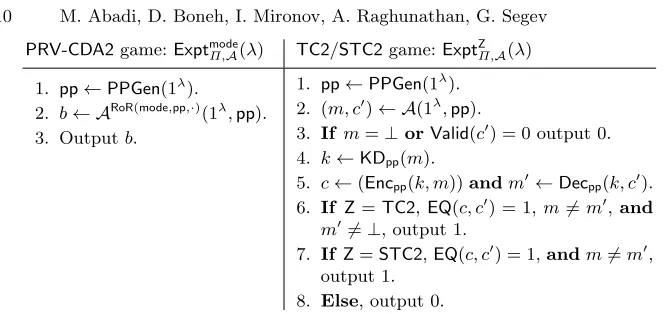
A stronger notion of message privacy:PRV-CDA2.We define the following security notion with respect to polynomial-sizeX-source adversaries (see Defini-tion 4.3), which we denoteX-sourcePRV-CDA2security. A simple modification to the experiments in the security definition allows us to restrict our class of ad-versaries toΓ-sampling complexity orq-queryX-source adversaries. Such notions are referred to asΓ-sampling complexity or q-queryX-sourcePRV-CDA2. Definition 4.5 (PRV-CDA2 security). An MLE2 schemeΠ = (PPGen,KD,
Enc,Dec,EQ,Valid)isX-sourcePRV-CDA2secure, forX∈ {(T, k)-block,(T, k)}, if for any probabilistic polynomial-time polynomial-size X-source adversary A, there exists a negligible functionν(λ)such that
AdvPRV-CDA2Π,A (λ)def=
Pr
h
ExptrealΠ,A(λ) = 1i−PrhExptrandΠ,A(λ) = 1i
≤ν(λ),
PRV-CDA2game:ExptmodeΠ,A(λ) TC2/STC2game:Expt Z
Π,A(λ)
1. pp←PPGen(1λ).
2. b← ARoR(mode,pp,·)(1λ,pp).
3. Outputb.
1. pp←PPGen(1λ).
2. (m, c0)← A(1λ,pp).
3. If m=⊥orValid(c0) = 0 output 0. 4. k←KDpp(m).
5. c←(Encpp(k, m))andm0←Decpp(k, c0).
6. If Z=TC2,EQ(c, c0) = 1,m6=m0,and
m06=⊥, output 1.
7. IfZ=STC2,EQ(c, c0) = 1,andm6=m0, output 1.
8. Else, output 0.
Fig. 1.Security games for Definitions 4.5 and 4.7.
The assumption of the plaintexts’ unpredictability and support for equality testing (for use in the context of deduplication) may appear to be at odds with each other. After all, a distribution of plaintexts with sufficiently large min-entropy cannot possibly benefit from deduplication as the number of clones in a moderately sized sample is going to be negligible. However, the definition does not presuppose a particular generative model for the plaintexts. Instead, it bounds from below the amount of uncertainty that the adversary has about a particular plaintext, or in the language of Bayesian probability theory, the adversary’sprior. In other words, Alice and Bob may share the same document that can be deduplicated on the server and will stay private as long as the server cannot guess its exact content.
Our parameter-dependent security notion enables an immediate reduction of “multi-shot” adversaries to “single-shot” ones, as is standard in public-key encryption schemes. Theorem 4.6 stated below follows via a standard hybrid argument.
Theorem 4.6 (Equivalence of PRV-CDA2 and one-time PRV-CDA2 se-curity). Let k = k(λ), T = T(λ), and X ∈ {(T, k)-block,(T, k)}. Then, an MLE2 scheme is X-source PRV-CDA2-secure if and only if it is one-time X-source PRV-CDA2-secure.
Definition 4.7 (Tag consistency). An MLE2 schemeΠ = (PPGen,KD,Enc,
Dec,EQ,Valid)is tag consistent (resp., strongly tag consistent) if for any proba-bilistic polynomial-time adversaryA, there exists a negligible functionν(λ)such
that AdvexptΠ,A(λ) def= PrhExptΠ,exptA(λ) = 1i ≤ ν(λ), where expt = TC2 (resp., expt=STC2) and for eachZ∈ {TC2,STC2},λ∈Nthe experimentExptZΠ,A(λ),
is defined in Figure 1.
required to be efficiently samplable by polynomial-sized circuits. Nevertheless, motivated by the works of Bellare et al. [7] and Brakerski and Segev [12], we now present a strengthening of our notion of PRV-CDA2 security, for which we are able to prove an equivalence between security against (T, k)-block-source adversaries and security against (1, k)-source adversaries.
The strengthened notion, to which we refer asaux-PRV-CDA2 security (i.e.,
PRV-CDA2security with auxiliary inputs), is obtained by modifying the real-or-random encryption oracle. The modification is that its inputs are now of the form (mode,pp,(M,Aux)), where (M,Aux) is a joint distribution over messages and auxiliary inputs. If mode =real then the oracle samples (m1, . . . , mT,aux) ← (M,Aux), and if mode = rand then the oracle samples uniform and indepen-dent messagesm1, . . . , mT ← M andaux←Aux, independent of the messages. Next, for eachi∈[T], it sampleski ←KDpp(mi), computesci ←Encpp(ki, mi) and outputs the vector (c1, . . . , cT,aux). For X ∈ {(T, k)-block,(T, k)}, we say that a probabilistic polynomial-time algorithm Ais a polynomial-sizeX-source adversary if for each of A’s RoR-queries (M,Aux) it holds that: (1) the joint distribution (M,Aux) is samplable by a circuit of polynomial size, and (2) for every auxiliary input aux in the support ofAux, it holds thatM|Aux=aux is an X-source. Equipped with this modification, we prove the following theorem: Theorem 4.8 (Equivalence of (T , k)-block-source and (1, k)-source ad-versaries with auxiliary inputs). Let k=k(λ)andT =T(λ) be polynomial inλ. Then, an MLE2 scheme is(T, k)-block-sourceaux-PRV-CDA2-secure if and only if it is(1, k)-sourceaux-PRV-CDA2-secure.
A comparison to the security notion of Bellare et al. [7].In the security notion of MLE [7], adversaries are not given access to the public parameters
pp when interacting with the RoR encryption oracle (unlike in step 2 in our definition). Adversaries receive pp only after all queries to the RoR oracle are completed. (Once pp is published, subsequent oracle queries return ⊥.) Our security notion of MLE2 considers adversaries that are given access to the public parameters when interacting with theRoRencryption oracle. In particular, this enables adversaries to query the oracle with message distributions that depend on the public parameterspp (in a bounded manner, as described in the various adversary notions defined above).
The security notions of both MLE and MLE2 consider message distributions that are (T, k)-sources. All the MLE constructions of Bellare et al. are secure for (T, k)-sources, and our deterministic MLE2 construction forq-query adversaries is secure for (T, k)-sources as well (for any polynomialT =T(λ)). However, our fully randomized construction is secure only for k-sources (that is, for (1, k)-sources). This limitation seems to be inherent to our approach, which uses seed-dependent condensers. (See the work of Dodis et al. [17] for a discussion on the limitations of seed-dependent condensers in the presence of auxiliary inputs.)
experiment outputs 1 only ifEQ(c, c0) = 1, which corresponds to comparing tags in MLE. Additionally, we discard adversarially constructed ciphertexts c0 that can be recognized by algorithmValidas invalid.
5
A Fully Randomized Scheme
In this section, we present the scheme Πfull, a fully randomized MLE2 scheme.
An overview of the construction is presented in Section 2.
The scheme. Letλdenote the security parameter. LetGroupGen be a proba-bilistic polynomial-time algorithm that takes as input a security parameter 1λ, and outputs (G,GT, p, g,ˆe) where G and GT are groups of prime order p, G is generated by g, p is a λ-bit prime number, and ˆe:G×G → GT is a non-degenerate efficiently computable bilinear map. The scheme is parameterized by a parameternthat is polynomial in the security parameter. The MLE2 scheme Πfull comprises the following building blocks.
– A one-time secure symmetric-key encryption scheme SE = (K,E,D). As a concrete example, letG: K → Mbe a pseudorandom generator that takes short keys and expands them to the message space. We can use such a PRG as a one-time pad to get a simple, efficient, and one-time secure scheme
Ek(m) :=G(k)⊕m∈ M.
– An (n+1)-out-of-(2n+1) secret sharing of a keyk∈ K. The secret is encoded as an element of the field Fq for a prime q slightly larger than |K|. The additive secret-sharing scheme we use (based on interpolating polynomials) also satisfies the additional property that given 2n+ 1 shares of a secret, one can efficiently reconstruct (via Reed-Solomon decoding techniques [23]) the secret as long as at leastd(3n+ 1)/2eshares are correctly computed. – Two hash functionsRO:{0,1}∗→Fq andFS: {0,1}
∗
→pn,2n+1. The func-tions will be modeled in the proof of security as random oracles.ROis used to break circularity and FS denotes the random oracle required to imple-ment Fiat-Shamir. Herepn,2n+1 denotes the set of all subsets of [2n+ 1] of cardinalityn.
– A collectionH={Hλ}λ∈Nof collision-resistant hash functionsh:M →Zp. – A commitment schemeT C= (CGen,Commit,Reveal).
– A simulation-sound non-interactive extractable zero-knowledge proof system ZK= (ZKGen,ZKProve,ZKVer,ZKFakeGen,ZKSim,ZKExt) for the NP lan-guageLdefined at the end of the description of the scheme.
The scheme Πfull = (PPGen,KD,Enc,Dec,EQ,Valid) is parameterized by a
parameternthat is polynomial in the security parameter and is as follows: – Parameter-generation algorithm: On input 1λ, algorithm PPGen
ZKGen(1λ) and pp
com ← CGen(1λ) and publishes pp = (G,GT, p, g,ˆe, h,
ppZK,ppcom).
– Key-derivation function:KDtakes as input public parameterspp, a mes-sagem, and outputs the message-derived keykm=h(m).
– Encryption algorithm:Enctakes as input public parameterspp, a message m, and a message-derived key km. It samples r ← Zp and first computes τ= gr, gr·h(m)
∈G2.
Creating shares ofs: The algorithm chooses a key s ← K(1λ) for scheme SE and an (n+ 1)-out-of-(2n+ 1) additive secret sharing ofs denoted~s= (s1, . . . , s2n+1)∈Fq2n+1. It computes the encrypted messaged=Es(m)∈ C.
Committing to deferring elementsti:The algorithm samplest1, . . . , t2n+1← G and lets comi denote the commitment Commit(sikti). We let com~ = (com1, . . . ,com2n+1) and~t= (t1, . . . , t2n+1).
Encrypting deferring elementsti: The algorithm samples random elements u1, . . . , u2n+1 ← Zp and computes ElGamal encryptions of ti with public key gh(m). Let et
i = gui, gui·h(m)·ti
. We let et~ = (et1, . . . ,et2n+1) and ~u= (u1, . . . , u2n+1).
Encrypting shares ofs:The algorithm encrypts siundertiwith a construc-tion by Black et al. [9]. The algorithm samplesv1, . . . , v2n+1← {0,1}λ and sets esi to the ciphertext (vi,RO(vikti) +simodq). We let es~ denote (es1, . . . ,es2n+1).
Zero-knowledge proof: The algorithm computes a proof π using algorithm
ZKProvethat the statementσ= (d, ~com, ~et, τ) is in the language Ldefined below.
Cut-and-choose:The algorithm computesX←FS(σkπkes~) whereX ⊂[2n+ 1] of cardinality n. The algorithm reveals commitments comi for i ∈ X, denoted byrcom~ ={Reveal(comi)}i∈X.
The algorithm outputs:
c= d, ~com, ~et, ~es, π, ~rcom, τ
.
– Validity test: On input a ciphertext c = d, ~com, ~et, ~es, π, ~rcom, τ
, algo-rithm Valid constructs σ = d, ~com, ~et, τ. If ZKVer(ppZK, σ, π) = 0, algo-rithm Valid outputs 0. Next, Valid computes X = FS(σkπkes~) ∈ pn,2n+1 and verifies for revealed values {rcomi}i∈X from rcom~ that the commit-ments and encryptions of~s,{comi,esi}i∈X, are consistent with opened values {si, ti}i∈X. It outputs 1 if they are consistent and 0 otherwise.
– Decryption algorithm: On input the public parameters of the system
pp, the ciphertext c = d, ~com, ~et, ~es, π, ~rcom, τ
, and a secret key km, if
Valid(c) = 0, the decryption algorithm outputs ⊥. Else, the decryption al-gorithm first recoversti frometi = (α, β) with secret keykmby computing ti=β/ αkm
– Equality-testing algorithm: On input two ciphertexts, c1 and c2, the algorithm recoversτ1 andτ2. Letτ1= (g1, h1)∈G2 andτ2= (g2, h2)∈G2. The algorithm outputs 1 if and only if ˆe(g1, h2) = ˆe(g2, h1).
The language L and relation R.Intuitively, the language L contains only statements σ = (d, ~com, ~et, τ) whose components are created with the secret values (m, r, s, ~t, ~u) in a consistent manner. More formally, we define the relation R={(σ, w)}of statementsσand corresponding proof stringswbelow and note that L={σ : ∃ws.t. (σ, w)∈ R}:
R:=
d, ~com, ~et, τ, ~s, ~t, m
d=Es(m)
comi =Commit(sikti)∀i∈[2n+ 1]
eti = gui, gui·h(m)
for uniformui∈Zp τ = gr, gr·h(m)
for uniformr∈Zp
.
Correctness of the scheme Πfull.Consider a ciphertextc←Encpp(h(m), m)
with components (d, ~com, ~et, ~es, π, ~rcom, τ) and the secret key km = h(m). If
eti = (α, β), then we have β/(αkm) = gui·h(m)·ti/(gui)h(m) = ti as required. Next, if esi = (α, β), we haveβ−RO(αkti) =RO(vikti) +si−RO(vikti) =si (mod q) as required. The secret-sharing scheme correctly reconstructs s given shares (s1, . . . , s2n+1) (via Reed-Solomon decoding techniques [23]) and therefore correctness of the scheme follows from correctness of the symmetric encryption schemeSE.
Correctness of algorithmEQfollows from properties of groups equipped with bilinear maps. Ifτ1= (α1, β1)∈G2 and τ2 = (α2, β2)∈G2 are constructed by the encryption scheme with the same underlying messagem, then
ˆ
e(α1, β2) = ˆe
gr1, gr2·h(m)
= ˆe(g, g)r1r2·h(m), and ˆ
e(α2, β1) = ˆe
gr2, gr1·h(m)
= ˆe(g, g)r1r2·h(m) as required.
Succinct ciphertexts. In order to shrink the ciphertexts in the scheme Πfull
to be of length |Es(m)|+ poly(λ), we replace the (long) NIZK proof π in our ciphertext with a non-interactive succinct extractable argument system whose length depends only on the security parameter. (Such argument systems are known to exist in the random oracle model—see the full version for the definition and instantiation.)
Specifically, our parameter generation algorithm outputs additionally the public parameters ppSA for the argument system. The encryption scheme first computes an NIZK proofπfor the statementσ= (d, ~com, ~et, τ), and then uses πas a witness for asserting (with a succinct proofπSA), using the succinct
argu-ment system, that there exists a proofπ that is accepted by the verifier of the NIZK system for the assertion that (σ, π)∈ R. Finally, we discard the NIZK proofπand only include the succinct argumentπSAin the ciphertext. The rest
in the work of Boneh, Segev, and Waters [11]. And finally, we modify the valid-ity test by invoking the verifierSAVer of the succinct argument system on πSA
instead of the verifier of the NIZK proof system.
The following theorem states that the scheme Πfull is k-source PRV-CDA2
secure (see Definition 4.5). A proof outline is presented in Section 2.
Theorem 5.1. Let SE be a one-time secure symmetric-key encryption scheme,
T C be a statistically-hiding commitment scheme, ZK be a non-interactive ex-tractable zero-knowledge proof system, and Hbe a family ofpoly,2−ω(log2λ) -collision-resistant hash functions. Then, under the ω(log2λ)-min-entropy DDH assumption and the CDH assumption in groupG, for anyk > ω(log2λ),Πfull is
k-sourcePRV-CDA2 secure withROandFSmodeled as random oracles.
Next, we state that the schemeΠfull satisfies the notion ofstrongtag
consis-tency as in Definition 4.7.
Theorem 5.2. LetT Cbe a secure commitment scheme,ZKbe a non-interactive extractable zero-knowledge proof system, andHbe a family ofpoly,2−ω(log2λ)
-collision-resistant hash functions. Then, settingn≥ω(logλ),Πfullis strongly tag consistent.
6
A Deterministic Scheme for Bounded Message
Distribu-tions
The scheme. Our deterministic MLE2 scheme uses as a building block an IND-CPA secure symmetric-key scheme SE = (K,E,D) with the same message spaceMas the MLE2 scheme, key spaceK, ciphertext spaceC, and randomness length ρ. It is additionally parameterized by an integer q =q(λ). The scheme Πdet(q)= (PPGen,KD,Enc,Dec,EQ,Valid) is defined as follows:
– Parameter-generation algorithm: On input 1λ, the algorithm PPGen
chooses two hash functionsH1:{0,1}∗ → K andH2:{0,1}∗ → {0,1}ρ. It outputs the public parameterspp= (H1, H2, q).
– Key-derivation function: The algorithm KD takes as input public pa-rameters pp, a message m, and outputs the message-derived key km = H1(mk1)⊕H1(mk2)⊕ · · · ⊕H1(mkq+ 1)∈ K.
– Encryption algorithm: The algorithmEnc takes as input public param-eters pp, a message m, and a message-derived key km. It computes rm = H2(mk1)⊕H2(mk2)⊕ · · · ⊕H2(mkq+ 1) and outputs Ekm(m;rm)∈ C.
– Validity test:The algorithmValidoutputs 1 on any inputc∈ C.
– Decryption algorithm:Dectakes as input public parameterspp, a cipher-textc, and a message-derived key km and outputsm←Dkm(c).
The following theorem, which is analogous to the combination of Theo-rems 5.1 and 5.2, captures security of ΠDet(q). However, security is established in a different, incomparable adversarial model: the source specified by the ad-versary is allowed to output T, possibly correlated, messages at a time as long as the sampling circuit makes no more thanqrandom oracle queries.
Theorem 6.1. Let q∈Nbe polynomial in the security parameterλ.
1. IfSE is anIND-CPAsecure scheme andH1 andH2 are modeled as random
oracles, then, for any anyT = poly(λ)and anyk=ω(logλ),Πdet(q)isq-query
(T, k)-sourcePRV-CDA2-secure.
2. The schemeΠDet(q) is strongly tag consistent.
7
Conclusions and Open Problems
Prior definitions and schemes for message-locked encryption (MLE) admit only an adversary who is oblivious to the scheme’s public parameters during the initial interaction. We explore two avenues for extending security guarantees of MLE towards a more powerful adversarial model, where the distribution of plaintexts can be correlated with the scheme’s parameters (lock-dependent messages). In our first construction we augment the definition of MLE to allow fully random ciphertexts by supporting equality-testing functionality. One challenging aspect of the construction is ensuring ciphertext consistency in the presence of random oracles without inflating the length of the ciphertext. We achieve this goal via a combination of a cut-and-choose technique and NIZKs. The resulting scheme is secure against a fully adaptive adversary. Our second construction assumes a predetermined bound on the complexity of distributions specified by the ad-versary. It fits the original framework of deterministic MLE while satisfying a stronger security notion.
We formulate the following several directions for further research. First, we ask whether a fully adaptive randomized MLE2 can be constructed and proven secure in the standard model. Second, a randomized scheme for deduplication creates a potential leakage channel that allows one user to test whether her plain-text has already been uploaded to the system (similar to the attack described by Harnik et al. [20] where the deduplication event was observable via traffic anal-ysis). Designing a scheme resistant to this attack, for example, by supporting server-side rerandomization of ciphertexts, constitutes an interesting research question. Note that deterministic MLEs are immune to this problem. Finally, our first scheme requires a pairwise application of the equality-testing algorithm to identify all duplicate ciphertexts, and uses computationally expensive NIZKs as a building block. We leave reducing the overhead of the scheme as an open problem.
References
1. Bitcasa.http://www.bitcasa.com
2. GNUNet.http://www.gnu.org/software/GNUnet/
3. Adya, A., Bolosky, W.J., Castro, M., Cermak, G., Chaiken, R., Douceur, J.R., Howell, J., Lorch, J.R., Theimer, M., Wattenhofer, R.: FARSITE: Federated, avail-able, and reliable storage for an incompletely trusted environment. In: Culler and Druschel [16], pp. 1–14
4. Bellare, M., Boldyreva, A., O’Neill, A.: Deterministic and efficiently searchable en-cryption. In: Menezes, A. (ed.) CRYPTO 2007. Lecture Notes in Computer Science, vol. 4622, pp. 535–552. Springer (2007)
5. Bellare, M., Brakerski, Z., Naor, M., Ristenpart, T., Segev, G., Shacham, H., Yilek, S.: Hedged public-key encryption: How to protect against bad randomness. In: Matsui, M. (ed.) ASIACRYPT 2009. Lecture Notes in Computer Science, vol. 5912, pp. 232–249. Springer (2009)
6. Bellare, M., Fischlin, M., O’Neill, A., Ristenpart, T.: Deterministic encryption: Definitional equivalences and constructions without random oracles. In: Wagner [31], pp. 360–378
7. Bellare, M., Keelveedhi, S., Ristenpart, T.: Message-locked encryption and secure deduplication. In: Johansson and Nguyen [21], pp. 296–312
8. Bellare, M., Rogaway, P.: Random oracles are practical: A paradigm for designing efficient protocols. In: Denning, D.E., Pyle, R., Ganesan, R., Sandhu, R.S., Ashby, V. (eds.) ACM Conference on Computer and Communications Security. pp. 62–73. ACM (1993)
9. Black, J., Rogaway, P., Shrimpton, T.: Encryption-scheme security in the presence of key-dependent messages. In: Nyberg, K., Heys, H.M. (eds.) Selected Areas in Cryptography. Lecture Notes in Computer Science, vol. 2595, pp. 62–75. Springer (2002)
10. Boldyreva, A., Fehr, S., O’Neill, A.: On notions of security for deterministic en-cryption, and efficient constructions without random oracles. In: Wagner [31], pp. 335–359
11. Boneh, D., Segev, G., Waters, B.: Targeted malleability: homomorphic encryption for restricted computations. In: Goldwasser, S. (ed.) ITCS. pp. 350–366. ACM (2012)
12. Brakerski, Z., Segev, G.: Better security for deterministic public-key encryption: The auxiliary-input setting. In: Rogaway, P. (ed.) CRYPTO 2011. Lecture Notes in Computer Science, vol. 6841, pp. 543–560. Springer (2011)
13. Canetti, R.: Towards realizing random oracles: Hash functions that hide all partial information. In: Kaliski, Jr., B.S. (ed.) CRYPTO. Lecture Notes in Computer Science, vol. 1294, pp. 455–469. Springer (1997)
14. Cox, L.P., Murray, C.D., Noble, B.D.: Pastiche: Making backup cheap and easy. In: Culler and Druschel [16], pp. 285–298
15. Cramer, R. (ed.): Theory of Cryptography—9th Theory of Cryptography Confer-ence, TCC 2012, Taormina, Sicily, Italy, March 19-21, 2012. Proceedings, Lecture Notes in Computer Science, vol. 7194. Springer (2012)
16. Culler, D.E., Druschel, P. (eds.): 5th Symposium on Operating System Design and Implementation (OSDI 2002), Boston, Massachusetts, USA, December 9–11, 2002. USENIX Association (2002)
18. Douceur, J.R., Adya, A., Bolosky, W.J., Simon, D., Theimer, M.: Reclaiming space from duplicate files in a serverless distributed file system. In: ICDCS. pp. 617–624 (2002)
19. Fuller, B., O’Neill, A., Reyzin, L.: A unified approach to deterministic encryption: New constructions and a connection to computational entropy. In: Cramer [15], pp. 582–599
20. Harnik, D., Pinkas, B., Shulman-Peleg, A.: Side channels in cloud services: Dedu-plication in cloud storage. IEEE Security & Privacy 8(6), 40–47 (2010)
21. Johansson, T., Nguyen, P.Q. (eds.): Advances in Cryptology—EUROCRYPT 2013, 32nd Annual International Conference on the Theory and Applications of Crypto-graphic Techniques, Athens, Greece, May 26-30, 2013. Proceedings, Lecture Notes in Computer Science, vol. 7881. Springer (2013)
22. Kim, Y., Yurcik, W. (eds.): Proceedings of the 2008 ACM Workshop On Storage Security And Survivability, StorageSS 2008, Alexandria, VA, USA, October 31, 2008. ACM (2008)
23. MacWilliams, F., Sloane, N.: The theory of error-correcting codes. North-Holland (1977)
24. Mironov, I., Pandey, O., Reingold, O., Segev, G.: Incremental deterministic public-key encryption. In: Pointcheval and Johansson [27], pp. 628–644
25. Mislove, A., Post, A., Reis, C., Willmann, P., Druschel, P., Wallach, D.S., Bonnaire, X., Sens, P., Busca, J.M., Arantes, L.B.: POST: A secure, resilient, cooperative messaging system. In: Jones, M.B. (ed.) HotOS. pp. 61–66. USENIX (2003) 26. Muthitacharoen, A., Chen, B., Mazi`eres, D.: A low-bandwidth network file system.
In: SOSP 2001. pp. 174–187 (2001)
27. Pointcheval, D., Johansson, T. (eds.): Advances in Cryptology—EUROCRYPT 2012, 31st Annual International Conference on the Theory and Applications of Cryptographic Techniques, Cambridge, UK, April 15-19, 2012. Proceedings, Lec-ture Notes in Computer Science, vol. 7237. Springer (2012)
28. Quinlan, S., Dorward, S.: Venti: A new approach to archival storage. In: Long, D.D.E. (ed.) FAST. pp. 89–101. USENIX (2002)
29. Raghunathan, A., Segev, G., Vadhan, S.P.: Deterministic public-key encryption for adaptively chosen plaintext distributions. In: Johansson and Nguyen [21], pp. 93–110
30. Storer, M.W., Greenan, K.M., Long, D.D.E., Miller, E.L.: Secure data deduplica-tion. In: Kim and Yurcik [22], pp. 1–10
31. Wagner, D. (ed.): Advances in Cryptology—CRYPTO 2008, 28th Annual Inter-national Cryptology Conference, Santa Barbara, CA, USA, August 17-21, 2008. Proceedings, Lecture Notes in Computer Science, vol. 5157. Springer (2008) 32. Wee, H.: Dual projective hashing and its applications—lossy trapdoor functions
and more. In: Pointcheval and Johansson [27], pp. 246–262
33. Wilcox-O’Hearn, Z., Warner, B.: Tahoe: the least-authority filesystem. In: Kim and Yurcik [22], pp. 21–26
34. Yang, G., Tan, C.H., Huang, Q., Wong, D.S.: Probabilistic public key encryption with equality test. In: Pieprzyk, J. (ed.) CT-RSA. Lecture Notes in Computer Science, vol. 5985, pp. 119–131. Springer (2010)