Simple Functional Encryption Schemes
for Inner Products
Michel Abdalla, Florian Bourse, Angelo De Caro, and David Pointcheval
D´epartement d’Informatique, ´Ecole normale sup´erieure
{michel.abdalla,florian.bourse,angelo.decaro,david.pointcheval}@ens.fr
October 1, 2015
Abstract
Functional encryption is a new paradigm that allows users to finely control the amount of information that is revealed by a ciphertext to a given receiver. Recent papers have focused their attention on constructing schemes for general functionalities at expense of efficiency. Our goal, in this paper, is to construct functional encryption schemes for less general functionalities which are still expressive enough for practical scenarios. We propose a functional encryption scheme for theinner-productfunctionality, meaning that decrypting an encrypted vector x with a key for a vector y will reveal only hx,yi and nothing else, whose security is based on the DDH assumption. Despite the simplicity of this functionality, it is still useful in many contexts like descriptive statistics. In addition, we generalize our approach and present a generic scheme that can be instantiated, in addition, under the LWE assumption and offers various trade-offs in terms of expressiveness and efficiency.
Keywords: Functional Encryption, Inner-Product, Generic Constructions.
1 Introduction 1
2 Basic Tools 4
2.1 Notation and Conventions . . . 5 2.2 Public-Key Encryption . . . 5 2.3 Functional Encryption . . . 6
3 Inner-Product from DDH 7
4 A Generic Inner-Product Encryption Scheme 9
4.1 Construction . . . 9 4.2 Security: Simplified Case . . . 10 4.3 Security: General Case . . . 13
5 Instantiation from DDH 20
6 Instantiation from LWE 21
6.1 Tools and Assumptions . . . 21 6.2 Regev PKE Scheme . . . 22
1
Introduction
Functional Encryption. Whereas, in traditional public-key encryption, decryption is an all-or-nothing affair (i.e., a receiver is either able to recover the entire message using its key, or nothing), in functional encryption (FE), it is possible to finely control the amount of informa-tion that is revealed by a ciphertext to a given receiver. For example, decrypting an encrypted data set with a key for computing the mean will reveal only the mean computed over the data set and nothing else. Somewhat more precisely, in a functional encryption scheme for functionality F, each secret key (generated by a master authority having a master secret key) is associated with value k in some key space K; Anyone can encrypt via the public param-eters; When a ciphertext Ctx that encrypts x, in some message space X, is decrypted using a secret key Skk for value k, the result is F(k, x). A notable subclass of functional encryp-tion is that of predicate encryption (PE) which are defined for functionalities whose message space X consists of two subspaces I and M called respectively index space and payload space. In this case, the functionality F is defined in terms of a predicate P : K ×I → {0,1} as follows: F(k,(ind;m)) = m if P(k,ind) = 1, and ⊥ otherwise, where k ∈ K, ind ∈ I and m ∈ M. Those schemes are also called predicate encryption with private-index. Examples of those schemes are Anonymous Identity-Based Encryption (AIBE) [BF01,Gen06], Hidden Vec-tor Encryption [BW07] and Orthogonality [KSW08,LOS+10,OT12], among the others. On the other hand, when the index ind is easily readable from the ciphertext those schemes are called
predicate encryption with public-index (PIPE). Examples of PIPE schemes are Identity-Based Encryption (IBE) [Sha84,BF01,Coc01], Attribute-Based Encryption (ABE) [SW05,GPSW06], Functional Encryption for Regular Languages [Wat12].
The standard notion of security for functional encryption is that of indis-tinguishability-based security (IND). Informally, it requires that an adversary cannot tell apart which of two messages x0, x1 has been encrypted having oracle access to the key generation algorithm under the constraint that, for each k for which the adversary has seen a secret key, it holds that
F(k, x0) = F(k, x1). This models the idea that an individual’s messages are still secure even if an arbitrary number of other users of the system collude against that user. Boneh, Sahai, and Waters [BSW11] and O’Neill [O’N10] showed that the IND definition is weak in the sense that a trivially insecure scheme implementing a certain functionality can be proved IND-secure anyway. The authors, then, initiate the study of simulation-based(SIM) notions of security for FE, which asks that the “view” of the adversary can be simulated by simulator given neither ciphertexts nor keys but only the corresponding outputs of the functionality on the underlying plaintexts, and shows that SIM-security is not always achievable.
In a recent series of outstanding results, [GGH+13,BCP14,Wat15,GGHZ14] proposed IND-secure FE schemes for general circuits whose security is based either on indistinguishable ob-fuscation and its variants or polynomial hardness of simple assumptions on multilinear maps. Those schemes are far from being practical and this led us to investigate the possibility of having functional encryption schemes for functionalities of practical interest which are still expressive enough for practical scenarios. In doing so, we seek for schemes that offersimplicity, in terms of understanding of how the schemes work, and adaptabilityin terms of the possibility of choosing the instantiations and the parameters that better fit the constraints and needs of a specific scenario the user is interested in.
Here are a few examples:
Slugging average in baseball. A batter’s slugging average, also called slugging percentage, is computed by: SLG= (1∗SI+ 2∗DO+ 3∗TR+ 4∗HR)/AB, whereSLGis the slugging percentage, SI is the number of singles, DO the number of doubles, TR the number of triples,HRthe number of home runs, andABis total number of at-bats. Here, each single has a weightof 1, each double has a weightof 2, etc. The average counts home runs four times as important as singles, and so on. An at-bat without a hit has a weightof zero.
Course grades. A teacher might say that thetest averageis 60% of the grade,quiz averageis 30% of the grade, and a project is 10% of the grade. Suppose Alice got 90 and 78 on the tests; 100, 100 and 85 on the quizzes; and an 81 on the project. Then, Alice’s test average is (90 + 78)/2 = 84, quiz average is (100 + 100 + 85)/3 = 95, and her course grade would then be: .60·84 +.30·95 +.10·81 = 87.
Our goal then is to design a simple and efficient functional encryption scheme for inner products that can be used, for instance, to compute a weighted mean and to protect the privacy of Alice’s grades, in the example involving course grades. In fact, we can imagine that Alice’s grades, represented as a vector x = (x1, . . . , x`) in some finite field, says Zp for prime p, are encrypted in a ciphertext Ctx and the teacher has a secret key Sky for the vector of weights
y = (y1, . . . , y`). Then Alice’s course grade can be computed as the inner-productof x and y, written as hx,yi = P
i∈[`]xi ·yi. We would like to stress here that, unlike the inner-product predicate schemes in [KSW08,LOS+10,OT12], our goal is to output the actual value of the inner product.
A very simple scheme can be constructed to compute the above functionality whose security can be based on the DDH assumption. Informally, it is like this:
mpk = G,(hi =gsi)i∈[`]
Ctx= ct0 =gr,(cti =hri ·gxi)i∈[`]
Sky=hs,yi=
X
i∈[`]
si·yi,
where msk = s = (s1, ..., s`) is the master secret key used to generate secret keys Sky. Then,
decryption is done by computing the discrete log of (Q
i∈[`]ct yi i )/ct
Sky
0 . Please refer to Section3 for more details.
Despite its simplicity, this DDH-based scheme can be proved secure, in a selective security model1, against any adversary that issues an unbounded, but polynomially related to the security parameter, number of secret key queries. The adversary will not learn anything more than what it is implied by the linear combination of their keys.
An astute reader could now ask what happens if an adversary possesses secret keysSkyi, for i∈[q], such that theyi’s form a basis forZ`p. Clearly, this adversary can then recover completely
x from the ciphertext and wins the security game. But notice that this has nothing to do with the specific implementation of the functionality, it is something inherent to the functionality itself. This happens also for other functionalities: Consider the case of thecircuit functionality, where secret keys correspond to Boolean circuits over ` Boolean variables and one-bit output, and ciphertexts to vectors in {0,1}`. Then, an adversary having secret keys for circuits C
i, where Ci extract the i-th bit of the input, can recover completely the input from a ciphertext
1
no matter how the scheme, supporting this circuit functionality, is implemented. This subtle aspect will appear in the security proof, if the adversary asks such a set of secret keys then the simulator will not be able to answer all those queries. Notice that this is reasonable, because it is like requiring security when the adversary possesses the master secret key.
One drawback of the above scheme is that restrictions must be put in place in order to guar-antee that the final computed value has small magnitude and the discrete log can be computed efficiently. To overcome this limitation, let us first describe some interesting characteristics of the above scheme. To start, please notice that a ciphertext for a vector x consists of ElGamal ciphertexts [ElG84] (gr,(hri ·gxi)i) under public keys h
i =gsi, sharing the same randomness r. Then, a secret key for a vector y consists of a linear combination of the underlying ElGamal secrets si. Now notice that, by the ElGamal scheme’s homomorphic properties, it holds that
Y
i∈[`] ctyi
i =
Y
i∈[`]
hr·yi i ·g
xi·yi =hr·ghx,yi
where h is an ElGamal public key corresponding to secret key hs,yi. The above observations point out that, by possibly combining public-key encryption schemes secure under randomness reuse [BBS03], and having specific syntactical, non-security-related, properties, we can generalize the above construction with the aim of (1) having a scheme whose security can be based on different assumptions and that can provide different trade-offs in terms of efficiency and expressiveness, (2) have a generic proof of security that reduces secu-rity to that of the underlying public-key encryption scheme. We present our generalization in Section 4.
Related Work. One of the first example of investigation on reductions between various prim-itives has been given by [Rot11] who shows a simple reduction between any semantically secure private-key encryption scheme which possesses a simple homomorphic, namely that the prod-uct of two ciphertexts Ct1 and Ct2, encrypting plaintexts m1 and m2, yields a new ciphertext Ct = Ct1 ·Ct2 which decrypts to m1 +m2 mod 2. Goldwasser et al. [GLW12] investigated the construction of PIPE schemes for specific predicates. In particular, they show how public-key encryption schemes which possess a linear homomorphic property over their public-keys as well as hash proof system features with certain algebraic structure can be used to construct an efficient identity-based encryption (IBE) scheme that is secure against bounded collusions (BC-IBE). This weaker security notion restricts the adversary to issue only a bounded number of secret keys during the security game. In more details, they rely on a public-key encryption scheme whose secret keys and public keys are elements of respective groups (with possibly dif-ferent operations, which we denote by + and ·), and there exists an homomorphism µ such that µ(sk0 +sk1) = µ(sk0)·µ(sk1), where µ(sk0) and µ(sk1) are valid public keys for which sk0 and sk1 yield correct decryption, respectively. Then, to obtain a BC-IBE, the construction by Goldwasseret al. generates multiple public-key/secret-key pairs (pk1,sk1), . . . ,(pk`,sk`), let-ting the public-parameters and the master secret key of the scheme be params= (pk1, . . . ,pk`) and msk = (sk1, . . . ,sk`), respectively. Then, an efficient map φ associates every identity ID with a vector [id1, . . . ,id`], and a message m is encrypted for an identity ID as the ciphertext Ct =Encrypt(pkID, m), where pkID =Qn
i=1pk
IDi
i . Then,µ guarantees thatCt can be decrypted usingskID=
Pn
i=1IDi·ski, since by the homomorphism it holds thatpkID=µ(skID). The mapφ
is subject to a combinatorial requirement that disallows computingskIDgivenskID0 fortdifferent
in addition to some syntactical, non-security-related, properties. We will use Tessaro and Wilson to present a generalization of our results.
As already mentioned, in a recent series of outstanding results, [GGH+13,BCP14,Wat15, GGHZ14] proposed IND-secure FE scheme for general circuits whose security is based either on indistinguishable obfuscation and its variants or polynomial hardness of simple assumptions on multilinear maps. Clearly, those schemes can be used to implement the inner-product function-ality, but this would defeat our main goal which is to construct somewhat efficient functional encryption schemes for less general functionalities which are still expressive enough for practical scenarios.
In another line of research, Katz, Sahai, and Waters [KSW08] proposed a functional en-cryption scheme for a functionality called orthogonality (in the literature it is also know as inner-product encryption), meaning that decrypting an encrypted vector x with a key for a vectorywill reveal only ifhx,yiis equals to zero (meaning that the two vectors are orthogonal) or not, and nothing else. This functionality is of little help in our case because what we need is for the decryptor to be able to recover the value hx,yi.
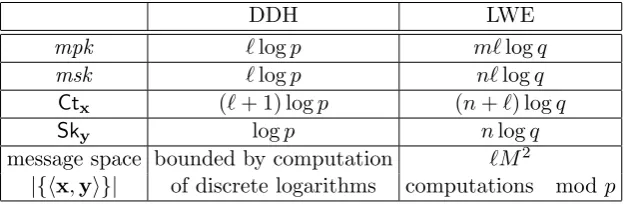
Parameter Sizes For Our Constructions. In Table1, we present the size of the parameters and ciphertexts for our concrete construction. Each column refers to an instantiation of our general scheme and is indexed by its underlying assumption. Each row describes the size of an element of the scheme. The master public key size does not include public parameters that can be re-used such that (g,A). Message space is the number of different messages that can be decrypted using this instantiation. The DDH instantiation can give short ciphertexts and keys using elliptic curves, but requires the computation of a discrete logarithm in the decryption, which makes it usable for small message space only. LWE enables short ciphertexts and keys together with a message space that is independent of the security parameter, which allows shorter ciphertexts for a smaller message space.
DDH LWE
mpk `logp m`logq
msk `logp n`logq
Ctx (`+ 1) logp (n+`) logq
Sky logp nlogq
message space bounded by computation `M2
|{hx,yi}| of discrete logarithms computations mod p
Table 1: Parameter Sizes. Here, `is the length of the vectors encrypted in the ciphertexts and encoded in the secret keys. In DDH,p is the size of a group element. In LWE,q is the size of a group element, pis the order ofB2`, andB is a bound on the message space.
2
Basic Tools
2.1 Notation and Conventions
LetNdenote the set of natural numbers. If n∈N, then{0,1}n denotes the set ofn-bit strings, and {0,1}∗ is the set of all bit strings. The empty string is denoted ε. More generally, if S is a set, then Sn is the set ofn-tuples of elements of S,S≤n is the set of tuples of length at most
n. If x is a string then |x| denotes its length, and if S is a set then |S|denotes its size. If S
is finite, then x ←R S denotes the assignment to x of an element chosen uniformly at random from S. IfAis an algorithm, then y← A(x) denotes the assignment to y of the output ofAon inputx, and ifAis randomized, theny← AR (x) denotes that the output of an execution ofA(x) with fresh coins is assigned to y. Unless otherwise indicated, an algorithm may be randomized. “PT” stands for polynomial time and “PTA” for polynomial-time algorithm or adversary. We denote by λ ∈ N the security parameter. A function ν : N → [0,1] is said to be negligible if for every c∈ Nthere exists a λc ∈N such that ν(λ)≤ λ−c for all λ > λc, and it is said to be
overwhelming if the function|1−ν(λ)|is negligible.
Letei be the vector with all 0 but one 1 in thei-th position.
Code-Based Games. We use the code-based game-playing [BR06] to define the security notions. In such games, there exist procedures for initialization (Initialize) and finalization (Finalize) and procedures to respond to adversary oracle queries. A game G is executed with an adversary Aas follows. First,Initializeexecutes and its outputs are the inputs toA. Then
A executes, its oracle queries being answered by the corresponding procedures of G. When A
terminates, its output becomes the input to the Finalize procedure. The output of the latter, denoted G(A), is called the output of the game, and “G(A) = y” denotes the event that the output takes a valuey. Boolean flags are assumed initialized tofalse. Games Gi,Gj areidentical until badif their code differs only in statements that follow the setting of badtotrue.
2.2 Public-Key Encryption
Definition 2.1 [Public-Key Encryption Scheme] Apublic-key encryption (PKE) schemeE is a tuple E = (Setup,Encrypt,Decrypt) of 3 algorithms:
1. Setup(1λ) outputs public andsecret keys (pk,sk) for security parameterλ;
2. Encrypt(pk, m), on input public key pk and message m in the allowed message space, outputsciphertextCt;
3. Decrypt(sk,Ct) on input secret keysk and ciphertext Ct, outputs messagesm0.
In addition we make the following correctness requirement: for all (pk,sk)← Setup(1λ), all messagesmand ciphertextsCt←Encrypt(pk, m), we have thatDecrypt(sk,Ct) =mexcept with negligible probability.
We often also allow public-key encryption schemes to additionally depend on explicit public parametersparams(randomly generated in an initial phase and shared across multiple instances of the PKE scheme) on which all ofSetup,Encrypt, andDecryptare allowed to depend. Examples include the description of a group G with its generator g. We will often omit them in the descriptions of generic constructions from PKE schemes.
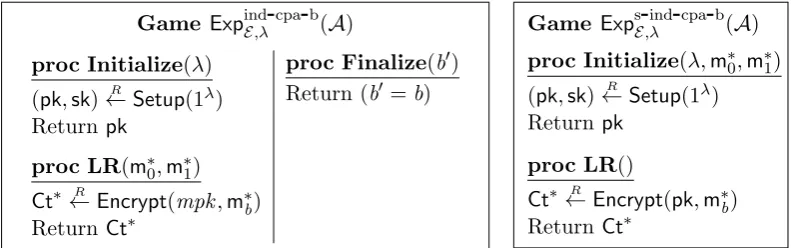
Indistinguishability-Based Security. We define security against chosen-plaintext attacks
Game ExpindE,λ-cpa-b(A)
proc Initialize(λ)
(pk,sk)←R Setup(1λ) Return pk
proc Finalize(b0) Return (b0 =b)
proc LR(m∗0,m∗1) Ct∗←R Encrypt(mpk,m∗b) Return Ct∗
Game ExpsE-,λind-cpa-b(A)
proc Initialize(λ,m∗0,m∗1) (pk,sk)←R Setup(1λ) Return pk
proc LR()
Ct∗ ←R Encrypt(pk,m∗b) Return Ct∗
Figure 1: GamesExpind-cpa-bE,λ (A) andExps-ind-cpa-bE,λ (A) define IND-CPA and s-IND-CPA security (respectively) ofE. The procedureFinalizeis common to both games, which differ in their Ini-tialize and LR procedures.
(IND-CPA secure, for short) if
Pr[Exp
ind-cpa-0
E,λ (A) =1]−Pr[Exp
ind-cpa-1
E,λ (A) =1]
=negl(λ).
We also defineselective security against chosen-plaintext attacks(s-IND-CPAsecurity, for short) when the challenge messages m∗0 and m∗1 have to be chosen before hand. Actually, in this case, the procedures Initialize and LR can be merged into an Initialize procedure that outputs both the public key pk and the challenge ciphertextCt∗.
2.3 Functional Encryption
Following Boneh et al.[BSW11], we start by defining the notion of functionality and then that of functional encryption scheme F E for functionality F.
Definition 2.2 [Functionality] AfunctionalityF defined over (K, X) is a functionF :K×X→
Σ∪ {⊥} whereK is the key space,X is themessage space and Σ is theoutput spaceand⊥is a special string not contained in Σ. Notice that the functionality is undefined for when either the key is not in the key space or the message is not in the message space.
Definition 2.3 [Functional Encryption Scheme] A functional encryption (FE) scheme F E for functionality F is a tuple F E = (Setup,KeyDer,Encrypt,Decrypt) of 4 algorithms:
1. Setup(1λ) outputs public andmaster secret keys (mpk,msk) for security parameterλ; 2. KeyDer(msk, k), on input a master secret keymsk and keyk∈K outputssecret keyskk; 3. Encrypt(mpk, x), on input public keympk and messagex∈X outputs ciphertextCt; 4. Decrypt(mpk,Ct,skk) outputs y∈Σ∪ {⊥}.
We make the following correctnessrequirement: for all (mpk,msk)←Setup(1λ), allk∈K and
m ∈ M, for skk ← KeyDer(msk, k) and Ct ← Encrypt(mpk, m), we have that Decrypt(mpk,Ct, skk) =F(k, m) whenever F(k, m)6=⊥2, except with negligible probability.
2
Indistinguishability-Based Security. For a functional encryption scheme F E = (Setup,
KeyDer,Encrypt,Decrypt) for functionality F, defined over (K, X), we define security against chosen-plaintext attacks(IND-FE-CPAsecurity, for short) via the security game depicted on Fig-ure 2. Then, we say that F E is secure against chosen-plaintext attacks (IND-FE-CPA secure, for short) if
Pr[Exp
ind-fe-cpa-0
F E,λ (A) =1]−Pr[Exp
ind-fe-cpa-1
F E,λ (A) =1]
=negl(λ).
We also define selective security against chosen-plaintext attacks (s-IND-FE-CPA security, for short) when the challenge messagesm∗0 and m∗1 have to be chosen before hand.
Game ExpindF E-,λfe-cpa-b(A)
proc Initialize(λ)
(mpk,msk)←R Setup(1λ)
V ← ∅
Return mpk
proc KeyDer(k)
V ←V ∪ {k}
skk R
←KeyDer(msk, k) Return skk
proc LR(m∗0,m∗1) Ct∗←R Encrypt(mpk,m∗b) Return Ct∗
proc Finalize(b0)
if ∃k∈V such that
F(k,m∗0)6=F(k,m∗1)
then returnfalse Return (b0 =b)
Game ExpsF E-ind,λ-fe-cpa-b(A)
proc Initialize(λ,m∗0,m∗1) (mpk,msk)←R Setup(1λ)
V ← ∅
Return mpk
proc LR()
Ct∗ ←R Encrypt(mpk,m∗b) Return Ct∗
Figure 2: Games Expind-fe-cpa-F E,λ b(A) and Exps-ind-fe-cpa-F E,λ b(A) define IND-FE-CPA and s-IND-FE-CPA security (respectively) of F E. The procedures KeyDerand Finalize are com-mon to both games, which differ in theirInitialize and LR procedures.
Inner-Product Functionality. In this paper we are mainly interested in the inner-product functionality over the integers (IP, for short) defined in the following way. It is a family of functionalities with key spaceK`and message space X` both consisting of vectors inZpof norm bounded by p of length`: for any k∈K`, x∈X` the functionality IP`(k, x) =hk, xi. When it is clear from the context we remove the reference to the length `.
3
Inner-Product from DDH
In this section, we present our first functional encryption scheme for the inner-product function-ality whose security can be based on the plain DDH assumption.
The Decisional Diffie-Hellman assumption. LetGroupGenbe a probabilistic polynomial-time algorithm that takes as input a security parameter 1λ, and outputs a triplet (
G, p, g) where G is a group of order p that is generated by g ∈ G, and p is an λ-bit prime number. Then, the Decisional Diffie-Hellman (DDH) assumption states that the tuples (g, ga, gb, gab) and (g, ga, gb, gc) are computationally indistinguishable, where (
G, p, g) ← GroupGen(1λ), and
a, b, c∈Zp are chosen independently and uniformly at random.
• Setup(1λ,1`) samples (
G, p, g)←GroupGen(1λ) and s= (s1, . . . , s`)←Z`p, and setsmpk = (hi =gsi)i∈[`]and msk =s. The algorithm returns the pair (mpk,msk);
• Encrypt(mpk,x) on input master public key mpk and message x = (x1, . . . , x`) ∈ Z`p, chooses a randomr ←Zp and computesct0 =gr and, for eachi∈[`], cti =hri ·gxi. Then the algorithm returns the ciphertextCt= (ct0,(cti)i∈[`]);
• KeyDer(msk,y) on input master secret keymsk and vectory= (y1, . . . , y`)∈Z`p, computes and outputs secret key sky =hy,si;
• Decrypt(mpk,Ct,sky) on input master public keympk, ciphertextCt= (ct0,(cti)i∈[`]) and secret keySky for vector y, returns the discrete logarithm in basis gof
Y
i∈[`] ctyi
i /ct
sky 0 .
Correctness. For all (mpk,msk) ← Setup(1λ,1`), all y ∈ Z`
p and x ∈ Z`p, for sky ←
KeyDer(msk,y) andCt←Encrypt(mpk,x), we have that
Decrypt(mpk,Ct,sk) =
Q
i∈[`]ct yi i
ctsky 0
=
Q
i∈[`](gsir+xi)yi
gr( P
i∈[`]yisi) =g
P
i∈[`]yisir+Pi∈[`]yixi−r(Pi∈[`]yisi) =g
P
i∈[`]yixi =ghx,yi.
The above scheme limits the expressiveness of the functionality that can be computed because in order to recover the final inner-product value a discrete logarithm computation must take place. In the next section, in order to overcome this limitation and to generalize to other settings we will present a generic scheme whose security can be based on the semantic security of the underlying public-key encryption scheme under randomness reuse. Before moving to the generic scheme and its proof of security, we sketch below the proof of security for the above IP scheme to offer to the reader useful intuitions that will be reused in the proof of security of our generic functional encryption scheme for the inner-product functionality.
Theorem 3.2 Under the DDH assumption, the above IPscheme is s-IND-FE-CPA.
Proof Sketch. For the sake of contradiction, suppose that there exists an adversary A that breaks s-IND-FE-CPA security of our IP scheme with non-negligible advantage. Then, we con-struct a simulatorBthat given in input an instance of the DDH assumption, (g, ga, gb, gc) where
c is either abor uniformly random, breaks it by usingA.
If the challenge messagesx0 and x1 are different, there exists a vector in the message space for which the key shouldn’t be known by the adversary (x1−x0 is one of them).
To generate the master public key,Bfirst generates secret keys for a basis (zi) of (x1−x0)⊥. Setting implicitly a as secret key for x1 −x0, B generates the master public key using ga. Actually, once group elements are generated for the basis (yi) completed with (x1−x0), one can find the public key, for the canonical basis.
To generate the challenge ciphertext,Bchooses a random bitµand usinggbandgc, generates a ciphertext for message xµ.
Now, if c=ab, then the challenge ciphertext is a well-distributed ciphertext of the message
xµ. On the other hand, ifcis random, the challenge ciphertext encrypts messageux0+ (1−u)x1 where u is uniformly distributed and in this case µ is information theoretically hidden: for all sky asked, since y is orthogonal to x1 −x0, and thus hx0,yi = hx1,yi, while the ciphertexts decrypt to the inner products
hux0+ (1−u)x1,yi=uhx0,yi+ (1−u)hx1,yi =uhxµ,yi+ (1−u)hxµ,yi
=hxµ,yi .
4
A Generic Inner-Product Encryption Scheme
In this section, we present a generic functional encryption scheme for the inner-product func-tionality IP = (Setup,KeyDer,Encrypt,Decrypt) based on any public-key encryption scheme
E = (Setup,Encrypt,Decrypt) that has the following structural and homomorphic properties.
Structure. E’s secret keys are elements of a group (G,+,0G), public keys are elements of group (H,·,1H), and the message space is Zq for some prime q. In addition, we require the ciphertexts to consist of two parts ct0 and ct1. The first part ct0 corresponds to some
commitment C(r) of the randomness r used for the encryption. The second part ct1 is the encryption E(pk, x;r) in a group (I,·,1I) of the message x under public key pk and randomness r.
Linear Key Homomorphism. We say that a PKE has linear key homomorphism (LKH, for short) if for any two secret keys sk1,sk2 ∈G and anyy1, y2 ∈Zq, the component-wise G -linear combination formed by y1sk1+y2sk2 can be computed efficiently only using public parameters, the secret keyssk1andsk2and the coefficientsy1andy2. And this combination
y1sk1+y2sk2also functions as a secret key to a public key that can be computed aspky11 ·pk y2 2 , where pk1 (resp. pk2) is a public key corresponding to sk1 (resp. sk2).
Linear Ciphertext Homomorphism Under Shared Randomness. We say that a PKE
haslinear ciphertext homomorphism under shared randomness(LCH, for short) if it holds that E(pk1pk2, x1+x2;r) =E(pk1, x1;r)·E(pk2, x2;r).
4.1 Construction
Construction 4.1 [PKE-IP Scheme] Let E = (Setup,Encrypt,Decrypt) be a PKE scheme with the properties defined above, we define our functional encryption scheme for the inner-product functionality IP= (Setup,KeyDer,Encrypt,Decrypt) as follows.
• Setup(1λ, `, B) callsE’s key generation algorithm to generate `independent (sk1,pk1), . . . ,
(sk`,pk`) pairs, sharing the same public parameters params. Then, the algorithm sets the functionality’s key space K` and message space X` to M = {0, . . . , B −1}` ⊆ Zq and returns mpk = (params,pk1, . . . ,pk`) and msk = (sk1, . . . ,sk`).
• Encrypt(mpk,x) on input master public key mpk and message x = (x1, . . . , x`) ∈ M, chooses shared randomness r in the randomness space of E, and computes ct0 = E.C(r) and cti =E.E(pki, xi;r). Then the algorithm returns the ciphertextCt= (ct0,(cti)i∈[`]).
• Decrypt(mpk,Ct,sky) on input master public key mpk, ciphertext Ct = (ct0,(cti)i∈[`]), and secret key Sky for vector y= (y1, . . . , y`), returns the output of E.Decrypt(Sky,(ct0,
Q
i∈[`]ct yi i )).
Correctness. For all (mpk,msk) ← Setup(1λ,1`), all y ∈ M` and x ∈ M, for sky ←
KeyDer(msk,y) andCt←Encrypt(mpk,x), we have that
Decrypt(mpk,Ct,sky) =E.Decrypt(Sky,(ct0,
Y
i∈[`] ctyi
i ))
=E.Decrypt(Sky,(ct0,
Y
i∈[`]
E.E(pki, xi;r)yi))
=E.Decrypt(Sky,(ct0,E.Encrypt(
Y
i∈[`] pkyi
i ,
X
i∈[`]
yixi;r)))
=X
i∈[`]
yixi .
by the LCH property. Finally, note that the decryption is allowed because (Sky,Qi∈[`]pk yi i ) is a valid key pair, due to the LKH property.
4.2 Security: Simplified Case
If the underlying PKE scheme is semantically secure and remains secure under randomness-reuse then there is a very simple way to prove security of Construction 4.1.
Specifically, we define randomness-reuse as follows:
Randomness Reuse. We say that a PKE hasrandomness reuse(RR, for short) ifE(pk, x;r) is
efficiently computedgiven the triple (x,pk, r), or the triple (x,sk,C(r)) whereskis a secret key corresponding to pk. In [BBS03], this property is also called reproducibility and guar-antees that it is secure to reuse randomness when encrypting under several independent public keys. The idea of randomness reuse was first considered by [Kur02].
Then, we are able to prove the following theorem:
Theorem 4.2 Let E be a public-key encryption scheme with message spaceZq for some prime
q, and let IP be the functional encryption scheme for the inner-product functionality obtained by applying Construction 4.1toE with parameters `andB. Ifq > `·B2 andE is s-IND-CPA, linear-key homomorphic, linear-ciphertext homomorphic under shared randomness, and remains secure under randomness-reuse thenIP is s-IND-FE-CPA.
Remark 4.3 For our security proof to work, it must hold thatkx1−x0k2 6= 0 modq, where
x0,x1 are the challenge messages. The lower bound onq ensures exactly this.
a game where the challenge ciphertext encrypts a random combination of the challenge messages whose coefficients sum up to one. Thus, the challenge ciphertext decrypts to the expected values and information theoretically hides the challenge bit.
Given an adversary A that breaks the s-IND-FE-CPA security of our IP scheme with non-negligible probabilityε, we construct an adversaryBthat breaks the s-IND-CPA security of the underlying PKE scheme E with comparable probability.
B starts by picking a random element a in the full message space of the underlying PKE E, and sends challenge messages 0 and ato the challenger C of PKE security game. C answers by sending an encryption Ct= (ct0,ct1) of either 0 or aand public keypk.
B then invokes Aon input the security parameter and gets two different challenge messages in output, namely (xi= (xi,1, . . . , xi,`))i∈{0,1} both in M.
Recall that, by the constraints of security game, the adversary can only issue secret key queries for vectors y such that hx0,yi=hx1,yi. Thus, we have that hy,x1−x0i = 0 meaning thaty is in the vector space defined by (x1−x0)⊥.
Then, Bgenerates the view for A in the following way:
Public Key. To generate master public key mpk,B does the following. First, B finds a basis (z1,z2, . . . ,z`−1) of (x1 −x0)⊥. Then we can write the canonical vectors in the basis ((x1−x0),z1,z2, . . . ,z`−1): for i∈[`], j ∈[`−1], there existλi,j ∈Zq and αi ∈ Zq such that:
ei =αi(x1−x0) +
X
j∈[`−1]
λi,jzj. (1)
Then, for j∈[`−1],B sets (pkzj,skzj) =E.Setup(1
λ), and for i∈[`],
γi =
Y
j∈[`−1] pkλi,j
zj and pki =pk αiγ
i.
Eventually,B invokes A on inputmpk = (pki)i∈[`]. Notice that, B is implicitly setting ski = αisk +
P
j∈[`−1]λi,jskzj because of the LKH property, where skis the secret key corresponding to pk, which is unknown toB.
Challenge Ciphertext. Bcomputes the challenge ciphertextCt∗ as follows. Brandomly picks
b ← {R 0,1}, computes E.E(γi,0;r) fromct0 and Pj∈[`−1]λi,jskzj and E.E(1H, xb,i;r) from secret key 0G andct0, by randomness reuse. B then sets
ct∗0 =ct0 and (ct∗i =ctαi
1 · E.E(γi,0;r)· E.E(1H, xb,i;r))i∈[`] ,
Then the algorithm returns the challenge ciphertext Ct∗ = (ct∗0,(ct∗i)i∈[`]).
Secret Keys. To generate a secret key for vectory,B computes sky as
sky=
X
j∈[`−1]
X
i∈[`]
yiλi,j
At the end of the simulation, if A correctly guesses b, then B returns 0 (B guesses that C
encrypted 0), else B returns 1 (B guesses that C encrypteda). This concludes the description of adversary B.
It remains to verify that B correctly simulatesA’s environment.
First see that the master public key is well distributed, because we are just applying a change of basis to a well distributed master public key. Now it holds that αi = x1,i
−x0,i
kx1−x0k2 because
x1,i−x0,i =hx1−x0,eii =αikx1−x0k2+
X
j∈[`−1]
λi,jhx1−x0,zji
=αikx1−x0k2 .
To ensure thatkx1−x0k2 is different from 0 moduloq, fixed the message spaceM ={0, . . . , B− 1} ⊆Zq,q needs to be set to be a prime larger then`·B2.
Now recall that a vectorysatisfying the security game constraints is such thathy,x0i=hy,x1i, so
X
i∈[`]
yiαi=
X
i∈[`]
yi
x1,i−x0,i
kx1−x0k2 = 0
which in turn implies that a secret keysky for the vectory is distributed as
sky=
X
i∈[`]
yiski=
X
i∈[`]
yiαisk+
X
i∈[`]
X
j∈[`−1]
yiλi,jskzj
= X
j∈[`−1]
X
i∈[`]
yiλi,j
skzj
On the other hand, if Aasks for a secret key for some vector y∈/ (x1−x0)⊥,B would need to know sk in order to generate a correct secret key for y.
Now, we have to analyze the following two cases, depending on which message was encrypted by C in the challenge ciphertext:
1. C encrypted 0. Then, the challenge ciphertext Ct∗ for message xb is distributed as
ct∗0 =ct0
and
ct∗i =E.E(pk,0;r)αi· E.E(γ
i, xb,i;r) =E.E(pki, xb,i;r) ,
thanks to the LCH property, and then as in the real game.
2. C encrypteda. First, in Equation1, we haveαi = (x1,i−x0,i)/kx1−x0k2. Let us analyze the distribution of the challenge ciphertext in this case. We have ct∗0=ct0 and
ct∗i =E.E(pk, a;r)αi · E.E(γ
i, xb,i;r) =E.E(pki, xb,i+αia;r)
=E.E(pki,xˆi;r),
thanks to the LCH property, where ˆxi is defined as follows:
ˆ
xi=xb,i+αia=
a kx1−x0k2
(x1,i−x0,i) +xb,i
= a
kx1−x0k2
(x1,i−x0,i) +x0,i+b(x1,i−x0,i).
Let us set u = a/kx1 −x0k2 +b, which is a random value in the full message space of
E, given that a is random in the same space, then ˆxi = ux1,i+ (1−u)x0,i. Then, the challenge ciphertext is a valid ciphertext for the messagexˆ=ux1+ (1−u)x0, which is a random linear combination of the vectors x0 and x1 whose coefficients sum up to one, as expected. Notice thatbis information theoretically hidden because the distribution ofuis independent fromb. Hence, the advantage ofBin this game is 0, when a random non-zero
ahas been encrypted.
Eventually, this shows thatεis bounded by the best advantage one can get against s-IND-FE-CPA of E. Hence, taking the maximal values, the best advantage one can get against s-IND-FE-CPA of IPis bounded by the best advantage one can get against s-IND-FE-CPA of E.
4.3 Security: General Case
If the underlying PKE scheme does not support randomness-reuse defined in the previous section then it is still possible to prove the security of Construction 4.1 but we need the following generalized security properties.
Before stating them, for convenience we split theSetup algorithm in the following two algo-rithms to sample secret keys and generate the corresponding public keys.
• SKGen(1λ) takes in input the security parameter and sample a secret keyskfrom the secret key space according to the same distribution induced bySetup.
• PKGen(sk, τ) takes in input a secret keysk and parameters τ, and generates a public key pk corresponding to sk according to the distribution induced byτ. We will omit τ when it is clear from the context.
We are ready to state the security properties that we require.
Game Exp`E-,λpk-rep-b(A)
proc Initialize(λ,M)
(sk,(αi,ski)i∈[`]) R
← M(1λ)
if b= 0 then
(pki =E.PKGen(αisk+ski, τ))i∈[`]
else
pk← E.PKGen(sk, τ0) (pki =pkαi· E.PKGen(sk
i, τi))i∈[`] Return (pki,ski)i∈[`]
proc Finalize(b0) Return (b0=b)
with Msamples tuples of the form (sk,(αi,ski)i∈[`]) where sk and theski’s are inG, and theαi’s are in Zq.
Then, we say thatE has`-public-key-reproducibility if there exists τ, τ0,(τi)i∈[`] such that
Pr[Exp
`-pk-rep-0
F E,λ (A) =1]−Pr[Exp
`-pk-rep-1
F E,λ (A) =1]
=negl(λ).
`-Ciphertext-Reproducibility. For a public-key encryption schemeE we define` -ciphertext-reproducibility via the following security game:
Game Exp`E-,λct-rep-b(A)
proc Initialize(λ,M)
(a,(αi, xi,ski)i∈[`]) R
← M(1λ)
sk← E.SKGen(1λ),pk← E.PKGen(sk, τ0) (pki← E.PKGen(ski, τi))i∈[`]
ct0 =E.C(r),ct=E.E(pk, a;r)
if b= 0 then
cti=ctαi· E.E(pk i, xi;r)
else
cti=ctαi· E.E0(ski, xi,ct0)
Return (pk,(αi,pki,ski)i∈[`],ct0,(cti)i∈[`])
proc Finalize(b0) Return (b0=b)
where
• M samples tuples of the form (a,(αi, xi, ,ski)i∈[`]), where ski’s are in G, and a and theαi’s,xi’s are in Zq.
Then, we say that E has `-ciphertext-reproducibility if there exists τ0,τi’s and algorithm E0 such that
Pr[Exp
`-ct-rep-0
F E,λ (A) =1]−Pr[Exp
`-ct-rep-1
F E,λ (A) =1]
=negl(λ).
Then, we are able to prove the following theorem:
Theorem 4.4 Let E be a public-key encryption scheme with message spaceZq for some prime
q, and let IP be the functional encryption scheme for the inner-product functionality obtained by applying Construction 4.1toE with parameters `andB. Ifq > `·B2 andE is s-IND-CPA, linear-key homomorphic, linear-ciphertext homomorphic under shared randomness, ` -public-key-reproducible and `-ciphertext-reproducible thenIP is s-IND-FE-CPA.
Proof: The proof strategy is essential that of Theorem 4.2. We prove security via a sequence of hybrid experiments.
Hybrid H1: This is the s-IND-FE-CPA game.
proc Initialize(λ,x0,x1) (mpk,msk)←R Setup(1λ)
V ← ∅
Returnmpk
proc KeyDer(y)
V ←V ∪ {y}
sky
R
←KeyDer(msk,y) Returnsky
proc LR()
Ct∗←R Encrypt(mpk,xb)
Return Ct∗
proc Finalize(b0)
if ∃y∈V such that
F(y,x0)6=F(y,x1)
then returnfalse Return (b0 =b)
Hybrid H2: This is like H1 except that the master public key is generated by invoking the algorithm H2.Setup defined as follows:
H2.Setup(1λ,x0,x1): The algorithm finds a basis (z1,z2, . . . ,z`−1) of (x1−x0)⊥. Then, the canonical vectors can be rewritten in this basis as follows: fori∈[`], j ∈[`−1], there existλi,j ∈Zq and αi∈Zq such that:
ei=αi
(x1−x0)
||x1−x0||2
+ X
j∈[`−1]
λi,jzj.
Then, the algorithms samplessk← E.SKGen(1λ) and, for j∈[`], PKE secret key skzj ← E.SKGen(1
λ). Finally, the algorithm sets:
ski=αi·sk+
X
λi,jskzj, pki =E.PKGen(ski, τ),
proc Initialize(λ,x0,x1)
(mpk,msk)←R H2.Setup(1λ,x0,x1)
V ← ∅
Returnmpk
proc KeyDer(y)
V ←V ∪ {y}
sky
R
←KeyDer(msk,y) Returnsky
proc LR()
Ct∗ ←R Encrypt(mpk,xb)
ReturnCt∗
proc Finalize(b0)
if ∃y∈V such that
F(y,x0)6=F(y,x1)
then returnfalse Return (b0 =b)
Hybrid H3: This is like H2 except that the master public key is generated by invoking the algorithmH3.Setupand the secret keys are generated by invoking the algorithmH3.KeyDer which are defined as follows.
H3.Setup(1λ,x0,x1): The algorithm finds a basis (z1,z2, . . . ,z`−1) of (x1−x0)⊥. Then, the canonical vectors can be rewritten in this basis as follows: fori∈[`], j ∈[`−1], there existλi,j ∈Zq and αi∈Zq such that:
ei=αi
(x1−x0)
||x1−x0||2
+ X
j∈[`−1]
λi,jzj.
Then, the algorithms first samples sk← ER .SKGen(1λ) andpk R
← E.PKGen(sk, τ0). Then, forj ∈[`−1], a PKE secret keysskzj ← E.SKGen(1
λ), setst
i =Pλi,jskzj, pkti ← E.PKGen(ti, τi) and computes
pki =pkαi·pk ti.
The algorithm returnsmpk = (pki)i∈[`] and msk0 = (pk,skzj).
H3.KeyDer(msk0,y): The algorithm computes secret key for vectory in the following way: Sky=Pi∈[`]yi·ti.
proc Initialize(λ,x0,x1)
(mpk,msk0)←R H3.Setup(1λ,x0,x1)
V ← ∅
Returnmpk
proc KeyDer(y)
V ←V ∪ {y}
sky
R
←H3.KeyDer(msk0, k) Returnsky
proc LR()
Ct∗ ←R Encrypt(mpk,xb)
Return Ct∗
proc Finalize(b0)
if ∃y∈V such that
F(y,x0)6=F(y,x1)
then returnfalse Return (b0 =b)
H4.Encrypt(msk0,x): The algorithm computes the ciphertext for x in the following way:
ct0=E.C(r) and cti=E.E(pk,0;r)αi· E.E(pkti, xi;r)
i∈[`] , wherer is some randomness in the random space of E.
proc Initialize(λ,x0,x1)
(mpk,msk0)←R H3.Setup(1λ,x0,x1)
V ← ∅
Returnmpk
proc KeyDer(y)
V ←V ∪ {y}
sky
R
←H3.KeyDer(msk0, k) Returnsky
proc LR()
Ct∗ ←R H4.Encrypt(msk0,xb)
ReturnCt∗
proc Finalize(b0)
if ∃y∈V such that
F(y,x0)6=F(y,x1)
then returnfalse Return (b0 =b)
Hybrid H5: This is like H4 except that the challenge ciphertext is generated by invoking the algorithm H5.Encrypt defined as follows:
H5.Encrypt(msk0,Ct,x): Let Ct= (ct0,ct1), then, the algorithm computes the cipher-text forxin the following way:
ct00=ct0 and ct0i =ct αi 1 · E.E
0(t
i, xi,ct0; ˜r)
i∈[`] , where ˜r is some randomness shared among all the invocation ofE.E.
proc Initialize(λ,x0,x1)
(mpk,msk0)←R H3.Setup(1λ,x0,x1)
V ← ∅
Returnmpk
proc KeyDer(y)
V ←V ∪ {y}
sky
R
←H3.KeyDer(msk0, k) Returnsky
proc LR()
Ct=E.Encrypt(pk,0)
Ct∗ ←R H5.Encrypt(msk0,Ct,xb)
ReturnCt∗
proc Finalize(b0)
if ∃y∈V such that
F(y,x0)6=F(y,x1)
then returnfalse Return (b0 =b)
H5 is indistinguishable from H4 due to the`-ciphertext-reproducability.
proc Initialize(λ,x0,x1)
(mpk,msk0)←R H3.Setup(1λ,x0,x1)
V ← ∅
Returnmpk
proc KeyDer(y)
V ←V ∪ {y}
sky
R
←H3.KeyDer(msk0, k) Returnsky
proc LR()
Ct=E.Encrypt(pk, a), a←Zp
Ct∗ ←R H5.Encrypt(msk0,Ct,xb)
ReturnCt∗
proc Finalize(b0)
if ∃y∈V such that
F(y,x0)6=F(y,x1)
then returnfalse Return (b0 =b)
We now show that the relevant distinguishing probabilities between adjacent hybrids are negli-gible, which completes the proof.
Indistinguishability of H1 and H2: The distribution of the master public key in both the games is identically. This is because inH2a simple change of basis is applied to a well distributed master secret key and this change of basis can be computed due to the linear key-homomorphism of E, that tells us that the ski’s as computed inH2 are valid secret keys ofE.
Moreover, notice that, by our change of basis it holds thatαi=x1,i−x0,i because
x1,i−x0,i=hx1−x0,eii =αi+
X
j∈[`−1]
λi,jhx1−x0,zji
=αi .
Then, the change of basis implies that for all the vectors y= (y1, . . . , y`) satisfying the security game constraints, meaning thaty∈(x1−x0)⊥, it holds thatPi∈[`]yi·αi= 0. Thus, to generate a well-distributed secret key for a ysatisfying the security game constraints,sk is not required.
Indistinguishability of H2 and H3: This holds under the `-public-key-reproducibility of E for the distribution M, induced by the challenge messages, defined as follows:
Mx0,x1(1λ): Mfinds a basis (z
1,z2, . . . ,z`−1) of (x1−x0)⊥. Then, the canonical vectors can be rewritten in this basis as follows: fori∈[`], j ∈[`−1], there existλi,j ∈Zqandαi∈Zq such that:
ei =αi
(x1−x0)
||x1−x0||2
+ X
j∈[`−1]
λi,jzj.
Then,Mfirst samplessk← ER .SKGen(1λ), then, forj∈[`−1], samplesskzj ← E.SKGen(1 λ),
setsti =Pλi,jskzj and gives in output (sk,(αi, ti)i∈[`]).
B does the following. B invokes A to gets the challenge messages x0,x1. Then, B receives from the challenger of the `-public-key-reproducibility values (pki, ti)i∈[`] on input the security parameter and distribution Mx0,x1. B sets master public key as mpk = (pk
i)i∈[`] and gives it to A. ThenB answers secret key queries by using the ti’s which are enough to generate secret keys for vectors satisfying the security game constraints. B generates the challenge ciphertext by using mpk and uses A’s guess as its guess for the`-public-key-reproducibility game.
Finally, notice that ifBplaysExp`-pk-rep-0E,λ (B) (resp. Exp`-pk-rep-1E,λ (B)), thenBperfectly simulates
H2 (resp. H3).
Indistinguishability of H3 and H4: By linear ciphertext-homomorphism ofE,H3 =H4. In fact, notice that in both the games pki =pkα·pkti, then it holds that
E.E(pkαi·pk
ti, xi;r) =E.E(pk,0;r)
αi· E.E(pk
ti, xi;r) .
Indistinguishability of H4 and H5: This holds under the`-ciphertext-reproducibility of E for the distribution M, induced by the challenge messages, defined as follows:
Mx0,x1(1λ): Mfinds a basis (z
1,z2, . . . ,z`−1) of (x1−x0)⊥. Then, the canonical vectors can be rewritten in this basis as follows: fori∈[`], j ∈[`−1], there existλi,j ∈Zqandαi∈Zq such that:
ei =αi
(x1−x0)
||x1−x0||2
+ X
j∈[`−1]
λi,jzj.
Then,M samples, forj∈[`−1], secret keys skzj ← E.SKGen(1 λ).
Finally, M, fori ∈[`], sets ti =Pλi,jskzj and returns (0,(αi, xβ,i,skti)i∈[`]), where β is random bit.
For the sake of completeness, suppose that there exists and adversary Athat distinguishes with non-negligible advantage H4 fromH5. Then, we can construct an adversaryBthat usesA as a subroutine and breaks the `-ciphertext-reproducibility ofE.
B does the following. B invokes A to gets the challenge messages x0,x1. Then, B receives from the challenger of the `-ciphertext-reproducibility values (pk,(αi,pkti, ti)i∈[`],ct0,(cti)i∈[`]) on input the security parameter and distribution Mx0,x1. B sets master public key as mpk = (pki = pkαi ·pk
ti)i∈[`] and gives it to A. Then B answers secret key queries by using the ti’s which are enough to generate secret keys for vectors satisfying the security game constraints. B
uses as challenge ciphertext (ct0,(cti)i∈[`]) and uses A’s guess as its guess for the ` -ciphertext-reproducibility game.
Finally, notice that if BplaysExp`-ct-rep-0E,λ (B) (resp. Exp`-ct-rep-1E,λ (B)), thenBperfectly simulates
H4 (resp. H5).
Indistinguishability ofH5andH6: The only difference betweenH5andH6is in the message that Ct encrypts. InH5,Ct is an encryption of 0 andH5, it is an encryption ofafor a random
a∈ Zq. Moreover, notice that sk is never used. Therefore under the the IND-CPA security of
Advantage of any adversary in H6. In this game, the challenge ciphertext is for message ˆ
x= (ˆx1, . . . ,xˆ`) defined as follows:
ˆ
xi =xb,i+αia=a(x1,i−x0,i) +xb,i
=a(x1,i−x0,i) +x0,i+b(x1,i−x0,i).
Let us set u =a+b, which is a random value in Zp, then ˆxi =ux1,i+ (1−u)x0,i. Then, the challenge ciphertext is a valid ciphertext for the messageˆx=ux1+ (1−u)x0, which is a random linear combination of the vectors x0 and x1 whose coefficients sum up to one. Notice that b is information theoretically hidden because the distribution ofuis independent fromb. Hence, the advantage of any adversary in this game is 0.
5
Instantiation from DDH
In this section, we show that the ElGamal encryption scheme [ElG85] can be used to instantiate Construction 4.1. In fact, we have:
Structure. Letq be a prime andGa group of orderq where the DDH assumption is supposed to be hard, and g a generator of G. Then, ElGamal’s secret key space is the group (Zq,+,0), public key space is the group (G,×,1), and the message space is Zq. An ElGamal ciphertext is of the form Ct = (ct0 = gr,ct1 = pkr ·gx) as required. Thus, C(r) =gr and E(pk, x;r) =pkr·gx.
Linear Key Homomorphism. It is easy to see that for any two secret keyssk1,sk2 ∈Zq and any y1, y2 ∈ Zq, the component-wise linear combination formed by y1sk1+y2sk2 can be computed efficiently only using public parameters, the secret keys sk1 and sk2 and the coefficients y1 and y2. And this combination y1sk1+y2sk2 also functions as a secret key to a public key that can be computed as pky11 ·pky22 =gy1sk1+y2sk2, where pk
1 (resp. pk2) is a public key corresponding to sk1 (resp. sk2).
Linear Ciphertext Homomorphism Under Shared Randomness. It holds that
E(pk1, x1;r)·E(pk2, x2;r) =gr·sk1gx1 ·gr·sk2gx2 =gr·(sk1+sk2)·gx1+x2
=E(pk1pk2, x1+x2;r) .
IP’s Key and Message spaces. The key and message spaces for the IP scheme are M =
{0, . . . , B−1}`⊆
Zq, whereB can be any value satisfying`·B2 < q. However,B cannot be very large since it should allow for an efficient computation of the final discrete log during decryption.
Security. The ElGamal encryption scheme remains secure under randomness reuse. In fact, it holds that
E(pk, x;r) = (gsk)r·gx= (gr)sk·gx .
6
Instantiation from LWE
In this section, we show that Regev’s public-key encryption scheme [Reg05] can also be used to instantiate Construction 4.1.
6.1 Tools and Assumptions
Gaussians and Lattices. Then-dimensional Gaussian function ρ:Rn→(0,1] is defined as
ρ(x) = exp(−π· ||x||2) = exp(−π· hx,xi) .
Applying a linear transformation given by a (not necessarily square) matrix B with linearly independent columns yields the (possibly degenerate) Gaussian function
ρB(x) =
(
ρ(B+x) = exp(−π·x>Σ+x) If x∈span(B) = span(Σ)
0 otherwise
where Σ =BB>≤0. Because ρB is distinguished only up to Σ, we usually refer to it as ρ√Σ.
Lemma 6.1 Let ρ√
Σ(x) be the probability that a gaussian random variables of covariance matrix Σ is equal tox. Then, for any invertible matrix β,
ρ√
Σ(β
−1x) =ρ
β√Σ(x) .
Lemma 6.2 Let Λ⊂Rnbe a lattice. For any Σ≥0andc∈
Rn, we haveρ√Σ(Λ+c)≤ρ√Σ(Λ). Moreover, if √Σ≥η(Λ) for some >0 and c∈span(Λ), thenρ√
Σ(Λ +c)≥ 1−
1+ ·ρ√Σ(Λ).
The LWE Assumption. The learning with errors (LWE) problem was introduced by Regev [Reg05]. Letn, q be integer parameters. For any noise distributionχ on Zq, and vector s∈Znq, the oracle LWEq,n,χ(s) samples a fresh random n-dimensional vector a ← Zn
q, as well as noise
e←χ, and returns (a,ha,si+e). The LWE assumption with noise χstates that for every PPT distinguisher D,
Pr[s←Znq : DLWEq,n,χ(s)= 1]−Pr[s←
Znq : DLWEq,n,U(s) = 1] =negl(n),
where U is the uniform distribution onZq.
Generalized Leftover Hash Lemma. The following text and lemma are taken verbatim from [DRS04]. The predictability of a random variableAis maxaPr[A=a], and its min-entropy
H∞(A) is −log(maxaPr[A =a]). The min-entropy of a distribution tells us how many nearly uniform random bits can be extracted from it. The notion of nearly is defined as follows. The statistical distance between two probability distributionsAandB isSD(A, B) = 12P
v|Pr[A=
v]−Pr[B =v]|.
about security in log-scale, which is why we define the average min-entropy of A given B as simply the logarithm of the above:
˜
H∞(A|B) =−logEb←B[max
a Pr[A=a|B =b]]
=−logEb←B
h
2H∞(A|B=b)i .
Lemma 6.3 Let A, B, C be random variables. Then If B has at most 2λ possible values, then
˜
H∞(A|(B, C))≥H∞˜ ((A, B)|C)−λ≥H∞˜ (A|C)−λ ,
In particular, ˜H∞(A|B)≥H∞((A, B))−λ≥H∞(A)−λ.
Lemma 6.4 [Generalized Leftover Hash Lemma [DRS04]] Assume{Hx :{0,1}n→ {0,1}`}x∈X is a family of universal hash functions. Then, for any random variables W and I,
SD((HX(W), X, I),(U`, X, I))≤ 1 2
p
2−H˜∞(W|I)2` .
6.2 Regev PKE Scheme
The message space is M = {0, . . . , B−1} ⊆ Zp for some integer B and prime p > `·B2. Let
q =poly(n)> pbe another prime modulus that satisfies the constraints of the security proof of Section4.3. Our public keys and ciphertexts consist of matrices and vectors over Zq. For every
v∈Zp (i.e., one entry of a message vector), define the “center” forvast(v) =jv·qpk∈Zq. Let
χσ denote an integer gaussian distribution over Zq with standard deviation σ: χσ(x) = ρρσσ((x)Z). Let m = m(n), and σ = σ(n) and σ0 = σ0(n) be positive real Gaussian parameters. The following relations between parameters are required for correctness and security:
• m≥(1 +)(`+n+ 1) logq
• q is a prime number of the size ofpn2B√`
• σ ≥(`B+ 1)σ the standard deviation of the errors in the scheme
• σ0 =o(pB2`√1mlogλ) the standard deviation of the errors in the proof of security
All operations are performed overZq.
Construction 6.5 We define ourpublic-key encryption schemeE = (Gen,SKGen,PKGen,Encrypt,
Decrypt) as follows.
• Gen(1λ) generates common parameters. Specifically, the algorithm samples A ←
Zmq ×n, and returns params = (A, χσ). We always assume that all the other algorithms take in input params, thus we avoid to include explicitly.
• SKGen(1λ) takes in input the security parameter and samplessfromZnq and returnssk=s.
• PKGen(sk, τ) takes in input secret key s, parameters τ, and samples efromχmσ and com-putes pk=As+e∈Zmq . Then the algorithm returns pk.
• Encrypt(pk, x) on input public key pk, and message x ∈M, chooses random r← {0,1}m and computes
ct0 =A>r∈Znq and
ct1 =hpk,ri+t(x)∈Zq . Then the algorithm returns the ciphertextCt= (ct0,ct1).
• Decrypt(pk,Ct,sk) on input public key pk, ciphertext Ct = (ct0,ct1) and secret key sk, Compute d = ct1 − hct0,si and output the plaintext x ∈ M, where each x is such that
d−t(x)∈Zq is closest to 0 modq.
We now show that the above scheme possesses the properties required to instantiate Con-struction 4.1.
Linear Key Homomorphism. The first property comes from the fact that secret keys are elements uniformly sampled from the group Znq, so the secret key space is stable under addition. Moreover, P
αisi is a correct secret key for Pαi(Asi+ei) as long as Pαiei remains small, which is true for small values of αi.
Ciphertext Homomorphism Under Shared Randomness. It is easy to verify that:
hpk1,ri+t(x1) +hpk2,ri+t(x2) =hpk1+pk2,ri+t(x1+x2) .
By definition oft.
Finally, in order to prove security, we resort to the our generalized proof of security. It is enough to show that the above scheme satisfies `-Public-Key Reproducibility and`-Ciphertext Reproducibility. Namely:
`-Public-Key Reproducibility. To show that Construction6.5has`-public-key-reproducibility, for any fixed constant `, it is sufficient to show that there are error distributions with standard deviations σ, σ0,(σi)i∈[`] such that Exp`-pk-rep-0E,λ (A) is indistinguishable fromExp
`-pk-rep-1
E,λ (A).
Theorem 6.6 Construction 6.5has`-public-key-reproducibility in a statistical sense.
Proof: Let τ be the description of an error distribution with standard deviation σ, and τ0 an error distribution with standard deviation σ0.
Let {τi}i∈[`] describe sampling ` errors with covariance matrix
√
Σ, where Σ =σ2I`−σ02α~~α>, whereα~ = (α1, . . . , α`). Notice that Σ is positive semi-definite ifσ > σ0(1 +B
√
`) becauseαi is smaller than B for any i.
Finally, let β= I` ~α
and Σ0 =
Σ 0
0 σ02
, where I` is the identity matrix.
Then, If b= 0, the errors appearing inpki come from the distributionχσI`. Ifb= 1, the errors appearing inpki come from the distribution βχ√
Σ0.
We show that these two distribution are statistically close if σ > σ0(1 +B√`). Let us set β0 =
I` ~α
~
µ> 1 +~µ>~α
for some~µ. Let Σ0 =β0√Σ0(β0√Σ0)> be of the target form
σ2I` 0 0 γ02
If Σ0 has this form, it means that β0
√
Σ0 gives us ` uncorrelated errors distributed as χ
σ and another error distributed as χγ0 which we can drop because it is not correlated to the other. Then ∀z, ←χ√
Σ0
Pr(β=z) =X s
Pr
β0=
z ~ µ>z+s
=X
s
Pr
=β0−1
z ~ µ>z+s
∝X
s
ρ√Σ0
β0−1
z ~ µ>z+s
∝X
s
ρβ0√Σ0
z ~ µ>z+s
by Lemma6.1
∝X
s
ρ√
Σ0(z)ργ0(~µ>z+s)
∝ρ√Σ0(z)ργ0(µ~>z+Z)
∝νρ√
Σ0(z) whereν ∈
1−
1 +,1
as long as γ0>2 by Lemma 6.2
`-Ciphertext Reproducibility. We show that Construction6.5has`-ciphertext-reproducibility, for any fixed constant `, by taking error distributions with standard deviations σ0,(σi)i∈[`] as chosen for the`-public-key-reproducibility, and by the following alternative encryption algorithm
E0((si,ei), xi,ct0;r0) =hsi,ct0i+hei,r0i+t(xi) .
as required. This is enough to show thatExp`-ct-rep-0E,λ (A) is indistinguishable fromExp`-ct-rep-1E,λ (A).
Theorem 6.7 Under the LWE assumption, Construction6.5 has`-ciphertext-reproducibility.
Proof: We prove the theorem via a sequence of hybrid experiments.
Hybrid H1: This is the Exp`-ct-rep-0E,M,λ (A), with the algorithms unfold.
proc Initialize(λ,M)
(a,(αi, xi,ski)i∈[`]) R
← M(1λ) sk←R Zn
q,e←χmσ0,pk=Ask+e
pki =Aski+ei, forei ←χmσi
r← {R 0,1}m
ct0 =A>r,ct=E(pk, a;r) cti =αict+E(pki, xi;r)
Return (pk,(αi,pki,ski)i∈[`],ct0,(cti)i∈[`])
Hybrid H2: This is likeH1 except that pk is taken uniformly random in Zmq .
proc Initialize(λ,M)
(a,(αi, xi,ski)i∈[`]) R
← M(1λ)
pk←R Zmq
pki =Aski+ei, forei ←χmσi
r← {R 0,1}m
ct0 =A>r,ct=E(pk, a;r) cti =αict+E(pki, xi;r)
Return (pk,(αi,pki,ski)i∈[`],ct0,(cti)i∈[`])
proc Finalize(b0) Return (b0=b)
Hybrid H3: This is like H2 except that ct0 and hpk,ri are replaced with uniformly random values.
proc Initialize(λ,M)
(a,(αi, xi,ski)i∈[`]) R
← M(1λ)
pk←R Zmq ,u R
←Zq
pki =Aski+ei, forei ←χmσi
r← {R 0,1}m
ct0 R
←Zm
q ,ct=u+t(a)
cti =αict+ E0((ski,ei), xi,ct0;r)
Return (pk,(αi,pki,ski)i∈[`],ct0,(cti)i∈[`])
proc Finalize(b0) Return (b0=b)
Notice that E0((ski,ei), xi,ct0;r) =E(pki, xi;r) if ct0 =A>r.
Hybrid H4: This is likeH3 except that ris replaced by another random value r0.
proc Initialize(λ,M)
(a,(αi, xi,ski)i∈[`]) R
← M(1λ) pk←R Zmq , u
R
←Zq
pki =Aski+ei, forei ←χmσi
r0 ← {R 0,1}m
ct0 R
←Zmq ,ct=u+t(a)
cti =αict+ E0((ski,ei), xi,ct0;r0)
Return (pk,(αi,pki,ski)i∈[`],ct0,(cti)i∈[`])
Hybrid H5: This is likeH4 except that ct0 is generated asA>rand u is replaced by hpk,ri.
proc Initialize(λ,M)
(a,(αi, xi,ski)i∈[`]) R
← M(1λ)
pk←R Zmq
pki =Aski+ei, forei ←χmσi
r← {R 0,1}m,r0 R
← {0,1}m
ct0 =A>r,ct=E(pk, a;r) cti =αict+E0((ski,ei), xi,ct0;r0)
Return (pk,(αi,pki,ski)i∈[`],ct0,(cti)i∈[`])
proc Finalize(b0) Return (b0=b)
Hybrid H6: This is the Exp`-ct-rep-1E,M,λ (A).
proc Initialize(λ,M)
(a,(αi, xi,ski)i∈[`]) R
← M(1λ)
sk←R Zn
q,e←χmσ0,pk=Ask+e
pki =Aski+ei, forei ←χmσi
r← {R 0,1}m,r0 R
← {0,1}m ct0 =A>r,ct=E(pk, a;r) cti =αict+E0((ski,ei), xi,ct0;r0)
Return (pk,(αi,pki,ski)i∈[`],ct0,(cti)i∈[`])
proc Finalize(b0) Return (b0=b)
We now show that the relevant distinguishing probabilities between adjacent hybrids are negli-gible, which completes the proof.
Indistinguishability of H1 and H2: The hardness of LWE guarantees thatpklooks pseudo-random to the adversary. Moreover notice thatsk is never used.
Indistinguishability of H2 and H3: Let us define the following random variables:
• X is the random variable that takes uniform values of the form (A∈Zm×n
q ,b∈Znq).
• W is the random variable that takes uniform values of the formr∈ {0,1}m.
• I is the random variable that takes values of the form (he1,ri, . . . ,he`,ri), whereei ←χm,
Then, by Lemma6.3, we have that ˜H∞(W|I)≥H∞(W)−(`−1) logq=m−(`−1) logq.Now, notice that HX(W) = H(A,b)(r) = (A>r,hb,ri) is a universal hash function and by applying the generalized leftover hash lemma (Lemma 6.4), we have that:
SD((HX(W), X, I),(U, X, I))≤ 1 2
q
2−H˜∞(W|I)qn+1 .
Then, ifm≥(n+`+ 1) logq+ 2 log1 + Ω(1), the statistical distance between the two views is at most.
Indistinguishability of H3 and H4: These are exactly the same distribution as r is used nowhere else.
Indistinguishability of H4 and H5: The change from H5 toH4 is the same as the change from H2 toH3, except that no information about r is leaked. So Lemma 6.3gives us that the statistical distance between the two views is at most .
Indistinguishability of H5 and H6: Once again, the hardness of LWE guarantees that pk looks pseudo-random to the adversary.
Acknowledgments
We thank the anonymous reviewers for their fruitful comments and for pointing out an issue with an instantiation based on Paillier’s encryption scheme. We are also grateful to Damien Stehl´e, Eric Miles, and Prabhanjan Ananth for comments on previous versions of this paper.
References
[ABN10] M. Abdalla, M. Bellare, and G. Neven. Robust encryption. In TCC 2010, LNCS
5978, pages 480–497. Springer, Heidelberg, February 2010. (Page6.)
[BBS03] M. Bellare, A. Boldyreva, and J. Staddon. Randomness re-use in multi-recipient encryption schemeas. InPKC 2003,LNCS2567, pages 85–99. Springer, Heidelberg, January 2003. (Pages3 and 10.)
[BCP14] E. Boyle, K.-M. Chung, and R. Pass. On extractability obfuscation. InTCC 2014,
LNCS8349, pages 52–73. Springer, Heidelberg, February 2014. (Pages 1and 4.)
[BF01] D. Boneh and M. K. Franklin. Identity-based encryption from the Weil pairing. InCRYPTO 2001,LNCS 2139, pages 213–229. Springer, Heidelberg, August 2001. (Page1.)
[BO13] M. Bellare and A. O’Neill. Semantically-secure functional encryption: Possibility results, impossibility results and the quest for a general definition. In CANS 13,
LNCS8257, pages 218–234. Springer, Heidelberg, November 2013. (Page 6.)
[BR06] M. Bellare and P. Rogaway. The security of triple encryption and a framework for code-based game-playing proofs. InEUROCRYPT 2006,LNCS4004, pages 409–426. Springer, Heidelberg, May / June 2006. (Page5.)
[BSW11] D. Boneh, A. Sahai, and B. Waters. Functional encryption: Definitions and chal-lenges. InTCC 2011,LNCS6597, pages 253–273. Springer, Heidelberg, March 2011. (Pages1 and 6.)
[BW07] D. Boneh and B. Waters. Conjunctive, subset, and range queries on encrypted data. In TCC 2007, LNCS 4392, pages 535–554. Springer, Heidelberg, February 2007. (Page1.)
[Coc01] C. Cocks. An identity based encryption scheme based on quadratic residues. In
8th IMA International Conference on Cryptography and Coding, LNCS 2260, pages 360–363. Springer, Heidelberg, December 2001. (Page1.)
[DRS04] Y. Dodis, L. Reyzin, and A. Smith. Fuzzy extractors: How to generate strong keys from biometrics and other noisy data. In EUROCRYPT 2004, LNCS 3027, pages 523–540. Springer, Heidelberg, May 2004. (Pages21 and22.)
[ElG84] T. ElGamal. A public key cryptosystem and a signature scheme based on discrete logarithms. InCRYPTO’84,LNCS 196, pages 10–18. Springer, Heidelberg, August 1984. (Page3.)
[ElG85] T. ElGamal. A public key cryptosystem and a signature scheme based on discrete logarithms.IEEE Transactions on Information Theory, 31:469–472, 1985. (Page20.)
[Gen06] C. Gentry. Practical identity-based encryption without random oracles. In EURO-CRYPT 2006,LNCS 4004, pages 445–464. Springer, Heidelberg, May / June 2006. (Page1.)
[GGHZ14] S. Garg, C. Gentry, S. Halevi, and M. Zhandry. Fully secure attribute based en-cryption from multilinear maps. Cryptology ePrint Archive, Report 2014/622, 2014.
http://eprint.iacr.org/2014/622. (Pages 1and 4.)
[GLW12] S. Goldwasser, A. B. Lewko, and D. A. Wilson. Bounded-collusion IBE from key homomorphism. In TCC 2012, LNCS 7194, pages 564–581. Springer, Heidelberg, March 2012. (Page3.)
[GPSW06] V. Goyal, O. Pandey, A. Sahai, and B. Waters. Attribute-based encryption for fine-grained access control of encrypted data. InACM CCS 06, pages 89–98. ACM Press, October / November 2006. Available as Cryptology ePrint Archive Report 2006/309. (Page1.)
[KSW08] J. Katz, A. Sahai, and B. Waters. Predicate encryption supporting disjunctions, polynomial equations, and inner products. In EUROCRYPT 2008, LNCS 4965, pages 146–162. Springer, Heidelberg, April 2008. (Pages1,2, and 4.)
[Kur02] K. Kurosawa. Multi-recipient public-key encryption with shortened ciphertext. In PKC 2002, LNCS 2274, pages 48–63. Springer, Heidelberg, February 2002. (Page10.)
[LOS+10] A. B. Lewko, T. Okamoto, A. Sahai, K. Takashima, and B. Waters. Fully secure functional encryption: Attribute-based encryption and (hierarchical) inner product encryption. InEUROCRYPT 2010,LNCS6110, pages 62–91. Springer, Heidelberg, May 2010. (Pages1 and2.)
[O’N10] A. O’Neill. Definitional issues in functional encryption. Cryptology ePrint Archive, Report 2010/556, 2010. http://eprint.iacr.org/2010/556. (Page1.)
[OT12] T. Okamoto and K. Takashima. Adaptively attribute-hiding (hierarchical) inner product encryption. In EUROCRYPT 2012, LNCS 7237, pages 591–608. Springer, Heidelberg, April 2012. (Pages1and 2.)
[Reg05] O. Regev. On lattices, learning with errors, random linear codes, and cryptography. In37th ACM STOC, pages 84–93. ACM Press, May 2005. (Page 21.)
[Rot11] R. Rothblum. Homomorphic encryption: From private-key to public-key. In
TCC 2011,LNCS6597, pages 219–234. Springer, Heidelberg, March 2011. (Page3.)
[Sha84] A. Shamir. Identity-based cryptosystems and signature schemes. InCRYPTO’84,
LNCS196, pages 47–53. Springer, Heidelberg, August 1984. (Page 1.)
[SW05] A. Sahai and B. R. Waters. Fuzzy identity-based encryption. InEUROCRYPT 2005,
LNCS3494, pages 457–473. Springer, Heidelberg, May 2005. (Page1.)
[TW14] S. Tessaro and D. A. Wilson. Bounded-collusion identity-based encryption from semantically-secure public-key encryption: Generic constructions with short cipher-texts. InPKC 2014,LNCS 8383, pages 257–274. Springer, Heidelberg, March 2014. (Page3.)
[Wat12] B. Waters. Functional encryption for regular languages. In CRYPTO 2012,LNCS