permanent tape points.
The frame is placed over the tape near the first frame posi- tion, with the centered edge of the axial member next to the tape. Next, the frame is leveled and set to tape height by adjust- ing the legs. Then, holding the centered edge of the axial mem- ber flush with the tape, the back edge of the cross member is matched with the tape mark of the first frame position. With the frame thus alined, the loop shank is placed and plumbed in the desired notches, and ground cover within the loop is recorded. Frame alinement and recording of ground cover is repeated at each frame position, resulting in a grid of 50 loop readings on the plot (Figure 3). Although the 0.7-foot grid interval makes pos- sible 52 loop positions per plot, only 50 are recorded. This facili- tates analysis and transformation
of data to percentiles. When the frame is alined on the first and eighth frame position of a plot, one loop position is omitted. In Figure 3, the third loop position has been omitted.
The recording form used for each plot is similar to that used in loop transect work2 except that 8 instead of 10 rows and columns of recording blocks are
used. The eight rows of blocks correspond to the eight frame positions on the plot. Also, each row has only the numbered blocks that correspond to the numbered loop positions read at that frame position. For ex- ample: the first row has blocks 4, 5, and 6 only; the second row, blocks 2 to 7; and the third row, blocks 1 to 8. This method of recording assures the operator of recording ground cover only at those loop positions desired at each frame position.
The height of the two refer- ence points controls tape height; therefore, the tape occasionally lies below the minimum adjust- able frame height. When this occurs, the tape side of the for- ward leg (at the end of the axial member) is positioned flush with the tape, and the frame is then alined along the tape line by using the loop shank as a plumb line. The tape mark designating a frame position is matched to the loop shank held plumb from the junction of the extended axial member and the back edge of the cross member (Figure 2).
Discussion
This equipment and method can yield any desired number of loop or similar measurements of
ground cover in an area1 distri- bution with accurate and easily maintained position control. When carefully used it also en- ables good accuracy in duplicat- ing loop positions during remeas- urements. Trials on eight grass- land plots resulted in a plot aver- age of 93.2 percent duplication of loop recordings with a standard error of 3.2 percent. More than three-fourths of the discrepan- cies noted in the remeasurement resulted from displacement of rock, litter, and moss by the op- erator during initial measure- ment.
The method is not well suited for sampling herbaceous vegeta- tion in heavy timber nor among tall shrubs because of the rigid- ity and size of the frame. How- ever, it has been used success- fully since 1957 in open timber stands, in sparse cover of low shrubs, and in grasslands to sup- plement plot measurements ob- tained by other means and to re- late these measurements to loop measurements.
LITERATURE CITED
DRISCOLL, RICHARD S. 1958. A loop method for measuring ground- cover characteristics on perma- nent plots. Jour. Range Mangt. 11: 94, illus.
The Relative Rate of Root Development of
Cheatgrass and Medusahead
M. HIRONAKA
Assistant Range Ecologist, Forest Wildlife and Range Experiment Station, University of Idaho, Moscow, Idaho
Cheatgrass (Bromus tectorum) is an annual grass well adapted to the Northern Intermountain Region. Since its introduction into southern Idaho, more than 50 years ago, cheatgrass has spread rapidly where the origi- nal native plant cover has been disturbed or destroyed by ex- cessive grazing, burning, or land abandonment after c r o p p i n g
(Hull and Stewart, 1948). It is most abundant in the sagebrush- grass region, but it extends well into the salt-desert shrub type as well as into the ponderosa pine and Douglas-fir zones. Cheat- grass is currently dominant or an important component of the her- baceous vegetation on several million acres of rangeland in southern Idaho (Hull and Pe-
chanec, 1947).
Cheatgrass is an important economic species because it pro- vides the bulk of the forage for sheep and cattle on many spring- fall ranges. In recent years an- other introduced annual grass, medusahead (Elymus
caput-
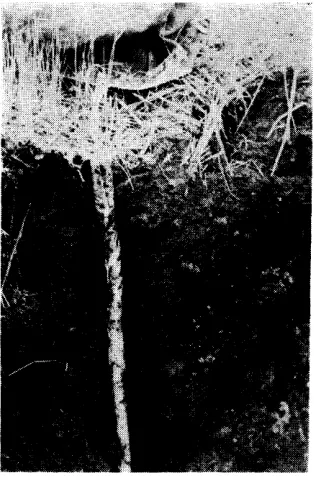
me&sue), has been replacing cheatgrass and other annuals in Idaho, Oregon, Washington, and California. This newcomer is of great concern to land managers and livestock operators because of its low palatability and rapid increase.FIGURE 1. Individual plants were grown in tubes of nylon cloth. The tubes were re- covered from the sidewall of trench dug adjacent to a row of tubes.
isolated patches to become the dominant on more than 750,000 acres of former cheatgrass range in Idaho. Reduction in livestock grazing capacity by as much as 50 to 80 percent has resulted in some areas within a period of a few years. Many additional hun- dreds of thousands of acres of annual grass range appear sus- ceptible to invasion by medusa- head in Idaho and adjacent states.
Both cheatgrass and medusa- head are wmter annuals and their life cycles are similar ex- I cept in one major feature. Medu-
sahead reaches maturity 2 to 3 weeks later than cheatgrass
(Sharp et al., 1957). The reason for the apparent ease with which medusahead has been able to dis- place cheatgrass is not under- stood. Outwardly, medusahead does not appear to have any distinct competitive advantage over cheatgrass, and yet the former has been able to replace the latter (Sharp and Tisdale, 1952). The possibility that an ex- amination of the root system of the two species might help ex- slain medusahead’s superior
competitive ability led to the present study, conducted during the period 1956 through 1958.
Location of Study
The study was conducted in Gem County, Idaho in a field where medusahead had sup - planted cheatgrass several years previously. The soil type is Brent silt loam, a Chestnut soil. The soil developed on an old alluvial fan and has a relatively deep (43 inches) and well-developed pro- file. The land slopes 3 per cent to the west, and the elevation is approximately 2,600 feet above sea level. Precipitation at the study area was estimated to be slightly greater than at Emmett, located about 8 miles away. Emmett normally receives about 12 inches of precipitation annual- ly, but about 15 inches of precipi- tation was recorded annually during the study period.
Methods
Prior knowledge of cheatgrass and medusahead root behavior played an important role in the decision as to what technique was to be employed in this study. Cheatgrass roots tend to pene- trate the soil vertically (Hulbert, 1955) and preliminary study by the author indicated that medu- sahead roots behave similarly. This tendency toward vertical
root penetration was found to be more pronounced in dense than in sparse stands.
In order to simulate natural stand condition as much as possi- ble and simultaneously be able to follow rate of soil penetration by individual plants, roots of in- dividuals were restricted to a narrow column of soil encased in l-inch diameter tubes made from nylon cloth (Figure 1). The use of cloth, rather than a rigid con- tainer, permitted close contact between soil column and con- tainer wall during soil drying and allowed easy exchange of soil moisture with the adjacent soil outside the tube.
The cloth tubes were filled with soil extracted by an orchard-type soil sampler. The soil was placed in the tubes in the reverse order of extraction, i.e., soil from the bottom of the hole was placed in the bottom of the tube. A firmly packed tube was indicated when it became circular in cross section with re- peated bouncing and tapping on the ground. The tubes were “planted” in holes from which the soil was obtained.
In October 1956 each tube was planted in a separate hole, but in the following year they were bundled in groups of four and firmly secured to a lath. The lath spine greatly facilitated later re-
t
48”
0” I I 1 I , - 0”
DEC. JAN. FEB. MAR. APR. MAY JUN.
covery of the tubes. The length of the tubes to be recovered dur- ing the winter months was 2 feet or less. Those to be recovered after March were 3 feet long.
Only medusahead and cheat- grass were grown the first year. Each tube received two seeds and after germination and emer- gence one seedling was permit- ted to become established. When the experiment was repeated the following year (1957) each of the four tubes of a bundle was seeded to one of four species- medusahead, cheatgrass, desert wheatgrass (Agropyron deser- torum), or intermediate wheat- grass (A. intermedium).
The tubes (or bundles of tubes) were planted 18 inches apart in seven rows in a dense stand of medusahead. The dis- turbance of the existing vegeta- tion and soil was confined to a core 3 inches in diameter with a depth equal to the length of the “planted” tubes. The study area was mulched with a light cover of grain straw to reduce the chance of contamination of the seeded tubes by stray medusa- head seed and also to lessen the effect of frost heaving. Each month, beginning in mid-Decem- ber, one row of tubes (consisting of four replicates of each spe- cies) was recovered, taken to the laboratory, and soaked in water overnight. Each tube was then split carefully and the roots separated from the soil by wash- ing with a fine jet of water. In no case did a root penetrate the nylon cloth, but in a few in- stances roots passed through the seams between stitches. Length measurements obtained were the maximum distance from root tip to seed and from seed to leaf tip with the plant laid out on a flat surf ace.
Resulfs
The cumulative growth curves of r o o t s of medusahead and cheatgrass for the 1956-57 study are presented in Figure 2. There was no signif icant difference in
48”
i t 48”
- MEDUSAHEAD
1957 - 1958 . . . . ..““‘CHEATGRASS
--- INTERMEDIATE u) 36’5
?
- CRESTED , . . . . . . . . . . . . . . . -36”
z I
$ 24’1 - 24”
x
5
2
l2’L - 12”
0” I 1 I 1 1 - 0”
OK. JAN. FEB. MAR. APR. MAY JUN.
FIGURE 3. The cumulative growth curves of depths of root penetration for four species
during the 1957-58 study. Measurements were obtained during the middle of each
month.
root length between the two species during any period of the study. A significant increase in root length occurred for both species between mid-December and mid-March and between mid-March and mid-April. Little additional increase in overall root length occurred after mid- April for the two species.
Measurable increase in the aerial portion of the plants was not evident until after mid- March. Full emergence of the inflorescence of cheatgrass oc- curred during the third week of May, after which time no further increase in height was noted. Medusahead reached full flower- ing during the second week of June. Plants of both species de- veloped only single culms dur- ing the first year of study.
The following year the experi- ment was repeated with the addition of desert wheatgrass a n d intermediate wheatgrass, two perennial grasses commonly used for range seeding purposes. Germination of these species occurred during the third week of October, about one week later than the annual grasses.
The cumulative growth curves for the four species are presented in Figure 3. Cheatgrass did not grow as well in 1958 as in the previous year, but medusahead behaved much as it had the year
before. The roots of cheatgrass tended to be consistently shorter than those of medusahead, but because of the small number of replications a statistically sig- nificant difference (P.,,5) could not be demonstrated between the two species. Because one or two plants were either missing or damaged at each recovery, the multiple range tests as described by Kramer (1956) were em- ployed. The perennial species had a higher mortality percent- age than the annuals.
Prior to April the root systems of the two annual grasses con- sisted primarily of a single main root with short laterals. About the time the aerial portion of the plants began to add conspicuous growth, much ramification and lateral development of the root systems were observed. It be- came increasingly difficult to de- termine which of the long roots was the original primary root. Multiculum plants tended to de- velop a more extensive root sys- tem than those with only a single culm. During the second year of study most of the annual plants developed more than one culm. Tillering became evident in April.
l : - l CRESTEO
1957 - 1958 MEWSAHEAD
e... * * * CHEATGRASS
-- - INTERMEDIATE
18”
12 ”
6 I,
0”
DEC. JAN. FEB. MAR. APR. MAY JUN.
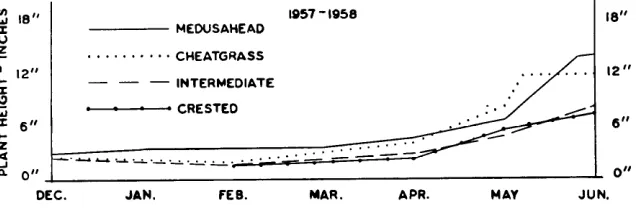
FIGURE 4. The cumulative growth curves of average maximum height of aerial portion for four species during the 1957-58 study. Measurements were obtained during the middle of each month. Cheatgrass reached its maximum height several days after the mid-May recovery was made.
older and appeared to be corre- lated with a change in color from white to brown. A noticeable in- crease in brittleness of roots occurred as full inf lorescence was approached for both species.
The roots of the perennial grasses did not add any signifi- cant increment from mid-Decem- ber to mid-March. After March, root increment was added at a fairly consistent rate ‘until the termination of the study in mid- June. As in the case of the annual grasses, a significant in- crease in leaf length did not occur until April (Figure 4). This delay of aerial growth ac- tivity for all species was more apparent than real, however. The leaf blades that were present in the fall were gradually killed back from the leaf tip, and at the same time new leaf blades re- placed the old during late winter and early spring. It was not noted whether this replacement occurred for all leaf blades that were present the previous fall, but it is probable that the coleop- tile and the first and second true leaves were replaced in this manner.
Discussion
The root systems of cheatgrass and medusahead reached full de- velopment about the time full in- florescence occurred. After this stage of plant development a marked increase in brittleness of roots was noted. Nut t onson
(1957) mentioned a s i m i 1 a r phenomenon with annual rye,
Secale cereale, and indicated that it was associated with a marked decrease in moisture uptake by the roots.
According to Piemeisel (1951), the annual species that ranks high in earliness of germination, earliness of maximum growth and maturity, capacity to with- stand crowding, and high seed production possesses a decided advantage in occupying and hold- ing a particular site over other annuals that rate lower in these characteristics. Cheatgrass is su- perior to medusahead in earli- ness of maximum growth and maturity. Both species are about equal in the remaining char- acteristics. It appears likely that a stand of cheatgrass would be able to resist invasion by medu- sahead in situations where soil moisture was sufficiently limit- ing that cheatgrass was able to utilize nearly all of the available moisture for its development, leaving an insufficient amount for medusahead to complete its life cycle.
In areas having a surplus of soil moisture after cheatgrass reaches maturity, medusahead would be able to complete its life cycle in spite of the presence of cheatgrass. This might explain how medusahead is able to in- vade cheatgrass stands when soil moisture is the only considera- tion. In southern Idaho there are many areas where a surplus of available moisture is p r e s e n t after cheatgrass matures. These areas are conspicuous by the
presence of summer broadleaved annuals. Differential g r a z i n g preference by livestock may also favor invasion of medusahead into areas where it would not normally become established un- less the cheatgrass cover were disturbed.
The above offers an explana- tion as to how it is possible for medusahead to invade cheatgrass stands. It does not, however, ex- plain how medusahead is able to replace and become the domi- nant after initial invasion. In this respect, this study of the root system of the two species failed to yield a satisfactory answer. The mechanism of c h e a t g r a s s replacement by medusahead needs further study. The performance of the peren- nial grasses in this study shows clearly why range seeding with perennial species is apt to be un- successful on lands dominated by cheatgrass or medusahead unless competition from the latter spe- cies is reduced.
Fall emergence of these annu- als is a common occurrence, whereas fall e m e r g e n c e of seeded perennials is less frequent under the normal climatic con- ditions as well as under the pres- ent practice followed in seeding rangelands in the Intermountain Region. By the time spring emer- gence of the perennial species occurs, the annual grasses have their root systems well advanced towards full development. Even if the seeded species were to ger- minate and emerge in the fall, as in this study, the slower rate of root penetration places them at a disadvantage in competing for soil moisture in the spring.
Summary
covered
monthly from mid-
December through mid-June and
the depth of root penetration and
aerial g r o w t h measurements
were obtained.
Rate of vertical root penetra-
tion of the two annual grasses
was about equal, but cheatgrass
reached maximum branching a
few weeks earlier than medusa-
head. Maximum root develop-
ment coincided closely with time
of full inflorescence for the two
species. Because medusahead
matures later, its root system re-
mains functional for a longer
period than those of cheatgrass.
When the two species are grow-
ing together the water require-
ment for cheatgrass must be
satisfied before medusahead is
able to complete its life cycle.
LITERATURE CITED
HULBERT, LLOYD C. 1955. Ecological studies of Bromus tectorum and other annual bromegrasses. Ecol.
Monog. 25 (2) : 181-213.
HULL, A. C. JR., AND JOSEPH F. PECHANEC. 1947. Cheatgrass - a challenge to range research. Jour. Forestry 45 (8) : 555-564.
HULL, A. C. JR., AND GEORGE STEWART. 1948. Replacing cheatgrass by re- seeding with perennial grass on southern Idaho ranges. Jour. Amer. Sot. Agron. 40 (8) : 694-703. KRAMER, CLYDE YOUNG. 1956. Exten- sion of multiple range tests to group means with unequal num-
bers of replications. Biometrics 12 (3) : 307-310.
NUTTONSON, M. Y. 1957. Rye-climate relationships and the use of phe- nology in ascertaining the thermal and photo-thermal requirements of rye. Amer. Inst. Crop Ecology, Wash., D. C. 1958.
PIEMEISEL, ROBERT L. 1951. Causes affecting change and rate of change in a vegetation of annuals in Idaho. Ecology 32 (1) : 53-72. SHARP, LEE A., AND E. W. TISDALE.
1952. Medusa-head, a problem on some Idaho ranges-a preliminary study. Res. Note 3, For., Wildlife and Range Expt. Sta., Univ. of Idaho, Moscow, Idaho.
SHARP, LEE A., M. HIRONAKA, AND E. W. TISDALE. 1957. Viability of medusa-head (Elymus caput-me- dusae L.) seed collected in Idaho. Jour. Range Mangt. 10 (3) : 123-126.
Water Inta
on Certain
.ke as Affected by Soil and Vegetation
Western South Dakota Rangelands’
.FRANK RAUZI AND ARMINE R. KUHLMAN
Soil Scientist, Western Soil and Water Management Research Branch, and Project Leader, Watershed Tech- nology Research Branch, Soil and Water Conservation Research Division, Agricultural Research Service, U. S. Department of Agriculture, Laramie, Wyoming and Newell, South Dakota, respectively.