Random Number Generators
Yuan Ma1,2, Jingqiang Lin1,2,3, and Jiwu Jing1,2,3
1
Data Assurance and Communication Security Research Center, Chinese Academy of Sciences, Beijing, China
2
State Key Laboratory of Information Security, Institute of Information Engineering, Chinese Academy of Sciences, Beijing, China
3
University of Chinese Academy of Sciences, Beijing, China
{yma,linjq,jing}@is.ac.cn
Abstract. True random number generators (TRNGs) are essential for cryptographic systems, and they are usually evaluated by the concept of entropy. In general, the entropy of a TRNG is estimated from its s-tochastic model, and reflected in the statistical results of the generated raw bits. Oscillator-based TRNGs are widely used in practical crypto-graphic systems due to its elegant structure, and its stochastic model has been studied in different aspects. In this paper, we investigate the appli-cability of the different entropy estimation methods for oscillator-based TRNGs, including thebit-rate entropy, thelower bound and the approx-imate entropy. Particularly, we firstly analyze the two existing stochastic models (one of which is phase-based and the other is time-based), and deduce consistent bit-rate entropy results from these two models. Then, we design an approximate entropy calculation method on the output raw bits of a simulated oscillator-based TRNG, and this statistical calcula-tion result well matches the bit-rate entropy from stochastic models. In addition, we discuss the extreme case of tiny randomness where some methods are inapplicable, and provide the recommendations for these entropy evaluation methods. Finally, we design a hardware verification method in a real oscillator-based TRNG, and validate these estimation methods in the hardware platform.
Keywords: Oscillators, true random number generators, entropy esti-mation, stochastic model
1
Introduction
Diehard [11]) cannot evaluate the unpredictability of the sequence, as determin-istic sequences with good statdetermin-istical properties are able to pass the statdetermin-istical tests.
The concept of entropy, which measures the uncertainty in bits (e.g., bit-rate entropy), is used to evaluate the unpredictability of a RNG. For a true RNG (TRNG), the predictability comes from the randomness of physical noises. The international standard ISO/IEC 18031 [7] and Germany standard AIS 31 [8] recommend to establish the entropy estimator with a stochastic model for TRNG evaluation. The stochastic model describes the extraction process from physical random noises to digitized random bits based on reasonable physical assumptions.
Oscillator-based sampling is a typical structure adopted by many TRNG designs, and the stochastic models of oscillator-based TRNGs have been well studied in recent years. To figure out the entropy of oscillator-based TRNGs, Killmann and Schindler [9] established a common stochastic model by a time-based approach, and gave a tight lower bound of the entropy; using the similar approach, Ma et al. [10] presented a calculation method to obtain the precise entropy. In addition, Amakiet al.[1] calculated the probabilities of certain bit patterns by using a Markov state transition matrix, but they evaluated the security using the Poker test [6] rather than entropy estimation. Baudetet al.[2] proposed a phase-based approach and provided a concise analytical formula for the entropy calculation (including then-bit entropy and the lower bound). The entropy can be rapidly figured out by substituting the TRNG design parameters, including the jitter ratio and the frequencies of the sampling and sampled signals. This formula is then employed to estimate the entropy for a sufficient-entropy TRNG design [4].
While the entropy is estimated with these stochastic models based on the TRNG design parameters, the approximate entropy (ApEn) is obtained statis-tically based on the output bit sequence of a TRNG. ApEn is calculated by comparing the distributions ofm-bit and (m+ 1)-bit blocks in the bit sequence. However, the parametermin ApEn shall be chosen carefully to trade off between the accuracy of entropy estimation and the computation complexity.
Although various entropy estimation methods have been proposed in litera-ture, a comprehensive and systematical study for their accuracy and applicability (e.g., the consistency of different methods, the estimation error between theory and experiment, the extreme cases of design parameters) is still lacking. In this paper, we investigate the applicability of different entropy calculation methods for oscillator-based TRNGs, including the bit-rate entropy, the lower bound and the approximate entropy. Particularly, we make the following contributions.
– We present two bit-rate entropy calculation methods based on the time-based and phase-time-basedn-bit entropy stochastic models [2, 10], respectively. The results are analyzed, and we deduce consistent bit-rate entropy results from these two models by expanding the original analytical expression. – We propose an approximate entropy calculation method for the output bit
from the autocorrelation coefficient of the bit sequence. The ApEn calcula-tion result of a simulated oscillator-based TRNG well matches the bit-rate entropy from stochastic models, which confirms the correctness of the theo-retical results.
– We investigate the applicability of these entropy estimation methods in the extreme case with tiny randomness (i.e., the accumulated jitter is very small within the sampling interval). As it is possible to make an overestimation of the entropy in such case, we provide an alternative method to acquire a conservative estimation for the entropy.
– We design a hardware verification method in a real oscillator-based TRNG. In the experiment, we calculate the randomness factor under the white noise, and validate these estimation methods in the hardware platform.
The rest of the paper is organized as follows. In Section 2, we introduce the preliminary about the principle and existing entropy estimation methods for oscillator-based TRNGs. We propose our evaluation method on the different types of entropy in Section 3. In Section 4, we present the evaluation results and investigate the case of tiny randomness. In Section 5, we investigate the effectiveness of the estimation methods in the hardware platform. In Section 6, we conclude the paper.
2
Preliminary
In this section, we first introduce the principle of oscillator-based TRNGs. Then we summarize the methods of entropy estimation. The types of entropy include n-bit entropy, lower bound of entropy and approximate entropy.
2.1 Oscillator-based TRNGs
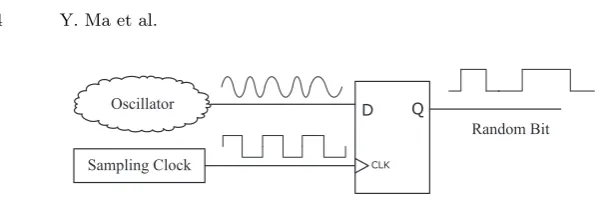
The basic structure of oscillator-based TRNGs contains an unstable oscillator generating a fast oscillating signal with jitter, and a sampling reference clock that is assumed without jitter, as shown in Figure 1. The randomness comes from jitter in the fast signal periods that is caused by noises. In general, the noises that affect jitter are assumed to be independent and identically distributed (i.i.d.) for the simplicity of the model. As an exception, the model of [9] partially allows short-term dependency in the half-periods of the fast oscillating signal.
We firstly present some definitions of the parameters in the aspect of time evolution. The half-periods of fast oscillating signal are assumed to be i.i.d. with meanmX =E(Xk) and variancesX2 =V(Xk), whereXkis thek-th half-period. The fixed sampling interval is denoted as∆t.
Sampling Clock
D Q
CLK
Random Bit Oscillator
Fig. 1.The basic structure of oscillator-based TRNGs
mX to the sampling interval∆t, which is measured using variable r=∆t/mX mod 1. The divisibility increases whenrapproaches to 0.5 from either 0 or 1 and reaches its maximum atr= 0.5. The cases ofr= 0 andr = 0.5 represent the worst and the best case of the TRNG output quality, respectively. This property has been discovered in [2, 10, 1].
2.2 n-bit entropy
The n-bit entropy represents the amount of entropy for n-bit output random sequences. In general, there are two methods to get the n-bit entropy, time-based and phase-time-based. The basic idea is to calculate the probability of n-bit pattern, which is denoted as p(b), from the stochastic model, and then iterate all the patterns to getn-bit entropy via Equation (1).
Hn=
∑
b∈{0,1}n
−p(b) logp(b). (1)
Time-based method. Ma et al. [10] use the classic model of [9] in the aspect of time evolution. They utilize the waiting timeWito represent the rela-tionship between the adjacent sampling bits, whereWiis the distance of thei-th sampling position to the closest following edge of fast oscillating signal. They use a set of conditional probability functions to calculate then-bit pattern prob-ability by iterating, and eliminate Wi from the final expression by probability integration for the uniform distribution ofWi. Here we do not list the detailed computing process. Furthermore, they gave several curves from the worst to the best case to demonstrate the entropy variation using numerical computation, but an analytical probability or entropy expression was not given in their work. Phase-based method.Baudetet al.[2] use the phase-oriented approach to model the stochastic behavior of the oscillating signal. The phase evolution of an oscillation is modeled by a Wiener stochastic process φ(t) with driftµ >0 and volatility σ2 >0. The parameters are equivalent to the time-based definitions following the equations:µ= 1
2mX and σ
2= s2X 4m3
X
.
Another quality factor is denoted asQ=σ2∆t= s2X∆t
4m3
X
. The frequency ratio
of the fast signal to the slow one is denoted asν=µ∆t=2m∆t
X, sor= 2ν mod 1.
sets of parameters can be converted to each other. The quality fact Q in the
phase-based method equals 4q2, whereq=√∆t mX ·
sX
mX is the parameter defined
in the time-based model [10]. For convenience, we useQ andr to compute the entropy for either time-based or phase-based method in the subsequent.
The following two formulas computing the probability andn-bit entropy are provided in their work, whereB=e−2π2Q.
1. The probability to output a vectorb= (b1, . . . , bn)∈ {0,1}n satisfies
p(b) = 1 2n +
8 2nπ2(
n∑−1
j=1
(−1)bj+bj+1) cos(2πν)B+O(B2). (2)
2. The entropy of such an output is
Hn =
∑
b∈{0,1}n
−p(b) logp(b) =n−32(n−1) π4ln(2) cos
2(2πν)B2+O(B3). (3)
2.3 Lower Bound of Entropy
Min-entropy or lower bound of entropy is the most conservative measurement of entropy, and is useful in determining the worst-case entropy of a TRNG. In the aspect of entropy calculating complexity, min-entropy or a lower bound has considerable advantages for dependent stochastic process, as only the probability in the worst case is involved. The methods for calculating a lower bound of entropy for oscillator-based TRNG are presented in [9, 2], and the worst case is also investigated in [1].
The calculation expression of the lower bound [9], which is denoted asHlo, was presented in Equation (4):
H(Bi|Bi−1, . . . , B1)≥Hlo=H(Bi|Wi−1)≈
∫ s
0
H(R(s−u)mod 2)PW(du), (4)
where Bi is theith sampling bit and R(s−u) represents the number of crossing edges in the duration of (s−u). The idea is inspired by the fact that Wi tells more information about Bi+1 than all the previous bits. Following the similar idea, [2] also provides an analytical expression forHlo, as shown in Equation (5).
Hlo= 1− 4 π2ln(2)e
−4π2Q
+O(e−6π2Q) (5)
2.4 Approximate Entropy
adopted in the NIST statistical test suite [13], which compares the frequency of overlapping blocks of two consecutive/adjacent lengths (mandm+1) against the expected result for a random sequence. The calculation process of ApEn for b= (b1, . . . , bn) is presented in Algorithm 1. The block lengthmin Algorithm 1 has an important impact on ApEn calculation, which is treated as a trade-off. The larger value of mimproves the accuracy of entropy estimation, but mean-while significantly increase the computation complexity and the required length of the tested bit sequence.
Algorithm 1Approximate entropy calculation [13] Input: block lengthm, bit sequenceb= (b1, . . . , bn)∈ {0,1}n
Output: ApEn
1: Augment then-bit sequence to createnoverlappingm-bit sequences by appending
m−1 bits from the beginning of the sequence to the end of the sequence. 2: Make a frequency count of thenoverlapping blocks. The count is represented as
#i, whereiis them-bit value.
3: ComputeCim= #i/nfor each value ofi.
4: Computeδm=Σ2
m−1
i=0 C
m
i log2C
m i .
5: Replacembym+ 1 and repeat Steps 1-4. 6: ComputeApEn=δm+1−δm.
7: return ApEn
3
Our Evaluation Method
In this section, we provide three estimation methods for the entropy: phase-based, time-based and ApEn. The former two utilize the jitter parameters to perform the estimation in theory, while the latter analyzes the output sequences.
3.1 Bit-rate Entropy Calculation
In practice, the concept of entropy per bit is preferred for entropy evaluation, rather than then-bit entropy. As the unit of the lower bound and ApEn is one bit, it is necessary to transfern-bit entropy to entropy per bit, which is called bit-rate entropy. The bit-rate entropy is closely related to the expected workload that is necessary to guess (sufficiently long) sequences of random bits [7]. In addition, a precise Shannon entropy expression, which contains more parameters, allows the TRNG designers to optimize their structures and specifically adjust the parameters to get more entropy.
Another possible case is thatnactually can be a finite value, rather than being asymptotically infinite.
H = lim n→∞
Hn
n = limn→∞H(Bn|Bn−1, ..., B1) (6)
Time-based method.In the aspect of time evolution, it is observed that the correlation between two adjacent sampling bits is decreasing with the increase of the sampling interval. When the sampling interval is sufficient long, the sampling bits can be treated as independent. Here we provide a method to determine the required sampling interval for independent sampling bits.
The correlation coefficient of adjacent bitsBi andBi+1 is represented as:
cor(Bi, Bi+1) =
COV(Bi, Bi+1)
√
Var(Bi)Var(Bi+1) ,
where COV(·) is the covariance function, and Var(·) represents the variance. Then, using the stationary property [9] that Prob(Bi = 1) = Prob(Bi+1 = 1), the correlation coefficient is deduced as:
cor(Bi, Bi+1) =
Prob(Bi= 1, Bi+1= 1)−Prob(Bi= 1)2 Prob(Bi= 1)·Prob(Bi= 0)
.
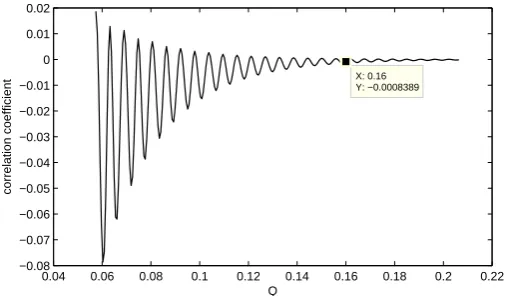
For different values ofQ, we compute the correlation coefficients, as shown in Figure 2. We observe that the dependence oscillatingly decreases with the increasing ofQ. The absolute value of the coefficient drops below 10−3 whenQ is larger than 0.16, where we consider that the correlation can be ignored and the adjacent sampling bits are treated as independent.
0.04 0.06 0.08 0.1 0.12 0.14 0.16 0.18 0.2 0.22 −0.08
−0.07 −0.06 −0.05 −0.04 −0.03 −0.02 −0.01 0 0.01 0.02
X: 0.16 Y: −0.0008389
Q
correlation coefficient
Fig. 2.The correlation coefficient in terms ofQ
treated to be independent. We denotel as the correlation length, which means the (i+l)th sampling bitBi+l is only dependent on the previous l bits. Given a value of Qfor a oscillator-based TRNG, the correlation length is deduced as l=⌊(Qind
Q )⌋, whereQindis the requiredQvalue for the independence, andQind is set to 0.16 in this paper. Then, combining with the additional conclusion that the sampling process is stationary [9],H can be derived as
H = lim
n→∞H(Bn|Bn−1, ..., B1) =H(Bl+1|Bl, ..., B1). (7)
A lower threshold of the coefficient certainly is helpful for getting a more reliable result, but the derived correlation length may be too large to complete the iterating computation of entropy within an acceptable time. The maximum l in our computation is limited below 15. ForQind= 0.16, settingl= 15 means reliable values can be acquired forQ >0.0107.
Phase-based method. In [2], since an analytical expression of n-bit en-tropy exists, forn is approaching infinity, the approximated bit-rate entropy is expressed as Equation (8).
H ≈1− 32 π4ln(2)cos
2(2πν)B2 (8)
Note that using this equation to calculate bit-rate entropy is tentative, s-inceHn in Equation (3) is not provably uniform in n[2]. The problem of non-uniformness inndose not exist in the time-based method, because the parameter l has been chosen before calculating Equation (7). In the following sections, we will learn that Equation (8) is applicable under some parameters, but has non-ignorable errors under other parameters. Hence, in the next section, we improve the equation by performing further expansion of original expression, and validate the effectiveness of the improvement by comparing with the time-based method and the ApEn of simulated sequences.
3.2 Approximate Entropy for Short-Term Dependent Bits
ApEn is a statistical result to estimate the entropy of the tested sequence. An important parameter in the algorithm is the block length m, which partially determine the estimation accuracy of the algorithm. The ideal case is that the tested bits are independent beyond the bit interval of m, which means the es-timation algorithm can have a comprehensive overlook on the tested sequence. Fortunately, for the output of oscillator-based TRNGs, the correlation lags are limited due to the independence condition, hence the sampling bits only have short-term dependence.
satisfied), a higher correlation value will be acquired and autocorrelation test is failed. Hence, we return to the original test approach that only focuses on the correlation. The autocorrelation coefficient is represented as Rh =Ch/C0, and Ch is the autocovariance function: Ch = n1
∑n−h
t=1(bt−¯b)(bt+h−¯b), where ¯b is the mean ofb1, ..., bn, andC0 is the variance function:C0= n1
∑n
t=1(bt−¯b)2. For randomness tests, it is recommended to use 99% confidence band to justify whether the test is passed or not. In this case, the test is passed when Ch lies in the interval [−z1−α/2/
√
n, z1−α/2/
√
n], where the significance level α= 0.01 andz is the cumulative distribution function of the standard normal distribution. Therefore, for the calculation of approximate entropy for short-term dependent bits, we provide the following statistical method on the oscillator-based TRNG output, as shown in Algorithm 2. Note that, due to the Type-I error in the hypothesis test, the intrinsic independent sequences still has the probability ofαto fail the test. However, this fact, which increases the correlation length m, would not lead to estimation error of the entropy as long as the sequence length is satisfied, since largerm is preferred for estimation.
Algorithm 2Approximate entropy calculation for short-term dependent bits Input: h= 1, bit sequenceb= (b1, . . . , bn)∈ {0,1}n
Output: ApEn
1: while|Ch|> z0.995/ √
ndo
2: h=h+ 1 3: end while
4: ComputeApEnusing Algorithm 1 with the parameterm=h
5: return ApEn
4
Entropy Evaluation
In this section, by comparing the results of different entropy calculation methods, we evaluate the applicability and accuracy of these methods for oscillator-based TRNGs. Particularly, as the original analytical formula has biases on the bit-rata entropy estimation for some TRNG parameters, we present a more accurate formula by performing further deducing, and the correctness is verified with other entropy results. Finally, we investigate the limitations of these methods in the case of tiny randomness, i.e., very smallQ.
4.1 Bit-rate Entropy Calculation Results
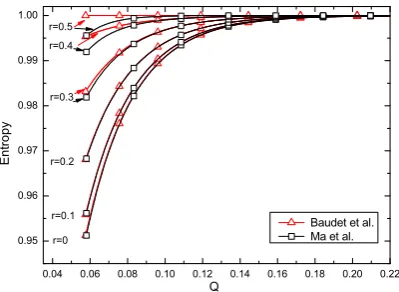
from 0 to 0.5. More precisely, the difference between the two results is maximized with the parameter r approaching 0.5, as shown in Figure 3. Their results are almost identical in the worse cases (r∈[0,0.2]), but in the other cases ofrwith a modest Qvalue the deviation occurs, especially at r= 0.5.
0.04 0.06 0.08 0.10 0.12 0.14 0.16 0.18 0.20 0.22 0.95
0.96 0.97 0.98 0.99 1.00
Baudet et al. Ma et al.
E
n
t
r
o
p
y
Q r=0
r=0.1 r=0.2 r=0.3 r=0.4 r=0.5
Fig. 3.The bit-rate entropy calculated from Ma et al.’s (time-based) and Baudetet al.’s (phase-based) methods
From the physical perspective, thervalue is related to the fractional part of the ratio of sampling interval to the mean of half-periods (∆t/mX). From the theoretical result of [10], to achieve a sufficient bit-rate entropy (such as 0.9999), the required sampling frequency in the best case is about two times faster than that in the worst case under the same quality factor. Hence, in the condition of fixed Q, the value of rhas a non-negligible impact on the entropy, as shown in Figure 3. Also, from the perspective of the designer, adjustingrcan significantly improve the entropy without the degradation of the sampling frequency.
4.2 Improved Bit-Rate Entropy Expression Formula
We expand the original approximated expression formula of n-bit entropy by performing further deducing. The improved results are presented in Theorem 1.
Theorem 1. Forr=m∆t
X mod 1andQ=
s2
X∆t 4m3
X
, then-bit entropy is:
Hn=. n−
32 ln(2)π4 cos
2
(πr)(n−1)e−4π2Q
− 32
ln(2)π4 [
cos4(πr)(1.524n−0.092)−2.379 cos2(πr)(n−2) + (n−2)
]
e−8π2Q
The (trial) approximated bit-rate entropy is expressed as:
H≈ 1− 32B
2
ln(2)π4 cos 2
(πr)− 32B
4
ln(2)π4 [
1.524 cos4(πr)−2.379 cos2(πr) + 1
] .
(10)
In the improved expression Equation (9), the first two terms are derived from the original one. Our work focuses on the deduction of the third term, the higher-order term. We strictly follow the same assumptions used in [2], but perform the further deduction on the entropy calculation process based on series expansion. The proof details are presented in the full version of this paper.
4.3 Bit-Rate Entropy Comparison: Time-based vs. Phase-based
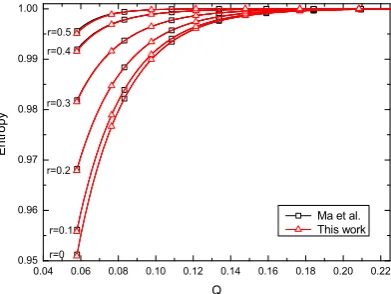
In order to validate the reliability of the improved result, we first compare it with the bit-rate entropy derived from the time-based method. The comparison result is shown in Figure 4. We can see that after our improvement the two results become very close in all six cases fromr= 0 tor= 0.5. Note that as the expression is analytical, the derived entropy is not only the data lying in the six curves, but the values for all the possible cases ofQandr. We remark that it is no surprise that the two entropy results are identical, because the focusing target and the physical assumption of small jitter are both the same. The equivalence between the two models has been presented in [2].
0.04 0.06 0.08 0.10 0.12 0.14 0.16 0.18 0.20 0.22 0.95
0.96 0.97 0.98 0.99 1.00
Ma et al. This work
E
n
t
r
o
p
y
Q r=0
r=0.1 r=0.2 r=0.3 r=0.4 r=0.5
Fig. 4.The comparison of bit-rate entropy with the improved formula
the existence of the constant 1 in the coefficient of B4. Therefore, in this case the impact of B4 term cannot be ignored and only using B2 term to estimate the entropy is not enough.
Another important observation is that expanding the Taylor series to B4 is enough to reliably estimate the entropy for such Q ∈ (0.06,+∞), where Q is not a very small value. The improved expression might have a bias when Q becomes a much smaller value, as the impact of the higher-order term ofB(such asB6) exists. But we must admit that getting the higher-order term ofBseems infeasible, as the series in Equation (3) after further expanding are too complex.
4.4 Bit-Rate Entropy vs. Approximate Entropy
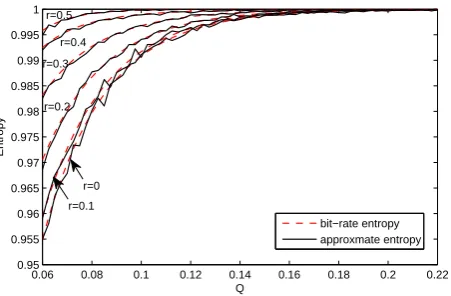
After the improvement, the bit-rate entropy values derived from the two meth-ods are consistent, but it is necessary to confirm that the theoretical results is consistent with the experimental. For this purpose, we use the approximate en-tropy, which is a statistical measurement from the output bit sequence, to verify the applicability of the entropy evaluation method. Note that, the statistical entropy values are also random for random sequences, so directly using ApEn to do entropy estimation would lead to measurement errors. However, it is valuable to compare the trends of ApEn and bit rate entropy, which can be treated as experimental and theoretical results, respectively.
Following the assumptions in the aspect of time evolution, we perform a simulation experiment to calculate ApEn. In the experiment, the fast signal periods are independent and identically distributed, and the distribution is set as the normal distributionN(1,0.012). Each ApEn is computed from 105sampling bits for each sampling interval which corresponds the values ofQandr. As the two bit-rate entropy results are almost the same, we use the improved phase-based result as the reference to compare with ApEn. The comparison results from r = 0 to r = 0.5 are shown in Figure 5. We find that the two sets of results are well-matched for all r values. Therefore, Algorithm 2 is suitable to estimate the bit-rate entropy for this type of short-term dependent sequences. A more precise results can be acquired by averaging the estimated values of many statistical experiments.
4.5 Entropy Estimation for Smaller Quality Factor
In the previous entropy estimation results, the investigated values ofQare not very small, which are available for the entropy evaluation of most practical TRNGs. However, for very samll Q values, the presented entropy calculation methods are not applicable. The reasons are explained as follows.
0.06 0.08 0.1 0.12 0.14 0.16 0.18 0.2 0.22 0.95
0.955 0.96 0.965 0.97 0.975 0.98 0.985 0.99 0.995 1
Q
Entropy
bit−rate entropy approxmate entropy r=0.1
r=0 r=0.2
r=0.4 r=0.5
r=0.3
Fig. 5.The comparison between the bit-rate entropy and the approximate entropy
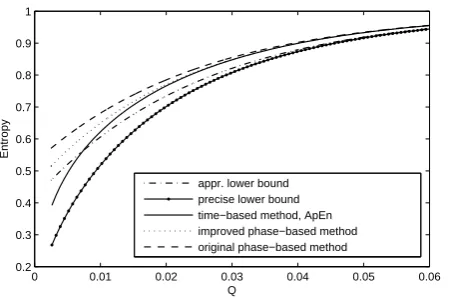
– For the phase-based bit-rate entropy calculation method, whenQdecreases, the estimation error increases with no limitation, as the Hn expression is not uniform in n. Therefore, the approximated formula is not applicable to estimate the bit-rate entropy in this case, though our improvement has extended the applicable range of the formula.
– For the presented approximate entropy estimation method, a very smallQ makes the statistical correlation lasts very long lags, which causes that the parameterm in Algorithm 2 is too large to complete the computation. For example, in our experiment, whenQ= 0.01 the statisticalm of Algorithm 2 is about 30, thus the workload for the traversal loops and the requirement for the sequence length are unacceptable in this case. The problem also leads to an overestimation for the entropy of the tested sequence.
0 0.01 0.02 0.03 0.04 0.05 0.06 0.2
0.3 0.4 0.5 0.6 0.7 0.8 0.9 1
Q
Entropy
appr. lower bound precise lower bound time−based method, ApEn improved phase−based method original phase−based method
Fig. 6.The comparison of entropy values with smallQatr= 0
5
On the Relationship with Physical RNGs
The existing models [2, 10] assume that the oscillating period or phase increment is independently distributed due to the influence of white noise. This is a com-mon assumption in literature, which allows to guarantee the simplicity of the model. However, in real TRNG circuits, the jitter or phase is also influenced by colored noises (such as 1/f noise) more than white noise, and the phenomenon has been demonstrated in recent works [5, 10, 14]. Under these colored noises, the period jitter has long-term dependence, and the dependence is also inher-ited by the sampling bit sequence [10]. In practical TRNGs, it is infeasible to perform similar confirmatory experiment as our simulation where the entropy is calculated via the output sequence, as the randomness amount is inevitably increased by colored noises and the offsetris hard to be precisely measured.
Fortunately, the white noise is independent from colored noises in principle, so the existing model and corresponding entropy estimation methods can still work for estimating the contribution of the white noise. When the estimated contribution (i.e., entropy) derived fromindependent jitter is sufficient, we can also claim that the entropy of the TRNG is satisfied. In practical entropy evalua-tion, the independent jitter can be acquired by employing an inner measurement method that excludes the dependent component of the jitter in the measurement (such as [5]). This evaluation approach neatly sidesteps the impact of colored noises.
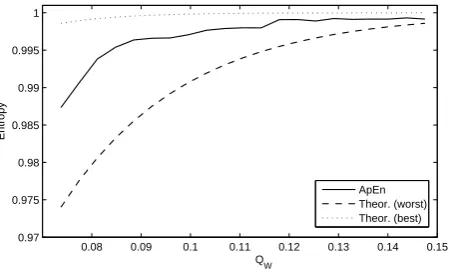
duty cycle, and the change is compatible with the above models. The period number of the sampling signal is set to 256×i, where i ∈ {20,21, ...,40}. For each sampling interval, we collect the random number sequence with length 220, and calculate the ApEn of the bit sequence. Particularly, the quality factor that is influenced by white noisesQW is computed by employing the method of [5]. The comparison between the ApEn and the theoretical entropy (worst case and best case) is depicted in Figure 7. It is observed that ApEn increases between the worst and the best case of theoretical entropy as expected. As the bit se-quence has been affected by colored noises, its statistical randomness is much better than the worst case of the theoretical entropy. From Figure 7, we can conclude that our improved theoretical entropy is suitable to estimate the lower and upper bounds of the output bit sequence.
0.08 0.09 0.1 0.11 0.12 0.13 0.14 0.15 0.97
0.975 0.98 0.985 0.99 0.995 1
QW
Entropy
ApEn Theor. (worst) Theor. (best)
Fig. 7.The comparison between ApEn and theoretical entropy in the physical RNG
6
Conclusion
Acknowledgments.
This work was partially supported by National Basic Research Program of China (973 Program No. 2013CB338001), National Natural Science Foundation of Chi-na (No. 61602476, No. 61402470) and Strategy Pilot Project of Chinese Academy of Sciences (No. XDA06010702).
References
1. Amaki, T., Hashimoto, M., Mitsuyama, Y., Onoye, T.: A worst-case-aware de-sign methodology for noise-tolerant oscillator-based true random number generator with stochastic behavior modeling. IEEE Transactions on Information Forensics and Security 8(8), 1331–1342 (2013)
2. Baudet, M., Lubicz, D., Micolod, J., Tassiaux, A.: On the security of oscillator-based random number generators. Journal of Cryptology 24(2), 398–425 (2011) 3. Box, G.E.P., Jenkins, G.: Time Series Analysis: Forecasting and Control, pp. 28–32.
Holden-Day (1976)
4. Fischer, V., Lubicz, D.: Embedded evaluation of randomness in oscillator based elementary TRNG. In: Batina, L., Robshaw, M. (eds.) Cryptographic Hardware and Embedded Systems (CHES). pp. 527–543 (2014)
5. Haddad, P., Teglia, Y., Bernard, F., Fischer, V.: On the assumption of mutual independence of jitter realizations in P-TRNG stochastic models. In: IEEE Design, Automation and Test in Europe Conference and Exhibition (DATE). pp. 1–6 (2014) 6. Information Technology Laboratory: FIPS 140-2: Security Requirement For
Cryp-tographic Modules (2011)
7. ISO/IEC 18031: Information Technology - Security Techniques - Random bit gen-eration (2011)
8. Killmann, W., Schindler, W.: A proposal for functionality classes for random number generators. http://www.bsi.bund.de/SharedDocs/Downloads/DE/BSI/ Zertifizierung/Interpretationen/AIS_31_Functionality_classes_for_
random_number_generators_e.pdf?__blob=publicationFile(2011)
9. Killmann, W., Schindler, W.: A design for a physical RNG with robust entropy estimators. In: Oswald, E., Rohatgi, P. (eds.) Cryptographic Hardware and Em-bedded Systems (CHES). pp. 146–163 (2008)
10. Ma, Y., Lin, J., Chen, T., Xu, C., Liu, Z., Jing, J.: Entropy evaluation for oscillator-based true random number generators. In: Batina, L., Robshaw, M. (eds.) Cryp-tographic Hardware and Embedded Systems (CHES). pp. 544–561 (2014) 11. Marsaglia, G.: Diehard Battery of Tests of Randomness. http://www.stat.fsu.
edu/pub/diehard/
12. Menezes, A., Oorschot, P.v., Vanstone, S.: Handbook of Applied Cryptography. CRC Press (1997)
13. Rukhin, A., et al.: A statistical test suite for random and pseudorandom number generators for cryptographic applications. NIST Special Publication 800–22.http: //csrc.nist.gov/publications/nistpubs/800-22-rev1a/SP800-22rev1a.pdf