Downgradable Identity-based Encryption and
Applications
Olivier Blazy†, Paul Germouty‡, and Duong Hieu Phan†
† Université de Limoges, XLim, France
‡
Abstract. In Identity-based cryptography, in order to generalize one receiver encryption to multi-receiver encryption, wildcards were introdu-ced: WIBE enables wildcard in receivers' pattern and Wicked-IBE allows one to generate a key for identities with wildcard. However, the use of wildcard makes the construction of WIBE, Wicked-IBE more complica-ted and signicantly less ecient than the underlying IBE. The main reason is that the conventional identity's binary alphabet is extended to a ternary alphabet{0,1,∗} and the wildcard∗ is always treated in a convoluted way in encryption or in key generation. In this paper, we show that when dealing with multi-receiver setting, wildcard is not ne-cessary. We introduce a new downgradable property for IBE scheme and show that any IBE with this property, called DIBE, can be eciently transformed into WIBE or Wicked-IBE.
While WIBE and Wicked-IBE have been used to construct Broadcast en-cryption, we go a step further by employing DIBE to construct Attribute-based Encryption of which the access policy is expressed as a boolean formula in the disjunctive normal form.
Keywords. Identity-Based Encryption, Attribute-Based Encryption.
1 Introduction
Identity-based encryption (IBE) is a concept introduced by Shamir in [Sha84] allowing encrypting for a specic recipient using solely his iden-tity (for example an email address or phone number) instead of public key. Decryption is done by using a user secret key for the said identity, obtai-ned via a trusted authority. This concept avoids the use of Public Key Infrastructure in order to get a user's public key securely. This was the main argument to build such scheme, however a lot of works expose the fact that Identity-based Encryption schemes can be used to build other primitives like Adaptive Oblivious Transfer [GH07,BCG16].
meaning that an adversary may select the challenge identity id∗ after
seeing the public key and arbitrarily many user secret keys for identities of his choice. The concept of IBE generalizes naturally to hierarchical IBE (HIBE). In anL-level HIBE, hierarchical identities are vectors of identities
of maximal length L and user secret keys for a hierarchical identity can
be delegated. An IBE is simply a L-level HIBE withL= 1.
From one receiver to multi-receiver setting: introduction of wil-dcard. As in the case of public-key encryption, passing from one receiver setting to multi-receiver setting is an important step. For this aim, wild-card IBE (WIBE) was introduced in [ACD+06] where the wildcard symbol
(*) is added in identities to encrypt for a broad range of users at once. Along the same line, another generalization called WKD-IBE [AKN07] al-lows joker (*) symbol in users' secret keys to decrypt several targeted iden-tities with a single key. Many others primitives, namely identity-based bro-adcast encryption [AKN07], identity-based traitor tracing [ADML+07],
identity-based trace and revoke [PT11] schemes can be then constructed from WIBE and WKD-IBE.
Is wildcard really necessary for the multi-receiver setting? While the introduction of wildcard is very interesting, it makes the construction of WIBE, Wicked-IBE more complicated and thus less ecient than the underlying IBE. Basically the alphabet is extended from a conventional binary alphabet to a ternary alphabet{0,1,∗}and the wildcard∗is trea-ted in a special and dierent way than{0,1}. Beside the eciency, there is often a signicant loss in reducing the security of the WIBE, Wicked-IBE to the underlying IBE.
We are thus interested in the following question: can we avoid wildcard in considering IBE in multi-receiver setting? This paper gives the positive answer. We propose a new property for IBE, called downgradable IBE (DIBE). While keeping the binary alphabet unchanged, we show that downgradable IBE is not less powerful than the other wildcard based IBE: ecient transformations from downgradable IBE to wildcard based IBE schemes will be given.
key linear in the size of the identity (instead of n2) and is fully secure
under the standard assumption DLin. Indirectly our instantiation also improve the identity-based broadcast encryption, identity-based traitor tracing, identity-based trace and revoke schemes which rely on the WIBE and Wicked-IBE.
Toward ecient transformations from DIBE to ABE. Attribute-Based Encryption (ABE), introduced by Sahai and Waters [SW05], is a generalization of both identity-based encryption and broadcast encryp-tion. It gives a exible way to dene the target group of people who can receive the message: the target set can be dened in a more structural way via access policies on the user's attributes. While broadcast encryp-tion can be obtained from WIBE, as far as we know, there is still no generic construction of ABE from any variant of IBE. We will show a transformation from DIBE to ABE where the access policies is in DNF.
In the papers [AKN07, FP12], they show how some variant of IBE, WKD-IBE for the rst one and HIBE for the second one, can be used to create broadcast encryption. ABE encompass the notion of Broadcast Encryption, thus our work achieves the willing of constructing the complex primitive like ABE from the much more simple IBE.
1.1 This work
Downgradable IBE In this work we introduce the notion of Down-gradable Identity-based Encryption (DIBE). A downDown-gradable IBE is an identity-based encryption where a user possessing a key for an identity
usk[id]can downgrade his key to any identityid˜ with the restriction that
he can only transform 1 into 0 in his identity string. More formally, the set ID˜ ={id˜|∀i,id˜i = 1⇒idi = 1}.
From Downgradable IBE to HIBE, WIBE, WKD-IBE We later show that our new primitive encompasses other previous primitives, and that it can be tightly transformed into all of them. We then propose a generic framework, and an instantiation inspired by [BKP14], and show that thanks to our transform, we can obtain ecient WIBE, and WKD-IBE. This can be seen as a new method to design Wildcard-based IBE: one just need to prove the downgradable property of the IBE and then apply our direct transformation.
bit in the identity bit string. Our instantiation of DIBE lead to a secure ABE scheme with boolean formula in DNF.
DIBE
WKD-IBE WIBE HIBE
DNF-ABE Known
Known, tight Ours, tight
Fig. 1. Relations Between Primitives
1.2 Comparison to existing work
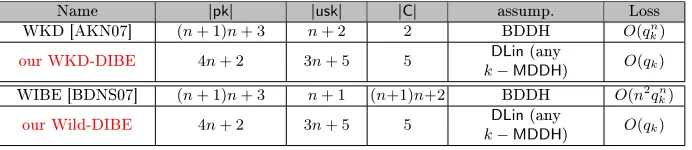
We propose a construction of DIBE inspired by the Hash-Proof based HIBE from [BKP14]. Interestingly, our construction combined with the WKD-DIBE, Wild-DIBE transformations are way more ecient than the existing WIBE and WKD-IBE. We compare them in gure 2, where we set the number of pattern and the size of the identity to the same valuen, qk correspond to the number adversary's key derivation queries. ` is the number of bits of identity that a user is allow to delegate a key to (e.g. his height in the hierarchical tree). A more detailed comparison can be found in section 7. The improvements both in term of security and eciency make those schemes now more suitable for practical applications.
Name |pk| |usk| |C| assump. Loss
WKD [AKN07] (n+ 1)n+ 3 n+ 2 2 BDDH O(qkn)
our WKD-DIBE 4n+ 2 3n+ 5 5 DLin(any
k−MDDH) O(qk)
WIBE [BDNS07] (n+ 1)n+ 3 n+ 1 (n+1)n+2 BDDH O(n2qnk)
our Wild-DIBE 4n+ 2 3n+ 5 5 DLin(any
k−MDDH) O(qk)
1.3 Open problems
We managed to create an ecient Ciphertext Policy Attribute-based En-cryption for boolean formula in DNF. This improve our knowledge of the relation Between IBE and ABE. But nally how close IBE and ABE are? Is it possible to extend eciently our idea to t other/any kind of access structure.
2 Denitions
2.1 Notation
If x ∈ BSn, then |x| denotes the length n of the vector. Further, x ← BS$ denotes the process of sampling an element x from set BS uniformly at random.
IfA∈Zp(k+1)×n is a matrix, thenA∈Zkp×ndenotes the upper matrix ofA and thenA∈Z1×k
p denotes the last row ofA.
We are going to dene a relation between two strings s, t of the
same length `, such that st if and only if∀i∈J1, `K, s[i]≤t[i]. As
an extension, given a setS of strings of length` and a similarly long
stringt, we are going to say thattS, if there existss∈S such that t s. One has to pay attention that is not total, for example, 10
and01 can not be compared.
Similarly, we dene a relation∗ between two stringss, tof the same
length`, such thats∗tif and only if∀i∈J1, `K, s[i]t[i]∨s[i] =∗.
Games. We use games for our security reductions. A gameGis dened
by procedures Initialize and Finalize, plus some optional procedures P1, . . . ,Pn. All procedures are given using pseudo-code, where initially
all variables are undened. An adversaryAis executed in gameGif it
rst callsInitialize, obtaining its output. Next, it may make arbitrary
queries to Pi (according to their specication), again obtaining their output. Finally, it makes one single call to Finalize(·) and stops. We
deneGA as the output of A's call toFinalize.
2.2 Pairing groups and Matrix Die-Hellman Assumption Let GGen be a probabilistic polynomial time (PPT) algorithm that on
e:G1×G2 is an eciently computable (non-degenerated) bilinear map.
Dene gT :=e(g1, g2), which is a generator in GT.
We use implicit representation of group elements as introduced in [EHK+13]. For s∈ {1,2, T} and a∈
Zp dene[a]s =gsa∈Gs as the im-plicit representation of ainGs. More generally, for a matrix A= (aij)∈ Znp×m we dene [A]s as the implicit representation of A in Gs. Obvi-ously, given [a]s ∈ Gs and a scalar x ∈ Zp, one can eciently compute
[ax]s∈Gs. Further, given[a]1,[a]2 one can eciently compute[ab]T using the pairinge. Fora,b∈Zk
p denee([a]1,[b]2) := [a>b]T ∈GT.
We recall the denition of the matrix Die-Hellman (MDDH)
assump-tion [EHK+13].
Denition 1 (Matrix Distribution). Let k∈N. We call Dk a matrix distribution if it outputs matrices in Z(pk+1)×k of full rankkin polynomial time.
We assume the rst k rows of A ← D$ k form an invertible matrix. The Dk-Matrix Die-Hellman problem is to distinguish the two distributions
([A],[Aw])and ([A],[u])whereA← D$ k,w←$ Zk p and u
$ ←Zk+1
p .
Denition 2 (Dk-Matrix Die-Hellman AssumptionDk-MDDH).
Let Dk be a matrix distribution and s ∈ {1,2, T}. We say that the D k-Matrix Die-Hellman (Dk-MDDH) Assumption holds relative toGGenin
group Gs if for all PPT adversariesD,
AdvDk,GGen(D)
:=|Pr[D(G,[A]s,[Aw]s) = 1]−Pr[D(G,[A]s,[u]s) = 1]|=negl(λ),
where the probability is taken overG $
←GGen(1λ),A← D$ k,w←$ Zkp,u $ ←
Zkp+1. This assumption is Random Self Reducible.
2.3 Identity-based Key Encapsulation
We now recall syntax and security of IBE in terms of an ID-based key encapsulation mechanism IBKEM. EveryIBKEMcan be transformed into
an ID-based encryption scheme IBE using a (one-time secure) symmetric
cipher.
Denition 3 (Identity-based Key Encapsulation Scheme). An identity-based key encapsulation (IBKEM) scheme IBKEM consists of four PPT
algorithms IBKEM = (Gen,USKGen,Enc,Dec) with the following
The probabilistic key generation algorithmGen(K)returns the (master)
public/secret key(mpk,msk). We assume thatmpkimplicitly denes a
message spaceM, an identity spaceID, a key spaceK, and ciphertext spaceCS.
The probabilistic user secret key generation algorithmUSKGen(msk,id)
returns the user secret-keyusk[id]for identity id∈ID.
The probabilistic encapsulation algorithmEnc(mpk,id)returns the
sym-metric key sk ∈ K together with a ciphertext C ∈ CS with respect to
identityid.
The deterministic decapsulation algorithm Dec(usk[id],id,C) returns
the decapsulated keysk∈ K or the reject symbol⊥.
For perfect correctness we require that for all K∈N, all pairs (mpk,msk)
honestly generated by Gen(K), all identities id ∈ID, all usk[id] generated
by USKGen(msk,id) and all(sk,C) output by Enc(mpk,id):
Pr[Dec(usk[id],id,C) =sk] = 1.
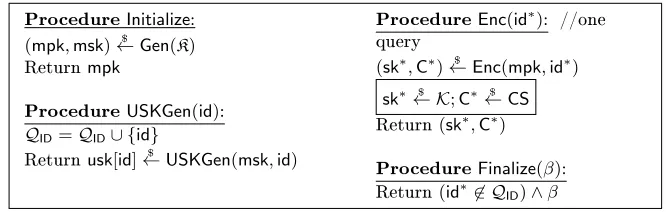
The security requirements for an IBKEM we consider here are indis-tinguishability and anonymity against chosen plaintext and identity at-tacks (IND-ID-CPAand ANON-ID-CPA). Instead of dening both security
notions separately, we dene pseudorandom ciphertexts against chosen plaintext and identity attacks (PR-ID-CPA) which means that challenge
key and ciphertext are both pseudorandom. Note thatPR-ID-CPAtrivially
impliesIND-ID-CPAandANON-ID-CPA. We denePR-ID-CPA-security of IBKEMformally via the games given in Figure 3.
ProcedureInitialize:
(mpk,msk) $
←Gen(K) Returnmpk
ProcedureUSKGen(id):
QID=QID∪ {id}
Returnusk[id]←$ USKGen(msk,id)
ProcedureEnc(id∗): //one
query
(sk∗,C∗)←$ Enc(mpk,id∗)
sk∗← K$ ;C∗←$ CS
Return(sk∗,C∗) ProcedureFinalize(β):
Return(id∗6∈ QID)∧β
Denition 4 (PR-ID-CPA Security). An identity-based key
encapsula-tion schemeIBKEMisPR-ID-CPA-secure if for all PPTA,AdvprIBKEM-id-cpa(A) :=
|Pr[PR-ID-CPAAreal⇒1]−Pr[PR-ID-CPAArand⇒1]|is negligible.
3 Downgradable Identity-Based Encryption
In this section we introduce the notion of Downgradable Identity-Based Encryption. There is a lot of dierent variant of IBE in the nowadays, add another one seems to be not useful but we stress that our is not here to be used as a simple scheme but as a key pillar to create ABE from IBE. Also in section 4 we explain the relations between dierent variant of IBE and how DIBE can be transformed into them. For simplicity we are going to express in term of Key Encapsulation, as it can then be trivially transformed into an encryption.
Denition 5 (Downgradable Identity-based Key Encapsulation Scheme). A Downgradable identity-based key encapsulation (DIBKEM) schemeDIBKEMconsists of ve PPT algorithmsDIBKEM= (Gen,USKGen,
Enc,Dec,USKDown) with the following properties.
The probabilistic key generation algorithmGen(K)returns the (master)
public/secret key(mpk,msk). We assume thatmpkimplicitly denes a
message spaceM, an identity spaceID, a key spaceK, and ciphertext spaceCS.
The probabilistic user secret key generation algorithmUSKGen(msk,id)
returns the user secret-keyusk[id]for identity id∈ID.
The probabilistic encapsulation algorithmEnc(mpk,id)returns the
sym-metric key sk ∈ K together with a ciphertext C ∈ CS with respect to
identityid.
The deterministic decapsulation algorithm Dec(usk[id],id,C) returns
the decapsulated keysk∈ K or the reject symbol⊥.
The probabilistic user secret key downgrade algorithmUSKDown(usk[id],id˜)
returns the user secret-keyusk[ ˜id]as long asid˜ id.
For perfect correctness we require that for all K∈N, all pairs (mpk,msk)
honestly generated by Gen(K), all identities id ∈ID, all usk[id] generated
by USKGen(msk,id) and all(sk,C) output by Enc(mpk,id):
Pr[Dec(usk[id],id,C) =sk] = 1.
We also require the distribution of usk[ ˜id] from USKDown(usk[id],id˜)
The security requirements we consider here are indistinguishability and anonymity against chosen plaintext and identity attacks (IND-ID-CPA
and ANON-ID-CPA). Instead of dening both security notions separately,
we dene pseudorandom ciphertexts against chosen plaintext and identity attacks (PR-ID-CPA) which means that challenge key and ciphertext are
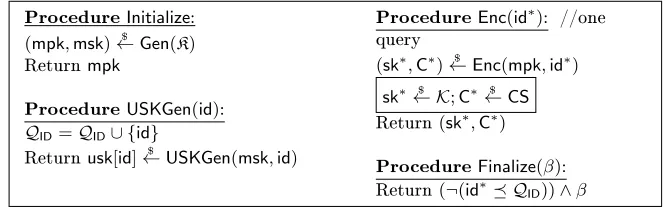
both pseudorandom. We dene PR-ID-CPA-security of DIBKEMformally
via the games given in Figure 4.
ProcedureInitialize:
(mpk,msk)←$ Gen(K) Returnmpk
ProcedureUSKGen(id):
QID=QID∪ {id}
Returnusk[id]←$ USKGen(msk,id)
ProcedureEnc(id∗): //one query
(sk∗,C∗)←$ Enc(mpk,id∗)
sk∗← K$ ;C∗←$ CS
Return(sk∗,C∗) ProcedureFinalize(β): Return(¬(id∗ QID))∧β
Fig. 4. Security Games PR-ID-CPAreal and PR-ID-CPArand for dening PR-ID-CPA -security forDIBKEM.
Denition 6 (PR-ID-CPASecurity). A downgradable identity-based key
encapsulation scheme DIBKEM is PR-ID-CPA-secure if for all PPT A,
AdvprDIBKEM-id-cpa(A) := |Pr[PR-ID-CPAAreal ⇒ 1]−Pr[PR-ID-CPAArand ⇒ 1]| is negligible.
We stress the importance of the condition: (¬(id∗ QID)). This is
here to guarantee that the adversary did not query an identity that can be downgraded to the challenge one, as this would allow for a trivial attack.
4 Transformation to classical primitives
4.1 From DIBE to WIBE
Wildcard Identity-Based Encryption is a concept introduced in [ACD+06].
The idea is to be able to encrypt message for serveral identities by xing some identity bits and letting others free (symbolized by the∗). Thus only people with identity matching the one used to encrypt can decrypt. We say that id matches id0 if ∀i idi = id0i or id
0
i =∗. Detailed denitions are included in Appendix A
We are now given a DIBKEM(Gen,USKGen,Enc,Dec,USKDown), let
us show how to build the corresponding Wild-IBKEM.
As with all the following constructions, the heart of the transformation will be to use aDIBKEMfor identity of size2`to handle identities of size `.
Let's consider an identitywidof size`, we deneid=φ(wid)as follows:
id[2i,2i+ 1] =
01 if wid[i] = 0
10 if wid[i] = 1
00 otherwise.
Now we can dene :
WIBE.Gen(K) :Gen(K), except that instead of deningID as strings of
size2`, we suppose the public key deneWIDof enriched identities of
size`.
WIBE.USKGen(sk,id) =USKGen(sk, φ(id)).
WIBE.Enc(mpk,id) =Enc(mpk, φ(id)).
WIBE.Dec(usk[id],idˆ,C) checks if idˆ id, then computes usk[φ( ˆid)] =
USKDown(usk[φ(id)]). ReturnsDec(usk[φ( ˆid)],idˆ,C) or rejects with⊥.
4.2 From DIBE to HIBE
Hierarchical Identity-Based Encryption is a concept introduced in [GS02]. The idea of this primitive is to introduce a hierarchy in the user secret key. A user can create a secret key from his one for any identity with prex his own identity. Detailed denitions are included in Appendix A
This time, we are going to map the identity space to a bigger set, with joker identity that can be downgraded to both 0 or 1.
Let's consider an identityhidof size`, we deneid=φ(hid)as follows:
id[2i,2i+ 1] =
01 if hid[i] = 0
10 if hid[i] = 1
11 otherwise(hid[i] =⊥).
HIB.Gen(K) : Gen(K), except instead of dening ID as strings of size
2`, we suppose the public key deneHIDof enriched identities of size
`.
HIB.USKGen(sk,id) = USKGen(sk, φ(id)). It should be noted that in
case of an DIBKEM, some identities are never to be queried to the
downgradable IBKEM: those with 00 is2i,2i+ 1, or those with 11 at 2i,2i+ 1and then a 0 (this would correspond to punctured identities).
HIB.USKDel(usk[id],id∈ BSp,idp+1) =USKDown(usk[φ(id)], φ(id||idp+1)). By construction we haveφ(id||idp+1)φ(id).
HIB.Enc(mpk,id) =Enc(mpk, φ(id)).
HIB.Dec(usk[id],id,C)returnsDec(usk[φ(id)], φ(id),C)or the reject
sym-bol⊥.
4.3 From DIBE to Wicked IBE
The paper [AKN07] presents a variant of Identity-based Encryption called Wicked IBE (WKD-IBE). A wicked IBE or wildcard key derivation IBE is a generalization of the concept of limited delegation concept by Boneh-Boyen-Goh [BBG05].
This scheme allows secret key associated with a patternP = (P1, ..., Pl)∈ {{0,1}∗∪ {∗}}l to be delegated for a pattern P0 = (P0
1, ..., Pl00) that
ma-tches P. We say that P0 match P if ∀i ≤ l0 Pi0 = Pi or Pi = ∗ and ∀l0+ 1≤i≤l Pi =∗.
Here again, we are going to map the identity space to a bigger set. Let's consider an identity id of size `, we dene id = φ(wkdid) as
follows:
id[2i,2i+ 1] =
01 if wkdid[i] = 0 10 if wkdid[i] = 1 11 if wkdid[i] =∗
Now we can dene :
WKDIB.Gen(K) : Gen(K), except instead of dening ID as strings of
size2`, we suppose the public key deneWKDIDof enriched identities
of size`.
WKDIB.USKGen(msk,id) = USKGen(msk, φ(id)). It should be noted
that in case of an WKD-DIBE, some identities are never to be queried to the downgradable IBE: those with 00.
WKDIB.USKDel(usk[id],id,id0) =USKDown(usk[φ(id)], φ(id), φ(id0)).
WKDIB.Enc(mpk,id) =Enc(mpk, φ(id)).
WKDIB.Dec(usk[id],id,C)returnsDec(usk[φ(id)], φ(id),C)or the reject
Remark 7. It can be noted, that all those transformations end up using 4 bits instead to encode a ternary alphabet. So there is a bit wasted in every given transformation. This could easily be avoided by using a more convoluted encoding, however this is already enough to show the link between the construction;also, this allows to build a scheme both wicked and wildcarded.
4.4 From Wicked IBE to DIBE
We can easily transform a Wicked IBE scheme into DIBE by using only identity made of 0and∗. In fact the element1 of the DIBE play the role
of the∗of the Wicked IBE. Morally a DIBE can be seen as a Wicked IBE where the patterns are made of only 2 distinct elements instead of 3.
5 ABE
In this section, we consider Attribute Based Encryption (ABE) and pre-sent a transformation from DIBE to ABE. We recall the denition and the security requirement:
Denition 8 (Attribute-based Encryption).
An Attribute-based encryption (ABE) scheme ABE consists of four
PPT algorithms ABKEM = (Gen,USKGen,Enc,Dec) with the following
properties.
The probabilistic key generation algorithm Gen(K) returns the
(mas-ter) public/secret key (pk,sk). We assume that pk implicitly denes a
message spaceM, an Attribute spaceAS, and ciphertext space CS.
The probabilistic user secret key generation algorithm USKGen(sk,A) that takes as input the master secret key sk and a set of attributes
A⊂AS and returns the user secret-key usk[A].
The probabilistic encryption algorithmEnc(pk,F, M) returns a cipher-textC∈CSwith respect to the access structure F.
The deterministic decryption algorithmDec(usk[A],F,A,C)returns the decrypted messageM ∈ M or the reject symbol ⊥.
For perfect correctness we require that for all K ∈ N, all pairs (pk,sk)
generated by Gen(K), all access structure F, all set of attribute A ⊂ AS satisfying F, all usk[A] generated by USKGen(sk,A) and all C output by
Enc(pk,F, M):
Pr[Dec(usk[A],F,A,C) =M] = 1.
ProcedureInitialize:
(pk,sk)←$ Gen(K) Returnpk
ProcedureUSKGen(A):
QA← QA∪ {A}
Returnusk[A]←$ USKGen(sk,A)
ProcedureEnc(F∗): //one query (sk∗,C∗) $
←Enc(pk,F∗, M∗)
C∗ $
←CS
Return(C∗)
ProcedureFinalize(β):
Return(∀A∈ QA,Adoesn't verify F)∧β
Fig. 5. Security Games PR-A-CPAreal and PR-A-CPArand for dening PR-A-CPA -security.
Denition 9 (PR-A-CPA Security). An identity-based key
encapsula-tion schemeABKEMisPR-A-CPA-secure if for all PPTA,AdvPRABKEM-A-CPA(A) :=
|Pr[PR-A-CPAAreal⇒1]−Pr[PR-A-CPAArand⇒1]|is negligible.
In a usual notion of (ciphertext-policy) ABE, a key is associated with a set Aof attributes in the attribute universeU, while a ciphertext is associated with an access policy F (or called access structure) over attributes. The decryption can be done if A satisesF. We can see that IBE is a special case of ABE where bothAandFare singletons, that is, each is an identity in the universe U.
In this paper, we conne ABE in the two following aspects. First, we restrict the universeU to be of polynomial size in security parameter; this is often called small-universe ABE (as opposed to large-universe ABE where U can be of super polynomial size.). Second, we allow only DNF formulae in expressing policies (as opposed to any boolean formulae, or equivalently, any access structures).
Our idea for obtaining a (small-universe) ABE scheme for DNF for-mulae from any DIBE scheme is as follows. For simplicity and wlog, we set the universe asU ={1, . . . , n}. We will use DIBE with identity length
n. For any set S ⊆ U, we dene idS ∈ {0,1}n where its i-th position is dened by
idS[i] := (
1 if i∈S
0 if i6∈S.
To issue an ABE key for a set A ⊆ U, we use a DIBE key for idA. On the other hand, to encrypt a message M in ABE with a DNF policy
F=Wkj=1(
V
message M in DIBE each withidSj for all j ∈[1, k]; this will result in k
ciphertexts of the DIBE scheme. Note that k is the number of OR, the
disjunction, in the DNF formula.
Decryption can be done as follows. SupposeA satises F. Hence, we have that there exists Sj (dened in the formula F) such that Sj ⊆ A. We then derive a DIBE key for idSj from our ABE key for A (which is
then a DIBE key foridA); this can be done sinceSj ⊆Aimplies that any positions of 1inidSj will also contain1 inidA(and thus the derivation is possible). We nally decrypt the ciphertext associated withidSj to obtain
the message M. We summarize this transformation in Fig 6.
Setup(param): RunGenDIBE(K) Return(mpk,msk)
KeyGen(msk,A): Return
usk[A]←USKGenDIBE(msk,idA)
Encrypt(mpk,F, M): ParseF=Wkj=1(
V a∈Sja) For allj∈[1, k], compute:
(Cj, Kj)←EncDIBE(mpk,idSj)and
Cj0 ←M⊕Kj
ReturnC= (C1, . . . ,Ck, C10, . . . Ck0)
Decrypt(usk[A],F,A,C): ParseF=Wkj=1(
V a∈Sja) Findj∈[1, k]s.t.Sj⊆A
ComputeU ←USKDownDIBE(usk[A],idSj) ComputeKj←DecDIBE(U,idSj,Cj) ReturnM =Cj0⊕Kj
Fig. 6.ABEfromDIBE
We have the following security theorem for the above ABE scheme. The proof is very simple and is done by a straightforward hybrid argument over k ciphertexts of DIBE. Note that the advantage denition for ABE
is dened similarly to other primitives and is captured in Appendix ??. Theorem 10. The above ABE from DIBE is pr-a-cpa secure under the pr-id-cpasecurity of the DIBE scheme used. In particular for all
adversa-ries A, we have that AdvPRABE-A-CPA(A)≤k·AdvprDIBE-id-cpa(A) where k is the
number of OR in the DNF formula (associated to the challenge ciphertext).
Proof. We prove our transformation via a sequence of games beginning with the real game for thepr-a-cpasecurity of the ABE and ending up with
Let A be an adversary against the pr-a-cpa security of our
transfor-mation. Let C be the simulator of the pr-a-cpaexperience.
Game G0: This is the real security game.
Game G1.1: In this game the simulator generates correctly every
cip-hertexts but the rst one. The rst ciphertext is replaced by a random element of the ciphertext space. G1.1 is indistinguishable from Game 0 if
thepr-id-cpasecurity holds for theDIBE used.
AdvG0,G1.1(A)≤Advpr-id-cpa
DIBE (A)
Game G1.i: This game is the same than the gameG1.i−1 but thei-th
ciphertext is replaced by a random element of the ciphertext space.G1.iis indistinguishable from G1.i−1 if the pr-id-cpasecurity holds for the DIBE
used.
AdvG1.i−1,G1.i(A)≤Advpr-id-cpa DIBE (A)
Game G1.k: in this game all ciphertexts are random elements,G1.k is indistinguishable from G1.k−1 if thepr-id-cpasecurity holds for the DIBE
used.
AdvG1.k−1,G1.k(A)≤Advpr-id-cpa DIBE (A)
At this point our current gameG1.k has for challenge encryption only random elements. This means that an adversary has no advantage in win-ning this game. We nally end up with the advantage ofAin winning the original security game:
AdvPRABE-A-CPA(A)≤AdvG0,G1.k(A)
≤ k X
i=1
AdvG1.i−1,G1.i(A)
≤k×AdvprDIBE-id-cpa(A)
u t
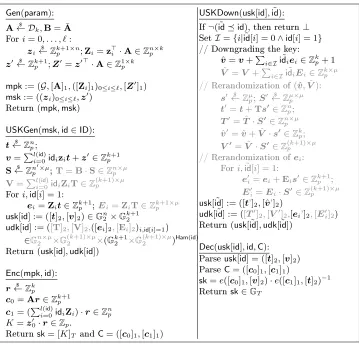
6 Instantiation
Theorem 11. Under the Dk-MDDH assumption, the scheme presented
in gure 7 is PR-ID-CPA secure. For all adversaries A there exists an adversary B with T(A) ≈ T(B) and AdvDIBKEM,Dk(B)
PR-ID-CPA(A) ≤
(AdvDk,GGen(B) + 2qk(AdvDk,GGen(B) + 1/q) 1.
1 We recall thatq
Gen(param):
A← D$ k,B= ¯A
Fori= 0, . . . , `:
zi←$ Zkp+1×n;Zi=z
>
i ·A∈Znp×k z0←$ Zkp+1;Z
0
=z0>·A∈Z1p×k
mpk:= (G,[A]1,([Zi]1)0≤i≤`,[Z0]1)
msk:= ((zi)0≤i≤`,z0)
Return(mpk,msk)
USKGen(msk,id∈ID):
t←$ Znp; v=Pl(id)
i=0idizit+z
0 ∈Zkp+1 S←$ Zn
0×µ
p ;T=B·S∈Znp×µ
V=Pli(=0id)idiZiT∈Z(pk+1)×µ Fori,id[i] = 1:
ei=Zit∈Zkp+1;Ei=ZiT∈Zkp+1×µ
usk[id] := ([t]2,[v]2)∈Gn2×Gk2+1
udk[id] := ([T]2,[V]2,([ei]2,[Ei]2)i,id[i]=1)
∈Gn2×µ×G (k+1)×µ
2 ×(G
k+1 2 ×G
(k+1)×µ
2 )
Ham(id) Return(usk[id],udk[id])
Enc(mpk,id):
r $
←Zkp
c0=Ar∈Zkp+1
c1= (Pli(id)=0idiZi)·r∈Znp
K=z00·r∈Zp.
Returnsk= [K]T andC= ([c0]1,[c1]1)
USKDown(usk[id],id˜): If¬( ˜idid), then return⊥
SetI={i|id˜[i] = 0∧id[i] = 1}
// Downgrading the key: ˆ
v=v+P
i∈Iid˜iei∈Zkp+ 1
ˆ
V =V +P
i∈Iid˜iEi∈Zkp×µ
// Rerandomization of(vˆ,Vˆ):
s0←$ Zµp;S0 $ ←Zµp×µ
t0=t+Ts0∈Znp;
T0= ˆT·S0∈Znp×µ ˆ
v0= ˆv+ ˆV ·s0∈Zkp;
V0= ˆV ·S0∈Z(pk+1)×µ
// Rerandomization ofei:
Fori,id˜[i] = 1:
e0i=ei+Eis0∈Zkp+1;
E0i=Ei·S0∈Z(pk+1)×µ
usk[ ˜id] := ([t']2,[ˆv']2)
udk[ ˜id] := ([T0]2,[V0]2,[ei']2,[E0i]2)
Return(usk[ ˜id],udk[ ˜id])
Dec(usk[id],id,C): Parseusk[id] = ([t]2,[v]2) ParseC= ([c0]1,[c1]1)
sk=e([c0]1,[v]2)·e([c1]1,[t]2)−1 Returnsk∈GT
Fig. 7. A Downgradable IBE based onMDDH. For readability, the user secret key is
split here betweenuskfor the decapsulation, andudkused for the downgrade operation.
The proof is detailed in Appendix B.
Remark 12. This instantiation respect the formal denition ofDIBKEMof
3. However for eciency purpose one can remark that for realizing WIBE or ABE the user's secret keys does not need to be rerandomize during the delegation phase since it will not be used by another user. It introduce the concept of self-delegatable-only scheme. Thus we can avoid the heavy elements T,S,E of the user secret keys, the self-delegetable-only scheme
7 Eciency Comparison
In this section we compare the schemes obtained by using our instantiation of DIBE (see sec. 6) and our transformations described in the section 4. We end up with the most ecient scheme for full security in the standard model and under classical hypothesis for WIBE, WKD-IBE and of similar eciency for HIBE.
In the example of WIBE and WKD-IBE given below the parameters will grow exponentially in the number of query from the adversary, where our will be only linear. This is a parameter to take into account because the size of the keys for the same security will depend on this security loss. To compare eciency in a simple way, we choose to consider the case where the number of pattern is maximal e.g. the size of pattern is equal to 1, thus the number of pattern is n which is the length of the identity.
The value qk correspond to the number of derivation key oracle request made by the adversary.2
Name |pk| |usk| |C| assump. Sec Loss WKD [AKN07] n+ 4 n+ 2 2 BDDH standardSel. O(nqk)
WKD [AKN07] (n+ 1)n+ 3 n+ 2 2 BDDH standardFull O(qn k)
WKD-DIBE 4n+ 2 3n+ 5 5 DLin(any
k−MDDH) standardFull O(qk)
SWIBE [KLLO18] n+ 4 2n+ 3 4 ROM Full O((n+ 1)(qk+ 1)n)
WIBE [BDNS07] (n+ 1)n+ 3 n+ 1 (n+1)n+2 BDDH standardFull O(n2qn k)
Wild-DIBE 4n+ 2 3n+ 5 5 DLin(any
k−MDDH) standardFull O(qk)
Fig. 8. Eciency Comparison Between our Transformations and Previous Schemes
Eciency comparison for HIBE The gure 9 compares the HIBE built via our DIBE. Our instantiation of DIBE inherit its eciency from the HIBE from [BKP14], except we need to articially double the size of the identities. Here ` is the number of free bits in an identity (the ones
to delegate). Note that for the case of root of the hierarchy e.g. the user with an empty bit string as identity,`=n.
It should be noted, that while we rely on the same underlying principle, our security reduction does not need handle⊥symbol as [BKP14], which allows to circumvent the worrisome parts of their proofs.
Name |pk| |usk| |C| assump. Loss
HIBE [BBG05] n+ 4 2 +` 5 DLin sel. O(n·qk)
HIBE [BKP14] 2n+ 1 11`+ 5 5 DLin(any
k−MDDH) O(n)
H-DIBE 4n+ 2 11n+ 5 5 DLin(any
k−MDDH) O(qk)
Fig. 9. Eciency Comparison Between our Transformations and HIBE schemes
Eciency comparison for ABE Our instantiation leads to a very ef-cient ABE scheme. This scheme would be one of the most practical. However we achieve ABE where the access structure has to be a boolean formula in the DNF which is less general than allowing any kind of access structure (which is done in others practical schemes).
Name |pk| |sk| |C| pairing expG expGt Reduction Loss
[OT10] 4U+ 2 3U+ 3 7m+ 5 7m+ 5 0 m O(qk)
[LW12] 24U+ 12 6U+ 6 6m+ 6 6m+ 9 0 m O(qk)
[CGW15] 6U R+ 12 3U R+ 3 3m+ 3 6 6m 0 O(qk)
[Att16]
scheme 10 6U R+ 12 3U R+ 6 3m+ 6 9 6m 0 O(qk)
[Att16] scheme 13
96(M+T R)2+
log(U R) 3U R+ 6 3m+ 6 9 6m 0 O(qk) Our
DNF-ABE 4U+ 2 3U+ 3 3k+ 2 13 0 0 O(qk)
Fig. 10. Eciency Comparison of Practical CP-ABE Schemes
Fig. 10 presents a non exhaustive comparison of our ABE schemes with ecient ones. They are all full secure under the classical assumptionDLin.
U is the size of the universe of attributes.m is the number of attributes
in a policy.tis the size of an attribute set, and T is the maximum size of t(if bounded).Ris the maximum number of attributes multi used in one
policy (if bounded).qkis again the number of all the key queries made by the adversary during security game. For our scheme, k is the number of
OR, the disjunction, in the associated DNF formula.
Acknowledgements.
References
[ACD+06] Michel Abdalla, Dario Catalano, Alex Dent, John Malone-Lee, Gregory Neven, and Nigel Smart. Identity-based encryption gone wild. In Michele Bugliesi, Bart Preneel, Vladimiro Sassone, and Ingo Wegener, editors, ICALP 2006, Part II, volume 4052 of LNCS, pages 300311. Springer, Heidelberg, July 2006.
[ACP12] Michel Abdalla, Angelo De Caro, and Duong Hieu Phan. Generalized key delegation for wildcarded identity-based and inner-product encryption. IEEE Transactions on Information Forensics and security, 7(6):1695 1706, 2012.
[ADML+07] Michel Abdalla, Alexander W. Dent, John Malone-Lee, Gregory Neven, Duong Hieu Phan, and Nigel P. Smart. Identity-based traitor tracing. In Tatsuaki Okamoto and Xiaoyun Wang, editors, PKC 2007, volume 4450 of LNCS, pages 361376. Springer, Heidelberg, April 2007.
[AFL12] Michel Abdalla, Dario Fiore, and Vadim Lyubashevsky. From selective to full security: Semi-generic transformations in the standard model. In Marc Fischlin, Johannes Buchmann, and Mark Manulis, editors, PKC 2012, volume 7293 of LNCS, pages 316333. Springer, Heidelberg, May 2012. [AKN07] Michel Abdalla, Eike Kiltz, and Gregory Neven. Generalized key
dele-gation for hierarchical identity-based encryption. In Joachim Biskup and Javier López, editors, ESORICS 2007, volume 4734 of LNCS, pages 139 154. Springer, Heidelberg, September 2007.
[Att16] Nuttapong Attrapadung. Dual system encryption framework in prime-order groups via computational pair encodings. In Jung Hee Cheon and Tsuyoshi Takagi, editors, ASIACRYPT 2016, Part II, volume 10032 of LNCS, pages 591623. Springer, Heidelberg, December 2016.
[BBG05] Dan Boneh, Xavier Boyen, and Eu-Jin Goh. Hierarchical identity ba-sed encryption with constant size ciphertext. In Ronald Cramer, editor, EUROCRYPT 2005, volume 3494 of LNCS, pages 440456. Springer, Hei-delberg, May 2005.
[BCG16] Olivier Blazy, Céline Chevalier, and Paul Germouty. Adaptive oblivious transfer and generalization. In Jung Hee Cheon and Tsuyoshi Takagi, editors, ASIACRYPT 2016, Part II, volume 10032 of LNCS, pages 217 247. Springer, Heidelberg, December 2016.
[BDNS07] James Birkett, Alexander W. Dent, Gregory Neven, and Jacob C. N. Schuldt. Ecient chosen-ciphertext secure identity-based encryption with wildcards. In Josef Pieprzyk, Hossein Ghodosi, and Ed Dawson, editors, ACISP 07, volume 4586 of LNCS, pages 274292. Springer, Heidelberg, July 2007.
[BF01] Dan Boneh and Matthew K. Franklin. Identity-based encryption from the Weil pairing. In Joe Kilian, editor, CRYPTO 2001, volume 2139 of LNCS, pages 213229. Springer, Heidelberg, August 2001.
[BKP14] Olivier Blazy, Eike Kiltz, and Jiaxin Pan. (Hierarchical) identity-based encryption from ane message authentication. In Juan A. Garay and Rosario Gennaro, editors, CRYPTO 2014, Part I, volume 8616 of LNCS, pages 408425. Springer, Heidelberg, August 2014.
[Coc01] Cliord Cocks. An identity based encryption scheme based on quadratic residues. In Bahram Honary, editor, 8th IMA International Conference on Cryptography and Coding, volume 2260 of LNCS, pages 360363. Springer, Heidelberg, December 2001.
[EHK+13] Alex Escala, Gottfried Herold, Eike Kiltz, Carla Ràfols, and Jorge Vil-lar. An algebraic framework for Die-Hellman assumptions. In Ran Ca-netti and Juan A. Garay, editors, CRYPTO 2013, Part II, volume 8043 of LNCS, pages 129147. Springer, Heidelberg, August 2013.
[FP12] Nelly Fazio and Irippuge Milinda Perera. Outsider-anonymous broadcast encryption with sublinear ciphertexts. In Marc Fischlin, Johannes Bu-chmann, and Mark Manulis, editors, PKC 2012, volume 7293 of LNCS, pages 225242. Springer, Heidelberg, May 2012.
[GH07] Matthew Green and Susan Hohenberger. Blind identity-based encryption and simulatable oblivious transfer. In Kaoru Kurosawa, editor, ASIA-CRYPT 2007, volume 4833 of LNCS, pages 265282. Springer, Heidelberg, December 2007.
[GS02] Craig Gentry and Alice Silverberg. Hierarchical ID-based cryptography. In Yuliang Zheng, editor, ASIACRYPT 2002, volume 2501 of LNCS, pages 548566. Springer, Heidelberg, December 2002.
[KLLO18] Jihye Kim, Seunghwa Lee, Jiwon Lee, and Hyunok Oh. Scalable wild-carded identity-based encryption. In Javier López, Jianying Zhou, and Miguel Soriano, editors, ESORICS 2018, Part II, volume 11099 of LNCS, pages 269287. Springer, Heidelberg, September 2018.
[LW12] Allison B. Lewko and Brent Waters. New proof methods for attribute-based encryption: Achieving full security through selective techniques. In Reihaneh Safavi-Naini and Ran Canetti, editors, CRYPTO 2012, volume 7417 of LNCS, pages 180198. Springer, Heidelberg, August 2012. [OT10] Tatsuaki Okamoto and Katsuyuki Takashima. Fully secure functional
encryption with general relations from the decisional linear assumption. In Tal Rabin, editor, CRYPTO 2010, volume 6223 of LNCS, pages 191 208. Springer, Heidelberg, August 2010.
[PT11] Duong Hieu Phan and Viet Cuong Trinh. Identity-based trace and revoke schemes. In Xavier Boyen and Xiaofeng Chen, editors, ProvSec 2011, volume 6980 of LNCS, pages 204221. Springer, Heidelberg, October 2011. [Sha84] Adi Shamir. Identity-based cryptosystems and signature schemes. In G. R. Blakley and David Chaum, editors, CRYPTO'84, volume 196 of LNCS, pages 4753. Springer, Heidelberg, August 1984.
[SOK00] Ryuichi Sakai, Kiyoshi Ohgishi, and Masao Kasahara. Cryptosystems based on pairing. In SCIS 2000, Okinawa, Japan, January 2000.
[SW05] Amit Sahai and Brent R. Waters. Fuzzy identity-based encryption. In Ronald Cramer, editor, EUROCRYPT 2005, volume 3494 of LNCS, pages 457473. Springer, Heidelberg, May 2005.
A Extra Denitions
A.1 Wildcard Identity-based Key Encapsulation Scheme
Denition 13 (Wildcard Identity-based Key Encapsulation Scheme). A Wildcard identity-based key encapsulation scheme WIBKEM consists of
ve PPT algorithms WIBKEM = (Gen,USKGen,Enc,Dec) with the
follo-wing properties.
The probabilistic key generation algorithm Gen(K) returns the
(mas-ter) public/secret key (pk,sk). We assume that pk implicitly denes a
message spaceM, an identity spaceID, a key spaceK, and ciphertext spaceCS.
The probabilistic user secret key generation algorithm USKGen(sk,id)
returns the user secret-keyusk[id]for identity id∈ID.
The probabilistic encapsulation algorithm Enc(pk,id) returns the
sym-metric keysk∈ K together with a ciphertextC∈CSwith respect to an
identityid∈IDˆ, this means that ∀i,idi∈ {0,1,∗}.
The deterministic decapsulation algorithm Dec(usk[id],idˆ,C) returns
the decapsulated keysk∈ K or the reject symbol⊥.
For perfect correctness we require that for allK∈N, all pairs(pk,sk)
gene-rated byGen(K), all identitiesid∈ID, allusk[id]generated byUSKGen(sk,id)
and all (sk,C) output by Enc(pk,idˆ) for idˆ ∈IDˆ such that idˆ ∗id:
Pr[Dec(usk[id],id,C) =sk] = 1.
A.2 Hierarchical Identity-Based Key Encapsulation Mechanism
We recall syntax and security of a hierarchical identity-based key encap-sulation mechanism (HIBKEM).
Denition 14 (Hierarchical Identity-Based Key Encapsulation Me-chanism). A hierarchical identity-based key encapsulation mechanismDIBKEM
consists of ve PPT algorithms DIBKEM = (Gen,USKDel,USKGen,Enc,
Dec) with the following properties.
The probabilistic key generation algorithm Gen(K) returns the
(mas-ter) public/secret key and delegation key(pk,sk). We assume that pk
implicitly denes a message space M and hierarchical identity space
ID=BS≤m, for some base identity set BS.
The probabilistic user secret key generation algorithm USKGen(sk,id)
The probabilistic key delegation algorithmUSKDel(usk[id],id∈ BSp,id p+1∈
BS) returns a user secret keyusk[id|idp+1]for the hierarchical identity
id0 =id|idp+1∈ BSp+1. We require 1≤ |id| ≤m−1.
The probabilistic encapsulation algorithm Enc(pk,id) returns a
sym-metric key sk ∈ K together with a ciphertext C with respect to the
hierarchical identity id∈ID.
The deterministic decapsulation algorithm Dec(usk[id],id,C) returns a
decapsulated keysk∈ K or ⊥.
For correctness we require that for allK∈N, all pairs(pk,sk)generated by
Gen(K), all id∈ID, all usk[id] generated by USKGen(sk,id) and all (sk, c)
generated by Enc(pk,id):
Pr[Dec(usk[id],id,C) =sk] = 1.
Moreover, we also require the distribution of usk[id|idp+1] generated with
USKDel(usk[id],udk[id],id,idp+1)to be identical to the one fromUSKGen(sk,id|idp+1).
B Downgradable IBE Proof
Theorem 15. Under the Dk-MDDH assumption, the scheme presented
in gure 7 is PR-ID-CPA secure. For all adversaries A there exists an adversary B with T(A) ≈ T(B) and AdvDIBKEM,Dk(B)
PR-ID-CPA(A) ≤
(AdvDk,GGen(B) + 2qk(AdvDk,GGen(B) + 1/q) 3.
The inner block is a downgradable MAC
Denition 16. An ane MACover Znp is downgradable, if the message space isM={0,1}m for some nite base set{0,1},f0
0(m) = 1, and there
exists a public function f :M → {0, . . . , `} such that for all m0 m,
fi(m0i) = (
fi(mi) if mi =m0i
fi(0) otherwise
.
Let MAC be a delegatable ane MAC over Znp with message space M = {0,1}m. To build a DIBE, we require a new notion denoted as
DPR0-CMA security. It diers from the classical security in two ways.
Firstly, additional values needed for DIBE downgrade process are provided to the adversary through the call to Initialize and Eval. Secondly, Chal
always returns a realh0. (In fact, the additional values actually allow the
adversary to distinguish real from random h0.)
Let G = (G1,G2,GT, q, g1, g2, e) be an asymmetric pairing group in
par. Consider the games from Figure 11.
3 We recall thatq
Initialize:
skMAC= (B,(xi)0≤i≤`, x00) $
←GenMAC(par) Return([B]2,([xi>B]2)0≤i≤`)
Eval(m):
QM=QM∪ {m}
([t]2,[u]2)←$ Tag(skMAC,m) Fori,mi= 1:di=x>i t∈Zp
Return([t]2,[u]2,([di]2))
Chal(m∗): // one query
h $
←Zp
h0=Pfi(mi∗)xi·h∈Znp
h1=x00·h∈Zp
h1
$
←Zp
Return([h]1,[h0]1,[h1]T)
Finalize(β∈ {0,1}):
Returnβ∧(m∗6 QM)
Fig. 11. GamesDPR-CMAreal, andDPR0-CMArand(boxed) for deningDPR0-CMA se-curity.
Denition 17. A delegatable aneMACoverZnp isDPR0-CMA-secure if
for all PPTA,Advdpr0-cma
MAC (A) := Pr[DPR-CMA
A
real⇒1]−Pr[DPR0-CMAArand⇒ 1] is negligible.
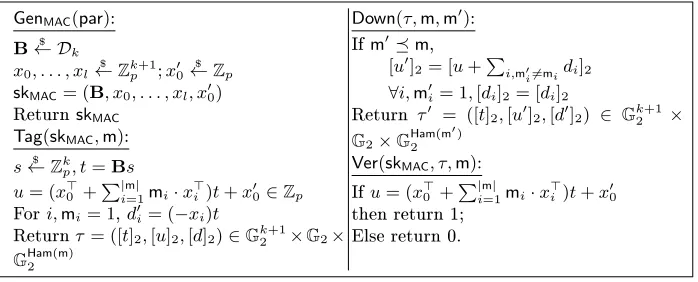
We explicit in Figure 12 the inner downgradable MAC we consider in our scheme. And then prove its security.
GenMAC(par):
B $
← Dk
x0, . . . , xl←$ Zkp+1;x00
$
←Zp
skMAC= (B, x0, . . . , xl, x00) ReturnskMAC
Tag(skMAC,m):
s←$ Zkp, t=Bs
u= (x>0 +
P|m|
i=1mi·x
>
i)t+x00∈Zp
Fori,mi= 1,d0i= (−xi)t
Returnτ = ([t]2,[u]2,[d]2)∈Gk2+1×G2× GHam(m)2
Down(τ,m,m0): Ifm0m,
[u0]2= [u+P
i,m0i6=midi]2
∀i,m0i= 1,[di]2= [di]2
Return τ0 = ([t]2,[u0]2,[d0]2) ∈ Gk2+1× G2×GHam(m
0)
2
Ver(skMAC, τ,m): Ifu= (x>0 +P
|m|
i=1mi·x>i )t+x
0
0 then return 1;
Else return 0.
Fig. 12. DowngradableMACfromHPS[BKP14]
In this proof we will show that an adversary will be at some point against a standard ane MAC thus the security of the MAC we based
our instantiation on, ensure the security of our Downgradable MAC.
In-tuitively, we will replace query by query the answer of the Eval oracle by
proof of security of the ane MAC from HPS in [BKP14].G0 is the real
security game dened in 11. G1,i the rst i−1 answer to theEval oracle are random and the rest is answered as in the real game. We also need a game to switch from gameg1,i to the game G1,i+1. This new game will
be calledG01,i. Here we will only describe how to come fromG0i,1 to Gi+1,1
since it is the only part that will dier from the proof in [BKP14]. Letmbe thei-th query of the adversary, sincem∗ 6mthere exists aj
such thatm∗j 6=mj andfj(m∗j)6=fj(0). In this conguration the adversary not more information aboutxjthan in a standard aneMAC. We can thus reuse the argument of the original proof: there is an information-theoretic argument to show that u−x00 is uniformly random. To simplify our proof
we assume that the adversary A knows x00 and all xl with l6∈ {0, j}. He may also know B>x0 and B>xj. We will show that Ais unable to guess
xj and x0,Ahas to solve the following matrix equation:
B>x0
B>
h0 u−x00
=
B> 0
0 B>
h·Ik+1m∗jh·Ik+1 t> mjt>
| {z }
M
·
x0 xj
(1)
The u−x00 is linearly independent from the other rows: t> is
inde-pendent from B> because t 6∈ span(B) with probability (q−1)/q, also
mj 6= m∗j which means that this last row is independent from the rows
h·Ik+1m∗jh·Ik+1
. Thus this system of equations has not enough equa-tions to be solved e.g. A can not distinguish between a random and u
(except for a probability 1/q).
Finally, we do all the other steps of the proof like in the original proof, and then we end up with the following lemma.
Lemma 18. For all adversariesAthere exists an adversaryBwithT(A)≈ T(B) and AdvMACHPS,Dk(B)
DPR0-CMA(A)≤2q
k(AdvDk,GGen(B) + 1/q).
Which leads to the security of the downgradable MAC. Achieving Secure DIBE
We dene the sequence of games G0-G4 as in Figure 13. Let A be
an adversary against the PR-ID-CPA security ofDIBKEM. G0 is the real
attack game.
We can see thatG1 is simply a rewriting of G0.
Initialize: // GamesG0-G2, G3-G4
G $
←GGen(K);A← D$ k
skMAC= (B, x0, . . . , x`, x00)
$
←GenMAC(G)
∀i∈J0, `K:
Yi $
← Zkp×n;Zi = (Y
>
i | xi)·A ∈
Znp×k
di,1=zi>·B∈Zkp
di,2-n=z>i ·B∈Zkp×n−1
di,2-n0 = (A−1)>(Z>iB−A>xiB) y00
$
←Zkp;z00= (y00
>
|x00)·A∈Z1p×k
pk:= ([A]1,([Zi]1)0≤i≤`,[z00]1)
dk:= ([B]2,([di]2)0≤i≤`)
sk:= ((Zi)0≤i≤`, z00) Return(pk,dk)
USKGen(id): //GamesG0-G2, G3-G4
QID=QID∪ {id}
([t]2,[u]2)←$ Tag(skMAC,id)
v=P
ifi(id)Yit+y00 ∈Z
k p
v>= (t>P
fi(id)Zi+z00 −u·A)·A−1 Fori,id[i] = 1:
di,1=x>it∈Zp
di,2-n=Yit∈Zkp;
d>i,2-n= (t
>
Zi−di,1A)A−1∈Z1p×k
usk[id] := ([t]2,[u]2,[v]2)∈Gn2×G12×Gk2
udk[id] := ([di]2)id[i]=1∈(G1+2 k) (Ham(id)) Return (usk[id],udk[id])
Enc(id∗): //GamesG0, G1-G2 , G2 , G3
r←$ Zkp
c∗0=Ar∈Zkp+1
c∗0
$
←Zkp+1
h $
←Zp;c∗0
$
←Zkp;
c∗0 :=h+A·A−1c∗0∈Zp
c∗1= (Pifi(id∗)Zi)r∈Znp
c∗1=
P ifi(id
∗
)(Y>i |xi)c∗0 ∈Znp
c∗1 =
P ifi(id
∗
)(Zi·A−1c∗0+xi·h)
K∗=z00·r∈Zp.
K∗= (y0>0 |x
0
0)c
∗
0∈Zp
K∗=z00 ·A
−1c∗
0+x
0
0·h
ReturnK∗= [K∗]T andC∗= ([c∗0]1,[c∗1]1)
Enc(id∗): //GameG3, G4
h←$ Zp;c∗0
$
←Zkp;c∗0 :=h+A·A−1c∗0 ∈Zp
c∗1=
P
ifi(id∗i)(Zi·A
−1c∗
0+xi·h)
K∗=z00·A
−1
c∗0+x
0
0·h
K∗ $
←Zp
ReturnK∗= [K∗]T andC∗= ([c∗0]1,[c
∗
1]1)
Finalize(β): //GamesG0-G4 Return(id∗6 QID)∧β
Fig. 13. GamesG0-G4 for the proof
Lemma 20. There exists an adversary B1 with T(B1)≈T(A) and
AdvDk,GGen(B1)≥ |Pr[G
A
2 ⇒1]−Pr[GA1 ⇒1]|.
Lemma 21. Pr[GA3 ⇒1] = Pr[GA2 ⇒1].
Proof. G3 is simulated without using y00 and (Yi)0≤i≤`. By Y>i = (Zi−
Di= (A−1)>(Z>i B−A>di) = (A−1)>(Z>i −A>x>i )
| {z }
Yi
B
di= (A−1)>·(Z>i t−A> x>i t |{z} di
) =Yit.
as in GameG2. And so, we have [v]2,K∗ and C∗ are identical to G2.
u t
Lemma 22. There exists an adversary B2 with T(B2)≈T(A) and
AdvdprMAC0-cma(B2)≥ |Pr[GA4 ⇒1]−Pr[GA3 ⇒1]|
Proof. In G4, we answer theEnc(id∗) query by choosing randomK∗. We
construct algorithm B2 in Figure 14 to show the dierences between G4
andG3is bounded by the advantage of breakingdpr0-cmasecurity ofMAC.
Initialize:
A← D$ k
([B]2,([x>iB]2)0≤i≤`) $
←InitializeMAC
∀i∈J0, `K:
Zi←$ Znp×k;z
0
0
$
←Z1p×k
pk:= (G,[A]1,([Zi]1)0≤i≤`,[z00]1) Return(pk,dk)
Enc(id∗): //only one query ([h]1,[h0]1,[h1]T)
$
←Chal(id∗)
c∗0
$
←Zkp;c∗0 :=h+A·A−1c∗0∈Zp
c∗1=
P ifi(id
∗
)Zi·A−1c∗
0+h0
K∗=z00·A−1c∗0+h1
Return K∗ = [K∗]T and C∗ =
([c∗0]1,[c∗1]1)
USKGen(id):
QID=QID∪ {id}
([t]2,[u]2,[T]2,[u]2,([di]2,[Di]2)) ←$
Eval(id)
v>= (t>P
fi(id)Zi+z00−u·A)·(A)
−1
V = (A−1)>(P
fi(id)Zi>·T−A
>· u) Fori,idi= 1:
e>i = (t
>
Zi−diA)A−1∈Z1p×k
Ei = (A−1)>(Z>i T−A
> ·Di)∈
Zkp×µ
usk[id] := ([t]2,[u]2,[v]2) ∈
Gn2×G12×Gk2
udk[id] := ([T]2,[u]2,[V]2,[ei]2,[Ei]2))
Return(usk[id],udk[id])
Finalize(β):
Return(id∗6 QID)∧FinalizeMAC(β)
Fig. 14. Description of B2 (having access to the oracles
InitializeMAC,Eval,Chal,FinalizeMAC for the proof of Lemma 22.
We note that, in games G3 and G4, the values xi and x0i are hidden until the call toEnc(id∗)(because the adversary is not allowed to query an
id such that id∗ id). In both games DPR-CMAreal and DPR0-CMArand,
we haveh=c∗0−AA−1c∗0. Henceh0 =Pfi(mi)xi·(c∗0−A·A
−1c∗
implies c∗1 is distributed identically in games G3 and G4. If h1 is uniform
(i.e.,B2is in GameDPR0-CMArand) then the view ofAis the same as inG4.
Ifh1is real (i.e.,B2 is in GameDPR-CMAreal) thenK∗ =z00·A−1c∗0+x00·h,
which means the view of Ais the same as inG3.
u t