The Control of Digger Pine with Herbicides
Placed in Basal Cuts1
J. L. LAUNCHBAUGH,* H. H. BISWELL, AND
A. M. SCHULTZ
Associate Professor, Fort Hays Branch, Kansas Agricul- tural Experiment Station, Hays, Kansas; Professor and Specialist, respectively, School of Forestry, University of California, Berkeley.
Digger pine (Pinus sabiniana)
occurs in abundance on many
woodland-grass ranges in Cali- forma (Fig. 1). These ranges, de- scribed by Talbot and Biswell
(1942) and Biswell (1956)) are managed primarily for livestock but they support large numbers of deer, quail, and dove.
Digger pine has little commer- cial value as timber. It is ob- noxious on ranges in that shad- ing and needle fall reduce the amount of forage under the can- opy. Also, resin drip in summer reduces the palatability of the forage. The tree has increased in
many of the woodland-grass
areas in recent years (Fig. 2) .
New seedlings become estab-
lished every year and the young
trees grow very rapidly. For
these reasons many landowners have wished to reduce the num- of trees on their land.
Studies were made from 1950 to 1954 on rangelands in Madera County to determine the effects of various chemical herbicides on digger pines when applied to cuts in the basal part of the trunk.
Broadcast aerial spraying was
ruled out because of the scat- tered distribution of the pine trees, the presence of some de-
‘Contribution from cooperative in- vestigation between the University of California and the California De- partment of Fish and Game. Re- search was done under Federal Aid in Wildlife Restoration Act, Pittman- Robertson Research Project W-31-R. 2Formerly Assistant Specialist, School of Forestry, University of California, Berkeley.
sired oaks, and the many pala- table shrubs and broad-leaved herbs in the forage. Foliar spray- ing from the ground was thought not feasible because of the great size of many of the trees. Thus the study was limited to basal treatments.
Methods
The method of treatment con-
sisted of chopping several
notched cups evenly around the basal part of the tree and apply- ing various chemical formula- tions in the cups. The growth form of digger pine seemed ideal for basal application rather than foliar spray. Notching the base of the trunk and applying small
amounts of herbicides in the cups appeared to be the most conserv- ative way to administer the ma- terial, especially since digger pine has thick bark which may inhibit penetration of the chemi-
cals. The equipment for the
treatments included an axe, a pump-type oil can, and a supply of herbicide. Chemicals in crystal or powder form were applied to the cups with a spoon. Emrick
(1953) describes the method. In all treatments the cups were
made by cutting through the
bark and cambium layer and into
the wood, approximately one
foot above ground level. The
width of each cup was approxi- mately 5 inches-as wide as the axe blade. Various spacings were used since spacing between cups was one of the factors to be studied. The dosage of material applied to each cut was deter-
mined by finding how much
liquid chemical could be added to the cup without running it over. The average cup made with a 5-inch axe blade will hold ap- proximately 2.5 cc.
The chemical treatments were evaluated on the basis of per- centage of crown and complete kill observed at various inter-
CONTROL OF DIGGER PINE WITH HERBICIDES 15
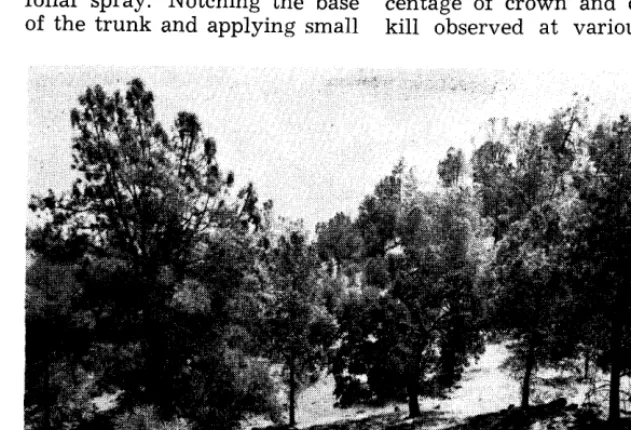
FIGURE 2. Dense stand of young digger pine surrounding parent tree on moderately grazed range.
vals following treatment. Crown or top kill percentage is meas- ured by the proportion of the needles dead on all trees taken collectively; complete kill per- centage is the ratio of dead trees to trees treated.
Treatments and Resulfs
Preliminary Treatments
Treatments were made from
1950 through 1952 for the pur- pose of screening a number of herbicides to narrow the choice for further studies.
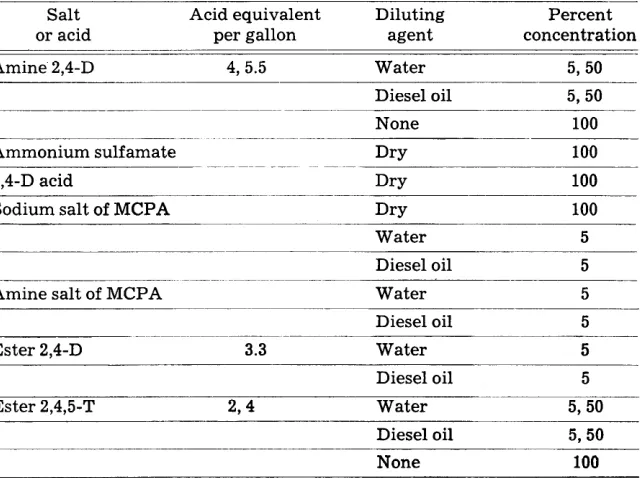
The various treatments applied to a large number of trees in the spring months are listed in Table 1.
With the exception of some of the 2,4-D amine treatments, no application gave complete kill. The 2,4,5-T treatments were the least effective. Dilution of 2,4-D amine to 5 percent with water
and dry ammonium sulfamate
produced less than 40 percent top kills. The 50 and 100 percent ap- plications of 2,4-D amine were the most promising. Intensified experimentation was confined to these concentrations.
Treatments of 1952
Using full concentrations and 50 percent dilutions, 170 digger pines ranging from 2 to 35 inches
dbh were treated in April 1952. The object was to narrow down the treatments to the one which most closely and consistently gave complete kill. Undiluted amine of 2,4-D, with 5.5 pounds of acid equivalent per gallon pro- duced the most effective kill. The effectiveness of amine 2,4-D in these tests was directly pro-
portional to amount of acid
equivalent present in each for-
mulation. The trees reacted
gradually to the herbicides and most of the killing action oc- curred prior to the first winter period following treatment. All of the trees were at least partial- ly dead one year following ap- plication of the herbicide.
Trees containing less than 15 percent green foliage after the first winter did not survive be- yond the second year following treatment, while those with over 15 percent green foliage were still alive 3 years after the ap- plications were made. The trees ranging from 2 to 15 inches dbh were most easily killed in all treatments. These were the first to show signs of reaction to the herbicides late in the spring of 1952. The upper branches of the smaller trees bent over in a char- acteristic “gooseneck” and the upper leaves turned brown on the larger trees. The trees died from the top downward in most
instances throughout the sum-
mer and early fall periods. Treatments of 1953
After determining what for-
mulation was best and what con-
centration was optimum, the
next emphasis was placed on
Table 1. Herbicide screening treatments made in 1950-1952.
Salt Acid equivalent Diluting Percent
or acid per gallon agent concentration
Amine 2,4-D 4, 5.5 Water 5, 50
Diesel oil 5, 50
None 100
Ammonium sulfamate Dry 100
2,4-D acid Dry 100
Sodium salt of MCPA Dry 100
Water 5
Diesel oil 5
Amine salt of MCPA-- Water 5
Diesel oil 5
Ester 2,4-D 3.3 Water 5
Diesel oil 5
Ester 2,4,5-T 294 Water 5, 50
Diesel oil 5,50
~-
16 J. L. LAUNCHBAUGH, H. H. BISWELL, AND A. M. SCHULTZ
Table 2. Chemical applications in March, 1953, 10 19 frees per freaf- menf. In each freafmenf 5 trees were less than 15 inches dbh and 5 were larger fhan 15 inches dbh.
Spacing
between Concentration
CUPS of herbicide*
Treatment in inches in percent
1 4 100
2 4 50
3 4 10
4 7 100
5 7 50
6 7 10
7 10 100
8 10 50
9 10 10
* Concentration of 100% is pure form of amine of 2,4-D containing 5.5 lbs. acid equivalent per gallon, other treatments diluted with water to stated percentages. Each cup re- ceived 2.5 cc. of material.
economizing cup spacing and concentration while attempting to retain satisfactory kill per- centages.
In March, 1953, the treatments shown in Table 2 were applied to 10 trees per treatment.
Figure 3 shows the relation- ship of cup spacing and herbicide concentration to kill two years following treatment. Apparently complete kills are possible only
with high concentrations of
amine 2,4-D and close cup spac- ings. Except for very low con- centrations of 2,4-D, close spac- ing compensated for dilution of
the herbicide with water in
terms of percentage crown kill. Treatments of 1953- 1954 Additional studies were started in November, 1953 to determine
the relationship between per-
centage kill and time of year when the herbicide is applied. Only trees larger than 12 inches dbh were used in this test since
the smaller diameter classes
were known to be easier to kill.
During November, 120 trees
were selected at random from a uniform stand of digger pines and divided into 12 lots of 10 trees each. A different lot of
trees was treated with 100 per- cent amine 2,4-D containing 5.5 lbs. acid equivalent per gallon on the 15th of each month during the next 12 months. The cups were spaced at 4-inch intervals around each tree and approxi- mately 2.5 cc. of material added to each cup. The results of this experiment are given in Table 3 and the reaction pattern shown in Figure 4.
In the above study, responses were evident within 2 months in all trees treated from February through June, while those treat- ed in the summer, fall and early winter showed considerable lag.
Complete kills were obtained
from each monthly treatment
except September and October. With these, 90 and 70 percent, respectively, of the trees were
killed. The November through
April applications produced the most rapid complete kills, all trees dying within a period of from 6 to 9 months. Trees treated each month from May through
October required from 1% to
over 2 years to die. Trees which were still alive 2 years following the October treatments had lost from 30 to 70 percent of their needles; however, they appeared to be in various stages of recov- ery. New growth had been pro- duced and eventually the trees may recover completely.
The rapidity of kill in digger
A- COMPLETE KILL
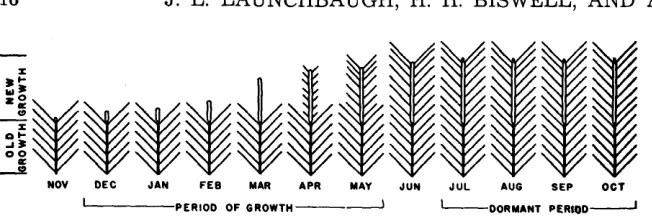
pines treated with amine 2,4-D was closely associated with the growth activity of the trees. Ob- servations of the development of terminal growth of branches and needles during each month of treatment indicated that the pe- riod of active growth is from late November to June (Fig. 5). The most satisfactory kills were ob- tained during this time. The pe- riod of active growth no doubt is associated with the period of available soil moisture. This may account for the failure to obtain complete kills among trees treat- ed during September and Octo- ber. The November to July treat- ments were applied after the first seasonal precipitation had fallen and during a time when soil moisture conditions were favorable. The July through Oc- tober treatments were applied after the end of the spring rainy period. Only 1% inches of mois- ture fell in the treated area be-
tween April and November of
1954. The soil moisture content was consequently low during the
September and October herbi-
cide applications, so the trees re- mained dormant and there was very little translocation of the active ingredients until growing conditions improved.
Discussion and Conclusions Amine 2,4-D containing 5.5 lbs. acid equivalent per gallon seems
B- CROWN KILL
FIGURE 3. Effects of concentration of amine 2,4-D and distance between cups on per- centage of complete kill (A) ; and percentage of crown kill (B) in digger pine. Dlistance
CONTROL OF’ DIGGER PINE WITH HERBICIDES 17
to be the most effective herbicide tested on digger pines in these
experiments. Lower concentra-
tions of acid per gallon produced correspondingly lower kills when applied to basal cuts in the trunks. The most practical meth- od of application is to chop the cups with a hand axe and add the chemical with a pump-type oil can.
Undiluted amine 2,4-D is supe- rior to diluted mixtures in killing
digger pines. Leonard (1952,
1956) reported similar findings with the same method in the treatment of interior live oak and blue oak and Leonard and Harvey (1956) with digger pine.
Other experimental work has
shown dilute mixtures of 2,4-D and 2,4,5-T in the form of esters to be effective in killing a num- ber of different species of trees
(Goddard, 1954; Peevy, 1954;
Arend and Coulter, 1953; and
McCully and Darrow, 1952). Close cup spacing along with
high concentrations of amine
2,4-D is important in obtaining effective kills. Spacings greater than 4 inches between the edges of cups reduced the number of trees completely killed. It ap- pears that spacing cups closer than 4 inches apart is not neces- sary under conditions which pre- vailed in the experimental areas.
The height of cuts above
ground was not studied in this
Table 3. Time required in months for various degrees of kill in digger pine treated each month of the year with amine 2,4-D in basal cuts in trunk.
First Visible All Trees Show
Month of Evidence Effects of All Trees
Treatment of Kill Treatment Dead
Months Following Treatment
November 4 5 9
December 3 4 8
January 2 3 7
February 1 2 8
March 1 2 a
April 1 2 6
May 1 1 17
June 1 2 16
July 2 3 26”
August 3 10 25*
September 5 9 --t
October 4 8 --It
* All trees may have been dead 1 to 11 months earlier. These trees were not observed from November 1955 until October 1956.
t Nine trees dead, one partially killed but showing some recovery, two years following treatment.
$+ Seven trees dead, three partially killed but showing fair to good recovery, two years following treatment.
experiment. Leonard (1956)
found that heights of cuts on blue oaks was a factor in the con- trol of sprouting but did not ap- pear to influence the percentage of top kill. Digger pines do not sprout, thus height of cuts prob- ably is not important in the treatment of digger pines with amine 2,4-D.
The time of application appar- ently is not critical except during the late summer-early fall period when the trees may be dormant.
The dormant period may be
FIGURE 4. Monthly increment of top kill of 10 digger pine trees treated on the 15tlh of every month of the year. Month of treatment, left to right; month in which percent kill was read, front to back. Sum of blocks in a tier equals 100 percent kill. Incomplete kill
with September and ‘October treatments and apparent recovery of some trees for October treatment; with dhese exceptions, last block falls in month when complete kill is attained.
June, as indicated, shows the greatest activity.
longer some years than others
depending upon the available
soil moisture during the early fall. The season of year trials indicate that good kills may be obtained after fall rains have stimulated new growth and may be continued until growth ceases in the late spring or early sum- mer. Visible responses to the herbicides were not pronounced until the trees were growing rapidly.
In the practical sense, the best period to treat trees coincides with the most desirable seasons for this type of work in the Cali- f ornia foothills region-late fall, winter, and spring months.
This method of treatment of- fers not only a rapid, but a rela- tively inexpensive means of kill- ing digger pines. In a typical stand one man can treat from 35 to 50 trees per hour and cut down
an additional 30 saplings with dbh less than 2 inches. One gal- lon of concentrated amine 2,4-D is sufficient to treat from 300 to 350 digger pines.
Summary
18
J. L. LAUNCHBAUGH, H. H. BISWELL, AND A. M. SCHULTZ
of Calif. Agr. Extension Serv. Leaflet. 9 pp. (Mimeo.)
GODDARD, RAY E. 1954. Killing small undesirable hardwoods by use of the Cornell tool. Down to Earth 10: 5.
LEONARD, 0. A. 1952. Result of a cut-surface experiment on interior
NOV JAN APR MAY JUN JUL AUG SEP
L---PERIOD OF GROWTH- ’ -OORMANT PERIOD- live oak. Research Rept., 13th
FIGURE 5. Schematized phenological development of digger pine terminal branches duning Western Weed Control Conf. 53-54.
the 1953-54 monthly treatments. Trees treated during the period of growth died more ____. 1956. Effect on blue oak
rapidly than those treated during the dormant period. 2,4,5-T concentrates applied to cuts (Quercus douglasii) of 2,4-D and
in trunks. Jour. Range Mangt.
digger pines when applied to the trees, which in turn is influenced
9: 15-19.trees by the basal cut method.
by seasonal precipitation and --
AND w* A* HARVEY*
1g56.
2. Amine 2,4-D was the most soil moisture. Dormant trees in
Chemical control of woody plantseffective formulation tried. Con- a dry soil were more difficult to
in California. Calif. Agr. Exp. Sta.centrates of amine 2,4-D contain-
kill than trees which had started
Bull. 755, pp. l-40.ing 5.5 lbs. acid equivalent per growth after fall rains.
MCCULLY, W. G. AND R. A. DARROW.gallon were more effective than
jack 1952. Control of post and black- oaks with growth-regulatorlower concentrations or diluted
LITERATURE CITED herbicides. Proc. 5th South. Weedforms.
AREND, J. L. AND L. L. COULTER. 1953. Conf. 137-140.3. Cup spacings not over 4
lease in lower Michigan. Down to Chemical frill girdling for pine re- PEEVY, F. A. 1954. Woody plant con-inches apart were found to be
Earth 8: 2-4. trol in southern forests. Proc. 7thimportant in obtaining complete
South. Weed Conf. 261-264.kills on digger pines.
BISWELL, H. H. 1956. Ecology of TALBOT, M. W. AND H. H. BISWELL.4. Seasonal effects of herbicide
Mangt. 9: 19-24. California grasslands. Jour. Range 1942. The forage crop and its man-applications apparently depend
agement. In The San Joaquin Ex-upon the growth rate of the
EMRICK, WALTER E. 1953. An easy way to kill your bull pines. Univ. perimental Range. Calif. Agr. Exp. Sta. Bull. 663: 13-49.Techniques in Studying Competition Between
Big Game and Livestock
ODELL JULANDER
Intermountain Forest Service, Utah
Most of the big game grazing
lands in the West are grazed in
common with livestock. Much of
this range is heavily stocked
with game, livestock, or both, re-
sulting in overuse of the impor-
tant forage plants on the more
intensively used areas. On such
areas conflict exists between
game and livestock for the lim-
ited supply of forage. This we
refer to as forage competition,
and this paper is concerned with
Forest and Range Experiment Station, U. S. Department of Agriculture, Ogden,
methods of determining this type
of competition between big game
and livestock.
The degree of competition be-
tween big game and livestock on
a range is determined by two
factors: (1) the extent to which
game and livestock graze the
same areas, and (2) the extent
to which they prefer the same
species. Thus two phases of
study are necessary in determin-
ing competition,
Areas Grazed