On the Primary Constructions of Vectorial Boolean Bent
Functions
∗Yuwei Xu1,2 and Chuankun Wu1
1State Key Laboratory of Information Security
Institute of Information Engineering
Chinese Academy of Sciences, Beijing 100093, China
2University of Chinese Academy of Sciences
Beijing 100049, China
Email: {xuyuwei, ckwu}@iie.ac.cn
Abstract
Vectorial Boolean bent functions, which possess the maximal nonlinearity and the minimum differential uniformity, contribute to optimum resistance against linear crypt-analysis and differential cryptcrypt-analysis for the cryptographic algorithms that adopt them as nonlinear components. This paper is devoted to the new primary constructions of vectorial Boolean bent functions, including four types: vectorial monomial bent func-tions, vectorial Boolean bent functions with multiple trace terms,Hvectorial functions and H-like vectorial functions. For vectorial monomial bent functions, this paper an-swers one open problem proposed by E. Pasalic et al. and characterizes the vectorial monomial bent functions corresponding to the five known classes of bent exponents. For the vectorial Boolean bent functions with multiple trace terms, this paper answers one open problem proposed by A. Muratovi´c-Ribi´c et al., presents six new infinite classes of explicit constructions and shows the nonexistence of the vectorial Boolean bent func-tions fromF2n to F2k of the formP2
k−2
i=1 T r
n
k(ax(2i−1)(2 k−1)
) withn= 2k anda∈F∗2k. Moreover, H vectorial functions are further characterized. In addition, a new infinite class of vectorial Boolean bent function named asH-like vectorial functions are derived, which includesHvectorial functions as a subclass.
1
Introduction
Vectorial Boolean functions, which are widely used in block ciphers, stream ciphers and Hash functions, paly an important role in cryptography. The security of the cryptographic algo-rithms, adopting vectorial Boolean functions as nonlinear components, usually depends on the cryptographic properties of the vectorial Boolean functions adopted. The nonlinearity and the differential uniformity of the adopted vectorial Boolean functions are two parame-ters that measure the resistence of the cryptographic algorithms against linear cryptanalysis [27, 39] and differential cryptanalysis [1, 2] respectively. The vectorial Boolean functions possessing the maximal nonlinearity, which is the optimal nonlinearity, are referred to as
∗
vectorial Boolean bent functions. The concept bent of vectorial Boolean functions, which is an extension of Boolean bent functions [56], was first considered by Nyberg in [51], where it was shown that bent (n, m)-functions (i.e., the vectorial Boolean functions fromF2ntoF2m) exist if and only if nis even andn≥2m. Vectorial Boolean bent functions are also named as perfect nonlinear functions [17, 51], for the reason possessing the minimum differential uniformity, which is the optimal differential uniformity. Thus, the constructions of vectorial Boolean bent functions have both theoretical significance and practical applications.
The construction methods of vectorial Boolean bent functions can be divided into two categories: primary constructions and secondary constructions. Primary constructions are also called direct constructions, and secondary constructions lead to vectorial Boolean bent functions based on some known vectorial Boolean bent functions, which are also called in-direct constructions. Among the constructions of vectorial Boolean bent functions, primary constructions hold a key status.
Strict Maiorana-McFarland vectorial functions, extended Maiorana-McFarland vecto-rial functions and general Maiorana-McFarland vectovecto-rial functions are the three infinite classes of vectorial Boolean bent functions [11, 51, 52, 54, 57] stemming from the Maiorana-McFarland constructions of Boolean bent functions [22, 40]. In the light of the Partial Spread constructions of Boolean bent functions [22], two infinite classes of vectorial Boolean bent functions,PSapvectorial functions [11] and Partial Spread vectorial functions [15], were presented. In [5], two infinite classes of vectorial Boolean bent functions were introduced by investigating the bent component functions of non-bent vectorial Boolean functions. Two infinite classes of vectorial hyper-bent functions, which is a subclass of vectorial Boolean bent functions, were discussed in [38, 61]. A vectorial hyper-bent function is the vectorial Boolean function that every one of its component functions is a hyper-bent function, and the Boolean bent functionf(x) onF2n is a hyper-bent function iff(xj) is also bent for any gcd(j,2n−1) = 1 [61]. All the above infinite classes of vectorial Boolean bent functions are primary constructions, and a few primary constructions of vectorial Boolean bent functions which are not infinite classes can be found in [15]. Recently, the primary constructions of some other infinite classes of vectorial Boolean bent functions have attracted a lot of attentions.
The bent (n, m)-functions of the form T rmn(axd) are referred to as vectorial monomial bent functions, which aremonomial bent functionsifm= 1, i.e., the Boolean bent functions of the form T rn1(axd) on F2n, and exist only if gcd(d,2n−1) 6= 1 [34], where dis integer and a ∈ F∗2n. In [55], it was shown that T rnm(axd) is a vectorial monomial bent function ifT rn1(axd) is a monomial bent function and xd is a permutation on F2m, i.e., gcd(d,2m− 1) = 1, and some classes of vectorial monomial bent functions with the Kasami exponent, the Leander exponent and the Canteaut-Charpin-Kyureghyan exponent were investigated. However, whether the condition that gcd(d,2m −1) = 1 is necessary or not and how to relax the condition gcd(d,2m−1) = 1 forT rnm(axd) to be bent are unknown and left open in [55]. In [58], a counter example to show that gcd(d,2m−1) = 1 is not necessary for
T rnm(axd) to be bent was found. In [26], it was shown that T rkn(axd), with n = 2k, is a vectorial monomial bent function if gcd(d,2n−1)| (2k+ 1) and T r1n(axd) is a monomial bent function with the Gold exponent or the Kasimi exponent. However, in [26], whether the condition gcd(d,2n−1)|(2k+1) is necessary or not forT rnk(axd) to be bent is unknown. In [48], it was proved that there does not exist a vectorial monomial bent function of the form T rkn(axd) with the Dillon exponent fora∈F∗
2k,d=s(2
k−1) and gcd(s,2k+ 1) = 1.
functions is still not clear.
In [48], the general construction of the bent (n, m)-functions of the formT rnm(a1xd1 +
Pj
i=2aixd1+vi(2
m−1)
) was studied, where ai ∈F∗2n for i = 1,2,· · · , j. An (n, m)-functions
T rnm(a1xd1+Pji=2aixd1+vi(2
m−1)
) was shown in [48] to be bent if gcd(d1,2m−1) = 1 and the Boolean function T rn1(a1xd1+Pji=2aixd1+vi(2
m−1)
) onF2n is bent, wherevi is nonnegative integer fori= 2,3,· · ·, j. In [48], whether the condition that gcd(d1,2m−1) = 1 is necessary or not was unknown, and an open problem (i.e., Open Problem 1 in [48]) left was to find a similar result to the above conclusion (i.e., Theorem 1 in [48]) with gcd(d1,2m−1)6= 1.
The explicit constructions of vectorial Boolean bent functions with multiple trace terms are rare, and only four classes of them can be found in the public literatures. The bent (n, m)-functions of the formT rmn(a1xd1 +a2xd2) are named asvectorial binomial bent
func-tions, which are binomial bent functions if m = 1, i.e., the Boolean bent functions of the form T r1n(a1xd1 +a2xd2) on F2n, where a1, a2 ∈F∗2n. Based on the three infinite classes of binomial bent functions given in [25], three infinite classes of the vectorial binomial bent functions with two Niho exponents and m =k were presented in [48]. In [49], an infinite class of the hyper-bent (n, k)-functions of the form T rkn(P2k
i=1aixi(2
k−1)
) was presented. In [45], a new primary construction named as H vectorial functions was introduced, i.e., the infinite class of the vectorial Boolean bent functions of the form yG(zy2k−2), where (y, z)∈F2k×F2k andG is an o-polynomial onF2k.
This paper is devoted to new primary constructions of vectorial Boolean bent functions. Four types of vectorial Boolean bent functions, i.e., vectorial monomial bent functions, vectorial Boolean bent functions with multiple trace terms, H vectorial functions and H -like vectorial functions, are investigated.
Firstly, several general constructions of vectorial monomial bent functions are given, which imply answers to one open problem proposed by E. Pasalic et al. in [55], i.e., given a monomial bent function T r1n(axd), we present several conditions which are much closer to the sufficient and necessary conditions forT rnm(axd) to be bent than the condition that gcd(d,2m−1) = 1. Subsequently, the vectorial monomial bent functions corresponding to the five known classes of bent exponents are characterized. For vectorial monomial bent functions, the main results are the existence and constructions of the vectorial monomial bent functions corresponding to the five known classes of bent exponents.
In the second place, several general constructions of the bent (n, m)-functions of the form T rn
m(
Pj
i=1aixdi), where ai ∈ F∗2n for i= 1,2,· · · , j, are derived, which are answers to one open problem proposed by A. Muratovi´c-Ribi´c et al. in [48], i.e., we give similar results to Theorem 1 in [48] with gcd(d1,2m −1) 6= 1. Then we focus on the explicit constructions of the vectorial Boolean bent functions with multiple trace terms. Six new infinite classes of the explicit constructions of such bent (n, m)-functions are obtained, i.e., one classes with 2r−1 Niho exponents, wherer < kand gcd(r, k) = 1, four classes with some Gold exponents and one class with 2k−2 Dillon exponents. For the vectorial Boolean bent functions with multiple trace terms, the main results are the six infinite classes of the explicit constructions. Furthermore, it is shown that there does not exist a bent (n, k)-function of the form P2k−2
i=1 T rkn(ax(2i
−1)(2k−1)
), wherea∈F∗2k.
In addition, we present a new infinite class of the vectorial Boolean bent functions of the formT rmk(yV(zy2k−2lc), where (y, z)∈F2k×F2k,l|k,c∈Zk
l andV is aϕ-polynomial on F2k corresponding to Φ≡c, and name it asH-like vectorial functions, which includesH vectorial functions as a subclass.
The rest of this paper is organized as follows. Section 2 provides some preliminaries for the description of the paper and introduces the basic idea of the constructions of vectorial Boolean bent functions. Section 3 discusses vectorial monomial bent functions. Section 4 analyzes the vectorial Boolean bent functions with multiple trace terms. Section 5 charac-terizes H vectorial functions. Section 6 presents H-like vectorial functions. And Section 7 concludes this paper.
2
Preliminaries
Throughout this paper, let k, m be two positive integers, n = 2k, F2k denote the Galois fieldGF(2k),F∗2k =F2k\ {0},F2n be identified withF2k×F2k andαbe a primitive element of F2n, and lett= 2n−m+ 2n−2m+· · ·+ 2m+ 1 ifm|n.
Form|k, the trace functionT rkm:F2k →F2m is defined as
T rkm(z) =z+z2m+z22m+· · ·+z2(
n m−1)m
.
In particular, T rk1(z) is called the absolute trace function on F2k. Note that the trace function has the well known properties thatT rkm(z) =T rm1 ◦T rkm(z) andT rkm(z) =T rkm(z2).
Form|k, the norm functionNmk :F2k →F2m is defined as
Nmk(z) =z·z2m·z22m· · ·z2(
k m−1)m
.
A mapping G:F2k → F2m is referred to as a vectorial Boolean function, which is also known as a (k, m)−function, a multiple output Boolean function or an S-box, particularly,
G is a Boolean function onF2k ifm= 1. The (k, m)−functionGcan be represented as
G(z) = (g1(z), g2(z),· · ·, gm(z)),
where g1(z), g2(z),· · ·, gm(z) are m Boolean functions on F2k and called the coordinate
functions of G. All nonzero linear combinations of the coordinate functions are called the
component functionsofG, and can be represented asv·GorT rm
1 (λ·G), where 06=v∈Fm2 and λ∈F∗2m.
Gcan be uniquely represented in the univariate polynomial representation as
G(z) = 2k−1
X
i=0
aizi, ai∈F2k.
The algebraic degree ofG, denoted bydeg(G), is defined as
deg(G) = max{wt(i) : 0≤i≤2k−1, ai 6= 0},
the linear vectorial Boolean functions are the affine vectorial Boolean functions with the algebraic degree being 1 whose constant terms are null, and with the algebraic degree being 0 (i.e., constant functions).
Form|k,Gcan also be represented in a non-unique way as
G(z) =T rmk(P(z)), P(z)∈F2k[z].
An (n, m)-functionF can be uniquely represented in the bivariate polynomial represen-tation as
F(y, z) = X
0≤i1,i2≤2k−1
ai1,i2y
i1zi2, (y, z)∈
F2k×F2k, ai1,i2 ∈F2k.
The algebraic degree of F in the bivariate polynomial representation is
deg(F) = max{wt(i1) +wt(i2) : 0≤i1, i2 ≤2k−1, ai1,i2 6= 0}.
Form|k,F can also be represented non-uniquely as
F(y, z) =T rmk(P(y, z)), P(y, z)∈F2k[y, z].
Thenonlinearityof the Boolean function g on F2k, denoted bynl(g), is defined as
nl(g) = min
g0∈ An
d(g, g0),
where An is the set of all the affine Boolean functions on F2k and d(g, g0) is theHamming
distance betweeng and g0, i.e., the cardinality of the set {x∈F2k :g(x)6=g0(x)}. The nonlinearity ofg can be measured as
nl(g) = 2k−1− 1 2ωmax∈F2k
Wg(ω),
where Wg(ω) is the Walsh transform ofg and defined as
Wg(ω) =
X
z∈F
2k
(−1)g(z)+T r1k(ωz), ∀ ω∈F
2k.
The Walsh spectrumof g is the set{Wg(ω) :ω∈F2k}. The well known Parseval’s equation
X
ω∈F2k
(Wg(ω))2= 22k,
implies that, for the Boolean function g on F2k,
nl(g)≤2k−1−2k2−1.
Definition 1. Let f be a Boolean function on F2n. Then f is referred to as a Boolean bent
Thenonlinearityof the (k, m)-function G, denoted bynl(G), is defined as
nl(G) = min{nl(T rm1 (λG)) :λ∈F∗2m},
By the relation between the nonlinearity of Boolean functions and the Walsh transform, the nonlinearity of Gcan be measured as
nl(G) = 2k−1−1 2ωmax∈F2k
max
λ∈F∗2m
WG(ω, λ).
where WG(ω, λ) is theextended Walsh transformof Gand defined as
WG(ω, λ) =
X
z∈F
2k
(−1)T rm1 (λF(z))+T rk1(ωz), ∀ ω∈F
2k,∀λ∈F∗2m.
The extended Walsh spectrum ofG is the set{WG(ω, λ) :ω∈F2k, λ∈F∗2m}. The Parseval’s equation also implies that, for the (k, m)-function G,
nl(F)≤2k−1−2k2−1.
Among the many equivalent definitions of vectorial Boolean bent functions, we recall the following two definitions.
Definition 2. Let F be an (n, m)-function. Then F is referred to as a vectorial Boolean bent function if and only if nl(F) = 2n−1−2n2−1.
Definition 3. A vectorial Boolean function is bent if and only if all of its component functions are Boolean bent functions.
We recall the binary Kloosterman sums onF2k, which is an classical exponential sums.
Definition 4. The binary Kloosterman sums on F2k is defined as
K(a) = X
z∈F
2k
(−1)T r1k(z2 k−2
+az), ∀ a∈
F2k.
2.1 The basic idea of constructing vectorial Boolean bent functions
Definition 3, which indicates that the bent property of vectorial Boolean functions can be characterized by their component functions, is the common underlying idea of all the constructions of vectorial Boolean bent functions.
The following theorem give the presentation of this idea over finite field.
Theorem 1 ([11, 51]). An(n, m)-function F is bent if and only if T rm1 (λF) is bent for all λ∈F∗2m.
To construct vectorial Boolean bent functions, it is the essential issue to ensure that
T rm1 (λF) is bent for allλ∈F∗
2.1.1 The invariance of bentness under EA-equivalence
The equivalence relations of vectorial Boolean functions are important tools to study the existence, constructions and various properties of vectorial Boolean functions. The extended affine equivalence (EA-equivalence) and the Carlet-Charpin-Zinoviev equivalence (CCZ-equivalence) are two greatly useful equivalence relations.
Definition 5 ([3, 8, 53]). Let G, G0 be two (k, m)-functions and
G0=A1◦G◦A2+A3.
The corresponding concepts of equivalence betweenG and G0 are called:
• Linear equivalence, if A1 andA2 are two linear permutations on F2m and F2k
respec-tively, and A3 is null.
• Affine equivalence, if A1 and A2 are two affine permutations on F2m and F2k
respec-tively, and A3 is null.
• Extended affine equivalence (EA-equivalence), if A1 and A2 are two affine
permuta-tions on F2m andF2k respectively, and A3 is an affine (k, m)-function.
Clearly, the relations among the three equivalence are: linear equivalence ⊂ affine e-quivalence⊂ EA-equivalence.
Definition 6 ([3, 8, 13]). Let G, G0 be two (k, m)-functions and
A(GRG) =GRG0,
where GRG = (z, G(z)) and GRG0 = (z, G0(z)) are graphs of G(z) and G0(z)
respective-ly. The corresponding concept of equivalence between G and G0 is called Carlet-Charpin-Zinoviev equivalence (CCZ-equivalence) if A is an affine permutation onF2k×F2m.
CCZ-equivalence is a more general concept than equivalence [4, 8]. Under EA-equivalence, the algebraic degree, the nonlinearity and the differential uniformity [8] are invariable. Under CCZ-equivalence, the nonlinearity and the differential uniformity [8] are also invariable, however, the algebraic degree is not always the same. For example, any per-mutation and its inverse are CCZ-equivalent [13], but the algebraic degree of a perper-mutation is often different from its inverse. For k > 5, m > 1 and m | k, the concept of CCZ-equivalence of (k, m)-functions is strictly more general than EA-equivalence [4]. Although CCZ-equivalence is more general than EA-equivalence, the two concepts of equivalent rela-tions are equivalent in some special cases [3], such as for Boolean funcrela-tions [4] and vectorial Boolean bent functions [5].
Since the nonlinearity of vectorial Boolean functions is an invariant under EA-equivalence, the bent property of vectorial Boolean functions is invariable under EA-equivalence [11]. Thus, for an (n, m)-function F and ∀ λ∈ F∗2m, T rm1 (λF) is bent if it is EA-equivalent to some Boolean bent functions. By Theorem 1, the following conclusion can be obtained.
Theorem 2. Let F be an(n, m)-function, and F have a bent component functionf. Then F is bent if T r1m(λF) is EA-equivalent tof for allλ∈F∗
2m.
2.1.2 The class of a bent component function
Boolean bent functions have been studied extensively in public literatures, and the charac-terizations of many classes of Boolean bent functions are clear. For an (n, m)-function F, if it can be determined that T rm1 (λF) belongs to some classes of Boolean bent function for everyλ∈F∗2m, then the bent property ofF is sure. By Theorem 1, the following conclusion can be obtained.
Theorem 3. Let F be an(n, m)-function, and F have a bent component functionf. Then F is bent if T r1m(λF) and f belong to the same class of Boolean bent functions for all λ∈F∗2m.
To construct some bent (n, m)-function F that has a bent component function f, we may focus on the class of Boolean bent functions that f belongs to.
Remark 1. Usually, if two Boolean functions are EA-equivalent, they belong to the same class of Boolean functions. Thus, Theorem 3 almost always includes Theorem 2 as a special case.
Hereafter, we will study the existence and constructions of vectorial Boolean bent func-tions by Theorem 1, Theorem 2 or Theorem 3 according to the situation.
3
Vectorial monomial bent functions
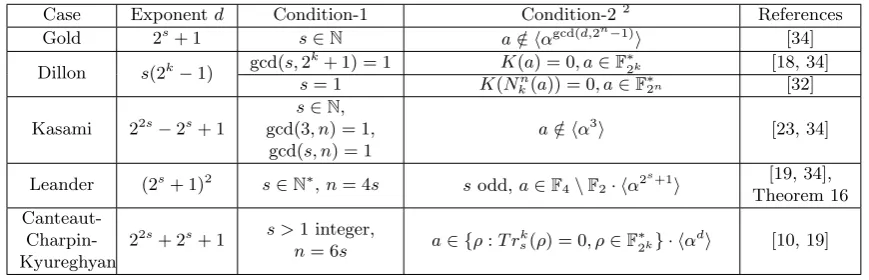
An integer d (in the sense of modulo 2n−1) is named as a bent exponent if there exists an element a ∈ F∗2n such that the Boolean function T r1n(axd) on F2n is bent. So far, five classes of bent exponents [43] have been found (see Table 1), and the corresponding five classes of monomial bent functions have been well studied in public literatures. However, the characterization of the vectorial monomial bent functions with the five known classes of bent exponents is still not clear. In this section, we study the existence and constructions of vectorial monomial bent functions.
3.1 General constructions of vectorial monomial bent functions
This subsection discusses the general constructions of vectorial monomial bent functions and answers one open problem proposed by E. Pasalic et al. [55].
In order to obtain the general constructions of vectorial monomial bent functions, we give the following theorem, which can be obtained by Theorem 2 directly.
Theorem 4. Let T rn1(axd) be a monomial bent function. Then T rnm(axd) is a vectorial monomial bent function if T rn
1(aλxd) is linear equivalent toT rn1(axd) for all λ∈F∗2m. To make use of Theorem 4, it is foremost to ensure the linear equivalence between
T rn1(aλxd) andT r1n(axd) for allλ∈F∗2m. We give three equivalent conditions which will be used to meet the condition thatT r1n(aλxd) is linear equivalent toT rn1(axd) for all λ∈F∗2m.
Before that, a useful lemma is presented as follows, which can be proved easily.
Lemma 1. Let G ={xd:x∈F∗
2n}. Then G=hαdi=hαgcd(d,2 n−1)
i.
(1) F∗2m ⊆ {xd:x∈F∗2n}.
(2) gcd(d,2n−1)|t.
(3) gcd(gcd(dd,t),2m−1) = 1.
Proof. By Lemma 1, it is known that {xd : x ∈ F∗2n} = hαgcd(d,2 n−1)
i. Since F∗2m = hαti, the equivalence between item (1) and item (2) can be obtained. In the following, we prove the equivalence between item (1) and item (3).
Let lcm[t, d] denote the lowest common multiple of t and d. By Lemma 1, {xd : x ∈
F∗2n}=hαdi. Then we have
F∗2m ⊆ {xd:x∈F∗2n} ⇔ hαti ⊆ hαdi
⇔ hαti ∩ hαdi=hαti
⇔ hαlcm[t,d]i=hαti
⇔ gcd(lcm[t, d],2n−1) =t
⇔ gcd( td gcd(d, t),2
n−1) =t
⇔ gcd( d gcd(d, t),2
m−1) = 1.
Given the above, the conclusion of the theorem holds.
Note that F∗2m ⊆ {xd : x ∈ F∗2n} if and only if there exists some β ∈ F∗2n such that
λ = βd for all λ∈ F∗2m. If one of the three conditions in Theorem 5 holds, by Definition 5, then T r1n(aλxd) = T rn1(a(βx)d) is linear equivalent to T rn1(axd) for all λ∈F∗
2m. Thus, according to Theorem 4 and Theorem 5, the general constructions of the vectorial monomial bent functions corresponding to the three conditions in Theorem 5 can be obtained as the following theorem.
Theorem 6. Let m | n and T rn1(axd) be a monomial bent function. If one of the three conditions in Theorem 5 holds, then T rmn(axd) is a vectorial monomial bent function.
In [55], given a monomial bent function T rn
1(axd), E. Pasalic et al. proved thatxd is a permutation onF2m, i.e., gcd(d,2m−1) = 1, is sufficient forT rmn(axd) to be bent, and left an open problem as follows.
Open Problem 1 ([55]). Let m|n andT r1n(axd) be a monomial bent function. Let xd be a permutation of F2m. Then T rnm(axd) is a vectorial monomial bent function.
The condition that the mapping xd is a permutation over F2m seems to be a necessary
condition as well, but this still remains open.
It is certainly of interest to relax the condition regarding the permutation property of xd over Fm2 . Anyway, a generalization of the above result for nonpermutating over F2m seems
not to be straightforward.
ofxdonFm2 is still unknown. Here, we answer Open Problem 1 adequately. Before that, we investigate the relation between gcd(d,2m−1) = 1 and the three conditions in Theorem 5.
According to item (3) of Theorem 5, the following theorem can be obtained directly.
Theorem 7. Let m|nand dbe integer. If gcd(d,2m−1) = 1, then every one of the three conditions in Theorem 5 holds. But it is not vice versa.
By Theorem 6 and Theorem 7, we have that, given a monomial bent functionT rn1(axd), every one of the three conditions in Theorem 5 is closer to the sufficient and necessary conditions for T rn
m(axd) to be bent than gcd(d,2m−1) = 1.
While how much difference between gcd(d,2m −1) = 1 and the three conditions in Theorem 5? In fact, given a monomial bent functionT r1n(axd), there exist many conditions that are much closer to the sufficient and necessary conditions forT rnm(axd) to be bent than gcd(d,2m−1) = 1, and further than every one of the three conditions in Theorem 5.
Theorem 8. Let m|n,d be integer, l1, l2 ∈N∗, l1 ≥2, l1 > l2, Condition-A denote every
one of the three conditions in Theorem 5 and Condition-B denote every one of the three conditions in Theorem 5 with d=dl1. Then
Condition−A ;
⇐Condition−B ⇐; gcd(
dl1 gcd(dl2, t),2
m−1) = 1 ;
⇐ gcd(d,2m−1) = 1
Proof. Condition-A;
⇐Condition-B is obvious.
Sincel1 > l2, gcd( d l1
gcd(dl1,t),2m−1) = 1;⇐ gcd( d l1
gcd(dl2,t),2m−1) = 1 is also obvious. By Theorem 5, Condition-B ;
⇐ gcd( d
l1 gcd(dl2,t),2
m−1) = 1 holds.
Since gcd( dl1
gcd(dl2,t),2
m−1) = 1 ;
⇐ gcd(dl1,2m−1) = 1, and gcd(dl1,2m−1) = 1 ⇔
gcd(d,2m−1) = 1, we have that gcd(gcd(ddl1l2,t),2m−1) = 1;⇐ gcd(d,2m−1) = 1.
Given the above, the conclusion of the theorem holds.
According to Theorem 6 and Theorem 8, the following theorem can be obtained.
Theorem 9. Let m | n and T rn1(axd) be a monomial bent function. Then T rmn(axd) is a vectorial monomial bent function if one of the following four conditions holds, where l, l0 ∈N∗, l≥l0:
(1) F∗2m ⊆ {xd l
:x∈F∗ 2n}.
(2) gcd(dl,2n−1)|t.
(3) gcd( dl gcd(dl0,t),2
m−1) = 1.
(4) gcd(d,2m−1) = 1.
Remark 2. (1) Note that, in this paper, without statement, there is no restriction that T r1n(axd) is bent when referring to the four conditions in Theorem 9.
In [51], it was shown that bent (n, m)-functions exist if and only ifnis even andn≥2m. Thus, by Theorem 9, we have the following corollary.
Corollary 1. Let m|n andT rn1(axd) be a monomial bent function. Then one of the four conditions in Theorem 9 holds only if m≤k.
Anwsers to Open Problem 1. Following from Theorem 8 and Theorem 9, given a mono-mial bent function T r1n(axd), we have that every one of the three conditions corresponding to item (1)-item (3) of Theorem 9 is closer to the sufficient and necessary conditions for T rn
m(axd) to be a vectorial monomial bent function than gcd(d,2m−1) = 1.
Although the non-necessity of gcd(d,2m−1) = 1 and every one of the three conditions corresponding to item (1)-item (3) of Theorem 9 withl≥2 forT rnm(axd) to be bent can be obtained by Theorem 8 and Theorem 9 directly, given a monomial bent function T rn1(axd), whether every one of the three conditions in Theorem 5 is necessary or not for T rmn(axd) to be bent is also interesting. According to Theorem 8, item (1) of Remark 4, item (1) of Remark 5, item (1) of Remark 7 and item (1) of Remark 8 (see below), we have the following conclusion.
Theorem 10. Let m|n and T rn
1(axd) be a monomial bent function. For T rmn(axd) to be
a vectorial monomial bent function, every one of the four conditions in Theorem 9 is
(1) sufficient but not necessary in general case;
(2) sufficient and necessary ifd is a Kasami exponent or a Leander exponent.
In addition, if d is a Gold exponent, then every one of the four conditions in Theorem 9 with m=k is also sufficient and necessary for T rn
k(axd) to be bent.
On the other hand, in some cases, the four conditions in Theorem 9 may be equivalent.
Theorem 11. Let m |n and d be integer. If gcd(2m−1, t) = 1, then the four conditions
in Theorem 9 are equivalent.
Proof. According to Theorem 5 and Theorem 8, it only needs to prove that gcd(gcd(dd,t),2m− 1) = 1 is necessary for gcd(d,2m−1) = 1 to hold. Since gcd(2m−1, t) = 1, we have that gcd(d,2m−1) = 1 if and only if gcd(gcd(dd,t),2m−1) = 1 holds.
Remark 3. Letm|n andT rn1(axd)be a monomial bent function. Thengcd(2m−1, t) = 1
is not necessary for the four conditions in Theorem 9 to be equivalent. The reason is as follows.
Let m = 3 and n = 84. By Theorem 15, Theorem 16, Theorem 22 and Theorem 23 (see below), we have that the four conditions in Theorem 9 are equivalent if dis a Kasami exponent or a Leander exponent. However, gcd(2m−1, t) = gcd(2m−1,mn) = 7.
Open Problem 2. Letm|nandT r1n(axd)be a monomial bent function. Ifgcd(2m−1, t) = 1, it is not yet known whether every one of the four conditions in Theorem 9 is necessary or not for T rnm(axd) to be a vectorial monomial bent function.
Trivially, by Theorem 1, the (n, m)-function T rnm(axd) is bent if and only ifT rn1(aλxd) is bent for all λ∈F∗2m, where a∈F∗2n. The same idea was also considered in [58]. For the convenience of discussion, we list this fact as the following theorem.
Theorem 12 ([58]). Let m|n, a∈F∗2n and denote
C={β ∈F2n :T rn1(βxd) is a monomial bent f unction}.
Then T rmn(axd) a vectorial monomial bent function if and only if
a·F∗2m ⊆C.
3.2 The characterizations of vectorial monomial bent functions
In this subsection, we focus on the characterizations of the vectorial monomial bent functions with the known bent exponents.
3.2.1 The known monomial bent functions
It is known that there are five classes of monomial bent functions, accordingly, five classes of bent exponents have been found so far. The known monomial bent functions are introduced below and listed in Table 1, which will be used to characterize the vectorial monomial bent functions corresponding to the five known classes of bent exponents.
The monomial bent functions with the Gold exponentd= 2s+ 1 are well known, where
s∈N. By Lemma 1, this can be described as the following theorem.
Theorem 13 (Gold Case [34]). Let s∈N, d= 2s+ 1 and a∈F∗2n. The Boolean function
T rn1(axd) on F2n is bent if and only if
a /∈ hαgcd(d,2n−1)i.
It was shown in [22] that the Boolean function T r1n(ax2k−1) on F2n is bent if and only if K(a) = 0 with a ∈ F∗
2k, and in [32] that T r
n
1(ax2 k−1
) on F2n is bent if and only if
K(Nn
k(a)) = 0 with a ∈ F
∗
2n. In [18], it was shown that T r1n(axs(2 k−1)
) on F2n is bent if and only if K(a) = 0, where gcd(s,2k+ 1) = 1 and a ∈ F∗2k. For the Dillon exponent
d = s(2k−1) with s integer, we recall Theorem 5 in [18] and Theorem 3 in [32] as the following theorem. Note that the Kloosterman sums defined in this paper is the same as that in [18] and is different from that in [32].
Theorem 14(Dillon Case [18, 32]). Letsbe an integer andd=s(2k−1). For the Boolean function T rn1(axd) onF2n, the following conclusions hold:
(1) Let gcd(s,2k+ 1) = 1 and a∈
F∗2k. Then T rn1(axd) is bent if and only if
(2) Let s= 1 and a∈F∗
2n. Then T rn1(axd) is bent if and only if
a∈ {β :K(Nkn(β)) = 0, β∈F∗2n}.
The conclusion for the monomial bent functions on F2n with the Kasami exponent
d= 22s−2s+ 1, wheres∈Nand gcd(s, n) = 1, was conjectured in [28] and proved in [23]. Since 3 |(2n−1), by Lemma 1, the conclusion for the monomial bent functions with the
Kasami exponent can be described as follows.
Theorem 15 (Kasami Case [23, 34]). Let gcd(3, n) = 1, s ∈ N, gcd(s, n) = 1, d = 22s−2s+ 1and a∈F∗2n. The Boolean function T rn1(axd) onF2n is bent if and only if
a /∈ hα3i.
In [34], it was proved that there exist monomial bent functions with the Leander expo-nentd= (2s+1)2, and further result was given in [19]. It was shown in [19] that the Boolean functionT rn1(ax(2s+1)2) onF2n is bent if and only ifsis positive odd integer and there exist some ρ ∈εF∗2s and β ∈F∗2n such that a=ρβ(2
s+1)2
holds, where n= 4sand ε∈F4\F2. Note the fact, the condition that there exist someρ∈εF∗2s andβ ∈F∗2n withε∈F4\F2 and
n= 4ssuch thata=ρβ(2s+1)2 is equivalent toa∈F4\F2·F∗2s·{x(2 s+1)2
:x∈F∗2n}. By Lem-ma 1 andn= 4s,{x(2s+1)2 :x∈F∗2n}=hα2
s+1
iholds. SinceF∗2s =hα(2
s+1)(22s+1)
i, we have
F∗2s ⊂ {x(2 s+1)2
:x∈F∗
2n}. Therefore, F4\F2·F∗2s· {x(2 s+1)2
:x∈F∗
2n}=F4\F2· hα2 s+1
i. Thus, Theorem 4.8 in [19] can be described equivalently and more succinctly as the following theorem.
Theorem 16 (Leander Case [19, 34]). Let s ∈ N∗, n = 4s, d = (2s+ 1)2 and a ∈
F∗2n.
Then the Boolean function T r1n(axd) on F2n is bent if and only if
s is odd and a∈F4\F2· hα2s+1i.
For the the Canteaut-Charpin-Kyureghyan exponentd= 22s+ 2s+ 1, in [10, 19], it was shown that the Boolean function T rn
1(axd) on F2n is bent if and only ifa∈ {ρ:T rsk(ρ) = 0, ρ∈F∗2k} · {xd:x∈F
∗
2n}, where the integer s >1 andn= 6s. By Lemma 1, we describe this conclusion as the following theorem.
Theorem 17 (Canteaut-Charpin-Kyureghyan Case [10, 19]). Let s > 1 be an integer, n= 6s, d= 22s+ 2s+ 1and a∈F2∗n. Then the Boolean function T rn1(axd) onF2n is bent
if and only if
a∈ {ρ:T rks(µ) = 0, µ∈F∗2k} · hαdi.
3.2.2 Characterizing the vectorial monomial bent functions with the known bent exponents
Table 1: The Known Monomial Bent Functions of the formT rn1(axd) 1
Case Exponentd Condition-1 Condition-22 References
Gold 2s+ 1 s∈N a /∈ hαgcd(d,2
n−1)
i [34]
Dillon s(2k−1) gcd(s,2 k
+ 1) = 1 K(a) = 0, a∈F∗2k [18, 34]
s= 1 K(Nn
k(a)) = 0, a∈F
∗
2n [32]
Kasami 22s−2s+ 1
s∈N,
gcd(3, n) = 1, gcd(s, n) = 1
a /∈ hα3i [23, 34]
Leander (2s+ 1)2 s∈N∗,n= 4s sodd,a∈F4\F2· hα2 s+1
i [19, 34],
Theorem 16
Canteaut- Charpin-Kyureghyan
22s+ 2s+ 1 s >1 integer,
n= 6s a∈ {ρ:T r
k
s(ρ) = 0, ρ∈F∗2k} · hαdi [10, 19] 1n= 2kanda∈
F∗2n.
2Necessary and sufficient conditions forT rn
1(axd) to be bent.
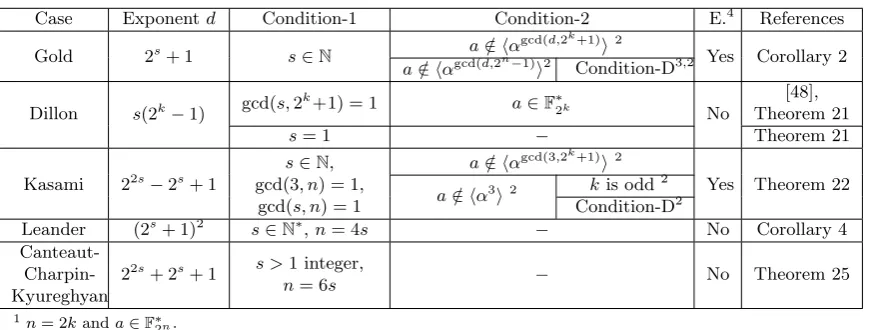
space, are optimal. Thus, we list the results of the vectorial monomial bent functions of the form T rn
k(axd) in Table 4.
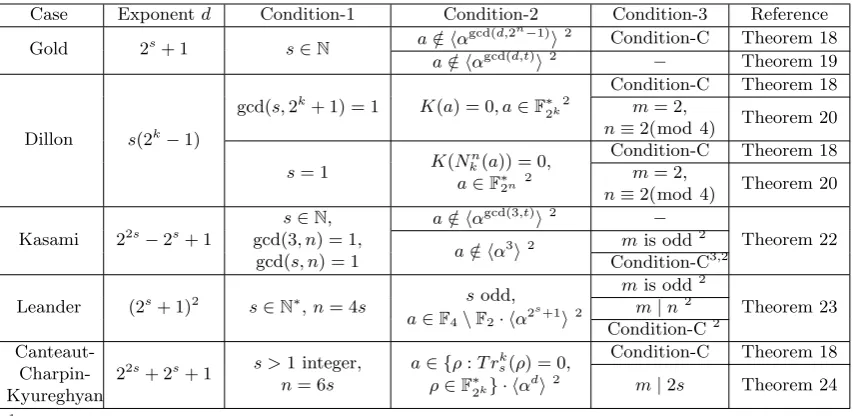
According to Theorem 9 and Theorem 13-17, the following theorem can be obtained directly, which gives the vectorial monomial bent functions corresponding to the five known classes of bent exponents.
Theorem 18. Let m|n, a∈F∗2n and one of the four conditions in Theorem 9 holds. For
the (n, m)-function T rmn(axd), the following conclusions hold:
(1) (Gold Case). Let s∈N and d= 2s+ 1. Then T rmn(axd) is bent if and only if
a /∈ hαgcd(d,2n−1)i.
(2) (Dillon Case). Let s be an integer andd=s(2k−1).
(2.1) Let gcd(s,2k+ 1) = 1and a∈F∗
2k. Then T rmn(axd) is bent if and only if
a∈ {β:K(µ) = 0, µ∈F∗2k}.
(2.2) Let s= 1 and a∈F∗2n. Then T rmn(axd) is bent if and only if
a∈ {β :K(Nkn(β)) = 0, β∈F∗2n}.
(3) (Kasami Case). Let gcd(3, n) = 1, s∈ N, gcd(s, n) = 1 and d= 22s−2s+ 1 . Then
T rmn(axd) is bent if and only if
a /∈ hα3i.
(4) (Leander Case). Let s∈N∗, n= 4s and d= (2s+ 1)2. Then T rn
m(axd) is bent if and
only if
s is odd and a∈F4\F2· hα2 s+1
i.
(5) (Canteaut-Charpin-Kyureghyan Case). Let s > 1 be an integer, n = 6s and d = 22s+ 2s+ 1. Then T rn
m(axd) is bent if and only if
Although five classes of vectorial monomial bent functions are given in Theorem 18, the four conditions in Theorem 9 seem inconvenient to use directly. In order to construct vectorial monomial bent functions more practically, we further characterize the vectorial monomial bent functions corresponding to the five known classes of bent exponents.
We have a new sufficient and necessary condition for the vectorial monomial bent func-tions with the Gold exponent to be bent, which has less restricfunc-tions than that in Theorem 18.
Theorem 19 (Gold Case). Let m|n,s∈N, d= 2s+ 1 and a∈F∗2n. The (n, m)-function
T rnm(axd) is bent if and only if
a /∈ hαgcd(d,t)i.
Proof. By Theorem 13, the set of the coefficients such thatT rn1(βxd) onF2n is bent is
C={β ∈F∗2n :β /∈ hαgcd(d,2 n−1)
i}.
Then, by Theorem 12, we get thatT rmn(axd) is bent if and only if
a·F∗2m ⊆ {β ∈F∗2n :β /∈ hαgcd(d,2 n−1)
i}
⇔ a·F∗2m∩ hαgcd(d,2 n−1)
i=∅
⇔ a /∈ hαgcd(d,2n−1)i ·F∗2m ⇔ a /∈ hαgcd(d,2n−1)i · hαti
⇔ a /∈ hαgcd(t,gcd(d,2n−1))i
⇔ a /∈ hαgcd(d,t)i
Given the above, the theorem is proved to be true.
Remark 4. (1) Here, we give an example that T rnm(axd) is a vectorial monomial bent function with a Gold exponent and the three conditions in Theorem 5 do not hold, which means that the three conditions in Theorem 5 are not necessary for T rmn(axd)
to be bent. In Gold case, let s= 3, m = 4 and n= 12. Then gcd(d, t) = gcd(2s+ 1,22mn−−11) = gcd(9,273) = 36= 1. Thus, F∗2n\ hαgcd(d,t)i =F∗212\ hα3i 6=∅. For ∀ a∈
F∗212\hα3i, by Theorem 19, we haveT r412(ax9)is bent. However,gcd(gcd(dd,t),2
m−1) =
gcd(3,15) = 36= 1.
(2) Obviously, all the vectorial monomial bent functions constructed by item (1) of Theorem 18 can be constructed by Theorem 19. However, by item (1), we know that it is not vice-versa.
Then we discuss the necessary and sufficient conditions for the (n, k)-function of the form T rnk(axd) with the Gold exponent to be bent. Before the discussion, the following lemma is given, which can be derived from Lemma 1 in [34].
Lemma 2. LetT rn1(axd) be a monomial bent function. Thengcd(d,2k−1) = 1if and only if gcd(d,2k+ 1)6= 1.
Corollary 2. Let m|n, s∈N, d= 2s+ 1 anda∈F∗2n. For the (n, k)-function T rkn(axd),
the following three conditions are equivalent:
(2) a /∈ hαgcd(d,2k+1)i.
(3) a /∈ hαgcd(d,2n−1)i and one of the four conditions in Theorem 9 with m=kholds.
Proof. By Theorem 19, the equivalence between item (1) and item (2) is trivial.
(2)⇒(3): Sincea∈F∗
2n\ hαgcd(d,2 k+1)
i anda∈F∗
2n, we have thata /∈ hαgcd(d,2 n−1)
i and gcd(d,2k+ 1)6= 1. By Lemma 2, gcd(d,2k−1) = 1. According to Theorem 8, all the four conditions in Theorem 9 with m=khold.
(3)⇒(1): This follows from item (1) of Theorem 18. Given the above, the corollary is proved to be true.
Remark 5. (1) If T rn1(axd) is a monomial bent function with a Gold exponent, by Theo-rem 13 and item (3) of Corollary 2, then every one of the four conditions in TheoTheo-rem 9 with m=k is also necessary for T rnk(axd) to be bent.
(2) Theorem 6 in [26] is a special case corresponding to item (3) of Corollary 2. More-over, Corollary 2 indicates that the conditions gcd(2s + 1,2n −1) | (2k + 1) and
a6∈ {xgcd(d,2n−1) :x ∈F2n} of Theorem 6 in [26] are also necessary for T rn
k(axd) to
be bent, which is unknown in [26].
In order to discuss the vectorial monomial bent functions with the Dillon exponent, a lemma is given as follows.
Lemma 3. Let m ≥ 2, m | n, s be an integer, gcd(s,2k+ 1) = 1, d = s(2k −1) and T rn1(axd) be a monomial bent function. Then one of the three conditions in Theorem 5 holds if and only if m= 2,n≥6 and n≡2(mod 4).
Proof. Since gcd(s,2k+ 1) = 1, we have
gcd(d,2n−1)|t
⇔ (2m−1)|(2k+ 1)
⇔ 2m−1 = gcd(2m−1,2k+ 1).
Necessity: If m | k, then gcd(2m −1,2k+ 1) = gcd(2m −1,2m + 1) = 1. Because
m ≥2, there is no m such that 2m−1 = gcd(2m−1,2k+ 1) = 1. Then we have m - k.
According to Corollary 1 and m-k, it is obtained thatm < k.
Bym≥2 andm < k, we have n≥6.
Since m < k, gcd(2m−1,2k+ 1) = gcd(2m−1,2k modm+ 1). And because m ≥ 2,
m - k and 2m−1 = gcd(2m −1,2k + 1), we have that m = 2 and k ≡ 1(mod 2), i.e.,
n≡2(mod 4).
Thus,m= 2,n≥6 andn≡2(mod 4).
Sufficiency: If m = 2, n ≥ 6 and n≡ 2(mod 4), then m -k and m < k. Therefore,
gcd(2m−1,2k+ 1) = gcd(2m−1,2k modm+ 1) = 2m−1. By Theorem 5, the lemma is proved to be true.
By item (2) of Theorem 18 and Lemma 3, we can derive the following theorem.
Theorem 20 (Dillon Case). Let n ≡ 2(mod 4) and n ≥ 6, s be an integer and d =
(1) Let gcd(s,2k+ 1) = 1 and a∈F∗
2k. Then T rn2(axd) is bent if and only if
a∈ {β:K(µ) = 0, µ∈F∗2k}.
(2) Let s= 1 and a∈F∗2n. Then T rn2(axd) is bent if and only if
a∈ {β :K(Nkn(β)) = 0, β∈F∗2n}.
Remark 6. According to Theorem 8 and Lemma 3, we have that all the vectorial monomial bent functions constructed by item (2) of Theorem 18 and by Theorem 20 are the same.
It was shown by Theorem 10 in [48] that there does not exist a vectorial monomial bent functions of the formT rkn(axd) with the Dillon exponentd=s(2k−1), where gcd(s,2k+1) = 1 and a ∈ F∗2k. Here, we give an alternative proof of Theorem 10 in [48], and also prove the nonexistence of the vectorial monomial bent functions of the form T rkn(axd) with the Dillon exponent for s= 1 and a∈F∗2n. Before the proof, a lemma is given as follows.
Lemma 4. For ∀ a∈F∗2n, {Nkn(aλ) :λ∈F∗2k}=F
∗ 2k.
Proof. Note the fact that, for ∀ λ1, λ2 ∈F2∗k, if λ1 6=λ2, then λ2 k+1 1 6=λ2
k+1
2 . Therefore, {λ2k+1 :λ∈F∗2k}=F
∗
2k. Since Nkn(aλ) =a2 k+1
λ2k+1 and a2k+1 ∈F∗2k, we have {Nkn(aλ) :
λ∈F∗
2k}=F∗2k.
Theorem 21. Let s be an integer andd=s(2k−1). The following conclusions hold:
(1) ([48])Letgcd(s,2k+1) = 1anda∈F∗2k. Then there does not exist a vectorial monomial
bent function of the form T rkn(axd).
(2) Let s= 1 and a∈ F∗
2n. Then there does not exist a vectorial monomial bent function
of the form T rkn(axd).
Proof. Assume the contrary that such a vectorial monomial bent functionT rnk(axd) exists. (1) According to Theorem 1 and item (1) of Theorem 14, we have thatT rkn(axd) is bent if and only if K(aλ) = 0 holds for allλ∈F∗
2k. Then,
X
z∈F
2k
(−1)T rk1(z2 k−2
+aλz)= 0 for all λ∈
F∗2k
⇔ X
z,y∈F∗ 2k
(−1)T r1k(z2 k−2
+y)=−1
⇔ X
z∈F∗2k
(−1)T rk1(z2 k−2
) X
y∈F∗2k
(−1)T r1k(y)=−1
⇔ ( X
z∈F∗2k
(−1)T r1k(z))2 =−1
(2) By Theorem 1 and item (2) of Theorem 14, we get thatT rkn(axd) is bent if and only ifK(Nkn(aλ)) = 0 holds for allλ∈F∗2k. By Lemma 4, we have
X
z∈F2k
(−1)T rk1(z2 k−2
+z·Nkn(aλ)) = 0 for allλ∈
F∗2k
⇔ X
z,y∈F∗ 2k
(−1)T rk1(z2 k−2
+y) =−1
⇔ X
z∈F∗ 2k
(−1)T rk1(z2 k−2
) X
y∈F∗ 2k
(−1)T rk1(y)=−1
⇔ ( X
z∈F∗ 2k
(−1)T r1k(z))2=−1
This is also impossible.
The above impossible inductions mean that, the assumption of the existence of the vectorial monomial bent functionT rnk(axd) is wrong. Hence the conclusions of the theorem hold.
For the vectorial monomial bent functions with the Kasami exponent, we can derive the following theorem.
Theorem 22(Kasami Case). Letm|n,gcd(3, n) = 1,s∈N,gcd(s, n) = 1,d= 22s−2s+1
anda∈F∗
2n. For the(n, m)-functionT rmn(axd), the following four conditions are equivalent:
(1) T rnm(axd) is bent.
(2) a /∈ hαgcd(3,t)i.
(3) a /∈ hα3i and m is odd.
(4) a /∈ hα3i and one of the four conditions in Theorem 9 holds.
Proof. By Theorem 12 and Theorem 15, the proof of the equivalence between item (1) and item (2) is similar to the proof of Theorem 19.
(2)⇒(3): It is easy to prove that,
gcd(3, t) =
gcd(3,2m+ 1) = 3, m odd, mn even 1, m odd, mn odd
gcd(3,2m+1+ 1) = 3, m even, 0≡ mn(mod 3) 1, m even, 1≡ mn(mod 3) gcd(3,2m+ 1) = 1, m even, 2≡ n
m(mod 3).
Becausen is even, the case bothm and mn are odd does not exist. Since gcd(3, n) = 1, the case 0≡ n
m(mod 3) does not exist either.
Then we have
gcd(3, t) =
Becausea∈F∗
2n and a /∈ hαgcd(3,t)i, we havehαgcd(3,t)i 6=F∗2n. Then, gcd(3, t)6= 1, i.e., gcd(3, t) = 3.
Therefore,m is odd.
(3)⇒(4): If m is odd, then gcd(3,2m−1) = 1. Since gcd(d,2n−1) = 3 (see the proof of Theorem 11 in [23]), we have gcd(d,2m−1) = 1.
By Theorem 8, we have that every one of the four conditions in Theorem 9 holds. (4)⇒(1): This follows from item (3) of Theorem 18.
Consequently, the conclusion of the theorem have been proved to be true.
Remark 7. (1) If T rn1(axd) is a monomial bent function with a Kasami exponent, by Theorem 15 and item (4) of Theorem 22, then every one of the four conditions in Theorem 9 is also necessary for T rmn(axd) to be bent.
(2) According to item (4) of Theorem 22, we also know that the vectorial monomial bent functions constructed by item (3) of Theorem 18 and by Theorem 22 are the same.
(3) Sincegcd(d,2n−1) = 3 in Kasami case, by Lemma 1, it is known that {xgcd(d,2n−1) :
x∈F2n}={x3:x∈F2n}=hα3i, where dis a Kasami exponent. Then we have (3.1) Theorem 2 in [55] is a special case corresponding to item (3) of Theorem 22
withsodd andm=kodd. The conditions thatkis odd anda /∈ {x3 :x∈F2n}of
Theorem 2 in [55] are also necessary for T rkn(axd) to be bent, which is unknown in [55].
(3.2) Theorem 7 in [26] is a special case corresponding to item (4) of Theorem 22 with m=k. The conditions that gcd(d,2n−1)|(2k+ 1) and a6∈ {xgcd(d,2n−1) :
x∈F2n} of Theorem 7 in [26] are also necessary forT rnk(axd) to be bent, which
is unknown in [26].
(3.3) Theorem 2 in [58] is a special case corresponding to item (3) of Theorem 22 for the case n= 2s1+1k
1 and m =k1, where s1 ≥0 and k1 is odd. The conditions
thatk1 is odd anda /∈ {x3 :x∈F2n} of Theorem 2 in [58] are also necessary for
T rkn
1(ax
d) to be bent, which is unknown in [58].
According to item (3) of Theorem 22, the following corollary can be obtained.
Corollary 3. Let m | n, gcd(3, n) = 1, s ∈ N, gcd(s, n) = 1, d = 22s −2s+ 1 and a∈F∗
2n. If m is even, then there does not exist a vectorial monomial bent function of the
form T rnm(axd).
In order to discuss the vectorial monomial bent functions with the Leander exponent, a lemma is given as follows.
Lemma 5. If s is a positive odd andn= 4s, then hα2s+1i ∩F4\F2· hα2s+1i=∅.
Proof. If s is a positive odd, then gcd(3,(2s−1)(22s+ 1)) = 1. Since the order of every
element in F4\F2 is 3 and the order of every element in hα2 s+1
i is (2s−1)(22s+ 1), we have thathα2s+1i ∩F4\F2=∅. Therefore, hα2
s+1
i ∩F4\F2· hα2s+1i=∅.
Theorem 23 (Leander Case). Let s∈N∗, n= 4s, m|n, d= (2s+ 1)2 and a∈
F∗2n. For
the (n, m)-function T rmn(axd), the following four conditions are equivalent:
(1) T rnm(axd) is bent.
(2) sis odd, a∈F4\F2· hα2s+1i and m is odd.
(3) sis odd, a∈F4\F2· hα2 s+1
i and m|s.
(4) sis odd, a∈F4\F2· hα2 s+1
i and one of the four conditions in Theorem 9 holds.
Proof. (1)⇒(2): According to Theorem 12 and Theorem 16, T rmn(axd) is bent if and only if
sis odd and a·F∗2m ⊆F4\F2· hα2 s+1
i.
Thus, there exist some ε∈F4\F2 andτ ∈ hα2 s+1
isuch that a=ε·τ.
If m is even, then F4 \F2 ⊆F∗2m. Therefore, ε2 ∈ F4\F2 ⊆F∗2m. Let λ = ε2. Then
aλ=ε3τ =τ ∈ hα2s+1i.By Lemma 5, we have thataλ /∈F4\F2· hα2 s+1
i. This contradicts
a·F∗
2m ⊆F4\F2· hα2 s+1
i. Thus, m cannot be even, i.e., mis odd.
(2)⇔(3): Becausesis odd and m|4s, we have thatm is odd if and only ifm|s. (3)⇒(4): Sincem|s, we have gcd(d,2m−1) = 1. By Theorem 8, every one of the four conditions in Theorem 9 holds.
(4)⇒(1): This follows from item (4) of Theorem 18. Given the above, the theorem is proved to be true.
Remark 8. (1) If T rn1(axd) is a monomial bent function with a Leander exponent, by Theorem 16 and item (4) of Theorem 23, then every one of the four conditions in Theorem 9 is also necessary for T rmn(axd) to be bent.
(2) According to item (4) of Theorem 23, we also know that the vectorial monomial bent functions constructed by item (4) of Theorem 18 and by Theorem 23 are the same.
(3) In [55], it was claimed that, ifs >1 is odd, n= 4s and d= (2s+ 1)2, then the (n, s) -functionT rn
s(axd) is bent for anya∈F∗2s\F22. That is Theorem 3 in [55]. However,
it is wrong. The reason is as follows.
According to Lemma 5, we know that F∗2s ∩F4 \F2· hα2 s+1
i = ∅. By item (2) of
Theorem 23, we have that such (n, s)-function T rsn(axd) is not bent for any a∈F∗ 2s.
According to item (2) and item (3) of Theorem 23, we have the following corollary.
Corollary 4. Let s∈N∗, n= 4s, m|n, d= (2s+ 1)2 and a∈
F∗2n. If m is even or m-s,
then there does not exist a vectorial monomial bent function of the form T rn m(axd).
For the vectorial monomial bent functions with the Canteaut-Charpin-Kyureghyan ex-ponent, we have the following theorem.
Theorem 24 (Canteaut-Charpin-Kyureghyan Case). Let s > 1 be an integer, n = 6s, d= 22s+ 2s+ 1 and a∈F∗
2n. If m|2s, then the (n, m)-function T rnm(axd) is bent if and
only if
Proof. Note thatm|2sif and only if (2m−1)|(22s−1). Since 2n−1 =d(22s−1)(22s−2s+1), we haved|t. Thus, gcd(d,2n−1)|t. By item (5) of Theorem 18, the conclusion holds.
Remark 9. (1) According to the proof of Theorem 24, we have that the vectorial monomial bent functions constructed by item (5) of Theorem 18 include all of those constructed by Theorem 24.
(2) In [55], it was claimed that, ifs >1is an odd integer,n= 6sandd= 22s+ 2s+ 1, then the (n,2s)-function T r2ns(axd) and the (n, s)-function T rsn(axd) are bent for a∈F∗
22s,
respectively a∈ F∗
2s, satisfying T r3ss(a3) = 0. That is Theorem 4 in [55]. However,
there is no such vectorial monomial bent function. The reasons are as follows.
Since s is odd, gcd(d,22s−1) = 1. If T rn2s(axd) with a ∈ F∗22s is bent, then there
exists some β ∈F∗
22s such that T rn2s((βx)d) is bent. Since T r2ns((βx)d) and T rn2s(xd)
are linear equivalent, T rn
2s(xd) is bent. Then T r1n(xd) is bent. However T rs3s(1) =
16= 0. This contradicts Theorem 3 in [10]. Thus, we have that such (n,2s)-function T r2ns(axd) is not bent for any a∈F∗
22s.
The reason for the nonexistence of such vectorial monomial bent functions of the form T rn
s(axd) for any a∈F∗2s is similar to the above.
(3) Theorem 3 in [58] is a special case of Theorem 24 withm= 2sand a∈ {µ:T rsk(µ) = 0, µ∈F∗2k}.
However, whether all the vectorial monomial bent functions constructed by item (5) of Theorem 18 can be constructed by Theorem 24 or not is unknown. We leave this as an open problem.
Open Problem 3. It is not yet known whether item (5) of Theorem 18 and Theorem 24 construct the same vectorial monomial bent functions.
We conclude that no vectorial monomial bent function with the Canteaut-Charpin-Kyureghyan exponent has the optimal dimension of the output space, i.e., half of the di-mension of the input space.
Theorem 25. Let s >1 be an integer, n= 6s, d= 22s+ 2s+ 1and a∈F∗
2n. There is no
vectorial monomial bent function of the form T rnk(axd).
Proof. Trivially, according to Theorem 17, the (n, k)-function T rnk(axd) is not bent for
a /∈ {µ:T rks(µ) = 0, µ∈F∗
2k} · hαdi. In the following, we discuss the casea∈ {µ:T rsk(µ) =
0, µ∈F∗
2k} · hαdi.
For∀a∈ {µ:T rks(µ) = 0, µ∈F∗2k}·hαdi, there are someµ1 ∈ {µ:T rsk(µ) = 0, µ∈F∗2k} and someβ1 ∈F∗2n such thata=µ1β1d. According to Theorem 1 and Theorem 17,T rkn(axd)
is bent if and only if µ1λβd1 ∈ {µ:T rks(µ) = 0, µ∈F∗2k} · hαdifor all λ∈F∗2k.
Let µ2 = µ1λ. Because of µ1 ∈ F∗2k and the ergodicity of λ over F∗2k, we have that
µ1λβ1d ∈ {µ : T rks(µ) = 0, µ ∈ F∗2k} · hαdi for all λ ∈ F2∗k, is equivalent to, µ2β1d ∈ {µ :
T rks(µ) = 0, µ ∈ F∗
2k} · hαdi for all µ2 ∈ F∗2k. Thus, T rnk(axd) is bent if and only if
T rn1(µ2β1dxd) is bent for allµ2 ∈F∗2k.
Since T r1n(µ2xd) is linear equivalent to T r1n(µ2βd1xd), we have that T rkn(axd) is bent if
Considering the equivalence induced by replacing µ2 with µ2βd for all β ∈ F∗2n, then
T rnk(axd) is bent if and only if T r1n(a0xd) is bent for all a0 ∈ F∗2k · hαdi, where a
0 =µ 2βd. Since gcd(d,2k+ 1) = 1, we have F∗2k· hαdi =F
∗
2n. If T rnk(axd) is bent, thenT r1n(a0xd) is bent for alla0 ∈F∗2n. This contradicts Theorem 17. HenceT rnk(axd) cannot be bent.
Given the above, the conclusion of the theorem holds.
Table 2: The Known Vectorial Monomial Bent Functions of the form T rnm(axd) 1
Case Exponentd Condition-1 Condition-2 Condition-3 Reference
Gold 2s+ 1 s∈
N a /∈ hα
gcd(d,2n−1)i2 Condition-C Theorem 18
a /∈ hαgcd(d,t)i2 − Theorem 19
Dillon s(2k−1)
gcd(s,2k+ 1) = 1 K(a) = 0, a∈F∗2k2
Condition-C Theorem 18
m= 2,
n≡2(mod 4) Theorem 20
s= 1 K(N
n
k(a)) = 0,
a∈F∗2n2
Condition-C Theorem 18
m= 2,
n≡2(mod 4) Theorem 20
Kasami 22s−2s+ 1
s∈N,
gcd(3, n) = 1, gcd(s, n) = 1
a /∈ hαgcd(3,t)i2 −
Theorem 22
a /∈ hα3i2 mis odd 2
Condition-C3,2
Leander (2s+ 1)2 s∈N∗,n= 4s sodd,
a∈F4\F2· hα2 s+1
i2
mis odd2
Theorem 23
m|n2
Condition-C 2
Canteaut- Charpin-Kyureghyan
22s+ 2s+ 1 s >1 integer,
n= 6s
a∈ {ρ:T rks(ρ) = 0,
ρ∈F∗2k} · hα di2
Condition-C Theorem 18
m|2s Theorem 24
1n= 2kanda∈ F∗2n.
2Necessary and sufficient conditions forT rn
m(axd) to be bent. 3Every one of the four conditions in Theorem 9.
Table 3: The Nonexistence of the Vectorial Monomial Bent Functions of the formT rnm(axd) 1
Case Exponentd Condition-1 m2 References
Dillon s(2k−1) gcd(s,2
k
+ 1) = 1 k [48],
Theorem 21
s= 1 k Theorem 21
Kasami 22s−2s+ 1
s∈N,
gcd(3, n) = 1, gcd(s, n) = 1
meven Corollary 3
Leander (2s+ 1)2 s∈
N∗,n= 4s mmeven Corollary 4
-s
Canteaut- Charpin-Kyureghyan
22s+ 2s+ 1 s >1 integer,
n= 6s k Theorem 25
1n= 2kanda∈ F∗2n.
2Ifm is the value in this column, there does not exist the vectorial monomial bent
Table 4: The Vectorial Monomial Bent Functions of the form T rnk(axd) 1
Case Exponentd Condition-1 Condition-2 E.4 References
Gold 2s+ 1 s∈N a /∈ hα
gcd(d,2k+1)i2
Yes Corollary 2
a /∈ hαgcd(d,2n−1)i2 Condition-D3,2
Dillon s(2k−1) gcd(s,2
k
+1) = 1 a∈F∗2k
No
[48], Theorem 21
s= 1 − Theorem 21
Kasami 22s−2s+ 1
s∈N,
gcd(3, n) = 1, gcd(s, n) = 1
a /∈ hαgcd(3,2k+1)i2
Yes Theorem 22
a /∈ hα3i2 kis odd2
Condition-D2
Leander (2s+ 1)2 s∈
N∗,n= 4s − No Corollary 4
Canteaut- Charpin-Kyureghyan
22s+ 2s+ 1 s >1 integer,
n= 6s − No Theorem 25
1n= 2kanda∈ F∗2n.
2Necessary and sufficient conditions forT rn k(ax
d) to be bent. 3Every one of the four conditions in Theorem 9 withm=k.
4The existence of the vectorial monomial bent functions of the formT rn k(axd).
4
The vectorial Boolean bent functions with multiple trace
terms
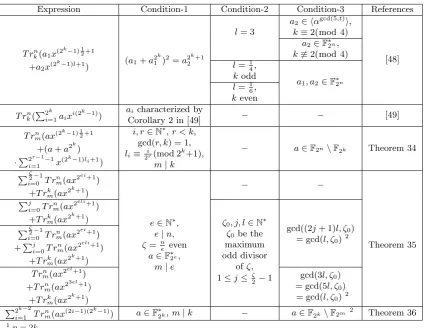
The Boolean bent functions with multiple trace terms have been researched in a large number of public literatures [7, 9, 14, 18, 20, 24, 25, 29, 33, 35, 41–44, 47, 59, 62]. However, the discussions of the vectorial Boolean bent functions with multiple trace terms are rare, only few can be found in [48, 49, 58].
In this section, we investigate the constructions of the vectorial Boolean bent functions with multiple trace terms.
4.1 General constructions of the vectorial Boolean bent functions with multiple trace terms
This subsection discusses general constructions of the vectorial Boolean bent functions with multiple trace terms, and answers Open Problem 1 in [48] (named Open Problem 4 in this paper).
In order to gain general constructions of the vectorial Boolean bent functions with multiple trace terms, we give the following theorem, which can be obtained by Theorem 2 directly.
Theorem 26. Let the Boolean function T r1n(Pj
i=1aixdi) on F2n be bent, where ai ∈ F ∗ 2n
for i= 1,2,· · ·, j. Then the (n, m)-function T rnm(Pj
i=1aixdi) is bent if T rn1(λ
Pj
i=1aixdi)
is linear equivalent to T r1n(Pj
i=1aixdi) for all λ∈F∗2m. Given a Boolean bent functionT rn
1(
Pj
i=1aixdi) onF2n, whereai ∈F∗2nfori= 1,2,· · · , j, to construct vectorial Boolean bent functions by Theorem 26, it is the principal concern that ensuring the linear equivalence between T rn1(λPj
i=1aixdi) and T rn1(
Pj
i=1aixdi) for
all λ ∈ F∗2m. We give four conditions which will be used to meet the condition that
T rn1(λPj
i=1aixdi) is linear equivalent to T r1n(
Pj
Lemma 6. Let m|n and d∈Z∗. For ∀ β ∈
F∗2n, then βu = 1if one of the following four
conditions holds:
(1) u= v1(2m−1) gcd(dl1,2m−1)
dl1−1 and βd∈F
∗ 2m.
(2) u= v2(2n−1) gcd(dl2,2m−1)
dl2 .
(3) u= v3(2m−1) gcd(dl 0 3,t)
dl3−1 and gcd(
dl3
gcd(dl03,t),2
m−1) = 1, βd∈
F∗2m.
(4) u= v4(2n−1) gcd(dl 0 4,t)
dl4 and gcd(
dl4 gcd(dl04,t),2
m−1) = 1,
where v% are some integers such that u is integer and l% ∈N∗ for % = 1,2,3,4, l03, l40 ∈N∗,
l3 ≥l03 and l4≥l40.
Proof. (1) Letλ=βd. Then λ∈F∗
2m. Foru= v1(2
m−1) gcd(dl1,2m−1)
dl1−1 , we have
βu = β
v1(2m−1) gcd(dl1,2m−1) dl1−1
= βd·
v1(2m−1) gcd(dl1,2m−1) dl1
= λ
v1(2m−1) gcd(dl1,2m−1) dl1
(∵ gcd( d
l1
gcd(dl1,2m−1),2
m−1) = 1,
∴ ∃γ ∈F∗2m s.t. λ=γ dl1 gcd(dl1,2m−1))
= (γ
dl1 gcd(dl1,2m−1))
v1(2m−1) gcd(dl1,2m−1) dl1
= γv1(2m−1) = 1.
(2) Letσ =βt. Thenσ ∈F∗2m. Foru= v2(2
n−1) gcd(dl2,2m−1)
dl2 , we have
βu = β
v2(2n−1) gcd(dl2,2m−1) dl2
= βt·
v2(2m−1) gcd(dl2,2m−1) dl2
= σ
v2(2m−1) gcd(dl2,2m−1) dl2
(∵ gcd( d
l2
gcd(dl2,2m−1),2
m−1) = 1, ∴ ∃γ ∈
F∗2m s.t. σ=γ dl2 gcd(dl2,2m−1))
= (γ
dl2 gcd(dl2,2m−1))
v2(2m−1) gcd(dl2,2m−1) dl2
= γv2(2m−1)
(3) Letλ=βd. Then λ∈F∗2m. Foru=
v3(2m−1) gcd(dl 0 3,t)
dl3−1 , we have
βu = β
v3(2m−1) gcd(dl
0 3,t) dl3−1
= βd·
v3(2m−1) gcd(dl
0 3,t) dl3
= λ
v3(2m−1) gcd(dl
0 3,t) dl3
(∵ gcd( d
l3
gcd(dl03, t),2
m−1) = 1, ∴ ∃ γ ∈
F∗2m s.t. λ=γ dl3 gcd(dl03,t))
= (γ
dl3 gcd(dl
0 3,t))
v3(2m−1) gcd(dl
0 3,t) dl3
= γv3(2m−1)
= 1.
(4) Letσ =βt. Thenσ ∈
F∗2m. Foru=
v4(2n−1) gcd(dl 0 4,t)
dl4 , we have
βu = β
v4(2n−1) gcd(dl
0 4,t) dl4
= βt·
v4(2m−1) gcd(dl
0 4,t) dl4
= σ
v4(2m−1) gcd(dl
0 4,t) dl4
(∵ gcd( d
l4
gcd(dl04, t)
,2m−1) = 1, ∴ ∃ γ ∈F∗2m s.t. σ =γ dl4 gcd(dl
0 4,t))
= (γ
dl4 gcd(dl
0 4,t))
v4(2m−1) gcd(dl
0 4,t) dl4
= γv4(2m−1)
= 1.
Given the above, the theorem is proved to be true.
If gcd( dl gcd(dl0,t),2
m−1) = 1 with l ≥ l0 holds, by Theorem 8, then every one of the
three conditions in Theorem 5 holds. By item (1) of Theorem 5 and Lemma 6, we have the following theorem.
Theorem 27. Let m |n and d∈Z∗. For ∀ λ∈
F∗2m, then there exist some β ∈F∗2n such
that λ=βd=βd+u if one of the following four conditions holds:
(1) u= v1(2m−1) gcd(dl1,2m−1)
dl1−1 and one of the three conditions in Theorem 5 holds, (2) u= v2(2n−1) gcd(dl2,2m−1)
dl2 and one of the three conditions in Theorem 5 holds,
(3) u= v3(2m−1) gcd(dl 0 3,t)
dl3−1 1
and gcd( d l3 1
gcd(dl03,t),2
m−1) = 1,
(4) u= v4(2n−1) gcd(dl 0 4,t)
dl4 and gcd(
dl4 gcd(dl04,t),2