Multi-keyword Similarity Search Over Encrypted
Cloud Data
?Mikhail Strizhov and Indrajit Ray
Colorado State University Fort Collins, CO, 80523, USA
{strizhov, indrajit}@CS.ColoState.EDU
Abstract. Searchable encryption allows one to upload encrypted documents on a remotehonest-but-curiousserver and query that data at the server it-self without requiring the documents to be decrypted prior to searching. In this work, we propose a novel secure and efficient multi-keyword similar-ity searchable encryption (MKSim) that returns the matching data items in a ranked ordered manner. Unlike all previous schemes, our search complexity is sublinear to the total number of documents that contain the queried set of keywords. Our analysis demonstrates that proposed scheme is proved to be secure against adaptive chosen-keyword attacks. We show that our approach is highly efficient and ready to be deployed in the real-world cloud storage systems.
Keywords: searchable encryption, secure cloud outsourcing, multi-keyword ranked search, homomorphic encryption
1
Introduction
Cloud computing enables new types of services where the computational and net-work resources are available online through the Internet. One of the most popular services of cloud computing is data outsourcing. For reasons of cost and convenience, public as well as private organizations can now outsource their large amounts of data to the cloud and enjoy the benefits of remote storage. At the same time, confiden-tiality of remotely stored data on untrusted cloud server is a big concern. In order to reduce these concerns, sensitive data, such as, personal health records, emails, income tax and financial reports, etc. are usually outsourced in encrypted form us-ing well-known cryptographic techniques. Although encrypted data storage protects remote data from unauthorized access, it complicates some basic, yet essential data utilization services such as plaintext keyword search. A simple solution of download-ing the data, decryptdownload-ing and searchdownload-ing locally is clearly inefficient since stordownload-ing data in the cloud is meaningless unless it can be easily searched and utilized. Thus, cloud services should enable efficient search on encrypted data to provide the benefits of a first-class cloud computing environment.
?This work was partially supported by the U.S. National Science Foundation under Grant
Researchers have investigated this problem quite extensively in the context of encrypted documents[1–6, 9, 10, 12, 13, 16, 20, 23, 25, 26]. Solutions generally in-volve building an encrypted searchable index such that its content is hidden from the remote server yet allowing the corresponding documents to be searched. These solutions differ from each other mostly in terms of whether they allow single key-word search or multi-keykey-word search and the types of techniques they use to build the trapdoor function. A few of them, most notably [4, 5, 9, 25], allow the notion of similarity search. The similarity search problem consists of a collection of data items that are characterized by some features, a query that specifies a value for a particular feature, and a similarity metric to measure the relevance between the query and the data items. However, these techniques either do not allow search-ing on multiple keywords and ranksearch-ing the retrieved document in terms of similarity scores or are very computationally intensive. Moreover, none of these schemes are protected againstadaptive adversaries[12]. Taking into account large volumes of data available today, there is need in efficient methods to perform secure similarity search over encrypted data outsourced into the cloud. In this work, we propose a novel secure and efficient multi-keyword similarity searchable encryption scheme that returns the matching data items in a ranked order.
Our contributions can be summarized as follows:
1. We present a secure searchable encryption scheme that allows multi-keyword query over an encrypted document corpus and retrieves the relevant documents ranked based on a similarity score.
2. We construct the searchable encryption scheme that is CKA2-secure in the ran-dom oracle model[12,17]. Our scheme achieves semantic security against adap-tiveadversaries that choose their search queries as a function of previously ob-tained trapdoors and search outcomes.
3. We present a construction that achieves theoptimalsearch time. Unlike all previ-ous schemes that are glued to the linear search complexity, our search is sublin-ear to the total number of documents that contain the queried set of keywords. We show that this type of searchable encryption scheme can be extremely effi-cient.
The rest of the paper is organized as follows: Section 2 gives an outline of the most recent related work. In Section 3 we discuss the threat model for our prob-lem space, give an overview of the system model, notations and preliminaries and introduce the building blocks used in our solution. In Section 4, we provide the framework of the proposed searchable encryption scheme and define the necessary security terms and requirements. The security analysis and comparison to other ex-isting schemes is given in Section 5. Finally, Section 6 is devoted for the concluding remarks.
2
Related Work
hidden to the server, however it still allows performing document searching with given search query. Songet al.[23]were the first to investigate the techniques for keyword search over encrypted and outsourced data. The authors begin with idea to store a set of plaintext documents on data storage server such as mail servers and file servers in encrypted form to reduce security and privacy risks. The work presents a cryptographic scheme that enables indexed search on encrypted data without leak-ing any sensitive information to the untrusted remote server. Goh[16]developed a per-file Bloom filter-based secure index, which reduce the searching cost propor-tional to the number of files in collection. Recent work by Moatazet al.[21] pro-posed boolean symmetric searchable encryption scheme. Here, the scheme is based on the orthogonalization of the keywords according to the Gram-Schmidt process. Orencik’s solution[22]proposed privacy-preserving multi-keyword search method that utilizes minhash functions. Bonehet al.[6]developed the first searchable en-cryption using the asymmetric settings, where anyone with the public key can write to the data stored remotely, but the users with private key execute search queries. The other asymmetric solution was provided by Di Crescenzoet al.in[11], where the authors propose a public-key encryption scheme with keyword search based on a variant of the quadratic residuosity problem.
All secure index based schemes presented so far, are limited in their usage since they support only exact matching in the context of keyword search. Wanget al.[25] studied the problem of secure ranked keyword search over encrypted cloud data. The authors explored the statistical measure approach that embeds the relevance score of each document during the establishment of searchable index before out-sourcing the encrypted document collection. The authors propose a single keyword searchable encryption scheme using ranking criteria based on keyword frequency that retrieves the best matching documents. Caoet al.[9]presented a multi-keyword ranked search scheme, where they used the principle of "coordinate matching" that captures the similarity between a multi-keyword search query and data documents. However, their index structure is uses a binary representation of document terms and thus the ranked search does not differentiate documents with higher number of repeated terms than documents with lower number of repeated terms.
3
Background and Building Blocks
3.1 System & Threat Model
data user usessearch trapdoor(distributed by the data owner) that generates the search request to the cloud server. Once the cloud server receives such request, it performs a search based on the stored indexIand returns a ranked list of encrypted documentsL⊆Cto the data user. The data user then uses the secret keyS, securely obtained from the data owner, to decrypt received documentsLto original view.
We assume ahonest-but-curiousmodel for the cloud server. The cloud server is honest, that is, it is always available to the data user and it correctly follows the designated protocol specification, and it provides all services that are expected. The curiouscloud server may try to perform some additional analysis to breach the con-fidentiality of the stored data. In the rest of the paper, the cloud server and the adversary are the same entity. That way, the adversary has access to the same set of information as the cloud server. For this work, we are not concerned about the cloud server being able to link a query to a specific user; nor are we concerned about any denial-of-service attacks.
3.2 Notations and Preliminaries
LetD = (D1,D2, . . . ,Dn)be a set of documents andK= (k1,k2, . . . ,km)be the dictionary consisting of unique keywords in all documents inD, where∀i∈[1,m] ki∈{0, 1}∗.C={C
1,C2, . . . ,Cn}is an encrypted document collection stored in the cloud server.Iiis a searchable index associated with the corresponding encrypted documentCi. IfAis an algorithm thena←A(. . .)represents the result of applying the algorithmAto given arguments. LetRbe an operational ring, we write vectors in bold, e.g.v ∈ R. The notationv[i]refers to thei-th coefficient ofv. We denote the dot product ofu,v∈Rasu⊗v=Pi=1u[i]·v[i]∈R. We usebxeto indicate roundingxto the nearest integer, andbxc,dxe(forx>0)to indicate rounding down or up.
Cryptographic Notations.A private-key encryption scheme is a set of three polynomial-time algorithmsSKE= (Gen,Enc,Dec)such thatGenis a probabilis-tic algorithm that takes a security parameterkand returns a secret keyKsecret;Enc is a probabilistic algorithm that takes a keyKsecretand a messagem, and outputs a ciphtertextξ;Decis a deterministic algorithm that takes a secret keyKsecretand a ciphertextξ, and outputsmifKsecretis the valid secret key. We say thatSKEis CPA-secure if the ciphtertexts it outputs do not reveal any partial information about the original plaintext to an adversary that can adaptively query an encryption oracle. We also make use of use pseudo-random function (PRF), which is a polynomial-time computable function that cannot be distinguished from random functions by any probabilistic polynomial-time adversary. We refer the reader[12, 17, 19]for formal definitions ofsemantic security, CPA-security and PRFs.
We now review definitions related to homomorphic encryption. Our definitions are based on Gentry’s works[14]and[15], but we slightly relax the definition of decryption correctness, to allow a negligible probability of error.
Definition 1. Homomorphic encryption:A homomorphic encryption schemeHom consist of four algorithms:
– Enc: Given the plaintextm∈{0, 1}and public keypk, returns ciphertextφ.
– Dec: Given the ciphertextφand secret keysk, returns the plaintextm.
– Eval: Given public keypk, at-input circuitC(consisting of addition and multipli-cation gates modulo2), and a tuple of ciphtertext(φ1,φ2, . . . ,φt)(corresponding to thetinput bits ofC), returns a ciphertextφ.
Homis correct for a familyCof circuits with6t=Poly(λ)input bits if for any C∈Cand input bits(mi)i6t, the following holds with overwhelming probability over
the randomness ofKeyGenandEnc:
Dec(sk,Eval(pk,C,(φ1,φ2, . . . ,φt))) =C(m1,m2, . . . ,mt), (1)
where(sk,pk) =KeyGen(λ)andφi=Enc(pk,mi)fori=1, . . . ,t.
Homis compact if for any circuitCwith6t=Poly(λ)input bits, the bit-size of the ciphertextEval(pk,C,(φ1,φ2, . . . ,φt))is bounded by a fixed polynomialb(λ).
3.3 Brakerski’s Homomorphic Cryptosystem
Brakerskiet al.[7, 8]recently proposed encryption schemes that efficiently support low-degree homomorphic computations needed for our constructions. We use the ring-LWE-based variant of Brakerski’s homomorphic cryptosystem[7]that operates over polynomial rings modulo a cyclotomic polynomial. One appealing property of Brakerski’s homomorphic cryptosystem is to use the “batching mode” where a single ciphertext represent a vector of encrypted values and single homomorphic operation on two such ciphertexts applies the homomorphic operation component-wise to the entire vector. In such way, for the cost of a single homomorphic operation we get the compute on a entire vector of encrypted plaintexts. Let∆m(x)be themthcyclotomic polynomial and letR=Z[x]/∆m(x)denote the operational ring. Moreover, letRp= Zp[x]/∆m(x)be our plaintext space and letRq = Zq[x]/∆m(x)be our ciphertext space for someq > p. Here, the secret keys are vectors of elements inRqand the plaintext comprises of elements ofRp. We present the necessary basics of ring-LWE-based homomorphic encryption scheme: key-generation, encryption and decryption mechanisms:
Hom.KeyGen: We sample a polynomial¯s∈ Rq from a Hamming weight dis-tributionHWT(h). Here,h specifies the number of nonzero coefficients in¯sand each nonzero element in¯sis±1 with equal probability. The vectors= (1,¯s)∈R2q is the secret key. The public key is generated by sampling uniformly a polynomial
A fromRqandefrom a noise distribution. The noise distribution is set to be the zero-mean discrete Gaussian distributionDG(σ2)with varianceσ2. The public key isP= [b||−A]∈R2
q, whereb= [A·¯s+e]q.
Hom.Enc(P,m): The algorithm that encrypts the messagem∈Rpwith public keyP. We sample a polynomialrwith coefficients varying in{0,±1}ande= (e0,e1)
from the noise distributionDG2(σ2). The encryption of messagemusing public key
Pis a vector of ciphtertextsc=hPTr+jq p
k mi
Hom.Dec(S,c): The algorithm that decrypts a ciphertextcusing the secret key
sas follows:m=hjp·[hc,si]q
q
mi
p.
Addition:csum=c1+c2.Esumis the result noise incsumandEsum6E1+E2, whereE1andE2denote noise forc1andc2.
Multiplication:cprod = jp
q·(c1⊗c2)
m
.Eprodhere denote the maximum noise incprodandEprod6δ1+δ2+δ3, where(δi)16i63is the noise inflicted by the key switching process. We refer the reader to[7, 8]for more detailed discussion on the properties of Brakerski’s homomorphic cryptosystem.
3.4 Term Frequency-Inverse Document Frequency
One of the main problems of information retrieval is to determine the relevance of documents with respect to the user information needs. The most commonly used technique to represent the relevance score in the information retrieval community is Term Frequency-Inverse Documents Frequency measure[18, 27, 28]. It is computed based on two independent measures - the Term Frequency and the Inverse Document Frequency. The Term Frequency (TF) is a statistical measure that represents the frequency of repeated terms in a documents. The TF value calculates the number of times a given term appears within a single document. The Inverse Documents Frequency (IDF) is a measure of a term’s importance across the whole document collection. It is defined as the logarithm of the ratio of the number of documents in a collection to the number of documents containing a given term.
We adopt the following equation for TF-IDF measure from[27]:
Score=log(fi,j+1)×log
1+ Pn n
k=1 χ(fi,k)
(2)
wherefi,j specifies the Term Frequency of term jin document Di, nis the total number of documents in the corpus and
n
P
k=1
χ(fj,k)denotes IDF value for term j among the entire document collectionD.
To provide the ranked results to user’s queries we choose to use the dot product as similarity metric. We use vector space model[18], where the documents and search query are represented as high dimensional vectors. The similarity metric is measured by applying the dot product between each document vector and the search query vector as follows:dotprod(Di,Q)=Di⊗Q, whereDiis a vector that represents i-th document andQis a search query vector.
4
Multi-keyword Similarity Searchable Encryption (MKSim)
index is constructed in such a way that it provides enough information to perform the search on the outsourced data, but does not give away any information about the original data. Once the server receives the index and encrypted document files, it performs a search on the index and retrieves the most relevant documents according to data user’s query.
4.1 Algorithm Definitions
Definition 2. Multi-keyword Similarity Searchable Encryption (MKSim) scheme over the set of documentsDconsists of five polynomial-time algorithms, as follows:
1. S1,S2,PK,SK←Gen(1s): a probabilistic algorithm that is run by the data owner to setup the scheme. The algorithm outputs secret keysS1,S2,PKandSK. 2. (I,C)←BuildIndex(S1,S2,PK,D,K): a probabilistic algorithm run by the data
owner that takes as input a collection of documentsD, the keyword dictionaryK and secret keysS1,S2andPK, and outputs the collection of encrypted documents C={C1,C2, . . . ,Cn}and the searchable indexI.
3. Ω←MakeQuery(S2,PK,K, ¯K): a (possibly probabilistic) algorithm run by the data user that takes an input a secret keysS2andPK, keyword dictionaryKand multiple keywords of interestK, and outputs the search query¯ Ω.
4. L←Evaluate(I,Ω): a deterministic algorithm run by the cloud server. The al-gorithm inputs a search queryΩand the secure indexI. It outputs the sequence of identifiersL⊆Cmatching the search query.
5. Di←Decrypt(S1,SK,Ci): a deterministic algorithm that takes as input secret keysS1andSK, and a ciphertextCiand outputs a documentDi.
An index-based MKSim scheme is correct if∀ s∈N,∀ S1,S2,PK,SK generated by Gen(1s),∀D,∀(I,C)output byBuildIndex(S
1,S2,PK,D,K),∀K¯∈K, and16 i6n,
Evaluate(I,MakeQuery(S2,PK,K, ¯K)) =D(K)¯
^
Decrypt(S1,SK,Ci) =Di (3)
4.2 MKSim Security Model
Definition 3. History:LetK¯be a collection of keywords of interest,Dbe a collection of documents andΩ={Ω1,Ω2,. . .,Ωq}be a vector ofqsearch queries. The history of is defined asH(D,Ω).
Definition 4. Access Pattern:Let K¯ be a collection of keywords of interest,D be a collection of documents andΩ={Ω1,Ω2,. . .,Ωq}be a vector ofqsearch queries. The access pattern induced by aq-query historyH(D,Ω), is defined as follows:α(H)
=(D(Ω1),D(Ω2), . . . ,D(Ωq)).
Definition 6. Trace:LetK¯be a collection of keywords of interest,Dbe a collection of documents andΩ={Ω1,Ω2,. . .,Ωq}be a vector ofqsearch queries. The trace in-duced by the historyH(D,Ω)is a sequenceτ(H) = (|D1|,|D2|, . . . ,|Dn|,α(H),σ(H)) comprised of the lengths of document collectionD=(D1,D2,. . .,Dn), and the access and search patters induced by the historyH(D,Ω).
Definition 7. Randomized query:LetΩ16i6qbe a sequence ofqgenerated search queries with the same set of keywordsK. We say that the scheme has¯ (q,)-randomized query if:∀i,j∈1,q Pr(Ωi=Ωj)< .
Definition 8. Adaptive Semantic Security: Let MKSim = (Gen, BuildIndex, MakeQuery,Evaluate,Decrypt)be an index-based similarity searchable encryp-tion scheme,sbe the security parameter, andA= (A0, . . . ,Aq)be an adversary such thatq∈NandS= (S0, . . . ,Sq)be a simulator. Consider the following probabilistic experimentsReal?
MKSim,A(s)andSim ?
MKSim,A,S(s):
Real?
MKsim,A(s): Sim
?
MKSim,A,S(s): (D,stA)←A0(1s) (D,stA)←A0(1s) S1,S2←Gen(1s) (I,C,stS)←S0(τ(D)) (I,C)←BuildIndex(S1,S2,D,K) (K¯1,stA)←A1(stA,I,C) (K¯1,stA)←A1(stA,I,C) (Ω1,stS)←S1(stS,τ(D, ¯K1)) Ω1←MakeQuery(S2,K, ¯K1) for26i6q
for26i6q (Ki,¯ stA)←Ai(stA,I,C,Ω1, . . . ,Ωi−1) (K¯i,stA)←Ai(stA,I,C,Ω1, . . . ,Ωi−1) (Ωi,stS)←Si(stS,τ(D, ¯K1, . . . , ¯Ki)) Ωi←MakeQuery(S2,K, ¯Ki) letΩ={Ω1,Ω2,. . .,Ωq}
letΩ={Ω1,Ω2,. . .,Ωq} outputo= (I,C,Ω)andstA outputo= (I,C,Ω)andstA
where stA is the state of adversary, stS is the state of the simulator. We say that MKSim is adaptively semantically secure if for all polynomial-size adversaries A = (A0, . . . ,Aq)such thatqis is polynomial ins, there exist a non-uniform polynomial-size simulatorS= (S0, . . . ,Sq)such that for all polynomial-sizeR:
|Pr[R(o,stA) =1] −Pr[R(¯o, ¯stA)]|6, (4)
where(o,stA)←Real?MKSim,A(s),(¯o, ¯stA)←Sim?MKSim,A,S(s)and the proba-bilities are over the coins ofGenandBuildIndexandMakeQuery.
4.3 MKSim Construction
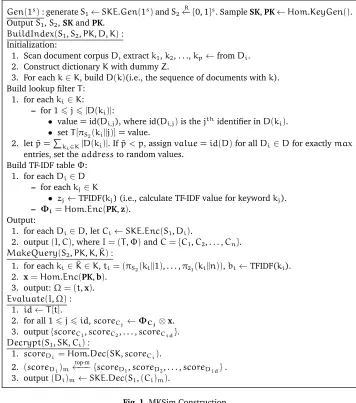
Our searchable scheme is based on SSE-2 inverted index data construction previ-ously introduced in[12]. We enhance SSE-2 scheme with addition of TF-IDF statis-tical measurement and dot product for ranked search. We show that our construc-tion is very efficient and it achieves the same semantic security guarantees as SSE-2 scheme. Fig. 1 shows an outline of MKSim scheme.
word importance. We first couple the document collectionDwith the dictionaryK to produce the lookup filterT. For each wordkwe add an entry inT, therevalue is the document identifier with the instance of wordk. Note, for a given wordk and the set of documents that contains the wordk, we derive a label for k with jth document identifier. For example, if word kis a “colorado” and there is only one document with this word, thenk||jis “colorado1”. We represent the family ofk with matchingjthdocuments as follows:Fk={k||j:1
6j6|D(k)|}, where|D(k)| represents the list of matching documents. For instance, if the wordk=”state” exists in a set of four documents, then familyFkis{“state1”, “state2”, “state3”, “state4”}. In our construction, searching for wordkbecomes equal of searching for all labels in a form ofk||jin the familyFk.
We guard the unique number of words in each document by adopting the idea of padding the lookup filter T such that the identifier of each document appears in the same number of entries. To protect the keyword content in the tableT, we use the pseudo-random permutationπwith secret parameterS2such as{0, 1}S2 × {0, 1}l+log2(n+max)→{0, 1}l+log2(n+max), wheremaxdenote the maximum num-ber of distinct keywords in the largest document inD,nis the number of documents inD and each keyword is represented using at mostl bits. Our lookup tableT is ({0, 1}l+log2(n+max)×{0, 1}log2(n)×{p}), wherep=max?n.
In our second step, for each distinct keywordkjin a documentDi, we calcu-late the TF-IDF value using equation (2). We then construct a tableΦwhere each row corresponds to the documentidand each column is a keyword in the dictio-nary K. Each cell element of tableΦ contains the TF-IDF value of a keywordkj. Unfortunately, outsourcing the table elements to the cloud leaks some important information. It is well known fact [24]that an adversary (in our case, the cloud server) may know some of keywords and their TF distributions. Using this infor-mation, an adversary can infer the keyword index or even the document content. Based on this observation, we decided to improve the security of our solution. Our table includes the set of dummy keywordsZthat are added to the keyword dictio-naryK. This gives us the randomness that hides the original keyword distribution of TF-IDF values. Finally, we use the “batching mode” encryption of Brakerski’s homo-morphic cryptosystem to protect the values of TF-IDF tableΦ. We apply Brakerski’s Hom.Enc()with secretPKon each row of TF-IDF tableΦ.
Once both the lookup filterT and TF-IDF tableΦare constructed, we use secure symmetric encryption schemeSKE to encrypt each documentDi with secret key S1to formCi. We outsource searchable indexI= (T,Φ)and encryption collection C={C1,C2, . . . ,Cn}to the cloud server.
Gen(1s) :generateS
1←SKE.Gen(1s)andS2 R
←−{0, 1}s. SampleSK,PK←Hom.KeyGen(). OutputS1,S2,SKandPK.
BuildIndex(S1,S2,PK,D,K) : Initialization:
1. Scan document corpusD, extractk1,k2, . . .,kp←fromDi. 2. Construct dictionaryKwith dummyZ.
3. For eachk∈K, buildD(k)(i.e., the sequence of documents withk). Build lookup filterT:
1. for eachki∈K:
– for 16j6|D(ki)|:
• value=id(Di,j), where id(Di,j)is thejthidentifier inD(ki).
• setT[πS2(ki||j)]=value. 2. let ¯p=Pk
i∈K|D(ki)|. If ¯p < p, assignvalue=id(D)for allDi∈Dfor exactlymax
entries, set theaddressto random values. Build TF-IDF tableΦ:
1. for eachDi∈D
– for eachkj∈K
• zj←TFIDF(kj) (i.e., calculate TF-IDF value for keywordkj).
– Φi=Hom.Enc(PK,z). Output:
1. for eachDi∈D, letCi←SKE.Enc(S1,Di).
2. output(I,C), whereI= (T,Φ)andC={C1,C2, . . . ,Cn}.
MakeQuery(S2,PK,K, ¯K) :
1. for eachki∈K¯ ∈K,ti= (πS2(ki||1), . . . ,π21(ki||n)),bi←TFIDF(ki). 2. x=Hom.Enc(PK,b).
3. output:Ω= (t,x).
Evaluate(I,Ω) : 1. id←T[t].
2. for all 16j6id,scoreCj ←ΦCj⊗x.
3. output{scoreC1,scoreC2, . . . ,scoreCid}. Decrypt(S1,SK,Ci) :
1. scoreDi=Hom.Dec(SK,scoreCi).
2. (scoreDi)m
top-m
←−−−{scoreD1,scoreD2, . . . ,scoreDid}.
3. output(Di)m←SKE.Dec(S1,(Ci)m).
Fig. 1.MKSim Construction
The data user decrypts these polynomials usingHom.Dec()with secretSKand then he retrieves top-mdocuments with highest output scores.
5
Security Analysis and Complexity Results
5.1 Security
Proof. We are going to describe a polynomial-size simulator S = {S0,S1,. . . ,Sq} such that for all polynomial-size adversaries A = {A1,A2,. . . , Aq}, the outputs ofReal?
MKSim,A(s)andSim ?
MKSim,A,S(s)are computationally indistinguishable. Consider the simulatorS= {S0,S1,. . . ,Sq}that adaptively generates the outputo?= (I∗,C∗,Ω∗)as follows:
– S0(1s,τ(D)): the simulator has a knowledge of historyHthat includes the num-ber and the size of the documents.S0 start with generating C∗i
R
←−{0, 1}|Di|
wherei∈{1, 2, . . . ,n}and indexI∗= (T∗,Φ∗). HereT∗←−R {0, 1}l+log2(n+max) is a lookup filter, andΦ∗←R−{0, 1}Kis TF-IDF table.
S0now includesI∗instSand outputs(I∗,C∗,stS). SincestAdoes not include secretsS1andPK,I∗is indistin-guishable from the real index. OtherwiseS0can distinguish between the output of pseudo-random permutationπand a random values of sizel+log2(n+max) andK. At the same time,stAdoes not include secretS2, thus the outputC∗is indistinguishable from the real ciphertext
– S1(stS,τ(D,Ω1)): now the simulatorS1has a knowledge of all document iden-tifiers corresponding to the search query. However the search query does not disclose its structure and the content. Recall thatD(Ω1)is the set of all match-ing document identifiers. For all 16j6|D(Ω1)|, the simulator first makes an association between each document identifierid(Dj)and a generated search query such that(D(Ω1)i,I?i)are pairwise distinct.S1then createsΩ
?
1=(t?,x?), wheret?←−R (id(D
1), . . . ,id(|D(Ω1)|))andx? R
←−{0, 1}K.
S1stores the associa-tion betweenΩ?
1andΩ1instS, and outputs(Ω?1,stS). SincestAdoes not in-clude secretS1, the outputt?1is indistinguishable from the real generated query t1, otherwise one could distinguish between the output ofπand a random string of sizel+log2(n+max). Similarly, sincestAdoes not include secretPK, the outputx? is indistinguishable from the realx, otherwise one could distinguish between the output ofHom.Enc()and a random string of a sizeK. Thus,Ω?1is indistinguishable fromΩ1.
– Si(stS,τ(D,Ω1,Ω2, . . . ,Ωq))for 26i6q: firstSichecks if the search query Ωiwas executed before, that is, if it appeared in the traceσ[i,j] =1, where 16 j6i−1. Ifσ[i,j] =0, the search query has not appeared before andSigenerates the search query asS1. Ifσ[i,j] =1, thenSiretrieves previously searched query, and constructsΩ?
i.Sioutputs(Ω?i,stS), whereΩ?iis indistinguishable from real Ωi. The final output Ω = (Ω?
1, . . . ,Ω?q) is indistinguishable from generated query(Ω= Ω1, . . . ,Ωq), and outputs of experimentsSim?MKSim,A,S(s)and Real?
MKSim,A(s)are indistinguishable.
Theorem 2. Injection of dummy keywords provides randomized search queries.
We first estimate the probability Pr(k)that the intersectionZof two sets Z1, Z2⊆
Z is equal to some valuek. We have:
Pr(k) = #of ways of choosing Z1,Z2with|Z|=k #of ways of choosing Z1,Z2
(5)
Note, there are nk
choices forZ. If Z1has size k, then there is one choice for Z1, and we can choose Z2arbitrarily from 2n−kpossibilities. IfZ1has size k+1, then there are n−k1
choices for Z1and 2n−k−1choices for Z2. Let m=n−k, then there are m
P
j=0
2m−j m
j
= 3m possible choices for Z
1, Z2with intersectionZ. Thus, there are
3n−k n
k
possible ways of choosing the subsets. Since there are 4nways of choosing any two subsets ofZ, we have the following:Pr(k)= 3
n−k(n k)
4n . We now evaluate
Pr(k)with inputk→0: limk→0Pr(k)=limk→0 3n−k(n
k)
4n =
3 4
n
. Asnincreases, limk→0Pr(k)→0 and hence Theorem 2 is preserved .
5.2 Complexity
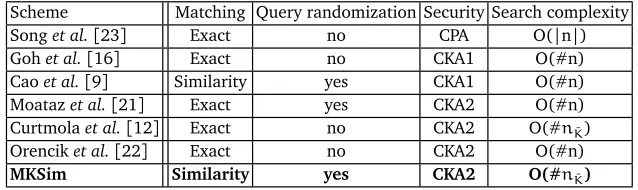
We compare MKSim scheme with previous searchable encryption solutions in Ta-ble 1. Our comparison is based on few simple metrics: matching technique, query randomization, security notions and search complexity. We use security notations from[12]. Note that all previous work able to achieve the linear search complexity within the total number of documents in the collection. In contrast, the search in our solution is proportional to the number of files that contain a certain set of keywords.
Table 1.Comparison of several searchable encryption schemes.nis the document collection, |n| denotes its bit length, #n is the number of files in the collectionn, #nK¯is the number of files that contain keywords of interest ¯K.
Scheme Matching Query randomization Security Search complexity
Songet al.[23] Exact no CPA O(|n|)
Gohet al.[16] Exact no CKA1 O(#n)
Caoet al.[9] Similarity yes CKA1 O(#n)
Moatazet al.[21] Exact yes CKA2 O(#n)
Curtmolaet al.[12] Exact no CKA2 O(#nK¯)
Orenciket al.[22] Exact no CKA2 O(#n)
MKSim Similarity yes CKA2 O(#nK¯)
6
Conclusion
ranked search over encrypted cloud data. In particular, we present an efficient simi-larity searchable encryption scheme that supports multi-keyword semantics. Our so-lution is based two building blocks: Term Frequency - Inverse Document Frequency (TF-IDF) measurement and ring-LWE-based variant of homomorphic cryptosystem. We use the dot product to quantitatively evaluate similarity measure and rank the outsourced documents with their importance to the search query. We show that our scheme is adaptive semantically secure against adversaries and able to achieve opti-mal sublinear search time. As future work, we plan to optimize the index construc-tion algorithm and continue to research on usable and secure mechanisms for the effective utilization over outsourced cloud data.
References
1. M. Abdalla, M. Bellare, D. Catalano, E. Kiltz, T. Kohno, T. Lange, J. Malone-Lee, G. Neven, P. Paillier, and H. Shi. Searchable encryption revisited: consistency properties, relation to anonymous ibe, and extensions.Journal of Cryptology, 21(3):350–391, 2008.
2. R. Agrawal, J. Kiernan, R. Srikant, and Y. Xu. Order-preserving encryption for numeric data. InProceedings of the ACM SIGMOD International Conference on Management of Data, Paris, France, June 2004.
3. M. Bellare, A. Boldyreva, and A. O’Neill. Deterministic and efficiently searchable en-cryption. InProceedings of the 27th Annual International Cryptology Conference, Santa Barbara, CA, USA, Aug. 2007.
4. M. Blanton. Achieving full security in privacy-preserving data mining. InProceedings of the 3rd IEEE International Conference on Privacy, Security, Risk and Trust, Boston, MA, USA, Oct. 2011.
5. M. Blanton, M. J. Atallah, K. B. Frikken, and Q. M. Malluhi. Secure and efficient out-sourcing of sequence comparisons. InProceedings of the 17th European Symposium on Research in Computer Security, Pisa, Italy, Sept. 2012.
6. D. Boneh and B. Waters. Conjunctive, subset, and range queries on encrypted data. In Proceedings of the 4th IACR Theory of Cryptography Conference, Amsterdam, The Nether-lands, Feb. 2007.
7. Z. Brakerski. Fully homomorphic encryption without modulus switching from classical gapsvp. In R. Safavi-Naini and R. Canetti, editors,Advances in Cryptology - CRYPTO 2012, volume 7417 ofLecture Notes in Computer Science, pages 868–886. Springer Berlin Heidelberg, 2012.
8. Z. Brakerski, C. Gentry, and V. Vaikuntanathan. Fully homomorphic encryption with-out bootstrapping. InProceedings of the 3rd Innovations in Theoretical Computer Science Conference, Cambridge, MA, USA, 2012.
9. N. Cao, C. Wang, M. Li, K. Ren, and W. Lou. Privacy-preserving multi-keyword ranked search over encrypted cloud data. InProceedings of the 30th IEEE International Conference on Computer Communications, Shanghai, China, Apr. 2011.
10. Y.-C. Chang and M. Mitzenmacher. Privacy preserving keyword searches on remote en-crypted data. InProceedings of the 3rd International Conference on Applied Cryptography and Network Security, New York, NY, USA, June 2005.
12. R. Curtmola, J. Garay, S. Kamara, and R. Ostrovsky. Searchable symmetric encryption: Improved definitions and efficient constructions. InProceedings of the 13th ACM Confer-ence on Computer and Communications Security, Alexandria, VA, October 2006.
13. S. D. C. di Vimercati, S. Foresti, S. Jajodia, S. Paraboschi, and P. Samarati. Private data indexes for selective access to outsourced data. InProceedings of the 10th Annual ACM Workshop on Privacy in the Electronic Society, Chicago, IL, USA, Oct. 2011.
14. C. Gentry.A fully homomorphic encryption scheme. PhD thesis, Stanford University, 2009. crypto.stanford.edu/craig.
15. C. Gentry. Fully homomorphic encryption using ideal lattices. InProceedings of the 41st Annual ACM Symposium on Theory of Computing, Bethesda, MD, 2009.
16. E.-J. Goh. Secure indexes. Cryptology ePrint Archive, Report 2003/216, 2003. http: //eprint.iacr.org/2003/216/.
17. O. Goldreich.The foundations of cryptography - volume 2, basic applications. Cambridge University Press, 2004.
18. D. Grossman and O. Frieder. Information retrieval: algorithms and heuristics. Kluwer international series on information retrieval. Springer, 2004.
19. J. Katz and Y. Lindell. Introduction to Modern Cryptography (Chapman & Hall/Crc Cryp-tography and Network Security Series). Chapman & Hall/CRC, 2007.
20. M. Kuzu, M. S. Islam, and M. Kantarcioglu. Efficient similarity search over encrypted data. InProceedings of the 28th IEEE International Conference on Data Engineering, Washington, DC, USA, Apr. 2012.
21. T. Moataz and A. Shikfa. Boolean symmetric searchable encryption. InProceedings of the 8th ACM SIGSAC Symposium on Information, Computer and Communications Security, Hangzhou, China, May 2013.
22. C. Orencik, M. Kantarcioglu, and E. Savas. A practical and secure multi-keyword search method over encrypted cloud data. InProceedings of the 6th IEE International Conference on Cloud Computing, Santa Clara, CA, USA, June 2013.
23. D. X. Song, D. Wagner, and A. Perrig. Practical techniques for searches on encrypted data. InProceedings of the 2000 IEEE Symposium on Security and Privacy, Berkeley, CA, USA, May 2000.
24. A. Swaminathan, Y. Mao, G.-M. Su, H. Gou, A. L. Varna, S. He, M. Wu, and D. W. Oard. Confidentiality-preserving rank-ordered search. InProceedings of the ACM Workshop on Storage Security and Survivability, Alexandria, VA, 2007.
25. C. Wang, N. Cao, K. Ren, and W. Lou. Enabling secure and efficient ranked keyword search over outsourced cloud data.IEEE Transactions on Parallel and Distributed Systems, 23(8):1467–1479, 2012.
26. C. Wang, K. Ren, S. Yu, and K. M. R. Urs. Achieving usable and privacy-assured similarity search over outsourced cloud data. InProceedings of the 31st Annual IEEE International Conference on Computer Communications, Orlando, FL, USA, Mar. 2012.